Psalms 52:5

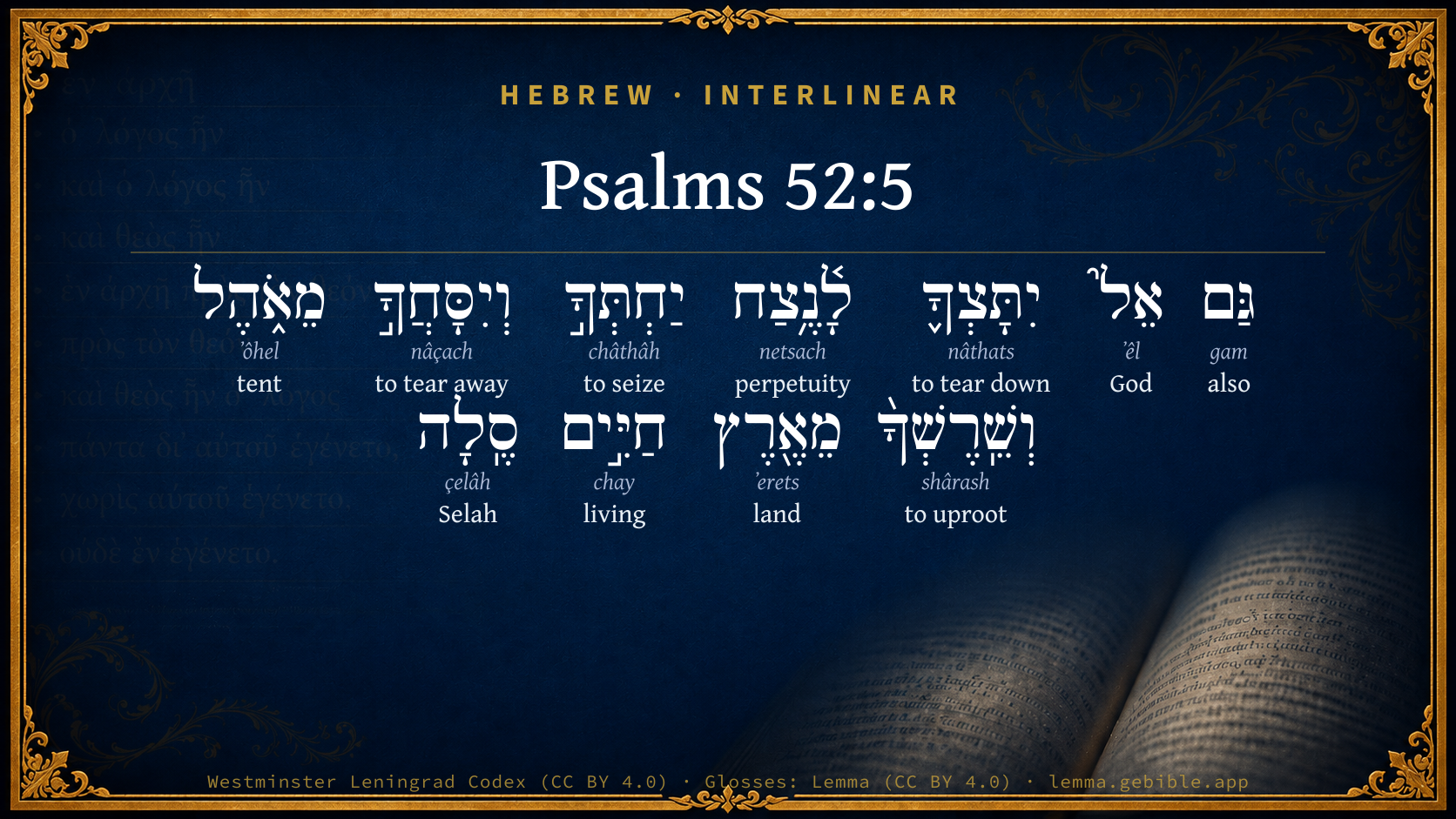
Hebrew (Westminster Leningrad Codex) Psalms 52:5 appears in the Hebrew Old Testament. The text above is from the Westminster Leningrad Codex. Each word links to its Strong’s number, a concise gloss, and parsing drawn from the Open Scriptures Hebrew Bible morphology. Click any word for its full Brown-Driver-Briggs (BDB) entry.
Download image
Cite this verse

Psalms 52:5 (World English Bible). Public Domain. Lemma interlinear Bible study tool, https://lemma.gebible.app/v/psalms/52/5.

Show BibTeX & RIS
BibTeX
RIS
English Translation
God will likewise destroy you forever. He will take you up, and pluck you out of your tent, And root you out of the land of the living. Selah.
World English Bible · Public Domain
Highlights
  • 1 first appearance in the Hebrew Bible
Full analysis ↓
Download a study sheet

One document with this verse’s original text, its word-by-word gloss line, the meaning frame, cross-references with their text, attributed commentary, and full source and license credits — printable, and it pastes into notes with its structure intact.

This verse Autodidact and up

Study sheet (.html) Plain text (.txt)

A passage Seminary Student

Up to 50 verses in one chapter. A passage sheet keeps up to 6 commentary sources and 12 cross-references per verse, in the order this page ranks them, and says so on the sheet whenever that leaves anything out. Ask for a single verse and you get the Autodidact verse sheet above.

Everything on this page stays free to read, with no account — the sheet is a download of what is already on screen, not access to it.

Want to remove ads? Support Godless Engineer
Compare translations 3

The same verse in 3 English versions, stacked beneath the original-language interlinear above. Click any original word for its lexicon entry.

Each is an independent rendering of the whole verse — the interlinear is not word-aligned to these translations.

Highlighted words mark where these versions differ — a whole-verse word diff, not a word-by-word alignment.

  • World English Bible Public Domain
    God will likewise destroy you forever. He will take you up, and pluck you out of your tent, And root you out of the land of the living. Selah.
  • King James Version Public Domain
    God shall likewise destroy thee for ever, he shall take thee away, and pluck thee out of thy dwelling place, and root thee out of the land of the living. Selah.
  • unfoldingWord Literal Text CC BY-SA 4.0
    God will also tear you down forever. He will take you away and tear you from the tent and uproot you from the land of the living. Selah

unfoldingWord Literal Text — © unfoldingWord, licensed CC BY-SA 4.0. Word-aligned USFM3 via Door43 (git.door43.org/unfoldingWord/en_ult).

Versions to compare (up to 4)

3 of 4 selected

Show all 18 translations

Every available English version of this verse, each an independent rendering of the whole verse.

  • World English Bible Public Domain
    God will likewise destroy you forever. He will take you up, and pluck you out of your tent, And root you out of the land of the living. Selah.
  • Berean Standard Bible Public Domain
    Surely God will bring you down to everlasting ruin; He will snatch you up and tear you away from your tent; He will uproot you from the land of the living. Selah
  • Majority Standard Bible Public Domain
    Surely God will bring you down to everlasting ruin; He will snatch you up and tear you away from your tent; He will uproot you from the land of the living. Selah
  • King James Version Public Domain
    God shall likewise destroy thee for ever, he shall take thee away, and pluck thee out of thy dwelling place, and root thee out of the land of the living. Selah.
  • American Standard Version (1901) Public Domain
    God will likewise destroy thee for ever; He will take thee up, and pluck thee out of thy tent, And root thee out of the land of the living. Selah
  • Revised Version (1885) Public Domain
    God shall likewise destroy thee for ever, he shall take thee up, and pluck thee out of thy tent, and root thee out of the land of the living. Selah
  • Geneva Bible (1599) Public Domain
    So shall God destroy thee for euer: he shall take thee and plucke thee out of thy tabernacle, and roote thee out of ye land of the liuing. Selah.
  • Douay-Rheims (1899) Public Domain
    Thou hast loved malice more than goodness: and iniquity rather than to speak righteousness.
  • Young's Literal Translation Public Domain
    Also -- God doth break thee down for ever, Taketh thee, and pulleth thee out of the tent, And He hath uprooted thee Out of the land of the living. Selah.
  • Literal Standard Version CC BY-SA 4.0
    Also—God breaks you down forever, || Takes you, and pulls you out of the tent, || And He has uprooted you || Out of the land of the living. Selah.
  • Unlocked Literal Bible CC BY-SA 4.0
    God will likewise destroy you forever; he will take you up and pluck you out of your tent and root you out of the land of the living. Selah
  • unfoldingWord Literal Text CC BY-SA 4.0
    God will also tear you down forever. He will take you away and tear you from the tent and uproot you from the land of the living. Selah
  • Darby Bible Public Domain
    ùGod shall likewise destroy thee for ever; he shall take thee away, and pluck thee out of [thy] tent, and root thee out of the land of the living. Selah.
  • World Messianic Bible Public Domain
    God will likewise destroy you forever. He will take you up, and pluck you out of your tent, and root you out of the land of the living. Selah.
  • Webster's Bible Public Domain
    \\52:3\\Thou lovest evil more than good; and lying rather than to speak righteousness. Selah.
  • Free Bible Version CC BY-SA 4.0
    But God will strike you down so hard you'll never get up. He will grab hold of you and drag you from your tent. He will tear you out of the land of the living. Selah.
  • Bible in Basic English Public Domain
    But God will put an end to you for ever; driving you out from your tent, uprooting you from the land of the living. (Selah.)
  • JPS Tanakh (1917) Public Domain
    (52-7) God will likewise break thee for ever, He will take thee up, and pluck thee out of thy tent, and root thee out of the land of the living. Selah

Literal Standard Version (2020), Covenant Press — licensed CC BY-SA 4.0. Text via the HelloAO Bible API (eBible.org). Unlocked Literal Bible (unfoldingWord) — licensed CC BY-SA 4.0. Text via the HelloAO Bible API (eBible.org). unfoldingWord Literal Text — © unfoldingWord, licensed CC BY-SA 4.0. Word-aligned USFM3 via Door43 (git.door43.org/unfoldingWord/en_ult). Free Bible Version, Dr. Jonathan Gallagher — licensed CC BY-SA 4.0. Text via the HelloAO Bible API (eBible.org).

Word by word

More ways to search: Search by grammar → Find every occurrence → Compare this word →

Practice this passage: Drill this verse → Learn its vocabulary →

יַחְתְּךָ֣
châthâh
H2846
“to seize · you”
Verb, Qal, Imperfect, 3rd Person, Masculine, Singular + Suffix, Personal, 2nd Person, Masculine, Singular
Part of Speech
Verb
Stem
Qal
Form
Imperfect
Person
3rd Person
Gender
Masculine
Number
Singular
Full BDB Definition

Origin: a primitive root

TWOT: 777

(Qal) to take hold of, seize, take away, pile up, snatch up (coals)
  1. גַּם gam H1571 “also” Particle, Accusative
  2. אֵל֮ ʼêl H410 “God” Noun, Common, Masculine, Singular, Absolute
  3. יִתָּצְךָ֪ nâthats H5422 “to tear down · you” Verb, Qal, Imperfect, 3rd Person, Masculine, Singular + Suffix, Personal, 2nd Person, Masculine, Singular
  4. לָ֫נֶ֥צַח netsach H5331 “to/for · perpetuity” Preposition + Noun, Common, Masculine, Singular, Absolute
  5. וְיִסָּחֲךָ֣ nâçach H5255 “and · to tear away · you” Conjunction + Verb, Qal, Imperfect, 3rd Person, Masculine, Singular + Suffix, Personal, 2nd Person, Masculine, Singular
  6. מֵאֹ֑הֶל ʼôhel H168 “from · tent” Preposition + Noun, Common, Masculine, Singular, Absolute
  7. וְשֵֽׁרֶשְׁךָ֨ shârash H8327 “and · to uproot · you” Conjunction + Verb, Piel, Sequential Perfect, 3rd Person, Masculine, Singular + Suffix, Personal, 2nd Person, Masculine, Singular
  8. מֵאֶ֖רֶץ ʼerets H776 “from · land of” Preposition + Noun, Common, Both, Singular, Construct
  9. חַיִּ֣ים chay H2416 “living” Adjective, Adjective, Masculine, Plural, Absolute
  10. סֶֽלָה çelâh H5542 “Selah” Particle, Interjection

About this verse

These counts appear in no published source. They are computed here, from the morphology-tagged text and Lemma’s own curated glosses. What Lemma adds →

11
words
11
distinct lemmas
Wisdom
section

Notable vocabulary

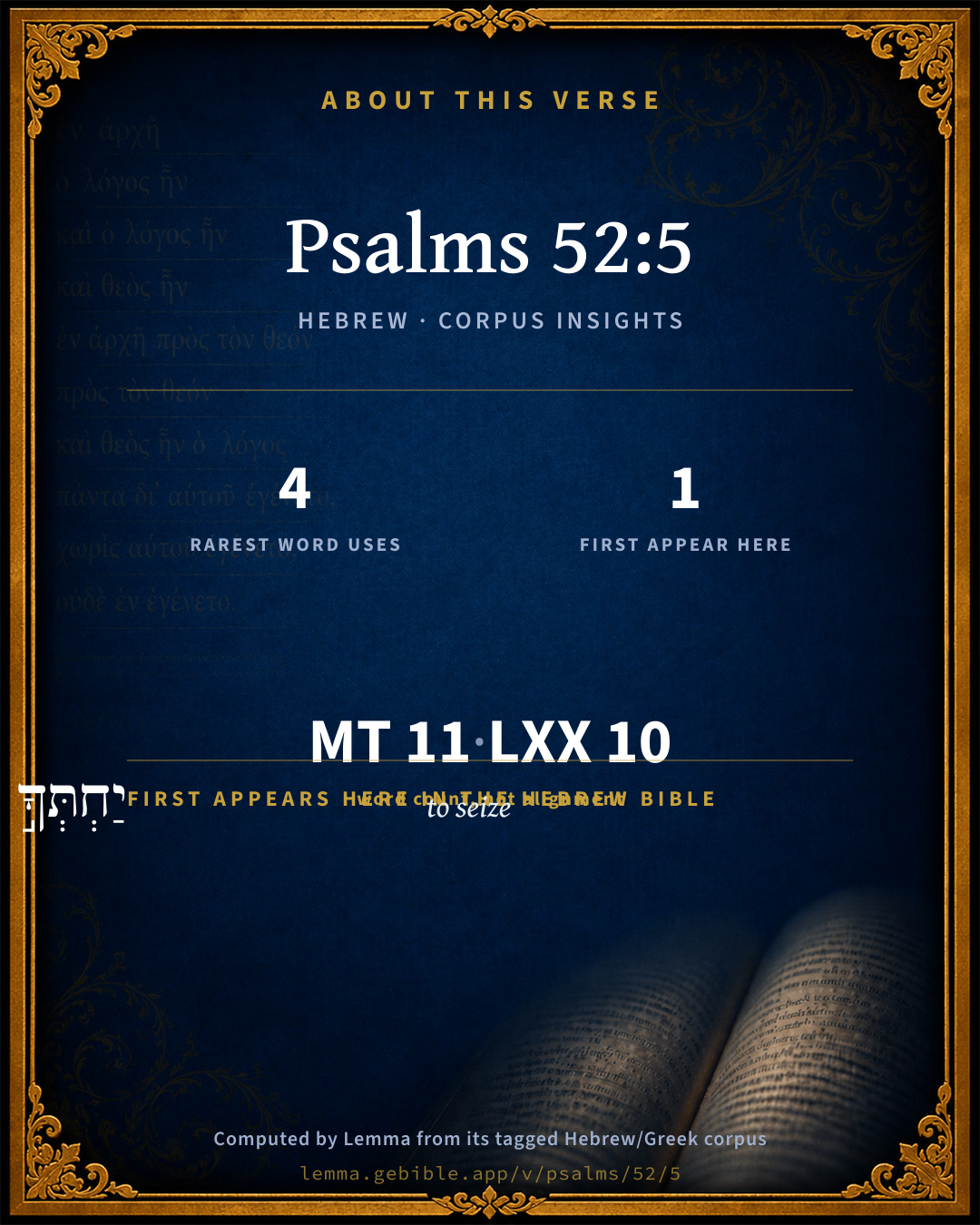
The rarest word here is יַחְתְּךָ֣ to seize H2846 — appearing just 4 times in the whole Hebrew Bible.

First appearance in Scripture

This word makes its first canonical appearance in the Hebrew Bible here:

  • יַחְתְּךָ֣ to seize H2846

Shared distinctive vocabulary

יַחְתְּךָ֣ to seize H2846 occurs in 4 verses of the Hebrew Bible. Also found in:

Grammatical profile

  • 4 verbs
  • 4 nouns
  • 1 adjective
  • 2 particles

Verb forms

  • יִתָּצְךָ֪ Qal · Imperfect
  • יַחְתְּךָ֣ Qal · Imperfect
  • וְיִסָּחֲךָ֣ Qal · Imperfect
  • וְשֵֽׁרֶשְׁךָ֨ Piel · Sequential Perfect

Hebrew & Septuagint length

In English translation the verse runs 29 words from the Hebrew and 29 from the Septuagint (LXX English) — the same length.

A rough comparison of the two English renderings, which tokenize alike — not a word-level alignment.

Word counts can differ between the Hebrew and the Greek without any difference in meaning — e.g. the Hebrew direct-object marker אֵת has no separate Greek word, and Greek often adds the article ὁ.

In the original languages it is 11 Hebrew tokens and 10 Greek tokens — but the two are counted differently (Hebrew bundles its prefixes and suffixes into one token; the Greek is in lemma form), so that isn’t a like-for-like length.

Cross-references

18

Topical passages linked to Psalms 52:5 in the Treasury of Scripture Knowledge — connected by theme and wording, ordered by reader-vote popularity; previews shown in the World English Bible.

  • Proverbs 2:22 But the wicked will be cut off from the land. The treacherous will be rooted out of it.
  • Psalms 27:13 I am still confident of this: I will see the goodness of Yahweh in the land of the living.
  • Revelation 21:8 But for the cowardly, unbelieving, sinners, abominable, murderers, sexually immoral, sorcerers, idolaters, and all liars, their part is in the lake that burns with fire and sulfur, which is the second death."
  • Job 18:14 He shall be rooted out of his tent where he trusts. He shall be brought to the king of terrors.
  • Proverbs 12:19 Truth's lips will be established forever, But a lying tongue is only momentary.
  • Proverbs 19:9 A false witness shall not be unpunished. He who utters lies shall perish.
  • Isaiah 38:11 I said, I shall not see Yah, Yah in the land of the living: I shall see man no more with the inhabitants of the world.
  • Job 20:6–7 Though his height mount up to the heavens, And his head reach to the clouds,
  • Psalms 7:14–16 Behold, he travails with iniquity; Yes, he has conceived mischief, And brought forth falsehood.
  • Psalms 37:35–36 I have seen the wicked in great power, Spreading himself like a green tree in its native soil.
  • Psalms 55:23 But you, God, will bring them down into the pit of destruction. Bloodthirsty and deceitful men shall not live out half their days, But I will trust in you.
  • Psalms 64:7–10 But God will shoot at them. They will be suddenly struck down with an arrow.
  • Psalms 116:9 I will walk before Yahweh in the land of the living.
  • Psalms 120:2–4 Deliver my soul, Yahweh, from lying lips, From a deceitful tongue.
  • Psalms 140:9–11 As for the head of those who surround me, Let the mischief of their own lips cover them.
  • Proverbs 19:5 A false witness shall not be unpunished. He who pours out lies shall not go free.
  • Isaiah 22:19 I will thrust you from your office; and from your station shall you be pulled down.
  • Luke 16:27–28 "He said, 'I ask you therefore, father, that you would send him to my father's house;

Cross-references courtesy of OpenBible.info (CC BY 4.0).

Hebrew and Greek witnesses Masoretic Hebrew ↔ Greek Septuagint

The same verse in the two great witnesses to the Old Testament, shown verse-for-verse.

You’re reading Greek Psalm 51 (Hebrew Psalm 52). The Septuagint counts the superscription, so verse numbers can differ from the Hebrew — chapter-level alignment, not verse-by-verse. Numbering follows Rahlfs.

These are two independent witnesses, not word-aligned to each other, and the Septuagint is shown in lemma (dictionary) form.

Hebrew Psalms 52:5 Masoretic · Westminster Leningrad Codex

גַּם אֵל֮ יִתָּצְךָ֪ לָ֫נֶ֥צַח יַחְתְּךָ֣ וְיִסָּחֲךָ֣ מֵאֹ֑הֶל וְשֵֽׁרֶשְׁךָ֨ מֵאֶ֖רֶץ חַיִּ֣ים סֶֽלָה

God will likewise destroy you forever. He will take you up, and pluck you out of your tent, And root you out of the land of the living. Selah.

World English Bible · Public Domain

Greek LXX Greek Psalm 51:5 Septuagint · lemma form

ἀγαπάω κακία ὑπέρ ἀγαθωσύνη ἀδικία ὑπέρ ὁ λαλέω δικαιοσύνη διάψαλμα

Therefore may God destroy you for ever, may he pluck you up and utterly remove you from your dwelling, and your root from the land of the living. Pause.

LXX2012 (modern English Septuagint) · Public Domain

On this verse, The Cambridge Bible for Schools and Colleges discusses the Septuagint’s reading. Read the note in Commentary ↓

Hebrew: Westminster Leningrad Codex (CC BY 4.0). Greek: Septuagint (public domain); English from LXX2012 (modern English Septuagint) (Public Domain). How the Septuagint differs from the Hebrew →

Commentary

Notes on Psalms 52:5 from classic Christian and Jewish commentators (each source and its license shown beneath its notes). The classic Christian expositions comment on the surrounding passage and are grouped to its opening verse, so a note may address several verses; the Jewish commentaries on the Tanakh (Rashi and others) are per-verse, so they appear only where the commentator wrote on this verse.

Lemma curates 59 commentaries, every one of them public domain or Creative Commons licensed, each selected and text-cleaned for this edition rather than reprinted as found. About our sources →

Trapp's Complete Commentary

John Trapp

Psa 52:5 God shall likewise destroy thee for ever, he shall take thee away, and pluck thee out of [thy] dwelling place, and root thee out of the land of the living. Selah.

Ver. 5. God shall likewise destroy thee] Here are quot verba tot tonitrua, so many words, so many thunderclaps. As thou hast destroyed the Lord’s priests and their whole city, razing and harassing it; so God will demolish and destroy thee utterly, as a house pulled down to the ground, so that one stone is not left upon another, Lev 14:45. So shall God pull down Doeg from that high preferment which he by sycophancy hath got at court, Iudicium ipsum lethale describitur.

He shall take thee away] As a coal of fire is taken with the tongs, Isa 30:4, that it do no further mischief. Some render it, He shall burn thee, Exuret te (Vatab.). R. Gaon, He shall terrify thee.

And pluck thee out of thy dwelling place] Or, shall sweep thee out of thy tabernacle. R. Gaon interpreteth it, Beth hamidrash, the Lord’s tabernacle, whereinto a Doeg may set his foot as far as a David, but God will pluck him thence.

And root thee out of the land of the living] Everret et evertet te cum tota familia, He shall utterly ruin thee and thine, leaving thee neither root nor branch, chick nor child.

Selah] i.e. Veritas est, saith Aben Ezra. It is even so; think not that these things are spoken only in terrorem, for a scarebug, for they shall all be surely fulfilled upon thee.

John Trapp, A Commentary or Exposition upon All the Books of the Old and New Testament (1647–1656) — public domain. Text from a community e-Sword module.

J. A. Alexander on Psalms

Joseph Addison Alexander

7. (Psa 52:5). (So) likewise shall God destroy thee for ever; he shall take thee away, and pluck thee out of (thy) tent, and root thee out of the land of life. Selah. The particle at the beginning, also, likewise, shows the dependence of this verse upon the one before it, which is really conditional though not in form. "As thou, on thy part, lovest all devouring words, so likewise God, on his part, will destroy thee." No exact translation can convey the full force of the verbs in this verse, which suggests a variety of striking figures for destruction or extermination. The first denotes properly the act of pulling down or demolishing a house (Lev 14:45), and this would also seem to be the primary meaning of the third (Pro 15:25), although somesuppose it to denote the act of pulling up, and to be the opposite of plant, as the first verb is of build. The second verb, in every other place where it occurs, has reference to the handling and carrying of fire or coals. See Pro 6:27; Pro 25:22, Isa 30:14. To a Hebrew reader, therefore, it would almost necessarily suggest, not the general idea of removal merely, but the specific one of removing or taking away like fire, i.e. as coals are swept out from a hearth, or otherwise extinguished. The remaining verb adds to these figures that of violent eradication, and is well represented by its English equivalent. The land of life, or, as it is commonly translated, and of the living, is a poetical description of life itself, or the present state of existence, under the figure of a country. See above, on Psa 27:13. The quick recurrence of the pause implies excited feeling, and invites attention to the threatening which immediately precedes.

Joseph Addison Alexander, The Psalms Translated and Explained (1850) — public domain. Text from a community e-Sword module.

Tyndale Open Study Notes

Tyndale Open Resources

52:5-7 God’s judgment on the wicked will come suddenly and forcibly. The godly rejoice in God’s justice, not in the misfortunes of the wicked.

52:5 God will strike the wicked down like a pagan altar, idol, or unclean vessel (Exod 34:13; Lev 11:35; 2 Kgs 10:27).

Tyndale Open Study Notes — © Tyndale Open Resources, licensed CC BY-SA 4.0. Text via the HelloAO Bible API.

Geneva Bible (1599)

Geneva Bible translators

Though God forbear for a time, yet at length he will recompense thy falsehood.

Albeit thou seem to be never so sure settled.

Geneva Bible (1599) marginal notes — public domain. Text via Bolls.life.

Jamieson, Fausset & Brown

Robert Jamieson, A. R. Fausset & David Brown

likewise--or, "so," "also," as you have done to others God will do to you (Psa 18:27). The following terms describe the most entire ruin.

Jamieson, Fausset & Brown — Commentary Critical and Explanatory on the Whole Bible (1871) — public domain (CC PDM 1.0). Text via the HelloAO Bible API.

Adam Clarke's Commentary

Verse 5. God shall likewise destroy thee]

1. God shall set himself to destroy thee; יתצך yittotscha, "he will pull down thy building;" he shall unroof it, dilapidate, and dig up thy foundation.

2. He shall bruise or break thee to pieces for ever; thou shalt have neither strength, consistence, nor support.

3. He will mow thee down, and sweep thee away like dust or chaff, or light hay in a whirlwind, so that thou shalt be scattered to all the winds of heaven. Thou shalt have no residence, no tabernacle: that shall be entirely destroyed. Thou shalt be rooted out for ever from the land of the living. The bad fruit which it has borne shall bring God's curse upon the tree; it shall not merely wither, or die, but it shall be plucked up from the roots, intimating that such a sinner shall die a violent death. Selah. So it shall be, and so it ought to be.

Adam Clarke's Commentary on the Bible (1810–1826) — public domain. Text from a community e-Sword/MySword module.

John Calvin's Commentaries

5 God shall likewise destroy thee for ever. From these words it is made still more evident that his object in dwelling upon the aggravated guilt of Doeg, was to prove the certainty of his approaching doom, and this rather for his own conviction and comfort, than with a view to alarming the conscience of the offender. Accordingly, he declares his persuasion that God would not allow his treachery to pass unpunished, though he might for a time connive at the perpetration of it. The ungodly are disposed, so long as their prosperity continues, to indulge in undisturbed security; and the saint of God, when he sees the power of which they are possessed, and witnesses their proud contempt of the divine judgments, is too apt to be overwhelmed with unbelieving apprehensions. But in order to establish his mind in the truth which he announces, it is observable that the Psalmist heaps one expression upon another, — God shall destroy thee, take thee away, pluck thee out, root thee out, — as if by this multiplicity of words he would convince himself more effectually, that God was able to overthrow this adversary with all his boasted might and authority. In adding that God would root him out of his dwelling-place or tent, and out of the land of the living, he insinuates that the wicked will be destroyed by God, however securely they may seem to repose ir the nest of some comfortable mansion, and in the vain hope of living upon earth for ever. Possibly he may allude, in mentioning a tent, to the profession of Doeg, as shepherds have their dwelling in tents.

John Calvin's Commentaries (1540-1563) — public domain. Text from the Calvin Translation Society English edition (1840s-50s) via the Christian Classics Ethereal Library (ccel.org). Calvin's coverage is partial (roughly two-thirds of the Bible); uncommented books and verses are honest gaps, never fabricated. The 19th-century editor's footnotes and remarks are omitted so the notes are faithfully Calvin's own voice.

Ellicott's Commentary for English Readers

(5) Destroy.—Better, tear down, as if of a building.

Take thee away.—Better, lay hold of thee. The Hebrew word is always used of taking a live coal from the hearth. Notice, however, that the exactly opposite is intended of our “pluck a brand from the burning.” Here the idea is of pulling the house-fire to pieces, and so extinguishing domestic life.

A Bible Commentary for English Readers, edited by Charles John Ellicott (1878–1897) — public domain. Text from a community e-Sword module.

The Cambridge Bible for Schools and Colleges

gen. ed. J. J. S. Perowne

5. likewise] We might have expected therefore, as P.B.V. following Vulg. loosely renders: but likewise is significant. There is a correspondence and equivalence between the sin and its punishment Cp. Mic_2:1-10, where the idea is worked out that the heartless oppressors who have driven the poor from their homes will be driven from the land into exile.

The doom of the wicked man is forcibly described by various figures. He fancies himself securely intrenched in the fortress of his wealth, but God will break him down (Jdg_8:9) and that for ever, so that there will be no restoration of the ruins. He is at ease in his home, but God will take him as a man takes a coal from the hearth with tongs or shovel, and plucking him out of his dwelling, drive him forth as a homeless wanderer (Deu_28:63; Pro_2:22; Job_18:14, R.V.). He is “spreading himself like a green tree in its native soil” (Psa_37:35), but God will uproot him out of the land of the living. Cp. for the phrase Jer_11:19; and note the contrast between the fate of the wicked and the future of the Psalmist (Psa_52:8).

The verbs in this verse might be rendered as in the LXX, as a prayer, “May God destroy thee” &c.; but the rendering in the future is preferable. Sentence is pronounced in a tone of prophetic authority. Cp. Isa_22:17 ff.

Selah marks the conclusion of the first part of the Psalm.

The Cambridge Bible for Schools and Colleges (gen. ed. J. J. S. Perowne; Cambridge University Press, 1878–1918) — public domain. Text from a community e-Sword module.

John Gill's Exposition

God shall likewise destroy thee for ever,.... As a just retaliation for the mischief done to others; or, "therefore God shall destroy" (z), &c. even body and soul in hell, with an everlasting destruction, which will be the case of every wicked man, and particularly of the antichristian party, Rev 14:10; the word is used of breaking down the house in which the leprosy was, Lev 14:45; and denotes the utter extinction of Doeg's family, and the irrecoverable ruin of antichrist, Rev 18:21;

he shall take thee away; as fire from the hearth, Isa 30:14; or as burning coals from the altar: a word from the root here used signifies a censer: and the meaning is, that as his tongue was a fire, and set on fire of hell, and he was as a burning coal, he was fit for nothing but to be cast into everlasting burnings;

and pluck thee out of thy dwelling place; "tent", or "tabernacle" (a); referring to the tents of shepherds, he being the chief of Saul's shepherds, or to some stately palace he had built for himself to dwell in, upon his advancement at court; or rather to the tabernacle of the Lord, where he had been an hypocritical worshipper; but now should be cut off from the church of God, as a rotten member, and cast out of the tabernacle of Jacob, Mal 2:12; while David flourished as an olive tree in the house of the Lord, Psa 52:8;

and root thee out of the land of the living. In retaliation for his rooting out Ahimelech's family, and the inhabitants of Nob; so in like manner he and his should be destroyed root and branch, and not see the goodness of the Lord in the land of the living, nor enjoy eternal life in the world to come.

Selah; on this word; see Gill on Psa 3:2. The Targum renders the word "Selah" here "for ever", as in Psa 52:3.

(z) , Sept. "propterea", V. L. "idcirco etiam", Piscator; "ideo etiam", Michaelis. (a) "de tabernaculo", V. L. Pagninus, Montanus, Musculus; "e tentorio", Junius & Tremellius, Piscator, Cocceius.

John Gill's Exposition of the Whole Bible (1746–1763) — public domain (CC PDM 1.0). Text via the HelloAO Bible API.

Albert Barnes' Notes on the Bible

God shall likewise destroy thee for ever - Margin, “beat thee down.” The Hebrew word means to “tear, to break down, to destroy:” Lev 14:45; Jdg 6:30. The reference here is not to the “tongue” alluded to in the previous verses, but to Doeg himself. The language in the verse is intensive and emphatic. The main idea is presented in a variety of forms, all designed to denote utter and absolute destruction - a complete and entire sweeping away, so that nothing should be left. The word “here” used would suggest the idea of “pulling down” - as a house, a fence, a wall; that is, the idea of completely “demolishing” it; and the meaning is, that destruction would come upon the informer and slanderer “like” the destruction which comes upon a house, or wall, or fence, when it is entirely pulled down.

He shall take thee away - An expression indicating in another form that he would be certainly destroyed. The verb used here - חתה châthâh - is elsewhere used only in the sense of taking up and carrying fire or coals: Isa 30:14; Pro 6:27; Pro 25:22. The idea here “may” be that he would be seized and carried away with haste, as when one takes up fire or coals, he does it as rapidly as possible, lest he should be burned.

And shall pluck thee out of thy dwelling-place - literally, “out of the tent.” The reference is to his abode. The allusion here in the verb that is used - נסח nâsach - is to the act of pulling up plants; and the idea is, that he would be plucked up as a plant is torn from its roots.

And root thee out of the land of the living - As a tree is torn up from the roots and thus destroyed. He would be no more among the living. Compare Psa 27:13. All these phrases are intended to denote that such a man would be utterly destroyed.

Albert Barnes' Notes on the Bible (1834–1885) — public domain. Text from a community e-Sword/MySword module.

Matthew Poole's English Annotations

Likewise, i.e. totally and unavoidably, as thou didst destroy the priests.

Pluck thee, i.e. violently, and irresistibly, and suddenly remove thee, as the Hebrew word signifies.

Out of thy dwelling-place; from thy house and lands, and all the wages of thy unrighteousness. Or, out of his (i.e. the Lord’s) tabernacle; in which thou didst seek and take the matter of thy slanders, and from which thou didst cut off the Lord’s priests. Therefore God shall excommunicate thee from his presence, and from the society of the faithful.

Root thee out; though thou seemest to have taken very deep rooting, and to be the more firmly settled for this barbarous cruelty, yet God shall pluck thee up by the very roots, and destroy thee both root and branch.

Out of the land of the living; out of this world, as the phrase is taken, Isa 53:8; Eze 32:32, and elsewhere; which was very terrible to him, who had all his portion in this world.

Matthew Poole's English Annotations on the Holy Bible (1683–1685) — public domain. Text from a community e-Sword/MySword module.

The Treasury of David

Charles H. Spurgeon

Ver. 5. God shall likewise destroy thee for ever. Fain would the persecutor destroy the church, and therefore God shall destroy him, pull down his house, pluck up his roots, and make an end of him. He shall take thee away. God shall extinguish his coal and sweep him away like the ashes of the hearth; he would have quenched the truth, and God shall quench him. And pluck thee out of thy dwelling place, like a plant torn from the place where it grew, or a captive dragged from his home. Ahimelech and his brother priests were cut off from their abode, and so should those be who compassed and contrived their murder. And root thee out of the land of the living. The persecutor shall be eradicated, stubbed up by the root, cut up root and branch. He sought the death of others and death shall fall upon him. He troubled the land of the living, and he shall be banished to that land where the wicked cease from troubling. Those who will not "let live" have no right to "live." God will turn the tables on malicious men, and mete to them a portion with their own measure. "SELAH." Pause again, and behold the divine justice proving itself more than a match for human sin.

Ver. 5. God shall destroy thee forever, etc. There are four words the psalmist makes us of to denote the utter vengeance that awaited this deceitful and bloody wretch, all of them having a very strong meaning. The first, ksty from stn, signifies to pull down, and break utterly into pieces; as when an altar is demolished. (Jud 6:30 8:9.) The second, kth from the root hrh, which signifies to twist anything, or pluck it up by twisting it round, as trees are sometimes twisted up. The third, khmy from hmg, which properly signifies utterly to sweep away anything like dust or chaff; and the expression lhm khm means not sweep thee away from thy tent, but sweep thee away, that thou mayest be no longer a tent; thyself, thy family, thy fortune, shall be wholly and entirely swept away, and dissipated forever; to which the fourth word, ksrs, answers, eradicabit te, he shall root thee out from the land of the living. It is impossible words can express a more entire and absolute destruction. Samuel Chandler.

Ver. 5. God shall likewise destroy thee forever. Here are quot verba tot tonotrua, so many words, so many thunderclaps. As thou hast destroyed the Lord's priests, and their whole city, razing and harassing it; so God will demolish and destroy thee utterly, as an house pulled down to the ground, so that one stone is not left upon another (Le 14:45); so shall God pull down Doeg from that high preferment, which he by sycophancy hath got at court. John Trapp.

Ver. 5. Wonderful is the force of the verbs in the original, which convey to us the four ideas of laying prostrate, dissolving as by fire, sweeping away as with a besom, and totally extirpating root and branch, as a tree is eradicated from the spot on which it grew. If a farther comment be wanted, it may be found in the history of David's enemies, and the crucifiers of the son of David; but the passage will be fully and finally explained by the destruction of the world of the ungodly at the last day. George Horne.

Ver. 5. The poet accumulates dire and heavy words, and mingles various metaphors that he might paint the picture of this man's destruction in more lively colours. Three metaphors appear to be joined together, the first taken from a building, the second from a tent, the third from a tree, if attention is given to the force and common acceptation of the words. Hermann Venema.

Ver. 5. He shall take thee away; or, seize thee, as coals are taken with the tongs. J. J. Stewart Perowne.

None.

Psalms 52:6*

Charles H. Spurgeon's The Treasury of David (1869–1885) — public domain. Psalms only. Text from a community e-Sword/MySword module.

Whedon's Commentary on the Bible

Daniel D. Whedon

5-7. These verses describe the downfall of this wicked man. God shall…

destroy thee—Literally, God shall break thee down: cause thee to fall with a crash. Sudden and irretrievable ruin would end his boastful career of crime.

For ever—The fall of the wicked is without relief or hope.

Pluck thee out of thy dwellingplace… root thee out of the land—Descriptions of the utter extirpation of his plans and social standing.

Daniel D. Whedon (gen. ed.), Commentary on the Old and New Testaments (1874–1909) — public domain. Text from a community e-Sword module.

The Pulpit Commentary

God shall likewise destroy thee for ever. As thy "devouring words" have been the destruction of many, so shall God, in return, "destroy thee" (literally, pull thee down) "for ever destroy thee, i.e. , with a complete and final destruction. He shall take thee away; rather, seize thee (Kay, Cheyne), and pluck thee out of thy dwelling-place; literally, out of thy tent. (comp. Job_18:14 1Ki_12:16) And root thee out of the land of the living. Destroy thee, root and branch, as thou didst destroy the entire house of Ahimelech. (1Sa_22:17-19)

The Pulpit Commentary (1880–1919), ed. H.D.M. Spence-Jones & Joseph S. Exell — public domain. Text from a community e-Sword module.

John Wesley's Explanatory Notes

Pluck thee - Violently and suddenly as the Hebrew word signifies, from thy house and lands, and all the wages of thy righteousness. Root - Though thou seemest to have taken deep root, yet God shall pluck thee up by the very roots, and destroy thee both root and branch.

John Wesley, Explanatory Notes Upon the Whole Bible (1754–1765) — public domain. Text via the GEBible commentary corpus.

Keil & Delitzsch

C. F. Keil & F. Delitzsch

The announcement of the divine retribution begins with גּם as in Isa 66:4; Eze 16:43; Mal 2:9. The אהל is not, as one might suppose, the holy tent or tabernacle, that he has desecrated by making it the lurking-place of the betrayer (Sa1 21:7), which would have been expressed by מאהלו, but his own dwelling. God will pull him, the lofty and imperious one, down (נתץ, like a tower perhaps, Jdg 8:9; Eze 26:9) from his position of honour and his prosperity, and drag him forth out of his habitation, much as one rakes a coal from the hearth (חתה Biblical and Talmudic in this sense), and tear him out of this his home (נסח, cf. נתק, Job 18:14) and remove him far away (Deu 28:63), because he has betrayed the homeless fugitive; and will root him out of the land of the living, because he has destroyed the priests of God (Sa1 22:18). It then proceeds in Psa 52:8 very much like Psa 40:4, Psa 40:5, just as the figure of the razor also coincides with Psalms belonging to exactly the same period (Psa 51:8; Psa 57:5, cf. לטשׁ, Psa 7:13). The excitement and indignant anger against one's foes which expresses itself in the rhythm and the choice of words, has been already recognised by us since Ps 7 as a characteristic of these Psalms. The hope which David, in Psa 52:8, attaches to God's judicial interposition is the same as e.g., in Psa 64:10. The righteous will be strengthened in the fear of God (for the play of sounds cf. Psa 40:4) and laugh at him whom God has overthrown, saying: Behold there the man, etc. According to Psa 58:11, the laughing is joy at the ultimate breaking through of justice long hidden and not discerned; for even the moral teaching of the Old Testament (Pro 24:17) reprobates the low malignant joy that glories at the overthrow of one's enemy. By ויּבטח the former trust in mammon on the part of the man who is overtaken by punishment is set forth as a consequence of his refusal to put trust in God, in Him who is the true מעוז = Arab. m‛âḏ, hiding-place or place of protection (vid., on 31;3, Psa 37:39, cf. Psa 17:7; 22:33). הוּה is here the passion for earthly things which rushes at and falls upon them (animo fertur).

Keil & Delitzsch — Biblical Commentary on the Old Testament (1861–1891) — public domain (CC PDM 1.0). Text via the HelloAO Bible API. (Old Testament only.)

Lesson kit

Teaching starters — assembled from the data on this page, not authored interpretation. Every prompt links to the verse data it draws on. Edit before teaching.

Psalms, in the Wisdom, opens this verse with 11 words (11 distinct Hebrew lemmas). Its most distinctive word is châthâh (“to seize”). A historical commentator’s framing appears above. Read the whole chapter for the surrounding context.

Discussion questions

  1. How does “to seize” (châthâh) shape what this verse is saying?
  2. The word “to seize” first appears here in Scripture. What is being introduced at this debut?
  3. Proverbs 6:27 shares the word «to seize» with this verse. How do the two illuminate each other?
  4. These translations render this verse differently; the difference is in the English rendering, not the original. What questions does that raise?
  5. The verb «יִתָּצְךָ֪» is Qal Imperfect. How does its form color the action?
  6. Reading how Trapp's Complete Commentary and J. A. Alexander on Psalms read this verse, where do the two commentators agree and where do they part?

Things to notice

Reading settings

Reading text

Shown beneath each verse's original-language words.

Old Testament
Old Testament edition

Read the OT as the Masoretic Hebrew (MT) or the Greek Septuagint (LXX).

English shown for the Greek Septuagint (in the Hebrew ↔ Greek comparison).

Comparing translations? Open the Compare panel on any verse page to stack up to four side by side.