Ezekiel 31:11

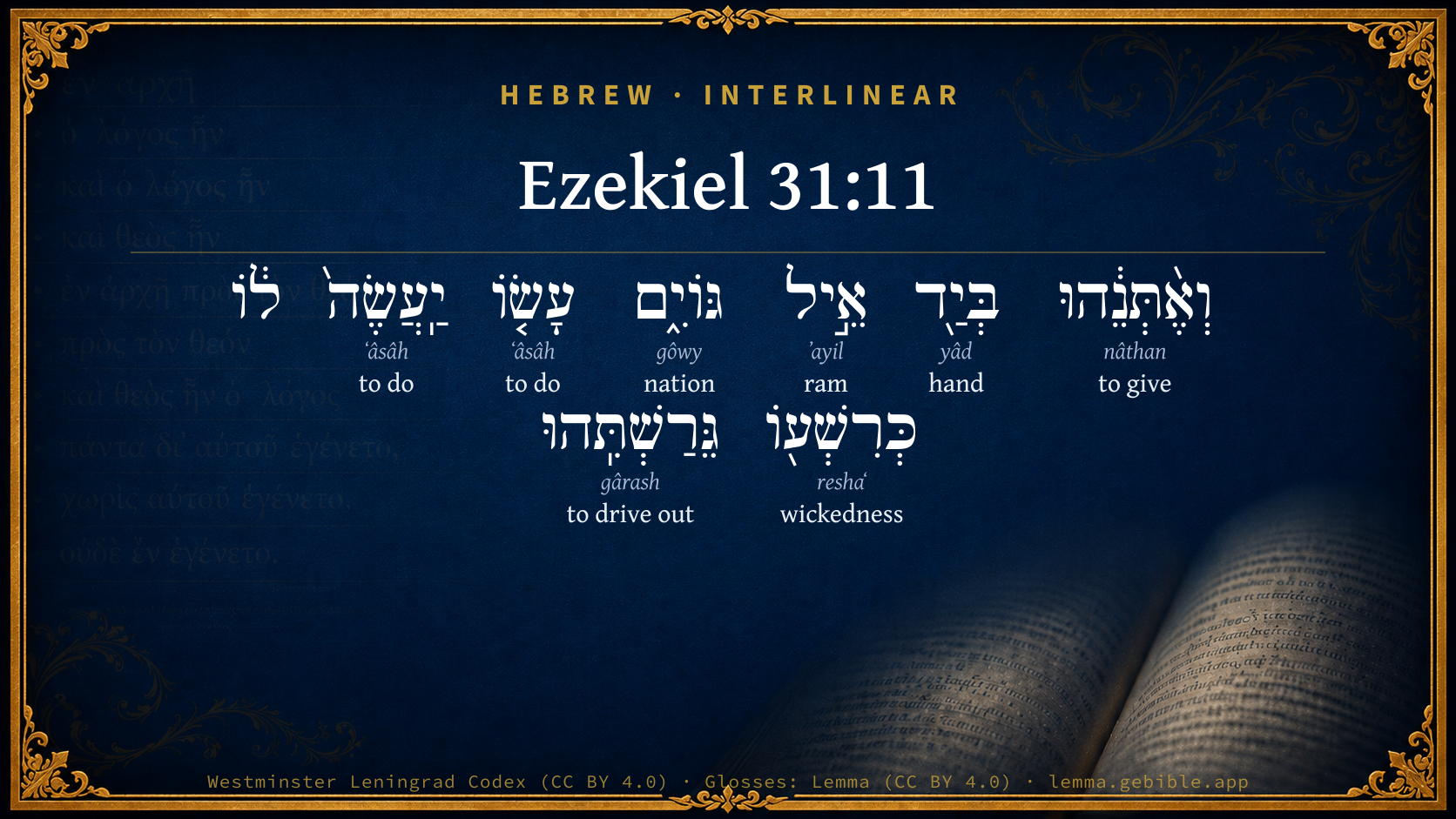
Hebrew (Westminster Leningrad Codex) Ezekiel 31:11 appears in the Hebrew Old Testament. The text above is from the Westminster Leningrad Codex. Each word links to its Strong’s number, a concise gloss, and parsing drawn from the Open Scriptures Hebrew Bible morphology. Click any word for its full Brown-Driver-Briggs (BDB) entry.
Download image
Cite this verse

Ezekiel 31:11 (World English Bible). Public Domain. Lemma interlinear Bible study tool, https://lemma.gebible.app/v/ezekiel/31/11.

Show BibTeX & RIS
BibTeX
RIS
English Translation
I will even deliver him into the hand of the mighty one of the nations; he shall surely deal with him; I have driven him out for his wickedness.
World English Bible · Public Domain
Download a study sheet

One document with this verse’s original text, its word-by-word gloss line, the meaning frame, cross-references with their text, attributed commentary, and full source and license credits — printable, and it pastes into notes with its structure intact.

This verse Autodidact and up

Study sheet (.html) Plain text (.txt)

A passage Seminary Student

Up to 50 verses in one chapter. A passage sheet keeps up to 6 commentary sources and 12 cross-references per verse, in the order this page ranks them, and says so on the sheet whenever that leaves anything out. Ask for a single verse and you get the Autodidact verse sheet above.

Everything on this page stays free to read, with no account — the sheet is a download of what is already on screen, not access to it.

Want to remove ads? Support Godless Engineer
Compare translations 3

The same verse in 3 English versions, stacked beneath the original-language interlinear above. Click any original word for its lexicon entry.

Each is an independent rendering of the whole verse — the interlinear is not word-aligned to these translations.

Highlighted words mark where these versions differ — a whole-verse word diff, not a word-by-word alignment.

  • World English Bible Public Domain
    I will even deliver him into the hand of the mighty one of the nations; he shall surely deal with him; I have driven him out for his wickedness.
  • King James Version Public Domain
    I have therefore delivered him into the hand of the mighty one of the heathen; he shall surely deal with him: I have driven him out for his wickedness.
  • unfoldingWord Literal Text CC BY-SA 4.0
    I have given it into the hand of a mighty one of the nations, to deal with it according to what its wickedness deserves. I have thrown it out.

unfoldingWord Literal Text — © unfoldingWord, licensed CC BY-SA 4.0. Word-aligned USFM3 via Door43 (git.door43.org/unfoldingWord/en_ult).

Versions to compare (up to 4)

3 of 4 selected

Show all 18 translations

Every available English version of this verse, each an independent rendering of the whole verse.

  • World English Bible Public Domain
    I will even deliver him into the hand of the mighty one of the nations; he shall surely deal with him; I have driven him out for his wickedness.
  • Berean Standard Bible Public Domain
    I delivered it into the hand of the ruler of the nations, for him to deal with it according to its wickedness. I have banished it.
  • Majority Standard Bible Public Domain
    I delivered it into the hand of the ruler of the nations, for him to deal with it according to its wickedness. I have banished it.
  • King James Version Public Domain
    I have therefore delivered him into the hand of the mighty one of the heathen; he shall surely deal with him: I have driven him out for his wickedness.
  • American Standard Version (1901) Public Domain
    I will even deliver him into the hand of the mighty one of the nations; he shall surely deal with him; I have driven him out for his wickedness.
  • Revised Version (1885) Public Domain
    I will even deliver him into the hand of the mighty one of the nations; he shall surely deal with him: I have driven him out for his wickedness.
  • Geneva Bible (1599) Public Domain
    I haue therefore deliuered him into the handes of the mightiest among the heathen: he shall handle him, for I haue cast him away for his wickednesse.
  • Douay-Rheims (1899) Public Domain
    I have delivered him into the hands of the mighty one of the nations, he shall deal with him: I have cast him out according to his wickedness.
  • Young's Literal Translation Public Domain
    I give him into the hand of a god of nations, He dealeth sorely with him, In his wickedness I have cast him out.
  • Literal Standard Version CC BY-SA 4.0
    I give him into the hand of a god of nations, || He deals severely with him, || In his wickedness I have cast him out.
  • Unlocked Literal Bible CC BY-SA 4.0
    I have given it into the hand of a mighty one of the nations, to deal with it according to what its wickedness deserves. I have thrown it out.
  • unfoldingWord Literal Text CC BY-SA 4.0
    I have given it into the hand of a mighty one of the nations, to deal with it according to what its wickedness deserves. I have thrown it out.
  • Darby Bible Public Domain
    I have given him into the hand of the mighty one of the nations; he shall surely deal with him: I have driven him out for his wickedness.
  • World Messianic Bible Public Domain
    I will deliver him into the hand of the mighty one of the nations. He will surely deal with him. I have driven him out for his wickedness.
  • Webster's Bible Public Domain
    I have therefore delivered him into the hand of the mighty one of the heathen; he shall surely deal with him: I have driven him out for his wickedness.
  • Free Bible Version CC BY-SA 4.0
    So I handed it over to the leader of a foreign nation who will punish it for its wickedness. I have thrown it out.
  • Bible in Basic English Public Domain
    I have given him up into the hands of a strong one of the nations; he will certainly give him the reward of his sin, driving him out.
  • JPS Tanakh (1917) Public Domain
    I do even deliver him into the hand of the mighty one of the nations; he shall surely deal with him; I do drive him out according to his wickedness.

Literal Standard Version (2020), Covenant Press — licensed CC BY-SA 4.0. Text via the HelloAO Bible API (eBible.org). Unlocked Literal Bible (unfoldingWord) — licensed CC BY-SA 4.0. Text via the HelloAO Bible API (eBible.org). unfoldingWord Literal Text — © unfoldingWord, licensed CC BY-SA 4.0. Word-aligned USFM3 via Door43 (git.door43.org/unfoldingWord/en_ult). Free Bible Version, Dr. Jonathan Gallagher — licensed CC BY-SA 4.0. Text via the HelloAO Bible API (eBible.org).

Word by word

More ways to search: Search by grammar → Find every occurrence → Compare this word →

Practice this passage: Drill this verse → Learn its vocabulary →

כְּרִשְׁע֖וֹ
reshaʻ
H7562
“like/as · wickedness · his”
Preposition + Noun, Common, Masculine, Singular, Construct + Suffix, Personal, 3rd Person, Masculine, Singular
Part of Speech
Preposition + Noun
Type
Common
Gender
Masculine
Number
Singular
State
Construct
Full BDB Definition

Origin: from H7561

TWOT: 2222a

wrong, wickedness, guilt - wickedness (as violence and crime against civil law) - wickedness (of enemies) - wickedness (in ethical relations)
  1. וְאֶ֨תְּנֵ֔הוּ nâthan H5414 “and · to give · him” Conjunction + Verb, Qal, Imperfect, 1st Person, Common, Singular + Suffix, Personal, 3rd Person, Masculine, Singular
  2. בְּיַ֖ד yâd H3027 “in/at · hand of” Preposition + Noun, Common, Both, Singular, Construct
  3. אֵ֣יל ʼayil H352 “ram of” Noun, Common, Masculine, Singular, Construct
  4. גּוֹיִ֑ם gôwy H1471 “nations” Noun, Common, Masculine, Plural, Absolute
  5. עָשׂ֤וֹ ʻâsâh H6213 “to do” Verb, Qal, Infinitive Absolute
  6. יַֽעֲשֶׂה֙ ʻâsâh H6213 “to do” Verb, Qal, Imperfect, 3rd Person, Masculine, Singular
  7. גֵּרַשְׁתִּֽהוּ gârash H1644 “to drive out · him” Verb, Piel, Perfect, 1st Person, Common, Singular + Suffix, Personal, 3rd Person, Masculine, Singular

About this verse

These counts appear in no published source. They are computed here, from the morphology-tagged text and Lemma’s own curated glosses. What Lemma adds →

9
words
7
distinct lemmas
Prophets
section

Shared distinctive vocabulary

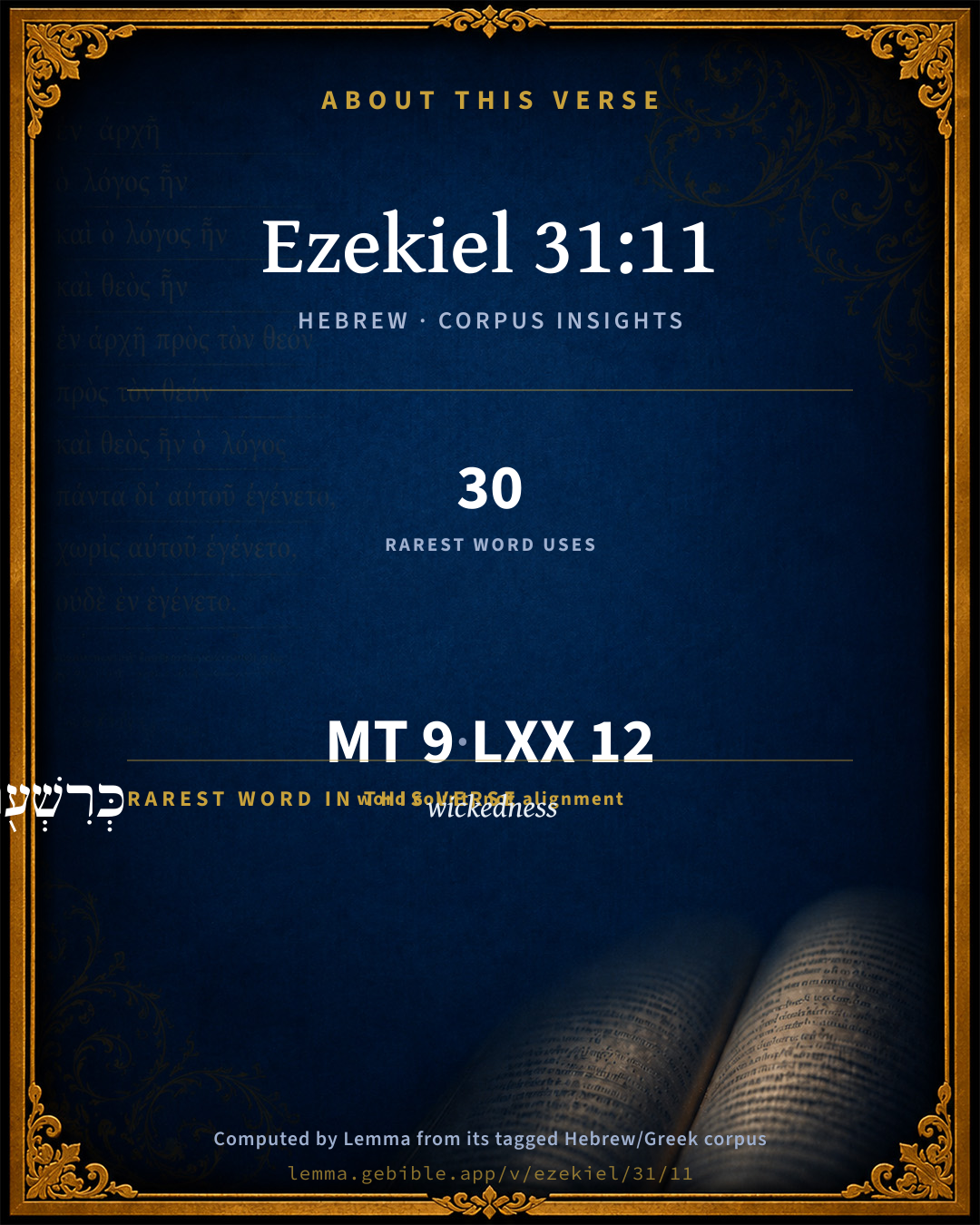
כְּרִשְׁע֖וֹ wickedness H7562 occurs in 29 verses of the Hebrew Bible. Also found in:

Grammatical profile

  • 4 verbs
  • 4 nouns
  • 1 preposition

Verb forms

  • וְאֶ֨תְּנֵ֔הוּ Qal · Imperfect
  • עָשׂ֤וֹ Qal · Infinitive Absolute
  • יַֽעֲשֶׂה֙ Qal · Imperfect
  • גֵּרַשְׁתִּֽהוּ Piel · Perfect

Repetition

A word recurs within this verse — often emphatic in Hebrew:

  • עָשׂ֤וֹ to do H6213 ×2

Hebrew & Septuagint length

In English translation the verse runs 29 words from the Hebrew and 18 from the Septuagint (LXX English) — the Septuagint runs noticeably shorter here. See the side-by-side →

A rough comparison of the two English renderings, which tokenize alike — not a word-level alignment.

Word counts can differ between the Hebrew and the Greek without any difference in meaning — e.g. the Hebrew direct-object marker אֵת has no separate Greek word, and Greek often adds the article ὁ.

In the original languages it is 9 Hebrew tokens and 12 Greek tokens — but the two are counted differently (Hebrew bundles its prefixes and suffixes into one token; the Greek is in lemma form), so that isn’t a like-for-like length.

Cross-references

16

Topical passages linked to Ezekiel 31:11 in the Treasury of Scripture Knowledge — connected by theme and wording, ordered by reader-vote popularity; previews shown in the World English Bible.

  • Deuteronomy 18:12 For whoever does these things is an abomination to Yahweh: and because of these abominations Yahweh your God does drive them out from before you.
  • Ezekiel 32:11–12 For thus says the Lord Yahweh: The sword of the king of Babylon shall come on you.
  • Daniel 5:18–19 You king, the Most High God gave Nebuchadnezzar your father the kingdom, and greatness, and glory, and majesty:
  • Nahum 3:18 Your shepherds slumber, king of Assyria. Your nobles lie down. Your people are scattered on the mountains, and there is no one to gather them.
  • Leviticus 18:24–28 "'Don't defile yourselves in any of these things: for in all these the nations which I am casting out before you were defiled.
  • Leviticus 20:22–23 "'You shall therefore keep all my statutes, and all my ordinances, and do them; that the land, where I am bringing you to dwell, may not vomit you out.
  • Judges 1:7 Adoni-bezek said, "Seventy kings, having their thumbs and their great toes cut off, gathered [their food] under my table: as I have done, so God has requited me." They brought him to Jerusalem, and he died there.
  • Judges 16:23 The lords of the Philistines gathered them together to offer a great sacrifice to Dagon their god, and to rejoice; for they said, Our god has delivered Samson our enemy into our hand.
  • Jeremiah 25:9 behold, I will send and take all the families of the north, says Yahweh, and [I will send] to Nebuchadrezzar the king of Babylon, my servant, and will bring them against this land, and against the inhabitants of it, and against all these nations round about; and I will utterly destroy them, and make them an astonishment, and a hissing, and perpetual desolations.
  • Lamentations 1:21 They have heard that I sigh; there is none to comfort me; All my enemies have heard of my trouble; they are glad that you have done it: You will bring the day that you have proclaimed, and they shall be like me.
  • Ezekiel 11:9 I will bring you forth out of the midst of it, and deliver you into the hands of strangers, and will execute judgments among you.
  • Ezekiel 21:31 I will pour out my indignation on you; I will blow on you with the fire of my wrath; and I will deliver you into the hand of brutish men, skillful to destroy.
  • Ezekiel 23:28 For thus says the Lord Yahweh: Behold, I will deliver you into the hand of them whom you hate, into the hand of them from whom your soul is alienated;
  • Matthew 7:1–2 "Don't judge, so that you won't be judged.
  • 1 Timothy 1:20 of whom is Hymenaeus and Alexander; whom I delivered to Satan, that they might be taught not to blaspheme.
  • James 2:13 For judgment is without mercy to him who has shown no mercy. Mercy triumphs over judgment.

Cross-references courtesy of OpenBible.info (CC BY 4.0).

Hebrew and Greek witnesses Masoretic Hebrew ↔ Greek Septuagint

The same verse in the two great witnesses to the Old Testament, shown verse-for-verse.

Here the Septuagint runs noticeably shorter than the Hebrew — LXX2012 (modern English Septuagint) 18 words vs World English Bible 29. A rough length comparison of the two English translations, not a word-level alignment — read both below.

These are two independent witnesses, not word-aligned to each other, and the Septuagint is shown in lemma (dictionary) form.

Hebrew Ezekiel 31:11 Masoretic · Westminster Leningrad Codex

וְאֶ֨תְּנֵ֔הוּ בְּיַ֖ד אֵ֣יל גּוֹיִ֑ם עָשׂ֤וֹ יַֽעֲשֶׂה֙ ל֔וֹ כְּרִשְׁע֖וֹ גֵּרַשְׁתִּֽהוּ

I will even deliver him into the hand of the mighty one of the nations; he shall surely deal with him; I have driven him out for his wickedness.

World English Bible · Public Domain

Greek LXX Ezekiel 31:11 Septuagint · lemma form

καί παραδίδωμι αὐτός εἰς χείρ ἄρχων ἔθνος καί ποιέω ὁ ἀπώλεια αὐτός

therefore I delivered him into the hands of the prince of the nations, and he wrought his destruction.

LXX2012 (modern English Septuagint) · Public Domain

On this verse, The Cambridge Bible for Schools and Colleges discusses the Septuagint’s reading. Read the note in Commentary ↓

Hebrew: Westminster Leningrad Codex (CC BY 4.0). Greek: Septuagint (public domain); English from LXX2012 (modern English Septuagint) (Public Domain). How the Septuagint differs from the Hebrew →

Targum (Aramaic paraphrase)

1

The Targum is the ancient Jewish Aramaic paraphrase of the Hebrew Scriptures — an interpretive translation, not the Hebrew text itself. Onkelos (literal) and Pseudo-Jonathan (expansive) render the Torah, and Jonathan the Prophets. Coverage is partial: where no permissively-licensed English translation exists for a verse, only the Aramaic is shown. This is verse-level text, not a word-by-word alignment to the Hebrew.

  1. Targum Jonathan Prophets (Joshua–Malachi)
    וְאֶמְסְרִינֵיהּ בְּיַד תַּקִיף עַמְמַיָא אִתְפְּרַע מִנֵיהּ בְּחוֹבֵיהּ תָּרֵיכְתֵּיהּ:

    (no public-domain English translation for this verse)

    Targum Jonathan — Aramaic: “Mikraot Gedolot” (public domain). English: “Sefaria Community Translation” (CC0 1.0 (public-domain dedication)); “London "Chaldee Paraphrase," 1871” (public domain). Text via Sefaria.

Commentary

Notes on Ezekiel 31:11 from classic Christian and Jewish commentators (each source and its license shown beneath its notes). The classic Christian expositions comment on the surrounding passage and are grouped to its opening verse, so a note may address several verses; the Jewish commentaries on the Tanakh (Rashi and others) are per-verse, so they appear only where the commentator wrote on this verse.

Lemma curates 59 commentaries, every one of them public domain or Creative Commons licensed, each selected and text-cleaned for this edition rather than reprinted as found. About our sources →

Trapp's Complete Commentary

John Trapp

Eze 31:11 I have therefore delivered him into the hand of the mighty one of the heathen; he shall surely deal with him: I have driven him out for his wickedness.

Ver. 11. I have therefore delivered him into the hand of the mighty one.] Of Merodach Baladan, who of governor had made himself King of Babylon; and in the twelfth year of his reign, having overcome Esarhaddon, son to Sennacherib, and last monarch of Assyria, he adjoined that whole empire to the Babylonians, and reigned after that forty years. {a}

He shall surely deal with him.] Heb., In doing he shall do unto him; i.e., he shall do what he list with him; {b} as Tamerlane since did with Bajazet, whom he carried about in an iron cage, using him on festival days for a footstool, and feeding him like a dog with crumbs fallen from his table. All which Tamerlane did, not so much for hatred to the man, saith the historian, {c} as to manifest the just judgment of God against the arrogant folly of the proud.

{a} Metashenes, Josephus, lib. i. cap. 2.

{b} Pro libitu tractabo. - Piscat.

{c} Turkish History, 220.

John Trapp, A Commentary or Exposition upon All the Books of the Old and New Testament (1647–1656) — public domain. Text from a community e-Sword module.

Geneva Bible (1599)

Geneva Bible translators

That is, of Nebuchadnezzar, who afterward was the monarch and only ruler of the world.

Geneva Bible (1599) marginal notes — public domain. Text via Bolls.life.

Jamieson, Fausset & Brown

Robert Jamieson, A. R. Fausset & David Brown

Here the literal supersedes the figurative.

shall surely deal with him--according to his own pleasure, and according to the Assyrian's (Sardanapalus) desert. Nebuchadnezzar is called "the mighty one" (El, a name of God), because he was God's representative and instrument of judgment (Dan 2:37-38).

Jamieson, Fausset & Brown — Commentary Critical and Explanatory on the Whole Bible (1871) — public domain (CC PDM 1.0). Text via the HelloAO Bible API.

Adam Clarke's Commentary

Verse 11. The mighty one of the heathen] Nebuchadnezzar. It is worthy of notice, that Nebuchadnezzar, in the first year of his reign, rendered himself master of Nineveh, the capital of the Assyrian empire. See Sedar Olam. This happened about twenty years before Ezekiel delivered this prophecy; on this account, Ashshur, Eze 31:3, may relate to the Assyrians, to whom it is possible the prophet here compares the Egyptians. But see on Eze 31:3.

Adam Clarke's Commentary on the Bible (1810–1826) — public domain. Text from a community e-Sword/MySword module.

Ellicott's Commentary for English Readers

(11) The mighty one of the heathen.—The Chaldæan monarch. At the time of the fall of Assyria this was Nabupolassar, Nebuchadnezzar’s father. In this verse, and partially in the next, the prophet drops his figure to make clear literal statements.

A Bible Commentary for English Readers, edited by Charles John Ellicott (1878–1897) — public domain. Text from a community e-Sword module.

The Cambridge Bible for Schools and Colleges

gen. ed. J. J. S. Perowne

11. have … delivered] I will deliver.

mighty one of the heathen] of the nations, Nebuchadnezzar.

for his wickedness] The traditional reading is: according to his. On “driven out” cf. Gen_3:24. The whole clause, “I have … wickedness” appears to fail in LXX.

The Cambridge Bible for Schools and Colleges (gen. ed. J. J. S. Perowne; Cambridge University Press, 1878–1918) — public domain. Text from a community e-Sword module.

John Gill's Exposition

I have therefore delivered him into the hand of the mighty one of the Heathen,.... Or, into the hand of the mightiest of the nations (o); the mightiest prince among them. Some understand this of Arbaces the Mede, by whom Sardanapalus had been defeated long before this time: others of Merodachbaladan king Babylon, by whom Esarhaddon the Assyrian monarch was vanquished; or rather Nebuchadnezzar, who was called Nabopolassar; who, in the first year (p) of his reign, in conjunction with Cyaxares king of Media, took Nineveh, the metropolis of the Assyrian monarchy; and this was by the appointment of God, and under the direction of his providence, and through the success he gave to the arms of these princes, according to his own decrees and prophecies. Some render it, "into the hand of the god of the nations" (q); yet meaning either Cyaxares or Nebuchadnezzar; so called because of their great power and might, and which they had from the Lord:

he shall surely deal with him; or, "in doing he shall do to him" (r); he shall do with him as he pleases he shall easily manage him, though so powerful; and deal with him according to his deserts; or, as the Targum, he shall take vengeance on him, as he did:

I have driven him out for his wickedness; out of his court and palace; out of his royal city Nineveh; out of his kingdom and dominions; and he shall reside and reign no more there; and all this for his wickedness, pride, and oppression, and other sins: when God strips men of their honour, riches, power, and dominion, it is because of their abuse of them; for some sin, or sins, or wickedness they have been guilty of, both against him and men; and therefore it is but just and righteous in him to dethrone such princes, and drive them from their seats.

(o) "in manum fortissimi gentium", Pagninus, Junius & Tremellius, Polanus; "potentissimi", Piscator. (p) Seder Olam Rabba, p. 69. (q) "In manum dei gentium", Montanus, Starckius; "deo gentium", Castalio. (r) "faciendo faciet ei", Pagninus, Montanus; "faciendo faciebat ipsi", Starckius.

John Gill's Exposition of the Whole Bible (1746–1763) — public domain (CC PDM 1.0). Text via the HelloAO Bible API.

Haydock's Catholic Bible Commentary

I have delivered. Here the time past is put for the future; i.e., I shall deliver. --- The mighty one, &c., viz., Nabuchodonosor, who conquered both the Assyrians and Egyptians; (Challoner) or rather his father, Nabopolassar, subdued the former, ver. 3. (Haydock)

George Leo Haydock (1774–1849), Haydock's Catholic Family Bible and Commentary, 1859 edition — public domain. Excludes Psalms (Douay-Rheims chapter numbering differs from Protestant) and Deuterocanonical books (Catholic canon only).

Matthew Poole's English Annotations

I have therefore delivered: no prophetic style, as some think, I have because I will, for most certainly God would deliver.

Him; the proud king of Assyria, who inherited all the vices of his progenitors more than their kingdoms; infamous Sardanapalus.

The mighty one: some say Cyrus, or rather Arbaces, who first struck at the root of this cedar, and cut him down; and well might this man, though no king when he attempted this, be styled the mighty one of the heathen, who could bring together four hundred thousand of Medes, Persians, Babylonians, and Arabians, a power sufficient to besiege the Assyrian king two years in his own city and palace.

He shall surely deal with him; so he did, for he held him besieged without hope of relief, till at two years’ end this vicious king burned himself with his palace.

Driven him out, with disgrace, for his lewd, shameless courses, as a wife is cast out by divorce for adultery, Lev 21:7.

For his wickedness; so Sardanapalus was cast out for his effeminacy and lewdness; for it is reported this gave Arbaces first encouragement to lay a design against him. He was driven out, as the prophet words it, by the breach two miles and a half wide, made by the mighty floods from continual rains, which the walls of Nineveh could not withstand: so God rather than man did drive this beast out.

Matthew Poole's English Annotations on the Holy Bible (1683–1685) — public domain. Text from a community e-Sword/MySword module.

Whedon's Commentary on the Bible

Daniel D. Whedon

11. I have therefore delivered — R.V., “I will even deliver.”

Heathen — R.V., “nations.” Because of unholy pride Egypt will fall before Nebuchadnezzar, as he in turn, for the same reason, must hereafter fall (Daniel iv).

Daniel D. Whedon (gen. ed.), Commentary on the Old and New Testaments (1874–1909) — public domain. Text from a community e-Sword module.

John Wesley's Explanatory Notes

Him - The proud king of Assyria, Sardanapalus. The mighty one - Arbaces, who first struck at the root of this Cedar, might well be styled the mighty one of the heathen, since he could bring together four hundred thousand of Medes, Persians, Babylonians, and Arabians.

John Wesley, Explanatory Notes Upon the Whole Bible (1754–1765) — public domain. Text via the GEBible commentary corpus.

Rashi

Rabbi Shlomo Yitzchaki (Rashi)

into the hands of the strongest of nations into the hands of the harshest of nations; I gave him into the hands of Nebuchadnezzar, as the master said (Seder Olam, ch. 24; Meg. 11b; Arachin 12a): In his first year, he conquered Nineveh.

that he execute upon him [that] Nebuchadnezzar [execute upon him] in accordance with all My wishes.

Rashi on the Tanakh — English translations: “The Judaica Press complete Tanach with Rashi, translated by A. J. Rosenberg” (CC BY 4.0); “Pentateuch with Rashi's commentary by M. Rosenbaum and A.M. Silbermann, 1929-1934” (public domain); “The Metsudah Tanach series, Lakewood, N.J” (CC BY 4.0); and “The Book of Joshua, Metsudah Publications, 1997” (CC BY 4.0). Text via Sefaria.

Lesson kit

Teaching starters — assembled from the data on this page, not authored interpretation. Every prompt links to the verse data it draws on. Edit before teaching.

Ezekiel, in the Prophets, opens this verse with 9 words (7 distinct Hebrew lemmas). Its most distinctive word is reshaʻ (“wickedness”). The Greek Septuagint runs shorter here. A historical commentator’s framing appears above. Read the whole chapter for the surrounding context.

Discussion questions

  1. How does “wickedness” (reshaʻ) shape what this verse is saying?
  2. How does Deuteronomy 9:27, which shares the word «wickedness», read alongside this verse?
  3. What does the repetition of “to do” (2× in this one verse) do in this verse?
  4. The Septuagint runs shorter here than the Hebrew. What might account for the difference?
  5. These translations render this verse differently; the difference is in the English rendering, not the original. What questions does that raise?
  6. «וְאֶ֨תְּנֵ֔הוּ» is a Qal Imperfect verb. How does that grammatical form shape the action described?
  7. Compare how Trapp's Complete Commentary and Geneva Bible (1599) read this verse. Where do they agree or differ?

Things to notice

Reading settings

Reading text

Shown beneath each verse's original-language words.

Old Testament
Old Testament edition

Read the OT as the Masoretic Hebrew (MT) or the Greek Septuagint (LXX).

English shown for the Greek Septuagint (in the Hebrew ↔ Greek comparison).

Comparing translations? Open the Compare panel on any verse page to stack up to four side by side.