

Job 13:7

Hebrew (Westminster Leningrad Codex) Job 13:7 appears in the Hebrew Old Testament. The text above is from the Westminster Leningrad Codex. Each word links to its Strong’s number, a concise gloss, and parsing drawn from the Open Scriptures Hebrew Bible morphology. Click any word for its full Brown-Driver-Briggs (BDB) entry.
Download image
Cite this verse

Job 13:7 (World English Bible). Public Domain. Lemma interlinear Bible study tool, https://lemma.gebible.app/v/job/13/7.

Show BibTeX & RIS
BibTeX
RIS
English Translation
Will you speak unrighteously for God, And talk deceitfully for him?
World English Bible · Public Domain
Highlights
  • 1 first appearance in the Hebrew Bible
Full analysis ↓
Download a study sheet

One document with this verse’s original text, its word-by-word gloss line, the meaning frame, cross-references with their text, attributed commentary, and full source and license credits — printable, and it pastes into notes with its structure intact.

This verse Autodidact and up

Study sheet (.html) Plain text (.txt)

A passage Seminary Student

Up to 50 verses in one chapter. A passage sheet keeps up to 6 commentary sources and 12 cross-references per verse, in the order this page ranks them, and says so on the sheet whenever that leaves anything out. Ask for a single verse and you get the Autodidact verse sheet above.

Everything on this page stays free to read, with no account — the sheet is a download of what is already on screen, not access to it.

Want to remove ads? Support Godless Engineer
Compare translations 3

The same verse in 3 English versions, stacked beneath the original-language interlinear above. Click any original word for its lexicon entry.

Each is an independent rendering of the whole verse — the interlinear is not word-aligned to these translations.

Highlighted words mark where these versions differ — a whole-verse word diff, not a word-by-word alignment.

  • World English Bible Public Domain
    Will you speak unrighteously for God, And talk deceitfully for him?
  • King James Version Public Domain
    Will ye speak wickedly for God? and talk deceitfully for him?
  • unfoldingWord Literal Text CC BY-SA 4.0
    Will you speak unrighteously for God, and will you talk deceitfully for him?

unfoldingWord Literal Text — © unfoldingWord, licensed CC BY-SA 4.0. Word-aligned USFM3 via Door43 (git.door43.org/unfoldingWord/en_ult).

Versions to compare (up to 4)

3 of 4 selected

Show all 18 translations

Every available English version of this verse, each an independent rendering of the whole verse.

  • World English Bible Public Domain
    Will you speak unrighteously for God, And talk deceitfully for him?
  • Berean Standard Bible Public Domain
    Will you speak wickedly on God’s behalf or speak deceitfully for Him?
  • Majority Standard Bible Public Domain
    Will you speak wickedly on God’s behalf or speak deceitfully for Him?
  • King James Version Public Domain
    Will ye speak wickedly for God? and talk deceitfully for him?
  • American Standard Version (1901) Public Domain
    Will ye speak unrighteously for God, And talk deceitfully for him?
  • Revised Version (1885) Public Domain
    Will ye speak unrighteously for God, and talk deceitfully for him?
  • Geneva Bible (1599) Public Domain
    Will ye speake wickedly for Gods defence, and talke deceitfully for his cause?
  • Douay-Rheims (1899) Public Domain
    Hath God any need of your lie, that you should speak deceitfully for him?
  • Young's Literal Translation Public Domain
    For God do ye speak perverseness? And for Him do ye speak deceit?
  • Literal Standard Version CC BY-SA 4.0
    Do you speak perverseness for God? And do you speak deceit for Him?
  • Unlocked Literal Bible CC BY-SA 4.0
    Will you speak unrighteously for God, and will you talk deceitfully for him?
  • unfoldingWord Literal Text CC BY-SA 4.0
    Will you speak unrighteously for God, and will you talk deceitfully for him?
  • Darby Bible Public Domain
    Will ye speak unrighteously for ùGod? and for him speak deceit?
  • World Messianic Bible Public Domain
    Will you speak unrighteously for God, and talk deceitfully for him?
  • Webster's Bible Public Domain
    Will ye speak wickedly for God? and talk deceitfully for him?
  • Free Bible Version CC BY-SA 4.0
    Do you think you can tell lies to defend God? Are you talking deceitfully on his behalf?
  • Bible in Basic English Public Domain
    Will you say in God's name what is not right, and put false words into his mouth?
  • JPS Tanakh (1917) Public Domain
    Will ye speak unrighteously for God, and talk deceitfully for Him?

Literal Standard Version (2020), Covenant Press — licensed CC BY-SA 4.0. Text via the HelloAO Bible API (eBible.org). Unlocked Literal Bible (unfoldingWord) — licensed CC BY-SA 4.0. Text via the HelloAO Bible API (eBible.org). unfoldingWord Literal Text — © unfoldingWord, licensed CC BY-SA 4.0. Word-aligned USFM3 via Door43 (git.door43.org/unfoldingWord/en_ult). Free Bible Version, Dr. Jonathan Gallagher — licensed CC BY-SA 4.0. Text via the HelloAO Bible API (eBible.org).

Word by word

More ways to search: Search by grammar → Find every occurrence → Compare this word →

Practice this passage: Drill this verse → Learn its vocabulary →

About this verse

These counts appear in no published source. They are computed here, from the morphology-tagged text and Lemma’s own curated glosses. What Lemma adds →

6
words
4
distinct lemmas
Wisdom
section

Notable vocabulary

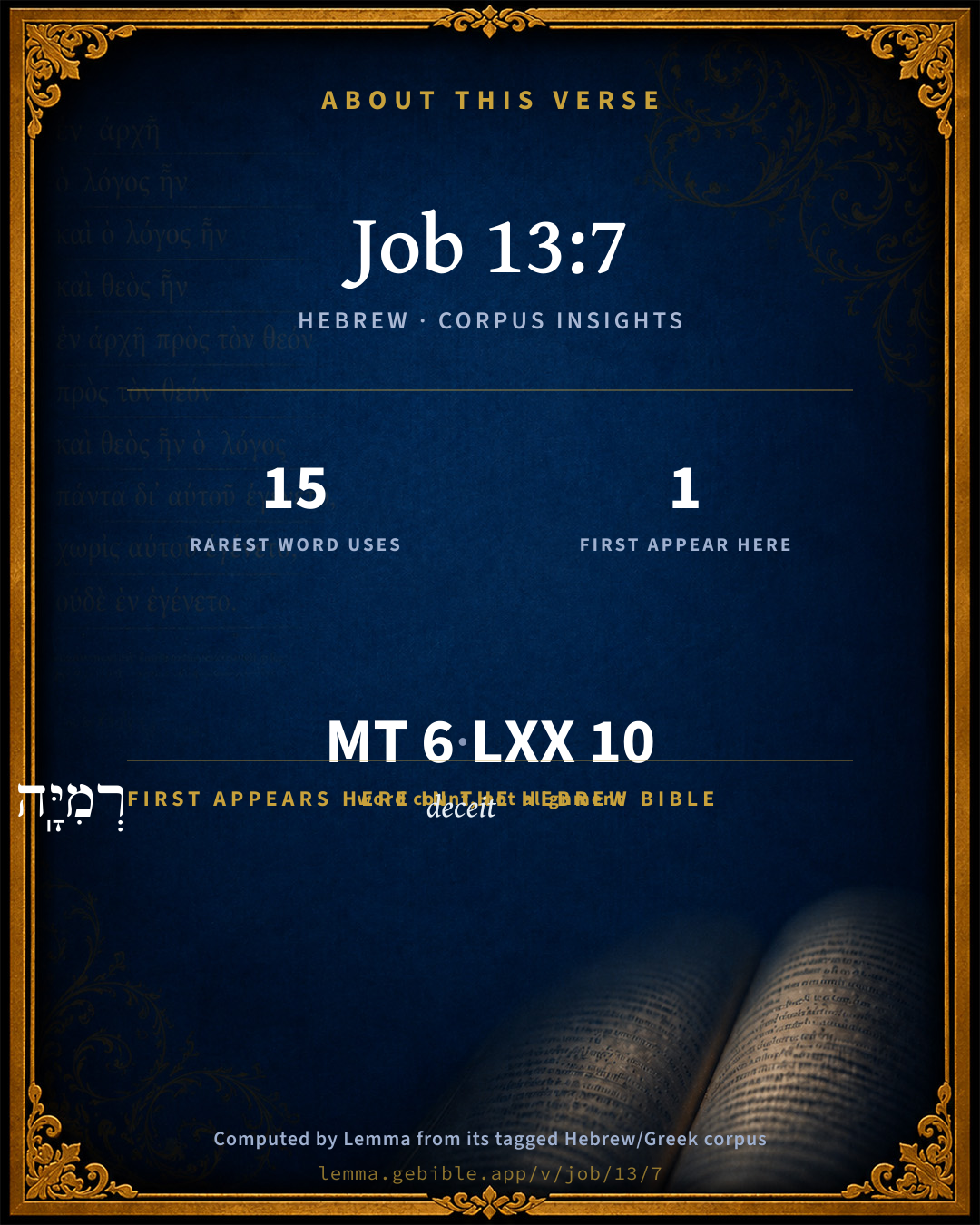
The rarest word here is רְמִיָּֽה deceit H7423 — appearing just 15 times in the whole Hebrew Bible.

First appearance in Scripture

This word makes its first canonical appearance in the Hebrew Bible here:

  • רְמִיָּֽה deceit H7423

Shared distinctive vocabulary

רְמִיָּֽה deceit H7423 occurs in 15 verses of the Hebrew Bible. Also found in:

Grammatical profile

  • 2 verbs
  • 3 nouns
  • 1 preposition

Verb forms

  • תְּדַבְּר֣וּ Piel · Imperfect
  • תְּֽדַבְּר֥וּ Piel · Imperfect

Repetition

A word recurs within this verse — often emphatic in Hebrew:

  • תְּדַבְּר֣וּ to speak H1696 ×2

Hebrew & Septuagint length

In English translation the verse runs 11 words from the Hebrew and 12 from the Septuagint (LXX English) — closely comparable.

A rough comparison of the two English renderings, which tokenize alike — not a word-level alignment.

Word counts can differ between the Hebrew and the Greek without any difference in meaning — e.g. the Hebrew direct-object marker אֵת has no separate Greek word, and Greek often adds the article ὁ.

In the original languages it is 6 Hebrew tokens and 10 Greek tokens — but the two are counted differently (Hebrew bundles its prefixes and suffixes into one token; the Greek is in lemma form), so that isn’t a like-for-like length.

Cross-references

9

Topical passages linked to Job 13:7 in the Treasury of Scripture Knowledge — connected by theme and wording, ordered by reader-vote popularity; previews shown in the World English Bible.

  • Job 36:4 For truly my words are not false. One who is perfect in knowledge is with you.
  • Job 27:4 Surely my lips shall not speak unrighteousness, Neither shall my tongue utter deceit.
  • Job 4:7 "Remember, now, whoever perished, being innocent? Or where were the upright cut off?
  • Job 11:2–4 "Shouldn't the multitude of words be answered? Should a man full of talk be justified?
  • Job 17:5 He who denounces his friends for a prey, Even the eyes of his children shall fail.
  • Job 32:21–22 Please don't let me respect any man's person, Neither will I give flattering titles to any man.
  • John 16:2 They will put you out of the synagogues. Yes, the time comes that whoever kills you will think that he offers service to God.
  • Romans 3:5–8 But if our unrighteousness commends the righteousness of God, what will we say? Is God unrighteous who inflicts wrath? I speak like men do.
  • 2 Corinthians 4:2 But we have renounced the hidden things of shame, not walking in craftiness, nor handling the word of God deceitfully; but by the manifestation of the truth commending ourselves to every man's conscience in the sight of God.

Cross-references courtesy of OpenBible.info (CC BY 4.0).

Hebrew and Greek witnesses Masoretic Hebrew ↔ Greek Septuagint

The same verse in the two great witnesses to the Old Testament, shown verse-for-verse.

These are two independent witnesses, not word-aligned to each other, and the Septuagint is shown in lemma (dictionary) form.

Hebrew Job 13:7 Masoretic · Westminster Leningrad Codex

הַ֭לְאֵל תְּדַבְּר֣וּ עַוְלָ֑ה וְ֝ל֗וֹ תְּֽדַבְּר֥וּ רְמִיָּֽה

Will you speak unrighteously for God, And talk deceitfully for him?

World English Bible · Public Domain

Greek LXX Job 13:7 Septuagint · lemma form

πότερον οὐ ἔναντι κύριος λαλέω ἔναντι δέ αὐτός φθέγγομαι δόλος

Do you⌃ not speak before the Lord, and utter deceit before him?

LXX2012 (modern English Septuagint) · Public Domain

Hebrew: Westminster Leningrad Codex (CC BY 4.0). Greek: Septuagint (public domain); English from LXX2012 (modern English Septuagint) (Public Domain). How the Septuagint differs from the Hebrew →

Commentary

Notes on Job 13:7 from classic Christian and Jewish commentators (each source and its license shown beneath its notes). The classic Christian expositions comment on the surrounding passage and are grouped to its opening verse, so a note may address several verses; the Jewish commentaries on the Tanakh (Rashi and others) are per-verse, so they appear only where the commentator wrote on this verse.

Lemma curates 59 commentaries, every one of them public domain or Creative Commons licensed, each selected and text-cleaned for this edition rather than reprinted as found. About our sources →

Trapp's Complete Commentary

John Trapp

Job 13:7 Will ye speak wickedly for God? and talk deceitfully for him?

Ver. 7. Will ye speak wickedly for God?] Ought ye to defend God’s justice by unjustly accusing me? Or must ye needs so free him from injustice, that ye must charge me with hypocrisy? Job had before called them physicians of no value; here he compareth them to lawyers of no conscience, that care not what they plead, so they may carry the cause of their client. But the Lord needeth no such advocates; he so loveth truth, that he will not borrow patronage to his cause from falsehood; he so hateth flattery (though it be of himself) that he hath threatened to cut off all flattering lips, Psa 12:3; and would one day say as much to Job’s friends, notwithstanding their pretended zeal for his glory, as once Alexander the Great did to Aristobulus the historian, who presented him with a flattering piece concerning his own worthy acts, which he extolled above measure; he cast the book into the river Hydaspes, and told the author he could find in his heart to cast him after it.

And talk deceitfully for him?] To talk for God is our duty; it is to make our tongue our glory; but to talk deceitfully for him, to seek to hold his truth by our lie (the Vulgate here hath it, needeth God your lie?), that is altogether unlawful; for shall we do evil that good may come thereof? God forbid, Rom 3:8. And yet the Papists do so familiarly, and think they therein do God good service; as when they deny his provident hand in ordering the disorders of the world to his own glory, lest they should make him the author of sin; so they think to defend his justice by teaching predestination according to foreseen works, by ascribing to man free will, righteousness of works, merit, &c. So their doctrine of equivocation for the relief of persecuted Catholics, their piae fraudes (as they call them), their holy hypocrisy to draw infidels to the embracing of the faith, and to the love of virtue; their lying legends, made, say they, for good intention, that the common people might with greater zeal serve God and his saints; and especially, to draw the women to good order, being by nature facile and credulous, addicted to novelties and miracles (Spec. Hist. lib. 29).

John Trapp, A Commentary or Exposition upon All the Books of the Old and New Testament (1647–1656) — public domain. Text from a community e-Sword module.

The Biblical Illustrator

Joseph S. Exell

Job_13:7

Will ye speak wickedly for God and talk deceitfully for Him?

Special religious pleaders

Job finds them guilty of speaking falsely as special pleaders for God, in two respects. They insist that he has offended God, but they cannot point to one sin which he has committed. On the other hand, they affirm positively that God will restore prosperity if confession is made. But in this, too, they play the part of advocates without warrant. They show great presumption in daring to pledge the Almighty to a course in accordance with their idea of justice. The issue might be what they predict; it might not. They are venturing on ground to which their knowledge does not extend. They think their presumption justified because it is for religions sake. Job administers a sound rebuke, and it extends to our own time. Special pleaders for Gods sovereignty and unconditional right, and for His illimitable good nature, alike have warning here. What justification have men in affirming that God will work out His problems in detail according to their views? He has given to us the power to apprehend the great principles of His working. There are certainties of our consciousness, facts of the world and of revelation, from which we can argue. Where these confirm we may dogmatise, and the dogma will strike home. But no piety, no desire to vindicate the Almighty, or to convict and convert the sinner, can justify any man in passing beyond the certainty which God has given him to that unknown which lies far above human ken. (R. A. Watson, D. D.)

The Biblical Illustrator, edited by Joseph S. Exell (c. 1880s–1900s) — public domain. Text from a community e-Sword module.

Whedon's Commentary on the Bible

Daniel D. Whedon

Second strophe — Such is Job’s fiery indignation at the dishonesty and arrogance of the friends in assuming to be God’s advocates, that he still turns aside from his main purpose of appeal that he may chide them anew, Job_13:7-12.

7. Deceitfully — In the sense of sophistically. Their sophism assumed the form of a dilemma — either Job is a transgressor or God is unjust. But the dilemma necessarily failed in the latter condition, and thus the whole fell to the ground.

Daniel D. Whedon (gen. ed.), Commentary on the Old and New Testaments (1874–1909) — public domain. Text from a community e-Sword module.

Tyndale Open Study Notes

Tyndale Open Resources

13:7-10 defending God with lies: False witnesses were forbidden even if speaking on God’s behalf (Exod 20:16).

Tyndale Open Study Notes — © Tyndale Open Resources, licensed CC BY-SA 4.0. Text via the HelloAO Bible API.

Geneva Bible (1599)

Geneva Bible translators

He condemneth their zeal, which had not knowledge, neither regarded they to comfort him, but always grated on God’s justice, as though it was not evidently seen in Job, except they had undertaken the probation thereof.

Geneva Bible (1599) marginal notes — public domain. Text via Bolls.life.

Jamieson, Fausset & Brown

Robert Jamieson, A. R. Fausset & David Brown

deceitfully--use fallacies to vindicate God in His dealings; as if the end justified the means. Their "deceitfulness" for God, against Job, was that they asserted he was a sinner, because he was a sufferer.

Jamieson, Fausset & Brown — Commentary Critical and Explanatory on the Whole Bible (1871) — public domain (CC PDM 1.0). Text via the HelloAO Bible API.

Adam Clarke's Commentary

Verse 7. Will ye speak wickedly for God?] In order to support your own cause, in contradiction to the evidence which the whole of my life bears to the uprightness of my heart, will ye continue to assert that God could not thus afflict me, unless flagrant iniquity were found in my ways; for it is on this ground alone that ye pretend to vindicate the providence of God. Thus ye tell lies for God's sake, and thus ye wickedly contend for your Maker.

Adam Clarke's Commentary on the Bible (1810–1826) — public domain. Text from a community e-Sword/MySword module.

Ellicott's Commentary for English Readers

(7) Will ye speak wickedly for God?—And now, in these verses, he gives utterance to a sublime truth, which shows how truly he had risen to the true conception of God, for he declares that He, who is no respecter of persons, desires to have no favour shown to Himself, and that in seeking to show favour they will greatly damage their own cause, for He is a God of truth, and by Him words as well as actions are weighed, and therefore nothing that is not true can stand any one in stead with Him.

A Bible Commentary for English Readers, edited by Charles John Ellicott (1878–1897) — public domain. Text from a community e-Sword module.

The Cambridge Bible for Schools and Colleges

gen. ed. J. J. S. Perowne

7. speak wickedly] Or, wrongously, lit. speak iniquity, ch. Job_5:16, cf. Zophar’s recommendation to Job, ch. Job_11:14. For God means in His behalf, in His defence; and the words for God are emphatic.

The Cambridge Bible for Schools and Colleges (gen. ed. J. J. S. Perowne; Cambridge University Press, 1878–1918) — public domain. Text from a community e-Sword module.

John Gill's Exposition

Will you speak wickedly for God?.... As he suggests they did; they spoke for God, and pleaded for the honour of his justice, by asserting he did not afflict good men, which they thought was contrary to his justice; but: then, at the same time, they spoke wickedly of Job, that he being afflicted of God was a bad man, and an hypocrite; and this was speaking wickedly for God, to vindicate his justice at the expense of his character, which there was no need to do; and showed that they were poor advocates for God, since they might have vindicated the honour of his justice, and yet allowed that he afflicted good men, and that Job was such an one:

and talk deceitfully for him? or tell lies for him, namely, those just mentioned, that only wicked men, and not good men, were afflicted by him, and that Job was a bad man, and an hypocrite.

John Gill's Exposition of the Whole Bible (1746–1763) — public domain (CC PDM 1.0). Text via the HelloAO Bible API.

Albert Barnes' Notes on the Bible

Will ye speak wickedly for God? - That is, will you maintain unjust principles with a view to honor or to vindicate God? Job refers doubtless to the positions which they had defended in regard to the divine administration - principles which he regarded as unjust, though they had employed them professedly in vindicating God. The sense is, that unjust principles ought not to be advanced to vindicate God. The great cause of truth and justice should always be maintained, and even in attempting to vindicate the divine administration, we ought to make use of no arguments which are not based on that which is right and true. Job means to reproach his friends with having, in their professed vindication of God, advanced sentiments which were at war with truth and justice, and which were full of fallacy and sophistry. And is this never done now? Are sophistical arguments never employed in attempting to vindicate the divine government? Do we never state principles in regard to him which we should esteem to be unjust and dishonorable if applied to man? Do not good people sometimes feel that that government must be defended at all events; and when they can see no reason for the divine dealings, do they not make attempts at vindicating them, which are merely designed to throw dust in the eyes of an opponent, and which are known to be sophistical in their nature? It is wrong to employ a sophistical argument on any subject; and in reasoning on the divine character and dealings, when we come, as we often do, to points which we cannot understand, it is best to confess it. God asks no weak or sophistical argument in his defense; still less can he be pleased with an argument, though in defense of his government, which is based on unjust principles.

And talk deceitfully for him - Use fallacies and sophisms in attempting to vindicate him. Everything in speaking of God, should be true, pure, and sound. Every argument should be free from any appearance of sophism, and should be such as will bear the test of the most thorough examination. No honor is done to God by sophistical arguments, nor can he be pleased when such arguments are employed even to vindicate and honor his character.

Albert Barnes' Notes on the Bible (1834–1885) — public domain. Text from a community e-Sword/MySword module.

Matthew Poole's English Annotations

Will you utter falsehoods upon pretence of pleasing God, or of maintaining God’s honour or justice? Doth he need such defences?

Matthew Poole's English Annotations on the Holy Bible (1683–1685) — public domain. Text from a community e-Sword/MySword module.

The Pulpit Commentary

Will ye speak wickedly for God? We are not to suppose that Job"s friends consciously used unsound and untrue arguments in their disputations with him on God"s behalf. On the contrary, they are to be regarded as convinced of the truth of their own reasonings as brought up in the firm belief, that temporal prosperity or wretchedness was dealt out by God, immediately, by his own will, to his subjects according to their behaviour. Holding this, they naturally thought that Job, being so greatly afflicted, must be a great sinner, and, as they could not very plausibly allege any open sins against him, they saw in his sufferings a judgment on him for secret sins. "His chosen friends, as Mr. Froude says, "wise, good, pious men, as wisdom and piety were then, without one glimpse of the true cause of his sufferings, saw in them a judgment of this character. He became to them an illustration, and even (such are the paralogisms of men of this description) a proof of their theory that "the prosperity of the wicked is but for a while;" and instead of the comfort and help that they might have brought him, and which in the end they were made to bring him, he is to them no more than a text for the enunciation of solemn falsehood" ("Short Studies," vol. 1. p. 300), i.e. of statements which were false, though solemnly believed by them to be true. And talk deceitfully for him. "Deceitfully," because untruly, yet so plausibly as to be likely to deceive others.

Speaking wickedly for God.

Here was the great fault and sin of the three friends. They affected to be God"s advocates, yet they spoke wickedly. Thus they endeavoured to support their view of providence by uncharitable assumptions and theories that were not in accordance with the facts. Such conduct was culpable, displeasing to God, and most injurious to the true interests of religion.

I THE TEMPTATION TO SPEAK WICKEDLY FOR GOD. This comes from the notion that the end justifies the means. If the object is to serve God, it is assumed that whatever process is employed must be right. Thus it has been a doctrine among the Jesuits that equivocal conduct which would be condemned in the work of the world is to be condoned when it is turned to the advancement of the Church. The apparently unselfish character of the action adds to the subtle deceptiveness of the temptation. What is said is not for our own sakes, but for the glory of God. Further, it is argued men have no right to complain, because the true servants of God will rejoice in what glorifies him; and they who are not of the Church are out of court, and can have no ground on which to plead a complaint. Yet even they might profit, it is further urged; if they were led to the Church by fraud, when once they were in, would they not bless the fraud that saved them? All this is but the sophistry of a temptation from the devil.

II THE GREAT SIN OF SPEAKING WICKEDLY FOR GOD. This is peculiarly hateful to him, for he is a God of righteousness. Several points go to make up the exceeding badness of such conduct.

1. It destroys truth. If we may lie for God, truth itself is humiliated. The permission of mere equivocation which is intended to deceive lowers the standard of truth. This is a break-up of the rigorous moral law.

2. It is fatal to charity. The plea is that man must be sacrificed for the sake of God. But God has said, "I will have mercy, and not sacrifice." He will not accept the service that is rendered at the cost of cruelty to a brother.

3. It is dishonouring to God. His holy Name is dragged down to man"s low conduct, and enlisted in the service of evil. What is done for his glory is supposed to carry his sanction. Thus the God of truth and love is made to appear as the champion of lies and hatred. This is a most abominable insult to God.

4. It is a miserable cloak for sin. It would seem that men would not think of speaking wickedly for God unless there were wickedness in their own hearts. It is true they may be foolish enough to imagine that their conduct will really minister to the Divine glory, and it is only fair to admit that people who are deluded by Jesuitical casuistry will do for the Church what they would not dream of doing for themselves. Thus these people are not really so bad as their conduct suggests. Still, unless they are utterly duped by their system, unless their consciences have been warped into a kind of moral insanity by their training and it must be allowed that this is possible we cannot but say that their action must spring from a low tone of morality. At all events, it must tend to produce this, must be distinctly degrading and demoralizing.

5. It is doomed to failure. Nothing more injures the cause of Christ than the unworthy conduct of his followers, especially when this pleads his glory as its excuse. Nothing so favours unbelief as the suspicion of want of candour in defenders of the faith. It is fatal to cling to a bad argument because of its tendency to support the right. We can only please and serve God when we follow truth and love. This is the method of Christ, who scorned all subterfuges, and chose the apparent failure of the cross rather than the triumphs of safe diplomatic policy. W.F.A.

The Pulpit Commentary (1880–1919), ed. H.D.M. Spence-Jones & Joseph S. Exell — public domain. Text from a community e-Sword module.

Keil & Delitzsch

C. F. Keil & F. Delitzsch

7 Will ye speak what is wrong for God,

And speak what is deceitful for Him?

8 Will ye be partial for Him,

Or will ye play the part of God's advocates?

9 Would it be pleasant if He should search you out,

Or can ye jest with Him, as one jesteth with men?

10 He will surely expose you

If ye secretly act with partiality.

11 Will not His majesty confound you,

And His fear fall upon you?

Their advocacy of God - this is the thought of this strophe - is an injustice to Job, and an evil service rendered to God, which cannot escape undisguised punishment from Him. They set themselves up as God's advocates (לאל ריב, like לבּעל ריב, Jdg 6:31), and at the same time accept His person, accipiunt (as in acceptus = gratus), or lift it up, i.e., favour, or give preference to, His person, viz., at the expense of the truth: they are partial in His favour, as they are twice reminded and given to understand by the fut. energicum תּשּׂאוּן. The addition of בּסּתר (Job 13:10) implies that they conceal their better knowledge by the assumption of an earnest tone and bearing, expressive of the strongest conviction that they are in the right. They know that Job is not a flagrant sinner; nevertheless they deceive themselves with the idea that he is, and by reason of this delusion they take up the cause of God against him. Such perversion of the truth in majorem Dei gloriam is an abomination to God. When He searches them, His advocates, out (חקר, as Prov.Job 28:11), they will become conscious of it; or will God be mocked, as one mocketh mortal men? Comp. Gal 6:7 for a similar thought. חתל is inf. absol. after the form תּללּ, and תּהתלּוּ is also to be derived from תּללּ, and is fut. Hiph., the preformative not being syncopated, for תּתלּוּ (Ges. 53, rem. 7); not Piel, from התל (as Kg1 18:27), with the doubling of the middle radical resolved (Olsh. in his Lehrb. S. 577). God is not pleased with λατρεία (Joh 16:2) which gives the honour to Him, but not to truth, such ζῆλος Θεοῦ ἀλλ ̓ ου ̓ κατ ̓ ἐπίγνωσιν (Rom 10:2), such advocacy contrary to one's better knowledge and conscience, in which the end is thought to sanctify the means. Such advocacy must be put to shame and confounded when He who needs no concealment of the truth for His justification is manifest in His שׂאת, i.e., not: in the kindling of His wrath (after Jdg 20:38; Isa 30:27), but: in His exaltation (correctly by Ralbag: התנשׂאותו ורוממותו), and by His direct influence brings all untruth to light. It is the boldest thought imaginable, that one dare not have respect even to the person of God when one is obliged to lie to one's self. And still it is also self-evident. For God and truth can never be antagonistic.

Keil & Delitzsch — Biblical Commentary on the Old Testament (1861–1891) — public domain (CC PDM 1.0). Text via the HelloAO Bible API. (Old Testament only.)

Rashi

Rabbi Shlomo Yitzchaki (Rashi)

Will you speak unjustly for God Since you come to contend in the place of God, it is not good that you should speak unjustly.

and will you speak deceitfully for Him? Heb. ולו [usually “to him”]. For His sake will you speak deceitfully? As in (below 33:6), “Behold I am like your mouth for God (לאל),” and like (Deut. 9:28), “to the land that He spoke for them (להם),” for their benefit, and like (Exod. 14:14), “will fight for you (לכם)”; (Jud. 6:31), “Will you contend for the Baal (לבעל)?” (I find it difficult to compare these instances to here [this verse]. Rather, this is analogous to [Num. 17: 5], “through Moses concerning him [לו],” concerning Korah.)

Rashi on the Tanakh — English translations: “The Judaica Press complete Tanach with Rashi, translated by A. J. Rosenberg” (CC BY 4.0); “Pentateuch with Rashi's commentary by M. Rosenbaum and A.M. Silbermann, 1929-1934” (public domain); “The Metsudah Tanach series, Lakewood, N.J” (CC BY 4.0); and “The Book of Joshua, Metsudah Publications, 1997” (CC BY 4.0). Text via Sefaria.

Lesson kit

Teaching starters — assembled from the data on this page, not authored interpretation. Every prompt links to the verse data it draws on. Edit before teaching.

Job, in the Wisdom, opens this verse with 6 words (4 distinct Hebrew lemmas). Its most distinctive word is rᵉmîyâh (“deceit”). A historical commentator’s framing appears above. Read the whole chapter for the surrounding context.

Discussion questions

  1. How does “deceit” (rᵉmîyâh) shape what this verse is saying?
  2. The word “deceit” first appears here in Scripture. What is being introduced at this debut?
  3. Job 27:4 shares the word «deceit» with this verse. How do the two illuminate each other?
  4. “to speak” occurs 2× in this one verse. What is the effect of the repetition?
  5. These translations render this verse differently; the difference is in the English rendering, not the original. What questions does that raise?
  6. The verb «תְּדַבְּר֣וּ» is Piel Imperfect. How does its form color the action?
  7. Reading how Trapp's Complete Commentary and The Biblical Illustrator read this verse, where do the two commentators agree and where do they part?

Things to notice

Reading settings

Reading text

Shown beneath each verse's original-language words.

Old Testament
Old Testament edition

Read the OT as the Masoretic Hebrew (MT) or the Greek Septuagint (LXX).

English shown for the Greek Septuagint (in the Hebrew ↔ Greek comparison).

Comparing translations? Open the Compare panel on any verse page to stack up to four side by side.