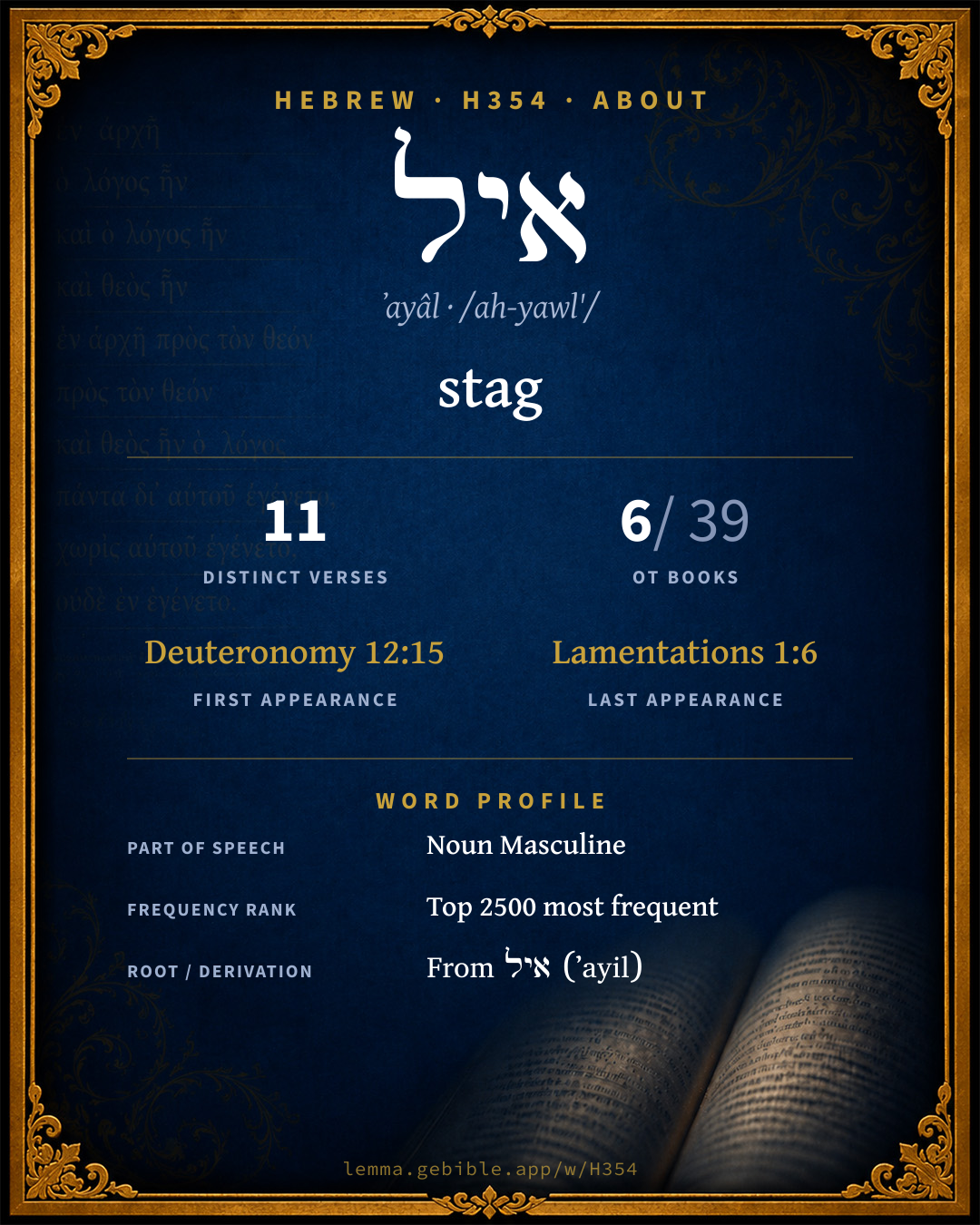
אַיָּל
stag
Full lexicon entry — Brown-Driver-Briggs (BDB)
From Brown-Driver-Briggs (BDB)
Where this word appears
Grammar key — what these labels mean
Part of speech
- Noun
- A naming word — a person, place, thing, or idea.
Noun type
- Common
- A common noun — a general class of person, place, or thing (“king,” “city,” “water”), not a specific name.
State
- Absolute
- The independent form of a noun, not bound to a following word.
Gender
- Both
- Attested as both masculine and feminine.
Number
- Plural
- More than one (in Hebrew, generally three or more).
- Singular
- One.
Grammatical forms
- Noun, Common, Both, Singular, Absolute 7 times (64%)
- Noun, Common, Both, Plural, Absolute 4 times (36%)
Parsed forms decoded from the imported morphology (morphhb / Westminster Leningrad Codex — WLC text public domain, morphhb tagging CC BY 4.0), counted across 11 parsed occurrences — not distinct verses.
Every verse where H354 appears — 11 distinct verses across 6 books. Click any verse to open its interlinear word-by-word view. Verse text shown in the World English Bible for context — . Each verse’s Hebrew form is shown with its reference; the English is not keyword-highlighted, since the data carries no word-level English alignment. Use “Compare translations” on any verse to read it across multiple English versions. This concordance covers the Hebrew Bible; Septuagint (Greek Old Testament) occurrences are not indexed here.
Deuteronomy 4 verses
- Deuteronomy 12:15 וְ/כָ/אַיָּֽל conj + prep det + n c bs Notwithstanding, you may kill and eat flesh within all your gates, after all the desire of your soul, according to the blessing of Yahweh your God which he has given you: the unclean and the clean may eat of it, as of the gazelle, and as of the hart.
- Deuteronomy 12:22 הָ֣/אַיָּ֔ל ptcl def.art + n c bs Even as the gazelle and as the hart is eaten, so you shall eat of it: the unclean and the clean may eat of it alike.
- Deuteronomy 14:5 אַיָּ֥ל n c bs the hart, and the gazelle, and the roebuck, and the wild goat, and the ibex, and the antelope, and the chamois.
- Deuteronomy 15:22 וְ/כָ/אַיָּֽל conj + prep det + n c bs You shall eat it within your gates: the unclean and the clean [shall eat it] alike, as the gazelle, and as the hart.
1 Kings 1 verse
Psalms 1 verse
Song of Solomon 3 verses
- Song of Solomon 2:9 הָֽ/אַיָּלִ֑ים ptcl def.art + n c bp My beloved is like a roe or a young hart. Behold, he stands behind our wall! He looks in at the windows. He glances through the lattice.
- Song of Solomon 2:17 הָ/אַיָּלִ֖ים ptcl def.art + n c bp Until the day is cool, and the shadows flee away, Turn, my beloved, And be like a roe or a young hart on the mountains of Bether.
- Song of Solomon 8:14 הָֽ/אַיָּלִ֔ים ptcl def.art + n c bp Come away, my beloved! Be like a gazelle or a young stag on the mountains of spices!
Isaiah 1 verse
Lamentations 1 verse
About this entry
At a glance — auto-summarized from this page’s data, not written by a person. Every figure links to its source below. This summary describes the numbers; it doesn’t interpret them.
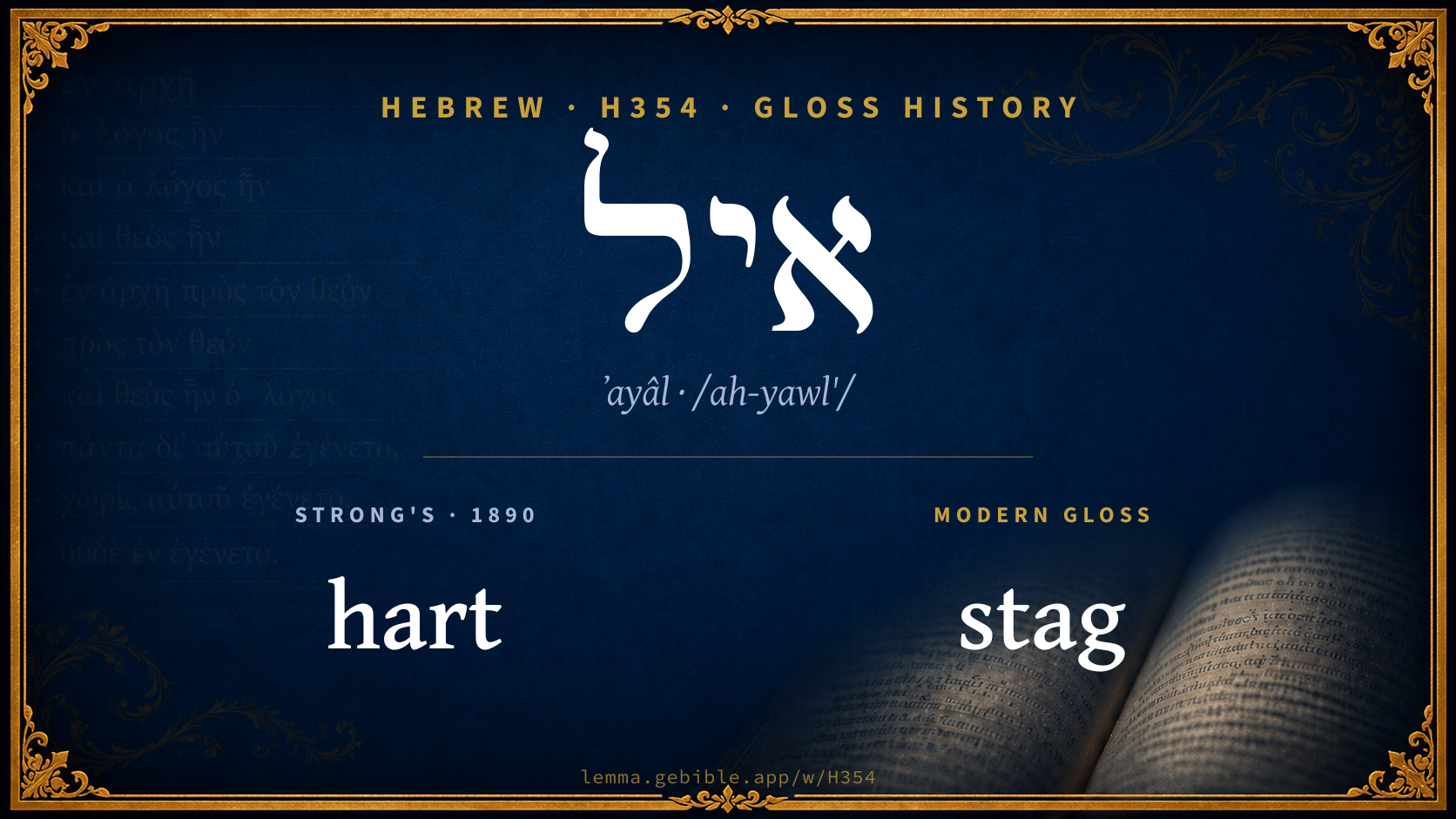
איל — transliterated ʼayâl — is a Hebrew noun carrying the sense “stag.” Older and newer Bibles part ways — “hart” in the King James Version, “deer” (unfoldingWord Literal Text) in modern versions. See the renderings breakdown. It appears 11 verses across 6 books of the Hebrew Bible, among its uncommon vocabulary. More than a third of its appearances fall in Deuteronomy. Its earliest occurrence is Deuteronomy 12:15. Each statement above links to its evidence; the full detail follows below.
Gloss history
Strong's 1890 vs modern scholarship
About this word
Strong's H354 catalogs a Hebrew word from the Hebrew Old Testament.
These counts are not copied from any lexicon or concordance. They are computed here, from the morphology-tagged Hebrew Old Testament. What Lemma adds →
- 11
- distinct verses
- The word appears in 11 distinct verses.
- 6 / 39
- OT books
- The word appears in 6 of 39 Old Testament books.
- #2,210
- by frequency
- Top 2500 most frequent Hebrew words (rank 2,210 of 8,640 Hebrew words by occurrence).
View all 11 occurrences in the concordance →
Most concentrated in
- Deuteronomy 4 verses 36%
- Song of Solomon 3 verses 27%
- 1 Kings 1 verse 9%
By section of the Old Testament
By traditional corpus
Conventional, traditional groupings — biblical authorship is debated, so this is a traditional corpus grouping, not an authorship claim. Each share is this word’s portion of its verses in that division of the Hebrew canon. Each figure is a share of the word’s 11 distinct verses.
- Writings (Ketuvim) 5 verses · 45%
- Torah (Pentateuch) 4 verses · 36%
- Prophets (Nevi'im) 2 verses · 18%
How translations render this word
Counts come from each version’s own published word-to-Strong’s tagging or interlinear alignment — an approximate guide to how each version renders this word, not a word-level alignment the data otherwise carries. Because each total is that version’s own tagged count, the per-version totals vary from one another and need not match the appearance or distinct-verse counts above. These counts may also differ from a printed concordance because Lemma counts each distinctly tagged rendering and does not collapse phrase taggings into a single head-word total. This is a fixed set of word-tagged versions (KJV, ASV, BSB, ULT) and does not change with the reading translation you choose elsewhere. Each version’s license is shown beside its name below (and on Sources).
BDB lists this Strong’s number as 2 distinct words (homographs). Each count above pools all of them and is not split by sense — see the Senses section below. A low-frequency rendering may belong to a different one of those words, not the primary meaning.
- King James Version†: Hart 9×
- American Standard Version†: Hart 8×
- Berean Standard Bible†: Deer 3×, Or deer 2×, Stag 2×
- unfoldingWord Literal Text†: Deer 5×, Stag 3×
King James Version Public Domain
Renders H354 across 11† tagged occurrences — most commonly:
Plus 2 renderings that appear only once — usually multi-word phrases or single function words the recovered tagging swept in, not distinct renderings.
American Standard Version Public Domain
Renders H354 across 11† tagged occurrences — most commonly:
Plus 3 renderings that appear only once — usually multi-word phrases or single function words the recovered tagging swept in, not distinct renderings.
Berean Standard Bible Public Domain
Renders H354 across 10† tagged occurrences — most commonly:
Plus 3 renderings that appear only once — usually multi-word phrases or single function words the recovered tagging swept in, not distinct renderings. Not rendered by a distinct English word in 1 further occurrence.
unfoldingWord Literal Text CC BY-SA 4.0
Renders H354 across 11† tagged occurrences — most commonly:
Plus 3 renderings that appear only once — usually multi-word phrases or single function words the recovered tagging swept in, not distinct renderings.
Senses in BDB
The 1 sense BDB distinguishes for this word, in lexicon order (not ranked by frequency or importance). The full entry — with sub-senses — is in the Lexicon Entry tab.
- stag, deer, hart
Word origin
n.[m.] (f. ψ 42:2) hart, stag, deer (Aramaic id., ܐܰܝܠܴܐ Arabic إِيَّلٌ Assyrian ailu DlW, but dub., v. HptBAS i. 170, Ethiopic ሀየል = leader? cf. אַיִל. Arabic إِيَّلٌ = ibex (i.q. وَعْلٌ, وَعِلٌ).) א׳ abs. Dt 12:15 + 6 times; pl. אַיָּלִים Ct 2:9 + 3 times;—hart, stag, allowed as food Dt 12:15, 22; 15:22 (all ‖ צְבִי); 14:5 (‖ צְבִי, יַחְמוּר etc.); eaten in Sol.’s household 1 K 5:3 (‖ as Dt 14:5); sim. of leaping Is 35:6; id. עֹפֶר הָא׳ Ct 2:9, 17; 8:14 (all ‖ צְבִי); as in search of pasture, sim. of princes of Judah La 1:6; as longing for water, sim. of longing for י׳ ψ 42:2.
— Brown-Driver-Briggs (Oxford 1906, public domain), digitized via Sefaria, supplemented by the OpenScriptures HebrewLexicon (CC BY 4.0). See Sources.
Derived from איל (ʼayil) (H352) — ram.
Jastrow Dictionary
A second Hebrew/Aramaic lexicon for comparison, covering Aramaic and post-biblical (Talmudic, Targumic, Midrashic) usage that the biblical-Hebrew BDB does not. Matched by lemma rather than by Strong’s number, so a lemma may carry more than one Jastrow headword (shown separately below), and the entries cover usage well beyond the Bible.
*אֱיָל
- superiority, patronage, arbitration; v. Midr. Till. to Ps. LXXXVIII, 5. Midr. Till. to Ps. CIV, 29 (ref. to Is. LVII, 19 peace, peace &c.) אילולי (אֱיָילוֹ) אֱיָלוֹ של וכ׳ but for the peace-making arbitration of the Lord &c. e.g. Isaiah 57:19
אַיִל
- 1. ram (the strong). B. Kam. 65ᵇ if one stole טלה ונעשה א׳ a lamb and it grew to be a ram. Ib. א׳ בן יומו קרוי א׳ a ram one day old is called a ram (ayil is used in a general sense, irrespective of age). R. Hash. 16ᵃ; a. fr.—[*Pl. אֵלִים. Tosef. R. Hash. III (II), 3 (Var. יעלים).]—
- *2. א׳ קמצא [perh. אַיָּל q. v.] a species of locusts. Eduy. VIII, 4; Pes. 16ᵃ; Ab. Zar. 37ᵃ אייל ed. (Ms. M. אייול), v. דְּכֵי.
אַיָּל
- prob. fr. אול = עול, cmp. Var. lect. of אַיֶּלֶת II; cmp. אלל) [the climber], hart. Ḥull. 28ᵃ; a. e.
A Dictionary of the Targumim, the Talmud Babli and Yerushalmi, and the Midrashic Literature (Marcus Jastrow; London, Luzac, 1903) — Public Domain. Digitized via Sefaria. Digitized via Sefaria. Full attribution on Sources.
Forms in the corpus
The 10 distinct written forms H354 takes in the Hebrew Bible, most frequent first — each parse links to that state’s occurrences in the concordance. Hebrew forms include their vowel points and cantillation, so a single lemma takes many written forms.
| Form | Parsing | Example | Uses |
|---|---|---|---|
| וְ/כָ/אַיָּֽל | Noun, Common, Both, Singular, Absolute | Deuteronomy 12:15 | 2 |
| אַיָּ֥ל | Noun, Common, Both, Singular, Absolute | Deuteronomy 14:5 | 1 |
| הָ/אַיָּלִ֖ים | Noun, Common, Both, Plural, Absolute | Song of Solomon 2:17 | 1 |
| הָ֣/אַיָּ֔ל | Noun, Common, Both, Singular, Absolute | Deuteronomy 12:22 | 1 |
| הָֽ/אַיָּלִ֑ים | Noun, Common, Both, Plural, Absolute | Song of Solomon 2:9 | 1 |
| הָֽ/אַיָּלִ֔ים | Noun, Common, Both, Plural, Absolute | Song of Solomon 8:14 | 1 |
| כְּ/אַיָּ֗ל | Noun, Common, Both, Singular, Absolute | Psalms 42:1 | 1 |
| כְּ/אַיָּלִים֙ | Noun, Common, Both, Plural, Absolute | Lamentations 1:6 | 1 |
| כָּֽ/אַיָּל֙ | Noun, Common, Both, Singular, Absolute | Isaiah 35:6 | 1 |
| מֵֽ/אַיָּ֤ל | Noun, Common, Both, Singular, Absolute | 1 Kings 4:23 | 1 |
Same root — word family
Other BDB entries built from the same root as H354, grouped by Strong’s listed origin. These share a root / origin per the lexicon — not necessarily a shared meaning. Each links to that word’s own entry.
Derives from
Shares the same root
- איל ʼĕyâl H353 strength
- אילם ʼêylâm H361 porch
- אילן ʼîylân H363 tree
- אלה ʼêlâh H424 terebinth
- אלון ʼêlôwn H436 oak
Derived from this word
Proper names from this root
People and places named from this root — a name, not an additional meaning of the word.
- אילון ʼÊylôwn H356 Elon
- אילות ʼÊylôwth H359 Elath
- אילם ʼÊylim H362 Elim
- איל פארן ʼÊyl Pâʼrân H364 El-paran
- אל ʼêl H410 God
- אילון ʼAyâlôwn H357 Ajalon
Compare all same-root words → Showing 4 of 14 — not the complete family. 6 of the same-root words are proper names (people or places). They share a root, not necessarily a meaning.
Septuagint verse parallels
This word appears in 10 verses that also exist in the Greek Old Testament (Septuagint), out of the 11 Hebrew verses it occurs in. You can read those verses in Greek by switching the Old Testament edition to the Septuagint.
Read these verses in the Septuagint
This is a verse-level parallel only — the same verses exist in both the Hebrew and Greek Old Testaments. No word-level Hebrew↔Greek correspondence is claimed: the data carries no such alignment, so no Greek word is shown as this Hebrew word’s translation. Coverage is not total — the Septuagint omits the deuterocanon and renumbers the Psalms, so some Hebrew verses have no direct Greek parallel.