Ezekiel 10:5

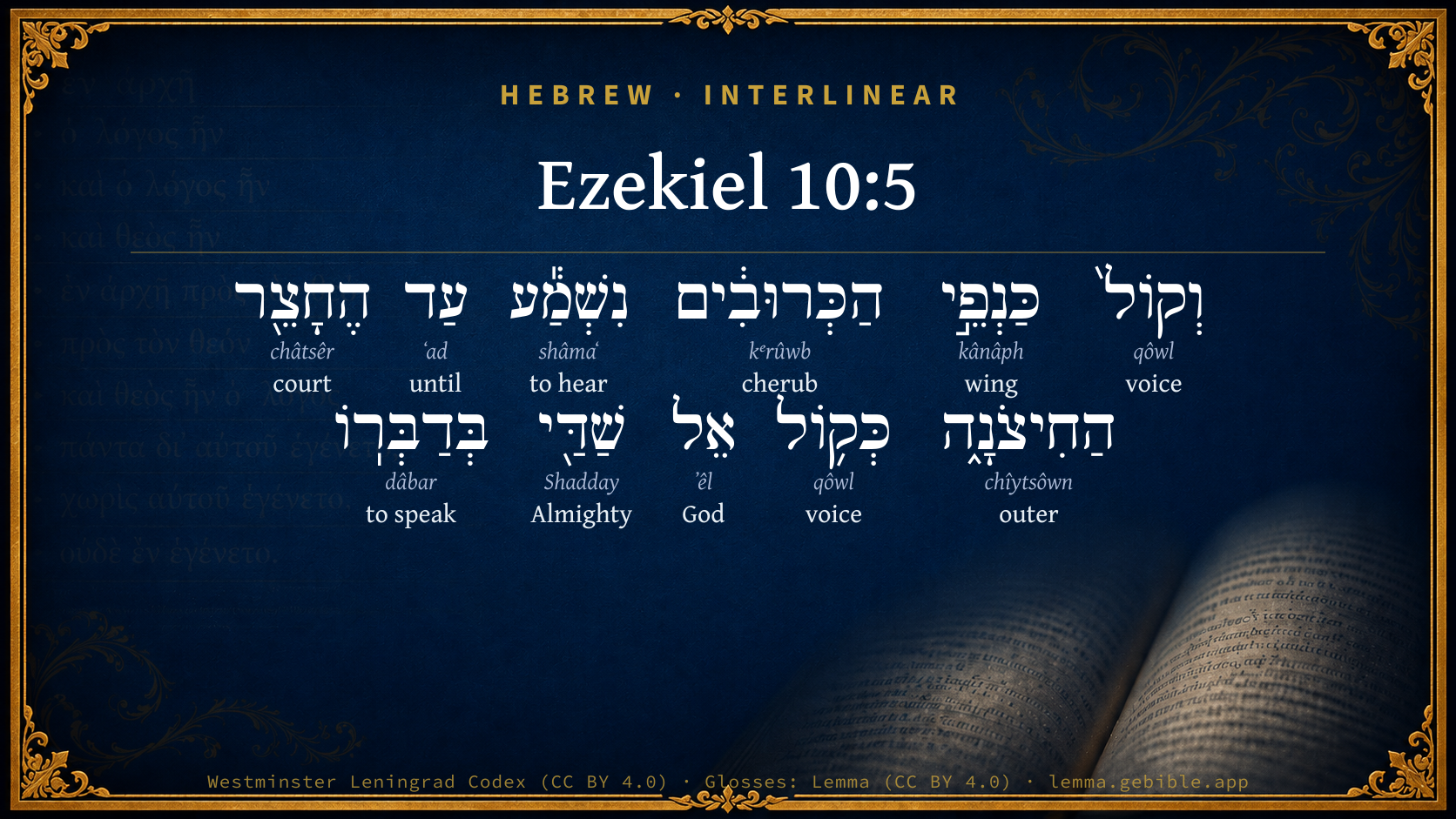
Hebrew (Westminster Leningrad Codex) Ezekiel 10:5 appears in the Hebrew Old Testament. The text above is from the Westminster Leningrad Codex. Each word links to its Strong’s number, a concise gloss, and parsing drawn from the Open Scriptures Hebrew Bible morphology. Click any word for its full Brown-Driver-Briggs (BDB) entry.
Download image
Cite this verse

Ezekiel 10:5 (World English Bible). Public Domain. Lemma interlinear Bible study tool, https://lemma.gebible.app/v/ezekiel/10/5.

Show BibTeX & RIS
BibTeX
RIS
English Translation
The sound of the wings of the cherubim was heard even to the outer court, as the voice of God Almighty when he speaks.
World English Bible · Public Domain
Download a study sheet

One document with this verse’s original text, its word-by-word gloss line, the meaning frame, cross-references with their text, attributed commentary, and full source and license credits — printable, and it pastes into notes with its structure intact.

This verse Autodidact and up

Study sheet (.html) Plain text (.txt)

A passage Seminary Student

Up to 50 verses in one chapter. A passage sheet keeps up to 6 commentary sources and 12 cross-references per verse, in the order this page ranks them, and says so on the sheet whenever that leaves anything out. Ask for a single verse and you get the Autodidact verse sheet above.

Everything on this page stays free to read, with no account — the sheet is a download of what is already on screen, not access to it.

Want to remove ads? Support Godless Engineer
Compare translations 3

The same verse in 3 English versions, stacked beneath the original-language interlinear above. Click any original word for its lexicon entry.

Each is an independent rendering of the whole verse — the interlinear is not word-aligned to these translations.

Highlighted words mark where these versions differ — a whole-verse word diff, not a word-by-word alignment.

  • World English Bible Public Domain
    The sound of the wings of the cherubim was heard even to the outer court, as the voice of God Almighty when he speaks.
  • King James Version Public Domain
    And the sound of the cherubims' wings was heard even to the outer court, as the voice of the Almighty God when he speaketh.
  • unfoldingWord Literal Text CC BY-SA 4.0
    The sound of the cherubim’s wings was heard as far as the outer courtyard, like the voice of God Almighty when he speaks.

unfoldingWord Literal Text — © unfoldingWord, licensed CC BY-SA 4.0. Word-aligned USFM3 via Door43 (git.door43.org/unfoldingWord/en_ult).

Versions to compare (up to 4)

3 of 4 selected

Show all 18 translations

Every available English version of this verse, each an independent rendering of the whole verse.

  • World English Bible Public Domain
    The sound of the wings of the cherubim was heard even to the outer court, as the voice of God Almighty when he speaks.
  • Berean Standard Bible Public Domain
    The sound of the wings of the cherubim could be heard as far as the outer court, like the voice of God Almighty when He speaks.
  • Majority Standard Bible Public Domain
    The sound of the wings of the cherubim could be heard as far as the outer court, like the voice of God Almighty when He speaks.
  • King James Version Public Domain
    And the sound of the cherubims' wings was heard even to the outer court, as the voice of the Almighty God when he speaketh.
  • American Standard Version (1901) Public Domain
    And the sound of the wings of the cherubim was heard even to the outer court, as the voice of God Almighty when he speaketh.
  • Revised Version (1885) Public Domain
    And the sound of the wings of the cherubim was heard even to the outer court, as the voice of God Almighty when he speaketh.
  • Geneva Bible (1599) Public Domain
    And the sound of the Cherubims wings was heard into the vtter court, as the voyce of the Almightie God, when he speaketh.
  • Douay-Rheims (1899) Public Domain
    And the sound of the wings of the cherubims was heard even to the out- ward court as the voice of God Almighty speaking.
  • Young's Literal Translation Public Domain
    And a noise of the wings of the cherubs hath been heard unto the outer court, as the voice of God -- the Mighty One -- in His speaking.
  • Literal Standard Version CC BY-SA 4.0
    And a noise of the wings of the cherubim has been heard in the outer court, as the voice of God—the Mighty One—in His speaking.
  • Unlocked Literal Bible CC BY-SA 4.0
    The sound of the cherubim's wings was heard as far as the outer courtyard, like the voice of God Almighty when he speaks.
  • unfoldingWord Literal Text CC BY-SA 4.0
    The sound of the cherubim’s wings was heard as far as the outer courtyard, like the voice of God Almighty when he speaks.
  • Darby Bible Public Domain
    And the sound of the wings of the cherubim was heard to the outer court, as the voice of the Almighty ùGod when he speaketh.
  • World Messianic Bible Public Domain
    The sound of the wings of the cherubim was heard even to the outer court, as the voice of God Almighty when he speaks.
  • Webster's Bible Public Domain
    And the sound of the cherubim's wings was heard even to the outer court, as the voice of the Almighty God when he speaketh.
  • Free Bible Version CC BY-SA 4.0
    The noise made by the cherubim's wings could even be heard in the outer courtyard, and sounded like the voice of God Almighty.
  • Bible in Basic English Public Domain
    And the sound of the wings of the winged ones was clear even in the outer square, like the voice of the Ruler of all.
  • JPS Tanakh (1917) Public Domain
    And the sound of the wings of the cherubim was heard even to the outer court, as the voice of God Almighty when He speaketh.

Literal Standard Version (2020), Covenant Press — licensed CC BY-SA 4.0. Text via the HelloAO Bible API (eBible.org). Unlocked Literal Bible (unfoldingWord) — licensed CC BY-SA 4.0. Text via the HelloAO Bible API (eBible.org). unfoldingWord Literal Text — © unfoldingWord, licensed CC BY-SA 4.0. Word-aligned USFM3 via Door43 (git.door43.org/unfoldingWord/en_ult). Free Bible Version, Dr. Jonathan Gallagher — licensed CC BY-SA 4.0. Text via the HelloAO Bible API (eBible.org).

Word by word

More ways to search: Search by grammar → Find every occurrence → Compare this word →

Practice this passage: Drill this verse → Learn its vocabulary →

הַחִיצֹנָ֑ה
chîytsôwn
H2435
“the · outer”
Particle, Definite Article + Adjective, Adjective, Feminine, Singular, Absolute
Part of Speech
Particle + Adjective
Type
Adjective
Gender
Feminine
Number
Singular
State
Absolute
Full BDB Definition

Origin: from H2434

TWOT: 627b

outer, external, outward
  1. וְקוֹל֙ qôwl H6963 “and · voice of” Conjunction + Noun, Common, Masculine, Singular, Construct
  2. כַּנְפֵ֣י kânâph H3671 “wings of” Noun, Common, Feminine, Dual, Construct
  3. הַכְּרוּבִ֔ים kᵉrûwb H3742 “the · cherubim” Particle, Definite Article + Noun, Common, Masculine, Plural, Absolute
  4. נִשְׁמַ֕ע shâmaʻ H8085 “to hear” Verb, Niphal, Perfect, 3rd Person, Masculine, Singular
  5. עַד ʻad H5704 “until” Preposition
  6. הֶחָצֵ֖ר châtsêr H2691 “the · court” Particle, Definite Article + Noun, Common, Both, Singular, Absolute
  7. כְּק֥וֹל qôwl H6963 “like/as · voice of” Preposition + Noun, Common, Masculine, Singular, Construct
  8. אֵל ʼêl H410 “God of” Noun, Common, Masculine, Singular, Construct
  9. שַׁדַּ֖י Shadday H7706 “Almighty” Noun, Proper
  10. בְּדַבְּרֽוֹ dâbar H1696 “in/at · to speak · him” Preposition + Verb, Piel, Infinitive Construct + Suffix, Personal, 3rd Person, Masculine, Singular

About this verse

These counts appear in no published source. They are computed here, from the morphology-tagged text and Lemma’s own curated glosses. What Lemma adds →

11
words
10
distinct lemmas
Prophets
section

Notable vocabulary

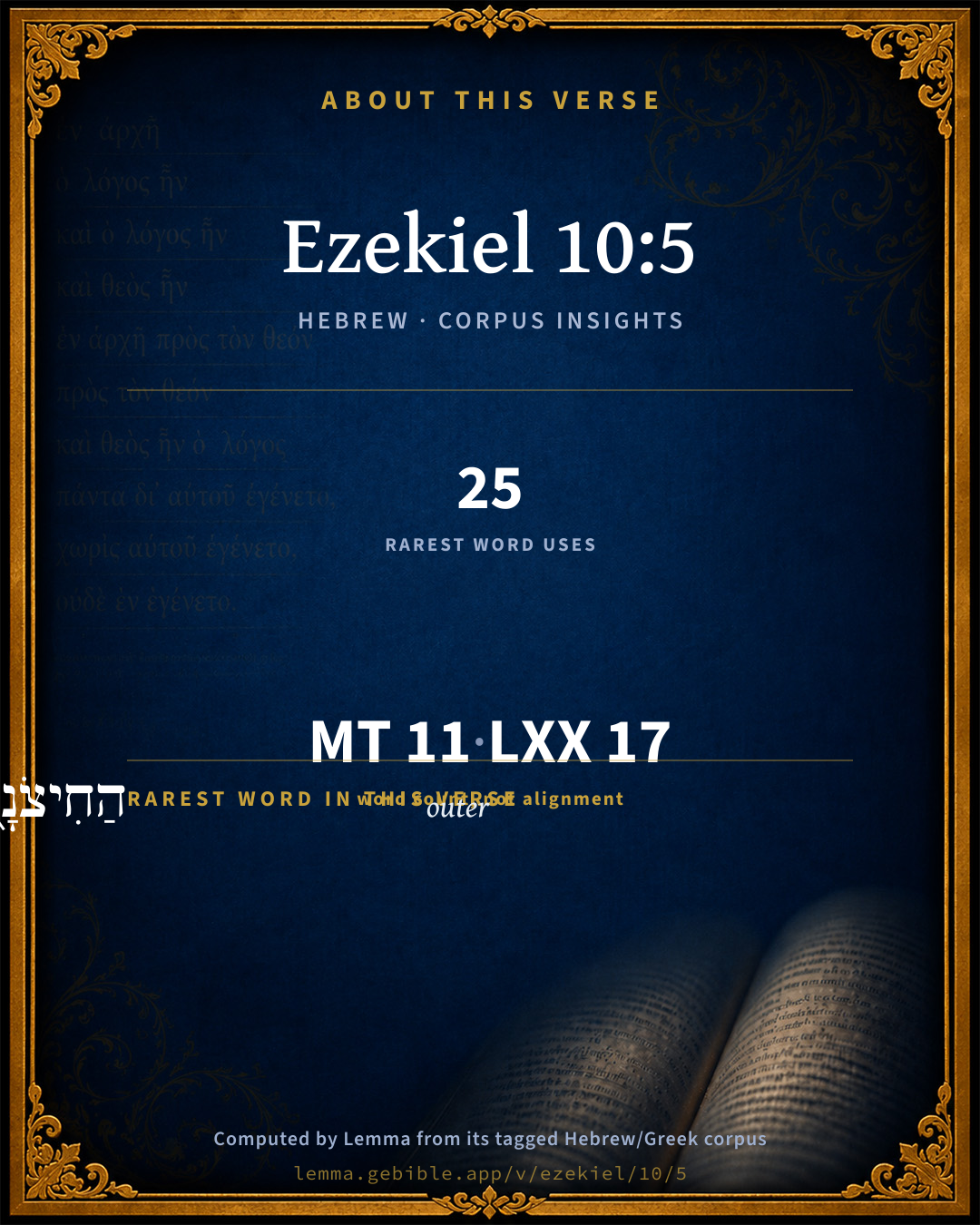
The rarest word here is הַחִיצֹנָ֑ה outer H2435 — appearing just 25 times in the whole Hebrew Bible.

Shared distinctive vocabulary

הַחִיצֹנָ֑ה outer H2435 occurs in 24 verses of the Hebrew Bible. Also found in:

Grammatical profile

  • 2 verbs
  • 7 nouns
  • 1 adjective
  • 1 preposition

Verb forms

  • נִשְׁמַ֕ע Niphal · Perfect
  • בְּדַבְּרֽוֹ Piel · Infinitive Construct

Repetition

A word recurs within this verse — often emphatic in Hebrew:

  • וְקוֹל֙ voice H6963 ×2

Hebrew & Septuagint length

In English translation the verse runs 24 words from the Hebrew and 23 from the Septuagint (LXX English) — closely comparable.

A rough comparison of the two English renderings, which tokenize alike — not a word-level alignment.

Word counts can differ between the Hebrew and the Greek without any difference in meaning — e.g. the Hebrew direct-object marker אֵת has no separate Greek word, and Greek often adds the article ὁ.

In the original languages it is 11 Hebrew tokens and 17 Greek tokens — but the two are counted differently (Hebrew bundles its prefixes and suffixes into one token; the Greek is in lemma form), so that isn’t a like-for-like length.

Cross-references

16

Topical passages linked to Ezekiel 10:5 in the Treasury of Scripture Knowledge — connected by theme and wording, ordered by reader-vote popularity; previews shown in the World English Bible.

  • Ezekiel 1:24 When they went, I heard the noise of their wings like the noise of great waters, like the voice of the Almighty, a noise of tumult like the noise of a host: when they stood, they let down their wings.
  • Job 40:9 Or have you an arm like God? Can you thunder with a voice like him?
  • Exodus 19:16 It happened on the third day, when it was morning, that there were thunders and lightnings, and a thick cloud on the mountain, and the sound of an exceedingly loud trumpet; and all the people who were in the camp trembled.
  • Exodus 19:19 When the sound of the trumpet grew louder and louder, Moses spoke, and God answered him by a voice.
  • Exodus 20:18–19 All the people perceived the thunderings, the lightnings, the sound of the trumpet, and the mountain smoking. When the people saw it, they trembled, and stayed at a distance.
  • Deuteronomy 4:12–13 Yahweh spoke to you out of the midst of the fire: you heard the voice of words, but you saw no form; only [you heard] a voice.
  • 1 Kings 7:9 All these were of costly stones, even of hewn stone, according to measure, sawed with saws, inside and outside, even from the foundation to the coping, and so on the outside to the great court.
  • Job 37:2–5 Hear, oh, hear the noise of his voice, The sound that goes out of his mouth.
  • 2 Chronicles 4:9 Furthermore he made the court of the priests, and the great court, and doors for the court, and overlaid the doors of them with brass.
  • Psalms 29:3–9 Yahweh's voice is on the waters. The God of glory thunders, even Yahweh on many waters.
  • Psalms 68:33 To him who rides on the heaven of heavens, which are of old; Behold, he utters his voice, a mighty voice.
  • Psalms 77:17 The clouds poured out water. The skies resounded with thunder. Your arrows also flashed around.
  • Ezekiel 46:21 Then he brought me forth into the outer court, and caused me to pass by the four corners of the court; and, behold, in every corner of the court there was a court.
  • John 12:28–29 Father, glorify your name!" Then there came a voice out of the sky, saying, "I have both glorified it, and will glorify it again."
  • Hebrews 12:18–19 For you have not come to a mountain that might be touched, and that burned with fire, and to blackness, darkness, tempest,
  • Revelation 10:3–4 He cried with a loud voice, as a lion roars. When he cried, the seven thunders uttered their voices.

Cross-references courtesy of OpenBible.info (CC BY 4.0).

Hebrew and Greek witnesses Masoretic Hebrew ↔ Greek Septuagint

The same verse in the two great witnesses to the Old Testament, shown verse-for-verse.

These are two independent witnesses, not word-aligned to each other, and the Septuagint is shown in lemma (dictionary) form.

Hebrew Ezekiel 10:5 Masoretic · Westminster Leningrad Codex

וְקוֹל֙ כַּנְפֵ֣י הַכְּרוּבִ֔ים נִשְׁמַ֕ע עַד הֶחָצֵ֖ר הַחִיצֹנָ֑ה כְּק֥וֹל אֵל שַׁדַּ֖י בְּדַבְּרֽוֹ

The sound of the wings of the cherubim was heard even to the outer court, as the voice of God Almighty when he speaks.

World English Bible · Public Domain

Greek LXX Ezekiel 10:5 Septuagint · lemma form

καί φωνή ὁ πτέρυξ ὁ χερουβείμ ἀκούω ἕως ὁ αὐλή ὁ ἐξώτερος ὡς φωνή θεός σαδδαι λαλέω

And the sound of the cherubs' wings was heard as far as the outer court, as the voice of the Almighty God speaking.

LXX2012 (modern English Septuagint) · Public Domain

Hebrew: Westminster Leningrad Codex (CC BY 4.0). Greek: Septuagint (public domain); English from LXX2012 (modern English Septuagint) (Public Domain). How the Septuagint differs from the Hebrew →

Targum (Aramaic paraphrase)

1

The Targum is the ancient Jewish Aramaic paraphrase of the Hebrew Scriptures — an interpretive translation, not the Hebrew text itself. Onkelos (literal) and Pseudo-Jonathan (expansive) render the Torah, and Jonathan the Prophets. Coverage is partial: where no permissively-licensed English translation exists for a verse, only the Aramaic is shown. This is verse-level text, not a word-by-word alignment to the Hebrew.

  1. Targum Jonathan Prophets (Joshua–Malachi)
    וְקַל כַּנְפֵי כְרוּבַיָא אִשְׁתְּמַע עַד דַרְתָּא בִּרְיָתָא כְקָלָא מִן קֳדָם שַׁדַי בְּמִלוּלָא:

    (no public-domain English translation for this verse)

    Targum Jonathan — Aramaic: “Mikraot Gedolot” (public domain). English: “Sefaria Community Translation” (CC0 1.0 (public-domain dedication)); “London "Chaldee Paraphrase," 1871” (public domain). Text via Sefaria.

Commentary

Notes on Ezekiel 10:5 from classic Christian and Jewish commentators (each source and its license shown beneath its notes). The classic Christian expositions comment on the surrounding passage and are grouped to its opening verse, so a note may address several verses; the Jewish commentaries on the Tanakh (Rashi and others) are per-verse, so they appear only where the commentator wrote on this verse.

Lemma curates 59 commentaries, every one of them public domain or Creative Commons licensed, each selected and text-cleaned for this edition rather than reprinted as found. About our sources →

Ellicott's Commentary for English Readers

(5) The sound of the cherubims’ wings.—This sound indicates that the cherubim were already in motion, for when they stood they “let down their wings” (Eze_1:24). They were now just on the eve of going away, and the movement was a great one, so that the sound was “heard even to the outer court” Throughout this chapter the s in cherubims is quite unnecessary, since cherubim is already the Hebrew plural of cherub.

Eze_10:6-7 are not subsequent in time to Eze_10:5, but are simply a more particular account, given parenthetically, of what had already been briefly mentioned in Eze_10:2.

Eze_10:8-17 are largely a repetition of the description of the vision in Ezekiel 1, but it is here given in parts, parenthetically, in connection with the progress of the narrative. The course of the narrative itself is as follows :—After the man in linen has gone out (Eze_10:7), a command is issued, “O wheel.” They were to set themselves in motion. Then (Eze_10:15) they “were lifted up,” and (Eze_10:18-19) “the glory of the Lord departed” from the Temple, and “mounted up from the earth.” The repetition of the description of Ezekiel 1 is by no means accidental, but serves partly to connect the various particulars with the course of the symbolic narrative, and mainly to emphasize the identity of the glory departing from the Temple with the Divine glory before seen. There are, however, several variations from the former description. Particularly in Eze_10:12 (as in Rev_4:6) there is mention of the abundance of eyes, a symbol of vigilance and activity, covering the whole body of the cherubim and the wheels. In Eze_10:14, after saying that “every one had four faces,” as in Ezekiel 1, the particular faces are described, but with this important variation :—the first is said to be “the face of a cherub,” instead of “the face of an ox,” as in Ezekiel 1; more exactly it is “the face of the cherub,” since the Hebrew has the definite article. The reason of this variation and the meaning of “the face of the cherub” are both obscure. In Eze_10:22 it is expressly said that their faces were the same as those seen by the Chebar; and again, in Eze_10:15-20, the whole vision is described as the “living creature” seen by the Chebar. It is plain, therefore, that the variation is only in the description, and not in the thing described. The most natural solution of the difficulty in the text as it stands is that a cherub was ordinarily represented with the face of an ox. But there is no evidence of this, and it is not impossible that a slight error may have been introduced into the text. The Greek version did not contain the verse in the time of St. Jerome, and in its Roman form does not now. It was introduced into the Alexandrian copies from the later version of Theodotion, and Theodoret does not recognise it.

A Bible Commentary for English Readers, edited by Charles John Ellicott (1878–1897) — public domain. Text from a community e-Sword module.

Trapp's Complete Commentary

John Trapp

Eze 10:5 And the sound of the cherubims’ wings was heard [even] to the outer court, as the voice of the Almighty God when he speaketh.

Ver. 5. And the sound of the cherubims’ wings was heard.] As applauding Christ’s act, and rejoicing thereat.

As the voice of the Almighty God,] i.e., As thunder. {Psa 29:3} Hereby might also be signified insignis et insolita mutatio in urbe, a notable noise that should be made in the city by clattering of arms, neighing of horses, roaring of enemies, &c. The Hebrew word here used is Shaddai, which signifieth vastatorem et victorem, saith Aben Ezra, a waster and a victor.

John Trapp, A Commentary or Exposition upon All the Books of the Old and New Testament (1647–1656) — public domain. Text from a community e-Sword module.

Geneva Bible (1599)

Geneva Bible translators

Read Ezek. 1:24.

Geneva Bible (1599) marginal notes — public domain. Text via Bolls.life.

Jamieson, Fausset & Brown

Robert Jamieson, A. R. Fausset & David Brown

sound of . . . wings--prognostic of great and awful changes.

voice of . . . God--the thunder (Psa 29:3, &c.).

Jamieson, Fausset & Brown — Commentary Critical and Explanatory on the Whole Bible (1871) — public domain (CC PDM 1.0). Text via the HelloAO Bible API.

Adam Clarke's Commentary

Verse 5. As the voice of the Almighty God] That is, as thunder; for this was called the voice of God.

Adam Clarke's Commentary on the Bible (1810–1826) — public domain. Text from a community e-Sword/MySword module.

John Calvin's Commentaries

In this verse also the Prophet confirms the vision, because God always gave signs of his presence. But it seems also to have another object, since the cherubim by the sound of their wings point out a remarkable change, both unusual and incomprehensible. For he says, there was a noise which shook the place, just as if God was speaking. When therefore we hear God’s voice, the Prophet means to say, it is just as if God thundered from heaven and made the whole world tremble; for no concussion can be more severe than that sound of the cherubims’ wings. From this a certain wonderful change must be perceptible, since God so filled his Prophet with terror, that he should be a messenger and witness of it to all others.

John Calvin's Commentaries (1540-1563) — public domain. Text from the Calvin Translation Society English edition (1840s-50s) via the Christian Classics Ethereal Library (ccel.org). Calvin's coverage is partial (roughly two-thirds of the Bible); uncommented books and verses are honest gaps, never fabricated. The 19th-century editor's footnotes and remarks are omitted so the notes are faithfully Calvin's own voice.

The Cambridge Bible for Schools and Colleges

gen. ed. J. J. S. Perowne

5. sound of the cherubims’ wings] It is to be supposed that some movement of the living creatures’ wings accompanied the rising of the divine glory from above them, as it is said that when they stood their wings dropped (Eze_1:24). The language of Eze_10:18 (cf. Eze_9:3) excludes the supposition that the cherubim as well as the glory moved towards the threshold (Ew.). Jehovah’s “speaking” is the thunder (ch. Eze_1:24), but the statement that the sound was heard in the outer court is strange, as the distance was not great. In Ezekiel’s day, however, the outer court had not the symmetry which he gives it in his final vision but extended to a considerable distance from the house, and may have been regarded as including the royal buildings (see the plans Ency. Brit., and Stade’s Hist., vol. i).

The Cambridge Bible for Schools and Colleges (gen. ed. J. J. S. Perowne; Cambridge University Press, 1878–1918) — public domain. Text from a community e-Sword module.

John Gill's Exposition

And the sound of the cherubim's wings was heard even to the outer court,.... Or outward court. The sound of the Gospel, which is a joyful sound; a sound of love, grace, and mercy; of life, liberty, peace, pardon, righteousness, and salvation by Christ; the sound of this in the swift ministry of the apostles, signified by the "cherubim's wings", went into all the earth, and throughout the whole Gentile world; by which many souls were quickened and enlightened; many churches were formed; and the glory of the Lord, being revealed, was seen by all flesh; and the whole world was filled with the brightness of the Lord's glory, as it will be again, and more abundantly, in the latter day: and this sound was

as the voice of the Almighty God when he speaketh; the Gospel is as thunder, which is the voice of God; and the ministers of it are "Boanergeses", "sons of thunder", Mar 3:17, it shakes the conscience; shows men their danger; and points at the Saviour: it is not the word of man, but in deed and in truth the word of God: it is the voice of Christ, who is the Almighty; and it appears to be so, by its powerful effects, when attended with a divine energy, in quickening dead sinners; enlightening dark minds; unstopping deaf ears; softening hard hearts; and turning men from darkness to light, and from the power of Satan to God; it is so when God speaks in it, and by it; when it comes not in word only, but in the Holy Ghost, and in power.

John Gill's Exposition of the Whole Bible (1746–1763) — public domain (CC PDM 1.0). Text via the HelloAO Bible API.

Albert Barnes' Notes on the Bible

The Almighty God - El Shaddai; compare the Gen 17:1 note.

Albert Barnes' Notes on the Bible (1834–1885) — public domain. Text from a community e-Sword/MySword module.

Haydock's Catholic Bible Commentary

Court of the people. --- Speaking in thunder.

George Leo Haydock (1774–1849), Haydock's Catholic Family Bible and Commentary, 1859 edition — public domain. Excludes Psalms (Douay-Rheims chapter numbering differs from Protestant) and Deuterocanonical books (Catholic canon only).

Matthew Poole's English Annotations

There was a great and dreadful noise to awaken, or stop the mouths of sinners; whether this was an applause of Christ’s righteous procedure, or any sound of alarm, or both, let your own judgment determine. See Eze 1:24.

Was heard; such as might well be heard; and as the vision represented such a great sound to the prophet, he reports it to the Jews; not that the elders now with Ezekiel did hear this, or that such an audible sound was heard in Jerusalem, but it is all represented to the prophet, and by him to them.

The outer court; this was the court of the women.

As the voice of the Almighty; as a mighty and terrible thunder, which is, Psa 29:3-5, the voice of the Lord.

When he speaketh; as when he spake on Mount Sinai, which made them all fear, and the sight so terrible, that Moses himself trembled, Heb 12.

Matthew Poole's English Annotations on the Holy Bible (1683–1685) — public domain. Text from a community e-Sword/MySword module.

Whedon's Commentary on the Bible

Daniel D. Whedon

5. Even to the outer court — See comments Eze_8:16; Eze_9:3. We consider the glory to be over the threshold of the inner court, near the sanctuary.

The voice of the Almighty God — The Hebrews often spoke of the thunder as the voice of El Shaddai, or Jehovah (Psalms 29). The movements of the cherubs’ wings, as they made ready to accompany their Master, though detained by divine will, could be heard even into the court of the Gentiles, and sounded like the noise of thunder. “‘El Shaddai’ was the name of God as ruling over nature, while ‘Jehovah’ expressed his covenant relationship to Israel.” — Plumptre.

Daniel D. Whedon (gen. ed.), Commentary on the Old and New Testaments (1874–1909) — public domain. Text from a community e-Sword module.

The Pulpit Commentary

Vers. 5, 6. And the sound of the cherubim. The use of God Almighty, (El Shaddai; comp. Exo_6:3) the name of God as ruling over nature, while Jehovah expressed his covenant relationship to Israel, is, it may be noted, characteristic of the early stage of the religion of Israel. (Gen_17:1 Gen_28:3 Gen_43:14 Gen_48:3) Shaddai alone appears eighty-one times in the Book of Job. Psalm 29. explains the voice of El Shaddai (though there it is "the voice of Jehovah") as meaning the roar of the thunder. The hands of the "living creatures," now recognized as cherubim, had been mentioned in Eze_1:8, and it is one of those hands that gives the fire into the hands of the linen vested minister of wrath. The elemental forces of nature, of which the cherubim are, partly at least, the symbols, are working out the purposes of Jehovah. The two words translated wheels are different in the Hebrew. The first is singular and collective (galgal, the "whirling thing," used of the wheel of a war chariot, (Eze_23:24; Isa_5:28) and might well be translated "chariot"here. The second, that used in Eze_1:15, Eze_1:16, also in the singular, is applied to the single wheel of the four by which the angel, ministers stood.

The voice of the Almighty.

The human voice deserves to be studied and admired as a most effective and delicate and exquisitely beautiful provision for the expression of thought and feeling. It is so ethereal, so semi-spiritual, that there seems scarcely any anthropomorphism in attributing it to the Creator himself. The sounds of nature may indeed be designated the voice of God. But the characteristics of the human utterance seem most justly attributable to him who comprehends in perfection within himself all those thoughts and emotions which are distinctive of the spiritual nature.

I THE EXPRESSION CASTS LIGHT UPON THE NATURE OF GOD. The voice is, among all the inhabitants of this earth, man"s prerogative alone. And for this reason man alone has reason, and therefore he alone has speech. There are noises and sounds, and even musical sounds, in nature; but to man alone belongs the voice, the organ of articulate speech and intelligible language. When voice is attributed to the Almighty God, it is implied that he is himself in perfection that Reason which he communicates to his creature man. Our intellect and thought are derived from his, and are akin to his; our reason is "the candle of the Lord" within.

II THE EXPRESSION CASTS LIGHT UPON THE INTERCOURSE BETWEEN GOD AND MAN. The purpose of the voice is that man may communicate with his fellow man by means of articulate language, and by means of all those varied and delicate shades of intonation by which we convey our sentiments, and indicate satisfaction and disapproval, confidence and distrust, tenderness and severity, inquiry and command. Now, where we meet in Scripture with the phrase, "the voice of God Almighty when he speaketh," we are led to think of the purpose for which he utters his voice. It is evidently to communicate with man mind with mind that we may be acquainted with his thoughts, his wishes, his sentiments with regard to us, if we may use language so human. The whole of nature may be regarded as uttering the Divine thought, though, as the psalmist tells us, "there is no speech nor language, and their voice cannot be heard." But his articulate speech comes through the medium of human minds the minds of prophets and apostles, and (above all) the mind of Christ Jesus. The Word speaks with the Divine voice; in him alone that voice reaches us with all the faultless tones, and with the perfect revelation which we need in order that we may realize and rejoice in the presence of the Divine Father of spirits, the Divine Saviour and Helper.

III THIS EXPRESSION CASTS LIGHT UPON THE DUTY AND PRIVILEGE OF MAN.

1. It is ours to listen with grateful joy to the voice of God. "The friend ofthe bridegroom rejoiceth greatly because of the bridegroom"s voice." Christ speaks, and his utterances are welcome to every believing and sympathetic nature; they are as the sound of a voice long expected and wished for, as it now fails upon the listening and eager ear. The sinner may well dread the voice which can speak to him as with the thunder of threatened vengeance. But the Christian recognizes the tones of love and the accents of gentleness.

2. It is ours to listen to the voice of God with believing submission andobedience. God"s voice is always with authority. Because he reveals himself as our Father, he does not cease to command. "Ye have not heard his voice at any time," was the stern reproach addressed by Jesus to the unspiritual Jews. The exhortation comes to us all, "Today if ye will hear his voice, harden not your hearts. T.

The Pulpit Commentary (1880–1919), ed. H.D.M. Spence-Jones & Joseph S. Exell — public domain. Text from a community e-Sword module.

John Wesley's Explanatory Notes

Was heard - As a mighty and terrible thunder.

John Wesley, Explanatory Notes Upon the Whole Bible (1754–1765) — public domain. Text via the GEBible commentary corpus.

Rashi

Rabbi Shlomo Yitzchaki (Rashi)

until the outer court The Temple Mount. I may think that [it was heard no further] because the sound was low. Therefore, Scripture states: “like the voice of God Almighty when He speaks.” Yet, when it would reach the outer court, it would [suddenly] stop.

Rashi on the Tanakh — English translations: “The Judaica Press complete Tanach with Rashi, translated by A. J. Rosenberg” (CC BY 4.0); “Pentateuch with Rashi's commentary by M. Rosenbaum and A.M. Silbermann, 1929-1934” (public domain); “The Metsudah Tanach series, Lakewood, N.J” (CC BY 4.0); and “The Book of Joshua, Metsudah Publications, 1997” (CC BY 4.0). Text via Sefaria.

Lesson kit

Teaching starters — assembled from the data on this page, not authored interpretation. Every prompt links to the verse data it draws on. Edit before teaching.

Ezekiel, in the Prophets, opens this verse with 11 words (10 distinct Hebrew lemmas). Its most distinctive word is chîytsôwn (“outer”). A historical commentator’s framing appears above. Read the whole chapter for the surrounding context.

Discussion questions

  1. How does “outer” (chîytsôwn) shape what this verse is saying?
  2. How does 1 Kings 6:29, which shares the word «outer», read alongside this verse?
  3. What does the repetition of “voice” (2× in this one verse) do in this verse?
  4. These translations render this verse differently; the difference is in the English rendering, not the original. What questions does that raise?
  5. «נִשְׁמַ֕ע» is a Niphal Perfect verb. How does that grammatical form shape the action described?
  6. Compare how Ellicott's Commentary for English Readers and Trapp's Complete Commentary read this verse. Where do they agree or differ?

Things to notice

Reading settings

Reading text

Shown beneath each verse's original-language words.

Old Testament
Old Testament edition

Read the OT as the Masoretic Hebrew (MT) or the Greek Septuagint (LXX).

English shown for the Greek Septuagint (in the Hebrew ↔ Greek comparison).

Comparing translations? Open the Compare panel on any verse page to stack up to four side by side.