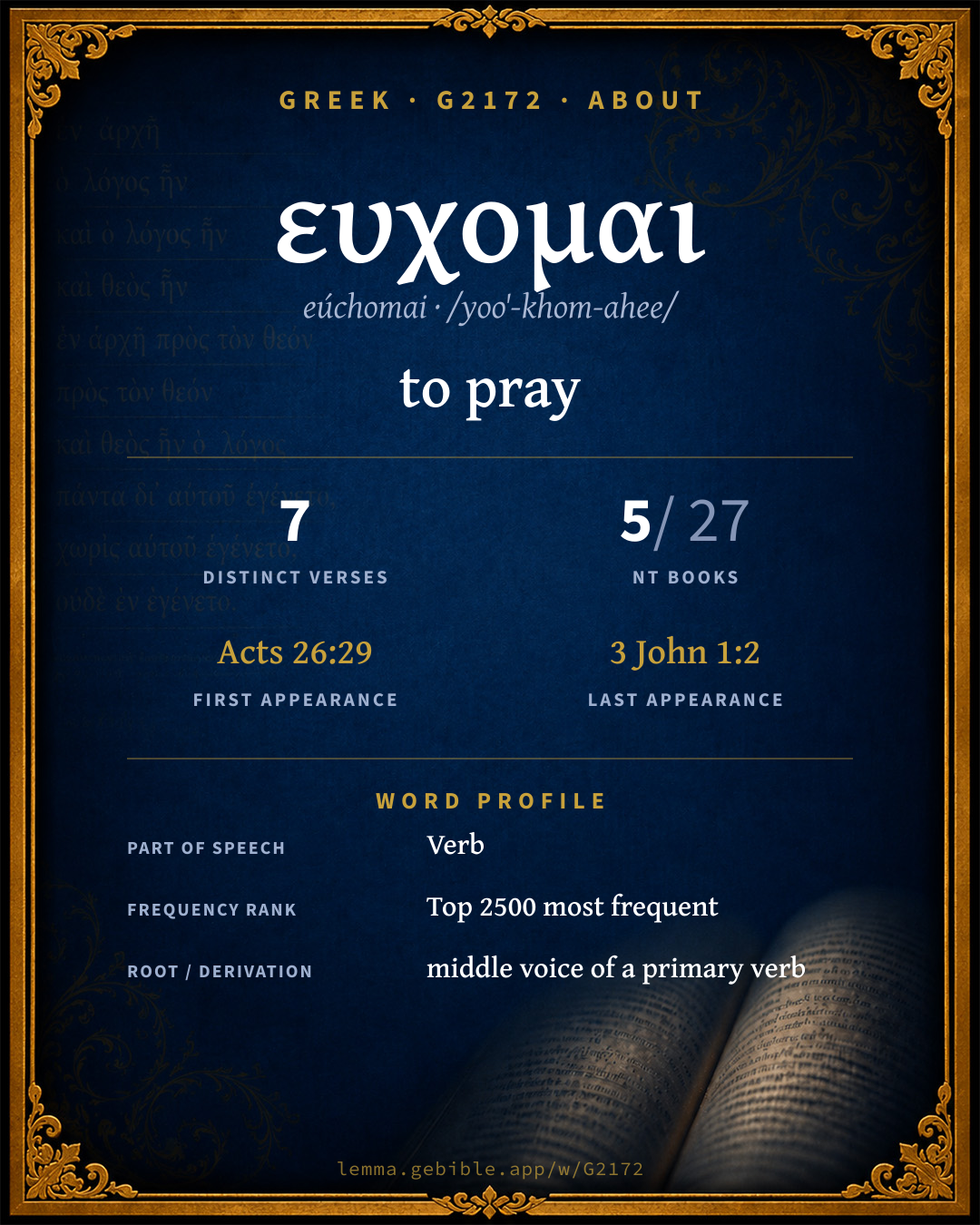
εὔχομαι
to pray
‘to pray’ is one of 2 main senses fuller range ↓
Full lexicon entry — Thayer's Greek Lexicon
From Thayer's Greek Lexicon
Where this word appears
See every Present-tense verb in the Greek New Testament →
Grammar key — what these labels mean
Part of speech
- Verb
- An action or state-of-being word.
Tense
- Present
- Ongoing or general action in present time (imperfective aspect).
- Aorist
- Action viewed as a simple whole, without regard to duration — often past (perfective aspect).
- Imperfect
- Continuous or repeated action in past time (“was writing”).
Voice
- Middle or Passive deponent
- Middle/passive in form but active in meaning.
- Middle deponent
- Middle in form but active in meaning.
Mood
- Indicative
- States a fact or asks a factual question (the mood of reality).
- Optative
- Expresses a wish or a remote possibility.
- Imperative
- Expresses a command or request.
Person
- 1st person
- The speaker (“I / we”).
- 3rd person
- The one spoken about (“he / she / it / they”).
- 2nd person
- The one addressed (“you”).
Number
- Plural
- More than one.
- Singular
- One.
Grammatical forms
- Verb, Present, Middle or Passive deponent, Indicative, 1st person, Plural 2 times (29%)
- Verb, Aorist, Middle deponent, Optative, 1st person, Singular 1 time (14%)
- Verb, Imperfect, Middle or Passive deponent, Indicative, 1st person, Singular 1 time (14%)
- Verb, Imperfect, Middle or Passive deponent, Indicative, 3rd person, Plural 1 time (14%)
- Verb, Present, Middle or Passive deponent, Indicative, 1st person, Singular 1 time (14%)
- Verb, Present, Middle or Passive deponent, Imperative, 2nd person, Plural 1 time (14%)
Parsed forms decoded from the imported morphology (Robinson–Tischendorf, public domain), counted across 7 parsed occurrences — not distinct verses.
Every verse where G2172 appears — 7 distinct verses across 5 books. Click any verse to open its interlinear word-by-word view. Verse text shown in the World English Bible for context — . Each verse’s Greek form is shown with its reference; the English is not keyword-highlighted, since the data carries no word-level English alignment. Use “Compare translations” on any verse to read it across multiple English versions. This concordance covers the Greek New Testament; Septuagint (Greek Old Testament) occurrences of this word are not indexed here.
Acts 2 verses
- Acts 26:29 εὐξαίμην aor mid.dep opt 1sg Paul said, "I pray to God, that whether with little or with much, not only you, but also all that hear me this day, might become such as I am, except for these bonds."
- Acts 27:29 εὔχοντο impf mid/pass.dep ind 3pl Fearing that we would run aground on rocky ground, they let go four anchors from the stern, and wished for daylight.
Romans 1 verse
2 Corinthians 2 verses
- 2 Corinthians 13:7 εὐχόμεθα pres mid/pass.dep ind 1pl Now I pray to God that you do no evil; not that we may appear approved, but that you may do that which is honorable, though we are as reprobate.
- 2 Corinthians 13:9 εὐχόμεθα pres mid/pass.dep ind 1pl For we rejoice when we are weak and you are strong. And this we also pray for, even your perfecting.
James 1 verse
3 John 1 verse
About this entry
At a glance — auto-summarized from this page’s data, not written by a person. Every figure links to its source below. This summary describes the numbers; it doesn’t interpret them.
ευχομαι (eúchomai) is a Greek verb most often rendered “to pray.” It first appears in Acts 26:29. Spanning 7 verses in 5 books, it ranks among the uncommon words of the Greek New Testament. Acts dominates its distribution — 2 of 7 verses. Its lexical range runs to 2 senses. The sections below give every sense, occurrence, and version rendering.
Gloss history
Strong's 1890 vs modern scholarship
About this word
Strong's G2172 catalogs a Greek word from the Greek New Testament.
These counts are not copied from any lexicon or concordance. They are computed here, from the morphology-tagged Greek New Testament. What Lemma adds →
- 7
- distinct verses
- The word appears in 7 distinct verses.
- 5 / 27
- NT books
- The word appears in 5 of 27 New Testament books.
- #1,358
- by frequency
- Top 2500 most frequent Greek words (rank 1,358 of 5,347 Greek words by occurrence).
View all 7 occurrences in the concordance →
Most concentrated in
- Acts 2 verses 29%
- 2 Corinthians 2 verses 29%
- Romans 1 verse 14%
By section of the New Testament
By traditional corpus
Conventional, traditional groupings — biblical authorship is debated, so this is a traditional corpus grouping, not an authorship claim. Some books belong to more than one corpus (Luke is in both the Gospels and the Lukan corpus, and so on), so these shares overlap and need not total 100%. Each figure is a share of the word’s 7 distinct verses.
- Pauline corpus 3 verses · 43%
- Lukan (Luke–Acts) 2 verses · 29%
- General (Catholic) Epistles 2 verses · 29%
- Johannine 1 verse · 14%
How translations render this word
Counts come from each version’s own published word-to-Strong’s tagging or interlinear alignment — an approximate guide to how each version renders this word, not a word-level alignment the data otherwise carries. Because each total is that version’s own tagged count, the per-version totals vary from one another and need not match the appearance or distinct-verse counts above. These counts may also differ from a printed concordance because Lemma counts each distinctly tagged rendering and does not collapse phrase taggings into a single head-word total. This is a fixed set of word-tagged versions (KJV, ASV, BSB, ULT) and does not change with the reading translation you choose elsewhere. Each version’s license is shown beside its name below (and on Sources).
- King James Version: Could wish 1×, I pray 1×, I wish 1×
- American Standard Version: Pray 2×
- Berean Standard Bible: Could wish that 1×, I pray that 1×, I wish 1×
- unfoldingWord Literal Text: That 2×
King James Version Public Domain
Renders G2172 across 6 tagged occurrences — most commonly:
Not rendered by a distinct English word in 1 further occurrence.
American Standard Version Public Domain
Renders G2172 across 7 tagged occurrences — most commonly:
Plus 5 renderings that appear only once — usually multi-word phrases or single function words the recovered tagging swept in, not distinct renderings.
Berean Standard Bible Public Domain
Renders G2172 across 7 tagged occurrences — most commonly:
unfoldingWord Literal Text CC BY-SA 4.0
Renders G2172 across 10 tagged occurrences — most commonly:
Plus 8 renderings that appear only once — usually multi-word phrases or single function words the recovered tagging swept in, not distinct renderings.
Senses in Thayer's
The 2 senses Thayer's distinguishes for this word, in lexicon order (not ranked by frequency or importance). The full entry — with sub-senses — is in the Lexicon Entry tab.
- to pray to God
- to wish, to pray, to pray for
Word origin
Origin: middle voice of a primary verb
Middle voice of a primary verb; to wish ; by implication to pray to God : - pray will wish.
— Strong’s Exhaustive Concordance (1890), public domain.
Forms in the corpus
The 6 distinct written forms G2172 takes in the Greek New Testament, most frequent first — each parse links to that tense’s occurrences in the concordance.
| Form | Parsing | Example | Uses |
|---|---|---|---|
| εὐχόμεθα euchómetha | Verb, Present, Middle or Passive deponent, Indicative, 1st person, Plural | 2 Corinthians 13:7 | 2 |
| εὐξαίμην euxaímēn | Verb, Aorist, Middle deponent, Optative, 1st person, Singular | Acts 26:29 | 1 |
| εὔχεσθε eúchesthe | Verb, Present, Middle or Passive deponent, Imperative, 2nd person, Plural | James 5:16 | 1 |
| εὔχομαί eúchomaí | Verb, Present, Middle or Passive deponent, Indicative, 1st person, Singular | 3 John 1:2 | 1 |
| εὔχοντο eúchonto | Verb, Imperfect, Middle or Passive deponent, Indicative, 3rd person, Plural | Acts 27:29 | 1 |
| ηὐχόμην ēuchómēn | Verb, Imperfect, Middle or Passive deponent, Indicative, 1st person, Singular | Romans 9:3 | 1 |
Same root — word family
Other Thayer's entries built from the same root as G2172, grouped by Strong’s listed origin. These share a root / origin per the lexicon — not necessarily a shared meaning. Each links to that word’s own entry.
Derived from this word
Compare all same-root words → They share a root, not necessarily a meaning.
Septuagint usage
The same Greek word ευχομαι appears 62 times in the Greek Old Testament (Septuagint), across 57 verses in 17 books.
- 62
- LXX occurrences
- Tagged occurrences of this Greek word in the Septuagint.
- 57
- verses
- Distinct Septuagint verses containing this word.
- 17 / 39
- OT books
- The word appears in 17 of the 39 Old Testament books.
Sample Septuagint occurrences
- Genesis 28:20 εὔχομαι
- Exodus 8:4 εὔχομαι
- Leviticus 27:2 εὔχομαι
- Numbers 6:2 εὔχομαι
- Deuteronomy 9:20 εὔχομαι
- Judges 11:30 εὔχομαι
- 1 Samuel 1:11 εὔχομαι
- 2 Samuel 15:7 εὔχομαι
- 2 Kings 20:2 εὔχομαι
- Job 22:27 εὔχομαι
- Psalms 75:12 εὔχομαι
- Proverbs 20:16 εὔχομαι
Septuagint occurrences (same lexeme)
Every verse where the same Strong’s number (G2172) appears in the Greek Septuagint — showing the first 50 of 57. Verse text shown in the World English Bible for context; the Greek form is the matched word — the English is not keyword-highlighted.
- Genesis 28:20 εὔχομαι Jacob vowed a vow, saying, "If God will be with me, and will keep me in this way that I go, and will give me bread to eat, and clothing to put on,
- Genesis 31:13 εὔχομαι I am the God of Bethel, where you anointed a pillar, where you vowed a vow to me. Now arise, get out from this land, and return to the land of your birth."
- Exodus 8:4 εὔχομαι and the frogs shall come up both on you, and on your people, and on all your servants.'"
- Exodus 8:5 εὔχομαι Yahweh said to Moses, "Tell Aaron, 'Stretch forth your hand with your rod over the rivers, over the streams, and over the pools, and cause frogs to come up on the land of Egypt.'"
- Exodus 8:24 εὔχομαι Yahweh did so; and there came grievous swarms of flies into the house of Pharaoh, and into his servants' houses: and in all the land of Egypt the land was corrupted by reason of the swarms of flies.
- Exodus 8:25 εὔχομαι Pharaoh called for Moses and for Aaron, and said, "Go, sacrifice to your God in the land!"
- Exodus 8:26 εὔχομαι Moses said, "It isn't appropriate to do so; for we shall sacrifice the abomination of the Egyptians to Yahweh our God. Behold, shall we sacrifice the abomination of the Egyptians before their eyes, and won't they stone us?
- Exodus 9:28 εὔχομαι Pray to Yahweh; for there has been enough of mighty thunderings and hail. I will let you go, and you shall stay no longer."
- Exodus 10:18 εὔχομαι He went out from Pharaoh, and prayed to Yahweh.
- Leviticus 27:2 εὔχομαι "Speak to the children of Israel, and say to them, 'When a man makes a vow, the persons shall be for Yahweh by your valuation.
- Leviticus 27:8 εὔχομαι But if he is poorer than your valuation, then he shall be set before the priest, and the priest shall value him; according to the ability of him who vowed shall the priest value him.
- Numbers 6:2 εὔχομαι "Speak to the children of Israel, and tell them: When either man or woman shall make a special vow, the vow of a Nazirite, to separate himself to Yahweh,
- Numbers 6:5 εὔχομαι "All the days of his vow of separation there shall no razor come on his head, until the days are fulfilled, in which he separates himself to Yahweh. He shall be holy. He shall let the locks of the hair of his head grow long.
- Numbers 6:13 εὔχομαι "This is the law of the Nazirite: when the days of his separation are fulfilled, he shall be brought to the door of the Tent of Meeting,
- Numbers 6:18 εὔχομαι The Nazirite shall shave the head of his separation at the door of the Tent of Meeting, and shall take the hair of the head of his separation, and put it on the fire which is under the sacrifice of peace offerings.
- Numbers 6:19 εὔχομαι The priest shall take the boiled shoulder of the ram, and one unleavened cake out of the basket, and one unleavened wafer, and shall put them on the hands of the Nazirite, after he has shaved the head of his separation;
- Numbers 6:20 εὔχομαι and the priest shall wave them for a wave offering before Yahweh. This is holy for the priest, together with the breast that is waved and the thigh that is offered. After that the Nazirite may drink wine.
- Numbers 6:21 εὔχομαι "This is the law of the Nazirite who vows, and of his offering to Yahweh for his separation, besides that which he is able to get. According to his vow which he vows, so he must do after the law of his separation."
- Numbers 11:2 εὔχομαι The people cried to Moses; and Moses prayed to Yahweh, and the fire abated.
- Numbers 21:2 εὔχομαι Israel vowed a vow to Yahweh, and said, If you will indeed deliver this people into my hand, then I will utterly destroy their cities.
- Numbers 21:7 εὔχομαι The people came to Moses, and said, We have sinned, because we have spoken against Yahweh, and against you; pray to Yahweh, that he take away the serpents from us. Moses prayed for the people.
- Numbers 30:3 εὔχομαι Also when a woman vows a vow to Yahweh, and binds herself by a bond, being in her father's house, in her youth,
- Numbers 30:4 εὔχομαι and her father hears her vow, and her bond with which she has bound her soul, and her father holds his peace at her; then all her vows shall stand, and every bond with which she has bound her soul shall stand.
- Numbers 30:10 εὔχομαι If she vowed in her husband's house, or bound her soul by a bond with an oath,
- Deuteronomy 9:20 εὔχομαι Yahweh was very angry with Aaron to destroy him: and I prayed for Aaron also at the same time.
- Deuteronomy 9:26 εὔχομαι I prayed to Yahweh, and said, Lord Yahweh, don't destroy your people and your inheritance, that you have redeemed through your greatness, that you have brought forth out of Egypt with a mighty hand.
- Deuteronomy 12:11 εὔχομαι then it shall happen that to the place which Yahweh your God shall choose, to cause his name to dwell there, there shall you bring all that I command you: your burnt offerings, and your sacrifices, your tithes, and the heave-offering of your hand, and all your choice vows which you vow to Yahweh.
- Deuteronomy 12:17 εὔχομαι You may not eat within your gates the tithe of your grain, or of your new wine, or of your oil, or the firstborn of your herd or of your flock, nor any of your vows which you vow, nor your freewill-offerings, nor the heave-offering of your hand;
- Deuteronomy 23:22 εὔχομαι But if you shall forbear to vow, it shall be no sin in you.
- Deuteronomy 23:23 εὔχομαι That which is gone out of your lips you shall observe and do; according as you have vowed to Yahweh your God, a freewill-offering, which you have promised with your mouth.
- Deuteronomy 23:24 εὔχομαι When you come into your neighbor's vineyard, then you may eat of grapes your fill at your own pleasure; but you shall not put any in your vessel.
- Judges 11:30 εὔχομαι Jephthah vowed a vow to Yahweh, and said, If you will indeed deliver the children of Ammon into my hand,
- Judges 11:39 εὔχομαι It happened at the end of two months, that she returned to her father, who did with her according to his vow which he had vowed: and she was a virgin. It was a custom in Israel,
- 1 Samuel 1:11 εὔχομαι She vowed a vow, and said, Yahweh of hosts, if you will indeed look on the affliction of your handmaid, and remember me, and not forget your handmaid, but will give to your handmaid a man-child, then I will give him to Yahweh all the days of his life, and there shall no razor come on his head.
- 1 Samuel 2:9 εὔχομαι He will keep the feet of his holy ones; But the wicked shall be put to silence in darkness; For by strength shall no man prevail.
- 2 Samuel 15:7 εὔχομαι It happened at the end of forty years, that Absalom said to the king, please let me go and pay my vow, which I have vowed to Yahweh, in Hebron.
- 2 Samuel 15:8 εὔχομαι For your servant vowed a vow while I abode at Geshur in Syria, saying, If Yahweh shall indeed bring me again to Jerusalem, then I will serve Yahweh.
- 2 Kings 20:2 εὔχομαι Then he turned his face to the wall, and prayed to Yahweh, saying,
- Job 22:27 εὔχομαι You shall make your prayer to him, and he will hear you. You shall pay your vows.
- Job 33:26 εὔχομαι He prays to God, and he is favorable to him, So that he sees his face with joy: He restores to man his righteousness.
- Job 42:8 εὔχομαι Now therefore, take to yourselves seven bulls and seven rams, and go to my servant Job, and offer up for yourselves a burnt offering; and my servant Job shall pray for you, for I will accept him, that I not deal with you according to your folly. For you have not spoken of me the thing that is right, as my servant Job has."
- Job 42:10 εὔχομαι Yahweh turned the captivity of Job, when he prayed for his friends. Yahweh gave Job twice as much as he had before.
- Psalms 75:12 εὔχομαι
- Psalms 131:2 εὔχομαι Surely I have stilled and quieted my soul, Like a weaned child with his mother, Like a weaned child is my soul within me.
- Proverbs 20:16 εὔχομαι Take the garment of one who puts up collateral for a stranger; And hold him in pledge for a wayward woman.
- Ecclesiastes 5:3 εὔχομαι For as a dream comes with a multitude of cares, so a fool's speech with a multitude of words.
- Ecclesiastes 5:4 εὔχομαι When you vow a vow to God, don't defer to pay it; for he has no pleasure in fools. Pay that which you vow.
- Isaiah 19:21 εὔχομαι Yahweh shall be known to Egypt, and the Egyptians shall know Yahweh in that day; yes, they shall worship with sacrifice and offering, and shall vow a vow to Yahweh, and shall perform it.
- Jeremiah 7:16 εὔχομαι Therefore don't you pray for this people, neither lift up a cry nor prayer for them, neither make intercession to me; for I will not hear you.
- Jeremiah 22:27 εὔχομαι But to the land whereunto their soul longs to return, there shall they not return.
These are occurrences of the same Greek lexeme (G2172) in the Septuagint — not a translation of any one Hebrew word. The store carries no word-level Hebrew↔Greek alignment, so no Hebrew original is asserted here. Counts come from the recovered LXX Strong's tagging — high-frequency vocabulary is well covered, while rare or late forms may be untagged — so they reflect tagged occurrences and may slightly undercount.