

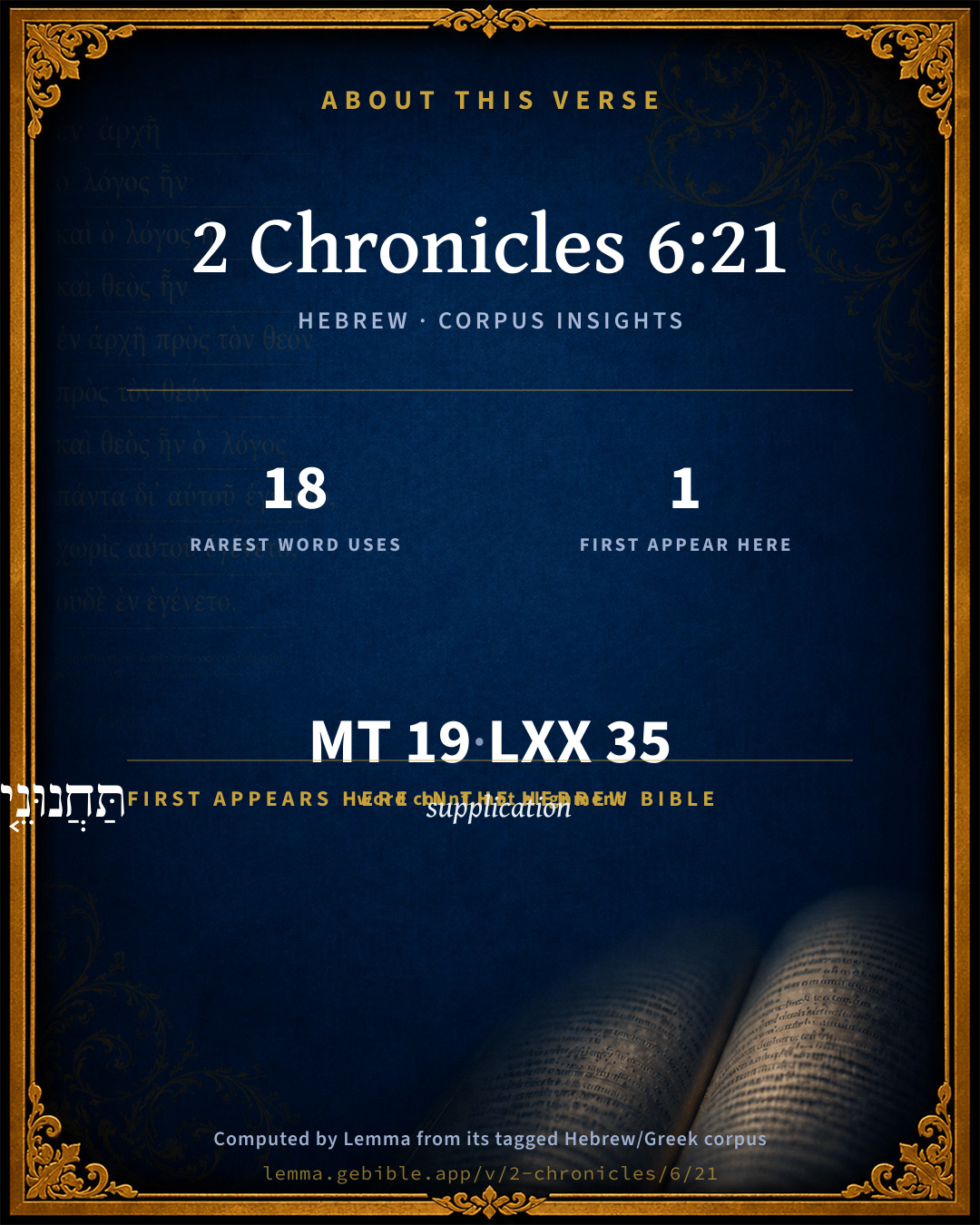
2 Chronicles 6:21

Hebrew (Westminster Leningrad Codex) 2 Chronicles 6:21 appears in the Hebrew Old Testament. The text above is from the Westminster Leningrad Codex. Each word links to its Strong’s number, a concise gloss, and parsing drawn from the Open Scriptures Hebrew Bible morphology. Click any word for its full Brown-Driver-Briggs (BDB) entry.
Download image
Cite this verse

2 Chronicles 6:21 (World English Bible). Public Domain. Lemma interlinear Bible study tool, https://lemma.gebible.app/v/2-chronicles/6/21.

Show BibTeX & RIS
BibTeX
RIS
English Translation
Listen you to the petitions of your servant, and of your people Israel, when they shall pray toward this place: yes, hear from your dwelling-place, even from heaven; and when you hear, forgive.
World English Bible · Public Domain
Highlights
  • 1 first appearance in the Hebrew Bible
Full analysis ↓
Download a study sheet

One document with this verse’s original text, its word-by-word gloss line, the meaning frame, cross-references with their text, attributed commentary, and full source and license credits — printable, and it pastes into notes with its structure intact.

This verse Autodidact and up

Study sheet (.html) Plain text (.txt)

A passage Seminary Student

Up to 50 verses in one chapter. A passage sheet keeps up to 6 commentary sources and 12 cross-references per verse, in the order this page ranks them, and says so on the sheet whenever that leaves anything out. Ask for a single verse and you get the Autodidact verse sheet above.

Everything on this page stays free to read, with no account — the sheet is a download of what is already on screen, not access to it.

Want to remove ads? Support Godless Engineer
Compare translations 3

The same verse in 3 English versions, stacked beneath the original-language interlinear above. Click any original word for its lexicon entry.

Each is an independent rendering of the whole verse — the interlinear is not word-aligned to these translations.

Highlighted words mark where these versions differ — a whole-verse word diff, not a word-by-word alignment.

  • World English Bible Public Domain
    Listen you to the petitions of your servant, and of your people Israel, when they shall pray toward this place: yes, hear from your dwelling-place, even from heaven; and when you hear, forgive.
  • King James Version Public Domain
    Hearken therefore unto the supplications of thy servant, and of thy people Israel, which they shall make toward this place: hear thou from thy dwelling place, even from heaven; and when thou hearest, forgive.
  • unfoldingWord Literal Text CC BY-SA 4.0
    And listen to the supplications of your servant and your people Israel when they pray toward this place, and you yourself hear from the place of your dwelling from the heavens, and hear and forgive.

unfoldingWord Literal Text — © unfoldingWord, licensed CC BY-SA 4.0. Word-aligned USFM3 via Door43 (git.door43.org/unfoldingWord/en_ult).

Versions to compare (up to 4)

3 of 4 selected

Show all 18 translations

Every available English version of this verse, each an independent rendering of the whole verse.

  • World English Bible Public Domain
    Listen you to the petitions of your servant, and of your people Israel, when they shall pray toward this place: yes, hear from your dwelling-place, even from heaven; and when you hear, forgive.
  • Berean Standard Bible Public Domain
    Hear the plea of Your servant and of Your people Israel when they pray toward this place. May You hear from heaven, Your dwelling place. May You hear and forgive.
  • Majority Standard Bible Public Domain
    Hear the plea of Your servant and of Your people Israel when they pray toward this place. May You hear from heaven, Your dwelling place. May You hear and forgive.
  • King James Version Public Domain
    Hearken therefore unto the supplications of thy servant, and of thy people Israel, which they shall make toward this place: hear thou from thy dwelling place, even from heaven; and when thou hearest, forgive.
  • American Standard Version (1901) Public Domain
    And hearken thou to the supplications of thy servant, and of thy people Israel, when they shall pray toward this place: yea, hear thou from thy dwelling-place, even from heaven; and when thou hearest forgive.
  • Revised Version (1885) Public Domain
    And hearken thou to the supplications of thy servant, and of thy people Israel, when they shall pray toward this place: yea, hear thou from thy dwelling place, even from heaven; and when thou hearest, forgive.
  • Geneva Bible (1599) Public Domain
    Heare thou therefore the supplication of thy seruant, and of thy people Israel, which they pray in this place: and heare thou in the place of thine habitation, euen in heauen, and when thou hearest, be mercifull.
  • Douay-Rheims (1899) Public Domain
    And that thou wouldst hear the prayer which thy servant prayeth in it: hearken then to the prayers of thy servant, and of thy people Israel. Whosoever shall pray in this place, hear thou from thy dwelling place, that is, from heaven, and shew mercy.
  • Young's Literal Translation Public Domain
    `And Thou hast hearkened unto the supplications of Thy servant, and of Thy people Israel, that they pray towards this place, and Thou dost hear from the place of Thy dwelling, from the heavens, and hast hearkened, and forgiven.
  • Literal Standard Version CC BY-SA 4.0
    And You have listened to the supplications of Your servant, and of Your people Israel, that they pray toward this place, and You hear from the place of Your dwelling, from the heavens, and have listened, and forgiven.
  • Unlocked Literal Bible CC BY-SA 4.0
    So listen to the requests of your servant and of your people Israel when we pray toward this place. Yes, listen from the place where you live, from the heavens; and when you listen, forgive.
  • unfoldingWord Literal Text CC BY-SA 4.0
    And listen to the supplications of your servant and your people Israel when they pray toward this place, and you yourself hear from the place of your dwelling from the heavens, and hear and forgive.
  • Darby Bible Public Domain
    And hearken unto the supplications of thy servant, and of thy people Israel, which they shall pray toward this place, and hear thou from thy dwelling-place, from the heavens, and when thou hearest, forgive.
  • World Messianic Bible Public Domain
    Listen to the petitions of your servant and of your people Israel, when they pray toward this place. Yes, hear from your dwelling place, even from heaven; and when you hear, forgive.
  • Webster's Bible Public Domain
    Hearken therefore to the supplications of thy servant, and of thy people Israel, which they shall make towards this place: hear thou from thy dwelling-place, even from heaven; and when thou hearest, forgive.
  • Free Bible Version CC BY-SA 4.0
    and hear the request of your servant and your people Israel when they pray toward this place. Please hear from heaven where you live. May you hear and forgive.
  • Bible in Basic English Public Domain
    And give ear to the prayers of your servant and of your people Israel, when they make their prayers, turning to this place; give ear from heaven your living-place; and hearing have mercy.
  • JPS Tanakh (1917) Public Domain
    And hearken Thou to the supplications of Thy servant, and of Thy people Israel, when they shall pray toward this place; yea, hear Thou from Thy dwelling-place, even from heaven; and when Thou hearest, forgive.

Literal Standard Version (2020), Covenant Press — licensed CC BY-SA 4.0. Text via the HelloAO Bible API (eBible.org). Unlocked Literal Bible (unfoldingWord) — licensed CC BY-SA 4.0. Text via the HelloAO Bible API (eBible.org). unfoldingWord Literal Text — © unfoldingWord, licensed CC BY-SA 4.0. Word-aligned USFM3 via Door43 (git.door43.org/unfoldingWord/en_ult). Free Bible Version, Dr. Jonathan Gallagher — licensed CC BY-SA 4.0. Text via the HelloAO Bible API (eBible.org).

Word by word

More ways to search: Search by grammar → Find every occurrence → Compare this word →

Practice this passage: Drill this verse → Learn its vocabulary →

תַּחֲנוּנֵ֤י
tachănûwn
H8469
“supplications of”
Noun, Common, Masculine, Plural, Construct
Part of Speech
Noun
Type
Common
Gender
Masculine
Number
Plural
State
Construct
Full BDB Definition

Origin: from H2603

TWOT: 694g

supplication, supplication for favour - to man - to God
  1. וְשָׁ֨מַעְתָּ֜ shâmaʻ H8085 “and · to hear” Conjunction + Verb, Qal, Sequential Perfect, 2nd Person, Masculine, Singular
  2. אֶל ʼêl H413 “to” Preposition
  3. עַבְדְּךָ֙ ʻebed H5650 “servant · your” Noun, Common, Masculine, Singular, Construct + Suffix, Personal, 2nd Person, Masculine, Singular
  4. וְעַמְּךָ֣ ʻam H5971 “and · people · your” Conjunction + Noun, Common, Masculine, Singular, Construct + Suffix, Personal, 2nd Person, Masculine, Singular
  5. יִשְׂרָאֵ֔ל Yisrâʼêl H3478 “Israel” Noun, Proper
  6. אֲשֶׁ֥ר ʼăsher H834 “which” Particle, Relative
  7. יִֽתְפַּֽלְל֖וּ pâlal H6419 “to pray” Verb, Hithpael, Imperfect, 3rd Person, Masculine, Plural
  8. אֶל ʼêl H413 “to” Preposition
  9. הַמָּק֣וֹם mâqôwm H4725 “the · place” Particle, Definite Article + Noun, Common, Masculine, Singular, Absolute
  10. הַזֶּ֑ה zeh H2088 “the · this” Particle, Definite Article + Pronoun, Demonstrative, Masculine, Singular
  11. וְ֠אַתָּה ʼattâh H859 “and · you” Conjunction + Pronoun, Personal, 2nd Person, Masculine, Singular
  12. תִּשְׁמַ֞ע shâmaʻ H8085 “to hear” Verb, Qal, Imperfect, 2nd Person, Masculine, Singular
  13. מִמְּק֤וֹם mâqôwm H4725 “from · place of” Preposition + Noun, Common, Masculine, Singular, Construct
  14. שִׁבְתְּךָ֙ yâshab H3427 “to dwell · you” Verb, Qal, Infinitive Construct + Suffix, Personal, 2nd Person, Masculine, Singular
  15. מִן min H4480 “from” Preposition
  16. הַשָּׁמַ֔יִם shâmayim H8064 “the · heaven(s)” Particle, Definite Article + Noun, Common, Masculine, Plural, Absolute
  17. וְשָׁמַעְתָּ֖ shâmaʻ H8085 “and · to hear” Conjunction + Verb, Qal, Sequential Perfect, 2nd Person, Masculine, Singular
  18. וְסָלָֽחְתָּ çâlach H5545 “and · to forgive” Conjunction + Verb, Qal, Sequential Perfect, 2nd Person, Masculine, Singular

About this verse

These counts appear in no published source. They are computed here, from the morphology-tagged text and Lemma’s own curated glosses. What Lemma adds →

19
words
15
distinct lemmas
Historical
section

Notable vocabulary

The rarest word here is תַּחֲנוּנֵ֤י supplication H8469 — appearing just 18 times in the whole Hebrew Bible.

First appearance in Scripture

This word makes its first canonical appearance in the Hebrew Bible here:

  • תַּחֲנוּנֵ֤י supplication H8469

Shared distinctive vocabulary

תַּחֲנוּנֵ֤י supplication H8469 occurs in 18 verses of the Hebrew Bible. Also found in:

Grammatical profile

  • 6 verbs
  • 7 nouns
  • 2 pronouns
  • 3 prepositions
  • 1 particle

Verb forms

  • וְשָׁ֨מַעְתָּ֜ Qal · Sequential Perfect
  • יִֽתְפַּֽלְל֖וּ Hithpael · Imperfect
  • תִּשְׁמַ֞ע Qal · Imperfect
  • שִׁבְתְּךָ֙ Qal · Infinitive Construct
  • וְשָׁמַעְתָּ֖ Qal · Sequential Perfect
  • וְסָלָֽחְתָּ Qal · Sequential Perfect

Repetition

Words recur within this verse — often emphatic in Hebrew:

  • וְשָׁ֨מַעְתָּ֜ to hear H8085 ×3
  • הַמָּק֣וֹם place H4725 ×2
  • אֶל to H413 ×2

Hebrew & Septuagint length

In English translation the verse runs 33 words from the Hebrew and 39 from the Septuagint (LXX English) — closely comparable.

A rough comparison of the two English renderings, which tokenize alike — not a word-level alignment.

Word counts can differ between the Hebrew and the Greek without any difference in meaning — e.g. the Hebrew direct-object marker אֵת has no separate Greek word, and Greek often adds the article ὁ.

In the original languages it is 19 Hebrew tokens and 35 Greek tokens — but the two are counted differently (Hebrew bundles its prefixes and suffixes into one token; the Greek is in lemma form), so that isn’t a like-for-like length.

Cross-references

14

Topical passages linked to 2 Chronicles 6:21 in the Treasury of Scripture Knowledge — connected by theme and wording, ordered by reader-vote popularity; previews shown in the World English Bible.

  • Micah 7:18 Who is a God like you, who pardons iniquity, And passes over the disobedience of the remnant of his heritage? He doesn't retain his anger forever, Because he delights in loving kindness.
  • Isaiah 43:25 I, even I, am he who blots out your transgressions for my own sake; and I will not remember your sins.
  • Daniel 9:19 Lord, hear; Lord, forgive; Lord, listen and do; don't defer, for your own sake, my God, because your city and your people are called by your name.
  • 2 Chronicles 6:39 then hear from heaven, even from your dwelling-place, their prayer and their petitions, and maintain their cause, and forgive your people who have sinned against you.
  • 2 Chronicles 30:27 Then the priests the Levites arose and blessed the people: and their voice was heard, and their prayer came up to his holy habitation, even to heaven.
  • Psalms 130:3–4 If you, Yah, kept a record of sins, Lord, who could stand?
  • Matthew 6:9 Pray like this: 'Our Father in heaven, may your name be kept holy.
  • Matthew 6:12 Forgive us our debts, as we also forgive our debtors.
  • Job 22:12–14 "Isn't God in the heights of heaven? See the height of the stars, how high they are!
  • Psalms 85:2–3 You have forgiven the iniquity of your people. You have covered all their sin. Selah.
  • Psalms 123:1 To you I do lift up my eyes, You who sit in the heavens.
  • Ecclesiastes 5:2 Don't be rash with your mouth, and don't let your heart be hasty to utter anything before God; for God is in heaven, and you on earth. Therefore let your words be few.
  • Isaiah 44:22 I have blotted out, as a thick cloud, your transgressions, and, as a cloud, your sins: return to me; for I have redeemed you.
  • Isaiah 57:15 For thus says the high and lofty One who inhabits eternity, whose name is Holy: I dwell in the high and holy place, with him also who is of a contrite and humble spirit, to revive the spirit of the humble, and to revive the heart of the contrite.

Cross-references courtesy of OpenBible.info (CC BY 4.0).

Hebrew and Greek witnesses Masoretic Hebrew ↔ Greek Septuagint

The same verse in the two great witnesses to the Old Testament, shown verse-for-verse.

These are two independent witnesses, not word-aligned to each other, and the Septuagint is shown in lemma (dictionary) form.

Hebrew 2 Chronicles 6:21 Masoretic · Westminster Leningrad Codex

וְשָׁ֨מַעְתָּ֜ אֶל תַּחֲנוּנֵ֤י עַבְדְּךָ֙ וְעַמְּךָ֣ יִשְׂרָאֵ֔ל אֲשֶׁ֥ר יִֽתְפַּֽלְל֖וּ אֶל הַמָּק֣וֹם הַזֶּ֑ה וְ֠אַתָּה תִּשְׁמַ֞ע מִמְּק֤וֹם שִׁבְתְּךָ֙ מִן הַשָּׁמַ֔יִם וְשָׁמַעְתָּ֖ וְסָלָֽחְתָּ

Listen you to the petitions of your servant, and of your people Israel, when they shall pray toward this place: yes, hear from your dwelling-place, even from heaven; and when you hear, forgive.

World English Bible · Public Domain

Greek LXX 2 Chronicles 6:21 Septuagint · lemma form

καί ἀκούω ὁ δέησις ὁ παῖς σύ καί λαός σύ ἰσραήλ ὅς ἄν προςεὔχομαι εἰς ὁ τόπος οὗτος καί σύ εἰςἀκούω ἐν ὁ τόπος ὁ κατοίκησις σύ ἐκ ὁ οὐρανός καί ἀκούω καί ἵλεως εἰμί

And you shall hear the supplication of your servant, and of your people Israel, whatever prayers they shall make towards this place: and you shall listen in your dwelling-place out of heaven, yes you shall hear, and be merciful.

LXX2012 (modern English Septuagint) · Public Domain

Hebrew: Westminster Leningrad Codex (CC BY 4.0). Greek: Septuagint (public domain); English from LXX2012 (modern English Septuagint) (Public Domain). How the Septuagint differs from the Hebrew →

Commentary

Notes on 2 Chronicles 6:21 from classic Christian and Jewish commentators (each source and its license shown beneath its notes). The classic Christian expositions comment on the surrounding passage and are grouped to its opening verse, so a note may address several verses; the Jewish commentaries on the Tanakh (Rashi and others) are per-verse, so they appear only where the commentator wrote on this verse.

Lemma curates 59 commentaries, every one of them public domain or Creative Commons licensed, each selected and text-cleaned for this edition rather than reprinted as found. About our sources →

Joseph Benson's Commentary

2Ch 6:21. Hearken to the supplication of thy people, &c. — He asks not that God would help them without their praying for themselves, but that God would help them in answer to their prayers. Even Christ’s intercession does not supersede, but encourages our supplications.

Joseph Benson's Commentary on the Old and New Testaments (1811–1818) — public domain. Text from a community e-Sword module.

Tyndale Open Study Notes

Tyndale Open Resources

6:21-39 In his covenant with Israel, the Lord established blessings and life as consequences of obedience, and curses and death as consequences of disobedience (Deut 27:11–28:68; 30:15-18). Solomon prayed for God to hear . . . and forgive when the people failed to keep God’s covenant. The seven “if-then” petitions of his prayer represented any future situation that the people of the covenant might encounter. In each case, Solomon described the situation and asked God to intervene to help his people.

Tyndale Open Study Notes — © Tyndale Open Resources, licensed CC BY-SA 4.0. Text via the HelloAO Bible API.

Ellicott's Commentary for English Readers

(21) Supplications.—Tahγnϋnξm, a word chiefly poetic and late, which nowhere appears in Kings, and only here in Chronicles. Kings has the older synonym tĕhinnâh.

Hear thou from thy dwelling place, even from heaven.—Yea thou—thou shalt hear from the place of thy dwelling, from the heavens. For “from,” in both places, Kings has “unto,” an unusual pregnant construction, which is probably original.

A Bible Commentary for English Readers, edited by Charles John Ellicott (1878–1897) — public domain. Text from a community e-Sword module.

The Cambridge Bible for Schools and Colleges

gen. ed. J. J. S. Perowne

21. from thy dwelling place, even from heaven] Here, as in 2Ch_6:18, Solomon refuses to regard the Temple as Jehovah’s “dwelling place.” Cp. 2Ch_2:6.

The Cambridge Bible for Schools and Colleges (gen. ed. J. J. S. Perowne; Cambridge University Press, 1878–1918) — public domain. Text from a community e-Sword module.

The Pulpit Commentary

The supplications of thy servant. "The great thought of Solomon now is that the centre and core of all worship is prayer" (Professor Dr. James G. Murphy, in "Handbook for Bible Classes: Chronicles"). Toward this place. (see other instances of this expression, Psa_5:7 Psa_28:2 Psa_138:2; Jon_2:4; Dan_6:10) From thy dwelling-place. 1Ki_8:30 has, "hear to thy dwelling-place, to heaven," by probably the mere error of a copyist.

The Pulpit Commentary (1880–1919), ed. H.D.M. Spence-Jones & Joseph S. Exell — public domain. Text from a community e-Sword module.

John Wesley's Explanatory Notes

And when they shall, &c. - He asks not, that God would help them without their praying for themselves, but that God would help them, in answer to their prayers. Even Christ's intercession does not supersede, but encourage our supplications.

John Wesley, Explanatory Notes Upon the Whole Bible (1754–1765) — public domain. Text via the GEBible commentary corpus.

unfoldingWord translationNotes

Door43 World Missions Community

Connecting Statement:

King Solomon continues praying.

So listen to the requests of your servant and of your people Israel

Solomon speaks of himself as "your servant" to show that he respects Yahweh. This can be stated in first person. AT: "So listen to my requests and the requests of your people Israel" (See: First, Second, or Third Person)

when you listen, forgive

"when you hear our prayers, please forgive our sins"

translationWords

life

heaven

forgive

unfoldingWord translationNotes — © Distant Shores Media and the Door43 World Missions Community, licensed CC BY-SA 4.0. Source: git.door43.org/Door43/en_tn.

Lesson kit

Teaching starters — assembled from the data on this page, not authored interpretation. Every prompt links to the verse data it draws on. Edit before teaching.

2 Chronicles, in the Historical, opens this verse with 19 words (15 distinct Hebrew lemmas). Its most distinctive word is tachănûwn (“supplication”). A historical commentator’s framing appears above. Read the whole chapter for the surrounding context.

Discussion questions

  1. The word tachănûwn carries the sense “supplication.” How does it shape the verse?
  2. This is the first place “supplication” appears in Scripture (first appears here). What does its debut here establish?
  3. How does Job 41:3, which shares the word «supplication», read alongside this verse?
  4. What does the repetition of “to hear” (3× in this one verse) do in this verse?
  5. These translations render this verse differently; the difference is in the English rendering, not the original. What questions does that raise?
  6. «וְשָׁ֨מַעְתָּ֜» is a Qal Sequential Perfect verb. How does that grammatical form shape the action described?
  7. Compare how Joseph Benson's Commentary and Tyndale Open Study Notes read this verse. Where do they agree or differ?

Things to notice

Reading settings

Reading text

Shown beneath each verse's original-language words.

Old Testament
Old Testament edition

Read the OT as the Masoretic Hebrew (MT) or the Greek Septuagint (LXX).

English shown for the Greek Septuagint (in the Hebrew ↔ Greek comparison).

Comparing translations? Open the Compare panel on any verse page to stack up to four side by side.