2 Chronicles 32:20

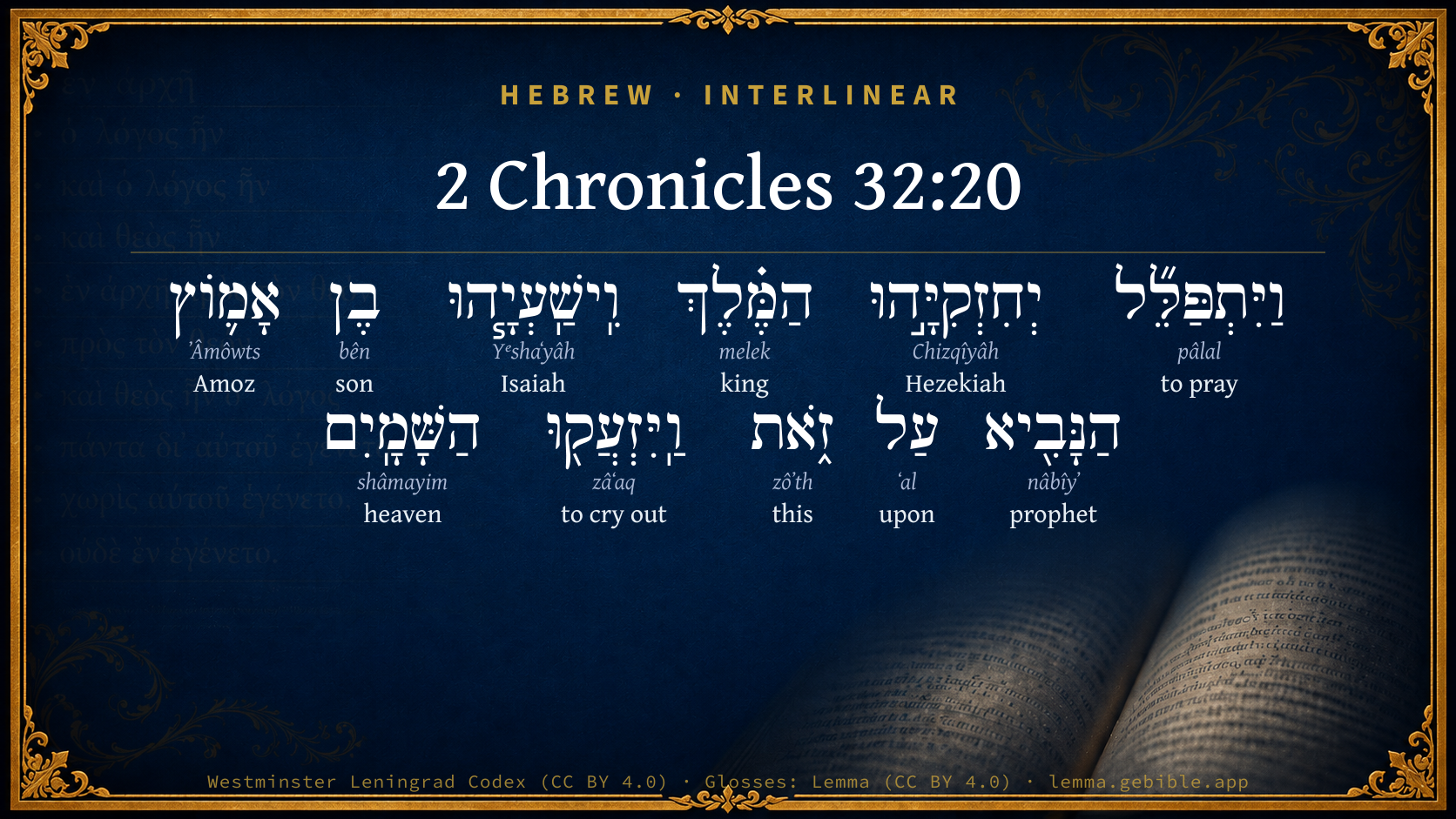
Hebrew (Westminster Leningrad Codex) 2 Chronicles 32:20 appears in the Hebrew Old Testament. The text above is from the Westminster Leningrad Codex. Each word links to its Strong’s number, a concise gloss, and parsing drawn from the Open Scriptures Hebrew Bible morphology. Click any word for its full Brown-Driver-Briggs (BDB) entry.
Download image
Cite this verse

2 Chronicles 32:20 (World English Bible). Public Domain. Lemma interlinear Bible study tool, https://lemma.gebible.app/v/2-chronicles/32/20.

Show BibTeX & RIS
BibTeX
RIS
English Translation
Hezekiah the king, and Isaiah the prophet the son of Amoz, prayed because of this, and cried to heaven.
World English Bible · Public Domain
Download a study sheet

One document with this verse’s original text, its word-by-word gloss line, the meaning frame, cross-references with their text, attributed commentary, and full source and license credits — printable, and it pastes into notes with its structure intact.

This verse Autodidact and up

Study sheet (.html) Plain text (.txt)

A passage Seminary Student

Up to 50 verses in one chapter. A passage sheet keeps up to 6 commentary sources and 12 cross-references per verse, in the order this page ranks them, and says so on the sheet whenever that leaves anything out. Ask for a single verse and you get the Autodidact verse sheet above.

Everything on this page stays free to read, with no account — the sheet is a download of what is already on screen, not access to it.

Want to remove ads? Support Godless Engineer
Compare translations 3

The same verse in 3 English versions, stacked beneath the original-language interlinear above. Click any original word for its lexicon entry.

Each is an independent rendering of the whole verse — the interlinear is not word-aligned to these translations.

Highlighted words mark where these versions differ — a whole-verse word diff, not a word-by-word alignment.

  • World English Bible Public Domain
    Hezekiah the king, and Isaiah the prophet the son of Amoz, prayed because of this, and cried to heaven.
  • King James Version Public Domain
    And for this cause Hezekiah the king, and the prophet Isaiah the son of Amoz, prayed and cried to heaven.
  • unfoldingWord Literal Text CC BY-SA 4.0
    And Hezekiah, the king, prayed, and Isaiah the son of Amoz, the prophet, about this, and they cried out to the heavens.

unfoldingWord Literal Text — © unfoldingWord, licensed CC BY-SA 4.0. Word-aligned USFM3 via Door43 (git.door43.org/unfoldingWord/en_ult).

Versions to compare (up to 4)

3 of 4 selected

Show all 18 translations

Every available English version of this verse, each an independent rendering of the whole verse.

  • World English Bible Public Domain
    Hezekiah the king, and Isaiah the prophet the son of Amoz, prayed because of this, and cried to heaven.
  • Berean Standard Bible Public Domain
    In response, King Hezekiah and the prophet Isaiah son of Amoz cried out to heaven in prayer,
  • Majority Standard Bible Public Domain
    In response, King Hezekiah and the prophet Isaiah son of Amoz cried out to heaven in prayer,
  • King James Version Public Domain
    And for this cause Hezekiah the king, and the prophet Isaiah the son of Amoz, prayed and cried to heaven.
  • American Standard Version (1901) Public Domain
    And Hezekiah the king, and Isaiah the prophet the son of Amoz, prayed because of this, and cried to heaven.
  • Revised Version (1885) Public Domain
    And Hezekiah the king, and Isaiah the prophet the son of Amoz, prayed because of this, and cried to heaven.
  • Geneva Bible (1599) Public Domain
    But Hezekiah the King, and the Prophet Isaiah the sonne of Amoz prayed against this and cryed to heauen.
  • Douay-Rheims (1899) Public Domain
    And Ezechias the king, and Isaias the prophet the son of Amos, prayed against this blasphemy, and cried out to heaven.
  • Young's Literal Translation Public Domain
    And Hezekiah the king prayeth, and Isaiah son of Amoz the prophet, concerning this, and they cry to the heavens,
  • Literal Standard Version CC BY-SA 4.0
    And Hezekiah the king prays, and Isaiah son of Amoz the prophet, concerning this, and they cry to the heavens,
  • Unlocked Literal Bible CC BY-SA 4.0
    Hezekiah, the king, and Isaiah son of Amoz, the prophet, prayed because of this matter and he cried out to heaven.
  • unfoldingWord Literal Text CC BY-SA 4.0
    And Hezekiah, the king, prayed, and Isaiah the son of Amoz, the prophet, about this, and they cried out to the heavens.
  • Darby Bible Public Domain
    And because of this, king Hezekiah and the prophet Isaiah the son of Amoz prayed and cried to heaven.
  • World Messianic Bible Public Domain
    Hezekiah the king and Isaiah the prophet, the son of Amoz, prayed because of this, and cried to heaven.
  • Webster's Bible Public Domain
    And for this cause Hezekiah the king, and the prophet Isaiah the son of Amoz, prayed and cried to heaven.
  • Free Bible Version CC BY-SA 4.0
    King Hezekiah and the prophet Isaiah, son of Amoz, appealed about this in prayer to the God of heaven.
  • Bible in Basic English Public Domain
    And Hezekiah the king, and Isaiah the prophet, the son of Amoz, made prayer because of this, crying out to heaven.
  • JPS Tanakh (1917) Public Domain
    And Hezekiah the king, and Isaiah the prophet the son of Amoz, prayed because of this, and cried to heaven.

Literal Standard Version (2020), Covenant Press — licensed CC BY-SA 4.0. Text via the HelloAO Bible API (eBible.org). Unlocked Literal Bible (unfoldingWord) — licensed CC BY-SA 4.0. Text via the HelloAO Bible API (eBible.org). unfoldingWord Literal Text — © unfoldingWord, licensed CC BY-SA 4.0. Word-aligned USFM3 via Door43 (git.door43.org/unfoldingWord/en_ult). Free Bible Version, Dr. Jonathan Gallagher — licensed CC BY-SA 4.0. Text via the HelloAO Bible API (eBible.org).

Word by word

More ways to search: Search by grammar → Find every occurrence → Compare this word →

Practice this passage: Drill this verse → Learn its vocabulary →

About this verse

These counts appear in no published source. They are computed here, from the morphology-tagged text and Lemma’s own curated glosses. What Lemma adds →

11
words
11
distinct lemmas
Historical
section

Notable vocabulary

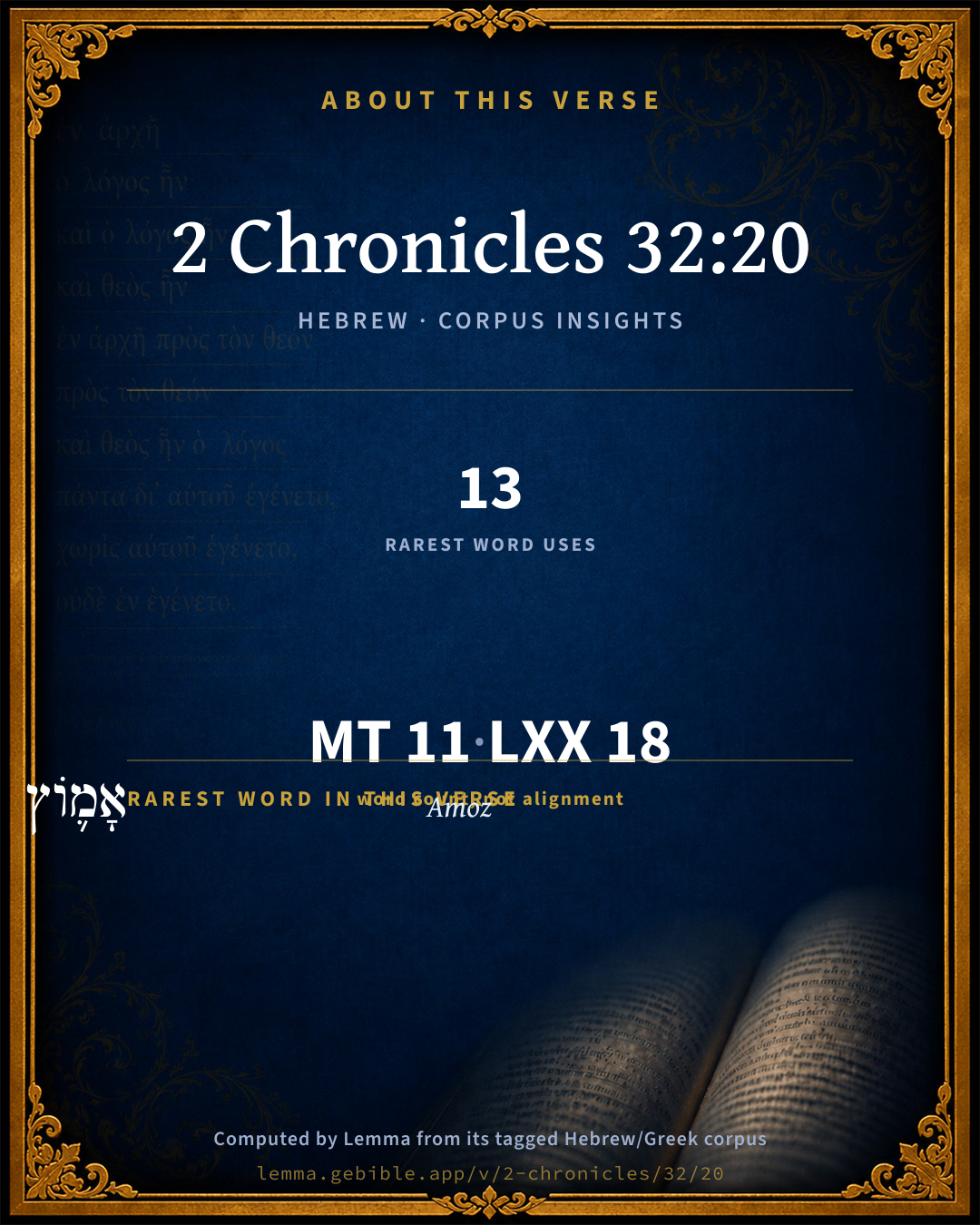
The rarest word here is אָמ֛וֹץ Amoz H531 — appearing just 13 times in the whole Hebrew Bible.

Shared distinctive vocabulary

אָמ֛וֹץ Amoz H531 occurs in 13 verses of the Hebrew Bible. Also found in:

Grammatical profile

  • 2 verbs
  • 7 nouns
  • 1 pronoun
  • 1 preposition

Verb forms

  • וַיִּתְפַּלֵּ֞ל Hithpael · Sequential Imperfect
  • וַֽיִּזְעֲק֖וּ Qal · Sequential Imperfect

Hebrew & Septuagint length

In English translation the verse runs 19 words from the Hebrew and 20 from the Septuagint (LXX English) — closely comparable.

A rough comparison of the two English renderings, which tokenize alike — not a word-level alignment.

Word counts can differ between the Hebrew and the Greek without any difference in meaning — e.g. the Hebrew direct-object marker אֵת has no separate Greek word, and Greek often adds the article ὁ.

In the original languages it is 11 Hebrew tokens and 18 Greek tokens — but the two are counted differently (Hebrew bundles its prefixes and suffixes into one token; the Greek is in lemma form), so that isn’t a like-for-like length.

Cross-references

8

Topical passages linked to 2 Chronicles 32:20 in the Treasury of Scripture Knowledge — connected by theme and wording, ordered by reader-vote popularity; previews shown in the World English Bible.

  • Psalms 91:14–15 "Because he has set his love on me, therefore I will deliver him. I will set him on high, because he has known my name.
  • 2 Kings 19:2–4 He sent Eliakim, who was over the household, and Shebna the scribe, and the elders of the priests, covered with sackcloth, to Isaiah the prophet the son of Amoz.
  • 2 Chronicles 14:11 Asa cried to Yahweh his God, and said, Yahweh, there is none besides you to help, between the mighty and him who has no strength: help us, Yahweh our God; for we rely on you, and in your name are we come against this multitude. Yahweh, you are our God; don't let man prevail against you.
  • 2 Chronicles 20:6–12 and he said, Yahweh, the God of our fathers, aren't you God in heaven? and aren't you ruler over all the kingdoms of the nations? and in your hand is power and might, so that none is able to withstand you.
  • Isaiah 37:14–20 Hezekiah received the letter from the hand of the messengers, and read it; and Hezekiah went up to the house of Yahweh, and spread it before Yahweh.
  • Psalms 50:15 Call on me in the day of trouble. I will deliver you, and you will honor me."
  • 2 Kings 19:14–19 Hezekiah received the letter from the hand of the messengers, and read it; and Hezekiah went up to the house of Yahweh, and spread it before Yahweh.
  • Isaiah 37:1–4 It happened, when king Hezekiah heard it, that he tore his clothes, and covered himself with sackcloth, and went into the house of Yahweh.

Cross-references courtesy of OpenBible.info (CC BY 4.0).

Hebrew and Greek witnesses Masoretic Hebrew ↔ Greek Septuagint

The same verse in the two great witnesses to the Old Testament, shown verse-for-verse.

These are two independent witnesses, not word-aligned to each other, and the Septuagint is shown in lemma (dictionary) form.

Hebrew 2 Chronicles 32:20 Masoretic · Westminster Leningrad Codex

וַיִּתְפַּלֵּ֞ל יְחִזְקִיָּ֣הוּ הַמֶּ֗לֶךְ וִֽישַֽׁעְיָ֧הוּ בֶן אָמ֛וֹץ הַנָּבִ֖יא עַל זֹ֑את וַֽיִּזְעֲק֖וּ הַשָּׁמָֽיִם

Hezekiah the king, and Isaiah the prophet the son of Amoz, prayed because of this, and cried to heaven.

World English Bible · Public Domain

Greek LXX 2 Chronicles 32:20 Septuagint · lemma form

καί προςεὔχομαι εζεκιας ὁ βασιλεύς καί ησαιας υἱός αμως ὁ προφήτης περί οὗτος καί βοάω εἰς ὁ οὐρανός

And king Ezekias and Esaias the prophet the son of Amos prayed concerning these things, and they cried to heaven.

LXX2012 (modern English Septuagint) · Public Domain

Hebrew: Westminster Leningrad Codex (CC BY 4.0). Greek: Septuagint (public domain); English from LXX2012 (modern English Septuagint) (Public Domain). How the Septuagint differs from the Hebrew →

Commentary

Notes on 2 Chronicles 32:20 from classic Christian and Jewish commentators (each source and its license shown beneath its notes). The classic Christian expositions comment on the surrounding passage and are grouped to its opening verse, so a note may address several verses; the Jewish commentaries on the Tanakh (Rashi and others) are per-verse, so they appear only where the commentator wrote on this verse.

Lemma curates 59 commentaries, every one of them public domain or Creative Commons licensed, each selected and text-cleaned for this edition rather than reprinted as found. About our sources →

Trapp's Complete Commentary

John Trapp

2Ch 32:20 And for this [cause] Hezekiah the king, and the prophet Isaiah the son of Amoz, prayed and cried to heaven.

Ver. 20. For this cause.] See 2Ki 19:2-3, &c.

And the prophet Isaiah … prayed.] And at the same time prophesied comfortably. {2Ki 19:14-19}

John Trapp, A Commentary or Exposition upon All the Books of the Old and New Testament (1647–1656) — public domain. Text from a community e-Sword module.

The Biblical Illustrator

Joseph S. Exell

2Ch_32:20

Prayed and cried to heaven.

True prayer

True prayer is not pestering the Throne with passionate entreaties that a certain method of deliverance which seems best to us, should be forthwith effected; but is a calm utterance of need, and a patient, submissive expectance of fitting help, of which we dare not define the manner or the time. They are wisest, most trustful and reverent, who do not seek to impose their notions or wills on the clearer wisdom and deeper love to which they betake themselves, but are satisfied with leaving all to His arbitrament. True prayer is the bending of our own wills to the Divine, not the urging of ours on it. When Hezekiah received the insolent letter from the invader, he took it and spread it before the Lord, asking God to read it, leaving all else to Him to determine: as if he had said, Behold, Lord, this boastful page. I bring it to Thee, and now it is Thine affair more than mine. The burden which we roll on God lies lightly on our own shoulders; and if we do roll it thither, we need not trouble ourselves with the question of how He will deal with it. (Alex. Maclaren, D.D.)

Fire upwards

A story of the wars of the first Napoleon has often come back to me. He was trying in a winter campaign to cut off the march of the enemy across a frozen lake. The gunners were told to fire on the ice and break it, but the cannon balls glanced harmlessly along the surface. With one of the sudden flashes of genius he gave the word, Fire upwards! and the balls crashed down full weight, shattering the whole sheet into fragments, and the day was won. You can fire upwards in this battle even if you are shut out from fighting it face to face. You can do your share within the four walls of your room. (Miss Trotter.)

The Biblical Illustrator, edited by Joseph S. Exell (c. 1880s–1900s) — public domain. Text from a community e-Sword module.

Geneva Bible (1599)

Geneva Bible translators

This showeth what is the best refuge in all troubles and dangers.

Geneva Bible (1599) marginal notes — public domain. Text via Bolls.life.

Ellicott's Commentary for English Readers

(20) For this cause.—Upon this (‘al zôth). The reference is to the Assyrian blasphemies against Jehovah, which Hezekiah urged in his prayer for deliverance (2Ki_19:16), and to which Isaiah referred in his prophetic answer (Isa_37:23). The prayer of Hezekiah is given in 2Ki_19:15-19; Isa_37:15-20. The parallel passages do not say that Isaiah also prayed; but 2Ki_19:2-4, and Isa_37:2-4, report that the king sent a deputation of nobles to the prophet, requesting his prayers “for the remnant that were left.”

Cried to heaven.—Comp. 2Ch_30:27; 1Sa_5:12.

A Bible Commentary for English Readers, edited by Charles John Ellicott (1878–1897) — public domain. Text from a community e-Sword module.

The Cambridge Bible for Schools and Colleges

gen. ed. J. J. S. Perowne

20. And for this cause Hezekiah … prayed] R.V. And Hezekiah … prayed because of this.

heaven] Here used reverently for “God”; cp. 2Ch_28:9; Dan_4:26; Luk_15:21.

20–23 (cp. 2Ki_19:1-4; 2Ki_19:14-19; 2Ki_19:35-37). Hezekiah and Isaiah pray. The Deliverance

This section is a very brief epitome of 2 Kings 19. The Chronicler assumes here as elsewhere that his readers have access to the fuller sources of information.

The Cambridge Bible for Schools and Colleges (gen. ed. J. J. S. Perowne; Cambridge University Press, 1878–1918) — public domain. Text from a community e-Sword module.

John Gill's Exposition

In those days Hezekiah was sick,.... Of which sickness, and of his prayer, and of the sign given him, see Isa 38:1 and the notes there.

and the notes there.

2 Chronicles 32:25

ch2 32:25

ch2 32:25

ch2 32:25But Hezekiah rendered not again according to the benefit done unto him,.... Both in the deliverance of him and his people from the king of Assyria, and the recovery of him from his sickness:

for his heart was lifted up; with pride, because of the wonderful defeat of the Assyrian army in his favour, the miracle wrought at his recovery from illness, the riches and honour conferred upon him, the presents brought him from his neighbours, and especially the embassy of the king of Babylon to him:

therefore there was wrath upon him, and upon Judah and Jerusalem; who, in imitation of him, fell into the same sin of pride, with many others; and therefore both he and they were threatened with some tokens of the divine displeasure.

John Gill's Exposition of the Whole Bible (1746–1763) — public domain (CC PDM 1.0). Text via the HelloAO Bible API.

Haydock's Catholic Bible Commentary

CHAPTER XXXII.

George Leo Haydock (1774–1849), Haydock's Catholic Family Bible and Commentary, 1859 edition — public domain. Excludes Psalms (Douay-Rheims chapter numbering differs from Protestant) and Deuterocanonical books (Catholic canon only).

The Pulpit Commentary

For the prayer of Hezekiah, see 2Ki_19:14-19; and for the place of the prayer or prayers of Isaiah, and the indications of their having been offered, see alike 2Ch_19:4-7, and the verses of the grand passage.

The Pulpit Commentary (1880–1919), ed. H.D.M. Spence-Jones & Joseph S. Exell — public domain. Text from a community e-Sword module.

unfoldingWord translationNotes

Door43 World Missions Community

cried out to heaven

Here "heaven" represents Yahweh. AT: "cried to Yahweh for help" or "pleaded to Yahweh" (See: Metonymy)

with shame on his face

"embarrassed" or "ashamed"

the house of his god

"the temple of his god"

translationWords

Isaiah

prophet

Amoz

cry

heaven

angel

sword

unfoldingWord translationNotes — © Distant Shores Media and the Door43 World Missions Community, licensed CC BY-SA 4.0. Source: git.door43.org/Door43/en_tn.

Rashi

Rabbi Shlomo Yitzchaki (Rashi)

And Hezekiah... prayed In II Kings (19:15–19) and in Isaiah (37:15–19) the prayer is delineated.

Rashi on the Tanakh — English translations: “The Judaica Press complete Tanach with Rashi, translated by A. J. Rosenberg” (CC BY 4.0); “Pentateuch with Rashi's commentary by M. Rosenbaum and A.M. Silbermann, 1929-1934” (public domain); “The Metsudah Tanach series, Lakewood, N.J” (CC BY 4.0); and “The Book of Joshua, Metsudah Publications, 1997” (CC BY 4.0). Text via Sefaria.

Lesson kit

Teaching starters — assembled from the data on this page, not authored interpretation. Every prompt links to the verse data it draws on. Edit before teaching.

2 Chronicles, in the Historical, opens this verse with 11 words (11 distinct Hebrew lemmas). Its most distinctive word is ʼÂmôwts (“Amoz”). A historical commentator’s framing appears above. Read the whole chapter for the surrounding context.

Discussion questions

  1. The word ʼÂmôwts carries the sense “Amoz.” How does it shape the verse?
  2. How does 2 Kings 19:2, which shares the word «Amoz», read alongside this verse?
  3. The translations on this page render this verse differently — a whole-verse word diff, not a word-by-word alignment. What might account for the different wordings?
  4. «וַיִּתְפַּלֵּ֞ל» is a Hithpael Sequential Imperfect verb. How does that grammatical form shape the action described?
  5. Compare how Trapp's Complete Commentary and The Biblical Illustrator read this verse. Where do they agree or differ?

Things to notice

Reading settings

Reading text

Shown beneath each verse's original-language words.

Old Testament
Old Testament edition

Read the OT as the Masoretic Hebrew (MT) or the Greek Septuagint (LXX).

English shown for the Greek Septuagint (in the Hebrew ↔ Greek comparison).

Comparing translations? Open the Compare panel on any verse page to stack up to four side by side.