1 Corinthians 14:13

Greek (Tischendorf 8th ed.) 1 Corinthians 14:13 appears in the Greek New Testament. The text above is from the Tischendorf 8th edition. Each word links to its Strong’s number and a concise gloss. Click any word for its full Thayer’s Greek Lexicon entry.
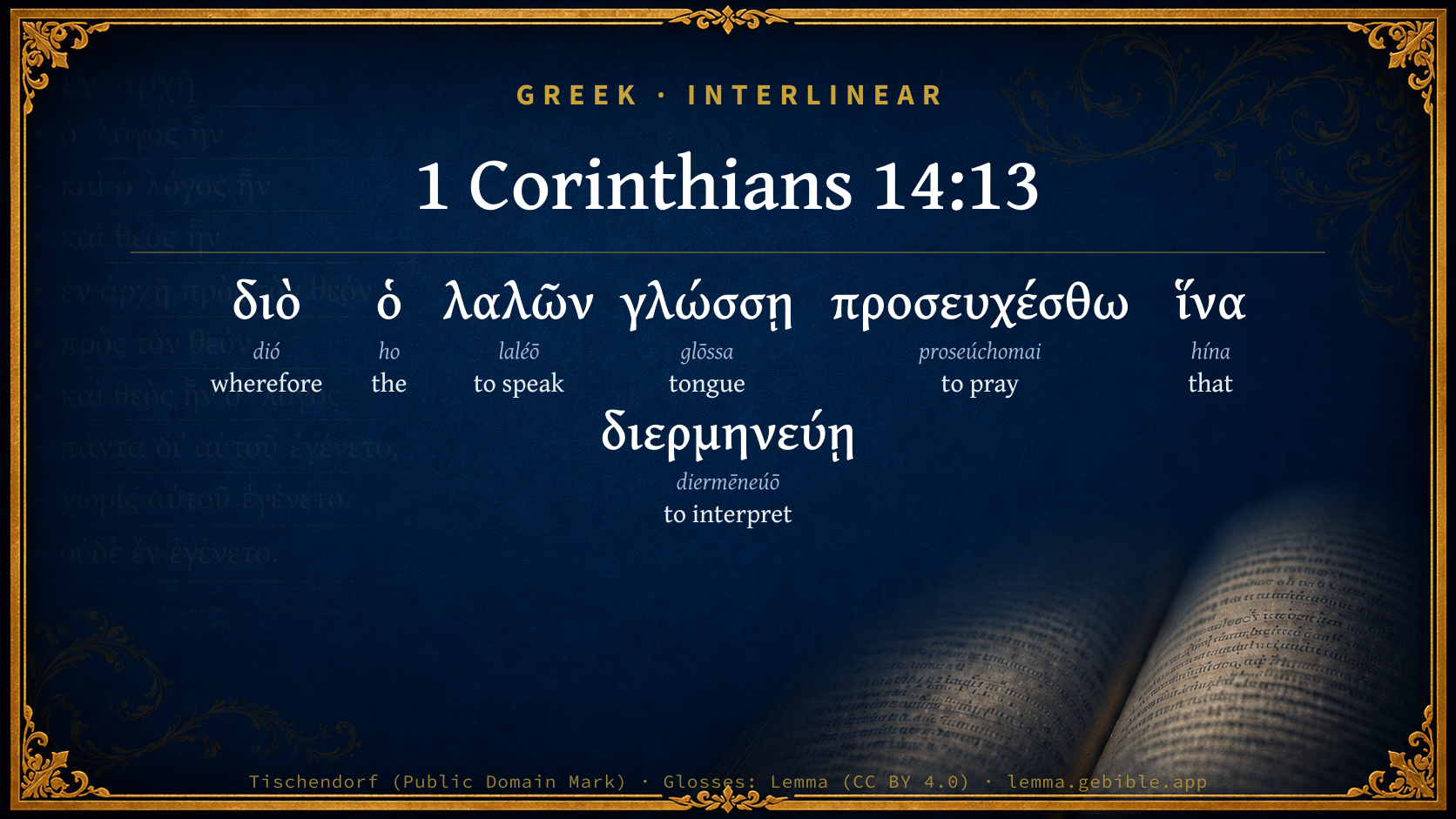
Download image
Cite this verse

1 Corinthians 14:13 (World English Bible). Public Domain. Lemma interlinear Bible study tool, https://lemma.gebible.app/v/1-corinthians/14/13.

Show BibTeX & RIS
BibTeX
RIS
English Translation
Therefore let him who speaks in another language pray that he may interpret.
World English Bible · Public Domain
Download a study sheet

One document with this verse’s original text, its word-by-word gloss line, the meaning frame, cross-references with their text, attributed commentary, and full source and license credits — printable, and it pastes into notes with its structure intact.

This verse Autodidact and up

Study sheet (.html) Plain text (.txt)

A passage Seminary Student

Up to 50 verses in one chapter. A passage sheet keeps up to 6 commentary sources and 12 cross-references per verse, in the order this page ranks them, and says so on the sheet whenever that leaves anything out. Ask for a single verse and you get the Autodidact verse sheet above.

Everything on this page stays free to read, with no account — the sheet is a download of what is already on screen, not access to it.

Want to remove ads? Support Godless Engineer
Compare translations 3

The same verse in 3 English versions, stacked beneath the original-language interlinear above. Click any original word for its lexicon entry.

Each is an independent rendering of the whole verse — the interlinear is not word-aligned to these translations.

Highlighted words mark where these versions differ — a whole-verse word diff, not a word-by-word alignment.

  • World English Bible Public Domain
    Therefore let him who speaks in another language pray that he may interpret.
  • King James Version Public Domain
    Wherefore let him that speaketh in an unknown tongue pray that he may interpret.
  • unfoldingWord Literal Text CC BY-SA 4.0
    So let the one speaking in a tongue pray that he might interpret.

unfoldingWord Literal Text — © unfoldingWord, licensed CC BY-SA 4.0. Word-aligned USFM3 via Door43 (git.door43.org/unfoldingWord/en_ult).

Versions to compare (up to 4)

3 of 4 selected

Show all 19 translations

Every available English version of this verse, each an independent rendering of the whole verse.

  • World English Bible Public Domain
    Therefore let him who speaks in another language pray that he may interpret.
  • Berean Standard Bible Public Domain
    Therefore, the one who speaks in a tongue should pray that he may interpret.
  • Majority Standard Bible Public Domain
    Therefore, the one who speaks in a tongue should pray that he may interpret.
  • King James Version Public Domain
    Wherefore let him that speaketh in an unknown tongue pray that he may interpret.
  • American Standard Version (1901) Public Domain
    Wherefore let him that speaketh in a tongue pray that he may interpret.
  • Revised Version (1885) Public Domain
    Wherefore let him that speaketh in a tongue pray that he may interpret.
  • Geneva Bible (1599) Public Domain
    Wherefore, let him that speaketh a strange tongue, pray, that he may interprete.
  • Douay-Rheims (1899) Public Domain
    And therefore he that speaketh by a tongue, let him pray that he may interpret.
  • Young's Literal Translation Public Domain
    wherefore he who is speaking in an `unknown' tongue -- let him pray that he may interpret;
  • Literal Standard Version CC BY-SA 4.0
    for this reason he who is speaking in an [unknown] tongue—let him pray that he may interpret;
  • Unlocked Literal Bible CC BY-SA 4.0
    So the one who speaks in a tongue should pray that he may interpret.
  • unfoldingWord Literal Text CC BY-SA 4.0
    So let the one speaking in a tongue pray that he might interpret.
  • Darby Bible Public Domain
    Wherefore let him that speaks with a tongue pray that he may interpret.
  • World Messianic Bible Public Domain
    Therefore let him who speaks in another language pray that he may interpret.
  • Webster's Bible Public Domain
    Wherefore, let him that speaketh in an unknown language, pray that he may interpret.
  • Free Bible Version CC BY-SA 4.0
    Anyone who speaks in a tongue should pray that they're able to translate what they say.
  • Bible in Basic English Public Domain
    For this reason, let the man who has the power of using tongues make request that he may, at the same time, be able to give the sense.
  • Text-Critical English NT CC BY 4.0
    Therefore anyone who speaks in a tongue should pray for the ability to interpret what he says.
  • Tyndale New Testament (1534) Public Domain
    Wherfore let him that speaketh with tonges praye that he maye interpret also.

Literal Standard Version (2020), Covenant Press — licensed CC BY-SA 4.0. Text via the HelloAO Bible API (eBible.org). Unlocked Literal Bible (unfoldingWord) — licensed CC BY-SA 4.0. Text via the HelloAO Bible API (eBible.org). unfoldingWord Literal Text — © unfoldingWord, licensed CC BY-SA 4.0. Word-aligned USFM3 via Door43 (git.door43.org/unfoldingWord/en_ult). Free Bible Version, Dr. Jonathan Gallagher — licensed CC BY-SA 4.0. Text via the HelloAO Bible API (eBible.org).

Word by word

More ways to search: Search by grammar → Find every occurrence → Compare this word →

Practice this passage: Drill this verse → Learn its vocabulary →

About this verse

These counts appear in no published source. They are computed here, from the morphology-tagged text and Lemma’s own curated glosses. What Lemma adds →

7
words
7
distinct lemmas
Pauline Epistles
section

Notable vocabulary

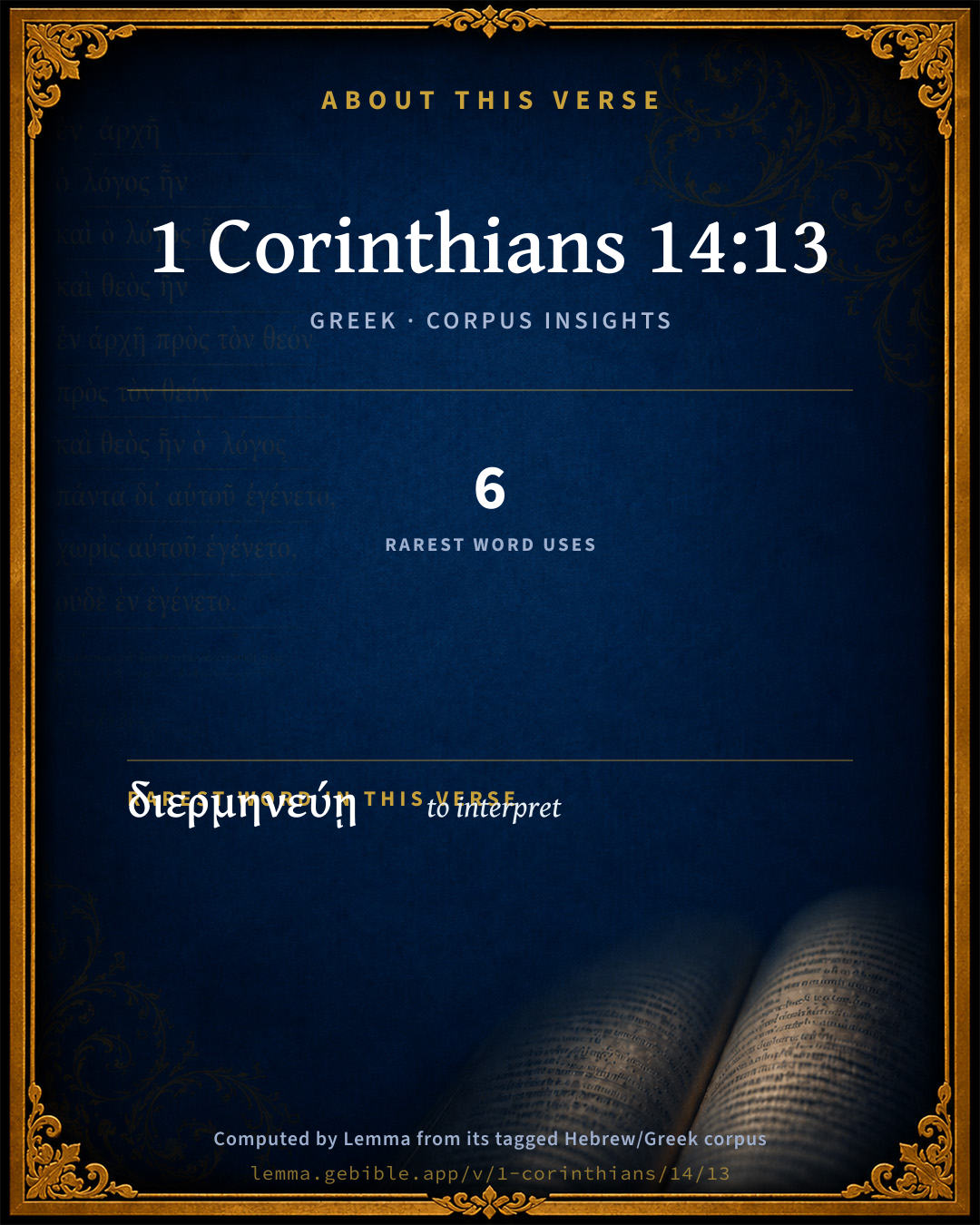
The rarest word here is διερμηνεύῃ to interpret G1329 — appearing just 6 times in the whole Greek New Testament.

Shared distinctive vocabulary

διερμηνεύῃ to interpret G1329 occurs in 6 verses of the Greek New Testament. Also found in:

Cross-references

8

Topical passages linked to 1 Corinthians 14:13 in the Treasury of Scripture Knowledge — connected by theme and wording, ordered by reader-vote popularity; previews shown in the World English Bible.

  • Mark 11:24 Therefore I tell you, all things whatever you pray and ask for, believe that you receive them, and you shall have them.
  • John 14:13–14 Whatever you will ask in my name, that will I do, that the Father may be glorified in the Son.
  • 1 Corinthians 12:30 Do all have gifts of healings? Do all speak with various languages? Do all interpret?
  • Acts 1:14 All these with one accord continued steadfastly in prayer and supplication, along with the women, and Mary the mother of Jesus, and with his brothers.
  • Acts 4:29–31 Now, Lord, look at their threats, and grant to your servants to speak your word with all boldness,
  • Acts 8:15 who, when they had come down, prayed for them, that they might receive the Holy Spirit;
  • 1 Corinthians 12:10 and to another workings of miracles; and to another prophecy; and to another discerning of spirits; to another different kinds of languages; and to another the interpretation of languages.
  • 1 Corinthians 14:27–28 If any man speaks in another language, let it be two, or at the most three, and in turn; and let one interpret.

Cross-references courtesy of OpenBible.info (CC BY 4.0).

Commentary

Notes on 1 Corinthians 14:13 from classic Christian and Jewish commentators (each source and its license shown beneath its notes). The classic Christian expositions comment on the surrounding passage and are grouped to its opening verse, so a note may address several verses; the Jewish commentaries on the Tanakh (Rashi and others) are per-verse, so they appear only where the commentator wrote on this verse.

Lemma curates 59 commentaries, every one of them public domain or Creative Commons licensed, each selected and text-cleaned for this edition rather than reprinted as found. About our sources →

Joseph Benson's Commentary

1Co 14:13-14. Wherefore let him that speaketh in a tongue — Unknown to the congregation to which he would address himself; pray that he may interpret — That God would give him the gift also of expounding his discourse, in the common language of the place, a gift this distinct from the other. For if I pray, &c. — The apostle, as he did at 1Co 14:6, transfers it to himself; in an unknown tongue; without making use of any explication; my spirit indeed prayeth — By the influence of the Spirit of God, I understand the words myself; but my understanding is unfruitful — Namely, to others; the knowledge I have is of no benefit to them; and I perform an action void of that prudence and good sense which ought always to govern persons in their addresses to God, and act so childish and foolish a part that the reason of a man may seem at that time to have deserted me. “This,” says Dr. Doddridge, “I think a more natural interpretation than that which supposes the apostle to suggest a thought which the Papists urge to palliate the absurdity of offering prayers in an unknown tongue, namely, ‘there may be some general good affections working where the person praying does not particularly understand what he says.’ But this would make it almost impossible to conceive how the gift of tongues could be abused, if the person exercising it was under such an extraordinary impulse of the Spirit, as to utter sensible words which he did not himself understand; in which case a man must be, in the most extraordinary sense that can be conceived, the mere organ of the Holy Ghost himself.”

Joseph Benson's Commentary on the Old and New Testaments (1811–1818) — public domain. Text from a community e-Sword module.

Tyndale Open Study Notes

Tyndale Open Resources

14:13 Paul does not forbid speaking in tongues (see 14:39), but the ability to interpret is crucial, especially in public worship (see 14:27-28).

Tyndale Open Study Notes — © Tyndale Open Resources, licensed CC BY-SA 4.0. Text via the HelloAO Bible API.

Bengel's Gnomon

Johann Albrecht Bengel

1Co 14:13. Προσευχέσθω) let him pray; and he will do this with such fruit and effect, that the interpretation shall be added to the unknown tongue; see the following verse. It is implied that this will be obtained by prayers.

Bengel's Gnomon of the New Testament — English translation (T&T Clark, Edinburgh, 1860) — public domain. Text from a community e-Sword module.

Meyer's Critical & Exegetical Commentary

Heinrich August Wilhelm Meyer

1Co_14:13. Προσευχέσθω ἵνα διερμ.] is taken by Chrysostom, Theodoret, Theophylact, Castalio, Erasmus, Beza, Calvin, Grotius, Estius, Wetstein, Bengel, and others, including Flatt, Bleek, Rückert, Olshausen, Neander, Hofmann, in the sense of: let him pray for the gift of interpretation. But against this 1Co_14:14 is decisive, where the προσεύχεσθαι, linked by γάρ to what precedes, must have the same reference with our προσεύχεσθαι in 1Co_14:13. Bleeks objection, that we find εὐχαριστῶ in 1Co_14:18 standing in a different reference than previously, does not hold good, since 1Co_14:17-18 do not stand in direct logical connection (as 1Co_14:12; 1Co_14:14 do), but, on the contrary, with 1Co_14:18 there begins a section of the discourse distinct from the preceding. Without taking ἵνα, with Luther, Vorstius, Wolf, Rosenmüller (comp. already Photius in Oecumenius), as meaning so that, the right translation is: let him pray in the design, in order to interpret (afterwards what has been prayed γλώσσῃ). Comp. Billroth, David Schulz, Winer, de Wette, Osiander, Ch. F. Fritzsche, Ewald, Maier. The previous general λαλεῖν is thus represented here by προσεύχεσθαι, i.e. more precisely described as what it was, as address in prayer, see 1Co_14:14-17. It is objected that 1Co_14:27 militates against this view (see Rückert); that the person praying γλώσσῃ could not have had that design, because he did not know whether the interpretation would be given to him (Hofmann). But our explanation does not in fact assume that every man who spoke with tongues was capable of interpreting; but, on the contrary, that Paul, in 1Co_14:13, was thinking only of such speakers with tongues as possessed also the gift of interpretation (1Co_14:5). The apostle still leaves out of view the case in which the speaker was not also interpreter (1Co_14:28); hence we are not to take it with Ewald: that people may interpret it. The subject is the speaker himself (1Co_14:14 ff.), as in 1Co_14:5.

Meyer — Critical and Exegetical Commentary on the New Testament — English translation by Peter Christie, edited by Frederick Crombie (T&T Clark, 1880) — public domain. Text from a community e-Sword module.

Expositor's Greek Testament

ed. W. Robertson Nicoll

1Co 14:13 . “Wherefore (since thus only can the γλώσσαις λαλῶν edify the church) let him who speaks with a tongue pray that he may interpret”: cf. 1Co 14:5 . It appears that the speaker with Tongues in some instances could recall, on recovery, what he had uttered in his trance-ecstasy, so as to render it into rational speech. The three vbs. are pr ., regulating current procedure. The ἵνα clause, after προσευχέσθω , gives the purport of the prayer, as in Phi 1:9 ; cf. Phi 1:10 above, 1Co 16:12 ; Luk 9:40 , etc. Mr [2075] , El [2076] , and others, prefer to borrow γλώσσῃ from the next ver., and render thus: “Let him that speaks (with a tongue) pray (therewith), in order that he may interpret”; but this strains the construction, and γλώσσῃ appears to be added in 1Co 14:14 just because the vb [2077] προσεύχομαι had not been so understood before.

[2075] Meyer’s Critical and Exegetical Commentary (Eng. Trans.).

[2076] C. J. Ellicott’s St. Paul’s First Epistle to the Corinthians .

[2077] verb

The Expositor's Greek Testament, edited by W. Robertson Nicoll (1897–1910) — public domain. Text from a community e-Sword module.

Godet's Commentaries

Frédéric Louis Godet

Vv. 13-15. “Wherefore let him that speaketh in a tongue pray that he may interpret. 14. For if I pray in a tongue, my spirit prayeth, but my understanding is unfruitful. 15. What is it then? I will pray with the Spirit, but I will pray with the understanding also: I will sing with the Spirit, but I will sing with the understanding also.”

There are two readings: διό, wherefore, and διόπερ, wherefore indeed; the second is perhaps taken from 1Co 8:13 and 1Co 10:14, where Paul also states the conclusions of a discussion.

The ancient Greek interpreters and many moderns, Erasmus, Calvin, Rückert, Hofmann, etc., make the words: that he may interpret, the logical object of the word: let him pray: “Let him ask of God the power to interpret.” But the terms αἰτεῖν or δεῖσθαι would perhaps suit better a positive position than προσεύχεσθαι, which rather denotes the state of prayer; and the use Paul makes of this same term προσεύχεσθαι in the following verses, specially to denote ecstatic prayer, hardly admits of our taking it in 1Co 14:13 in another sense. The words: let him pray (in tongues) that he may interpret, therefore signify: “In giving himself up to the Spirit who leads him to pray in a tongue, let him do so with the intention and with the settled aim beforehand to reproduce the contents of his prayer afterwards in intelligible language.” So Meyer, Edwards, etc. It does not therefore follow that ἵνα is here taken, as has been thought, in the sense of ita ut, so that. Heinrici rightly observes, that in the exercise of every χάρισμα (gift) the intention of the will remains in force.

Frédéric Louis Godet — Commentaries on Luke, John, Romans, and 1 Corinthians — English translation (T&T Clark, Edinburgh, 1870s–1890s) — public domain. Text from a community e-Sword module.

Hodge's Commentary on Romans, Ephesians & First Corinthians

Charles Hodge

1Co_14:13

Wherefore let him that speaketh in an (unknown) tongue pray that he may interpret.

This is an inference not only from the preceding verse but from the whole preceding argument, which was designed to show how useless it is to speak in a language which no one present understands. The verse admits of two interpretations. It may mean that the speaker with tongues should pray for the gift of interpretation; or, that he should pray with the purpose (ἵνα) of interpreting what he said. The principal reason for this latter interpretation is the assumption that the gift of tongues was exercised only in prayer and praise; in other words, that it consisted in an ecstatic but unintelligible and unintelligent pouring out of the heart to God. It is therefore inferred that to speak with a tongue, 1Co_14:13, and to pray with a tongue, 1Co_14:14, mean exactly the same thing; the former being no more comprehensive than the latter. But this whole assumption is not only gratuitous but contrary to Scripture. The gift of tongues was, according to Act_2:5-11, exercised in declaring the wonderful works of God. It is also apparent from what is said in this chapter, 1Co_14:22-25, and 1Co_14:27, that the gift in question was not confined to acts of devotion. The former interpretation is therefore to be preferred. Let him pray that (ἵνα) he may interpret. For this use of ἵνα after verbs of entreating, etc., see Robinsons Greek Lex. p. 352.

Charles Hodge — Commentary on Romans (1835), First Corinthians (1857), and Ephesians (1856) — public domain. Text from a community e-Sword module.

Geneva Bible (1599)

Geneva Bible translators

Pray for the gift of interpretation.

Geneva Bible (1599) marginal notes — public domain. Text via Bolls.life.

Jamieson, Fausset & Brown

Robert Jamieson, A. R. Fausset & David Brown

Explain, "Let him who speaketh with a tongue [unknown] in his prayer (or, when praying) strive that he may interpret" [ALFORD]. This explanation of "pray" is needed by its logical connection with "prayer in an unknown tongue" (Co1 14:14). Though his words be unintelligible to his hearers, let him in them pray that he may obtain the gift of interpreting, which will make them "edifying" to "the church" (Co1 14:12).

Jamieson, Fausset & Brown — Commentary Critical and Explanatory on the Whole Bible (1871) — public domain (CC PDM 1.0). Text via the HelloAO Bible API.

Adam Clarke's Commentary

Verse 13. Pray that he may interpret.] Let him who speaks or reads the prophetic declarations in the Old Testament, in that tongue in which they were originally spoken and written, pray to God that he may so understand them himself, and receive the gift of interpretation, that he may be able to explain them in all their depth and latitude to others.

Adam Clarke's Commentary on the Bible (1810–1826) — public domain. Text from a community e-Sword/MySword module.

John Calvin's Commentaries

13. Wherefore let him that speaketh in another tongue This is an anticipation, by way of reply to a question which might very readily be proposed to him. “If any one, therefore, is able to speak a foreign language, will the gift be useless? Why should that be kept back, which might be brought out to light, to the glory of God?” He shows the remedy. “Let him,” says he, “ask from God the gift of interpretation also. If he is without this, let him abstain in the meantime from ostentation.”

John Calvin's Commentaries (1540-1563) — public domain. Text from the Calvin Translation Society English edition (1840s-50s) via the Christian Classics Ethereal Library (ccel.org). Calvin's coverage is partial (roughly two-thirds of the Bible); uncommented books and verses are honest gaps, never fabricated. The 19th-century editor's footnotes and remarks are omitted so the notes are faithfully Calvin's own voice.

Ellicott's Commentary for English Readers

(13) In an unknown tongue.—Better, in a tongue. The gift of interpretation would make the gift of tongues useful for the edifying of the Church. This would be an object of unselfish prayer, which God would indeed answer. In the Greek it is suggested that the gift of interpretation is not only to be the object of his prayer, but that it will be the result; and this leads on to the thought in the next verse.

A Bible Commentary for English Readers, edited by Charles John Ellicott (1878–1897) — public domain. Text from a community e-Sword module.

The Cambridge Bible for Schools and Colleges

gen. ed. J. J. S. Perowne

13. pray that he may interpret] Cf. 1Co_14:1; 1Co_14:5. This passage may mean (1) pray that he may receive the faculty of interpretation, or (2) pray in such a language as he has the power of interpreting.

The Cambridge Bible for Schools and Colleges (gen. ed. J. J. S. Perowne; Cambridge University Press, 1878–1918) — public domain. Text from a community e-Sword module.

John Gill's Exposition

Wherefore let him that speaketh in an unknown tongue,.... The Hebrew, or any other, the gift of speaking with which is bestowed upon him:

pray that he may interpret; that he may have also the gift of interpretation of tongues; for as has been before hinted, these two gifts were distinct; and a man might have the one, and not the other; a man might speak in an unknown tongue, so as to understand himself, what he said, and be edified, and yet not be capable of translating it at once into the common language of the people; and if he could not do this, he would not excel in his gift to the edification of the church; whereas if he could interpret he would, and therefore, above all things, he should pray to the Father of lights, the giver of every good and perfect gift, that he might be furnished with this also.

John Gill's Exposition of the Whole Bible (1746–1763) — public domain (CC PDM 1.0). Text via the HelloAO Bible API.

Trapp's Complete Commentary

John Trapp

13 Wherefore let him that speaketh in an unknown tongue pray that he may interpret.

Ver. 13. Pray that he may interpret] Pope Innocent III never prayed thus; for he said, that the Church decreed the service in an unknown tongue, Ne sacrosaneta verba vilescerent, lest the holy words should be underprized. But public prayers in an unknown tongue, saith Erasmus, must be attributed to the change of time itself in Italy, France, and Spain, for there a long time the Latin was understood by all. But when afterwards their speeches degenerated into those common tongues now there used, then the language, not of the service, but of the people, was altered.

John Trapp, A Commentary or Exposition upon All the Books of the Old and New Testament (1647–1656) — public domain. Text from a community e-Sword module.

Albert Barnes' Notes on the Bible

Pray that he may interpret - Let him ask of God ability that he may explain it clearly to the church. It would seem probable that the power of speaking foreign languages, and the power of conveying truth in a clear and distinct manner, were not always found in the same person, and that the one did not of necessity imply the other. The truth seems to have been, that these extraordinary endowments of the Holy Spirit were bestowed upon people in some such way as “ordinary” talents and mental powers are now conferred; and that they became in a similar sense the “characteristic mental endowments of the individual,” and of course were subject to the same laws, and liable to the same kinds of abuse, as mental endowments are now. And as it now happens that one man may have a special faculty for acquiring and expressing himself in a foreign language who may not be by any means distinguished for clear enunciation, or capable of conveying his ideas in an interesting manner to a congregation, so it was then.

The apostle, therefore, directs such, if any there were, instead of priding themselves on their endowments, and instead of always speaking in an unknown tongue, which would he useless to the church, to “pray” for the more useful gift of being able to convey their thoughts in a clear and intelligible manner in their vernacular tongue. This would be useful. The truths, therefore, that they had the power of speaking with eminent ability in a foreign language, they ought to desire to be able to “interpret” so that they would be intelligible to the people whom they addressed in the church. This seems to me to be the plain meaning of this passage, which has given so much perplexity to commentators. Macknight renders it, however, “Let him who prayeth in a foreign language, pray so as some one may interpret;” meaning that he who prayed in a foreign language was to do it by two or three sentences at a time, so that he might be followed by an interpreter. But this is evidently forced. In order to this, it is needful to suppose that the phrase ὁ λαλῶν ho lalōn , “that speaketh,” should be rendered, contrary to its obvious and usual meaning, “who prays,” and to supply τις tis, “someone,” in the close of the verse. The obvious interpretation is that which is given above; and this proceeds only on the supposition that the power of speaking foreign languages and the power of interpreting were not always united in the same person - a supposition that is evidently true, as appears from 1Co 12:10.

Albert Barnes' Notes on the Bible (1834–1885) — public domain. Text from a community e-Sword/MySword module.

Haydock's Catholic Bible Commentary

Pray that he may interpret. In order that he may be rendered more useful to the Church, as the martyrs, who prayed for those particular gifts they saw would be most useful for themselves, or their neighbours. (Calmet)

George Leo Haydock (1774–1849), Haydock's Catholic Family Bible and Commentary, 1859 edition — public domain. Excludes Psalms (Douay-Rheims chapter numbering differs from Protestant) and Deuterocanonical books (Catholic canon only).

Matthew Poole's English Annotations

To interpret here signifieth no more, than to render that intelligible to people, which he first uttereth in an unknown tongue. But what need he pray for that? Hath not every man that can speak a power to speak his native language, as well as a foreign language? Some say, therefore, that ινα in this place signifies also, let him pray and also interpret; but this seemeth hard: nor can I think those that had a faculty to speak in an unknown tongue, might some of them not themselves understand what they said, and so had need to pray that they might interpret: but they might be puffed up with their gift, and think it beneath them to interpret, and then they had need to pray that they might have humility enough to interpret. Others think, that by interpreting in this place, is meant something more than bare translating, or turning the words into the common language of the place, viz. the opelling and applying of the Scriptures, an ability to which was a distinct gift; which they who would have, had need pray that God would open their eyes to understand the mysteries of his law.

Matthew Poole's English Annotations on the Holy Bible (1683–1685) — public domain. Text from a community e-Sword/MySword module.

Whedon's Commentary on the Bible

Daniel D. Whedon

13. Pray… may interpret—This has been construed by many commentators to mean pray in order that, or with the purpose to, interpret. This must not imply that the speaking with a tongue was always prayer. For, 1. The pentecostal tongues were rather praise than prayer, and apparently addressed to the people. 2. An interpreter would usually be more suitable for a discourse than for prayer. 3. It is not unworthy of consideration that in Mr. Bushnell’s narrative the tongue was hortatory, and, 4. We can see nothing in the nature of the “tongue” prohibiting the idea of its being used for every mode of exercise. We render it, Let him so pray that he may be enabled afterwards to interpret his prayer. By that means, as in Mr. Bushnell’s instance, he may follow the discourse with an interpretation, and the divine charism gives the discourse a divine authority.

Daniel D. Whedon (gen. ed.), Commentary on the Old and New Testaments (1874–1909) — public domain. Text from a community e-Sword module.

The Pulpit Commentary

Pray that he may interpret; either, so pray as to be able to interpret, or, pray with the object of afterwards interpreting. The meaning, "pray to have the power of interpretation given him," seems excluded by the next verse.

The Pulpit Commentary (1880–1919), ed. H.D.M. Spence-Jones & Joseph S. Exell — public domain. Text from a community e-Sword module.

John Wesley's Explanatory Notes

That he may be able to interpret - Which was a distinct gift.

John Wesley, Explanatory Notes Upon the Whole Bible (1754–1765) — public domain. Text via the GEBible commentary corpus.

Burkitt's Expository Notes on the New Testament

William Burkitt

Observe here, How strongly the apostle pleads the necessity for all public worship, particularly preaching or prophesying, praying and singing, to be performed in a language known and understood by all the congregation: Let him that speaketh, preacheth, or teacheth, in an unknown tongue, in which he cannot edify others, pray for the edifying gift of interpretation, that others may be edified as well as himself; otherwise when we pray in an unknown tongue, our spirit prayeth, that is, our own gifts are exercised; but our understanding is unfruitful, that is, unto others. If we satisfy ourselves, we cannot deify them.

Learn from hence, Both the impiety and absurdity of the church of Rome, in appointing their public offices to be performed in Latin; a language which the common people in France, Spain, Germany, yea, in Italy itself, do not undertand; for the Latin tongue in not now the mother tongue of any nation under heaven: and the council of Trent thunders out an anathema against those that say the mass ought to be celebrated only in the vulgar tongue.

Lord! what is it, if this be not, to offer the sacrifice of fools? How can this be a reasonable service, which is no better than a sinful taking God’s name in vain. How can their hearts and tongues go along together, who understand nothing which their tongues utter. They neither know the God they pray to, nor yet the mercies which they pray for. Lord, pity the miserable souls in their communion, who erect an altar, and offer up unknown prayers to an unknown God.

William Burkitt's Expository Notes on the New Testament (1700–1703) — public domain. Text from a community e-Sword module.

McGarvey & Pendleton's Commentaries

J. W. McGarvey

Wherefore let him that speaketh in a tongue pray that he may interpret .

J. W. McGarvey (with Philip Y. Pendleton), Commentaries on the New Testament (The Fourfold Gospel, 1914; Acts; and the epistles) — public domain. Text from a community e-Sword/MySword module.

The People's New Testament

B. W. Johnson

13. Wherefore let him that speaketh in an unknown tongue. Let him pray that he may have the gift of interpretation also. See 12:10. Let him pray that he may understand what he utters, so as to explain it.

B. W. Johnson's The People's New Testament with Notes (1889–1891) — public domain. Electronic text from the Christian Classics Ethereal Library (CCEL) ThML edition.

Cambridge Greek Testament for Schools and Colleges

13. προσευχέσθω ἵνα διερμηνεύῃ. Cf. 1Co 14:1; 1Co 14:5. This passage may mean (1) pray that he may receive the faculty of interpretation, or (2) pray in such a language as he has the power of interpreting. Winer would give the telic sense to ἵνα here. But though it is doctrinally unexceptionable, the use of ἵνα in the rest of the passage is strongly against it. The preposition in διερμηνεύῃ indicates that the interpretation is thorough. See also 1Co 14:27.

Cambridge Greek Testament for Schools and Colleges (Cambridge University Press, 1896; 21 vols, various authors incl. Carr, Maclear, Plummer, Farrar, Lumby, Moule, M. R. James, Simcox) — public domain. Text from a community e-Sword module.

Alford’s Greek Testament

Henry Alford

13.] Hortatory inference from the foregoing examples. There is some difficulty in the construction of this verse. προσευχ. ἵνα διερμ. is rendered by Chrys., Theodoret, Theophyl., Erasm., Beza, Calv., Grot., Estius, Wetst., Bleek, Rückert, Olsh., al., ‘pray that he may interpret.’ But the next verse shews that this is untenable. For the act of προσεύχεσθαι γλώσσῃ is there introduced in strict logical connexion with this verse, so as to shew that the προσευχέσθω here must have the same meaning as there, viz., that of praying in a tongue, openly in the church. Seeing this, Luther, Rosenm., al., render it, ‘let.… so pray, that he may interpret:’ i.e. ‘not pray, unless he can interpret.’ But this rendering of ἵνα is hardly allowable even where οὕτω is expressed, see note on ch. 9:24. The knot of the difficulty lies in the relation of ἵνα to verbs of this kind. It may be doubted whether in such expressions as προσεύχεσθαι ἵνα (see reff.), the conj. ever represents the mere purport of the prayer, as in our “to pray, that.” The idea of purpose is inseparably bound up in this particle, and can be traced wherever it is used. Thus προσεύχ. ἵνα seems always to convey the meaning, “to pray, in order that.” At the same time, prayer being a direct seeking of the fulfilment of the purpose on account of which we pray,—not, like many other actions, indirectly connected with it,—the purport and purpose become compounded in the expression. This will be illustrated by γρηγορεῖτε κ. προσεύχεσθε, ἵνα μὴ εἰσέλθητε εἰς πειρασμόν: where it is plain enough that ἵνα μή represents the ulterior object of γρηγορεῖτε and, now that it is joined with γρηγορεῖτε, of προσεύχεσθε; but had it been merely, προσεύχεσθε ἵνα μὴ κ.τ.λ., the above confusion would have occurred. Now this confusion it is, which makes the words προσευχέσθω ἵνα διερμηνεύῃ so difficult. Obviously, the προσευχέσθω is not merely used to express a seeking by prayer of the gift of interpretation, on account of the sense in the next verse: but as plainly, there is in προσευχέσθω a sense which passes on to ἵνα διερμηνεύῃ. The rendering of Meyer and De Wette, ‘pray, with a view to interpret (what he has spoken in a tongue),’ is unobjectionable, but does not give any reason for the choice of προσευχέσθω, any more than εὐχαριστείτω, or the like. I believe the true rendering to be pointed out by the distinction in the next verse. If a man prays in a tongue, his spirit prays, but his understanding is barren. This prayer of his spirit is, the intense direction of his will and affections to God, accompanied by the utterance of sounds to him unintelligible. ‘Let then him who speaks with a tongue, pray, when he does pray, with an earnest striving (in this prayer of his spirit) after the gift of interpretation.’ The meaning might be more strictly given thus in English: wherefore let him who speaketh with a tongue, in his prayer (or, when praying), strive that he may interpret.

Henry Alford, The Greek Testament (1849–1861) — public domain. Text from a community e-Sword module.

International Critical Commentary

13. Διὸ ὁ λαλῶν γλώσσῃ προσευχέσθω ἵνα διερμηνεύῃ. ‘It follows from this (12:3; Gal 4:31, etc.) that he who speaks in a Tongue should pray that he may interpret,’ i.e. have the gift of interpretation also. This prayer might precede or follow the ecstatic speech. The verse does not necessarily mean ‘Let him in his ecstasy pray that he may be allowed to interpret’; still less, ‘Let him in his ecstasy pray in such a way as to make his utterance intelligible.’ It was characteristic of glossolalia that the speaker could not make his speech intelligible; and apparently he had no control over the sounds that he uttered, although he could abstain from uttering them. It does not follow that, because we have προσεύχωμαι γλώσσῃ in v. 14, therefore γλώσσῃ is to be understood with προσευχέσθω in v. 13: γλώσσῃ is indispensable in v. 14. Διό is found in all groups of the Pauline Epp., except the Pastorals, and is specially frequent in this group.

International Critical Commentary — older volumes (1896–1929), various authors — public domain. Text from a community e-Sword module.

Vincent's Word Studies in the New Testament

Marvin R. Vincent

Pray that he may interpret [προσευχεσθω ινα διερμηνευη] . Not, pray for the gift of interpretation, but use his unknown tongue in prayer, which, above all other spiritual gifts, would minister to the power of interpreting.

Marvin R. Vincent, Word Studies in the New Testament (1887–1900) — public domain. Text from a community e-Sword/MySword module.

Lesson kit

Teaching starters — assembled from the data on this page, not authored interpretation. Every prompt links to the verse data it draws on. Edit before teaching.

1 Corinthians, in the Pauline Epistles, opens this verse with 7 words (7 distinct Greek lemmas). Its most distinctive word is diermēneúō (“to interpret”). A historical commentator’s framing appears above. Read the whole chapter for the surrounding context.

Discussion questions

  1. The word diermēneúō carries the sense “to interpret.” How does it shape the verse?
  2. Luke 24:27 shares the word «to interpret» with this verse. How do the two illuminate each other?
  3. These translations render this verse differently. What is at stake in choosing one wording over another?
  4. Reading how Joseph Benson's Commentary and Tyndale Open Study Notes read this verse, where do the two commentators agree and where do they part?

Things to notice

Reading settings

Reading text

Shown beneath each verse's original-language words.

Old Testament
Old Testament edition

Read the OT as the Masoretic Hebrew (MT) or the Greek Septuagint (LXX).

English shown for the Greek Septuagint (in the Hebrew ↔ Greek comparison).

Comparing translations? Open the Compare panel on any verse page to stack up to four side by side.