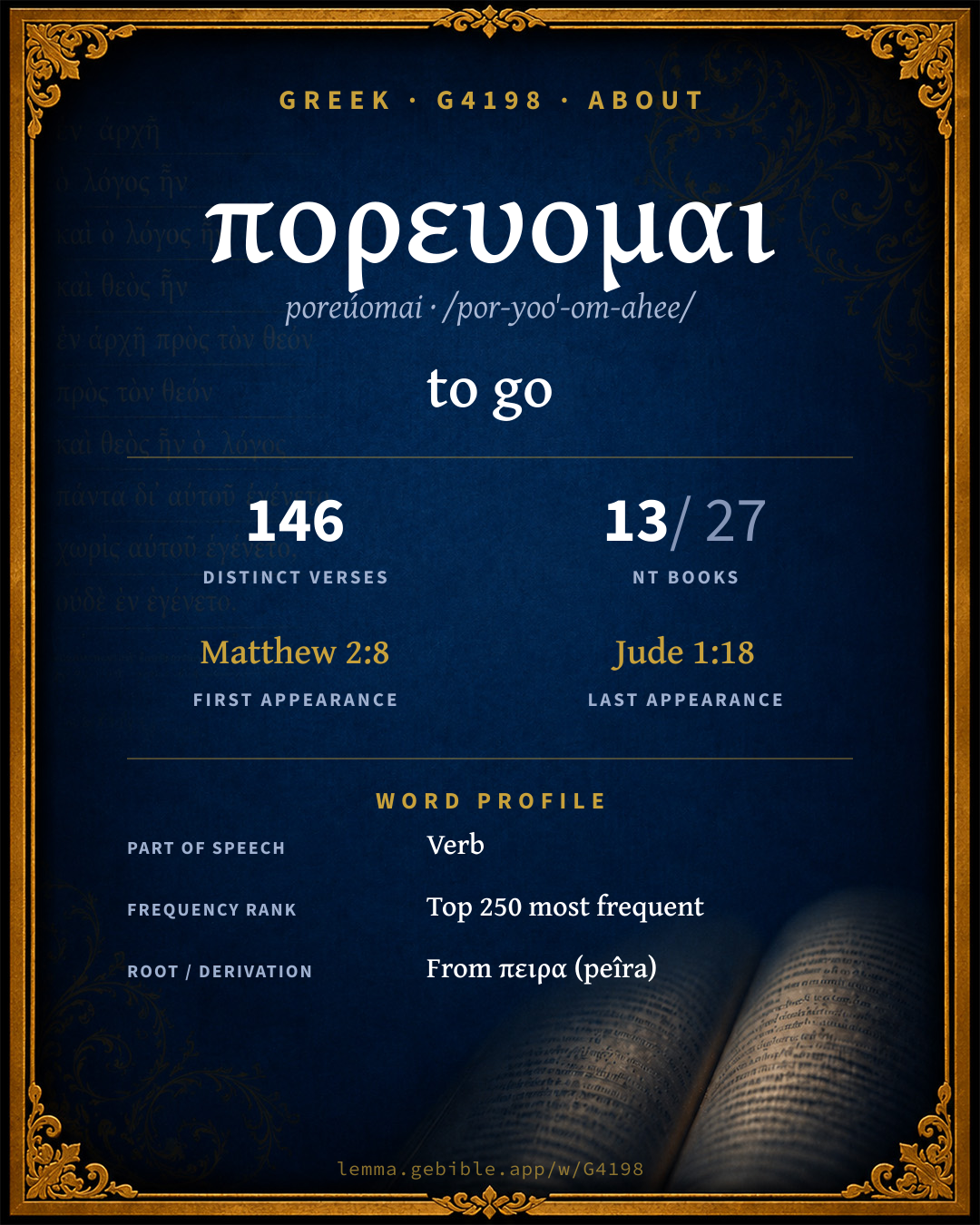
πορεύομαι
to go
Full lexicon entry — Thayer's Greek Lexicon
From Thayer's Greek Lexicon
Where this word appears
Grammar key — what these labels mean
Part of speech
- Verb
- An action or state-of-being word.
Tense
- Present
- Ongoing or general action in present time (imperfective aspect).
- Aorist
- Action viewed as a simple whole, without regard to duration — often past (perfective aspect).
- Imperfect
- Continuous or repeated action in past time (“was writing”).
- Future
- Action expected in future time.
- Perfect
- A completed past action with continuing present results.
Voice
- Middle or Passive deponent
- Middle/passive in form but active in meaning.
- Passive deponent
- Passive in form but active in meaning.
- Middle deponent
- Middle in form but active in meaning.
Mood
- Infinitive
- A verbal noun (“to write”), unmarked for person or number.
- Imperative
- Expresses a command or request.
- Participle
- A verbal adjective (“writing,” “having written”).
- Indicative
- States a fact or asks a factual question (the mood of reality).
- Subjunctive
- Expresses probability, purpose, or possibility (the mood of contingency).
Case
- Nominative
- The case of the subject (and the predicate nominative).
- Genitive
- The case of source, possession, or “of” — answers “whose / from what.”
- Accusative
- The case of the direct object and of extent.
- Dative
- The case of the indirect object, means, or location — “to / for / with / in.”
Person
- 2nd person
- The one addressed (“you”).
- 3rd person
- The one spoken about (“he / she / it / they”).
- 1st person
- The speaker (“I / we”).
Gender
- Masculine
- Grammatically masculine.
- Feminine
- Grammatically feminine.
- Neuter
- Grammatically neuter.
Number
- Singular
- One.
- Plural
- More than one.
Every verse where G4198 appears in the Book of 2 Peter — 2 distinct verses. Click any verse to open its interlinear word-by-word view. Verse text shown in the World English Bible for context — . Each verse’s Greek form is shown with its reference; the English is not keyword-highlighted, since the data carries no word-level English alignment. Use “Compare translations” on any verse to read it across multiple English versions. This concordance covers the Greek New Testament; Septuagint (Greek Old Testament) occurrences of this word are not indexed here.
2 Peter
- 2 Peter 2:10 πορευομένους pres mid/pass.dep ptcp acc pl masc but chiefly those who walk after the flesh in the lust of defilement, and despise authority. Daring, self-willed, they are not afraid to speak evil of dignitaries;
- 2 Peter 3:3 πορευόμενοι pres mid/pass.dep ptcp nom pl masc knowing this first, that in the last days mockers will come, walking after their own lusts,
About this entry
At a glance — auto-summarized from this page’s data, not written by a person. Every figure links to its source below. This summary describes the numbers; it doesn’t interpret them.
The Greek verb πορευομαι centers on the idea of “to go.” Scripture first uses it in Matthew 2:8. Spanning 146 verses in 13 books, it ranks among the common words of the Greek New Testament. Luke dominates its distribution — 48 of 146 verses. It clusters with πειρα, πειραζω and πειραω under a shared root. Dig into 146-verse concordance and the renderings breakdown below.
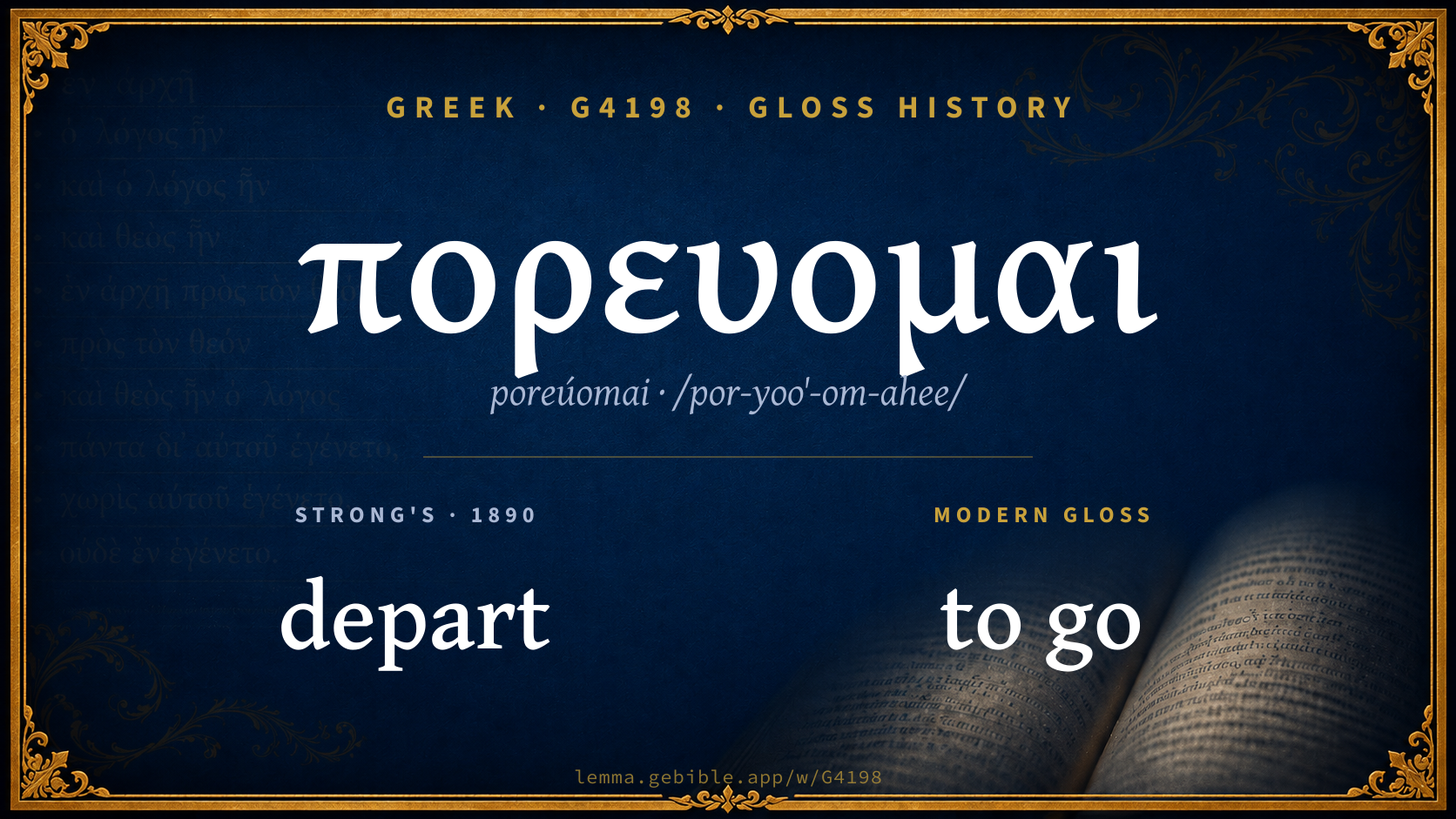
Gloss history
Strong's 1890 vs modern scholarship
About this word
Strong's G4198 catalogs a Greek word from the Greek New Testament.
These counts are not copied from any lexicon or concordance. They are computed here, from the morphology-tagged Greek New Testament. What Lemma adds →
- 146
- distinct verses
- The word appears in 146 distinct verses.
- 13 / 27
- NT books
- The word appears in 13 of 27 New Testament books.
- #106
- by frequency
- Top 250 most frequent Greek words (rank 106 of 5,347 Greek words by occurrence).
View all 146 occurrences in the concordance →
By section of the New Testament
By traditional corpus
Conventional, traditional groupings — biblical authorship is debated, so this is a traditional corpus grouping, not an authorship claim. Some books belong to more than one corpus (Luke is in both the Gospels and the Lukan corpus, and so on), so these shares overlap and need not total 100%. Each figure is a share of the word’s 146 distinct verses.
- Gospels 93 verses · 64%
- Lukan (Luke–Acts) 85 verses · 58%
- Johannine 14 verses · 10%
- General (Catholic) Epistles 9 verses · 6%
- Pauline corpus 7 verses · 5%
How translations render this word
Counts come from each version’s own published word-to-Strong’s tagging or interlinear alignment — an approximate guide to how each version renders this word, not a word-level alignment the data otherwise carries. Because each total is that version’s own tagged count, the per-version totals vary from one another and need not match the appearance or distinct-verse counts above. These counts may also differ from a printed concordance because Lemma counts each distinctly tagged rendering and does not collapse phrase taggings into a single head-word total. This is a fixed set of word-tagged versions (KJV, ASV, BSB, ULT) and does not change with the reading translation you choose elsewhere. Each version’s license is shown beside its name below (and on Sources).
- King James Version: Go 41×, Went 25×, I go 8×
- American Standard Version: Go 48×, Went 22×, Go ye 5×
- Berean Standard Bible: Go 47×, Went 15×, I am going 4×
- unfoldingWord Literal Text: Go 44×, Having gone 16×, Going 15×
King James Version Public Domain
Renders G4198 across 154 tagged occurrences — most commonly:
Plus other, less common renderings. Plus 32 renderings that appear only once — usually multi-word phrases or single function words the recovered tagging swept in, not distinct renderings. Not rendered by a distinct English word in 1 further occurrence.
American Standard Version Public Domain
Renders G4198 across 153 tagged occurrences — most commonly:
Plus other, less common renderings. Plus 41 renderings that appear only once — usually multi-word phrases or single function words the recovered tagging swept in, not distinct renderings.
Berean Standard Bible Public Domain
Renders G4198 across 147 tagged occurrences — most commonly:
Plus other, less common renderings. Plus 58 renderings that appear only once — usually multi-word phrases or single function words the recovered tagging swept in, not distinct renderings. Not rendered by a distinct English word in 5 further occurrences.
unfoldingWord Literal Text CC BY-SA 4.0
Renders G4198 across 159 tagged occurrences — most commonly:
Plus other, less common renderings. Plus 36 renderings that appear only once — usually multi-word phrases or single function words the recovered tagging swept in, not distinct renderings.
Senses in Thayer's
The 1 sense Thayer's distinguishes for this word, in lexicon order (not ranked by frequency or importance). The full entry — with sub-senses — is in the Lexicon Entry tab.
- to lead over, carry over, transfer
Word origin
Derived from πειρα (peîra) (G3984) — trial.
Middle voice from a derivative of the same as G3984 ; to traverse that is travel (literally or figuratively; especially to remove [figuratively die ] live etc.): - depart go (away forth one´ s way up) (make a take a) journey walk.
— Strong’s Exhaustive Concordance (1890), public domain.
Forms in the corpus
The 40 distinct written forms G4198 takes in the Greek New Testament, most frequent first — each parse links to that tense’s occurrences in the concordance.
Same root — word family
Other Thayer's entries built from the same root as G4198, grouped by Strong’s listed origin. These share a root / origin per the lexicon — not necessarily a shared meaning. Each links to that word’s own entry.
Derives from
Shares the same root
Derived from this word
Compare all same-root words → Showing 4 of 5 — not the complete family. They share a root, not necessarily a meaning.
Septuagint usage
The same Greek word πορευομαι appears 1,018 times in the Greek Old Testament (Septuagint), across 897 verses in 36 books.
- 1,018
- LXX occurrences
- Tagged occurrences of this Greek word in the Septuagint.
- 897
- verses
- Distinct Septuagint verses containing this word.
- 36 / 39
- OT books
- The word appears in 36 of the 39 Old Testament books.
Sample Septuagint occurrences
- Genesis 2:14 πορεύομαι
- Exodus 2:8 πορεύομαι
- Leviticus 11:20 πορεύομαι
- Numbers 10:30 πορεύομαι
- Deuteronomy 1:19 πορεύομαι
- Joshua 1:9 πορεύομαι
- Judges 1:3 πορεύομαι
- Ruth 1:1 πορεύομαι
- 1 Samuel 1:14 πορεύομαι
- 2 Samuel 2:19 πορεύομαι
- 1 Kings 2:2 πορεύομαι
- 2 Kings 1:2 πορεύομαι
Septuagint occurrences (same lexeme)
Every verse where the same Strong’s number (G4198) appears in the Greek Septuagint — showing the first 50 of 897. Verse text shown in the World English Bible for context; the Greek form is the matched word — the English is not keyword-highlighted.
- Genesis 2:14 πορεύομαι The name of the third river is Hiddekel: this is the one which flows in front of Assyria. The fourth river is the Euphrates.
- Genesis 3:14 πορεύομαι Yahweh God said to the serpent, "Because you have done this, cursed are you above all cattle, and above every animal of the field. On your belly shall you go, and you shall eat dust all the days of your life.
- Genesis 8:3 πορεύομαι The waters receded from off the earth continually. After the end of one hundred fifty days the waters decreased.
- Genesis 8:5 πορεύομαι The waters receded continually until the tenth month. In the tenth month, on the first day of the month, the tops of the mountains were seen.
- Genesis 9:23 πορεύομαι Shem and Japheth took a garment, and laid it on both their shoulders, went in backwards, and covered the nakedness of their father. Their faces were backwards, and they didn't see their father's nakedness.
- Genesis 11:31 πορεύομαι Terah took Abram his son, Lot the son of Haran, his son's son, and Sarai his daughter-in-law, his son Abram's wife. They went forth from Ur of the Chaldees, to go into the land of Canaan. They came to Haran, and lived there.
- Genesis 12:4 πορεύομαι So Abram went, as Yahweh had spoken to him. Lot went with him. Abram was seventy-five years old when he departed out of Haran.
- Genesis 12:5 πορεύομαι Abram took Sarai his wife, Lot his brother's son, all their substance that they had gathered, and the souls who they had gotten in Haran; and they went forth to go into the land of Canaan. Into the land of Canaan they came.
- Genesis 12:9 πορεύομαι Abram traveled, going on still toward the South.
- Genesis 13:3 πορεύομαι He went on his journeys from the South even to Bethel, to the place where his tent had been at the beginning, between Bethel and Ai,
- Genesis 16:8 πορεύομαι He said, "Hagar, Sarai's handmaid, where did you come from? Where are you going?" She said, "I am fleeing from the face of my mistress Sarai."
- Genesis 21:19 πορεύομαι God opened her eyes, and she saw a well of water. She went, filled the bottle with water, and gave the boy drink.
- Genesis 22:2 πορεύομαι He said, "Now take your son, your only son, whom you love, even Isaac, and go into the land of Moriah. Offer him there for a burnt offering on one of the mountains which I will tell you of."
- Genesis 22:3 πορεύομαι Abraham rose early in the morning, and saddled his donkey, and took two of his young men with him, and Isaac his son. He split the wood for the burnt offering, and rose up, and went to the place of which God had told him.
- Genesis 22:6 πορεύομαι Abraham took the wood of the burnt offering and laid it on Isaac his son. He took in his hand the fire and the knife. They both went together.
- Genesis 22:8 πορεύομαι Abraham said, "God will provide himself the lamb for a burnt offering, my son." So they both went together.
- Genesis 22:13 πορεύομαι Abraham lifted up his eyes, and looked, and saw that behind him was a ram caught in the thicket by his horns. Abraham went and took the ram, and offered him up for a burnt offering instead of his son.
- Genesis 22:19 πορεύομαι So Abraham returned to his young men, and they rose up and went together to Beersheba. Abraham lived at Beersheba.
- Genesis 24:4 πορεύομαι But you shall go to my country, and to my relatives, and take a wife for my son Isaac."
- Genesis 24:5 πορεύομαι The servant said to him, "What if the woman isn't willing to follow me to this land? Must I bring your son again to the land you came from?"
- Genesis 24:8 πορεύομαι If the woman isn't willing to follow you, then you shall be clear from this my oath. Only you shall not bring my son there again."
- Genesis 24:10 πορεύομαι The servant took ten camels, of his master's camels, and departed, having all goodly things of his master's in his hand. He arose, and went to Mesopotamia, to the city of Nahor.
- Genesis 24:38 πορεύομαι but you shall go to my father's house, and to my relatives, and take a wife for my son.'
- Genesis 24:39 πορεύομαι I said to my master, 'What if the woman will not follow me?'
- Genesis 24:42 πορεύομαι I came this day to the spring, and said, 'Yahweh, the God of my master Abraham, if now you do prosper my way which I go.
- Genesis 24:58 πορεύομαι They called Rebekah, and said to her, "Will you go with this man?" She said, "I will go."
- Genesis 24:61 πορεύομαι Rebekah arose with her ladies. They rode on the camels, and followed the man. The servant took Rebekah, and went his way.
- Genesis 24:62 πορεύομαι Isaac came from the way of Beer Lahai Roi. For he lived in the land of the South.
- Genesis 24:65 πορεύομαι She said to the servant, "Who is the man who is walking in the field to meet us?" The servant said, "It is my master." She took her veil, and covered herself.
- Genesis 25:22 πορεύομαι The children struggled together within her. She said, "If it be so, why do I live?" She went to inquire of Yahweh.
- Genesis 25:32 πορεύομαι Esau said, "Behold, I am about to die. What good is the birthright to me?"
- Genesis 26:1 πορεύομαι There was a famine in the land, besides the first famine that was in the days of Abraham. Isaac went to Abimelech king of the Philistines, to Gerar.
- Genesis 26:26 πορεύομαι Then Abimelech went to him from Gerar, and Ahuzzath his friend, and Phicol the captain of his host.
- Genesis 27:5 πορεύομαι Rebekah heard when Isaac spoke to Esau his son. Esau went to the field to hunt for venison, and to bring it.
- Genesis 27:9 πορεύομαι Go now to the flock, and get me from there two good kids of the goats. I will make them savory food for your father, such as he loves.
- Genesis 27:13 πορεύομαι His mother said to him, "Let your curse be on me, my son. Only obey my voice, and go get them for me."
- Genesis 27:14 πορεύομαι He went, and got them, and brought them to his mother. His mother made savory food, such as his father loved.
- Genesis 28:5 πορεύομαι Isaac sent Jacob away. He went to Paddan Aram to Laban, son of Bethuel the Syrian, Rebekah's brother, Jacob's and Esau's mother.
- Genesis 28:7 πορεύομαι and that Jacob obeyed his father and his mother, and was gone to Paddan Aram.
- Genesis 28:9 πορεύομαι Esau went to Ishmael, and took, besides the wives that he had, Mahalath the daughter of Ishmael, Abraham's son, the sister of Nebaioth, to be his wife.
- Genesis 28:10 πορεύομαι Jacob went out from Beersheba, and went toward Haran.
- Genesis 28:15 πορεύομαι Behold, I am with you, and will keep you, wherever you go, and will bring you again into this land. For I will not leave you, until I have done that which I have spoken of to you."
- Genesis 28:20 πορεύομαι Jacob vowed a vow, saying, "If God will be with me, and will keep me in this way that I go, and will give me bread to eat, and clothing to put on,
- Genesis 29:1 πορεύομαι Then Jacob went on his journey, and came to the land of the children of the east.
- Genesis 30:14 πορεύομαι Reuben went in the days of wheat harvest, and found mandrakes in the field, and brought them to his mother, Leah. Then Rachel said to Leah, "Please give me some of your son's mandrakes."
- Genesis 31:30 πορεύομαι Now, you want to be gone, because you sore longed after your father's house, but why have you stolen my gods?"
- Genesis 32:18 πορεύομαι Then you shall say, 'They are your servant, Jacob's. It is a present sent to my lord, Esau. Behold, he also is behind us.'"
- Genesis 33:12 πορεύομαι Esau said, "Let us take our journey, and let us go, and I will go before you."
- Genesis 35:3 πορεύομαι Let us arise, and go up to Bethel. I will make there an altar to God, who answered me in the day of my distress, and was with me in the way which I went."
- Genesis 35:22 πορεύομαι It happened, while Israel lived in that land, that Reuben went and lay with Bilhah, his father's concubine, and Israel heard of it. Now the sons of Jacob were twelve.
These are occurrences of the same Greek lexeme (G4198) in the Septuagint — not a translation of any one Hebrew word. The store carries no word-level Hebrew↔Greek alignment, so no Hebrew original is asserted here. Counts come from the recovered LXX Strong's tagging — high-frequency vocabulary is well covered, while rare or late forms may be untagged — so they reflect tagged occurrences and may slightly undercount.