
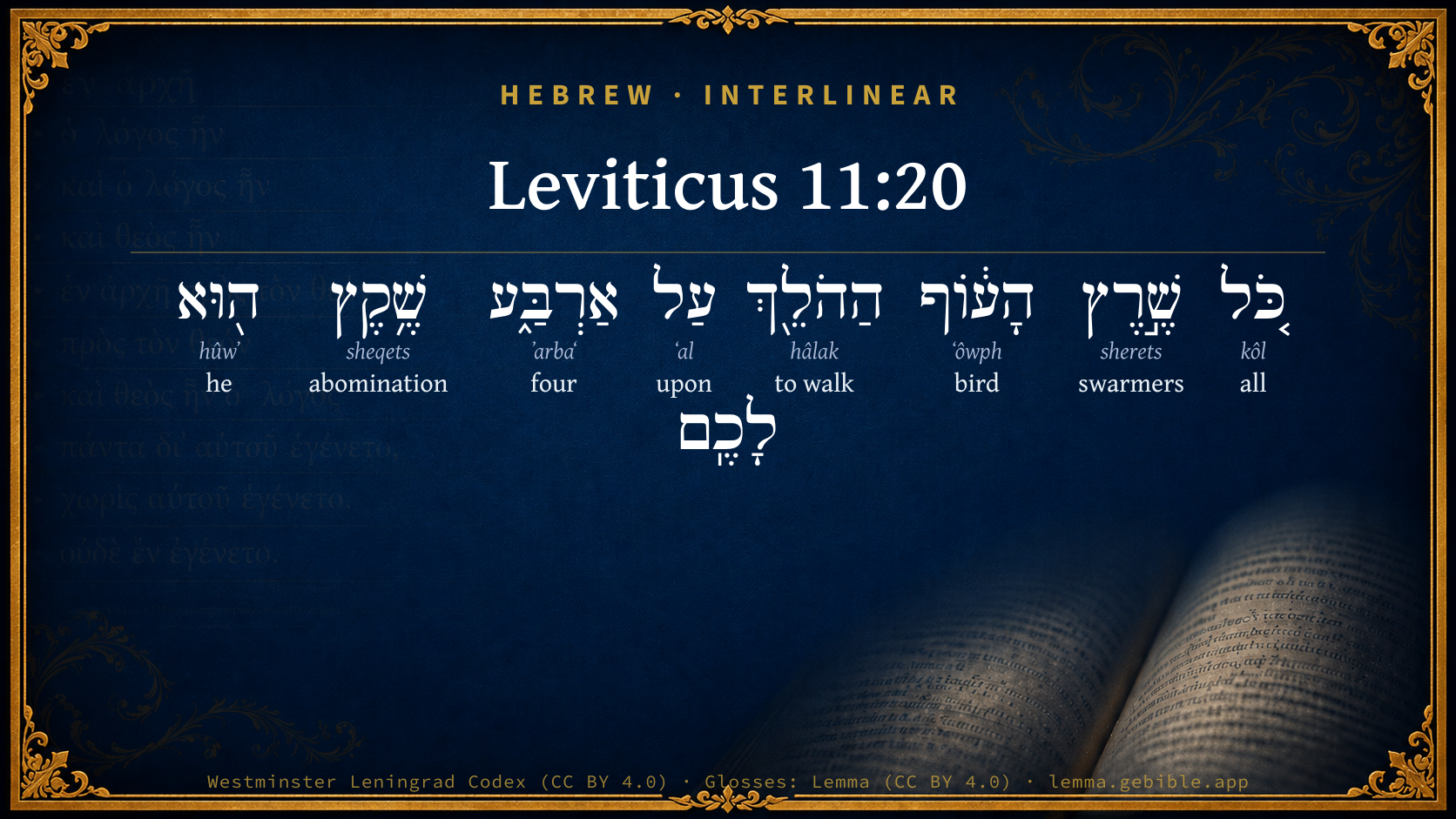
Leviticus 11:20

Hebrew (Westminster Leningrad Codex) Leviticus 11:20 appears in the Hebrew Old Testament. The text above is from the Westminster Leningrad Codex. Each word links to its Strong’s number, a concise gloss, and parsing drawn from the Open Scriptures Hebrew Bible morphology. Click any word for its full Brown-Driver-Briggs (BDB) entry.
Download image
Cite this verse

Leviticus 11:20 (World English Bible). Public Domain. Lemma interlinear Bible study tool, https://lemma.gebible.app/v/leviticus/11/20.

Show BibTeX & RIS
BibTeX
RIS
English Translation
"'All flying insects that walk on all fours are an abomination to you.
World English Bible · Public Domain
Download a study sheet

One document with this verse’s original text, its word-by-word gloss line, the meaning frame, cross-references with their text, attributed commentary, and full source and license credits — printable, and it pastes into notes with its structure intact.

This verse Autodidact and up

Study sheet (.html) Plain text (.txt)

A passage Seminary Student

Up to 50 verses in one chapter. A passage sheet keeps up to 6 commentary sources and 12 cross-references per verse, in the order this page ranks them, and says so on the sheet whenever that leaves anything out. Ask for a single verse and you get the Autodidact verse sheet above.

Everything on this page stays free to read, with no account — the sheet is a download of what is already on screen, not access to it.

Want to remove ads? Support Godless Engineer
Compare translations 3

The same verse in 3 English versions, stacked beneath the original-language interlinear above. Click any original word for its lexicon entry.

Each is an independent rendering of the whole verse — the interlinear is not word-aligned to these translations.

Highlighted words mark where these versions differ — a whole-verse word diff, not a word-by-word alignment.

  • World English Bible Public Domain
    "'All flying insects that walk on all fours are an abomination to you.
  • King James Version Public Domain
    All fowls that creep, going upon all four, shall be an abomination unto you.
  • unfoldingWord Literal Text CC BY-SA 4.0
    Every swarming thing of the wing, the one walking on four—it a detestable thing to you.

unfoldingWord Literal Text — © unfoldingWord, licensed CC BY-SA 4.0. Word-aligned USFM3 via Door43 (git.door43.org/unfoldingWord/en_ult).

Versions to compare (up to 4)

3 of 4 selected

Show all 18 translations

Every available English version of this verse, each an independent rendering of the whole verse.

  • World English Bible Public Domain
    "'All flying insects that walk on all fours are an abomination to you.
  • Berean Standard Bible Public Domain
    All flying insects that walk on all fours are detestable to you.
  • Majority Standard Bible Public Domain
    All flying insects that walk on all fours are detestable to you.
  • King James Version Public Domain
    All fowls that creep, going upon all four, shall be an abomination unto you.
  • American Standard Version (1901) Public Domain
    All winged creeping things that go upon all fours are an abomination unto you.
  • Revised Version (1885) Public Domain
    All winged creeping things that go upon all four are an abomination unto you.
  • Geneva Bible (1599) Public Domain
    Also euery foule that creepeth and goeth vpon all foure, such shalbe an abomination vnto you.
  • Douay-Rheims (1899) Public Domain
    Of things that fly, whatsoever goeth upon four feet, shall be abominable to you.
  • Young's Literal Translation Public Domain
    `Every teeming creature which is flying, which is going on four -- an abomination it `is' to you.
  • Literal Standard Version CC BY-SA 4.0
    Every teeming creature which is flying, which is going on four [legs]—it [is] an abomination to you.
  • Unlocked Literal Bible CC BY-SA 4.0
    All winged insects that walk on four legs are detestable to you.
  • unfoldingWord Literal Text CC BY-SA 4.0
    Every swarming thing of the wing, the one walking on four—it a detestable thing to you.
  • Darby Bible Public Domain
    Every winged crawling thing that goeth upon all four shall be an abomination unto you.
  • World Messianic Bible Public Domain
    “‘All flying insects that walk on all fours are an abomination to you.
  • Webster's Bible Public Domain
    All fowls that creep, going upon all four, shall be an abomination to you.
  • Free Bible Version CC BY-SA 4.0
    All flying insects that crawl are repulsive to you.
  • Bible in Basic English Public Domain
    Every winged four-footed thing which goes on the earth is disgusting to you;
  • JPS Tanakh (1917) Public Domain
    All winged swarming things that go upon all fours are a detestable thing unto you.

Literal Standard Version (2020), Covenant Press — licensed CC BY-SA 4.0. Text via the HelloAO Bible API (eBible.org). Unlocked Literal Bible (unfoldingWord) — licensed CC BY-SA 4.0. Text via the HelloAO Bible API (eBible.org). unfoldingWord Literal Text — © unfoldingWord, licensed CC BY-SA 4.0. Word-aligned USFM3 via Door43 (git.door43.org/unfoldingWord/en_ult). Free Bible Version, Dr. Jonathan Gallagher — licensed CC BY-SA 4.0. Text via the HelloAO Bible API (eBible.org).

Word by word

More ways to search: Search by grammar → Find every occurrence → Compare this word →

Practice this passage: Drill this verse → Learn its vocabulary →

About this verse

These counts appear in no published source. They are computed here, from the morphology-tagged text and Lemma’s own curated glosses. What Lemma adds →

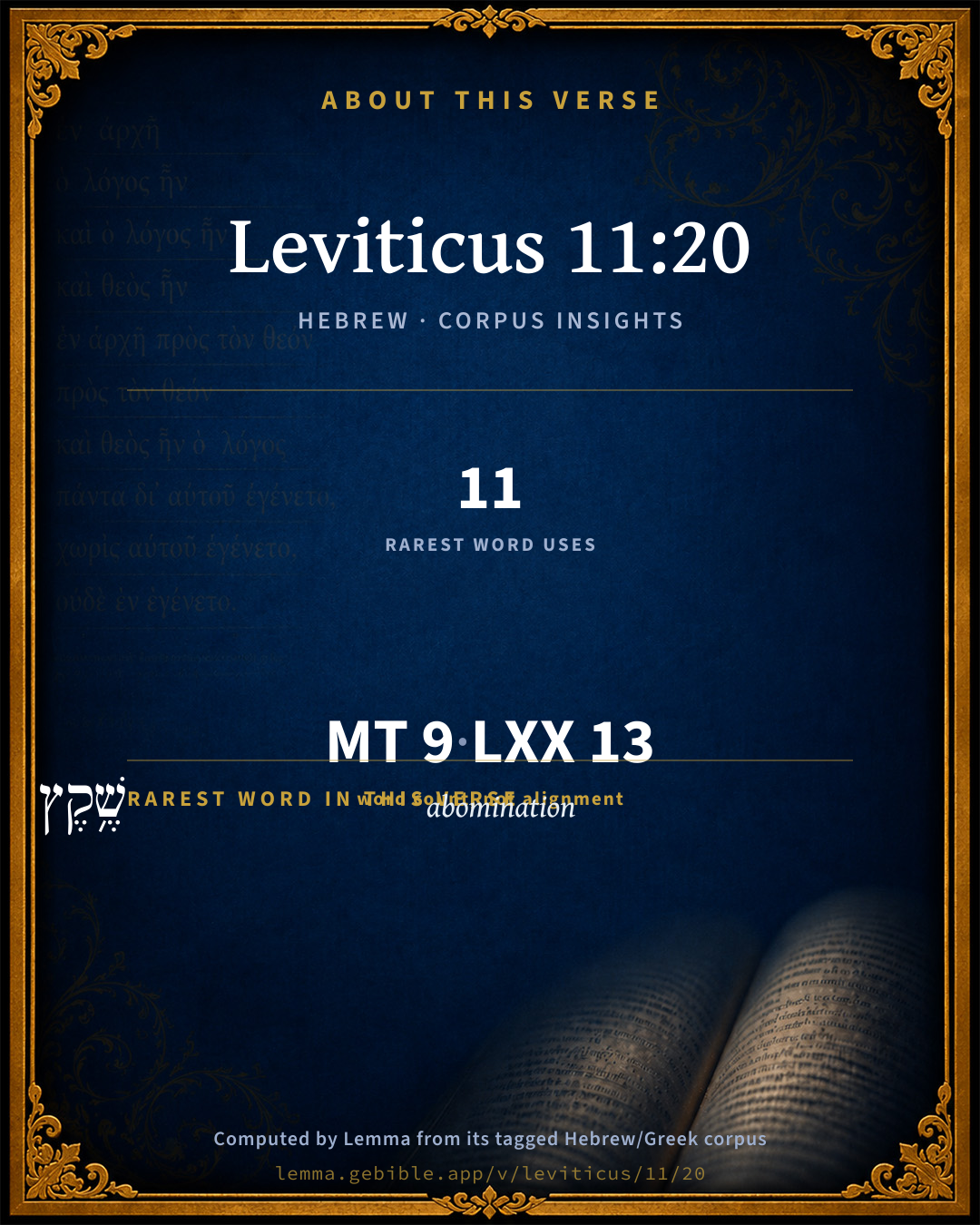
9
words
8
distinct lemmas
Pentateuch
section

Notable vocabulary

The rarest word here is שֶׁ֥קֶץ abomination H8263 — appearing just 11 times in the whole Hebrew Bible.

Shared distinctive vocabulary

שֶׁ֥קֶץ abomination H8263 occurs in 11 verses of the Hebrew Bible. Also found in:

Grammatical profile

  • 1 verb
  • 4 nouns
  • 1 adjective
  • 1 pronoun
  • 2 prepositions

Verb forms

  • הַהֹלֵ֖ךְ Qal · Participle Active

Hebrew & Septuagint length

In English translation the verse runs 13 words from the Hebrew and 15 from the Septuagint (LXX English) — closely comparable.

A rough comparison of the two English renderings, which tokenize alike — not a word-level alignment.

Word counts can differ between the Hebrew and the Greek without any difference in meaning — e.g. the Hebrew direct-object marker אֵת has no separate Greek word, and Greek often adds the article ὁ.

In the original languages it is 9 Hebrew tokens and 13 Greek tokens — but the two are counted differently (Hebrew bundles its prefixes and suffixes into one token; the Greek is in lemma form), so that isn’t a like-for-like length.

Cross-references

11

Topical passages linked to Leviticus 11:20 in the Treasury of Scripture Knowledge — connected by theme and wording, ordered by reader-vote popularity; previews shown in the World English Bible.

  • Leviticus 11:23 But all winged creeping things which have four feet, are an abomination to you.
  • Leviticus 11:27 Whatever goes on its paws, among all animals that go on all fours, they are unclean to you. Whoever touches their carcass shall be unclean until the evening.
  • Deuteronomy 14:19 All winged creeping things are unclean to you: they shall not be eaten.
  • 2 Kings 17:28–41 So one of the priests whom they had carried away from Samaria came and lived in Bethel, and taught them how they should fear Yahweh.
  • Psalms 17:14 From men by your hand, Yahweh, From men of the world, whose portion is in this life. You fill the belly of your cherished ones. Your sons have plenty, And they store up wealth for their children.
  • Matthew 6:24 "No one can serve two masters, for either he will hate the one and love the other; or else he will be devoted to one and despise the other. You can't serve both God and Mammon.
  • Philippians 3:18–19 For many walk, of whom I told you often, and now tell you even weeping, as the enemies of the cross of Christ,
  • 2 Timothy 4:10 for Demas left me, having loved this present world, and went to Thessalonica; Crescens to Galatia, and Titus to Dalmatia.
  • 1 John 2:15–17 Don't love the world, neither the things that are in the world. If anyone loves the world, the Father's love isn't in him.
  • Jude 1:10 But these speak evil of whatever things they don't know. What they understand naturally, like the creatures without reason, in these things are they destroyed.
  • Jude 1:19 These are they who cause divisions, and are sensual, not having the Spirit.

Cross-references courtesy of OpenBible.info (CC BY 4.0).

Hebrew and Greek witnesses Masoretic Hebrew ↔ Greek Septuagint

The same verse in the two great witnesses to the Old Testament, shown verse-for-verse.

These are two independent witnesses, not word-aligned to each other, and the Septuagint is shown in lemma (dictionary) form.

Hebrew Leviticus 11:20 Masoretic · Westminster Leningrad Codex

כֹּ֚ל שֶׁ֣רֶץ הָע֔וֹף הַהֹלֵ֖ךְ עַל אַרְבַּ֑ע שֶׁ֥קֶץ ה֖וּא לָכֶֽם

"'All flying insects that walk on all fours are an abomination to you.

World English Bible · Public Domain

Greek LXX Leviticus 11:20 Septuagint · lemma form

καί πᾶς ὁ ἑρπετόν ὁ πετεινόν ὅς πορεύομαι ἐπί τέσσαρες βδέλυγμα εἰμί σύ

And all winged creatures that creep, which go upon four feet, are abominations to you.

LXX2012 (modern English Septuagint) · Public Domain

On this verse, Keil & Delitzsch discusses the Septuagint’s reading. Read the note in Commentary ↓

Hebrew: Westminster Leningrad Codex (CC BY 4.0). Greek: Septuagint (public domain); English from LXX2012 (modern English Septuagint) (Public Domain). How the Septuagint differs from the Hebrew →

Targum (Aramaic paraphrase)

2

The Targum is the ancient Jewish Aramaic paraphrase of the Hebrew Scriptures — an interpretive translation, not the Hebrew text itself. Onkelos (literal) and Pseudo-Jonathan (expansive) render the Torah, and Jonathan the Prophets. Coverage is partial: where no permissively-licensed English translation exists for a verse, only the Aramaic is shown. This is verse-level text, not a word-by-word alignment to the Hebrew.

  1. Targum Onkelos Torah (Genesis–Deuteronomy)
    כֹּל רִחֲשָׁא דְעוֹפָא דִמְהַלֵךְ עַל אַרְבַּע שִׁקְצָא הוּא לְכוֹן

    (no public-domain English translation for this verse)

    Targum Onkelos — Aramaic: “Onkelos Genesis” (public domain); “Onkelos Exodus” (public domain); “Onkelos Leviticus” (public domain); “Onkelos Numbers” (public domain); “Onkelos Deuteronomy” (public domain). English: “Sefaria Community Translation” (CC0 1.0 (public-domain dedication)); “J.W. Etheridge. The Targums of Onkelos and Jonathan Ben Uzziel on the Pentateuch. London: Longmans, Green, 1862” (public domain). Text via Sefaria.

  2. Targum Pseudo-Jonathan Torah (Genesis–Deuteronomy)
    וְכָל רִיחֲשָׁא דְעוֹפָא דִמְהַלֵךְ עַל אַרְבַּע זְנֵי דְיַבְּבֵי וּזְנֵי אוֹזְפֵיהּ וּזְנֵי זִיבּוֹרֵי שִׁיקְצָא הוּא לְכוֹן בְּרַם דוּבְשָׁא דְזִיבּוֹרָא יִתְאָכֵיל

    And every flying reptile that goeth upon four, the fly species, the wasp (or hornet) species, and the bee species shall be an abomination to you: nevertheless of honey of the bee you may eat.

    Targum Pseudo-Jonathan — Aramaic: “Targum Jonathan on Genesis” (public domain); “Targum Jonathan on Exodus” (public domain); “Targum Jonathan on Leviticus” (public domain); “Targum Jonathan on Numbers” (public domain); “Targum Jonathan on Deuteronomy” (public domain). English: “The Targum of Jonathan ben Uzziel, trans. J. W. Etheridge, London, 1862” (public domain). Text via Sefaria.

Commentary

Notes on Leviticus 11:20 from classic Christian and Jewish commentators (each source and its license shown beneath its notes). The classic Christian expositions comment on the surrounding passage and are grouped to its opening verse, so a note may address several verses; the Jewish commentaries on the Tanakh (Rashi and others) are per-verse, so they appear only where the commentator wrote on this verse.

Lemma curates 59 commentaries, every one of them public domain or Creative Commons licensed, each selected and text-cleaned for this edition rather than reprinted as found. About our sources →

Matthew Henry's Commentary

Here is the law, 1. Concerning flying insects, as flies, wasps, bees, etc.; these they might not eat (Lev 11:20), nor indeed are they fit to be eaten; but there were several sorts of locusts which in those countries were very good meat, and much used: John Baptist lived upon them in the desert, and they are here allowed them, Lev 11:21, Lev 11:22. 2. Concerning the creeping things on the earth; these were all forbidden (Lev 11:29, Lev 11:30, and again, Lev 11:41, Lev 11:42); for it was the curse of the serpent that upon his belly he should go, and therefore between him and man there was an enmity put (Gen 3:15), which was preserved by this law. Dust is the meat of the creeping things, and therefore they are not fit to be man's meat. 3. Concerning the dead carcasses of all these unclean animals. (1.) Every one that touched them was to be unclean until the evening, Lev 11:24-28. This law is often repeated, to possess them with a dread of every thing that was prohibited, though no particular reason for the prohibition did appear, but only the will of the Law-maker. Not that they were to be looked upon as defiling to the conscience, or that it was a sin against God to touch them, unless done in contempt of the law: in many cases, somebody must of necessity touch them, to remove them; but it was a ceremonial uncleanness they contracted, which for the time forbade them to come into the tabernacle, or to eat of any of the holy things, or so much as to converse familiarly with their neighbours. But the uncleanness continued only till the evening, to signify that all ceremonial pollutions were to come to an end by the death of Christ in the evening of the world. And we must learn, by daily renewing our repentance every night for the sins of the day, to cleanse ourselves from the pollution we contract by them, that we may not lie down in our uncleanness. Even unclean animals they might touch while they were alive without contracting any ceremonial uncleanness by it, as horses and dogs, because they were allowed to use them for service; but they might not touch them when they were dead, because they might not eat their flesh; and what must not be eaten must not be touched, Gen 3:3. (2.) Even the vessels, or other things they fell upon, were thereby made unclean until the evening (Lev 11:32), and if they were earthen vessels they must be broken, Lev 11:33. This taught them carefully to avoid every thing that was polluting, even in their common actions. Not only the vessels of the sanctuary, but every pot in Jerusalem and Judah, must be holiness to the Lord, Zac 14:20, Zac 14:21. The laws in these cases are very critical, and the observance of them would be difficult, we should think, if every thing that a dead mouse or rat, for instance, falls upon must be unclean; and if it were an oven, or ranges for pots, they must all be broken down, Lev 11:35. The exceptions also are very nice, Lev 11:36, etc. All this was designed to exercise them to a constant care and exactness in their obedience, and to teach us, who by Christ are delivered from these burdensome observances, not to be less circumspect in the more weighty matters of the law. We ought as industriously to preserve our precious souls from the pollutions of sin, and as speedily to cleanse them when they are polluted, as they were to preserve and cleanse their bodies and household goods from those ceremonial pollutions.

Matthew Henry's Commentary on the Whole Bible (1708–1710) — public domain (CC PDM 1.0). Text via the HelloAO Bible API.

Ellicott's Commentary for English Readers

(20) All the fowls that creep.—Better, all creeping things which have wings. The swarming animals or insects, which, as we have seen, constitute the fourth class of the Hebrew division of the animal kingdom, are now discussed in Lev_11:20-23. From the fact that in the following verse several kinds of locusts are exempted, it is evident that the phrase “creeping things which have wings” denotes insects.

Going upon all four.—That is, the insects in question not only fly but also creep. The phrase, however, “upon all four” does not refer to the exact number of feet, but, as in some modern languages, denotes walking with its body in a horizontal position, or near the ground, in contradistinction to the two-legged birds discussed in the foregoing verses. This is the sense which the administrators of the law in the time of Christ attached to the phrase. Hence the Chaldee paraphrase of Jonathan translates it, “And all creeping-things which have wings going upon all four, the flyspecies and the wasp or hornet species and the bee species.”

Shall be an abomination unto you.—As the bee species is included among “the creeping things which have wings,” some have supposed that bee-honey comes within the unclean things which are here said “shall be an abomination unto you.” Hence it is thought that the honey (dabesh) which is so frequently mentioned in the Bible as a special feature of the promised land (Exo_3:8; Exo_3:17; Exo_13:5; Exo_16:14; Exo_33:3; Lev_20:24, etc.), and which formed an important article of food among the Hebrews, was not the natural product of the bee, but is either the grape-honey, the dibs, which is still prepared in many parts of Syria and Palestine, and is exported in great quantities into Egypt; or the vegetable – honey, the exudation of certain trees and shrubs found in the peninsula of Sinai. Hence, too, it is supposed that the wild honey which Jonathan ate in the wood (1Sa_14:25), and which was the meat of John the Baptist (Mat_3:4), must refer to this vegetable-honey. But though it is true that the canon which obtained during the second Temple was “Whatsoever cometh from unclean creatures is unclean,” and that in accordance with this law the milk of unclean quadrupeds and the eggs of unclean birds and fishes were forbidden, yet the honey of bees was expressly permitted. The administrators of the law in the time of Christ accounted for this exemption that it is not the direct produce of the insect itself, but is a preparation from gathered juices of clean herbs. The Chaldee paraphrase of Jonathan therefore adds, after “shall be an abomination unto you,” the words, nevertheless the honey of the bee ye may eat. John the Baptist therefore acted in perfect obedience to the Law when he ate the honey which the bees deposited in the crevices of the rocks and in the hollow of trees. The prohibition to use honey in meatofferings is not owing to its being unclean, but to its producing fermentation. (See Lev_2:11.)

A Bible Commentary for English Readers, edited by Charles John Ellicott (1878–1897) — public domain. Text from a community e-Sword module.

Trapp's Complete Commentary

John Trapp

Lev 11:20 All fowls that creep, going upon [all] four, [shall be] an abomination unto you.

Ver. 20. All fowls that creep.] So all mongrels in religion, that, like the planet Mercury, can he good in conjunction with good, and bad with bad; that have religionem ephemeram, fidem menstruam. {a}

{a} Hilar.

John Trapp, A Commentary or Exposition upon All the Books of the Old and New Testament (1647–1656) — public domain. Text from a community e-Sword module.

Joseph Benson's Commentary

Lev 11:20-21. All fowls that creep — The original word signifies any animal or moving creature, especially of the reptile or insect kind, (Gen 1:20; Gen 7:21,) and ought to be rendered every winged reptile, or, every flying, creeping thing that goeth upon four, as in Lev 11:21, upon four legs, or upon more than four, which is all one as to the present purpose. Which have legs above their feet to leap withal — This is a description of the locusts, which, besides four smaller feet, have two larger ones, by means whereof they leap about.

Joseph Benson's Commentary on the Old and New Testaments (1811–1818) — public domain. Text from a community e-Sword module.

Jamieson, Fausset & Brown

Robert Jamieson, A. R. Fausset & David Brown

All fowls that creep, &c.--By "fowls" here are to be understood all creatures with wings and "going upon all fours," not a restriction to animals which have exactly four feet, because many "creeping things" have more than that number. The prohibition is regarded generally as extending to insects, reptiles, and worms.

Jamieson, Fausset & Brown — Commentary Critical and Explanatory on the Whole Bible (1871) — public domain (CC PDM 1.0). Text via the HelloAO Bible API.

Adam Clarke's Commentary

Verse 20. All fowls that creep] Such as the bat, already mentioned, which has claws attached to its leathern wings, and which serve in place of feet to crawl by, the feet and legs not being distinct; but this may also include all the different kinds of insects, with the exceptions in the following verse.

Going upon all four] May signify no more than walking regularly or progressively, foot after foot as quadrupeds do; for it cannot be applied to insects literally, as they have in general six feet, many of them more, some reputed to have a hundred, hence called centipedes; and some a thousand, hence called millipedes; words which often signify no more than that such insects have a great number of feet.

Adam Clarke's Commentary on the Bible (1810–1826) — public domain. Text from a community e-Sword/MySword module.

The Cambridge Bible for Schools and Colleges

gen. ed. J. J. S. Perowne

20. All winged swarming things] The same words as in Deu_14:19; swarming creatures which also fly, i.e. flying insects. A.V. obscures for the English reader the identity of expression by rendering here ‘all fowls that creep,’ and in Deu_14:19 ‘every creeping thing that flieth.’ In Deut. these things are all classed as unclean and not to be eaten. They are here further described as those ‘that go upon all four.’ All these swarming things have six feet, but the text describes their action as it appears to an ordinary observer, and, as in Lev_11:5-6, the language is popular, rather than scientific.

20–23. The connexion between these vv. and Lev_11:41 is very close, and Lev_11:24-30 are generally regarded as supplementary. See pp. 162 f.

The Cambridge Bible for Schools and Colleges (gen. ed. J. J. S. Perowne; Cambridge University Press, 1878–1918) — public domain. Text from a community e-Sword module.

John Gill's Exposition

All fowls that creep,.... Or rather "every creeping thing that flies"; for what are designed are not properly fowls, but, as the Jewish writers interpret them, flies, fleas, bees, wasps, hornets, locusts, &c. so the Targum of Jonathan, Jarchi, Ben Gersom, and Maimonides (y):

going upon all four; that is, upon their four feet, when they walk or creep:

these shall be an abomination to you; not used as food, but detested as such.

(y) Maacolot Asurot, c. 2. l. 5.

John Gill's Exposition of the Whole Bible (1746–1763) — public domain (CC PDM 1.0). Text via the HelloAO Bible API.

Albert Barnes' Notes on the Bible

Rather, “All creeping things which have wings,” etc. The word rendered creeping things may be regarded as coextensive with our word vermin. It is derived from a verb which signifies not only to creep, but to teem, or bring forth abundantly Gen 1:21; Gen 8:17; Exo 8:3; Psa 105:30, and so easily came to denote creatures which are apt to abound, to the annoyance of mankind.

Albert Barnes' Notes on the Bible (1834–1885) — public domain. Text from a community e-Sword/MySword module.

Haydock's Catholic Bible Commentary

Feet. Such as bees, (Calmet) and other insects of which he speaks. (Menochius)

George Leo Haydock (1774–1849), Haydock's Catholic Family Bible and Commentary, 1859 edition — public domain. Excludes Psalms (Douay-Rheims chapter numbering differs from Protestant) and Deuterocanonical books (Catholic canon only).

Matthew Poole's English Annotations

All fowls that crawl or creep upon the earth, and so degenerate from their proper nature, which is to fly, and are of a mongrel kind; which may intimate that apostates and mongrels in religion are abominable in the sight of God, and in conversation with men.

Going upon all four, upon four legs, or upon more than four, as bees, flies, &c, which is all one to the present purpose, these pluralists for legs being here opposed to those that have but two.

Matthew Poole's English Annotations on the Holy Bible (1683–1685) — public domain. Text from a community e-Sword/MySword module.

The Pulpit Commentary

Vers. 20-23. All fowls that creep should rather be rendered all winged creeping things, that is, all flying insects. None are allowed except the Saltatoria, or locust family. The word translated beetle signifies a sort of locust, like the other three words. That the locust was a regular article of food in Palestine is amply proved. "It is well known that locusts were eaten by many of the nations of antiquity, both in Asia and Africa, and even the ancient Greek thought the cicadas very agreeable in flavour (Arist. "Hist. An.," 5:30). In Arabia they are sold in the market, sometimes strung upon cords, sometimes by measure, and they are also dried and kept in bags for winter use.... They are generally cooked over hot coals, or on a plate, or in an oven, or stewed in butter, and eaten either with salt or with spice and vinegar, the head, wings, and feet being thrown away. They are also boiled in salt and water, and eaten with salt or butter. Another process is to dry them thoroughly, and then grind them into meal, and make cakes of them" (Keil). (Cf. Mat_3:4) The expression goeth upon all four, means groveling or going in a horizontal position, in contrast with two-legged birds, just spoken of.

The Pulpit Commentary (1880–1919), ed. H.D.M. Spence-Jones & Joseph S. Exell — public domain. Text from a community e-Sword module.

John Wesley's Explanatory Notes

All fowls - Flying things that crawl or creep upon the earth, and so degenerate from their proper nature, and are of a mongrel kind, which may intimate that apostates and mongrels in religion are abominable in the sight of God. Upon all four - Upon four legs, or upon more than four, which is all one to the present purpose.

John Wesley, Explanatory Notes Upon the Whole Bible (1754–1765) — public domain. Text via the GEBible commentary corpus.

Keil & Delitzsch

C. F. Keil & F. Delitzsch

(cf. Deu 14:19). To the birds there are appended flying animals of other kinds: "all swarms of fowl that go upon fours," i.e., the smaller winged animals with four feet, which are called sherez, "swarms," on account of their multitude. These were not to be eaten, as they were all abominations, with the exception of those "which have two shank-feet above their feet (i.e., springing feet) to leap with" (לא for לו as in Exo 21:8). Locusts are the animals referred to, four varieties being mentioned with their different species ("after his kind"); but these cannot be identified with exactness, as there is still a dearth of information as to the natural history of the oriental locust. It is well known that locusts were eaten by many of the nations of antiquity both in Asia and Africa, and even the ancient Greeks thought the Cicades very agreeable in flavour (Arist. h. an. 5, 30). In Arabia they are sold in the market, sometimes strung upon cords, sometimes by measure; and they are also dried, and kept in bags for winter use. For the most part, however, it is only by the poorer classes that they are eaten, and many of the tribes of Arabia abhor them (Robinson, ii. p. 628); and those who use them as food do not eat all the species indiscriminately. They are generally cooked over hot coals, or on a plate, or in an oven, or stewed in butter, and eaten either with salt or with spice and vinegar, the head, wings, and feet being thrown away. They are also boiled in salt and water, and eaten with salt or butter. Another process is to dry them thoroughly, and then grind them into meal and make cakes of them. The Israelites were allowed to eat the arbeh, i.e., according to Exo 10:13, Exo 10:19; Nah 3:17, etc., the flying migratory locust, gryllus migratorius, which still bears this name, according to Niebuhr, in Maskat and Bagdad, and is poetically designated in Psa 78:46; Psa 105:34, as חסיל, the devourer, and ילק, the eater-up; but Knobel is mistaken in supposing that these names are applied to certain species of the arbeh. סלעם, according to the Chaldee, deglutivit, absorpsit, is unquestionably a larger and peculiarly voracious species of locust. This is all that can be inferred from the rashon of the Targums and Talmud, whilst the ἀττάκης and attacus of the lxx and Vulg. are altogether unexplained. חרגּל: according to the Arabic, a galloping, i.e., a hopping, not a flying species of locust. This is supported by the Samaritan, also by the lxx and Vulg., ὀφιομάχης, ophiomachus. According to Hesychius and Suidas, it was a species of locust without wings, probably a very large kind; as it is stated in Mishnah, Shabb. vi. 10, that an egg of the chargol was sometimes suspended in the ear, as a remedy for earache. Among the different species of locusts in Mesopotamia, Niebuhr (Arab. p. 170) saw two of a very large size with springing feet, but without wings. חגב, a word of uncertain etymology, occurs in Num 13:33, where the spies are described as being like chagabim by the side of the inhabitants of the country, and in Ch2 7:13, where the chagab devours the land. From these passages we may infer that it was a species of locust without wings, small but very numerous, probably the ἀττέλαβος, which is often mentioned along with the ἀκρίς, but as a distinct species, locustarum minima sine pennis (Plin. h. n. 29, c. 4, s. 29), or parva locusta modicis pennis reptans potius quam volitans semperque subsiliens (Jerome (on Nah 3:17).

(Note: In Deu 14:19 the edible kinds of locusts are passed over, because it was not the intention of Moses to repeat every particular of the earlier laws in these addresses. But when Knobel (on Lev. pp. 455 and 461) gives this explanation of the omission, that the eating of locusts is prohibited in Deuteronomy, and the Deuteronomist passes them over because in his more advanced age there was apparently no longer any necessity for the prohibition, this arbitrary interpretation is proved to be at variance with historical truth by the fact that locusts were eaten by John the Baptist, inasmuch as this proves at all events that a more advanced age had not given up the custom of eating locusts.)

Keil & Delitzsch — Biblical Commentary on the Old Testament (1861–1891) — public domain (CC PDM 1.0). Text via the HelloAO Bible API. (Old Testament only.)

unfoldingWord translationNotes

Door43 World Missions Community

General Information:

Yahweh continues telling Moses and Aaron what he permits the people to eat and what he forbids them to eat.

All winged insects that walk on four legs are detestable to you

The word "detestable" can be translated with a verbal phrase. AT: "You will detest all winged insects that walk on four legs" (See: Abstract Nouns)

insects that walk on four legs

Here the phrase "four legs" is an idiom that means to crawl on the ground and sets these insects apart from other flying things, such as birds, that have only two feet. AT: "insects that crawl on the ground" (See: Idiom)

locust, katydid, cricket, or grasshopper

These are small insects that eat plants and can jump. (See: Translate Unknowns)

flying insects that have four feet

"flying insects that have four legs"

unfoldingWord translationNotes — © Distant Shores Media and the Door43 World Missions Community, licensed CC BY-SA 4.0. Source: git.door43.org/Door43/en_tn.

Rashi

Rabbi Shlomo Yitzchaki (Rashi)

העוף ‎שרץ PROLIFIC CREATURES AMONGST FOWL — These are the thin, lowly creatures which move upon the ground, such as flies and hornets and gnats and grasshoppers (cf. Rashi on Genesis 1:20).

Rashi on the Tanakh — English translations: “The Judaica Press complete Tanach with Rashi, translated by A. J. Rosenberg” (CC BY 4.0); “Pentateuch with Rashi's commentary by M. Rosenbaum and A.M. Silbermann, 1929-1934” (public domain); “The Metsudah Tanach series, Lakewood, N.J” (CC BY 4.0); and “The Book of Joshua, Metsudah Publications, 1997” (CC BY 4.0). Text via Sefaria.

Ramban (Nachmanides)

Rabbi Moshe ben Nachman (Ramban / Nachmanides)

SHERETZ HA’OPH’ (WINGED SWARMING THINGS). “These are the thin, lowly creatures which crawl upon the ground, such as flies and hornets, mosquitoes and grasshoppers.” This is Rashi’s language. But I do not consider it to be correct, for a bird is not called sheretz (a swarming thing) on account of its smallness, nor is the unqualified term oph (bird) used because of the largeness of its body. The bat has very small legs, and many kinds of grasshoppers have larger ones than it, so why is the bat not called sheretz ha’oph (a winged swarming thing) like the grasshoppers? Rather, the meaning of sheretz ha’oph is written [in Scripture immediately] after it: that go upon all fours. For all fowls that walk upon two legs, have erect necks, and their heads face upwards, and they always depend on their wings and flap them; therefore they are called oph kanaph (winged fowl), or just oph. But those that have [four] legs walk lowly, with their neck and head bent downwards like creeping things, and therefore they are called sheretz ha’oph (a winged creeping thing), as I have explained in Seder Bereshith. Similarly He referred back here and explained, And all ‘sheretz ha’oph’ (winged creeping things) which have four feet, are a detestable thing unto you, the meaning thereof being as if He had said: “all winged creeping things which have only four feet and do not have jointed legs [above their feet] as mentioned [in Verse 21 amongst the signs of purity], are a detestable thing unto you.” The interpretation thereof in Torath Kohanim is: 3:10. “Rabbi says: And all ‘sheretz ha’oph’ (winged creeping things) which have four feet, are a detestable thing. But if it has five feet, it is a clean species.”Now in this section regarding winged creeping things there is only a positive commandment, etc. (Verse 21), from which you derive the principle that those that do not meet these criteria, are forbidden to be eaten by means of a negative commandment, and a negative commandment derived from a positive commandment carries the force of the positive commandment. Hence he who eats forbidden winged swarming (or creeping) things transgresses a positive commandment, for which there is no punishment by the court. But in the Book of Deuteronomy, Ramban continues, there is also an express negative commandment against eating it. Hence he who eats it incurs whipping. but in the Book of Deuteronomy there is a prohibition mentioned in connection with it, [namely], And all ‘sheretz ha’oph’ (winged creeping things) are unclean unto you; they shall not be eaten. It is on the basis of that verse there that whipping is incurred for violation thereof.

Ramban (Nachmanides) on the Tanakh — English translation: “Commentary on the Torah by Ramban (Nachmanides). Translated and annotated by Charles B. Chavel. New York, Shilo Pub. House, 1971-1976” (CC BY 4.0). Text via Sefaria.

Lesson kit

Teaching starters — assembled from the data on this page, not authored interpretation. Every prompt links to the verse data it draws on. Edit before teaching.

Leviticus, in the Pentateuch, opens this verse with 9 words (8 distinct Hebrew lemmas). Its most distinctive word is sheqets (“abomination”). A historical commentator’s framing appears above. Read the whole chapter for the surrounding context.

Discussion questions

  1. The word sheqets carries the sense “abomination.” How does it shape the verse?
  2. Leviticus 7:21 shares the word «abomination» with this verse. How do the two illuminate each other?
  3. These translations render this verse differently; the difference is in the English rendering, not the original. What questions does that raise?
  4. The verb «הַהֹלֵ֖ךְ» is Qal Participle Active. How does its form color the action?
  5. Reading how Matthew Henry's Commentary and Ellicott's Commentary for English Readers read this verse, where do the two commentators agree and where do they part?

Things to notice

Reading settings

Reading text

Shown beneath each verse's original-language words.

Old Testament
Old Testament edition

Read the OT as the Masoretic Hebrew (MT) or the Greek Septuagint (LXX).

English shown for the Greek Septuagint (in the Hebrew ↔ Greek comparison).

Comparing translations? Open the Compare panel on any verse page to stack up to four side by side.