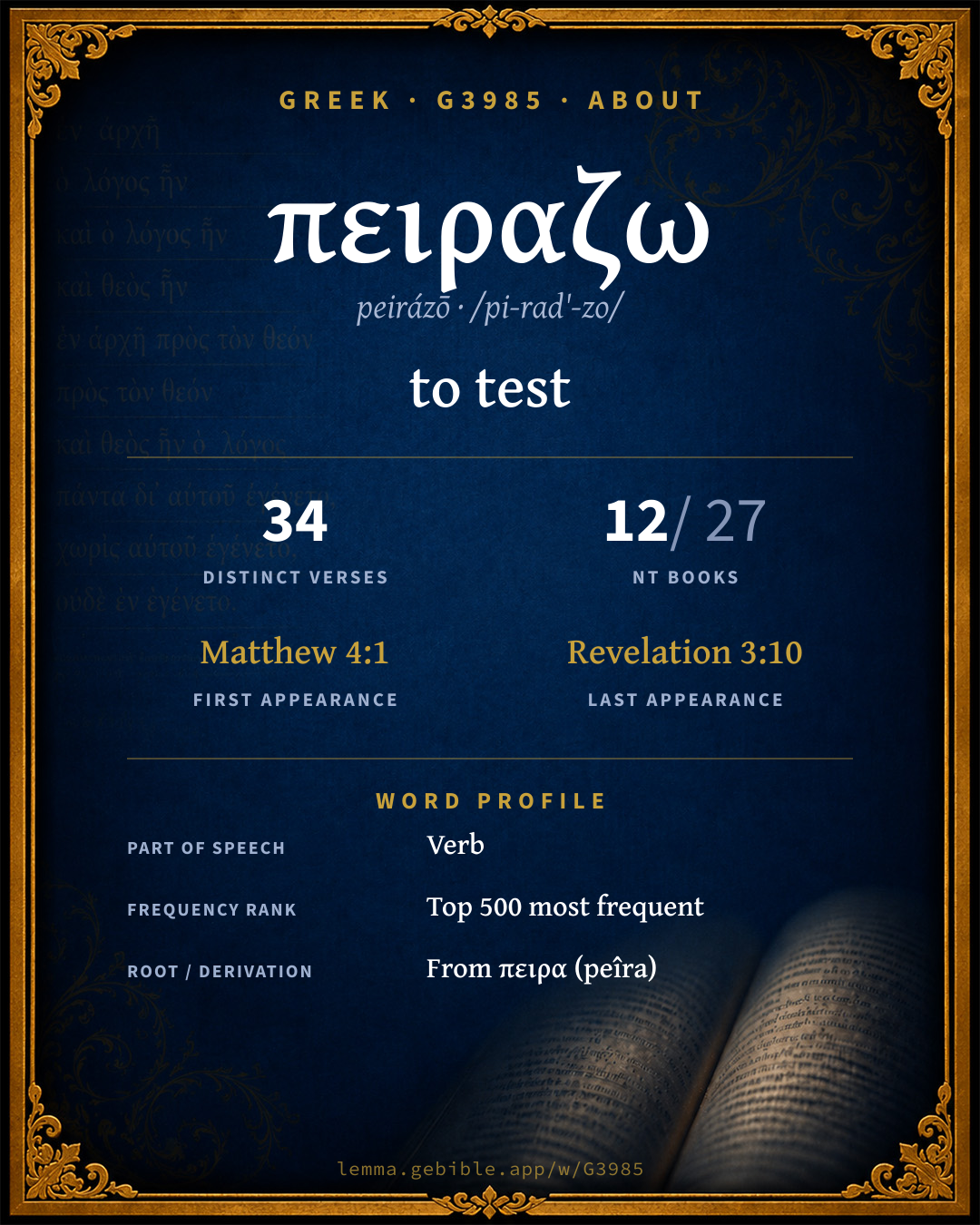
πειράζω
to test
‘to test’ is one of 2 main senses fuller range ↓
Full lexicon entry — Thayer's Greek Lexicon
From Thayer's Greek Lexicon
Where this word appears
See every Present-tense verb in the Greek New Testament →
Grammar key — what these labels mean
Part of speech
- Verb
- An action or state-of-being word.
Tense
- Present
- Ongoing or general action in present time (imperfective aspect).
- Imperfect
- Continuous or repeated action in past time (“was writing”).
- Aorist
- Action viewed as a simple whole, without regard to duration — often past (perfective aspect).
- Perfect
- A completed past action with continuing present results.
Voice
- Active
- The subject performs the action.
- Passive
- The subject receives the action.
Mood
- Participle
- A verbal adjective (“writing,” “having written”).
- Indicative
- States a fact or asks a factual question (the mood of reality).
- Infinitive
- A verbal noun (“to write”), unmarked for person or number.
- Subjunctive
- Expresses probability, purpose, or possibility (the mood of contingency).
- Imperative
- Expresses a command or request.
Case
- Nominative
- The case of the subject (and the predicate nominative).
- Dative
- The case of the indirect object, means, or location — “to / for / with / in.”
- Accusative
- The case of the direct object and of extent.
Person
- 3rd person
- The one spoken about (“he / she / it / they”).
- 2nd person
- The one addressed (“you”).
- 1st person
- The speaker (“I / we”).
Gender
- Masculine
- Grammatically masculine.
Number
- Plural
- More than one.
- Singular
- One.
Grammatical forms 21 distinct
- Verb, Present, Active, Participle, Nominative, Plural, Masculine 6 times (16%)
- Verb, Present, Active, Participle, Nominative, Singular, Masculine 4 times (11%)
- Verb, Present, Passive, Participle, Nominative, Singular, Masculine 4 times (11%)
- Verb, Imperfect, Active, Indicative, 3rd person, Singular 3 times (8%)
- Verb, Present, Active, Indicative, 2nd person, Plural 3 times (8%)
- Verb, Aorist, Active, Infinitive 2 times (5%)
- Verb, Aorist, Passive, Infinitive 2 times (5%)
- Verb, Aorist, Active, Indicative, 2nd person, Singular 1 time (3%)
+13 more forms (13 occurrences)
Parsed forms decoded from the imported morphology (Robinson–Tischendorf, public domain), counted across 38 parsed occurrences — not distinct verses.
Every verse where G3985 appears — 34 distinct verses across 12 books. Click any verse to open its interlinear word-by-word view. Verse text shown in the World English Bible for context — . Each verse’s Greek form is shown with its reference; the English is not keyword-highlighted, since the data carries no word-level English alignment. Use “Compare translations” on any verse to read it across multiple English versions. This concordance covers the Greek New Testament; Septuagint (Greek Old Testament) occurrences of this word are not indexed here.
Matthew 6 verses
- Matthew 4:1 πειρασθῆναι aor pass inf Then Jesus was led up by the Spirit into the wilderness to be tempted by the devil.
- Matthew 4:3 πειράζων pres act ptcp nom sg masc The tempter came and said to him, "If you are the Son of God, command that these stones become bread."
- Matthew 16:1 πειράζοντες pres act ptcp nom pl masc The Pharisees and Sadducees came, and testing him, asked him to show them a sign from heaven.
- Matthew 19:3 πειράζοντες pres act ptcp nom pl masc Pharisees came to him, testing him, and saying, "Is it lawful for a man to divorce his wife for any reason?"
- Matthew 22:18 πειράζετε pres act ind 2pl But Jesus perceived their wickedness, and said, "Why do you test me, you hypocrites?
- Matthew 22:35 πειράζων pres act ptcp nom sg masc One of them, a lawyer, asked him a question, testing him.
Mark 4 verses
- Mark 1:13 πειραζόμενος pres pass ptcp nom sg masc He was there in the wilderness forty days tempted by Satan. He was with the wild animals; and the angels were ministering to him.
- Mark 8:11 πειράζοντες pres act ptcp nom pl masc The Pharisees came out and began to question him, seeking from him a sign from heaven, and testing him.
- Mark 10:2 πειράζοντες pres act ptcp nom pl masc Pharisees came to him testing him, and asked him, "Is it lawful for a man to divorce his wife?"
- Mark 12:15 πειράζετε pres act ind 2pl Shall we give, or shall we not give?" But he, knowing their hypocrisy, said to them, "Why do you test me? Bring me a denarius, that I may see it."
Luke 2 verses
John 2 verses
Acts 5 verses
- Acts 5:9 πειράσαι aor act inf But Peter asked her, "How is it that you have agreed together to tempt the Spirit of the Lord? Behold, the feet of those who have buried your husband are at the door, and they will carry you out."
- Acts 9:26 ἐπείραζεν impf act ind 3sg When Saul had come to Jerusalem, he tried to join himself to the disciples; but they were all afraid of him, not believing that he was a disciple.
- Acts 15:10 πειράζετε pres act ind 2pl Now therefore why do you tempt God, that you should put a yoke on the neck of the disciples which neither our fathers nor we were able to bear?
- Acts 16:7 ἐπείραζον impf act ind 3pl When they had come opposite Mysia, they tried to go into Bithynia, but the Spirit didn't allow them.
- Acts 24:6 ἐπείρασεν impf act ind 3sg He even tried to profane the temple, and we arrested him.
1 Corinthians 2 verses
- 1 Corinthians 7:5 πειράζῃ pres act subj 3sg Don't deprive one another, unless it is by consent for a season, that you may give yourselves to fasting and prayer, and may be together again, that Satan doesn't tempt you because of your lack of self-control.
- 1 Corinthians 10:13 πειρασθῆναι aor pass inf No temptation has taken you except what is common to man. God is faithful, who will not allow you to be tempted above what you are able, but will with the temptation also make the way of escape, that you may be able to endure it.
2 Corinthians 1 verse
Galatians 1 verse
1 Thessalonians 1 verse
Hebrews 5 verses
- Hebrews 2:18 πειρασθείς πειραζομένοις aor pass ptcp nom sg masc pres pass ptcp dat pl masc For in that he himself has suffered being tempted, he is able to help those who are tempted.
- Hebrews 3:9 ἐπείρασαν aor act ind 3pl Where your fathers tested me by proving me, And saw my works for forty years.
- Hebrews 4:15 πεπειρασμένον perf pass ptcp acc sg masc For we don't have a high priest who can't be touched with the feeling of our infirmities, but one who has been in all points tempted like we are, yet without sin.
- Hebrews 11:17 πειραζόμενος pres pass ptcp nom sg masc By faith, Abraham, being tested, offered up Isaac. Yes, he who had gladly received the promises was offering up his one and only son;
- Hebrews 11:37 ἐπειράσθησαν aor pass ind 3pl They were stoned. They were sawn apart. They were tempted. They were slain with the sword. They went around in sheep skins and in goat skins; being destitute, afflicted, ill-treated
James 2 verses
- James 1:13 πειραζόμενος πειράζομαι πειράζει pres pass ptcp nom sg masc pres pass ind 1sg pres act ind 3sg Let no man say when he is tempted, "I am tempted by God," for God can't be tempted by evil, and he himself tempts no one.
- James 1:14 πειράζεται pres pass ind 3sg But each one is tempted, when he is drawn away by his own lust, and enticed.
Revelation 3 verses
- Revelation 2:2 ἐπείρασας aor act ind 2sg "I know your works, and your toil and perseverance, and that you can't tolerate evil men, and have tested those who call themselves apostles, and they are not, and found them false.
- Revelation 2:10 πειρασθῆτε aor pass subj 2pl Don't be afraid of the things which you are about to suffer. Behold, the devil is about to throw some of you into prison, that you may be tested; and you will have oppression for ten days. Be faithful to death, and I will give you the crown of life.
- Revelation 3:10 πειράσαι aor act inf Because you kept my command to endure, I also will keep you from the hour of testing, which is to come on the whole world, to test those who dwell on the earth.
About this entry
At a glance — auto-summarized from this page’s data, not written by a person. Every figure links to its source below. This summary describes the numbers; it doesn’t interpret them.
At its core, πειραζω (peirázō) means “to test.” The King James Version usually renders it “tempting,” while modern versions prefer “test” (Berean Standard Bible) and “testing” (unfoldingWord Literal Text) — see the renderings breakdown. Spanning 34 verses in 12 books, it ranks among the moderately common words of the Greek New Testament. Scripture first uses it in Matthew 4:1. Catalogued under 2 senses, its meaning is not single-sense. Dig into 34-verse concordance and the renderings breakdown below.
Gloss history
Strong's 1890 vs modern scholarship

About this word
Strong's G3985 catalogs a Greek word from the Greek New Testament.
These counts are not copied from any lexicon or concordance. They are computed here, from the morphology-tagged Greek New Testament. What Lemma adds →
- 34
- distinct verses
- The word appears in 34 distinct verses.
- 12 / 27
- NT books
- The word appears in 12 of 27 New Testament books.
- #392
- by frequency
- Top 500 most frequent Greek words (rank 392 of 5,347 Greek words by occurrence).
View all 34 occurrences in the concordance →
By section of the New Testament
By traditional corpus
Conventional, traditional groupings — biblical authorship is debated, so this is a traditional corpus grouping, not an authorship claim. Some books belong to more than one corpus (Luke is in both the Gospels and the Lukan corpus, and so on), so these shares overlap and need not total 100%. Each figure is a share of the word’s 34 distinct verses.
- Gospels 14 verses · 41%
- Lukan (Luke–Acts) 7 verses · 21%
- Johannine 5 verses · 15%
- Pauline corpus 5 verses · 15%
- Hebrews 5 verses · 15%
- Revelation 3 verses · 9%
- General (Catholic) Epistles 2 verses · 6%
How translations render this word
Counts come from each version’s own published word-to-Strong’s tagging or interlinear alignment — an approximate guide to how each version renders this word, not a word-level alignment the data otherwise carries. Because each total is that version’s own tagged count, the per-version totals vary from one another and need not match the appearance or distinct-verse counts above. These counts may also differ from a printed concordance because Lemma counts each distinctly tagged rendering and does not collapse phrase taggings into a single head-word total. This is a fixed set of word-tagged versions (KJV, ASV, BSB, ULT) and does not change with the reading translation you choose elsewhere. Each version’s license is shown beside its name below (and on Sources).
- King James Version: Tempting 6×, Tempted 5×, Tempt ye 4×
- American Standard Version: Trying 6×, Make ye 3×, Try 3×
- Berean Standard Bible: Test 5×, Tested 5×, Are you testing 2×
- unfoldingWord Literal Text: Testing 6×, Being tempted 4×, Test 4×
King James Version Public Domain
Renders G3985 across 41 tagged occurrences — most commonly:
Plus 19 renderings that appear only once — usually multi-word phrases or single function words the recovered tagging swept in, not distinct renderings. Not rendered by a distinct English word in 1 further occurrence.
American Standard Version Public Domain
Renders G3985 across 39 tagged occurrences — most commonly:
Plus 21 renderings that appear only once — usually multi-word phrases or single function words the recovered tagging swept in, not distinct renderings.
Berean Standard Bible Public Domain
Renders G3985 across 37 tagged occurrences — most commonly:
Plus 15 renderings that appear only once — usually multi-word phrases or single function words the recovered tagging swept in, not distinct renderings. Not rendered by a distinct English word in 1 further occurrence.
unfoldingWord Literal Text CC BY-SA 4.0
Renders G3985 across 44 tagged occurrences — most commonly:
Plus 21 renderings that appear only once — usually multi-word phrases or single function words the recovered tagging swept in, not distinct renderings.
Senses in Thayer's
The 2 senses Thayer's distinguishes for this word, in lexicon order (not ranked by frequency or importance). The full entry — with sub-senses — is in the Lexicon Entry tab.
- to try whether a thing can be done
- to try, make trial of, test: for the purpose of ascertaining his quantity, or what he thinks, or how he will behave…
Word origin
Derived from πειρα (peîra) (G3984) — trial.
From G3984 ; to test (objectively) that is endeavor scrutinize entice discipline : - assay examine go about prove tempt (-er) try.
— Strong’s Exhaustive Concordance (1890), public domain.
Forms in the corpus
The 21 distinct written forms G3985 takes in the Greek New Testament, most frequent first — each parse links to that tense’s occurrences in the concordance.
Same root — word family
Other Thayer's entries built from the same root as G3985, grouped by Strong’s listed origin. These share a root / origin per the lexicon — not necessarily a shared meaning. Each links to that word’s own entry.
Derives from
Shares the same root
Derived from this word
Compare all same-root words → Showing 4 of 5 — not the complete family. They share a root, not necessarily a meaning.
Septuagint usage
The same Greek word πειραζω appears 30 times in the Greek Old Testament (Septuagint), across 30 verses in 12 books.
- 30
- LXX occurrences
- Tagged occurrences of this Greek word in the Septuagint.
- 30
- verses
- Distinct Septuagint verses containing this word.
- 12 / 39
- OT books
- The word appears in 12 of the 39 Old Testament books.
Sample Septuagint occurrences
- Genesis 22:1 πειράζω
- Exodus 15:25 πειράζω
- Numbers 14:22 πειράζω
- Deuteronomy 4:34 πειράζω
- Judges 2:22 πειράζω
- 1 Samuel 17:19 πειράζω
- 1 Kings 10:1 πειράζω
- 2 Chronicles 9:1 πειράζω
- Psalms 25:2 πειράζω
- Ecclesiastes 2:1 πειράζω
- Isaiah 7:12 πειράζω
- Daniel 1:12 πειράζω
Septuagint occurrences (same lexeme)
Every verse where the same Strong’s number (G3985) appears in the Greek Septuagint. Verse text shown in the World English Bible for context; the Greek form is the matched word — the English is not keyword-highlighted.
- Genesis 22:1 πειράζω It happened after these things, that God tested Abraham, and said to him, "Abraham!" He said, "Here I am."
- Exodus 15:25 πειράζω Then he cried to Yahweh. Yahweh shown him a tree, and he threw it into the waters, and the waters were made sweet. There he made a statute and an ordinance for them, and there he tested them;
- Exodus 16:4 πειράζω Then said Yahweh to Moses, "Behold, I will rain bread from the sky for you, and the people shall go out and gather a day's portion every day, that I may test them, whether they will walk in my law, or not.
- Exodus 17:2 πειράζω Therefore the people quarreled with Moses, and said, "Give us water to drink." Moses said to them, "Why do you quarrel with me? Why do you test Yahweh?"
- Exodus 17:7 πειράζω He called the name of the place Massah, and Meribah, because the children of Israel quarreled, and because they tested Yahweh, saying, "Is Yahweh among us, or not?"
- Exodus 20:20 πειράζω Moses said to the people, "Don't be afraid, for God has come to test you, and that his fear may be before you, that you won't sin."
- Numbers 14:22 πειράζω because all those men who have seen my glory, and my signs, which I worked in Egypt and in the wilderness, yet have tempted me these ten times, and have not listened to my voice;
- Deuteronomy 4:34 πειράζω Or has God tried to go and take him a nation from the midst of [another] nation, by trials, by signs, and by wonders, and by war, and by a mighty hand, and by an outstretched arm, and by great terrors, according to all that Yahweh your God did for you in Egypt before your eyes?
- Deuteronomy 13:4 πειράζω You shall walk after Yahweh your God, and fear him, and keep his commandments, and obey his voice, and you shall serve him, and cleave to him.
- Deuteronomy 33:8 πειράζω Of Levi he said, Your Thummim and your Urim are with your godly one, Whom you did prove at Massah, With whom you did strive at the waters of Meribah;
- Judges 2:22 πειράζω that by them I may prove Israel, whether they will keep the way of Yahweh to walk therein, as their fathers did keep it, or not.
- Judges 3:1 πειράζω Now these are the nations which Yahweh left, to prove Israel by them, even as many [of Israel] as had not known all the wars of Canaan;
- Judges 3:4 πειράζω They were [left], to prove Israel by them, to know whether they would listen to the commandments of Yahweh, which he commanded their fathers by Moses.
- Judges 6:39 πειράζω Gideon said to God, Don't let your anger be kindled against me, and I will speak but this once: Please let me make a trial just this once with the fleece; let it now be dry only on the fleece, and on all the ground let there be dew.
- 1 Samuel 17:19 πειράζω Now Saul, and they, and all the men of Israel, were in the valley of Elah, fighting with the Philistines.
- 1 Kings 10:1 πειράζω When the queen of Sheba heard of the fame of Solomon concerning the name of Yahweh, she came to prove him with hard questions.
- 2 Chronicles 9:1 πειράζω When the queen of Sheba heard of the fame of Solomon, she came to prove Solomon with hard questions at Jerusalem, with a very great train, and camels that bore spices, and gold in abundance, and precious stones: and when she was come to Solomon, she talked with him of all that was in her heart.
- 2 Chronicles 32:31 πειράζω However in [the business of] the ambassadors of the princes of Babylon, who sent to him to inquire of the wonder that was done in the land, God left him, to try him, that he might know all that was in his heart.
- Psalms 25:2 πειράζω My God, I have trusted in you, Don't let me be shamed. Don't let my enemies triumph over me.
- Psalms 34:16 πειράζω Yahweh's face is against those who do evil, To cut off the memory of them from the earth.
- Psalms 77:41 πειράζω
- Psalms 77:56 πειράζω
- Psalms 94:9 πειράζω He who implanted the ear, won't he hear? He who formed the eye, won't he see?
- Psalms 105:14 πειράζω He allowed no one to do them wrong. Yes, he reproved kings for their sakes,
- Ecclesiastes 2:1 πειράζω I said in my heart, "Come now, I will test you with mirth: therefore enjoy pleasure;" and, behold, this also was vanity.
- Ecclesiastes 7:23 πειράζω All this have I proved in wisdom. I said, "I will be wise;" but it was far from me.
- Isaiah 7:12 πειράζω But Ahaz said, "I will not ask, neither will I tempt Yahweh."
- Daniel 1:12 πειράζω Prove your servants, I beg you, ten days; and let them give us pulse to eat, and water to drink.
- Daniel 1:14 πειράζω So he listened to them in this matter, and proved them ten days.
- Daniel 12:10 πειράζω Many shall purify themselves, and make themselves white, and be refined; but the wicked shall do wickedly; and none of the wicked shall understand; but those who are wise shall understand.
These are occurrences of the same Greek lexeme (G3985) in the Septuagint — not a translation of any one Hebrew word. The store carries no word-level Hebrew↔Greek alignment, so no Hebrew original is asserted here. Counts come from the recovered LXX Strong's tagging — high-frequency vocabulary is well covered, while rare or late forms may be untagged — so they reflect tagged occurrences and may slightly undercount.