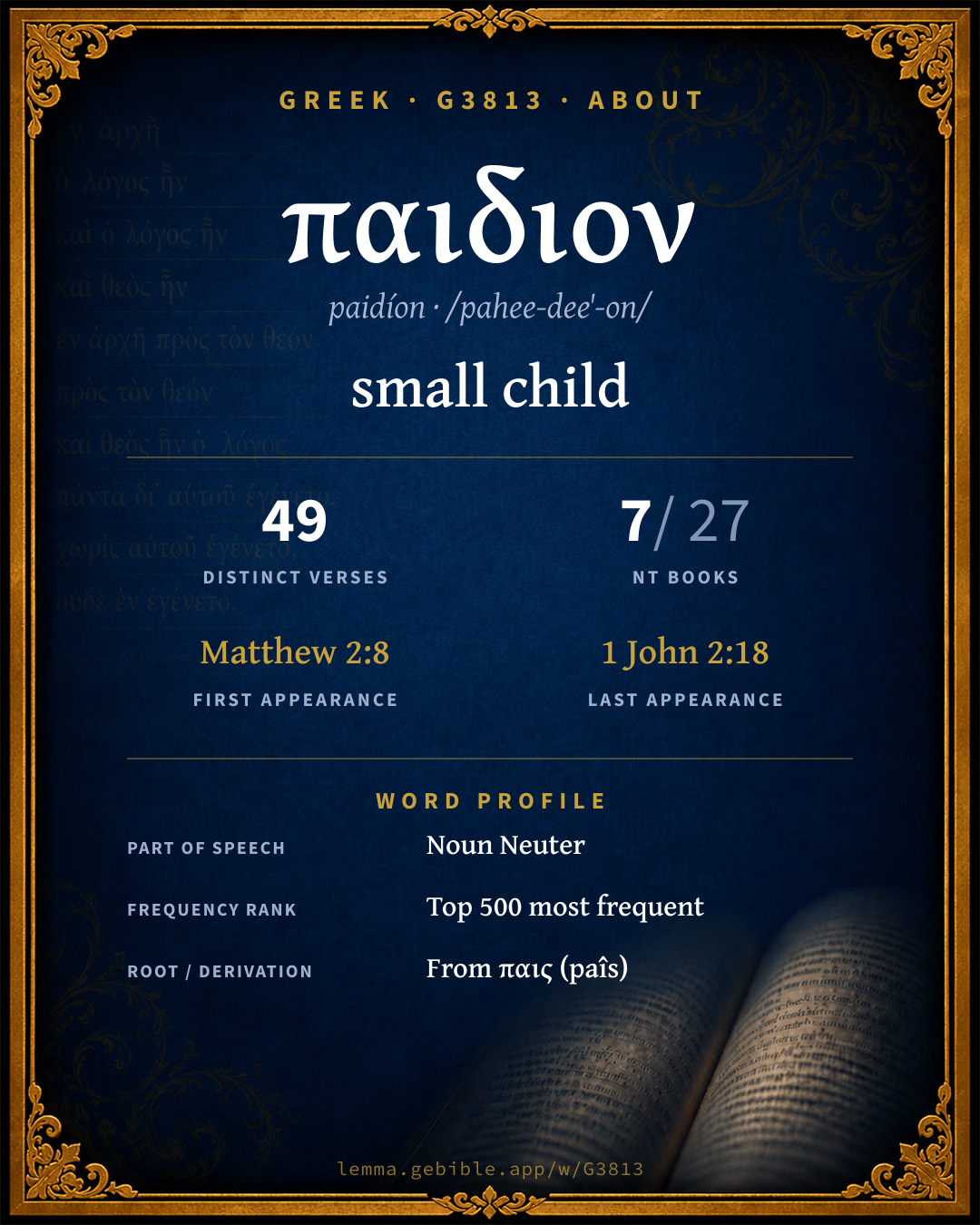
παιδίον
small child
Full lexicon entry — Thayer's Greek Lexicon
From Thayer's Greek Lexicon
Where this word appears
See every Accusative-case word in the Greek New Testament →
Grammar key — what these labels mean
Part of speech
- Noun
- A naming word — a person, place, thing, or idea.
Case
- Accusative
- The case of the direct object and of extent.
- Nominative
- The case of the subject (and the predicate nominative).
- Genitive
- The case of source, possession, or “of” — answers “whose / from what.”
- Vocative
- The case of direct address (“O Lord”).
- Dative
- The case of the indirect object, means, or location — “to / for / with / in.”
Gender
- Neuter
- Grammatically neuter.
Number
- Singular
- One.
- Plural
- More than one.
Grammatical forms 9 distinct
- Noun, Accusative, Singular, Neuter 16 times (31%)
- Noun, Nominative, Singular, Neuter 9 times (17%)
- Noun, Genitive, Singular, Neuter 7 times (13%)
- Noun, Nominative, Plural, Neuter 6 times (12%)
- Noun, Accusative, Plural, Neuter 4 times (8%)
- Noun, Genitive, Plural, Neuter 4 times (8%)
- Noun, Vocative, Plural, Neuter 3 times (6%)
- Noun, Dative, Plural, Neuter 2 times (4%)
+1 more form (1 occurrence)
Parsed forms decoded from the imported morphology (Robinson–Tischendorf, public domain), counted across 52 parsed occurrences — not distinct verses.
Every verse where G3813 appears — 49 distinct verses across 7 books. Click any verse to open its interlinear word-by-word view. Verse text shown in the World English Bible for context — . Each verse’s Greek form is shown with its reference; the English is not keyword-highlighted, since the data carries no word-level English alignment. Use “Compare translations” on any verse to read it across multiple English versions. This concordance covers the Greek New Testament; Septuagint (Greek Old Testament) occurrences of this word are not indexed here.
Matthew 16 verses
- Matthew 2:8 παιδίου n gen sg neut He sent them to Bethlehem, and said, "Go and search diligently for the young child. When you have found him, bring me word, so that I also may come and worship him."
- Matthew 2:9 παιδίον n nom sg neut They, having heard the king, went their way; and behold, the star, which they saw in the east, went before them, until it came and stood over where the young child was.
- Matthew 2:11 παιδίον n acc sg neut They came into the house and saw the young child with Mary, his mother, and they fell down and worshiped him. Opening their treasures, they offered to him gifts: gold, frankincense, and myrrh.
- Matthew 2:13 παιδίον παιδίον n acc sg neut n acc sg neut Now when they had departed, behold, an angel of the Lord appeared to Joseph in a dream, saying, "Arise and take the young child and his mother, and flee into Egypt, and stay there until I tell you, for Herod will seek the young child to destroy him."
- Matthew 2:14 παιδίον n acc sg neut He arose and took the young child and his mother by night, and departed into Egypt,
- Matthew 2:20 παιδίον παιδίου n acc sg neut n gen sg neut "Arise and take the young child and his mother, and go into the land of Israel, for those who sought the young child's life are dead."
- Matthew 2:21 παιδίον n acc sg neut He arose and took the young child and his mother, and came into the land of Israel.
- Matthew 11:16 παιδίοις n dat pl neut "But to what shall I compare this generation? It is like children sitting in the marketplaces, who call to their companions
- Matthew 14:21 παιδίων n gen pl neut Those who ate were about five thousand men, besides women and children.
- Matthew 15:38 παιδίων n gen pl neut Those who ate were four thousand men, besides women and children.
- Matthew 18:2 παιδίον n acc sg neut Jesus called a little child to himself, and set him in the midst of them,
- Matthew 18:3 παιδία n nom pl neut and said, "Most assuredly I tell you, unless you turn, and become as little children, you will in no way enter into the Kingdom of Heaven.
- Matthew 18:4 παιδίον n nom sg neut Whoever therefore humbles himself as this little child, the same is the greatest in the Kingdom of Heaven.
- Matthew 18:5 παιδίον n acc sg neut Whoever receives one such little child in my name receives me,
- Matthew 19:13 παιδία n nom pl neut Then little children were brought to him, that he should lay his hands on them and pray; and the disciples rebuked them.
- Matthew 19:14 παιδία n acc pl neut But Jesus said, "Allow the little children, and don't forbid them to come to me; for to such belongs the Kingdom of Heaven."
Mark 11 verses
- Mark 5:39 παιδίον n nom sg neut When he had entered in, he said to them, "Why do you make an uproar and weep? The child is not dead, but is asleep."
- Mark 5:40 παιδίου παιδίον n gen sg neut n nom sg neut They ridiculed him. But he, having put them all out, took the father of the child and her mother and those who were with him, and went in where the child was lying.
- Mark 5:41 παιδίου n gen sg neut Taking the child by the hand, he said to her, "Talitha cumi;" which means, being interpreted, "Girl, I tell you, get up."
- Mark 7:28 παιδίων n gen pl neut But she answered him, "Yes, Lord. Yet even the dogs under the table eat the children's crumbs."
- Mark 7:30 παιδίον n acc sg neut She went away to her house, and found the child having been laid on the bed, with the demon gone out.
- Mark 9:24 παιδίου n gen sg neut Immediately the father of the child cried out with tears, "I believe. Help my unbelief!"
- Mark 9:36 παιδίον n acc sg neut He took a little child, and set him in the midst of them. Taking him in his arms, he said to them,
- Mark 9:37 παιδίων n gen pl neut "Whoever receives one such little child in my name, receives me, and whoever receives me, doesn't receive me, but him who sent me."
- Mark 10:13 παιδία n acc pl neut They were bringing to him little children, that he should touch them, but the disciples rebuked those who were bringing them.
- Mark 10:14 παιδία n acc pl neut But when Jesus saw it, he was moved with indignation, and said to them, "Allow the little children to come to me! Don't forbid them, for the Kingdom of God belongs to such as these.
- Mark 10:15 παιδίον n nom sg neut Most assuredly I tell you, whoever will not receive the Kingdom of God like a little child, he will in no way enter into it."
Luke 13 verses
- Luke 1:59 παιδίον n acc sg neut It happened on the eighth day, that they came to circumcise the child; and they would have called him Zacharias, after the name of the father.
- Luke 1:66 παιδίον n nom sg neut All who heard them laid them up in their heart, saying, "What then will this child be?" The hand of the Lord was with him.
- Luke 1:76 παιδίον n voc sg neut And you, child, will be called a prophet of the Most High, For you will go before the face of the Lord to make ready his ways,
- Luke 1:80 παιδίον n nom sg neut The child was growing, and becoming strong in spirit, and was in the desert until the day of his public appearance to Israel.
- Luke 2:17 παιδίου n gen sg neut When they saw it, they publicized widely the saying which was spoken to them about this child.
- Luke 2:27 παιδίον n acc sg neut He came in the Spirit into the temple. When the parents brought in the child, Jesus, that they might do concerning him according to the custom of the law,
- Luke 2:40 παιδίον n nom sg neut The child was growing, and was becoming strong in spirit, being filled with wisdom, and the grace of God was upon him.
- Luke 7:32 παιδίοις n dat pl neut They are like children who sit in the marketplace, and call one to another, saying, 'We piped to you, and you didn't dance. We mourned, and you didn't weep.'
- Luke 9:47 παιδίου n gen sg neut Jesus, perceiving the reasoning of their hearts, took a little child, and set him by his side,
- Luke 9:48 παιδίον n acc sg neut and said to them, "Whoever receives this little child in my name receives me. Whoever receives me receives him who sent me. For whoever is least among you all, this one will be great."
- Luke 11:7 παιδία n nom pl neut and he from within will answer and say, 'Don't bother me. The door is now shut, and my children are with me in bed. I can't get up and give it to you'?
- Luke 18:16 παιδία n acc pl neut Jesus summoned them, saying, "Allow the little children to come to me, and don't hinder them, for the Kingdom of God belongs to such as these.
- Luke 18:17 παιδίον n nom sg neut Most assuredly, I tell you, whoever doesn't receive the Kingdom of God like a little child, he will in no way enter into it."
John 3 verses
- John 4:49 παιδίον n acc sg neut The nobleman said to him, "Sir, come down before my child dies."
- John 16:21 παιδίον n acc sg neut A woman, when she gives birth, has sorrow, because her time has come. But when she has delivered the child, she doesn't remember the anguish any more, for the joy that a human being is born into the world.
- John 21:5 παιδία n voc pl neut Jesus therefore said to them, "Children, have you anything to eat?" They answered him, "No."
1 Corinthians 1 verse
Hebrews 3 verses
- Hebrews 2:13 παιδία n nom pl neut Again, "I will put my trust in him." Again, "Behold, here am I and the children whom God has given me."
- Hebrews 2:14 παιδία n nom pl neut Since then the children have shared in flesh and blood, he also himself in like manner partook of the same, that through death he might bring to nothing him who had the power of death, that is, the devil,
- Hebrews 11:23 παιδίον n acc sg neut By faith, Moses, when he was born, was hidden for three months by his parents, because they saw that he was a beautiful child, and they were not afraid of the king's commandment.
1 John 2 verses
- 1 John 2:13 παιδία n voc pl neut I write to you, fathers, because you know him who is from the beginning. I write to you, young men, because you have overcome the evil one. I write to you, little children, because you know the Father.
- 1 John 2:18 Παιδία n voc pl neut Little children, these are the end times, and as you heard that the Antichrist is coming, even now many antichrists have arisen. By this we know that it is the end times.
About this entry
At a glance — auto-summarized from this page’s data, not written by a person. Every figure links to its source below. This summary describes the numbers; it doesn’t interpret them.
At its core, παιδιον (paidíon) means “small child.” It first appears in Matthew 2:8. Spanning 49 verses in 7 books, it ranks among the moderately common words of the Greek New Testament. Its uses concentrate in Matthew (33% of all occurrences). Sharing its root, it stands alongside παις, παιδαγωγος and παιδαριον. Dig into 49-verse concordance and the renderings breakdown below.
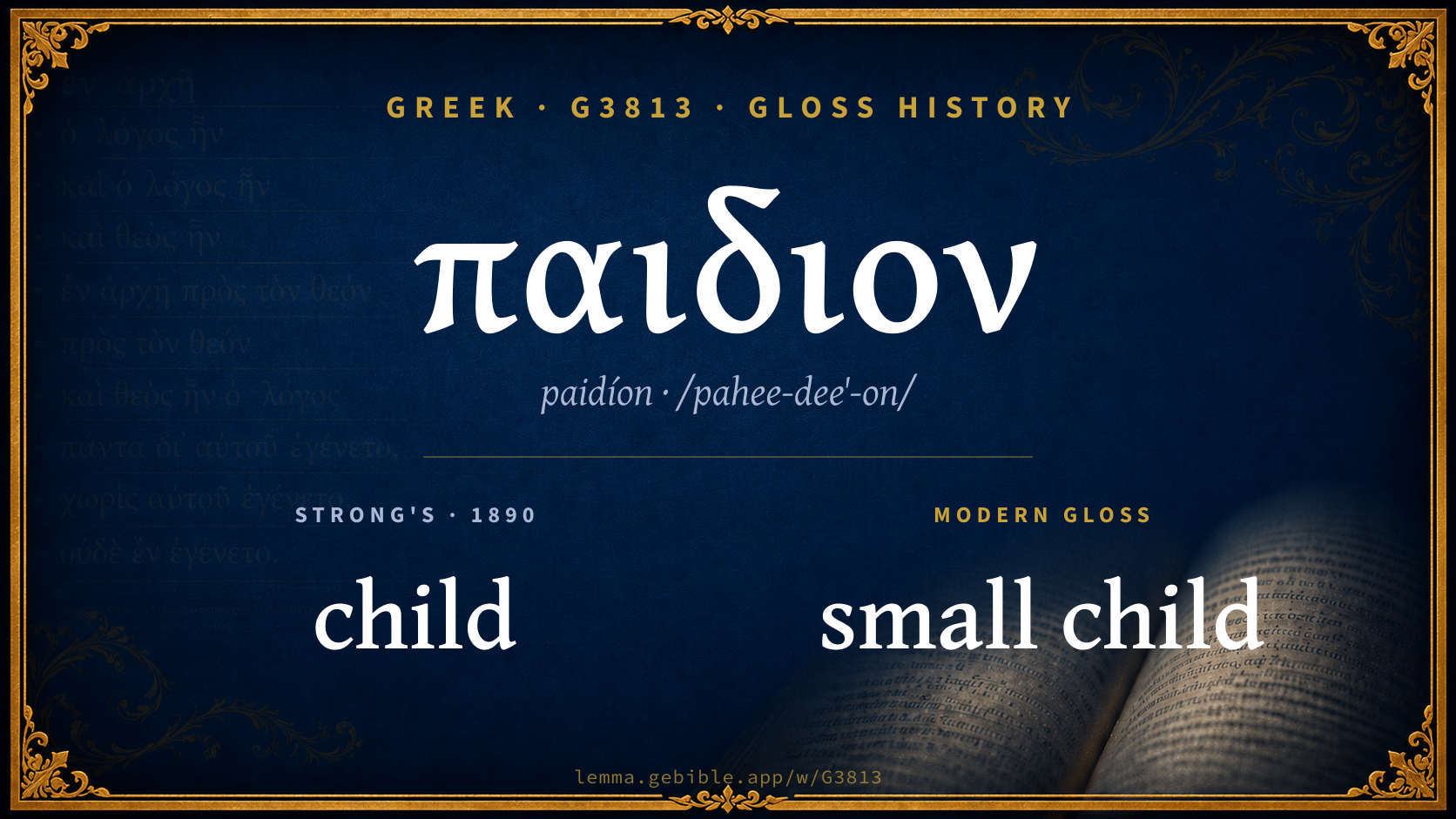
Gloss history
Strong's 1890 vs modern scholarship
About this word
Strong's G3813 catalogs a Greek word from the Greek New Testament.
These counts are not copied from any lexicon or concordance. They are computed here, from the morphology-tagged Greek New Testament. What Lemma adds →
- 49
- distinct verses
- The word appears in 49 distinct verses.
- 7 / 27
- NT books
- The word appears in 7 of 27 New Testament books.
- #305
- by frequency
- Top 500 most frequent Greek words (rank 305 of 5,347 Greek words by occurrence).
View all 49 occurrences in the concordance →
By section of the New Testament
By traditional corpus
Conventional, traditional groupings — biblical authorship is debated, so this is a traditional corpus grouping, not an authorship claim. Some books belong to more than one corpus (Luke is in both the Gospels and the Lukan corpus, and so on), so these shares overlap and need not total 100%. Each figure is a share of the word’s 49 distinct verses.
- Gospels 43 verses · 88%
- Lukan (Luke–Acts) 13 verses · 27%
- Johannine 5 verses · 10%
- Hebrews 3 verses · 6%
- General (Catholic) Epistles 2 verses · 4%
- Pauline corpus 1 verse · 2%
How translations render this word
Counts come from each version’s own published word-to-Strong’s tagging or interlinear alignment — an approximate guide to how each version renders this word, not a word-level alignment the data otherwise carries. Because each total is that version’s own tagged count, the per-version totals vary from one another and need not match the appearance or distinct-verse counts above. These counts may also differ from a printed concordance because Lemma counts each distinctly tagged rendering and does not collapse phrase taggings into a single head-word total. This is a fixed set of word-tagged versions (KJV, ASV, BSB, ULT) and does not change with the reading translation you choose elsewhere. Each version’s license is shown beside its name below (and on Sources).
- King James Version: Child 15×, Children 9×, Young child 8×
- American Standard Version: Child 13×, Children 9×, Young child 9×
- Berean Standard Bible: Child 20×, Children 10×, Little children 7×
- unfoldingWord Literal Text: Child 18×, Little children 9×, Children 8×
King James Version Public Domain
Renders G3813 across 51 tagged occurrences — most commonly:
Plus 3 renderings that appear only once — usually multi-word phrases or single function words the recovered tagging swept in, not distinct renderings.
American Standard Version Public Domain
Renders G3813 across 49 tagged occurrences — most commonly:
Plus 2 renderings that appear only once — usually multi-word phrases or single function words the recovered tagging swept in, not distinct renderings.
Berean Standard Bible Public Domain
Renders G3813 across 50 tagged occurrences — most commonly:
Plus 3 renderings that appear only once — usually multi-word phrases or single function words the recovered tagging swept in, not distinct renderings. Not rendered by a distinct English word in 2 further occurrences.
unfoldingWord Literal Text CC BY-SA 4.0
Renders G3813 across 53 tagged occurrences — most commonly:
Plus 1 rendering that appears only once — usually multi-word phrases or single function words the recovered tagging swept in, not distinct renderings.
Senses in Thayer's
The 1 sense Thayer's distinguishes for this word, in lexicon order (not ranked by frequency or importance). The full entry — with sub-senses — is in the Lexicon Entry tab.
- a young child, a little boy, a little girl
Word origin
Derived from παις (paîs) (G3816) — child.
Neuter diminutive of G3816 ; a childling (of either sex) that is (properly) an infant or (by extension) a half grown boy or girl; figuratively an immature Christian : - (little young) child damsel.
— Strong’s Exhaustive Concordance (1890), public domain.
Forms in the corpus
The 6 distinct written forms G3813 takes in the Greek New Testament, most frequent first — each parse links to that case’s occurrences in the concordance.
| Form | Parsing | Example | Uses |
|---|---|---|---|
| παιδίον paidíon | Noun, Accusative, Singular, Neuter | Matthew 2:11 | 26 |
| παιδία paidía | Noun, Nominative, Plural, Neuter | Matthew 18:3 | 12 |
| παιδίου paidíou | Noun, Genitive, Singular, Neuter | Matthew 2:8 | 7 |
| παιδίων paidíōn | Noun, Genitive, Plural, Neuter | Matthew 14:21 | 4 |
| παιδίοις paidíois | Noun, Dative, Plural, Neuter | Matthew 11:16 | 2 |
| Παιδία Paidía | Noun, Vocative, Plural, Neuter | 1 John 2:18 | 1 |
Same root — word family
Other Thayer's entries built from the same root as G3813, grouped by Strong’s listed origin. These share a root / origin per the lexicon — not necessarily a shared meaning. Each links to that word’s own entry.
Derives from
Shares the same root
- παιδαγωγος paidagōgós G3807 tutor
- παιδαριον paidárion G3808 boy
- παιδευω paideúō G3811 to discipline
- παιδισκη paidískē G3814 young girl
- παιζω paízō G3815 to play
Derived from this word
Compare all same-root words → Showing 4 of 8 — not the complete family. They share a root, not necessarily a meaning.
Septuagint usage
The same Greek word παιδιον appears 91 times in the Greek Old Testament (Septuagint), across 84 verses in 15 books.
- 91
- LXX occurrences
- Tagged occurrences of this Greek word in the Septuagint.
- 84
- verses
- Distinct Septuagint verses containing this word.
- 15 / 39
- OT books
- The word appears in 15 of the 39 Old Testament books.
Sample Septuagint occurrences
- Genesis 17:12 παιδίον
- Exodus 2:3 παιδίον
- Leviticus 22:28 παιδίον
- Numbers 3:4 παιδίον
- Deuteronomy 1:39 παιδίον
- Joshua 1:14 παιδίον
- Judges 13:8 παιδίον
- Ruth 4:16 παιδίον
- 1 Samuel 1:2 παιδίον
- 2 Samuel 6:23 παιδίον
- 1 Kings 3:25 παιδίον
- Job 1:19 παιδίον
Septuagint occurrences (same lexeme)
Every verse where the same Strong’s number (G3813) appears in the Greek Septuagint — showing the first 50 of 84. Verse text shown in the World English Bible for context; the Greek form is the matched word — the English is not keyword-highlighted.
- Genesis 17:12 παιδίον He who is eight days old will be circumcised among you, every male throughout your generations, he who is born in the house, or bought with money of any foreigner who is not of your seed.
- Genesis 21:7 παιδίον She said, "Who would have said to Abraham, that Sarah would nurse children? For I have borne him a son in his old age."
- Genesis 21:8 παιδίον The child grew, and was weaned. Abraham made a great feast on the day that Isaac was weaned.
- Genesis 21:12 παιδίον God said to Abraham, "Don't let it be grievous in your sight because of the boy, and because of your handmaid. In all that Sarah says to you, listen to her voice. For from Isaac will your seed be called.
- Genesis 21:14 παιδίον Abraham rose up early in the morning, and took bread and a bottle of water, and gave it to Hagar, putting it on her shoulder, and gave her the child, and sent her away. She departed, and wandered in the wilderness of Beersheba.
- Genesis 21:15 παιδίον The water in the bottle was spent, and she cast the child under one of the shrubs.
- Genesis 21:16 παιδίον She went and sat down opposite him, a good way off, about a bow shot away. For she said, "Don't let me see the death of the child." She sat over against him, and lifted up her voice, and wept.
- Genesis 21:17 παιδίον God heard the voice of the boy. The angel of God called to Hagar out of the sky, and said to her, "What ails you, Hagar? Don't be afraid. For God has heard the voice of the boy where he is.
- Genesis 21:18 παιδίον Get up, lift up the boy, and hold him in your hand. For I will make him a great nation."
- Genesis 21:19 παιδίον God opened her eyes, and she saw a well of water. She went, filled the bottle with water, and gave the boy drink.
- Genesis 21:20 παιδίον God was with the boy, and he grew. He lived in the wilderness, and became, as he grew up, an archer.
- Genesis 25:22 παιδίον The children struggled together within her. She said, "If it be so, why do I live?" She went to inquire of Yahweh.
- Genesis 30:26 παιδίον Give me my wives and my children for whom I have served you, and let me go: for you know my service with which I have served you."
- Genesis 31:17 παιδίον Then Jacob rose up, and set his sons and his wives on the camels,
- Genesis 31:28 παιδίον and didn't allow me to kiss my sons and my daughters? Now have you done foolishly.
- Genesis 32:16 παιδίον He delivered them into the hands of his servants, every herd by itself, and said to his servants, "Pass over before me, and put a space between herd and herd."
- Genesis 32:23 παιδίον He took them, and sent them over the stream, and sent over that which he had.
- Genesis 33:1 παιδίον Jacob lifted up his eyes, and looked, and, behold, Esau was coming, and with him four hundred men. He divided the children between Leah, Rachel, and to the two handmaids.
- Genesis 33:2 παιδίον He put the handmaids and their children in front, Leah and her children after, and Rachel and Joseph at the rear.
- Genesis 33:5 παιδίον He lifted up his eyes, and saw the women and the children; and said, "Who are these with you?" He said, "The children whom God has graciously given your servant."
- Genesis 33:13 παιδίον Jacob said to him, "My lord knows that the children are tender, and that the flocks and herds with me have their young, and if they overdrive them one day, all the flocks will die.
- Genesis 44:20 παιδίον We said to my lord, 'We have a father, an old man, and a child of his old age, a little one; and his brother is dead, and he alone is left of his mother; and his father loves him.'
- Genesis 44:22 παιδίον We said to my lord, 'The boy can't leave his father: for if he should leave his father, his father would die.'
- Genesis 44:32 παιδίον For your servant became collateral for the boy to my father, saying, 'If I don't bring him to you, then I will bear the blame to my father forever.'
- Genesis 44:33 παιδίον Now therefore, please let your servant stay instead of the boy, a bondservant to my lord; and let the boy go up with his brothers.
- Genesis 44:34 παιδίον For how will I go up to my father, if the boy isn't with me? Lest I see the evil that will come on my father."
- Genesis 45:19 παιδίον Now you are commanded: do this. Take wagons out of the land of Egypt for your little ones, and for your wives, and bring your father, and come.
- Genesis 48:16 παιδίον the angel who has redeemed me from all evil, bless the lads, and let my name be named on them, and the name of my fathers Abraham and Isaac. Let them grow into a multitude in the midst of the earth."
- Genesis 50:23 παιδίον Joseph saw Ephraim's children to the third generation. The children also of Machir, the son of Manasseh, were born on Joseph's knees.
- Exodus 2:3 παιδίον When she could no longer hide him, she took a papyrus basket for him, and coated it with tar and with pitch. She put the child in it, and laid it in the reeds by the river's bank.
- Exodus 2:6 παιδίον She opened it, and saw the child, and, behold, the baby cried. She had compassion on him, and said, "This is one of the Hebrews' children."
- Exodus 2:7 παιδίον Then his sister said to Pharaoh's daughter, "Should I go and call a nurse for you from the Hebrew women, that she may nurse the child for you?"
- Exodus 2:8 παιδίον Pharaoh's daughter said to her, "Go." The maiden went and called the child's mother.
- Exodus 2:9 παιδίον Pharaoh's daughter said to her, "Take this child away, and nurse him for me, and I will give you your wages." The woman took the child, and nursed it.
- Exodus 2:10 παιδίον The child grew, and she brought him to Pharaoh's daughter, and he became her son. She named him Moses, and said, "Because I drew him out of the water."
- Exodus 4:20 παιδίον Moses took his wife and his sons, and set them on a donkey, and he returned to the land of Egypt. Moses took God's rod in his hand.
- Exodus 4:25 παιδίον Then Zipporah took a flint, and cut off the foreskin of her son, and cast it at his feet; and she said, "Surely you are a bridegroom of blood to me."
- Exodus 4:26 παιδίον So he let him alone. Then she said, "You are a bridegroom of blood," because of the circumcision.
- Exodus 21:4 παιδίον If his master gives him a wife and she bears him sons or daughters, the wife and her children shall be her master's, and he shall go out by himself.
- Exodus 21:5 παιδίον But if the servant shall plainly say, 'I love my master, my wife, and my children. I will not go out free;'
- Exodus 21:22 παιδίον "If men fight and hurt a pregnant woman so that she gives birth prematurely, and yet no harm follows, he shall be surely fined as much as the woman's husband demands and the judges allow.
- Exodus 22:23 παιδίον If you take advantage of them at all, and they cry at all to me, I will surely hear their cry;
- Leviticus 22:28 παιδίον Whether it is a cow or ewe, you shall not kill it and its young both in one day.
- Leviticus 25:54 παιδίον "'If he isn't redeemed by these means, then he shall be released in the Year of Jubilee, he, and his children with him.
- Numbers 3:4 παιδίον Nadab and Abihu died before Yahweh, when they offered strange fire before Yahweh, in the wilderness of Sinai, and they had no children. Eleazar and Ithamar ministered in the priest's office in the presence of Aaron their father.
- Numbers 14:3 παιδίον Why does Yahweh bring us to this land, to fall by the sword? Our wives and our little ones will be a prey: wouldn't it be better for us to return into Egypt?
- Numbers 14:31 παιδίον But your little ones, that you said should be a prey, them will I bring in, and they shall know the land which you have rejected.
- Deuteronomy 1:39 παιδίον Moreover your little ones, whom you said should be a prey, and your children, who this day have no knowledge of good or evil, they shall go in there, and to them will I give it, and they shall possess it.
- Deuteronomy 3:6 παιδίον We utterly destroyed them, as we did to Sihon king of Heshbon, utterly destroying every inhabited city, with the women and the little ones.
- Deuteronomy 11:2 παιδίον Know you this day: for I don't speak with your children who have not known, and who have not seen the chastisement of Yahweh your God, his greatness, his mighty hand, and his outstretched arm,
These are occurrences of the same Greek lexeme (G3813) in the Septuagint — not a translation of any one Hebrew word. The store carries no word-level Hebrew↔Greek alignment, so no Hebrew original is asserted here. Counts come from the recovered LXX Strong's tagging — high-frequency vocabulary is well covered, while rare or late forms may be untagged — so they reflect tagged occurrences and may slightly undercount.