Genesis 33:2

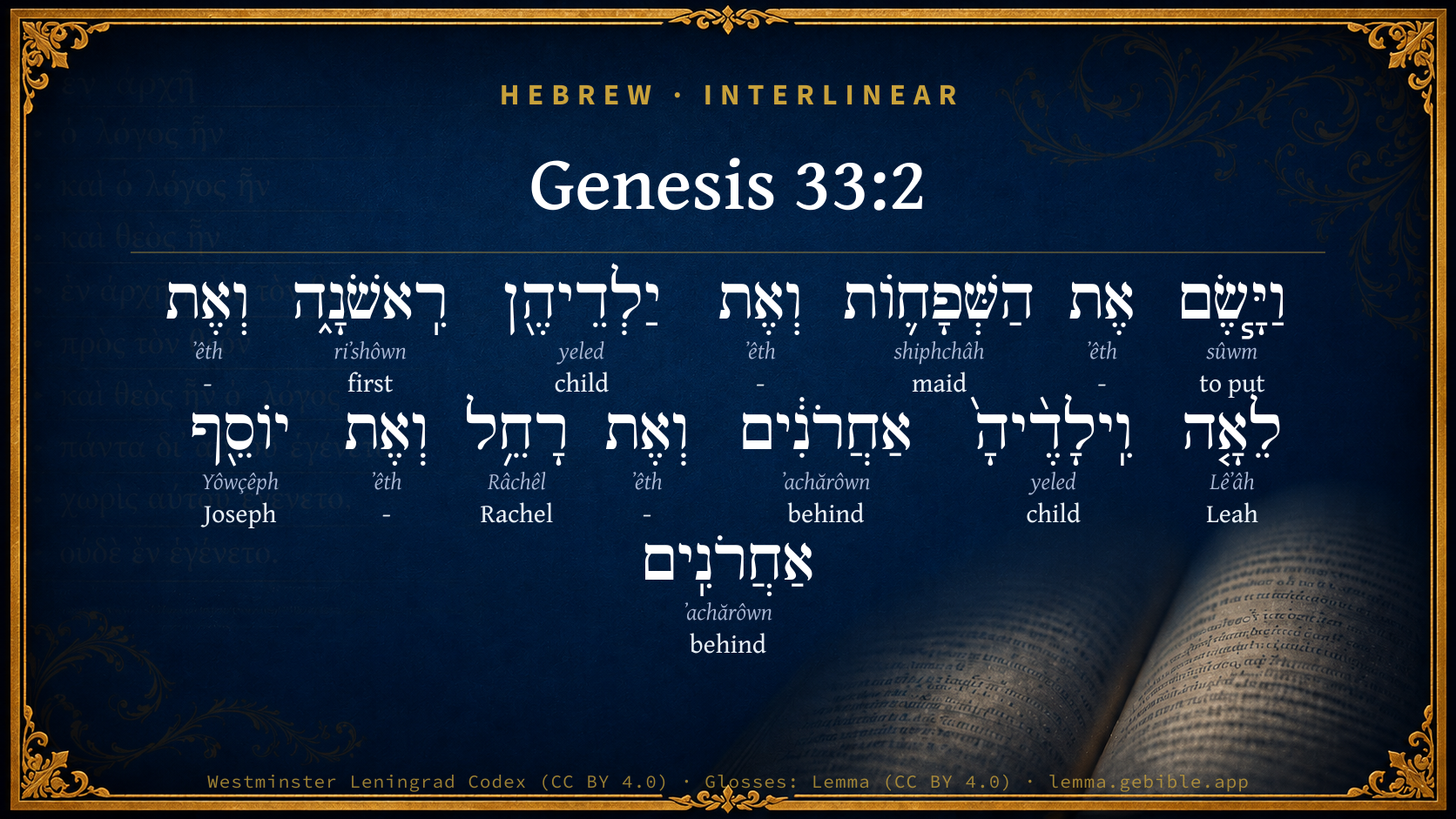
Hebrew (Westminster Leningrad Codex) Genesis 33:2 appears in the Hebrew Old Testament. The text above is from the Westminster Leningrad Codex. Each word links to its Strong’s number, a concise gloss, and parsing drawn from the Open Scriptures Hebrew Bible morphology. Click any word for its full Brown-Driver-Briggs (BDB) entry.
Download image
Cite this verse

Genesis 33:2 (World English Bible). Public Domain. Lemma interlinear Bible study tool, https://lemma.gebible.app/v/genesis/33/2.

Show BibTeX & RIS
BibTeX
RIS
English Translation
He put the handmaids and their children in front, Leah and her children after, and Rachel and Joseph at the rear.
World English Bible · Public Domain
Highlights
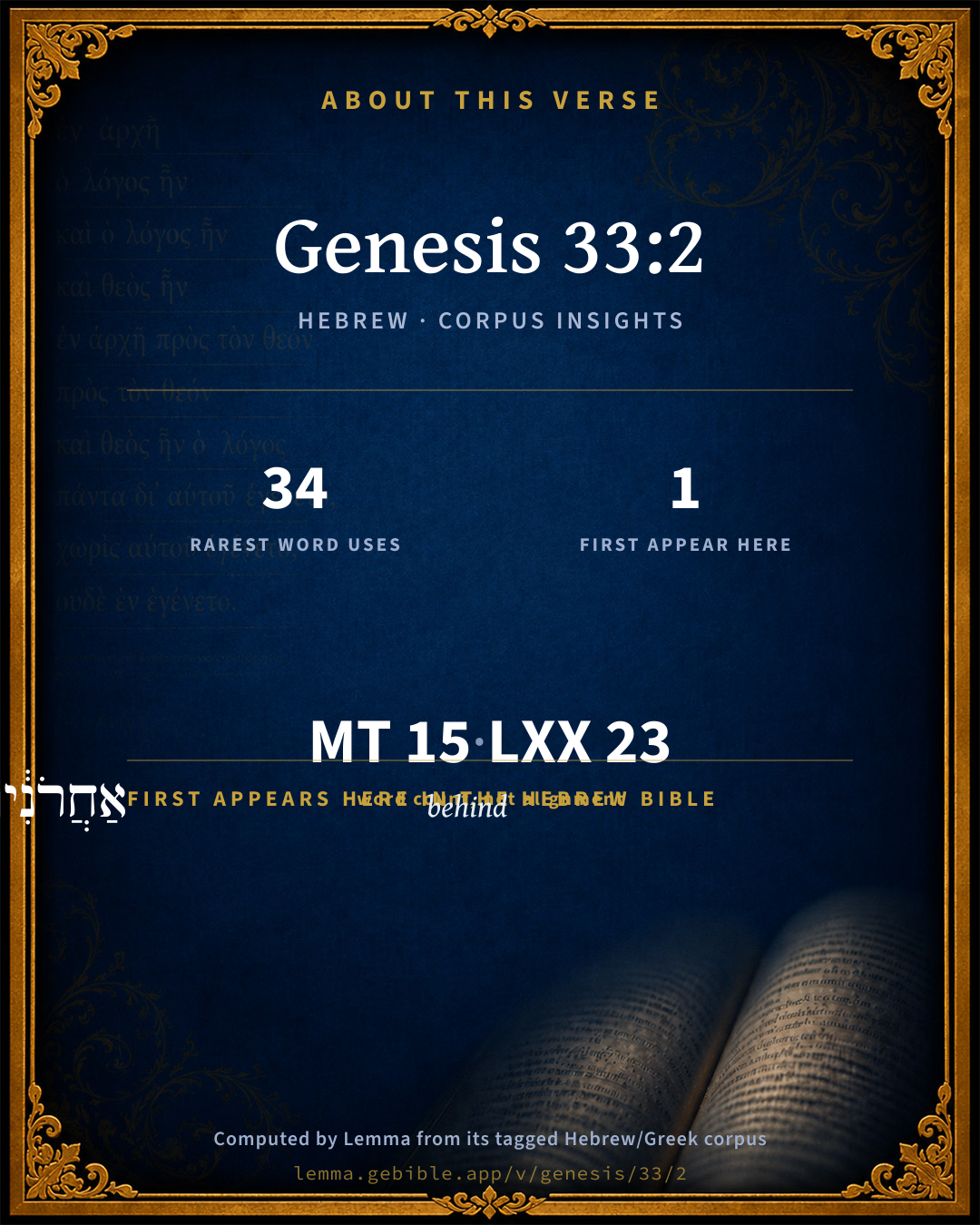
  • 1 first appearance in the Hebrew Bible
Full analysis ↓
Download a study sheet

One document with this verse’s original text, its word-by-word gloss line, the meaning frame, cross-references with their text, attributed commentary, and full source and license credits — printable, and it pastes into notes with its structure intact.

This verse Autodidact and up

Study sheet (.html) Plain text (.txt)

A passage Seminary Student

Up to 50 verses in one chapter. A passage sheet keeps up to 6 commentary sources and 12 cross-references per verse, in the order this page ranks them, and says so on the sheet whenever that leaves anything out. Ask for a single verse and you get the Autodidact verse sheet above.

Everything on this page stays free to read, with no account — the sheet is a download of what is already on screen, not access to it.

Want to remove ads? Support Godless Engineer
Compare translations 3

The same verse in 3 English versions, stacked beneath the original-language interlinear above. Click any original word for its lexicon entry.

Each is an independent rendering of the whole verse — the interlinear is not word-aligned to these translations.

Highlighted words mark where these versions differ — a whole-verse word diff, not a word-by-word alignment.

  • World English Bible Public Domain
    He put the handmaids and their children in front, Leah and her children after, and Rachel and Joseph at the rear.
  • King James Version Public Domain
    And he put the handmaids and their children foremost, and Leah and her children after, and Rachel and Joseph hindermost.
  • unfoldingWord Literal Text CC BY-SA 4.0
    And he put the maidservants and their children first, and Leah and her children after them, and Rachel and Joseph after them.

unfoldingWord Literal Text — © unfoldingWord, licensed CC BY-SA 4.0. Word-aligned USFM3 via Door43 (git.door43.org/unfoldingWord/en_ult).

Versions to compare (up to 4)

3 of 4 selected

Show all 18 translations

Every available English version of this verse, each an independent rendering of the whole verse.

  • World English Bible Public Domain
    He put the handmaids and their children in front, Leah and her children after, and Rachel and Joseph at the rear.
  • Berean Standard Bible Public Domain
    He put the maidservants and their children in front, Leah and her children next, and Rachel and Joseph at the rear.
  • Majority Standard Bible Public Domain
    He put the maidservants and their children in front, Leah and her children next, and Rachel and Joseph at the rear.
  • King James Version Public Domain
    And he put the handmaids and their children foremost, and Leah and her children after, and Rachel and Joseph hindermost.
  • American Standard Version (1901) Public Domain
    And he put the handmaids and their children foremost, and Leah and her children after, and Rachel and Joseph hindermost.
  • Revised Version (1885) Public Domain
    And he put the handmaids and their children foremost, and Leah and her children after, and Rachel and Joseph hindermost.
  • Geneva Bible (1599) Public Domain
    And he put the maides, and their children formost, and Leah, and her children after, and Rahel, and Ioseph hindermost.
  • Douay-Rheims (1899) Public Domain
    And he put both the handmaids and their children foremost: and Lia and her children in the second place: and Rachel and Joseph last.
  • Young's Literal Translation Public Domain
    and he setteth the maid-servants and their children first, and Leah and her children behind, and Rachel and Joseph last.
  • Literal Standard Version CC BY-SA 4.0
    and he sets the maidservants and their children first, and Leah and her children behind, and Rachel and Joseph last.
  • Unlocked Literal Bible CC BY-SA 4.0
    Then he put the female servants and their children in front, followed by Leah and her children, and followed by Rachel and Joseph last of all.
  • unfoldingWord Literal Text CC BY-SA 4.0
    And he put the maidservants and their children first, and Leah and her children after them, and Rachel and Joseph after them.
  • Darby Bible Public Domain
    and he put the maidservants and their children foremost, and Leah and her children after, and Rachel and Joseph hindmost.
  • World Messianic Bible Public Domain
    He put the servants and their children in front, Leah and her children after, and Rachel and Joseph at the rear.
  • Webster's Bible Public Domain
    And he put the handmaids and their children foremost, and Leah and her children after, and Rachel and Joseph hindermost.
  • Free Bible Version CC BY-SA 4.0
    He placed the two personal maids with their children first, then Leah and her children, and Rachel and Joseph last.
  • Bible in Basic English Public Domain
    He put the servants and their children in front, Leah and her children after them, and Rachel and Joseph at the back.
  • JPS Tanakh (1917) Public Domain
    And he put the handmaids and their children foremost, and Leah and her children after, and Rachel and Joseph hindermost.

Literal Standard Version (2020), Covenant Press — licensed CC BY-SA 4.0. Text via the HelloAO Bible API (eBible.org). Unlocked Literal Bible (unfoldingWord) — licensed CC BY-SA 4.0. Text via the HelloAO Bible API (eBible.org). unfoldingWord Literal Text — © unfoldingWord, licensed CC BY-SA 4.0. Word-aligned USFM3 via Door43 (git.door43.org/unfoldingWord/en_ult). Free Bible Version, Dr. Jonathan Gallagher — licensed CC BY-SA 4.0. Text via the HelloAO Bible API (eBible.org).

Word by word

More ways to search: Search by grammar → Find every occurrence → Compare this word →

Practice this passage: Drill this verse → Learn its vocabulary →

לֵאָ֤ה
Lêʼâh
H3812
“Leah”
Noun, Proper
Part of Speech
Noun
Type
Proper
Full BDB Definition

Origin: from H3811

TWOT: None

Leah = "weary" - daughter of Laban, first wife of Jacob, and mother of Reuben, Simeon, Levi, Judah, Issachar, Zebulun, and Dinah
  1. וַיָּ֧שֶׂם sûwm H7760 “and · to put” Conjunction + Verb, Qal, Sequential Imperfect, 3rd Person, Masculine, Singular
  2. אֶת ʼêth H853 “-” Particle, Direct Object
  3. הַשְּׁפָח֛וֹת shiphchâh H8198 “the · maids” Particle, Definite Article + Noun, Common, Feminine, Plural, Absolute
  4. וְאֶת ʼêth H853 “and · -” Conjunction + Particle, Direct Object
  5. יַלְדֵיהֶ֖ן yeled H3206 “children · their” Noun, Common, Masculine, Plural, Construct + Suffix, Personal, 3rd Person, Feminine, Plural
  6. רִֽאשֹׁנָ֑ה riʼshôwn H7223 “first” Adjective, Adjective, Feminine, Singular, Absolute
  7. וְאֶת ʼêth H853 “and · -” Conjunction + Particle, Direct Object
  8. וִֽילָדֶ֨יהָ֙ yeled H3206 “and · children · her” Conjunction + Noun, Common, Masculine, Plural, Construct + Suffix, Personal, 3rd Person, Feminine, Singular
  9. אַחֲרֹנִ֔ים ʼachărôwn H314 “behind” Adjective, Adjective, Masculine, Plural, Absolute
  10. וְאֶת ʼêth H853 “and · -” Conjunction + Particle, Direct Object
  11. רָחֵ֥ל Râchêl H7354 “Rachel” Noun, Proper
  12. וְאֶת ʼêth H853 “and · -” Conjunction + Particle, Direct Object
  13. יוֹסֵ֖ף Yôwçêph H3130 “Joseph” Noun, Proper
  14. אַחֲרֹנִֽים ʼachărôwn H314 “behind” Adjective, Adjective, Masculine, Plural, Absolute

About this verse

These counts appear in no published source. They are computed here, from the morphology-tagged text and Lemma’s own curated glosses. What Lemma adds →

15
words
9
distinct lemmas
Pentateuch
section

First appearance in Scripture

This word makes its first canonical appearance in the Hebrew Bible here:

  • אַחֲרֹנִ֔ים behind H314

Shared distinctive vocabulary

לֵאָ֤ה Leah H3812 occurs in 32 verses of the Hebrew Bible. Also found in:

Grammatical profile

  • 1 verb
  • 6 nouns
  • 3 adjectives
  • 5 particles

Verb forms

  • וַיָּ֧שֶׂם Qal · Sequential Imperfect

Repetition

Words recur within this verse — often emphatic in Hebrew:

  • יַלְדֵיהֶ֖ן child H3206 ×2
  • אַחֲרֹנִ֔ים behind H314 ×2

Hebrew & Septuagint length

In English translation the verse runs 21 words from the Hebrew and 23 from the Septuagint (LXX English) — closely comparable.

A rough comparison of the two English renderings, which tokenize alike — not a word-level alignment.

Word counts can differ between the Hebrew and the Greek without any difference in meaning — e.g. the Hebrew direct-object marker אֵת has no separate Greek word, and Greek often adds the article ὁ.

In the original languages it is 15 Hebrew tokens and 23 Greek tokens — but the two are counted differently (Hebrew bundles its prefixes and suffixes into one token; the Greek is in lemma form), so that isn’t a like-for-like length.

Cross-references

4

Topical passages linked to Genesis 33:2 in the Treasury of Scripture Knowledge — connected by theme and wording, ordered by reader-vote popularity; previews shown in the World English Bible.

  • Genesis 29:30 He went in also to Rachel, and he loved also Rachel more than Leah, and served with him yet seven other years.
  • Genesis 30:22–24 God remembered Rachel, and God listened to her, and opened her womb.
  • Genesis 37:3 Now Israel loved Joseph more than all his children, because he was the son of his old age, and he made him a coat of many colors.
  • Malachi 3:17 They shall be mine," says Yahweh of Hosts, "my own possession in the day that I make, and I will spare them, as a man spares his own son who serves him.

Cross-references courtesy of OpenBible.info (CC BY 4.0).

Hebrew and Greek witnesses Masoretic Hebrew ↔ Greek Septuagint

The same verse in the two great witnesses to the Old Testament, shown verse-for-verse.

These are two independent witnesses, not word-aligned to each other, and the Septuagint is shown in lemma (dictionary) form.

Hebrew Genesis 33:2 Masoretic · Westminster Leningrad Codex

וַיָּ֧שֶׂם אֶת הַשְּׁפָח֛וֹת וְאֶת יַלְדֵיהֶ֖ן רִֽאשֹׁנָ֑ה וְאֶת לֵאָ֤ה וִֽילָדֶ֨יהָ֙ אַחֲרֹנִ֔ים וְאֶת רָחֵ֥ל וְאֶת יוֹסֵ֖ף אַחֲרֹנִֽים

He put the handmaids and their children in front, Leah and her children after, and Rachel and Joseph at the rear.

World English Bible · Public Domain

Greek LXX Genesis 33:2 Septuagint · lemma form

καί ποιέω ὁ δύο παιδίσκη καί ὁ υἱός αὐτός ἐν πρῶτος καί λεια καί ὁ παιδίον αὐτός ὀπίσω καί ραχηλ καί ιωσηφ ἔσχατο

And he put the two handmaidens and their children with the first, and Lea and her children behind, and Rachel and Joseph last.

LXX2012 (modern English Septuagint) · Public Domain

Hebrew: Westminster Leningrad Codex (CC BY 4.0). Greek: Septuagint (public domain); English from LXX2012 (modern English Septuagint) (Public Domain). How the Septuagint differs from the Hebrew →

Targum (Aramaic paraphrase)

2

The Targum is the ancient Jewish Aramaic paraphrase of the Hebrew Scriptures — an interpretive translation, not the Hebrew text itself. Onkelos (literal) and Pseudo-Jonathan (expansive) render the Torah, and Jonathan the Prophets. Coverage is partial: where no permissively-licensed English translation exists for a verse, only the Aramaic is shown. This is verse-level text, not a word-by-word alignment to the Hebrew.

  1. Targum Onkelos Torah (Genesis–Deuteronomy)
    וְשַׁוִּי יָת לְחֵינָתָא וְיָת בְּנֵיהֶן קַדְמָאִין וְיָת לֵאָה וּבְנָהָא בַּתְרָאִין וְיָת רָחֵל וְיָת יוֹסֵף בַּתְרָאִין

    (no public-domain English translation for this verse)

    Targum Onkelos — Aramaic: “Onkelos Genesis” (public domain); “Onkelos Exodus” (public domain); “Onkelos Leviticus” (public domain); “Onkelos Numbers” (public domain); “Onkelos Deuteronomy” (public domain). English: “Sefaria Community Translation” (CC0 1.0 (public-domain dedication)); “J.W. Etheridge. The Targums of Onkelos and Jonathan Ben Uzziel on the Pentateuch. London: Longmans, Green, 1862” (public domain). Text via Sefaria.

  2. Targum Pseudo-Jonathan Torah (Genesis–Deuteronomy)
    וְשַׁוִי יַת לְחֵינָתָא הִינָן וּבְנֵיהֶן בְּקַדְמֵיתָא אֲרוּם אָמַר אִלוּ אָתֵי עֵשָו לְחַבְּלָא בְּרֻבַיָא לְמֶעֱבַד זְנוּ בִּנְשַׁיָא יַעֲבֵּיד בְּאִילֵן וּבְגוֹ פִּתְגָמָא הָדֵין נְקוּם וְנַגַח עִמֵיהּ קְרָבָא וְיַת לֵאָה וְרִיבָהָא בַּתְרָאִין וְיַת רָחֵל וְיַת יוֹסֵף בַּתְרָאִין

    and placed the concubines and their sons foremost; for he said, If Esau come to destroy the children and abuse the women, he will do it with them, and meantime we will arise and encounter him in fight; and Leah and her children after, and Rahel and Joseph after them.

    Targum Pseudo-Jonathan — Aramaic: “Targum Jonathan on Genesis” (public domain); “Targum Jonathan on Exodus” (public domain); “Targum Jonathan on Leviticus” (public domain); “Targum Jonathan on Numbers” (public domain); “Targum Jonathan on Deuteronomy” (public domain). English: “The Targum of Jonathan ben Uzziel, trans. J. W. Etheridge, London, 1862” (public domain). Text via Sefaria.

Commentary

Notes on Genesis 33:2 from classic Christian and Jewish commentators (each source and its license shown beneath its notes). The classic Christian expositions comment on the surrounding passage and are grouped to its opening verse, so a note may address several verses; the Jewish commentaries on the Tanakh (Rashi and others) are per-verse, so they appear only where the commentator wrote on this verse.

Lemma curates 59 commentaries, every one of them public domain or Creative Commons licensed, each selected and text-cleaned for this edition rather than reprinted as found. About our sources →

Trapp's Complete Commentary

John Trapp

Gen 33:2 And he put the handmaids and their children foremost, and Leah and her children after, and Rachel and Joseph hindermost.

Ver. 2. He put the handmaids, &c.] Of children and friends, some may be better beloved than others: and whereas all cannot be saved or helped, the dearest may be chiefly cared for.

John Trapp, A Commentary or Exposition upon All the Books of the Old and New Testament (1647–1656) — public domain. Text from a community e-Sword module.

Joseph Benson's Commentary

Gen 33:2-3. He put Rachel and Joseph hinder-most — Giving those that were dearest to him most opportunity to escape. He passed over before them — Exposing himself to the first and greatest danger for the security of his wives and children. He bowed himself to the ground — Thus doing obeisance to Esau as an elder brother, though he feared him as an enemy.

Joseph Benson's Commentary on the Old and New Testaments (1811–1818) — public domain. Text from a community e-Sword module.

Adam Clarke's Commentary

Verse 2. He put the handmaids and their children foremost] There is something so artificial in this arrangement of Jacob's family, that it must have had some peculiar design. Was Jacob still apprehensive of danger, and put those foremost whom he least esteemed, that if the foremost met with any evil, those who were behind might escape on their swift beasts? Ge 32:7-8. Or did he intend to keep his choicest treasure to the last, and exhibit his beautiful Rachel and favourite Joseph after Esau had seen all the rest, in order to make the deeper impression on his mind?

Adam Clarke's Commentary on the Bible (1810–1826) — public domain. Text from a community e-Sword/MySword module.

John Gill's Exposition

And he put the handmaids and their children foremost,.... In the first division, as being less honourable and less beloved by him:

and Leah and her children after; still according to the degree of honour and affection due unto them; Leah being a wife that was imposed and forced upon him:

and Rachel and Joseph hindermost; being most beloved by him, and therefore most careful of them; Rachel being his principal and lawful wife, and who had the greatest share in his affection, and Joseph his only child by her.

John Gill's Exposition of the Whole Bible (1746–1763) — public domain (CC PDM 1.0). Text via the HelloAO Bible API.

Matthew Poole's English Annotations

Placing his best beloved in the last and safest place.

Matthew Poole's English Annotations on the Holy Bible (1683–1685) — public domain. Text from a community e-Sword/MySword module.

Whedon's Commentary on the Bible

Daniel D. Whedon

MEETING OF JACOB AND ESAU, Gen_33:1-16.

2. Rachel and Joseph hindermost — Jacob evidently arranged his companies according to his special affection for each; for the handmaids least, for Rachel most.

Daniel D. Whedon (gen. ed.), Commentary on the Old and New Testaments (1874–1909) — public domain. Text from a community e-Sword module.

Rashi

Rabbi Shlomo Yitzchaki (Rashi)

ואת לאה וילדיה אחרנים AND LEAH AND HER CHILDREN AFTER — The more behind — the more beloved (Genesis Rabbah 78:8).

Rashi on the Tanakh — English translations: “The Judaica Press complete Tanach with Rashi, translated by A. J. Rosenberg” (CC BY 4.0); “Pentateuch with Rashi's commentary by M. Rosenbaum and A.M. Silbermann, 1929-1934” (public domain); “The Metsudah Tanach series, Lakewood, N.J” (CC BY 4.0); and “The Book of Joshua, Metsudah Publications, 1997” (CC BY 4.0). Text via Sefaria.

Radak

Rabbi David Kimhi (Radak)

וישם, the most beloved he placed last, hoping that Esau’s anger had been blunted by the time he met them.

Radak on the Tanakh — English translations: “Sefaria Community Translation” (CC0 1.0 (public-domain dedication)); “Eliyahu Munk, HaChut Hameshulash” (CC BY 4.0); “Rabbi Mike Feuer, Jerusalem Anthology” (CC BY 4.0); and “R. David Kimhi on the first book of Psalms, Translated by R.G. Finch, London, 1919” (public domain). Text via Sefaria.

Lesson kit

Teaching starters — assembled from the data on this page, not authored interpretation. Every prompt links to the verse data it draws on. Edit before teaching.

Genesis, in the Pentateuch, opens this verse with 15 words (9 distinct Hebrew lemmas). Its most distinctive word is Lêʼâh (“Leah”). A historical commentator’s framing appears above. Read the whole chapter for the surrounding context.

Discussion questions

  1. What does “Leah” (Lêʼâh) contribute to the verse as a whole?
  2. The word “behind” first appears here in Scripture. What is being introduced at this debut?
  3. Genesis 29:16 shares the word «Leah» with this verse. How do the two illuminate each other?
  4. “child” occurs 2× in this one verse. What is the effect of the repetition?
  5. These translations render this verse differently. What is at stake in choosing one wording over another?
  6. The verb «וַיָּ֧שֶׂם» is Qal Sequential Imperfect. How does its form color the action?
  7. Reading how Trapp's Complete Commentary and Joseph Benson's Commentary read this verse, where do the two commentators agree and where do they part?

Things to notice

Reading settings

Reading text

Shown beneath each verse's original-language words.

Old Testament
Old Testament edition

Read the OT as the Masoretic Hebrew (MT) or the Greek Septuagint (LXX).

English shown for the Greek Septuagint (in the Hebrew ↔ Greek comparison).

Comparing translations? Open the Compare panel on any verse page to stack up to four side by side.