Numbers 14:31

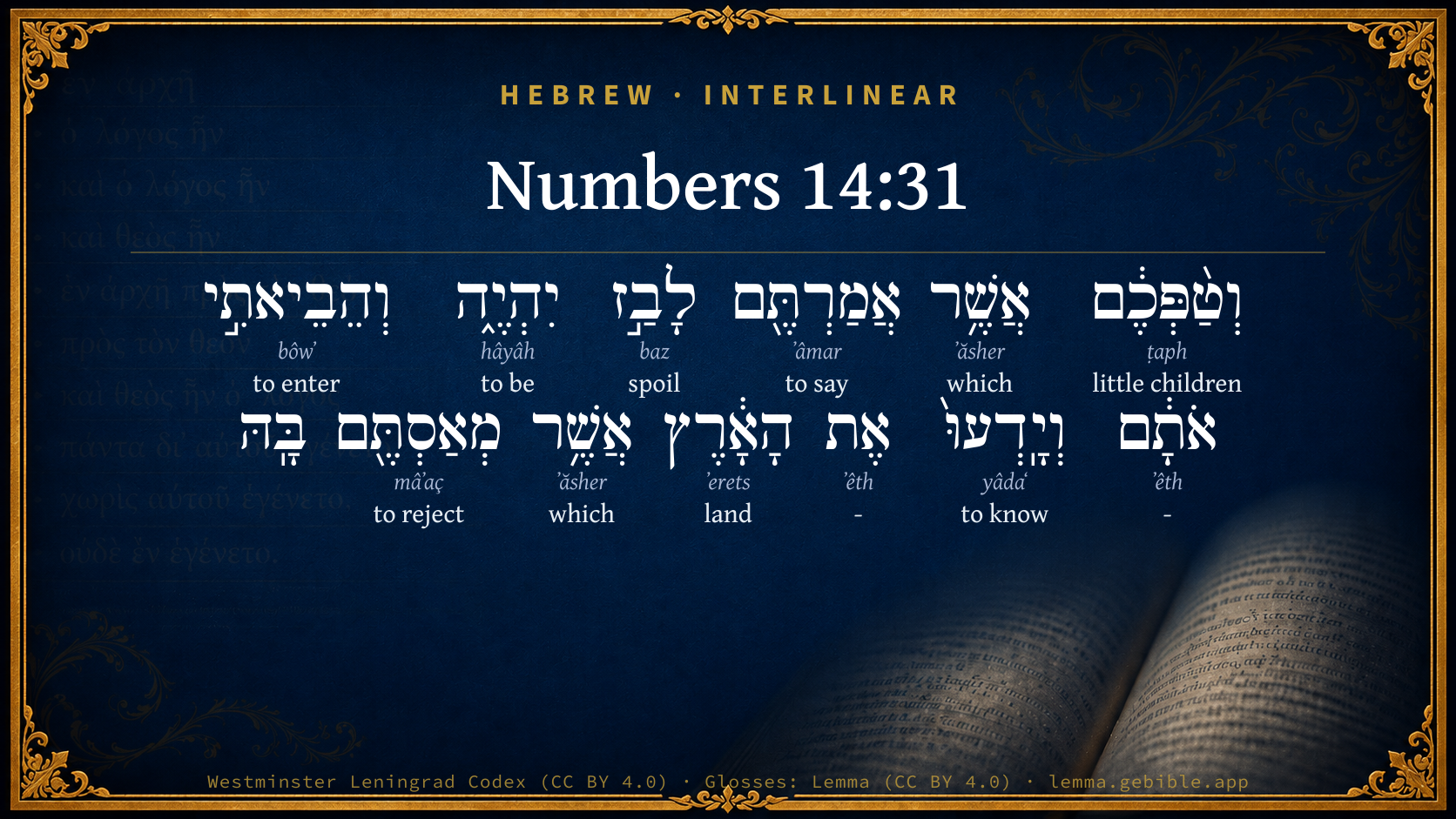
Hebrew (Westminster Leningrad Codex) Numbers 14:31 appears in the Hebrew Old Testament. The text above is from the Westminster Leningrad Codex. Each word links to its Strong’s number, a concise gloss, and parsing drawn from the Open Scriptures Hebrew Bible morphology. Click any word for its full Brown-Driver-Briggs (BDB) entry.
Download image
Cite this verse

Numbers 14:31 (World English Bible). Public Domain. Lemma interlinear Bible study tool, https://lemma.gebible.app/v/numbers/14/31.

Show BibTeX & RIS
BibTeX
RIS
English Translation
But your little ones, that you said should be a prey, them will I bring in, and they shall know the land which you have rejected.
World English Bible · Public Domain
Download a study sheet

One document with this verse’s original text, its word-by-word gloss line, the meaning frame, cross-references with their text, attributed commentary, and full source and license credits — printable, and it pastes into notes with its structure intact.

This verse Autodidact and up

Study sheet (.html) Plain text (.txt)

A passage Seminary Student

Up to 50 verses in one chapter. A passage sheet keeps up to 6 commentary sources and 12 cross-references per verse, in the order this page ranks them, and says so on the sheet whenever that leaves anything out. Ask for a single verse and you get the Autodidact verse sheet above.

Everything on this page stays free to read, with no account — the sheet is a download of what is already on screen, not access to it.

Want to remove ads? Support Godless Engineer
Compare translations 3

The same verse in 3 English versions, stacked beneath the original-language interlinear above. Click any original word for its lexicon entry.

Each is an independent rendering of the whole verse — the interlinear is not word-aligned to these translations.

Highlighted words mark where these versions differ — a whole-verse word diff, not a word-by-word alignment.

  • World English Bible Public Domain
    But your little ones, that you said should be a prey, them will I bring in, and they shall know the land which you have rejected.
  • King James Version Public Domain
    But your little ones, which ye said should be a prey, them will I bring in, and they shall know the land which ye have despised.
  • unfoldingWord Literal Text CC BY-SA 4.0
    and your children whom you said will be for plunder. And I will bring them, and they will know the land that you rejected.

unfoldingWord Literal Text — © unfoldingWord, licensed CC BY-SA 4.0. Word-aligned USFM3 via Door43 (git.door43.org/unfoldingWord/en_ult).

Versions to compare (up to 4)

3 of 4 selected

Show all 18 translations

Every available English version of this verse, each an independent rendering of the whole verse.

  • World English Bible Public Domain
    But your little ones, that you said should be a prey, them will I bring in, and they shall know the land which you have rejected.
  • Berean Standard Bible Public Domain
    But I will bring your children, whom you said would become plunder, into the land you have rejected—and they will enjoy it.
  • Majority Standard Bible Public Domain
    But I will bring your children, whom you said would become plunder, into the land you have rejected—and they will enjoy it.
  • King James Version Public Domain
    But your little ones, which ye said should be a prey, them will I bring in, and they shall know the land which ye have despised.
  • American Standard Version (1901) Public Domain
    But your little ones, that ye said should be a prey, them will I bring in, and they shall know the land which ye have rejected.
  • Revised Version (1885) Public Domain
    But your little ones, which ye said should be a prey, them will I bring in, and they shall know the land which ye have rejected.
  • Geneva Bible (1599) Public Domain
    But your children, (which ye said shoulde be a pray) them will I bring in, and they shall knowe the lande which ye haue refused:
  • Douay-Rheims (1899) Public Domain
    But your children, of whom you said, that they should be a prey to the enemies, will I bring in: that they may see the land which you have despised.
  • Young's Literal Translation Public Domain
    `As to your infants -- of whom ye have said, A spoil they are become -- I have even brought them in, and they have known the land which ye have kicked against;
  • Literal Standard Version CC BY-SA 4.0
    As for your infants—of whom you have said, They become a spoil—I have even brought them in, and they have known the land which you have kicked against;
  • Unlocked Literal Bible CC BY-SA 4.0
    But your little ones who you said would be victims, I will take them into the land. They will experience the land that you have rejected!
  • unfoldingWord Literal Text CC BY-SA 4.0
    and your children whom you said will be for plunder. And I will bring them, and they will know the land that you rejected.
  • Darby Bible Public Domain
    But your little ones, of whom ye said they should be a prey, them will I bring in, and they shall know the land that ye have despised.
  • World Messianic Bible Public Domain
    But I will bring in your little ones that you said should be captured or killed, and they shall know the land which you have rejected.
  • Webster's Bible Public Domain
    But your little ones, which ye said should be a prey, them will I bring in, and they shall know the land which ye have despised.
  • Free Bible Version CC BY-SA 4.0
    However, I will take your children—those you said would be taken away as plunder—into the country you rejected, and they will appreciate it.
  • Bible in Basic English Public Domain
    And your little ones, whom you said would come into strange hands, I will take in, and they will see the land which you would not have.
  • JPS Tanakh (1917) Public Domain
    But your little ones, that ye said would be a prey, them will I bring in, and they shall know the land which ye have rejected.

Literal Standard Version (2020), Covenant Press — licensed CC BY-SA 4.0. Text via the HelloAO Bible API (eBible.org). Unlocked Literal Bible (unfoldingWord) — licensed CC BY-SA 4.0. Text via the HelloAO Bible API (eBible.org). unfoldingWord Literal Text — © unfoldingWord, licensed CC BY-SA 4.0. Word-aligned USFM3 via Door43 (git.door43.org/unfoldingWord/en_ult). Free Bible Version, Dr. Jonathan Gallagher — licensed CC BY-SA 4.0. Text via the HelloAO Bible API (eBible.org).

Word by word

More ways to search: Search by grammar → Find every occurrence → Compare this word →

Practice this passage: Drill this verse → Learn its vocabulary →

לָבַ֣ז
baz
H957
“to/for · spoil”
Preposition + Noun, Common, Masculine, Singular, Absolute
Part of Speech
Preposition + Noun
Type
Common
Gender
Masculine
Number
Singular
State
Absolute
Full BDB Definition

Origin: from H962

TWOT: 225a

spoil, booty, robbery, spoiling
  1. וְטַ֨פְּכֶ֔ם ṭaph H2945 “and · little children · your” Conjunction + Noun, Common, Masculine, Singular, Construct + Suffix, Personal, 2nd Person, Masculine, Plural
  2. אֲשֶׁ֥ר ʼăsher H834 “which” Particle, Relative
  3. אֲמַרְתֶּ֖ם ʼâmar H559 “to say” Verb, Qal, Perfect, 2nd Person, Masculine, Plural
  4. יִהְיֶ֑ה hâyâh H1961 “to be” Verb, Qal, Imperfect, 3rd Person, Masculine, Singular
  5. וְהֵבֵיאתִ֣י bôwʼ H935 “and · to enter” Conjunction + Verb, Hiphil, Perfect, 1st Person, Common, Singular
  6. אֹתָ֔ם ʼêth H853 “- · them” Particle, Direct Object + Suffix, Personal, 3rd Person, Masculine, Plural
  7. וְיָֽדְעוּ֙ yâdaʻ H3045 “and · to know” Conjunction + Verb, Qal, Sequential Perfect, 3rd Person, Common, Plural
  8. אֶת ʼêth H853 “-” Particle, Direct Object
  9. הָאָ֔רֶץ ʼerets H776 “the · land” Particle, Definite Article + Noun, Common, Both, Singular, Absolute
  10. אֲשֶׁ֥ר ʼăsher H834 “which” Particle, Relative
  11. מְאַסְתֶּ֖ם mâʼaç H3988 “to reject” Verb, Qal, Perfect, 2nd Person, Masculine, Plural

About this verse

These counts appear in no published source. They are computed here, from the morphology-tagged text and Lemma’s own curated glosses. What Lemma adds →

13
words
10
distinct lemmas
Pentateuch
section

Notable vocabulary

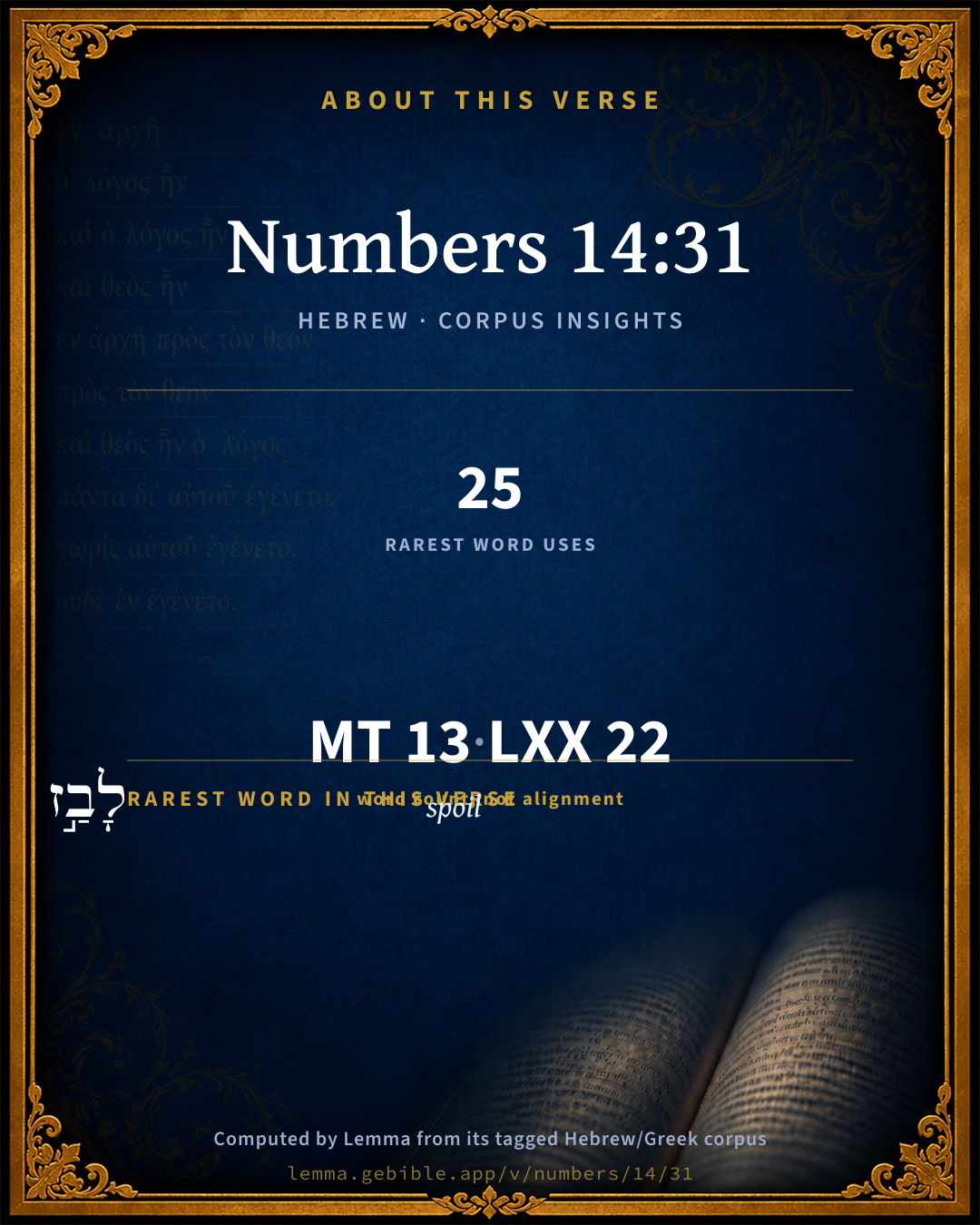
The rarest word here is לָבַ֣ז spoil H957 — appearing just 25 times in the whole Hebrew Bible.

Shared distinctive vocabulary

לָבַ֣ז spoil H957 occurs in 25 verses of the Hebrew Bible. Also found in:

Grammatical profile

  • 5 verbs
  • 3 nouns
  • 1 preposition
  • 4 particles

Verb forms

  • אֲמַרְתֶּ֖ם Qal · Perfect
  • יִהְיֶ֑ה Qal · Imperfect
  • וְהֵבֵיאתִ֣י Hiphil · Perfect
  • וְיָֽדְעוּ֙ Qal · Sequential Perfect
  • מְאַסְתֶּ֖ם Qal · Perfect

Repetition

A word recurs within this verse — often emphatic in Hebrew:

  • אֲשֶׁ֥ר which H834 ×2

Hebrew & Septuagint length

In English translation the verse runs 26 words from the Hebrew and 27 from the Septuagint (LXX English) — closely comparable.

A rough comparison of the two English renderings, which tokenize alike — not a word-level alignment.

Word counts can differ between the Hebrew and the Greek without any difference in meaning — e.g. the Hebrew direct-object marker אֵת has no separate Greek word, and Greek often adds the article ὁ.

In the original languages it is 13 Hebrew tokens and 22 Greek tokens — but the two are counted differently (Hebrew bundles its prefixes and suffixes into one token; the Greek is in lemma form), so that isn’t a like-for-like length.

Cross-references

11

Topical passages linked to Numbers 14:31 in the Treasury of Scripture Knowledge — connected by theme and wording, ordered by reader-vote popularity; previews shown in the World English Bible.

  • Deuteronomy 1:39 Moreover your little ones, whom you said should be a prey, and your children, who this day have no knowledge of good or evil, they shall go in there, and to them will I give it, and they shall possess it.
  • Psalms 106:24 Yes, they despised the pleasant land. They didn't believe his word,
  • Numbers 14:3 Why does Yahweh bring us to this land, to fall by the sword? Our wives and our little ones will be a prey: wouldn't it be better for us to return into Egypt?
  • Numbers 26:6 of Hezron, the family of the Hezronites; of Carmi, the family of the Carmites.
  • Numbers 26:64 But among these there was not a man of them who were numbered by Moses and Aaron the priest, who numbered the children of Israel in the wilderness of Sinai.
  • Genesis 25:34 Jacob gave Esau bread and stew of lentils. He ate and drank, rose up, and went his way. So Esau despised his birthright.
  • Proverbs 1:25 But you have ignored all my counsel, And wanted none of my reproof;
  • Proverbs 1:30 They wanted none of my counsel. They despised all my reproof.
  • Matthew 22:5 But they made light of it, and went their ways, one to his own farm, another to his merchandise,
  • Acts 13:41 'Behold, you scoffers, and wonder, and perish; For I work a work in your days, A work which you will in no way believe, if one declares it to you.'"
  • Hebrews 12:16–17 lest there be any sexually immoral person, or profane person, as Esau, who sold his birthright for one meal.

Cross-references courtesy of OpenBible.info (CC BY 4.0).

Hebrew and Greek witnesses Masoretic Hebrew ↔ Greek Septuagint

The same verse in the two great witnesses to the Old Testament, shown verse-for-verse.

These are two independent witnesses, not word-aligned to each other, and the Septuagint is shown in lemma (dictionary) form.

Hebrew Numbers 14:31 Masoretic · Westminster Leningrad Codex

וְטַ֨פְּכֶ֔ם אֲשֶׁ֥ר אֲמַרְתֶּ֖ם לָבַ֣ז יִהְיֶ֑ה וְהֵבֵיאתִ֣י אֹתָ֔ם וְיָֽדְעוּ֙ אֶת הָאָ֔רֶץ אֲשֶׁ֥ר מְאַסְתֶּ֖ם בָּֽהּ

But your little ones, that you said should be a prey, them will I bring in, and they shall know the land which you have rejected.

World English Bible · Public Domain

Greek LXX Numbers 14:31 Septuagint · lemma form

καί ὁ παιδίον ὅς εἶπον ἐν διαρπαγή εἰμί εἰςἄγω αὐτός εἰς ὁ γῆ καί κληρονομέω ὁ γῆ ὅς σύ ἀποἵστημι ἀπό αὐτός

And your little ones, who you⌃ said should be a prey, them will I bring into the land; and they shall inherit the land, which you⌃ rejected.

LXX2012 (modern English Septuagint) · Public Domain

Hebrew: Westminster Leningrad Codex (CC BY 4.0). Greek: Septuagint (public domain); English from LXX2012 (modern English Septuagint) (Public Domain). How the Septuagint differs from the Hebrew →

Targum (Aramaic paraphrase)

2

The Targum is the ancient Jewish Aramaic paraphrase of the Hebrew Scriptures — an interpretive translation, not the Hebrew text itself. Onkelos (literal) and Pseudo-Jonathan (expansive) render the Torah, and Jonathan the Prophets. Coverage is partial: where no permissively-licensed English translation exists for a verse, only the Aramaic is shown. This is verse-level text, not a word-by-word alignment to the Hebrew.

  1. Targum Onkelos Torah (Genesis–Deuteronomy)
    וְטַּפְלְכוֹן דִי אֲמַרְתּוּן לְבִזָא יְהֵי וְאָעֵל יַתְהוֹן וְיֵדְעוּן יָת אַרְעָא דִי קַצְתּוּן בַּהּ

    (no public-domain English translation for this verse)

    Targum Onkelos — Aramaic: “Onkelos Genesis” (public domain); “Onkelos Exodus” (public domain); “Onkelos Leviticus” (public domain); “Onkelos Numbers” (public domain); “Onkelos Deuteronomy” (public domain). English: “Sefaria Community Translation” (CC0 1.0 (public-domain dedication)); “J.W. Etheridge. The Targums of Onkelos and Jonathan Ben Uzziel on the Pentateuch. London: Longmans, Green, 1862” (public domain). Text via Sefaria.

  2. Targum Pseudo-Jonathan Torah (Genesis–Deuteronomy)
    וְטַפְלְכוֹן דַאֲמַרְתּוּן דִלְבִיזָא יְהוֹן וְאָעֵיל יַתְהוֹן וְיִנְדְעוּן יַת אַרְעָא דְקַצְתּוּן בָּהּ

    But your children, who you said would be a prey, them will I bring in, and they shall know the land which you rejected;

    Targum Pseudo-Jonathan — Aramaic: “Targum Jonathan on Genesis” (public domain); “Targum Jonathan on Exodus” (public domain); “Targum Jonathan on Leviticus” (public domain); “Targum Jonathan on Numbers” (public domain); “Targum Jonathan on Deuteronomy” (public domain). English: “The Targum of Jonathan ben Uzziel, trans. J. W. Etheridge, London, 1862” (public domain). Text via Sefaria.

Commentary

Notes on Numbers 14:31 from classic Christian and Jewish commentators (each source and its license shown beneath its notes). The classic Christian expositions comment on the surrounding passage and are grouped to its opening verse, so a note may address several verses; the Jewish commentaries on the Tanakh (Rashi and others) are per-verse, so they appear only where the commentator wrote on this verse.

Lemma curates 59 commentaries, every one of them public domain or Creative Commons licensed, each selected and text-cleaned for this edition rather than reprinted as found. About our sources →

John Gill's Exposition

But as for you, your carcasses,.... Which way of speaking seems to be used to distinguish them from their children:

they shall fall in this wilderness: which is repeated for the confirmation and certainty it, and an emphasis is laid on the words, this which are pronounced with an accent, to put them in mind of their wish, Num 14:2.

John Gill's Exposition of the Whole Bible (1746–1763) — public domain (CC PDM 1.0). Text via the HelloAO Bible API.

Whedon's Commentary on the Bible

Daniel D. Whedon

31. Your little ones — By something akin to poetical justice, the unbelieving fathers shall perish in the wilderness, and the helpless children, the objects of their skeptical solicitude, shall flourish in the land of promise. See Num_14:3. They despised the land when they distrusted the word of its great Giver. Thus the impenitent despise heaven when they reject Christ, its central attraction.

Daniel D. Whedon (gen. ed.), Commentary on the Old and New Testaments (1874–1909) — public domain. Text from a community e-Sword module.

unfoldingWord translationNotes

Door43 World Missions Community

your dead bodies will fall

Their dead bodies falling represents them dying. AT: "you will die" (See: Metonymy)

Your children will be shepherds in the wilderness

Some modern versions choose to translate, "Your children will wander in the wilderness." This is because in ancient times, shepherds usually wandered from place to place so their flocks and herds could find pasture.

They must bear the consequences of your acts

"They must suffer the consequences of your acts" or "They must suffer because of your acts"

until the end of your corpses

A corpse is a dead body. The end of their corpses represents the last of the them dying. AT: "until the last one of you dies" or "until all of you die" (See: Metonymy)

translationWords

reject

children

rebel

desert

unfoldingWord translationNotes — © Distant Shores Media and the Door43 World Missions Community, licensed CC BY-SA 4.0. Source: git.door43.org/Door43/en_tn.

Lesson kit

Teaching starters — assembled from the data on this page, not authored interpretation. Every prompt links to the verse data it draws on. Edit before teaching.

Numbers, in the Pentateuch, opens this verse with 13 words (10 distinct Hebrew lemmas). Its most distinctive word is baz (“spoil”). A historical commentator’s framing appears above. Read the whole chapter for the surrounding context.

Discussion questions

  1. The word baz carries the sense “spoil.” How does it shape the verse?
  2. How does Numbers 14:3, which shares the word «spoil», read alongside this verse?
  3. What does the repetition of “which” (2× in this one verse) do in this verse?
  4. These translations render this verse differently; the difference is in the English rendering, not the original. What questions does that raise?
  5. «אֲמַרְתֶּ֖ם» is a Qal Perfect verb. How does that grammatical form shape the action described?
  6. Compare how John Gill's Exposition and Whedon's Commentary on the Bible read this verse. Where do they agree or differ?

Things to notice

Reading settings

Reading text

Shown beneath each verse's original-language words.

Old Testament
Old Testament edition

Read the OT as the Masoretic Hebrew (MT) or the Greek Septuagint (LXX).

English shown for the Greek Septuagint (in the Hebrew ↔ Greek comparison).

Comparing translations? Open the Compare panel on any verse page to stack up to four side by side.