1 Kings 3:25

Hebrew (Westminster Leningrad Codex) 1 Kings 3:25 appears in the Hebrew Old Testament. The text above is from the Westminster Leningrad Codex. Each word links to its Strong’s number, a concise gloss, and parsing drawn from the Open Scriptures Hebrew Bible morphology. Click any word for its full Brown-Driver-Briggs (BDB) entry.
Download image
Cite this verse

1 Kings 3:25 (World English Bible). Public Domain. Lemma interlinear Bible study tool, https://lemma.gebible.app/v/1-kings/3/25.

Show BibTeX & RIS
BibTeX
RIS
English Translation
The king said, Divide the living child in two, and give half to the one, and half to the other.
World English Bible · Public Domain
Highlights
  • 1 first appearance in the Hebrew Bible
Full analysis ↓
Download a study sheet

One document with this verse’s original text, its word-by-word gloss line, the meaning frame, cross-references with their text, attributed commentary, and full source and license credits — printable, and it pastes into notes with its structure intact.

This verse Autodidact and up

Study sheet (.html) Plain text (.txt)

A passage Seminary Student

Up to 50 verses in one chapter. A passage sheet keeps up to 6 commentary sources and 12 cross-references per verse, in the order this page ranks them, and says so on the sheet whenever that leaves anything out. Ask for a single verse and you get the Autodidact verse sheet above.

Everything on this page stays free to read, with no account — the sheet is a download of what is already on screen, not access to it.

Want to remove ads? Support Godless Engineer
Compare translations 3

The same verse in 3 English versions, stacked beneath the original-language interlinear above. Click any original word for its lexicon entry.

Each is an independent rendering of the whole verse — the interlinear is not word-aligned to these translations.

Highlighted words mark where these versions differ — a whole-verse word diff, not a word-by-word alignment.

  • World English Bible Public Domain
    The king said, Divide the living child in two, and give half to the one, and half to the other.
  • King James Version Public Domain
    And the king said, Divide the living child in two, and give half to the one, and half to the other.
  • unfoldingWord Literal Text CC BY-SA 4.0
    And the king said, “Divide the living child in two, and give half to one and half to the other.”

unfoldingWord Literal Text — © unfoldingWord, licensed CC BY-SA 4.0. Word-aligned USFM3 via Door43 (git.door43.org/unfoldingWord/en_ult).

Versions to compare (up to 4)

3 of 4 selected

Show all 18 translations

Every available English version of this verse, each an independent rendering of the whole verse.

  • World English Bible Public Domain
    The king said, Divide the living child in two, and give half to the one, and half to the other.
  • Berean Standard Bible Public Domain
    and the king declared, “Cut the living child in two and give half to one and half to the other.”
  • Majority Standard Bible Public Domain
    and the king declared, “Cut the living child in two and give half to one and half to the other.”
  • King James Version Public Domain
    And the king said, Divide the living child in two, and give half to the one, and half to the other.
  • American Standard Version (1901) Public Domain
    And the king said, Divide the living child in two, and give half to the one, and half to the other.
  • Revised Version (1885) Public Domain
    And the king said, Divide the living child in two, and give half to the one, and half to the other.
  • Geneva Bible (1599) Public Domain
    And the King sayde, Deuide ye the liuing child in twaine, and giue the one halfe to the one, and the other halfe to the other.
  • Douay-Rheims (1899) Public Domain
    Divide, said he, the living child in two, and give half to the one, and half to the other.
  • Young's Literal Translation Public Domain
    and the king saith, `Cut the living child into two, and give the half to the one, and the half to the other.'
  • Literal Standard Version CC BY-SA 4.0
    and the king says, “Cut the living child into two, and give half to one, and half to the other.”
  • Unlocked Literal Bible CC BY-SA 4.0
    Then the king said, “Divide the living child in two, and give half to this woman and half to the other.”
  • unfoldingWord Literal Text CC BY-SA 4.0
    And the king said, “Divide the living child in two, and give half to one and half to the other.”
  • Darby Bible Public Domain
    And the king said, Divide the living child in two, and give half to the one, and half to the other.
  • World Messianic Bible Public Domain
    The king said, “Divide the living child in two, and give half to the one, and half to the other.”
  • Webster's Bible Public Domain
    And the king said, Divide the living child in two, and give half to the one, and half to the other.
  • Free Bible Version CC BY-SA 4.0
    “Cut the child that's alive in two, and give half to one woman and half to another,” he commanded.
  • Bible in Basic English Public Domain
    And the king said, Let the living child be cut in two and one half given to one woman and one to the other.
  • JPS Tanakh (1917) Public Domain
    And the king said: 'Divide the living child in two, and give half to the one, and half to the other.'

Literal Standard Version (2020), Covenant Press — licensed CC BY-SA 4.0. Text via the HelloAO Bible API (eBible.org). Unlocked Literal Bible (unfoldingWord) — licensed CC BY-SA 4.0. Text via the HelloAO Bible API (eBible.org). unfoldingWord Literal Text — © unfoldingWord, licensed CC BY-SA 4.0. Word-aligned USFM3 via Door43 (git.door43.org/unfoldingWord/en_ult). Free Bible Version, Dr. Jonathan Gallagher — licensed CC BY-SA 4.0. Text via the HelloAO Bible API (eBible.org).

Word by word

More ways to search: Search by grammar → Find every occurrence → Compare this word →

Practice this passage: Drill this verse → Learn its vocabulary →

גִּזְר֛וּ
gâzar
H1504
“cut off”
Verb, Qal, Imperative, 2nd Person, Masculine, Plural
Part of Speech
Verb
Stem
Qal
Form
Imperative
Person
2nd Person
Gender
Masculine
Number
Plural
Full BDB Definition

Origin: a primitive root

TWOT: 340

to cut, divide, cut down, cut off, cut in two, snatch, decree - (Qal) - to cut in two, divide - to cut down - to cut off, destroy, exterminate - to decree - (Niphal) - to be cut off, separated, excluded - to be destroyed, cut off - to be decreed
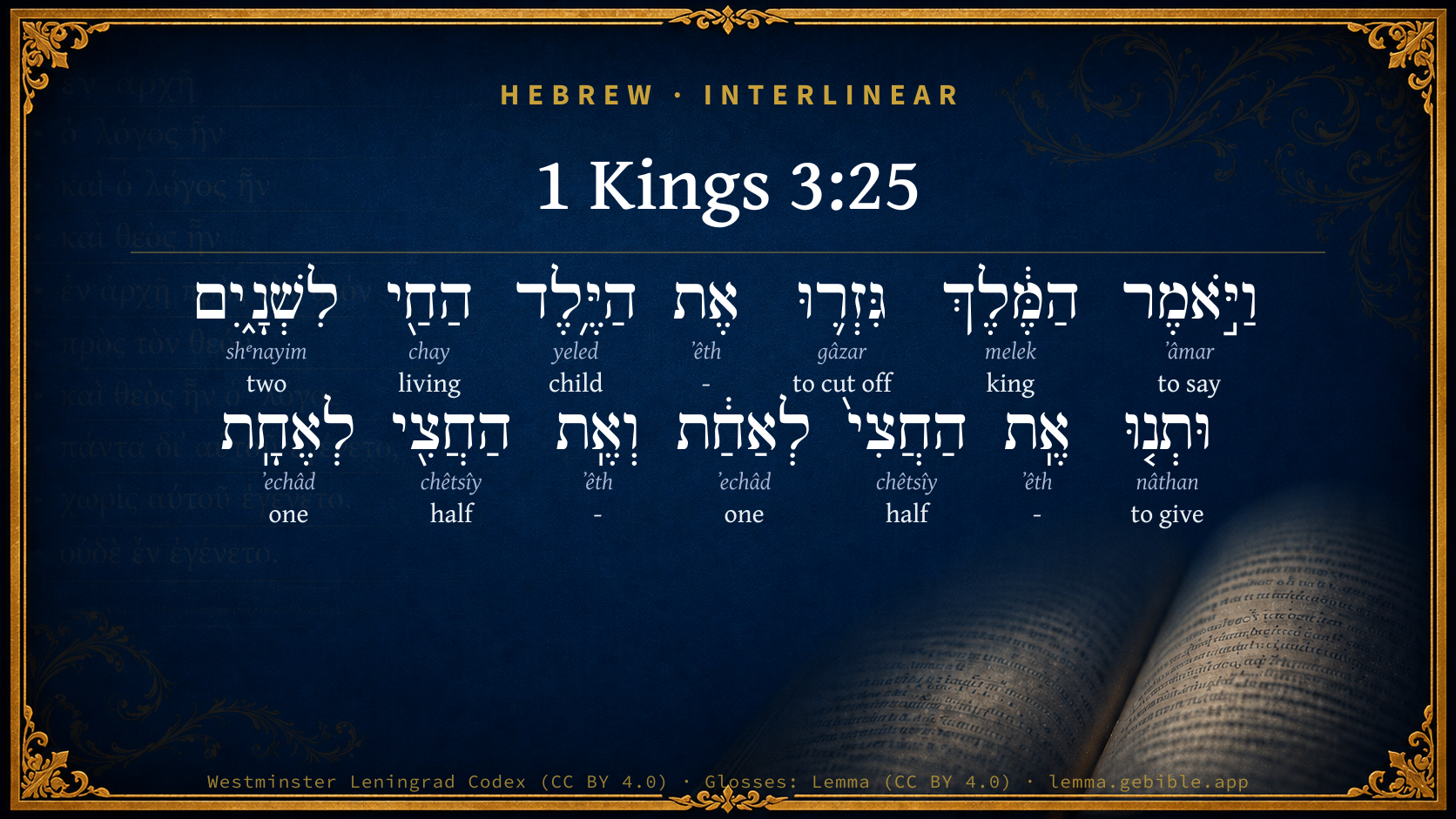
  1. וַיֹּ֣אמֶר ʼâmar H559 “and · to say” Conjunction + Verb, Qal, Sequential Imperfect, 3rd Person, Masculine, Singular
  2. הַמֶּ֔לֶךְ melek H4428 “the · king” Particle, Definite Article + Noun, Common, Masculine, Singular, Absolute
  3. אֶת ʼêth H853 “-” Particle, Direct Object
  4. הַיֶּ֥לֶד yeled H3206 “the · child” Particle, Definite Article + Noun, Common, Masculine, Singular, Absolute
  5. הַחַ֖י chay H2416 “the · living” Particle, Definite Article + Adjective, Adjective, Masculine, Singular, Absolute
  6. לִשְׁנָ֑יִם shᵉnayim H8147 “to/for · two” Preposition + Adjective, Cardinal number, Masculine, Dual, Absolute
  7. וּתְנ֤וּ nâthan H5414 “and · give” Conjunction + Verb, Qal, Imperative, 2nd Person, Masculine, Plural
  8. אֶֽת ʼêth H853 “-” Particle, Direct Object
  9. הַחֲצִי֙ chêtsîy H2677 “the · half” Particle, Definite Article + Noun, Common, Masculine, Singular, Absolute
  10. לְאַחַ֔ת ʼechâd H259 “to/for · one” Preposition + Adjective, Cardinal number, Feminine, Singular, Absolute
  11. וְאֶֽת ʼêth H853 “and · -” Conjunction + Particle, Direct Object
  12. הַחֲצִ֖י chêtsîy H2677 “the · half” Particle, Definite Article + Noun, Common, Masculine, Singular, Absolute
  13. לְאֶחָֽת ʼechâd H259 “to/for · one” Preposition + Adjective, Cardinal number, Feminine, Singular, Absolute

About this verse

These counts appear in no published source. They are computed here, from the morphology-tagged text and Lemma’s own curated glosses. What Lemma adds →

14
words
10
distinct lemmas
Historical
section

Notable vocabulary

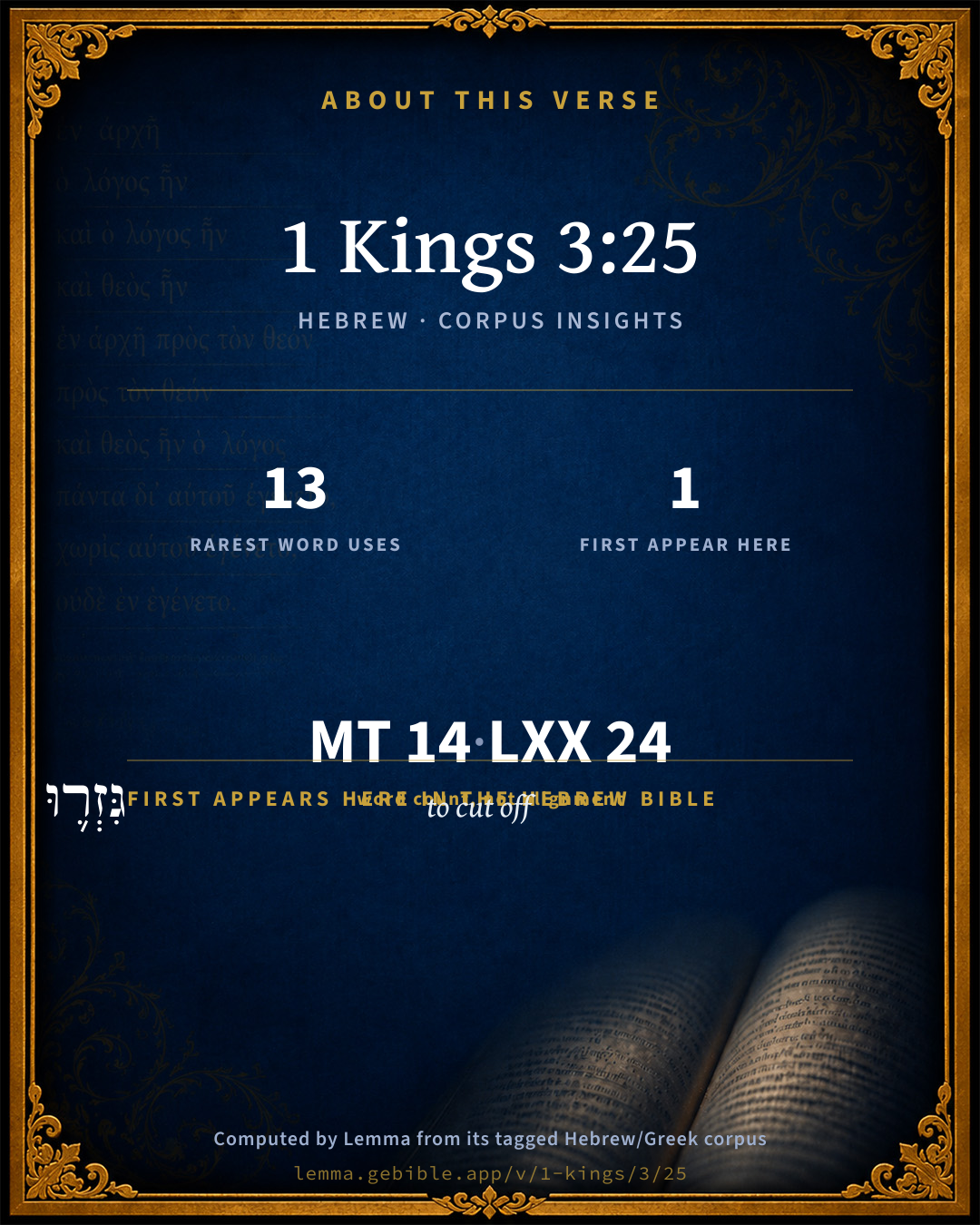
The rarest word here is גִּזְר֛וּ to cut off H1504 — appearing just 13 times in the whole Hebrew Bible.

First appearance in Scripture

This word makes its first canonical appearance in the Hebrew Bible here:

  • גִּזְר֛וּ to cut off H1504

Shared distinctive vocabulary

גִּזְר֛וּ to cut off H1504 occurs in 13 verses of the Hebrew Bible. Also found in:

Grammatical profile

  • 3 verbs
  • 4 nouns
  • 4 adjectives
  • 3 particles

Verb forms

  • וַיֹּ֣אמֶר Qal · Sequential Imperfect
  • גִּזְר֛וּ Qal · Imperative
  • וּתְנ֤וּ Qal · Imperative

Repetition

Words recur within this verse — often emphatic in Hebrew:

  • הַחֲצִי֙ half H2677 ×2
  • לְאַחַ֔ת one H259 ×2

Hebrew & Septuagint length

In English translation the verse runs 20 words from the Hebrew and 26 from the Septuagint (LXX English) — closely comparable.

A rough comparison of the two English renderings, which tokenize alike — not a word-level alignment.

Word counts can differ between the Hebrew and the Greek without any difference in meaning — e.g. the Hebrew direct-object marker אֵת has no separate Greek word, and Greek often adds the article ὁ.

In the original languages it is 14 Hebrew tokens and 24 Greek tokens — but the two are counted differently (Hebrew bundles its prefixes and suffixes into one token; the Greek is in lemma form), so that isn’t a like-for-like length.

Cross-references

1

Topical passages linked to 1 Kings 3:25 in the Treasury of Scripture Knowledge — connected by theme and wording, ordered by reader-vote popularity; previews shown in the World English Bible.

  • Proverbs 25:8 Don't be hasty in bringing charges to court. What will you do in the end when your neighbor shames you?

Cross-references courtesy of OpenBible.info (CC BY 4.0).

Hebrew and Greek witnesses Masoretic Hebrew ↔ Greek Septuagint

The same verse in the two great witnesses to the Old Testament, shown verse-for-verse.

These are two independent witnesses, not word-aligned to each other, and the Septuagint is shown in lemma (dictionary) form.

Hebrew 1 Kings 3:25 Masoretic · Westminster Leningrad Codex

וַיֹּ֣אמֶר הַמֶּ֔לֶךְ גִּזְר֛וּ אֶת הַיֶּ֥לֶד הַחַ֖י לִשְׁנָ֑יִם וּתְנ֤וּ אֶֽת הַחֲצִי֙ לְאַחַ֔ת וְאֶֽת הַחֲצִ֖י לְאֶחָֽת

The king said, Divide the living child in two, and give half to the one, and half to the other.

World English Bible · Public Domain

Greek LXX 1 Kings 3:25 Septuagint · lemma form

καί εἶπον ὁ βασιλεύς διααἱρέω ὁ παιδίον ὁ θηλάζω ὁ ζάω εἰς δύο καί δίδωμι ὁ ἥμισυς αὐτός οὗτος καί ὁ ἥμισυς αὐτός οὗτος

And the king said, Divide the live child, the suckling, in two; and give half of it to one, and half of it to the other.

LXX2012 (modern English Septuagint) · Public Domain

Hebrew: Westminster Leningrad Codex (CC BY 4.0). Greek: Septuagint (public domain); English from LXX2012 (modern English Septuagint) (Public Domain). How the Septuagint differs from the Hebrew →

Targum (Aramaic paraphrase)

1

The Targum is the ancient Jewish Aramaic paraphrase of the Hebrew Scriptures — an interpretive translation, not the Hebrew text itself. Onkelos (literal) and Pseudo-Jonathan (expansive) render the Torah, and Jonathan the Prophets. Coverage is partial: where no permissively-licensed English translation exists for a verse, only the Aramaic is shown. This is verse-level text, not a word-by-word alignment to the Hebrew.

  1. Targum Jonathan Prophets (Joshua–Malachi)
    וַאֲמַר מַלְכָּא פְּסוּקוּ יַת רַבְיָא חַיָא לִתְרֵין גִזְרִין וְהָבוּ פַלְגָא לַחֲדָא וּפַלְגָא לַחֲדָא:

    (no public-domain English translation for this verse)

    Targum Jonathan — Aramaic: “Mikraot Gedolot” (public domain). English: “Sefaria Community Translation” (CC0 1.0 (public-domain dedication)); “London "Chaldee Paraphrase," 1871” (public domain). Text via Sefaria.

Commentary

Notes on 1 Kings 3:25 from classic Christian and Jewish commentators (each source and its license shown beneath its notes). The classic Christian expositions comment on the surrounding passage and are grouped to its opening verse, so a note may address several verses; the Jewish commentaries on the Tanakh (Rashi and others) are per-verse, so they appear only where the commentator wrote on this verse.

Lemma curates 59 commentaries, every one of them public domain or Creative Commons licensed, each selected and text-cleaned for this edition rather than reprinted as found. About our sources →

Trapp's Complete Commentary

John Trapp

1Ki 3:25 And the king said, Divide the living child in two, and give half to the one, and half to the other.

Ver. 25. Divide the living child in two.] This he spake for trial, {a} and that he might make nature speak in the true mother. The like is recorded of Claudius Caesar, and of Galba, of Charles the Great, and of Alphonsus of Arragon, when but newly come to his crown.

And give half to the one, &c.] So the Arminians would divide man’s salvation between God’s free grace and man’s free will; Papists between Christ and their own good works.

{a} Some appearance of evil is not to be disliked.

John Trapp, A Commentary or Exposition upon All the Books of the Old and New Testament (1647–1656) — public domain. Text from a community e-Sword module.

Joseph Benson's Commentary

1Ki 3:25. The king said — With seeming sincerity, though with a design far above the reach of the two women, or of the people present, who probably with horror expected the execution of his sentence. “Solomon knew at once that the only sign whereby to discover the true mother, would be her affection, and compassionate tenderness for her child; and therefore, in order to distinguish between the two, his business was to make trial of this. And if we suppose that, when he commanded the child to be divided, he spake with a sedate countenance and seeming earnestness, as the true mother’s petition to the king makes it apparent that he did; then we may suppose further, not only the two women, but all the people present, with dread and admiration expecting the execution of the thing; which when it ended in so just a decision, quite contrary to what they looked for, raised joy in every breast, and gave a more advantageous commendation to the judge. And yet Abarbinel, the Jewish commentator, thinks that all this was no great proof of Solomon’s extraordinary wisdom, nor could it beget that fear or reverence which the text (says 1Ki 3:28) it procured to his person. His opinion, therefore, is, that Solomon made a discovery of the truth antecedent to this experiment; that by observing the countenance, the manner of speech, and all the motions of the women, he discerned the secret of their hearts, and penetrated to the bottom of the business; and that his commanding the child to be divided afterward was only to notify to the company what he before had discovered.” See Patrick and Calmet.

Joseph Benson's Commentary on the Old and New Testaments (1811–1818) — public domain. Text from a community e-Sword module.

Adam Clarke's Commentary

Verse 25. Divide the living child in two] This was apparently a very strange decision, and such as nothing could vindicate had it been carried into execution; but Solomon saw that the only way to find out the real mother was by the affection and tenderness which she would necessarily show to her offspring. He plainly saw that the real mother would rather relinquish her claim to her child than see it hewn in pieces before her eyes, while it was probable the pretender would see this with indifference. He therefore orders such a mode of trial as would put the maternal affection of the real mother to the utmost proof; the plan was tried, and it succeeded. This was a proof of his sound judgment, penetration, and acquaintance with human nature; but surely it is not produced as a proof of extraordinary and supernatural wisdom. We have several similar decisions even among heathens.

Suetonius, in his life of the Emperor Claudius, cap. xv., whom he celebrates for his wonderful sagacity and penetration on some particular occasions, tells us, that this emperor discovered a woman to be the mother of a certain young man, whom she refused to acknowledge as her son, by commanding her to marry him, the proofs being doubtful on both sides; for, rather than commit this incest, she confessed the truth. His words are: Feminam, non agnoscentem fllium suum, dubia utrinque argumentorum fide, ad confessionem compulit, indicto matrimonio juvenis.

Ariopharnes, king of Thrace, being appointed to decide between three young men, who each professed to be the son of the deceased king of the Cimmerians, and claimed the crown in consequence, found out the real son by commanding each to shoot an arrow into the body of the dead king: two of them did this without hesitation, the third refused, and was therefore judged by Ariopharnes to be the real son of the deceased. Grotius, on this place, quotes this relation from Diodorus Siculus; I quote this on his authority, but have not been able to find the place in Diodorus. This is a parallel case to that in the text; a covert appeal was made to the principle of affection; and the truth was discovered, as in the case of the mother of the living child.

Adam Clarke's Commentary on the Bible (1810–1826) — public domain. Text from a community e-Sword/MySword module.

The Cambridge Bible for Schools and Colleges

gen. ed. J. J. S. Perowne

25. Divide the living child] According to Josephus, the order of the king was that both the living and the dead child should be divided and half of either be given to each mother. But this was not in Solomon’s thought. He was not wishing to make a fair division of the two children, but, by threatening the living one, to bring to light the maternal feeling and so to find out to which of them it really belonged.

The Cambridge Bible for Schools and Colleges (gen. ed. J. J. S. Perowne; Cambridge University Press, 1878–1918) — public domain. Text from a community e-Sword module.

John Gill's Exposition

Then spake the woman, whose the living child was, unto the king,.... In haste, and with great vehemency, lest the executioner should at once dispatch it:

(for her bowels yearned upon her son); not being able to bear to see his life taken away:

and she said, O my lord: or, "on me (q), my lord"; let the sin, the lie that I have told, be on me, and the punishment of it; she rather chose to be reckoned a liar, and to endure any punishment such an offence deserved, than that her child should be cut asunder:

give her the living child, and in no wise slay it; being willing to part with her interest in it, rather than it should be put to death:

but the other said, let it be neither mine nor thine, but divide it; for as she knew it was not her own, she had no affection for it, nor desire to have it; chose rather to be clear of the expense of keeping and nursing it, and would, by its being put to death, be avenged of her adversary, who had brought this cause before the king.

(q) "in me", Montanus; so Abarbinel.

John Gill's Exposition of the Whole Bible (1746–1763) — public domain (CC PDM 1.0). Text via the HelloAO Bible API.

Haydock's Catholic Bible Commentary

Other. This sentence manifested the wisdom of Solomon, who knew that the real mother would feel the emotions of parental tenderness. By similar experiments, the truth has sometimes been discovered. Claudius obliged a mother to own her son, by ordering her to take him for a husband. (Seutonius xv.) --- The king of Trace told three who pretended to be the sons of the deceased king of the Cimmerians, to shoot an arrow at the corpse; which the real son would not do. (Calmet) (Diodorus, Sic.) --- A native of Mexico, reclaiming a horse which a Spaniard pretended was his, as the judge was under some doubts, the American threw his cloak over the horse’s head, and asked which eye was blind? The Spaniard replied, the right; and thus was detected. (Palafox.)

George Leo Haydock (1774–1849), Haydock's Catholic Family Bible and Commentary, 1859 edition — public domain. Excludes Psalms (Douay-Rheims chapter numbering differs from Protestant) and Deuterocanonical books (Catholic canon only).

Matthew Poole's English Annotations

He said this with seeming sincerity and earnestly, though with a design far above the reach of the two women or of the people present, who probably with admiration and horror expected the execution of it.

Matthew Poole's English Annotations on the Holy Bible (1683–1685) — public domain. Text from a community e-Sword/MySword module.

The Pulpit Commentary

And the king said, Divide the living child in two, and give half to the one and half to the other (Heb. one).

The Pulpit Commentary (1880–1919), ed. H.D.M. Spence-Jones & Joseph S. Exell — public domain. Text from a community e-Sword module.

John Wesley's Explanatory Notes

Said - Though with a design far above the reach of the two women, or of the people present, who probably with horror expected the execution of it.

John Wesley, Explanatory Notes Upon the Whole Bible (1754–1765) — public domain. Text via the GEBible commentary corpus.

Lesson kit

Teaching starters — assembled from the data on this page, not authored interpretation. Every prompt links to the verse data it draws on. Edit before teaching.

1 Kings, in the Historical, opens this verse with 14 words (10 distinct Hebrew lemmas). Its most distinctive word is gâzar (“to cut off”). A historical commentator’s framing appears above. Read the whole chapter for the surrounding context.

Discussion questions

  1. The word gâzar carries the sense “to cut off.” How does it shape the verse?
  2. This is the first place “to cut off” appears in Scripture (first appears here). What does its debut here establish?
  3. How does 1 Kings 3:26, which shares the word «to cut off», read alongside this verse?
  4. What does the repetition of “half” (2× in this one verse) do in this verse?
  5. «וַיֹּ֣אמֶר» is a Qal Sequential Imperfect verb. How does that grammatical form shape the action described?
  6. Compare how Trapp's Complete Commentary and Joseph Benson's Commentary read this verse. Where do they agree or differ?

Things to notice

Reading settings

Reading text

Shown beneath each verse's original-language words.

Old Testament
Old Testament edition

Read the OT as the Masoretic Hebrew (MT) or the Greek Septuagint (LXX).

English shown for the Greek Septuagint (in the Hebrew ↔ Greek comparison).

Comparing translations? Open the Compare panel on any verse page to stack up to four side by side.