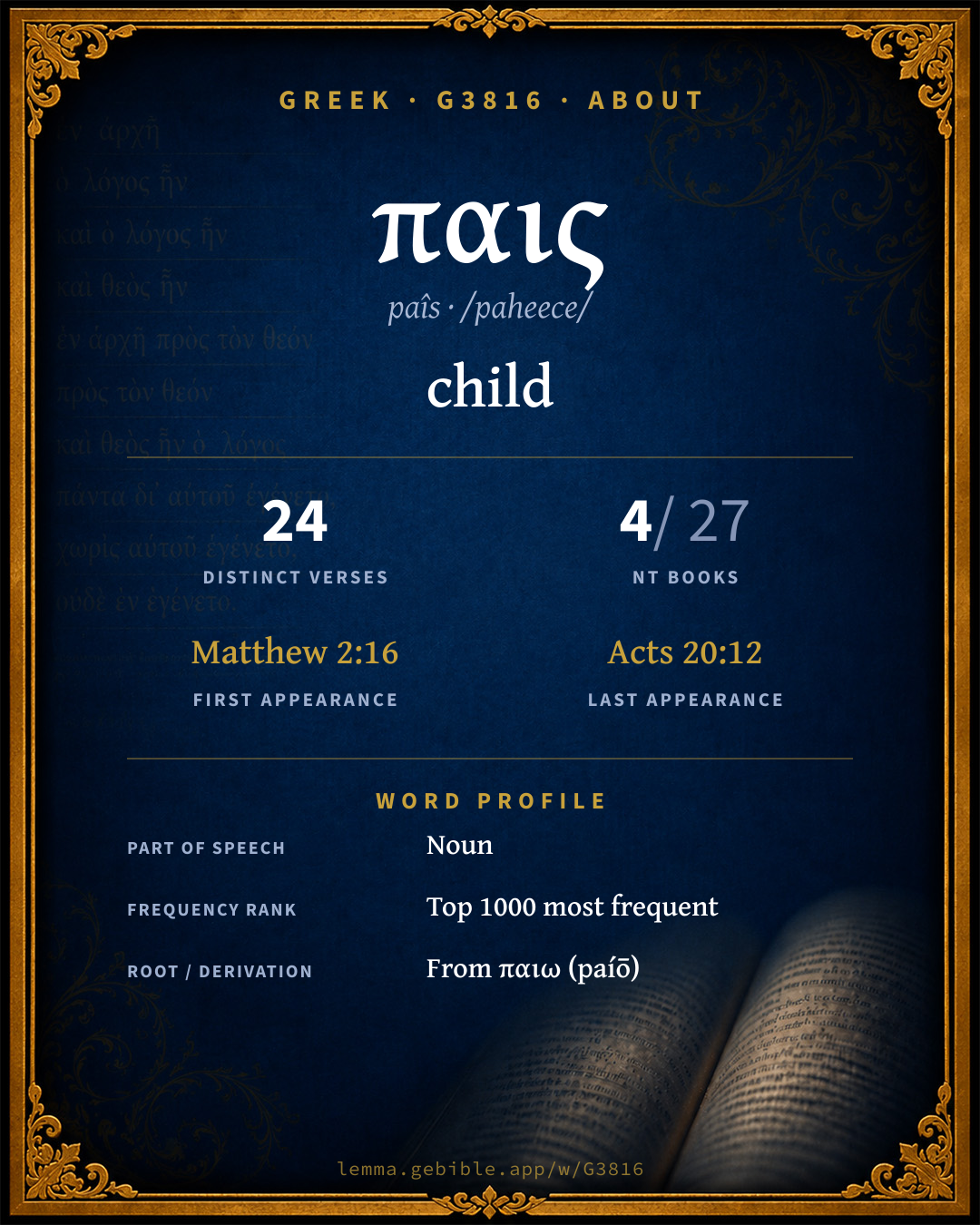
παῖς
child
‘child’ is one of 2 main senses fuller range ↓
Full lexicon entry — Thayer's Greek Lexicon
From Thayer's Greek Lexicon
Where this word appears
See every Nominative-case word in the Greek New Testament →
Grammar key — what these labels mean
Part of speech
- Noun
- A naming word — a person, place, thing, or idea.
Case
- Nominative
- The case of the subject (and the predicate nominative).
- Accusative
- The case of the direct object and of extent.
- Genitive
- The case of source, possession, or “of” — answers “whose / from what.”
- Dative
- The case of the indirect object, means, or location — “to / for / with / in.”
Gender
- Masculine
- Grammatically masculine.
- Feminine
- Grammatically feminine.
Number
- Singular
- One.
- Plural
- More than one.
Grammatical forms
- Noun, Nominative, Singular, Masculine 8 times (33%)
- Noun, Accusative, Singular, Masculine 5 times (21%)
- Noun, Genitive, Singular, Masculine 4 times (17%)
- Noun, Accusative, Plural, Masculine 3 times (13%)
- Noun, Dative, Plural, Masculine 1 time (4%)
- Noun, Genitive, Plural, Masculine 1 time (4%)
- Noun, Genitive, Singular, Feminine 1 time (4%)
- Noun, Nominative, Singular, Feminine 1 time (4%)
Parsed forms decoded from the imported morphology (Robinson–Tischendorf, public domain), counted across 24 parsed occurrences — not distinct verses.
Every verse where G3816 appears — 24 distinct verses across 4 books. Click any verse to open its interlinear word-by-word view. Verse text shown in the World English Bible for context — . Each verse’s Greek form is shown with its reference; the English is not keyword-highlighted, since the data carries no word-level English alignment. Use “Compare translations” on any verse to read it across multiple English versions. This concordance covers the Greek New Testament; Septuagint (Greek Old Testament) occurrences of this word are not indexed here.
Matthew 8 verses
- Matthew 2:16 παῖδας n acc pl masc Then Herod, when he saw that he was mocked by the wise men, was exceedingly angry, and sent out, and killed all the male children who were in Bethlehem and in all the surrounding countryside, from two years old and under, according to the exact time which he had learned from the wise men.
- Matthew 8:6 παῖς n nom sg masc and saying, "Lord, my servant lies in the house paralyzed, grievously tormented."
- Matthew 8:8 παῖς n nom sg masc The centurion answered, "Lord, I'm not worthy for you to come under my roof. Just say the word, and my servant will be healed.
- Matthew 8:13 παῖς n nom sg masc Jesus said to the centurion, "Go your way. Let it be done for you as you have believed." His servant was healed in that hour.
- Matthew 12:18 παῖς n nom sg masc "Behold, my servant whom I have chosen; My beloved in whom my soul is well pleased: I will put my Spirit on him. He will proclaim justice to the Gentiles.
- Matthew 14:2 παισὶν n dat pl masc and said to his servants, "This is John the Baptizer. He is risen from the dead. That is why these powers work in him."
- Matthew 17:18 παῖς n nom sg masc Jesus rebuked him, the demon went out of him, and the boy was cured from that hour.
- Matthew 21:15 παῖδας n acc pl masc But when the chief priests and the scribes saw the wonderful things that he did, and the children who were crying in the temple and saying, "Hosanna to the son of David!" they were indignant,
Luke 9 verses
- Luke 1:54 παιδὸς n gen sg masc He has given help to Israel, his servant, that he might remember mercy,
- Luke 1:69 παιδὸς n gen sg masc And has raised up a horn of salvation for us in the house of his servant David
- Luke 2:43 παῖς n nom sg masc and when they had fulfilled the days, as they were returning, the boy Jesus stayed behind in Jerusalem. Joseph and his mother didn't know it,
- Luke 7:7 παῖς n nom sg masc Therefore I didn't even think myself worthy to come to you; but say the word, and my servant will be healed.
- Luke 8:51 παιδὸς n gen sg fem When he came to the house, he didn't allow anyone to enter in, except Peter, John, James, the father of the child, and her mother.
- Luke 8:54 παῖς n nom sg fem But he put them all outside, and taking her by the hand, he called, saying, "Child, arise!"
- Luke 9:42 παῖδα n acc sg masc While he was still coming, the demon threw him down and convulsed him violently. But Jesus rebuked the unclean spirit, and healed the boy, and gave him back to his father.
- Luke 12:45 παῖδας n acc pl masc But if that servant says in his heart, 'My lord delays his coming,' and begins to beat the menservants and the maidservants, and to eat and drink, and to be drunken,
- Luke 15:26 παίδων n gen pl masc He called one of the servants to him, and asked what was going on.
John 1 verse
Acts 6 verses
- Acts 3:13 παῖδα n acc sg masc The God of Abraham, Isaac, and Jacob, the God of our fathers, has glorified his Servant Jesus, whom you delivered up, and denied in the presence of Pilate, when he had determined to release him.
- Acts 3:26 παῖδα n acc sg masc God, having raised up his servant, Jesus, sent him to you first, to bless you, in turning away everyone of you from your wickedness."
- Acts 4:25 παιδός n gen sg masc who by the mouth of your servant, David, said, 'Why do the nations rage, And the peoples plot a vain thing?
- Acts 4:27 παῖδά n acc sg masc For truly, in this city against your holy servant, Jesus, whom you anointed, both Herod and Pontius Pilate, with the Gentiles and the people of Israel, were gathered together
- Acts 4:30 παιδός n gen sg masc while you stretch out your hand to heal; and that signs and wonders may be done through the name of your holy Servant Jesus."
- Acts 20:12 παῖδα n acc sg masc They brought the boy in alive, and were greatly comforted.
About this entry
At a glance — auto-summarized from this page’s data, not written by a person. Every figure links to its source below. This summary describes the numbers; it doesn’t interpret them.
At its core, παις (paîs) means “child.” Scripture first uses it in Matthew 2:16. With 24 verses in 4 books, it is an uncommon word in the Greek New Testament. Its uses concentrate in Luke (38% of all occurrences). Ranging over 2 senses, it is not a single-sense word. Each statement above links to its evidence; the full detail follows below.
Gloss history
Strong's 1890 vs modern scholarship
About this word
Strong's G3816 catalogs a Greek word from the Greek New Testament.
These counts are not copied from any lexicon or concordance. They are computed here, from the morphology-tagged Greek New Testament. What Lemma adds →
- 24
- distinct verses
- The word appears in 24 distinct verses.
- 4 / 27
- NT books
- The word appears in 4 of 27 New Testament books.
- #548
- by frequency
- Top 1000 most frequent Greek words (rank 548 of 5,347 Greek words by occurrence).
View all 24 occurrences in the concordance →
By section of the New Testament
By traditional corpus
Conventional, traditional groupings — biblical authorship is debated, so this is a traditional corpus grouping, not an authorship claim. Some books belong to more than one corpus (Luke is in both the Gospels and the Lukan corpus, and so on), so these shares overlap and need not total 100%. Each figure is a share of the word’s 24 distinct verses.
- Gospels 18 verses · 75%
- Lukan (Luke–Acts) 15 verses · 63%
- Johannine 1 verse · 4%
How translations render this word
Counts come from each version’s own published word-to-Strong’s tagging or interlinear alignment — an approximate guide to how each version renders this word, not a word-level alignment the data otherwise carries. Because each total is that version’s own tagged count, the per-version totals vary from one another and need not match the appearance or distinct-verse counts above. These counts may also differ from a printed concordance because Lemma counts each distinctly tagged rendering and does not collapse phrase taggings into a single head-word total. This is a fixed set of word-tagged versions (KJV, ASV, BSB, ULT) and does not change with the reading translation you choose elsewhere. Each version’s license is shown beside its name below (and on Sources).
- King James Version: Servant 8×, Child 5×, Son 3×
- American Standard Version: Servant 12×, Boy 3×, Maiden 2×
- Berean Standard Bible: Servant 12×, Boy 4×, Servants 2×
- unfoldingWord Literal Text: Servant 12×, Boy 4×, Child 2×
King James Version Public Domain
Renders G3816 across 24 tagged occurrences — most commonly:
Plus 4 renderings that appear only once — usually multi-word phrases or single function words the recovered tagging swept in, not distinct renderings.
American Standard Version Public Domain
Renders G3816 across 27 tagged occurrences — most commonly:
Plus 6 renderings that appear only once — usually multi-word phrases or single function words the recovered tagging swept in, not distinct renderings.
Berean Standard Bible Public Domain
Renders G3816 across 23 tagged occurrences — most commonly:
Plus 5 renderings that appear only once — usually multi-word phrases or single function words the recovered tagging swept in, not distinct renderings. Not rendered by a distinct English word in 1 further occurrence.
unfoldingWord Literal Text CC BY-SA 4.0
Renders G3816 across 26 tagged occurrences — most commonly:
Plus 6 renderings that appear only once — usually multi-word phrases or single function words the recovered tagging swept in, not distinct renderings.
Senses in Thayer's
The 2 senses Thayer's distinguishes for this word, in lexicon order (not ranked by frequency or importance). The full entry — with sub-senses — is in the Lexicon Entry tab.
- infants, children
- servant, slave
Word origin
Derived from παιω (paíō) (G3817) — to strike.
Perhaps from G3817 ; a boy (as often beaten with impunity) or (by analogy) a girl and (generally) a child ; specifically a slave or servant (especially a minister to a king; and by eminence to God): - child maid (-en) (man) servant son young man.
— Strong’s Exhaustive Concordance (1890), public domain.
Forms in the corpus
The 8 distinct written forms G3816 takes in the Greek New Testament, most frequent first — each parse links to that case’s occurrences in the concordance.
| Form | Parsing | Example | Uses |
|---|---|---|---|
| παῖς paîs | Noun, Nominative, Singular, Masculine | Matthew 8:6 | 9 |
| παῖδα paîda | Noun, Accusative, Singular, Masculine | Luke 9:42 | 4 |
| παιδὸς paidòs | Noun, Genitive, Singular, Masculine | Luke 1:54 | 3 |
| παῖδας paîdas | Noun, Accusative, Plural, Masculine | Matthew 2:16 | 3 |
| παιδός paidós | Noun, Genitive, Singular, Masculine | Acts 4:25 | 2 |
| παίδων paídōn | Noun, Genitive, Plural, Masculine | Luke 15:26 | 1 |
| παισὶν paisìn | Noun, Dative, Plural, Masculine | Matthew 14:2 | 1 |
| παῖδά paîdá | Noun, Accusative, Singular, Masculine | Acts 4:27 | 1 |
Same root — word family
Other Thayer's entries built from the same root as G3816, grouped by Strong’s listed origin. These share a root / origin per the lexicon — not necessarily a shared meaning. Each links to that word’s own entry.
Derives from
Shares the same root
Derived from this word
- παιδαγωγος paidagōgós G3807 tutor
- παιδαριον paidárion G3808 boy
- παιδευω paideúō G3811 to discipline
- παιδιον paidíon G3813 small child
- παιδισκη paidískē G3814 young girl
- παιζω paízō G3815 to play
Compare all same-root words → Showing 4 of 10 — not the complete family. They share a root, not necessarily a meaning.
Septuagint usage
The same Greek word παις appears 387 times in the Greek Old Testament (Septuagint), across 356 verses in 24 books.
- 387
- LXX occurrences
- Tagged occurrences of this Greek word in the Septuagint.
- 356
- verses
- Distinct Septuagint verses containing this word.
- 24 / 39
- OT books
- The word appears in 24 of the 39 Old Testament books.
Sample Septuagint occurrences
- Genesis 9:25 παῖς
- Exodus 5:16 παῖς
- Leviticus 25:6 παῖς
- Numbers 14:24 παῖς
- Deuteronomy 5:14 παῖς
- Joshua 1:7 παῖς
- Judges 3:24 παῖς
- Ruth 2:6 παῖς
- 1 Samuel 16:15 παῖς
- 2 Samuel 2:12 παῖς
- 1 Kings 1:2 παῖς
- 2 Kings 2:16 παῖς
Septuagint occurrences (same lexeme)
Every verse where the same Strong’s number (G3816) appears in the Greek Septuagint — showing the first 50 of 356. Verse text shown in the World English Bible for context; the Greek form is the matched word — the English is not keyword-highlighted.
- Genesis 9:25 παῖς He said, "Cursed be Canaan; A servant of servants will he be to his brothers."
- Genesis 9:26 παῖς He said, "Blessed be Yahweh, the God of Shem; Let Canaan be his servant.
- Genesis 9:27 παῖς God enlarge Japheth, Let him dwell in the tents of Shem; Let Canaan be his servant."
- Genesis 12:16 παῖς He dealt well with Abram for her sake. He had sheep, and oxen, and male donkeys, and men-servants, and maid-servants, and female donkeys, and camels.
- Genesis 14:15 παῖς He divided himself against them by night, he and his servants, and struck them, and pursued them to Hobah, which is on the left hand of Damascus.
- Genesis 18:3 παῖς and said, "My lord, if now I have found favor in your sight, please don't go away from your servant.
- Genesis 18:5 παῖς I will get a morsel of bread so you can refresh your heart. After that you may go your way, now that you have come to your servant." They said, "Very well, do as you have said."
- Genesis 18:7 παῖς Abraham ran to the herd, and fetched a tender and good calf, and gave it to the servant. He hurried to dress it.
- Genesis 18:17 παῖς Yahweh said, "Will I hide from Abraham what I do,
- Genesis 19:2 παῖς and he said, "See now, my lords, please turn aside into your servant's house, stay all night, wash your feet, and you will rise up early, and go on your way." They said, "No, but we will stay in the street all night."
- Genesis 19:19 παῖς See now, your servant has found favor in your sight, and you have magnified your loving kindness, which you have shown to me in saving my life. I can't escape to the mountain, lest evil overtake me, and I die.
- Genesis 20:8 παῖς Abimelech rose early in the morning, and called all his servants, and told all these things in their ear. The men were very scared.
- Genesis 20:14 παῖς Abimelech took sheep and oxen, men-servants and women-servants, and gave them to Abraham, and restored Sarah, his wife to him.
- Genesis 21:25 παῖς Abraham complained to Abimelech because of a water well, which Abimelech's servants had violently taken away.
- Genesis 22:3 παῖς Abraham rose early in the morning, and saddled his donkey, and took two of his young men with him, and Isaac his son. He split the wood for the burnt offering, and rose up, and went to the place of which God had told him.
- Genesis 22:5 παῖς Abraham said to his young men, "Stay here with the donkey. The boy and I will go yonder. We will worship, and come back to you.
- Genesis 22:19 παῖς So Abraham returned to his young men, and they rose up and went together to Beersheba. Abraham lived at Beersheba.
- Genesis 24:2 παῖς Abraham said to his servant, the elder of his house, who ruled over all that he had, "Please put your hand under my thigh.
- Genesis 24:5 παῖς The servant said to him, "What if the woman isn't willing to follow me to this land? Must I bring your son again to the land you came from?"
- Genesis 24:9 παῖς The servant put his hand under the thigh of Abraham his master, and swore to him concerning this matter.
- Genesis 24:10 παῖς The servant took ten camels, of his master's camels, and departed, having all goodly things of his master's in his hand. He arose, and went to Mesopotamia, to the city of Nahor.
- Genesis 24:14 παῖς Let it happen, that the young lady to whom I will say, 'Please let down your pitcher, that I may drink.' She will say, 'Drink, and I will also give your camels a drink.' Let the same be she who you have appointed for your servant Isaac. Thereby will I know that you have shown kindness to my master."
- Genesis 24:17 παῖς The servant ran to meet her, and said, "Please give me a drink, a little water from your pitcher."
- Genesis 24:28 παῖς The young lady ran, and told her mother's house about these words.
- Genesis 24:34 παῖς He said, "I am Abraham's servant.
- Genesis 24:35 παῖς Yahweh has blessed my master greatly. He has become great. He has given him flocks and herds, silver and gold, men-servants and maid-servants, and camels and donkeys.
- Genesis 24:52 παῖς It happened that when Abraham's servant heard their words, he bowed himself down to the earth to Yahweh.
- Genesis 24:53 παῖς The servant brought forth jewels of silver, and jewels of gold, and clothing, and gave them to Rebekah. He gave also to her brother and to her mother precious things.
- Genesis 24:57 παῖς They said, "We will call the young lady, and ask her."
- Genesis 24:59 παῖς They sent away Rebekah, their sister, with her nurse, Abraham's servant, and his men.
- Genesis 24:61 παῖς Rebekah arose with her ladies. They rode on the camels, and followed the man. The servant took Rebekah, and went his way.
- Genesis 24:65 παῖς She said to the servant, "Who is the man who is walking in the field to meet us?" The servant said, "It is my master." She took her veil, and covered herself.
- Genesis 24:66 παῖς The servant told Isaac all the things that he had done.
- Genesis 26:15 παῖς Now all the wells which his father's servants had dug in the days of Abraham his father, the Philistines had stopped, and filled with earth.
- Genesis 26:18 παῖς Isaac dug again the wells of water, which they had dug in the days of Abraham his father. For the Philistines had stopped them after the death of Abraham. He called their names after the names by which his father had called them.
- Genesis 26:19 παῖς Isaac's servants dug in the valley, and found there a well of springing water.
- Genesis 26:25 παῖς He built an altar there, and called on the name of Yahweh, and pitched his tent there. There Isaac's servants dug a well.
- Genesis 26:32 παῖς It happened the same day, that Isaac's servants came, and told him concerning the well which they had dug, and said to him, "We have found water."
- Genesis 30:43 παῖς The man increased exceedingly, and had large flocks, maid-servants and men-servants, and camels and donkeys.
- Genesis 32:5 παῖς I have oxen, donkeys, flocks, men-servants, and maid-servants. I have sent to tell my lord, that I may find favor in your sight.'"
- Genesis 32:6 παῖς The messengers returned to Jacob, saying, "We came to your brother Esau. Not only that, but he comes to meet you, and four hundred men with him."
- Genesis 32:11 παῖς Please deliver me from the hand of my brother, from the hand of Esau: for I fear him, lest he come and strike me, and the mothers with the children.
- Genesis 32:17 παῖς He commanded the foremost, saying, "When Esau, my brother, meets you, and asks you, saying, 'Whose are you? Where are you going? Whose are these before you?'
- Genesis 32:19 παῖς He commanded also the second, and the third, and all that followed the herds, saying, "This is how you shall speak to Esau, when you find him.
- Genesis 32:21 παῖς So the present passed over before him: and he himself lodged that night in the camp.
- Genesis 33:5 παῖς He lifted up his eyes, and saw the women and the children; and said, "Who are these with you?" He said, "The children whom God has graciously given your servant."
- Genesis 33:8 παῖς Esau said, "What do you mean by all this company which I met?" Jacob said, "To find favor in the sight of my lord."
- Genesis 33:14 παῖς Please let my lord pass over before his servant: and I will lead on gently, according to the pace of the cattle that are before me and according to the pace of the children, until I come to my lord to Seir."
- Genesis 34:12 παῖς Ask me a great amount for a dowry, and I will give whatever you ask of me, but give me the young lady as a wife."
- Genesis 39:14 παῖς that she called to the men of her house, and spoke to them, saying, "Behold, he has brought in a Hebrew to us to mock us. He came in to me to lie with me, and I cried with a loud voice.
These are occurrences of the same Greek lexeme (G3816) in the Septuagint — not a translation of any one Hebrew word. The store carries no word-level Hebrew↔Greek alignment, so no Hebrew original is asserted here. Counts come from the recovered LXX Strong's tagging — high-frequency vocabulary is well covered, while rare or late forms may be untagged — so they reflect tagged occurrences and may slightly undercount.