John 19:28

Greek (Tischendorf 8th ed.) John 19:28 appears in the Greek New Testament. The text above is from the Tischendorf 8th edition. Each word links to its Strong’s number and a concise gloss. Click any word for its full Thayer’s Greek Lexicon entry.
Download image
Cite this verse

John 19:28 (World English Bible). Public Domain. Lemma interlinear Bible study tool, https://lemma.gebible.app/v/john/19/28.

Show BibTeX & RIS
BibTeX
RIS
English Translation
After this, Jesus, seeing that all things were now finished, that the Scripture might be fulfilled, said, "I am thirsty."
World English Bible · Public Domain
Download a study sheet

One document with this verse’s original text, its word-by-word gloss line, the meaning frame, cross-references with their text, attributed commentary, and full source and license credits — printable, and it pastes into notes with its structure intact.

This verse Autodidact and up

Study sheet (.html) Plain text (.txt)

A passage Seminary Student

Up to 50 verses in one chapter. A passage sheet keeps up to 6 commentary sources and 12 cross-references per verse, in the order this page ranks them, and says so on the sheet whenever that leaves anything out. Ask for a single verse and you get the Autodidact verse sheet above.

Everything on this page stays free to read, with no account — the sheet is a download of what is already on screen, not access to it.

Want to remove ads? Support Godless Engineer
Compare translations 3

The same verse in 3 English versions, stacked beneath the original-language interlinear above. Click any original word for its lexicon entry.

Each is an independent rendering of the whole verse — the interlinear is not word-aligned to these translations.

Highlighted words mark where these versions differ — a whole-verse word diff, not a word-by-word alignment.

  • World English Bible Public Domain
    After this, Jesus, seeing that all things were now finished, that the Scripture might be fulfilled, said, "I am thirsty."
  • King James Version Public Domain
    After this, Jesus knowing that all things were now accomplished, that the scripture might be fulfilled, saith, I thirst.
  • unfoldingWord Literal Text CC BY-SA 4.0
    After this, Jesus, knowing that all things had already been completed, so that the scripture might be completed, says, “I thirst.”

unfoldingWord Literal Text — © unfoldingWord, licensed CC BY-SA 4.0. Word-aligned USFM3 via Door43 (git.door43.org/unfoldingWord/en_ult).

Versions to compare (up to 4)

3 of 4 selected

Show all 19 translations

Every available English version of this verse, each an independent rendering of the whole verse.

  • World English Bible Public Domain
    After this, Jesus, seeing that all things were now finished, that the Scripture might be fulfilled, said, "I am thirsty."
  • Berean Standard Bible Public Domain
    After this, knowing that everything had now been accomplished, and to fulfill the Scripture, Jesus said, “I am thirsty.”
  • Majority Standard Bible Public Domain
    After this, seeing that everything had now been accomplished, and to fulfill the Scripture, Jesus said, “I am thirsty.”
  • King James Version Public Domain
    After this, Jesus knowing that all things were now accomplished, that the scripture might be fulfilled, saith, I thirst.
  • American Standard Version (1901) Public Domain
    After this Jesus, knowing that all things are now finished, that the scripture might be accomplished, saith, I thirst.
  • Revised Version (1885) Public Domain
    After this Jesus, knowing that all things are now finished, that the scripture might be accomplished, saith, I thirst.
  • Geneva Bible (1599) Public Domain
    After, when Iesus knew that all things were performed, that the Scripture might be fulfilled, he said, I thirst.
  • Douay-Rheims (1899) Public Domain
    Afterwards, Jesus knowing that all things were now accomplished, that the scripture might be fulfilled, said: I thirst.
  • Young's Literal Translation Public Domain
    After this, Jesus knowing that all things now have been finished, that the Writing may be fulfilled, saith, `I thirst;'
  • Literal Standard Version CC BY-SA 4.0
    After this, Jesus knowing that all things have now been accomplished, that the Writing may be fulfilled, says, “I thirst”;
  • Unlocked Literal Bible CC BY-SA 4.0
    After this, knowing that everything was now completed and so that the scriptures would be fulfilled, Jesus said, “I am thirsty.”
  • unfoldingWord Literal Text CC BY-SA 4.0
    After this, Jesus, knowing that all things had already been completed, so that the scripture might be completed, says, “I thirst.”
  • Darby Bible Public Domain
    After this, Jesus, knowing that all things were now finished, that the scripture might be fulfilled, says, I thirst.
  • World Messianic Bible Public Domain
    After this, Yeshua, seeing that all things were now finished, that the Scripture might be fulfilled, said, “I am thirsty!”
  • Webster's Bible Public Domain
    After this, Jesus knowing that all things were now accomplished, that the scripture might be fulfilled, saith, I thirst.
  • Free Bible Version CC BY-SA 4.0
    Jesus now realized that he had finished all that he had come to do. In fulfillment of Scripture, he said, “I'm thirsty.”
  • Bible in Basic English Public Domain
    After this, being conscious that all things had now been done so that the Writings might come true, Jesus said, Give me water.
  • Text-Critical English NT CC BY 4.0
    After this, when Jesus saw that everything was now finished, in order to fulfill the Scripture he said, “I am thirsty.”
  • Tyndale New Testament (1534) Public Domain
    After that when Iesus perceaved that all thinges were performed: that the scripture myght be fulfilled he sayde: I thyrst.

Literal Standard Version (2020), Covenant Press — licensed CC BY-SA 4.0. Text via the HelloAO Bible API (eBible.org). Unlocked Literal Bible (unfoldingWord) — licensed CC BY-SA 4.0. Text via the HelloAO Bible API (eBible.org). unfoldingWord Literal Text — © unfoldingWord, licensed CC BY-SA 4.0. Word-aligned USFM3 via Door43 (git.door43.org/unfoldingWord/en_ult). Free Bible Version, Dr. Jonathan Gallagher — licensed CC BY-SA 4.0. Text via the HelloAO Bible API (eBible.org).

Word by word

More ways to search: Search by grammar → Find every occurrence → Compare this word →

Practice this passage: Drill this verse → Learn its vocabulary →

διψῶ
dipsáō
G1372
“to thirst”
Verb, Present, Active, Indicative, 1st person, Singular
Part of Speech
Verb
Tense
Present
Voice
Active
Mood
Indicative
Person
1st person
Number
Singular
Full Thayer's Definition

Origin: from a variation of G1373

TDNT: 05:46,2

1. to suffer thirst, suffer from thirst a. figuratively, those who are said to thirst who painfully feel their want of, and eagerly long for, those things by which the soul is refreshed, supported, strengthened
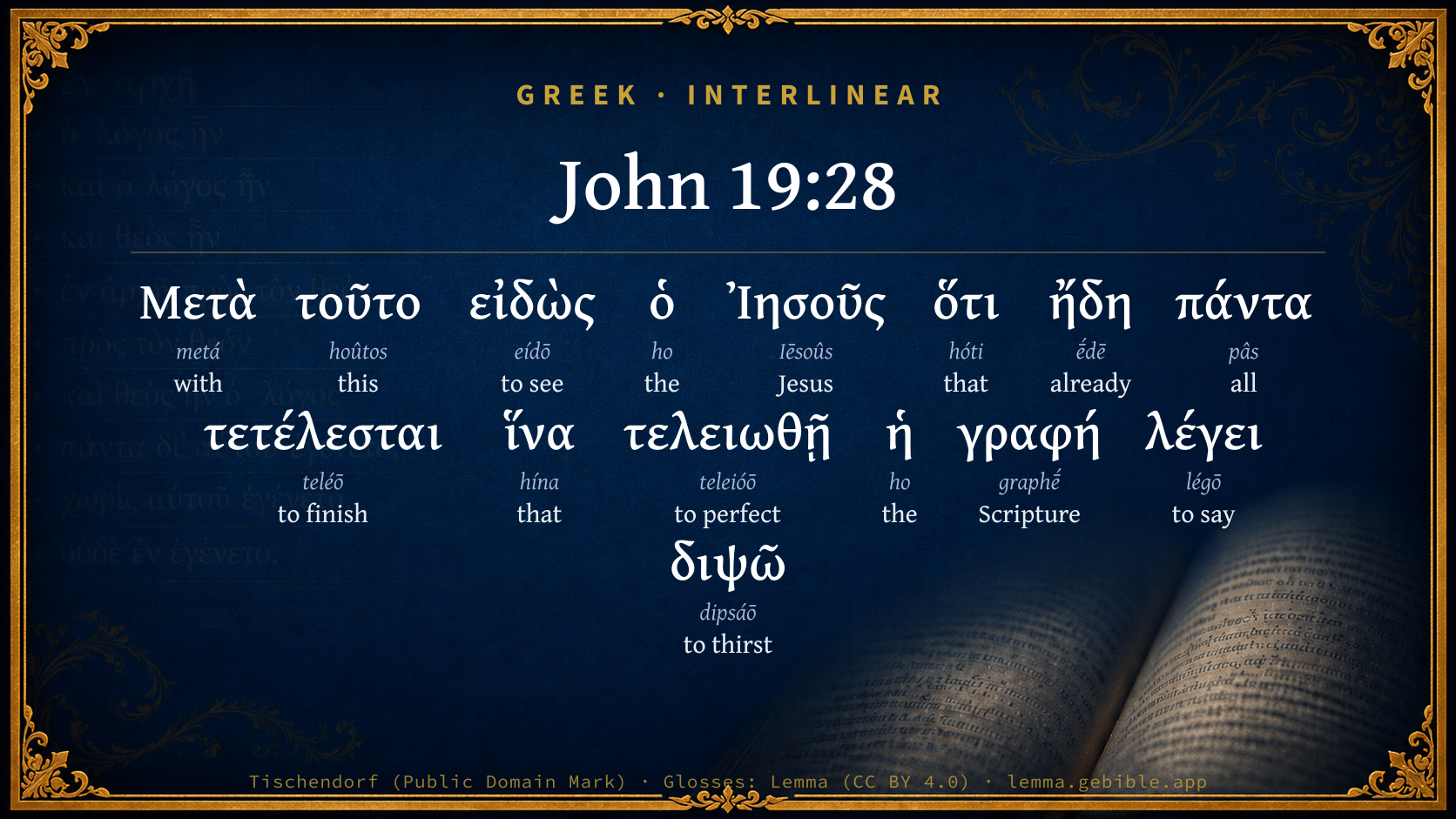
  1. Μετὰ metá G3326 “with” Preposition
  2. τοῦτο hoûtos G3778 “this” Demonstrative pronoun, Accusative, Singular, Neuter
  3. εἰδὼς eídō G1492 “to see” Verb, Perfect, Active, Participle, Nominative, Singular, Masculine
  4. ὁ ho G3588 “the” Article, Nominative, Singular, Masculine
  5. Ἰησοῦς Iēsoûs G2424 “Jesus” Noun, Nominative, Singular, Masculine
  6. ὅτι hóti G3754 “that” Conjunction
  7. ἤδη ḗdē G2235 “already” Adverb
  8. πάντα pâs G3956 “all” Adjective, Nominative, Plural, Neuter
  9. τετέλεσται teléō G5055 “to finish” Verb, Perfect, Passive, Indicative, 3rd person, Singular
  10. ἵνα hína G2443 “that” Conjunction
  11. τελειωθῇ teleióō G5048 “to perfect” Verb, Aorist, Passive, Subjunctive, 3rd person, Singular
  12. ἡ ho G3588 “the” Article, Nominative, Singular, Feminine
  13. γραφή graphḗ G1124 “Scripture” Noun, Nominative, Singular, Feminine
  14. λέγει légō G3004 “to say” Verb, Present, Active, Indicative, 3rd person, Singular

About this verse

These counts appear in no published source. They are computed here, from the morphology-tagged text and Lemma’s own curated glosses. What Lemma adds →

15
words
14
distinct lemmas
Gospels
section

Notable vocabulary

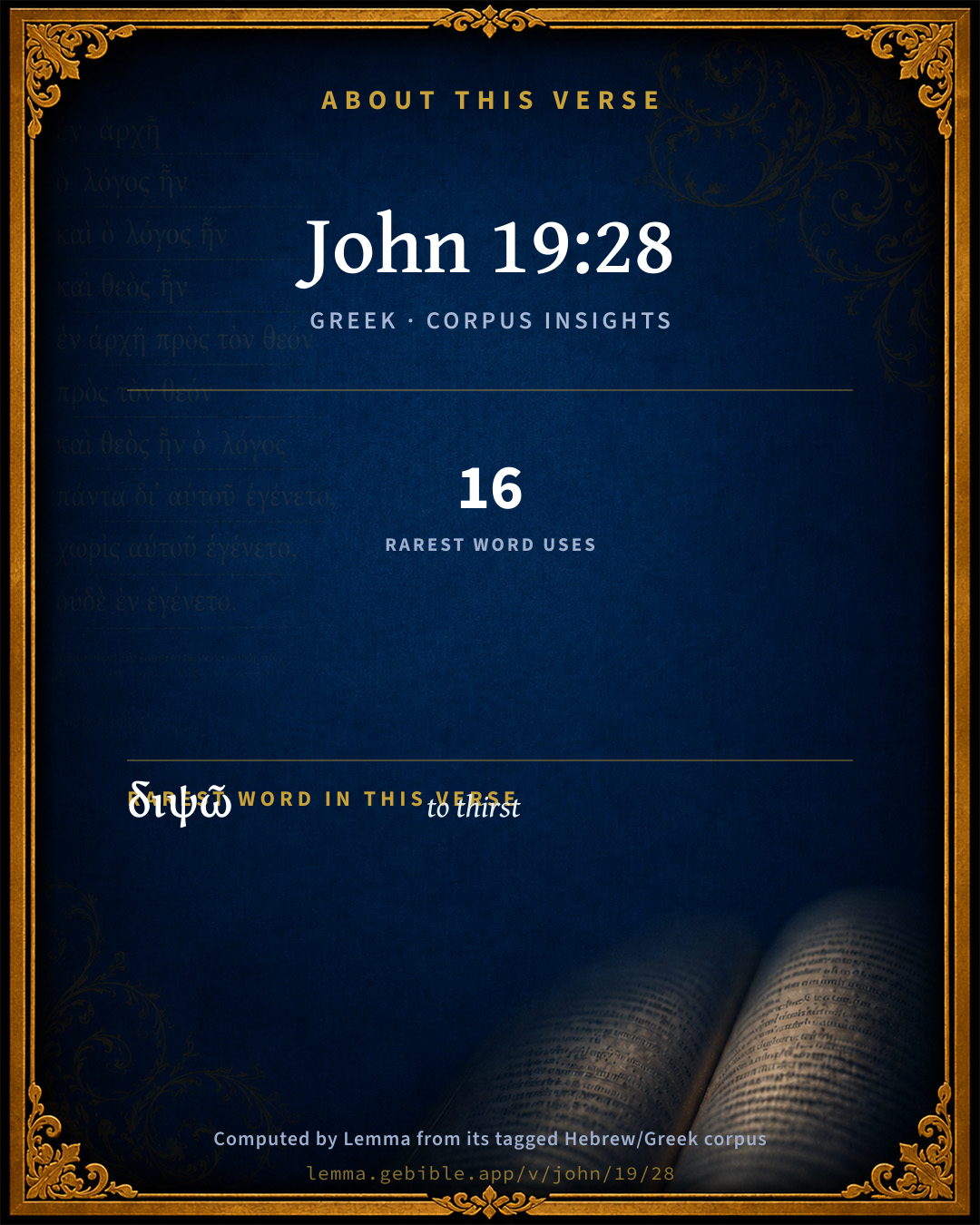
The rarest word here is διψῶ to thirst G1372 — appearing just 16 times in the whole Greek New Testament.

Shared distinctive vocabulary

διψῶ to thirst G1372 occurs in 16 verses of the Greek New Testament. Also found in:

Repetition

A word recurs within this verse:

Cross-references

11

Topical passages linked to John 19:28 in the Treasury of Scripture Knowledge — connected by theme and wording, ordered by reader-vote popularity; previews shown in the World English Bible.

  • Psalms 69:21 They also gave me gall for my food. In my thirst, they gave me vinegar to drink.
  • Psalms 22:15 My strength is dried up like a potsherd. My tongue sticks to the roof of my mouth. You have brought me into the dust of death.
  • John 19:30 When Jesus therefore had received the vinegar, he said, "It is finished." He bowed his head, and gave up his spirit.
  • Luke 22:37 For I tell you that this which is written must still be fulfilled in me: 'He was counted with the lawless.' For that which concerns me has an end."
  • Luke 18:31 He took the twelve aside, and said to them, "Behold, we are going up to Jerusalem, and all the things that are written through the prophets concerning the Son of Man will be completed.
  • John 19:24 Then they said to one another, "Let's not tear it, but cast lots for it to decide whose it will be," that the Scripture might be fulfilled, which says, "They parted my garments among them. For my cloak they cast lots." Therefore the soldiers did these things.
  • John 18:4 Jesus therefore, knowing all the things that were happening to him, went forth, and said to them, "Who are you looking for?"
  • John 13:1 Now before the feast of the Passover, Jesus knowing that his time had come that he would depart from this world to the Father, having loved his own who were in the world, he loved them to the end.
  • Luke 9:31 who appeared in glory, and spoke of his departure, which he was about to accomplish at Jerusalem.
  • Acts 13:29 When they had fulfilled all things that were written about him, they took him down from the tree, and laid him in a tomb.
  • Luke 12:50 But I have a baptism to be baptized with, and how distressed I am until it is accomplished!

Cross-references courtesy of OpenBible.info (CC BY 4.0).

Commentary

Notes on John 19:28 from classic Christian and Jewish commentators (each source and its license shown beneath its notes). The classic Christian expositions comment on the surrounding passage and are grouped to its opening verse, so a note may address several verses; the Jewish commentaries on the Tanakh (Rashi and others) are per-verse, so they appear only where the commentator wrote on this verse.

Lemma curates 59 commentaries, every one of them public domain or Creative Commons licensed, each selected and text-cleaned for this edition rather than reprinted as found. About our sources →

The Biblical Illustrator

Joseph S. Exell

Joh_19:28-29

After this, Jesus knowing that all things were now accomplished that the Scriptures might be fulfilled, saith, I thirst

A word from the cross

1. Our Lords seven words from the cross, have in all ages been very dear to the Church. There is nothing strange in this. Had it been but some earthly monarch, great, wise and good, would not his latest words, or words uttered at some notable crisis, be accounted a precious legacy? But what king, what moment like this?

2. That the words should be thus exactly seven, the sacred and mystical number is not without its significance. No evangelist records them all; every evangelist some. St. John alone records the briefest of them all; only one word in the original. It is the only utterance which contains any allusion to Christs bodily anguish. He has from His cross a word of intercession on behalf of His enemies; a word of grace for an enemy turned into a friend; a word of tender and thoughtful love for His mother; a word of triumph as He contemplates the near consummation of His work; a word of affiance on His Father and God; yes, too, and His souls agony has claimed one mysterious utterance for itself.

3. And even this word was not wrung out from Him by any overpowering necessity. He would not have spoken it, if He had not known that this was one of the things which were foretold concerning Him. The Scriptures referred to are no doubt Psa_22:1-31. and Psa_69:4. Physicians assure us that all the worst which we could imagine would be but a feeble and remote approach to His sufferings from thirst. Consider all which during the last few hours He had gone through. There is no suffering comparable to that of an unassuaged thirst, such as everything here was caculated to arouse. Those who have wandered over a fresh battlefield inform us that the one cry of the sufferers there is for water; all other agony being forgotten in this. The cry for water swallows up every other cry.

I. WHAT A LESSON OF COMFORT DOES THIS UTTERANCE CONTAIN! We want a Saviour, at least in our times of trial and suffering, not Himself untouched with the same, who can have a fellow-feeling with those who suffer, in that Ha Himself has suffered first. And such a Saviour we are assured that we have. He was God; yet He did not take refuge in His divinity when the stress of the trial grew sharp and strong. There was no make believe in the matter. As He had known slighter accesses of this human infirmity, when, for instance, at Jacobs well, so now He endured the fiercest access of it. He who avoided not this, we may be sure, avoided none of the weaknesses and woes of our fallen humanity.

II. WHAT A CONSTANTLY RECURRING TEMPTATION BESETS EVERY ONE OF US IN THE NECESSARY REFRESHMENT AND REPARATION OF THE DAILY WASTE OF THE BODY. How easily we come to attach too much importance to what we shall eat and what we shall drink; and, though guilty, it may be, of no excess in the eyes of others, yet to burden and clog the spirit through over-much allowing and indulging the flesh! How easily in this way our table may become a snare to us. It is not for nothing that our warning examples of those who sinned, seduced by temptations of appetite, are scattered through all the Scripture. The first sin of all was a sin of this character. It is for a mess of pottage that Esau sells his birthright. No sins of the children of Israel in the wilderness are so frequent as these. Surely, if we would overcome these, the power to do this must be found, where all other power is to be found, in the Cross of Christ. And we need this help. The whole mechanism of social life is at this day, for the higher classes of society, so finished and elaborate, that they are very little trained or disciplined to meet small annoyances, disappointments, and defeats of appetite. Great danger, therefore, there is that those, who would perhaps have borne some great trial bravely, should be immoderately disturbed by these small ones. But how will the Cross of Christ put to silence these petty discontents.

III. CONSIDER WHO IT WAS WHO SPAKE THOSE WORDS. We have seen in them the evidence that He was Man, but He was also God. Surely when we would stir up these cold hearts of ours to love Him better and to serve Him more, it is well that we should bring this before our mind, that He had been in the form of God from eternity, who had now made Himself so poor for us that He was content to ask and to receive a boon from one of the unworthiest of His creatures. He who exclaimed now, I thirst, was the same who had made the sea and the dry land, who held the ocean in the hollow of His hand. All streams and fountains, all wells and waterbrooks, and the rivers that run among the hills, were His, who now thirsted as probably no other child of man ever had.

IV. AND WHEREFORE DOES HE THIRST? That our portion may not be with Him who, tormented in that flame, craved in vain a drop of water for His burning tongue; that we may receive of Him that gift of the water of life which shall cause us never to thirst any more; that He may lead us at last to that pure river of the water of life, etc.; that He might see us thirsting after God. When He sees this in us, then He beholds the fruit of the travail of His soul, and is satisfied. (Abp. Trench.)

The shortest of the seven cries

We shall look upon these words as

I. THE ENSIGN OF CHRISTS TRUE HUMANITY. Angels cannot thirst. A phantom, as some have called him, could not suffer in this fashion. Thirst is a common-place misery, such as may happen to peasants or beggars; it is no royal grief; Jesus is brother to the poorest. Our Lord, however, endured thirst to an extreme degree, for it was the thirst of death, and more the thirst of one whose death was for every man. Believing this

1. Let us tenderly feel how very near akin to us our Lord has become. You have been parched with fever as He was, and gasped out, I thirst. Your path runs hard by that of your Master. Next time your fevered lips thus murmur, you may say, Those are sacred words, for my Lord spake in that fashion. While we admire His condescension let our thoughts turn with delight to His sure sympathy.

2. Let us cultivate the spirit of resignation, for we may well rejoice to carry a cross which His shoulders have borne before us. If our Master said, I thirst, do we expect every day to drink of streams from Lebanon? Shall the servant be above his Master? &c.

3. Let us resolve to shun no denials, but rather court them that we may be conformed to His image. May we not be half ashamed of our pleasures when He says, I thirst?

II. THE TOKEN OF HIS SUFFERING SUBSTITUTION.

1. My God, My God, why hast Thou forsaken Me? points to the anguish of His soul; I thirst expresses the torture of His body; and they were both needful. The pangs that are due to law are of both kinds, touching both heart and flesh.

2. The present effect of sin is thirst, dissatisfaction. Now Christ standing in the stead of the ungodly suffers thirst as a type of His enduring the result of sin. More solemn still is the reflection that thirst will also be the eternal result of sin. Father Abraham, send Lazarus, &c.

3. He had no sooner said I thirst, and sipped the vinegar, than He shouted, It is finished; and all was over; and our great Deliverers thirst was the sign of His having smitten the last foe.

III. A TYPE OF MANS TREATMENT OF HIS LORD.

1. It was a confirmation of the Scripture testimony with regard to mans natural enmity to God. According to modern thought man is a very fine and noble creature, struggling to become better. But such is not the Scripture estimate. At the first there was no room for Him at the inn, and at the last there was no water for Him to drink; but when He thirsted they gave Him vinegar. Manhood, left to itself, rejects, crucifies, and mocks the Christ of God.

2. Have we not often given Him vinegar to drink? Did we not do so years ago before we knew Him? We gave Him our tears and then grieved Him with our sins. Nor does the grief end here, for our best works, feelings, prayers, have been tart and sour with sin.

IV. THE MYSTICAL EXPRESSION OF THE DESIRE OF HIS HEART.

1. His heart was thirsting to save men. This thirst had been on Him early. Wist ye not that I must be about My Fathers business? I have a baptism to be baptized with, &c., and when on the cross the work was almost done His thirst could not be assuaged till He could say, It is finished.

2. He thirsts after the love of His people. Call to mind His complaint in Isa_5:1-30, It brought forth wild grapes--vinegar. According to the sacred canticle of love (Solomons Son_5:1-16.), we learn that when He drank in those olden times it was in the garden of His Church that He was refreshed.

3. He thirsts for communion with His people, not because you can do Him good, but because He can do you good. He thirsts to bless you and to receive your grateful love in return.

V. THE PATTERN OF OUR DEATH WITH HIM. Know ye not that ye are crucified together with Christ? Well, then, what means this cry, I thirst, but this, that we should thirst too

1. After Christ. Certain philosophers have said that they love the pursuit of truth even better than the knowledge of truth. I differ from them, but, next to the actual enjoyment of my Lords presence, I love to hunger and to thirst after Him.

2. For the souls of our fellow-men. Thirst to have your children, your workpeople, your class, saved.

3. As for yourselves, thirst after perfection. Hunger and thirst after righteousness, for you shall be filled. (C. H. Spurgeon.)

The fifth word from the cross

Wrung from Christ by the most agonizing of pains. Teaches us that Christ was no stoic. Psa_22:15, fulfilled. Not bodily thirst only. The soul sympathized with the body, and through it betrayed its deepest wants. These words

I. Betray AN IRREPRESSIBLE LONGING FOR HUMAN SYMPATHY. Learn this Psa_69:20. The sympathy of Peter rejected because mistimed; that of the daughters of Jerusalem because misdirected. Here, and in Gethsemane, Christ, as a true Man, felt the want of it.

II. Reveal THE DEPTH OF THAT HUMILIATION TO WHICH CHRIST DESCENDED IN ACCOMPLISHING HUMAN REDEMPTION. All the resources of the universe were at His disposal. Had He not miraculously fed the multitude, &c., and proclaimed, If any man thirst, &c. That the Son of the Highest should stoop to ask aid from His executioners proves the voluntariness and greatness of His humiliation.

III. Form THE CLIMAX TO THE PRECEDING CRY OF DISTRESS. My God, My God, &c. Not the Fathers approval, but the consciousness of it, obscured for a moment. Christ longed to hear the familiar words of approval, This is My beloved Son. Two dense clouds intervened.

1. Combined hosts of darkness.

2. Accumulated load of human guilt (Psa_69:1-3).

IV. Express THE SAVIOURS YEARNING FOR HUMAN PENITENCE AND LOVE. He looked upon the multitude, but found no sign of relenting. When He sat on the well He said, Give Me to drink, and meant, Give Me thy heart--so here. (W. Forsyth, M. A.)

The thirst of Christ

Considered in its

I. PHYSICAL ASPECT.

1. Its producing cause--bodily pain and exhaustion.

2. Its significance--that Christ was very Man.

II. SPIRITUAL ASPECT.

1. Its objects. Christ thirsted for

(1) The love of men.

(2) The salvation of men.

(3) Reunion with His Father.

III. PROPHETIC ASPECT.

1. Its expression and import--that the Scripture might be fulfilled.

2. Its significance--that Christ was very God.

IV. PRACTICAL ASPECT. It teaches us

1. To bear suffering with patience and submission.

2. That patience in suffering is quite distinct from stoical endurance.

3. To abstain from fleshly lusts.

4. The blackness of human ingratitude.

5. The unselfishness of Divine love.

6. For what man should thirst.

(1) For reconciliation to God through Christ, by quenching the thirst of His dear Son in accepting His offered salvation, and turning to Him with love, sorrow, and repentance.

(2) For the communion of Christs body and blood in the perpetual memorial of His precious death. (Thirty Thousand Thoughts.)

Now there was set a vessel full of vinegar.--This vessel of the ordinary sour wine drunk by the Roman soldiers was placed near in order to be given to those who were crucified. Thirst was always an accompaniment of death by crucifixion, and that the vessel of wine was prepared for this purpose is probable by the mention of the sponge and the hyssop. This latter detail is peculiar to John. Bochart thinks that the hyssop was marjoram, or some plant like it, and he is borne out by ancient tradition. The stalks from a foot to a foot and a half high would be sufficient to reach to the cross (Archdeacon Watkins.)

The Biblical Illustrator, edited by Joseph S. Exell (c. 1880s–1900s) — public domain. Text from a community e-Sword module.

Joseph Benson's Commentary

Joh 19:28-30. After this — After what is related above; and after other events recorded by the other evangelists, such as the three hours supernatural darkness, and the doleful exclamation of Jesus, Eloi, Eloi, &c., of which see notes on Mat 27:46-47; Mar 15:34; Jesus, knowing that all things — All the grievous and terrible sufferings he had to endure; were now upon the point of being accomplished — And being parched with a violent drought: that the scripture might be fulfilled — Where the Messiah is described as crying out, My tongue cleaveth to my jaws, and in my thirst they gave me vinegar to drink, (Psa 22:15; Psa 69:21,) to show that he endured all that had been foretold concerning him; saith, I thirst. Now there was set — As usual on such occasions; a vessel full of vinegar — Near the cross: as vinegar and water was the common drink of the Roman soldiers, perhaps this vinegar was set here for their use. And they filled a sponge with vinegar, and put it upon hyssop — That is, a stalk of hyssop; and put it to his mouth — In a contemptuous manner. See note on Mat 27:48. “There must have been some plant in Judea of the lowest class of trees, or shrubs, which was either a species of hyssop, or had a strong resemblance to what the Greeks called υσσωπος; inasmuch as the Hellenist Jews always distinguished it by that name. It is said of Solomon, (1Ki 4:33,) that he spake of trees, from the cedar tree that is in Lebanon, even unto the hyssop that springeth out of the wall. Now they did not reckon among trees any plants but such as had durable and woody stalks, see note on Mat 6:30. That their hyssop was of this kind, is evident also from the uses of sprinkling, to which it is in many cases appointed by the law to be applied.” — Campbell. When Jesus had received the vinegar, he said, It is finished — The predictions of the prophets that respect my personal ministry are all fulfilled. The important work of man’s redemption is accomplished. The demands of the law, and of divine justice, are satisfied, and my sufferings are now at an end. It appears from Matthew, Mark, and Luke, that in speaking these words he cried with an exceeding loud voice; probably to show that his strength was not exhausted, but that he was about to give up his life of his own accord. Having thus shouted, he addressed his Father, with a tone of voice proper in prayer; saying, Father, into thy hands I commend my spirit, and then bowed his head, and gave up the ghost — Leaving us the best pattern of a recommendatory prayer in the article of death. See note on Mat 27:50; Luk 23:46.

Joseph Benson's Commentary on the Old and New Testaments (1811–1818) — public domain. Text from a community e-Sword module.

Whedon's Commentary on the Bible

Daniel D. Whedon

The thirst and death of Jesus, Joh_19:28-30.

28. After this—That is, subsequent not merely to the event last narrated, but to all the events narrated. The last preceding event was the cry of Jesus, “Eloi, Eloi;” and the present furnishing of drink is parallel with Mat_27:48.

All things… accomplished—All his sufferings up to the now closing point.

Scripture… fulfilled—Some commentators refer this clause to what precedes; and the sense would then be that all things were accomplished in order to the fulfilment of Scripture. Stier more properly refers it to what follows; and the sense would then be that Jesus, in order to the fulfilment of Scripture, said, “I thirst.” We would, however, so extend as to include 29, 30. In order to the fulfilment of Scripture, Jesus, after the satisfaction of his predicted thirst, uttered the final “It is finished,” and expired.

I thirst—The briefest but not least significant of the Lord’s utterances upon the cross. The reference may be to Psa_22:15, or rather to Psa_69:21 : “They gave me also gall for my meat; and in my thirst they gave me vinegar to drink.” It must not be conceived that our Lord, in a servile way, directed his mind to the interpretation of Scripture in these agonizing moments; yet, in a full, calm, glorious consciousness, he trod the path foreknown of God. He acts in the full spirit of Psa_40:7 : “Then said I, Lo, I come; in the volume of the book it is written of me, I delight to do thy will, O my God.” Hitherto in the great agonies of his soul there had been little thought for the pains of the body. His utterance, as Lange well says, “is like the words of a hero, to whose consciousness it now first occurs that his wounds are bleeding, and that he needs some invigoration after the heat of the conflict has been sustained.” And thirst is a deeper suffering than hunger. After the bloody sweat of Gethsemane, the sleepless night of his trial, the scourgings, the loss of blood, and the unknown mental agonies, the fluids of his system became exhausted, and the glorious sufferer has not, perhaps, strength to utter his cry of final triumph. Meekly, like a lamb bleating to its slaughterers, he utters the feeble expression of his need. He consents to receive the aid of his murderers. Invigorated in body by the natural supply, he hastens in spirit, with brief, rapid utterances, to the consummation.

Daniel D. Whedon (gen. ed.), Commentary on the Old and New Testaments (1874–1909) — public domain. Text from a community e-Sword module.

Godbey's Commentary on the New Testament

William B. Godbey

JESUS EXPIRES AMID THE DARKNESS

Luk 23:44-46; Joh 19:28-30; Mar 15:33-37; Mat 27:45-50. “And from the sixth hour there was darkness over all the earth until the ninth hour.” Infidelity has ransacked astronomy to find a total solar eclipse at this time and thus account for the darkness. If you will think of one fact you will see the utter folly of such an effort. You know it was the time of the Jewish Passover, which always took place at the full moon of our April. You know this is a time when a solar eclipse is utterly impossible, as the moon is in the east and the sun is in the west, the eclipse necessarily taking place when they are both on the same side of the earth, as the moon must come between the earth and the sun in order to produce the eclipse. Luk 23:45 : “And the sun was darkened.” This settles the matter against the hypothesis of an eclipse, as the sun is not darkened in that case, but shining as brightly as if no intervening object casts a dark shadow on the earth. The revelation sustains the conclusion that the sun himself actually refused to shine.

“He dies, the Friend of sinners dies! Lo, Salem’s daughters weep around! A solemn darkness veils the skies, A sudden trembling shakes the ground. Come, saints, and drop a tear or two For Him who groaned beneath your load: He shed a thousand drops for you —

A thousand drops of richest blood.”

Mat 27:46-49 : “About the ninth hour, Jesus cried with a great voice, saying, Eli, Eli, lama sabachthani? that is My God, My God, why hast Thou forsaken Me?” Thus the darkness, prevailed from twelve to three o’clock, when our Lord expired with these words. A momentous crisis right here culminates, leading us down into the profoundest depths of the redemptive scheme.

“He made Him sin who knew no sin, in order that we may be the righteousness of God in Him.” (2Co 5:21.)

In this wonderfully terse statement of the vicarious atonement, be sure you recognize the fact that “sin” in both clauses is a noun. If you take it for a verb, you ruin the passage. In the Greek, you see on a glance that it is a noun in both instances; but not so in English, which is a loose, unmechanical language, splendid for universal use, but really unfit for a Divine revelation. Consequently, God in mercy made the intensely mechanical Greek, in order to reveal His wonderful truth to the world in such an explicit presentation that human ingenuity: can never evade its legitimate meaning. While Jesus knew no sin — i. e., was always perfectly sinless and holy, — God made Him “sin” as a substitute for a guilty world. E. V. gives it “to be sin,” as you see, italicizing “to be,” showing thereby that it is not in the original, which is true. “To be” is objectionable, too much savoring the idea that Jesus in some way had sin in Him, which is utterly incorrect and unsustained by the Scripture. I trow, this moment, when God turned His face away from Him, was the identical crisis when He laid on Him the sins of the whole world, and the above Scripture was verified.

God can not look upon sin under any circumstances; hence when He laid the sins of the whole world on His Own Son, He turned His face away from Him, when the humanity cried out as above. You see here that sin and righteousness are antithetical and coextensive, all sin being laid on Jesus and all the world receiving the righteousness of God — i. e., being justified in Him — this taking place in infancy, and explaining the fact of universal infantile salvation. This is also the sinner’s hope. As Jesus carried all of his sins on the cross, he has nothing to do but forsake all, receive the righteousness of God by faith, and become a disciple of our Lord.

“And certain ones of those standing by hearing, said, He is calling for Elijah.” As they did not understand the Hebrew word “Eli,” taking the sound, they mistook it for Elijah. “And immediately one of them, running, and taking a sponge, and filling it with vinegar, putting it on a reed, gave Him drink. And the rest said, Let Him alone; let us see if Elijah is coming to save Him.” They all knew well that Elijah never died, but was translated to heaven alive. Therefore, looking upon him as still alive, and thinking that Jesus was calling him, they did not know but he would ride down from heaven on his fiery chariot, as he had gone up from the land of Moab many centuries ago.

Luk 23:46. “Calling with a great voice, Jesus said, Father, into Thy hands I will commit My spirit. And saying these things, He expired.” Matthew and John say, “He gave up His spirit;” i. e., the human spirit left the body, going into Hades as above described, proclaimed His victory in hell, meeting the thief and all the Old Testament saints in the intermediate paradise, and returned the third morn, when He re-entered His body. As Jesus is both man and God, He has a perfect human soul and body, like Adam before he fell. O what a time the soul-sleeping heresy has with plain and unmistakable Scriptures like these, showing positively that Jesus had a human soul, which He gave up when He died, and it returned to His body in the resurrection, as they are under the necessity either to abandon their false doctrine or prove that Jesus had no soul, which you see flatly contradicts the Word of God, as here given! I hope, reader, if you have a creed of any kind you will throw it away, and take the Bible for your only guide. If your creed is true, you do not need it, as the Bible includes it; if untrue throw it away, lest it lead you to hell.

William B. Godbey, Commentary on the New Testament (1896–1900) — public domain. Text from a community e-Sword module.

Bengel's Gnomon

Johann Albrecht Bengel

Joh 19:28. Μετὰ τοῦτο, after this) after this one event which immediately preceded. [After the parting of the garments, whereby the Scripture which was immediately before quoted by John obtained its fulfilment.—V. g.] [The conjecture is somewhat different, which is exhibited almost in these words in the Harm., p. 569: “The phrase μετὰ τοῦτο seems rather to refer to the whole act of the crucifixion, than the address to His mother and the disciple mentioned in Joh 19:26-27, as immediately preceding. For John, having brought Mary to his dwelling, returned to the cross, Joh 19:35; from which we may gather the inference, that not only was she brought into the house out of the open air before the darkness, but even that immediately after the first word spoken by Jesus on the cross, which was directed to the Father, the second word had regard to His mother, whom He observed beneath His cross.” Let the impartial Reader weigh well in what way best the statements which the Gnomon has, as to the order of these events, can be made to harmonise with those which we have now brought forward, as well from the Harm. Ev. as also from the Germ Vers.—E. B.] Τοῦτο differs from ταῦτα, ch. Joh 11:11. The former is never taken adverbially.—εἰδὼς, knowing) Believers also, in the agony of the last conflict, may perceive that the issue (end) is near.—πάντα, all things) for instance, those things which are recorded in Joh 19:24, even concerning minor matters.—τετέλεσται, ἵνα τελειωθῇ) The verb τελέω applies to events; τελειόω, to Holy Scripture. The verb διψῶ, I thirst, and the verb τετέλεσται, it is finished (‘consummated’), are closely connected. The thirst had been, in the case of the body of Jesus, what the dereliction by the Father had been in His soul. In His journey on foot He had felt weariness (ch. Joh 4:6); in His voyage, He had been overpowered by sleep (Mar 4:38); in the desert previously, He had felt hunger (Mat 4:2); and now, in fine, on the cross, the most extreme and burning thirst, after His sweat, His goings back and forward [between Caiaphas, Herod, Pilate, and the people], His speaking, His scourging, and the nails. Amidst all these He had not said, He is in pain; for the fact spoke for itself as to His pains, which were foretold in Scripture; but He does speak of His thirst, in which all the rest have their confluence and termination, and thereby He asks for a drink. For the Scripture had foretold both the thirst and the drink. Thirst is wont both to be felt most, and to be quenched, only then when one’s toil has been completely ended: ἵνα, that, may be joined with λέγει, He saith.

Bengel's Gnomon of the New Testament — English translation (T&T Clark, Edinburgh, 1860) — public domain. Text from a community e-Sword module.

Meyer's Critical & Exegetical Commentary

Heinrich August Wilhelm Meyer

Joh_19:28. Μετὰ τοῦτο] Not indefinitely later, but after this scene with Mary and John.

εἰδὼς, κ.τ.λ.] as He was aware (Joh_13:1) that His death was already at hand, that consequently all was already accomplished, in order to bring the Scripture to fulfilment, in respect of the accomplishment of its predictions concerning His earthly work, He now still desires, at this goal of accomplishment, a refreshment, and says: I thirst. Accordingly, ἵνα τελ. ἡ γράφη is to be referred to πάντα ἤδη τετέλ., as Cyril (?), Bengel, Michaelis, Semler, Thalem., van Hengel (Annot. p. 62 ff.), Paulus, Tholuck, Hofmann,[248] Luthardt, Lange, Baeumlein, Scholten, Steinmeyer, have connected it, This is the correct construction, because ΠΆΝΤΑ ἬΔΗ ΤΕΤΈΛ. leaves us no room to think of a fulfilment of Scripture still remaining behind, and consequently excludes the connection of ἵνα τελ. ἡ γρ. with ΛΈΓΕΙ; because, further, ΤΕΛΕΙΏΘΗ is selected simply for the sake of its reference to τετέλ. (it is the ΠΛΉΡΩΣΙς of Scripture, to which now nothing more is wanting), and because John never makes the statement of purpose, that the Scripture might be fulfilled, precede the moment of fulfilment, and even where a single definite fact is the fulfilling element, always actually adduces the passage of Scripture in question (Joh_17:12 is a retrospective indication of a passage already before adduced). Hence the ordinary interpretation must be given up (Chrysostom, Theophylact, Euth. Zigabenus, Ruperti, and many others, including Lücke, De Wette, Brückner, Strauss, B. Crusius, Baur, Ewald, Hengstenberg, Godet), that ἵνα τελ., Κ.Τ.Λ. refers to ΛΈΓΕΙ· ΔΙΨῶ, so that it contains the scriptural ground of the thirst, to which Jesus gave expression, and of the drinking of the vinegar which was given to Him, and Psa_69:22 is the passage intended; where, however, the drinking of vinegar is the work of scorn and of malice, which would not be at all appropriate here, since it is simply the quenching of thirst immediately before death that is in question, without other and further background.

πάντα ἤδη τετέλ.] τουτέστιν ὅτι οὑδὲν λείπει τῇ οἰκονομίᾳ, Chrysostom; ἬΔΗ (already) points to the very early occurrence of His death (Nonnus: θοῶς).

[248] Weissag. u. Erf. II. p. 146. On the other hand, Hofmann, in the Schriftbew. II. 1, p. 314, has altered his views, and connects ἵνα τελ. ἡ γρ. with λέγει.

Meyer — Critical and Exegetical Commentary on the New Testament — English translation by Peter Christie, edited by Frederick Crombie (T&T Clark, 1880) — public domain. Text from a community e-Sword module.

Expositor's Greek Testament

ed. W. Robertson Nicoll

Joh 19:28 . Μετὰ τοῦτο … Διψῶ . “After this, Jesus knowing that all things are now finished, that the scripture might be completely fulfilled, saith, I thirst.” Jesus did not feel thirsty and proclaim it with the intention of fulfilling scripture which would be a spurious fulfilment but in His complaint and the response to it, John sees a fulfilment of Psa 69:22 , εἰς τὴν δίψαν μου ἐπότισάν με ὄξος . Only when all else had been attended to ( εἰδὼς κ . τ . λ .) was He free to attend to His own physical sensations.

The Expositor's Greek Testament, edited by W. Robertson Nicoll (1897–1910) — public domain. Text from a community e-Sword module.

Godet's Commentaries

Frédéric Louis Godet

Vv. 28-30. “After this, Jesus, knowing that all was now finished, that the Scripture might be fulfilled, says, I thirst.29. There was a vessel there full of vinegar; and the soldiers, having filled a sponge with vinegar and having put it on the end of a hyssop stalk, brought it to his mouth. 30. When Jesus therefore had taken the vinegar, he said, It is finished. Then, having bowed his head, he gave up his spirit.”

John completes by means of some important details the narrative already known respecting the last moments of Jesus.— Μετὰ τοῦτο, after this, must be taken in a broad sense, as throughout our whole Gospel. It is between the preceding incident and this one that the unspeakable anguish of heart is to be placed from the depth of which Jesus cried out: “My God, my God, why hast thou forsaken me?”

The expression: All is finished, refers to His task as Redeemer, so far as He was able to accomplish it during His earthly existence, and, at the same time, to the prophetic picture in which this task had been traced beforehand. There remained, however, a point in the prophecy which was not yet accomplished. Many interpreters (Bengel, Tholuck, Meyer, Luthardt, Baumlein, Keil) make ἵνα, that, depend on τετέλεσται : “Knowing that all was accomplished to this end, that the Scripture might be fulfilled.” This sense does not seem to me admissible. The fulfilment of the Scriptures cannot be regarded as the end of the accomplishment of the work of Jesus. Moreover, it follows precisely from Joh 19:28-29 that, if the redemptive work was consummated, there was, nevertheless, a point still wanting to the fulfilment of the prophetic representation of the sufferings of the Messiah, and that Jesus does not wish to leave this point unfulfilled. The that depends therefore on the following verb λέγει : Jesus says. So Chrysostom, Lucke, de Wette, Weiss, etc.

Only we must not, with Weiss, attribute the purpose to God; it is that of Jesus Himself, as theεἰδώς, knowing that, shows. By saying I thirst, Jesus really meant to occasion the literal fulfilment of this last point of the sufferings of the Messiah: “They gave me vinegar to drink” (Psa 69:22). Jesus had been for a long time tormented by thirst—it was one of the most cruel tortures of this punishment— and He could have restrained even to the end, as He had done up to this moment, the expression of this painful sensation. If He did not do it, it was because He knew that this last point must still be fulfilled, and because He desired that it should be fulfilled without delay. John says τελειωθῇ, and not πληρωθῇ (which is wrongly substituted by some documents). The question, indeed, is not of the fulfilment of this special prophecy, but of the completing of the fulfilment of the Scripture prophecies in general. Keil thinks that this momentary refreshment was necessary for Him, in order that He might be able Himself to give up His soul to God.

The drink offered to Jesus is not the stupefying potion which He had refused at the moment of the crucifixion, and which was a deadening wine mixed with myrrh (Mark) or wormwood (Matthew). Jesus had refused it, because He wished to preserve the perfect clearness of His mind until the end. The potion which the soldier offers Him now is no longer the soldiers’ wine, as it was ordinarily called; for, in that case, the sponge and the stalk of hyssop would have been to no purpose. It was vinegar prepared for the condemnedthemselves.

In the first two Gospels, the cry of Jesus: “Eli, Eli!...My God! my God!...” had called forth from a soldier a similar act, but three hours had elapsed since then.

Hyssop is a plant which is only a foot and a half high. Since a stalk of this length was sufficient to reach the lips of the condemned person, it follows from this that the cross was not so high as it is ordinarily represented.

Ostervald and Martin translate altogether wrongly: “They put hyssop around [the sponge];” or “surrounding it with hyssop.” A Dutch critic, de Koe (Conjecturaal Critik en het Evangelie naar Johannes, 1883), has proposed to substitute for ὑσσώπῳ, (hyssop) ὑσσῷ, a lance. The conjecture is ingenious, but not sufficiently well founded. “I thirst” was the fifth expression of the Saviour, and “all is finished” the sixth. The first three of His seven expressions on the cross had reference to His personal relations: they were the prayer for His executioners (Luke), the promise made to the thief, His companion in punishment (Luke), the legacy made to His mother and His friend (John). The following three referred to His work of salvation: the cry “My God...” (Matthew and Mark), to the moral sufferings of the expiatory sacrifice; the groan: “I thirst” (John), to His physical sufferings; the triumphant expression: “It is finished,” to the consummation of both. Finally, the seventh and last, which is expressly mentioned only by Luke: “Father, into thy hands I commend my spirit,” is implied in John in the word παρέδωκε, he gave up; it refers to Himself, to the finishing of His earthly existence. This Greek term is not exactly rendered by our phrase to give up the ghost. It expresses a spontaneous act. “No one takes my life,” Jesus had said; “I have power to lay it down and I have power to take it again” (Joh 10:18); it would be necessary to translate by the word hand over (commit). Such was also the meaning of the loud cry with which, according to Matthew and Mark, Jesus expired.

The word κλίνας, “having bowed His head,” indicates that until then He had held His head erect. The breaking of the legs: Joh 19:31-37. Joh 19:31. “The Jews therefore, that the bodies might not remain on the cross during the Sabbath, because it was the preparation (for the day of that Sabbath was a high day), asked Pilate that the legs of the crucified might be broken, and that they might be taken away.”

John describes here a series of Providential facts, omitted by his predecessors, which occurred in quick succession, and which united in impressing on the person of Jesus, in His condition of deepest humiliation, the Messianic seal. The Romans commonly left the bodies of the condemned on the cross; they became the prey of wild beasts or of dissolution. But the Jewish law required that the bodies of executed criminals should be put out of the way before sunset, that the Holy Land might not, on the following day, be polluted by the curse attached to the lifeless body, a monument of a divine condemnation (Deu 21:23, Jos 8:29; Jos 10:26, Josephus, Bell. Jud. 4.5, 2). Ordinarily, no doubt, the Romans did not trouble themselves about this law. But, in this particular case, the Jews would have been absolutely unable to bear the violation of it, because, as John observes, the following day was neither an ordinary day nor even an ordinary Sabbath; it was a Sabbath of an altogether exceptional solemnity. Those who think that, according to John himself, the Jewish people had already celebrated the Passover on the preceding evening, and that at this time the great Sabbatic day of the 15th Nisan was ending, give to the word παρασκευή, preparation, the technical sense ofFriday, and explain the special solemnity of the Saturday which was to follow by the fact that this Sabbath belonged to the Passover week.

They call to mind also the fact that on the 16th of Nisan the offering of the sacred sheaf was celebrated, a well- known act of worship by which the harvest was annually opened. But neither the one nor the other of these reasons can explain the extraordinary solemnity which John ascribes to the Sabbath of the next day. The 16th of Nisan was in itself so little of a Sabbath that, in order to cut the ears on the evening of the 15-16th, which were intended to form the sacred sheaf, the messengers of the Sanhedrim were obliged to wait until the people cried out to them: “The sun is set;” then only did the 16th begin, and then only could they take the sickle. Thus in Lev 23:11-14 the 16th is called “the day after the Sabbath.” How could the weekly Sabbath derive its superior sanctity from its coincidence with this purely working day? As to the technical sense of Friday, given to παρασκευή, it is set aside here by the absence of the article. Finally, the γάρ, for, clearly puts the idea of preparation in a logical relation to that of the extraordinary sanctity of the Sabbath which was to begin at six o’clock in the evening, and thus obliges us to keep for this word its natural sense of preparation. Hence it follows that the time of Jesus’ death was the afternoon of the 14th, and not that of the 15th, since the Sabbatic day was on the point of beginning, not of ending. The words: “For it was the preparation,” signify at once preparation for the Sabbath (as Friday) and preparation for the great Paschal day (as the day before the 15th of Nisan). There was, therefore, on this day a double preparation, because there was an accumulation of Sabbath rest on the following day, which was at once the weekly Sabbath and the great Sabbath, the first day of the feast. By the words: “it was the preparation,” the evangelist reminds us indirectly that the essential act of the preparation, the slaying of the lamb, took place in the temple at that very moment, and that the Paschal supper was about to follow in a few hours.

This was the reason why it was a matter of absolute necessity, from the Jewish point of view, that the bodies should be put out of the way without delay, before the following day should begin (at six o’clock in the evening).

Pilate, respecting this scruple, consented to the thing which was asked of him. The breaking of the legs did not occasion death immediately, but it was intended to make it certain, and thus to allow of the removal of the bodies. For it rendered any return to life impossible, because mortification necessarily and immediately resulted from it. The existence of this custom (σκελοκοπία, crurifragium), among the Romans, in certain exceptional cases, is fully established (see the numerous passages cited by Keim). Thus Renan says: “The Jewish archaeology and the Roman archaeology of Joh 19:31 are exact.” If Keim himself has, notwithstanding this, raised difficulties, asking why the Synoptics do not mention this fact if it is historical, it is easy to answer him: Because Jesus Himself was not affected by it. But His person alone was of importance to them, not those of the two malefactors. Neither would John have mentioned this detail except for its relation to the fulfilment of a prophecy, which had so forcibly struck him.

Is it necessary to understand ἀρθῶσι, might be taken away, simply of removal from the cross. I think not. What concerned the Jews who made the request was not that the bodies should be unfastened, but that they should be put out of sight. The law Deu 21:23, which required of them this request, had no reference to the punishment of the cross, which was unknown to Israel.

Frédéric Louis Godet — Commentaries on Luke, John, Romans, and 1 Corinthians — English translation (T&T Clark, Edinburgh, 1870s–1890s) — public domain. Text from a community e-Sword module.

Geneva Bible (1599)

Geneva Bible translators

Christ, when he hath taken the vinegar, yieldeth up the Ghost, drinking up indeed that most bitter and sharp cup of his Father’s wrath in our name.

Geneva Bible (1599) marginal notes — public domain. Text via Bolls.life.

Jamieson, Fausset & Brown

Robert Jamieson, A. R. Fausset & David Brown

After this, Jesus knowing that all things were now accomplished--that is, the moment for the fulfilment of the last of them; for there was one other small particular, and the time was come for that too, in consequence of the burning thirst which the fevered state of His frame occasioned (Psa 22:15).

that the scripture-- (Psa 69:21).

might be fulfilled saith, I thirst. Now there was set a vessel full of vinegar--on the offer of the soldiers' vinegar, see on Joh 19:24.

and they--"one of them," (Mat 27:48).

Jamieson, Fausset & Brown — Commentary Critical and Explanatory on the Whole Bible (1871) — public domain (CC PDM 1.0). Text via the HelloAO Bible API.

Adam Clarke's Commentary

Verse 28. I thirst.] The scripture that referred to his drinking the vinegar is Ps 69:21. The fatigue which he had undergone, the grief he had felt, the heat of the day, and the loss of blood, were the natural causes of this thirst. This he would have borne without complaint; but he wished to give them the fullest proof of his being the Messiah, by distinctly marking how every thing relative to the Messiah, which had been written in the prophets, had its complete fulfilment in him.

Adam Clarke's Commentary on the Bible (1810–1826) — public domain. Text from a community e-Sword/MySword module.

John Calvin's Commentaries

28. Jesus, knowing that all things were now accomplished. John purposely passes by many things which are related by the other three Evangelists. He now describes the last act, which was an event of the greatest importance.When John says that a vessel was placed there, he speaks of it as a thing that was customary. There has been much controversy on this subject; but I agree with those who think (and, indeed, the custom is proved by histories) that it was a kind of beverage usually administered for the purpose of accelerating the death of wretched malefactors, when they had undergone sufficient torture Now, it ought to be remarked, that Christ does not ask any thing to drink till all things have been accomplished; and thus he testified his infinite love towards us, and the inconceivable earnestness of his desire to promote our salvation. No words can fully express the bitterness of the sorrows which he endured; and yet he does not desire to be freed from them, till the justice of God has been satisfied, and till he has made a perfect atonement.

But how does he say, that all things were accomplished, while the most important part still remained to be performed, that is, his death? Besides, does not his resurrection contribute to the accomplishment of our salvation? I answer, John includes those things which were immediately to follow. Christ had not yet died: and had not yet risen again; but he saw that nothing now remained to hinder him from going forward to death and resurrection. In this manner he instructs us, by his own example, to render perfect obedience, that we may not think it hard to live according to his good pleasure, even though we must languish in the midst of the most excruciating pains.

That the Scripture might be fulfilled. From what is stated by the other Evangelists, (Matthew 27:48; Mark 15:23, 36; Luke 23:36,) it may readily be concluded that the passage referred to is Psalm 69:21,

They gave me gall for my food, and in my thirst they gave me vinegar to drink.

It is, undoubtedly, a metaphorical expression, and David means by it, not only that they refused to him the assistance which he needed, but that they cruelly aggravated his distresses. But there is no inconsistency in saying that what had been dimly shadowed out in David was more clearly exhibited in Christ: for thus we are enabled more fully to perceive the difference between truth and figures, when those things which David suffered, only in a figurative manner, are distinctly and perfectly manifested in Christ. To show that he was the person whom David represented, Christ chose to drink vinegar; and he did so for the purpose of strengthening our faith.

I thirst. Those who contrive a metaphorical meaning for the word thirst, as if he meant that, instead of a pleasant and agreeable beverage, they gave him bitterness, as if they intended to flay his throat, are more desirous to be thought ingenious than to promote true edification; and, indeed, they are expressly refuted by the Evangelist, who says that Christ asked for vinegar when he was near death; from which it is evident that he did not desire any luxuries.

John Calvin's Commentaries (1540-1563) — public domain. Text from the Calvin Translation Society English edition (1840s-50s) via the Christian Classics Ethereal Library (ccel.org). Calvin's coverage is partial (roughly two-thirds of the Bible); uncommented books and verses are honest gaps, never fabricated. The 19th-century editor's footnotes and remarks are omitted so the notes are faithfully Calvin's own voice.

Ellicott's Commentary for English Readers

(28) Comp. accounts of the darkness and death in Mat_27:45-50; Mar_15:33-39; Luk_23:44-46.

Knowing that all things were now accomplished, that the scripture might be fulfilled.—It is difficult to give the exact meaning of the words in English. In the original the words for “accomplished” and “fulfilled” are derived from the same root, and the latter word is not the ordinary formula of quotation which we have had, e.g., in Joh_13:18 (see Note there). The Vulgate has “Postea sciens Jesus quia omnia consummata sunt ut consummaretur Scriptural Perhaps the nearest English rendering is “that all things were now completed that the Scripture might be accomplished.” But then there arises the difficult question, Is this connected with the words which follow, or not? The margin assumes that it is, and refers to Psa_69:21. On the other hand (1) St. John’s custom is to quote the fulfilment of Scripture as seen in the event after its occurrence; (2) he does not here use the ordinary words which accompany such a reference; (3) the actual meaning of “knowing that all things were now accomplished” seems to exclude the idea of a further accomplishment, and to refer to the whole life which was an accomplishment of Scripture; (4) the context of words as they occur in the Psalm (Joh_19:22 et seq.) cannot be understood of our Lord. There seems to be good reason, therefore, for understanding the words “that the Scripture might be completed,” of the events of the whole life, and not of the words which immediately follow.

I thirst.—He had refused the usual stupefying drink at the moment of crucifixion (comp. Notes on Mat_27:34; Mat_27:48), but now all has been accomplished, the moment of His departure is at hand, and He seeks relief from the physical agony of the thirst caused by His wounds.

A Bible Commentary for English Readers, edited by Charles John Ellicott (1878–1897) — public domain. Text from a community e-Sword module.

The Cambridge Bible for Schools and Colleges

gen. ed. J. J. S. Perowne

28–30. The two words from the Cross, ‘I Thirst,’ ‘It is Finished’

28. After this] See on Joh_19:38.

knowing] Comp. Joh_13:1.

were now accomplished] Rather, are already finished. The very same word is used here as in Joh_19:30, and this identity must be preserved in translation.

that the scripture, &c.] Many critics make this depend on ‘are already finished,’ in order to avoid the apparent contradiction between all things being already finished and something still remaining to be accomplished. But this construction is somewhat awkward. It is better to connect ‘that … fulfilled’ with ‘saith,’ especially when Psa_69:21 speaks so plainly of the thirst. The apparent contradiction almost disappears when we remember that the thirst had been felt sometime before it was expressed. All things were finished, including the thirst; but Christ alone knew this. In order that the prophecy might be accomplished, it was necessary that He should make known His thirst. ‘Brought to its due end’ or ‘made perfect’ is the natural meaning of the very unusual expression translated ‘fulfilled.’

The Cambridge Bible for Schools and Colleges (gen. ed. J. J. S. Perowne; Cambridge University Press, 1878–1918) — public domain. Text from a community e-Sword module.

John Gill's Exposition

After this,.... After he had committed his mother to the care of John, which was about the sixth hour, before the darkness came over the land: and three hours after this was the following circumstance, which was not without the previous knowledge of Christ:

Jesus knowing that all things were now accomplished; or just upon being accomplished, were as good as finished; and as they were to be, would be in a very short time; even all things relating to his sufferings, and the circumstances of them, which were afore appointed by God, and foretold in prophecy, and of which he had perfect knowledge:

that the Scripture might be fulfilled: might appear to have its accomplishment, which predicted the great drought and thirst that should be on him, Psa 22:15 and that his enemies at such a time would give him vinegar to drink, Psa 69:21

saith, I thirst; which was literally true of him, and may be also understood spiritually of his great thirst and eager desire after the salvation of his people.

John Gill's Exposition of the Whole Bible (1746–1763) — public domain (CC PDM 1.0). Text via the HelloAO Bible API.

Trapp's Complete Commentary

John Trapp

28 After this, Jesus knowing that all things were now accomplished, that the scripture might be fulfilled, saith, I thirst.

Ver. 28. That the Scripture might be fulfilled] It is a high point of heavenly wisdom to do our ordinary business in obedience to God’s command, and with an aim at his glory; to go about our earthly affairs with heavenly minds, and in serving men to serve God; to taste God in the creature, and whether we eat or drink, or whatever else we do, to set up God, 1Co 10:31. Every action is a step either to heaven or hell. The poor servant in being faithful to his master, "serves the Lord Christ," Col 3:24, who was more careful here of fulfilling the Scripture and working out our salvation, than of satisfying his own most vehement thirst.

John Trapp, A Commentary or Exposition upon All the Books of the Old and New Testament (1647–1656) — public domain. Text from a community e-Sword module.

Albert Barnes' Notes on the Bible

See the notes at Mat 27:46-50.

That the scripture might be fulfilled, saith, I thirst - See Psa 69:21. Thirst was one of the most distressing circumstances attending the crucifixion. The wounds were highly inflamed, and a raging fever was caused, usually, by the sufferings on the cross, and this was accompanied by insupportable thirst. See the notes at Mat 27:35. A Mameluke, or Turkish officer, was crucified, it is said in an Arabic manuscript recently translated, on the banks of the Barada River, under the castle of Damascus. He was nailed to the cross on Friday, and remained until Sunday noon, when he died. After giving an account of the crucifixion, the narrator proceeds: “I have heard this from one who witnessed it; and he thus remained until he died, patient and silent, without wailing, but looking around him to the right and the left, upon the people. But he begged for water, and none was given him; and the hearts of the people were melted with compassion for him, and with pity on one of God’s creatures, who, yet a boy, was suffering under so grievous a trial. In the meantime the water was flowing around him, and he gazed upon it, and longed for one drop of it; and he complained of thirst all the first day, after which he was silent, for God gave him strength” - Wiseman’s Lectures, pp. 164, 165, ed.

Joh 19:30

It is finished - The sufferings and agonies in redeeming man are over. The work long contemplated, long promised, long expected by prophets and saints, is done. The toils in the ministry, the persecutions and mockeries, and the pangs of the garden and the cross, are ended, and man is redeemed. What a wonderful declaration was this! How full of consolation to man! And how should this dying declaration of the Saviour reach every heart and affect every soul!

Albert Barnes' Notes on the Bible (1834–1885) — public domain. Text from a community e-Sword/MySword module.

Matthew Poole's English Annotations

David said, Psa 69:21, to signify his enemies multiplying afflictions upon him, They gave me also gall for my meat; and in my thirst they gave me vinegar to drink; which he spake metaphorically. Part of these words were without a figure literally fulfilled in Christ, who was the Son of David; for he crying out upon the cross that he thirsted, there being no other liquor at hand, or this being set on purpose for this end, they dip a spunge in it, and give it to him to drink; whether to stupify his sense, or to prolong his life in those torments, or barely to quench his thirst, is hard to determine. It is probable that it was such a kind of refreshment as they allowed to ordinary malefactors in his circumstances, the particulars of which usage we are not able to determine.

Matthew Poole's English Annotations on the Holy Bible (1683–1685) — public domain. Text from a community e-Sword/MySword module.

The Pulpit Commentary

Vers. 28, 29. (c) "I thirst the last agony.

It does not come within the purpose of John to record the portents which attended the final scene either the supernatural darkness on the one hand, or the rending of the veil of the temple on the other. He does not record the visions of the saints, nor the testimony of the centurion. (Mat_27:45-56 Mar_15:33-39 Luk_23:44-49) He does not record the further quotation of Ps 22; the cry, "Eloi, Eloi, lama sabachthani?" nor the misinterpretation of the multitudes; nor the jeer at his dying agonies. But he does record two of the words of the Lord, which they had omitted. He, moreover, implies that he had purposely left these omissions to be filled up from the synoptists, for he adds, After this, Jesus, knowing that all things had been (tetelestai) now finished, said, I thirst, in order that the Scripture might be fulfilled. John heard in this word the comprehensive cry which gathered up all the yearnings and agonies of his soul, which fulfilled its travail, which expressed the awful significance of his suffering, and strangely filled up the prophetic picture. (Psa_69:21)

Vers. 28-30. The death of Jesus.

After he has thus ministered to others, attention is turned to himself.

I THE THIRST OF THE SUFFERER. "After this, Jesus knowing that all things were now accomplished, that the Scripture might be fulfilled, saith, I thirst.

1. The burning fever caused by the inflammation of his wounds made him athirst. The cry attests his extreme suffering.

2. The minute fulfillment of prophecy is present to the Sufferer"s mind.

"They gave me vinegar to drink". (Psa_69:21) He was surely "made perfect through suffering.

II THE THIRST ASSUAGED. "Now there was set a vessel full of vinegar, and they filled a sponge with vinegar, and put it upon hyssop, and put it to his mouth.

1. This drink was not that which he had refused at the beginning of his crucifixion a drink given in mercy to stupefy the sufferer. Jesus would die in the perfect clearness of his faculties.

2. The act of the soldiers was one of compassion, not of mockery.

III THE SURRENDER OF LIFE. "When Jesus therefore had received the vinegar, he said, It is finished! and he bowed his head, and gave up the ghost.

1. The cry, "It is finished!" proclaimed:

(1) The consummation of his sufferings.

(2) The final accomplishment of his Father"s will that he should give himself a sacrifice for sin.

(3) The complete fulfillment of all the Messianic prophecies, as well as the types of the dispensation.

(4) The perfecting by one offering "them that are sanctified.

2. The death.

(1) It was a free, spontaneous act. "No man taketh my life from me; I have power to lay it down, and I have power to take it again". (Joh_10:18)

(2) The apostles regarded it exactly in this light. "He gave up himself". (Eph_5:2, 25 Gal_2:20 1Pe_2:23) Though therefore his death was violent and cruel, it was a voluntary sacrifice.

The fifth word from the cross.

This is both the shortest of all the dying utterances of Jesus, and it is the one which is most closely related to himself. It came from the parched lips of the Divine Victim towards the close of his agony, and after the darkness which endured from the sixth to the ninth hour. Most touching in itself, it has its spiritual significance for us.

I THIS CRY REMINDS US THAT OUR LORD JESUS SHARED OUR HUMAN NATURE AND ITS INFIRMITIES. The need and desire to which expression was thus given had a physical cause and was accompanied by a physical pain. Jesus had thirsted upon his journey when he asked from the Samaritan woman a draught of water from Jacob"s well. Jesus seems to have taken no refreshment from the time when he supped with the apostles in the upper room; since then he had endured the agony in the garden, had passed through the repeated examinations before the Jewish council and the Roman governor, and had hung for hours upon the cross. The bodily anguish and exhaustion of crucifixion, aggravated by his unspeakable mental distress, account for the thirst which possessed the dying Sufferer. When the refreshment was offered, Jesus moistened his lips with the posca, or sour wine, offered him in the sponge raised on the stem of hyssop. This seems to have revived him, and strengthened him for the last cries which he uttered in his humiliation.

II THIS CRY IS AN EVIDENCE OF OUR LORD"S EXTREME HUMILIATION. When we remember that Jesus was the Lord of nature, who could feed multitudes with bread, and could supply a banquet with wine; when we remember that this acknowledgment of thirst was made in the presence of his enemies and persecutors; when we remember from whom Jesus deigned to accept the draught by which his thirst was relieved; we cannot but be impressed by the depth of humiliation to which he stooped, He was "obedient unto death;" the "things which he suffered" were unexampled. Christ not only condescended to die; he accepted death in a form and with accompanying circumstances which rendered it something more than death. His death was sacrificial, and he shrank from nothing that could contribute to make him "perfect through suffering.

III THIS CRY INSTRUCTS US AS TO THE PRICE BY WHICH OUR REDEMPTION WAS SECURED. Our Lord"s pain of body, his anguish of soul, the ignominious circumstances attending his decease, were all foreseen and accepted. This very cry was a fulfillment of an ancient prophecy; and the language of the evangelist forbids us to regard this as a mere coincidence. "By his stripes we are healed;" and we may look upon his voluntary endurance of thirst as a means of satisfying the deep thirst of our immortal spirit. At all events, in his anguish he paid the price by which his people are redeemed.

IV THIS CRY SUGGESTS TO US A METHOD BY WHICH WE MAY, IN ACCORDANCE WITH CHRIST"S OWN DIRECTIONS, MINISTER UNTO HIM. Jesus has taught us to identify his people with himself. If love to him would find an opportunity for its display, an outlet by which it may flow forth, this is to be found in those ministrations to Christ"s "little ones" which he enjoins upon those who recognize his authority and who love to please him. The cup of cold water may be given to the thirsty one in the name of a disciple. Some want may be supplied, some suffering alleviated, some wrong redressed. And they who for Christ"s sake thus minister to the thirsting, the needy, the friendless, are justified in deeming themselves, so far, ministers to Christ himself. It is all as though, hearing his dying cry, they raised the refreshing draught to his parched lips. He will account the deed of charity as done unto himself. T.

Suffering, yet not ascetic.

Each of the seven words from the cross, if they are to be appreciated at their full value, must be looked at in the light of the other six. Especially is this the case here. This word comes the fifth in order. The first three words show Jesus thinking of the needs and sufferings of others rather than of his own. The fourth word shows him feeling mental suffering far more than bodily. While Jesus felt forsaken of the Father, the needs of the body would almost lie dormant. But when the gladdening sense of the Father"s presence returned, then for the first time would Jesus feel fully conscious of physical pain. Pain of body is forgotten in pain of mind. But, after all, bodily thirst is a reality, rising to one of the intensest, most intolerable pains that the physical frame can suffer; and thus, when Jesus became fully free to feel that he had a body, he naturally gave expression to the keen want. What a curious correspondence there is with the experience of Jesus in the wilderness at the beginning! Then he hungered; now he thirsts. There he was in solitude, and needed to say nothing; now there ere people round him, able to allay his thirst, if they are so disposed.

I THE FEELING ITSELF. To know that Jesus thirsted in this way is to know that he must have suffered a great deal of physical pain. The pain is suggested rather than described, which is a great deal better; for who wants minute descriptions of physical pain? And yet there must be some particular hint to produce on our minds a most distinct impression as to the reality and intensity of the suffering through which Jesus passed. Jesus, while a calm Sufferer, must be also a great Sufferer, otherwise it cannot be fully true that "he tasted death for every man." Painless death euthanasia, an easy exit from the world such is the portion of some; they seem to dissolve out of natural existence with hardly an ache. But what a scene of suffering other deaths present! what groanings! what clenched hands! what unendurable misery revealed in the face! And because of this, Jesus also had to know the greatest intensity of physical pain. His comforts in pain are the comforts of one who has been through pain. The very fact that he suffered so much physically shows that physical suffering is far from the worst of evils. It is a thing to be escaped, if possible, and relieved as much as possible; but there are things far worse. A suffering Jesus with no feeling of forgiveness for those who had so treated him, with no sympathy for his fellow-sufferer, with no solicitude for his mother about to be bereft, absorbed in his own suffering, a Jesus such as that would have suggested experiences more deplorable than any physical pain.

II THE UTTERANCE OF THE FEELING. The thirst might have been felt, yet the feeling not expressed. Why, then, was it expressed? The mere fulfillment of a prophecy does not explain, for then the prophecy itself has to be explained. Surely the great lesson of the utterance is that, when suffering has done its work, it may cease. In suffering merely as suffering there is no merit. The merit of suffering is measured by the remedial and purifying agencies it brings into play. Jesus was no ascetic, even on the cross. He never went an inch out of his way to seek privation and pain. What came in the way of duty he faced and accepted; but to the notion that God can be pleased with suffering as suffering, with austerity as austerity, he never lent the slightest sanction. And so, when the mental pain was over, he took the first opportunity to relieve the physical pain. But we must not stop with the mere literal interpretation of the cry. It was not enough for Jesus to escape from suffering. Bodily thirst was soon allayed, but there remained a thirst of the heart to be satisfied. We have to think of the aims, desires, and achievements that lay beyond all this suffering. There is the intense desire in the heart of Jesus to win the world to himself. The longings of prophets and apostles for a better world are but faint types of the longing that abides in the heart of the Savior. He knew from experience the delight of a draught of cold spring water in a dry and thirsty land. Pleasant to him such a draught must often have been. But pleasanter far is it, because refreshment to his loving heart, when each latest one among the children of men comes to him in fullness of trust and obedience. Y.

The Pulpit Commentary (1880–1919), ed. H.D.M. Spence-Jones & Joseph S. Exell — public domain. Text from a community e-Sword module.

Kretzmann's Popular Commentary

Paul E. Kretzmann

The death of Jesus:

v. 28. After this, Jesus knowing that all things were now accomplished, that the scripture might be fulfilled, saith, I thirst.

v. 29. Now there was set a vessel full of vinegar; and they filled a sponge with vinegar, and put it upon hyssop, and put it to His mouth.

v. 30. When Jesus, therefore, had received the vinegar, He said, It is finished; and He bowed His head, and gave up the ghost.

Again and again the evangelists bring out this fact that the suffering and death of Jesus took place in accordance with the will and counsel of God and with the sayings of the prophets, through whom the Messiah spoke. It was about three o’clock in the afternoon when the most acute and piercing suffering of Jesus, when, during the darkness that covered the land, He had drunk the cup of the wrath of God over the sins of the world to the very dregs, was over. He had remained victor in the terrible battle; He had conquered all the enemies of mankind; He had accomplished all things, brought them to a successful close; He had gained the salvation of mankind. Here is a word of wonderful comfort for all believers, especially in the hours when the attacks of doubt are directed against the assurance of salvation. The redemption of mankind is complete; nothing remains to be done but to accept this fact and to place unwavering trust in the Savior. But there was still a word of Old Testament prophecy which had not yet found its fulfillment, and therefore Jesus, whose thirst had been intensified by the agony of soul which He had just endured, cried out: I thirst. See Psa 69:21. And just as He had foretold through the mouth of His Old Testament servant, it happened. There was a vessel there containing vinegar, of which they had offered Him a sip when they crucified Him, but in a form intended to act as a mild anesthetic. One of the soldiers now took a sponge, dipped it into the vinegar, attached it to a reed of hyssop, and held it up to the mouth of the Savior, thus relieving, at least in a small measure, the burning thirst attending the crucifixion, although it was in itself a bit of cruelty to offer Him this drink. But the Holy One of God patiently endured all the indignities, all the cruelties that were heaped upon Him. And now, the great work having been accomplished and even the last passage of Old Testament Scripture having been fulfilled, Jesus Himself made the announcement of the redemption’s completion by calling out: It is finished. All that the Messiah was to endure and suffer, everything that belongs to the work of salvation, was finished. Yea, the death of Christ itself was included in this statement, for He was now about to lay down His life in death, in His own power, of His own free will. He now bowed His head and gave up the spirit, delivered His soul into the hands of His heavenly Father. All this He did in His own power; for He did not die of exhaustion, as all the external circumstances of the story also indicate. Jesus died because He wanted to die. In the case of the ordinary human being, death is an unpleasant, disagreeable, terrible experience, from which man shrinks and flees. But Jesus wanted to die, He wanted to fulfill the word which He Himself had spoken, chap. 10:16, 17. The factor of willingness in the death of Jesus gives to it its value, makes it a sacrifice well pleasing to God. Mark also: The Man that died on the cross is not a mere man, but the Son of God, God Himself. Jesus, disposing of His own life as He willed it, Himself is God: This fact erases the guilt of the world; the great worth of the life which was given on Calvary makes it more than equivalent in value and ransom to all the sin and guilt of all men since the beginning of time and till the everlasting day begins.

Paul E. Kretzmann, Popular Commentary of the Bible (1921–1924) — public domain. Text from a community e-Sword module.

Burkitt's Expository Notes on the New Testament

William Burkitt

Observe here, 1. The affliction or suffering which our Saviour complained of, and that is, thirst; there are two sorts of thirst, the one natural and proper, the other spiritual and figurative; Christ felt both at this time. His body thirsted by reason of those agonies which it laboured under. His soul thirsted in vehement desires, and fervent longings, to accomplish that great and difficult work he was now about.

2. The design and end of our Lord’s complaint; that the scripture might be fulfilled, he said, I thirst. Our Savour finding that all was accomplished, which he was to do before his death, but only the fulfilling of that one scripture, They gave me vinegar to drink; Psa 69:21 he, for the accomplishment thereof, said, I thirst.

Whence note, that such were the agonies and extreme sufferings of our Lord Jesus Christ upon the cross, that they drank up his very spirits, and made him cry, I thirst.

2. That when Christ cried out, I thirst, it was to show, that whatever was foretold by the prophets concerning him, was exactly accomplished, and even to a circumstance fulfilled in him: That the scripture might be fulfilled, Jesus saith, I thirst.

William Burkitt's Expository Notes on the New Testament (1700–1703) — public domain. Text from a community e-Sword module.

McGarvey & Pendleton's Commentaries

J. W. McGarvey

J. W. McGarvey's The Fourfold Gospel [CXXXIII. C. Three Hours' Darkness].

CXXXIII. THE CRUCIFIXION. Subdivision C. DARKNESS THREE HOURS. AFTER FOUR MORE SAYINGS, \line JESUS EXPIRES. STRANGE EVENTS ATTENDING HIS DEATH. aMATT. XXVII. 45-56; bMARK XV. 33-41; cLUKE XXIII. 44-49; dJOHN XIX. 28-30.

c44 And it was now about the sixth hour, b33 And a45 Now bwhen the sixth hour was come, there was ca darkness came aover all bthe whole land afrom the sixth hour buntil the ninth hour. c45 the sun's light failing [The darkness lasted from noon until three o'clock. It could not have been an eclipse, for the moon was always full on the first day of the passover. Whether the darkness was over the whole world, or simply all of Palestine, is uncertain, as, according to the usage of Bible language, the words would be the same]: b34 And at aabout the ninth hour Jesus cried with a loud voice, saying, Eli, Eli bEloi, Eloi, lama sabachthani? which is, athat is, [729] bbeing interpreted, My God, my God, why hast thou forsaken me? [We can imagine what it would mean to a righteous man to feel that he was forsaken of God. But the more we feel and enjoy the love of another, the greater our sense of loss at being deprived of it. Considering, therefore, the near and dear relationship between the Son and Father, it is evident that we can never know or fathom the depth of anguish which this cry expressed. Suffice it to say, that this was without doubt the most excruciating of all Christ's sufferings, and it, too, was a suffering in our stead. The words of the cry are found at Psa_22:1. Eli is Hebrew, Eloi Aramaic or Syro-Chaldaic for "My God." The former would be used by Jesus if he quoted the Scripture, the latter if he spoke the language of the people.] 35 And some of them that stood by, { athis man when they heard it, said, bBehold, he athis man calleth Elijah. d28 After this Jesus, knowing that all things are now finished, that the scripture might be accomplished, saith, I thirst. 29 There was set there a vessel full of vinegar: a48 And straightway one of them ran, and took a sponge, and filled it with band filling a sponge full of vinegar, aand put it on a reed, and gave him to drink. dso they put a sponge full of the vinegar upon hyssop, and brought it to his mouth. bsaying, a49 And the rest said, Let be; let us see whether Elijah cometh bto take him down. ato save him. [Jesus had now been upon the cross for six hours, and fever and loss of blood and the strain upon the muscles of his chest had rendered his articulation difficult and indistinct. For this reason some of those who stood by, though perfectly familiar with the language, misunderstood him and thought that he called upon Elijah. Immediately afterwards Jesus speaks of his thirst, and vinegar is given to him to remove the dryness from his throat. Those who give the vinegar and those who stand by, unite in saying "Let be." This phrase has no reference to the vinegar; it is a general expression, meaning, "Let us do nothing to prevent him from calling upon Elijah, or to prevent Elijah from [730] coming."] b37 And d30 When Jesus therefore had received the vinegar, aJesus cried again with buttered a loud voice, dhe said, It is finished [He had come, had ministered, had suffered, and had conquered. There now remained but the simple act of taking possession of the citadel of the grave, and the overthrowing of death. By his righteousness Jesus had triumphed in man's behalf and the mighty task was accomplished]: c46 And Jesus, crying with a loud voice, said, Father, into thy hands I commend my spirit [ Psa_31:5]: and having said this, dhe bowed his head, and gave up ayielded up bthe ghost. ahis spirit. [None of the Evangelists speaks of Jesus as dying; for he yielded up his spirit voluntarily-- Joh_10:18.] 51 And behold, the veil of the temple was rent in two cin the midst. bfrom the top to the bottom. [The veil was the heavy curtain which hung between the holy and the most holy places in the sanctuary. By shutting out from the most holy place all persons except the high priest, who alone was permitted to pass through it, and this only once in the year, it signified that the way into the holiest--that is, into heaven--was not yet made manifest while the first tabernacle was standing ( Heb_9:7, Heb_9:8). But the moment that Jesus died, thus making the way manifest, the veil was appropriately rent in twain from top to bottom, disclosing the most holy place to the priests who were at that time offering the evening incense in the holy place.] aand the earth did quake; and the rocks were rent; 52 and the tombs were opened; and many bodies of the saints that had fallen asleep were raised; 53 and coming forth out of the tombs after his resurrection they entered into the holy city and appeared unto many. [The earthquake, the rending of the rocks, and the consequent opening of the graves, occurred at the moment Jesus died, while the resurrection and visible appearance in the city of the bodies of the saints occurred "after his resurrection," for Jesus himself was the "first-born from the dead" ( Col_1:18). Matthew chooses to mention the last event here because of its association with the rending of [731] the rocks, which opened the rock-hewn sepulchres in which the saints had slept. There has been much speculation as to what became of these risen saints. We have no positive information, but the natural presumption is, that they ascended to heaven. These resurrections were symbolic, showing that the resurrection of Christ is the resurrection of the race-- 1Co_15:22.] b39 And when the centurion, who stood by awatching Jesus, bover against him, saw that he so gave up the ghost, asaw the earthquake, and the things that were cwhat was done, he glorified God, saying, bhe said, cCertainly this was a righteous man. a54 Now the centurion, and they that were with him feared exceedingly, saying, Truly this bman was the Son of God. [The conduct of Jesus upon the cross and the disturbances of nature which accompanied his death convinced the centurion that Jesus was a righteous man. But knowing that Jesus claimed to be the Son of God, and this claim was the real cause for which the Jews were crucifying him, he concludes, since he concedes that Jesus is righteous, that he is also all that he professed to be--the Son of God. There is no just reason for minimizing his confession, as though he had said, "A son of the gods;" for he said nothing of that kind, and those err as to the use of Scriptural language who think so. Like the centurions of Capernaum ( Mat_8:10) and Cæsarea ( Act_10:1, Act_10:2), this Roman surpassed in faith those who had better opportunities. But in this faith he was not alone.] c48 And all the multitudes that came together to this sight, when they beheld the things that were done, returned smiting their breasts. [The people who had acted under the influence of the priests now yielded to superior influences and began to experience that change of sentiment which led so many to repent and confess Christ at Pentecost.] 49 And all his acquaintance, a55 And many women balso awere there beholding cthe women that awho had followed cwith aJesus from Galilee, ministering unto him: cstood afar off, abeholding from afar, cseeing these things. bamong [732] whom i were both Mary Magdalene, and Mary the mother of James the less and of Joses, and Salome; athe mother of the sons of Zebedee. b41 who, when he was in Galilee, followed him, and ministered unto him; and many other women that came up with him unto Jerusalem. [John has already mentioned this group of women (see Act_16:29). The synoptists, who make mention of the women toward the close of the crucifixion, do not mention the mother of Jesus as any longer among them. It is likely that she had withdrawn with John, being unable longer to endure the sight. As to the ministering of these women, see p. 297, 298.]

[FFG 729-733]

J. W. McGarvey (with Philip Y. Pendleton), Commentaries on the New Testament (The Fourfold Gospel, 1914; Acts; and the epistles) — public domain. Text from a community e-Sword/MySword module.

unfoldingWord translationNotes

Door43 World Missions Community

knowing that everything was now completed

You can translate this in an active form. AT: "he knew that he had done everything that God had sent him to do" (See: Active or Passive)

A container full of sour wine was placed there

You can translate this in an active form. AT: "Someone had placed there a full container of sour wine" (See: Active or Passive)

sour wine

"bitter wine"

they put

Here "they" refers to the Roman guards.

a sponge

a small object that can soak up and hold much liquid

on a hyssop staff

"on a branch of a plant called hyssop"

He bowed his head and gave up his spirit

John implies here that Jesus gave his spirit back to God. AT: "He bowed his head and gave God his spirit" or "He bowed his head and died" (See: Assumed Knowledge and Implicit Information)

translationWords

word of God

wine

spirit

unfoldingWord translationNotes — © Distant Shores Media and the Door43 World Missions Community, licensed CC BY-SA 4.0. Source: git.door43.org/Door43/en_tn.

Cambridge Greek Testament for Schools and Colleges

28–30. THE TWO WORDS FROM THE CROSS, ‘I THIRST,’ ‘IT IS FINISHED’

28. μετὰ τοῦτο εἰδώς. See on Joh 19:38, Joh 3:22, Joh 13:1. The identity between τετέλεσται here and in Joh 19:30 must be preserved in translation; are now finished. The construction that follows is amphibolous. In order to avoid the apparent contradiction between all things being already finished and something still remaining to be accomplished, many critics make ἵνα τελειωθῇ depend upon τετέλεσται. But this is awkward. It is better to connect ἵνα τελ. with λέγει, especially as Psalms 69 speaks so plainly of the thirst. The seeming contradiction disappears when we consider that the thirst had been felt before it was expressed. All things were finished, including the thirst; but Jesus alone knew this. In order that the Scripture might be accomplished and made perfect, it was necessary that He should make known His thirst. “He could have borne His drought: He could not bear the Scripture not fulfilled” (Bishop Hall). Τελειόω in this sense is remarkable and very unusual.

Cambridge Greek Testament for Schools and Colleges (Cambridge University Press, 1896; 21 vols, various authors incl. Carr, Maclear, Plummer, Farrar, Lumby, Moule, M. R. James, Simcox) — public domain. Text from a community e-Sword module.

Alford’s Greek Testament

Henry Alford

28.] μετὰ τοῦτο is generally, but not necessarily, immediate. Here we must suppose the ἐλωῒ ἐλωΐ to have been said meantime, and the three hours’ darkness to have taken place. Perhaps during some of this time John was absent: see above. ἵνα τελ. ἡ γρ.] Various needless objections have been raised to the application of these words to the saying of the Lord which follows, and attempts have been made (by Luthardt and Meyer among others: see on the other hand Ewald) to connect them with τετέλεσται (τετέλεσται, ἵνα τελειωθῇ). That St. John does use ἵνα … as applying to what follows, ch. 14:31 shews. And so here,—‘that the Scripture might be accomplished’ (not πληρωθῇ),—having it in view to leave no pre-appointed particular of the circumstances of his suffering unfulfilled, Jesus, speaking doubtless also in intense present agony of thirst, but only speaking because He so willed it, and because it was an ordained part of the course which He had taken upon Him, said this word. “Nec hoc levamentum petiisset, nisi scivisset id quoque ad κριτήρια Messiæ secundum Prophetas spectare. Unde hæc altera motiva additur: ut consummaretur Scriptura.” Lampe in loc.

Henry Alford, The Greek Testament (1849–1861) — public domain. Text from a community e-Sword module.

International Critical Commentary

28. μετὰ τοῦτο. The phrase does not convey that the incident of vv. 28-30 immediately followed on that of vv. 25-27. In fact, there was interposed the long interval of darkness and of silence, of which all the Synoptists speak as lasting for some three hours (Mar 15:33, Mat 27:45, Luk 23:44). But it means, as it does elsewhere in Joh_2 that the second incident was later than the first; whereas the phrase μετὰ ταῦτα does not carry the sense of strict chronological sequence so explicitly.

εἰδὼς ὁ Ἰησοῦς κτλ. The same phrase occurs in 13:1, where in like manner it leads up to the statement that the appointed hour had come. He knew that “all things had now been finished,” ἤδη πάντα τετέλεσται. Jn. never allows his readers to forget that events which he records were eternally fore-ordained, and that Jesus was conscious of this. Primarily ἤδη πάντα τετέλεσται may have reference to the details of the Passion, and the Lord’s word τετέλεσται may be taken to mean that the Passion with its anguish and its sordid accompaniments was now over. And so “that the Scripture might be accomplished, Jesus said, I thirst.”

28, 29, 30. ἵνα τελειωθῇ ἡ γραφή. So ABLNWΓ. אDsuppΘ and fam. 13 have the more usual πληρωθῇ. Some have found a more complete consummation expressed by τελειωθῇ than πληρωθῇ would convey, but this is over subtle. If a reason is sought for the choice of the word τελειωθῇ, it may be found in the preceding τετέλεσται; τελεῖν suggesting τελειοῦν.

ἵνα τελ. ἡ γρ. probably refers to what follows, not to what precedes.1 Jn. held that every incident of the Crucifixion took place as foreshadowed in the O.T. Scriptures, and that the Divine purpose as expressed therein might be accomplished. For him, the thirst of Jesus and its relief were foretold and fore-ordained in Psa 69:21: εἰς τὴν δίψαν μου ἐπότισάν με ὄξος. That this is the passage in Jn.’s mind appears from the mention of ὄξος after the word διψῶ. The phrasing of the parallel narrative (Mar 15:36), σπόγγον ὄξους περιθεὶς καλάμῳ ἐπότιζεν αὐτόν, shows that Mk. (followed by Mat 27:48) had the same passage from the Psalter in his thought. The ὄξος, or posca, was the sour wine which was the usual drink of the legionaries, some of which, according to Lk. (23:36), had already been offered by the soldiers to Jesus in mockery, as if it were a coronation cup.

It is not doubtful, however, that Jn. intends τετέλεσται to have a deeper significance than that the various incidents of the Passion were now finished. τετέλεσται is not a cry of relief that all is over; it is a shout of Victory. The mission of Redemption has now been perfected. See on 4:34. According to the Synoptists (see Additional Note on v. 26) τετέλεσται was cried “with a loud voice.” This may have some bearing on the request suggested in the preceding word διψῶ. Jesus may have desired that those who were present, the idle spectators and the soldiers as well as the faithful disciples, should understand that He counted His Death as a Victory. He may have wished to announce this publicly, so that all could hear. But if He was to speak now, after the long torture of the Cross, “with a loud voice,” His parched throat must be cooled. It was necessary that He should ask for drink. And so, ὅτε οὖν ἔλαβεν τὸ ὄξος, “when He had therefore taken the wine,” He cried Τετέλεσται, that all might know that great fact of which He was Himself assured, ἤδη πάντα τετέλεσται. It was this majestic word which seems specially to have impressed the centurion who was there. “When the centurion, which stood by over against Him, saw that He so gave up the ghost, he said, Truly this man was a Son of God” (Mar 15:39), “Certainly this was a righteous man” (Luk 23:47). At any rate, Jn. regards it as the Final Word, and will add nothing to it.

But whether this connexion between the two words διψῶ and τετέλεσται be suggested by Jn. or no (and it may be thought over subtle), διψῶ must be taken in its plain meaning of physical thirst. This Jesus felt, and a merciful bystander relieved Him.

We are not to confuse this incident with the refusal by Jesus, before He was crucified, of the drugged wine which it was customary to offer criminals who were condemned to the Cross (Mar 15:23, Mat 27:34). The Talmudists say of this kindly custom “they gave them to drink a little frankincense in a cup of wine … that their understanding might be disordered.”1 This Jesus refused because He willed to endure the Cross with full and unimpaired consciousness. But now all is finished. The work of redemption has been completed. It is no part of Christ’s revelation that the enduring of purposeless pain is meritorious. The pains of thirst were terrible to one exposed to the scorching heat of midday, while hanging naked on the Cross. And so Jesus said, “I thirst,” in His death-agony.

It would seem that some provision had been made for relieving the thirst of the dying men.

σκεῦος ἔκειτο ὄξους μεστόν, “a vessel full of vinegar was set there”; it was quite ready. Some have imagined that this also was a drugged potion, such as that of Mat 27:34 (οἶνον μετὰ χολῆς), given with the view of hastening the death of the sufferers. But there is no ground for this in the evangelical narratives. Mt., who follows the words of Psa 69:21, takes the word χολή from thence, this being the only place where χολή is mentioned in the Gospels, viz. in connexion with the draught offered to Jesus before He was crucified. Neither Mt. (see 27:48) nor any other evangelist mentions χολή in connexion with the final draught accepted by Jesus at the end. Barnabas (§ 7) says, indeed, σταυρωθεὶς ἐποτίζετο ὄξει καὶ χολῇ, but he probably had Mat 27:34 rather than Mat 27:48 in his mind. In any case, he is a confused writer, as is also the author of the Gospel of Peter who writes thus (§ 5): καί τις αὐτῶν εἶπεν Ποτίσατε αὐτὸν χολὴν μετὰ ὄξους· καὶ κεράσαντες ἐπότισαν. καὶ ἐπλήρωσαν πάντα, καὶ ἐτελείωσαν κατὰ τῆς κεφαλῆς αὐτῶν τὰ ἁμαρτήματα. Nonnus (fifth cent.) suggests that Jesus asked for the draught in order that the end might come more quickly: νοήσας | ὅττι θοῶς τετέλεστο, θοώτερον ἤθελεν εἶναι. But there is no hint of such a motive in the canonical Gospels.

International Critical Commentary — older volumes (1896–1929), various authors — public domain. Text from a community e-Sword module.

Vincent's Word Studies in the New Testament

Marvin R. Vincent

Were accomplished [τετελεσται] . Rev., with stricter rendering of the perfect tense, are finished. Finished corresponds better with it is finished, ver. 30. This sentence may be taken with the preceding one, or with that which follows.

Marvin R. Vincent, Word Studies in the New Testament (1887–1900) — public domain. Text from a community e-Sword/MySword module.

Lesson kit

Teaching starters — assembled from the data on this page, not authored interpretation. Every prompt links to the verse data it draws on. Edit before teaching.

John, in the Gospels, opens this verse with 15 words (14 distinct Greek lemmas). Its most distinctive word is dipsáō (“to thirst”). A historical commentator’s framing appears above. Read the whole chapter for the surrounding context.

Discussion questions

  1. How does “to thirst” (dipsáō) shape what this verse is saying?
  2. How does Matthew 5:6, which shares the word «to thirst», read alongside this verse?
  3. What does the repetition of “the” (2× in this one verse) do in this verse?
  4. These translations render this verse differently; the difference is in the English rendering, not the original. What questions does that raise?
  5. Compare how The Biblical Illustrator and Joseph Benson's Commentary read this verse. Where do they agree or differ?

Things to notice

Reading settings

Reading text

Shown beneath each verse's original-language words.

Old Testament
Old Testament edition

Read the OT as the Masoretic Hebrew (MT) or the Greek Septuagint (LXX).

English shown for the Greek Septuagint (in the Hebrew ↔ Greek comparison).

Comparing translations? Open the Compare panel on any verse page to stack up to four side by side.