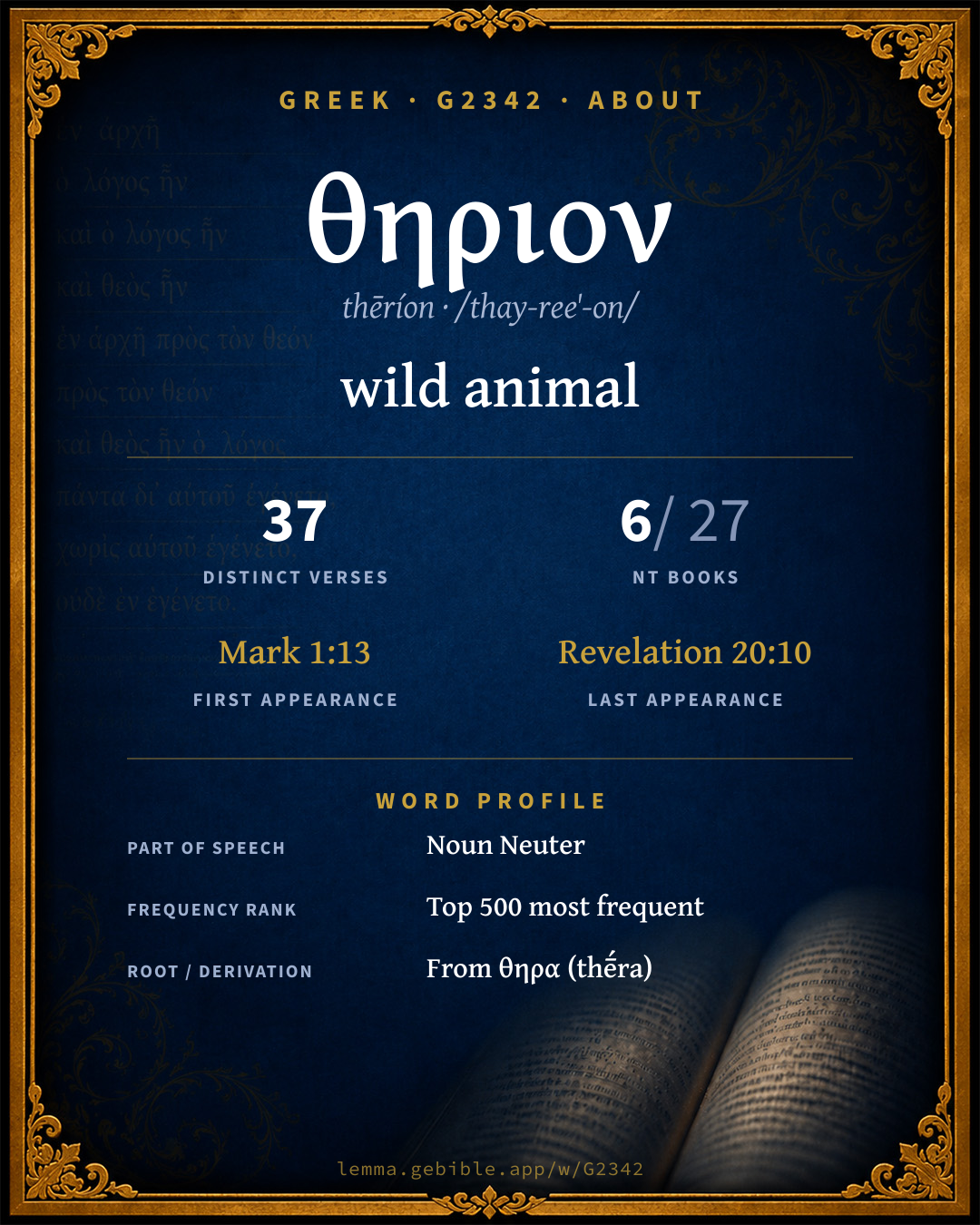
θηρίον
wild animal
‘wild animal’ is one of 3 main senses fuller range ↓
Full lexicon entry — Thayer's Greek Lexicon
From Thayer's Greek Lexicon
Where this word appears
See every Genitive-case word in the Greek New Testament →
Grammar key — what these labels mean
Part of speech
- Noun
- A naming word — a person, place, thing, or idea.
Case
- Genitive
- The case of source, possession, or “of” — answers “whose / from what.”
- Accusative
- The case of the direct object and of extent.
- Nominative
- The case of the subject (and the predicate nominative).
- Dative
- The case of the indirect object, means, or location — “to / for / with / in.”
Gender
- Neuter
- Grammatically neuter.
Number
- Singular
- One.
- Plural
- More than one.
Grammatical forms
- Noun, Genitive, Singular, Neuter 15 times (33%)
- Noun, Accusative, Singular, Neuter 10 times (22%)
- Noun, Nominative, Singular, Neuter 9 times (20%)
- Noun, Dative, Singular, Neuter 6 times (13%)
- Noun, Genitive, Plural, Neuter 3 times (7%)
- Noun, Accusative, Plural, Neuter 1 time (2%)
- Noun, Nominative, Plural, Neuter 1 time (2%)
Parsed forms decoded from the imported morphology (Robinson–Tischendorf, public domain), counted across 45 parsed occurrences — not distinct verses.
Every verse where G2342 appears — 37 distinct verses across 6 books. Click any verse to open its interlinear word-by-word view. Verse text shown in the World English Bible for context — . Each verse’s Greek form is shown with its reference; the English is not keyword-highlighted, since the data carries no word-level English alignment. Use “Compare translations” on any verse to read it across multiple English versions. This concordance covers the Greek New Testament; Septuagint (Greek Old Testament) occurrences of this word are not indexed here.
Mark 1 verse
Acts 3 verses
- Acts 11:6 θηρία n acc pl neut When I had looked intently at it, I considered, and saw the four-footed animals of the earth, wild animals, creeping things, and birds of the sky.
- Acts 28:4 θηρίον n acc sg neut When the natives saw the creature hanging from his hand, they said one to another, "No doubt this man is a murderer, whom, though he has escaped from the sea, yet Justice has not allowed to live."
- Acts 28:5 θηρίον n acc sg neut However he shook off the creature into the fire, and wasn't harmed.
Titus 1 verse
Hebrews 1 verse
James 1 verse
Revelation 30 verses
- Revelation 6:8 θηρίων n gen pl neut And behold, a pale horse, and he who sat on it, his name was Death. Hades followed with him. Authority over one fourth of the earth, to kill with the sword, with famine, with death, and by the wild animals of the earth was given to him.
- Revelation 11:7 θηρίον n nom sg neut When they have finished their testimony, the beast that comes up out of the abyss will make war with them, and overcome them, and kill them.
- Revelation 13:1 θηρίον n acc sg neut Then I stood on the sand of the sea. I saw a beast coming up out of the sea, having ten horns and seven heads. On his horns were ten crowns, and on his heads, blasphemous names.
- Revelation 13:2 θηρίον n nom sg neut The beast which I saw was like a leopard, and his feet were like those of a bear, and his mouth like the mouth of a lion. The dragon gave him his power, his throne, and great authority.
- Revelation 13:3 θηρίου n gen sg neut One of his heads looked like it had been wounded fatally. His fatal wound was healed, and the whole earth marveled at the beast.
- Revelation 13:4 θηρίῳ θηρίῳ θηρίῳ n dat sg neut n dat sg neut n dat sg neut They worshiped the dragon, because he gave his authority to the beast, and they worshiped the beast, saying, "Who is like the beast? Who is able to make war with him?"
- Revelation 13:11 θηρίον n acc sg neut I saw another beast coming up out of the earth. He had two horns like a lamb, and he spoke like a dragon.
- Revelation 13:12 θηρίου θηρίον n gen sg neut n acc sg neut He exercises all the authority of the first beast in his presence. He makes the earth and those who dwell in it to worship the first beast, whose fatal wound was healed.
- Revelation 13:14 θηρίου θηρίῳ n gen sg neut n dat sg neut He deceives my own people who dwell on the earth because of the signs he was granted to do in front of the beast; saying to those who dwell on the earth, that they should make an image to the beast who had the sword wound and lived.
- Revelation 13:15 θηρίου θηρίου θηρίου n gen sg neut n gen sg neut n gen sg neut It was given to him to give breath to it, to the image of the beast, that the image of the beast should both speak, and cause as many as wouldn't worship the image of the beast to be killed.
- Revelation 13:17 θηρίου n gen sg neut and that no one would be able to buy or to sell, unless he has that mark, the name of the beast or the number of his name.
- Revelation 13:18 θηρίου n gen sg neut Here is wisdom. He who has understanding, let him calculate the number of the beast, for it is the number of a man. His number is six hundred sixty-six.
- Revelation 14:9 θηρίον n acc sg neut Another angel, a third, followed them, saying with a great voice, "If anyone worships the beast and his image, and receives a mark on his forehead, or on his hand,
- Revelation 14:11 θηρίον n acc sg neut The smoke of their torment goes up forever and ever. They have no rest day and night, those who worship the beast and his image, and whoever receives the mark of his name.
- Revelation 15:2 θηρίου n gen sg neut I saw something like a sea of glass mixed with fire, and those who overcame the beast, his image, and the number of his name, standing on the sea of glass, having harps of God.
- Revelation 16:2 θηρίου n gen sg neut The first went, and poured out his bowl into the earth, and it became a harmful and evil sore on the people who had the mark of the beast, and who worshiped his image.
- Revelation 16:10 θηρίου n gen sg neut The fifth poured out his bowl on the throne of the beast, and his kingdom was darkened. They gnawed their tongues because of the pain,
- Revelation 16:13 θηρίου n gen sg neut I saw coming out of the mouth of the dragon, and out of the mouth of the beast, and out of the mouth of the false prophet, three unclean spirits, something like frogs;
- Revelation 17:3 θηρίον n acc sg neut He carried me away in the Spirit into a wilderness. I saw a woman sitting on a scarlet-colored animal, full of blasphemous names, having seven heads and ten horns.
- Revelation 17:7 θηρίου n gen sg neut The angel said to me, "Why do you wonder? I will tell you the mystery of the woman, and of the beast that carries her, which has the seven heads and the ten horns.
- Revelation 17:8 θηρίον θηρίον n nom sg neut n nom sg neut The beast that you saw was, and is not; and is about to come up out of the abyss and to go into destruction. Those who dwell on the earth and whose names have not been written in the book of life from the foundation of the world will marvel when they see that the beast was, and is not, and shall be present.
- Revelation 17:11 θηρίον n nom sg neut The beast that was, and is not, is himself also an eighth, and is of the seven; and he goes to destruction.
- Revelation 17:12 θηρίου n gen sg neut The ten horns that you saw are ten kings who have received no kingdom as yet, but they receive authority as kings, with the beast, for one hour.
- Revelation 17:13 θηρίῳ n dat sg neut These have one mind, and they give their power and authority to the beast.
- Revelation 17:16 θηρίον n nom sg neut The ten horns which you saw, and the beast, these will hate the prostitute, and will make her desolate, and will make her naked, and will eat her flesh, and will burn her utterly with fire.
- Revelation 17:17 θηρίῳ n dat sg neut For God has put in their hearts to do what he has in mind, and to be of one mind, and to give their kingdom to the beast, until the words of God should be accomplished.
- Revelation 19:19 θηρίον n acc sg neut I saw the beast, and the kings of the earth, and their armies, gathered together to make war against him who sat on the horse, and against his army.
- Revelation 19:20 θηρίον θηρίου n nom sg neut n gen sg neut The beast was taken, and with him the false prophet who worked the signs in his sight, with which he deceived those who had received the mark of the beast and those who worshiped his image. These two were thrown alive into the lake of fire that burns with sulfur.
- Revelation 20:4 θηρίον n acc sg neut I saw thrones, and they sat on them, and judgment was given to them. I saw the souls of those who had been beheaded for the testimony of Jesus, and for the word of God, and such as didn't worship the beast nor his image, and didn't receive the mark on their forehead and on their hand. They lived, and reigned with Christ for the thousand years.
- Revelation 20:10 θηρίον n nom sg neut The devil who deceived them was thrown into the lake of fire and sulfur, where the beast and the false prophet are also. They will be tormented day and night forever and ever.
About this entry
At a glance — auto-summarized from this page’s data, not written by a person. Every figure links to its source below. This summary describes the numbers; it doesn’t interpret them.
At its core, θηριον (thēríon) means “wild animal.” The word gravitates to Revelation (81%), then Acts and Mark. It turns up in 37 verses across 6 books, a moderately common footprint. Scripture first uses it in Mark 1:13. Catalogued under 3 senses, its meaning is not single-sense. Dig into 37-verse concordance and the renderings breakdown below.
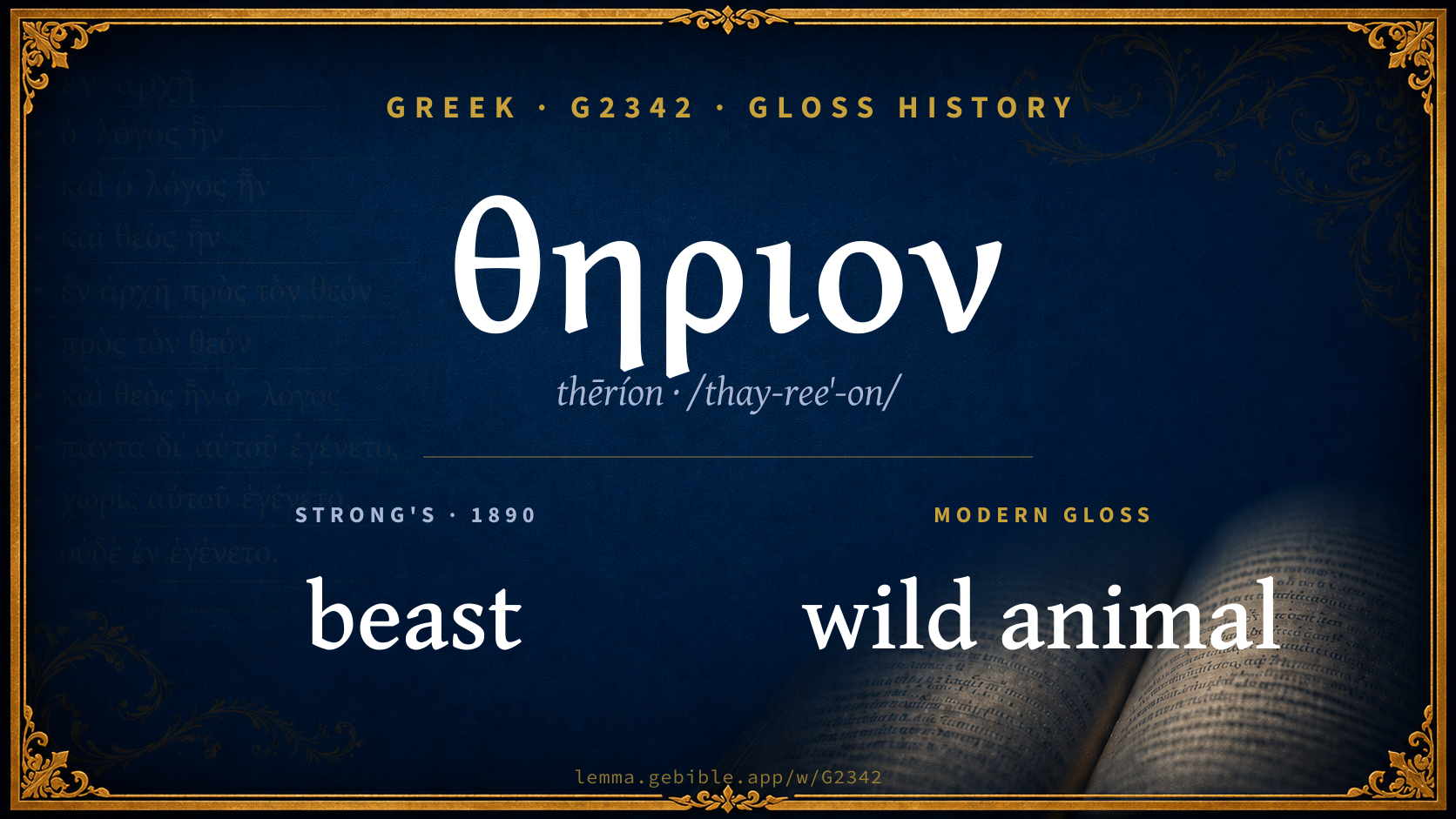
Gloss history
Strong's 1890 vs modern scholarship
About this word
Strong's G2342 catalogs a Greek word from the Greek New Testament.
These counts are not copied from any lexicon or concordance. They are computed here, from the morphology-tagged Greek New Testament. What Lemma adds →
- 37
- distinct verses
- The word appears in 37 distinct verses.
- 6 / 27
- NT books
- The word appears in 6 of 27 New Testament books.
- #337
- by frequency
- Top 500 most frequent Greek words (rank 337 of 5,347 Greek words by occurrence).
View all 37 occurrences in the concordance →
Most concentrated in
- Revelation 30 verses 81%
- Acts 3 verses 8%
- Mark 1 verse 3%
By section of the New Testament
By traditional corpus
Conventional, traditional groupings — biblical authorship is debated, so this is a traditional corpus grouping, not an authorship claim. Some books belong to more than one corpus (Luke is in both the Gospels and the Lukan corpus, and so on), so these shares overlap and need not total 100%. Each figure is a share of the word’s 37 distinct verses.
- Johannine 30 verses · 81%
- Revelation 30 verses · 81%
- Lukan (Luke–Acts) 3 verses · 8%
- Gospels 1 verse · 3%
- Pauline corpus 1 verse · 3%
- Hebrews 1 verse · 3%
- General (Catholic) Epistles 1 verse · 3%
How translations render this word
Counts come from each version’s own published word-to-Strong’s tagging or interlinear alignment — an approximate guide to how each version renders this word, not a word-level alignment the data otherwise carries. Because each total is that version’s own tagged count, the per-version totals vary from one another and need not match the appearance or distinct-verse counts above. These counts may also differ from a printed concordance because Lemma counts each distinctly tagged rendering and does not collapse phrase taggings into a single head-word total. This is a fixed set of word-tagged versions (KJV, ASV, BSB, ULT) and does not change with the reading translation you choose elsewhere. Each version’s license is shown beside its name below (and on Sources).
- King James Version: Beast 39×, Beasts 3×, Wild beasts 3×
- American Standard Version: Beast 36×, Wild beasts 3×
- Berean Standard Bible: Beast 36×, Beasts 2×, Creature 2×
- unfoldingWord Literal Text: Beast 37×, Beasts 2×, Creature 2×
King James Version Public Domain
Renders G2342 across 46 tagged occurrences — most commonly:
Plus 1 rendering that appears only once — usually multi-word phrases or single function words the recovered tagging swept in, not distinct renderings.
American Standard Version Public Domain
Renders G2342 across 45 tagged occurrences — most commonly:
Plus 6 renderings that appear only once — usually multi-word phrases or single function words the recovered tagging swept in, not distinct renderings.
Berean Standard Bible Public Domain
Renders G2342 across 44 tagged occurrences — most commonly:
Plus 4 renderings that appear only once — usually multi-word phrases or single function words the recovered tagging swept in, not distinct renderings. Not rendered by a distinct English word in 2 further occurrences.
unfoldingWord Literal Text CC BY-SA 4.0
Renders G2342 across 47 tagged occurrences — most commonly:
Plus 4 renderings that appear only once — usually multi-word phrases or single function words the recovered tagging swept in, not distinct renderings.
Senses in Thayer's
The 3 senses Thayer's distinguishes for this word, in lexicon order (not ranked by frequency or importance). The full entry — with sub-senses — is in the Lexicon Entry tab.
- an animal
- a wild animal, wild beast, beast
- metaph. a brutal, bestial man, savage, ferocious
Word origin
Derived from θηρα (thḗra) (G2339) — hunting.
Diminutive from the same as G2339 ; a dangerous animal : - (venomous wild) beast.
— Strong’s Exhaustive Concordance (1890), public domain.
Forms in the corpus
The 5 distinct written forms G2342 takes in the Greek New Testament, most frequent first — each parse links to that case’s occurrences in the concordance.
| Form | Parsing | Example | Uses |
|---|---|---|---|
| θηρίον thēríon | Noun, Accusative, Singular, Neuter | Acts 28:4 | 19 |
| θηρίου thēríou | Noun, Genitive, Singular, Neuter | Revelation 13:3 | 15 |
| θηρίῳ thēríō | Noun, Dative, Singular, Neuter | Revelation 13:4 | 6 |
| θηρίων thēríōn | Noun, Genitive, Plural, Neuter | Mark 1:13 | 3 |
| θηρία thēría | Noun, Accusative, Plural, Neuter | Acts 11:6 | 2 |
Same root — word family
Other Thayer's entries built from the same root as G2342, grouped by Strong’s listed origin. These share a root / origin per the lexicon — not necessarily a shared meaning. Each links to that word’s own entry.
Derives from
Shares the same root
Derived from this word
Compare all same-root words → They share a root, not necessarily a meaning.
Septuagint usage
The same Greek word θηριον appears 105 times in the Greek Old Testament (Septuagint), across 97 verses in 18 books.
- 105
- LXX occurrences
- Tagged occurrences of this Greek word in the Septuagint.
- 97
- verses
- Distinct Septuagint verses containing this word.
- 18 / 39
- OT books
- The word appears in 18 of the 39 Old Testament books.
Sample Septuagint occurrences
- Genesis 1:24 θηρίον
- Exodus 23:11 θηρίον
- Leviticus 11:27 θηρίον
- Deuteronomy 7:22 θηρίον
- Joshua 23:5 θηρίον
- 1 Samuel 17:26 θηρίον
- 2 Samuel 21:10 θηρίον
- 2 Kings 14:9 θηρίον
- 2 Chronicles 25:18 θηρίον
- Job 5:22 θηρίον
- Psalms 49:10 θηρίον
- Isaiah 5:29 θηρίον
Septuagint occurrences (same lexeme)
Every verse where the same Strong’s number (G2342) appears in the Greek Septuagint — showing the first 50 of 97. Verse text shown in the World English Bible for context; the Greek form is the matched word — the English is not keyword-highlighted.
- Genesis 1:24 θηρίον God said, "Let the earth bring forth living creatures after their kind, cattle, creeping things, and animals of the earth after their kind," and it was so.
- Genesis 1:25 θηρίον God made the animals of the earth after their kind, and the cattle after their kind, and everything that creeps on the ground after its kind. God saw that it was good.
- Genesis 1:30 θηρίον To every animal of the earth, and to every bird of the sky, and to everything that creeps on the earth, in which there is life, I have given every green herb for food." And it was so.
- Genesis 2:19 θηρίον Out of the ground Yahweh God formed every animal of the field, and every bird of the sky, and brought them to the man to see what he would call them. Whatever the man called every living creature, that was its name.
- Genesis 2:20 θηρίον The man gave names to all cattle, and to the birds of the sky, and to every animal of the field; but for man there was not found a helper suitable for him.
- Genesis 3:1 θηρίον Now the serpent was more subtle than any animal of the field which Yahweh God had made. He said to the woman, "Yes, has God said, 'You shall not eat of any tree of the garden?'"
- Genesis 3:14 θηρίον Yahweh God said to the serpent, "Because you have done this, cursed are you above all cattle, and above every animal of the field. On your belly shall you go, and you shall eat dust all the days of your life.
- Genesis 6:19 θηρίον Of every living thing of all flesh, you shall bring two of every sort into the ark, to keep them alive with you. They shall be male and female.
- Genesis 7:14 θηρίον they, and every animal after its kind, all the cattle after their kind, every creeping thing that creeps on the earth after its kind, and every bird after its kind, every bird of every sort.
- Genesis 7:21 θηρίον All flesh died that moved on the earth, including birds, cattle, animals, every creeping thing that creeps on the earth, and every man.
- Genesis 8:1 θηρίον God remembered Noah, all the animals, and all the cattle that were with him in the ark; and God made a wind to pass over the earth. The waters subsided.
- Genesis 8:17 θηρίον Bring forth with you every living thing that is with you of all flesh, including birds, cattle, and every creeping thing that creeps on the earth; that they may breed abundantly in the earth, and be fruitful, and multiply on the earth."
- Genesis 8:19 θηρίον Every animal, every creeping thing, and every bird, whatever moves on the earth, after their families, went forth out of the ark.
- Genesis 9:2 θηρίον The fear of you and the dread of you will be on every animal of the earth, and on every bird of the sky. Everything that the ground teems with, and all the fish of the sea are delivered into your hand.
- Genesis 9:5 θηρίον I will surely require your blood of your lives. At the hand of every animal I will require it. At the hand of man, even at the hand of every man's brother, I will require the life of man.
- Genesis 9:10 θηρίον and with every living creature that is with you: the birds, the cattle, and every animal of the earth with you. Of all that go out of the ark, even every animal of the earth.
- Genesis 37:20 θηρίον Come now therefore, and let's kill him, and cast him into one of the pits, and we will say, 'An evil animal has devoured him.' We will see what will become of his dreams."
- Genesis 37:33 θηρίον He recognized it, and said, "It is my son's coat. An evil animal has devoured him. Joseph is without doubt torn in pieces."
- Exodus 23:11 θηρίον but the seventh year you shall let it rest and lie fallow, that the poor of your people may eat; and what they leave the animal of the field shall eat. In like manner you shall deal with your vineyard and with your olive grove.
- Exodus 23:29 θηρίον I will not drive them out from before you in one year, lest the land become desolate, and the animals of the field multiply against you.
- Leviticus 11:27 θηρίον Whatever goes on its paws, among all animals that go on all fours, they are unclean to you. Whoever touches their carcass shall be unclean until the evening.
- Leviticus 17:13 θηρίον "'Whatever man there is of the children of Israel, or of the strangers who live as foreigners among them, who takes in hunting any animal or bird that may be eaten; he shall pour out its blood, and cover it with dust.
- Leviticus 25:7 θηρίον For your cattle also, and for the animals that are in your land, shall all the increase of it be for food.
- Leviticus 26:6 θηρίον "'I will give peace in the land, and you shall lie down, and no one will make you afraid; and I will remove evil animals out of the land, neither shall the sword go through your land.
- Leviticus 26:22 θηρίον I will send the wild animals among you, which will rob you of your children, destroy your cattle, and make you few in number; and your roads will become desolate.
- Deuteronomy 7:22 θηρίον Yahweh your God will cast out those nations before you by little and little: you may not consume them at once, lest the animals of the field increase on you.
- Deuteronomy 28:26 θηρίον Your dead body shall be food to all birds of the sky, and to the animals of the earth; and there shall be none to frighten them away.
- Deuteronomy 32:24 θηρίον [They shall be] wasted with hunger, and devoured with burning heat Bitter destruction; The teeth of animals will I send on them, With the poison of crawling things of the dust.
- Joshua 23:5 θηρίον Yahweh your God, he will thrust them out from before you, and drive them from out of your sight; and you shall possess their land, as Yahweh your God spoke to you.
- 1 Samuel 17:26 θηρίον David spoke to the men who stood by him, saying, What shall be done to the man who kills this Philistine, and takes away the reproach from Israel? for who is this uncircumcised Philistine, that he should defy the armies of the living God?
- 2 Samuel 21:10 θηρίον Rizpah the daughter of Aiah took sackcloth, and spread it for her on the rock, from the beginning of harvest until water was poured on them from the sky; and she allowed neither the birds of the sky to rest on them by day, nor the animals of the field by night.
- 2 Kings 14:9 θηρίον Jehoash the king of Israel sent to Amaziah king of Judah, saying, The thistle that was in Lebanon sent to the cedar that was in Lebanon, saying, Give your daughter to my son as wife: and there passed by a wild animal that was in Lebanon, and trod down the thistle.
- 2 Chronicles 25:18 θηρίον Joash king of Israel sent to Amaziah king of Judah, saying, The thistle that was in Lebanon sent to the cedar that was in Lebanon, saying, Give your daughter to my son as wife: and there passed by a wild animal that was in Lebanon, and trod down the thistle.
- Job 5:22 θηρίον At destruction and famine you shall laugh, Neither shall you be afraid of the animals of the earth.
- Job 37:8 θηρίον Then the animals take cover, And remain in their dens.
- Job 39:15 θηρίον And forgets that the foot may crush them, Or that the wild animal may trample them.
- Job 40:15 θηρίον "See now, behemoth, which I made as well as you. He eats grass as an ox.
- Job 41:17 θηρίον They are joined one to another; They stick together, so that they can't be pulled apart.
- Psalms 49:10 θηρίον For he sees that wise men die; Likewise the fool and the senseless perish, And leave their wealth to others.
- Psalms 67:31 θηρίον
- Psalms 73:19 θηρίον How they are suddenly destroyed! They are completely swept away with terrors.
- Psalms 78:2 θηρίον I will open my mouth in a parable. I will utter dark sayings of old,
- Psalms 103:11 θηρίον For as the heavens are high above the earth, So great is his loving kindness toward those who fear him.
- Psalms 103:20 θηρίον Praise Yahweh, you angels of his, Who are mighty in strength, who fulfill his word, Obeying the voice of his word.
- Psalms 148:10 θηρίον Wild animals and all cattle; Small creatures and flying birds;
- Isaiah 5:29 θηρίον Their roaring will be like a lioness. They will roar like young lions. Yes, they shall roar, And seize their prey and carry it off, And there will be no one to deliver.
- Isaiah 13:21 θηρίον But wild animals of the desert shall lie there; and their houses shall be full of doleful creatures; and ostriches shall dwell there, and wild goats shall dance there.
- Isaiah 18:6 θηρίον They shall be left together to the ravenous birds of the mountains, and to the animals of the earth; and the ravenous birds shall summer on them, and all the animals of the earth shall winter on them.
- Isaiah 35:9 θηρίον No lion shall be there, nor shall any ravenous animal go up thereon; they shall not be found there; but the redeemed shall walk [there]:
- Isaiah 43:20 θηρίον The animals of the field shall honor me, the jackals and the ostriches; because I give waters in the wilderness, and rivers in the desert, to give drink to my people, my chosen,
These are occurrences of the same Greek lexeme (G2342) in the Septuagint — not a translation of any one Hebrew word. The store carries no word-level Hebrew↔Greek alignment, so no Hebrew original is asserted here. Counts come from the recovered LXX Strong's tagging — high-frequency vocabulary is well covered, while rare or late forms may be untagged — so they reflect tagged occurrences and may slightly undercount.