
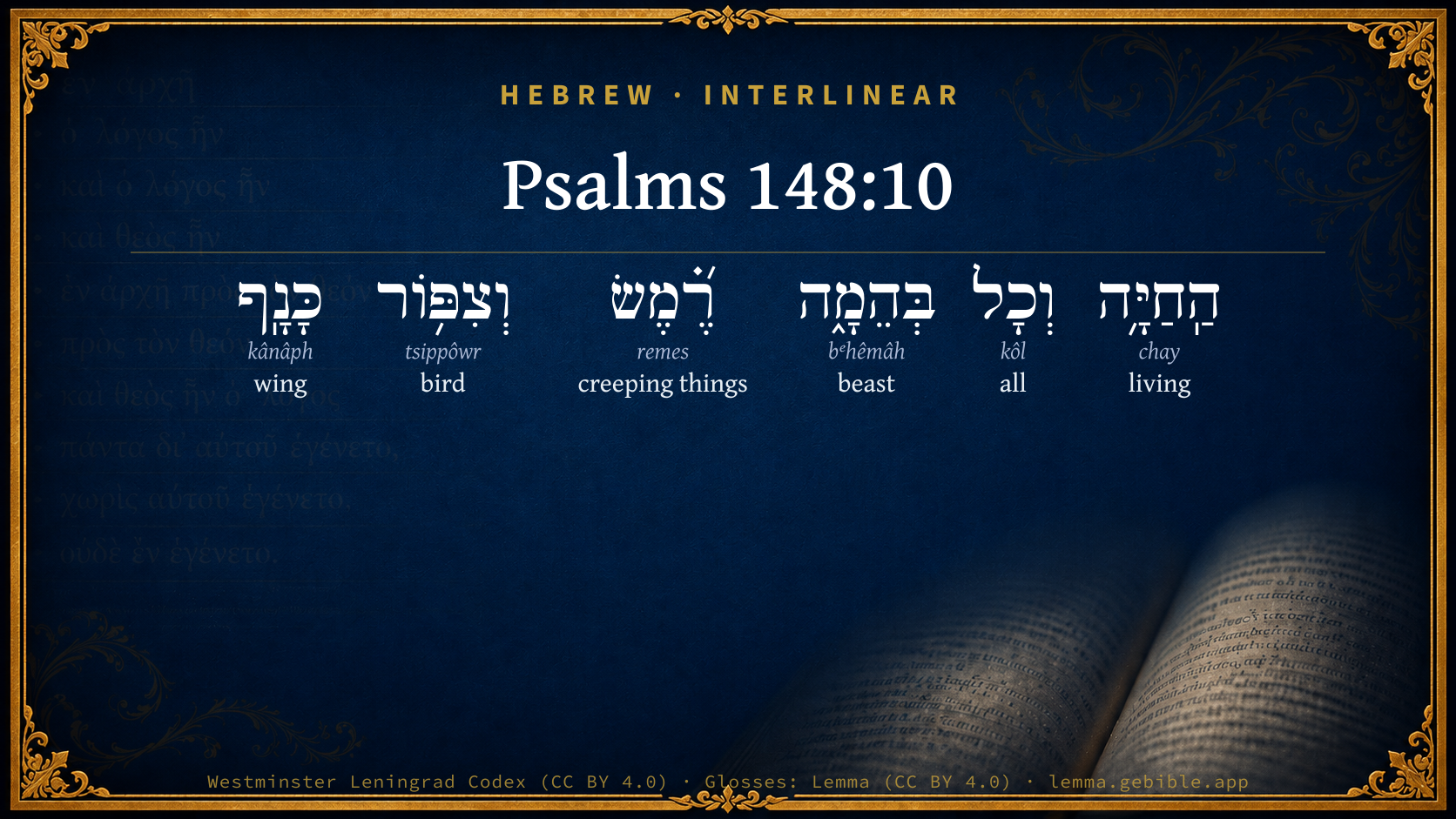
Psalms 148:10

Hebrew (Westminster Leningrad Codex) Psalms 148:10 appears in the Hebrew Old Testament. The text above is from the Westminster Leningrad Codex. Each word links to its Strong’s number, a concise gloss, and parsing drawn from the Open Scriptures Hebrew Bible morphology. Click any word for its full Brown-Driver-Briggs (BDB) entry.
Download image
Cite this verse

Psalms 148:10 (World English Bible). Public Domain. Lemma interlinear Bible study tool, https://lemma.gebible.app/v/psalms/148/10.

Show BibTeX & RIS
BibTeX
RIS
English Translation
Wild animals and all cattle; Small creatures and flying birds;
World English Bible · Public Domain
Download a study sheet

One document with this verse’s original text, its word-by-word gloss line, the meaning frame, cross-references with their text, attributed commentary, and full source and license credits — printable, and it pastes into notes with its structure intact.

This verse Autodidact and up

Study sheet (.html) Plain text (.txt)

A passage Seminary Student

Up to 50 verses in one chapter. A passage sheet keeps up to 6 commentary sources and 12 cross-references per verse, in the order this page ranks them, and says so on the sheet whenever that leaves anything out. Ask for a single verse and you get the Autodidact verse sheet above.

Everything on this page stays free to read, with no account — the sheet is a download of what is already on screen, not access to it.

Want to remove ads? Support Godless Engineer
Compare translations 3

The same verse in 3 English versions, stacked beneath the original-language interlinear above. Click any original word for its lexicon entry.

Each is an independent rendering of the whole verse — the interlinear is not word-aligned to these translations.

Highlighted words mark where these versions differ — a whole-verse word diff, not a word-by-word alignment.

  • World English Bible Public Domain
    Wild animals and all cattle; Small creatures and flying birds;
  • King James Version Public Domain
    Beasts, and all cattle; creeping things, and flying fowl:
  • unfoldingWord Literal Text CC BY-SA 4.0
    the living and every beast, the creeper and the bird of wing,

unfoldingWord Literal Text — © unfoldingWord, licensed CC BY-SA 4.0. Word-aligned USFM3 via Door43 (git.door43.org/unfoldingWord/en_ult).

Versions to compare (up to 4)

3 of 4 selected

Show all 18 translations

Every available English version of this verse, each an independent rendering of the whole verse.

  • World English Bible Public Domain
    Wild animals and all cattle; Small creatures and flying birds;
  • Berean Standard Bible Public Domain
    wild animals and all cattle, crawling creatures and flying birds,
  • Majority Standard Bible Public Domain
    wild animals and all cattle, crawling creatures and flying birds,
  • King James Version Public Domain
    Beasts, and all cattle; creeping things, and flying fowl:
  • American Standard Version (1901) Public Domain
    Beasts and all cattle; Creeping things and flying birds;
  • Revised Version (1885) Public Domain
    Beasts and all cattle; creeping things and flying fowl:
  • Geneva Bible (1599) Public Domain
    Beasts and all cattell, creeping things and fethered foules:
  • Douay-Rheims (1899) Public Domain
    He shall not delight in the strength of the horse: nor take pleasure in the legs of a man.
  • Young's Literal Translation Public Domain
    The wild beast, and all cattle, Creeping thing, and winged bird,
  • Literal Standard Version CC BY-SA 4.0
    The wild beast, and all livestock, || Creeping thing, and winged bird,
  • Unlocked Literal Bible CC BY-SA 4.0
    animals wild and tame, creatures that crawl and birds.
  • unfoldingWord Literal Text CC BY-SA 4.0
    the living and every beast, the creeper and the bird of wing,
  • Darby Bible Public Domain
    Beasts and all cattle, creeping things and winged fowl;
  • World Messianic Bible Public Domain
    wild animals and all livestock, small creatures and flying birds,
  • Webster's Bible Public Domain
    Beasts, and all cattle; creeping animals, and flying fowl:
  • Free Bible Version CC BY-SA 4.0
    wild animals and all livestock, crawling animals and wild birds,
  • Bible in Basic English Public Domain
    Beasts and all cattle; insects and winged birds:
  • JPS Tanakh (1917) Public Domain
    Beasts and all cattle, creeping things and winged fowl;

Literal Standard Version (2020), Covenant Press — licensed CC BY-SA 4.0. Text via the HelloAO Bible API (eBible.org). Unlocked Literal Bible (unfoldingWord) — licensed CC BY-SA 4.0. Text via the HelloAO Bible API (eBible.org). unfoldingWord Literal Text — © unfoldingWord, licensed CC BY-SA 4.0. Word-aligned USFM3 via Door43 (git.door43.org/unfoldingWord/en_ult). Free Bible Version, Dr. Jonathan Gallagher — licensed CC BY-SA 4.0. Text via the HelloAO Bible API (eBible.org).

Word by word

More ways to search: Search by grammar → Find every occurrence → Compare this word →

Practice this passage: Drill this verse → Learn its vocabulary →

About this verse

These counts appear in no published source. They are computed here, from the morphology-tagged text and Lemma’s own curated glosses. What Lemma adds →

6
words
6
distinct lemmas
Wisdom
section

Notable vocabulary

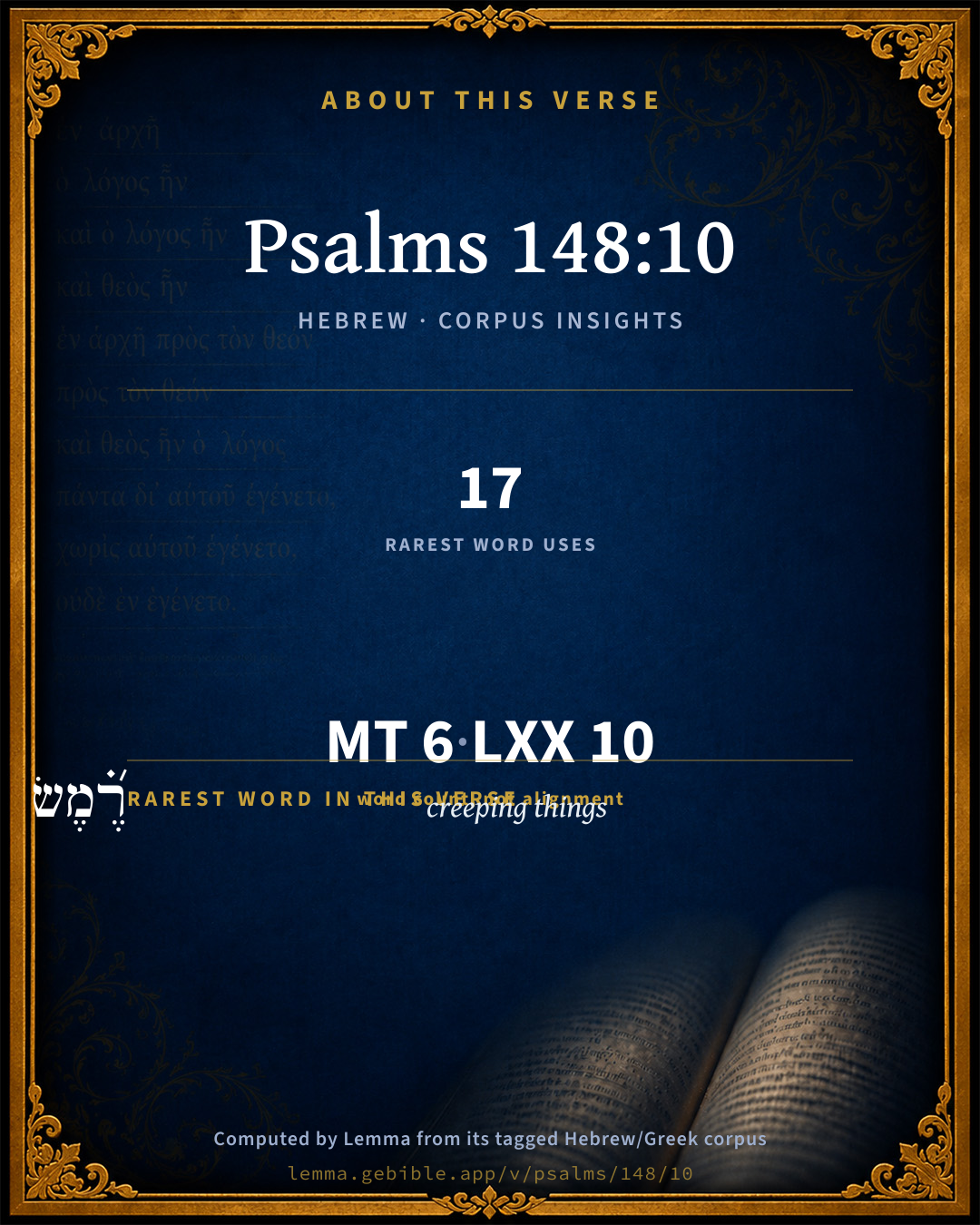
The rarest word here is רֶ֝֗מֶשׂ creeping things H7431 — appearing just 17 times in the whole Hebrew Bible.

Shared distinctive vocabulary

רֶ֝֗מֶשׂ creeping things H7431 occurs in 17 verses of the Hebrew Bible. Also found in:

Grammatical profile

  • 6 nouns

Hebrew & Septuagint length

In English translation the verse runs 10 words from the Hebrew and 9 from the Septuagint (LXX English) — closely comparable.

A rough comparison of the two English renderings, which tokenize alike — not a word-level alignment.

Word counts can differ between the Hebrew and the Greek without any difference in meaning — e.g. the Hebrew direct-object marker אֵת has no separate Greek word, and Greek often adds the article ὁ.

In the original languages it is 6 Hebrew tokens and 10 Greek tokens — but the two are counted differently (Hebrew bundles its prefixes and suffixes into one token; the Greek is in lemma form), so that isn’t a like-for-like length.

Cross-references

6

Topical passages linked to Psalms 148:10 in the Treasury of Scripture Knowledge — connected by theme and wording, ordered by reader-vote popularity; previews shown in the World English Bible.

  • Genesis 1:20–25 God said, "Let the waters swarm with swarms of living creatures, and let birds fly above the earth in the open expanse of sky."
  • Psalms 103:22 Praise Yahweh, all you works of his, In all places of his dominion. Praise Yahweh, my soul.
  • Psalms 150:6 Let everything that has breath praise Yah! Praise Yah!
  • Genesis 7:14 they, and every animal after its kind, all the cattle after their kind, every creeping thing that creeps on the earth after its kind, and every bird after its kind, every bird of every sort.
  • Ezekiel 17:23 in the mountain of the height of Israel will I plant it; and it shall bring forth boughs, and bear fruit, and be a goodly cedar: and under it shall dwell all birds of every wing; in the shade of the branches of it shall they dwell.
  • Psalms 50:10–11 For every animal of the forest is mine, And the cattle on a thousand hills.

Cross-references courtesy of OpenBible.info (CC BY 4.0).

Hebrew and Greek witnesses Masoretic Hebrew ↔ Greek Septuagint

The same verse in the two great witnesses to the Old Testament, shown verse-for-verse.

You’re reading Greek Psalm 148 (Hebrew Psalm 148). The Septuagint counts the superscription, so verse numbers can differ from the Hebrew — chapter-level alignment, not verse-by-verse. Numbering follows Rahlfs.

These are two independent witnesses, not word-aligned to each other, and the Septuagint is shown in lemma (dictionary) form.

Hebrew Psalms 148:10 Masoretic · Westminster Leningrad Codex

הַֽחַיָּ֥ה וְכָל בְּהֵמָ֑ה רֶ֝֗מֶשׂ וְצִפּ֥וֹר כָּנָֽף

Wild animals and all cattle; Small creatures and flying birds;

World English Bible · Public Domain

Greek LXX Greek Psalm 148:10 Septuagint · lemma form

ὁ θηρίον καί πᾶς ὁ κτῆνος ἑρπετόν καί πετεινόν πτερωτός

wild beasts, and all cattle; reptiles, and winged birds:

LXX2012 (modern English Septuagint) · Public Domain

Hebrew: Westminster Leningrad Codex (CC BY 4.0). Greek: Septuagint (public domain); English from LXX2012 (modern English Septuagint) (Public Domain). How the Septuagint differs from the Hebrew →

Commentary

Notes on Psalms 148:10 from classic Christian and Jewish commentators (each source and its license shown beneath its notes). The classic Christian expositions comment on the surrounding passage and are grouped to its opening verse, so a note may address several verses; the Jewish commentaries on the Tanakh (Rashi and others) are per-verse, so they appear only where the commentator wrote on this verse.

Lemma curates 59 commentaries, every one of them public domain or Creative Commons licensed, each selected and text-cleaned for this edition rather than reprinted as found. About our sources →

Trapp's Complete Commentary

John Trapp

Psa 148:10 Beasts, and all cattle; creeping things, and flying fowl:

Ver. 10. Beasts] i.e. Wild beasts, that are fullest of life; and therehence have their name in the Hebrew tongue.

And all cattle] Domestic and tame beasts, even to the elephant; which is said to turn up the first sprig towards heaven, in token of thankfulness, by a natural instinct, when he comes to feed.

Creeping things] Whether in earth or sea; all these are summoned in by the psalmist to pay their tribute of praise, and to do their homage to the Most High.

John Trapp, A Commentary or Exposition upon All the Books of the Old and New Testament (1647–1656) — public domain. Text from a community e-Sword module.

J. A. Alexander on Psalms

Joseph Addison Alexander

10. (Psa 148:10) The wild (beast) and all cattle, creeping thing and flying fowl. The contrast in the first clause is analogous to that between fruit-trees and cedars in Psa 148:9. The Hebrew wordtranslated creeping thing has no exact equivalent in English. It seems strictly to denote animal or vital motion, or as a concrete term whatever so moves, and is even applied to aquatic animals, Psa 104:25. But when used distinctively, it denotes the smaller classes of terrestrial animals, including insects, reptiles, and the smallest quadrupeds. It is here added simply to complete the expression of the general idea, all animals whatever. Flying fowl, literally bird of wing. The first of the Hebrew words is specially applied to the smaller birds, and sometimes specifically to the sparrow. See above, on Psa 11:1; Psa 84:3; Psa 104:17; Psa 124:7. This and the preceding item in the catalogue, suggesting the idea of the smallest animals, may possibly have been used to denote the universality of the call here made upon all creatures, from the greatest to the smallest, to praise God their maker.

Joseph Addison Alexander, The Psalms Translated and Explained (1850) — public domain. Text from a community e-Sword module.

Adam Clarke's Commentary

Verse 10. Beasts] החיה hachaiyah, wild beasts of every kind.

All cattle] בהמה behemah, all domestic animals; those used for the service of the house, and those for agricultural purposes.

Creeping things] All the class of reptiles, from the boa constrictor, that can combat, kill, and swallow whole the royal tiger, to the cobra de manille, a poisonous reptile as small as a fine needle; with those still smaller animals that are found in water, and require the power of the microscope to bring them to view. In the production, preservation, habits, and properties of all these, there is a profusion of wisdom and economy that would require ages to exhibit.

Flying fowl] The structure of fowls is astonishing; and the exact mathematical manner in which flying fowls swim the air, and steer their course wheresoever they will; the feathers, and their construction, with the muscles which give them motion; strike the observer of nature with astonishment and delight.

Adam Clarke's Commentary on the Bible (1810–1826) — public domain. Text from a community e-Sword/MySword module.

Ellicott's Commentary for English Readers

(10) So here we have wild animals and domesticated animals. (See Note, Psa_50:10.)

Creeping things.—This seems to include all the smaller creatures that move on the ground, in contrast with the birds that fly above it.

A Bible Commentary for English Readers, edited by Charles John Ellicott (1878–1897) — public domain. Text from a community e-Sword module.

The Cambridge Bible for Schools and Colleges

gen. ed. J. J. S. Perowne

10. All kinds of living creatures: animals, wild and tame; reptiles and birds. Cp. Gen_1:24-25; Gen_1:21.

The Cambridge Bible for Schools and Colleges (gen. ed. J. J. S. Perowne; Cambridge University Press, 1878–1918) — public domain. Text from a community e-Sword module.

John Gill's Exposition

Beasts, and all cattle,.... Wild and tame; the beasts of the field, and the cattle on a thousand hills, which are all the Lord's, made, supported, and supplied by him; he gives them their food and drink, which they wait for and receive from him, and in their manner praise him for the same; and these are useful to men for labour or for food, and therefore should praise the Lord for them; see Isa 43:20;

creeping things, and flying fowl: of "creeping things" some belong to the sea and others to the land; see Psa 104:25; and there is not the least creature on the sea or land, the meanest reptile or worthless worm, but is of such exquisite workmanship as gives praise and glory to the Creator; and so do every fly and every insect, as well as "flying fowl" of the greatest size, as the eagle, vulture, &c. these, though they fly in the air, had their original from the waters, Gen 1:20.

John Gill's Exposition of the Whole Bible (1746–1763) — public domain (CC PDM 1.0). Text via the HelloAO Bible API.

Albert Barnes' Notes on the Bible

Beasts, and all cattle - Wild beasts and tame; those which roam the forest, and those which have been domesticated for the service of man. As fruitful trees and cedars might include all the trees, so the “beasts and cattle” here might include the whole of those that were wild and tamed.

Creeping things, and flying fowl - Margin, as in Hebrew, Birds of wing. These are grouped together for a reason similar to that for which fruitful trees and cedars, and beasts and cattle, are grouped together, to embrace the whole. The expression embraces the loftiest and lowest; those which ascend farthest above the earth, and those which creep upon its surface. The word rendered creeping things would properly embrace the smaller animals which creep along upon the ground; both those which have four feet or more, as mice, lizards, crabs, etc., and those without feet, which glide or drag themselves upon the ground, as worms and serpents. (Gesenius, Lexicon) These, in their lowly condition, and in their humble way, are called on to unite in the general chorus of praise. Accomplishing the purpose for which they are made, they will, with the most lofty of created beings, contribute to proclaim the wisdom, the power, and the goodness of God.

Albert Barnes' Notes on the Bible (1834–1885) — public domain. Text from a community e-Sword/MySword module.

The Treasury of David

Charles H. Spurgeon

Ver. 10. Beasts, and all cattle. Animals fierce or tame; wild beasts and domestic cattle; let all these show forth the praises of Jehovah. Those are worse than beasts who do not praise our God. More than brutish are those who are wilfully dumb concerning their Maker.

Creeping things, and flying fowl. The multitudes that throng the earth and the air; insects of every form and birds of every wing are called upon to join the universal worship. No one can become familiar with insect and bird life without feeling that they constitute a wonderful chapter in the history of divine wisdom. The minute insect marvellously proclaims the Lord's handiwork: when placed under the microscope it tells a wondrous tale. So, too, the bird which soars aloft displays in its adaptation for an aerial life an amount of skill which our balloonists have in vain attempted to emulate. True devotion not only hears the praises of God in the sweet song of feathered minstrels, but even discovers it in the croaking from the marsh, or in the buzz of "the blue fly which singeth in the window pane." More base than reptiles, more insignificant than insects, are songless men.

Ver. 10. Creeping things. In public worship all should join. The little strings go to make up a concert, as well as the great. Thomas Goodwin.

Ver. 10. Flying fowl. Thus the air is vocal. It has a hallelujah of its own. The "flying fowl" praise him; whether it be "the stork that knoweth her appointed time" (Jer 8:7), or "the sparrow alone upon the housetop" (Ps 102:7), or "the raven of the valley" (Pr 30:17), or the eagle "stirring up her nest, and fluttering over her young" (De 32:11), or the turtle making its voice to be heard in the land (So 2:12), or the dove winging its way to the wilderness (Ps 105:6). This is creation's harp (truer and sweeter than Memnon's) which each sunrise awakens, "turning all the air to music." Horatius Bonar, in "Earth's Morning; or, Thoughts on Genesis", 1875.

Ver. 10. The wildest, the quietest, the most depressed, and the most aspiring should each have its song.

Psalms 148:11*

Charles H. Spurgeon's The Treasury of David (1869–1885) — public domain. Psalms only. Text from a community e-Sword/MySword module.

The Pulpit Commentary

Beasts, and all cattle. There is a gradual ascent from inanimate to animate things, from the "beasts" of the field to domesticated animals; from such animals to man (vers. 11, 12). Creeping things. (comp. Gen_1:24, Gen_1:25, 30 Psa_104:25) And flying fowl; literally, bird of wing. The intention is to include, under a few heads, all animate creation.

The Pulpit Commentary (1880–1919), ed. H.D.M. Spence-Jones & Joseph S. Exell — public domain. Text from a community e-Sword module.

Lesson kit

Teaching starters — assembled from the data on this page, not authored interpretation. Every prompt links to the verse data it draws on. Edit before teaching.

Psalms, in the Wisdom, opens this verse with 6 words (6 distinct Hebrew lemmas). Its most distinctive word is remes (“creeping things”). A historical commentator’s framing appears above. Read the whole chapter for the surrounding context.

Discussion questions

  1. What does “creeping things” (remes) contribute to the verse as a whole?
  2. Genesis 1:24 shares the word «creeping things» with this verse. How do the two illuminate each other?
  3. The translations on this page render this verse differently — a whole-verse word diff, not a word-by-word alignment. What might account for the different wordings?
  4. Reading how Trapp's Complete Commentary and J. A. Alexander on Psalms read this verse, where do the two commentators agree and where do they part?

Things to notice

Reading settings

Reading text

Shown beneath each verse's original-language words.

Old Testament
Old Testament edition

Read the OT as the Masoretic Hebrew (MT) or the Greek Septuagint (LXX).

English shown for the Greek Septuagint (in the Hebrew ↔ Greek comparison).

Comparing translations? Open the Compare panel on any verse page to stack up to four side by side.