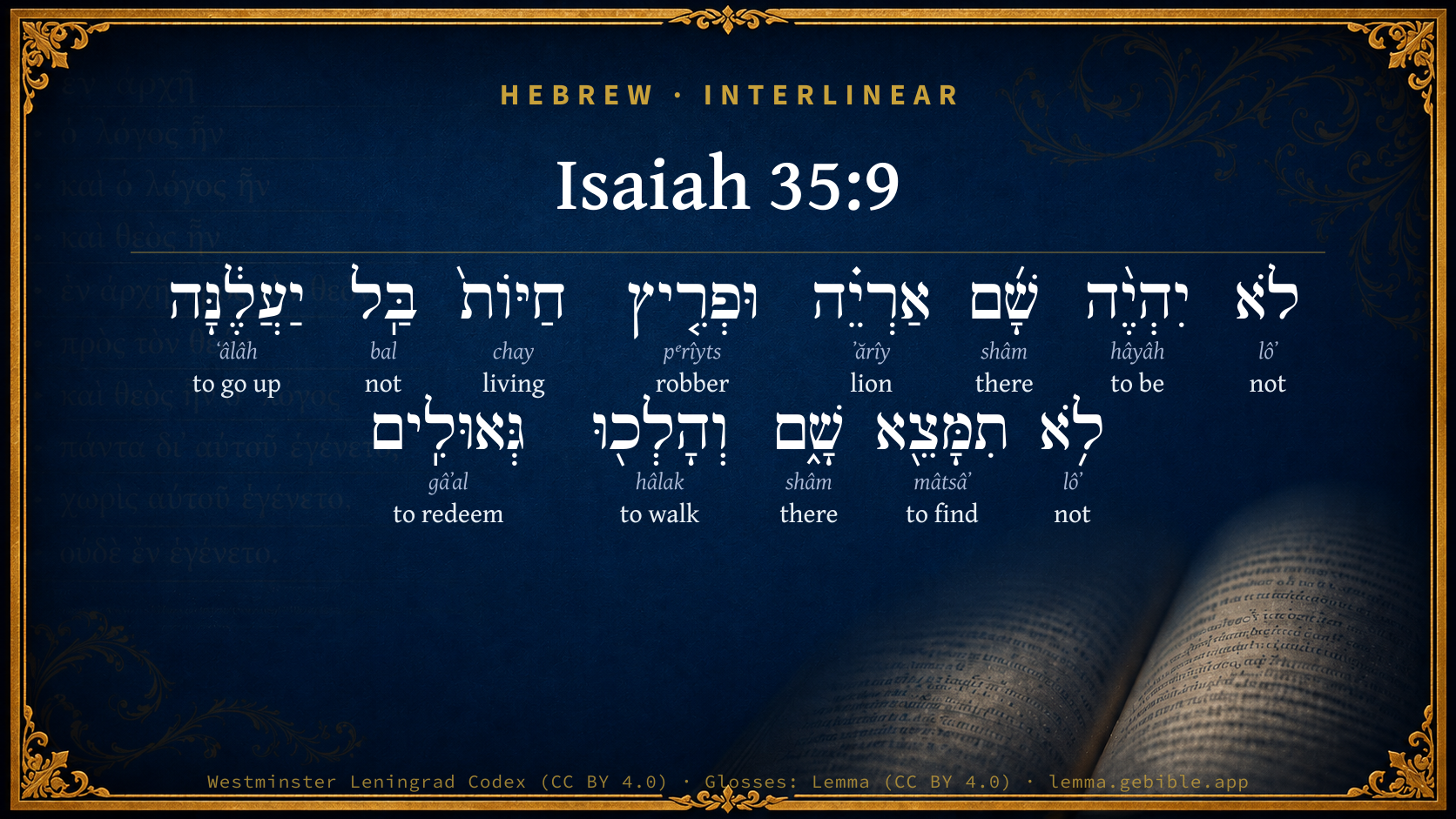
Isaiah 35:9

Hebrew (Westminster Leningrad Codex) Isaiah 35:9 appears in the Hebrew Old Testament. The text above is from the Westminster Leningrad Codex. Each word links to its Strong’s number, a concise gloss, and parsing drawn from the Open Scriptures Hebrew Bible morphology. Click any word for its full Brown-Driver-Briggs (BDB) entry.
Download image
Cite this verse

Isaiah 35:9 (World English Bible). Public Domain. Lemma interlinear Bible study tool, https://lemma.gebible.app/v/isaiah/35/9.

Show BibTeX & RIS
BibTeX
RIS
English Translation
No lion shall be there, nor shall any ravenous animal go up thereon; they shall not be found there; but the redeemed shall walk [there]:
World English Bible · Public Domain
Download a study sheet

One document with this verse’s original text, its word-by-word gloss line, the meaning frame, cross-references with their text, attributed commentary, and full source and license credits — printable, and it pastes into notes with its structure intact.

This verse Autodidact and up

Study sheet (.html) Plain text (.txt)

A passage Seminary Student

Up to 50 verses in one chapter. A passage sheet keeps up to 6 commentary sources and 12 cross-references per verse, in the order this page ranks them, and says so on the sheet whenever that leaves anything out. Ask for a single verse and you get the Autodidact verse sheet above.

Everything on this page stays free to read, with no account — the sheet is a download of what is already on screen, not access to it.

Want to remove ads? Support Godless Engineer
Compare translations 3

The same verse in 3 English versions, stacked beneath the original-language interlinear above. Click any original word for its lexicon entry.

Each is an independent rendering of the whole verse — the interlinear is not word-aligned to these translations.

Highlighted words mark where these versions differ — a whole-verse word diff, not a word-by-word alignment.

  • World English Bible Public Domain
    No lion shall be there, nor shall any ravenous animal go up thereon; they shall not be found there; but the redeemed shall walk [there]:
  • King James Version Public Domain
    No lion shall be there, nor any ravenous beast shall go up thereon, it shall not be found there; but the redeemed shall walk there:
  • unfoldingWord Literal Text CC BY-SA 4.0
    No lion will be there, and the violent of the beasts will not go up on it; it will not be found there. But the redeemed will walk,

unfoldingWord Literal Text — © unfoldingWord, licensed CC BY-SA 4.0. Word-aligned USFM3 via Door43 (git.door43.org/unfoldingWord/en_ult).

Versions to compare (up to 4)

3 of 4 selected

Show all 18 translations

Every available English version of this verse, each an independent rendering of the whole verse.

  • World English Bible Public Domain
    No lion shall be there, nor shall any ravenous animal go up thereon; they shall not be found there; but the redeemed shall walk [there]:
  • Berean Standard Bible Public Domain
    No lion will be there, and no vicious beast will go up on it. Such will not be found there, but the redeemed will walk upon it.
  • Majority Standard Bible Public Domain
    No lion will be there, and no vicious beast will go up on it. Such will not be found there, but the redeemed will walk upon it.
  • King James Version Public Domain
    No lion shall be there, nor any ravenous beast shall go up thereon, it shall not be found there; but the redeemed shall walk there:
  • American Standard Version (1901) Public Domain
    No lion shall be there, nor shall any ravenous beast go up thereon; they shall not be found there; but the redeemed shall walk `there':
  • Revised Version (1885) Public Domain
    No lion shall be there, nor shall any ravenous beast go up thereon, they shall not be found there; but the redeemed shall walk there:
  • Geneva Bible (1599) Public Domain
    There shall be no lyon, nor noysome beastes shall ascend by it, neither shall they be found there, that the redeemed may walke.
  • Douay-Rheims (1899) Public Domain
    No lion shall be there, nor shall any mischievous beast go up by it, nor be found there: but they shall walk there that shall be delivered.
  • Young's Literal Translation Public Domain
    No lion is there, yea, a destructive beast Ascendeth it not, it is not found there, And walked have the redeemed,
  • Literal Standard Version CC BY-SA 4.0
    No lion is there, || Indeed, a destructive beast does not ascend it, || It is not found there, || And the redeemed have walked,
  • Unlocked Literal Bible CC BY-SA 4.0
    No lion will be there, no ferocious beast will be on it; they will not be found there, but the redeemed will walk there.
  • unfoldingWord Literal Text CC BY-SA 4.0
    No lion will be there, and the violent of the beasts will not go up on it; it will not be found there. But the redeemed will walk,
  • Darby Bible Public Domain
    No lion shall be there, nor shall ravenous beast go up thereon, nor be found there; but the redeemed shall walk [there].
  • World Messianic Bible Public Domain
    No lion will be there, nor will any ravenous animal go up on it. They will not be found there; but the redeemed will walk there.
  • Webster's Bible Public Domain
    No lion shall be there, nor any ravenous beast shall go up thereon, it shall not be found there; but the redeemed shall walk there:
  • Free Bible Version CC BY-SA 4.0
    No lions or other dangerous animals will be found there on the road—only the redeemed will walk along it.
  • Bible in Basic English Public Domain
    No lion will be there, or any cruel beast; they will not be seen there; but those for whom the Lord has given a price,
  • JPS Tanakh (1917) Public Domain
    No lion shall be there, nor shall any ravenous beast go up thereon, they shall not be found there; but the redeemed shall walk there;

Literal Standard Version (2020), Covenant Press — licensed CC BY-SA 4.0. Text via the HelloAO Bible API (eBible.org). Unlocked Literal Bible (unfoldingWord) — licensed CC BY-SA 4.0. Text via the HelloAO Bible API (eBible.org). unfoldingWord Literal Text — © unfoldingWord, licensed CC BY-SA 4.0. Word-aligned USFM3 via Door43 (git.door43.org/unfoldingWord/en_ult). Free Bible Version, Dr. Jonathan Gallagher — licensed CC BY-SA 4.0. Text via the HelloAO Bible API (eBible.org).

Word by word

More ways to search: Search by grammar → Find every occurrence → Compare this word →

Practice this passage: Drill this verse → Learn its vocabulary →

וּפְרִ֤יץ
pᵉrîyts
H6530
“and · robber of”
Conjunction + Noun, Common, Masculine, Singular, Construct
Part of Speech
Conjunction + Noun
Type
Common
Gender
Masculine
Number
Singular
State
Construct
Full BDB Definition

Origin: from H6555

TWOT: 1826b

violent one, breaker - robber, murderer
  1. לֹא lôʼ H3808 “not” Particle, Negative
  2. יִהְיֶ֨ה hâyâh H1961 “to be” Verb, Qal, Imperfect, 3rd Person, Masculine, Singular
  3. שָׁ֜ם shâm H8033 “there” Adverb
  4. אַרְיֵ֗ה ʼărîy H738 “lion” Noun, Common, Masculine, Singular, Absolute
  5. חַיּוֹת֙ chay H2416 “living things” Noun, Common, Feminine, Plural, Absolute
  6. בַּֽל bal H1077 “not” Particle, Negative
  7. יַעֲלֶ֔נָּה ʻâlâh H5927 “to go up · her” Verb, Qal, Imperfect, 3rd Person, Masculine, Singular + Suffix, Personal, 3rd Person, Feminine, Singular
  8. לֹ֥א lôʼ H3808 “not” Particle, Negative
  9. תִמָּצֵ֖א mâtsâʼ H4672 “to find” Verb, Niphal, Imperfect, 3rd Person, Feminine, Singular
  10. שָׁ֑ם shâm H8033 “there” Adverb
  11. וְהָלְכ֖וּ hâlak H1980 “and · to walk” Conjunction + Verb, Qal, Sequential Perfect, 3rd Person, Common, Plural
  12. גְּאוּלִֽים gâʼal H1350 “redeemed” Verb, Qal, Participle Passive, Masculine, Plural, Absolute

About this verse

These counts appear in no published source. They are computed here, from the morphology-tagged text and Lemma’s own curated glosses. What Lemma adds →

13
words
11
distinct lemmas
Prophets
section

Notable vocabulary

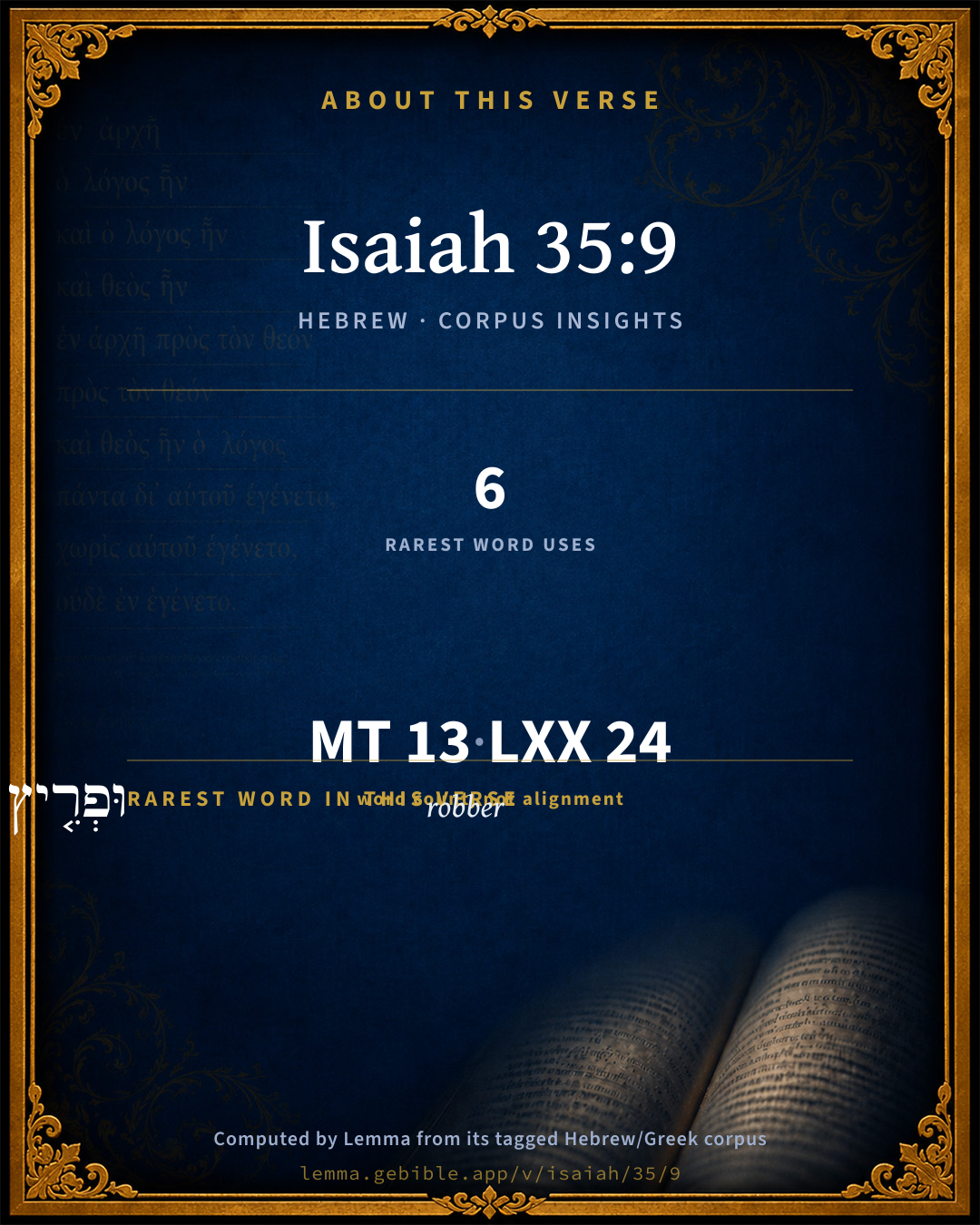
The rarest word here is וּפְרִ֤יץ robber H6530 — appearing just 6 times in the whole Hebrew Bible.

Shared distinctive vocabulary

וּפְרִ֤יץ robber H6530 occurs in 6 verses of the Hebrew Bible. Also found in:

Grammatical profile

  • 5 verbs
  • 3 nouns
  • 2 adverbs
  • 3 particles

Verb forms

  • יִהְיֶ֨ה Qal · Imperfect
  • יַעֲלֶ֔נָּה Qal · Imperfect
  • תִמָּצֵ֖א Niphal · Imperfect
  • וְהָלְכ֖וּ Qal · Sequential Perfect
  • גְּאוּלִֽים Qal · Participle Passive

Repetition

Words recur within this verse — often emphatic in Hebrew:

Hebrew & Septuagint length

In English translation the verse runs 25 words from the Hebrew and 35 from the Septuagint (LXX English) — the Septuagint runs noticeably longer here. See the side-by-side →

A rough comparison of the two English renderings, which tokenize alike — not a word-level alignment.

Word counts can differ between the Hebrew and the Greek without any difference in meaning — e.g. the Hebrew direct-object marker אֵת has no separate Greek word, and Greek often adds the article ὁ.

In the original languages it is 13 Hebrew tokens and 24 Greek tokens — but the two are counted differently (Hebrew bundles its prefixes and suffixes into one token; the Greek is in lemma form), so that isn’t a like-for-like length.

Cross-references

15

Topical passages linked to Isaiah 35:9 in the Treasury of Scripture Knowledge — connected by theme and wording, ordered by reader-vote popularity; previews shown in the World English Bible.

  • Isaiah 62:12 They shall call them The holy people, The redeemed of Yahweh: and you shall be called Sought out, A city not forsaken.
  • Ezekiel 34:25 I will make with them a covenant of peace, and will cause evil animals to cease out of the land; and they shall dwell securely in the wilderness, and sleep in the woods.
  • Exodus 15:13 "You, in your loving kindness, have led the people that you have redeemed. You have guided them in your strength to your holy habitation.
  • Leviticus 26:6 "'I will give peace in the land, and you shall lie down, and no one will make you afraid; and I will remove evil animals out of the land, neither shall the sword go through your land.
  • Psalms 107:2 Let the redeemed by Yahweh say so, Whom he has redeemed from the hand of the adversary,
  • Isaiah 11:6–9 The wolf shall dwell with the lamb, and the leopard shall lie down with the kid; and the calf and the young lion and the fattened calf together; and a little child shall lead them.
  • Isaiah 30:6 The burden of the animals of the South. Through the land of trouble and anguish, from whence come the lioness and the lion, the viper and fiery flying serpent, they carry their riches on the shoulders of young donkeys, and their treasures on the humps of camels, to a people that shall not profit [them].
  • Isaiah 63:4 For the day of vengeance was in my heart, and the year of my redeemed is come.
  • Isaiah 65:25 The wolf and the lamb shall feed together, and the lion shall eat straw like the ox; and dust shall be the serpent's food. They shall not hurt nor destroy in all my holy mountain, says Yahweh.
  • Hosea 2:18 In that day I will make a covenant for them with the animals of the field, And with the birds of the sky, And with the creeping things of the ground. I will break the bow, the sword, and the battle out of the land, And will make them lie down safely.
  • Galatians 3:13 Christ redeemed us from the curse of the law, having become a curse for us. For it is written, "Cursed is everyone who hangs on a tree,"
  • Titus 2:14 who gave himself for us, that he might redeem us from all iniquity, and purify for himself a people for his own possession, zealous for good works.
  • 1 Peter 1:18 knowing that you were redeemed, not with corruptible things, with silver or gold, from the useless way of life handed down from your fathers,
  • Revelation 5:9 They sang a new song, saying, "You are worthy to take the book, And to open its seals: For you were killed, And bought us for God with your blood, Out of every tribe, language, people, and nation,
  • Revelation 20:1–3 I saw an angel coming down out of heaven, having the key of the abyss and a great chain in his hand.

Cross-references courtesy of OpenBible.info (CC BY 4.0).

Hebrew and Greek witnesses Masoretic Hebrew ↔ Greek Septuagint

The same verse in the two great witnesses to the Old Testament, shown verse-for-verse.

Here the Septuagint runs noticeably longer than the Hebrew — LXX2012 (modern English Septuagint) 35 words vs World English Bible 25. A rough length comparison of the two English translations, not a word-level alignment — read both below.

These are two independent witnesses, not word-aligned to each other, and the Septuagint is shown in lemma (dictionary) form.

Hebrew Isaiah 35:9 Masoretic · Westminster Leningrad Codex

לֹא יִהְיֶ֨ה שָׁ֜ם אַרְיֵ֗ה וּפְרִ֤יץ חַיּוֹת֙ בַּֽל יַעֲלֶ֔נָּה לֹ֥א תִמָּצֵ֖א שָׁ֑ם וְהָלְכ֖וּ גְּאוּלִֽים

No lion shall be there, nor shall any ravenous animal go up thereon; they shall not be found there; but the redeemed shall walk [there]:

World English Bible · Public Domain

Greek LXX Isaiah 35:9 Septuagint · lemma form

καί οὐ εἰμί ἐκεῖ λέων οὐδέ ὁ θηρίον ὁ πονηρός οὐ μή ἀναβαίνω ἐπί αὐτός οὐδέ μή εὑρίσκω ἐκεῖ ἀλλά πορεύομαι ἐν αὐτός λυτρόω

And there shall be no lion there, neither shall any evil beast go up upon it, nor at all be found there; but the redeemed and gathered on the Lord's behalf, shall walk in it,

LXX2012 (modern English Septuagint) · Public Domain

On this verse, Adam Clarke's Commentary discusses the Septuagint’s reading. Read the note in Commentary ↓

Hebrew: Westminster Leningrad Codex (CC BY 4.0). Greek: Septuagint (public domain); English from LXX2012 (modern English Septuagint) (Public Domain). How the Septuagint differs from the Hebrew →

Targum (Aramaic paraphrase)

1

The Targum is the ancient Jewish Aramaic paraphrase of the Hebrew Scriptures — an interpretive translation, not the Hebrew text itself. Onkelos (literal) and Pseudo-Jonathan (expansive) render the Torah, and Jonathan the Prophets. Coverage is partial: where no permissively-licensed English translation exists for a verse, only the Aramaic is shown. This is verse-level text, not a word-by-word alignment to the Hebrew.

  1. Targum Jonathan Prophets (Joshua–Malachi)
    לָא יְהֵי תַמָן מֶלֶךְ מַבְאֵישׁ וְשִׁלְטוֹן מְעִיק לָא יְגוֹזִינֵהּ וְלָא יִשְׁתַּכְּחוּן תַּמָן וִיהָכוּן פְרִיקִין:

    There shall not be there a king doing evil, and an oppressive governor shall not pass over it, yea, they shall not be found there; but the redeemed shall walk there.

    Targum Jonathan — Aramaic: “Mikraot Gedolot” (public domain). English: “Sefaria Community Translation” (CC0 1.0 (public-domain dedication)); “London "Chaldee Paraphrase," 1871” (public domain). Text via Sefaria.

Commentary

Notes on Isaiah 35:9 from classic Christian and Jewish commentators (each source and its license shown beneath its notes). The classic Christian expositions comment on the surrounding passage and are grouped to its opening verse, so a note may address several verses; the Jewish commentaries on the Tanakh (Rashi and others) are per-verse, so they appear only where the commentator wrote on this verse.

Lemma curates 59 commentaries, every one of them public domain or Creative Commons licensed, each selected and text-cleaned for this edition rather than reprinted as found. About our sources →

Trapp's Complete Commentary

John Trapp

Isa 35:9 No lion shall be there, nor [any] ravenous beast shall go up thereon, it shall not be found there; but the redeemed shall walk [there]:

Ver. 9. No lion shall be there.] The devil, that roaring lion, nor his actuaries, tyrants and heretics, shall haunt these holy highways. God will preserve his people from all devoratory evils, as Tertullian calleth them, {2Th 3:3} "that wicked one, the devil, shall not once touch them," {1Jn 5:18} so as to thrust his deadly sting into them.

John Trapp, A Commentary or Exposition upon All the Books of the Old and New Testament (1647–1656) — public domain. Text from a community e-Sword module.

The Biblical Illustrator

Joseph S. Exell

Isa_35:9

No lion shall be there

Human animalness

I.

MAY NATURALLY POSSESSES SOMETHING OF THE ANIMAL NATURE. That man by nature has animal desires and passions is no fault of his own, nor is it a misfortune to the possessor if these are inherited in harmonious proportion with the mental and spiritual propensities. They are all from the Divine Creator. They are all essential to mans enjoyment, and symmetrical development. The Creator wastes no material. As the watch contains no unnecessary spring, wheel, cog, or screw, so every passion, emotion, affection, from the lowest to the highest, as coming from God, is of account.

II. When the animal nature is fed and strengthened to the neglect and at the expense of the other and higher faculties and tendencies of the human make-up, then the animal appears in a great variety of forms.

III. MAN IS RESPONSIBLE FOR HIS TREATMENT OF HIS ANIMAL NATURE. It is not to be crucified, or wholly exterminated, but kept in subordination, subject to the ruling of the mental and spiritual. Some by nature have a great deal more to contend with on this line than others. The first nature, the animal, can be transformed into the second nature, the man; and if made a new creature in Christ Jesus, such must necessarily be the result. (W. G. Thrall.)

The Biblical Illustrator, edited by Joseph S. Exell (c. 1880s–1900s) — public domain. Text from a community e-Sword module.

Joseph Benson's Commentary

Isa 35:9. No lion shall be there, &c. — It shall not only be a plain, but a safe way. They that keep close to God in this way, keep out of the reach of Satan, the roaring lion: that wicked one toucheth them not; nor shall any of their other spiritual enemies be suffered to destroy, subdue, or bring them into bondage. They may proceed with a holy security and serenity of mind, and may be quiet from the fear of evil. This is the same promise with that of Isa 11:9 : They shall not hurt nor destroy in all my holy mountain.

Joseph Benson's Commentary on the Old and New Testaments (1811–1818) — public domain. Text from a community e-Sword module.

MacLaren's Expositions of Holy Scripture

Alexander MacLaren

Isaiah

THE KING’S HIGHWAY

WHAT LIFE’S JOURNEY MAY BE

Isa 35:9 - Isa 35:10.

We have here the closing words of Isaiah’s prophecy. It has been steadily rising, and now it has reached the summit. Men restored to all their powers, a supernatural communication of a new life, a pathway for our journey-these have been the visions of the preceding verses, and now the prophet sees the happy pilgrims flocking along the raised way, and hears some faint strains of their glad music, and he marks them, rank after rank, entering the city of their solemnities, and through the gates can behold them invested with joy and gladness, while sorrow and sighing, like some night-loving birds shrinking from the blaze of that better sun which lights the city, spread their black wings and flee away.

The noble rhythm of our English version rises here to a strain of pathetic music, the very cadence of which stirs thoughts that lie too deep for tears, and one shrinks from taking these lofty words of immortal hope-which life’s sorrows have interpreted, I trust, for many of us-as the text of a sermon. But I would fain try whether some of their gracious sweetness and power may not survive even our rude handling of them.

The prophet here is not only speaking of the literal return of his brethren from captivity. The place which this prophecy holds at the very close of the book, the noble loftiness of the language, the entire absence of any details or specific allusions which compel reference to the Captivity, would be sufficient of themselves to make us suspect that there was very much more here. The structure of prophecy is misunderstood unless it be recognised that all the history of Israel was itself a prediction, a great supernatural system of types and shadows, and that all the interventions of the divine hand are one in principle, and all foretell the great intervention of redeeming love, in the person of Jesus Christ. Nor need that be unlikely in the eyes of any who believe that Christ’s coming is the centre of the world’s history, and that there is in prophecy a supernatural element. We are not reading our own fancies into Scripture; we are not using, in allowable freedom, words which had another meaning altogether, to adorn our own theology, but we are apprehending the innermost meaning of prophecy, when we see in it Christ and His salvation {1Pe 1:10}.

We have then here a picture of what Christ does for us weary journeyers on life’s road,

I. Who are the travellers?

‘Redeemed,’ ‘ransomed of the Lord.’ Israel had in its past history one great act, under the imagery of which all future deliverances were prophesied. The events of the Exodus were the great storehouse from which prophets drew the clothing of their brightest hopes; and that is a lesson for us of how to use the history of God’s past deliverances. They believed that each transitory act was a revelation of an unchanging purpose and an unexhausted power, and that it would be repeated over and over again. Experience supplied the material out of which Hope wove its fairest webs, but Faith drove the shuttle. Here the names which describe the pilgrims come from the old story. They are slaves, purchased or otherwise set free from captivity by a divine act. The epithets are transferred to the New Testament, and become the standing designation for those who have been delivered by Christ.

That designation, ‘ransomed of the Lord,’ opens out into the great evangelical thoughts which are the very life-blood of vital Christianity.

Emancipation from bondage is the first thing that we all need. ‘He that committeth sin is the slave of sin.’ An iron yoke presses on every neck.

The needed emancipation can only be obtained by a ransom price. The question of to whom the ransom is paid is not in the horizon of prophet or apostle or of Jesus Himself, in using this metaphor. What is strongly in their minds is that a great surrender must be greatly made by the Emancipator.

Jesus conceived of Himself as giving ‘His life a ransom for the many.’

The emancipation must be a divine act. It surpasses any created power.

There can be no happy pilgrims unless they are first set free.

II. The end of the journey.

‘They shall come to Zion.’ It is one great distinctive characteristic and blessedness of the Christian conception of the future that it takes away from it all the chilling sense of strangeness, arising from ignorance and lack of experience, and invests it with the attraction of being the mother-city of us all. So the pilgrims are not travelling a dreary road into the common darkness, but are like colonists who visit England for the first time, and are full of happy anticipations of ‘going home,’ though they have never seen its shores.

That conception of the future perfect state as a ‘city’ includes the ideas of happy social life, of a settled polity, of stability and security. The travellers who were often solitary on the march will all be together there. The nomads, who had to leave their camping-place each morning and let the fire that cheered them in the night die down into a little ring of grey ashes, will ‘go no more out,’ but yet make endless progress within the gates. The defenceless travellers, who were fain to make the best ‘laager’ they could, and keep vigilant watch for human and bestial enemies crouching beyond the ring of light from the camp-fires, are safe at last, and they that swallowed them up shall be far away.

Contrast the future outlook of the noblest minds in heathenism with the calm certainty which the gospel has put within the reach of the simplest! ‘Blessed are your eyes, for they see.’

III. The joy of the road.

The pilgrims do not plod wearily in silence, but, like the tribes going up to the feasts, burst out often, as they journey, into song. They are like Jehoshaphat’s soldiers, who marched to the fight with the singers in the van chanting ‘Give thanks unto the Lord, for His mercy endureth for ever.’ The Christian life should be a joyful life, ever echoing with the ‘high praises of God.’ However difficult the march, there is good reason for song, and it helps to overcome the difficulties. ‘A merry heart goes all the day, a sad heart tires in a mile.’ Why should the ransomed pilgrims sing? For present blessings, for deliverance from the burden of self and sin, for communion with God, for light shed on the meaning of life, and for the sure anticipation of future bliss.

‘Everlasting joy on their heads.’ Other joys are transitory. It is not only ‘we poets’ who ‘in our youth begin with gladness,’ whereof ‘cometh in the end despondency and madness’; but, in a measure, these are the outlines of the sequence in all godless lives. The world’s festal wreathes wilt and wither in the hot fumes of the banqueting house, and ‘the crown of pride shall be trodden under foot.’ But joy of Christ’s giving ‘shall remain,’ and even before we sit at the feast, we may have our brows wreathed with a garland ‘that fadeth not away.’

IV. The perfecting of joy at last.

‘They shall obtain joy and gladness’: but had they not had it on their heads as they marched? Yes; but at last they have it in perfect measure and manner. The flame that burned but dimly in the heavy air of earth flashes up into new brightness in the purer atmosphere of the city.

And one part of its perfecting is the removal of all its opposites. Sorrow ends when sin and the discipline that sin needs have ended. ‘The inhabitant shall not say: I am sick; the people that dwell therein shall be forgiven their iniquity.’ Sighing ends when weariness, loss, physical pain, and all the other ills that flesh is heir to have ceased to vex and weigh upon the spirit. Life purges the dross of imperfection from character. Death purges the alloy of sorrow and sighing from joy, and leaves the perfected spirit possessor of the pure gold of perfect and eternal gladness.

Alexander MacLaren, Expositions of Holy Scripture (1904–1910) — public domain. Text from a community e-Sword module.

Geneva Bible (1599)

Geneva Bible translators

As he threateneth to the wicked to be destroyed hereby, Isa. 30:6.

Geneva Bible (1599) marginal notes — public domain. Text via Bolls.life.

Jamieson, Fausset & Brown

Robert Jamieson, A. R. Fausset & David Brown

No lion--such as might be feared on the way through the wilderness which abounded in wild beasts, back to Judea. Every danger shall be warded off the returning people (Isa 11:6-9; Eze 34:25; Hos 2:18). Compare spiritually, Pro 3:17.

Jamieson, Fausset & Brown — Commentary Critical and Explanatory on the Whole Bible (1871) — public domain (CC PDM 1.0). Text via the HelloAO Bible API.

Adam Clarke's Commentary

Verse 9. It shall not be found there - "Neither shall he be found there"] Three MSS. read ולא velo, adding the conjunction; and so likewise the Septuagint and Vulgate. And four MSS., one ancient, read ימצא yimmatsa, the verb, as it certainly ought to be, in the masculine form.

The redeemed shall walk there] גאולים geulim. Those whose forfeited inheritances are brought back by the kinsman, גואל goel, the nearest of kin to the family. This has been considered by all orthodox divines as referring to the incarnation of our Lord, and his sacrificial offering. After גאולים geulim, one of De Rossi's MSS. adds עד עולם ad olam, for ever, "The redeemed shall walk there for ever."

Adam Clarke's Commentary on the Bible (1810–1826) — public domain. Text from a community e-Sword/MySword module.

Ellicott's Commentary for English Readers

(9) No lion shall be there . . .—We have to remember that the lion had not ceased to haunt the valley of the Jordan, as it had done in the days of Samson (Jdg_14:5), and David (1Sa_17:3-4; 2Sa_23:20). The recent depopulation of the northern kingdom had probably laid the country more open to their attack (2Ki_17:25), and thus gave a special force to the prophet’s description. For “any ravenous beast,” read the most ravenous.

The redeemed . . . (10) . . . the ransomed.—The Hebrew words express simply the idea of release and freedom, without implying, as the English words do, a payment as its condition.

A Bible Commentary for English Readers, edited by Charles John Ellicott (1878–1897) — public domain. Text from a community e-Sword module.

The Cambridge Bible for Schools and Colleges

gen. ed. J. J. S. Perowne

9. the redeemed] cf. ch. Isa_51:10, Isa_62:12, Isa_63:4.

The Cambridge Bible for Schools and Colleges (gen. ed. J. J. S. Perowne; Cambridge University Press, 1878–1918) — public domain. Text from a community e-Sword module.

John Gill's Exposition

No lion shall be there,.... That is, in the way before described; no wicked persons, comparable to lions for their savage and cruel dispositions towards the people of God; for those who have been as such, as Saul before conversion, yet when brought into this way become as tame as lambs. The Targum interprets it of tyrannical kings and princes,

"there shall not be there a king doing evil, nor an oppressive governor;''

and Jarchi applies it to Nebuchadnezzar, as in Jer 4:7 and the sense may be, that when this way shall be more known on earth, in the latter day, there will be no persecutor of the church and people of God: or else Satan, the roaring lion, is here meant, who has no part nor lot in this way of salvation; and all that are in it are out of his reach; and though he may disturb in the paths of duty and ordinances, yet he can never destroy those who are in Christ the way:

nor any ravenous beast shall go up thereon; upon the high way; the same may be intended as before:

it shall not be found there; walking, ravaging, and destroying:

but the redeemed shall walk there; without fear, as Kimchi adds, since no lion, or any beast of prey, shall be found upon it: the "redeemed" are the redeemed of the Lord, and by him, and are peculiarly his, being bought with his precious blood, redeemed from among men, and unto God, and from sin, the law, its curse, and condemnation; these "shall walk" in the way of life and salvation by Christ, in consequence of their being redeemed; which supposes life, strength, and wisdom, which are given them, and a proficiency or going forward: they "shall" walk here; though they have been blind, their eyes shall be opened to see this way; and, though weak, they shall have strength to walk in it; and, though foolish, they shall have wisdom to guide their feet with discretion; and, though they may stumble and fall, they shall rise again, and shall keep on walking to the end.

John Gill's Exposition of the Whole Bible (1746–1763) — public domain (CC PDM 1.0). Text via the HelloAO Bible API.

Albert Barnes' Notes on the Bible

No lion shall be there - Lions abounded in all the countries adjacent to Palestine. They are, therefore, often referred to by the sacred writers, as objects of dread and alarm. The leading idea in the language of Isaiah in this whole passage, is that of a way constructed from Babylon to Judea, so straight and plain that the most simple of the people might find it and walk in it. But such a path would lie through desert sands. It would be in the region infested with lions and other wild beasts. The prophet, therefore, suggests that there should be no cause for such dread and alarm. The sense is, that in that kingdom to which he had made reference all would be safe. They who entered it should find security and defense as they traveled that road. And it is true. They who enter the path that leads to life, find there no cause of alarm. Their fears subside; their apprehensions of punishment on account of their sins die away; and they walk that path with security and confidence. There is nothing in that way to alarm them; and though there may be many foes - fitly represented by lions and wild beasts - lying about the way, yet no one is permitted to ‘go up thereon.’ This is a most beautiful image of the safety of the people of God, and of their freedom from all enemies that could annoy them.

But the redeemed shall walk there - The language here referred at first doubtless to those who would be rescued from the captivity at Babylon; but the main reference is to those who would be redeemed by the blood of the atonement, or who are properly called ‘the redeemed of the Lord.’ That Isaiah was acquainted with the doctrine of redemption is apparent from Isa 53:1-12. There is not here, indeed, any express mention made of the means by which they would be redeemed, but the language is so general that it may refer either to the deliverance from the captivity at Babylon, or the future more important deliverance of his people from the bondage of sin by the atoning sacrifice of the Messiah. On the word rendered ‘redeem,’ see the note at Isa 43:1. The idea is, that the path here referred to is appropriately designed only for the redeemed of Lord. It is not for the profane, the polluted, the hypocrite. It is not for those who live for this world, or for those who love pleasure more than they love God. The church should not be entered except by those who have evidence that they are redeemed. None should make a profession of religion who have no evidence that they belong to ‘the redeemed,’ and who are not disposed to walk in the way of holiness. But, for all such it is a highway on which they are to travel. It is made by levelling hills and elevating valleys; it is made across the sandy desert and through the wilderness of this world; it is made through a world infested with the enemies of God and his people. It is made straight and plain, so that none need err; it is defended from enemies, so that all may be safe; it is rendered secure, because ‘He,’ their Leader and Redeemer, shall go with and guard that way.

Albert Barnes' Notes on the Bible (1834–1885) — public domain. Text from a community e-Sword/MySword module.

Haydock's Catholic Bible Commentary

Lion. The devil’s power shall be repressed, so that none will be deluded except by their own fault. (Menochius)

George Leo Haydock (1774–1849), Haydock's Catholic Family Bible and Commentary, 1859 edition — public domain. Excludes Psalms (Douay-Rheims chapter numbering differs from Protestant) and Deuterocanonical books (Catholic canon only).

Matthew Poole's English Annotations

It shall not only be a plain, but a safe way, free from all annoyance or danger from mischievous creatures. This is the same promise, for substance, with that Isa 11:9,

They shall not hurt nor destroy in all my holy mountain.

Matthew Poole's English Annotations on the Holy Bible (1683–1685) — public domain. Text from a community e-Sword/MySword module.

The Pulpit Commentary

No lion shall be there. No great tyrannical power, like Assyria (Nah_2:11, Nah_2:12) or Babylon, shall arrest the energies of the Church, take it captive, or enslave it. No ravenous beast shall make it his prey. In proportion as the Church is holy (ver. 8) it shall be free from the molestation of bloody persecutors. (see Isa_11:9) The redeemed those whom God has purchased for his own (Exo_6:6 Hos_13:14) shall be free to walk there, untroubled by cruel enemies. There is an under-current of comparison between the blessedness of the last times and the existing troubles of Israel, still threatened by Sennacherib.

The Pulpit Commentary (1880–1919), ed. H.D.M. Spence-Jones & Joseph S. Exell — public domain. Text from a community e-Sword module.

J. A. Alexander on Isaiah

Joseph Addison Alexander

“There shall not be there a lion, and a ravenous beast shall not ascend it, nor be found there; and (there) shall walk redeemed (ones).” The wilderness, though no longer barren or pathless, might still be the resort of beasts of prey. The promised highway might itself be exposed to their incursions. But immunity from this inconvenience is here promised. For a similar promise, in a still more figurative dress, see Hos 2:18, and for a description of the desert as the home of deadly animals, Isa 30:6. The primary allusion is no doubt to the highway described in the foregoing verse. Hence the phrase ascend it, (i.e., from the level of the sands), through which the road is supposed to be cast up. These terms are intended to complete the great prophetic picture of a total change in the condition of the desert, under which general idea we may then include a great variety of suitable particulars, without however making any one of them the exclusive subject of the prophecy.

Joseph Addison Alexander, The Prophecies of Isaiah (1846–1847; New York: Scribner, 1870–1878) — public domain. Text from a community e-Sword module.

Scofield Reference Notes

C. I. Scofield

redeemed

Heb. "goel," Redemp. (Kinsman type). (See Scofield "Isa 59:20").

The Scofield Reference Bible (1917 edition), notes by C. I. Scofield — public domain. Text from a community e-Sword module.

Rashi

Rabbi Shlomo Yitzchaki (Rashi)

a profligate beast The boar out of the forest (80:14). There is none as profligate among the beasts as the boar, and also “the lions from his thicket” (Jer. 4:7), i.e., Nebuchadnezzar, shall not be found there.

nor shall...ascend thereon On that road (הַדֶּרֶךְ). The word דֶּרֶךְ is used both as masculine and feminine gender, as it is written (Ex. 18:20): “The way (הַדֶּרֶךְ) upon which (בָּהּ) they shall walk.” (Lit., on her.) Thus it is feminine. Comp. (Deut. 28:7) “In one road (בַּדֶּרֶךְ אֶחָד) they shall come out to you.” Thus it is masculine.

it shall not be found any wild beast there.

Rashi on the Tanakh — English translations: “The Judaica Press complete Tanach with Rashi, translated by A. J. Rosenberg” (CC BY 4.0); “Pentateuch with Rashi's commentary by M. Rosenbaum and A.M. Silbermann, 1929-1934” (public domain); “The Metsudah Tanach series, Lakewood, N.J” (CC BY 4.0); and “The Book of Joshua, Metsudah Publications, 1997” (CC BY 4.0). Text via Sefaria.

Ibn Ezra

Rabbi Abraham ibn Ezra

No lion shall be there on that way.

Nor any ravenous beast, that could do harm, and frighten those that wish to return. But the redeemed shall walk there. Those that will return will be unmolested by enemies and wild beasts.

Ibn Ezra on the Tanakh — English translations: “Sefaria Community Translation” (CC0 1.0 (public-domain dedication)); “Yalkut, Sifsei Chachomim Chumash, Metsudah Publications, 2009” (CC BY 4.0); and “Commentary of Ibn Ezra on Isaiah - trans. by M. Friedlander, 1873” (public domain). Text via Sefaria.

Lesson kit

Teaching starters — assembled from the data on this page, not authored interpretation. Every prompt links to the verse data it draws on. Edit before teaching.

Isaiah, in the Prophets, opens this verse with 13 words (11 distinct Hebrew lemmas). Its most distinctive word is pᵉrîyts (“robber”). The Greek Septuagint runs longer here. A historical commentator’s framing appears above. Read the whole chapter for the surrounding context.

Discussion questions

  1. What does “robber” (pᵉrîyts) contribute to the verse as a whole?
  2. Psalms 17:4 shares the word «robber» with this verse. How do the two illuminate each other?
  3. “there” occurs 2× in this one verse. What is the effect of the repetition?
  4. Compared with the Hebrew, the Septuagint runs longer here. What questions does that raise?
  5. These translations render this verse differently; the difference is in the English rendering, not the original. What questions does that raise?
  6. The verb «יִהְיֶ֨ה» is Qal Imperfect. How does its form color the action?
  7. Reading how Trapp's Complete Commentary and The Biblical Illustrator read this verse, where do the two commentators agree and where do they part?

Things to notice

Reading settings

Reading text

Shown beneath each verse's original-language words.

Old Testament
Old Testament edition

Read the OT as the Masoretic Hebrew (MT) or the Greek Septuagint (LXX).

English shown for the Greek Septuagint (in the Hebrew ↔ Greek comparison).

Comparing translations? Open the Compare panel on any verse page to stack up to four side by side.