

Psalms 103:11

Hebrew (Westminster Leningrad Codex) Psalms 103:11 appears in the Hebrew Old Testament. The text above is from the Westminster Leningrad Codex. Each word links to its Strong’s number, a concise gloss, and parsing drawn from the Open Scriptures Hebrew Bible morphology. Click any word for its full Brown-Driver-Briggs (BDB) entry.
Download image
Cite this verse

Psalms 103:11 (World English Bible). Public Domain. Lemma interlinear Bible study tool, https://lemma.gebible.app/v/psalms/103/11.

Show BibTeX & RIS
BibTeX
RIS
English Translation
For as the heavens are high above the earth, So great is his loving kindness toward those who fear him.
World English Bible · Public Domain
Download a study sheet

One document with this verse’s original text, its word-by-word gloss line, the meaning frame, cross-references with their text, attributed commentary, and full source and license credits — printable, and it pastes into notes with its structure intact.

This verse Autodidact and up

Study sheet (.html) Plain text (.txt)

A passage Seminary Student

Up to 50 verses in one chapter. A passage sheet keeps up to 6 commentary sources and 12 cross-references per verse, in the order this page ranks them, and says so on the sheet whenever that leaves anything out. Ask for a single verse and you get the Autodidact verse sheet above.

Everything on this page stays free to read, with no account — the sheet is a download of what is already on screen, not access to it.

Want to remove ads? Support Godless Engineer
Compare translations 3

The same verse in 3 English versions, stacked beneath the original-language interlinear above. Click any original word for its lexicon entry.

Each is an independent rendering of the whole verse — the interlinear is not word-aligned to these translations.

Highlighted words mark where these versions differ — a whole-verse word diff, not a word-by-word alignment.

  • World English Bible Public Domain
    For as the heavens are high above the earth, So great is his loving kindness toward those who fear him.
  • King James Version Public Domain
    For as the heaven is high above the earth, so great is his mercy toward them that fear him.
  • unfoldingWord Literal Text CC BY-SA 4.0
    For as the heavens are high above the earth, his covenant faithfulness is strong toward those fearing him.

unfoldingWord Literal Text — © unfoldingWord, licensed CC BY-SA 4.0. Word-aligned USFM3 via Door43 (git.door43.org/unfoldingWord/en_ult).

Versions to compare (up to 4)

3 of 4 selected

Show all 18 translations

Every available English version of this verse, each an independent rendering of the whole verse.

  • World English Bible Public Domain
    For as the heavens are high above the earth, So great is his loving kindness toward those who fear him.
  • Berean Standard Bible Public Domain
    For as high as the heavens are above the earth, so great is His loving devotion for those who fear Him.
  • Majority Standard Bible Public Domain
    For as high as the heavens are above the earth, so great is His loving devotion for those who fear Him.
  • King James Version Public Domain
    For as the heaven is high above the earth, so great is his mercy toward them that fear him.
  • American Standard Version (1901) Public Domain
    For as the heavens are high above the earth, So great is his lovingkindness toward them that fear him.
  • Revised Version (1885) Public Domain
    For as the heaven is high above the earth, so great is his mercy toward them that fear him.
  • Geneva Bible (1599) Public Domain
    For as high as the heauen is aboue ye earth, so great is his mercie toward them that feare him.
  • Douay-Rheims (1899) Public Domain
    For according to the height of the heaven above the earth: he hath strengthened his mercy towards them that fear him.
  • Young's Literal Translation Public Domain
    For, as the height of the heavens `is' above the earth, His kindness hath been mighty over those fearing Him.
  • Literal Standard Version CC BY-SA 4.0
    For as the height of the heavens [is] above the earth, || His kindness has been mighty over those fearing Him.
  • Unlocked Literal Bible CC BY-SA 4.0
    For as the skies are high above the earth, so great is his covenant faithfulness toward those who honor him.
  • unfoldingWord Literal Text CC BY-SA 4.0
    For as the heavens are high above the earth, his covenant faithfulness is strong toward those fearing him.
  • Darby Bible Public Domain
    For as the heavens are high above the earth, so great is his loving-kindness toward them that fear him.
  • World Messianic Bible Public Domain
    For as the heavens are high above the earth, so great is his loving kindness toward those who fear him.
  • Webster's Bible Public Domain
    For as the heaven is high above the earth, so great is his mercy towards them that fear him.
  • Free Bible Version CC BY-SA 4.0
    For as high as the heavens are above the earth is the extent of his trustworthy love to those who honor him.
  • Bible in Basic English Public Domain
    For as the heaven is high over the earth, so great is his mercy to his worshippers.
  • JPS Tanakh (1917) Public Domain
    For as the heaven is high above the earth, so great is His mercy toward them that fear Him.

Literal Standard Version (2020), Covenant Press — licensed CC BY-SA 4.0. Text via the HelloAO Bible API (eBible.org). Unlocked Literal Bible (unfoldingWord) — licensed CC BY-SA 4.0. Text via the HelloAO Bible API (eBible.org). unfoldingWord Literal Text — © unfoldingWord, licensed CC BY-SA 4.0. Word-aligned USFM3 via Door43 (git.door43.org/unfoldingWord/en_ult). Free Bible Version, Dr. Jonathan Gallagher — licensed CC BY-SA 4.0. Text via the HelloAO Bible API (eBible.org).

Word by word

More ways to search: Search by grammar → Find every occurrence → Compare this word →

Practice this passage: Drill this verse → Learn its vocabulary →

גָּבַ֥ר
gâbar
H1396
“to be strong”
Verb, Qal, Perfect, 3rd Person, Masculine, Singular
Part of Speech
Verb
Stem
Qal
Form
Perfect
Person
3rd Person
Gender
Masculine
Number
Singular
Full BDB Definition

Origin: a primitive root

TWOT: 310

to prevail, have strength, be strong, be powerful, be mighty, be great - (Qal) - to be strong, mighty - to prevail - (Piel) to make strong, strengthen - (Hiphil) - to confirm, give strength - to confirm (a covenant) - (Hithpael) - to show oneself mighty - to act proudly (toward God)
  1. כִּ֤י kîy H3588 “that” Conjunction
  2. כִגְבֹ֣הַּ gâbahh H1361 “like/as · to be high” Preposition + Verb, Qal, Infinitive Construct
  3. שָׁ֭מַיִם shâmayim H8064 “heaven(s)” Noun, Common, Masculine, Plural, Absolute
  4. עַל ʻal H5921 “upon” Preposition
  5. הָאָ֑רֶץ ʼerets H776 “the · land” Particle, Definite Article + Noun, Common, Both, Singular, Absolute
  6. חַ֝סְדּ֗וֹ chêçêd H2617 “kindness · his” Noun, Common, Masculine, Singular, Construct + Suffix, Personal, 3rd Person, Masculine, Singular
  7. עַל ʻal H5921 “upon” Preposition
  8. יְרֵאָֽיו yârêʼ H3373 “fearing · his” Adjective, Adjective, Masculine, Plural, Construct + Suffix, Personal, 3rd Person, Masculine, Singular

About this verse

These counts appear in no published source. They are computed here, from the morphology-tagged text and Lemma’s own curated glosses. What Lemma adds →

9
words
8
distinct lemmas
Wisdom
section

Notable vocabulary

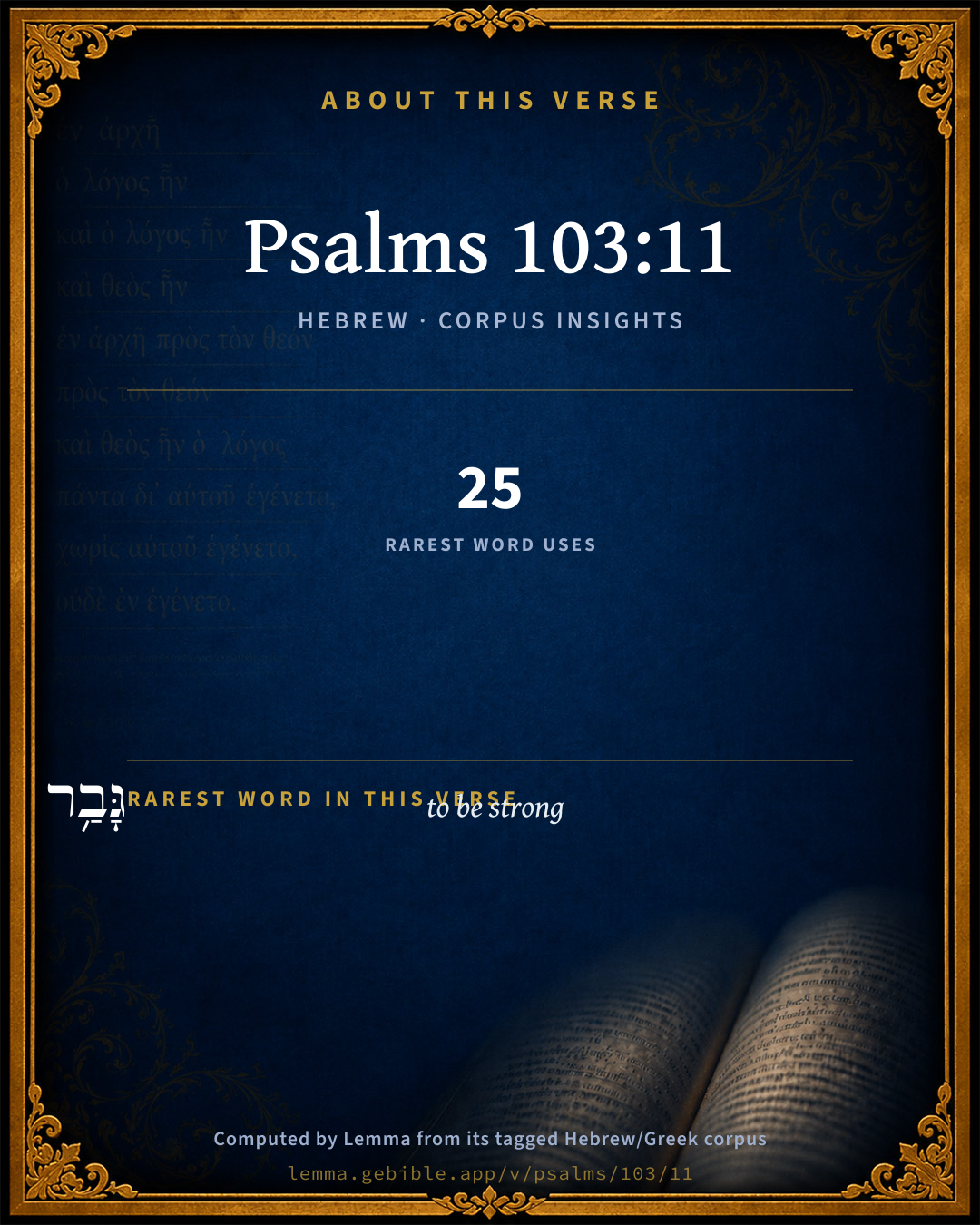
The rarest word here is גָּבַ֥ר to be strong H1396 — appearing just 25 times in the whole Hebrew Bible.

Shared distinctive vocabulary

גָּבַ֥ר to be strong H1396 occurs in 24 verses of the Hebrew Bible. Also found in:

Grammatical profile

  • 2 verbs
  • 3 nouns
  • 1 adjective
  • 2 prepositions
  • 1 conjunction

Verb forms

  • כִגְבֹ֣הַּ Qal · Infinitive Construct
  • גָּבַ֥ר Qal · Perfect

Repetition

A word recurs within this verse — often emphatic in Hebrew:

Hebrew & Septuagint length

In English translation the verse runs 20 words from the Hebrew and 21 from the Septuagint (LXX English) — closely comparable.

A rough comparison of the two English renderings, which tokenize alike — not a word-level alignment.

Word counts can differ between the Hebrew and the Greek without any difference in meaning — e.g. the Hebrew direct-object marker אֵת has no separate Greek word, and Greek often adds the article ὁ.

Cross-references

10

Topical passages linked to Psalms 103:11 in the Treasury of Scripture Knowledge — connected by theme and wording, ordered by reader-vote popularity; previews shown in the World English Bible.

  • Psalms 57:10 For your great loving kindness reaches to the heavens, And your truth to the skies.
  • Luke 1:50 His mercy is for generations of generations on those who fear him.
  • Psalms 36:5 Your loving kindness, Yahweh, is in the heavens. Your faithfulness reaches to the skies.
  • Psalms 103:17 But Yahweh's loving kindness is from everlasting to everlasting with those who fear him, His righteousness to children's children;
  • Ephesians 2:4–7 But God, being rich in mercy, for his great love with which he loved us,
  • Proverbs 25:3 As the heavens for height, and the earth for depth, So the hearts of kings are unsearchable.
  • Isaiah 55:9 For as the heavens are higher than the earth, so are my ways higher than your ways, and my thoughts than your thoughts.
  • Psalms 89:2 I indeed declare, "Love stands firm forever. You established the heavens. Your faithfulness is in them."
  • Ephesians 3:18–19 may be strengthened to comprehend with all the saints what is the breadth and length and height and depth,
  • Job 22:12 "Isn't God in the heights of heaven? See the height of the stars, how high they are!

Cross-references courtesy of OpenBible.info (CC BY 4.0).

Hebrew and Greek witnesses Masoretic Hebrew ↔ Greek Septuagint

The same verse in the two great witnesses to the Old Testament, shown verse-for-verse.

You’re reading Greek Psalm 102 (Hebrew Psalm 103). The Septuagint counts the superscription, so verse numbers can differ from the Hebrew — chapter-level alignment, not verse-by-verse. Numbering follows Rahlfs.

These are two independent witnesses, not word-aligned to each other, and the Septuagint is shown in lemma (dictionary) form.

Hebrew Psalms 103:11 Masoretic · Westminster Leningrad Codex

כִּ֤י כִגְבֹ֣הַּ שָׁ֭מַיִם עַל הָאָ֑רֶץ גָּבַ֥ר חַ֝סְדּ֗וֹ עַל יְרֵאָֽיו

For as the heavens are high above the earth, So great is his loving kindness toward those who fear him.

World English Bible · Public Domain

Greek LXX Greek Psalm 102:11 Septuagint · lemma form

ὅτι κατά ὁ ὕψος ὁ οὐρανός ἀπό ὁ γῆ κραταίοω κύριος ὁ ἔλεος αὐτός ἐπί ὁ φοβέω αὐτός

For as the heaven is high above the earth, the Lord has so increased his mercy toward them that fear him.

LXX2012 (modern English Septuagint) · Public Domain

Hebrew: Westminster Leningrad Codex (CC BY 4.0). Greek: Septuagint (public domain); English from LXX2012 (modern English Septuagint) (Public Domain). How the Septuagint differs from the Hebrew →

Commentary

Notes on Psalms 103:11 from classic Christian and Jewish commentators (each source and its license shown beneath its notes). The classic Christian expositions comment on the surrounding passage and are grouped to its opening verse, so a note may address several verses; the Jewish commentaries on the Tanakh (Rashi and others) are per-verse, so they appear only where the commentator wrote on this verse.

Lemma curates 59 commentaries, every one of them public domain or Creative Commons licensed, each selected and text-cleaned for this edition rather than reprinted as found. About our sources →

Trapp's Complete Commentary

John Trapp

Psa 103:11 For as the heaven is high above the earth, [so] great is his mercy toward them that fear him.

Ver. 11. For as the heaven is high above the earth] How high the third heaven is cannot be conjectured. But for the middlemost heaven (wherein the sun, moon, and stars are placed), how exceeding high it is may be guessed and gathered, in that the stars (whereof those of the first magnitude are said to be every one above a hundred and seven times as big again as the whole earth) do yet seem to us but as so many sparks or spangles. See Pro 25:3 Eph 4:10.

So great is his mercy] The heavens are exceeding high above the earth, but God’s mercy to his is above the heavens, Psa 108:4. The original word, gabbar, here used, is the same with that, Gen 7:20, used for the prevailing of the waters above the mountains.

John Trapp, A Commentary or Exposition upon All the Books of the Old and New Testament (1647–1656) — public domain. Text from a community e-Sword module.

Joseph Benson's Commentary

Psa 103:11-13. As the heaven, &c., so great is his mercy — So much above our deserts and expectations, and above the mercy which one man shows to another; toward them that fear him — Which clause he adds here, as also Psa 103:17-18, to prevent men’s mistakes and abuses of God’s mercy, and to overthrow the vain hopes which impenitent sinners build thereon. As far as the east, &c., so far hath he removed our transgressions — The guilt of our sins, from our persons and consciences. The sense is, He hath fully pardoned them so as never to remember them more. Like as a father pitieth, &c. — No father can be more indulgent and tender hearted to his returning children, than the Lord is to those who so reform, by his chastisements, as to fear afterward to offend him. Thus, in these three verses, “we are presented with three of the most beautiful, apposite, and comforting similitudes in the world. When we lift up our eyes, and behold around us the lofty and stupendous vault of heaven, encircling, protecting, enlightening, refreshing, and cherishing the earth, and all things which are therein, we are bidden to contemplate, in this glass, the immeasurable height, the boundless extent, and the salutary influences of that mercy which, as it were, embraced the creation, and is over all the works of God. Often as we view the sun arising in the sea, and darkness flying away before his face toward the opposite quarter of the heavens, we may see an image of that goodness of Jehovah, whereby we are placed in the regions of illumination, and our sins are removed, and put far away out of his sight. And, that our hearts may, at all times, have confidence toward God, he is represented as bearing toward us the fond and tender affection of a father, ever ready to defend, to nourish, and to provide for us, to bear with us, to forgive us, and receive us in the paternal arms of everlasting love.” — Horne. “One would think it impossible,” says another eminent divine, “if daily experience did not convince us to the contrary, that human creatures should be regardless of such love, and ungrateful to so solicitous a benefactor! For my own part, I cannot conceive it possible for any heart to be unaffected or uninfluenced by such a composition as this before us.”

Joseph Benson's Commentary on the Old and New Testaments (1811–1818) — public domain. Text from a community e-Sword module.

Keil & Delitzsch

C. F. Keil & F. Delitzsch

The ingenious figures in Psa 103:11. (cf. Psa 36:6; Psa 57:11) illustrate the infinite power and complete unreservedness of mercy (loving-kindness). הרחיק has Gaja (as have also השׁחיתו and התעיבו, Psa 14:1; Psa 53:2, in exact texts), in order to render possible the distinct pronunciation of the guttural in the combination רח. Psa 103:13 sounds just as much like the spirit of the New Testament as Psa 103:11, Psa 103:12. The relationship to Jahve in which those stand who fear Him is a filial relationship based upon free reciprocity (Mal 3:11). His Fatherly compassion is (Psa 103:14) based upon the frailty and perishableness of man, which are known to God, much the same as God's promise after the Flood not to decree a like judgment again (Gen 8:21). According to this passage and Deu 31:21, יצרנוּ appears to be intended of the moral nature; but according to Psa 103:14, one is obliged to think rather of the natural form which man possesses from God the Creator (ויּיצר, Gen 2:7) than of the form of heart which he has by his own choice and, so far as its groundwork is concerned, by inheritance (Psa 51:7). In זכוּר, mindful, the passive, according to Bצttcher's correct apprehension of it, expresses a passive state after an action that is completed by the person himself, as in בּטוּה, ידוּע, and the like. In its form Psa 103:14 reminds one of the Book of Job Job 11:11; Job 28:23, and Psa 103:14 as to subject-matter recalls Job 7:7, and other passages (cf. Psa 78:39; Psa 89:48); but the following figurative representation of human frailty, with which the poet contrasts the eternal nature of the divine mercy as the sure stay of all God-fearing ones in the midst of the rise and decay of things here below, still more strongly recalls that book.

Keil & Delitzsch — Biblical Commentary on the Old Testament (1861–1891) — public domain (CC PDM 1.0). Text via the HelloAO Bible API. (Old Testament only.)

J. A. Alexander on Psalms

Joseph Addison Alexander

11. (Psa 103:11) For as the heavens are high above the earth, mighty is his mercy above those that fear him. The Hebrew preposition is the same in both clauses, and cannot be varied in translation without weakening the sentence. In the last clause it suggests the ideas of descent from above, superior power, and protection, in addition to that of mere relation or direction, which is all that is conveyed by the translation to or towards. The force of the original is likewise impaired by substituting great for strong or mighty. The idea meant to be conveyed is not that of mere extent but of efficiency. The literal meaning of the first words is, like the height of the heavens, or like their being high. His fearers, or those fearing him, is a common description of the righteous, or God's people, who are more particularly characterised in Psa 103:18.

Joseph Addison Alexander, The Psalms Translated and Explained (1850) — public domain. Text from a community e-Sword module.

Tyndale Open Study Notes

Tyndale Open Resources

103:11-12 The Lord’s love and forgiveness are infinite and complete.

Tyndale Open Study Notes — © Tyndale Open Resources, licensed CC BY-SA 4.0. Text via the HelloAO Bible API.

Adam Clarke's Commentary

Verse 11. For as the heaven is high above the earth] Great and provoking as our crimes may have been, yet his mercies have, in their magnitude and number, surpassed these, as far as the heavens are elevated beyond the earth.

Adam Clarke's Commentary on the Bible (1810–1826) — public domain. Text from a community e-Sword/MySword module.

John Calvin's Commentaries

11. For in proportion to the height of the heavens above the earth The Psalmist here confirms by a comparison the truth that God does not punish the faithful as they have deserved, but, by his mercy, strives against their sins. The form of expression is equivalent to saying that God’s mercy towards us is infinite. With respect to the word גבר, gabar, it is of little consequence whether it is taken in a neuter signification, or in a transitive, as is noted on the margin; for in either way the immeasurableness of God’s mercy is compared to the vast extent of the world. As the mercy of God could not reach us, unless the obstacle of our guilt were taken away, it is immediately added, (verse 12th,) that God removes our sins as far from us as the east is distant from the west The amount is, that God’s mercy is poured out upon the faithful far and wide, according to the magnitude of the world; and that, in order to take away every impediment to its course, their sins are completely blotted out. The Psalmist confirms what I have just now stated, namely, that he does not treat in general of what God is towards the whole world, but of the character in which he manifests himself towards the faithful. Whence also it is evident that he does not here speak of that mercy by which God reconciles us to himself at the first, but of that with which he continually follows those whom he has embraced with his fatherly love. There is one kind of mercy by which he restores us from death to life, while as yet we are strangers to him, and another by which he sustains this restored life; for that blessing would forthwith be lost did he not confirm it in us by daily pardoning our sins. Whence also we gather how egregiously the Papists trifle in imagining that the free remission of sins is bestowed only once, and that afterwards righteousness is acquired or retained by the merit of good works, and that whatever guilt we contract is removed by satisfactions. Here David does not limit to a moment of time the mercy by which God reconciles us to himself in not imputing to us our sins, but extends it even to the close of life. Not less powerful is the argument which this passage furnishes us in refutation of those fanatics who bewitch both themselves and others with a vain opinion of their having attained to perfect righteousness, so that they no longer stand in need of pardon.

John Calvin's Commentaries (1540-1563) — public domain. Text from the Calvin Translation Society English edition (1840s-50s) via the Christian Classics Ethereal Library (ccel.org). Calvin's coverage is partial (roughly two-thirds of the Bible); uncommented books and verses are honest gaps, never fabricated. The 19th-century editor's footnotes and remarks are omitted so the notes are faithfully Calvin's own voice.

Ellicott's Commentary for English Readers

(11) So great is his mercy toward.—Literally, Strong is his mercy upon (or, over). (Comp. Psa_117:2.) The comparison in the first clause, and the use of this expression in Gen_49:26 and 2Sa_11:23, suggests as the right rendering here

For as the heaven is higher than the earth,

So far (above what was expected) for them fearing him prevails his mercy.

(For the same comparison, see Isa_55:7-9; and comp. Isa_38:17; Mic_7:19.)

A Bible Commentary for English Readers, edited by Charles John Ellicott (1878–1897) — public domain. Text from a community e-Sword module.

The Cambridge Bible for Schools and Colleges

gen. ed. J. J. S. Perowne

11. Cp. Psa_36:5; Psa_57:10; Isa_55:9.

so great is] so mighty hath been. The change of a letter would give the sense, so high hath been; but it is unnecessary. Cp. Psa_117:2. The perfect tense in Psa_103:10-12 refers to Israel’s recent experience.

them that fear him] True Israelites are those who can claim the promise. Note the triple repetition of the words, which recur in Psa_103:13; Psa_103:17.

11–14. The greatness and tenderness of Jehovah’s forgiving love.

The Cambridge Bible for Schools and Colleges (gen. ed. J. J. S. Perowne; Cambridge University Press, 1878–1918) — public domain. Text from a community e-Sword module.

John Gill's Exposition

As far as the east is from the west,.... Which Kimchi thinks is mentioned because it contains the length of the habitable world; and therefore it is not said as far as the north is from the south; since a man can go from east to west, but not from north to south, because of the extreme heat and cold. But this distance is not given with respect to those opposite parts of the earth, which scarcely exceed 12700 miles; but with respect to those opposite points in the heavens: and the meaning is, that as far as the eastern point of the heavens is from the western point of them; which more illustrates the matter in hand, or the blessing later mentioned, than the other.

So far hath he removed our transgressions from us; which removed men and angels from God, and set them at a distance from him; and which, if not removed, are such burdens as must sink men down into the lowest hell; and yet cannot be removed by anything that they can do; not by any sacrifices, services, or duties of any kind; nor in any other way, nor by any other person, than the Lord himself: and this is to be understood not of a removal of the being of sin out of his people, for that is not done in this life; rather of the removal of the guilt of sin, by a special application of pardoning grace and mercy; see Sa2 12:13, but, best of all, of a removal of sins to Christ, and of them by his sacrifice and satisfaction: Christ engaged as a surety for his people; Jehovah the Father considered him as such; and therefore did not impute their sins to them, but to him; and when he sent him in the likeness of sinful flesh, he removed them from them, and laid them upon him; who voluntarily took them on himself, cheerfully bore them, and, by bearing them, removed the iniquity of the land in one day; and carried them away to the greatest distance, and even put them away for ever by the sacrifice of himself; and upon the satisfaction he gave to divine justice, the Lord removed them both from him and them; justified and acquitted him, and his people in him: and by this means so effectually, and so far, are their transgressions removed, that they shall never be seen any more, nor ever be imputed to them, nor be brought against them to their condemnation; in consequence of which, pardon is applied to them, and so sin is removed from their consciences, as before observed; see Lev 16:21.

John Gill's Exposition of the Whole Bible (1746–1763) — public domain (CC PDM 1.0). Text via the HelloAO Bible API.

Albert Barnes' Notes on the Bible

For as the heaven is high above the earth - See the notes at Psa 57:10. Compare the notes at Isa 55:9. The literal translation of the phrase here would be, “For like the height of the heavens above the earth.” The heavens - the starry heavens - are the highest objects of which we have any knowledge; and hence, the comparison is used to denote the great mercy of God - meaning that it is as great as can be conceived; that there is nothing beyond it; that we cannot imagine that it could be greater - as we can imagine nothing higher than the heavens.

So great is his mercy toward them that fear him - To those who reverence and serve him. That is, His mercy is thus great in forgiving their offences; in imparting grace; in giving them support and consolation.

Albert Barnes' Notes on the Bible (1834–1885) — public domain. Text from a community e-Sword/MySword module.

Matthew Poole's English Annotations

So much above their deserts and expectations, and above the mercy which one man showeth to another.

Toward them that fear them; which clause he adds here, as also Psa 103:17,18, to prevent men’s mistakes and abuses of God’s mercy, and to dash the vain hopes of impenitent sinners in God’s mercy.

Matthew Poole's English Annotations on the Holy Bible (1683–1685) — public domain. Text from a community e-Sword/MySword module.

The Treasury of David

Charles H. Spurgeon

Ver. 11. For as the heaven is high above the earth, so great is his mercy toward them that fear him. Boundless in extent towards his chosen is the mercy of the Lord; it is no more to be measured than the height of heaven or the heaven of heavens. "Like the height of the heavens" is the original language, which implies other points of comparison besides extent, and suggests sublimity, grandeur, and glory. As the lofty heavens canopy the earth, water it with dews and rains, enlighten it with sun, moon, and stars, and look down upon it with unceasing watchfulness, even so the Lord's mercy from above covers all his chosen, enriches them, embraces them, and stands for ever as their dwellingplace. The idea of our version is a very noble one, for who shall tell how exceeding great is the height of heaven? Who can reach the first of the fixed stars, and who can measure the utmost bounds of the starry universe? Yet so great is his mercy! Oh, that great little word so! All this mercy is for "them that fear him; "there must be a humble, hearty reverence of his authority, or we cannot taste of his grace. Godly fear is one of the first products of the divine life in us, it is the beginning of wisdom, yet it fully ensures to its possessor all the benefits of divine mercy, and is, indeed, here and elsewhere, employed to set forth the whole of true religion. Many a true child of God is full of filial fear, and yet at the same time stands trembling as to his acceptance with God; this trembling is groundless, but it is infinitely to be preferred to that baseborn presumption, which incites men to boast of their adoption and consequent security, when all the while they are in the gall of bitterness. Those who are presuming upon the infinite extent of divine mercy, should here be led to consider that although it is wide as the horizon and high as the stars, yet it is only meant for them that fear the Lord, and as for obstinate rebels, they shall have justice without mercy measured out to them.

Ver. 11. Our mind cannot find a comparison too large for expressing the superabundant mercy of the Lord toward his people. David Dickson.

Ver. 11-13. The height, length and depth of divine love.

Psalms 103:12*

Charles H. Spurgeon's The Treasury of David (1869–1885) — public domain. Psalms only. Text from a community e-Sword/MySword module.

Whedon's Commentary on the Bible

Daniel D. Whedon

11. As the heaven is high above the earth—The highest measure of comparison the mind can grasp. Comp. Psa_36:5; Psa_57:10.

Them that fear him—So, also, Psa_103:13; Psa_103:17-18. This shows he is speaking of God’s fatherly chastisements of his people. He looks at their sin in the light of their earthly misery and temptation, (Psa_103:14,) and mingles compassion with severity, “that we might be partakers of his holiness.” Heb_12:10

Daniel D. Whedon (gen. ed.), Commentary on the Old and New Testaments (1874–1909) — public domain. Text from a community e-Sword module.

The Pulpit Commentary

For as the heaven is high above the earth, so great is his mercy toward them that fear him. (comp. Psa_36:5, "Thy mercy, O Lord, is in the heavens, and thy faithfulness reacheth unto the clouds The metaphor is bold, yet inadequate; for God"s mercy is infinite.

The Pulpit Commentary (1880–1919), ed. H.D.M. Spence-Jones & Joseph S. Exell — public domain. Text from a community e-Sword module.

John Wesley's Explanatory Notes

So great - So much above their deserts and expectations.

John Wesley, Explanatory Notes Upon the Whole Bible (1754–1765) — public domain. Text via the GEBible commentary corpus.

Scofield Reference Notes

C. I. Scofield

fear

Also Psa 103:13, (See Scofield "Psa 19:9").

The Scofield Reference Bible (1917 edition), notes by C. I. Scofield — public domain. Text from a community e-Sword module.

unfoldingWord translationNotes

Door43 World Missions Community

For as the skies are high ... toward those who honor him

The simile compares the great distance between heaven and earth to the greatness of God's love for his people. (See: Simile)

so great is his covenant faithfulness

The abstract noun "faithfulness" can be translated with an adjective. AT: "so he is very faithful to his covenant" (See: Abstract Nouns)

As far as the east ... removed the guilt of our sins from us

The distance between east and west is so far that it cannot be measured. In this simile, that distance is being compared to how far God moves our guilt away from us. (See: Simile)

As a father has compassion ... on those who honor him

Here the author compares a father's compassion for his children to Yahweh's compassion for those who honor him. (See: Simile)

translationWords

covenant faithfulness

honor

guilt

compassion

unfoldingWord translationNotes — © Distant Shores Media and the Door43 World Missions Community, licensed CC BY-SA 4.0. Source: git.door43.org/Door43/en_tn.

Lesson kit

Teaching starters — assembled from the data on this page, not authored interpretation. Every prompt links to the verse data it draws on. Edit before teaching.

Psalms, in the Wisdom, opens this verse with 9 words (8 distinct Hebrew lemmas). Its most distinctive word is gâbar (“to be strong”). A historical commentator’s framing appears above. Read the whole chapter for the surrounding context.

Discussion questions

  1. What does “to be strong” (gâbar) contribute to the verse as a whole?
  2. Genesis 7:18 shares the word «to be strong» with this verse. How do the two illuminate each other?
  3. “upon” occurs 2× in this one verse. What is the effect of the repetition?
  4. These translations render this verse differently; the difference is in the English rendering, not the original. What questions does that raise?
  5. The verb «כִגְבֹ֣הַּ» is Qal Infinitive Construct. How does its form color the action?
  6. Reading how Trapp's Complete Commentary and Joseph Benson's Commentary read this verse, where do the two commentators agree and where do they part?

Things to notice

Reading settings

Reading text

Shown beneath each verse's original-language words.

Old Testament
Old Testament edition

Read the OT as the Masoretic Hebrew (MT) or the Greek Septuagint (LXX).

English shown for the Greek Septuagint (in the Hebrew ↔ Greek comparison).

Comparing translations? Open the Compare panel on any verse page to stack up to four side by side.