Revelation 15:2

Greek (Tischendorf 8th ed.) Revelation 15:2 appears in the Greek New Testament. The text above is from the Tischendorf 8th edition. Each word links to its Strong’s number and a concise gloss. Click any word for its full Thayer’s Greek Lexicon entry.
Download image
Cite this verse

Revelation 15:2 (World English Bible). Public Domain. Lemma interlinear Bible study tool, https://lemma.gebible.app/v/revelation/15/2.

Show BibTeX & RIS
BibTeX
RIS
English Translation
I saw something like a sea of glass mixed with fire, and those who overcame the beast, his image, and the number of his name, standing on the sea of glass, having harps of God.
World English Bible · Public Domain
Download a study sheet

One document with this verse’s original text, its word-by-word gloss line, the meaning frame, cross-references with their text, attributed commentary, and full source and license credits — printable, and it pastes into notes with its structure intact.

This verse Autodidact and up

Study sheet (.html) Plain text (.txt)

A passage Seminary Student

Up to 50 verses in one chapter. A passage sheet keeps up to 6 commentary sources and 12 cross-references per verse, in the order this page ranks them, and says so on the sheet whenever that leaves anything out. Ask for a single verse and you get the Autodidact verse sheet above.

Everything on this page stays free to read, with no account — the sheet is a download of what is already on screen, not access to it.

Want to remove ads? Support Godless Engineer
Compare translations 3

The same verse in 3 English versions, stacked beneath the original-language interlinear above. Click any original word for its lexicon entry.

Each is an independent rendering of the whole verse — the interlinear is not word-aligned to these translations.

Highlighted words mark where these versions differ — a whole-verse word diff, not a word-by-word alignment.

  • World English Bible Public Domain
    I saw something like a sea of glass mixed with fire, and those who overcame the beast, his image, and the number of his name, standing on the sea of glass, having harps of God.
  • King James Version Public Domain
    And I saw as it were a sea of glass mingled with fire: and them that had gotten the victory over the beast, and over his image, and over his mark, and over the number of his name, stand on the sea of glass, having the harps of God.
  • unfoldingWord Literal Text CC BY-SA 4.0
    Then I saw as it were a sea of glass having been mixed with fire and the ones being victorious over the beast and over his image and over the number of his name standing on the sea of glass having the harps of God.

unfoldingWord Literal Text — © unfoldingWord, licensed CC BY-SA 4.0. Word-aligned USFM3 via Door43 (git.door43.org/unfoldingWord/en_ult).

Versions to compare (up to 4)

3 of 4 selected

Show all 19 translations

Every available English version of this verse, each an independent rendering of the whole verse.

  • World English Bible Public Domain
    I saw something like a sea of glass mixed with fire, and those who overcame the beast, his image, and the number of his name, standing on the sea of glass, having harps of God.
  • Berean Standard Bible Public Domain
    And I saw something like a sea of glass mixed with fire, beside which stood those who had conquered the beast and its image and the number of its name. They were holding harps from God,
  • Majority Standard Bible Public Domain
    And I saw something like a sea of glass mixed with fire, beside which stood those who had conquered the beast and its image and the number of its name. They were holding harps from God,
  • King James Version Public Domain
    And I saw as it were a sea of glass mingled with fire: and them that had gotten the victory over the beast, and over his image, and over his mark, and over the number of his name, stand on the sea of glass, having the harps of God.
  • American Standard Version (1901) Public Domain
    And I saw as it were a sea of glass mingled with fire; and them that come off victorious from the beast, and from his image, and from the number of his name, standing by the sea of glass, having harps of God.
  • Revised Version (1885) Public Domain
    And I saw as it were a glassy sea mingled with fire; and them that come victorious from the beast, and from his image, and from the number of his name, standing by the glassy sea, having harps of God.
  • Geneva Bible (1599) Public Domain
    And I sawe as it were a glassie sea, mingled with fire, and them that had gotten victorie of the beast, and of his image, and of his marke, and of the number of his name, stand at the glassie sea, hauing the harpes of God,
  • Douay-Rheims (1899) Public Domain
    And I saw as it were a sea of glass mingled with fire, and them that had overcome the beast, and his image, and the number of his name, standing on the sea of glass, having the harps of God:
  • Young's Literal Translation Public Domain
    and I saw as a sea of glass mingled with fire, and those who do gain the victory over the beast, and his image, and his mark, `and' the number of his name, standing by the sea of the glass, having harps of God,
  • Literal Standard Version CC BY-SA 4.0
    and I saw as a sea of glass mingled with fire, and those who gain the victory over the beast, and his image, and his mark, [and] the number of his name, standing by the sea of the glass, having harps of God,
  • Unlocked Literal Bible CC BY-SA 4.0
    I saw what appeared to be a sea of glass mixed with fire. Standing beside the sea were those who had been victorious over the beast and his image, and over the number representing his name. They were holding harps given to them by God.
  • unfoldingWord Literal Text CC BY-SA 4.0
    Then I saw as it were a sea of glass having been mixed with fire and the ones being victorious over the beast and over his image and over the number of his name standing on the sea of glass having the harps of God.
  • Darby Bible Public Domain
    And I saw as a glass sea, mingled with fire, and those that had gained the victory over the beast, and over its image, and over the number of its name, standing upon the glass sea, having harps of God.
  • World Messianic Bible Public Domain
    I saw something like a sea of glass mixed with fire, and those who overcame the beast, his image, and the number of his name, standing on the sea of glass, having harps of God.
  • Webster's Bible Public Domain
    And I saw as it were a sea of glass mingled with fire: and them that had gained the victory over the beast, and over his image, and over his mark, and over the number of his name, stand on the sea of glass, having the harps of God.
  • Free Bible Version CC BY-SA 4.0
    I saw what looked like a sea of glass mixed with fire. Standing beside the sea of glass were those who had defeated the beast and his image and the number of his name. They had harps given to them by God
  • Bible in Basic English Public Domain
    And I saw a sea which seemed like glass mixed with fire; and those who had overcome the beast and his image and the number of his name, were in their places by the sea of glass, with God's instruments of music in their hands.
  • Text-Critical English NT CC BY 4.0
    I also saw something like a sea of glass mixed with fire, and those who had overcome the beast, his image, and the number of his name were standing by the sea of glass, holding the harps of God.
  • Tyndale New Testament (1534) Public Domain
    And I sawe as it were a glassye see mingled with fyre and the that had gotten victory of the beest and of his ymage and of his marke and of the nombre of his name stode on the glassye see havinge the harpes of god

Literal Standard Version (2020), Covenant Press — licensed CC BY-SA 4.0. Text via the HelloAO Bible API (eBible.org). Unlocked Literal Bible (unfoldingWord) — licensed CC BY-SA 4.0. Text via the HelloAO Bible API (eBible.org). unfoldingWord Literal Text — © unfoldingWord, licensed CC BY-SA 4.0. Word-aligned USFM3 via Door43 (git.door43.org/unfoldingWord/en_ult). Free Bible Version, Dr. Jonathan Gallagher — licensed CC BY-SA 4.0. Text via the HelloAO Bible API (eBible.org).

Word by word

More ways to search: Search by grammar → Find every occurrence → Compare this word →

Practice this passage: Drill this verse → Learn its vocabulary →

ὑαλίνην
hyálinos
G5193
“glassy”
Adjective, Accusative, Singular, Feminine
Part of Speech
Adjective
Case
Accusative
Number
Singular
Gender
Feminine
Full Thayer's Definition

Origin: from G5194

TDNT: None

1. of glass or transparent like glass, glassy
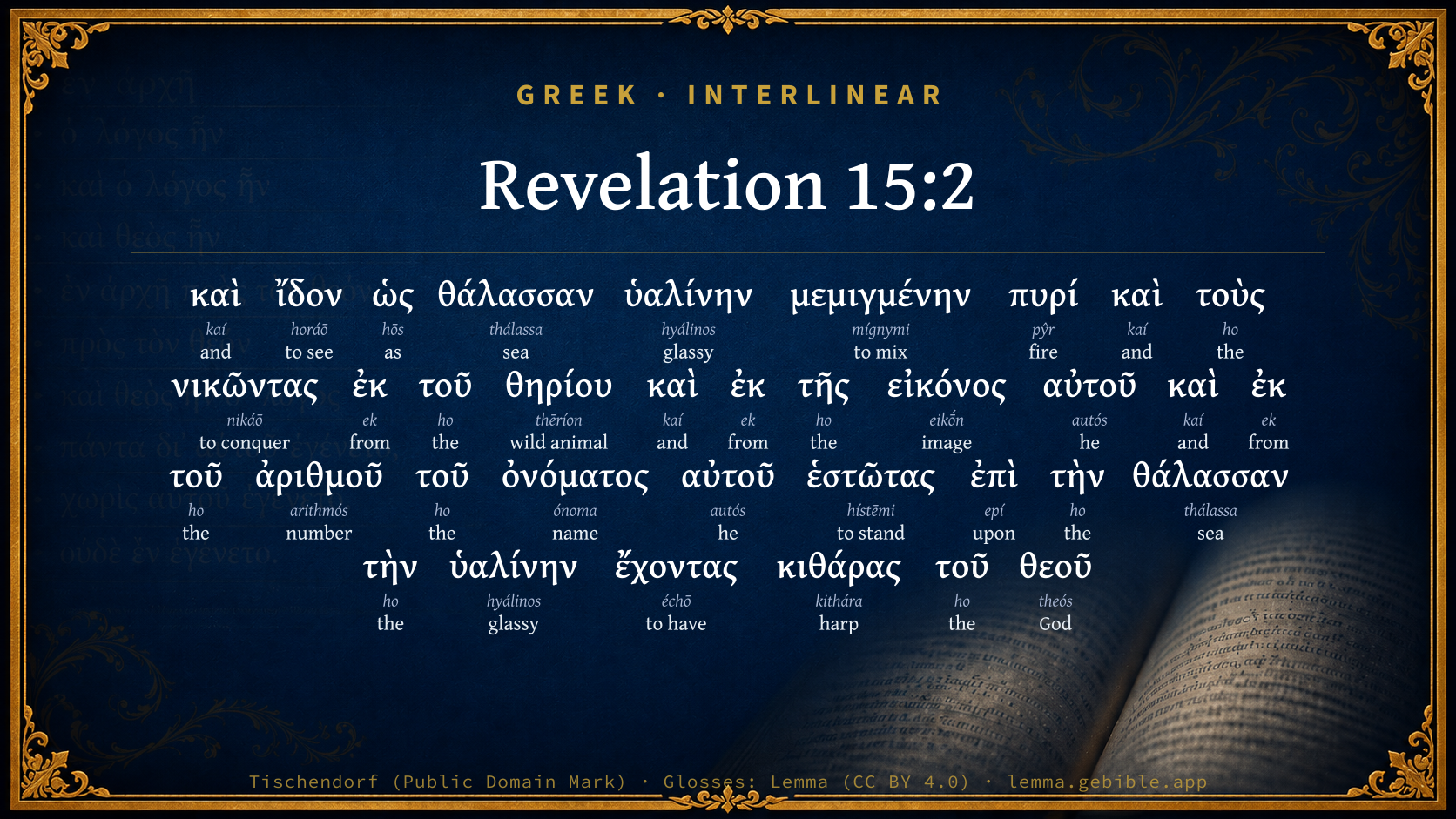
  1. καὶ kaí G2532 “and” Conjunction
  2. ἴδον horáō G3708 “to see” Verb, Aorist, Active, Indicative, 1st person, Singular
  3. ὡς hōs G5613 “as” Adverb
  4. θάλασσαν thálassa G2281 “sea” Noun, Accusative, Singular, Feminine
  5. μεμιγμένην mígnymi G3396 “to mix” Verb, Perfect, Passive, Participle, Accusative, Singular, Feminine
  6. πυρί pŷr G4442 “fire” Noun, Dative, Singular, Neuter
  7. καὶ kaí G2532 “and” Conjunction
  8. τοὺς ho G3588 “the” Article, Accusative, Plural, Masculine
  9. νικῶντας nikáō G3528 “to conquer” Verb, Present, Active, Participle, Accusative, Plural, Masculine
  10. ἐκ ek G1537 “from” Preposition
  11. τοῦ ho G3588 “the” Article, Genitive, Singular, Neuter
  12. θηρίου thēríon G2342 “wild animal” Noun, Genitive, Singular, Neuter
  13. καὶ kaí G2532 “and” Conjunction
  14. ἐκ ek G1537 “from” Preposition
  15. τῆς ho G3588 “the” Article, Genitive, Singular, Feminine
  16. εἰκόνος eikṓn G1504 “image” Noun, Genitive, Singular, Feminine
  17. αὐτοῦ autós G846 “he” Personal pronoun, Genitive, Singular, Neuter
  18. καὶ kaí G2532 “and” Conjunction
  19. ἐκ ek G1537 “from” Preposition
  20. τοῦ ho G3588 “the” Article, Genitive, Singular, Masculine
  21. ἀριθμοῦ arithmós G706 “number” Noun, Genitive, Singular, Masculine
  22. τοῦ ho G3588 “the” Article, Genitive, Singular, Neuter
  23. ὀνόματος ónoma G3686 “name” Noun, Genitive, Singular, Neuter
  24. αὐτοῦ autós G846 “he” Personal pronoun, Genitive, Singular, Neuter
  25. ἑστῶτας hístēmi G2476 “to stand” Verb, Perfect, Active, Participle, Accusative, Plural, Masculine
  26. ἐπὶ epí G1909 “upon” Preposition
  27. τὴν ho G3588 “the” Article, Accusative, Singular, Feminine
  28. θάλασσαν thálassa G2281 “sea” Noun, Accusative, Singular, Feminine
  29. τὴν ho G3588 “the” Article, Accusative, Singular, Feminine
  30. ὑαλίνην hyálinos G5193 “glassy” Adjective, Accusative, Singular, Feminine
  31. ἔχοντας échō G2192 “to have” Verb, Present, Active, Participle, Accusative, Plural, Masculine
  32. κιθάρας kithára G2788 “harp” Noun, Accusative, Plural, Feminine
  33. τοῦ ho G3588 “the” Article, Genitive, Singular, Masculine
  34. θεοῦ theós G2316 “God” Noun, Genitive, Singular, Masculine

About this verse

These counts appear in no published source. They are computed here, from the morphology-tagged text and Lemma’s own curated glosses. What Lemma adds →

35
words
20
distinct lemmas
Revelation
section

Notable vocabulary

The rarest word here is ὑαλίνην glassy G5193 — appearing just 3 times in the whole Greek New Testament.

Shared distinctive vocabulary

ὑαλίνην glassy G5193 occurs in 2 verses of the Greek New Testament. Also found in:

Repetition

Words recur within this verse:

  • θάλασσαν sea G2281 ×2
  • ὑαλίνην glassy G5193 ×2
  • τοὺς the G3588 ×8
  • καὶ and G2532 ×4
  • ἐκ from G1537 ×3
  • αὐτοῦ he G846 ×2

Cross-references

11

Topical passages linked to Revelation 15:2 in the Treasury of Scripture Knowledge — connected by theme and wording, ordered by reader-vote popularity; previews shown in the World English Bible.

  • Revelation 4:6 Before the throne was something like a sea of glass, similar to crystal. In the midst of the throne, and around the throne were four living creatures full of eyes before and behind.
  • Revelation 12:11 They overcame him because of the Lamb's blood, and because of the word of their testimony. They didn't love their life, even to death.
  • Revelation 5:8 Now when he had taken the book, the four living creatures and the twenty-four elders fell down before the Lamb, each one having a harp, and golden bowls full of incense, which are the prayers of the saints.
  • Revelation 19:1–7 After these things I heard something like a loud voice of a great multitude in heaven, saying, "Hallelujah! Salvation, power, and glory belong to our God:
  • 1 Peter 1:7 that the proof of your faith, which is more precious than gold that perishes even though it is tested by fire, may be found to result in praise, glory, and honor at the revelation of Jesus Christ--
  • Revelation 21:18 The construction of its wall was jasper. The city was pure gold, like pure glass.
  • Matthew 3:11 I indeed baptize you in water for repentance, but he who comes after me is mightier than I, whose shoes I am not worthy to carry. He will baptize you in the Holy Spirit.
  • Isaiah 4:4–5 when the Lord shall have washed away the filth of the daughters of Zion, and shall have purged the blood of Jerusalem from its midst, by the spirit of justice, and by the spirit of burning.
  • Revelation 13:14–14:5 He deceives my own people who dwell on the earth because of the signs he was granted to do in front of the beast; saying to those who dwell on the earth, that they should make an image to the beast who had the sword wound and lived.
  • Revelation 11:11–12 After the three and a half days, the breath of life from God entered into them, and they stood on their feet. Great fear fell on those who saw them.
  • 1 Peter 4:12 Beloved, don't be astonished at the fiery trial which has come upon you, to test you, as though a strange thing happened to you.

Cross-references courtesy of OpenBible.info (CC BY 4.0).

Where the printed editions differ

1 variant

Places in this verse where the major printed Greek editions disagree on the wording in a way that affects the translation — a comparison of editions, not a manuscript-by-manuscript collation. The editions are the modern critical texts (Nestlé-Aland 28/27, SBL, Westcott-Hort, Tregelles, Tyndale House) and the traditional texts behind the KJV (the Textus Receptus and the Byzantine/Majority text). It is not a claim about which reading is original.

  1. Extra text
    χαράγματος τοῦ ἐκ τοῦ

    “mark of it over the”

    In TR Not in NA28NA27TynSBLWHTregByz

    χαράγματος τοῦ ἐκ τοῦ (charagmatos tou ek tou) 'mark of it over the' is only in traditional manuscripts (TR)

Textual data: Translators Amalgamated Greek New Testament (STEPBible TAGNT) · CC BY 4.0.

Commentary

Notes on Revelation 15:2 from classic Christian and Jewish commentators (each source and its license shown beneath its notes). The classic Christian expositions comment on the surrounding passage and are grouped to its opening verse, so a note may address several verses; the Jewish commentaries on the Tanakh (Rashi and others) are per-verse, so they appear only where the commentator wrote on this verse.

Lemma curates 59 commentaries, every one of them public domain or Creative Commons licensed, each selected and text-cleaned for this edition rather than reprinted as found. About our sources →

The Cambridge Bible for Schools and Colleges

gen. ed. J. J. S. Perowne

The Triumph of the Victors over the Beast, Rev_15:2-8

2. a sea of glass mingled with fire] Probably describes an optical appearance much like that of Rev_21:18; Rev_21:21. It gives no reason for doubting that this is the same sea of glass as in Rev_4:6 : it is not till now that the Seer’s attention is specially directed to it, and he now describes it in more detail than before.

them that had gotten the victory over] Lit. them that overcame [the same word as “him that overcometh” in chapters Rev_2:3] from …: them that, as we might say, “fought their way clear of” all these dangers and temptations. R. V. “come victorious from.”

and over his mark] Should be omitted.

stand] Lit. standing.

on the sea] Perhaps literally, for “a sea of glass” would of course be a solid support; or if not, they might walk upon the sea like their Lord, sustained by faith. But perhaps no more is meant than when we speak of a town lying “on the sea:” this is supported by the fact that Israel sung the song of Moses on the shore, after their passage. And the Greek preposition used, though naturally translated “on,” is the same as in the phrase “stand at the door” in Rev_3:20.

harps] As Rev_5:8, Rev_14:2 : though the harpers here are not the same as in the first place nor (probably) as in the second.

The Cambridge Bible for Schools and Colleges (gen. ed. J. J. S. Perowne; Cambridge University Press, 1878–1918) — public domain. Text from a community e-Sword module.

Joseph Benson's Commentary

Rev 15:2-4. I saw as it were a sea of glass mingled with fire — It was before clear as crystal, (Rev 4:6,) but is now mingled with fire — Emblematical of the judgments whereby God’s enemies were about to be devoured; and them that had gained — Or were gaining, as τους νικωντας rather means; the victory over the beast and his image — And not submitted to his tyranny or religion, having steadfastly refused, though at the expense of their property, liberty, and lives, amidst so many who were devoted to him, to receive his mark, and the number of his name —

Expressions which seem to mean nearly the same thing; standing on the sea of glass — Which was before the throne; having the harps of God —

Given by him, and appropriated to his praise. And they sing, &c. — Like unto the people of Israel after their deliverance and escape out of Egypt, when, having passed through the Red sea, they stood on the shore; and, seeing their enemies overwhelmed with the waters, sung the triumphant song of Moses. So these, having passed through the fiery trials of this world, stand on a sea of glass, and, seeing the vials ready to be poured out upon their enemies, sing a song of triumph for the manifestation of the divine judgments, which is called the song of Moses and the song of the Lamb, because the words are, in a great measure, taken from the song of Moses and other parts of the Old Testament, and applied in a Christian sense; but chiefly because Moses was the minister and representative of the Jewish Church, as Christ is of the church universal: therefore it is also termed, the song of the Lamb. Saying, Great and marvellous are thy works — We acknowledge and know that all thy works, in and toward all the creatures, are great and wonderful; just and true are thy ways — With all the children of men, good and evil. Who shall not fear thee, O Lord — Stand in awe of thee, revere thy justice and thy power, and fear to offend thee; and glorify thy name — Honour and praise, love and serve thee; for thou only art holy — And in thy presence the holiness of all other beings disappears, as utterly unworthy to be mentioned. Or, as the words may be rendered, thou only art gracious, and thy grace is the spring of all thy wonderful works, even of thy destroying the enemies of thy people. Accordingly, in the 137th Psalm, that clause, for his mercy endureth for ever, is subjoined to the thanksgiving for his works of vengeance, as well as for his delivering the righteous. For all nations shall come and worship before thee — Shall serve thee as their king, and confide in thee as their Saviour with reverential joy: a glorious testimony this to the future conversion of all the heathen. The Christians are now a little flock; and they who do not worship God, an immense multitude. But all the nations, from all parts of the earth, shall come and worship him, and glorify his name. For thy judgments shall be made manifest — And then the inhabitants of the earth will, at length, learn to fear thee.

Joseph Benson's Commentary on the Old and New Testaments (1811–1818) — public domain. Text from a community e-Sword module.

MacLaren's Expositions of Holy Scripture

Alexander MacLaren

Revelation

THE SONG OF MOSES AND THE LAMB

Rev 15:2-3

The form of this vision is moulded partly by the circumstances of the Seer, and partly by reminiscences of Old Testament history. As to the former, it can scarcely be an accident that the Book of the Revelation abounds with allusions to the sea. We are never far from the music of its waves, which broke around the rocky Patmos where it was written. And the ‘sea of glass mingled with fire’ is but a photograph of what John must have seen on many a still morning, when the sunrise came blushing over the calm surface; or on many an evening when the wind dropped at sundown, and the sunset glow dyed the watery plain with a fading splendor. - Nor is the allusion to Old Testament history less obvious. We cannot but recognize the reproduction, with modifications, of that scene when Moses and his ransomed people looked upon the ocean beneath which their oppressors lay, and lifted up their glad thanksgivings. So here, by anticipation, in the solemn pause before the judgment goes forth, there are represented the spirits that have been made wise by conquest, as gathered on the bank of that steadfast ocean, lifting up as of old a hymn of triumphant thankfulness over destructive judgments, and blending the song of Moses and of the Lamb, in testimony of the unity of spirit which runs through all the manifestations of God’s character from the beginning to the end. Ever His judgments are right; ever the purpose of His most terrible things is that men may know Him, and may love Him; and ever they who see deepest into the mysteries, and understand most truly the realities of the universe will have praise springing to their lips for all that God hath done.

I. Notice the Triumphant Choir.

‘I saw them that had gotten the victory over the beast and over his image, and over the number of his name.’ Now I am not going to plunge into Apocalyptic discussions. It is no part of my business now either to ask or answer the question as to whether this Beast of the Revelation is a person or a tendency. I do not care, for my present purpose, whether, supposing it to be a person, an embodiment of certain tendencies, it is a person in the past or in the future; whether it was a veiled designation of the Emperor Nero, or whether it is a prophecy of some yet unborn human embodiment of transcendent wickedness. The question that I would ask is rather this, - Whoever the beast is, what makes him a beast? And if we will think about that, we may get some good out of it. What is the bestial element in him, whoever he be? And the answer is not far to find - Godless selfishness, that is ‘the mark of the beast.’ Wherever a human nature is self-centered, God-forgetting, and, therefore, God opposing {for whoever forgets God defies Him}, that nature has gone down below humanit3% and has touched the lower level of the brutes. Men are so made as that they must either rise to the level of God or certainly go down to that of the animal. And wherever you see men living by their own fancies, for their own pleasure, in forgetfulness and neglect of the sweet and mystic bonds that should knit them to God, there you see the image of the beast and the number of his name.’

But besides that godless selfishness, we may point to simple animalism as literally the mark of the beast. He who lives not by conscience and by faith, but by fleshly inclination and sense, lowers himself to the level of the instinctive brute-life, and beneath it, because he refuses to obey faculties which they do not possess, and what is nature in them is degradation in us. Look at the unblushing sensuality which marks many ‘respectable people’ nowadays. Look at the foul fleshliness of much of popular art and poetry. Look at the way in which pure animal passion, the lust of the flesh, and the lust of the eye, and the love of good things to eat, and plenty to drink, is swaying and destroying men and women by the thousand among us. Look at the temptations that lie along every street in our great cities, for every young man, after dusk. Look at the thin veneer of culture over the ugliest lust. Scratch the gentleman, and you find the satyr. Is it much of an exaggeration, in view of the facts of English life to-day, to say that all the world wonders after and worships this beast?

Further, notice that to escape from the power of the beast it is needful to fight one’s way out. The language of my text is remarkably significant. This Apocalyptic writer does not mind about grammar or smoothness so long as he can express his ideas; and he uses a form of speech here that makes the hair of grammatical purists stand on end, because it vigorously expresses his thought. He calls these triumphant choristers ‘conquerors out of the beast,’ which implies that victory over him is an escape from a dominion in which the conquerors, before their victory, were held. They have fought their way, as it were, out of the land of bondage, and, like revolted slaves, have won their liberty, and marched forth triumphant. The allusion to Israel’s exodus is probable. ‘Egypt was glad when they departed.’ So the bondsmen of this new Pharaoh recover freedom by conflict, and the fruit of their victory is entire escape from the tyrant.

That victory is possible. The Apocalypse shows us that there are two opposing Powers - this said ‘beast’ on the one side, and ‘the Lamb’ on the other. In the Seer’s vision these two divide the world between them. That is to say, Jesus Christ has conquered the bestial tendencies of our nature, the selfish godlessness which is apt to cast its spells and weave its chains over us all. The Warrior-Lamb, singular and incongruous as the combination sounds, is the Victor. He conquers because He is the Lamb of sacrifice; He conquers because He is the Lamb of innocence; He conquers because He is the Lamb of meekness, the gentle and, therefore, the all-victorious. By Christ we conquer. Through faith, which lays hold on His power and victory, we too may conquer. ‘This is the victory which overcometh the world, even our faith.’

Young men and women, may I make my appeal specially to you? Do not let yourselves be led away captives, like cattle to the shambles, by the fascinations and seductions of this poor, fleeting present. Keep your heel on the neck of the animal that is within you; take care of that selfish godlessness into which we all are tempted to fall. Listen to the trumpet-call that ought to stir your hearts, and summons you to freedom and to victory through the blood of the Lamb. And by humbly clasping Him as your Sacrifice, your Leader, and your Power, enroll yourselves amongst those who, in His own good time, shall come victorious out from the beast and from his image.

II. Still further, notice the position of this victorious chorus.

‘I saw as it were a sea of glass mingled with fire; and they stand on the sea of glass.’ Of course the propriety of the image, as well as the force of the original language, suggests at once that by ‘on the sea of glass’ here, we must understand, on the firm bank by its side. As Moses and the ransomed hosts stood on the shore of the Red Sea, so these conquerors are represented as standing on the safe beach, and looking out upon this sea of glass mingled with fire, which, calm, crystal, clear, stable, and yet shot through and through with the red lines of retributive judgment, sleeps above the buried oppressors.

Observe that besides its picturesque appropriateness and its historical allusion, this sea of glass has a distinct symbolical meaning. "We find it appearing also in the great vision in the fourth chapter, where the Seer beholds the normal and ideal order of the universe, which is - the central throne, the ‘Lamb that was slain’ in the interspace between the Throne and the creatures as mediator; and round about, the four living beings, who represent the fullness of creation, and the four and-twenty elders, who represent the Church in the Old and the New Covenants as one whole. Then follows, ‘before the Throne was a sea of glass,’ which cannot be any part of the material creation, and seems to have but one explanation, and that is that it means the aggregate of the Divine dealings. ‘Thy judgments are a mighty deep.’ Oh! the depth of the riches, both of the wisdom and of the knowledge of God; how unsearchable are His judgments and His ways past finding out.’ Such a signification fits precisely our present passage, for the sea here represents that beneath which the tyrant lies buried for evermore.

That great ocean of the judgment of God is crystalline-clear though deep. Does it seem so to us? Ah I we stand before the mystery of God’s dealings, often bewildered, and not seldom reluctant to submit. The perplexity arising from their obscurity is often almost torture, and sometimes leads men into Atheism, or something like it. And yet here is the assurance that that sea is crystal clear, and that if we cannot look to its lowest depths, that is not because there is any mud or foulness there, but partly because the light from above fails before it reaches the abysses, and partly because our eyes are uneducated to search its depths. In itself it is transparent, and it rises and falls without mire or dirt,’ like the blue Mediterranean on the marble cliffs of the Italian coast. If it is clear as far as the eye can see, let us trust that beyond the reach of the eye the clearness is the same.

And it is a crystal ocean as being calm. They who stand there have gotten the victory and bear the image of the Master. By reason of their conquest and by reason of their sympathy with Him they see that what to us, tossing upon its surface, appears such a troubled and tempestuous ocean, as calm and still. As from some height, looked down upon, the ocean seems a watery plain, and all the agitation of the billows has subsided into a gentle ripple on the surface, so to them looking down upon the sea that brought them thither, it is quiet - and their vision, not ours, is the true one.

It is a ‘sea of glass mingled with fire.’ Divine acts of retribution as it were flash through it, if I may so say, like those streaks of red that are seen in Venice glass, or like some ocean smitten upon the one side of every wave by a fiery sunlight, while the other side of each is dark. So through that great depth of God’s dealings there flashes the fire of retribution. They who have conquered the animal, the godless self, see into the meaning and the mercifulness of God’s dealings with the world; and we here, in the measure in which we have become victors over the rude animalism and the more subtle selfishness that tend to rule us all, and in the measure in which we bear the image of Jesus Christ, and therefore have come into sympathy with Him, may come to discern with some clearer understanding, and to trust with more unfaltering faith, the righteousness and the mercy of all that God shall do.

III. Lastly, notice the occasion of the song, and the song itself.

‘They sing the song of Moses and of the Lamb.’ The Song of Moses was a song of triumph over destructive judgment; the Song of the Lamb, says the text, is set on the same key. The one broad, general lesson to be drawn from this, is one on which I have no time to touch, viz., the essential unity, in spite of all superficial diversities, of the revelation of God in the Old Covenant by law and miracle and retributive acts, and the revelation of God in the New Covenant by the Cross and Passion of Jesus Christ. Men pit the Old Testament against the New; the God of the Old Testament against the God of the New. They sometimes tell us that there is antagonism. Modern teachers are wanting us to deny that the Old is the foreshadowing of the New, and the New the fulfilment of the Old. My text asserts, in opposition to all such errors, the fruitful principle of the fundamental unity of the two; and bids us find in the one the blossom and in the other the fruit, and declares that the God who brought the waters of the ocean over the oppressors is the God that has mercy upon all, in Jesus Christ, His dying Son.

And there is another principle here, upon which I need not do more than touch, for I have already anticipated much that might have been said about it, and that is the perfect harmony of the retributive acts of God’s destructive dealings in this world, and the highest conception of His love and mercy which the gospel brings us. ‘When the wicked perish,’ says one of the old proverbs, ‘there is shouting.’ And so there ought to be. When some hoary oppression that has been deceiving mankind for centuries, with its instruments and accomplices, is swept off the face of the earth, the more men have entered into the meaning of Jesus Christ’s mission and work, and the more they feel the pitying indignation which they ought to feel at seeing men led away by evil, and made miserable by oppression, the more they will rejoice. God’s dealings are meant to manifest His character and that in order that all men may know and love Him. We may, therefore, be sure, and keep firm hold of the confidence, that whatever He doeth, however the methods may seem to vary, comes from one unalterable and fixed motive, and leads to one unalterable and certain end. The motive is His own love; the end the glory of His Name, in the love and knowledge of men whose life and blessedness depend on their knowing and loving Him.

So, dear friends, do not let us be too swift in saying that this, that, and the other thing are inconsistent with the highest conceptions of the Divine character. I believe, as heartily as any man can believe, that God has put His witness in our consciences and minds, and that all His dealings will comply with any test that man’s reason and man’s conscience and man’s heart can subject them to. Only we have not got all the materials; we look at half -finished work; our eyes are not quite so educated as that we can pronounce infallibly, on seeing a small segment of a circle, what are its diameter and its sweep.

I am always suspicious of that rough-and-ready way of settling questions about God’s revelation, when a man says: I cannot accept this or that because it contradicts my conception of the Divine nature.’ Unless you are quite sure that your conceptions are infallibly accurate, unless you deny the possibility of their being educated, you must admit that agreement with them is but a leaden rule. And it seems to me a good deal wiser, and more accordant with the modesty which becomes us, to be cautious in pronouncing what does or does not befit God to do, and, until we reach that loftier point of vision, where being higher up we can see deeper down, to say ‘the Judge of all the earth must do right. If He does this, then it is right.’ At any rate let us lay hold of the plain truth: ‘O Lord! Thou preservest man and beast,’ and then we may venture to say, ‘Thy judgments are a mighty deep,’ and beneath that deepest depth, as the roots of the hills beneath the ocean, is God’s righteousness, which is like the great mountains.

The last thought that I would suggest is that, according to the teaching of my text, we may take that old, old story of the ransomed slaves and the baffled oppressor and the Divine intervention and the overwhelming ocean, as prophecy full of radiant hope for the world. That is how it is used here. Pharaoh is the beast, the Red Sea is this ‘sea of glass mingled with fire,’ the ransomed Israelites are those who have conquered their way out of the dominion of the beast, and the song of Moses and of the Lamb is a song parallel to the cadences of the ancient triumphant chorus, and celebrating the annihilation of that power which drew the world away from God. So we may believe that as Israel stood on the sands, and saw the Egyptians dead on the seashore, humanity will one day, delivered from all its bestiality and its selfishness, lift up a song of thanksgiving to the conquering King who has drowned its enemies in the depths of His own righteous judgments.

And as for the world, so for individuals. If you take the Beast for your Pharaoh and your task-master, you will ‘sink’ with him ‘like lead in the mighty waters.’ If you take the Lamb for your sacrifice and your King, He will break the bonds from off your arms, and lift the yoke from your neck, and lead you all your lives long; and you will stand at last, when the eternal morning breaks, and see its dawn touch with golden light the calm ocean, beneath which your oppressors lie buried for ever, and will lift up glad thanksgivings to Him who has washed you from your sins in His own blood, and made you victors over ‘the beast, and his image, and the number of his name.’

Alexander MacLaren, Expositions of Holy Scripture (1904–1910) — public domain. Text from a community e-Sword module.

Tyndale Open Study Notes

Tyndale Open Resources

15:2 The glass sea mixed with fire symbolizes victory through testing. Those who had been victorious over the beast (see 13:1-8, 15-18) hold harps that represent ultimate peace. Their place on the glass sea (cp. 4:6) symbolizes their endurance in the fire of persecution (cp. Ps 66:12; Isa 43:2; Dan 3:8-30).

Tyndale Open Study Notes — © Tyndale Open Resources, licensed CC BY-SA 4.0. Text via the HelloAO Bible API.

Bengel's Gnomon

Johann Albrecht Bengel

Rev 15:2. [172] Νικῶντας ἐκ) A phrase of rare occurrence; but that of Lycurgus, contra Leocr., is similar, τί ποιῶν ἂν νίκην λάβοι παρὰ τῶν πολεμίων. As to the preposition, the LXX. have, ποιεῖν ἐκδίκησιν ἐκ τῶν ἐχθρῶν, κ.τ.λ.—καὶ ἐκ τοῦ ἀριθμοῦ τοῦ ὀνόματος αὐτοῦ) After καὶ there is added by Erasmus, ἐκ τοῦ χαράγματος αὐτοῦ.[173] And this is the reading of about two or three MSS., which are so intimately related to one another, that they are, as it were, but one, and even these of themselves discover the gloss, by introducing various readings into the text. See App. on this passage. In fact there are not three things spoken of: but the name of the beast, OR the number of his name (disjunctively), is the mark itself. The mark (“character”) is the genus: there are two species, the name of the beast, and the number of his name. Hence it is that the mark (“character,” characterism) of the beast is spoken of for the most part indefinitely: ch. Rev 14:9, Rev 16:2, Rev 19:20, Rev 20:4; but when used definitely, it is either the mark (“charagma,” characteristic) of his name separately, as ch. Rev 14:11, or the number of his name separately, as here. For the one of these is included in the notion of the other: or at one time it is the name of the beast, at another, the number of his name, that more prevails. The preposition, ἐκ, is here used several times, as ch. Rev 18:20.—ἑστῶτας ἐπὶ τὴν θάλασσαν τὴν ὑαλίνην, standing at the sea of glass) ἐπὶ with an accusative, and with this very verb of standing, denotes either above, on, ch. Rev 7:1, Rev 11:11, Rev. 12:18 [Engl. Vers. Rev 13:1], Rev 14:1, or near, at, ch. Rev 3:20.

[172] Ver. 1. ἐτελέσθη, is consummated) After this consummation there are at hand better things.—V. g.

[173] These words are retained in Rec. Text in opposition to ABC Vulg.—E.

Bengel's Gnomon of the New Testament — English translation (T&T Clark, Edinburgh, 1860) — public domain. Text from a community e-Sword module.

Meyer's Critical & Exegetical Commentary

Heinrich August Wilhelm Meyer

Rev_15:2-4. Before the beginning of the last plagues, immediately preceding the end itself, yea before the opening of the heavenly νάος (Rev_15:5), and accordingly even before the actual coming-forth of the seven angels,[3610] a song is heard in heaven which proclaims the righteousness of the ways of God, now near their ultimate goal as worthy of adoration,[3611] and whose sense declares that they who, standing by the sea of glass, raise this song of praise, are the victors over the beast.

ὠς θάλασσαν ὑαλίνην μεμιγμένην πυρί. Ebrard is wrong in understanding here a different sea of glass from that in Rev_4:6; for the article missed by Ebrard must be lacking, because by the expression ὡς θαλ. ὑαλ., just as in Rev_4:6, it is chiefly to be indicated that not an actual sea of glass, but only something like a sea of glass, is designated. It is not until at the close of Rev_15:2, that, since by the first accurate expression recalling Rev_4:6, ὡς θάλ. ὑαλ., an end is placed to all misunderstanding, it is expressly said, with a certain want of precision, ἐπὶ τἡν θάλ. τὴν ὑαλ. That the addition μεμιγμένην πυρί cannot be referred here to any thing else than in Rev_4:6, follows likewise from the close of Rev_15:2, which shows that the essential designation of what is meant lies in the words θαλ. ὑαλιν., while the μεμιγμ. πυρί expresses a more special, although in this place a significant, side-reference. Because of the addition μεμιγμ. πυρί, the false interpretations of ὡς θάλ. ὑαλίν., Rev_4:6, appear here in new applications. Grot. understands here the mass of Gentile Christians inflamed with love to God; Coccejus, the peace of the world, and the operation of the Holy Spirit in the world; Calov., who refers the θάλ. to baptism, and the πὺρ to Gods wrath, interprets: That grace will not be denied to penitents in the midst of the flames of Divine wrath; Vitr. explains that the victors stand upon the firm ground of the truth illumined by the fire of Divine righteousness; the allusion to the lightning, Rev_4:5, Eichh. and De Wette interpret as meaning the atmosphere; Züll. and Ewald, the floor of heaven; while De Wette, Hengstenb., Ebrard, Stern,[3612] maintain a reference to the Red Sea, at which the children of Israel sang their song of praise. But it is just this passage[3613] which, because of its other contents, is adapted for furnishing the correct interpretation also for Rev_4:6. That which is like a sea of glass, by which[3614] the victors stand, designates, like the river of life,[3615] the eternal fulness of joy in Gods presence, with which the victors will be rewarded. But if, in this passage; the sea appears also as mingled with fire, thereby the unity of Gods saving grace and judging righteousness is designated in like manner; as already in the fundamental description of the glory of God, Rev_4:3 sqq.,[3616] both points are harmoniously[3617] presented, and, as in general in prophecy concerning the end, both parts of the subject belong together.

τοὺς νικῶντας. The pres. part.[3618] designates the idea without regard to time.[3619]

ἘΚ Τ. ΘΗΡ. Winer, p. 345. On the subject, cf. Rev_13:7; Rev_13:15 sqq, Rev_14:13.

ἜΧ. ΚΙΘΆΡΑς ΤΟῦ ΘΕΟῦ. Cf. Rev_5:8, Rev_14:2, 1Ch_16:42. The harps of God are such as serve only for the praise of God.[3620]

The song is characterized as: ΤῊΝ ᾨΔῊΝ ΜΩΫΣΈΩς ΤΟῦ ΔΟΎΛΟΜ ΤΟῦ ΘΕΟῦ ΚΑῚ ΤῊΝ ᾨΔῊΝ ΤΟῦ ἈΡΝΊΟΥ. It is not two songs that are designated;[3621] also no allusion whatever is made to the connection between prophecy and the gospel;[3622] altogether false is every explanation that does not acknowledge that the song immediately following, introduced by the ΛΈΓΟΝΤΕς, is at the same time both the song of Moses[3623] and the song of the Lamb. But this does not mean the song wherein these former idol-worshippers declare their conversion to Moses and Jesus, or rather to the God of these,[3624] nor the song of Moses[3625] applied to Christ and the things of Christ;[3626] but the song which is composed alike by Moses and the Lamb, and is taught to the victors.[3627] By this the same view is significantly expressed, which appears in another way also in Rev_10:7, Rev_7:9 sqq., in combination with Rev_7:4 sqq. and Rev_14:1; viz.,[3628] that the essential unity of the O. and the N. T. Church, which collects its victorious members from Jews and Gentiles, is attested and represented in the most definite manner,a view which is absolutely incompatible with the Judaism charged against the Apoc. by Baur, Volkm., etc. [See Note LXXVIII., p. 413.] The song has the O. T. psalm tone, as what is in clear accord with the O. T. manifests itself everywhere in the details.[3629] In a more definite form the character of a song of the Lamb is not distinctly expressed; but in fact it is also such, because the ΔΙΚΑΙΏΜΑΤΑ of God serve for the glory of the Lamb.

ΜΕΓΆΛΑ ΚΑῚ ΘΑΥΜΑΣΤᾺ, Κ.Τ.Λ. Cf. Psa_111:2; Psa_139:14; 1Ch_16:9.

ΚΎΡΙΕ

ΠΑΝΤΟΚΡΆΤΩΡ Rev_4:8, Rev_11:17. Cf. Rev_1:8.

ΔΊΚΑΙΑΙ ΚΑῚ ἈΛΗΘΙΝΑῚ ΑἹ ὉΔ. Σ. Psa_145:17; Deu_32:4.[3630]

ὁ βασιλεὺς τῶν ἐθνῶν. Jer_10:7. From this passage originate also the following words,[3631] and just in this way is the ascription of praise especially appropriate, because treating of the judgments on the Gentile world, which gives divine honor to the beast.[3632]

ὅτι, κ.τ.λ. Of the three clauses introduced by the ὅτι, the first two are co-ordinated with each other, since the former in its way gives the basis for the interrogatory τίς

τὸ ὄνομά σου, and the last words ὅτι τὰ δικαιώμ. σ. ἐφαν. that for the immediately preceding clause ὅτι πάντα, κ.τ.λ.

μόνος-g0- ὅσιος-g0-. The variation ἅγιος arises from the classical linguistic prejudice, according to which the predicate ὅσιος, which in the N. T. is said only (Rev_16:5) of God, is applied to godly men.[3633]

Although the words ὅτι μόνος ὄσιος present the alone holiness of God simply as the ground because of which every one must fear him, and the name of God be praised by every one, the fundamental reference to the succeeding words is not so readily afforded. The interposition of the first clause ὅτι μόν. ὅσ. modifies in a certain degree the inner connection, in the sense that the words ὅτι πάντα τὰ ἔθνη, κ.τ.λ., which express the sum of the O. T. prophecies concerning the conversion of the Gentilesand that, too, in its universality, so that the question is not that in fact only a certain number of the heathen are convertedgive the foundation for the thought of the question, τίς οὐ μῂ φοβ., κ.τ.λ.: Thee, who art the King of the nations, every one must and certainly shall fear, for all the nations shall adore Thee as their King.

ὅτι τὰ δικαιώματά σου ἐφανερώθησαν. For, from the works and judgments which the righteousness of God has executed, and in which he has been revealed as the βασιλεὺς τῶν ἐθνὼν, the nations shall learn to know his adorable name.[3634]

[3610] Cf. Rev_15:1.

[3611] Cf. Rev_11:15 sqq.; also Rev_4:8, Rev_5:8 sqq.

[3612] Who recognizes in the θαλ. ὑαλ. μεμ. πυρ. a symbol of the antichristian persecution.

[3613] Cf. Rev_22:1.

[3614] Beng., De Wette, etc. Cf. Rev_3:20, Rev_8:3. The explanation of the ἑπί by super, which is in itself unnatural, and does not harmonize with the scenery of Rev_4:6, coheres with the false allegorizing In Vitr., etc.

[3615] Rev_22:1 sqq.

[3616] Cf. especially Rev_4:5.

[3617] Out of harmony, and in violation of taste, Ew. thinks that by the mingling of sea and fire an indescribable boiling foam, a fire-broth, originated.

[3618] Incorrectly, Eichh.: νενικηκότας.

[3619] Cf. Rev_14:13, Rev_2:7; Rev_2:11; Rev_2:17.

[3620] Beng., etc.

[3621] Against Andr., who refers the one to the O. T. saints, and other to the N. T. believers.

[3622] Coccejus.

[3623] Concerning whose formal designation as τ. δούλ. τ. θ., cf. Exo_14:31; Num_12:7; Jos_14:7; Jos_22:5. The LXX. do not have here the word δοῦλος.

[3624] Züll.

[3625] Exodus 15.

[3626] Grot.; cf. Calov., Vitr., De Wette, Hengstenb., Ebrard.

[3627] Cf. Rev_14:3. Ew.

[3628] Cf. also Rev_12:1; Rev_12:17.

[3629] Cf. Züll., De Wette.

[3630] LXX.: ἀληθινά for תָּמִים. Cf., on the other hand, Rev_3:14.

[3631] Only that σε after φοβ. does not belong to the correct text.

[3632] Cf. Rev_13:4.

[3633] Cf. Schol. on Eurip., Hecub. 788: τὸ πρὸς θεοὺς ἐξ ἀνθρώπων γενόμενον δίκαιον ὅσιον καλοῦμεν [We call one among men who is just with respect to the gods, ὅσιον].

[3634] Exo_9:16; Exo_14:17 sq.; Psa_126:2; Mic_7:16 sqq.

NOTES BY THE AMERICAN EDITOR

LXXVIII. Rev_15:3. τὴν ᾠδὴν Μωυσέως, κ.τ.λ.

So Alford: It betokens the unity of the O. and N. T. Churches. Their songs of triumph have become ours; the song of Moses is the song of the Lamb. In this great victory all the triumphs of Gods people are included, and find their fulfilment. Gebhardt (p. 255): That is, Christians above, after they have overcome all the temptations of antichrist, look upon the holy and righteous judgments of God, or his works and ways with the world, as once Israel looked upon the plagues of Egypt and the Red Sea,indeed, in these visions, the Egyptian plagues frequently furnish the type,they sing the song of the deliverance of their persons, the song of salvation, as the children of Israel once sung it (Exodus 15), in its Christian fulfilment. Christian salvation is essentially that of the O. T., the completion once prepared, but now begun. J. Gerhard (L. T., xviii. 17): Because the Church triumphant consists of saints of the O. and the N. T.; and just as the Israelites, after their deliverance from Pharaonic bondage, praised God in the song of Moses (Exodus 15), so the blessed, after their deliverance from the tyranny of persecutors, and all the adversities of this life, praise God in the song of the Lamb, or Christ.

Meyer — Critical and Exegetical Commentary on the New Testament — English translation by Peter Christie, edited by Frederick Crombie (T&T Clark, 1880) — public domain. Text from a community e-Sword module.

Expositor's Greek Testament

ed. W. Robertson Nicoll

Rev 15:2-4 . An interlude like Rev 19:1 f. The manifestation of divine judgment (4) evokes reverence (contrast Rev 16:11 ) and praise from the saints in heaven.

Rev 15:2 . νικ . ἐκ κ . τ . λ ., “those who came off conquerors from” another pregnant use of ἐκ ( cf. Rev 2:21 , Rev 8:11 ) combining the ideas of victory over ( cf. on Rev 2:7 ) and deliverance from. A possible Latinism ( cf. L ivy 8:8, uictoriam ferre ex aliquo; 45:38, aliquis est Romae qui triumphari de Macedonis nolit?)? The prophet paints the downfall of the Roman persecutor in terms of the Jewish tradition preserved, e.g. , in Targ. Jerus. (on Exo 12:42 ) which singled out four memorable nights, that of the creation, that on which God’s promise of a son came to Abram, that of the tenth Egyptian plague, and that on which the world is ended (when Moses appears in a cloud from the wilderness and messiah in a cloud from Rome, led by the Word of the Lord). cf. Schemoth Rabba on Exo 12:2 : ex quo Deus mundum suum elegit, determinauit principium mensis redemptionis, quo liberati sunt Israelitae ex Aegypto, et quo liberabuntur futuro saeculo. In time as well as in method ( cf. on Rev 8:6 , and 1Co 10:1-11 ) the two redemptions, Mosaic and messianic, are to correspond. πυρί , a truly Red sea, red with the glow of God’s wrath. Like Pharaoh and his host (Exo 15:5 ; Exo 15:10 = Rev 18:21 ) the persecutors of God’s people in these latter days not only fail to effect their purpose, but are themselves destroyed by God’s vengeance ( cf. Rev 16:2 ). The faithful get through their sea of troubles, resisting threats and persuasions, and now stand safe at ( i.e. , on the shore of) the heavenly sea. “Duteous mourning we fulfil / In God’s name; but by God’s will / Doubt not the last word is still / victory” (D. G. Rossetti). Here, as at Rev 12:11 the thrill of triumph is enhanced by the fearful odds against which the saints had to contend. Apparently the world is now tenanted by pagans only, God’s faithful having been removed. Hence the plagues are all-embracing (contrast Rev 7:1 f.). Cf. Rev 20:4 .

The Expositor's Greek Testament, edited by W. Robertson Nicoll (1897–1910) — public domain. Text from a community e-Sword module.

Geneva Bible (1599)

Geneva Bible translators

Glorified God, from the particular observation of the weapons and instruments of God’s wrath, floating in the sea of glass.

This part of the vision alludeth unto the sea or large vessel of brass in which the Priests washed themselves in the entrance of the Temple: for in the entrance of the heavenly Temple (as it is called, verse 5) is said to have been a sea of glass, most lightsome and clear, unto the commodity of choice mixed with fire, that is, as containing the treasury of the judgments of God, which he bringeth forth and dispenseth according to his own pleasure: for out of the former, the Priests were cleansed of old and out of this the ungodly are destroyed now, Rev. 4:6.

There are two parts of the narration: one the confession of the Saints glorifying God, when they saw that preparation of the judgments of God, unto verse 4: another the vocation, instruction, and confirmation of those instruments which God hath ordained for the execution of his judgments, in 4 other verses.

That is, the Godly martyrs of Christ, who shall not give place even in miracles unto that beast: of these, see before, Rev. 13:17 and 14:9, 10.

Geneva Bible (1599) marginal notes — public domain. Text via Bolls.life.

Jamieson, Fausset & Brown

Robert Jamieson, A. R. Fausset & David Brown

sea of glass--Answering to the molten sea or great brazen laver before the mercy seat of the earthly temple, for the purification of the priests; typifying the baptism of water and the Spirit of all who are made kings and priests unto God.

mingled with fire--answering to the baptism on earth with fire, that is, fiery trial, as well as with the Holy Ghost, which Christ's people undergo to purify them, as gold is purified of its dross in the furnace.

them that had gotten the victory over--Greek, "those (coming) off from (the conflict with) the beast-conquerors."

over the number of his name--A, B, C, Vulgate, Syriac, and Coptic omit the words in English Version, "over his mark." The mark, in fact, is the number of his name which the faithful refused to receive, and so were victorious over it.

stand on the sea of glass--ALFORD and DE BURGH explain "on (the shore of) the sea": at the sea. So the preposition, Greek, "epi," with the accusative case, is used for at, Rev 3:20. It has a pregnant sense: "standing" implies rest, Greek "epi" with the accusative case implies motion "towards." Thus the meaning is, Having come TO the sea, and now standing AT it. In Mat 14:26, where Christ walks on the sea, the Greek oldest manuscripts have the genitive, not the accusative as here. Allusion is made to the Israelites standing on the shore at the Red Sea, after having passed victoriously through it, and after the Lord had destroyed the Egyptian foe (type of Antichrist) in it. Moses and the Israelites' song of triumph (Exo 15:1) has its antitype in the saints' "song of Moses and the Lamb" (Rev 15:3). Still English Version is consistent with good Greek, and the sense will then be: As the sea typifies the troubled state out of which the beast arose, and which is to be no more in the blessed world to come (Rev 21:1), so the victorious saints stand on it, having it under their feet (as the woman had the moon, see on Rev 12:1); but it is now no longer treacherous wherein the feet sink, but solid like glass, as it was under the feet of Christ, whose triumph and power the saints now share. Firmness of footing amidst apparent instability is thus represented. They can stand, not merely as victorious Israel at the Red Sea, and as John upon the sand of the shore, but upon the sea itself, now firm, and reflecting their glory as glass, their past conflict shedding the brighter luster on their present triumph. Their happiness is heightened by the retrospect of the dangers through which they have passed. Thus this corresponds to Rev 7:14-15.

harps of God--in the hands of these heavenly virgins, infinitely surpassing the timbrels of Miriam and the Israelitesses.

Jamieson, Fausset & Brown — Commentary Critical and Explanatory on the Whole Bible (1871) — public domain (CC PDM 1.0). Text via the HelloAO Bible API.

Adam Clarke's Commentary

Verse 2. A sea of glass] A spacious lucid plain around the throne, from which fiery coruscations were continually emitted: or, the reflection of the light upon this lucid plain produced the prismatic colours of the most vivid rainbow.

Over the beast, and over his image] See the notes on Re 13:1-18.

Adam Clarke's Commentary on the Bible (1810–1826) — public domain. Text from a community e-Sword/MySword module.

Ellicott's Commentary for English Readers

(2) And I saw as it were a sea of glass mingled with fire.—The wild beast rose out of the sea (Rev_13:1); the evil-hearted woman sits upon many waters (Rev_17:1); they draw strength from the wild, and ungoverned, and short-sighted impulses of human passion; in opposition to this near the throne of God is the calm and translucent sea of God’s counsels of righteousness and love, now clear as crystal, now ruddy with the fire of righteous indignation, the expression of His eternal will against sin. Such is the appearance of this glass-like sea now that the angels of the plagues are going forth.

But the seer saw more than this fire-flushed sea. He saw also those that are victorious over the wild beast. These he describes (such is the literal translation) as those who conquer out of the wild beast, &c.; they come off conquerors out of the struggle, and they escape from the temptation to worship his image and wear the badge of his service: they “escape victorious from” his image and from his mark. When he sees these, they are standing upon (i.e., on the shore of) the sea of glass, holding harps of God. We have had the harps mentioned previously (Rev_5:8; Rev_14:2); it is appropriate. The life which has been a discord to the world rises into true music before God; those who will make their life a melody must take it first as a conflict. The harps they hold are called harps of God, not merely because they are dedicated to Him. but because they are truly God’s. All the most glorious and noble things in nature were named God’s: the lofty trees were “trees of God “; the high-piled mountains were “mountains of God “; so also the harps which strike forth the richest music are “harps of God.” Nor is this a mere phrase to be considered as equivalent to very great or very glorious; great and glorious the trees, hills, and harps are, but only a prosaic or a profane mind can be satisfied with such a naked equivalent. The godly saw the hand of God in these things; and St. John knows that the noblest melody in the ears of God is the noble life of faith, suffering, and love. The power of such a life is in God, not in itself (Joh_15:5; Gal_2:20), and the music of such a life is music which God makes (2Co_4:7-10), drawing the sweetest tones from the strings which are smitten with pain and sorrow; and as its life’s music is God-taught, so does its song of triumph sound from a harp not its own, but God’s. If our power to sing in trial here a song worthy of God is only found in God, so will the songs of heaven be sweet only in Him, for those who dwell there shall be all taught of Him.

A Bible Commentary for English Readers, edited by Charles John Ellicott (1878–1897) — public domain. Text from a community e-Sword module.

John Gill's Exposition

And I saw, as it were, a sea of glass mingled with fire,.... Not baptism, but rather the blood of Christ, which may be compared to a sea, for its abundant virtue and efficacy in cleansing from all sin; and to a sea "of glass", since in it are clearly seen free justification, full pardon, peace and reconciliation; and may be said to be "mingled with fire", being attended in the application of it with the Spirit of God, whose gifts and graces are sometimes signified by fire: and so, according to others, this sea may represent the pure church of God, as washed in the blood of the Lamb; compared to a sea for the multitude of which it consists, and to a sea of glass, because of the transparency and clearness of its principles and practices, and may be said to be mingled with the fire of love and zeal: most interpreters understand it of the world, which is like a sea for the multitude of its inhabitants; and sometimes to a troubled one, because of the restlessness and disquietude of the wicked in it; but here it is like a sea of glass, for the quiet, and peace, and rest it shall be in at this time; though it is commonly said to be like such a sea, partly because all things are manifest, and open to an omniscient God; and partly because of its outward splendour, and the brittleness, frailty, and transitoriness of it; and to be mixed with fire, either because of the light of the Gospel, and the operation of the Spirit in the hearts of some that are in it, or because of the afflictions and persecutions the saints in it; though it seems best of all to understand it of the Gospel, as in See Gill on Rev 4:6; and which may be said to be mingled with fire, either because of the powerful and clear demonstration of the Spirit that attends it to the minds of many, or that heat of persecution which is raised by it; see Luk 12:49 or rather it denotes the purity of the Gospel in those times, its general spread, and the great zeal and fervour of the professors of it, since persecution will now be at an end.

And them that had gotten the victory over the beast; over antichrist, signified the beast, that rose up out of the sea, and out of the earth, Rev 13:1 and which are the same, and were but one, though in different forms, as from hence appears: the beast first overcame the saints, by slaying of them; and they overcame him by the blood of the Lamb, and by the word of their testimony, by preaching and professing the Gospel, by their close and constant adherence to it, and by dying for it:

and over his image; caused by him to be made to the first beast; and is no other than the Popish religion, which bears a resemblance to Paganism; and which the saints may be said to get the victory over, by standing out against it, opposing and refuting it, not giving into it, but bearing their testimony against it:

and over his mark; refusing to receive it either in their forehead, or in their right hand; that is, either to swear allegiance to him, or profess his religion. This clause is wanting in the Alexandrian copy, Vulgate Latin, Syriac. Arabic, and Ethiopic versions:

and over the number his name; that is, they would not own his supremacy and authority, nor embrace his doctrines, nor obey his orders, nor be reckoned his followers in any form or shape; see Rev 13:15. These conquerors John saw

stand on the sea of glass; which, if applied to the blood of Christ, shows that these confessors were purified by it, and were more than conquerors through it; that they were come out of great tribulation, and had washed their garments, and made them white in the blood of the Lamb; and were just come up from the washing, and stood upon, or rather by, or "near the sea", as the Arabic version renders it, in allusion to the priests at the molten sea, in the temple: but if the world is meant by the sea, their standing upon it designs their victory and triumph over it by faith, their having it under their feet, and their contempt of it; but rather, since the Gospel is intended, it may denote their solid standing upon the doctrines of it, the foundation of the apostles and prophets, and their steadfast continuance in them, and faithful abiding by them, whereby they got the victory over antichrist:

having the harps of God: their hearts in an excellent frame, tuned and disposed by God, to sing his praise, and set forth his glory; having them filled with spiritual joy and gladness, and with great thankfulness, on account of their victory, the happy state of Christ's church, and the destruction of its enemies: the allusion is to the people of Israel, Moses and the men, and Miriam and the women with timbrels and dances standing on the sea shore, when the Egyptians were destroyed, singing the praises of God; as is still more manifest from the following verse.

John Gill's Exposition of the Whole Bible (1746–1763) — public domain (CC PDM 1.0). Text via the HelloAO Bible API.

Trapp's Complete Commentary

John Trapp

2 And I saw as it were a sea of glass mingled with fire: and them that had gotten the victory over the beast, and over his image, and over his mark, and over the number of his name, stand on the sea of glass, having the harps of God.

Ver. 2. As it were a sea of glass] The word of God mingled with the virtue of the Holy Ghost, say some. The world full of affliction, say others.

Having the harps of God] Hearts full of heaven.

John Trapp, A Commentary or Exposition upon All the Books of the Old and New Testament (1647–1656) — public domain. Text from a community e-Sword module.

Albert Barnes' Notes on the Bible

And I saw as it were a sea of glass - In Rev 4:6, a similar vision is recorded - “And before the throne there was a sea of glass, like unto crystal.” See the notes on that passage. The sea of glass here means a sea clear, pellucid, like glass: an expanse that seemed to be made of glass. There it was entirely clear; here it is mingled with fire.

Mingled with fire - That is, a portion of the sea was red like fire. It was not all clear and pellucid, as in Rev 4:6, but it was as it were a tesselated expanse, composed in part of what seemed to be glass, and in part of a material of a red or fiery color. In the former case Rev 4:6, the emblem was designed to represent the pure worship of heaven without reference to any other symbolic design, and hence, the sea is wholly clear and pellucid; here, in connection with the purpose of furnishing an appropriate symbol of the divine majesty, there is united the idea of punishment on the foes of God, represented by the fiery or red color. If it is proper, from conjecture, to suggest the meaning of this as an emblem, it would be that the foundation - the main element - of all the divine dealings is justice or holiness - represented by the portion of the sea that seemed to be glass; and that there was, in this case, intermingled with that, the image of wrath or anger - represented by the portion that was fiery or red. The very sight of the pavement, therefore, on which they stood when worshipping God, would keep before their minds impressive views of his character and dealings.

And them that had gotten the victory over the beast - Rev 13:11. That is, they who had gained a victory in times of persecution and temptation; or they whom the “beast” had not been able, by arts or arms, to subdue. The persons referred to here, I suppose, are those who in the long dominion of the papal power, and amidst all its arts and corruptions - its threats and persecutions - had remained steadfast in the truth, and who might thus be said to have gained a victory - for such victories of piety, virtue, and truth, amidst the corrupting influences of sin and error, and the intimidations of power, are the most important that are gained in this world.

And over his image - See the notes on Rev 13:14-15. The meaning is, that they had not been led to apostatize by the dread of the power represented here by the “image of the beast.” In all the attempts of that power to subdue them - to intimidate them - to induce them to give up their attachment to the truth as it is in Jesus - they had remained steadfast in the faith, and had triumphed.

And over his mark - See the notes on Rev 13:16. Over all the attempts of the beast to fix his mark upon them, or to designate them as his own.

And over the number of his name - See the notes on Rev 13:17-18. Over all the attempts to fix upon them that mysterious number which expressed his name. The general sense is, that in times of general error and corruption; when the true friends of Christ were exposed to persecution; when every effort was made to induce them to become the followers of the “beast,” and to yield to the corrupt system represented by the “beast,” they remained unmoved, and adhered firmly to the truth. The number of such in the aggregate was not small; and with great beauty and propriory they are here represented as rejoicing and giving thanks to God on the overthrow of that corrupt and formidable power.

Stand on the sea of glass - That is, before God. They are now seen in heaven, redeemed and triumphant.

Having the harps of God - Harps that pertained to the worship of God; harps to be employed in his praise. See the notes on Rev 14:2.

Albert Barnes' Notes on the Bible (1834–1885) — public domain. Text from a community e-Sword/MySword module.

Haydock's Catholic Bible Commentary

I saw....a sea of glass, mingled with fire: by which are signified the storms and dangers which they had happily passed: now they are said to be singing the canticle of Moses after he had passed the Red Sea, Cantemus Domino, "Let us sing to the Lord," &c. As Moses was a figure of Christ, and the Israelites of the Christians, so it is now called the canticle of the Lamb. (Witham) --- By the sea of glass is meant the firmament that makes the floor of heaven, which is here said to be mingled with fire, in allusion to the troubles and persecutions which the faithful, who are standing on this sea, have sustained. The beast that is here mentioned is an allusion to idolatry or heresy (Pastorini)

George Leo Haydock (1774–1849), Haydock's Catholic Family Bible and Commentary, 1859 edition — public domain. Excludes Psalms (Douay-Rheims chapter numbering differs from Protestant) and Deuterocanonical books (Catholic canon only).

Matthew Poole's English Annotations

This sea of glass (as our learned More thinks) hath either an allusion to the sea of glass like unto crystal, reflected upon by the lamps of fire burning before the throne, Rev 4:5,6, or to the waters of the Red Sea congealed (while the Israelites passed over) reflected upon by the pillar of fire. Others make it the church gathered out of all nations, said to be of glass, because of its splendour and glory. Others make it to signify the world, which is said to be of glass, to let us understand God seeth through it. It seemeth to me to signify heaven; for it is mentioned as the place of the glorified saints, who had overcome all temptations to idolatry, either from pagans, (which were the beast), or from antichrist and his party, (which are called the image of the beast), and had avoided all kind of compliance with them in profession of the religion which he would endeavour to impose upon them.

Harps of God signify either the most excellent harps, or holy harps. Mr. Forbes saith well, they signify hearts tempered with joy, and love, and a grateful sense of the mercies of God towards them.

Matthew Poole's English Annotations on the Holy Bible (1683–1685) — public domain. Text from a community e-Sword/MySword module.

Whedon's Commentary on the Bible

Daniel D. Whedon

2. Sea of glass—Not glassy sea, but sea consisting of glass. As in Rev_4:6, it is before the throne; and the martyr spirits who in 14, I stood at a distance therefrom on mount Zion, are now advanced to this higher position. The sea, which on the former occasion was pure and colorless, is now suffused with fire, the omen of coming retribution.

Gotten… victory over—Better translated by Stuart, were conquerors from the beast; that is, had come victorious from the combat with him.

Image… name—The image they had never worshipped; the name they had never borne; the significance of its number they had never realized.

On the sea—Like Moses of old on the shore of the Red Sea, after the overthrow of Pharaoh.

Daniel D. Whedon (gen. ed.), Commentary on the Old and New Testaments (1874–1909) — public domain. Text from a community e-Sword module.

The Pulpit Commentary

And I saw as it were a sea of glass mingled with fire. "And I saw" indicates a new phase of the vision. (cf. Rev_14:6, Rev_14:14, etc.) The sea was like glass, either because of its pure transparent appearance, or on account of its consistency; the saints being subsequently described as standing on it. (For a full discussion of the meaning, see on Rev_4:6) The sea, the elders, and the triumphal hymns of praise are all characteristic of the vision in Re 4. Mingled with fire. In Re 4 it was described as "like unto crystal." The fire is an emblem of purity; the same idea is also conveyed by the "crystal." Fire is also a symbol of judgment, which is the theme of the song of the saints (ver. 4).

And them that had gotten the victory over the beast, and over his image, and over his mark, and over the number of his name, stand on the sea of glass, having the harps of God; and them that come victorious from the beast and from his image, and from the number, etc. Omit "and over his mark," according to all the best authorities. Standing by (or, on), having harps. (On "the beast" and "his image," etc., see on Re 13) These victorious ones stand by (such, probably, is the force of epi) the sea. (see above and on Rev_4:6) The "harps" are characteristic of the heavenly melodies. (Rev_5:8 Rev_14:2) This multitude has been before described in Rev_7:9. From his image; that is, from the temptation to worship the image.

The Pulpit Commentary (1880–1919), ed. H.D.M. Spence-Jones & Joseph S. Exell — public domain. Text from a community e-Sword module.

John Wesley's Explanatory Notes

The song was sung while the angels were coming out, with their plagues, who are therefore mentioned both before and after it, verses 1-6. chap. xv, 1-6, And I saw as it were a sea of glass mingled with fire - It was before "clear as crystal," chap. iv, 6, but now mingled with fire, which devours the adversaries. And them that gained, or were gaining, the victory over the wild beast - More of whom were yet to come. The mark of the beast, the mark of his name, and the number of his name, seem to mean here nearly the same thing. Standing at the sea of glass - Which was before the throne. Having the harps of God - Given by him, and appropriated to his praise.

John Wesley, Explanatory Notes Upon the Whole Bible (1754–1765) — public domain. Text via the GEBible commentary corpus.

Burkitt's Expository Notes on the New Testament

William Burkitt

There seems here to be an illusion to the Israelites’ deliverance out of Egypt, and to the song of Moses upon that occasion, recorded Exo 15:1-18. As they were delivered out of literal Egypt, so these from mystical Egypt, both nests of idolatry and false worship; a deliverance from both which deservedly called for a song of thanksgiving.

I saw a sea of glass mingled with fire; that is, a great number of pure, zealous Christians, their multitude being represented by the sea, their purity by glass, and their zeal by fire.

Who had gotten victory over the beast, and over his image; that is, who overcome all temptations of idolatry, both from the Pagan and antichristian emperors, called the beast and his image.

Having the harps of God in their hand, in allusion to the musical instruments used in the temple-service, and denoting hearts fitted for, and tuned by, the Spirit of God: to praise him with cheerfulness for preserving them from being overcome by temptations to idolatry.

Learn hence, That such as are sincerely gracious, are truly thankful to God for all his benefits and blessings, but especially for their preservation from sin, and their getting victory over temptations.

Observe next, the work of solemn praise and thanksgiving, which these purified and preserved souls were engaged in and employed about: They sung the song of Moses and the Lamb, saying, Great and marvellous are thy works, O Lord.

Where note, 1. The title of the song, namely, the song of Moses and the Lamb. The song of Moses, that is, a song much like unto that of Moses and the Israelites after they had passed safely through the Red Sea, Exo 15:1-18 and the song of the Lamb, so called, because it was a song indited by the Spirit of the Lamb, and tending to advance the glory of the Lamb.

Note, 2. The matter of the song, which is divided into two parts,

1. The church’s confession and declaration of those works which Christ doth: Great and marvellous are thy words, just and true are thy ways; that is, they are great and wonderful works, fit only to be done by him who is the Lord God Almighty; just and true, well becoming him who is King of saints.

2. The use which the church makes of these works; and that is, 1. To record, celebrate, and publish them. 2. To oblige and bind themselves faster and closer to him in his worship and service: Who shall not fear thee, O Lord! and glorify thy name? for thou only art holy.

Observe farther, The titles which are here by the church given unto God. 1. The Lord God Almighty. A title full of comfort to the saints in their greatest straits, and full of terror to their enemies in the midst of their abundance. 2. He is styled King of Saints, they receiving special protection from him, and he exercising a particular care over them. 3.He only is said to be holy, that is, essentially and causally: essentially in himself, and causally with respect to us: all holiness is originally in him, all holiness is derivatively from him, therefore should the praise thereof be given to him.

Observe lastly, The duty inferred from all those glorious titles which are here given to God, and for all the great and marvellous works done by him: Who shall not fear thee, O Lord, and glorify thy name? As if he had said, "All ought to do so, and there is great reason for so doing." As God is to be feared, because he is full of power and justice, so then especially should his people fear him when he is taking vengeance on his enemies, his own and his church’s adversary: Who shall not fear thee? for thy judgments are manifest.

William Burkitt's Expository Notes on the New Testament (1700–1703) — public domain. Text from a community e-Sword module.

The People's New Testament

B. W. Johnson

2. I saw as it were a sea of glass mingled with fire. In 4:6 “the sea of glass, clear as crystal,” was seen about the throne of God. It is the emblem of the calmness and purity of God's rule. Here the sea is mingled with fire, a symbol always denoting judgments. This shows that the time for judgments, coming from the throne of God, has come. And them that had gotten the victory over the beast. These are the redeemed of 14:1, who are there seen standing with the Lamb on Mount Zion. They now engage in triumphant songs over the approaching overthrow of their great enemy. Having the harps of God. Musical instruments wholly dedicated to his praise.

B. W. Johnson's The People's New Testament with Notes (1889–1891) — public domain. Electronic text from the Christian Classics Ethereal Library (CCEL) ThML edition.

unfoldingWord translationNotes

Door43 World Missions Community

General Information:

Here John begins to describe his vision of the people who had been victorious over the beast and who are praising God.

sea of glass

How it was like glass or a sea can be stated clearly. Possible meanings are 1) a sea is spoken of as if it were glass. AT: "a sea that was as smooth as glass" or 2) glass if spoken of as if it were a sea. See how you translated this in Revelation 4:6. AT: "glass that was spread out like a sea" (See: Metaphor)

who had been victorious over the beast and his image

How they were victorious can be stated clearly. AT: "who had been victorious over the beast and his image by not worshiping them" (See: Assumed Knowledge and Implicit Information)

over the number representing his name

How they were victorious over the number can be stated clearly. AT: "over the number representing his name by not being marked with that number" (See: Assumed Knowledge and Implicit Information)

the number representing his name

This refers to the number described in Revelation 13:18.

translationWords

fire

beast

image

harp

God

unfoldingWord translationNotes — © Distant Shores Media and the Door43 World Missions Community, licensed CC BY-SA 4.0. Source: git.door43.org/Door43/en_tn.

Cambridge Greek Testament for Schools and Colleges

2–4. THE TRIUMPH OF THE VICTORS OVER THE BEAST

It seems that here we have a vision of what follows the judgement on the Beast and Babylon, announced in chap. Rev 14:8-11; as in chap, Rev 7:9-17 we have a vision of what follows the Great Tribulation announced, but only announced, at the end of chap. 6.

2. ἐκ τοῦ θηρίου καὶ ἐκ τῆς εἰκόνος αὐτοῦ. B2 reads ἐκ τῆς εἰκόνος καὶ ἐκ τοῦ θηρίου αὐτοῦ. Text. Rec[503] adds καὶ ἐκ τοῦ χαράγματος αὐτοῦ with 1.

[503] Rec. Textus Receptus as printed by Scrivener.

καὶ ἐκ τοῦ ἀριθμοῦ τοῦ ὀνόματος αὐτοῦ. Primas[504] and cod. flor[505] omit. [Cyp.[506] Test. III. 20 has victores bestiae et imaginis et numcrus nominis ejus CXLIII stantes &c.

[504] Primasius, edited by Haussleiter.

[505] flor. Codex Toletanus 10th century at Madrid.

[506]] Enlarged edition of Testimonia Haussleiter.

2. θάλασσαν ὑαλίνην μεμιγμένηυ πυρί. Probably describes an optical appearance much like that of Rev 21:18; Rev 21:21. It gives no reason for doubting that this is the same sea of glass as in Rev 4:6: it is not till now that the Seer’s attention is specially directed to it, and he now describes it in more detail than before.

τοὺς νικῶντας ἐκ. Cf. ὁ νικῶν in chaps, 2. 3. Lit. “them that overcome from,” R.V[519] “come victorious from,” the victors (the present, like οἱ προσκυνοῦντες “the worshippers” Rev 14:11, rather excludes than marks time) have fought their way clear of all those dangers and temptations.

[519] Revised Version.

ἐπὶ τὴν θάλασσαν. Perhaps literally, for “a sea of glass” would of course be a solid support; or if not, they might walk upon the sea like their Lord, sustained by faith. But perhaps no more is meant than when we speak of a town lying “on the sea”: this is supported by the fact that Israel sung the song of Moses on the shore, after their passage. And the preposition, though naturally translated “on,” is the same as in the phrase “stand at the door” in Rev 3:20.

κιθάρας. As Rev 5:8, Rev 14:2: though the harpers here are not the same as in the first place, and perhaps not as in the second.

Cambridge Greek Testament for Schools and Colleges (Cambridge University Press, 1896; 21 vols, various authors incl. Carr, Maclear, Plummer, Farrar, Lumby, Moule, M. R. James, Simcox) — public domain. Text from a community e-Sword module.

Vincent's Word Studies in the New Testament

Marvin R. Vincent

A sea of glass [θαλασσαν υαλινην] . Rev., better, a glassy sea. See on ch. Rev 4:6.

Had gotten the victory over the beast [νικωντας εκ του θηριου] . The expression is peculiar. Lit., conquered out of The construction is unique in the New Testament. The phrase signifies, not as A. V., victory over, but coming triumphant out of [εκ] . So Rev., that come victorious from the beast.

Over his mark. Omit.

Standing on [επι] . Better, as Rev., by : on the shore of, as did the Israelites when they sang the song alluded to in ver 3.

The harps of God. Omit the. Instruments devoted wholly to His praise. Compare ch. Rev 5:8; Rev 14:2.

Marvin R. Vincent, Word Studies in the New Testament (1887–1900) — public domain. Text from a community e-Sword/MySword module.

Lesson kit

Teaching starters — assembled from the data on this page, not authored interpretation. Every prompt links to the verse data it draws on. Edit before teaching.

Revelation, in the Revelation, opens this verse with 35 words (20 distinct Greek lemmas). Its most distinctive word is hyálinos (“glassy”). A historical commentator’s framing appears above. Read the whole chapter for the surrounding context.

Discussion questions

  1. How does “glassy” (hyálinos) shape what this verse is saying?
  2. How does Revelation 4:6, which shares the word «glassy», read alongside this verse?
  3. What does the repetition of “sea” (2× in this one verse) do in this verse?
  4. The translations on this page render this verse differently — a whole-verse word diff, not a word-by-word alignment. What might account for the different wordings?
  5. Compare how The Cambridge Bible for Schools and Colleges and Joseph Benson's Commentary read this verse. Where do they agree or differ?

Things to notice

Reading settings

Reading text

Shown beneath each verse's original-language words.

Old Testament
Old Testament edition

Read the OT as the Masoretic Hebrew (MT) or the Greek Septuagint (LXX).

English shown for the Greek Septuagint (in the Hebrew ↔ Greek comparison).

Comparing translations? Open the Compare panel on any verse page to stack up to four side by side.