
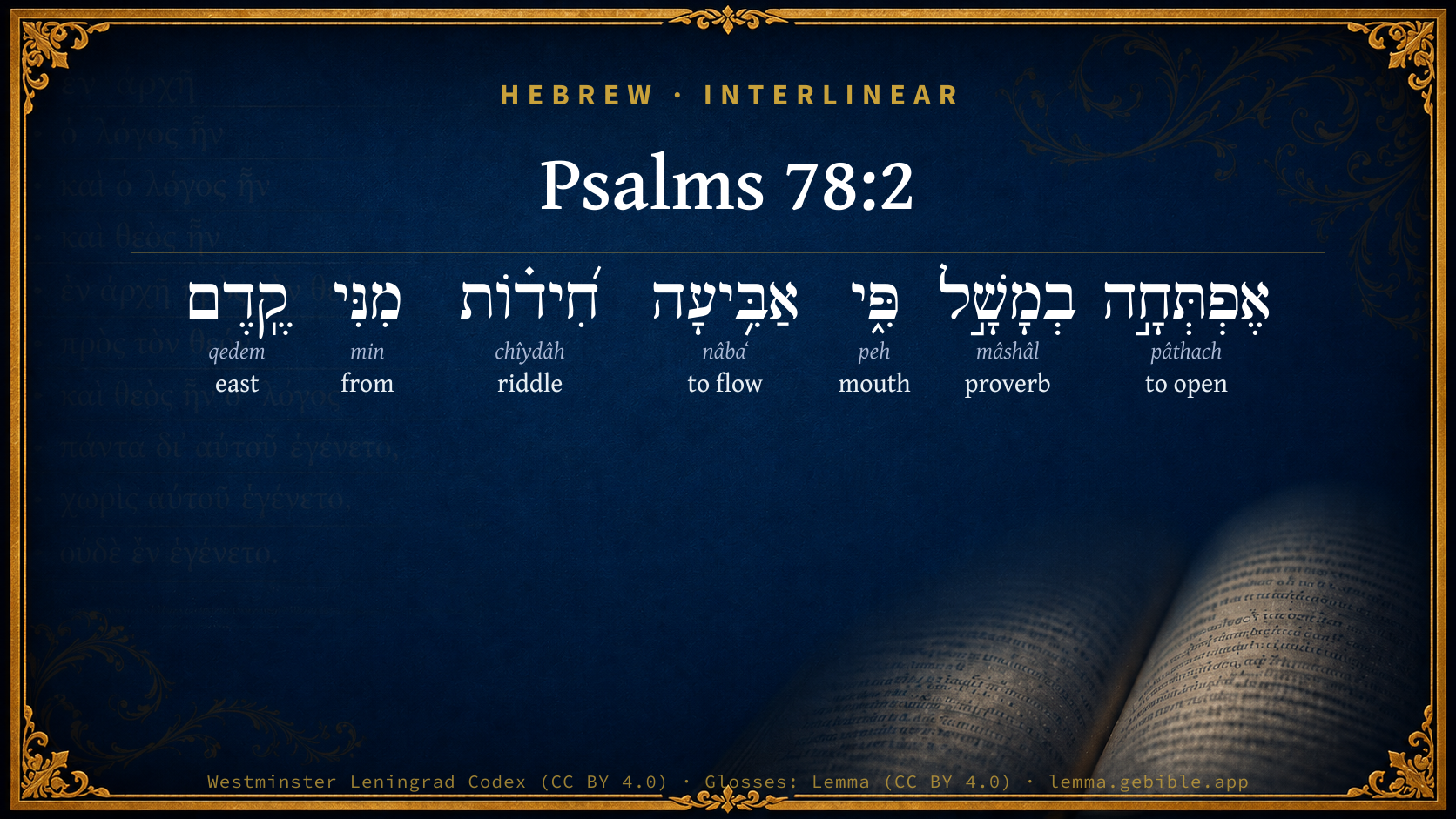
Psalms 78:2

Hebrew (Westminster Leningrad Codex) Psalms 78:2 appears in the Hebrew Old Testament. The text above is from the Westminster Leningrad Codex. Each word links to its Strong’s number, a concise gloss, and parsing drawn from the Open Scriptures Hebrew Bible morphology. Click any word for its full Brown-Driver-Briggs (BDB) entry.
Download image
Cite this verse

Psalms 78:2 (World English Bible). Public Domain. Lemma interlinear Bible study tool, https://lemma.gebible.app/v/psalms/78/2.

Show BibTeX & RIS
BibTeX
RIS
English Translation
I will open my mouth in a parable. I will utter dark sayings of old,
World English Bible · Public Domain
Download a study sheet

One document with this verse’s original text, its word-by-word gloss line, the meaning frame, cross-references with their text, attributed commentary, and full source and license credits — printable, and it pastes into notes with its structure intact.

This verse Autodidact and up

Study sheet (.html) Plain text (.txt)

A passage Seminary Student

Up to 50 verses in one chapter. A passage sheet keeps up to 6 commentary sources and 12 cross-references per verse, in the order this page ranks them, and says so on the sheet whenever that leaves anything out. Ask for a single verse and you get the Autodidact verse sheet above.

Everything on this page stays free to read, with no account — the sheet is a download of what is already on screen, not access to it.

Want to remove ads? Support Godless Engineer
Compare translations 3

The same verse in 3 English versions, stacked beneath the original-language interlinear above. Click any original word for its lexicon entry.

Each is an independent rendering of the whole verse — the interlinear is not word-aligned to these translations.

Highlighted words mark where these versions differ — a whole-verse word diff, not a word-by-word alignment.

  • World English Bible Public Domain
    I will open my mouth in a parable. I will utter dark sayings of old,
  • King James Version Public Domain
    I will open my mouth in a parable: I will utter dark sayings of old:
  • unfoldingWord Literal Text CC BY-SA 4.0
    I will open my mouth in a parable; I will pour out riddles from antiquity.

unfoldingWord Literal Text — © unfoldingWord, licensed CC BY-SA 4.0. Word-aligned USFM3 via Door43 (git.door43.org/unfoldingWord/en_ult).

Versions to compare (up to 4)

3 of 4 selected

Show all 18 translations

Every available English version of this verse, each an independent rendering of the whole verse.

  • World English Bible Public Domain
    I will open my mouth in a parable. I will utter dark sayings of old,
  • Berean Standard Bible Public Domain
    I will open my mouth in parables; I will utter things hidden from the beginning,
  • Majority Standard Bible Public Domain
    I will open my mouth in parables; I will utter things hidden from the beginning,
  • King James Version Public Domain
    I will open my mouth in a parable: I will utter dark sayings of old:
  • American Standard Version (1901) Public Domain
    I will open my mouth in a parable; I will utter dark sayings of old,
  • Revised Version (1885) Public Domain
    I will open my mouth in a parable; I will utter dark sayings of old:
  • Geneva Bible (1599) Public Domain
    I will open my mouth in a parable: I will declare high sentences of olde.
  • Douay-Rheims (1899) Public Domain
    I will open my mouth in parables: I will utter propositions from the beginning.
  • Young's Literal Translation Public Domain
    I open with a simile my mouth, I bring forth hidden things of old,
  • Literal Standard Version CC BY-SA 4.0
    I open my mouth with an allegory, || I bring forth hidden things of old,
  • Unlocked Literal Bible CC BY-SA 4.0
    I will open my mouth in parables; I will sing about hidden things about the past.
  • unfoldingWord Literal Text CC BY-SA 4.0
    I will open my mouth in a parable; I will pour out riddles from antiquity.
  • Darby Bible Public Domain
    I will open my mouth in a parable; I will utter riddles from of old,
  • World Messianic Bible Public Domain
    I will open my mouth in a parable. I will utter dark sayings of old,
  • Webster's Bible Public Domain
    I will open my mouth in a parable: I will utter dark sayings of old:
  • Free Bible Version CC BY-SA 4.0
    I will tell you wise sayings; I will explain mysteries from the past
  • Bible in Basic English Public Domain
    Opening my mouth I will give out a story, even the dark sayings of old times;
  • JPS Tanakh (1917) Public Domain
    I will open my mouth with a parable; I will utter dark sayings concerning days of old;

Literal Standard Version (2020), Covenant Press — licensed CC BY-SA 4.0. Text via the HelloAO Bible API (eBible.org). Unlocked Literal Bible (unfoldingWord) — licensed CC BY-SA 4.0. Text via the HelloAO Bible API (eBible.org). unfoldingWord Literal Text — © unfoldingWord, licensed CC BY-SA 4.0. Word-aligned USFM3 via Door43 (git.door43.org/unfoldingWord/en_ult). Free Bible Version, Dr. Jonathan Gallagher — licensed CC BY-SA 4.0. Text via the HelloAO Bible API (eBible.org).

Word by word

More ways to search: Search by grammar → Find every occurrence → Compare this word →

Practice this passage: Drill this verse → Learn its vocabulary →

About this verse

These counts appear in no published source. They are computed here, from the morphology-tagged text and Lemma’s own curated glosses. What Lemma adds →

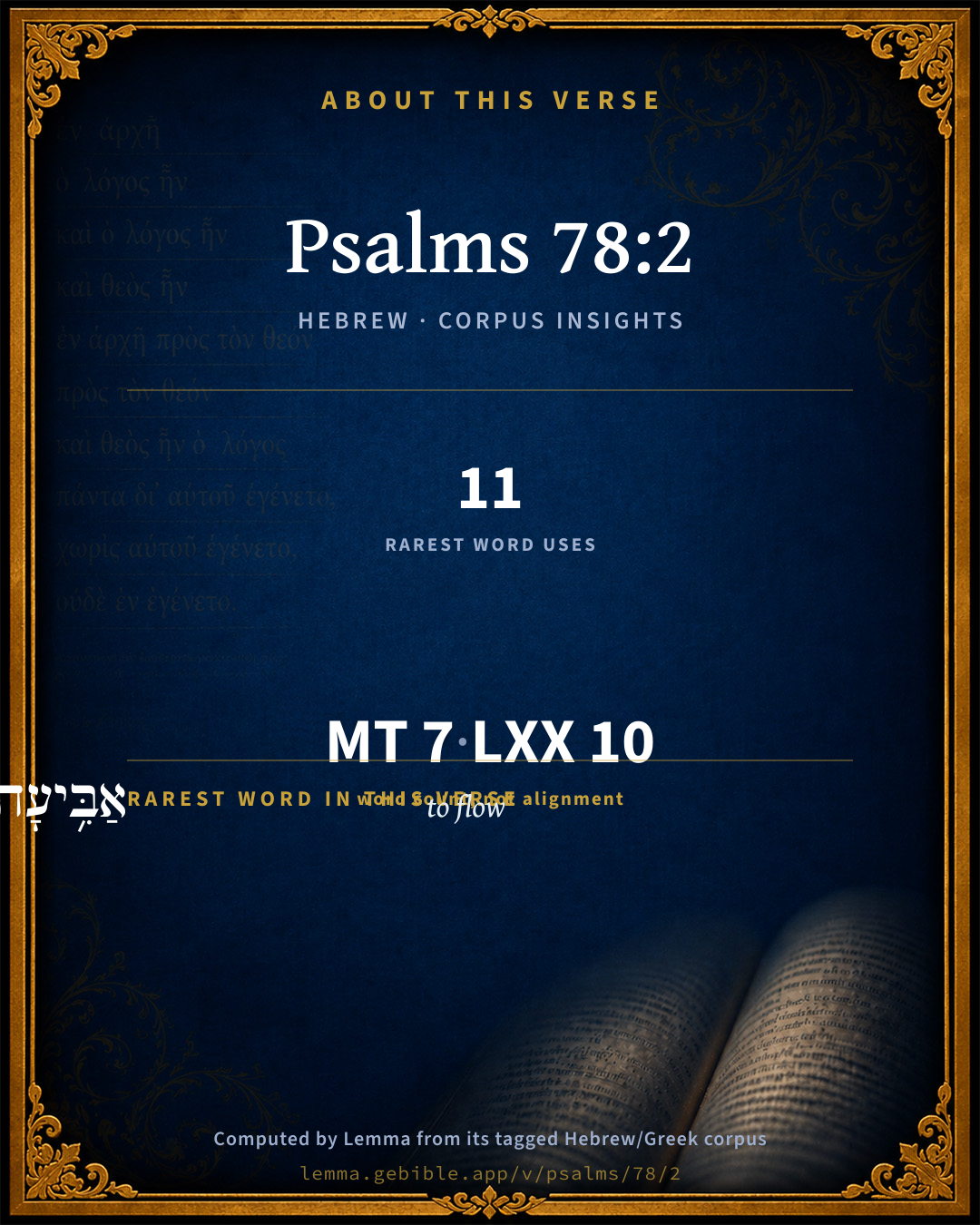
7
words
7
distinct lemmas
Wisdom
section

Notable vocabulary

The rarest word here is אַבִּ֥יעָה to flow H5042 — appearing just 11 times in the whole Hebrew Bible.

Shared distinctive vocabulary

אַבִּ֥יעָה to flow H5042 occurs in 11 verses of the Hebrew Bible. Also found in:

Grammatical profile

  • 2 verbs
  • 4 nouns
  • 1 preposition

Verb forms

  • אֶפְתְּחָ֣ה Qal · Cohortative
  • אַבִּ֥יעָה Hiphil · Cohortative

Hebrew & Septuagint length

In English translation the verse runs 15 words from the Hebrew and 18 from the Septuagint (LXX English) — closely comparable.

A rough comparison of the two English renderings, which tokenize alike — not a word-level alignment.

Word counts can differ between the Hebrew and the Greek without any difference in meaning — e.g. the Hebrew direct-object marker אֵת has no separate Greek word, and Greek often adds the article ὁ.

In the original languages it is 7 Hebrew tokens and 10 Greek tokens — but the two are counted differently (Hebrew bundles its prefixes and suffixes into one token; the Greek is in lemma form), so that isn’t a like-for-like length.

Cross-references

5

Topical passages linked to Psalms 78:2 in the Treasury of Scripture Knowledge — connected by theme and wording, ordered by reader-vote popularity; previews shown in the World English Bible.

  • Matthew 13:34–35 Jesus spoke all these things in parables to the multitudes; and without a parable, he didn't speak to them,
  • Matthew 13:11–13 He answered them, "To you it is given to know the mysteries of the Kingdom of Heaven, but it is not given to them.
  • Mark 4:34 Without a parable he didn't speak to them; but privately to his own disciples he explained all things.
  • Psalms 49:4 I will incline my ear to a proverb. I will open my riddle on the harp.
  • Proverbs 1:6 To understand a proverb, and parables, The words and riddles of the wise.

Cross-references courtesy of OpenBible.info (CC BY 4.0).

Hebrew and Greek witnesses Masoretic Hebrew ↔ Greek Septuagint

The same verse in the two great witnesses to the Old Testament, shown verse-for-verse.

You’re reading Greek Psalm 77 (Hebrew Psalm 78). The Septuagint counts the superscription, so verse numbers can differ from the Hebrew — chapter-level alignment, not verse-by-verse. Numbering follows Rahlfs.

These are two independent witnesses, not word-aligned to each other, and the Septuagint is shown in lemma (dictionary) form.

Hebrew Psalms 78:2 Masoretic · Westminster Leningrad Codex

אֶפְתְּחָ֣ה בְמָשָׁ֣ל פִּ֑י אַבִּ֥יעָה חִ֝יד֗וֹת מִנִּי קֶֽדֶם

I will open my mouth in a parable. I will utter dark sayings of old,

World English Bible · Public Domain

Greek LXX Greek Psalm 77:2 Septuagint · lemma form

ἀναοἴγω ἐν παραβολή ὁ στόμα ἐγώ φθέγγομαι πρόβλημα ἀπό ἀρχή

I will open my mouth in parables: I will utter dark sayings which have been from the beginning.

LXX2012 (modern English Septuagint) · Public Domain

On this verse, The Cambridge Bible for Schools and Colleges discusses the Septuagint’s reading. Read the note in Commentary ↓

Hebrew: Westminster Leningrad Codex (CC BY 4.0). Greek: Septuagint (public domain); English from LXX2012 (modern English Septuagint) (Public Domain). How the Septuagint differs from the Hebrew →

Commentary

Notes on Psalms 78:2 from classic Christian and Jewish commentators (each source and its license shown beneath its notes). The classic Christian expositions comment on the surrounding passage and are grouped to its opening verse, so a note may address several verses; the Jewish commentaries on the Tanakh (Rashi and others) are per-verse, so they appear only where the commentator wrote on this verse.

Lemma curates 59 commentaries, every one of them public domain or Creative Commons licensed, each selected and text-cleaned for this edition rather than reprinted as found. About our sources →

Trapp's Complete Commentary

John Trapp

Psa 78:2 I will open my mouth in a parable: I will utter dark sayings of old:

Ver. 2. I will open my mouth in a parable] I will speak freely and plainly (I will open my mouth, Mat 5:2 Act 10:34), and yet acutely and accurately. See Psa 49:4, {See Trapp on "Psa 49:4"}

I will utter dark sayings of old] Heb. I will well out (as from a spring or fountain) dark or sharp sayings, transacted and recorded of old, but of good use for ever. Difficulty doth not discourage, but rather whet on heroic spirits to a more diligent inquiry. Aben Ezra noteth here, that Psa 78:9, "The children of Ephraim," &c., is a parable, and Psa 78:25, "Man did eat angels’ food," is a riddle, or dark saying.

John Trapp, A Commentary or Exposition upon All the Books of the Old and New Testament (1647–1656) — public domain. Text from a community e-Sword module.

The Biblical Illustrator

Joseph S. Exell

Psa_78:2

I will open my mouth in a parable: I will utter dark sayings of old.

The nature and design of parabolic teaching

The word here translated parable did not probably convey to the mind of the psalmist the signification which we ordinarily attach to it. It might mean nothing more than a sublime, figurative, and sententious manner of stating facts or imparting moral lessons; or nothing more than a poem in which this style should prevail.

I. The nature of parabolic teaching. It is that which discerns most deeply and employs most judiciously these manifold analogies and comparisons, more or less partaking of what we understand by a continued metaphor. And he who has the greatest moral perfection will assuredly be the best adapted to the discernment of the lessons they imply. The Lord Jesus Christ, then, must be, from His very character and offices, best acquainted with this method of instruction. He who made all things and without whom not anything was made that was made, He is not only the Word, but the Wisdom of God--pronouncing His dark sayings and forming His secret things in the progress of the world and the Church, so that Egypt is still the type of bondage, and Israels journey through the wilderness to the land of promise one long parable, as Asaph saw darkly, of Gods dealings with His saints in the latter day. Every hour we behold Him illustrating the nature of this varying and marvellous instruction; aiding us to its definition; supplying the materials of which its innumerable comparisons are formed.

II. The adaptation of parabolic teaching to the condition of mankind upon earth. The human mind is so constituted, as to be unable to comprehend essences, properly speaking. The principles of causation are a sealed book to us. The progress of language, the manner in which we give names to objects, are of themselves sufficient proofs of this view. In everything pertaining to our moral conduct and choice, we follow another kind of evidence, and are influenced by another kind of reasoning. We determine what shall be our preference, not because we know absolutely the best course, but because our minds remark that what we are about to do bears a likeness to some other event or circumstance, which on another occasion, we have observed, came to pass. The rule and measure of our hopes and fears concerning the success of our pursuits; our expectation that others will act so and so under such circumstances; and our judgment that such actions proceed from such principles--all these rely upon our having observed the like to what we hope, fear, expect, judge; we say, upon our having observed the like, either with respect to others or ourselves. Our very life, then, is guided by a sort of parable, and hence the adaptation of its formal development to our circumstances and condition. But that propriety is illustrated not only by the connection of reasoning on probabilities, or likelihoods, or parallel courses of events, with the teaching by parables. We prove it also by the shortness of human life. A moral question comes before us; we make a parable to ourselves; we compare the subject on which we want to learn with another, where the decision and propriety is obvious. We do this involuntarily, because our time is so short; it is now or never. Here is another ground of arguing the adaptation of parabolical teaching to the necessities of mankind. We have said, what must the case be with the masses of which the world is constituted! Engaged as they are from morning to night in obtaining a scant supply for the wants of their bodies, they have no time or opportunity to rise, were the rising possible, above the range of this kind of information. But to them it seems strangely forcible. It strikes a chord in their understanding and heart. Metaphors are ever popular with the multitude. Children (and the mass of mankind are but children of a larger growth) love to be instructed by a similitude. It casts them on a new field of discovery; it opens their mind to a fresh series of glorious thoughts and feelings. And is it presumptuous to suppose that all this was part of ancient and venerable design on the part of our Lord Jesus Christ the Creator, and by creating the Teacher, as well as the Redeemer of our species? (T. Jackson, M. A.)

The Biblical Illustrator, edited by Joseph S. Exell (c. 1880s–1900s) — public domain. Text from a community e-Sword module.

J. A. Alexander on Psalms

Joseph Addison Alexander

2. (Psa 78:2) I will open, in a parable, my mouth; I will utter riddles from antiquity. By a parable we are here to understand an analogical illustration of divine truth. An exposition of the true design and meaning of the history of Israel was in this sense a mashal or parable. Riddles, enigmas, not the events themselves, but their latent import, which escaped a merely superficial observation. See above, on Psa 49:4. Of old, or from antiquity, i.e. belonging to the early period of our national existence. Utter, literally pour forth, cause to flow or gush. See above, on Psa 19:2.

Joseph Addison Alexander, The Psalms Translated and Explained (1850) — public domain. Text from a community e-Sword module.

Tyndale Open Study Notes

Tyndale Open Resources

78:2 The psalmist recites Israel’s story (78:5-72) in a parable in order to teach wisdom and insight. • Jesus quoted this verse to explain why he taught in parables (Matt 13:35).

Tyndale Open Study Notes — © Tyndale Open Resources, licensed CC BY-SA 4.0. Text via the HelloAO Bible API.

Adam Clarke's Commentary

Verse 2. In a parable] Or, I will give you instruction by numerous examples; see Ps 49:1-4, which bears a great similarity to this; and see the notes there. The term parable, in its various acceptations, has already been sufficiently explained; but משל mashal may here mean example, as opposed to תורה torah, law or precept, Ps 78:1.

Adam Clarke's Commentary on the Bible (1810–1826) — public domain. Text from a community e-Sword/MySword module.

Ellicott's Commentary for English Readers

(2, 3) I will open.—A difficulty is started by the fact that the psalm deals with history, and is neither a proverb (mâshal) nor riddle (chîdah). But the Divine rejection of the northern tribes may be the covert meaning which the poet sees to have been wrapped up in all the ancient history. The word mâshal is also sometimes used in a wide, vague sense, embracing prophetic as well as proverbial poetry. (See Num_21:27.)

For “dark sayings,” literally, knotty points, see Num_12:8. In Hab_2:6 the word seems to mean a sarcasm.

For the use of this passage in Mat_13:35, see Note, New Testament Commentary.

A Bible Commentary for English Readers, edited by Charles John Ellicott (1878–1897) — public domain. Text from a community e-Sword module.

The Cambridge Bible for Schools and Colleges

gen. ed. J. J. S. Perowne

2. On the words parable and dark sayings or enigmas see note on Psa_49:4. The Psalmist has no mere narrative of facts to recount, but a history full of significance for those who can penetrate its hidden meaning. It is a ‘parable’ not for Israel only, but for every individual in the Christian Church. dark sayings of old] Lessons drawn from the history of ancient times, from the Exodus, when Israel was ‘born’ as a nation, onward. Cp. Psa_77:5.

This verse is freely quoted by St Matthew (Mat_13:34-35), in a form which does not agree exactly either with the Heb. or with the LXX, with reference to our Lord’s teaching in parables. “All these things spake Jesus in parables unto the multitudes; and without a parable spake he nothing unto them: that it might be fulfilled which was spoken through the prophet, saying,

I will open my mouth in parables;

I will utter things hidden from the foundation of the world.”

The words of the Psalmist are not a direct prophecy of the Messiah’s method of teaching; but just as Christ as perfect Man summed up in Himself and fulfilled the manifold experiences of the people of God, so as the perfect Teacher He adopted the methods of the teachers of the old dispensation, and ‘fulfilled’ them by carrying them to their highest perfection. As the Psalmist used the facts of Israel’s history to convey the lesson which he desired to teach, so Christ used the phenomena of Nature and the experiences of Life. Cp. Introd. pp. lxxix ff.

The Cambridge Bible for Schools and Colleges (gen. ed. J. J. S. Perowne; Cambridge University Press, 1878–1918) — public domain. Text from a community e-Sword module.

John Gill's Exposition

I will open my mouth,.... Speak freely, boldly, and without reserve, Eph 6:19, so Christ opened his mouth, Mat 5:2,

in a parable; not that what follows in this psalm was such, but what were delivered by our Lord in the days of his flesh, who spake many parables; as of the sower, and of tares, and of the grain of mustard seed, and many others, and without a parable he spake not, and so fulfilled what he here said he would do, Mat 13:34.

I will utter dark sayings of old; sayings that relate to things of old; meaning not to the coming of the children of Israel out of Egypt, and what follows in the psalm, delivered, as Aben Ezra and Kimchi observe, in figurative and topical terms, as in Psa 78:19, but to the things which were from the foundation of the world, as the phrase is rendered in Mat 13:35, spoken of Christ in his ministry, such as the fall of the angels, the ruin of man by Satan, the murder of Abel, Abraham's sight of his day with joy, and many things that were said by them of old, Luk 10:18 or rather this refers to the Gospel, and the sayings and doctrines of it, which were kept secret since the world began, Mat 13:3, yea, which were ordained before the world was, and therefore called the everlasting Gospel, Co1 2:7 and here in the Arabic version, "eternal mysteries"; such as concerning the everlasting love of God to his people, his everlasting choice of them, and everlasting covenant with them: and the sayings or doctrines of the Gospel may he called "dark", because secret, hidden, and mysterious; and were so under the legal dispensation, in comparison of the more clear light under the Gospel dispensation; they having been wrapped up in types and shadows, and in the rites and ceremonies of the law, but now held forth clearly and plainly in the ministry of Christ and his apostles, as in a glass: these Christ says he would "utter" or deliver out as water from a fountain, in great plenty, as he did; he came in the fulness of the blessing of the Gospel; and being full of grace and truth, the doctrines of grace and truth, these came by him, and were delivered from him in all their fulness and glory.

John Gill's Exposition of the Whole Bible (1746–1763) — public domain (CC PDM 1.0). Text via the HelloAO Bible API.

Albert Barnes' Notes on the Bible

I will open my mouth in a parable - See the notes at Psa 49:4. The word “parable” here means a statement by analogy or comparison; that is, he would bring out what he had to say by a course of reasoning founded on an analogy drawn from the ancient history of the people.

I will utter dark sayings of old - Of ancient times; that is, maxims, or sententious thoughts, which had come down from past times, and which embodied the results of ancient observation and reflection. Compare Psa 49:4, where the word rendered “dark sayings” is explained. He would bring out, and apply, to the present case, the maxims of ancient wisdom.

Albert Barnes' Notes on the Bible (1834–1885) — public domain. Text from a community e-Sword/MySword module.

Matthew Poole's English Annotations

Open my mouth, speak to you with all freedom and plainness, in a parable; uttering divers and weighty sentences (for such are oft called

parables in Scripture) or passages of great moment for your instruction and advantage.

Dark sayings; so he calls the following passages, not because the words and sentences are in themselves hard to be understood, for they are generally historical and easy, but because the things contained in them, concerning God’s transcendent goodness to an unworthy people, and their unparalleled ingratitude for and abuse of such eminent favours, and their stupid ignorance and insensibleness under such excellent and constant teachings of God’s word and works, are indeed prodigious and hard to be believed.

Of old; of things done in ancient times, and in a great measure worn out of men’s minds.

Matthew Poole's English Annotations on the Holy Bible (1683–1685) — public domain. Text from a community e-Sword/MySword module.

The Treasury of David

Charles H. Spurgeon

Ver. 2. I will open my mouth in a parable. Analogies are not only to be imagined, but are intended by God to be traced between the story of Israel and the lives of believers. Israel was ordained to be a type; the tribes and their marchings are living allegories traced by the hand of an all wise providence. Unspiritual persons may sneer about fancies and mysticisms, but Paul spake well when he said "which things are an allegory, "and Asaph in the present case spake to the point when he called his narrative "a parable." That such was his meaning is clear from the quotation, "All these things spake Jesus unto the multitude in parables; and without a parable spake he not unto them: that it might be fulfilled which was spoken by the prophet, saying, I will open my mouth in parables; I will utter things which have been kept secret from the foundation of the world." Mt 13:34-35.

I will utter dark sayings of old; --enigmas of antiquity, riddles of yore. The mind of the poet prophet was so full of ancient lore that he poured it forth in a copious stream of song, while beneath the gushing flood lay pearls and gems of spiritual truth, capable of enriching those who could dive into the depths and bring them up. The letter of this song is precious, but the inner sense is beyond all price. Whereas the first verse called for attention, the second justifies the demand by hinting that the outer sense conceals an inner and hidden meaning, which only the thoughtful will be able to perceive.

Ver. 2. Parable. Dark sayings. lvm, an authoritative weighty speech or saying. The Hebrew term very nearly answers to the Greek, kuriai doxai, i.e., authoritative sentences or maxims, or weighty sayings, expressing or implying a comparison, as such sayings frequently do. hdyx an enigma, a parable, which penetrates the mind, and when understood makes a deep impression of what is intended or represented by it. Here twdyx seems to refer to the historical facts mentioned in the subsequent part of the Psalm, considered as enigmas of spiritual concern. John Parkhurst.

Ver. 2. Parable. Parables are the speeches of wise men, yea, they are the extracts and spirits of wisdom. The Hebrew word signifies to rule, or have authority, because such speeches come upon us with authority, and subdue our reason by the weight of theirs. Joseph Caryl.

Ver. 2. I will utter. The metaphor in this word is taken from a fountain which pours forth water abundantly. For ebg properly means to gush forth, or bubble up. The heart of teachers in the Church ought to be full, and ready to pour forth those streams by which the Church is watered. Their spring ought not to become exhausted, and fail in the summer. Mollerus.

Ver. 2. (first clause). Preach on the "Parable of the Prodigal Nation, "as given in the whole Psalm. C. A. Davies, of Chesterfield.

Ver. 2-3.

I. Truths are none the worse for being old: sayings of

old. "Old wood, "says Lord Bacon, "is best to burn;

old books are best to read; and old friends are best

to trust."

II. Truths are none the worse for being concealed under

metaphors: I will open, etc., in a parable;

dark sayings.

III. Truths are none the worse for being often repeated.

1. They are more tested.

2. They are better testified. G. R.

Psalms 78:3*

Ver. 2-3.

I. Truths are none the worse for being old: sayings of

old. "Old wood, "says Lord Bacon, "is best to burn;

old books are best to read; and old friends are best

to trust."

II. Truths are none the worse for being concealed under

metaphors: I will open, etc., in a parable;

dark sayings.

III. Truths are none the worse for being often repeated.

1. They are more tested.

2. They are better testified. G. R.

Charles H. Spurgeon's The Treasury of David (1869–1885) — public domain. Psalms only. Text from a community e-Sword/MySword module.

The Pulpit Commentary

I will open my mouth in a parable. The facts of Israelitish history. are the "parable," the inner meaning of which it is for the intelligent to grasp. They are fwnanta sunetoisin . I will utter dark sayings of old . (comp. Pro_1:6) Khidoth (twdyj) are properly "riddles". (see Jud_1:14:12) Here the idea is that God"s dealings with his people had been "riddles," whereto the psalmist would give the clue (comp. vers. 21, 22, 33, 56-59, etc.).

History a parable.

In Matthew 13 this verse is quoted as the ground of our Lord"s teaching by parables. He never used fables stories which contain the unnatural and grotesque, but parables stories of what were, or might have been, actual occurrences. Probably many of them were. And all history is a parable, and ought to be so used by us in teaching far more than it is; for, like the parables, history has for

I ITS AUTHOR God. The story of the nations often seems to be no better than a wild hurly-burly, and their wars to be no more important than, as one has said, the fightings of so many kites and crows. But such idea is the result of a merely slight and superficial observation. Deeper study would show the "Divinity that shapes our ends, Rough-hew them how we will.

The philosophy of history is the discovery of God.

II ITS METHODS the record of events that are ordinary, familiar, human. These are the common groundwork of both parable and history.

III ITS USEFULNESS that it conveys instruction in a manner that arrests thought, deepens impression, awakes interest, and is retained in the memory as other forms of teaching are not. It is especially adapted for children.

IV ITS INTENT AND PURPOSE to teach men, and to incline them to follow the ways of God. And such are

V ITS RESULTS. For just as the result of the parables of our Lord on the minds and hearts of men is simply incalculable in the vast extent of its controlling power, so also is it with the teachings of history. They have created a just judgment and a fixed habit of mind in men, upon which most of the modern life of the nations is based. History the record of experience is, after all, the Bible of mankind, and doubtless was intended so to be. We do no honour to the sacred Scriptures by our too common habit of confining our studies of the ways of God in history to its records alone. All history teaches of God, and not that of the Bible only. Happy will it be for both teachers and taught when they, as did the writer of this psalm, regard all national history as a parable of God. S.C.

Teaching by parable.

The answering word to "parable," in this verse, is "dark sayings," or "hard sentences," which reminds us of the Queen of Sheba, who journeyed to Jerusalem to prove Solomon with "hard questions." We cannot bring the precise New Testament ideas of the word "parable" to bear upon the word as used in this psalm, and yet its meaning is very exact. The parable is treated as a setting of truth which veils or hides the truth, and compels the hearer to search, if he would find it. A parable is truth like a nut. The kernel of truth can only be reached by those who will break the shell. Here the psalmist gives a sketch of the national history in such a way that, to many, it may only be a sketch of history; but he wraps up higher moral and spiritual teachings in it, and these those who are in earnest may discover. The parable, as used by our Lord, may be thus described: "It used an incident, taken from common life, and rounded into a gem-like picture, to set forth some corresponding truth in the higher and spiritual region." The Old Testament parable used "points of history" with a similar purpose. There is need for this method of teaching, in precise adaptation to every age; because the human mind needs help to the apprehension of higher truth, and the human heart needs help to the reception of spiritual truth. Pleading for teaching by parable or by illustration still, we may point out that

I IT ARRESTS ATTENTION. Just as children are all alive if we propose to tell them a story, so the teacher and the preacher at once brighten up their audiences when they give an illustration. Our Lord always secured attention because he was illustrative. There were no abstract statements in his teachings; they were all changed into pictures. His work "swarmed with figures of speech," and so it was that "the common people heard him gladly.

II IT DISARMS PREJUDICE. It is difficult for public teachers to warn and reprove wisely. They may easily offend by direct and pointed applications. They can interest in a picture which excites no prejudice, and skilfully bring out applications that awaken consciences, and set them making their reproaches.

III IT EXCITES THOUGHT. Illustrate by the difference between history as a bare record of facts, and the philosophy of history, which concerns the relations of the facts, and the mutual influence of the characters. The psalmist here designs to present the old history in such ways as to compel thought concerning God"s ways with man, and man"s ways with God.

IV IT REMAINS IN MEMORY. Only particular dispositions and trained intellects can remember abstract propositions. Everybody can remember stories, pictures, and illustrations; and there is always the possibility that, holding the parable, they will hold for use on occasion the truth which it was designed to teach. R.T.

The Pulpit Commentary (1880–1919), ed. H.D.M. Spence-Jones & Joseph S. Exell — public domain. Text from a community e-Sword module.

Rashi

Rabbi Shlomo Yitzchaki (Rashi)

...my mouth with a parable They are the words of Torah.

Rashi on the Tanakh — English translations: “The Judaica Press complete Tanach with Rashi, translated by A. J. Rosenberg” (CC BY 4.0); “Pentateuch with Rashi's commentary by M. Rosenbaum and A.M. Silbermann, 1929-1934” (public domain); “The Metsudah Tanach series, Lakewood, N.J” (CC BY 4.0); and “The Book of Joshua, Metsudah Publications, 1997” (CC BY 4.0). Text via Sefaria.

Lesson kit

Teaching starters — assembled from the data on this page, not authored interpretation. Every prompt links to the verse data it draws on. Edit before teaching.

Psalms, in the Wisdom, opens this verse with 7 words (7 distinct Hebrew lemmas). Its most distinctive word is nâbaʻ (“to flow”). A historical commentator’s framing appears above. Read the whole chapter for the surrounding context.

Discussion questions

  1. What does “to flow” (nâbaʻ) contribute to the verse as a whole?
  2. How does Psalms 19:2, which shares the word «to flow», read alongside this verse?
  3. These translations render this verse differently. What is at stake in choosing one wording over another?
  4. «אֶפְתְּחָ֣ה» is a Qal Cohortative verb. How does that grammatical form shape the action described?
  5. Compare how Trapp's Complete Commentary and The Biblical Illustrator read this verse. Where do they agree or differ?

Things to notice

Reading settings

Reading text

Shown beneath each verse's original-language words.

Old Testament
Old Testament edition

Read the OT as the Masoretic Hebrew (MT) or the Greek Septuagint (LXX).

English shown for the Greek Septuagint (in the Hebrew ↔ Greek comparison).

Comparing translations? Open the Compare panel on any verse page to stack up to four side by side.