
Revelation 13:18

Greek (Tischendorf 8th ed.) Revelation 13:18 appears in the Greek New Testament. The text above is from the Tischendorf 8th edition. Each word links to its Strong’s number and a concise gloss. Click any word for its full Thayer’s Greek Lexicon entry.
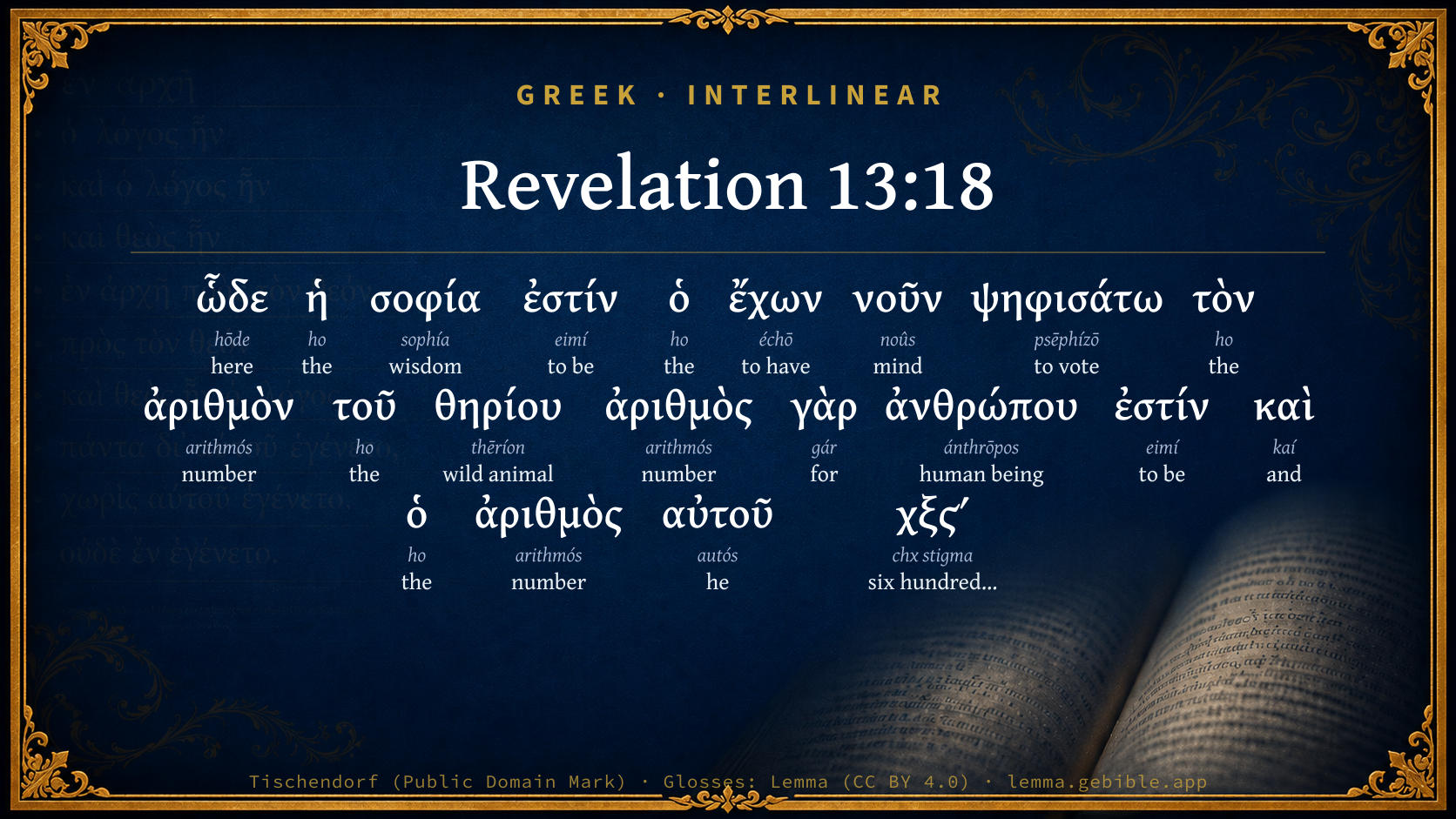
Download image
Cite this verse

Revelation 13:18 (World English Bible). Public Domain. Lemma interlinear Bible study tool, https://lemma.gebible.app/v/revelation/13/18.

Show BibTeX & RIS
BibTeX
RIS
English Translation
Here is wisdom. He who has understanding, let him calculate the number of the beast, for it is the number of a man. His number is six hundred sixty-six.
World English Bible · Public Domain
Highlights
  • 1 hapax legomenon — only here in the Greek New Testament
  • 1 first appearance in the Greek New Testament
Full analysis ↓
Download a study sheet

One document with this verse’s original text, its word-by-word gloss line, the meaning frame, cross-references with their text, attributed commentary, and full source and license credits — printable, and it pastes into notes with its structure intact.

This verse Autodidact and up

Study sheet (.html) Plain text (.txt)

A passage Seminary Student

Up to 50 verses in one chapter. A passage sheet keeps up to 6 commentary sources and 12 cross-references per verse, in the order this page ranks them, and says so on the sheet whenever that leaves anything out. Ask for a single verse and you get the Autodidact verse sheet above.

Everything on this page stays free to read, with no account — the sheet is a download of what is already on screen, not access to it.

Want to remove ads? Support Godless Engineer
Compare translations 3

The same verse in 3 English versions, stacked beneath the original-language interlinear above. Click any original word for its lexicon entry.

Each is an independent rendering of the whole verse — the interlinear is not word-aligned to these translations.

Highlighted words mark where these versions differ — a whole-verse word diff, not a word-by-word alignment.

  • World English Bible Public Domain
    Here is wisdom. He who has understanding, let him calculate the number of the beast, for it is the number of a man. His number is six hundred sixty-six.
  • King James Version Public Domain
    Here is wisdom. Let him that hath understanding count the number of the beast: for it is the number of a man; and his number is Six hundred threescore and six.
  • unfoldingWord Literal Text CC BY-SA 4.0
    Here is wisdom: The one having understanding, let him calculate the number of the beast. For it is the number of a man, and its number is 666.

unfoldingWord Literal Text — © unfoldingWord, licensed CC BY-SA 4.0. Word-aligned USFM3 via Door43 (git.door43.org/unfoldingWord/en_ult).

Versions to compare (up to 4)

3 of 4 selected

Show all 19 translations

Every available English version of this verse, each an independent rendering of the whole verse.

  • World English Bible Public Domain
    Here is wisdom. He who has understanding, let him calculate the number of the beast, for it is the number of a man. His number is six hundred sixty-six.
  • Berean Standard Bible Public Domain
    Here is a call for wisdom: Let the one who has insight calculate the number of the beast, for it is the number of a man, and that number is 666.
  • Majority Standard Bible Public Domain
    Here is a call for wisdom: Let the one who has insight calculate the number of the beast, for it is the number of a man, and that number is 666.
  • King James Version Public Domain
    Here is wisdom. Let him that hath understanding count the number of the beast: for it is the number of a man; and his number is Six hundred threescore and six.
  • American Standard Version (1901) Public Domain
    Here is wisdom. He that hath understanding, let him count the number of the beast; for it is the number of a man: and his number is Six hundred and sixty and six.
  • Revised Version (1885) Public Domain
    Here is wisdom. He that hath understanding, let him count the number of the beast; for it is the number of a man: and his number is Six hundred and sixty and six.
  • Geneva Bible (1599) Public Domain
    Here is wisdome. Let him that hath wit, count the number of the beast: for it is the number of a man, and his number is sixe hundreth threescore and sixe.
  • Douay-Rheims (1899) Public Domain
    Here is wisdom. He that hath understanding, let him count the number of the beast. For it is the number of a man: and the number of him is six hundred sixty-six.
  • Young's Literal Translation Public Domain
    Here is the wisdom! He who is having the understanding, let him count the number of the beast, for the number of a man it is, and its number `is' 666.
  • Literal Standard Version CC BY-SA 4.0
    Here is the wisdom! He who is having the understanding, let him count the number of the beast, for it is the number of a man, and its number: six hundred sixty-six.
  • Unlocked Literal Bible CC BY-SA 4.0
    This calls for wisdom. If anyone has insight, let him calculate the number of the beast. For it is the number of a human being. Its number is 666.
  • unfoldingWord Literal Text CC BY-SA 4.0
    Here is wisdom: The one having understanding, let him calculate the number of the beast. For it is the number of a man, and its number is 666.
  • Darby Bible Public Domain
    Here is wisdom. He that has understanding let him count the number of the beast: for it is a man's number; and its number [is] six hundred [and] sixty-six.
  • World Messianic Bible Public Domain
    Here is wisdom. He who has understanding, let him calculate the number of the beast, for it is the number of a man. His number is six hundred sixty-six.
  • Webster's Bible Public Domain
    Here is wisdom. Let him that hath understanding count the number of the beast: for it is the number of a man; and his number is six hundred and sixty six.
  • Free Bible Version CC BY-SA 4.0
    Wisdom is needed here. Whoever has understanding should calculate the number of the beast, for it is the number of a man. His number is 666.
  • Bible in Basic English Public Domain
    Here is wisdom. He who has knowledge let him get the number of the beast; because it is the number of a man: and his number is Six hundred and sixty-six.
  • Text-Critical English NT CC BY 4.0
    This calls for wisdom: Let anyone who has understanding calculate the number of the beast, for it is the number of a man; his number is six hundred sixty-six.
  • Tyndale New Testament (1534) Public Domain
    Here is wisdome. Let him that hath wytt count the nombre of the beest. For it is the nombre of a man and his nombre is sixe hondred threscore and sixe.

Literal Standard Version (2020), Covenant Press — licensed CC BY-SA 4.0. Text via the HelloAO Bible API (eBible.org). Unlocked Literal Bible (unfoldingWord) — licensed CC BY-SA 4.0. Text via the HelloAO Bible API (eBible.org). unfoldingWord Literal Text — © unfoldingWord, licensed CC BY-SA 4.0. Word-aligned USFM3 via Door43 (git.door43.org/unfoldingWord/en_ult). Free Bible Version, Dr. Jonathan Gallagher — licensed CC BY-SA 4.0. Text via the HelloAO Bible API (eBible.org).

Word by word

More ways to search: Search by grammar → Find every occurrence → Compare this word →

Practice this passage: Drill this verse → Learn its vocabulary →

χξϛʹ
chx stigma
G5516
“six hundred sixty-six”
Adjective, Numeral (indeclinable), Abbreviated
Part of Speech
Adjective · Numeral (indeclinable)
Degree
Abbreviated
Full Thayer's Definition

Origin: the G22 d, G14 th and an obsolete letter ( G4742 as a cross) of the Greek alphabet (intermediate between the G5 th and G6 th), used as numbers

TDNT: None

1. six hundred and sixty six, the meaning of which is the basis of much vain speculation
  1. ὧδε hōde G5602 “here” Adverb
  2. ἡ ho G3588 “the” Article, Nominative, Singular, Feminine
  3. σοφία sophía G4678 “wisdom” Noun, Nominative, Singular, Feminine
  4. ἐστίν eimí G1510 “to be” Verb, Present, Active, Indicative, 3rd person, Singular
  5. ὁ ho G3588 “the” Article, Nominative, Singular, Masculine
  6. ἔχων échō G2192 “to have” Verb, Present, Active, Participle, Nominative, Singular, Masculine
  7. νοῦν noûs G3563 “mind” Noun, Accusative, Singular, Masculine
  8. ψηφισάτω psēphízō G5585 “to vote” Verb, Aorist, Active, Imperative, 3rd person, Singular
  9. τὸν ho G3588 “the” Article, Accusative, Singular, Masculine
  10. ἀριθμὸν arithmós G706 “number” Noun, Accusative, Singular, Masculine
  11. τοῦ ho G3588 “the” Article, Genitive, Singular, Neuter
  12. θηρίου thēríon G2342 “wild animal” Noun, Genitive, Singular, Neuter
  13. ἀριθμὸς arithmós G706 “number” Noun, Nominative, Singular, Masculine
  14. γὰρ gár G1063 “for” Conjunction
  15. ἀνθρώπου ánthrōpos G444 “human being” Noun, Genitive, Singular, Masculine
  16. ἐστίν eimí G1510 “to be” Verb, Present, Active, Indicative, 3rd person, Singular
  17. καὶ kaí G2532 “and” Conjunction
  18. ὁ ho G3588 “the” Article, Nominative, Singular, Masculine
  19. ἀριθμὸς arithmós G706 “number” Noun, Nominative, Singular, Masculine
  20. αὐτοῦ autós G846 “he” Personal pronoun, Genitive, Singular, Neuter

About this verse

These counts appear in no published source. They are computed here, from the morphology-tagged text and Lemma’s own curated glosses. What Lemma adds →

21
words
14
distinct lemmas
Revelation
section

Notable vocabulary

1 hapax legomenon — a word that appears only here in the entire Greek New Testament:

  • χξϛʹ six hundred sixty-six G5516

First appearance in Scripture

This word makes its first canonical appearance in the Greek New Testament here:

  • χξϛʹ six hundred sixty-six G5516

Shared distinctive vocabulary

ψηφισάτω to vote G5585 occurs in 2 verses of the Greek New Testament. Also found in:
Repetition

Words recur within this verse:

  • ἀριθμὸν number G706 ×3
  • ἐστίν to be G1510 ×2
  • ἡ the G3588 ×5

Cross-references

10

Topical passages linked to Revelation 13:18 in the Treasury of Scripture Knowledge — connected by theme and wording, ordered by reader-vote popularity; previews shown in the World English Bible.

  • Revelation 15:2 I saw something like a sea of glass mixed with fire, and those who overcame the beast, his image, and the number of his name, standing on the sea of glass, having harps of God.
  • Revelation 17:9 Here is the mind that has wisdom. The seven heads are seven mountains, on which the woman sits.
  • Revelation 21:17 Its wall is one hundred forty-four cubits, by the measure of a man, that is, of an angel.
  • Daniel 12:10 Many shall purify themselves, and make themselves white, and be refined; but the wicked shall do wickedly; and none of the wicked shall understand; but those who are wise shall understand.
  • Mark 13:14 But when you see the abomination of desolation, spoken of by Daniel the prophet, standing where it ought not (let the reader understand), then let those who are in Judea flee to the mountains,
  • Revelation 1:3 Blessed is he who reads and those who hear the words of the prophecy, and keep the things that are written in it, for the time is at hand.
  • Hosea 14:9 Who is wise, that he may understand these things? Who is prudent, that he may know them? For the ways of Yahweh are right, And the righteous walk in them; But the rebellious stumble in them.
  • Psalms 107:43 Whoever is wise will pay attention to these things. They will consider the loving kindnesses of Yahweh.
  • Deuteronomy 3:11 (For only Og king of Bashan remained of the remnant of the Rephaim; behold, his bedstead was a bedstead of iron; isn't it in Rabbah of the children of Ammon? nine cubits was the length of it, and four cubits the breadth of it, after the cubit of a man.)
  • Romans 3:5 But if our unrighteousness commends the righteousness of God, what will we say? Is God unrighteous who inflicts wrath? I speak like men do.

Cross-references courtesy of OpenBible.info (CC BY 4.0).

Where the printed editions differ

2 variants

Places in this verse where the major printed Greek editions disagree on the wording in a way that affects the translation — a comparison of editions, not a manuscript-by-manuscript collation. The editions are the modern critical texts (Nestlé-Aland 28/27, SBL, Westcott-Hort, Tregelles, Tyndale House) and the traditional texts behind the KJV (the Textus Receptus and the Byzantine/Majority text). It is not a claim about which reading is original.

  1. Editions differ
    ἑξακόσιοι

    “six hundred”

    In NA28NA27Tyn»2SBLWHTreg»2TR»2Byz Not in TynTregTR
  2. Editions differ
    ἑξήκοντα

    “sixty”

    In NA28NA27Tyn»1SBLWHTreg»1TR»1Byz Not in TynTregTR

Textual data: Translators Amalgamated Greek New Testament (STEPBible TAGNT) · CC BY 4.0.

Commentary

Notes on Revelation 13:18 from classic Christian and Jewish commentators (each source and its license shown beneath its notes). The classic Christian expositions comment on the surrounding passage and are grouped to its opening verse, so a note may address several verses; the Jewish commentaries on the Tanakh (Rashi and others) are per-verse, so they appear only where the commentator wrote on this verse.

Lemma curates 59 commentaries, every one of them public domain or Creative Commons licensed, each selected and text-cleaned for this edition rather than reprinted as found. About our sources →

Adam Clarke's Commentary

Verse 18. Here is wisdom. Let him that hath understanding count the number of the beast; for it is the number of a man; and his number is Six hundred threescore and six.] In this verse we have the very name of the beast given under the symbol of the number 666. Before the invention of figures by the Arabs, in the tenth century, letters of the alphabet were used for numbers. The Greeks in the time of Homer, or soon after, are thought by some to have assigned to their letters a numerical value corresponding to their order in the alphabet: thus, α was 1, because the first letter; and ω 24, being the last. It is in this manner that the books of the Iliad and Odyssey are numbered, which have been thus marked by Homer himself, or by some person who lived near his time. A system of representing numbers of great antiquity was used by the Greeks, very much resembling that afterwards adopted by the Romans. This consisted in assigning to the initial letter of the name of the number a value equal to the number. Thus χ, the initial of χιλια, stood for a thousand; δ, the initial of δεκα, for ten; π, the initial of πεντε, for five, c. Herodotus, the grammarian, is the only writer of antiquity who has noticed this system, and the chronological table of remarkable events on the Arundelian marbles the only work extant in which this method of representing numbers is exhibited. The system now in use cannot be traced to any very ancient source. What can be proved is, that it was in use before the commencement of the Christian era. Numerical letters, denoting the year of the Roman emperor's reign, exist on great numbers of the Egyptian coins, from the time of Augustus Caesar through the succeeding reigns. See Numi AEgyptii Imperatorii, a Geo. Zoega, edit. Rom. 1787. There are coins extant marked of the 2d, 3d, 14th, 30th, 35th, 38th, 39th, 40th, 41st, and 42d years of Augustus Caesar, with the numerical letters preceded by L or λ for λυκαβας, year, thus: LΒ, Lγ, Lιδ, Lλ, Lλε, Lλη, Lλθ, Lμ, Lμα, and Lμβ. The following is the Greek alphabet, with the numerical value of each letter affixed, according to the generally received system:-

α . . . . 1 ι . . . . 10 ρ . . . . 100

β . . . . 2 κ . . . . 20 σ . . . . 200

γ . . . . 3 λ . . . . 30 τ . . . . 300

δ . . . . 4 μ . . . . 40 υ . . . . 400

ε . . . . 5 ν . . . . 50 φ . . . . 500

ζ . . . . 7 ξ . . . . 60 χ . . . . 600

η . . . . 8 ο . . . . 70 ψ . . . . 700

θ . . . . 9 π . . . . 80 ω . . . . 800

The method just described of representing numbers or letters of the alphabet, gave rise to a practice among the ancients of representing names also by numbers. Examples of this kind abound in the writings of heathens, Jews, and Christians. Where the practice of counting the number in names or phrases began first to be used, cannot be ascertained it is sufficient for the illustration of the passage under consideration, if it can be shown to have been in existence in the apostolic age. Seneca, who was contemporary with St. Paul, informs us, in his eighty-eighth epistle, that Apion, the grammarian, maintained Homer to have been the author of the division of his poems of the Iliad and Odyssey into forty-eight books; for a proof of which Apion produces the following argument: that the poet commenced his Iliad with the word μηνιν, that the two first letters, whose sum is 48, might indicate such division. Leonidas of Alexandria, who flourished in the reigns of Nero, Vespasian, c., carried the practice of computing the number in words so far as to construct equinumeral distichs that is, epigrams of four lines, whose first hexameter and pentameter contain the same number with the other two. We will only notice two examples; the first is addressed to one of the emperors, the other to Poppaea, the wife of Nero.

Θυει σοι τοδε γραμμα γενεθλιακαισιν εν ὡραις,

Καισαρ, Νειλαιη Μουσα Λεωνιδεω.

Καλλιοπης γαρ ακαπνον αει θυος· εις δε νεωτα

Ην εθελῃς, θυσει τουδε περισσοτερα.

"The muse of Leonidas of the Nile offers up to thee, O Caesar, this writing, at the time of thy nativity; for the sacrifice of Calliope is always without smoke: but in the ensuing year he will offer up, if thou wilt, better things than this."

From the numerical table already given, the preceding epigram may be shown to contain equinumeral distichs, as follows: θυει 424, i.e., θ 9, υ 400, ε 5, ι 10; in all 424: σοι contains 280, i.e., σ 200, ο 70, ι 10. In like manner τοδε will be found to contain 379, γραμμα 185, γενεθλιακαισιν 404, εν 55, ὡραις 1111, Καισαρ 332, Νειλαιη 114, Μουσα 711, Λεωνιδεω 1704. The sum of all these is 5699, the number in the first distich. In the second distich, Καλλιοπης contains 449, γαρ 104, ακαπνον 272, αει 16, θυος 679, εις 215, δε 9, νεωτα 1156, Ην 58, εθελῃς 267, (the subscribed iota being taken into the account), θυσει 624, τουδε 779, περισσοτερα 1071. The sum of all 5699, which is precisely the same with that contained in the first distich.

Ουρανιον μειμημα γενεθλιακαισιν εν ὡραις

Τουτ' απο Νειλογενους δεξο Λεωνιδεω,

Ποππαια, Διος ευνι, Σεβαστιας· ευαδε γαρ σοι

Δωρα, τα και λεκτρων αξια και σοφιης.

"O Poppaea, wife of Jupiter (Nero) Augusta, receive from Leonidas of the Nile a celestial globe on the day of thy nativity; for gifts please thee which are suited to thy imperial dignity and wisdom."

In this epigram each of the distichs contains the number 6422, viz., Ουρανιον 751, (i.e., ο 70, υ 400, ρ 100, α 1, ν 50, ι 10, ο 70, ν 50, the sum of which is 751), μειμημα 144, γενεθλιακαισιν 404, εν 55, ὡραις 1111, τουτ' 1070, απο 151, Νειλογενους 893, δεξο 139, Λεωνιδεω 1704; the sum of all 6422. The numbers corresponding to the words of the second distich are, respectively, 322, 284, 465, 919, 415, 104, 280, 905, 301, 31, 1305, 72, 31, 988; the sum of which is also 6422.

This poet did not restrict himself to the construction of equinumeral distichs. The following is one of his distichs in which the hexameter line is made equal in number to its corresponding pentameter: -

Εἱς προς ἑνα ψηφοισιν ισαζεται, ου δυο δοιοις,

Ου γαρ ετι στεργω την δολιχογραφιην.

"One line is made equal in number to one, not two to two; for I no longer approve of long epigrams."

In this distich the words of the hexameter line contain, respectively, the numbers 215, 450, 56, 1548, 534, 470, 474, and 364; the sum of which is 4111. The numbers corresponding to the words of the pentameter line are, respectively, 470, 104, 315, 1408, 358, and 1456; the sum of which is also 4111. The equinumeral distichs of Leonidas are contained in the second volume of Brunck and Jacob's edition of the Greek Anthology. It appears from ancient records that some of the Greeks in the early part of the second century, if not in the apostolic age, employed themselves in counting the numbers contained in the verses of Homer to find out what two consecutive lines were ισοψηφοι or equinumeral. Aulus Gellius, the grammarian, who lived in the reigns of Hadrian and Antoninus Pius, gives us an account (lib. xiv., cap. 6) of a person who presented him with a book filled with a variety of information collected from numerous sources, of which he was at liberty to avail himself in writing his Attic Nights. Among the subjects treated of in this book, we are informed by Gellius, was that of Homeric equinumeral verses. None of the examples are given by the grammarian; but Labbeus says, in his Bibl. Nov. MSS., p. 284, that the equinumeral verses are marked in the Codex 2216, in the French king's library. Gronovius, in his notes on Gellius, p. 655, has copied what he found in a MS. (No. 1488) upon this subject, viz., two examples out of the Iliad, and one in the Odyssey. The examples in the Iliad are lines 264 and 265 of book vii., each line containing 3508; and lines 306 and 307 of book xix., each containing 2848. The verses in the Odyssey (ω, 110, 111) stated to be equinumeral in the MS. cited by Gronovius have not now this property, owing possibly to some corruption that may have taken place in the lines from frequent transcription.

For other examples of the computation of the number in words or phrases, the reader is referred to the Oneirocritica of Artemidorus, lib. ii. c. 75; lib. iii. c. 34: and lib. iv. c. 26. See also Martiani Minei Felicis Capelhae Africarthaginensis, De Nuptiis Philologiae et Mercurii, lib. ii. and vii.; Irenaeus adversus Haereses, lib. i., ii., and v.; Tertullian. de Praescriptionibus Haeret., tom. ii., p. 487; Wirceburgi, 1781; Sibyll. Oracul., lib. i., etc.

Having thus shown that it was a practice in the apostolic age, and subsequently, to count the number in words and phrases, and even in whole verses, it will be evident that what is intended by 666 is, that the Greek name of the beast (for it was in the Greek language that Jesus Christ communicated his revelation to St. John) contains this number. Many names have been proposed from time to time as applicable to the beast, and at the same time containing 666. We will only notice one example, viz., that famous one of Irenaeus, which has been approved of by almost all commentators who have given any sort of tolerable exposition of the Revelation. The word alluded to is Λατεινος, the letters of which have the following numerical values: λ 30, α 1, τ 300, ε 5, ι 10, ν 50, ο 70, ς 200; and if these be added together, the sum will be found to be equivalent to the number of the beast. This word was applied by Irenaeus, who lived in the second century, to the then existing Roman empire; "for," says he, "they are Latins who now reign." Though it is evident, from the notes on the preceding part of this chapter, that the conjecture of Irenaeus respecting the number 666 having some way or other a reference to the empire of the Latins is well founded; yet his production of the word Λατεινος, as containing 666, is not a proof that it has any such reference. Bellarmin the Jesuit objected against Λατεινος being the name intended in the prophecy from its orthography; for, says he, it should be written Λατινος. That the objection of the learned Jesuit has very great force is evident from every Greek writer extant, who has used the Greek word for Latinus, in all of whom it is uniformly found without the dipthong. See Hesiod, Polybius, Dionysius of Halicarnassus, Strabo, Plutarch, Dio Cassius, Photius, the Byzantine historians, etc., etc. It hence follows that if the Greek word for Latinus had been intended, the number contained in Λατινος, and not that in Λατεινος, would have been called the number of the beast. We have already observed that the beast is the Latin kingdom or empire; therefore, if this observation be correct, the Greek words signifying the Latin kingdom must have this number. The most concise method of expressing this among the Greeks was as follows, Ἡ Λατινη βασιλεια, which is thus numbered: -

Η = 8 The Λ = 30 L α= 1 A τ = 300 T ι = 10 I ν = 50 N Β = 2 K α = 1 I σ = 200 N ι = 10 G λ = 30 D ε = 5 O ι = 10 M α = 1 666

No other kingdom on earth can be found to contain 666. This is then ἡ σοφια, the wisdom or demonstration. A beast is the symbol of a kingdom; The beast has been proved, in the preceding part of this chapter, to be the Latin kingdom; and Ἡ Λατινη βασιλεια, being shown to contain, exclusively, the number 666, is the demonstration.

Having demonstrated that Ἡ Λατινη βασιλεια, The Latin kingdom, is the name of the beast, we must now examine what is intended by the phrase in the 17th verse, the name of the beast, or the number of his name. Bishop Newton supposes that the name of the beast, and the number of his name, mean the same thing; but this opinion is totally irreconcilable with Rev 15:2, where St. John informs us that he "saw as it were a sea of glass mingled with fire, and them that had gotten the victory over the beast, and over his image, and over the number of his name, stand upon the sea of glass, having the harps of God." In this passage it is evident that the beast, his image, and the number of his name, are perfectly distinct; and therefore no two of them can mean the same thing. Hence what is meant by the name of the beast is entirely different from that intended by the number of his name. But how can this be, when it is expressly declared that the number of the beast is 666, which number is declared to be that of his name? The solution of the whole mystery is as follows: Both beasts of the Apocalypse, we have already shown, have the same appellation; that it to say, the name of the first and second least is equally Ἡ Λατινη βασιλεια, the Latin kingdom; therefore, by the name of the beast is meant the Latin kingdom, and by the number of his name is also meant the Latin kingdom. Hence only one of the beasts is numbered; the name of that which is not numbered is termed the name of the beast, and the numbered Latin empire is denominated the number of his name, or 666, exactly agreeable to an ancient practice already noticed, of representing names by the numbers contained in them. Therefore the meaning of the whole passage is, that those whom the false prophet does not excommunicate, or put out of the pale of his Church, have the mark of the beast, that is, are genuine papists, or such as are actively or passively obedient to his Latin idolatry. Those also escape his ecclesiastical interdicts who have the name of the beast, or the number of his name. By a person having the name of the beast is evidently meant his being a Latin, i.e., in subjection to the Latin empire, and, consequently an individual of the Latin world; therefore those that have the name of the beast, or the number of his name, are those that are subjects of the Latin empire, or of the numbered Latin empire, viz., who are in subjection to the Latin empire, secular or spiritual. All that were in subjection to the secular or spiritual power were not papists in heart; hence the propriety of distinguishing those which have the mark from those which have the name of the beast or the number of his name. But which of the two beasts it is which God has numbered has been not a little contested. That it is the first beast which is numbered has been the prevailing opinion. On this side are Lord Napier, Whiston, Bishop Newton, Faber, and others. Among those that have supposed the second beast to be the one which is numbered are, Dr. Henry More, Pyle, Kershaw, Galloway, Bicheno, Dr. Hales, etc. Drs. Gill and Reader assert that both beasts have the same number, and that the name is Λατεινος. Though it has been demonstrated that the name of the beast is the Latin kingdom, it is impossible from the mere name to say whether it is the Latin empire, Secular or Spiritual; hence the necessity of determining which of the two beasts God has computed. That it is the second beast which is numbered is evident from three different passages in the Apocalypse. The first is in Rev 13:17, where it is said, "that no man might buy or sell, save he that had the mark, or the name of the beast, or the number of his name." Here the name of the beast is mentioned before the number of his name, which is a presumptive evidence that the name of the beast refers to the first beast, and the number of his name to the second. The second passage is in Rev 15:2, where mention is made of "them that had gotten the victory over the beast, and over his image, and over the number of his name." That here styled the beast is evidently the secular Latin empire, for it was to this that the two-horned beast made an image; consequently there can be no doubt that the number of his name, or the numbered Latin empire, is the two-horned beast or false prophet. To feel the full force of this argument, it must be considered that the saints of God are represented as getting the victory over the beast as well as over the number of his name, which is a proof that two distinct antichristian empires are here spoken of, for otherwise it would be tautology. That the two-horned beast is the one which is numbered, is farther evident from a comparison of this passage with Rev 19:20. In the latter passage the words are: "And the beast was taken, and with him the false prophet that wrought miracles before him, with which he deceived them that had received the mark of the beast, and them that worshipped his image." Here nothing is said of the number of his name, which is so particularly mentioned in Rev 15:2, and in that chapter nothing is mentioned of the false prophet, the reason of which can only be, that what is termed in one passage the number of his name, is in its parallel one called the false prophet. Hence the two-horned beast, or false prophet, is also designated by the phrase the number of his name; and consequently it is this beast which is numbered. But what adds the last degree of certainty to this argument is the passage in Rev 13:18 : "Here is wisdom. Let him that hath a mind count the number of the beast; for it is the number of a man: and his number is six hundred threescore and six." Here is the solution of this mystery: let him that hath a mind for investigations of this kind, find out a kingdom which contains precisely the number 666, for this must be infallibly the name of the beast. Ἡ Λατινη βασιλεια, The Latin Kingdom, has exclusively this number. But both beasts are called by this name; which is, therefore, the one that is numbered? It is said the number of the beast is the number of a man; consequently the numbered beast must be A Man, that is, it must be represented elsewhere in the Revelation under this emblem, for in no other sense can an empire be denominated a man. Therefore, it is not the ten-horned beast, for this is uniformly styled The Beast in every part of the Apocalypse where there has been occasion to mention this power. It can therefore be no other than the two-horned beast, or Romish hierarchy; which, on account of its preaching to the world its most antichristian system of doctrines, and calling it Christianity, is likewise named in Rev 16:13; Rev 19:20; and Rev 20:10, The False Prophet.

John Edward Clark.

Adam Clarke's Commentary on the Bible (1810–1826) — public domain. Text from a community e-Sword/MySword module.

The Biblical Illustrator

Joseph S. Exell

Rev_13:18

Six hundred three score and six.

Sixes and sevens

I. The beast whose number is 666. The beast is not one, but three. It is evident the last verse sums up the two chapters, and gives its total number like the answer in an addition sum.

1. The first beast is the great red dragon of chap. 12. He has seven heads and ten horns, and seven crowns upon his heads. He appears in heaven in open revolt against all authority, and with special enmity against the man child. Who is this daring, determined fiend who disturbs heavens peace, and is thirsty for the blood of the saints? In Rev_12:9 we are told he is that old serpent, called the devil, and Satan. That point is clear enough at any rate; we have heard of him before.

2. The second beast rises up out of the sea, and is Daniels four beasts (Dan_7:1-8) rolled into one. Unto this beast the great red dragon, the devil, gave his power, his throne, and great authority. A throne means kingship and a kingdom. He takes up the rebellion against God, heaven, and the saints, and extends his authority over all kindreds and tongues and nations. The prince of this world. A title thrice given by Jesus Christ to His adversary.

3. The third beast rises up out of the earth, and in many respects differs from its fellow beasts. Instead of being a combination of terrors, it is meek and gentle in its appearance. Its mild and innocent looks are belied by its words, which carry its real character; they are fierce, treacherous, and cruel. This lamb-like dragon has no throne, neither does it rule over conquered peoples. It is the servant of the beast-royal. It is zealous for his honour, wields his authority, works miracles for his glory, makes men worship his image, and rejoices to lose itself in the splendour and glory of its lord.

4. Here, then, we see the great red dragon, and two beasts, varying in form and sphere of operation, but one in nature and purpose. And their relationship to each other is such as to suggest at once the evangelists conception of a trinity of evil in deadly conflict with the Divine and holy Trinity of good.

II. What is the significance of his number 6 6 6? The numbers are signs, and must be taken, not in their literal or numerical value, but in their symbolic sense. They stand for something altogether outside arithmetic. For instance, three is a number of mysterious sanctity, and refers to deities; four represents the earth in all its four corners; and six is everywhere the unlucky number. The Jew dreaded it, and to this day there linger many superstitions about the sixth day (Friday), the sixth hour, etc. The reason given is that it falls fatally below seven, the emblem of completeness, perfection, totality. Six is nearest to seven, but always falls one short of completeness.

III. The highest possible point of attainment, apart from God, is 666. This admits that without God six can be reached. In Church life we can do a great deal without God. Crowded Churches and overflowing coffers are no infallible sign of the Divine Presence. In individual reform much can be done without God. I have known men give up drink, gambling, lust, swearing, and almost every form of vice, and reform so completely that they have been held up in reports as miracles of grace; and afterwards they have confessed there was no grace in it, they had never prayed, nor sought help from God. Science has wrought wonders in the last fifty years. If any one had told our grandfathers of the achievements of steam and electricity they would have thought him mad But wonderful as science is, its number is only 6. Coming from America in the Augusta Victoria, a clever fellow with whom I had had several talks came up to me on Sunday morning. Seeing I was reading my Bible, he expressed surprise that I read that book. I told him I was surprised to hear him say so. Oh! he said, the world has grown out of that long since. Indeed, I replied; and into what has it grown? Then he extolled the work of science. And I asked him the simple question, Whence did you and I come? And he took me through the mysteries of evolution, performing two or three intellectual somersaults in the course, and at last put his finger on the first form of organic life, and said proudly, Thats where we began! Indeed, I said, and where did it begin? Then he said, We come now to what is variously described as the First Cause, Eternal Force, and the Unknowable. It wont do, I said; your explanation does not explain. His science was only 6. I turn to my Bible, and I find the missing link. In the beginning God! Life has no explanation with Him left out. So long as He is absent the one thing needful is lacking. It is the same with philosophy. It is only 6. It needs God to tell me whence I came, what I am, and whither I go. He alone can supply what lies between 6 and 7. The modern gospel without God is only 6. Reform is popular. Politicians of all grades vie with each other in their zeal for the uplifting of society. All this is very well as far as it goes; but its number is only the number of the beast. The gospel of to-day, apart from Christ, is expressed in three words: economics, sanitation, education. I believe in all three. I have been too long in the ranks of the toilers not to sympathise with their struggle for better conditions of work and life. But when you have given the workman the eight-hours day and the living wage, who is going to give him a pair of legs that will carry him past the first public-house? So also with sanitation. By all means let us have clean dwellings, pure air, and good drains. But good sanitation does not make saints. It is not the stye that makes the pig, but the pig that makes the stye. As a reforming power sanitation is good as far as it goes; but it gets no farther than the skin and the sewer. Its number is only 6. Education touches the man more directly; but experience has amply proved how insufficient it is to effect such radical change in men as will make them just and good. The fact is, this generation has fallen in love with the social conditions of the kingdom of Christ. It has become the great ideal--the ages utopia. But it has not adopted Christs method to bring it about. It wants a shorter cut. Christs method is: make men good, and the new creature will produce a new social order and a new world. But to make men good is such slow, hopeless work; so we will try making the world good, and then surely men must be good. It did not work in the garden of Eden. Neither will it now. Jesus Christ is still the only Saviour. He will reconstruct society by regenerating the individual; and the host of Christian workers, despised preachers of the gospel, Sunday-school teachers, and old-fashioned people, who still go to prayer meetings, are, after all, the best social reformers this world has. They have the one complete gospel; all others are but 6 6 6.

IV. What is your number? Apply this to your own life. What is your number? Is it 6 or 7.? You can get a good deal out of a life of sixes. You may get a lot of real pleasure out of life without religion. But the best of the worlds pleasure is only 6. The provoking thing about it is that there is always something short. It never quite satisfies. Jesus Christ said of it, Whosoever drinketh of this water shall thirst again; and the more he drinks the more he thirsts. But He gives the water of life that leaves no thirst; and, after all, you never know what happiness is till you drink of that stream. In character, too, you may be good without Christ. I admit it. But your goodness is only 6. A fine specimen of the 6 order came to Jesus one day. He had kept the commandments; he was greatly respected; so excellent was he that when Jesus saw him He loved him. But He said unto him, One thing thou lackest. Only one, but it was the one thing needful. (S. Chadwick.)

The number of the beast

The opening words of this verse, Here is wisdom, seem almost ironical in the light of the subsequent treatment that the verse has received, for it has been chosen as one of the favourite spots where sober understanding shall be forgotten. The people that have been busiest in reckoning up the number of the beast have, far from revealing the wisdom of which the passage speaks, only served to show us how foolish and fantastic even some good and earnest men can be. The name of anything, when used in the ideal and symbolic way in which it is used in this passage, is used to denote its real and essential being, The ideal function of a name is to express accurately and completely what the thing is. In actual life names are very far from doing this, but symbolic pictures deal with the ideal, and not the actual. So the name of the beast denotes its true nature, its living collection of qualities. The number of the name gives mystic indication of the fate that lies hidden in and for such a character. It is the destiny of the life written in the name. Therefore, while it is called the number of the name of the beast in one verse, it is simply called the number of the beast in another. It is not an external label, an arithmetical puzzle, but is vitally related to the life and character of the beast. Now, I dont think there can be the slightest doubt that the beast is a general expression for the kingdom of evil. The aptness of the term needs no exposition. Ferocity and baseness and all else that is included in brute-force serve well to symbolise the fierce and lawless power of evil.

I. The kingdom of evil, though apparently strong, is essentially weak, This is the first truth symbolised by the number 666. It is eternally incapable of becoming 777, and therefore eternally incapable of imperilling the supremacy of God.

II. The height of its power is the certain hour of its downfall. How vividly the symbols point out this! 666 almost the summit of attainment; but when it seems almost on the point of scaling the heavens and seizing the throne, out flash the fierce lightnings from the heart of regnant truth and purity, and the black mass is scattered to the earth crushed and impotent. It is the curse of evil that it cannot stop, that it must go on trying to swell itself out into the dimensions of God, and because it has eternal incapacity for reaching such a magnitude, it necessarily follows that after it has swollen to a certain point, like the frog in the fable, it bursts and collapses. Just like a bubble, the more it swells the nearer it is to destruction. The larger its dimensions, the less power it has to hold itself together. The most effectual way of crushing a weak and ambitious man is to load him with power and responsibility, for the weak spirit will not be able to sustain the burden, and will fall under it. Then his inherent weakness will be made manifest, and the number of his name be revealed. So beastism, or the kingdom of evil, can go so far and no further. It is fatally flawed by the fact that its own power is its own destruction. (John Thomas, M. A.)

.

The Biblical Illustrator, edited by Joseph S. Exell (c. 1880s–1900s) — public domain. Text from a community e-Sword module.

Joseph Benson's Commentary

Rev 13:18. Here is wisdom. Let him that hath understanding count the number of the beast — In saying, Here is wisdom, the apostle shows that it is not a vain and ridiculous attempt to search into this mystery, but, on the contrary, that it is recommended to us on divine authority. For it is the number of a man — It is a method of numbering practised among men, as the measure of a man (Rev 21:17) is such a measure as men commonly use. It was a practice among the ancients to denote names by numbers; of which many instances might be given, if it were necessary to prove it. It has likewise been the usual method in all God’s dispensations, for the Holy Spirit to accommodate his expressions to the customs, fashions, and manners of the several ages. Since then this art and mystery of numbers was so much used among the ancients, it is less wonderful that the beast also should have his number; and there was this additional reason for this obscure manner of characterizing him in the time of St. John, that no other manner would have been safe. Several names possibly might be cited, which contain this number; but it is evident that it must be some Greek or Hebrew name, and with the name also the other qualities and properties of the beast must all agree. The name alone will not constitute an agreement; all other particulars must be perfectly applicable, and the name also must comprehend the precise number of six hundred threescore and six. No name appears more proper and suitable than that famous one mentioned by Irenæus, who lived not long after St. John’s time, and was the disciple of Polycarp, the disciple of St. John. He saith, that “the name Lateinos contains the number of six hundred and sixty-six; and it is very likely, because the last kingdom is so called, for they are Latins who now reign: but in this we will not glory:” that is, as it becomes a modest and pious man in a point of such difficulty, he will not be too confident of his explication. Lateinos with ei is the true orthography, as the Greeks wrote the long i of the Latins, and as the Latins themselves wrote in former times. No objection therefore can be drawn from the spelling of the name, and the thing agrees to admiration. For after the division of the empire, the Greeks and other orientalists called the people of the western church, or Church of Rome, Latins: and they Latinize in every thing. Mass, prayers, hymns, litanies, canons, decretals, bulls, are conceived in Latin. The papal councils speak in Latin. Women themselves pray in Latin. Nor is the Scripture read in any other language under Popery than Latin. Wherefore the council of Trent commanded the vulgar Latin to be the only authentic version. Nor do their doctors doubt to prefer it to the Hebrew and Greek text itself, which was written by the prophets and apostles. In short, all things are Latin; the pope having communicated his language to the people under his dominion, as the mark and character of his empire. They themselves indeed choose rather to be called Romans, and, more absurdly still, Roman Catholics: and probably the apostle, as he hath made use of some Hebrew names in this book, as Abaddon, (ix. 11,) and Armageddon, (xvi. 16,) so might in this place likewise allude to the name in the Hebrew language. Now Romiith is the Hebrew name for the Roman beast, or Roman kingdom: and this word, as well as the former word Lateinos, contains the just and exact number of six hundred and sixty-six.

LATEINOS.

Λ 30

Α 1

Τ 300 Ε 5

Ι 10

Ν 50

Ο 70

Σ 200 666

ROMIITH.

ר 200

ו 6

מ 40

י 10

י 10

ת 400 666

It is really surprising that there should be such a fatal coincidence in both names in both languages. And perhaps no other word, in any language whatever, can be found to express both the same number and the same thing. See Bishop Newton.

Joseph Benson's Commentary on the Old and New Testaments (1811–1818) — public domain. Text from a community e-Sword module.

Tyndale Open Study Notes

Tyndale Open Resources

13:18 Wisdom is needed: John is giving a clue to help his readers solve the meaning of the beast’s number. • of a man: John hides the man’s identity, perhaps because revealing the name would place him and his readers in danger (cp. use of Babylon as a symbol for Rome, 17:9). • The number 666 represents supernatural evil (see “Symbolic Numbers” Theme Note). John might have used the transliteration Caesar Neron (a Hebrew spelling of the name) to arrive at the number 666. Later scribes, who spoke Greek but not Hebrew, corrected the number to 616 in some manuscripts, probably to match the name’s numerical value in Greek.

Tyndale Open Study Notes — © Tyndale Open Resources, licensed CC BY-SA 4.0. Text via the HelloAO Bible API.

Bengel's Gnomon

Johann Albrecht Bengel

Rev 13:18. Ὁ ἔχων νοῦν, ψηφισάτω, Let him that hath understanding, count) It is not said, He who readeth, νοείτω, let him consider, understand, as Mat 24:15, but νοῦς, mind, understanding, is presupposed; and he who has mind already, is aroused also to computing the number of the beast, and to make a calculation. Νοῦς, the understanding, is contradistinguished from the spirit, 1Co 14:14; but here it is contradistinguished from wisdom. We must calculate: therefore it is befitting that the numbers should be precisely taken which enter into the calculation, and those which answer to the numbers entering into the calculation. He who has νοῦν, understanding, is ordered to calculate; he ought therefore to bear with calmness another who does not comprehend calculations: only let him not despise and trample upon calculations, especially ὧδε here, where such a remedy [against the delusions of the beast] is necessary for us. Look to the passage, Dan 12:4; Dan 12:10. What kind of persons are they to whom, in this business, cither diligence and understanding, or negligence, is attributed?—ἀριθμὸς γὰρ, κ.τ.λ., for the number, etc.) Each noun is without an article, in this sense, ὁ ἀριθμὸς τοῦ θηρίου ἐστὶν ἀριθμὸς ἀνθρώπου. Ἀριθμὸς, without the article, is the predicate: and ἀνθρώπου denotes a number relating to a man. Thus μέτρον, not τὸ μέτρον, ch. Rev 21:17. The particle γὰρ, for, stimulates us, affording hope, nay, even the key, for solving the number. For immediately afterwards both the quality of the number reckoned is indicated, namely, that it is the number of a man; and the quantity of the number reckoning, namely DCLXVI. I have professedly given the more laborious calculation of this number in my German Exegesis of the Apocalypse, and indeed especially in the Introduction, § 43. I will here give some scattered fragments, by means of certain aphorisms, accompanied by their own illustrations: but I should wish the severer demonstration itself to be sought from that exegesis.

§ 1. It is correctly read in Greek ἑξακόσια ἑξήκοντα ἕξ, in the neuter gender;[148] but in Latin it is also truly read, sexcenti sexaginta sex, in the masculine gender.—Many copies have the numeral letters χξς. This in Latin is DC. LX. VI. There is no vestige of any proof to show, that, in expressing numbers, the prophets and apostles, and first copyists, made use of numeral letters. On the contrary, there is reason to suppose that they did not make use of them: for these numerals would have been a hindrance in the public reading of the lessons. Undoubtedly, whether John denoted the number by χξς, or wrote it out in full, it was necessary for the reader, who was sent from Patmos into Asia, to know, whether it was to be pronounced in the masculine or the neuter gender. It will be worth while to refer to and consider Irenæu[149], Book v. ch. 29 and 30. From thence you may collect, that even then the number of the beast had been described in Greek and Latin by numeral letters, and yet not by all writers. I have shown in the Apparatus, p. 826, that Irenæus wrote his works in Greek, but with this intention, that they might immediately after be translated by others into Latin; and therefore that he had reference alike to the Latin and Greek MSS. of the Now Testament. Wherefore he treated of the number of the beast in such a manner, as that it should agree at once with the Greek and Latin reading. The Alexandrian Copy in Greek, and the Latin translator, as in other places, so in this, agree with one another: for in the former there are ἑξακόσιοι ἑξήκοντα ἕξ, and in the latter, sexcenti sexaginta sex. The translator, as I conceive, did not trouble himself as to the sense, in which he either read it masculine in Greek, or rendered it so in Latin: but the Greek copyist seems to have preferred this form, because in the books of the Old Testament he had for the most part been accustomed to the expression of numbers in the masculine gender; for instance, Ezr 2:13, where the same number is used, as applied to men. Thence Irenæus more than once says, sexcentos sexaginta sex. The same writer again, when he writes that the same number had been sought for in the Greek names, ΕΥΑΝΘΑΣ, ΛΑΤΕΙΝΟΣ, ΤΕΙΤΑΝ, shows that ἑξακόσια ἑξήκοντα ἕξ, in the neuter gender, was read in the Greek: for the numerical value of 666, in the abstract, could not have been sought, by means of names of this kind, in the masculine gender, but only in the neuter. In a census of men, for instance in the fourth book of Moses, which from this circumstance has the title, Ἀριθμῶν, of Numbers, and in the book of Ezra, the numbers are put in the masculine gender: but when any number is put absolutely, no other gender than the neuter is conveniently employed. Arias Montanus expresses the Greek number in the masculine gender, after the example of the Complutensians; the Complutensians thus expressed it on the authority of the Vulgate: for in the Greek MS. which was used by them in other places, and which closely resembles the Codex Seidelianus, it was χξς, as is plain from the extracts of the Codex Seidelianus, with which a friend supplied me. Many MSS., as I think, retain the neuter gender; and collators may have judged it superfluous to note down their difference from the notation χξς. For it was not until the close of his labour that Mill himself quoted the Codex Covelianus as an authority for the reading, ἑξακόσια ἑξήκοντα ἕξ, to which my Apparatus added two others, widely removed from each other, and on that account of sufficient weight.

[148] Ah Vulg. have ἑξακόσιοι ἑξηκοντα ἕξ: so Lachm. B has χξςʼ: so Tisch. Orig., 3, 414a has χξʼ. C has ἑξακόσια δέκα ἕξ. Iron. 326 writes, sexcentos sexaginta sex. In 328 also he expressly opposes δέκα, and upholds ἑξήκοντα.—E.

[149] renæus (of Lyons, in Gaul: born about 130 A.D., and died about the end of the second century). The Editio Renati Massueti, Parisinæ, a. 1710.

§ 2. The number 666 is a certain [fixed] one, and is not put for an uncertain one.—We drew this inference a little while ago, in a summary manner, from the very command to calculate. We will hear Joh. March on the same subject. “Carolus Gallus,” he says, “thinks that he has made some important discovery, in believing that the word ‘man’ is put collectively for men, and then, that a number of men signifies a very numerous multitude. But the Hebrew phrase, which he adduces by way of proof, is altogether opposed to his hypothesis. For they (the Hebrews) use the phrase, ‘men of number’ [Marg. and Hebr. Eze 12:16], for a few, etc. But that opinion appears to be one which ought above all others to be rejected by us, which will have it, that a definite number is here put for an indefinite one, as when 144,000 are given to the Lamb; and that a great number is then denoted, either of blasphemies and errors of Antichrist, which errors make up a body so compact and bound together, that the members depend mutually upon one another; or [as others say] a great number of Papists, followers of Antichrist, in which the Romish beast prides himself, and far surpasses other holy and reformed churches. Gallus prefers this latter sense; but Durham the former, who contends at great length, that the name ought to denote the doctrines by which those devoted to the beast are distinguished, even by reason of the contradistinction to the elect, who have the name of the Father on their forehead; moreover, that the phrase, to number, is sometimes used for, to weigh together with judgment; comp. Dan 5:27; and that theological wisdom deduces inferences from doctrines and facts, rather than from letters. In reply to these things, it will suffice to have remarked in few words, that when a fixed character is assigned to the beast in the designated number of the name, and when the computation of that number is enjoined upon men, it ought altogether to be understood in a definite sense; and the more so even on this account, because this is not a round number, nor is there in it any allusion to any other calculation of men or opinions, which is elsewhere celebrated. I add, that if it were only a multitude indefinitely that is intended, whether it were of errors, or of persons in error, there would here be need of no such great understanding and attention as that which John requires. I still wonder by what means the number 666 can be taken for a great multitude, and that, too, by comparing it with the elect 144,000, since the latter greatly exceed the former. Gallus acknowledges this, and boldly changes the 666 men into so many myriads of men,” etc.—Comm. on Ap. p. 589, etc. Another interpretation takes the 666 for 6666, the 6666 for a legion, and the legion for a multitude of enemies of the Church. Contrary to this is the opinion of Zeger, who in his Epanorthotes thus comments: “There appears to be an allusion and reference to that name of the legion, which comprises 6666: and while this first number [figure] is taken away, it seems to be insinuated, that very great resources, both of strength and of subjects, have been subtracted from the devil by Christ, so that he cannot now boast and say, as he formerly did, My name is Legion.” Meyer, on Ap. fol. 55, is not at variance with both interpretations; and many things may be advantageously observed, either with reference to both or with reference to either of them. 1) Hesychius, in his Lexicon, is the only one who affirms that the legion consists of 6666 men, unless the copyist intentionally added the lesser sixes [numbers of six]. Weighty writers of military affairs speak otherwise, as Vegetius. l. ii. c. 2, 6. It is certain that the legion cannot be made to consist of 6666 men, so as to fall in with the time of John or the time of the boast. 2) The thousandth number in an epoch, and in the numbers of years from the creation of the world, is not expressed among the Hebrews: and we even now want proof that this custom prevailed among them in the time of John. An anonymous writer, indeed, who is said to have been Tobias Littleton, in the time of Queen Elizabeth, and who wrote The Final Downfall of Rome, which was published at London A. 1655, and wished to persuade the English who were living at Rome that the downfall of that city would take place in the 666th year after the thousandth, was mistaken. Among the Romans, whom no one has referred to this point, in a large amount the sestertium [a thousand sesterces] is not expressed. In all other computations, in every nation, it is not the largest, but the smallest part, which is especially accustomed to be omitted. 3) The Hebrews were compelled to use this abbreviation, through want of letters by which they might express thousands; but John had at hand the well-known Greek letters, by which he might, express the whole, σχξς, 6666. 4) The Hebrews supply the defect by a formula expressed by קטון לפרט, to which the formula of our ancestors, nach der mindern Zahl, sometimes answers. But John puts the number absolutely. 5) Without having recourse to the number of a thousand and its ellipsis, without having recourse to the legion and its metalepsis, a tenth part of the legion, the cohort, and thus 666 or 600 (just as six hundred is proverbially used [for any large number]), or 555 or 500 (see Vegetius, as quoted above), might more easily have been put or taken for an indefinite multitude. 6) But neither does one legion nor one cohort always promiscuously represent a great multitude, but according to the given circumstances; for instance, with reference to the one possessed, Mar 5:9. At other times many legions are rather used to express a multitude; for instance, of angels, Mat 26:53. 7) A multitude would comprise, under the number of the boast, either the seducers only, or the seduced also. But it cannot comprise the seduced, for they are much more numerous, Rev 13:8: nor the seducers, for they either have no government at all, or that of a democracy, or an aristocracy, or a monarchy; and any one of these will repel the notion of a multitude. But they have, in my opinion, a government, and that monarchical; and as in a monarchy the denomination is wont to be derived, not from many, much less from very many, but from are that which is especially needed in the case of the beast is, that there may be a place where the seven heads and the ten horns may be fixed. 8) No one who shall have weighed the system of the numbers of this book, the whole picture of the beast, and especially the close of this thirteenth chapter of the Apocalypse, will say that a multitude, whether great or lessened, is indefinitely denoted. The same interpretation of the number of the beast by a reference to the Roman legion, is refuted by the Acta Basileensia, etc., published A. 1730, p. 42, etc.

Lightfoot arrives at the same conclusion by a different course of argument, when he thus writes:— “The 42 months and 1260 days, also a time, times, and half a time, are SHORT PHRASES taken from Daniel, who, when he employs that made of speaking, describes the rage of Antiochus, and the trampling under foot of Religion, which was about last during the space of three years and six months. Dan 7:25; Dan 12:7; Dan 12:11, in which certain times of adversity and affliction (and NOT ANY DEFINITE PERIOD) seem to be marked out. This meaning of expressions of this kind prevailed everywhere among the Jewish writers”.—Chron. N. T. on Ap. xi. The two examples which he there subjoins are foreign to the purpose; and since the numbers in the same, and the very numbers used by Daniel, have a precise meaning, the numbers used in the Apocalypse ought not, as though they merely contained an allusion to those of Daniel, to be weakened, but to be taken with equal precision. Otherwise, in fact, the number of the for LXX. weeks. which Lightfoot takes precisely, would skill, because it is a round number, have to be taken as a certain number for an uncertain one, by some allusion or other (an error, which God forbid that any fall into!)

In short, the indefinite interpretation is as though he should say: A multitude is designed in general terms: there is to need of an arithmetical computation, by which the numbers are solved in a specific sense. But the text says, Count. And since that is not said at random, but to point out the hope of finding, we now proceed to make the computation.

§ 3. Another number adapted to the explanation of the number of the beast by calculation, and that affording proper facility [for counting], both ought to be sought in the text, and is found, viz. that of XLII. months.—The prophecy. 1) bids us to compute; 2) names the numbers of the beast; 3) names the numbers of a Man 1:4) and says that it is 666. All these things are pertinent to the subject; and we will look to them in the order of the Apocalypse, that is, in retrograde order.

1) The number is said to be 666, the adjective alone being expressed

Rev 13:1) The number is said to be 666, the adjective alone being expressed. A number expressed both by an adjective and a substantive (for instance, ten months, a hundred drachmז, a thousand soldiers), the one of which we call the reckoning number, the other the number reckoned, needs no explanation. But when a number is presented to us which requires solution, then either the substantive is expressed, as, for instance, pieces of money; and the adjective is to be sought for and inferred, for instance, five myriads: Act 19:19; also Luk 14:28: or the adjective is given, as 666, and so the substantive is to be sought for which is to be joined to it; a mode which, except in enigmas, and undoubtedly here, in a prophetical enigma, scarcely comes into use. The adjective, 666, I say, is given, and that so plainly, that it needs no further solution. It remains, that there should be traced out, and made up by calculation, not indeed another mere numeral adjective, by which no progress would be made, but a noun substantive, and that of a specific meaning, for which a general term of number is substituted. Be that of whatever kind it may, its ellipsis (the readers being now prepared by the ellipsis of the noun tongue and horsemen, in the first and second woe, to submit more readily to that in the third woe, ch. Rev 9:11; Rev 9:16, note),—the ellipsis, I say, is certainly that of a substantive: the only question is, whether the 666 are as it were points, such as are accustomed to be sought in systems of years; or men, or times, or anything else which occurs to the mind. In the meantime there appears to be a great difference between the two computations; for in the former case the subject of inquiry is the reckoning number, which is easily to be explained by arithmetic; but in the other, such as is the matter now under consideration, the subject of inquiry is the reckoned number, requiring a greater amount of the power of interpretation.

Wherefore 2) There occurs the mention of “the number of a man,” which is undoubtedly the cause of a difference: whence it is more fully evident, that the reckoned number is that which we are commanded to search out; for no reckoning number is found in the universe different from “that of a man.”[150] It is of no use to pursue this subject further.

[150] Bengel is wishing to prove that the noun to be understood to the adjective 666 is years, and these common years: for it is expressly said, “it is the number of a man.” 666 is a human number in contradistinction to the much longer prophetical year, Rev 9:15; not angelic-human, as the 144 measuring reeds, Rev 21:17.—E.

3) It is to be observed, that the number is said to be that of one beast, not of many beasts: and that it is the number of the beast itself, and not that of the name of the beast, which is proposed for computation

A number indeed is both assigned to the name of the beast repeatedly, and in Rev 13:18, only to the beast itself: and Rupertus Tuitiensis on Ap. p. 380, that I may not appear too minute in my inquiries, has seriously remarked, that the number of the beast is one thing, and the number of his name another; and Potter, in his Interpretation of the number 666, ch. 1, where he quotes many who agree with him, and this is proved by the very peculiarity of the expression. For there occurs, I. The beast; II. His name; III. The number of his name; IV. The number of the beast: and the fourth ought no more to be confounded with the others, than the others ought to be confounded with one another. Since however no number of the name of the beast is indicated apart from the number of the beast, I will readily acknowledge, that the latter is to be investigated by means of the former. In the meantime the prophetic phraseology is to be precisely adhered to, and the peculiarity of the well-weighed expression is to be followed. It is not said that the number of the name of the beast is to be computed, but the number of the beast. Moreover the number both of the beast himself and of one beast only, is a proof, that there is a number or multitude of accidents: for a number indeed of beasts would denote a number which was made up of the substances of many beasts taken together; but the number of the beast is that which is made up of certain accidents of one beast taken together. And since this is the number of the accidents, those accidents are inherent in the beast himself: For as, if the days of the beast were spoken of, I should take those days for a certain duration of the beast himself: so the number of accidents of the beast ought to be looked for in the beast itself, and not outside of him.

4) Here we are commanded not only to number, but to compute. The word is ψηφισάτω, not ἀριθμησάτω, comp. ch. Rev 7:9. “The peculiar number of the beast,” says Cassiodorus, in his Complexiones on this passage, “is explained under a certain method OF CALCULATION.” Now calculation and computation cannot be carried on in such a matter, except by taking in another number. Potter says, in accordance with reason, “Neither addition, nor subtraction, nor multiplication, nor division, can be carried on, unless two numbers at least are given, so that a third number may be sought out, which must be either their sum, or the remainder, or the product, or the quotient.” Whence the same writer, without noticing another number, which was expressed in a twofold manner, looked to the number 666 itself, endeavouring to extract its square root. See by all means the treatise quoted, ch. 10. What if there should be in the context another number expressed (as Potter required), and that too a more easy one, from which we may elicit a noun adapted to this adjective? Shall we imagine that it is accidentally presented to us? Lo! here are at hand 42 months, Rev 13:5. Receive that which is produced with a soul desirous of truth, and take it. The 42 months are times: therefore the 666 are also times. For what accidents except times, can one suppose, are possibly contained beneath the number 666?

§ 4. A number is elegantly used for the number of times, for times, years, etc.—This sentiment, the beast has 666 days, years, etc., when it has now been found out, may be suitably expressed in the following words: the number of days, of years, etc., of the beast are 666. But it is a much more suitable expression, compute the number 666, whereby a problem in particular is proposed for solution, so that the sense may be, compute 666, that you may ascertain whether they are days, years, etc.: nor will you be able to devise an easier formula of proposing this problem. What? not even in a categorical enunciation is it foolish to express times either by ellipsis or by trope. For thus the Septuagint, Job 36:26, ὁ Ἰσχυρὸς ΠΟΛΥΣ, God is great, that is, eternal; for it adds, ἀριθμὸς ἐτῶν αὐτοῦ, καὶ ἀπέραντος. So 2Ch 30:5, לרב, according to the meaning given by some interpreters, denotes often, much, for many years. In the commencement of his eighth book on the Republic, Plato, describing the period of states with the well-known obscureness of his numbers, uses the words τριὰς πεμπὰς, κ.τ.λ., and the very word ἀριθμὸς, absolutely, meaning times: and among all writers, πεντὰς, δεκὰς, εἰκὰς, τριακὰς, hebdomas, are used for a number of days. Caius says of Cerinthus, according to Eusebius, l. iii. Hist. Eccl. c. 25, ἀριθμὸν χιλιονταετίας λέγει γίνεσθαι. Hesychius, σάρος, ἀριθμός τις παρὰ Βαβυλωνίοις. It is a number of years, on which the Ordo Temp, treats, p. 323. Pliny, Hist. Natur. lib. viii. c. 6, says, Seven years being added to the former NUMBER (the 472d year of the city). Orosius, in his Apol. pro Lib. Arb., calls that the number of the world, which he had a little while before called the fulness of the appointed times, p. 753. The phraseology is very similar: The number of the beast, the number of the world. The Latin prologue to Mark: a fast of number, that is, of 40 days. Ticonius, on Rev 11:3, says, He spoke of the NUMBER of the last persecution, and of future peace, and of the whole time from the Passion of the Lord, etc. Time and place have many points of resemblance. It is a resemblance, that Xenophon in his Cyropœdia says, ἀριθμὸν ὁδοῦ, the number of a journey, for length. Add Eurip. ed. Gr. p. 290, r. 3, ed. Lat. Part II. p. 232; Eus. Præp. Ev. f. 228, ex Afric.

§ 5. The 42 months and the number 666 are equal.—The duration of the locusts, under the first woe, is twice expressed by five months: to the angels of the Euphrates, under the second woe, there is given an hour, and a day, and a month, and a year; and that body of horsemen, two myriads of myriads (200,000,000), is equalled to this space. Thus, under the third woe, 42 months of the power which the beast has, and the number 666 of the same beast, are equal.

§ 6. The form of expression respecting “the number of a man” implies 666 ordinary years, and by way of contradistinction to this, 42 prophetical months.—The number of the beast is said to be the number of a man. This expression, of a man, either denotes a man definitely or indefinitely. If definitely, it has reference either to the beast with ten horns, or to the man computing. There is no need of either of these in a matter which is of itself obvious; and neither would tend to aid the calculation. Therefore it must be used indefinitely, whence the article is not added in the Greek: therefore the genitive singular, of a man, is used for human, as ὀστᾶ ἀνθρώπου, 1Ki 13:2 (that is, ὀστᾶ ἀνθρώπσα, Num 19:16); σωτηρία ἀνθρώπω, Psa 60:11 [see marg. of Engl. Version]; μάχαιρα ἀνθρώπου, Isa 31:8. Moreover it is either human number of times, or a number of human times. It is not the former: for it would then have to be a human number, either of years, or months, or days: but 666 years very far exceed the age of man: but 666 days or months are far too short to express the duration of the beast; and such an ellipsis of days or months is unusual: finally, the word, months, is already preoccupied by the opposite 42 months. Therefore it is a number of times, human, or belonging to man. But the expression, the number of a man, is used for this very conveniently. For as in Gal 6:11, the greatness [of size] which belongs to the whole epistle is assigned to the letters; and as the curtailing, by which a longer interval is curtailed, is assigned to days, Psa 102:24-25; and the middle, which belongs to greater times of the world, is assigned to years, Hab 3:2 so, on the other hand, there is sometimes given to a collective noun a predicate, adapted to the individual things separately: Pro 30:26, οἱ χοιρογρύλλιοι ἔθνος οὐκ ἰσχυρόν: also, the days of My people are as the days of a tree, Isa 65:22,—of the people, that is of the individuals among the people. Among the Romans, Gallia Togata. And this metalepsis was especially befitting in a prophetical enigma, until the units of the times being found out, might themselves support the epithet, human, which was meanwhile sustained by the number, but was properly designed for themselves. Now since it is settled that the epithet, human, is taken indefinitely, and has reference to the individual times, it is evident of itself that such times are even passed by the beast, and, which falls in elegantly with the sense, by the computer of the number. Thus it is also in the case of the measures of the new Jerusalem, which are said, not universally, but each severally, to be the measure of a man, that is, of the angel, ch. Rev 21:17; and likewise the angel who measures partakes of the measure of a man, which is indefinitely that of an angel.

We have seen in § 5, that the number 666 and 42 months are equal to each other. Therefore the 666 times of man are 666 ordinary years of men; and, on the contrary, the 42 months, inasmuch as in the text they are not said to be the months of a man, are truly prophetical months. Q. E. D.

Thus at length (I use an ad hominem argument) justice is done to the Vulgate translator, who writes, as we have remarked, § 1, sexcenti sexaginta sex. If DIoCLes aVgVstVs, as Bossuet says, or any other name of this kind, would fill up the number of the beast by its 666 points, the Suppositio Materialis [see Append. Techn.] would require sexcenta, etc., the neuter absolute having the force of a substantive; wherefore even Rupertus Tuitiensis, in resolving the word DICLUX, which was invented by Ambrose Ansbert out of DCLXVI, was not able to retain sexcentos, etc., but says that it made sexcenta sexaginta sex: Comm. on Ap. p. 379: which very neuter gender, you may see on this passage, is used by many interpreters willingly, and by Romanists sometimes against their will. Now they ought to bring forward some who read sexcentos sexaginta sex; otherwise they will not be able to absolve the Translator, so highly extolled at Trent, from an error, and that of a serious character (for the subject is both a most weighty one, and the reading in the Latin copies is most unvarying). Those sexcenti sexaginta sex are so many years. Innocent III. long ago interpreted it by years in his Epistle to ALL the faithful of Christ, in aid of the Holy Land, A. 1213, and, to omit others of the intermediate ages, F. Louis S. Francisci, in his Cycle of Secrets, p. 917, edit. Rom. This stricture of Innocent, if there be added to it the parallelism of the 42 months, the length of the first and second woes, which is analogous to these, the intervals after the first and the second woe, the union of the beast and the woman, must persuade even those who depend on pontifical authority, of the true interpretation of the whole prophecy.

We return to the subject itself. The ellipsis of a “year” is of frequent occurrence. Xenophon, οἱ δέκα ἀφʼ ἥβης, who are passing the tenth year from their puberty. Plato, lib. vi. de legib., κατʼ ἐνιαυτὸν δὲ εἶναι καὶ μὴ μακρότερον χρὴ τὴν ἱερωσύνην ἐκάστῳ. ἔτι δὲ μὴ ἔλαττον ἑξήκοντα ἡμῖν εἴη γεγονὼς ὁ μέλλων καθʼ ἱεροὺς νόμους περὶ τὰ θεῖα ἱκανῶς ἁγιστεύειν. Polybius, ὀκτωκαίδεκα γεγονὼς, of eighteen years. But Dio Cass. appropriately to this passage, τόσα γέγονα, as though he should say, this is my number, that is, of years. The two last instances are contained in the Greek ellipses of Bos; and, from all the instances which he has collected of substantives that are usually omitted, you may perceive that nothing but ἔτος is suitable to this passage. In Daniel mention is made of LXX. weeks, the word, yearly times, being understood. Therefore ὁ ἀριθμὸς τοῦ θηρίου is equivalent to ὁ ἀριθμὸς τῶν ἐτῶν τοῦ θηρίου, just as ἀριθμὸς γενημάτων is equivalent to ἀριθμὸς ἐνιαυτῶν γενημάτων, Lev 25:15-16.

This ellipsis of years is not without advantage. If they had been expressly mentioned by name, the reader would have been liable to confound together times strictly and figuratively denoted, with an error which would create many disturbances; whereas now ordinary years conceal their own title, in sight of the prophetic months. So much the less ought the human times to cause us any difficulty in this book, since they are so sparingly and providently attempered with so many prophetical times, and so therefore without any danger of their being confounded with one another. For we do not pass by a leap, but we are gradually led from the prophetic times to the ordinary years which are here indicated by the ellipsis, and then in succession to the ordinary years, which are expressly mentioned as such in ch. 20. But the ellipsis even contributes to the seasonableness of the enigma, not only with reference to the beast, to whom, in the same mysterious manner as to the king of Babylon of old, the number and consummation of his kingdom is written before his eyes, Dan 5:26, but also with reference to the saints, who would have been disheartened by the long duration of those most sorrowful times, if they had known it, both on their own account and on account of their friends; for they did not imagine that so many years remained, even to the world itself. But it is evident that they, both before the Reformation and afterwards, were long supported by that hope, that the war against the saints would quickly come to an end. It was plainly to their own great advantage that they did not comprehend the age of the beast (for it was not then at hand). At one time the beast was acquainted with the times, and not with himself; the saints were acquainted with the beast more than with his times: now both the beast and his number, or, in other words, his times, will together become more and more known.

As to what remains, it is a question whether the number of 666 years in the Greek text is to be taken in the masculine or neuter gender. If the former, the reading is ἑξακόσιοι ἑξήκοντα ἓξ ἐνιαντοί; if the latter, it is ἑξακόσια ἑξήκοντα ἓξ ἔτη. But in truth the neuter gender, to which we gave the preference, § 1, is far superior to the masculine, as we shall presently, § 7, more fully ascertain.

§ 7. These 666 years have an appendage.—The 666 and the 1000 years, or ἔτη, are properly opposed to each other. The beast rages 666 years: they who had not worshipped the beast reign 1000 years. Moreover 666 are to 1000 years as nearly as possible in the same ratio as 2 to 3; but precisely as 3 are to 2, so are 1000 expressed years to 666 666/999 2/3, and this fractional number agrees with the ellipsis, leaving the word year to be understood: for each unit of the number of the beast is a figurative year, but is so with the addition of a few hours; which addition does not take away the truth of the ordinary year, but yet makes the title of year in some degree inappropriate. Thus the number 666 and the 1000 years mutually confirm and explain one another. It has occurred to some, doubtless from that hypothesis of the Apocalyptic year which contains 360 days, that is, the same number of years,—that 1000 years may be taken for 360 thousands of ordinary years. And although this thought is very absurd, yet it may have no slight influence with him who has been struck with the accurate analogy of the Apocalyptic times. Now, it is not only in this one place, but also previously in the number 666, that ordinary years and those “of a man” are employed. On the other hand, because the thousand years are said to be ἔτη, the number of 666 years is furnished with the most appropriate word to be supplied, viz. ἔτος, and the confusion between ordinary and prophetical times is thereby the more avoided; for a prophetical year in this book is called ἐνιαυτὸς, ch. Rev 9:15, but here they are ἔτη, which are partly expressed and partly understood. Indeed ἐνιαυτὸς has something more of a general meaning than ἔτος. Whence the comic writer said, ἐτῶν ἐνιαυτοὺς, and Plato in his Cratylus does not vary much from him. It has a closer reference to this, that the noun ἐνιαυτὸς is used for denoting any positive year, so to speak, while ἔτος is only used to denote the natural year. Apollodorus, lib. iii., speaking of Cadmus, ἀΐδιον ἐνιαυτὸν ἐθήτευσεν ἄρει· ἦν δὲ ἐνιαυτὸς τότε ὄκτω ἔτη. And the LXX., Deu 31:10, μετὰ ἑπτὰ ἔτη, ἐν καιρῷ ἐνιαυτοῦ τῆς ἀφέσεως: and thus continually, Lev 25:10; Lev 25:10; Lev 25:52; Lev 27:18; Jdg 10:8. Whence it comes to pass, that in innumerable places the noun ἔτη is construed with any cardinal number whatever, and often a large number; whereas ἐνιαυτὸς is never so used, but for the most part indefinitely, or in the singular number: Gen 47:28; 2Sa 21:1: compared with 1Ki 14:21; 2Ki 24:18; 2Ch 22:2. And this difference between the words ought not to be neglected, because it is peculiar to the Greeks, and not customary with us.

We have thus far discussed the subjects which we proposed, § 3. For the subject, viewed in this light, plainly, 1) consists of ψήφοι, elements of calculation, and contains division, multiplication, subtraction, and addition; and by means of those elements of calculation, first, its noun, years, is connected with the adjective itself 666; and then many other computations also are made from these. 2) It squares with the number of the beast, properly so called. 3) It introduces the number of the times of a Man 1:4) and the 666 years.

§ 8. Hence several lesser periods of times are resolved.—After the analogy of 42 months, other periods, for instance, the five months of the first woe, the hour and day and month and year of the second woe, are easily resolved; and the history corresponds, as we have shown at the proper places. But the question respecting the precise length of the Apocalyptic hour itself separately, of the day, the month, and the year, might be omitted. If, however, it is inquired into, it is easily deduced from those things which we have said. A month is the twelfth part of a year; a year has 365 97/400 days; a day has 24 hours: and with this natural division the prophetical corresponds. Moreover, since the 42 prophetical months are 666 2/3 ordinary years, the length of the prophetical times readily presents itself. In short, each measure of ordinary time is with reference to prophetical time, as 190 1/2 0/1 to 1, or as 4000 to 21.

§ 9. In the same manner greater periods also of time are resolved.—We propose this progressive system:—

A Half-time contains of ordinary years,

111 1/9

A Time (καιρός),

222 2/9

The Number of the beast,

666 6/9

Time 1, 2, and 1/2,

777 7/9

A Short Time,

888 8/9

A Millennium,

999 9/9

A Chronus (period),

1111 1/9

An Age,

2222 2/9, etc

The connection of the prophecy and the series of events confirm this as approximating to the length of periods thus increasing: but this exact length is recommended first of all by the analogy of the number 666 and of 1000 years; and in the next place it is confirmed by the system of septenaries resulting from it. For if, with astronomical strictness, you should resolve all the steps of this progression into days, the second step will give pure weeks of days, whilst the first will give as many half weeks (and this is the peculiar reason why the first is called ἥμισυ καιροῦ, half a time, and not until the second is there said to be καιρὸς, a time): then, as is the ratio either of the first or of the second step, so is that of the others, which are multiplied out of the first or even out of the second. Thus the System of sevens, which Moses and the Prophets so frequently employ in times, and the Apocalypse in actions, unexpectedly displays itself also from the times of the Apocalypse affording thus a remarkable test of true analysis. But the proper place for this demonstration is in the Order of Times, c. 11 and 12.

§ 10. This analysis of times, though intermediate, ought not to be thought foreign to the subject.—The prophetic day of about six months, for instance, ought not to be thought to be inconsistent with the sense of a day of the heavens, or an ordinary day. The Apocalypse itself suggests half times: ch. Rev 8:1, Rev 11:9, Rev 12:14; and other interpreters, proceeding from different ways, have long ago arrived at half forms of times. Seb. Meyer calls the 42 months, the 1260 days; and the 1, 2, and 1/2 times, the half of a week of years; but without. any further explanation. John Napeir endeavours to resolve the seven periods of time which he lays down from the destruction of Jerusalem to the end of the world, from the fact, that there are seven great Jubilees; not entire, of 490 years: therefore the HALVES consist of 245 years. See Expl. Apoc. Part i. Prop. 5. Molinæus thinks, that the 1260 years of the beast in the exercise of his power are a week; so that the half week of the two slain witnesses denotes a persecution of 630 years, which are the HALF of 1260 years. See Accompliss. des Proph. p. 357. Nor are these influenced so much by the truth of the reasons, as by the probable appearance of the fact alone. Aretius on this passage proceeds more speciously, mutually comparing the 1335 days of Daniel and the number 666. A space of six months is not only a part of a time, but it is also a time: and as the Indians, according to Curtius, had their month divided into 15 days (whence the Malabars at the present time account the 14 semicircles of the 7 planets for fourteen worlds); and the Chinese fix 24 semi-solar months in the year: so some of the ancients not unskilfully marked out one year by summer, and another by winter, as Pliny remarks, l. vii. c. 48. And Plutarch, Censorinus, and others, remark that the year was also terminated in six months among the Egyptians, and from them among the Greeks, and undoubtedly so among the Carians and Acarnaniaus, between whom Patmos was situated, and indeed it was very near to Caria. See Jo. Hiskiæ Cardilucii T. I. Evang. Naturwissenschaft in Præf., and Fabricii lib. de Mensibus, pp. 7, 8, and 153. The history of Thucydides is arranged by winters and summers. The ancient Saxons divided the year into two Malinas, autumnal and vernal, as Martinius remarks from Scaliger in his Lexicon Etym. col. 1438. And in all the intercourse of civil life a space of time consisting of six months was of very frequent occurrence. There were many magistracies of six months’ duration, as, for instance, the tribuneship mentioned by Pliny, Ephesians 4, l. 4. The fasces of the consuls were formerly given for six months: and at the present day, Academic officers and others. The Romans had rings for summer and winter: whence the six months’ gold, in Juven. Sat. vii. Those skilled in civil law cite six-monthly counsels of princes. See P. Fabri Præf. to his Semestria; for by this title he and other civil lawyers, and Dorscheus of divines, inscribed some of their writings: and at the present day Semestria are in existence among the French in forensic practice. James Cappellus suspects that the patriarchal years before Abraham were held by the Alexandrians to be of six months, when he is comparing the Alexandrian era of the creation of the world with the Jewish. Disp. Sedan. T. I. p. 1048. Comp. the things related by Calvis. upon A.M. 3185, taken from John George Herbart of Hohenburg. With astrologers sometimes, when they conjecture future things from celestial phenomena, a day by a mystic calculation denotes six months. See Zimmermann’s Tr. on the Comet of the year 1680, p. 101. With this especially agrees that solemnly observed division of the year into two equal parts among the Israelites, that is, into two periods of six months, one of which parts was reckoned from the beginning of the months, the other from the beginning of the year, viz. in spring and in autumn. See Ord. Temp. pp. 19, 27 [Ed. ii. pp. 16, 23]. Nor is it in the first month that the Jews increase the age by the addition of the year; but it is in the beginning of the seventh month, for instance, that they would begin to write A.M. 5500, instead of 5499, with the approbation of Moses: Exo 23:16; Exo 34:22. At any rate, from the time of Moses a period of six months was always very remarkable among the Israelites in life and its vicissitudes: and the courses of the priests divided the year into two periods of about six months. Moreover there was an interval of six months between the forerunner John and Christ Jesus Himself: Luk 1:36. R. Ase had his disciples with him six months in every year; he ordered them to be at home six months. We have not collected these things to demonstrate the precise length of the prophetical day, but only for the purpose of showing that that length ought not to appear so strange to us. We have derived the demonstration itself from a different source.

§ 11. Nay, it is only thus that interpretations branching off into intricate and extreme points are avoided.—The year-day, which many Protestants have long defended, is longer, and much longer, than truth permits; the ordinary day, which is maintained by Romanists and some of our more recent writers, is shorter, and much shorter, than truth permits. I have demonstrated both these points in my German Introduction, § 38, etc. It is evident that these are the two chief sources from which so many false interpretations have flowed. The truth lies between the two. Whoever is able to entrust himself to this will be in safety. See on Rev 13:1, Prop. 10. Obs. 29.

§ 12. Therefore both the months of the beast and his number, and the number of his name, have a system free from difficulty.—The 666 2/3 years, which equal the months of the beast and the number of the beast (see Erkl. Offenb. p. 133), had their commencement, when the event was proceeding from the beginning of ch. 13 to the middle of Rev 13:5, at the commencement of the pontificate of Cœlestine II. on September 25th A. 1143. Gregory VII. began to be independent of the Roman Emperor, Cœlestine II. of Rome itself, during the flourishing period of which the beast is not. At that time, therefore, power was given absolutely to the beast. The number of the name of the beast began from Gregory VII., who claimed for the Roman Pontiff alone the name of Pope, in the most exalted sense. They have that name who embrace and approve of the most disgraceful novelty of Gregory as something divine. Thus the number of the name of the beast is known from the number of the beast, and somewhat exceeds it. This method is easy and simple, by which the number of the name of the beast is explained. But there are some who think that it may possibly be the case that, as the name ΙΗΣΟΥΣ, that is, Jesus, is equivalent to 888 (see Estius on this passage), so the name of His adversary has the number 666 according to the numeral value of letters. “Nor is that to be passed over in this place,” says Neuhusius, “which historians have remarked, that the Number of the name assumed by the Pope is generally ominous of the duration of his life and reign. Certainly Alexander II. departed this mortal life in the second year of his pontificate, Clement III. in the third year, Victor IV. in the fourth, Pius V. in the fifth, Leo X. in the tenth, Gregory XIII. in the thirteenth, Sixtus V. in the fifth. By a like fatality, Benedict II., Sixtus II., Anastasius II., John II., Martin II., Nicholas II., died in the second year of their reign. Stephen III., Martin III., Clement III., Nicholas III., in the third year of their supreme power. Felix IV., Martin IV., Nicholas IV., Paul IV., Benedict IV., Clement IV., in the fourth; Boniface V. in the fifth; Innocent VIII, in the eighth, ceased to be among the living.”—Lib. ii. Fatid. Sacror. c. 31. G. Burius, in Notitia Pontificum, sect. xvi., has noticed similar instances, not only in years, but also in months. It was with this feeling that many have long since sought for the number 666 in many names. We have before brought forward some things from Irenæus; and of these, who has not spoken of ΛΑΤΕΙΝΟΣ? And we may conjecture how this might, even at that time, have occurred to any one. In the Sibylline books, which the ancients greatly regarded, it is said, lib. viii., λίνος αὐτὸν ὀλεῖται. Now in many sovereignties, the first and the last sovereigns are found to have been distinguished by the same name; and the first Bishop of Rome was not Peter, but Linus: and therefore, although an ancient error speaks of a second Peter, as the last, a more ancient opinion seems to have fastened upon a second Linus (with what amount of truth, does not affect the argument). In Latin, LInVs seCVnDVs might perhaps be equivalent to 666: but such signatures are accustomed to be noticed among their subjects at the first time, whence some regard them as omens, and not at the last. However that is, ΛΙΝΟΣ is equivalent to 360. There is therefore wanting the number 306, that is, TEA. By a combination of the letters TEA and ΛΙΝΟΣ, the well-known word ΛΑΤΕΙΝΟΣ was formed. Or else they had heard that the name of the beast would be Latin, as about to occur in the Latin language, and not in Hebrew or Greek; and by a “Suppositio Materialis” [See Append. Techn. Terms], they interpreted that of the name Λατεῖνος itself. Whether the former or the latter was the case, Λατεῖνος ought not to have been put with E; for the Greek EI, with a consonant following, is expressed in Latin by I, as εἰκὼν, icon: but the Latin I does not pass into ΕΙ in Greek, nor is Λατεῖνος borne out by analogy: for it is not written Ἀκυλεῖνος, κ.τ.λ., but Ἀκυλῖνος, Ἀλβῖνος, Ἀκραγαντῖνος, Ἀλεξανδρῖνος, Ἀντωνῖνος, Ἀρκτῖνος, Ἀρχῖνος, Βροντῖνος, Καλουῖνος, Καρῖνος, Κολλατῖνος, Κρατῖνος, Κρισπῖνος, Κουαρτῖνος, Κωνσταντῖνος, Λεοντῖνος, Λευῖος, Λιβερτῖνος, Λογγῖνος, Μακρῖνος, Μαξιμῖνος, Μαρῖνος, Νερυλλῖνος, Νιγρῖνος, Ξιφιλῖνος, Πισῖνος, Σαβῖνος, Σατορνῖνος, Στασῖνος, Ταραντῖνος, Τιγελλῖνος, Φιλῖνος, Φλωρεντῖνος. It would be tedious to collect more instances. In Irenæus himself, Ἰουστῖνος, Οὐαλεντῖνος, Ὑγῖνος, Φλωρῖνος, are uniformly written with the simple I: and thus also Λατῖνος, which very word is used in the Sibylline books with I, at one time long, and at another time short. And thus in one MS. of Andreas, Λατῖνος is replaced by the copyist, correcting the text, contrary to the design of Andreas: in a second, at the word Λατεῖνος there is added διὰ διφθόγγου, with an open acknowledgment of the license which is frequently used by the Greeks in Greek chronologies, as it is by the Germans in German. For on account of the same number 666, they made Τειτὰν out of Τιτὰν, Παπεῖσκος out of Παπίσκος, Ἀρνοῦμε out of Ἀρνοῦμαι. But there ought to be no place for a license of this kind in a matter of such great importance. Andreas of Cæsareia, or they who have enlarged upon his works, have added other names, for the sake of exercise, after the example of Hippolytus. Among these, BENEDICTUS is especially remarkable, not only in the Augustan Codex, which superadds one name upon another, but even in the Sylburgian edition: nor however does that Benedict of Nursia, of whom Andreas might have heard, and whom Nic. Mulerius brings forward on this place, appear to have been the person intended by any Greek copyist: for the Menologia of the Greeks also preserves his memory on the 14th of March; but the person meant was Benedict IX., Pontiff of Rome. sILVester seCVnDVs, who occurs to Caspar Heunischius, is not a dissimilar instance: for Silvester was on the Papal throne, when the 1000th year from the birth of Christ was reckoned; Benedict, when the 1000th year from His death; and at one or the other of these thousandth years, as though the thousand years mentioned in ch. 20 had elapsed, the ancients expected the kingdom of the beast (as it is plainly seen from Andreas, for the name ΒΕΝΕΔΙΚΤΟΣ, as it appears, furnished some ingenious reader of his with the number 666): nor has the fame of that Benedict the support of such authorities at the present day, as that of Silvester. We have, as I think, bestowed sufficient labour upon the consideration of the opinions of the ancients. Scherzer, above others, in Syst., p. 865, has thought it worth while to recount even more recent inventions, or rather trifles; and Wolf., in vol. iv. Curar., p. 545. Therefore we may pass them by: that however may be added, which Christopher Seebach, in his Germ. Key to Ap., p. 309, ἐπαῤῥησιάσατο: but the name LUDoVICVs has been certainly less forced [to yield the 666], which a treatise, published in Belgic and German, with the title, The Faith and Patience of the Saints, ch. 23, has applied to this, although even that disastrous persecution of the Reformers in the kingdom of the Gauls did not attain to the great force implied in this number; and evidently the name to which this number is given ought to be found, if anywhere, in the series of the Popes. Some, with Vitringa, who, on Ap. p. 629, quotes that writer who is in other places unnamed, and his book, question the numeral power of the Latin letters: but Baudius, Ep. 79, cent. 1, proves that they all have that power, except D; Scaliger, following Priscian, in his book respecting causes, L. L., ch. xli., proves that they all without exception have it. We think that these subtleties may be omitted. The number, even of the name of the beast, has, as we have seen, another meaning.[151]

[151] Bengel, J. A. (1866). Vol. 5: Gnomon of the New Testament (M. E. Bengel & J. C. F. Steudel, Ed.) (W. Fletcher, Trans.) (248–329). Edinburgh: T&T Clark.

Bengel's Gnomon of the New Testament — English translation (T&T Clark, Edinburgh, 1860) — public domain. Text from a community e-Sword module.

Meyer's Critical & Exegetical Commentary

Heinrich August Wilhelm Meyer

Rev_13:18. As John wants to designate the χάραγμα definitely, and that, too, in the form of the ἀριθμὸς τοῦ ὁνόματος of the beast (Rev_13:17), he mentions first of all, that wisdom and understanding are required for the comprehension of this mysterious mark. The formula ώδε ή σοφ. ἐστιν receives its peculiar meaning[3385] through the context, especially through the express demand Ὁ ἜΧΩΝ ΝΟῦΝ ΨΗΦΙΣΆΤΩ, Κ.Τ.Λ. A reckoning (ΨΗΦΙΣΆΤΩ) is properly required, because the subject has reference to a number, and the value of its letters; yet the invitation to solve the puzzle intelligibly is supported by the explicit remark that the solution can actually be found,[3386] because the number is meant in the ordinary way: ἀριθμὸς γὰρ ἀνθρώπου ἐστίν. These words do not declare that the number describes the name of any particular human person,[3387]in order to express which, John would have had to attach a τινὸς, or, after his way,[3388] a ἑνὸς, to ἀνθρ.,but, as also the γὰρ, and the omission of the art. before ἀριθμ. indicate, that the ἀριθαὸς τοῦ θηρίου express the ὄνομα τοῦ θηρίου in a human way, and therefore according to the value of the letters current with every one. The key to the mystery of the numerical name is, therefore, readily found; but wisdom and understanding are necessary in order to use this key properly. That this is not so easy, the history of the exposition shows, as it[3389] gives the report of hundreds of attempts to solve the puzzle, which failed just because it was not understood, on the part of the large number of men which may contain the names of thousands, how to decipher the only correct name.

With the statement of this riddle John concludes the description of the beast, which thus reaches the most significant climax: καὶ ὁ ἀριθμὸς αὐτοῦ χξϛʹ. The αὐτοὺ belongs to the conception τοῦ θηρίου,[3390] just as ΨΗΦ. Τ. ἈΡΙΘΜῸΝ Τ. ΘΗΡ. was expressed, yet in the sense that the ἉΡΙΘΜ. ΤΟῦ ΘΗΡΊΟΥ is meant as the ἈΡΙΘΜ. ΤΟῦ ὈΝΌΜΑΤΟς ΤΟῦ ΘΗΡ., Rev_13:17.

Without all doubt the number to be indicated means χΙϚʹ, i.e., 666; for what Irenaeus[3391] reports of those who received the number χΙϚʹ, 616, is the less applicable for causing any doubt with respect to the certainty of the received reading χΙϚʹ, as Irenaeus himself decidedly advocates the latter reading by asserting for it the authority of all good and ancient MSS., and an express tradition which he derived from the author of the Apoc. himself.

In order to find the interpretation of the enigmatical number commended by John to Christian understanding, the indications afforded by the nearer and more remote context are certainly to be observed, which show the entire class of attempts at interpretation to be impossible, and urge the correct interpretation:

[3385] Cf. Rev_13:10.

[3386] Against Irenæus, L. V., c. 30. Cf. Intro., p. 75. Andr.: ὁ χρόνος ἀποκαλύψει. Hofmann, who even assumes that John himself did not know the name signified by the number; Luthardt, etc. Cf. Intro., p. 42.

[3387] Beda, Grot., Ew. i., Züll., Hofm. (Schriftbew., ii. 637), Volkm., Klief., etc.

[3388] Rev_8:13.

[3389] Cf. Wolf, Curae, on this passage; Heinrichs, Excursus 4., De antichristo, et imprimis monogrammate illo, cap xiii. 18, numerum exprimente, vol. ii. p. 235. Züllig, Excurs. ii., 232.

[3390] This reference is not, as Klief. says, an evasion, but a philological necessity, which, of course, cannot be acknowledged, if, upon the basis of Rev_13:18 (ἁρ. γ. ἀνθρ.), it be asserted (Klief.) that the beast is a man, since the number of the beast designates a man. But in truth, the ἀνθρ. is only a qualitative designation of the ἀριθμὸς, so that it is directly impossible to refer the αὐτοῦ in the closing words to ἀνθρ. It can refer only to the chief conception which is designated by repetition in Rev_13:17 (τ. ἀρ. τ. ὁν. αὐτοῦ) and Rev_13:18 (τ. ἁρ. τοῦ θηριοῦ).

[3391] L. V., c. 30: I do not know how it is that some have erred, following the ordinary mode of speech, and have vitiated the middle number in the name, deducting fifty numbers, wishing that only one be instead of six decades. This 1 think was the fault of the copyists, etc.

(1) All expositors enter into an erroneous course who, in spite of the declaration of the text, understand the number not as τὸν ἀριθμὸν τοῦ ὀνόματος τοῦ θηρίου; i.e., who have held it as any thing else than a definite name expressed in numbers. Therefore, not only is such play-work to be rejected of itself, as that of Zeger[3392] and of Coccejus,[3393] but also all Apocalyptic chronology based upon the number 666. With what confidence this was formerly held, is to be seen from the fact that in the Wittenberg Bible of the year 1661, the note (Luthers gloss) is given: It is 666 years: so long does the worldly papacy stand. The master in the sphere of Apocalyptic arithmeticin which men even like Isaac Newton have erred[3394]was Bengel, whose piety remains worthy of respect because it believed that even in the spaces of time which are regarded as revealed in the Apoc., the holy ways of God are to be discerned, although not only is the excessive curiosity which muddled that piety reproved by the wording and spirit of Act_1:7. Mat_24:36,[3395] but also the entire theory, as it is built by Bengel upon this text, is deprived of a foundation and basis by making the text itself speak of nothing less than of 666 years. Bengels system of Apocalyptic chronology depends essentially upon the fact, that, in order to gain first an arithmetical proportion upon which to work, he combines the 666 years, as ordinary years, with the 3½ times or 42 prophetical months,[3396] that thereby he may attain the various chronological determinations,[3397] which he then applies to the history of the popes.

[3392] Viz., that the name Legion, Luk_8:30, is meant, viz., six thousand six hundred and sixty-six, but after a withdrawal of six thousand caused by Christs victory.

[3393] Viz., that the Catholic additions to apostolic doctrine are meant, the jus canonicum, espedially the liber sextus, since the number six remains if six hundred and sixty-six be divided by twelve.

[3394] Cf. Lücke, p. 1036.

[3395] In a remarkable way, Bengel (Erkl. Offenb., p. 1090) attempts to prove that Act_1:7 does not testify against his method of Apocalyptic chronology. The Lord, he says, gave his apostles no pure repulse, but only informed them that the knowledge of the day and hour did not belong to the apostolic office.

[3396] Rev_12:6; Rev_12:14.

[3397] 666, 777 years.

(2) Against the method, given in the text, for finding the name of the beast from the number 666, in such a way that the numerical value of the letters forming the concealed name gives that sum, Vitringa and Hengstenb. object, with their peculiar interpretation, rejected already by Vitr. and Coccejus. Because, in Ezr_2:13, a head of a family, Adonikam, with 666 sons, is mentioned, the Apoc. number is therefore regarded as referring to this name, אִדַֹנִיקָם (the Lord sets up), and thus, in the sense of Rev_13:4,[3398] the antichristian arrogance of the beast deifying itself is indicated. Besides, Hengstenb. finds even in the number 666 itself the sign of that which is contrary to God, because, as the swollen six, it always remains a world-number, and can never be reduced to the godly number seven.[3399] But even apart from this last mode of trifling, and without considering that it yields a Hebrew name,while only a Greek name is to be expected,a mere play-work would be found therein, entirely spiritless, and not in harmony with the holy earnestness of John, if, without all inner reference to the supposed name, it would be referred to the number of children of Adonikam. Yet the name Adonikam could be meant in the assumed sense if that head of a family had had 777 sons.

[3398] 2Th_2:4.

[3399] Cf. C. a Lap. and Lnthardt, who refer the antichristian number 666 as in antithesis to the number 888 with which in the Sibyll. Orac., L. I., p. 176, ed. Serv. Gall., the name Ἰησοῦς is described; Herd., etc., mention that the serpentine form ξ occurs between the letters χς, i.e., the monogram of the name of Christ.

(3) We have not only in the wording of Rev_13:17-18, the clear direction for seeking a name in the enigmatical number; but the Apoc. as a whole, and the context of ch. 13 especially, compel us to reckon that name from no other than the Greek alphabet. A scientific expositor at the present day no longer attempts to introduce the Latin alphabet[3400] or those of modern languages.[3401] It is only either the Greek or the Hebrew alphabet that can enter into consideration. The application of the latter is apparently urged by the O. T. character of the Apoc.[3402] Züllig thus finds the name Balaam in the designation of Jos_13:33, which,[3403] however, has nothing to do with the θηρίον of whose name it treats. Such interpretations would suit better, as that invented by Ewald for the (false) number 616, רום קיסר, i.e., Cæsar at Rome, or that received by Hilgenf., Renan, etc.,[3404] נרין קסר,[3405] if the presumption that Nero were to be identified with the beast were correct,[3406] and if the introduction of the Hebrew alphabet were not arbitrary. Irenaeus, Primas, Victorin., Beda, Andr., Areth., Wetst., Grot., Calov., Eichh., Ew. i., De Wette, Stern, Rinck, Lücke, Bleek, etc., are correct in their attempt to find the number indicated by the name in the Greek alphabet; for although the Apoc., in its entire mode of presentation and in its style, shows a strongly impressed O. T. type, yet it is intended for the Greek-speaking reader, and, therefore, takes the formula A and Ω[3407] from the Greek alphabet, as also, in its references to O. T. passages, it is not altogether independent of the version of the LXX.[3408] But of the Greek interpretations that have been attempted, most miscarry, because they are either in form intolerable, or without meaning and definite reference. Here belong the solutions εὐάνθας, ἅντεμος,[3409] ἀρνοῦμε,[3410] τεὶταν,[3411] ὁ νικητής,[3412] ἁντίδοκος,[3413] Οὔλπιος,[3414] λαμπέτης, κακὸς ὁδηγος, ἄμνος ἄδικος, etc.[3415] Ingenious is the solution commended by Märcker.[3416] He reckons, according to the Greek alphabet, the numerical value of the initials of the names of the emperors, from Octavianus to the tenth following, Vespasian, inclusive of the three emperors of the interregnum,

Galba, Otho, and Vitellius,by reckoning the numerical sign ί as the tenth, and so obtaining the letters οʹ, τʹ, γʹ, κʹ, υʹ, γʹ, οʹ, οʹ, οʹ, ιʹ, which, according to their numerical value, give correctly 666, and besides can be combined in the name of the beast, ὀγκότογιον, so that the result is an indication of the vastness and pride (ὄγκος), and of the peculiar garment (toga) in the Roman Empire. This solution is a flagrant act of trifling, to which, besides, a counterpart is offered. It is false, therefore, already, because nothing justifies us in taking the names of the ten emperors as a basis, among which the last is figured only as a numerical sign. The combined name of the beast expresses little.

Kienlen, resorting to the Hebrew alphabet, derives the name of Domitian.

Kliefoth says that no name whatever is mentioned, but only the antichristian character of the beast, which, in every gradation of the world-power indicated by the number six, does not, nevertheless, reach the number seven which symbolizes the divine.

Irenaeus already was acquainted with that solution of the puzzle, which alone corresponds to all demands,

Λατεῖνος, i.e., according to the value of the letters: 30 + 1 + 300 + 5 + 10 + 50 + 70 + 200 = 666. So Calov., Eichh., Ew. i., De Wette, Ebrard, etc. Irenaeus, indeed, preferred the name Τεῖταν, yet said: But the name Λατεῖνος also has the number 666, and it is very probable, since the last kingdom has this name. For the Latins are they who now rule. Against this interpretation it dare not be objected, that the usual form of the name is Λατῖνος; for although this is never found in analogous forms, like Σαβεῖνος, Παπείρος, etc., the very nature of the case has determined such a departure from what is usual, for the sake of the riddle. Yet, e.g., in the sibylline books,[3417] the name χρὶστος is changed into χρεῖστος, because in the acrostic description of the words Ἰησοῦς χρῖστος, θεοῦ υἰος, κ.τ.λ., not ι, but only an ει, can be introduced. But if the name of the beast be Λατεῖνος, there is conveyed by this numerical name the most definite designation of the beast as the Roman Empire, not of any individual emperor, and the exposition of ch. Rev_13:1 sqq., is expressly confirmed. [See Note LXXIV., p. 388.]

[3400] Cf. Bossuets interpretation: DIoCLes aVgVstVs = Diocles or Diocletian Augustus, by reckoning only one part of the letters. Similar artificial expedients in Vieg. and the Catholics, who derived the names Martin Luther, John Calvin, Beza antitheos, and the like, reckoning sometimes in German, and sometimes In Greek and Hebrew; while, on the contrary, the old Protestants conjectured the names of Popes, Jesuits, etc.

[3401] Cf. Gerken, with his numerous interpretations with respect to the history of Napoleon.

[3402] Cf. Intro., p. 63.

[3403] Only that Züll., in order to conform to the number 666, must put קסם instead of the הַקו̇סַם.

[3404] Cf. De Wette.

[3405] It ought to be נ ״קיסר, i.e., Nero Cæsar.

[3406] Cf., on the other hand, on Rev_13:3.

[3407] Rev_1:8, Rev_22:13.

[3408] Cf. Rev_12:5.

[3409] Interpreted as contrary to honor.

[3410] Interpreted denying. Both these interpretations rejected already by Beda.

[3411] Irenaeus, Beda, Wetst., found therein an allusion to the Emperor Titus.

[3412] Stern.

[3413] Rinck, who has to reckon the smooth breathing as 1, in order to avoid the result 665.

[3414] Interpreted Ulpius Trajan, which must reckon ας instead of αϛ.

[3415] Cf., already, Andr.

[3416] Stud. u. Krit., 1868, p. 699.

[3417] L. VIII., p. 723, ed. Serv. Gall.

NOTES BY THE AMERICAN EDITOR

LXXIV. Rev_13:18. ἑξακόσιοι ἑξήκοντα ἑξ

Luthardt: This number was transmitted also orally from the fathers, but not its meaning; this is a matter of the future, and all interpretations attempted are arbitrary. The best is still the ancient one: The Latin, i.e., the antichrist, is the ruler of the Roman Empire. But the number is intended to designate the name of a person. Alford (Prolegomena): Even while I print my note in favor of the Λατεινός of Irenaeus, I feel almost disposed to withdraw it. It is, beyond question, the best solution that has been given; but that it is not the solution, I have a persuasion amounting to certainty. It must be considered merely as worthy to emerge from the thousand and one failures strewed up and down in our books, and to be kept in sight till the challenge ώδε ἡ σοφία ἐστίν is satisfactorily redeemed. Gebhardt suggests that both Λατεινός and Cæsar Nero in Hebrew letters are correct. Farrar (Early Days of Christianity, pp. 468474) argues with much learning and great ingenuity for the latter interpretation.

Meyer — Critical and Exegetical Commentary on the New Testament — English translation by Peter Christie, edited by Frederick Crombie (T&T Clark, 1880) — public domain. Text from a community e-Sword module.

Expositor's Greek Testament

ed. W. Robertson Nicoll

Rev 13:18 . “Now for wisdom” skill to penetrate the secret of the cryptogram which would reveal the features of the dread opponent. This cryptic method was a favourite apocalyptic device, due partly to prudential reasons, partly to the desire for impressiveness; Orientals loved symbolic and enigmatic modes of expression in religion ( cf. Apoc. Bar. xxviii. 1, 2; Sib. Or. i. 141 f.; Barn. ix. 8, burlesqued by Lucian in Alex . 11). The prophet here drops the rôle of seer for that of hierophant or cabbalist. He invites his readers to count the name or number of the Beast, i.e. , to calculate a name whose letters, numerically valued on the fanciful principles of Gematria, would amount to 666. For John and his readers the Beast was primarily the foreign power which opposed the divine kingdom, i.e. , in this case, the Roman empire. But the drift of the present oracle is the further identification of the empire with the emperor, or rather (Rev 13:3 ) with one emperor in particular. Hence the prophet throws out the hint which will solve his riddle: the number of τοῦ θηρίου is ἀριθμὸς ἀνθρώπου , i.e. , of a historic personality. Ἀνθρώπου does not require τινός or ἑνός before it to bring this out. The only intelligible sense of the words is “a human number,” i.e. , not a number which is intelligible (for no other kind of number would be worth mentioning) but one which answered to an individual. Hence it is a matter of comparative indifference what the number of the Beast originally meant ΤΕΙΤΑΝ (so recently Abbott 80 f. = Titus, Teitous), Η ΛΑΤΕΙΝΗ ( ΙΤΑΛΗ ) ΒΑϹΙΛΕΙΑ (Clemen), ΛΑΤΕΙΝΟϹ, קיסר רום (= 616), קיסר רומים (= 666), Nimrod ( נמרד בו כש , Bruston), or any other ( cf. Cheyne’s Traditions and Beliefs of Anc. Israel , p. 248). This generic number is expressly identified or equalised by John with the number of an individual, viz. , Nero Cæsar ( קסר נרון ), the Greek letters of which yield 666. The defective writing of קסר (without the yod) is not unexampled. Besides, the abbreviated form would gain, at a very slight expense, this telling and symettrical cipher. Furthermore, when the last letter of Neron is dropped, this Latinised spelling brings the total value of the name to 616, the very variant which puzzled Irenæus. Gunkel’s proposal תהום קדמוניה (primal chaos = Tiâmat) suffers from several flaws; it omits the article, it employs a feminine ending which is not used in adjectives of this type, and “primal” is not a conventional epithet of mystery ( cf. G. F. Moore in Journ. Amer. Oriental Society , 1906, 315 f.). Besides, as Gunkel admits, there are no Babylonian parallels to Rev 13:11-17 . Thus, while the application of the term is obvious, its origin is obscure. The basis of such contrivances (which became popular in Gnostic circles) was twofold: ( a ) gematria , which, using Greek and Hebrew letters to denote numbers, could often turn a name into a suggestive cipher; ( b ) isopsephia , which put two words together of the same numerical value ( cf. for instances of ἰσόψηφα , Farrar 468 f. and Corssen). Probably the number of the Beast belonged to tradition. John plays upon it in order to disclose the shuddering climax of his oracle, that the final foe of the saints was Nero redivivus. The particular number 666 was specially apt as a symbol for this anti-divine power, since it formed a vain parody of the sacred number seven (Gfrörer notes further the ominous usage of 18 = 6 + 6 + 6 in Jdg 3:14 ; Jdg 10:8 ; Jer 32:1 ; Jer 52:29 ; Luk 13:1 , etc.), always falling short of it. In Sib. Or. i. 324 f. 888 represents Christ, and Origen (on Eze 4:9 ) remarks, apropos of the present passage, ἐστὶν ὁ ἀριθμὸς οὗτος πάθους σύμβολον καὶ κακώσεως τοῦ σωτῆρος τῇ ἕκτῃ ἠμέρᾳ πεπον · θότος . Irenæus explains the suitability of the number as “in recapitulationem uniuersae apostasiae eius, quae facta est in sex millibus annorum” ( adv. Haer. ver. 28, 2). Thus the very number 666 by itself, may have been significant of the anti-divine power. The Neronic application would intensify and concentrate its meaning for John’s readers who were initiated. And such calculations, as the Pompeii graffiti prove, were familiar even to Greek-speaking inhabitants of the empire. The Pergamos-inscriptions furnish analogous instances.

The Expositor's Greek Testament, edited by W. Robertson Nicoll (1897–1910) — public domain. Text from a community e-Sword module.

Geneva Bible (1599)

Geneva Bible translators

How great and of what denomination this number of the beast is, by which the beast accounted his wisdom, S. John declareth in these words. Dost thou demand how great it is? it is so great, that it occupieth the whole man: he is always learning, and never cometh to the knowledge thereof: he must be a man indeed that doth attain unto it. Askest thou of what denomination it is? verily it standeth of six throughout and perfectly ariseth of all the parts thereof in their several denominations (as they term them) it standeth of six by units, tens, hundreds, etc. so as there is no one part in the learning and order Pontifical, which is not either referred unto the head, and as it were the top thereof, or contained in the same: so fitly do all things in this hierarchy agree one with another, and with their head. Therefore that cruel beast Boniface the eighth doth commend by the number of six those Decretals which he perfected, in the proem of the sixth book. Which book (saith he) being to be added unto five other books of the same volume of Decretals, we thought good to name Sextum the sixth: that the same volume by addition thereof containing a senary, or the number of six books (which is a number perfect) may yield a perfect form of managing all things, and perfect discipline of behavior. Here therefore is the number of the beast, who poureth from himself all his parts and bringeth them all back again unto himself by his discipline in most wise and cunning manner. If any man desire more of this, let him read the gloss upon that place. I am not ignorant that other interpretations are brought upon this place: but I thought it my duty, with the good favor of all and without the offense of any, to propound mine opinion in this point. And for this cause especially, for that it seemed unto me neither profitable, nor like to be true, that the number of the beast, or of the name of the beast should be taken as the common sort of interpreters do take it. For this number of the beast teacheth, giveth out, imprinteth, as a public mark of such as be his, and esteemeth that mark above all others as the mark of those whom he loveth best. Now those other expositions seem rather to be far removed from this property and condition of that number: whether you respect the name Latinus or Titan, or another. For these the beast doth not teach, nor give forth nor imprint, but most diligently forbiddeth to be taught, and audaciously denieth: he approveth not these, but reproveth them: and hateth them that think so of this number, with an hatred, greater than that of Vatinius.

That is in this number of the beast consisteth that Popish wisdom, which unto them seemeth the greatest of all others. In these words S. John expoundeth that saying which went before of the number of the beast, what it hath above his mark or acconisance and his name. These things, saith S. John, the mark and the name of the beast, do easily happen unto any man: but to have the number of the beast, is wisdom: that is, only the wise and such as have understanding, can come by that number for they must be most illuminated doctors that attain thereunto, as the words following do declare.

Geneva Bible (1599) marginal notes — public domain. Text via Bolls.life.

Jamieson, Fausset & Brown

Robert Jamieson, A. R. Fausset & David Brown

wisdom--the armory against the second beast, as patience and faith against the first. Spiritual wisdom is needed to solve the mystery of iniquity, so as not to be beguiled by it.

count . . . for--The "for" implies the possibility of our calculating or counting the beast's number.

the number of a man--that is, counted as men generally count. So the phrase is used in Rev 21:17. The number is the number of a man, not of God; he shall extol himself above the power of the Godhead, as the MAN of sin [AQUINAS]. Though it is an imitation of the divine name, it is only human.

six hundred threescore and six--A and Vulgate write the numbers in full in the Greek. But B writes merely the three Greek letters standing for numbers, Ch, X, St. "C reads" 616, but IRENÆUS, 328, opposes this and maintains "666." IRENÆUS, in the second century, disciple of POLYCARP, John's disciple, explained this number as contained in the Greek letters of Lateinos (L being thirty; A, one; T, three hundred; E, five; I, ten; N, fifty; O, seventy; S, two hundred). The Latin is peculiarly the language of the Church of Rome in all her official acts; the forced unity of language in ritual being the counterfeit of the true unity; the premature and spurious anticipation of the real unity, only to be realized at Christ's coming, when all the earth shall speak "one language" (Zep 3:9). The last Antichrist may have a close connection with Rome, and so the name Lateinos (666) may apply to him. The Hebrew letters of Balaam amount to 666 [BUNSEN]; a type of the false prophet, whose characteristic, like Balaam's, will be high spiritual knowledge perverted to Satanic ends. The number six is the world number; in 666 it occurs in units, tens, and hundreds. It is next neighbor to the sacred seven, but is severed from it by an impassable gulf. It is the number of the world given over to judgment; hence there is a pause between the sixth and seventh seals, and the sixth and seventh trumpets. The judgments on the world are complete in six; by the fulfilment of seven, the kingdoms of the world become Christ's. As twelve is the number of the Church, so six, its half, symbolizes the world kingdom broken. The raising of the six to tens and hundreds (higher powers) indicates that the beast, notwithstanding his progression to higher powers, can only rise to greater ripeness for judgment. Thus 666, the judged world power, contrasts with the 144,000 sealed and transfigured ones (the Church number, twelve, squared and multiplied by one thousand, the number symbolizing the world pervaded by God; ten, the world number, raised to the power of three the number of God) [AUBERLEN]. The "mark" (Greek, "charagma") and "name" are one and the same. The first two radical letters of Christ (Greek, "Christos"), Ch and R, are the same as the first two of charagma, and were the imperial monogram of Christian Rome. Antichrist, personating Christ, adopts a symbol like, but not agreeing with, Christ's monogram, Ch, X, St; whereas the radicals in "Christ" are Ch, R, St. Papal Rome has similarly substituted the standard of the Keys for the standard of the Cross; so on the papal coinage (the image of power, Mat 22:20). The two first letters of "Christ," Ch, R, represent seven hundred, the perfect number. The Ch, X, St represent an imperfect number, a triple falling away (apostasy) from septenary perfection [WORDSWORTH].

Next: Revelation Chapter 14

Jamieson, Fausset & Brown — Commentary Critical and Explanatory on the Whole Bible (1871) — public domain (CC PDM 1.0). Text via the HelloAO Bible API.

Ellicott's Commentary for English Readers

(18) Here is wisdom . . .—Translate, Hither is wisdom. This most difficult verse is introduced by this word of preface. Wisdom—indeed, the highest wisdom—is needed for those who would understand it. Two or three points ought to be noticed. (1) The verse surely implies that the understanding of this name and number is attainable; it warns us that wisdom and understanding are needed, but it as certainly leads us to believe that to wisdom and understanding a solution of the problem will be granted. (2) There is a variation in the MSS. respecting the number. Some MSS. read six hundred and sixteen; but the probability is in favour of the reading six hundred and sixty-six. In an excursus (Excursus B) will be found a short account of the various interpretations which have been given. (3) The clause “It is the number of a man,” has been rendered “For number is of man.” The number, then, is the combination of three sixes; there is a wisdom and understanding which may grasp its import, and that import is to be guided by the principle that it is the number of a man, or that number is of man—is, that is to say, a method of computation which is used by man, and used by God in order to symbolise something made thus more intelligible to man. Is the wisdom which is to solve this, then, the mere cleverness which can guess an acrostic or an enigma? or is it rather that the true heavenly wisdom, which is moral rather than intellectual, is needed to unite itself with understanding to solve the problem? Surely the dignity of the Apocalypse is sacrificed when we search for its meaning like children playing with conundrums rather than like men being guided by its principles. There is a wisdom which brings its sevenfold beam of heavenly light to the children of men—a wisdom pure, peaceable, gentle, full of mercy, without partiality, without hypocrisy—and when this wisdom rests on men in the fulness of its seven-fold perfection they may read the number of the beast, and see that, with all its vaunted strength, it is but weak; with all its vaunted perfection, it is imperfect; that though it vaunts itself as rich, increased in goods and needing nothing, it still lacks that “one needful thing”—faith in God, or the love by which faith works. Without this it will never attain even the appearance of that perfect heavenly number symbolised by seven; it may multiply itself in earthly strength—the power of worldliness into the power of worldly wisdom, and this again by the power of a hundred-fold satanic subtlety—but it will remain still short of the tokens of the kingdom of God; and the number when read will be, however godlike it looks, but the number of a man after all.

I am disposed, therefore, to interpret this “six hundred and sixty-six” as a symbolical number, expressing all that it is possible for human wisdom, and human power, when directed by an evil spirit, to achieve, and indicating a state of marvellous earthly perfection, when the beast-power has reached its highest development, when culture, civilisation, art, song, science and reason have combined to produce an age so nearly resembling perfection—an age of gold, if not a golden age—that men will begin to say that faith in God is an impertinence, and the hope of a future life a libel upon the happiness of the present. Then will the world-power have reached the zenith of his influence; then will only a wisdom descended from above be able to detect the infinite difference between a world with faith and a world without faith, and the great gulf which the want of a little heaven-born love can fix between an age and an age.

At the same time, I feel bound to place here, as well as in the Excursus, two other views—one because it has recently been advanced with conspicuous ability; the other because it is perhaps the most generally adopted, as it is certainly the most ancient, view. Both these interpretations are based upon the theory that the letters of the name, when added together, according to their numerical value, will make up six hundred and sixty-six. The first of these alluded to finds the word in Nero Cæsar. The second, and more ancient, finds it in Lateinos: this last was mentioned by Irenæus. It will be seen that both these solutions are at one in making the number point to the great Roman Power; and this was the great embodiment of the terrible spirit of self-sufficiency, tyranny, and utter godless worldliness with which St. John was familiar. These interpretations are interpretations in example, and as such probably true; but they are only types, as it seems to me, of that fuller and deeper view which takes the number as symbolical of that power which, whether directed by Nero, or inspired by Emperor or Pope, or false teacher, or military tyrant, has dazzled mankind by a fictitious glory, a fictitious civilisation, and a fictitious religion, or deceived them by holding out the promise of splendour and happiness without the knowledge and obedience of God, without law, without faith, and therefore without true joy. (Comp. Note of the “Three Frogs,” Rev_16:13-14.)

A Bible Commentary for English Readers, edited by Charles John Ellicott (1878–1897) — public domain. Text from a community e-Sword module.

The Cambridge Bible for Schools and Colleges

gen. ed. J. J. S. Perowne

18. Here is wisdom. Let him that hath understanding &c.] “The terms of the challenge serve at once to shew that the feat proposed is possible, and that it is difficult.” (Alford.)

the number of a man] Comparing Rev_21:17, it appears that these words mean “is reckoned simply, by an ordinary human method.”

Six hundred threescore and six] The reading 616 is ancient, but certainly wrong: and it is not impossible that the repetition (which must strike every one in the words, though the Greek figures do not suggest it like the Arabic) of the number 6 is significant: it approximates to, but falls short of, the sacred 7. Certainly we get no help by referring to 1Ki_10:14—where the number is probably arrived at, by calculating that Solomon got 2000 talents every three years: cf. 1Ki_10:22.

The Cambridge Bible for Schools and Colleges (gen. ed. J. J. S. Perowne; Cambridge University Press, 1878–1918) — public domain. Text from a community e-Sword module.

Trapp's Complete Commentary

John Trapp

18 Here is wisdom. Let him that hath understanding count the number of the beast: for it is the number of a man; and his number is Six hundred threescore and six.

Ver. 18. Here is wisdom] That is, work for wisdom, as Rev 13:10. Here is "the patience and faith of saints."

It is the number of a man] Such as a man, by search, may find out, if he have his wits about him, as we say. Others sense it thus, the whole number of the beast, whatsoever is numbered to belong unto him, is but the number of a man; human inventions and will-wisdom. Men will have it so, and this is the sum of all Popish religion. Or it is called the "number of a man," because men do number. (Mr Cotton.) The philosopher affirms that man is therefore the wisest of creatures because he alone can number, Bruta non numerant. This is an essential difference.

Six hundred threescore and six] Among the many conjectures, that of λατεινος seems to me most probable, as most ancient and authentic. The year of Rome’s ruin is by some held to be 1666. It is plain, saith one, Satan shall be tied up 1000 years; 666 is the number of the beast; Antichrist shall so long reign; these two together make the just number. {a} Luther observeth, that about the year 666, the pope assumed to be αντπευθυνος, uncontrollable. Others observe, that Phocas (that adulterous assassin), Boniface the purchaser of supremacy, and Mahomet the grand impostor, brake forth together about the same time, to the great devastation and hazarding of all Christendom.

{a} Bernardus asseverat Antichristum futurum meridianum daemonem quia a meridie erit, et ibi sedebit. In Cant. ser. 33.

John Trapp, A Commentary or Exposition upon All the Books of the Old and New Testament (1647–1656) — public domain. Text from a community e-Sword module.

Albert Barnes' Notes on the Bible

Here is wisdom - That is, in what is stated respecting the name and the number of the name of the beast. The idea is, either that there would be need of special sagacity in determining what the “number” of the “beast” or of his “name” was, or that special “wisdom” was shown by the fact that the number could be thus expressed. The language used in the verse would lead the reader to suppose that the attempt to make out the “number” was not absolutely hopeless, but that the number was so far enigmatical as to require much skill in determining its meaning. It may also be implied that, for some reason, there was true “wisdom” in designating the name by this number, either because a more direct and explicit statement might expose him who made it to persecution, and it showed practical wisdom thus to guard against this danger; or because there was “wisdom” or skill shown in the fact that a number could be found which would thus correspond with the name. On either of these suppositions, special wisdom would be required in deciphering its meaning.

Let him that hath understanding - Implying:

(a)That it was practicable to “count the number of the name”; and,

(b)That it would require uncommon skill to do it.

It could not be successfully attempted by all; but still there were those who might do it. This is such language as would be used respecting some difficult matter, but where there was hope that, by diligent application of the mind, and by the exercise of a sound understanding, there would be a prospect of success.

Count the number of the beast - In Rev 13:16 it is “the number of his name.” The word rendered here “count” - ψηφισάτω psēphisatō - means, properly, to count or reckon with pebbles, or counters; then to reckon, to estimate. The word here means “compute”; that is, ascertain the exact import of the number, so as to identify the beast. The “number” is what is immediately specified, “six hundred threescore and six” - 666. The phrase “the number of the beast” means, that somehow this number was so connected with the beast, or would so represent its name or character, that the “beast” would be identified by its proper application. The mention in Rev 13:17 of “the name of the beast,” and “the number of his name,” shows that this “number” was somehow connected with his proper designation, so that by this he would be identified. The plain meaning is, that the number 666 would be so connected with his name, or with what would properly designate him, that it could be determined who was meant by finding that number in his name or in his proper designation. This is the exercise of the skill or wisdom to which the writer here refers: substantially that which is required in the solution of a riddle or a conundrum. If it should be said here that this is undignified and unworthy of an inspired book, it may be replied:

(a)That there might be some important reason why the name or designation should not be more plainly made;

(b)That it was important, nevertheless, that it should be so made that it would be possible to ascertain who was referred to;

(c)That this should be done only in some way which would involve the principle of the enigma - “where a known thing was concealed under obscure language” (Webster’s Dictionary);

(d)That the use of symbols, emblems, hieroglyphics, and riddles was common in the early periods of the world; and,

(e)That it was no uncommon thing in ancient times, as it is in modern, to test the capacity and skill of people by their ability to unfold the meaning of proverbs, riddles, and dark sayings. Compare the riddle of Samson, Jdg 14:12 ff. See also Psa 49:4; Psa 78:2; Eze 17:2-8; Pro 1:2-6; Dan 8:23.

It would be a sufficient vindication of the method adopted here if it was certain or probable that a direct and explicit statement of what was meant would have been attended with immediate danger, and if the object could be secured by an enigmatical form.

For it is the number of a man - Various interpretations of this have been proposed. Clericus renders it, “The number is small, or not such as cannot be estimated by a man.” Rosenmuller, “The number indicates a man, or a certain race of men.” Prof. Stuart, “The number is to be computed more humano, not wore angelico”; “it is a man’s number.” DeWette, “It is such a number as is commonly reckoned or designated by men.” Other interpretations may be seen in Poole’s Synopsis. That which is proposed by Rosenmuller, however, meets all the circumstances of the case. The idea is, evidently, that the number indicates or refers to a certain man, or order of people. It does not pertain to a brute, or to angelic beings. Thus it would be understood by one merely interpreting the language, and thus the connection demands.

And his number is six hundred threescore and six - The number of his name, Rev 13:17. This cannot be supposed to mean that his name would be composed of six hundred and sixty-six letters; and it must, therefore, mean that somehow the number 666 would be expressed by his name in some well-understood method of computation. The number here - six hundred and sixty-six - is, in Walton’s Polyglott, written out in full: Ἑξακόσιοι ἑξάκοντα ἕξ Hexakosioi hexakonta hex. In Wetstein, Griesbach, Hahn, Tittmann, and the common Greek text, it is expressed by the characters χξς = 666. There can be no doubt that this is the correct number, though, in the time of Irenaeus, there was in some copies another reading - χις = 616. This reading was adopted by the expositor Tychonius; but against this Irenaeus inveighs (Liv. v. 100:30). There can be no doubt that the number 666 is the correct reading, though it would seem that this was sometimes expressed in letters, and sometimes written in full. Wetstein supposes that both methods were used by John; that in the first copy of his book he used the letters, and in a subsequent copy wrote it in full. This inquiry is not of material consequence.

It need not be said that much has been written on this mysterious “number,” and that very different theories have been adopted in regard to its application. For the views which have been entertained on the subject, the reader may consult, with advantage, the article in Calmet’s Dictionary, under the word “antichrist.” It was natural for Calmet, being a Roman Catholic, to endeavor to show that the interpretations have been so various, that there could be no certainty in the application, and especially in the common application to the papacy. In endeavoring to ascertain the meaning of the passage, the following general remarks may be made, as containing the result of the investigation thus far:

(a) There was some mystery in the matter - some designed concealment - some reason why a more explicit statement was not adopted. The reason of this is not stated; but it may not be improper to suppose that it arose from something in the circumstances of the writer, and that the adoption of this enigmatical expression was designed to avoid some peril to which he or others might be exposed if there were a more explicit statement.

(b) It is implied, nevertheless, that it could be understood; that is, that the meaning was not so obscure that, by proper study, the designed reference could not be ascertained without material danger of error.

(c) It required skill to do this; either natural sagacity, or particular skill in interpreting hieroglyphics and symbols, or uncommon spiritual discernment.

(d) Some man, or order of men, is referred to that could properly be designated in this manner.

(e) The method of designating persons obscurely by a reference to the numerical signification of the letters in their names was not very uncommon, and was one that was not unlikely, in the circumstances of the case, to have been resorted to by John. “Thus, among the pagans, the Egyptian mystics spoke of Mercury, or Thouth, under the name 1218, because the Greek letters composing the word Thouth, when estimated by their numerical value, together made up that number. By others, Jupiter was invoked under the mystical number 717; because the letters of ̔Η ΑΡΧΗ HEĒ ARCHEE - “Beginning,” or “First Origin,” which was a characteristic of the supreme deity worshipped as Jupiter, made up that number. And Apollo under the number 608, as being that of ηυς ēus or ὑης huēs, words expressing certain solar attributes. Again, the pseudo-Christian, or semi-pagan Gnostics, from John’s time and downward, affixed to their gems and amulets, of which multitudes remain to the present day, the mystic word αβρασαξ abrasax or αβραξας abraxas, under the idea of some magic virtue attaching to its number 365, as being that of the days of the annual solar circle,” etc. See other instances referred to in Elliott, 3:205. These facts show that John would not be unlikely to adopt some such method of expressing a sentiment which it was designed should be obscure in form, but possible to be understood. It should be added here, that this was more common among the Jews than among any other people.

(f) It seems clear that some Greek word is here referred to, and that the mystic number is to be found in some word of that language. The reasons for this opinion are these:

John was writing in Greek, and it is most natural to suppose that this would be the reference;

(2)He expected that his book would be read by those who understood the Greek language, and it would have been unnatural to have increased the perplexity in understanding what he referred to by introducing a word of a foreign language;

(3)The first and last letters of the Greek alphabet, and not those of the Hebrew, are expressly selected by the Saviour to denote his eternity - “I am Alpha and Omega,” Rev 1:8, Rev 1:11; and,

(4)The numerals by which the enigma is expressed - χξς - are Greek. It has indeed been supposed by many that the solution is to be found in the Hebrew language, but these reasons seem to me to show conclusively that we are to look for the solution in some Greek word.

The question now is, whether there is any word which corresponds with these conditions, and which would naturally be referred to by John in this manner. The exposition thus far has led us to suppose that the papacy in some form is referred to; and the inquiry now is, whether there is any word which is so certain and determinate as to make it probable that John meant to designate that. The word Λατεινος Lateinos - “Lateinos, the Latin” (Man) - actually has all the conditions supposed in the interpretation of this passage. From this word the number specified - 666 - is made out as follows:

Λ

Α

Τ

Ε

Ι

Ν

Ο

Σ

30

1

300

5

10

50

70

200

= 666

In support of the opinion that this is the word intended to be referred to, the following suggestions may be made:

(a) It is a Greek word.

(b) It expresses the exact number, and corresponds in this respect with the language used by John.

(c) It was early suggested as the probable meaning, and by those who lived near the time of John; who were intimately acquainted with the Greek language; and who may be supposed to have been familiar with this mode of writing.

Thus it was suggested by Irenaeus, who says, “It seems to me very probable; for this is a name of the last of Daniel’s four kingdoms; they being Latins that now reign.” It is true that he also mentions two other words as those which may be meant - ευανθας euanthas, a word which had been suggested by others, but concerning which he makes no remarks, and which, of course, must have been destitute of any probability in his view; and Τειταν Teitan, which he thinks has the clearest claims for admission - though he speaks of the word Λατεινος Lateinos as having a claim of probability.

(d) This word would properly denote the Roman power, or the then Latin power, and would refer to that dominion as a Latin dominion - as it properly was; and if it be supposed that it was intended to refer to that, and, at the same time, that there should be some degree of obscurity about it, this would be more likely to be selected than the word “Roman,” which was better known; and,

(e) there was a special propriety in this, on the supposition that it was intended to refer to the papal Latin power. The most appropriate appellation, if it was designed to refer to Rome as a civil power, would undoubtedly have been the word “Roman”; but if it was intended to refer to the ecclesiastical power, or to the papacy, this is the very word to express the idea. In earlier times the more common appellation was Roman. This continued until the separation of the Eastern and Western empires, when the Eastern was called Greek, and the Western the Latin; or when the Eastern empire assumed the name of Roman, and affixed to the Western kingdoms one and all that were connected with Rome the appellation of Latin. This appellation, originally applied to the language only, was adopted by the Western kingdoms, and came to be that by which they were best designated. It was the Latin world, the Latin kingdom, the Latin church, the Latin patriarch, the Latin clergy, the Latin councils. To use Dr. More’s words, “They Latinize everything: mass, prayers, hymns, litanies, canons, decretals, bulls, are conceived in Latin. The papal councils speak in Latin, women themselves pray in Latin. The Scriptures are read in no other language under the papacy than Latin. In short, all things are Latin.” With what propriety, then, might John, under the influence of inspiration, speak, in this enigmatical manner, of the new power that was symbolized by the beast as Latin.

The only objection to this solution that has been suggested is, that the orthography of the Greek word is Λατινος Latinos - “Latinos,” and not Λατεινος Lateinos - Lateinos, giving the number 661, and not 666; and Bellarmine asserts that this is the uniform method of spelling in Greek authors. All that is necessary in reply to this is to copy the following remark from Prof. Stuart, vol. ii. p. 456: “As to the form of the Greek word Λατεινος Lateinos, namely, that ει ei is employed for the Latin long 4, it is a sufficient vindication of it to cite Σαβεῖνος Sabeinos, Φαυστεῖνος Fausteinos, Παυλεῖνος Pauleinos, Αντωνεῖνος Antōneinos, Ατειλιος Ateilios, Μετεῖλιος Metei̬lios, Παπεῖριος Papeirios, Ουεῖβιος Oueibios, etc. Or we may refer to the custom of the more ancient Latin, as in Plautus, of writing i by ei; e. g., solitei, Diveis, captivei, preimus, Lateina, etc.” See this point examined further, in Elliott, 3:210-213.

As a matter of historical interest, it may be observed that the solution of the difficulty has been sought in numerous other words, and the friends of the papacy and the enemies of the Bible have endeavored to show that such terms are so numerous that there can be no certainty in the application. Thus Calmet (Dictionary, “Antichrist”), after enumerating many of these terms, says: “The number 666 is found in names the most sacred, the most opposite to antichrist. The wisest and best way is to be silent.”

We have seen that, besides the name “Lateinos,” two other words had been referred to in the time of Irenaeus. Some of the words in which the mysterious number has been since supposed to be found are the following:

נרון קסר Neron Caesar.

50 + 200 + 6 + 50, and 100 + 60 + 200 =

666

Diocles Augustus (Dioclesian) =

DCLXVI.

C. F. Julianus Caesar Atheus (the Apostate) =

DCLXVI.

Luther - לולתר

200 + 400 + 30 + 6 + 30 =

666

Lampetis, Λαμπετις

30 + 1 + 40 + 80 + 5 + 300 + 10 + 200 =

666

ἡ Λατινη Βασιλεια hē Latinē Basileia

8 + 30 + 1 + 300 + 10 + 50 + 8 + 2 + 1 + 200 + 10 + 30 + 5 + 10 + 1 =

666

Ἰταλικα εκκλησια Italika ekklēsia

10 + 300 + 1 + 30 + 10 + 20 + 1 + 5 + 20 + 20 + 30 + 8 + 200 + 10 + 1 =

666

Ἀποστατης Apostatēs (the Apostate)

1 + 80 + 70 + 6 + 1 + 300 + 8 + 200 =

666

רומיית (Roman, sc. Sedes)

200 + 6 + 40 + 10 + 10 + 400 =

666

רמצנושׁ (Romanus, sc. Man)

200 + 40 + 70 + 50 + 6 + 300 =

666

It will be admitted that many of these, and others that might be named, are fanciful, and perhaps had their origin in a determination, on the one hand, to find Rome referred to somehow, or in a determination, on the other hand, equally strong, not to find this; but still it is remarkable how many of the most obvious solutions refer to Rome and the papacy. But the mind need not be distracted, nor need doubt be thrown over the subject, by the number of the solutions proposed. They show the restless character of the human mind, and the ingenuity of people; but this should not be allowed to bring into doubt a solution that is simple and natural, and that meets all the circumstances of the case. Such a solution, I believe, is found in the word Λατεινος Lateinos - “Lateinos,” as illustrated above; and as that, if correct, settles the case, it is unnecessary to pursue the matter further. Those who are disposed to do so, however, may find ample illustration in Calmet, Dictionary “Antichrist”; Elliott, Horae Apoca. iii. 207-221; Prof. Stuart, Com. vol. ii. Excursus iv.; Bibliotheca Sacra, i. 84-86; Robert Fleming on the Rise and Fall of the papacy, 28, seq.; DeWette, Exegetisches Handbuch, New Testament, iii. 140-142; Vitringa, Com. 625-637, Excursus iv.; Nov. Tes. Edi. Koppianae, vol. x. b, pp. 235-265; and the Commentaries generally.

Albert Barnes' Notes on the Bible (1834–1885) — public domain. Text from a community e-Sword/MySword module.

Haydock's Catholic Bible Commentary

Six hundred sixty-six. The numeral letters of his name shall make up this number. (Challoner)

George Leo Haydock (1774–1849), Haydock's Catholic Family Bible and Commentary, 1859 edition — public domain. Excludes Psalms (Douay-Rheims chapter numbering differs from Protestant) and Deuterocanonical books (Catholic canon only).

Matthew Poole's English Annotations

Here is wisdom; that is, Herein is the wisdom, the unsearchable wisdom, of God seen in the trial of his church; or, (which is more probably the sense), this is a point will exercise the wisdom of men.

Let him that hath understanding count the number of the beast; let him that is spiritually wise count the number of the beast.

For it is the number of a man; it is such as may be numbered after the way men use to number.

And his number is Six hundred threescore and six: what this meaneth hath exercised the wits of the greatest divines in all ages. A late learned and valuable writer thinks that 666 doth not signity a certain definite number, but an indefinite number, and that not of years, but of pernicious errors, by the broaching and upholding of which antichrist may be known. But the most interpreters think a number, and that a definite, certain number, of years is to be understood here: but they are again divided; some thinking them determining the time of the fall of this beast; others judging them to determine or define the year or time of his beginning to reign, the time from whence his period and term of forty-two months, or one thousand two hundred and sixty years, commenceth: most of those who think this number determinative of the time when he should fall, understood by it the year 1666, which raised the expectation of many good and some learned men (though we see in this thing they were deceived) upon that year. A countryman of our own, who hath written an English Dissertation about the Name, Number, and Character of the Beast, hath with much more probability judged this number definitive of the time when he began to reign under the title of "universal bishop," which was about the year 606; but there seemeth to be a want then of sixty years; to answer which objection, the aforesaid author (N. Stephens) undertaketh to make out, that the year which according to our account was 606, was according to Daniel’s chronology 666; for it is the six hundred and sixty-sixth year of the Roman monarchy, which, saith he, is to be counted from the time when that empire first invaded the church, which was when Cicero and Antonius were cousuls, about sixty years before Christ; for then the Romans first subdued the Jews, the ancient church of God. As to this notion, there is nothing to be proved, but that 666 must be counted from that epocha; for admitting that, the time of the beast’s reign, as to the beginning of it, fell much about the year 666. I shall only say of it, that I do not judge it a contemptible notion. This makes this prophecy a prediction of the time when this beast should begin to show his power, and therefore it is called the number of his name (name in Holy Scripture often signifying dominion and power). But there is yet another notion, which is the most learned Dr. Potter’s, in his book called The Interpretation of the Number Six Hundred and Sixty-six; a book justly valuable both for the great wit and learning in it, and much magnified both by Dr. More, and Mr. Mede, whose judgment of it is prefixed to it; in which he saith: It is the happiest tract that ever yet came into the world, —and though at first he read the book with much prejudice, yet when he had done it, it left him possessed with as much admiration. The foundation on which he goeth is, that this number is to be interpreted by the opposite number of 144, Rev 21:17, as the measure of the wall of the new Jerusalem; which is to be understood of square measure, as he proveth, Rev 6:1-17; for the wall could not be 144 cubits high, nor 144 cubits broad; but in square measure so much, that is 12 cubits high and 12 cubits broad (for the length cannot be understood); it being impossible that a wall 144 cubits long, should encompass a city 91 furlongs about. In like manner he thinks 666 ought to be counted by the square root of that number, which is 25??? Hence he concludeth, that as 12, the square root of 144, is God’s number, so 25 is the square root of antichrist’s number 666; and by this enigmatical expression we are taught that antichrist should be a political body, that should as much affect the number of 25, as God seemeth to have in his church affected the number of 12. Under the Old Testament God built his church upon twelve patriarchs, it was made up of twelve tribes: Jerusalem, mentioned by Ezekiel, Eze 48:31, and in this book, Rev 21:12, had twelve gates; Rev 21:21, these were twelve pearls; at the gates, Rev 21:12, were twelve angels; the wall, Rev 21:14, had twelve foundations, and in them the names of the twelve apostles; Rev 21:16, the measure of the city was twelve thousand furlongs; Rev 22:2, the tree of life had twelve manner of fruits: by all which it appears that 12 was the number God affected to use with reference to his church, and the square root, both of the 144 cubits, which were the measure of the wall, Rev 21:17, and likewise of the 144 thousands, mentioned in the next chapter as the number of Christ’s retinue. On the contrary, 25 is the square root of 666, (adding the fraction), which is the beast’s number; and that learned author proves, that the pope and his clergy as much affected the number of 25 in their first forming their church, as God did the number of 12. They at first divided Rome into 25 parishes, (instead of the old 35 tribes), over which they set 25 cardinals, (which were their first number), who had 25 churches: they made 25 gates to the city; at last they also brought the articles of their creed to 25. This that learned author abundantly proveth, Eze 17:1-20:49; 22:1-31, He also, Eze 24:1-26:21, showeth how in a multitude of things of lesser moment they affected this number of 25. This seemeth a very probable notion. I further refer my reader to the learned author’s book, where he enlargeth upon these things with great wit and learning. In this variety I shall positively determine nothing, but have shortly mentioned the senses I think most probable, as to this mysterious number 666.

Matthew Poole's English Annotations on the Holy Bible (1683–1685) — public domain. Text from a community e-Sword/MySword module.

Whedon's Commentary on the Bible

Daniel D. Whedon

18. Here is wisdom… understanding—The here means, in the true solution of this problem. The man who tries must bring his intellect to it; and the man who succeeds has brought here a true wisdom; a wisdom which not only involves a good many questions of history and literature, but is pregnant with very important conclusions.

Number of the beast— That is, of his name. To understand this, we must know that the Hebrews, Greeks, and Romans used not our now numerical Arabic figures in arithmetic, but the letters of their alphabets. The first ten letters in Hebrew and Greek stood for our figures from 1 to 10. Then the next ten designated the tens, repeated to a hundred; the rest designated thousands. By a little ingenuity both a number and a name might then be found in a certain arrangement of letters. This not only furnished room for play of fancy among Christians, but among cabalists a pretence of deep meanings. Thus the Greek Jesus, Jesous: J=10, e=8, s=200, o=70, u=400, s=200=888; quite an antithesis to 666.

Number of a man—A number which a man would use, and therefore calculable by a man. See note on Rev_21:17.

Six hundred threescore and six—When a problem of this kind is proposed and recorded for centuries, it might be expected that a great number of names would, in the course of centuries, be produced as the solution. We might at first imagine, too, that a plenty of fitting names would be furnished, and so the problem be really swamped. Numerous names have indeed been furnished, but scarce one meeting the obvious conditions. Puerile as a problem based on the position of letters and numerals may at first seem, the present problem includes elements and conditions tasking the most vigorous wisdom. The only name that seems to meet all the conditions, is one of the oldest, adduced by Irenaeus, the grand-pupil of St.

John himself, Lateinos, Latinus, Latin. Some conditions of the problem may be as follows:

Daniel D. Whedon (gen. ed.), Commentary on the Old and New Testaments (1874–1909) — public domain. Text from a community e-Sword module.

The Pulpit Commentary

Here is wisdom, Let him that hath understanding count the number of the beast: for it is the number of a man. The last clause has no article, ariymopou esti . Compare the expression, "Here is the patience," etc. in ver. 10, where it relates to what precedes. Here it evidently refers to what follows. The form of expression is frequent in St. John"s writings. (cf. 1Jn_2:6 1Jn_3:16, 19 4:10, etc.) The plain meaning seems to be that men may display their wisdom and understanding in discovering the meaning of the number of the beast. But the interpretation which Auberlen gives may be correct; viz. that as the first beast is met and vanquished by patience and faith, so this second beast is to be met by wisdom. This agrees with our interpretation of this second beast as symbolizing self deceit. St. John evidently intends that the meaning of the number should be known: "Let him that hath understanding count the number;" that is, "Let him that hath understanding discern in what sense the symbol is used." It is the "number of man;" that is, it describes symbolically something which is peculiarly a characteristic of mankind. Some writers have understood the words to mean, "the number refers to an individual man;" but the absence of the article militates against this view. Others explain, "It is a number which is to be reckoned according to man"s mode of reckoning," just as in Rev_21:17, "a measure of a man." If this be the meaning, it leaves open the question as to what St. John meant by "the usual mode of man"s reckoning." His own use of numerals throughout the Apocalypse is, as we have repeatedly seen, symbolical of general qualities, and does not indicate either individuals or exact numbers. We are justified, therefore, according to this view, in interpreting the number symbolically (vide supra). And his number is Six hundred three score and six. The Revised Version is better, Six hundred and sixty and six; it preserves the similarity of form which is found in the Greek words, exakosioi exhkonta ex , as found in A. In a we have exakosiai , etc.; in P, Andreas, exakosia . The shortened form cxv is found in B and most cursives. C, 11, and some manuscripts known to Irenaeus and Tichonius differ by reading exakosiai deka ex , "six hundred and sixteen," but this is probably incorrect. Commentators have universally attempted to discover the name denoted by this number, by attaching to each letter of the name (generally the Greek letters) its numerical value, the total of which should equal the number 666. To this method there are several objections. In the first place, St. John nowhere else makes such use of a number, though numbers form a prominent feature of the book. In the second place, the adoption of this method seems to have been a consequence upon the interpretation of the words, "number of a man," as meaning "a number to be calculated according to man"s methods." But this may not be the meaning at all (vide supra); and, if it is, "man"s method" would surely signify the symbolical method which St. John adopts all through the rest of the book, as being a language perfectly well understood by himself and his readers. And thirdly, this numerical method has proved entirely unsatisfactory in the hands of those who have hitherto adopted it. For a complete expose of the fallaciousness of such attempts, we may refer the reader to Dr. Salmon"s "Introduction to the New Testament," p. 291, et seq. A commonly received interpretation makes the name of the beast to be Nero Caesar, written in the Hebrew characters rsq wrn; and as the name may be written Neron or Nero, the difference of the final n (=50) is thought to account for the discrepancy in the manuscript authorities. Dr. Salmon shows that Nero could not have been intended, because

(1) the prophecy in that ease would have been immediately falsified;

(2) the solution would have been known to the early Christians; but it was not known, according to Irenaeus. Dr. Salmon then adds (p. 300), "Pages might be filled with a list of persons whose names have been proposed as solutions of the problem. Among the persons supposed to be indicated are the emperors Caligula, Trajan, and Julian the Apostate, Genseric the Vandal, Popes Benedict IX and Paul V, Mahomet, Martin Luther, John Calvin, Beza, and Napoleon Bonaparte. There are three rules by the help of which I believe an ingenious man could find the required sum in any given name. First, if the proper name by itself will not yield it, add a title; secondly, if the sum cannot be found in Greek, try Hebrew, or even Latin; thirdly, do not be too particular about the spelling." The above objections also hold good very generally with regard to the suggestion of lateinov , by which may be indicated the Roman or Latin power, either pagan or papal. But if we attempt to interpret this number in the same way as we have dealt with all other numbers in the Apocalypse, viz. by regarding them as symbolical of qualities, we shall be on surer ground. In the first place, the number six is typical of what is earthly as opposed to what is heavenly. As seven is the number of perfection, and is descriptive of universality, and is therefore the symbol pertaining to God, so six is a type of what falls short of the heavenly ideal. Cf. the six days of the creation; the six years of servitude (Exo_21:2, etc.) and of work. (Exo_23:10) Again, the threefold employment of the number six, while emphasizing the fact of the number referring to what is essentially earthly, has a fulness, importance, and seeming completeness which makes it a type of that which appears to be perfect, but in reality falls short of perfection. It is, in short, symbolical of a deceit, a sham. It is therefore descriptive of the nature of the second beast; of that self deceit which causes men to accept the world as a substitute for God, or, at least, as not antagonistic to him; which enables men to thus quiet their consciences, while in reality becoming followers of the worldly power and subjects of Satan. That this is the meaning of the number six is recognized by some writers, though they do not here so apply it. In the "Speaker"s Commentary," Introduction, (a), we find, "Six is the "signature" of non-perfection;" and, "This number is also a symbol of human rule and power. Wordsworth says, "The numerical symbol of the beast, 666, indicates that he aims at and aspires to the attributes of Christ, and puts forth a semblance of Christian truth, but falls away from it in a triple decline and degeneracy."

The Pulpit Commentary (1880–1919), ed. H.D.M. Spence-Jones & Joseph S. Exell — public domain. Text from a community e-Sword module.

John Wesley's Explanatory Notes

Here is the wisdom - To be exercised. "The patience of the saints" availed against the power of the first beast: the wisdom God giveth them will avail against the subtilty of the second. Let him that hath understanding - Which is a gift of God, subservient to that wisdom. Count the number of the wild beast - Surely none can be blamed for attempting to obey this command. For it is the number of a man - A number of such years as are common among men. And his number is six hundred and sixty-six years - So long shall he endure from his first appearing.

John Wesley, Explanatory Notes Upon the Whole Bible (1754–1765) — public domain. Text via the GEBible commentary corpus.

The People's New Testament

B. W. Johnson

18. Let him that hath understanding count the number of the beast. The seventeenth verse speaks of the name of the beast. It has, then, a name. It also speaks of the number of its name. Its name, then, is some number. We wish to discover its name, and if we can count the number, we will find its name. “The number of the beast,” that is, the “number of its name” is the number of a man, and that number is six hundred and sixty-six. It is, then, plain that the number six hundred and sixty-six is the number of the name of the beast, and this is the man's name. Six hundred sixty-six is English. John did not write in English, hence those words in English will not give the word we seek. 666 are the Arab characters for the numbers, but they were unknown until many hundred years after John wrote, and hence afford no help. John wrote in the Greek language for readers who understood that tongue. The number is evidently, then, to be expressed in Greek characters. The Greeks did not express numbers by figures, but by letters, just as among the Romans, X stood for ten and C for one hundred. Six hundred and sixty-six could be expressed by spelling out the words in the Greek language, or by using the letters which were symbols for various quantities. Let us try the latter method: 30=L, 1=a, 300-t, 5=e, 10=i, 50=n, 70=o, 200=s. 666=Lateinos. And what is this name? The number of a man; the Greek method of spelling the name of Latinus, the reputed founder of the Latin race. The Romans were a Latin race and spoke the Latin language. The Romish Church is continually officially called the Latin Church, to distinguish it from the Greek Church, the other branch of the great ancient schism; the Catholic sacred books are written in the Latin tongue; the worship is conducted in every country in the Latin alone, and when a Catholic council convenes, all its conferences are conducted in the tongue of the ancient Latins. There is, then, a Latin Church, whose official and sacred speech is the Latin language, which has for its seat the ancient Latin capital. That Church is the great Apostate Church, upon whose head the names of blasphemy have been written, which has claimed universal dominion upon the earth, and has slain the saints of the Most High. Its name is the number of the beast, and that name, Lateinos, the name or number of a man, is 666. It does not destroy the force of this that these numerals and letters can be so combined as to spell out other names. This name is one that at once points to a power which has displayed every mark which is assigned to the beast.

B. W. Johnson's The People's New Testament with Notes (1889–1891) — public domain. Electronic text from the Christian Classics Ethereal Library (CCEL) ThML edition.

unfoldingWord translationNotes

Door43 World Missions Community

General Information:

This verse is a break from John's account of his vision. Here he gives another warning to the people reading his account.

This calls for wisdom

"Wisdom is needed" or "You need to be wise about this"

If anyone has insight

The word "insight" can be translated with the verb "understand." AT: "If anyone is able to understand things" (See: Abstract Nouns)

let him calculate the number of the beast

"he should discern what the number of the beast means" or "he should figure out what the number of the beast means"

is the number of a human being

Possible meanings are 1) the number represents one person or 2) the number represents all of humanity.

translationWords

wise

beast

unfoldingWord translationNotes — © Distant Shores Media and the Door43 World Missions Community, licensed CC BY-SA 4.0. Source: git.door43.org/Door43/en_tn.

Cambridge Greek Testament for Schools and Colleges

18. χξς ́. C 5 11 and Tyc[462] still preserve the reading older than St Irenæus ἑξακόσιαι δέκα ἕξ.

[462] Tyconius.

18. ἐστάθην. If correct, it would mark the beginning of a new vision, just as Dan 8:2; Dan 10:4 begins a vision with a statement of where he saw it. If we read ἐστάθη, which was certainly the commonest reading before Andreas, the connexion will be, the dragon departed to make war and he stood on the sand of the sea waiting for the beast to come up to fight his battles. As Tischendorf observes, if chapters 12. and 13. are to be so closely connected, it becomes an unanswerable question, where is the dragon’s throne which is given to the beast; but this is not an unanswerable objection to the best attested reading.

Rev 13:1. εἶδον ἐκ τῆς θαλάσσης. Dan 7:3.

κέρατα δέκα καὶ κεφαλὰς ἑπτά. The ten horns are from Dan 7:7. But the beast seen by Daniel seems to have only one head, Dan 7:20: and hence some have supposed that this beast is not the same as that, but a combination of all Daniel’s four—and that the seven heads are obtained by adding together the four heads of the leopard with the single ones of the other three beasts. But this seems farfetched: it is better to remember (see on Rev 4:7) that God is not obliged always to reveal the same truth under the same image. St John’s vision was like enough to Daniel’s to indicate that it applied to the same thing, but it supplied details which Daniel’s did not. For one thing, comparing this description with Rev 12:3, we learn that this beast has a special likeness to the Devil.

ὀνόματα βλασφημίας. Cf. Rev 17:3. Divine honours were paid to every good or even tolerable emperor after his death, and claimed by Gaius, Nero and Domitian in their lifetime: both the tribute and claim were blasphemous: the claim was put forward more violently by Gaius, more persistently by Domitian, whom his subjects had to call “our Lord and our God,” to Christian ears a double blasphemy: Σεβαστός, the official title of all emperors, sounded like a divine name and was treated as such in Asia, and was therefore blasphemous. It is uncertain whether the plural implies that each head bore more blasphemous names than one.

18. ὁ ἔχων νοῦν ψηφισάτω. “The terms of the challenge serve at once to show that the feat proposed is possible, and that it is difficult.” (Alford.)

ἀριθμὸς γὰρ ἀνθρώπου ἐστίν. Comparing Rev 21:17, it appears that these words mean “is reckoned simply by an ordinary human method.”

χξϚʹ. The reading χιϚʹ is ancient, but certainly wrong: and it is not impossible that the repetition (which must strike every one in the words, though the Greek figures do not suggest it like the Arabic) of the number 6 is significant: it approximates to, but falls short of, the sacred 7. Certainly we get no help by referring to 1Ki 10:14—where the number is probably arrived at by calculating that Solomon got 2000 talents every three years: cf. 1Ki 10:22.

Cambridge Greek Testament for Schools and Colleges (Cambridge University Press, 1896; 21 vols, various authors incl. Carr, Maclear, Plummer, Farrar, Lumby, Moule, M. R. James, Simcox) — public domain. Text from a community e-Sword module.

Alford’s Greek Testament

Henry Alford

12:18-13:10.] The vision of the Beast that came up out of the sea. See Dan 7:7, Dan 7:8, Dan 7:19-27, to which continual reference will be made in the Commentary. And he (the dragon) stood upon the sand of the sea (see Dan 7:2, where the four winds of heaven are striving upon the great sea); and I saw out of the sea a wild-beast coming up, having ten horns (now put first, because they are crowned. The ten horns are found also in the fourth beast of Dan 7:7) and seven heads, and upon his horns ten diadems, and upon his heads (notice the gen. ἐπὶ τῶν κεράτων and the accus. ἐπὶ τὰς κεφαλάς: the reason being probably, that the crowns are simply spoken of as in position on the horns, whereas the names were inscribed on the heads, and the preposition takes the tinge of motion belonging to the act of inscription) a name of blasphemy (whether (see digest) we read plural or singular, the meaning will be the same—on each head a name. The heads are (see for the interpretation ch. 17:9, 10, where it is given by the angel) Kings, in the widest acceptation of the word; Kings, as representing their kingdoms; not necessarily individual Kings (see as above):—the name or names of blasphemy, the divine titles given to those Kings, “Lord of the whole earth,” and the like: in the Roman form, “Deus” or “Divus.” Hereafter, when the great harlot succeeds to the character and symbolic details of the beast, this is carried yet further). And the beast which I saw was like to a leopard, and its feet as of a bear, and its mouth as the mouth of a lion (thus uniting in itself the three previous kingdoms of Dan 7:4 ff., the first of which was like a lion, the second like a bear, the third like a leopard; and in consequence representing, not the Roman Empire merely, but the aggregate of the Empires of this world as opposed to Christ and His kingdom). And the dragon gave to it his might and his throne and great power (i. e. this beast, this earthly persecuting power, was the vicegerent and instrument of the devil, the prince of this world, and used by him for his purposes of hostility against the remnant of the seed of the woman). And (I saw) one from among his heads as it were wounded unto death (this seems to represent the Roman pagan Empire, which having long been a head of the beast, was crushed and to all appearance exterminated), and the stroke of its death was healed (in the establishment of the Christian Roman Empire. The period now treated of is the same, introduced here by anticipation, but hereafter to be described in detail, as that during which the woman sits on the beast and guides it. Very many Commentators have explained these seven heads as individual kings, and supposed the one who was wounded to death to be Nero, and these last words to allude to the idea that Nero would return from the dead and become antichrist. But this idea was certainly not prevalent in this form at the time when the Apocalypse was written. Tacitus merely relates, that there were many rumours about Nero’s death, “eoque pluribus vivere eum fingentibus credentibusque,” Hist. ii. 8, and that on the strength of this, a Pseudo-Nero arose in the East, Hist. 1. ii, “mota etiam prope Parthorum arma falsi Neronis ludibrio.” See also the citations from the Sibylline oracles, Lactantius, and Sulpicius Severus, in Düst.’s note. The first who mentions the idea of Nero returning from the dead, is Augustine, Civ. Dei xx. 19. 3, vol. vii. p. 686, in explaining 2Th 2:3 ff.: “quidam putant hoc (ver. 7) de imperio dictum fuisse Romano—ut hoc quod dixit, jam enim mysterium iniquitatis operatur, Neronem voluerit intelligi, cujus jam facta velut Antichristi videbantur. Unde non-nulli ipsum resurrecturum et futurum Antichristum suspicantur.” But it is observable that does not connect the idea with the Apocalypse. This is first done by Sulp. Severus, and completed by Victorinus, whose very words (“unum autem de capitibus occisum in morte et plaga mortis ejus curata est, Neronem dicit. Constat enim, dum insequeretur eum equitatus missus a senatu, ipsam sibi gulam succidisse. Hunc ergo suscitatum Deus mittet regem dignum dignis, et Christum qualem meruerint Judæi”) betray the origin of the idea having been from this passage itself). And the whole earth wondered after (pregnant construction for wondered at, as they followed, or gazed, after) the beast, and worshipped the dragon, because he gave the (or, his) power to the beast, and worshipped the beast, saying, Who is like to the beast? And who is able to war with him (these words are a sort of parody, in their blasphemy, on ascriptions of praise to God: cf. besides reff., Psa 112:5; Isa 40:18, Isa 40:25, 46:5; Jer 29:20 (49:19); Mic 7:18: they represent to us the relapse into all the substantial blasphemies of paganism under the resuscitated Empire of Rome, and the retention of pagan titles and forms. I may remark, that nothing in those words finds any representative in the history of the times of the Pagan Empire)? And there was given to it a mouth speaking great and blasphemous things (so we read of the little horn in Dan 7:8): and there was given to it power to work (more probably, as in former reff., than “to spend” merely: this meaning is indeed found in latter reff., but the places in Daniel seem to decide for us) forty-two months (the well-known period of the agency of antichrist = 3½ years = 1260 days: see Prolegomena, § v. 29 f.), and he opened his mouth (spoken, see reff., of the commencement of a series of discourses. These vv. 6, 7, in fact expand into detail that which ver. 5 gave compendiously) for blasphemies against God, to blaspheme His name and His tabernacle, which dwell in heaven (the apposition is strange, but if the καί must be omitted, the meaning is to enhance the enormity of the blasphemy by bringing out the lofty nature of God’s holy Name and dwelling-place. With the καί, the last clause would mean that he blasphemes them that dwell in heaven, i. e. the holy angels of God. To take this as still the meaning without the καί, is to introduce into the apocalyptic style an asyndeton which is not found in it). And there was given to it to make war with the saints (see Dan 7:21) and to conquer them (see ch. 11:7, of which this is a wider statement): and there was given to it power over every tribe and people and tongue and nation (viz. universal empire). And all shall worship it (αὐτόν, though masculine, must be referred to the θηρίον, which has been now for some time spoken of as an agent, and not to an impersonation of it by a living king) who dwell upon the earth, (every one) whose (the change into the singular arises from resolving πάντες into its component individuals) name (οὗ … αὐτοῦ, the usual Hellenistic redundance: see reff.) is not written in the book of life of the Lamb which is slain from the foundation of the world (these last words are ambiguously placed. They may belong either to γέγραπται, or to ἐσφαγμένου. The former connexion is taken by Hammond, Bengel, Heinr., Ewald, Züllig, De Wette, Hengstb., Düsterd. But the other is far more obvious and natural: and had it not been for the apparent difficulty of the sense thus conveyed, the going so far back as to γέγραπται for a connexion would never have been thought of. See this remarkably shewn in the Catena: ὧν γέγραπται, ἀπὸ καταβολῆς κόσμου γέγραπται· οὕτω γὰρ δεῖ νοεῖν, οὐχ ὡς ἡ γραφὴ ἔχει· ὅτι μηδὲ ἀπὸ καταβολῆς κόσμου ἡ τοῦ ἀρνίου σφαγή. The difficulty however is but apparent: 1Pe 1:19, 1Pe 1:20 says more fully the same thing. That death of Christ which was foreordained from the foundation of the world, is said to have taken place in the counsels of Him with whom the end and the beginning are one. Ch. 17:8, which is cited by De W. as decisive for his view, is irrelevant. Of course where simply the writing in the book of life from the foundation of the world is expressed, no other element is to be introduced: but it does not therefore follow, that where, as here, other elements are by the construction introduced, that, and that alone is to be understood).

9,

Henry Alford, The Greek Testament (1849–1861) — public domain. Text from a community e-Sword module.

Vincent's Word Studies in the New Testament

Marvin R. Vincent

Here is wisdom. Directing attention to the challenge which follows. Count [ψηφισατω] . See on Luk 14:28.

The number of a man. It is counted as men usually count. Compare ch. 21 17, and a man's pen, Isa 8:1. Some explain, a symbolical number denoting a person.

Six hundred threescore and six (c. 10 v). Each letter represents a component of the whole number : c = 600; x = 60; v = 6. In the earlier MSS : it is written in full, eJxakosioi eJxhkonta ejx. The method of reading generally adopted is that known as the Ghematria of the Rabbins, or in Greek, ijsoyhfia numerical equality, which assigns each letter of a name its usual numerical value, and gives the sum of such numbers as the equivalent of the name. Thus, in the Epistle of Barnabas, we are told that the name Ihsouv Jesus is expressed by the number 888. I = 10; h = 8; s = 200; o = 70; u = 400; s = 200. The majority of the commentators use the Greek alphabet in computation; others, however, employ the Hebrew; while a third class employ the Roman numerals.

The interpretations of this number form a jungle from which escape is apparently hopeless. Reuss says : "This famous number has been made to yield almost all the historical names of the past eighteen centuries : Titus, Vespasian, and Simon Gioras; Julian the Apostate and Genseric; Mahomet and Luther; Benedict iv and Louis xiv; Napoleon 1 and the Duke of Reichstadt; and it would not be difficult, on the same principles, to read in it one another's names." Some of the favorite names are Lateinov, Latinus, describing the common character of the rulers of the former pagan Roman Empire : Nero Caesar; Diocletian; cv the name of Christ abridged, and x the emblem of the serpent, so that the sublimated sense is the Messiah of Satan.

Marvin R. Vincent, Word Studies in the New Testament (1887–1900) — public domain. Text from a community e-Sword/MySword module.

Lesson kit

Teaching starters — assembled from the data on this page, not authored interpretation. Every prompt links to the verse data it draws on. Edit before teaching.

Revelation, in the Revelation, opens this verse with 21 words (14 distinct Greek lemmas). Its most distinctive word is chx stigma (“six hundred sixty-six”). A historical commentator’s framing appears above. Read the whole chapter for the surrounding context.

Discussion questions

  1. What does “six hundred sixty-six” (chx stigma) contribute to the verse as a whole?
  2. This verse holds 1 word here found nowhere else in the Greek New Testament. What might the rare word draw attention to?
  3. The word “six hundred sixty-six” first appears here in Scripture. What is being introduced at this debut?
  4. Luke 14:28 shares the word «to vote» with this verse. How do the two illuminate each other?
  5. “number” occurs 3× in this one verse. What is the effect of the repetition?
  6. These translations render this verse differently. What is at stake in choosing one wording over another?
  7. Reading how Adam Clarke's Commentary and The Biblical Illustrator read this verse, where do the two commentators agree and where do they part?

Things to notice

  • 1 word in this verse appears nowhere else in the Greek New Testament.
  • 1 word makes its first canonical appearance in Scripture here.
  • These translations choose different wording for 11 words in this verse.
  • “number” occurs 3× in this single verse.
  • 14 distinct Greek lemmas span 21 words in this verse.

Reading settings

Reading text

Shown beneath each verse's original-language words.

Old Testament
Old Testament edition

Read the OT as the Masoretic Hebrew (MT) or the Greek Septuagint (LXX).

English shown for the Greek Septuagint (in the Hebrew ↔ Greek comparison).

Comparing translations? Open the Compare panel on any verse page to stack up to four side by side.