Revelation 17:11

Greek (Tischendorf 8th ed.) Revelation 17:11 appears in the Greek New Testament. The text above is from the Tischendorf 8th edition. Each word links to its Strong’s number and a concise gloss. Click any word for its full Thayer’s Greek Lexicon entry.
Download image
Cite this verse

Revelation 17:11 (World English Bible). Public Domain. Lemma interlinear Bible study tool, https://lemma.gebible.app/v/revelation/17/11.

Show BibTeX & RIS
BibTeX
RIS
English Translation
The beast that was, and is not, is himself also an eighth, and is of the seven; and he goes to destruction.
World English Bible · Public Domain
Download a study sheet

One document with this verse’s original text, its word-by-word gloss line, the meaning frame, cross-references with their text, attributed commentary, and full source and license credits — printable, and it pastes into notes with its structure intact.

This verse Autodidact and up

Study sheet (.html) Plain text (.txt)

A passage Seminary Student

Up to 50 verses in one chapter. A passage sheet keeps up to 6 commentary sources and 12 cross-references per verse, in the order this page ranks them, and says so on the sheet whenever that leaves anything out. Ask for a single verse and you get the Autodidact verse sheet above.

Everything on this page stays free to read, with no account — the sheet is a download of what is already on screen, not access to it.

Want to remove ads? Support Godless Engineer
Compare translations 3

The same verse in 3 English versions, stacked beneath the original-language interlinear above. Click any original word for its lexicon entry.

Each is an independent rendering of the whole verse — the interlinear is not word-aligned to these translations.

Highlighted words mark where these versions differ — a whole-verse word diff, not a word-by-word alignment.

  • World English Bible Public Domain
    The beast that was, and is not, is himself also an eighth, and is of the seven; and he goes to destruction.
  • King James Version Public Domain
    And the beast that was, and is not, even he is the eighth, and is of the seven, and goeth into perdition.
  • unfoldingWord Literal Text CC BY-SA 4.0
    And the beast that was and is not is itself also an eighth, but it is from the seven and is going to destruction.

unfoldingWord Literal Text — © unfoldingWord, licensed CC BY-SA 4.0. Word-aligned USFM3 via Door43 (git.door43.org/unfoldingWord/en_ult).

Versions to compare (up to 4)

3 of 4 selected

Show all 19 translations

Every available English version of this verse, each an independent rendering of the whole verse.

  • World English Bible Public Domain
    The beast that was, and is not, is himself also an eighth, and is of the seven; and he goes to destruction.
  • Berean Standard Bible Public Domain
    The beast that was, and now is not, is an eighth king, who belongs to the other seven and is going into destruction.
  • Majority Standard Bible Public Domain
    The beast that was, and now is not, is an eighth king, who belongs to the other seven and is going into destruction.
  • King James Version Public Domain
    And the beast that was, and is not, even he is the eighth, and is of the seven, and goeth into perdition.
  • American Standard Version (1901) Public Domain
    And the beast that was, and is not, is himself also an eighth, and is of the seven; and he goeth into perdition.
  • Revised Version (1885) Public Domain
    And the beast that was, and is not, is himself also an eighth, and is of the seven; and he goeth into perdition.
  • Geneva Bible (1599) Public Domain
    And the beast that was, and is not, is euen the eight, and is one of the seuen, and shall goe into destruction.
  • Douay-Rheims (1899) Public Domain
    And the beast which was, and is not: the same also is the eighth, and is of the seven, and goeth into destruction.
  • Young's Literal Translation Public Domain
    and the beast that was, and is not, he also is eighth, and out of the seven he is, and to destruction he doth go away.
  • Literal Standard Version CC BY-SA 4.0
    and the beast that was, and is not, he also is eighth, and he is out of the seven, and he goes away to destruction.
  • Unlocked Literal Bible CC BY-SA 4.0
    The beast that existed, but does not exist now, is itself also an eighth king; but it is one of those seven kings, and it is going to destruction.
  • unfoldingWord Literal Text CC BY-SA 4.0
    And the beast that was and is not is itself also an eighth, but it is from the seven and is going to destruction.
  • Darby Bible Public Domain
    And the beast that was and is not, he also is an eighth, and is of the seven, and goes into destruction.
  • World Messianic Bible Public Domain
    The beast that was, and is not, is himself also an eighth, and is of the seven; and he goes to destruction.
  • Webster's Bible Public Domain
    And the beast that was, and is not, even he is the eighth, and is of the seven, and goeth into perdition.
  • Free Bible Version CC BY-SA 4.0
    The beast that was, and is not, is also an eighth king and belongs to the seven. He too will be completely destroyed.
  • Bible in Basic English Public Domain
    And the beast which was, and is not, is himself the eighth, and is of the seven; and he goes into destruction.
  • Text-Critical English NT CC BY 4.0
    The beast that was and is not, is an eighth king. Yet he is one of the seven and is on his way to destruction.
  • Tyndale New Testament (1534) Public Domain
    And the beste that was and ys not is even the ayght and ys one of the seven and shall goo into destruccion.

Literal Standard Version (2020), Covenant Press — licensed CC BY-SA 4.0. Text via the HelloAO Bible API (eBible.org). Unlocked Literal Bible (unfoldingWord) — licensed CC BY-SA 4.0. Text via the HelloAO Bible API (eBible.org). unfoldingWord Literal Text — © unfoldingWord, licensed CC BY-SA 4.0. Word-aligned USFM3 via Door43 (git.door43.org/unfoldingWord/en_ult). Free Bible Version, Dr. Jonathan Gallagher — licensed CC BY-SA 4.0. Text via the HelloAO Bible API (eBible.org).

Word by word

More ways to search: Search by grammar → Find every occurrence → Compare this word →

Practice this passage: Drill this verse → Learn its vocabulary →

ὄγδοός
ógdoos
G3590
“eighth”
Adjective, Nominative, Singular, Masculine
Part of Speech
Adjective
Case
Nominative
Number
Singular
Gender
Masculine
Full Thayer's Definition

Origin: from G3638

TDNT: None

1. the eighth
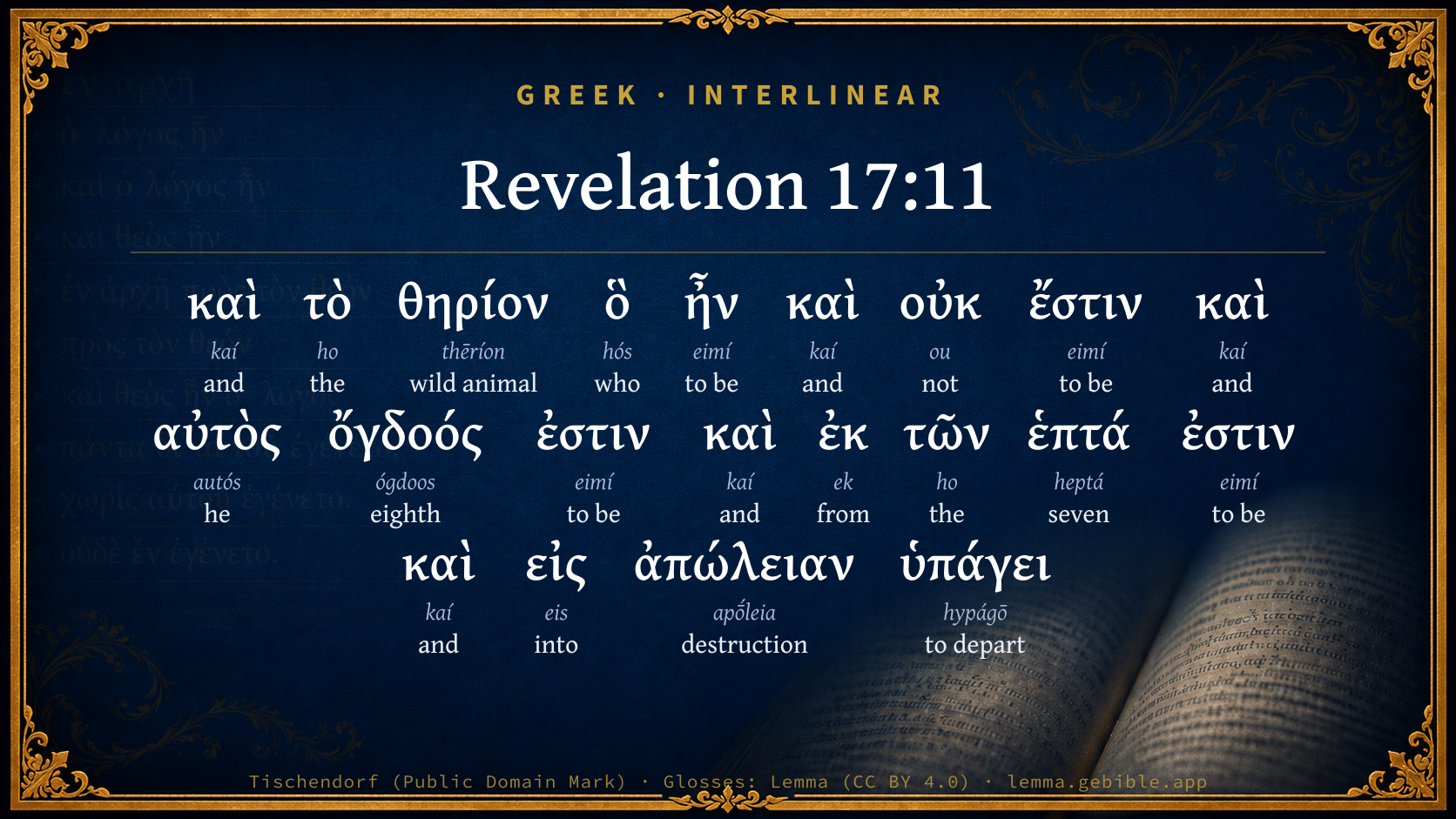
  1. καὶ kaí G2532 “and” Conjunction
  2. τὸ ho G3588 “the” Article, Nominative, Singular, Neuter
  3. θηρίον thēríon G2342 “wild animal” Noun, Nominative, Singular, Neuter
  4. ὃ hós G3739 “who” Relative pronoun, Nominative, Singular, Neuter
  5. ἦν eimí G1510 “to be” Verb, Imperfect, Active, Indicative, 3rd person, Singular
  6. καὶ kaí G2532 “and” Conjunction
  7. οὐκ ou G3756 “not” Particle, Negative
  8. ἔστιν eimí G1510 “to be” Verb, Present, Active, Indicative, 3rd person, Singular
  9. καὶ kaí G2532 “and” Conjunction
  10. αὐτὸς autós G846 “he” Personal pronoun, Nominative, Singular, Masculine
  11. ἐστιν eimí G1510 “to be” Verb, Present, Active, Indicative, 3rd person, Singular
  12. καὶ kaí G2532 “and” Conjunction
  13. ἐκ ek G1537 “from” Preposition
  14. τῶν ho G3588 “the” Article, Genitive, Plural, Masculine
  15. ἑπτά heptá G2033 “seven” Adjective, Numeral (indeclinable)
  16. ἐστιν eimí G1510 “to be” Verb, Present, Active, Indicative, 3rd person, Singular
  17. καὶ kaí G2532 “and” Conjunction
  18. εἰς eis G1519 “into” Preposition
  19. ἀπώλειαν apṓleia G684 “destruction” Noun, Accusative, Singular, Feminine
  20. ὑπάγει hypágō G5217 “to depart” Verb, Present, Active, Indicative, 3rd person, Singular

About this verse

These counts appear in no published source. They are computed here, from the morphology-tagged text and Lemma’s own curated glosses. What Lemma adds →

21
words
13
distinct lemmas
Revelation
section

Notable vocabulary

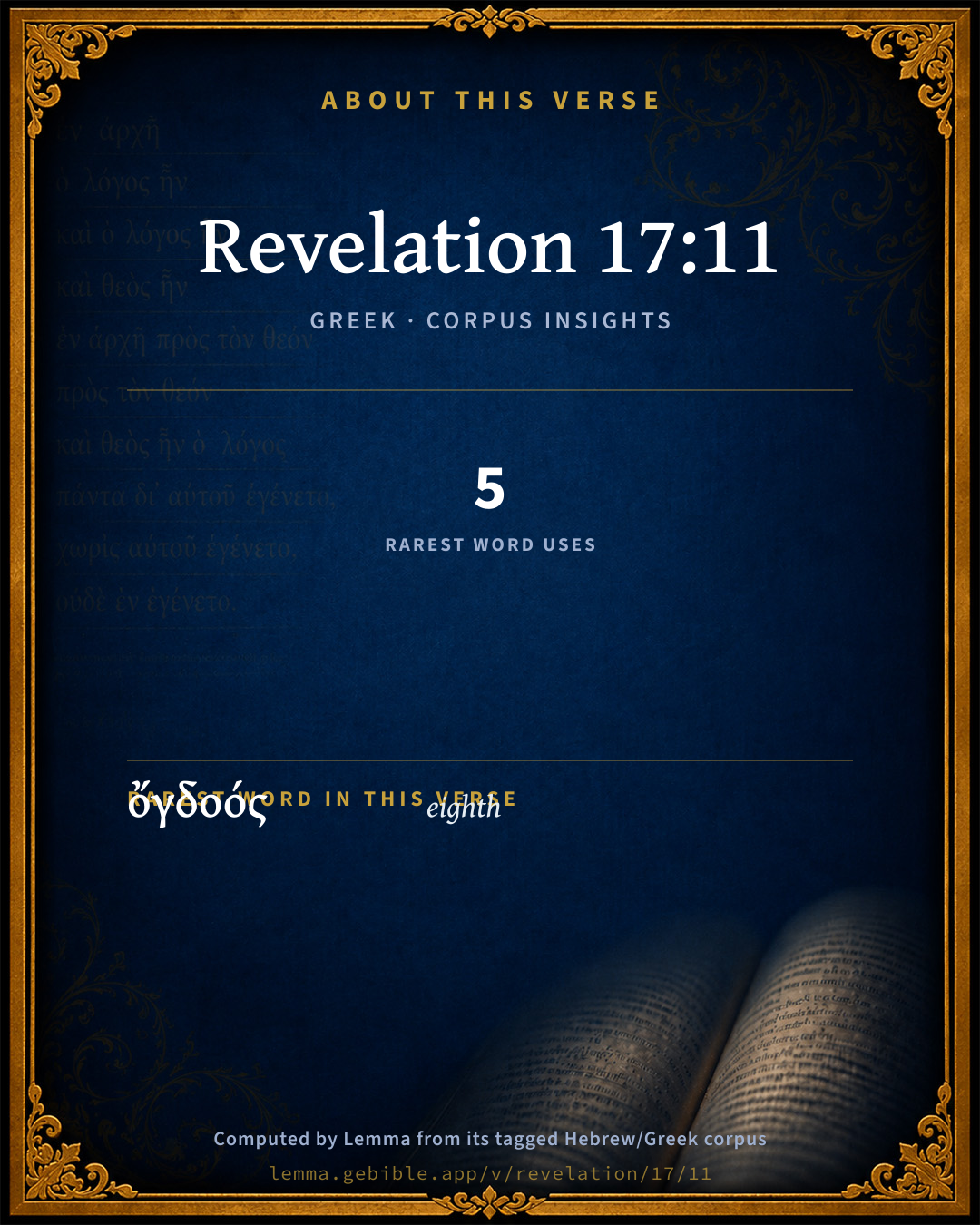
The rarest word here is ὄγδοός eighth G3590 — appearing just 5 times in the whole Greek New Testament.

Shared distinctive vocabulary

ὄγδοός eighth G3590 occurs in 5 verses of the Greek New Testament. Also found in:

Repetition

Words recur within this verse:

Cross-references

1

Topical passages linked to Revelation 17:11 in the Treasury of Scripture Knowledge — connected by theme and wording, ordered by reader-vote popularity; previews shown in the World English Bible.

  • Revelation 17:8 The beast that you saw was, and is not; and is about to come up out of the abyss and to go into destruction. Those who dwell on the earth and whose names have not been written in the book of life from the foundation of the world will marvel when they see that the beast was, and is not, and shall be present.

Cross-references courtesy of OpenBible.info (CC BY 4.0).

Commentary

Notes on Revelation 17:11 from classic Christian and Jewish commentators (each source and its license shown beneath its notes). The classic Christian expositions comment on the surrounding passage and are grouped to its opening verse, so a note may address several verses; the Jewish commentaries on the Tanakh (Rashi and others) are per-verse, so they appear only where the commentator wrote on this verse.

Lemma curates 59 commentaries, every one of them public domain or Creative Commons licensed, each selected and text-cleaned for this edition rather than reprinted as found. About our sources →

Jamieson, Fausset & Brown

Robert Jamieson, A. R. Fausset & David Brown

beast that . . . is not--his beastly character being kept down by outward Christianization of the state until he starts up to life again as "the eighth" king, his "wound being healed" (Rev 13:3), Antichrist manifested in fullest and most intense opposition to God. The "he" is emphatic in the Greek. He, peculiarly and pre-eminently: answering to "the little horn" with eyes like the eyes of a man, and a mouth speaking great things, before whom three of the ten horns were plucked up by the roots, and to whom the whole ten "give their power and strength" (Rev 17:12-13, Rev 17:17). That a personal Antichrist will stand at the head of the Antichristian kingdom, is likely from the analogy of Antiochus Epiphanes, the Old Testament Antichrist, "the little horn" in Dan 8:9-12; also, "the man of sin, son of perdition" (Th2 2:3-8), answers here to "goeth into perdition," and is applied to an individual, namely, Judas, in the only other passage where the phrase occurs (Joh 17:12). He is essentially a child of destruction, and hence he has but a little time ascended out of the bottomless pit, when he "goes into perdition" (Rev 17:8, Rev 17:11). "While the Church passes through death of the flesh to glory of the Spirit, the beast passes through the glory of the flesh to death" [AUBERLEN].

is of the seven--rather "springs out of the seven." The eighth is not merely one of the seven restored, but a new power or person proceeding out of the seven, and at the same time embodying all the God-opposed features of the previous seven concentrated and consummated; for which reason there are said to be not eight, but only seven heads, for the eighth is the embodiment of all the seven. In the birth-pangs which prepare the "regeneration" there are wars, earthquakes, and disturbances [AUBERLEN], wherein Antichrist takes his rise ("sea," Rev 13:1; Mar 13:8; Luk 21:9-11). He does not fall like the other seven (Rev 17:10), but is destroyed, going to his own perdition, by the Lord in person.

Jamieson, Fausset & Brown — Commentary Critical and Explanatory on the Whole Bible (1871) — public domain (CC PDM 1.0). Text via the HelloAO Bible API.

Albert Barnes' Notes on the Bible

And the beast that was, and is not - That is, the one power that was formerly mighty; that died away so that it might be said to be extinct; and yet Rev 17:8 that “still is,” or has a prolonged existence. It is evident that, by the “beast” here, there is some one power, dominion, empire, or rule, whose essential identity is preserved through all these changes, and to which it is proper to give the same name. It finds its termination, or its last form, in what is here called the “eighth”; a power which, it is observed, sustains such a special relation to the seven, that it may be said to be “of the seven,” or to be a mere prolongation of the same sovereignty.

Even he is the eighth - The eighth in the succession. This form of sovereignty, though a mere prolongation of the former government, so much so as to be, in fact, but keeping up the same empire in the world, appears in such a novelty of form, that, in one sense, it deserves to be called the eighth in order, and yet is so essentially a mere concentration and continuance of the one power, that, in the general reckoning Rev 17:10, it might be regarded as pertaining to the former. There was a sense in which it was proper to speak of it as the eighth power; and yet, viewed in its relation to the whole, it so essentially combined and concentrated all that there was in the seven, that, in a general view, it scarcely merited a separate mention. We should look for the fulfillment of this in some such concentration and embodiment of all that it was, in the previous forms of sovereignty referred to, that it perhaps would deserve mention as an eighth power, but that it was, nevertheless, such a mere prolongation of the previous forms of the one power, that it might be said to be “of the seven”; so that, in this view, it would not claim a separate consideration. This seems to be the fair meaning, though there is much that is enigmatical in the form of the expression.

And goeth into perdition - See the notes on Rev 17:8.

In inquiring now into the application of this very difficult passage, it may be proper to suggest some of the principal opinions which have been held, and then to endeavor to ascertain the true meaning:

I. The principal opinions which have been held may be reduced to the following:

(1) That the seven kings here refer to the succession of Roman emperors, yet with some variation as to the manner of reckoning. Prof. Stuart begins with Julius Caesar, and reckons them in this manner: the “five that are fallen” are Julius Caesar, Augustus, Tiberius, Caligula, Claudius. Nero, who, as he supposes, was the reigning prince at the time when the book was written, he regards as the sixth; Galba, who succeeded him, as the seventh. Others, who adopt this literal method of explaining it, suppose that the time begins with Augustus, and then Galba would be the sixth, and Otho, who reigned but three months, would be the seventh. The expression, “the beast that was, and is not, who is the eighth,” Prof. Stuart regards as referring to a general impression among the pagan and among Christians, in the time of the persecution under Nero, that he would again appear after it was reported that he was dead, or that he would rise from the dead and carry on his persecution again. See Prof. Stuart, Com. vol. ii., Excur. 3. The beast, according to this view, denotes the Roman emperors, specifically Nero, and the reference in Rev 17:8 is to “the well known hariolation respecting Nero, that he would be assassinated, and would disappear for a while, and then make his appearance again to the confusion of all his enemies.” “What the angel,” says he, “says, seems to be equivalent to this - ‘The beast means the Roman emperors, specifically Nero, of whom the report spread throughout the empire that he will revive, after being apparently slain, and will come, as it were, from the abyss or Hades, but he will perish, and that speedily,’” vol. ii. p. 323.

(2) That the word “kings” is not to be taken literally, but that it refers to forms of government, dynasties, or modes of administration. The general opinion among those who hold this view is, that the first six refer to the forms of the Roman government:

(1)Kings;

(2)Consuls;

(3)Dictators;

(4)Decemvirs;

(5)Military tribunes;

(6)The imperial form, beginning with Augustus.

This has been the common Protestant interpretation, and in reference to these six forms of government there has been a general agreement. But, while the mass of Protestant interpreters have supposed that the “six” heads refer to these forms of administration, there has been much diversity of opinion as to the seventh; and here, on this plan of interpretation, the main, if not the sole difficulty lies. Among the opinions held are the following:

That of Mr. Mede. He makes the seventh head what he calls the “Demi-Caesar,” or the “Western emperor who reigned after the division of the empire into East and West, and which continued, after the last division, under Honorius and Arcadius, about sixty years - a short space” (Works, book iii. ch. 8; book v. ch. 12). That of Dr. Newton, who regards the sixth or imperial “head” as continuing uninterruptedly through the line of Christian as well as pagan emperors, until Augustulus and the Heruli; and the seventh to be the Dukedom of Rome, established soon after under the exarchate of Ravenna (Prophecies, pp. 575, 576). That of Dr. More and Mr. Cunninghame, who suppose the Christian emperors, from Constantine to Augustulus, to constitute the seventh head, and that this had its termination by the sword of the Heruli. That of Mr. Elliott, who supposes the seventh head or power to refer to a new form of administration introduced by Diocletian, changing the administration from the original imperial character to that of an absolute Asiatic sovereignty. For the important changes introduced by Diocletian that justify this remark, see the Decline and Fall, vol. i. pp. 212-217.

Numerous other solutions may be found in Poole’s Synopsis, but these embrace the principal, and the most plausible that have been proposed.

II. I proceed, then, to state what seems to me to be the true explanation. This must be found in some facts that will accord with the explanation given of the meaning of the passage:

(1) There can be no doubt that this refers to Rome, either pagan, Christian, or papal. All the circumstances combine in this; all respectable interpreters agree in this. This would be naturally understood by the symbols used by John, and by the explanations furnished by the angel. See Rev 17:18; “And the woman which thou sawest is that great city, which reigneth over the kings of the earth.” Every circumstance combines here in leading to the conclusion that Rome is intended. There was no other power or empire on the earth to which this could be properly applied; there was everything in the circumstances of the writer to lead us to suppose that this was referred to; there is an utter impossibility now in applying the description to anything else.

(2) It was to be a revived power; not a power in its original form and strength. This is manifest, because it is said Rev 17:8 that the power represented by the beast “was, and is not, and yet is” - that is, it was once a mighty power; it then declined so that it could be said that “it is not”; and yet there was so much remaining vitality in it, or so much revived power, that it could be said that it “still is” - καίπερ ἐστίν kaiper estin. Now, this is strictly applicable to Rome when the papal power arose. The old Roman might had departed; the glory and strength evinced in the days of the consuls, the dictators, and the emperors, had disappeared, and yet there was a lingering vitality, and a reviving of power under the papacy, which made it proper to say that it still continued, or that that mighty power was prolonged. The civil power connected with the papacy was a revived Roman power - the Roman power prolonged under another form - for it is susceptible of clear demonstration that, if it had not been for the rise of the papal power, the sovereignty of Rome, as such, would have been wholly extinct. For the proof of this, see the passages quoted in the notes on Rev 17:3. Compare the notes on Rev 13:3, Rev 13:12, Rev 13:15.

(3) It was to be a power emanating from the “abyss,” or that would seem to ascend from the dark world beneath. See Rev 17:8. This was true in regard to the papacy, either:

(a)As apparently ascending from the lowest state and the most depressed condition, as if it came up from below (see the notes on Rev 17:3, compare Rev 13:11); or,

(b)As, in fact, having its origin in the world of darkness, and being under the control of the prince of that world, which, according to all the representations of that formidable anti-Christian power in the Scriptures, is true, and which the whole history of the papacy, and of its influence on religion, confirms.

(4) One of the powers referred to sustained the other. “The seven heads are seven mountains on which the woman sitteth,” Rev 17:9. That is, the power represented by the harlot was sustained or supported by the power represented by the seven heads or the seven mountains. Literally, applied, this would mean that the papacy, as an ecclesiastical institution, was sustained by the civil power, with which it was so closely connected. For the illustration and support of this, see the notes on Rev 13:2-3, Rev 13:12, Rev 13:15. In the notes on these passages it is shown that the support was mutual; that while the papacy, in fact, revived the almost extinct Roman civil power, and gave it new vitality, the price of that was, that it should be, in its turn, sustained by that revived Roman civil power. All history shows that that has been the fact; that in all its aggressions, assumptions, and persecutions, it has, in fact, and professedly, leaned on the arm of the civil power.

(5) A more important inquiry, and a more serious difficulty, remains in respect to the statements respecting the “seven kings,” Rev 17:10-11. The statements on this point are, that the whole number properly was seven; that of this number five had fallen or passed away; that one was in existence at the time when the author wrote; that another one was yet to appear who would continue for a little time; and that the general power represented by all these would be embodied in the “beast that was, and is not,” and that might, in some respects, be regarded as an “eighth.” These points may be taken up in their order:

(a) The first inquiry relates to the five that were fallen and the one that was then in existence - the first six. These may be taken together, for they are manifestly of the same class, and have the same characteristics, at least so far as to be distinguished from the “seventh” and the “eighth.” The meaning of the word “kings” here has been already explained, Rev 17:10. It denotes ruling power, or forms of power; and, so far as the signification of the word is concerned, it might be applicable to royalty, or to any other form of administration. It is not necessary, then, to find an exact succession of princes or kings that would correspond with this - five of whom were dead, and one of whom was then on the throne, and all soon to be succeeded by one more, who would soon die.

The true explanation of this seems to be what refers this to the forms of the Roman government or administration. These six “heads,” or forms of administration, were, in their order, Kings, Consuls, Dictators, Decemvirs, Military Tribunes, and Emperors. Of these, five had passed away in the time when John wrote the Apocalypse; the sixth, the imperial, was then in power, and had been from the time of Augustus Caesar. The only questions that can be raised are, whether these forms of administration were so distinct and prominent, and whether in the times previous to John they so embraced the whole Roman power, as to justify this interpretation - that is, whether these forms of administration were so marked in this respect that it may be supposed that John would use the language here employed in describing them. As showing the probability that he would use this language, I refer to the following arguments, namely:

(1) The authority of Livy, lib. 6:cap. 1. Speaking of the previous parts of his history, and of what he had done in writing it, he says: “Quae ab condita urbe Roma a.d. captam eandem urbem, Romani sub regibus primum, consulibus deinde ac dictatoribus, decemviris ac tribunis consularibus gessere, foris bella, domi seditiones, quinque libris exposui.” That is, “In five books I have related what was done at Rome, pertaining both to foreign wars and domestic strifes, from the foundation of the city to the time when it was taken, as it was governed by kings, by consuls, by dictators, by the decemvirs, and by consular tribunes.” Here he mentions five forms of administration under which Rome had been governed in the earlier periods of its history. The imperial power had a later origin, and did not exist until near the time of Livy himself.

(2) The same distribution of power, or forms of government, among the Romans, is made by Tacitus, Annual. lib. i. cap. 1: “Urbem Romam a principio reges habuere. Libertatem et consulatum L. Brutus instituit. Dictaturae a.d. tempus sumebantur. Neque decemviralis potestas ultra biennium, neque tribunorum militum consulure jus diu valuit. Non Cinnae, non Syllae longa dominatio: et Pompeii Crassique potentia cito in Caesarem, Lepidi atque Antonii arma in Augustum cessere; qui cuncta, discordiis civilibus fessa, nomine principis sub imperium accepit.” That is, “In the beginning, Rome was governed by kings. Then L. Brutus gave to her liberty and the consulship. A temporary power was conferred on the dictators. The authority of the decemvirs did not continue beyond the space of two years: neither was the consular power of the military tribunes of long duration. The rule of Cinna and Sylla was brief; and the power of Pompey and Crassus passed into the hands of Caesar; and the arms of Lepidus and Antony were surrendered to Augustus, who united all things, broken by civil discord, under the name of prince in the imperial government.” Here Tacitus distinctly mentions the six forms of administration that had prevailed in Rome, the last of which was the imperial. It is true, also, that he mentions the brief rule of certain men - as Cinna, Sylla, Antony, and Lepidus; but these are not forms of administration, and their temporary authority did not indicate any change in the government - for some of these men were dictators, and none of them, except Brutus and Augustus, established any permanent form of administration.

(3) The same thing is apparent in the usual statements of history, and the books that describe the forms of government at Rome. In so common a book as Adam’s Roman Antiquities, a description may be found of the forms of Roman administration that corresponds almost precisely with this. The forms of supreme power in Rome, as enumerated there, are what are called ordinary and extraordinary magistrates. Under the former are enumerated kings, consuls, praetors, censors, quaestors, and tribunes of the people. But of these, in fact, the supreme power was vested in two; for there were, under this, but two forms of administration - that of kings and consuls; the offices of praetor, censor, quaestor, and tribune of the people being merely subordinate to that of the consuls, and no more a new form of administration than the offices of secretary of the state, of war, of the navy, of the interior, are now. Under the latter - that of extraordinary magistrates - are enumerated dictators, decemvirs, military tribunes, and the interrex. But the interrex did not constitute a form of administration, or a change of government, anymore than, when the President or Vice-president of the United States should die, the performance of the duties of the office of president by the speaker of the senate would indicate a change, or than the regency of the Prince of Wales in the time of George III constituted a new form of government. So that, in fact, we have enumerated, as constituting the supreme power at Rome, kings, consuls, dictators, decemvirs, and military tribunes - five in number. The imperial power was the sixth.

(4) In confirmation of the same thing, I may refer to the authority of Bellarmine, a distinguished Roman Catholic writer. In his work De Pontiff., cap. 2, he thus enumerates the changes which the Roman government had experienced, or the forms of administration that had existed there:

Kings; Consuls; Decemvirs; Dictators; Military Tribunes with consular power; Emperors.

See Poole’s Synoptists, in loco. And,

(5) It may be added, that this would be understood by the contemporaries of John in this sense. These forms of government were so marked that, in connection with the mention of the “seven mountains,” designating the city, there could be no doubt as to what was intended. Reference would at once be made to the imperial power as then existing, and the mind would readily and easily turn back to the five main forms of the supreme administration which had existed before.

(b) The next inquiry is, what is denoted by “the seventh.” If the word “kings” here refers, as is supposed (see the notes on Rev 17:10), to a form of government or administration; if the “five” refer to the forms previous to the imperial, and the “sixth” to the imperial; and if John wrote during the imperial government, then it follows that this must refer to some form of administration that was to succeed the imperial. If the papacy was “the eighth,” and of the “seventh,” then it is clear that this must refer to some form of civil administration lying between the decline of the imperial and the rise of the papal power: that “short space” - for it was a short space that intervened. Now, there can be no difficulty, I think, in referring this to that form of administration over Rome that “dukedom” under the exarchate of Ravenna, which succeeded the decline of the imperial power, and which preceded the rise of the papal power; between the year 566 or 568, when Rome was reduced to a dukedom, under the exarchate of Ravenna, and the time when the city revolted from this authority and became subject to that of the pope, about the year 727.

This period continued, according to Mr. Gibbon, about two hundred years. He says, “During a period of two hundred years, Italy was unequally divided between the kingdom of the Lombards and the exarchate of Ravenna. The offices and professions, which the jealousy of Constantine had separated, were united by the indulgence of Justinian; and eighteen successive exarchs were invested, in the decline of the empire, with the full remains of civil, of military, and even of ecclesiastical power. Their immediate jurisdiction, which was afterward consecrated as the patrimony of Peter, extended over the modern Romagna, the marshes or valleys of Ferrara and Commachic, five maritime cities from Rimini to Ancona, and a second inland Pentapolis, between the Adriatic coast and the hills of the Apennine. The duchy of Rome appears to have included the Tuscan, Sabine, and Latian conquests, of the first four hundred years of the city; and the limits may be distinctly traced along the coast, from Civita Vecchia to Terracina, and with the course of the Tiber from Ameria and Narni to the port of Ostia” (Dec. and Fall, 3:202).

How accurate is this if it be regarded as a statement of a new power or form of administration that succeeded the imperial - a power that was, in fact, a prolongation of the old Roman authority, and that was designed to constitute and embody it all! Could Mr. Gibbon have furnished a better commentary on the passage if he had adopted the interpretation of this portion of the Apocalypse above proposed, and if he had designed to describe this as the seventh power in the successive forms of the Roman administration? It is worthy of remark, also, that this account in Mr. Gibbon’s history immediately precedes the account of the rise of the papacy; the record respecting the exarchate, and that concerning Gregory the Great, described by Mr. Gibbon as “the Saviour of Rome,” occurring in the same chapter, vol. iii. 202-211.

(c) This was to “continue for a short space” - for a little time. If this refers to the power to which in the remarks above it is supposed to refer, it is easy to see the propriety of this statement. Compared with the previous form of administration - the imperial - it was of short duration; absolutely considered, it was brief. Mr. Gibbon (iii. 202) has marked it as extending through “a period of two hundred years”; and if this is compared with the form of administration which preceded it, extending to more than five hundred years, and more especially with that which followed - the papal form - which has extended now some twelve hundred years, it will be seen with what propriety this is spoken of as continuing for a “short space.”

(d) “The beast that was, and is not, even he is the eighth, and is of the seven,” Rev 17:11. If the explanations above given are correct, there can be no difficulty in the application of this to the papal power; for:

(1) All this power was concentrated in the papacy, all that revived or prolonged Roman power had now passed into the papacy, constituting that mighty dominion which was to be set up for so many centuries over what had been the Roman world. See the statements of Mr. Gibbon (iii. 207-211), as quoted in the notes on Rev 17:3. Compare also, particularly, the remarks of Augustine Steuchus, a Roman Catholic writer, as quoted in the notes on that verse: “The empire having been overthrown, unless God had raised up the pontificate, Rome, resuscitated and restored by none, would have become uninhabitable, and been thenceforward a most foul habitation of cattle. But in the pontificate it revived as with a second birth; its empire in magnitude not indeed equal to the old empire, but its form not very dissimilar: because all nations, from East and from West, venerate the pope, not otherwise than they before obeyed the emperor.”

(2) This was an eighth power or form of administration - for it was different, in many respects, from that of the kings, the consuls, the dictators, the decemvirs, the military tribunes, the emperors, and the dukedom - though it comprised substantially the power of all. Indeed, it could not have been spoken of as identical with either of the previous forms of administration, though it concentrated the power which had been wielded by them all.

(3) It was “of the seven”; that is, it pertained to them; it was a prolongation of the same power. It had the same central seat - Rome; it extended over the same territory, and it embraced sooner or latter the same nations. There is not one of those forms of administration which did not find a prolongation in the papacy; for it aspired after, and succeeded in obtaining, all the authority of kings, dictators, consuls, emperors. It was in fact still the Roman scepter swayed over the world; and with the strictest propriety it could be said that it was “of the seven,” as having sprung out of the seven, and as perpetuating the sway of this mighty domination. For full illustration of this, see the Dan. 7 notes; and Rev. 13 notes.

(4) It would “go into perdition”; that is, it would be under this form that this mighty domination that had for so many ages ruled over the earth would die away, or this would be the last in the series. The Roman dominion, as such, would not be extended to a ninth, or tenth, or eleventh form, but would finally expire under the eighth. Every indication shows that this is to be so, and that with the decline of the papal power the whole Roman domination, that has swayed a scepter for two thousand five hundred years, will have come forever to an end. If this is so, then we have found an ample and exact application of this passage even in its most minute specifications.

Albert Barnes' Notes on the Bible (1834–1885) — public domain. Text from a community e-Sword/MySword module.

Bengel's Gnomon

Johann Albrecht Bengel

Rev 17:11. Καὶ αὐτὸς ὄγδοός ἐστι, καὶ ἐκ τῶν ἑπτά ἐστι, is both himself eighth, and is of the seven) Καὶ, καὶ, is equivalent to both, and. Ὄγδοος is a part the predicate, therefore it is put without the article: the pronoun, αὐτὸς, cohering with it, is also a part of the predicate, adding emphasis to the eighth, in so far as he himself is contradistinguished from the seven. The eighth, and the seven, are masculines, so that the noun king or kings is to be understood.

There is here an intimation of that long celebrated and great Adversary, whom all antiquity and the whole Church of Rome regard as one individual and extraordinary man. Bernard, who is called the last of the Fathers, has hit the matter closely enough. For in his late age, in his sixth discourse on the psalm, Qui habitat [Psalms 111], after bitter lamentations concerning the corrupt state of the Church and its ministers, he says, “It remains that the Man of Sin be revealed, the Son of Perdition, the demon, not only of the day, but even of the mid-day, which is not only transformed into an angel of light, but is also exalted above everything which is called God, or which is worshipped.” Of the Reformers, who in other respects had their attention especially fixed upon their own times, and not without reason, Francis Lambert acknowledged, that one remarkable adversary, the Son of Perdition, was hereafter to come and he mournfully described that calamity.—Exeg. Apoc. pp. 183, 193, 215, 265. Among the Propositions of Hier. Zanch was this: Although the kingdom of Antichrist has long ago been revealed; and he who holds the primacy in it, and reigns, is the true Antichrist; yet it is not in opposition to the Sacred Writings, to say, that just before the end of the world there shall come one of remarkable character, and outstripping all men in iniquity, the true and perfect Antichrist, who may even work miracles. For in a pre-lection at Argentina on the end of the world, he had discoursed to this purpose, and was blamed on that account by others. The Divines of Heidelberg, A. 1561, approved of this Proposition, and those of Zurich even confirmed it, in these words besides others: “Since wickedness becomes greater from day to day, and is increased without measure, there is no reason why there should not at last arise some one κατʼ ἐξοχὴν [by pre-eminence], who may very far outstrip in his impiety the other enemies of the Gospel, and whom the Lord may altogether destroy with the breath of His mouth.” see Zanch Misc. Theol. pp. 1, 18, 21, 44, 48. And in no other way, on this subject at least, Jo. Brent replied in the same year to Jo. Marpach: “I should be unwilling odiously to contend about Antichrist; we know that the Papacy is antichristianity. But it may perhaps happen, that among the Popes there may arise one, who may surpass all the rest in impiety, craft, deceits, cruelty, and tyranny, and may give occasion to the Son of God to hasten His coming for the complete destruction of the Papacy, and the judgment of the quick and dead. The Lord will take care concerning this matter: we will perform our own duty, and will wait for the coming of the Lord.” Compare the Epistle of Lud. Crocius, inserted among those of Voss; Heding. on 2Th 2:3; Weismann’s Inst. p. 1121, lin. 5, 6; the Patmos of H. Horchius, p. 70; C. B. Michaëlis on Dan. pp. 247, 248. “What if we should concede to the Papists,” says Bailly, “and in this the orthodox ARE NOT OBSTINATE, that in the long series of Romish antichrists there should at the end of the world arise one more wicked than his brethren, though they are most wicked, by a kind of ἐξοχῇ [pre-eminence] of wickedness,—one who should closely resemble the days of Antiochus: they themselves would gain nothing by this concession.”—Op. Hist. et Chron. f. 244. Vitringa says appropriately to this passage: That the beast itself is also the eighth king, according to the order of his predecessors. Thus it can without any difficulty be imagined, that after these kings of mystic Babylon one is still to be expected just before the close of the power of Antichrist, who shall slay the witnesses of Christ, and rage against the Church above all others; and of him the Spirit had especially prophesied under the name of the Beast: ch. Rev 11:7. And all at the present day, who take the prophetic times, and among these the 42 months of the beast, in their ordinary signification, agree, namely, in ascribing so short a power to the one king. I am not accustomed to rely on testimonies of human authority: the truth has no need of them; but when there is a possibility of its being supposed that any doctrine is paradoxical, it is expedient to collect the anticipations of the truth which lie concealed in the minds of men. This one, last king, will differ most widely from all his predecessors, as in malignity, so in the manner of his destruction. They for the most part die by a natural death; he shall be given alive to eternal torment: ch. Rev 19:20; 2Th 2:8.—ἐκ τῶν ἑπτὰ, of the seven) Primasius admirably says, LEST you should esteem this one, whom, he calls eighth, OF ANOTHER RACE, he has subjoined, He is of the seven.

Bengel's Gnomon of the New Testament — English translation (T&T Clark, Edinburgh, 1860) — public domain. Text from a community e-Sword module.

Expositor's Greek Testament

ed. W. Robertson Nicoll

Rev 17:11 . Bruston takes καὶ ἐκ τῶν ἑπτὰ ἐστιν as a translation of השבעה הוא ומן , in the sense that the eighth was more (or greater) than the seven, i.e. , realising more fully the ideal of the Beast. But even were the case for a Hebrew original clearer than it is, such an interpretation is forced. The verse is really a parenthesis added by John to bring the source up to date. Domitian, the eighth emperor, under whom he writes, is identified with the true Neronic genius of the empire; he is a revival and an embodiment of the persecuting Beast ( cf. Eus. H. E. iii. 17, Tert. Rev 5Rev 5 : portio Neronis de crudelitate, de pallio 4: a sub-Nero) to the Christian prophet, as he proved a second Nero to some of his Roman subjects ( cf. Juvenal’s well-known sneer at the caluus Nero ). This does not mean that John rationalises Nero redivivus into Domitian, which would throw the rest of the oracle entirely out of focus. Domitian, the eighth emperor, is not explained as the Beast which was and is not and is to come up out of the abyss (Rev 17:8 ), but simply as the Beast which was and is not ; no allusion is made to his term of power, and the concluding phrase καὶ εἰς ἀπ . ὑπάγει is simply the conventional prophecy of doom upon persecutors; it need not be a post-factum reference to D.’s murder in 96. He belonged to the seven , as he had been closely associated with the Imperial power already (Tac. Hist. iii. 84, iv. 2, 3; cf. Jos. Bell . iv. 11, 4). The enigmatic and curt tone of the verse shows that either from prudence (“some consideration towards the one who is beseems even a prophet,” Mommsen), or more probably from pre-occupation in the grim, ulterior figure of the Neronic antichrist, the prophet does not care to dwell minutely on the emperor’s personality as an incarnate Nero. He does not even allude to the suspicion, voiced by his contemporaries (4 Esd. 11:12) that Domitian had made away with Titus. His vision is strained, like that of his source, to the final and supernatural conflict; the Satanic messiah, the Beast who is to return from the abyss, bulks most prominently on the horizon. The absorbing interest of the oracle, even in its edited form, is eschatological. John simply puts in a few words, as few as possible, to bring this Vespasianic source up to date, since the death of Titus had not been followed by the appearance of the Nero-antichrist. The latter is still and soon to come however! John thoroughly shares, though he expands and applies, the prediction of his source. The addition he makes to it in Rev 17:11 must on no account be taken as if it meant the substitution of “Domitian = Nero redivivus” for the supernatural expectation of the latter. There is certainly some awkwardness in the juxtaposition of Domitian as a second Nero and of Nero redivivus, but this was inevitable under the circumstances.

The Expositor's Greek Testament, edited by W. Robertson Nicoll (1897–1910) — public domain. Text from a community e-Sword module.

Geneva Bible (1599)

Geneva Bible translators

This is spoken by the figure synecdoche, as much to say as that head of the beast which was and is not, because it is cut off, and Nerua in so short time extinguished. How many heads there were, so many beasts there seemed to be in one. See the like speech in Rev. 13.3

Namely, to molest with persecutions the Churches of Christ, as the histories do accord, and I have briefly noted, Rev. 2:10.

Nerua Traianus, who himself in divers respects is called here the seventh and the eighth.

Though in number and order of succession he be the eighth, yet he is reckoned together with one of these heads, because Nerua and he were one head. For this man obtained authority together with Nerua, and was Consul with him, when Nerua left his life.

Geneva Bible (1599) marginal notes — public domain. Text via Bolls.life.

Adam Clarke's Commentary

Verse 11. And the beast, that was, and is not, even he is the eighth, and is of the seven, and goeth into perdition.] That is to say, the Latin kingdom that has already been, but is now no longer nominally in existence, shall immediately follow the dissolution of the seventh form of Latin government; and this dominion is called ογδοος, an eighth, because it succeeds to the seventh. Yet it is not an eighth head of the beast, because the beast has only seven heads; for to constitute a new head of the beast the form of government must not only differ in nature, but also in name. This head of the beast is, therefore, εκτωνεπτα, ONE of the seven. Consequently the form of government represented by this head is the restoration of one of the preceding seven. The restored head can be therefore no other than the regal state of the Latins, or in other words the Latin kingdom, (ηλατινη βασιλεια,) which followed the patriciate or seventh head of Latin government. But the beast in his eighth state, or under his first head restored, goeth into perdition. No other form of Latin government shall succeed; but the beast in his last or antichristian condition shall be taken together with the false prophet that wrought miracles in his sight, "and cast alive into a lake of fire burning with brimstone."

It is observable that the eighth Latin power is called by the angel the beast, and also one of his heads. This apparent discordance arises from the double signification of the heads, for if we take the beast upon which the woman sits to be merely a representation of that secular power which supports the Latin Church, then the seven heads will represent the seven electorates of the Germanic empire; but if by the beast we understand the general Latin empire from first to last, then what is, according to the angel's first interpretation of the heads, called the beast, is in this case only one of his heads. See Clarke on Re 17:18.

Adam Clarke's Commentary on the Bible (1810–1826) — public domain. Text from a community e-Sword/MySword module.

Ellicott's Commentary for English Readers

(11) And the beast . . .—Better, And the wild beast which was, and is not, even he himself is the eighth, and is of the seven, and goeth into destruction. The wild beast himself, forming as it were an eighth, has to be reckoned with. There are seven heads; when these fall no eighth head will rise, but the wild beast, whose vitality has been seen in these successive heads, forms, as it were, an eighth, which is “out of the seven”—not one of them, but one rising out of them; no eighth empire shall rise, but the wild beast, now smitten in all the seven heads of his power, will, in the convulsive death-throe, seem an eighth power, in which the ebbing life of all the seven finds expression. The wild beast linked itself with seven great empires in succession: these all fell; the wild beast is left, as an eighth: then “the wild beast goes into destruction.” As an illustration, we may recall her whom the seven brothers had as wife; last of all the woman, the eighth, which was of the seven, died also. It has been noticed that the wild beast does not “fall,” like the others, “but goes into destruction;” there are no more world-powers like those who have fallen, but the wild beast is left, a last power reserved for destruction, a final antichrist, the lawless one whom the Lord will destroy with the brightness of His coming (2Th_2:3). This fierce and last flickering up of the doomed power of evil is dwelt on again in Rev_20:7-10.

A Bible Commentary for English Readers, edited by Charles John Ellicott (1878–1897) — public domain. Text from a community e-Sword module.

The Cambridge Bible for Schools and Colleges

gen. ed. J. J. S. Perowne

11. even he is the eighth] Perhaps rather, both is himself the eighth, and is of the seven.

of the seven] is most easily understood “is one of the seven”—i.e. the eighth emperor of Rome, in whom the antichristian spirit of the empire finds its personal embodiment, will be a revival of one of his seven predecessors—viz. Nero, the fifth of them. The words can however be taken to mean “the successor and result of the seven, following and springing out of them;” if a scheme of interpretation be preferred with which this meaning harmonises better.

goeth into perdition] Implies something more than the “fall” of the other kings.

The Cambridge Bible for Schools and Colleges (gen. ed. J. J. S. Perowne; Cambridge University Press, 1878–1918) — public domain. Text from a community e-Sword module.

John Gill's Exposition

And the beast that was, and is not, even he is the eighth,.... That was in embryo in John's time, and yet was not come to its power and grandeur, is the eighth king; and this is the Papacy, which takes the name of the beast, because it is the head of the beast, and the only surviving head of the beast, or Roman empire, now become Papal:

and is of the seven; one of the seven heads, and the last of them, and is an idolatrous one, as the rest were, requiring and encouraging the worship of angels, of the virgin Mary, and saints parted: the pope of Rome is the eighth king, and seventh head, the latter with respect to his temporal power, and the former with respect to his ecclesiastical authority; for his government is quite of a different sort from the rest, being of a mixed kind, partly civil, and partly ecclesiastical, and therefore is signified by two beasts in the thirteenth chapter:

and goes into perdition; being the son of perdition, and is justly deserving of it; See Gill on Rev 17:8.

John Gill's Exposition of the Whole Bible (1746–1763) — public domain (CC PDM 1.0). Text via the HelloAO Bible API.

Trapp's Complete Commentary

John Trapp

11 And the beast that was, and is not, even he is the eighth, and is of the seven, and goeth into perdition.

Ver. 11. He is the eighth] viz. The Pontifficality.

And is of the seven] i.e. Shall exercise that monarchical power that was before in the seven heads.

John Trapp, A Commentary or Exposition upon All the Books of the Old and New Testament (1647–1656) — public domain. Text from a community e-Sword module.

Haydock's Catholic Bible Commentary

The beast that was, and is not: is the eighth: and is of seven. The devil reigns with the kings in all these ages: he is of the seven, because he is the prince under whom reign the wicked in all ages: he is also the eighth, inasmuch as he is their prince, and they are only his instruments. (Witham)

George Leo Haydock (1774–1849), Haydock's Catholic Family Bible and Commentary, 1859 edition — public domain. Excludes Psalms (Douay-Rheims chapter numbering differs from Protestant) and Deuterocanonical books (Catholic canon only).

Matthew Poole's English Annotations

And the beast that was, and is not, even he is the eighth; this made the eighth succession of governments in the Roman empire.

And is of the seven; this was of the seventh head; for although this was the eighth government in order as we have counted them, yet one of these, viz. the seventh, (which was that of true Christian emperors), must not be counted as one of the seven heads, which were all idolatrous: so though this was the eighth government, yet he was one of the seven heads, i.e. idolatrous governments.

And goeth into perdition; and to be destroyed as they were.

Matthew Poole's English Annotations on the Holy Bible (1683–1685) — public domain. Text from a community e-Sword/MySword module.

Whedon's Commentary on the Bible

Daniel D. Whedon

11. And the beast—Passing from the heads, our angel now considers the whole beast.

Was, and is not—As the predicate, and yet is, (Rev_17:8,) is omitted for abbreviation, this describes the beast through all his historic changes, from Egypt to Pontifical Rome. Each previous phase once was, then by fall is not, and then is in its successor, until the perdition. The beast, here, is the totality of the entire successional antichrist—the whole composite beast.

He is the eighth—The Greek article being omitted, it should read an eighth, that is, a sort of eighth. Not an eighth head, for there were, as the cut shows, but seven heads to the beast. Besides, the Greek adjective for eighth could not grammatically agree with head, being of different gender. The meaning is, that it is the beast, as a totality, which, forming a sort of eighth individuality, finally goeth into perdition. Not one head alone—not merely all the heads—but the entire beast is destroyed. With papal Rome—the last head—all the five or six inherited by and embodied in her—namely, Egypt, Assyria, Babylon, Persia, Greece, pagan Rome—all go as one whole beast with her as antichristianities into perdition.

And is—Or, consists or results of, or rather from, the seven. Counted as a single head he is but one of the seven; counted as the whole beast he is an eighth. The six profane empires, traceable through and beyond Daniel’s image, are all abolished in her; an abolition which does not, probably, imply the destruction of the peoples but of the SYSTEMS by which the nationalities are antichristian despotisms. When, by the power of divine truth and the blessed Spirit, rectitude reigns in every heart, governments of force, of tyranny, and of war, may cease. The inequalities of wealth even, based, as they largely are, upon the thriftlessness and vices of a large share of the community, may largely disappear. And the equalized distribution of the goods of life, with all the necessary reforms of society, according to the laws of a truly Christian social science, would prove the downfall of iron politics and despotisms.

Daniel D. Whedon (gen. ed.), Commentary on the Old and New Testaments (1874–1909) — public domain. Text from a community e-Sword module.

The Pulpit Commentary

And the beast that was, and is not, even he is the eighth, and is of the seven, and goeth into perdition; and the beast (neuter, yhrion) that was and is not, he himself is also an eighth (masculine), and is of (ek , out of) the seven, etc. We may note

(1) that "eighth" refers to "king" in ver. 10, being masculine gender;

(2) the absence of the article before ogdov , "eighth," shows that this is not the eighth in a successive series, in which the kings already mentioned form the first seven. The Revised Version probably gives the correct meaning, "is of the seven;" that is, the beast himself consists of, and is formed by, what has been denoted by the seven kings. We have already interpreted the beast as the worldly power Satan in his capacity of "prince of this world." We have also shown that the "seven kings" describes this worldly power as it exists throughout all ages. This verse, therefore, sums up and reasserts briefly what has been already virtually intimated in the symbolism employed, viz. that the beast is the sum total of what has been described under the form of five kings, then one king, and then one king again (ver. 10). His final doom is also reasserted, "he goeth into perdition". (cf. ver. 8 and Rev_19:20)

The Pulpit Commentary (1880–1919), ed. H.D.M. Spence-Jones & Joseph S. Exell — public domain. Text from a community e-Sword module.

John Wesley's Explanatory Notes

And the wild beast that was, and is not, even he is the eighth - When the time of his not being is over. The beast consists, as it were, of eight parts. The seven heads are seven of them; and the eighth is his whole body, or the beast himself. Yet the beast himself, though he is in a sense termed the eighth, is of the seven, yea, contains them all. The whole succession of Popes from Gregory VII. are undoubtedly antichrist. Yet this hinders not, but that the last Pope in this succession will be more eminently the antichrist, the man of sin, adding to that of his predecessors a peculiar degree of wickedness from the bottomless pit. This individual person, as Pope, is the seventh head of the beast; as the man of sin, he is the eighth, or the beast himself.

John Wesley, Explanatory Notes Upon the Whole Bible (1754–1765) — public domain. Text via the GEBible commentary corpus.

The People's New Testament

B. W. Johnson

11. The beast that was, and is not, is the eighth. I have explained in chapter 13 this eighth power, which was a revivification of the beast, and which had the characteristics and strength of all the seven.

B. W. Johnson's The People's New Testament with Notes (1889–1891) — public domain. Electronic text from the Christian Classics Ethereal Library (CCEL) ThML edition.

unfoldingWord translationNotes

Door43 World Missions Community

it is one of those seven kings

Possible meanings are 1) the beast rules twice: first as one of the seven kings, and then as the eighth king or 2) the beast belongs to that group of seven kings because he is like them.

it is going to destruction

The certainty of what will happen in the future is spoken of as if the beast were going to it. AT: "it will certainly be destroyed" or "God will surely destroy it" (See: Metaphor and Active or Passive)

translationWords

beast

king

unfoldingWord translationNotes — © Distant Shores Media and the Door43 World Missions Community, licensed CC BY-SA 4.0. Source: git.door43.org/Door43/en_tn.

Cambridge Greek Testament for Schools and Colleges

11. καὶ αὐτός. א reads οὖτος; B2 καὶ οὖτος.

11. καὶ αὐτὸς κ.τ.λ. The analogy of this Book is in favour of connecting the first two words closely as in A. V[623], “even he is the eighth and is of the seven,” otherwise it might be possible and even preferable to translate “both himself is the eighth and is of the seven.”

[623] Authorised Version.

ἐκ τῶν ἑπτὰ is most easily understood “is one of the seven”—i.e. the eighth emperor of Rome, in whom the antichristian spirit of the empire finds its personal embodiment, will be a revival of one of his seven predecessors—viz. Nero, the fifth of them. The words can however be taken to mean “the successor and result of the seven, following and springing out of them”; if a scheme of interpretation be preferred with which this meaning harmonises better.

εἰς ἀπώλειαν ὑπάγει. Implies something more than the “fall” of the other kings.

Cambridge Greek Testament for Schools and Colleges (Cambridge University Press, 1896; 21 vols, various authors incl. Carr, Maclear, Plummer, Farrar, Lumby, Moule, M. R. James, Simcox) — public domain. Text from a community e-Sword module.

Lesson kit

Teaching starters — assembled from the data on this page, not authored interpretation. Every prompt links to the verse data it draws on. Edit before teaching.

Revelation, in the Revelation, opens this verse with 21 words (13 distinct Greek lemmas). Its most distinctive word is ógdoos (“eighth”). A historical commentator’s framing appears above. Read the whole chapter for the surrounding context.

Discussion questions

  1. The word ógdoos carries the sense “eighth.” How does it shape the verse?
  2. How does Luke 1:59, which shares the word «eighth», read alongside this verse?
  3. What does the repetition of “to be” (4× in this one verse) do in this verse?
  4. These translations render this verse differently. What is at stake in choosing one wording over another?
  5. Compare how Jamieson, Fausset & Brown and Albert Barnes' Notes on the Bible read this verse. Where do they agree or differ?

Things to notice

Reading settings

Reading text

Shown beneath each verse's original-language words.

Old Testament
Old Testament edition

Read the OT as the Masoretic Hebrew (MT) or the Greek Septuagint (LXX).

English shown for the Greek Septuagint (in the Hebrew ↔ Greek comparison).

Comparing translations? Open the Compare panel on any verse page to stack up to four side by side.