Isaiah 13:21

Hebrew (Westminster Leningrad Codex) Isaiah 13:21 appears in the Hebrew Old Testament. The text above is from the Westminster Leningrad Codex. Each word links to its Strong’s number, a concise gloss, and parsing drawn from the Open Scriptures Hebrew Bible morphology. Click any word for its full Brown-Driver-Briggs (BDB) entry.
Download image
Cite this verse

Isaiah 13:21 (World English Bible). Public Domain. Lemma interlinear Bible study tool, https://lemma.gebible.app/v/isaiah/13/21.

Show BibTeX & RIS
BibTeX
RIS
English Translation
But wild animals of the desert shall lie there; and their houses shall be full of doleful creatures; and ostriches shall dwell there, and wild goats shall dance there.
World English Bible · Public Domain
Highlights Full analysis ↓
Download a study sheet

One document with this verse’s original text, its word-by-word gloss line, the meaning frame, cross-references with their text, attributed commentary, and full source and license credits — printable, and it pastes into notes with its structure intact.

This verse Autodidact and up

Study sheet (.html) Plain text (.txt)

A passage Seminary Student

Up to 50 verses in one chapter. A passage sheet keeps up to 6 commentary sources and 12 cross-references per verse, in the order this page ranks them, and says so on the sheet whenever that leaves anything out. Ask for a single verse and you get the Autodidact verse sheet above.

Everything on this page stays free to read, with no account — the sheet is a download of what is already on screen, not access to it.

Want to remove ads? Support Godless Engineer
Compare translations 3

The same verse in 3 English versions, stacked beneath the original-language interlinear above. Click any original word for its lexicon entry.

Each is an independent rendering of the whole verse — the interlinear is not word-aligned to these translations.

Highlighted words mark where these versions differ — a whole-verse word diff, not a word-by-word alignment.

  • World English Bible Public Domain
    But wild animals of the desert shall lie there; and their houses shall be full of doleful creatures; and ostriches shall dwell there, and wild goats shall dance there.
  • King James Version Public Domain
    But wild beasts of the desert shall lie there; and their houses shall be full of doleful creatures; and owls shall dwell there, and satyrs shall dance there.
  • unfoldingWord Literal Text CC BY-SA 4.0
    But desert creatures will lie down there, and owls will fill their houses, and daughters of the ostrich will inhabit there, and wild goats will dance there.

unfoldingWord Literal Text — © unfoldingWord, licensed CC BY-SA 4.0. Word-aligned USFM3 via Door43 (git.door43.org/unfoldingWord/en_ult).

Versions to compare (up to 4)

3 of 4 selected

Show all 18 translations

Every available English version of this verse, each an independent rendering of the whole verse.

  • World English Bible Public Domain
    But wild animals of the desert shall lie there; and their houses shall be full of doleful creatures; and ostriches shall dwell there, and wild goats shall dance there.
  • Berean Standard Bible Public Domain
    But desert creatures will lie down there, and howling creatures will fill her houses. Ostriches will dwell there, and wild goats will leap about.
  • Majority Standard Bible Public Domain
    But desert creatures will lie down there, and howling creatures will fill her houses. Ostriches will dwell there, and wild goats will leap about.
  • King James Version Public Domain
    But wild beasts of the desert shall lie there; and their houses shall be full of doleful creatures; and owls shall dwell there, and satyrs shall dance there.
  • American Standard Version (1901) Public Domain
    But wild beasts of the desert shall lie there; and their houses shall be full of doleful creatures; and ostriches shall dwell there, and wild goats shall dance there.
  • Revised Version (1885) Public Domain
    But wild beasts of the desert shall lie there; and their houses shall be full of doleful creatures; and ostriches shall dwell there, and satyrs shall dance there.
  • Geneva Bible (1599) Public Domain
    But Ziim shall lodge there, and their houses shall be ful of Ohim: Ostriches shall dwel there, and the Satyrs shall dance there.
  • Douay-Rheims (1899) Public Domain
    But wild beasts shall rest there, and their houses shall be filled with serpents, and ostriches shall dwell there, and the hairy ones shall dance there:
  • Young's Literal Translation Public Domain
    And Ziim have lain down there, And full have been their houses of howlings, And dwelt there have daughters of an ostrich, And goats do skip there.
  • Literal Standard Version CC BY-SA 4.0
    And desert-dwellers have lain down there, || And their houses have been full of howlers, || And daughters of an ostrich have dwelt there, || And goats skip there.
  • Unlocked Literal Bible CC BY-SA 4.0
    But wild animals of the desert will lie there. Their houses will be full of owls; and ostriches and wild goats will skip about there.
  • unfoldingWord Literal Text CC BY-SA 4.0
    But desert creatures will lie down there, and owls will fill their houses, and daughters of the ostrich will inhabit there, and wild goats will dance there.
  • Darby Bible Public Domain
    But beasts of the desert shall lie there, and their houses shall be full of owls; and ostriches shall dwell there, and wild goats shall dance there.
  • World Messianic Bible Public Domain
    But wild animals of the desert will lie there, and their houses will be full of jackals. Ostriches will dwell there, and wild goats will frolic there.
  • Webster's Bible Public Domain
    But wild beasts of the desert shall lie there; and their houses shall be full of doleful creatures; and owls shall dwell there, and satyrs shall dance there.
  • Free Bible Version CC BY-SA 4.0
    Only desert animals will make their homes there, and the ruined houses will be inhabited by wild dogs. Owls will live there, and wild goats will leap around.
  • Bible in Basic English Public Domain
    But the beasts of the waste land will have their holes there; and the houses will be full of crying jackals, and ostriches will have their place there, and evil spirits will be dancing there.
  • JPS Tanakh (1917) Public Domain
    But wild-cats shall lie there; and their houses shall be full of ferrets; and ostriches shall dwell there, and satyrs shall dance there.

Literal Standard Version (2020), Covenant Press — licensed CC BY-SA 4.0. Text via the HelloAO Bible API (eBible.org). Unlocked Literal Bible (unfoldingWord) — licensed CC BY-SA 4.0. Text via the HelloAO Bible API (eBible.org). unfoldingWord Literal Text — © unfoldingWord, licensed CC BY-SA 4.0. Word-aligned USFM3 via Door43 (git.door43.org/unfoldingWord/en_ult). Free Bible Version, Dr. Jonathan Gallagher — licensed CC BY-SA 4.0. Text via the HelloAO Bible API (eBible.org).

Word by word

More ways to search: Search by grammar → Find every occurrence → Compare this word →

Practice this passage: Drill this verse → Learn its vocabulary →

אֹחִ֑ים
ʼôach
H255
“jackals”
Noun, Common, Masculine, Plural, Absolute
Part of Speech
Noun
Type
Common
Gender
Masculine
Number
Plural
State
Absolute
Full BDB Definition

Origin: probably from H253

TWOT: 65a

howling animal - jackal - hyena
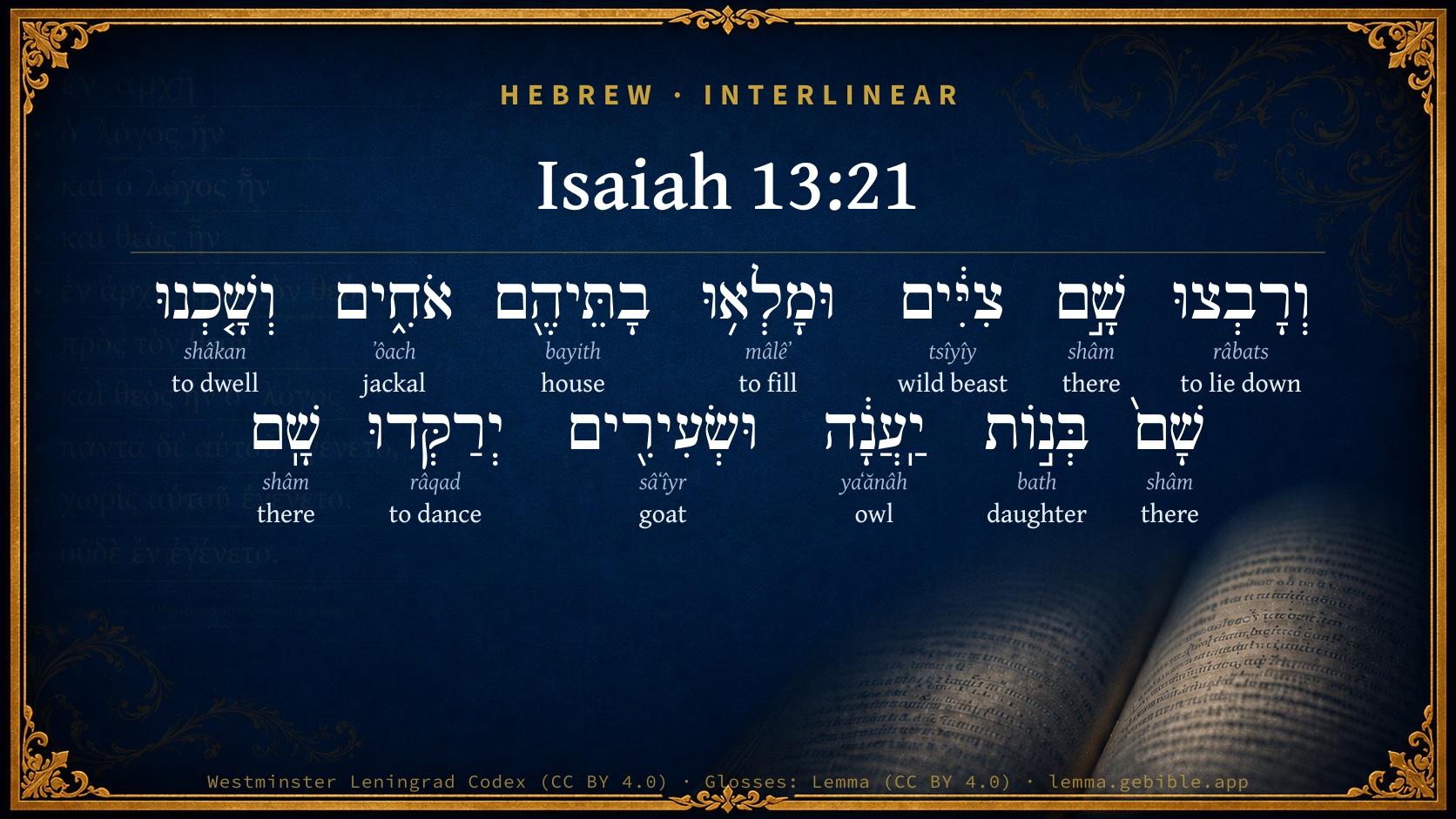
  1. וְרָבְצוּ râbats H7257 “and · to lie down” Conjunction + Verb, Qal, Sequential Perfect, 3rd Person, Common, Plural
  2. שָׁ֣ם shâm H8033 “there” Adverb
  3. צִיִּ֔ים tsîyîy H6728 “wild beasts” Noun, Common, Masculine, Plural, Absolute
  4. וּמָלְא֥וּ mâlêʼ H4390 “and · to fill” Conjunction + Verb, Qal, Sequential Perfect, 3rd Person, Common, Plural
  5. בָתֵּיהֶ֖ם bayith H1004 “houses · their” Noun, Common, Masculine, Plural, Construct + Suffix, Personal, 3rd Person, Masculine, Plural
  6. וְשָׁ֤כְנוּ shâkan H7931 “and · to dwell” Conjunction + Verb, Qal, Sequential Perfect, 3rd Person, Common, Plural
  7. שָׁם֙ shâm H8033 “there” Adverb
  8. בְּנ֣וֹת bath H1323 “daughters of” Noun, Common, Feminine, Plural, Construct
  9. יַֽעֲנָ֔ה yaʻănâh H3284 “owl” Noun, Common, Feminine, Singular, Absolute
  10. וּשְׂעִירִ֖ים sâʻîyr H8163 “and · goats” Conjunction + Noun, Common, Masculine, Plural, Absolute
  11. יְרַקְּדוּ râqad H7540 “to dance” Verb, Piel, Imperfect, 3rd Person, Masculine, Plural
  12. שָֽׁם shâm H8033 “there” Adverb

About this verse

These counts appear in no published source. They are computed here, from the morphology-tagged text and Lemma’s own curated glosses. What Lemma adds →

13
words
11
distinct lemmas
Prophets
section

Notable vocabulary

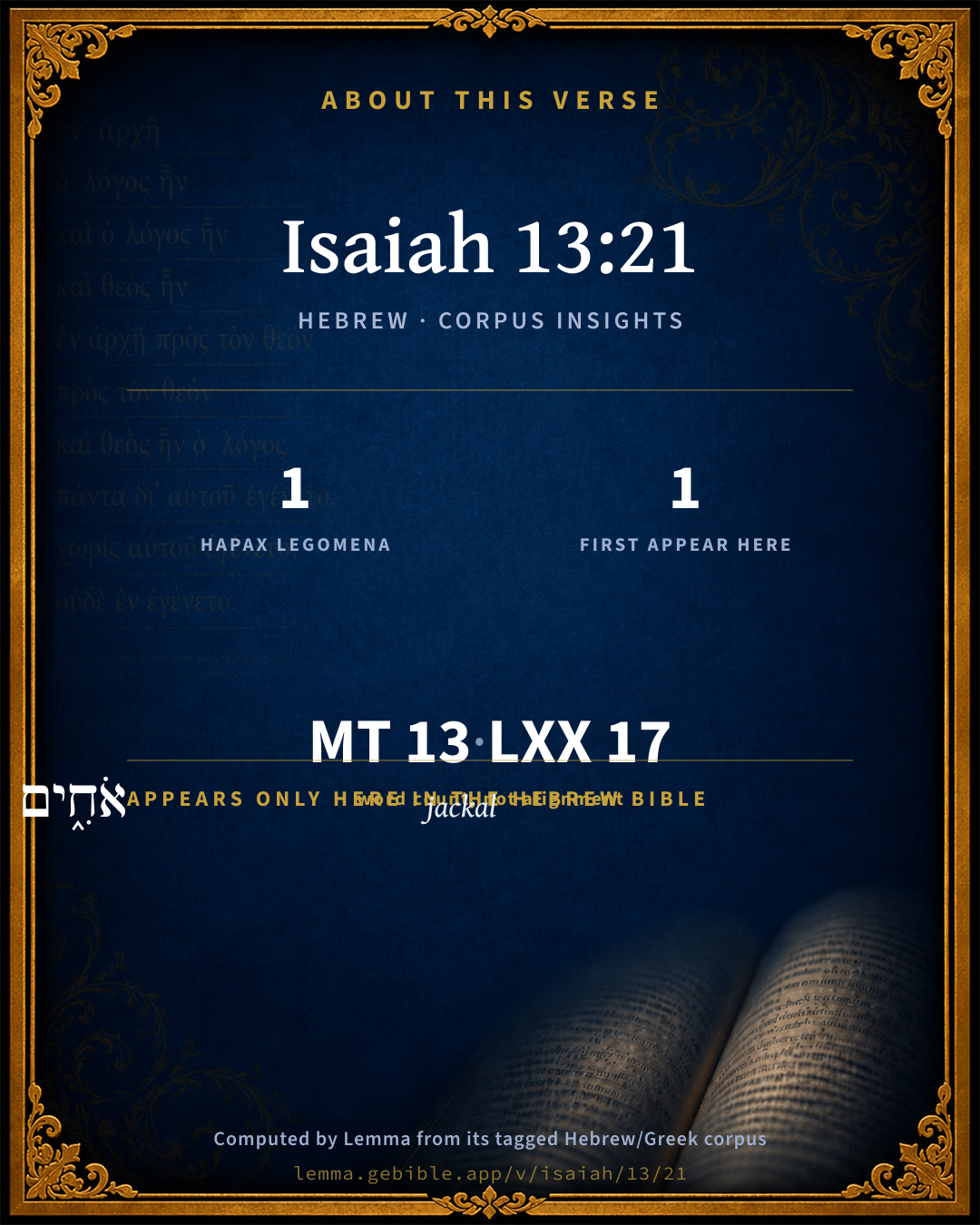
1 hapax legomenon — a word that appears only here in the entire Hebrew Bible:

  • אֹחִ֑ים jackal H255

First appearance in Scripture

This word makes its first canonical appearance in the Hebrew Bible here:

  • אֹחִ֑ים jackal H255

Shared distinctive vocabulary

צִיִּ֔ים wild beast H6728 occurs in 6 verses of the Hebrew Bible. Also found in:

Grammatical profile

  • 4 verbs
  • 6 nouns
  • 3 adverbs

Verb forms

  • וְרָבְצוּ Qal · Sequential Perfect
  • וּמָלְא֥וּ Qal · Sequential Perfect
  • וְשָׁ֤כְנוּ Qal · Sequential Perfect
  • יְרַקְּדוּ Piel · Imperfect

Repetition

A word recurs within this verse — often emphatic in Hebrew:

  • שָׁ֣ם there H8033 ×3

Hebrew & Septuagint length

In English translation the verse runs 29 words from the Hebrew and 46 from the Septuagint (LXX English) — the Septuagint runs noticeably longer here. See the side-by-side →

A rough comparison of the two English renderings, which tokenize alike — not a word-level alignment.

Word counts can differ between the Hebrew and the Greek without any difference in meaning — e.g. the Hebrew direct-object marker אֵת has no separate Greek word, and Greek often adds the article ὁ.

In the original languages it is 13 Hebrew tokens and 17 Greek tokens — but the two are counted differently (Hebrew bundles its prefixes and suffixes into one token; the Greek is in lemma form), so that isn’t a like-for-like length.

Cross-references

2

Topical passages linked to Isaiah 13:21 in the Treasury of Scripture Knowledge — connected by theme and wording, ordered by reader-vote popularity; previews shown in the World English Bible.

  • Revelation 18:2 He cried with a mighty voice, saying, "Fallen, fallen is Babylon the great, and she has become a habitation of demons, a prison of every unclean spirit, and a prison of every unclean and hateful bird!
  • Isaiah 34:11–15 But the pelican and the porcupine shall possess it; and the owl and the raven shall dwell therein: and he will stretch over it the line of confusion, and the plummet of emptiness.

Cross-references courtesy of OpenBible.info (CC BY 4.0).

Hebrew and Greek witnesses Masoretic Hebrew ↔ Greek Septuagint

The same verse in the two great witnesses to the Old Testament, shown verse-for-verse.

Here the Septuagint runs noticeably longer than the Hebrew — LXX2012 (modern English Septuagint) 46 words vs World English Bible 29. A rough length comparison of the two English translations, not a word-level alignment — read both below.

These are two independent witnesses, not word-aligned to each other, and the Septuagint is shown in lemma (dictionary) form.

Hebrew Isaiah 13:21 Masoretic · Westminster Leningrad Codex

וְרָבְצוּ שָׁ֣ם צִיִּ֔ים וּמָלְא֥וּ בָתֵּיהֶ֖ם אֹחִ֑ים וְשָׁ֤כְנוּ שָׁם֙ בְּנ֣וֹת יַֽעֲנָ֔ה וּשְׂעִירִ֖ים יְרַקְּדוּ שָֽׁם

But wild animals of the desert shall lie there; and their houses shall be full of doleful creatures; and ostriches shall dwell there, and wild goats shall dance there.

World English Bible · Public Domain

Greek LXX Isaiah 13:21 Septuagint · lemma form

καί ἀναπαύω ἐκεῖ θηρίον καί ἐνπίμπλημι ὁ οἰκία ἦχος καί ἀναπαύω ἐκεῖ σειρήν καί δαιμόνιον ἐκεῖ ὀρχέομαι

But wild beasts shall rest there; and the houses shall be filled with howling; and monsters shall rest there, and devils shall dance there, and satyrs shall dwell there; and hedgehogs shall make their nests in their houses. It will come soon, and will not wait.

LXX2012 (modern English Septuagint) · Public Domain

On this verse, John Gill's Exposition discusses the Septuagint’s reading. Read the note in Commentary ↓

Hebrew: Westminster Leningrad Codex (CC BY 4.0). Greek: Septuagint (public domain); English from LXX2012 (modern English Septuagint) (Public Domain). How the Septuagint differs from the Hebrew →

Targum (Aramaic paraphrase)

1

The Targum is the ancient Jewish Aramaic paraphrase of the Hebrew Scriptures — an interpretive translation, not the Hebrew text itself. Onkelos (literal) and Pseudo-Jonathan (expansive) render the Torah, and Jonathan the Prophets. Coverage is partial: where no permissively-licensed English translation exists for a verse, only the Aramaic is shown. This is verse-level text, not a word-by-word alignment to the Hebrew.

  1. Targum Jonathan Prophets (Joshua–Malachi)
    וְיִשְׁרוּן תַּמָן תַּמְוַן וְיִתְמְלוּן בָתֵּיהוֹן אוֹחִין וְיִשְׁרְיָן תַּמָן בְּנַת נַעֲמִין וְשֵׁידִין יְחַיְכוּן תַּמָן:

    But the martens shall lodge there; and their houses shall be filled with owls; and there shall the ostriches dwell; and devils shall delight themselves there.

    Targum Jonathan — Aramaic: “Mikraot Gedolot” (public domain). English: “Sefaria Community Translation” (CC0 1.0 (public-domain dedication)); “London "Chaldee Paraphrase," 1871” (public domain). Text via Sefaria.

Commentary

Notes on Isaiah 13:21 from classic Christian and Jewish commentators (each source and its license shown beneath its notes). The classic Christian expositions comment on the surrounding passage and are grouped to its opening verse, so a note may address several verses; the Jewish commentaries on the Tanakh (Rashi and others) are per-verse, so they appear only where the commentator wrote on this verse.

Lemma curates 59 commentaries, every one of them public domain or Creative Commons licensed, each selected and text-cleaned for this edition rather than reprinted as found. About our sources →

Trapp's Complete Commentary

John Trapp

Isa 13:21 But wild beasts of the desert shall lie there; and their houses shall be full of doleful creatures; and owls shall dwell there, and satyrs shall dance there.

Ver. 21. But wild beasts of the desert.] Heb., Ijim, Ochim, &c. These are names of wild creatures unknown to us in these parts.

And satyrs.] Or, Devils in borrowed shapes and hideous apparitions.

John Trapp, A Commentary or Exposition upon All the Books of the Old and New Testament (1647–1656) — public domain. Text from a community e-Sword module.

Joseph Benson's Commentary

Isa 13:21-22. The wild beasts of the desert shall lie there — Which was literally fulfilled, as we have just seen, in Jerome’s time, when it was a forest for breeding wild beasts, or a royal chase for hunting. And their houses shall be full of doleful creatures — This likewise has been exactly accomplished. Benjamin of Tudela, a Jew, in his Itinerary, written above seven hundred years ago, asserts, “Babylon is now laid waste, excepting the ruins of Nebuchadnezzar’s palace, which men are afraid to enter, on account of the serpents and scorpions that have taken possession of it.”

This account is confirmed by Rauwolf, who informs us, “that the supposed ruins of the tower of Babylon are so full of venomous creatures, that no one dares approach nearer to them than half a league.” It must be observed, however, that interpreters are not agreed as to the precise meaning of the word אחים, here rendered, doleful creatures. Some connect this clause with the preceding, and read it, And shall fill (namely, the wild beasts shall fill) their houses with their howlings. It is more probable, however, that some living creatures are intended, but whether reptiles, quadrupeds, or fowls, is uncertain. It is also doubtful what creatures are meant by several of the other Hebrew words here used, particularly by the word שׂעירים, seirim, translated satyrs. The term indeed signifies goats. And many have supposed that evil spirits often appeared, of old time, in the shape of goats. “Upon which account,” says Lowth, “the word is sometimes taken for devils, and is so translated, Lev 17:7,” (where see the note,) “and in 2Ch 11:15. But here, and Isa 34:14, it is rendered satyrs. The expression may be taken from a vulgar opinion, that desolate and forlorn places are inhabited by evil spirits. See Bar 4:35; Rev 18:2. Accordingly our Saviour, in his parable of an unclean spirit, says, that he walks through dry, or uninhabited places, Mat 12:43.” And dragons in their pleasant places — The word תנים, rendered dragons, signifies any large creature of the creeping kind, whether upon land or in the sea. Here it seems to be taken for a great serpent, such as are usually found in deserts and desolate places. But instead of wasting time in a fruitless attempt to ascertain what kind of creatures are meant by the different Hebrew words here used, which would only perplex and not edify the reader, we shall present him with Bishop Lowth’s translation of these two verses.

“But there shall the wild beasts of the deserts lodge;

And howling monsters shall fill their houses:

And there shall the daughters of the ostrich dwell;

And there shall the satyrs hold their revels.

And wolves shall howl to one another in their palaces;

And dragons in their voluptuous pavilions.”

What makes the present desolate condition of Babylon the more wonderful is, that Alexander the Great intended to have made it the seat of his empire, and actually set men to work to rebuild the temple of Belus, to repair the banks of the river, and to reduce the waters again to their own channel; but he met with too many difficulties to proceed with the work. And now, how justly may we reflect with Bishop Newton, (Dissert. xth.,) “How is Babylon become a desolation! How wonderful are such predictions, compared with the events! And what a convincing argument of the truth and divinity of the Holy Scriptures! Well might God allege this as a memorable instance of his prescience, and challenge all the false gods, and their votaries, to produce the like, Isa 45:21; Isa 46:10. And indeed where can be found a similar instance, but in Scripture, from the beginning of the world to this day?”

Joseph Benson's Commentary on the Old and New Testaments (1811–1818) — public domain. Text from a community e-Sword module.

Geneva Bible (1599)

Geneva Bible translators

Which were either wild beasts, or fowls, or wicked spirits, whereby Satan deluded man, as by the fairies, goblins, and such like fantasies.

Geneva Bible (1599) marginal notes — public domain. Text via Bolls.life.

Jamieson, Fausset & Brown

Robert Jamieson, A. R. Fausset & David Brown

wild beasts--Hebrew, tsiyim, animals dwelling in arid wastes. Wild cats, remarkable for their howl [BOCHART].

doleful creatures--"howling beasts," literally, "howlings" [MAURER].

owls--rather, "ostriches"; a timorous creature, delighting in solitary deserts and making a hideous noise [BOCHART].

satyrs--sylvan demi-gods--half man, half goat--believed by the Arabs to haunt these ruins; probably animals of the goat-ape species [VITRINGA]. Devil-worshippers, who dance amid the ruins on a certain night [J. WOLFF].

Jamieson, Fausset & Brown — Commentary Critical and Explanatory on the Whole Bible (1871) — public domain (CC PDM 1.0). Text via the HelloAO Bible API.

Adam Clarke's Commentary

Verse 21. Satyrs] A kind of beast like to man, which is called מרמוטש marmots, a monkey. - Rabbi Parchon.

Adam Clarke's Commentary on the Bible (1810–1826) — public domain. Text from a community e-Sword/MySword module.

Ellicott's Commentary for English Readers

(21) Wild beasts of the desert . . .—The Hebrew term, which in Psa_72:9, and perhaps in Isa_23:13, is used of men, has been rendered by “wild cats,” but is probably generic, the ferœ naturœ that haunt such desolate regions. The “doleful creatures” (literally groaners) are probably “horned owls;” while the word rendered “owls (literally, daughters of screaming) may be taken as ostriches (Job_39:13-18). In the “satyrs” (literally, hairy or shaggy ones) we may find either “goats (as in Lev_4:24; Lev_16:9), or, as the English version suggests, a mythical form of grotesque animal life (the “demons” or “devils” of Lev_17:7; 2Ch_11:15, a goat-shaped form, like that of the Greek Pan), or more probably (with Tristram), the species of baboon (Macacus Arabicus) still found in Babylonia.

A Bible Commentary for English Readers, edited by Charles John Ellicott (1878–1897) — public domain. Text from a community e-Sword module.

The Cambridge Bible for Schools and Colleges

gen. ed. J. J. S. Perowne

21. wild beasts of the desert] The word used means strictly “dwellers in the desert” and is applied to men in Psa_72:9. In ch. Isa_34:14 it seems to denote a particular kind of desert creature.

doleful creatures] Probably “howlers,” but what kind of howlers are meant is altogether uncertain. Some render “owls,” others “jackals,” &c. The word does not occur elsewhere. Owls should undoubtedly be ostriches. The Heb. name (bìnôth ya‘ǎnah), as explained by Wetzstein (see Delitzsch, Comm. on Job , 2 nd Ed., Eng. Tr., vol. II., p. 340) means “daughters of the desert.” The Arabs have a similar designation for the bird,—abu eṣ-ṣaḥârâ, “father of the desert.”

satyrs shall dance there] The noun also means “goats,” as in Gen_37:31; but the old translations have mostly perceived that goatshaped demons are here intended (so also in ch. Isa_34:14), the same beings to which Jewish superstition offered sacrifices (Lev_17:7; 2Ch_11:15—A.V. “devils”). The transition from the natural to the supernatural seems strange to our minds, but in the East the belief in weird creatures (jinn) inhabiting waste places and dangerous spots is a commonplace.

21, 22. It shall be haunted by wild beasts and creatures of demon kind, like the jinn of the Arabs. See ch. Isa_34:11-15; Zep_2:14 f.; Jer_50:39; Jer_51:37.

The Cambridge Bible for Schools and Colleges (gen. ed. J. J. S. Perowne; Cambridge University Press, 1878–1918) — public domain. Text from a community e-Sword module.

John Gill's Exposition

But wild beasts of the desert shall lie there,.... What sort of creatures are meant is not certain. The Targum renders it by a word which signifies monstrous, astonishing creatures; the Latin interpreter of it calls them apes. Jarchi and Kimchi say such are intended as are called martens or sables, a creature of the weasel kind. The Hebrew word does not much differ from the Arabic one used for "wild cats":

and their houses shall be full of doleful creatures; whose voices are very mournful and unpleasant. Aben Ezra says such creatures are meant, that those that see them are amazed at them. Jarchi declares they are a kind of creatures he was ignorant of; and Kimchi thinks they are the same with "furon", or "ferrets": and the Latin interpreter of the Targum renders the word that uses by "weasels":

and owls shall dwell there; or "the daughters of the owl", or "of the ostriches", as the Targum and Syriac version; with which agrees the Vulgate Latin, rendering the word "ostriches", as it is in Lam 4:3; the Septuagint version translates it "sirens", or "mermaids":

and satyrs shall dance there; a sort of monstrous creatures with the ancients, painted half men and half goats; the upper part of them like men, except the horns on their heads, and the lower parts like goats, and all over hairy; and the word here used signifies hairy; and is used for goats, and sometimes for devils, either because they have appeared in this form, as Kimchi says, to them that believe them; or because they, by their appearance, inject such horror in men, as cause their hair to stand upright: hence the Targum, Jarchi, and Kimchi, interpret it of devils here; and so the Septuagint version, and those that follow it, the Syriac and Arabic, render it, "and demons shall dance there": with this agrees the account of mystical Babylon, Rev 18:2.

John Gill's Exposition of the Whole Bible (1746–1763) — public domain (CC PDM 1.0). Text via the HelloAO Bible API.

Albert Barnes' Notes on the Bible

But wild beasts of the desert shall lie there - Hebrew, (ציים tsı̂yı̂ym). This word denotes properly those animals that dwell in dry and desolate places, from צי tsı̂y “a waste, a desert.” The ancient versions have differed considerably in the interpretation. The Septuagint in different places renders it, Θηριά Thēria - ‘Wild animals;’ or δαιμόνια daimonia - ‘Demons.’ The Syriac, ‘Wild animals, spirits, sirens.’ Vulgate, ‘Beasts, demons, dragons.’ Abarbanel renders it, ‘Apes.’ This word is applied to people, in Psa 72:9; Psa 74:14; to animals, Isa 23:13; Isa 34:14; Jer 50:39. Bochart supposes that wild cats or catamounts are here intended. He has proved that they abound in eastern countries. They feed upon dead carcasses, and live in the woods, or in desert places, and are remarkable for their howl. Their yell resembles that of infants. (“See” Bochart’s “Hieroz.” i. 3. 14. pp. 860-862.)

And their houses shall be full of doleful creatures - Margin, ‘Ochim,’ or ‘Ostriches.’ אחים 'ochı̂ym. The Septuagint renders this ‘Clamours,’ or ‘Howlings,’ without supposing that it refers to any particular animals. The Hebrew word is found nowhere else. Bochart supposes that the yell or howl of wild animals is intended, and not animals themselves (“Hieroz.” i. 3. 15).

And owls shall dwell there - Hebrew, ‘Daughters of the owl or ostrich.’ The owl is a well-known bird that dwells only in obscure and dark retreats, giving a doleful screech, and seeking its food only at night. It is not certain, however, that the owl is intended here. The Septuagint renders it, Σειρῆνες Seirēnes - ‘Sirens.’ The Chaldee, ‘The daughter of the ostrich.’ Bochart has gone into an extended argument to prove that the ostrich is intended here (“Hieroz.” xi. 2. 14). The Hebrew does not particularly denote the kind of bird intended, but means those that are distinguished for their sound - ‘the daughters of sound or clamor.’ ‘The ostrich is a sly and timorous creature, delighting in solitary barren deserts. In the night they frequently make a very doleful and hideous noise; sometimes groaning as if they were in the greatest agonies.’ (Shaw’s “Travels,” vol. ii. p. 348, 8vo; Taylor’s “Heb. Con.;” see Job 30:29; Isa 34:13; Isa 43:20; Jer 50:39; Mic 1:8; Lev 11:16; Deu 14:15; Lam 4:3.) The word does not elsewhere occur.

And satyrs shall dance there - (שׂערים s'e‛ı̂rı̂ym). A “satyr,” in mythology, was a sylvan deity or demigod, represented as a monster, half man and half goat, having horns on his head, a hairy body, with the feet and tail of a goat (Webster). The word used here properly denotes that which is “hairy,” or “rough,” and is applied to “goats” in Gen 25:25; Psa 68:21; Lev 13:10, Lev 13:25-26, Lev 13:30, Lev 13:32. It is often rendered “hair.” (“see” Taylor). In Isa 34:14, it is rendered ‘satyr;’ in Deu 32:2, it is rendered ‘the small ram;’ in Lev 17:7, and 2Ch 11:15, it is rendered ‘the devils,’ meaning objects of worship, or idols. Bochart supposes that it refers to the idols that were worshipped among the Egyptians, who placed “goats” among their gods. Doderlin supposes that it means either “fawns,” or a species of the monkey tribe, resembling in their rough and shaggy appearance the wild goat.

They are here represented as ‘dancing;’ and in Isa 34:14, as ‘crying to each other.’ It is evident that the prophet intends animals of a rough and shaggy appearance; such as are quick and nimble in their motions; such as dwell in deserts, in forests, or in old ruins; and such as answer to each other, or chatter. The description would certainly seem more applicable to some of the “simia” or monkey tribe than to any other animals. It is “possible,” indeed, that he means merely to make use of language that was well known, as describing animals that the ancients “supposed” had an existence, but which really had not, as the imaginary beings called satyrs. But it is possible, also, that he means simply wild goats (compare Bochart’s “Hieroz.” xi. 6. 7). The Septuagint renders it Δαιμόνια Daimonia - ‘Demons, or devils.’ The Vulgate, Pilosi - ‘Shaggy, or hairy animals.’ The Chaldee, ‘Demons.’ The essential idea is, that such wild animals as are supposed to dwell in wastes and ruins, would hold their revels in the forsaken and desolate palaces of Babylon. The following remarks of Joseph Wolff may throw light on this passage: ‘I then went to the mountain of Sanjaar, which was full of Yezeedes. One hundred and fifty years ago, they believed in the glorious doctrine of the Trinity, and worshipped the true God; but being severely persecuted by the neighboring Yezeedes, they have now joined them, and are worshippers of the devil.

These people frequent the ruins of Babylon, and dance around them. On a certain night, which they call the Night of Life, they hold their dances around the desolate ruins, in honor of the devil. The passage which declares that “satyrs shall dance there,” evidently has respect to this very practice. The original word translated “satyr,” literally means, according to the testimony of the most eminent Jewish rabbis, “devil worshippers.”’ ‘It is a curious circumstance,’ says Mr. Rich, in his “Memoir on the Ruins of Babylon,” p. 30, in describing the Mujelibe, ‘that here I first heard the oriental account of satyrs. I had always imagined the belief of their existence was confined to the mythology of the west; but a Choadar who was with me when I examined this ruin, mentioned by accident, that in this desert an animal is found resembling a man from the head to the waist, but having the thighs and legs of a sheep or a goat; he said also that the Arabs hunt it with dogs, and eat the lower parts, abstaining from the upper on account of their resemblance to the human species.’ ‘The Arabians call them Sied-as-sad, and say that they abound in some woody places near Semava on the Euphrates.’

Albert Barnes' Notes on the Bible (1834–1885) — public domain. Text from a community e-Sword/MySword module.

Haydock's Catholic Bible Commentary

Beasts. Hebrew tsiim, "fishermen." --- Serpents. Hebrew ochim. Septuagint, "echo," (Haydock) or "reeds." Babylon was built on a marshy situation, and Cyrus having let out the waters of the Euphrates, they could never be effectually stopped. --- Ostriches. Or swans. --- Hairy. Goats, chap. xxxiv. 14. (Calmet)

George Leo Haydock (1774–1849), Haydock's Catholic Family Bible and Commentary, 1859 edition — public domain. Excludes Psalms (Douay-Rheims chapter numbering differs from Protestant) and Deuterocanonical books (Catholic canon only).

Matthew Poole's English Annotations

Wild beasts of the desert shall lie there; the land being forsaken by men, shall be possessed by wild beasts, which love solitary places. What the Hebrew words used here, and in the next verse, signify, the learned may see in my Latin Synopsis; and for others, it may suffice to know that in which all the learned agree, that these are frightful and solitary creatures; of which if I should particularly discourse, I should rather perplex than edify the vulgar reader.

Matthew Poole's English Annotations on the Holy Bible (1683–1685) — public domain. Text from a community e-Sword/MySword module.

The Pulpit Commentary

Wild beasts of the desert shall lie there. It is not quite clear what particular wild beasts are intended. Those actually noted on the site of Babylon are lions, jackals, and porcupines. These sometimes make their lairs in the ruins (Rich, "First Memoir," p. 69; Ker Porter, "Travels," vol. 2. p. 342). Doleful creatures; in the original, okhim. What animal is meant we cannot say, as the word occurs only in this passage. Mr. Cheyne translates it by "hyenas." Owls shall dwell there; literally, daughters of the owl. (as in Lev_11:16 Deu_14:15 Job_30:29 Jer_1:3-9 Mic_1:8; and infra, Isa_34:13 Isa_43:20) Mr. Rich says, "In most of the cavities of the Babil Mound there are numbers of owls and bats." Sir A. Layard," A large grey owl is found in great numbers, frequently in flocks of nearly a hundred, in the low shrubs among the ruins of Babylon" ("Nin. and Bab.," p. 484, note). Satyrs shall dance there. The word translated "satyr" is, etymologically, "hairy one," and ordinarily means "a goat." Some have supposed "wild goats" to be here intended, but they are not found in Babylonia. The translation "satyr" is defended by many, who think Isaiah might draw upon current beliefs for some features of his description. Dr. Kay gives "baboons," since the Moko a kind of baboon is known in Babylonia.

Vers. 21, 22. Literal fulfillment of prophecy.

The language of modern travelers illustrates the fulfillment of the prediction. Layard says, "Owls start from the scanty thickets, and the foul jackal stalks among the furrows." "It is a naked and hideous waste." Dr. Plumptre says, "The work was, however, accompanied by slow degrees, and was not, like the destruction of Nineveh, the result of a single overthrow. Darius dismantled its walls, Xerxes pulled down the temple of Belus. Alexander contemplated its restoration, but his designs were frustrated by his early death. Susa and Ecbatana, Seleucia and Antioch, Ctesiphon and Bagdad, became successively the centers of commerce and of government." By the time of Strabo (B.C. 20) the work was accomplished, and the "vast city" had become a "vast desolation." In illustrating the literal fulfillment of this prophecy, the dean further says, "The Bedouins themselves, partly because the place is desolate, partly from a superstitious horror, shrink from encamping on the sites of the ancient temples and palaces, and they are left to lions, and other beasts of prey. On the other hand, Joseph Wolff, the missionary, describes a strange weird scene pilgrims of the Yezidis, or devil-worshippers, dancing and howling like dervishes amid the ruins of Babylon." It is interesting to note the following passage from the Itinerary of Benjamin Bar-ions, given by Matthew Henry. "This is that Babel which was of old thirty miles in breadth; it is now laid waste. There are yet to be seen the ruins of a palace of Nebuchadnezzar, but the sons of men dare not enter in, for fear of serpents and scorpions, which possess the place." For further indications of the precision of fulfillment, encyclopedias and books of Eastern travel should be studied. We point out here that prophecy is usually poetic, and, rather, vaguely descriptive and suggestive, than precise or minute. Sometimes, however, for the verifying of all prophecies, some portions are made precise, and are literally fulfilled, as in the case el Baby]on; and the two following points may be usefully illustrated:

I LITERAL FULFILMENT OF PROPHECY CONFIRMING THE DIVINE WORD.

II GENERAL FULFILMENTS THEREBY SHOWN TO BE EQUALLY CONFIRMATORY. When once the principle is established, we are freed from all bondage to demands for exact and minute agreements, and can freely read Scripture prophecy as full of poetical figure and imagery. R.T.

The Pulpit Commentary (1880–1919), ed. H.D.M. Spence-Jones & Joseph S. Exell — public domain. Text from a community e-Sword module.

John Wesley's Explanatory Notes

Satyrs - The learned agree, that these are frightful and solitary creatures.

John Wesley, Explanatory Notes Upon the Whole Bible (1754–1765) — public domain. Text via the GEBible commentary corpus.

J. A. Alexander on Isaiah

Joseph Addison Alexander

Having excluded men and the domesticated animals from Babylon, the Prophet now tells how it shall be occupied, viz. by creatures which are only found in deserts, and the presence of which therefore is a sign of desolation. In the first clause these solitary creatures are referred to in the general; the other clause specifies two kinds out of the many which are elsewhere spoken of as dwelling in the wilderness. “But there (instead of flocks) shall lie down desert creatures, and their houses, (those of the Babylonians) shall be filled with howls or yells, and there shall dwell the daughters of the ostrich, and shaggy beasts (or wild goats) shall gambol there.” The contrast is heightened by the obvious allusion to v. 20. As if he had said, ‘flocks shall not lie down there, but wild beasts shall; man shall not dwell there, but the ostrich shall.’ The meaning evidently is that the populous and splendid city should become the home of animals found only in the wildest solitudes. To express this idea, other species might have been selected with the same effect. The endless discussions therefore as to the identity of those here named, however laudable as tending to promote exact lexicography and natural history, have little or no bearing on the interpretation of the passage. Nothing more will be here attempted than to settle one or two points of comparative importance. Many interpreters regard the whole verse as an enumeration of particular animals. This has arisen from the assumption of a perfect parallelism in the clauses. It is altogether natural, however, to suppose that the writer would first make use of general expressions and afterwards descend to particulars. The daughter of the ostrich is an oriental idiom for ostriches in general, or for the female ostrich in particular. The old translation owls seems to be now universally abandoned. The most interesting point in the interpretation of this verse has reference to the word translated satyrs in the English Version; its original and proper sense is hairy, and its usual specific sense he-goats. In two places, (Lev 17:7; 2Ch 11:15) it is used to denote objects of idolatrous worship, probably images of goats, which according to Herodotus were worshipped in Egypt. In Chronicles especially this supposition is the natural one, because the word is joined with calves. Both there and in Leviticus, the Septuagint renders it tois mataiois, ‘vain things’, (i.e., false gods, idols). It is elsewhere explained to mean demons, and the same interpretation is given in the case before us by several of the ancient versions. From this traditional interpretation of the word here and in Isa 34:14, appears to have arisen, at an early period, a popular belief among the Jews, that demons or evil spirits were accustomed to haunt desert places in the shape of goats or other animals. And this belief is said to be actually cherished by the natives near the site of Babylon at the present day. In some, the combination of the two meanings, goats and demons, seems to have suggested the Pans, Fauns, and Satyrs of the classical mythology, imaginary beings represented as a mixture of the human form with that of goats, and supposed to frequent forests and other lonely places. Others explain the passage as relating to actual appearances of Satan under such disguises. Others understand the language as a mere concession or allusion to the popular belief, equivalent to saying, the solitude of Babylon shall be as awful as if occupied by Fauns and Satyrs, there, if anywhere, such beings may be looked for. But the great majority of modern writers adhere to the original meaning of the Hebrew word, wild goats. And even on the supposition of a reference to evil spirits, there is no need of assuming any concession or accommodation to the current superstitions. If the word denotes demons, this text is a proof, not of a popular belief, but of a fact, of a real apparition of such spirits under certain forms. The Jewish tradition warrants the application of the Hebrew term to demons, but not to the afauns or satyrs of the Greek and Roman fabulists. The popular belief of the Jews and other Orientals may be traced to the traditional interpretation of this passage, and this to the Septuagint version. The mention of demons in a list of beasts and birds is at variance not only with the parallelism, but with the natural and ordinary usages of language. Such a combination and arrangement as the one supposed — ostriches, demons, wolves, jackals — would of itself be a reason for suspecting that the second term must really denote some kind of animal, even if no such usage existed. But the usage o the Hebrew word, as the name of an animal, is perfectly well defined and certain. Even in Lev 17:7 and 2Ch 11:15, this, as we have seen, is the only natural interpretation. The result appears to be that if the question is determined by tradition and authority, it denotes demons; if by the context and the usage of the word, it signifies wild goats, or more generically hairy, shaggy animals. According to the principles of modern exegesis, the latter is clearly entitled to the preference; but even if the former be adopted, the language of the text should be regarded as the prediction of a real fact, which, though it should not be assumed without necessity, is altogether possible, and therefore, if alleged in Scripture, altogether credible.

Joseph Addison Alexander, The Prophecies of Isaiah (1846–1847; New York: Scribner, 1870–1878) — public domain. Text from a community e-Sword module.

unfoldingWord translationNotes

Door43 World Missions Community

Connecting Statement:

Yahweh continues speaking about what will happen to Babylon.

will lie there

"will lie in Babylon"

Their houses

"The people's houses"

owls

Owls are wild birds that hunt at night. (See: Translate Unknowns)

ostriches

Ostriches are large wild birds that run fast and cannot fly. (See: Translate Unknowns)

Hyenas

Hyenas are large wild animals that look like dogs and eat dead animals. Their loud cry sounds like a person laughing. (See: Translate Unknowns)

jackals in the beautiful palaces

The words "will cry" are understood. AT: "jackals will cry in the beautiful palaces" (See: Ellipsis)

jackals

wild dogs (See: Translate Unknowns)

Her time is near, and her days will not be delayed

These two phrases mean basically the same thing. "Her time" and "her days" both refer to the time that God has chosen for Babylon to be destroyed. This can be stated in active form. AT: "The time that all of this will happen to the people of Babylon is near, and nothing will stop it" (See: Parallelism and Active or Passive)

translationWords

desert

goat

unfoldingWord translationNotes — © Distant Shores Media and the Door43 World Missions Community, licensed CC BY-SA 4.0. Source: git.door43.org/Door43/en_tn.

Rashi

Rabbi Shlomo Yitzchaki (Rashi)

martens Heb. צִיִּים. Jonathan translates: תַּמְוָן, identical with נִמִּיּוֹת [found in the Talmud] martrines in O.F.

ferrets Heb. אֹחִים. I do not know what kind of animal they are. [אֹחִים is an expression of thorns, thistles, and briars.]

and satyrs demons.

Rashi on the Tanakh — English translations: “The Judaica Press complete Tanach with Rashi, translated by A. J. Rosenberg” (CC BY 4.0); “Pentateuch with Rashi's commentary by M. Rosenbaum and A.M. Silbermann, 1929-1934” (public domain); “The Metsudah Tanach series, Lakewood, N.J” (CC BY 4.0); and “The Book of Joshua, Metsudah Publications, 1997” (CC BY 4.0). Text via Sefaria.

Ibn Ezra

Rabbi Abraham ibn Ezra

ציים Beasts that dwell in the desert (צִיׇה)

אוחים hap. leg. Beasts at whose sight everyone is terrified.

בנות יענה Owls. A well known kind of birds.

שעירים Beasts like Shedim; wild goats.

אוחים might also be taken as a kind of birds.

Ibn Ezra on the Tanakh — English translations: “Sefaria Community Translation” (CC0 1.0 (public-domain dedication)); “Yalkut, Sifsei Chachomim Chumash, Metsudah Publications, 2009” (CC BY 4.0); and “Commentary of Ibn Ezra on Isaiah - trans. by M. Friedlander, 1873” (public domain). Text via Sefaria.

Lesson kit

Teaching starters — assembled from the data on this page, not authored interpretation. Every prompt links to the verse data it draws on. Edit before teaching.

Isaiah, in the Prophets, opens this verse with 13 words (11 distinct Hebrew lemmas). Its most distinctive word is ʼôach (“jackal”). The Greek Septuagint runs longer here. A historical commentator’s framing appears above. Read the whole chapter for the surrounding context.

Discussion questions

  1. The word ʼôach carries the sense “jackal.” How does it shape the verse?
  2. This verse holds 1 word here found nowhere else in the Hebrew Bible. What might the rare word draw attention to?
  3. The word “jackal” first appears here in Scripture. What is being introduced at this debut?
  4. Psalms 72:9 shares the word «wild beast» with this verse. How do the two illuminate each other?
  5. “there” occurs 3× in this one verse. What is the effect of the repetition?
  6. Compared with the Hebrew, the Septuagint runs longer here. What questions does that raise?
  7. These translations render this verse differently. What is at stake in choosing one wording over another?
  8. The verb «וְרָבְצוּ» is Qal Sequential Perfect. How does its form color the action?

Things to notice

  • 1 word in this verse appears nowhere else in the Hebrew Bible.
  • 1 word makes its first canonical appearance in Scripture here.
  • This verse counts 13 Hebrew ↔ 17 Greek words.
  • These translations choose different wording for 16 words in this verse.
  • “there” occurs 3× in this single verse.

Reading settings

Reading text

Shown beneath each verse's original-language words.

Old Testament
Old Testament edition

Read the OT as the Masoretic Hebrew (MT) or the Greek Septuagint (LXX).

English shown for the Greek Septuagint (in the Hebrew ↔ Greek comparison).

Comparing translations? Open the Compare panel on any verse page to stack up to four side by side.