Hebrews 12:20

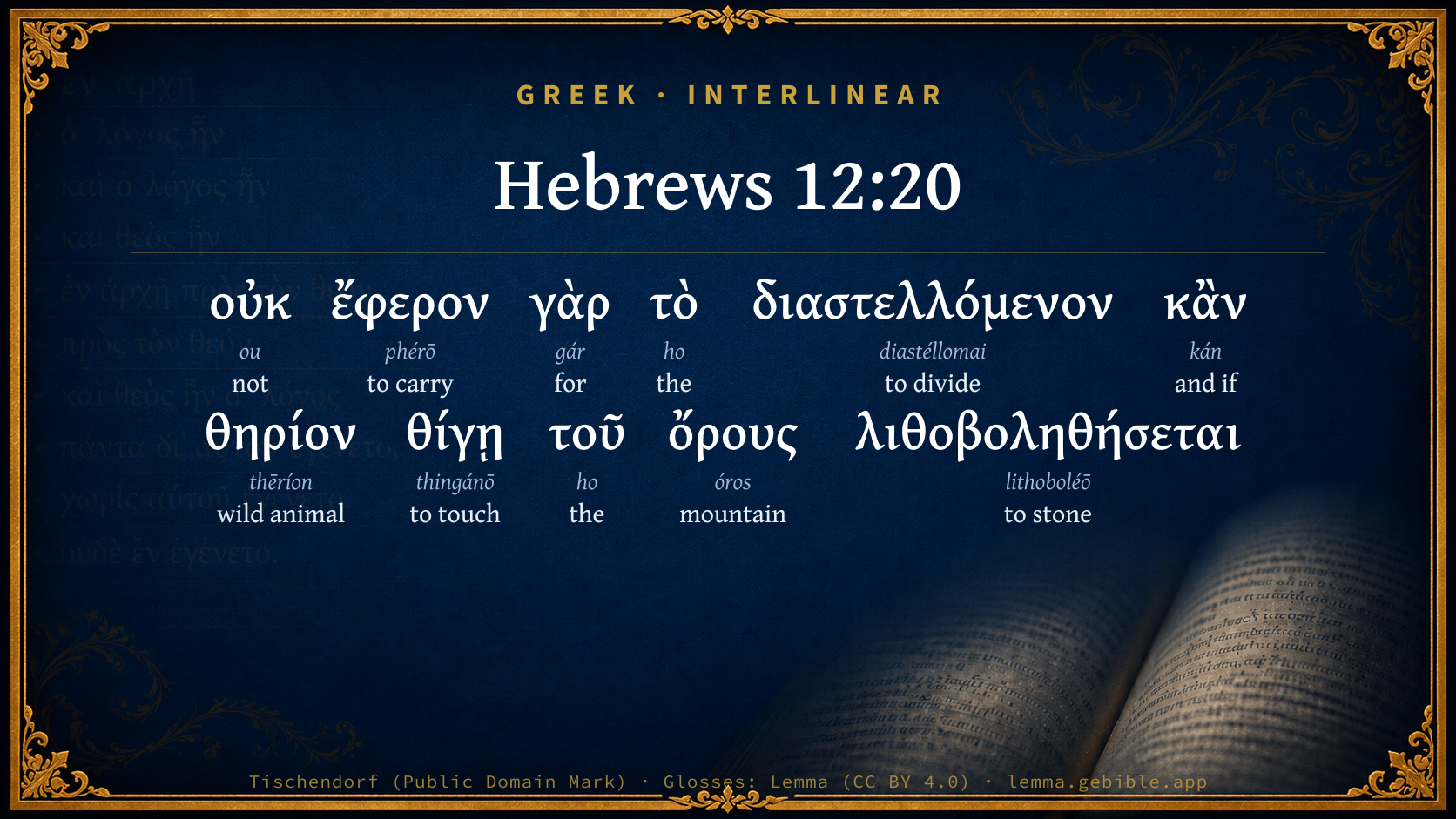
Greek (Tischendorf 8th ed.) Hebrews 12:20 appears in the Greek New Testament. The text above is from the Tischendorf 8th edition. Each word links to its Strong’s number and a concise gloss. Click any word for its full Thayer’s Greek Lexicon entry.
Download image
Cite this verse

Hebrews 12:20 (World English Bible). Public Domain. Lemma interlinear Bible study tool, https://lemma.gebible.app/v/hebrews/12/20.

Show BibTeX & RIS
BibTeX
RIS
English Translation
for they could not stand that which was commanded, "If even an animal touches the mountain, it shall be stoned;"
World English Bible · Public Domain
Download a study sheet

One document with this verse’s original text, its word-by-word gloss line, the meaning frame, cross-references with their text, attributed commentary, and full source and license credits — printable, and it pastes into notes with its structure intact.

This verse Autodidact and up

Study sheet (.html) Plain text (.txt)

A passage Seminary Student

Up to 50 verses in one chapter. A passage sheet keeps up to 6 commentary sources and 12 cross-references per verse, in the order this page ranks them, and says so on the sheet whenever that leaves anything out. Ask for a single verse and you get the Autodidact verse sheet above.

Everything on this page stays free to read, with no account — the sheet is a download of what is already on screen, not access to it.

Want to remove ads? Support Godless Engineer
Compare translations 3

The same verse in 3 English versions, stacked beneath the original-language interlinear above. Click any original word for its lexicon entry.

Each is an independent rendering of the whole verse — the interlinear is not word-aligned to these translations.

Highlighted words mark where these versions differ — a whole-verse word diff, not a word-by-word alignment.

  • World English Bible Public Domain
    for they could not stand that which was commanded, "If even an animal touches the mountain, it shall be stoned;"
  • King James Version Public Domain
    (For they could not endure that which was commanded, And if so much as a beast touch the mountain, it shall be stoned, or thrust through with a dart:
  • unfoldingWord Literal Text CC BY-SA 4.0
    For they could not endure was ordered: “If even an animal might touch the mountain, it must be stoned.”

unfoldingWord Literal Text — © unfoldingWord, licensed CC BY-SA 4.0. Word-aligned USFM3 via Door43 (git.door43.org/unfoldingWord/en_ult).

Versions to compare (up to 4)

3 of 4 selected

Show all 19 translations

Every available English version of this verse, each an independent rendering of the whole verse.

  • World English Bible Public Domain
    for they could not stand that which was commanded, "If even an animal touches the mountain, it shall be stoned;"
  • Berean Standard Bible Public Domain
    For they could not bear what was commanded: “If even an animal touches the mountain, it must be stoned.”
  • Majority Standard Bible Public Domain
    For they could not bear what was commanded: “If even an animal touches the mountain, it must be stoned.”
  • King James Version Public Domain
    (For they could not endure that which was commanded, And if so much as a beast touch the mountain, it shall be stoned, or thrust through with a dart:
  • American Standard Version (1901) Public Domain
    for they could not endure that which was enjoined, If even a beast touch the mountain, it shall be stoned;
  • Revised Version (1885) Public Domain
    for they could not endure that which was enjoined, If even a beast touch the mountain, it shall be stoned;
  • Geneva Bible (1599) Public Domain
    (For they were not able to abide that which was commanded, yea, though a beast touche the mountaine, it shalbe stoned, or thrust through with a dart:
  • Douay-Rheims (1899) Public Domain
    For they did not endure that which was said: And if so much as a beast shall touch the mount, it shall be stoned.
  • Young's Literal Translation Public Domain
    for they were not bearing that which is commanded, `And if a beast may touch the mountain, it shall be stoned, or with an arrow shot through,'
  • Literal Standard Version CC BY-SA 4.0
    for they were not bearing that which is commanded, “And if a beast may touch the mountain, it will be stoned, or shot through with an arrow,”
  • Unlocked Literal Bible CC BY-SA 4.0
    For they could not endure what was commanded: “If even an animal touches the mountain, it must be stoned.”
  • unfoldingWord Literal Text CC BY-SA 4.0
    For they could not endure was ordered: “If even an animal might touch the mountain, it must be stoned.”
  • Darby Bible Public Domain
    (for they were not able to bear what was enjoined: And if a beast should touch the mountain, it shall be stoned;
  • World Messianic Bible Public Domain
    for they could not stand that which was commanded, “If even an animal touches the mountain, it shall be stoned”.
  • Webster's Bible Public Domain
    (For they could not endure that which was commanded, And if so much as a beast touch the mountain, it shall be stoned, or thrust through with a dart:
  • Free Bible Version CC BY-SA 4.0
    For they couldn't take what they were told to do, such as, “Even if a farm animal touches the mountain, it must be stoned to death.”
  • Bible in Basic English Public Domain
    For the order which said, If the mountain is touched even by a beast, the beast is to be stoned, seemed hard to them;
  • Text-Critical English NT CC BY 4.0
    For they could not bear the order that was given: “If even a beast touches the mountain, it shall be stoned.”
  • Tyndale New Testament (1534) Public Domain
    For they were not able to abyde that which was spoken. If a beast had touched the mountayne it must have bene stoned or thrust thorowe with a darte:

Literal Standard Version (2020), Covenant Press — licensed CC BY-SA 4.0. Text via the HelloAO Bible API (eBible.org). Unlocked Literal Bible (unfoldingWord) — licensed CC BY-SA 4.0. Text via the HelloAO Bible API (eBible.org). unfoldingWord Literal Text — © unfoldingWord, licensed CC BY-SA 4.0. Word-aligned USFM3 via Door43 (git.door43.org/unfoldingWord/en_ult). Free Bible Version, Dr. Jonathan Gallagher — licensed CC BY-SA 4.0. Text via the HelloAO Bible API (eBible.org).

Word by word

More ways to search: Search by grammar → Find every occurrence → Compare this word →

Practice this passage: Drill this verse → Learn its vocabulary →

About this verse

These counts appear in no published source. They are computed here, from the morphology-tagged text and Lemma’s own curated glosses. What Lemma adds →

11
words
10
distinct lemmas
General Epistles
section

Notable vocabulary

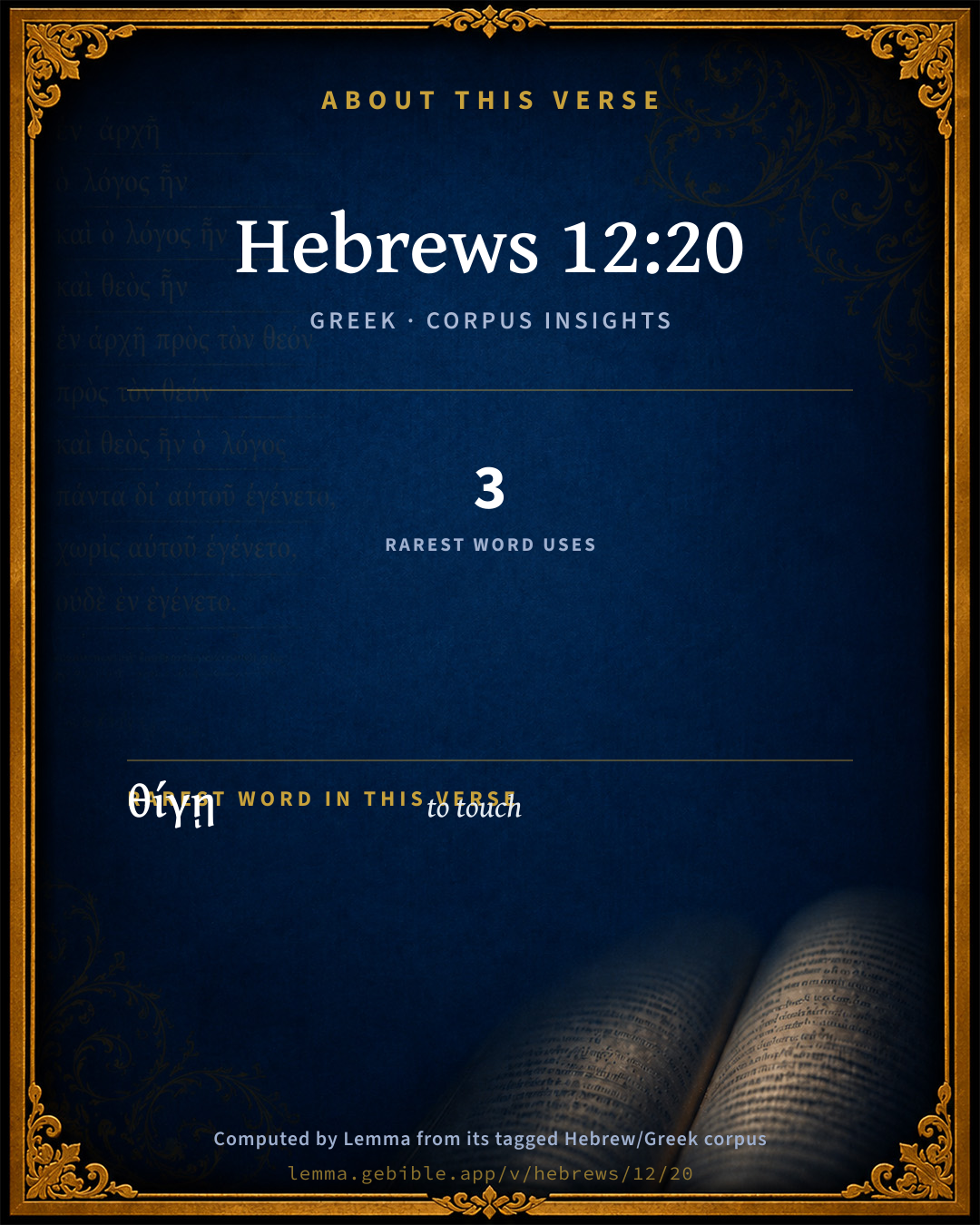
The rarest word here is θίγῃ to touch G2345 — appearing just 3 times in the whole Greek New Testament.

Shared distinctive vocabulary

θίγῃ to touch G2345 occurs in 3 verses of the Greek New Testament. Also found in:

Repetition

A word recurs within this verse:

Cross-references

6

Topical passages linked to Hebrews 12:20 in the Treasury of Scripture Knowledge — connected by theme and wording, ordered by reader-vote popularity; previews shown in the World English Bible.

  • Exodus 19:12–13 You shall set bounds to the people round about, saying, 'Be careful that you don't go up onto the mountain, or touch its border. Whoever touches the mountain shall be surely put to death.
  • Exodus 19:16 It happened on the third day, when it was morning, that there were thunders and lightnings, and a thick cloud on the mountain, and the sound of an exceedingly loud trumpet; and all the people who were in the camp trembled.
  • Deuteronomy 33:2 He said, Yahweh came from Sinai, Rose from Seir to them; He shined forth from Mount Paran, He came from the ten thousands of holy ones: At his right hand was a fiery law for them.
  • Galatians 2:19 For I, through the law, died to the law, that I might live to God.
  • Galatians 3:10 For as many as are of the works of the law are under a curse. For it is written, "Cursed is everyone who doesn't continue in all things that are written in the book of the law, to do them."
  • Romans 3:19–20 Now we know that whatever things the law says, it speaks to those who are under the law, that every mouth may be closed, and all the world may be brought under the judgment of God.

Cross-references courtesy of OpenBible.info (CC BY 4.0).

Where the printed editions differ

1 variant

Places in this verse where the major printed Greek editions disagree on the wording in a way that affects the translation — a comparison of editions, not a manuscript-by-manuscript collation. The editions are the modern critical texts (Nestlé-Aland 28/27, SBL, Westcott-Hort, Tregelles, Tyndale House) and the traditional texts behind the KJV (the Textus Receptus and the Byzantine/Majority text). It is not a claim about which reading is original.

  1. Extra text
    ἢ βολίδι κατατοξευθήσεται,

    “or with arrow will be shot down”

    In TR Not in NA28NA27TynSBLWHTregByz

    ἢ βολίδι κατατοξευθήσεται, (ē bolidi katatoxeuthēsetai) 'or with arrow will be shot down' is only in traditional manuscripts (TR)

Textual data: Translators Amalgamated Greek New Testament (STEPBible TAGNT) · CC BY 4.0.

Commentary

Notes on Hebrews 12:20 from classic Christian and Jewish commentators (each source and its license shown beneath its notes). The classic Christian expositions comment on the surrounding passage and are grouped to its opening verse, so a note may address several verses; the Jewish commentaries on the Tanakh (Rashi and others) are per-verse, so they appear only where the commentator wrote on this verse.

Lemma curates 59 commentaries, every one of them public domain or Creative Commons licensed, each selected and text-cleaned for this edition rather than reprinted as found. About our sources →

Joseph Benson's Commentary

Heb 12:20-21. For they could not endure that which was commanded — That is, either, 1st, The law itself, so strict and holy, and promulged amidst such terrors seen and heard: or, 2d, The sense is, they could not bear to hear the following charge, or endure the terror which seized them when they heard those words proclaimed, And if even a beast touch the mountain, it shall be stoned, &c. And so terrible was the sight — That manifestation of the divine presence, that even Moses — (Notwithstanding his office as a mediator, his great sanctity, and his having been frequently admitted to a very near intercourse with God, who had often spoken to him as a man speaketh to his friend;) said, I exceedingly fear and quake — This circumstance is not recorded in the history: but seeing the apostle mentions it here in this letter to the Hebrews as a thing known to them, it seems probable that they had it from tradition, or that it was recorded in some Jewish writing then extant. At other times Moses acted as a mediator between God and the people; but while the ten commandments were pronounced amidst blackness, darkness, and tempest, preceded by the sound of the trumpet waxing louder and louder, Moses stood as one of the hearers, Exo 19:25; Exo 20:19.

Joseph Benson's Commentary on the Old and New Testaments (1811–1818) — public domain. Text from a community e-Sword module.

Bengel's Gnomon

Johann Albrecht Bengel

Heb 12:20. Τὸ διαστελλόμενον, the interdict, that which was forbidden) that very command, Even if a beast, etc. The participle for the noun, as in the following verse.—κᾄν θηρίον θίγῃ τοῦ ὄρους, λιθοβοληθήσεται, if a beast should touch the mountain, he shall be stoned) The full text of Moses concerning the mountain is, “There shall not a hand touch it, for he shall surely be stoned or shot through with a dart; whether it be man or beast, he shall not live,” Exo 19:13. Here we have a twofold proclamation, that the beast is to be put to death by a dart, man by stoning. The apostle, studying brevity, expresses the subject out of the one sentence, the predicate out of the other, and leaves the rest to be supplied from these very words which are expressed. The expression is elliptical almost in the same way as at ch. Heb 7:5; Act 7:16, notes. It may be called a Semiduplex Oratio,[79] of which there are many examples in the Ordo tempor., p. 83, 88, 213 [Ed. ii. p. 73, 77, 187, 188]. The transcriber, not at all ancient, who added from the LXX. ἢ βολίδι κατατοξευθήσεται,[80] did not consider that with equal justice he might have added from the LXX., λίθοις, with stones, which would correspond to a dart; but with greater justice he might have supplied κἂν ἄνθρωπος, and if a man: for stoning was properly applicable to a man, when guilty, rather than to a beast: shooting with a dart was properly applicable to a beast, rather than to a man.

[79] See App.

[80] Not a single uncial MS. supports this addition. ACDf Vulg. have simply λιθοβοληθήσεται.—ED.

Bengel's Gnomon of the New Testament — English translation (T&T Clark, Edinburgh, 1860) — public domain. Text from a community e-Sword module.

Meyer's Critical & Exegetical Commentary

Heinrich August Wilhelm Meyer

Heb_12:20-21 form a parenthesis, and γάρ adduces a reason for the thought of the terribleness of the mode of revelation under the Old Covenant. The words οὐκ ἔφερον γὰρ τὸ διαστελλόμενον, however, contain no independent statement, in such wise that τὸ διαστελλόμενον should refer back to that which is before mentioned (Oecumenius, Theophylact; comp. Schlichting). For in that case κἂν θηρίον κ.τ.λ. would stand without connection. Rather are the words an introductory formula for the citation immediately attached, τὸ διαστελλόμενον, further, does not stand in the sense of a middle: that which ordained, or the divine voice ordaining (Storr, Schulz, Heinrichs, Delitzsch), which is constrained, but in a passive sense: that which was ordained, the divine commandment. The sense is, consequently: for they endured not the mandate, Though only a beast touch the mountain, it shall be stoned.

The citation is freely reproduced from Exo_19:12-13, in an abbreviated form, and one bringing out at once the gist of the narrative. In Exodus the words read: καὶ ἀφοριεῖς τὸν λαὸν κύκλῳ, λέγων· προσέχετε ἑαυτοῖς τοῦ ἀναβῆναι εἰς τὸ ὄρος καὶ θίγειν τι αὐτοῦ· πᾶς ὁ ἁψάμενος τοῦ ὄρους θανάτῳ τελευτήσει. Οὐχ ἅψεται αὐτοῦ χείρ· ἐν γὰρ λίθοις λιθοβοληθήσεται ἢ βολίδι κατατοξευθήσεται· ἐάν τε κτῆνος, ἐάν τε ἄνθρωπος, οὐ ζήσεται.

Meyer — Critical and Exegetical Commentary on the New Testament — English translation by Peter Christie, edited by Frederick Crombie (T&T Clark, 1880) — public domain. Text from a community e-Sword module.

Jamieson, Fausset & Brown

Robert Jamieson, A. R. Fausset & David Brown

that which was commanded--"the interdict" [TITTMANN]. A stern interdictory mandate is meant.

And--rather, "Even if a beast (much more a man) touch," &c.

or thrust through with a dart--omitted in the oldest manuscripts. The full interdict in Exo 19:12-13 is abbreviated here; the beast alone, being put for "whether man or beast"; the stoning, which applies to the human offender, alone being specified, the beast's punishment, namely, the being thrust through with a dart, being left to be understood.

Jamieson, Fausset & Brown — Commentary Critical and Explanatory on the Whole Bible (1871) — public domain (CC PDM 1.0). Text via the HelloAO Bible API.

Ellicott's Commentary for English Readers

(20) There is no sufficient reason for enclosing this verse and the next in a parenthesis.

And if so much as.—Better, If even a beast touch the mountain, it shall be stoned (Exo_19:12-13). The next clause, “or thrust through with a dart,” is absent from our best authorities; and has accidentally found its way into the text from Exo_19:13.

A Bible Commentary for English Readers, edited by Charles John Ellicott (1878–1897) — public domain. Text from a community e-Sword module.

The Cambridge Bible for Schools and Colleges

gen. ed. J. J. S. Perowne

20. they could not endure that which was commanded, And if so much as a beast …] Rather, “they endured not the injunction, If even a beast …” (Exo_19:12-13). This injunction seemed to them to indicate an awful terror and sanctity in the environment of the mountain. It filled them with alarm. The Jewish Hagadah said that at the utterance of each commandment the Israelites recoiled twelve miles, and were only brought forward again by the ministering angels. St Paul, in different style, contrasts “the Mount Sinai which gendereth to bondage” with “the Jerusalem which is free and the mother of us all” (Gal_4:24-26).

or thrust through with a dart] This clause is a gloss added from Exo_19:13. Any man who touched the mountain was to be stoned, any beast to be transfixed (Exo_19:13): but the quotation is here abbreviated, and the allusion is summary as in Heb_7:5; Act_7:16.

The Cambridge Bible for Schools and Colleges (gen. ed. J. J. S. Perowne; Cambridge University Press, 1878–1918) — public domain. Text from a community e-Sword module.

John Gill's Exposition

And so terrible was the sight,.... Of the smoke, fire, and lightnings; or of God himself, who descended on the mount; with which agrees the Arabic version, which renders the words, "and so terrible was he who vouchsafed himself to be seen"; not in the bush burning with fire; at which time Moses was afraid to look upon God, Exo 3:6 but on Mount Sinai, when the law was given:

that Moses said, I exceedingly fear and quake: perhaps he might say this, when he spake, and God answered him, Exo 19:19. These words are nowhere recorded in Scripture; wherefore the apostle had them either by divine revelation, or from tradition, confirmed by the former: for the Jews have a notion that Moses did quake and tremble, and when upon the mount; and that he expressed his fear and dread. They have such a tradition as this (e);

"when Moses ascended on high, the ministering angels said before the holy blessed God, Lord of the world, what has this man, born of a woman, to do among us? he said unto them, to receive the law he is come; they replied before him, that desirable treasure, which is treasured up with thee, nine hundred, and seventy, and four generations, before the world was created, dost thou seek to give to flesh and blood? "What is man, that thou art mindful of him, and the son of man, that thou visitest him? who hast set thy glory above the heavens!" The holy blessed God said to Moses, return them an answer; he said, before him, Lord of the world, , "I am afraid", lest they should burn, (or consume) me, with the breath of their mouth.''

Compare this last clause with Th2 2:8 and elsewhere (f) those words being cited, he called unto Moses, Exo 25:16 it is observed:

"this Scripture comes not, but "to terrify him"; that so the law might be given with fear, fervour, and trembling; as it is said, Psa 2:11''

Once more (g),

"at the time that the holy blessed God said to Moses, "go, get thee down, for thy people have corrupted themselves", Exo 32:7 , "Moses trembled"; and he could not speak, &c.''

And again, it is said (h), that when Moses was on Mount Sinai, supplicating for the people of Israel, five destroying angels appeared, and immediately , "Moses was afraid". Now this circumstance is mentioned by the apostle, to aggravate the terror of that dispensation; that Moses, a great and good man; and who had much familiarity with God; the general of the people of Israel; their leader and commander; a man of great courage and presence of mind; and was their mediator between God and them; and yet feared, and quaked: the best of men are not without sin; and the most holy man on earth cannot stand before a holy God, and his holy law, upon the foot of his own righteousness, without trembling: it is an awful thing to draw nigh to God; and there is no such thing as doing it without a Mediator; and that Mediator must be more than a creature: and it is our happiness that we have such a Mediator, who never feared, nor quaked; who failed not, nor was he discouraged.

(e) T. Bab. Sabbat, fol. 88. 2. Yalkut, 2. par. 2. fol. 92. (f) T. Bab. Yoma, fol. 4. 2. (g) Zohar in Exod. fol. 84. 4. (h) Midrash Kohelet, fol. 69. 4.

John Gill's Exposition of the Whole Bible (1746–1763) — public domain (CC PDM 1.0). Text via the HelloAO Bible API.

Trapp's Complete Commentary

John Trapp

20 (For they could not endure that which was commanded, And if so much as a beast touch the mountain, it shall be stoned, or thrust through with a dart:

Ver. 20. For they could not endure] This shows the nature and use of the law, contrary to that of the gospel. It is a killing letter, written in blood, holding forth justice only, and no mercy.

John Trapp, A Commentary or Exposition upon All the Books of the Old and New Testament (1647–1656) — public domain. Text from a community e-Sword module.

Albert Barnes' Notes on the Bible

For they could not endure that which was commanded - They could not sustain the awe produced by the fact that God uttered his commands himself. The meaning is not that the commands themselves were intolerable, but that the manner in which they were communicated inspired a terror which they could not bear. They feared that they should die; Exo 20:19.

And if so much as a beast touch the mountain, it shall be stoned - Exo 19:13. The prohibition was, that neither beast nor man should touch it on pain of death. The punishment was to be either by stoning, or being “shot through.”

Or thrust through with a dart - Exo 19:13. “Or shot through.” This phrase, however, though it is found in the common editions of the New Testament, is wanting in all the more valuable manuscripts; in all the ancient versions; and it occurs in none of the Greek ecclesiastical writers, with one exception. It is omitted now by almost all editors of the New Testament. It is beyond all doubt an addition of later times, taken from the Septuagint of Exo 19:13. Its omission does not injure the sense.

Albert Barnes' Notes on the Bible (1834–1885) — public domain. Text from a community e-Sword/MySword module.

Matthew Poole's English Annotations

The reason of the foregoing deprecation, and which adds to the terribleness of this covenant dispensation; for the voice surpassed their strength and capacity, that they must die if they heard it any more, so dreadful was the sound and matter of it; for the commandment and threatening was: That if any man or beast did but so much as touch the mountain, they should die for it, Exo 19:12,13,21,23,24. Therefore was Moses so strictly charged to look to it, and to provide against it, showing the dreadfulness of that covenant dispensation, that if men did not keep their beasts from coming near, they should be stoned or darted to death; how much more themselves, if they should transgress the law, which, though it was designed to lead them unto Christ, yet was not generally so discerned or used by them! So that if the publication of it be so terrible, how much more the punishment for breaking it! Exo 20:20.

Matthew Poole's English Annotations on the Holy Bible (1683–1685) — public domain. Text from a community e-Sword/MySword module.

Whedon's Commentary on the Bible

Daniel D. Whedon

20. While 18 and 19 give the essential particulars of the Sinaitic scene, 20 and 21 are added as the aggravations of the fearfulness of the whole.

Endure that… commanded—Namely, the law that if even a beast touch the mountain, it shall be stoned. The command that the intruding beast should be slain is in Exo_19:13. This command they could not endure. If the English reader will place namely before and he will get the meaning. Or thrust… dart is rejected by the best authorities.

Daniel D. Whedon (gen. ed.), Commentary on the Old and New Testaments (1874–1909) — public domain. Text from a community e-Sword module.

John Wesley's Explanatory Notes

For they could not bear - The terror which seized them, when they heard those words proclaimed, If even a beast, &c. Exod. xix, 12, &c.

John Wesley, Explanatory Notes Upon the Whole Bible (1754–1765) — public domain. Text via the GEBible commentary corpus.

The People's New Testament

B. W. Johnson

20. For they could not endure. The command and penalty of Exod. 19:12, added to their terror.

B. W. Johnson's The People's New Testament with Notes (1889–1891) — public domain. Electronic text from the Christian Classics Ethereal Library (CCEL) ThML edition.

Cambridge Greek Testament for Schools and Colleges

20. [ἢ βολίδι κατατοξευθήσεται]. An ill-supported gloss from Exo 19:13.

20. οὐκ ἔφερον γὰρ κ.τ.λ. “For they endured not the injunction, If even a beast …” (Exo 19:12-13). This injunction seemed to them to indicate an awful terror and sanctity in the environment of the mountain. It filled them with alarm. The Jewish Haggadah said that at the utterance of each commandment the Israelites recoiled twelve miles, and were only brought forward again by the ministering angels. St Paul, in different style, contrasts “the Mount Sinai which gendereth to bondage” with “the Jerusalem which is free and the mother of us all” (Gal 4:24-26).

ἢ βολίδι κατατοξευθήσεται. This clause is a gloss added from Exo 19:13. Any man who touched the mountain was to be stoned, any beast to be transfixed (Exo 19:13): but the quotation is here abbreviated, and the allusion is summary as in Heb 7:5; Act 7:16.

Cambridge Greek Testament for Schools and Colleges (Cambridge University Press, 1896; 21 vols, various authors incl. Carr, Maclear, Plummer, Farrar, Lumby, Moule, M. R. James, Simcox) — public domain. Text from a community e-Sword module.

Alford’s Greek Testament

Henry Alford

20.] for they could not bear that which was commanded (Œc. and Thl. take this as an independent sentence, said of the general fearful character of the commands: τουτέστι τὸ διαλαλούμενον παρὰ τοῦ θεοῦ οὐκ ἠδύναντο τοῖς ὠσὶ στέγειν ὡς φοβερόν. And so Schlichting. But this would be exceedingly harsh, and finds no justification in the reason assigned by Schlichting, viz. that thus “sequentia verba tanquam per se posita, ad exaggerandum magis spectaculi illius terrorem pertinebunt.” It is manifest, from the retention of the future λιθοβοληθήσεται, that the words are a citation, and this clause the introduction of it. But among those who agree thus far, there is another wide difference about the voice of the participle, as to whether διαστελλόμενον is middle or passive. Storr, Heinrichs, Schulz, Delitzsch, take it middle, in an active sense, “that which ordered:” viz. the divine voice. But surely this is, if admissible grammatically (see Mar 7:36 and 8:15, where only διεστέλλετο is found, all the other cases having the 1 aor. διαστείλασθαι, which stands on its own ground), yet contextually most improbable: 1. that God, or the voice of God, should be thus described by a neuter part.: 2. that with τὸ φανταζόμενον just below, in strict parallelism, τὸ διαστελλόμενον should signify any thing but that which was commanded), Even if a beast (much more if a man) touch the mountain, it shall be stoned (an abbreviation of Exo 19:12, Exo 19:13, καὶ ἀφοριεῖς τὸν λαὸν κύκλῳ, λέγων, Προσέχετε ἑαυτοῖς τοῦ ἀναβῆναι εἰς τὸ ὄρος καὶ θιγεῖν τι αὐτοῦ· πᾶς ὁ ἁψάμενος τοῦ ὄρους θανάτῳ τελευτήσει. οὐχ ἅψεται αὐτοῦ χείρ· ἐν γὰρ λίθοις λιθοβοληθήσεται ἢ βολίδι κατατοξευθήσεται· ἐάν τε κτῆνος ἐάν τε ἄνθρωπος, οὐ ζήσεται):

Henry Alford, The Greek Testament (1849–1861) — public domain. Text from a community e-Sword module.

Vincent's Word Studies in the New Testament

Marvin R. Vincent

That which was commanded [το διαστελλομενον] . See on Mr 7:36; Act 14:24.

Touch [θιγη] . Elsewhere in N. T. only ch. 11 28 and Col 2:21. LXX only Exo 19:12. It implies a touching or grasping which affects the object (comp. ver. 18 on yhlafan). In Class. often of touching or handling some sacred object which may be desecrated by the one who lays hands on it. See Soph. Philoct. 667; Oed. Tyr. 891, 899. So here, the touch of the mountain was profanation.

Shall be stoned [λιθοβολησεται] . Found in Matthew, Luke, and Acts. In LXX see Exo 19:13. Comp. ejliqasqhsan, ch. 11 37. The correct text omits or thrust through with a dart.

Marvin R. Vincent, Word Studies in the New Testament (1887–1900) — public domain. Text from a community e-Sword/MySword module.

Westcott on Hebrews & the Epistles of John

Brooke Foss Westcott

20. οὐκ ἔφερον... for they ecorld not bear that which was enjoined.... Vulg. non enim portabant quod dicebatur. Ex. xix. 12 f. The most impressive part of the whole command is taken to convey its effect: Jf even a beast...

The form in which the command is conveyed (ro διαστελλόμενον) prosonts it as ringing constantly in their ears (quod dicebatur). The word διαστέλλεσθαι does not occur again in the Epistles; eleowhere in the N. T. it is only used in the midd. sense: Mk. vii.

21. The fear which was felt by the people was felt also by the Lawgiver himself.

And—so fearful was the appearance— Moses said...The parenthesis (see v. 17) is in the style of the writer. Tho variety and living fulness of tho vision presented to Moses is expressed by the form ro φανταζόμενον. The word φαντάζεσθαι occurs nowhere elso in the N. T. Oomp. Wied. vi. 17 (Matt. xiv. 26 ddvracpa).

θίγη τοῦ Spoyc, λιθοβοληθήςεταδι"

τὸ φανταζόμενον, Μωυσῆς εἶπεν

[ἔντρομος ponosi.

22 ff. ἀλλὰ προσαελ....} Yo aro not brought face to face with any ropetition of tho torrors of Sinai; but yo are even now atill standing in a heavenly presence, not material but spiritual, not manifested in elemental powers but in living hoete, not finding expression in threatening commands but in means of reconciliation, inspiring not fear but hope. Yet, it is im-

numeruble hosts, oven a festal assembly of angels and church of firatborn...’), But it seems that the

special thought of πανήγνρις accords

Tho torm ‘firstborn’ here appears to describe a common privilege and is not used in relation to the circumstances of earth, as of the dead compared with the living. Christian believers in Christ, alike Hving and dead, aro united in the Body of Christ. In that Body wo have fellowship with a society of ‘eldest sons’ of God, who share the highest glory of the divine ordor. Thus the idea of the Com-

47. Herm. Vis. i. 3 (with Gebhardt and Harnack’s note); Sim. ii.9. For the word ἀπογράφεσθαι seo Luko ii. 1 ff.

Herveius has a striking remark : cum pluribus major erit beatitudo, ubi unusquisque de alio gaudebit sicut de seipso.

The word πρωτύτοκοι appears to be wholly inapplicable to angels, nor could they be described as ‘enrolled in heaven.’

warrant to draw any deductions from these glimpses of disembodied humanity, nor indeed can we apprehend them distinctly. We can feel however that something is yet wanting to the bleasedneas of tho blessed.

But while the work of Christ is as yet uncompleted in humanity, though ‘the righteous’ are spoken of as. spirits only, yot thoy are osuontially ‘made perfect.’ They have realised the end for which they were created in virtue of the completed work of Ohrist. When the Son bore humanity to the throne of God—the Father— those who were in fellowship with Him were {in this sense) perfected, but not till then: c. xi. 40. In this connexion reference may be made to the improssive picture of ‘the har-

The verb δικαιοῦν is not found in the Enistle.

Primasius reading ad spirttum (πνεύματι) explains it of the Holy Spirit: per quem justi creantur omnes in baptismate, accipientes ab illo remissionem omnium peccatorum. ta The support while the struggie

Brooke Foss Westcott (1825–1901), The Epistle to the Hebrews (1889) and The Epistles of St John (1883) — public domain (pre-1929). Text recovered from Internet Archive / Google Books OCR scans. Westcott’s Gospel of John commentary is not included (its OCR lost the chapter running-heads required for reliable verse-keying). Some Greek quoted in the Hebrews volume is imperfectly rendered by the OCR.

Lesson kit

Teaching starters — assembled from the data on this page, not authored interpretation. Every prompt links to the verse data it draws on. Edit before teaching.

Hebrews, in the General Epistles, opens this verse with 11 words (10 distinct Greek lemmas). Its most distinctive word is thingánō (“to touch”). A historical commentator’s framing appears above. Read the whole chapter for the surrounding context.

Discussion questions

  1. How does “to touch” (thingánō) shape what this verse is saying?
  2. How does Colossians 2:21, which shares the word «to touch», read alongside this verse?
  3. What does the repetition of “the” (2× in this one verse) do in this verse?
  4. These translations render this verse differently. What is at stake in choosing one wording over another?
  5. Compare how Joseph Benson's Commentary and Bengel's Gnomon read this verse. Where do they agree or differ?

Things to notice

Reading settings

Reading text

Shown beneath each verse's original-language words.

Old Testament
Old Testament edition

Read the OT as the Masoretic Hebrew (MT) or the Greek Septuagint (LXX).

English shown for the Greek Septuagint (in the Hebrew ↔ Greek comparison).

Comparing translations? Open the Compare panel on any verse page to stack up to four side by side.