
Psalms 73:19

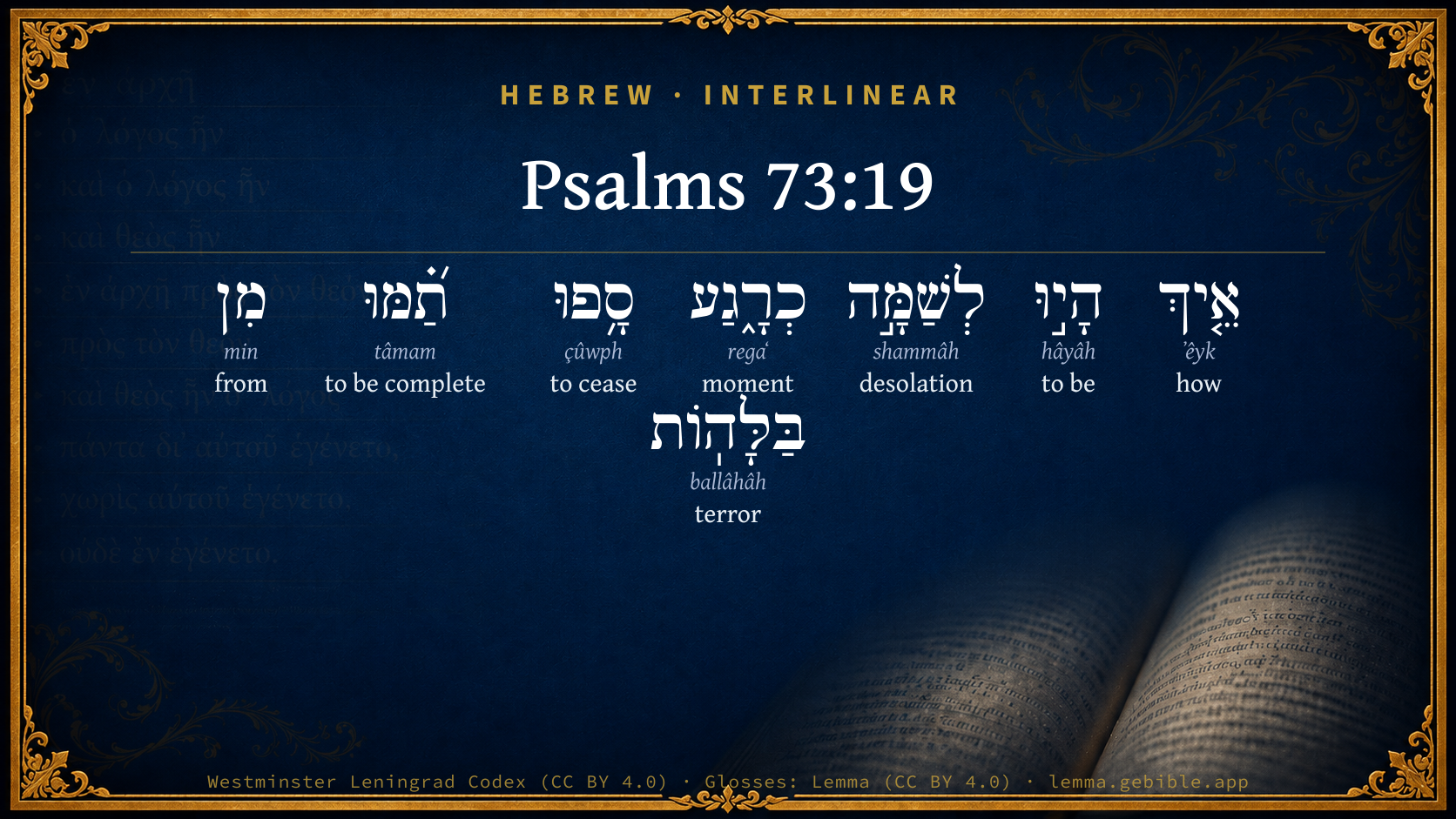
Hebrew (Westminster Leningrad Codex) Psalms 73:19 appears in the Hebrew Old Testament. The text above is from the Westminster Leningrad Codex. Each word links to its Strong’s number, a concise gloss, and parsing drawn from the Open Scriptures Hebrew Bible morphology. Click any word for its full Brown-Driver-Briggs (BDB) entry.
Download image
Cite this verse

Psalms 73:19 (World English Bible). Public Domain. Lemma interlinear Bible study tool, https://lemma.gebible.app/v/psalms/73/19.

Show BibTeX & RIS
BibTeX
RIS
English Translation
How they are suddenly destroyed! They are completely swept away with terrors.
World English Bible · Public Domain
Download a study sheet

One document with this verse’s original text, its word-by-word gloss line, the meaning frame, cross-references with their text, attributed commentary, and full source and license credits — printable, and it pastes into notes with its structure intact.

This verse Autodidact and up

Study sheet (.html) Plain text (.txt)

A passage Seminary Student

Up to 50 verses in one chapter. A passage sheet keeps up to 6 commentary sources and 12 cross-references per verse, in the order this page ranks them, and says so on the sheet whenever that leaves anything out. Ask for a single verse and you get the Autodidact verse sheet above.

Everything on this page stays free to read, with no account — the sheet is a download of what is already on screen, not access to it.

Want to remove ads? Support Godless Engineer
Compare translations 3

The same verse in 3 English versions, stacked beneath the original-language interlinear above. Click any original word for its lexicon entry.

Each is an independent rendering of the whole verse — the interlinear is not word-aligned to these translations.

Highlighted words mark where these versions differ — a whole-verse word diff, not a word-by-word alignment.

  • World English Bible Public Domain
    How they are suddenly destroyed! They are completely swept away with terrors.
  • King James Version Public Domain
    How are they brought into desolation, as in a moment! they are utterly consumed with terrors.
  • unfoldingWord Literal Text CC BY-SA 4.0
    How they are to desolation as in a moment! They come to an end, they perish by terrors.

unfoldingWord Literal Text — © unfoldingWord, licensed CC BY-SA 4.0. Word-aligned USFM3 via Door43 (git.door43.org/unfoldingWord/en_ult).

Versions to compare (up to 4)

3 of 4 selected

Show all 18 translations

Every available English version of this verse, each an independent rendering of the whole verse.

  • World English Bible Public Domain
    How they are suddenly destroyed! They are completely swept away with terrors.
  • Berean Standard Bible Public Domain
    How suddenly they are laid waste, completely swept away by terrors!
  • Majority Standard Bible Public Domain
    How suddenly they are laid waste, completely swept away by terrors!
  • King James Version Public Domain
    How are they brought into desolation, as in a moment! they are utterly consumed with terrors.
  • American Standard Version (1901) Public Domain
    How are they become a desolation in a moment! They are utterly consumed with terrors.
  • Revised Version (1885) Public Domain
    How are they become a desolation in a moment! they are utterly consumed with terrors.
  • Geneva Bible (1599) Public Domain
    How suddenly are they destroyed, perished and horribly consumed,
  • Douay-Rheims (1899) Public Domain
    How are they brought to desolation? they have suddenly ceased to be: they have perished by reason of their iniquity.
  • Young's Literal Translation Public Domain
    How have they become a desolation as in a moment, They have been ended -- consumed from terrors.
  • Literal Standard Version CC BY-SA 4.0
    How they have become a desolation as in a moment, || They have been ended—consumed from terrors.
  • Unlocked Literal Bible CC BY-SA 4.0
    How they become a wilderness in a moment! They come to an end and are finished in awful terrors.
  • unfoldingWord Literal Text CC BY-SA 4.0
    How they are to desolation as in a moment! They come to an end, they perish by terrors.
  • Darby Bible Public Domain
    How are they suddenly made desolate! they pass away, consumed with terrors.
  • World Messianic Bible Public Domain
    How they are suddenly destroyed! They are completely swept away with terrors.
  • Webster's Bible Public Domain
    How are they brought into desolation, as in a moment! they are utterly consumed with terrors.
  • Free Bible Version CC BY-SA 4.0
    How quickly they're destroyed! They come to a terrifying end.
  • Bible in Basic English Public Domain
    How suddenly are they wasted! fears are the cause of their destruction.
  • JPS Tanakh (1917) Public Domain
    How are they become a desolation in a moment! They are wholly consumed by terrors.

Literal Standard Version (2020), Covenant Press — licensed CC BY-SA 4.0. Text via the HelloAO Bible API (eBible.org). Unlocked Literal Bible (unfoldingWord) — licensed CC BY-SA 4.0. Text via the HelloAO Bible API (eBible.org). unfoldingWord Literal Text — © unfoldingWord, licensed CC BY-SA 4.0. Word-aligned USFM3 via Door43 (git.door43.org/unfoldingWord/en_ult). Free Bible Version, Dr. Jonathan Gallagher — licensed CC BY-SA 4.0. Text via the HelloAO Bible API (eBible.org).

Word by word

More ways to search: Search by grammar → Find every occurrence → Compare this word →

Practice this passage: Drill this verse → Learn its vocabulary →

About this verse

These counts appear in no published source. They are computed here, from the morphology-tagged text and Lemma’s own curated glosses. What Lemma adds →

8
words
8
distinct lemmas
Wisdom
section

Notable vocabulary

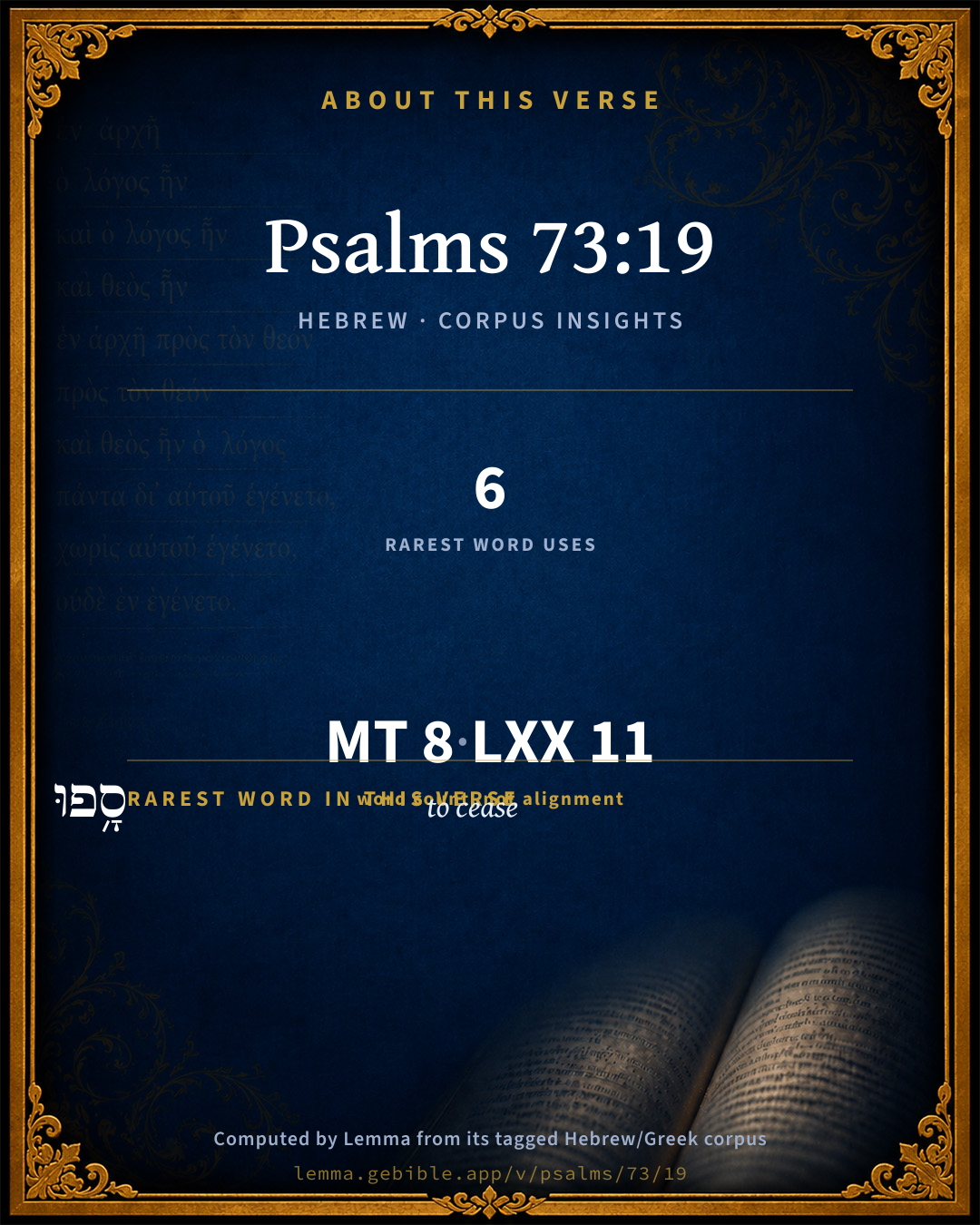
The rarest word here is סָ֥פוּ to cease H5486 — appearing just 6 times in the whole Hebrew Bible.

Shared distinctive vocabulary

סָ֥פוּ to cease H5486 occurs in 6 verses of the Hebrew Bible. Also found in:

Grammatical profile

  • 3 verbs
  • 3 nouns
  • 1 preposition
  • 1 particle

Verb forms

  • הָי֣וּ Qal · Perfect
  • סָ֥פוּ Qal · Perfect
  • תַ֝֗מּוּ Qal · Perfect

Hebrew & Septuagint length

In English translation the verse runs 12 words from the Hebrew and 16 from the Septuagint (LXX English) — closely comparable.

A rough comparison of the two English renderings, which tokenize alike — not a word-level alignment.

Word counts can differ between the Hebrew and the Greek without any difference in meaning — e.g. the Hebrew direct-object marker אֵת has no separate Greek word, and Greek often adds the article ὁ.

In the original languages it is 8 Hebrew tokens and 11 Greek tokens — but the two are counted differently (Hebrew bundles its prefixes and suffixes into one token; the Greek is in lemma form), so that isn’t a like-for-like length.

Cross-references

16

Topical passages linked to Psalms 73:19 in the Treasury of Scripture Knowledge — connected by theme and wording, ordered by reader-vote popularity; previews shown in the World English Bible.

  • Isaiah 47:11 Therefore shall evil come on you; you shall not know the dawning of it: and mischief shall fall on you; you shall not be able to put it away: and desolation shall come on you suddenly, which you don't know.
  • Proverbs 28:1 The wicked flee when no one pursues; But the righteous are as bold as a lion.
  • Daniel 5:6 Then the king's face was changed in him, and his thoughts troubled him; and the joints of his loins were loosened, and his knees struck one against another.
  • Job 15:21 A sound of terrors is in his ears; In prosperity the destroyer shall come on him.
  • Job 20:5 That the triumphing of the wicked is short, The joy of the godless but for a moment?
  • Isaiah 30:13 therefore this iniquity shall be to you as a breach ready to fall, swelling out in a high wall, whose breaking comes suddenly in an instant.
  • 1 Thessalonians 5:3 For when they are saying, "Peace and safety," then sudden destruction will come on them, like birth pains on a pregnant woman; and they will in no way escape.
  • Revelation 18:10 standing far away for the fear of her torment, saying, 'Woe, woe, the great city, Babylon, the strong city! For your judgment has come in one hour.'
  • Numbers 16:21 Separate yourselves from among this congregation, that I may consume them in a moment.
  • Numbers 17:12–13 The children of Israel spoke to Moses, saying, Behold, we perish, we are undone, we are all undone.
  • 1 Samuel 28:20 Then Saul fell immediately his full length on the earth, and was sore afraid, because of the words of Samuel: and there was no strength in him; for he had eaten no bread all the day, nor all the night.
  • Job 18:11 Terrors shall make him afraid on every side, And shall chase him at his heels.
  • Job 20:23–25 When he is about to fill his belly, God will cast the fierceness of his wrath on him. It will rain on him while he is eating.
  • Psalms 58:9 Before your pots can feel the heat of the thorns, He will sweep away the green and the burning alike.
  • Isaiah 21:3–4 Therefore are my loins filled with anguish; pangs have taken hold on me, as the pangs of a woman in travail: I am pained so that I can't hear; I am dismayed so that I can't see.
  • Acts 2:23 him, being delivered up by the determined counsel and foreknowledge of God, you have taken by the hand of lawless men, crucified and killed;

Cross-references courtesy of OpenBible.info (CC BY 4.0).

Hebrew and Greek witnesses Masoretic Hebrew ↔ Greek Septuagint

The same verse in the two great witnesses to the Old Testament, shown verse-for-verse.

You’re reading Greek Psalm 72 (Hebrew Psalm 73). The Septuagint counts the superscription, so verse numbers can differ from the Hebrew — chapter-level alignment, not verse-by-verse. Numbering follows Rahlfs.

These are two independent witnesses, not word-aligned to each other, and the Septuagint is shown in lemma (dictionary) form.

Hebrew Psalms 73:19 Masoretic · Westminster Leningrad Codex

אֵ֤יךְ הָי֣וּ לְשַׁמָּ֣ה כְרָ֑גַע סָ֥פוּ תַ֝֗מּוּ מִן בַּלָּהֽוֹת

How they are suddenly destroyed! They are completely swept away with terrors.

World English Bible · Public Domain

Greek LXX Greek Psalm 72:19 Septuagint · lemma form

πῶς γίγνομαι εἰς ἐρήμωσις ἐξάπινα ἐκλείπω ἀποὀλλύω διά ὁ ἀνομία αὐτός

How have they become desolate! suddenly they have failed: they have perished because of their iniquity.

LXX2012 (modern English Septuagint) · Public Domain

On this verse, Joseph Benson's Commentary discusses the Septuagint’s reading. Read the note in Commentary ↓

Hebrew: Westminster Leningrad Codex (CC BY 4.0). Greek: Septuagint (public domain); English from LXX2012 (modern English Septuagint) (Public Domain). How the Septuagint differs from the Hebrew →

Commentary

Notes on Psalms 73:19 from classic Christian and Jewish commentators (each source and its license shown beneath its notes). The classic Christian expositions comment on the surrounding passage and are grouped to its opening verse, so a note may address several verses; the Jewish commentaries on the Tanakh (Rashi and others) are per-verse, so they appear only where the commentator wrote on this verse.

Lemma curates 59 commentaries, every one of them public domain or Creative Commons licensed, each selected and text-cleaned for this edition rather than reprinted as found. About our sources →

Trapp's Complete Commentary

John Trapp

Psa 73:19 How are they [brought] into desolation, as in a moment! they are utterly consumed with terrors.

Ver. 19. How are they brought into desolation! &c.] Such as the psalmist expresseth by an exclamation, caused by an admiration at God’s dreadfull judgments which his faith beheld as present and unavoidable, and such as astonied the beholders. See it in the literal and mystical Babylon, Jer 51:37; Jer 51:41 Rev 18:10; Rev 18:17.

They are utterly consumed with terrors] Heb. They are ended, they are consumed with troublesome frights; especially when from their death beds they behold that three-fold terrible spectacle, death, judgment, hell, and all to be passed through by their poor souls.

John Trapp, A Commentary or Exposition upon All the Books of the Old and New Testament (1647–1656) — public domain. Text from a community e-Sword module.

Joseph Benson's Commentary

Psa 73:19-20. They are brought to desolation as in a moment — Their fall is wonderful, both for its greatness, and for its suddenness. They are utterly consumed with terrors — With the horrors of their own minds; or rather, with God’s judgments unexpectedly seizing upon them. As a dream when one awaketh — Their happiness is like that of a dream, wherein a man seems highly pleased and transported with ravishing delights, but when he awakes he finds himself deceived and unsatisfied. O Lord, when thou awakest — Arisest to punish them. Or rather, when they shall awake; namely, out of the pleasant dream of this sinful life, by death and the torments following. For the Hebrew is only בעיר, bagnir, in awaking, an expression which may be applied either to God or to them, as the context directs, and the latter application seems to agree best with the metaphor here before mentioned. Thou shalt despise their image — That is, all their felicity and glory, which, as indeed it ever was, so now shall evidently be discerned to be no real, or substantial and solid thing, but a mere image, or shadow, or vain show, which can neither abide with them, nor yield them satisfaction. Thus the word rendered pomp, Act 25:23, is, in the Greek, φαντασια, a mere fancy and imagination. And Psa 39:6, man is said to walk in a vain show; in the LXX., εν εικονι, in an image, the word used by these interpreters here. God is said to despise the image, when they awake, not really, for in that sense God ever did despise it, even when they were in the height of all their glory; but declaratively, things being often said to be done in Scripture when they appear or are manifest. The sense is, Thou shalt pour contempt upon them; make them despicable to themselves and others, notwithstanding all their riches; shalt raise them to shame and everlasting contempt. The LXX. render it, τον εικονα αυτων εξουδενωσεις, Thou shalt bring to naught, or make nothing of their image. God will render utterly contemptible even in their own sight, as well as in that of himself, of his holy angels, and the spirits of the righteous, those imaginary and fantastic pleasures for which they have lost the substantial joys and glories of his heavenly kingdom. For it is evident that what the psalmist here affirms, concerning the end of the wicked, cannot be understood, consistently with the rest of the Psalm, of their temporal destruction, but must be interpreted of their future wretched state in another world, which is often represented, in Scripture, by death and destruction; and so, indeed, these verses explain it. How are they brought to desolation in a moment, that is, the moment when they pass out of this life to another. It is then only that the wicked will be thoroughly awakened to see their misery, especially if they die without much pain or anguish, in a stupid, thoughtless way, as seems to be intimated Psa 73:4. And here let us reflect, with Dr. Horne, If “the sudden alteration which death makes in the state of a powerful and opulent sinner, cannot but affect all around him, though they behold but one part of it; how much more would they be astonished and terrified if the curtain between the two worlds were withdrawn, and the other half of the change exposed to view! Let faith do that which sight cannot do;” let it show us, that the life of the ungodly is a sleep; their happiness a dream, illusive and transitory; at best a shadow, afterward nothing; and that, at the day of death, the soul is roused out of this sleep, the dream vanishes, and the sinner finds himself consigned to everlasting torments, “and then the ungodly, however wealthy and honourable, will surely cease to be the objects of our envy.”

Joseph Benson's Commentary on the Old and New Testaments (1811–1818) — public domain. Text from a community e-Sword module.

J. A. Alexander on Psalms

Joseph Addison Alexander

Psa 73:19. How are they (brought) to desolation as (in) a moment! They have ceased, they are consumed with terrors! He here expresses his surprise at the abruptness and completeness of their ruin. The meaning of the last clause seems to be, that their very apprehensions were sufficient to destroy them, much more the actual experience of what they apprehended.

Joseph Addison Alexander, The Psalms Translated and Explained (1850) — public domain. Text from a community e-Sword module.

Geneva Bible (1599)

Geneva Bible translators

By thy fearful judgment.

Geneva Bible (1599) marginal notes — public domain. Text via Bolls.life.

Adam Clarke's Commentary

Verse 19. Are they brought into desolation] This is often a literal fact. I have known several cases where persons, very rich, have by sudden losses been brought into desolation as in a moment; in consequence of which they were utterly consumed in terrors.

Adam Clarke's Commentary on the Bible (1810–1826) — public domain. Text from a community e-Sword/MySword module.

John Calvin's Commentaries

19. How have they been destroyed, as it were in a moment! The language of wonder in which the Psalmist breaks forth serves much to confirm the sentiment of the preceding verse. As the consideration of the prosperity of the ungodly induces a torpor upon our minds, yea, even renders them stupid; so their destruction, being sudden and unlooked for, tends the more effectually to awaken us, each being thus constrained to inquire how such an event came to pass, which all men thought could never happen. The prophet, therefore, speaks of it in the way of interrogation, as of a thing incredible. Yet he, at the same time, thus teaches us that God is daily working in such a manner as that, if we would but open our eyes, there would be presented to us just matter for exciting our astonishment. Nay, rather, if by faith we would look from a distance at the judgments of God daily approaching nearer and nearer, nothing would happen which we would regard as strange or difficult to be believed; for the surprise which we feel proceeds from the slowness and carelessness with which we proceed in acquiring the knowledge of Divine truth. When it is said, They are consumed with terrors, it may be understood in two ways. It either means that God thunders upon them in such an unusual manner, that the very strangeness of it strikes them with dismay; or that God, although he may not lay his hand upon his enemies, nevertheless throws them into consternation, and brings them to nothing, solely by the terror of his breath, at the very time when they are recklessly despising all dangers, as if they were perfectly safe, and had made a covenant with death. Thus we have before seen David introducing them as encouraging themselves in their forwardness by this boasting language, “Who is lord over us?” (Psalm 12:4.) I am rather inclined to adopt the first sense; and the reason which leads me to do so is, that when God perceives that we are so slow in considering his judgments, he inflicts upon the ungodly judgments of a very severe kind, and pursues them with unusual tokens of his wrath, as if he would make the earth to tremble, in order thereby to correct our dullness of apprehension.

John Calvin's Commentaries (1540-1563) — public domain. Text from the Calvin Translation Society English edition (1840s-50s) via the Christian Classics Ethereal Library (ccel.org). Calvin's coverage is partial (roughly two-thirds of the Bible); uncommented books and verses are honest gaps, never fabricated. The 19th-century editor's footnotes and remarks are omitted so the notes are faithfully Calvin's own voice.

Ellicott's Commentary for English Readers

(19) In a moment.—Literally, in a wink. (Comp. “In the twinkling of an eye.”)

A Bible Commentary for English Readers, edited by Charles John Ellicott (1878–1897) — public domain. Text from a community e-Sword module.

The Cambridge Bible for Schools and Colleges

gen. ed. J. J. S. Perowne

19. How are they become a desolation in a moment!

They are at an end, they are consumed with terrors.

The word terrors, found here only in the Psalter, is a favourite word in Job in similar connexions (Psa_18:11; Psa_18:14, &c.).

The Cambridge Bible for Schools and Colleges (gen. ed. J. J. S. Perowne; Cambridge University Press, 1878–1918) — public domain. Text from a community e-Sword module.

John Gill's Exposition

How are they brought into desolation, as in a moment?.... Very suddenly, which is often the case of wicked men, who cry Peace and safety, and sudden destruction comes upon them, Th1 5:3, so as in a moment were the punishment of Sodom and Gomorrah, of Pharaoh and his host, and of Korah and his company, Lam 4:6, the words are expressed with admiration, as wondering at the sudden and amazing turn of things:

they are utterly consumed with terrors: their destruction is not only sudden, but entire; it is like the breaking in pieces of a potter's vessel; a shard of which cannot be gathered up and used, or like the casting of a millstone into the sea, which will never rise more; such will be the destruction of antichrist; see Rev 2:27 and this is done "with terrors"; either by terrible judgments inflicted on them from without; or with terrors inwardly seizing upon their minds and consciences; as, at the time of temporal calamities, or at death, however at judgment, when the awful sentence will be pronounced upon them; see Job 27:20.

John Gill's Exposition of the Whole Bible (1746–1763) — public domain (CC PDM 1.0). Text via the HelloAO Bible API.

Albert Barnes' Notes on the Bible

How are they brought into desolation, as in a moment! - How suddenly and unexpectedly does destruction come upon them! Nothing can be argued from their apparent prosperity, for there is no ground of security in “that,” no basis for an argument that it will continue. The end must be seen in order to form a correct estimate on the subject, and that end may soon come. Compare the notes at Job 15:20-21.

They are utterly consumed with terrors - literally, “they perish; they are destroyed by terrors;” that is, by terrible things, or by things suited to produce terror in the mind. The idea is not that they are destroyed by their own fears, but that things come upon them which are suited to overwhelm the soul, and that by those things they are utterly destroyed. It is by this result that we are to determine in regard to the equity of the divine administration, and not by their prosperity and their apparent safety.

Albert Barnes' Notes on the Bible (1834–1885) — public domain. Text from a community e-Sword/MySword module.

Matthew Poole's English Annotations

Their fall is wonderful, both for its soreness and for its suddenness.

Consumed with terrors; either, with the horrors of their own minds; or rather, with God’s dreadful judgments unexpectedly seizing upon them.

Matthew Poole's English Annotations on the Holy Bible (1683–1685) — public domain. Text from a community e-Sword/MySword module.

The Treasury of David

Charles H. Spurgeon

Ver. 19. How are they brought into desolation, as in a moment! This is an exclamation of godly wonder at the suddenness and completeness of the sinners' overthrow. Headlong is their fall; without warning, without escape, without hope of future restoration! Despite their golden chains, and goodly apparel, death stays not for manners but hurries them away; and stern justice unbribed by their wealth hurls them into destruction.

They are utterly consumed with terrors. They have neither root nor branch left. They cease to exist among the sons of men, and, in the other world, there is nothing left of their former glory. Like blasted trees, consumed by the lightning, they are monuments of vengeance; like the ruins of Babylon they reveal, in the greatness of their desolation, the judgments of the Lord against all those who unduly exalt themselves. The momentary glory of the graceless is in a moment effaced, their loftiness is in an instant consumed.

Ver. 19. They are utterly consumed with terrors. Their destruction is not only sudden, but entire; it is like the breaking in pieces of a potter's vessel, a sherd of which cannot be gathered up and used; or like the casting of a millstone into the sea, which will never rise more; and this is done with terrors, either by terrible judgments inflicted on them from without, or with terrors inwardly seizing upon their minds and consciences, as at the time of temporal calamities, or at death, and certainly at the judgment, when the awful sentence will be pronounced upon them. See Job 27:20. John Gill.

Ver. 19. If thou shouldest live the longest measure of time that any man hath done, and spend all that time in nothing but pleasures (which no man ever did but met with some crosses, afflictions, or sicknesses), but at the evening of this life, must take up thy lodging in the "everlasting burnings" and "devouring fire" (Isa 30:14); were those pleasures answerable to these everlasting burnings? An English merchant that lived at Dantzic, now with God, told us this story, and it was true. A friend of his (a merchant also), upon what grounds I know not, went to a convent, and dined with some friars. His entertainment was very noble. After he had dined and seen all, the merchant fell to commending their pleasant lives: "Yea, "said one of the friars to him, "we live gallantly indeed, had we anybody to go to hell for us when we die." Giles Firmin (1617-1617), in "The Real Christian, or, A Treatise of Effectual Calling."

Verses 18-20. The end of the wicked is,

I. Near: Thou hast set, etc. It may happen at any

time.

II. Judicial: Thou bringest, etc.

III. Sudden: How are they, etc.

IV. Tormenting: They are utterly consumed, etc.

V. Eternal: Left to themselves; gone from the mind of

God; and disregarded as a dream when one awaketh. No

after act respecting them, either for deliverance or

annihilation.

Ver. 19. The first sight and sense of hell by a proud and wealthy sinner, who has just died in peace.

Psalms 73:20*

Charles H. Spurgeon's The Treasury of David (1869–1885) — public domain. Psalms only. Text from a community e-Sword/MySword module.

Whedon's Commentary on the Bible

Daniel D. Whedon

19. How are they brought into desolation—Literally, How have they been for a desolation! The strongest possible mode of expression. Not annihilation, but the utter ruin of their plans, their pleasures, their hopes, and their proud positions of power.

In a moment—The suddenness and unexpectedness of their downfall augments their fears, so that now they are utterly consumed with terrors.

Daniel D. Whedon (gen. ed.), Commentary on the Old and New Testaments (1874–1909) — public domain. Text from a community e-Sword module.

The Pulpit Commentary

How are they brought into desolation, as in a moment! There is something very striking in the suddenness with which the prosperity of a wicked man often collapses. Saul, Jezebel, Athaliah, Epiphanes, Herod Agrippa, are cases in point, likewise Nero, Galerius, Julian. The first and second Napoleonic empires may also be cited. They are utterly consumed with terrors; literally, they perish; they come to an end through terrors. (comp. Job_18:11 Job_24:17 Job_27:20)

The Pulpit Commentary (1880–1919), ed. H.D.M. Spence-Jones & Joseph S. Exell — public domain. Text from a community e-Sword module.

John Wesley's Explanatory Notes

Terrors - With God's dreadful judgements unexpectedly seizing upon them.

John Wesley, Explanatory Notes Upon the Whole Bible (1754–1765) — public domain. Text via the GEBible commentary corpus.

Keil & Delitzsch

C. F. Keil & F. Delitzsch

The poet calms himself with the solution of the riddle that has come to him; and it would be beneath his dignity as a man to allow himself any further to be tempted by doubting thoughts. Placing himself upon the standpoint of the end, he sees how the ungodly come to terrible destruction in a moment: they come to an end (ספוּ from סוּף, not ספה), it is all over with them (תּמּוּ) in consequence of (מן as in Psa 76:7, and unconnected as in Psa 18:4; Psa 30:4; Psa 22:14) frightful occurrences (בּלּהות, a favourite word, especially in the Book of Job), which clear them out of the way. It is with them as with a dream, after (מן as in Ch1 8:8) one is awoke. One forgets the vision on account of its nothingness (Job 20:8). So the evil-doers who boast themselves μετὰ πολλῆς φαντασίας (Act 25:23) are before God a צלם, a phantom or unsubstantial shadow. When He, the sovereign Lord, shall awake, i.e., arouse Himself to judgment after He has looked on with forbearance, then He will despise their shadowy image, will cast it contemptuously from Him. Luther renders, So machstu Herr jr Bilde in der Stad verschmecht (So dost Thou, Lord, make their image despised in the city). But neither has the Kal בּזה this double transitive signification, "to give over to contempt," nor is the mention of the city in place here. In Hos 11:9 also בּעיר in the signification in urbem gives no right sense; it signifies heat of anger or fury, as in Jer 15:8, heat of anguish, and Schrder maintains the former signification (vid., on Psa 139:20), in fervore (irae), here also; but the pointing בּעיר is against it. Therefore בּעיר is to be regarded, with the Targum, as syncopated from בּהעיר (cf. לביא, Jer 39:7; Ch2 31:10; בּכּשׁלו, Pro 24:17, and the like); not, however, to be explained, "when they awake," viz., from the sleep of death (Targum),

(Note: The Targum version is, "As the dream of a drunken man, who awakes out of his sleep, wilt Thou, O Lord, on the day of the great judgment, when they awake out of their graves, in wrath abandon their image to contempt." The text of our editions is to be thus corrected according to Bechai (on Deu 33:29) and Nachmani (in his treatise שׁער הגמול).)

or after Psa 78:38, "when Thou awakest them," viz., out of their sleep of security (De Wette, Kurtz), but after Psa 35:23, "when Thou awakest," viz., to sit in judgment.

Thus far we have the divine answer, which is reproduced by the poet after the manner of prayer. Hengstenberg now goes on by rendering it, "for my heart was incensed;" but we cannot take יתחמּץ according to the sequence of tenses as an imperfect, nor understand כּי as a particle expression the reason. On the contrary, the poet, from the standpoint of the explanation he has received, speaks of a possible return (כּי seq. fut. = ἐάν) of his temptation, and condemns it beforehand: si exacerbaretur animus meus atque in renibus meis pungerer. התחמּץ, to become sour, bitter, passionate; השׁתּונן, with the more exactly defining accusative כּליותי, to be pricked, piqued, irritated. With ואני begins the apodosis: then should I be... I should have become (perfect as in Psa 73:15, according to Ges. 126, 5). Concerning לא ידע, non sapere, vid., Psa 14:4. בּהמות can be taken as compar. decurtata for כּבהמות; nevertheless, as apparently follows from Job 40:15, the poet surely has the p-ehe-mou, the water ox, i.e., the hippopotamus, in his mind, which being Hebraized is בּהמות,

(Note: The Egyptian p frequently passes over into the Hebrew b, and vice vers, as in the name Aperiu = עברים; p, however, is retained in פרעה = phar-aa, grand-house (οἶκος μέγας in Horapollo), the name of the Egyptian rulers, which begins with the sign of the plan of a house = p.)

and, as a plump colossus of flesh, is at once an emblem of colossal stupidity (Maurer, Hitzig). The meaning of the poet is, that he would not be a man in relation to God, over against God (עם, as in Psa 78:37; Job 9:2, cf. Arab. ma‛a, in comparison with), if he should again give way to the same doubts, but would be like the most stupid animal, which stands before God incapable of such knowledge as He willingly imparts to earnestly inquiring man.

Keil & Delitzsch — Biblical Commentary on the Old Testament (1861–1891) — public domain (CC PDM 1.0). Text via the HelloAO Bible API. (Old Testament only.)

Rashi

Rabbi Shlomo Yitzchaki (Rashi)

by terrors By demons.

Rashi on the Tanakh — English translations: “The Judaica Press complete Tanach with Rashi, translated by A. J. Rosenberg” (CC BY 4.0); “Pentateuch with Rashi's commentary by M. Rosenbaum and A.M. Silbermann, 1929-1934” (public domain); “The Metsudah Tanach series, Lakewood, N.J” (CC BY 4.0); and “The Book of Joshua, Metsudah Publications, 1997” (CC BY 4.0). Text via Sefaria.

Lesson kit

Teaching starters — assembled from the data on this page, not authored interpretation. Every prompt links to the verse data it draws on. Edit before teaching.

Psalms, in the Wisdom, opens this verse with 8 words (8 distinct Hebrew lemmas). Its most distinctive word is çûwph (“to cease”). A historical commentator’s framing appears above. Read the whole chapter for the surrounding context.

Discussion questions

  1. How does “to cease” (çûwph) shape what this verse is saying?
  2. Esther 9:28 shares the word «to cease» with this verse. How do the two illuminate each other?
  3. These translations render this verse differently. What is at stake in choosing one wording over another?
  4. The verb «הָי֣וּ» is Qal Perfect. How does its form color the action?
  5. Reading how Trapp's Complete Commentary and Joseph Benson's Commentary read this verse, where do the two commentators agree and where do they part?

Things to notice

Reading settings

Reading text

Shown beneath each verse's original-language words.

Old Testament
Old Testament edition

Read the OT as the Masoretic Hebrew (MT) or the Greek Septuagint (LXX).

English shown for the Greek Septuagint (in the Hebrew ↔ Greek comparison).

Comparing translations? Open the Compare panel on any verse page to stack up to four side by side.