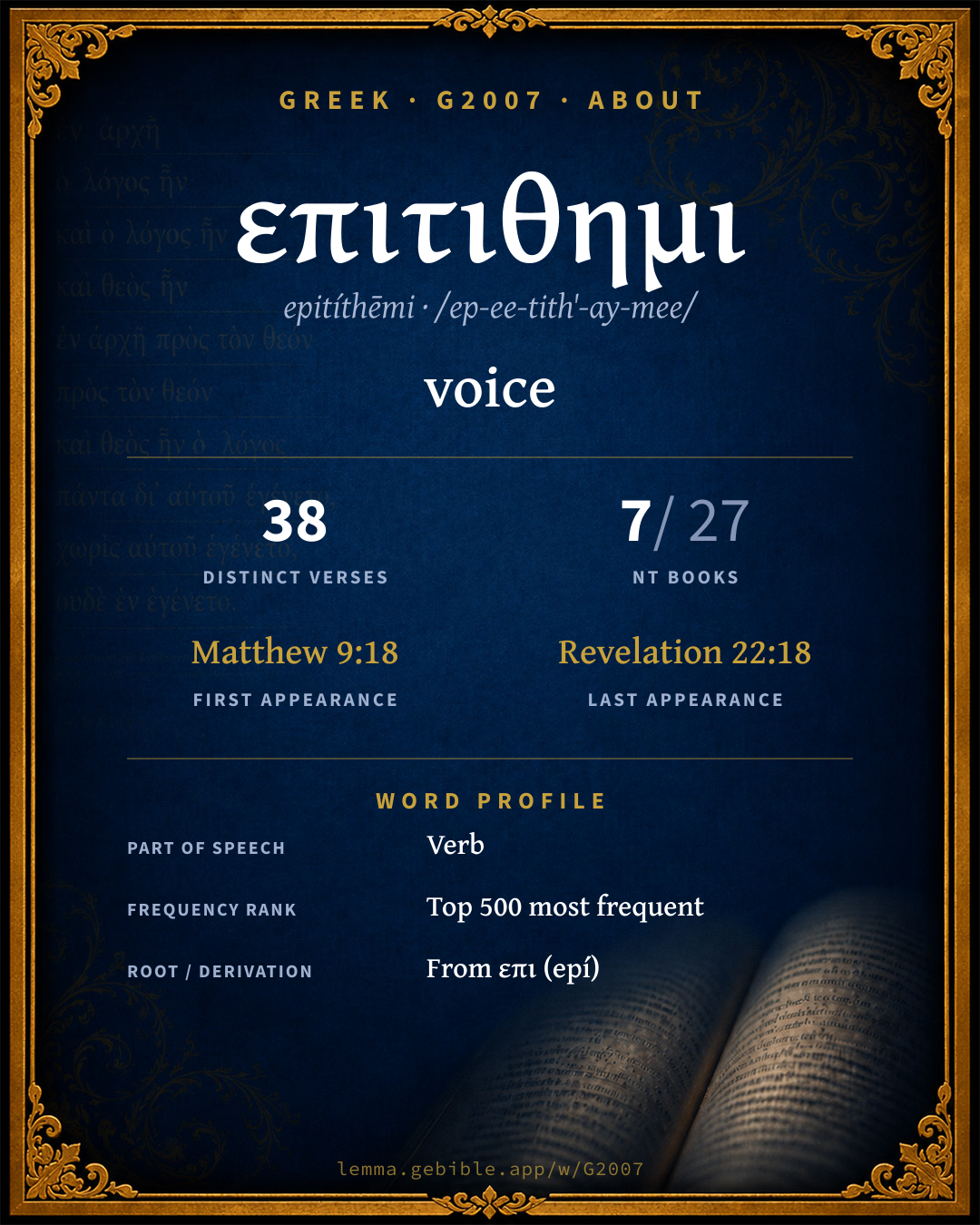
ἐπιτίθημι
voice
‘voice’ is one of 5 main senses fuller range ↓
Full lexicon entry — Thayer's Greek Lexicon
From Thayer's Greek Lexicon
Where this word appears
See every Aorist-tense verb in the Greek New Testament →
Grammar key — what these labels mean
Part of speech
- Verb
- An action or state-of-being word.
Tense
- Aorist
- Action viewed as a simple whole, without regard to duration — often past (perfective aspect).
- Future
- Action expected in future time.
- Imperfect
- Continuous or repeated action in past time (“was writing”).
- Present
- Ongoing or general action in present time (imperfective aspect).
Voice
- Active
- The subject performs the action.
- Middle
- The subject acts on or for itself, or with special interest in the action.
Mood
- Indicative
- States a fact or asks a factual question (the mood of reality).
- Participle
- A verbal adjective (“writing,” “having written”).
- Subjunctive
- Expresses probability, purpose, or possibility (the mood of contingency).
- Imperative
- Expresses a command or request.
- Infinitive
- A verbal noun (“to write”), unmarked for person or number.
Case
- Nominative
- The case of the subject (and the predicate nominative).
- Genitive
- The case of source, possession, or “of” — answers “whose / from what.”
- Accusative
- The case of the direct object and of extent.
Person
- 3rd person
- The one spoken about (“he / she / it / they”).
- 2nd person
- The one addressed (“you”).
- 1st person
- The speaker (“I / we”).
Gender
- Masculine
- Grammatically masculine.
Number
- Plural
- More than one.
- Singular
- One.
Grammatical forms 21 distinct
- Verb, Aorist, Active, Indicative, 3rd person, Plural 6 times (15%)
- Verb, Aorist, Active, Participle, Nominative, Singular, Masculine 5 times (13%)
- Verb, Aorist, Active, Indicative, 3rd person, Singular 5 times (13%)
- Verb, Aorist, Active, Participle, Nominative, Plural, Masculine 3 times (8%)
- Verb, Aorist, Active, Subjunctive, 3rd person, Singular 3 times (8%)
- Verb, Aorist, Active, Participle, Genitive, Singular, Masculine 2 times (5%)
- Verb, Aorist, Active, Imperative, 2nd person, Singular 1 time (3%)
- Verb, Aorist, Active, Infinitive 1 time (3%)
+13 more forms (13 occurrences)
Parsed forms decoded from the imported morphology (Robinson–Tischendorf, public domain), counted across 39 parsed occurrences — not distinct verses.
Every verse where G2007 appears — 38 distinct verses across 7 books. Click any verse to open its interlinear word-by-word view. Verse text shown in the World English Bible for context — . Each verse’s Greek form is shown with its reference; the English is not keyword-highlighted, since the data carries no word-level English alignment. Use “Compare translations” on any verse to read it across multiple English versions. This concordance covers the Greek New Testament; Septuagint (Greek Old Testament) occurrences of this word are not indexed here.
Matthew 7 verses
- Matthew 9:18 ἐπίθες aor act impv 2sg While he told these things to them, behold, a ruler came and worshiped him, saying, "My daughter has just died, but come and lay your hand on her, and she will live."
- Matthew 19:13 ἐπιθῇ aor act subj 3sg Then little children were brought to him, that he should lay his hands on them and pray; and the disciples rebuked them.
- Matthew 19:15 ἐπιθεὶς aor act ptcp nom sg masc He laid his hands on them, and departed from there.
- Matthew 21:7 ἐπέθηκαν aor act ind 3pl and brought the donkey and the colt, and laid their clothes on them; and he sat on them.
- Matthew 23:4 ἐπιτιθέασιν pres act ind 3pl attic For they bind heavy burdens that are grievous to be borne, and lay them on men's shoulders; but they themselves will not lift a finger to help them.
- Matthew 27:29 ἐπέθηκαν aor act ind 3pl They braided a crown of thorns and put it on his head, and a reed in his right hand; and they kneeled down before him, and mocked him, saying, "Hail, King of the Jews!"
- Matthew 27:37 ἐπέθηκαν aor act ind 3pl They set up over his head the accusation against him written, "THIS IS JESUS, THE KING OF THE JEWS."
Mark 8 verses
- Mark 3:16 ἐπέθηκεν aor act ind 3sg Simon, to whom he gave the name Peter;
- Mark 3:17 ἐπέθηκεν aor act ind 3sg James the son of Zebedee; John, the brother of James, and he surnamed them Boanerges, which means, Sons of Thunder;
- Mark 5:23 ἐπιθῇς aor act subj 2sg and begged him much, saying, "My little daughter is at the point of death. Please come and lay your hands on her, that she may be made healthy, and live."
- Mark 6:5 ἐπιθεὶς aor act ptcp nom sg masc He could do no mighty work there, except that he laid his hands on a few sick people, and healed them.
- Mark 7:32 ἐπιθῇ aor act subj 3sg They brought to him one who was deaf and had an impediment in his speech. They begged him to lay his hand on him.
- Mark 8:23 ἐπιθεὶς aor act ptcp nom sg masc He took hold of the blind man by the hand, and brought him out of the village. When he had spit on his eyes, and laid his hands on him, he asked him if he saw anything.
- Mark 8:25 ἐπέθηκεν aor act ind 3sg Then again he laid his hands on his eyes. He looked intently, and was restored, and saw everyone clearly.
- Mark 16:18 ἐπιθήσουσιν fut act ind 3pl they will take up serpents; and if they drink any deadly thing, it will in no way hurt them; they will lay hands on the sick, and they will recover."
Luke 5 verses
- Luke 4:40 ἐπιτιθεὶς pres act ptcp nom sg masc When the sun was setting, all those who had any sick with various diseases brought them to him; and he laid his hands on every one of them, and healed them.
- Luke 10:30 ἐπιθέντες aor act ptcp nom pl masc Jesus answered, "A certain man was going down from Jerusalem to Jericho, and he fell among robbers, who both stripped him and beat him, and departed, leaving him half dead.
- Luke 13:13 ἐπέθηκεν aor act ind 3sg He laid his hands on her, and immediately she stood up straight, and glorified God.
- Luke 15:5 ἐπιτίθησιν pres act ind 3sg When he has found it, he carries it on his shoulders, rejoicing.
- Luke 23:26 ἐπέθηκαν aor act ind 3pl When they led him away, they grabbed one Simon of Cyrene, coming from the country, and laid on him the cross, to carry it after Jesus.
John 2 verses
- John 9:15 ἐπέθηκέν aor act ind 3sg Again therefore the Pharisees also asked him how he received his sight. He said to them, "He put mud on my eyes, I washed, and I see."
- John 19:2 ἐπέθηκαν aor act ind 3pl The soldiers twisted thorns into a crown, and put it on his head, and dressed him in a purple garment.
Acts 14 verses
- Acts 6:6 ἐπέθηκαν aor act ind 3pl whom they set before the apostles. When they had prayed, they laid their hands on them.
- Acts 8:17 ἐπετίθεσαν impf act ind 3pl Then they laid their hands on them, and they received the Holy Spirit.
- Acts 8:19 ἐπιθῶ aor act subj 1sg saying, "Give me also this power, that whoever I lay my hands on may receive the Holy Spirit."
- Acts 9:12 ἐπιθέντα aor act ptcp acc sg masc and in a vision he has seen a man named Ananias coming in, and laying his hands on him, that he might receive his sight."
- Acts 9:17 ἐπιθεὶς aor act ptcp nom sg masc Ananias departed, and entered into the house. Laying his hands on him, he said, "Brother Saul, the Lord, who appeared to you on the road by which you came, has sent me, that you may receive your sight, and be filled with the Holy Spirit."
- Acts 13:3 ἐπιθέντες aor act ptcp nom pl masc Then, when they had fasted and prayed and laid their hands on them, they sent them away.
- Acts 15:10 ἐπιθεῖναι aor act inf Now therefore why do you tempt God, that you should put a yoke on the neck of the disciples which neither our fathers nor we were able to bear?
- Acts 15:28 ἐπιτίθεσθαι pres mid inf For it seemed good to the Holy Spirit, and to us, to lay no greater burden on you than these necessary things:
- Acts 16:23 ἐπιθέντες aor act ptcp nom pl masc When they had laid many stripes on them, they threw them into prison, charging the jailer to keep them safely,
- Acts 18:10 ἐπιθήσεταί fut mid ind 3sg for I am with you, and no one will attack you to harm you, for I have many people in this city."
- Acts 19:6 ἐπιθέντος aor act ptcp gen sg masc When Paul had laid his hands on them, the Holy Spirit came on them, and they spoke with other languages and prophesied.
- Acts 28:3 ἐπιθέντος aor act ptcp gen sg masc But when Paul had gathered a bundle of sticks and laid them on the fire, a viper came out because of the heat, and fastened on his hand.
- Acts 28:8 ἐπιθεὶς aor act ptcp nom sg masc It happened that the father of Publius lay sick of fever and dysentery. Paul entered in to him, prayed, and laying his hands on him, healed him.
- Acts 28:10 ἐπέθεντο aor mid ind 3pl They also honored us with many honors, and when we sailed, they put on board the things that we needed.
1 Timothy 1 verse
Revelation 1 verse
About this entry
At a glance — auto-summarized from this page’s data, not written by a person. Every figure links to its source below. This summary describes the numbers; it doesn’t interpret them.
The Greek verb επιτιθημι centers on the idea of “voice.” Older and newer Bibles part ways — “on” in the King James Version, “place” (Berean Standard Bible) and “having laid” (unfoldingWord Literal Text) in modern versions. See the renderings breakdown. It turns up in 38 verses across 7 books, a moderately common footprint. The word gravitates to Acts (37%), then Mark and Matthew. Thayer's distinguishes 5 senses for it. For the data behind this summary, explore the sense tree and the renderings breakdown below.
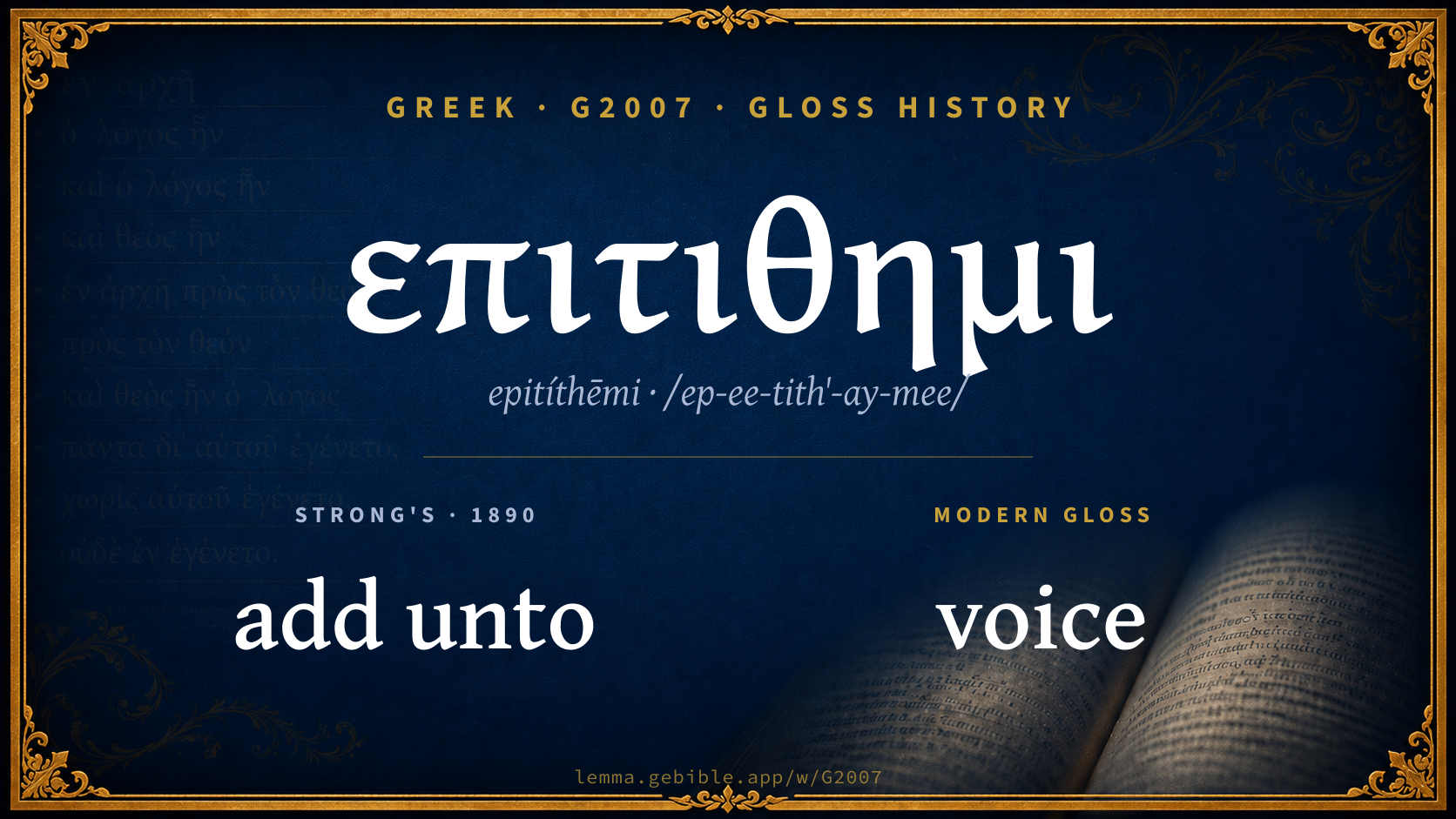
Gloss history
Strong's 1890 vs modern scholarship
About this word
Strong's G2007 catalogs a Greek word from the Greek New Testament.
These counts are not copied from any lexicon or concordance. They are computed here, from the morphology-tagged Greek New Testament. What Lemma adds →
- 38
- distinct verses
- The word appears in 38 distinct verses.
- 7 / 27
- NT books
- The word appears in 7 of 27 New Testament books.
- #385
- by frequency
- Top 500 most frequent Greek words (rank 385 of 5,347 Greek words by occurrence).
View all 38 occurrences in the concordance →
By section of the New Testament
By traditional corpus
Conventional, traditional groupings — biblical authorship is debated, so this is a traditional corpus grouping, not an authorship claim. Some books belong to more than one corpus (Luke is in both the Gospels and the Lukan corpus, and so on), so these shares overlap and need not total 100%. Each figure is a share of the word’s 38 distinct verses.
- Gospels 22 verses · 58%
- Lukan (Luke–Acts) 19 verses · 50%
- Johannine 3 verses · 8%
- Pauline corpus 1 verse · 3%
- Revelation 1 verse · 3%
How translations render this word
Counts come from each version’s own published word-to-Strong’s tagging or interlinear alignment — an approximate guide to how each version renders this word, not a word-level alignment the data otherwise carries. Because each total is that version’s own tagged count, the per-version totals vary from one another and need not match the appearance or distinct-verse counts above. These counts may also differ from a printed concordance because Lemma counts each distinctly tagged rendering and does not collapse phrase taggings into a single head-word total. This is a fixed set of word-tagged versions (KJV, ASV, BSB, ULT) and does not change with the reading translation you choose elsewhere. Each version’s license is shown beside its name below (and on Sources).
- King James Version: On 11×, He laid 5×, Lay 4×
- American Standard Version: He laid 6×, Laid 4×, Lay 4×
- Berean Standard Bible: Place 5×, Laid 4×, He placed 2×
- unfoldingWord Literal Text: Having laid 7×, They put 5×, It 3×
King James Version Public Domain
Renders G2007 across 53 tagged occurrences — most commonly:
Plus 16 renderings that appear only once — usually multi-word phrases or single function words the recovered tagging swept in, not distinct renderings. Not rendered by a distinct English word in 1 further occurrence.
American Standard Version Public Domain
Renders G2007 across 46 tagged occurrences — most commonly:
Plus 21 renderings that appear only once — usually multi-word phrases or single function words the recovered tagging swept in, not distinct renderings.
Berean Standard Bible Public Domain
Renders G2007 across 37 tagged occurrences — most commonly:
Plus 20 renderings that appear only once — usually multi-word phrases or single function words the recovered tagging swept in, not distinct renderings.
unfoldingWord Literal Text CC BY-SA 4.0
Renders G2007 across 49 tagged occurrences — most commonly:
Plus 24 renderings that appear only once — usually multi-word phrases or single function words the recovered tagging swept in, not distinct renderings.
Senses in Thayer's
The 5 senses Thayer's distinguishes for this word, in lexicon order (not ranked by frequency or importance). The full entry — with sub-senses — is in the Lexicon Entry tab.
- to put or lay upon
- to add to
- to have put on, bid to be laid on
- to lay or throw one's self upon
- to attack one, to make an assault on one
Word origin
Derived from επι (epí) (G1909) — upon.
Forms in the corpus
The 22 distinct written forms G2007 takes in the Greek New Testament, most frequent first — each parse links to that tense’s occurrences in the concordance.
Same root — word family
Other Thayer's entries built from the same root as G2007, grouped by Strong’s listed origin. These share a root / origin per the lexicon — not necessarily a shared meaning. Each links to that word’s own entry.
Derives from
Shares the same root
- επαγγελλω epangéllō G1861 to announce
- επαγω epágō G1863 to bring upon
- επαγωνιζομαι epagōnízomai G1864 to contend
- επαθροιζω epathroízō G1865 to gather together
- επαινεω epainéō G1867 to approve
- επαινος épainos G1868 approval
- επαιρω epaírō G1869 to lift up
- επαισχυνομαι epaischýnomai G1870 to be ashamed
- επαιτεω epaitéō G1871 to ask repeatedly
- επακουω epakoúō G1873 to give ear to
- επακροαομαι epakroáomai G1874 to listen to
- επαν epán G1875 after
- επαναγκες epánankes G1876 necessarily
- επαναγω epanágō G1877 to lead back
- επαναμιμνησκω epanamimnḗskō G1878 to remind
- επαναπαυομαι epanapaúomai G1879 to rest upon
- επανερχομαι epanérchomai G1880 to return
- επανισταμαι epanístamai G1881 to raise up against
- επανορθωσις epanórthōsis G1882 correction
- επανω epánō G1883 above
- επαρκεω eparkéō G1884 to avail
- επαρχια eparchía G1885 office of governor
- επαυλις épaulis G1886 farm
- επαυριον epaúrion G1887 the next day
+110 more words share this root (not shown).
Derived from this word
Proper names from this root
People and places named from this root — a name, not an additional meaning of the word.
Compare all same-root words → Showing 4 of 138 — not the complete family. 1 of the same-root words is a proper name (a person or place). They share a root, not necessarily a meaning.
Septuagint usage
The same Greek word επιτιθημι appears 234 times in the Greek Old Testament (Septuagint), across 216 verses in 27 books.
- 234
- LXX occurrences
- Tagged occurrences of this Greek word in the Septuagint.
- 216
- verses
- Distinct Septuagint verses containing this word.
- 27 / 39
- OT books
- The word appears in 27 of the 39 Old Testament books.
Sample Septuagint occurrences
- Genesis 9:23 ἐπιτίθημι
- Exodus 3:22 ἐπιτίθημι
- Leviticus 1:4 ἐπιτίθημι
- Numbers 4:6 ἐπιτίθημι
- Deuteronomy 7:15 ἐπιτίθημι
- Joshua 10:24 ἐπιτίθημι
- Judges 9:49 ἐπιτίθημι
- Ruth 3:15 ἐπιτίθημι
- 1 Samuel 6:18 ἐπιτίθημι
- 2 Samuel 13:19 ἐπιτίθημι
- 1 Kings 13:29 ἐπιτίθημι
- 2 Kings 4:29 ἐπιτίθημι
Septuagint occurrences (same lexeme)
Every verse where the same Strong’s number (G2007) appears in the Greek Septuagint — showing the first 50 of 216. Verse text shown in the World English Bible for context; the Greek form is the matched word — the English is not keyword-highlighted.
- Genesis 9:23 ἐπιτίθημι Shem and Japheth took a garment, and laid it on both their shoulders, went in backwards, and covered the nakedness of their father. Their faces were backwards, and they didn't see their father's nakedness.
- Genesis 11:6 ἐπιτίθημι Yahweh said, "Behold, they are one people, and they have all one language; and this is what they begin to do. Now nothing will be withheld from them, which they intend to do.
- Genesis 21:14 ἐπιτίθημι Abraham rose up early in the morning, and took bread and a bottle of water, and gave it to Hagar, putting it on her shoulder, and gave her the child, and sent her away. She departed, and wandered in the wilderness of Beersheba.
- Genesis 22:6 ἐπιτίθημι Abraham took the wood of the burnt offering and laid it on Isaac his son. He took in his hand the fire and the knife. They both went together.
- Genesis 22:9 ἐπιτίθημι They came to the place which God had told him of. Abraham built the altar there, and laid the wood in order, bound Isaac his son, and laid him on the altar, on the wood.
- Genesis 37:34 ἐπιτίθημι Jacob tore his clothes, and put sackcloth on his loins, and mourned for his son many days.
- Genesis 42:26 ἐπιτίθημι They loaded their donkeys with their grain, and departed from there.
- Genesis 43:18 ἐπιτίθημι The men were afraid, because they were brought to Joseph's house; and they said, "Because of the money that was returned in our sacks at the first time are we brought in; that he may seek occasion against us, and fall on us, and take us for bondservants, along with our donkeys."
- Genesis 44:13 ἐπιτίθημι Then they tore their clothes, and loaded every man his donkey, and returned to the city.
- Exodus 3:22 ἐπιτίθημι But every woman shall ask of her neighbor, and of her who visits her house, jewels of silver, jewels of gold, and clothing; and you shall put them on your sons, and on your daughters. You shall despoil the Egyptians.
- Exodus 18:11 ἐπιτίθημι Now I know that Yahweh is greater than all gods because of the thing in which they dealt arrogantly against them."
- Exodus 21:14 ἐπιτίθημι If a man schemes and comes presumptuously on his neighbor to kill him, you shall take him from my altar, that he may die.
- Exodus 22:24 ἐπιτίθημι and my wrath will grow hot, and I will kill you with the sword; and your wives shall be widows, and your children fatherless.
- Exodus 25:12 ἐπιτίθημι You shall cast four rings of gold for it, and put them in its four feet. Two rings shall be on the one side of it, and two rings on the other side of it.
- Exodus 25:18 ἐπιτίθημι You shall make two cherubim of hammered gold. You shall make them at the two ends of the mercy seat.
- Exodus 25:21 ἐπιτίθημι You shall put the mercy seat on top of the ark, and in the ark you shall put the testimony that I will give you.
- Exodus 25:26 ἐπιτίθημι You shall make four rings of gold for it, and put the rings in the four corners that are on its four feet.
- Exodus 25:30 ἐπιτίθημι You shall set bread of the presence on the table before me always.
- Exodus 25:37 ἐπιτίθημι You shall make its lamps seven, and they shall light its lamps to give light to the space in front of it.
- Exodus 26:32 ἐπιτίθημι You shall hang it on four pillars of acacia overlaid with gold; their hooks shall be of gold, on four sockets of silver.
- Exodus 28:14 ἐπιτίθημι and two chains of pure gold; you make them like cords shall, of braided work: and you shall put the braided chains on the settings.
- Exodus 28:29 ἐπιτίθημι Aaron shall bear the names of the children of Israel in the breastplate of judgment on his heart, when he goes in to the holy place, for a memorial before Yahweh continually.
- Exodus 28:30 ἐπιτίθημι You shall put in the breastplate of judgment the Urim and the Thummim; and they shall be on Aaron's heart, when he goes in before Yahweh: and Aaron shall bear the judgment of the children of Israel on his heart before Yahweh continually.
- Exodus 28:37 ἐπιτίθημι You shall put it on a lace of blue, and it shall be on the sash; on the front of the sash it shall be.
- Exodus 29:3 ἐπιτίθημι You shall put them into one basket, and bring them in the basket, with the bull and the two rams.
- Exodus 29:6 ἐπιτίθημι and you shall set the turban on his head, and put the holy crown on the turban.
- Exodus 29:10 ἐπιτίθημι "You shall bring the bull before the tent of meeting: and Aaron and his sons shall lay their hands on the head of the bull.
- Exodus 29:13 ἐπιτίθημι You shall take all the fat that covers the innards, the cover of the liver, the two kidneys, and the fat that is on them, and burn them on the altar.
- Exodus 29:15 ἐπιτίθημι "You shall also take the one ram; and Aaron and his sons shall lay their hands on the head of the ram.
- Exodus 29:17 ἐπιτίθημι You shall cut the ram into its pieces, and wash its innards, and its legs, and put them with its pieces, and with its head.
- Exodus 29:19 ἐπιτίθημι "You shall take the other ram; and Aaron and his sons shall lay their hands on the head of the ram.
- Exodus 29:20 ἐπιτίθημι Then you shall kill the ram, and take some of its blood, and put it on the tip of the right ear of Aaron, and on the tip of the right ear of his sons, and on the thumb of their right hand, and on the big toe of their right foot, and sprinkle the blood on the altar round about.
- Exodus 29:24 ἐπιτίθημι You shall put all of this in Aaron's hands, and in his sons' hands, and shall wave them for a wave-offering before Yahweh.
- Exodus 34:33 ἐπιτίθημι When Moses was done speaking with them, he put a veil on his face.
- Exodus 36:14 ἐπιτίθημι He made curtains of goats' hair for a covering over the tent. He made them eleven curtains.
- Exodus 36:23 ἐπιτίθημι He made the boards for the tent: twenty boards for the south side southward.
- Exodus 36:24 ἐπιτίθημι He made forty sockets of silver under the twenty boards; two sockets under one board for its two tenons, and two sockets under another board for its two tenons.
- Exodus 36:25 ἐπιτίθημι For the second side of the tent, on the north side, he made twenty boards,
- Exodus 36:26 ἐπιτίθημι and their forty sockets of silver; two sockets under one board, and two sockets under another board.
- Exodus 36:27 ἐπιτίθημι For the far part of the tent westward he made six boards.
- Exodus 36:32 ἐπιτίθημι and five bars for the boards of the other side of the tent, and five bars for the boards of the tent for the hinder part westward.
- Exodus 36:38 ἐπιτίθημι and the five pillars of it with their hooks. He overlaid their capitals and their fillets with gold, and their five sockets were of brass.
- Exodus 37:4 ἐπιτίθημι He made poles of acacia wood, and overlaid them with gold.
- Exodus 38:24 ἐπιτίθημι All the gold that was used for the work in all the work of the sanctuary, even the gold of the offering, was twenty-nine talents, and seven hundred thirty shekels, after the shekel of the sanctuary.
- Exodus 40:4 ἐπιτίθημι You shall bring in the table, and set in order the things that are on it. You shall bring in the lampstand, and light the lamps of it.
- Exodus 40:5 ἐπιτίθημι You shall set the golden altar for incense before the ark of the testimony, and put the screen of the door to the tent.
- Exodus 40:18 ἐπιτίθημι Moses raised up the tent, and laid its sockets, and set up the boards of it, and put in the bars of it, and raised up its pillars.
- Exodus 40:19 ἐπιτίθημι He spread the covering over the tent, and put the roof of the tent above on it, as Yahweh commanded Moses.
- Exodus 40:21 ἐπιτίθημι He brought the ark into the tent, and set up the veil of the screen, and screened the ark of the testimony, as Yahweh commanded Moses.
- Exodus 40:25 ἐπιτίθημι He lit the lamps before Yahweh, as Yahweh commanded Moses.
These are occurrences of the same Greek lexeme (G2007) in the Septuagint — not a translation of any one Hebrew word. The store carries no word-level Hebrew↔Greek alignment, so no Hebrew original is asserted here. Counts come from the recovered LXX Strong's tagging — high-frequency vocabulary is well covered, while rare or late forms may be untagged — so they reflect tagged occurrences and may slightly undercount.