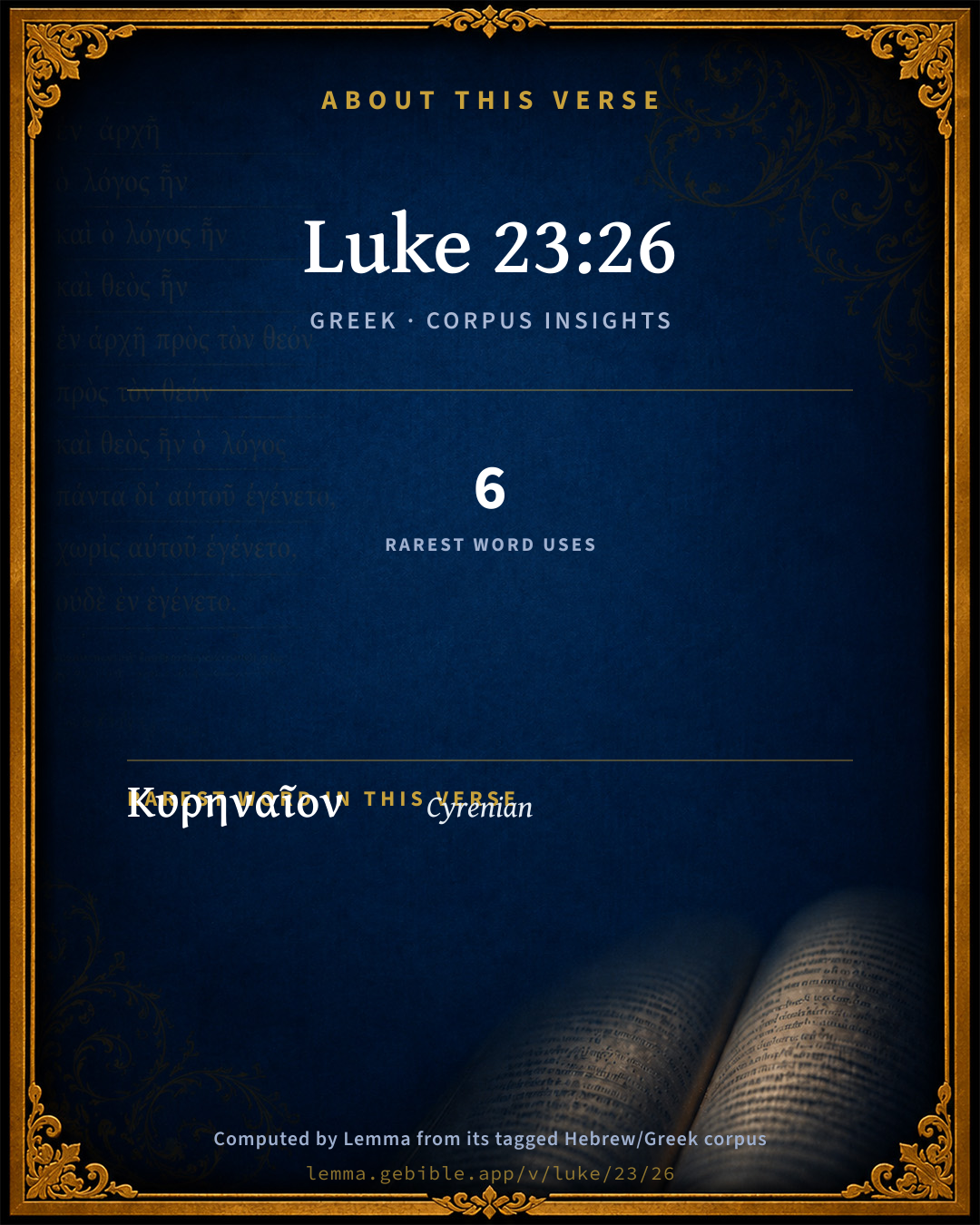
Luke 23:26

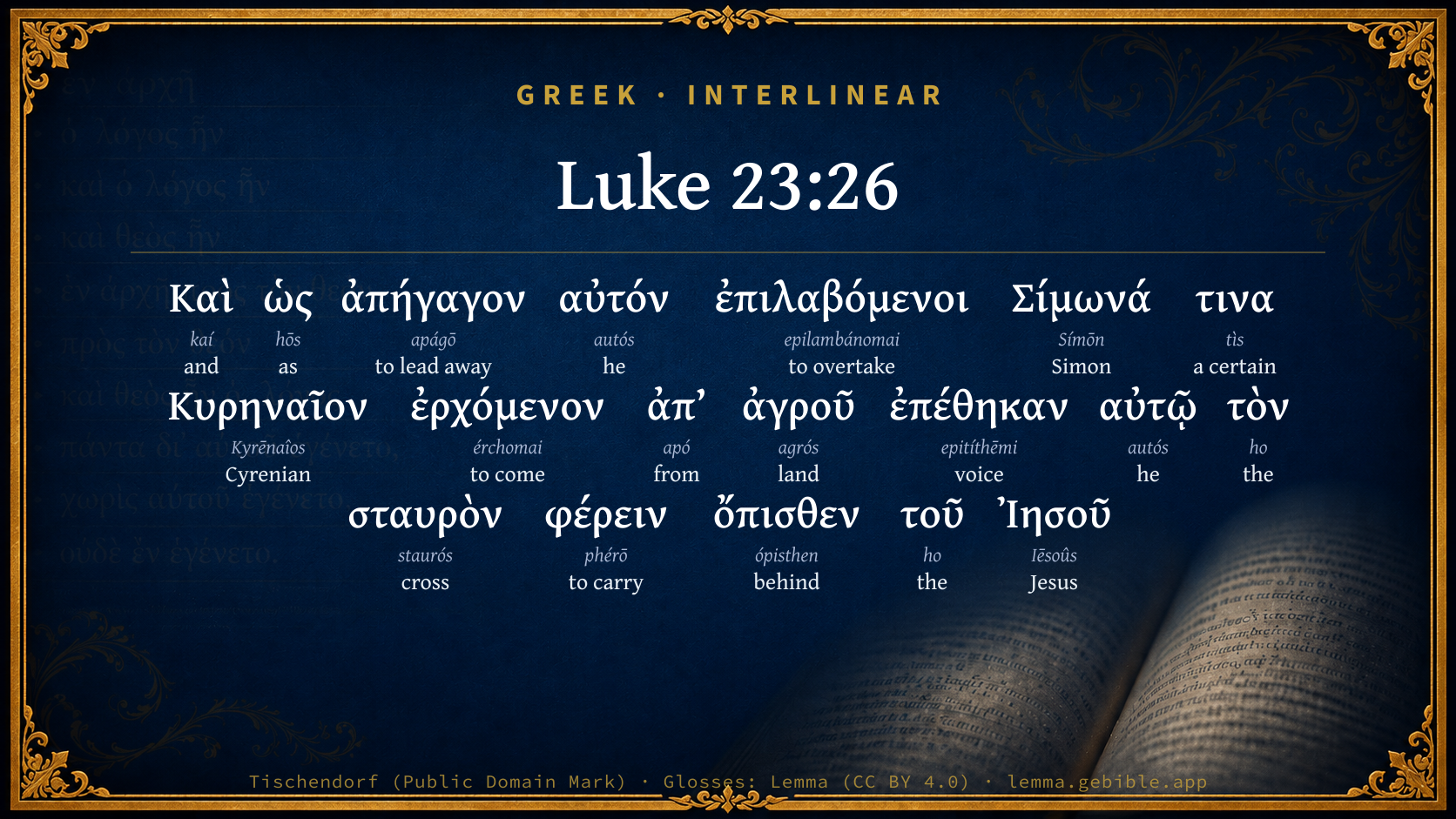
Greek (Tischendorf 8th ed.) Luke 23:26 appears in the Greek New Testament. The text above is from the Tischendorf 8th edition. Each word links to its Strong’s number and a concise gloss. Click any word for its full Thayer’s Greek Lexicon entry.
Download image
Cite this verse

Luke 23:26 (World English Bible). Public Domain. Lemma interlinear Bible study tool, https://lemma.gebible.app/v/luke/23/26.

Show BibTeX & RIS
BibTeX
RIS
English Translation
When they led him away, they grabbed one Simon of Cyrene, coming from the country, and laid on him the cross, to carry it after Jesus.
World English Bible · Public Domain
Download a study sheet

One document with this verse’s original text, its word-by-word gloss line, the meaning frame, cross-references with their text, attributed commentary, and full source and license credits — printable, and it pastes into notes with its structure intact.

This verse Autodidact and up

Study sheet (.html) Plain text (.txt)

A passage Seminary Student

Up to 50 verses in one chapter. A passage sheet keeps up to 6 commentary sources and 12 cross-references per verse, in the order this page ranks them, and says so on the sheet whenever that leaves anything out. Ask for a single verse and you get the Autodidact verse sheet above.

Everything on this page stays free to read, with no account — the sheet is a download of what is already on screen, not access to it.

Want to remove ads? Support Godless Engineer
Compare translations 3

The same verse in 3 English versions, stacked beneath the original-language interlinear above. Click any original word for its lexicon entry.

Each is an independent rendering of the whole verse — the interlinear is not word-aligned to these translations.

Highlighted words mark where these versions differ — a whole-verse word diff, not a word-by-word alignment.

  • World English Bible Public Domain
    When they led him away, they grabbed one Simon of Cyrene, coming from the country, and laid on him the cross, to carry it after Jesus.
  • King James Version Public Domain
    And as they led him away, they laid hold upon one Simon, a Cyrenian, coming out of the country, and on him they laid the cross, that he might bear it after Jesus.
  • unfoldingWord Literal Text CC BY-SA 4.0
    And as they led him away, seizing Simon, a certain Cyrenean coming from the country, they put the cross on him, to carry behind Jesus.

unfoldingWord Literal Text — © unfoldingWord, licensed CC BY-SA 4.0. Word-aligned USFM3 via Door43 (git.door43.org/unfoldingWord/en_ult).

Versions to compare (up to 4)

3 of 4 selected

Show all 19 translations

Every available English version of this verse, each an independent rendering of the whole verse.

  • World English Bible Public Domain
    When they led him away, they grabbed one Simon of Cyrene, coming from the country, and laid on him the cross, to carry it after Jesus.
  • Berean Standard Bible Public Domain
    As the soldiers led Him away, they seized Simon of Cyrene on his way in from the country, and put the cross on him to carry behind Jesus.
  • Majority Standard Bible Public Domain
    As the soldiers led Him away, they seized Simon of Cyrene on his way in from the country, and they put the cross on him to carry behind Jesus.
  • King James Version Public Domain
    And as they led him away, they laid hold upon one Simon, a Cyrenian, coming out of the country, and on him they laid the cross, that he might bear it after Jesus.
  • American Standard Version (1901) Public Domain
    And when they led him away, they laid hold upon one Simon of Cyrene, coming from the country, and laid on him the cross, to bear it after Jesus.
  • Revised Version (1885) Public Domain
    And when they led him away, they laid hold upon one Simon of Cyrene, coming from the country, and laid on him the cross, to bear it after Jesus.
  • Geneva Bible (1599) Public Domain
    And as they led him away, they caught one Simon of Cyrene, comming out of the fielde, and on him they layde the crosse, to beare it after Iesus.
  • Douay-Rheims (1899) Public Domain
    And as they led him away, they laid hold of one Simon of Cyrene, coming from the country; and they laid the cross on him to carry after Jesus.
  • Young's Literal Translation Public Domain
    And as they led him away, having taken hold on Simon, a certain Cyrenian, coming from the field, they put on him the cross, to bear `it' behind Jesus.
  • Literal Standard Version CC BY-SA 4.0
    And as they led Him away, having taken hold on Simon, a certain Cyrenian, coming from the field, they put the cross on him to carry [it] behind Jesus.
  • Unlocked Literal Bible CC BY-SA 4.0
    As they led him away, they seized one Simon of Cyrene, coming from the country, and they laid the cross on him to carry, following Jesus.
  • unfoldingWord Literal Text CC BY-SA 4.0
    And as they led him away, seizing Simon, a certain Cyrenean coming from the country, they put the cross on him, to carry behind Jesus.
  • Darby Bible Public Domain
    And as they led him away, they laid hold on a certain Simon, a Cyrenian, coming from the field, and put the cross upon him to bear it behind Jesus.
  • World Messianic Bible Public Domain
    When they led him away, they grabbed one Simon of Cyrene, coming from the country, and laid the cross on him to carry it after Yeshua.
  • Webster's Bible Public Domain
    And as they led him away, they laid hold upon one Simon a Cyrenian, coming out of the country, and on him they laid the cross, that he might bear it after Jesus.
  • Free Bible Version CC BY-SA 4.0
    As the soldiers led him away, they seized a man called Simon of Cyrene, who had come in from the countryside. They put the cross on him and made him carry it behind Jesus.
  • Bible in Basic English Public Domain
    And while they were taking him away, they put their hands on Simon of Cyrene, who was coming from the country, and made him take the cross after Jesus.
  • Text-Critical English NT CC BY 4.0
    As the soldiers led him away, they took hold of Simon, a Cyrenian man who was coming in from the countryside, and they laid on him the cross, forcing him to carry it behind Jesus.
  • Tyndale New Testament (1534) Public Domain
    And as they ledde him awaye they caught one Symon of Syrene commynge out of the felde: and on him layde they the crosse to beare it after Iesus.

Literal Standard Version (2020), Covenant Press — licensed CC BY-SA 4.0. Text via the HelloAO Bible API (eBible.org). Unlocked Literal Bible (unfoldingWord) — licensed CC BY-SA 4.0. Text via the HelloAO Bible API (eBible.org). unfoldingWord Literal Text — © unfoldingWord, licensed CC BY-SA 4.0. Word-aligned USFM3 via Door43 (git.door43.org/unfoldingWord/en_ult). Free Bible Version, Dr. Jonathan Gallagher — licensed CC BY-SA 4.0. Text via the HelloAO Bible API (eBible.org).

Word by word

More ways to search: Search by grammar → Find every occurrence → Compare this word →

Practice this passage: Drill this verse → Learn its vocabulary →

Κυρηναῖον
Kyrēnaîos
G2956
“Cyrenian”
Noun, Accusative, Singular, Masculine
Part of Speech
Noun
Case
Accusative
Number
Singular
Gender
Masculine
Full Thayer's Definition

Origin: from G2957

TDNT: None

1. a native of Cyrene
  1. Καὶ kaí G2532 “and” Conjunction
  2. ὡς hōs G5613 “as” Adverb
  3. ἀπήγαγον apágō G520 “to lead away” Verb, Aorist, Active, Indicative, 3rd person, Plural
  4. αὐτόν autós G846 “he” Personal pronoun, Accusative, Singular, Masculine
  5. ἐπιλαβόμενοι epilambánomai G1949 “to overtake” Verb, Aorist, Middle deponent, Participle, Nominative, Plural, Masculine
  6. Σίμωνά Símōn G4613 “Simon” Noun, Accusative, Singular, Masculine
  7. τινα tìs G5100 “a certain” Indefinite pronoun, Accusative, Singular, Masculine
  8. ἐρχόμενον érchomai G2064 “to come” Verb, Present, Middle or Passive deponent, Participle, Accusative, Singular, Masculine
  9. ἀπ’ apó G575 “from” Preposition
  10. ἀγροῦ agrós G68 “land” Noun, Genitive, Singular, Masculine
  11. ἐπέθηκαν epitíthēmi G2007 “voice” Verb, Aorist, Active, Indicative, 3rd person, Plural
  12. αὐτῷ autós G846 “he” Personal pronoun, Dative, Singular, Masculine
  13. τὸν ho G3588 “the” Article, Accusative, Singular, Masculine
  14. σταυρὸν staurós G4716 “cross” Noun, Accusative, Singular, Masculine
  15. φέρειν phérō G5342 “to carry” Verb, Present, Active, Infinitive
  16. ὄπισθεν ópisthen G3693 “behind” Adverb
  17. τοῦ ho G3588 “the” Article, Genitive, Singular, Masculine
  18. Ἰησοῦ Iēsoûs G2424 “Jesus” Noun, Genitive, Singular, Masculine

About this verse

These counts appear in no published source. They are computed here, from the morphology-tagged text and Lemma’s own curated glosses. What Lemma adds →

19
words
17
distinct lemmas
Gospels
section

Notable vocabulary

The rarest word here is Κυρηναῖον Cyrenian G2956 — appearing just 6 times in the whole Greek New Testament.

Shared distinctive vocabulary

Κυρηναῖον Cyrenian G2956 occurs in 6 verses of the Greek New Testament. Also found in:

Repetition

Words recur within this verse:

  • αὐτόν he G846 ×2
  • τὸν the G3588 ×2

Cross-references

9

Topical passages linked to Luke 23:26 in the Treasury of Scripture Knowledge — connected by theme and wording, ordered by reader-vote popularity; previews shown in the World English Bible.

  • Matthew 27:32–44 As they came out, they found a man of Cyrene, Simon by name, and they compelled him to go with them, that he might carry his cross.
  • Mark 15:21–32 They compelled one passing by, coming from the country, Simon of Cyrene, the father of Alexander and Rufus, to go with them, that he might bear his cross.
  • Luke 9:23 He said to all, "If anyone desires to come after me, let him deny himself, take up his cross, and follow me.
  • Luke 14:27 Whoever doesn't bear his own cross, and come after me, can't be my disciple.
  • John 19:16–17 So then he delivered him to them to be crucified. So they took Jesus and led him away.
  • Acts 2:10 Phrygia, Pamphylia, Egypt, the parts of Libya around Cyrene, visitors from Rome, both Jews and proselytes,
  • Acts 6:6 whom they set before the apostles. When they had prayed, they laid their hands on them.
  • Acts 6:9 But some of those who were of the synagogue called "The Libertines," and of the Cyrenians, of the Alexandrians, and of those of Cilicia and Asia arose, disputing with Stephen.
  • Acts 13:1 Now in the assembly that was at Antioch there were some prophets and teachers: Barnabas, Simeon who was called Niger, Lucius of Cyrene, Manaen the foster-brother of Herod the tetrarch, and Saul.

Cross-references courtesy of OpenBible.info (CC BY 4.0).

Commentary

Notes on Luke 23:26 from classic Christian and Jewish commentators (each source and its license shown beneath its notes). The classic Christian expositions comment on the surrounding passage and are grouped to its opening verse, so a note may address several verses; the Jewish commentaries on the Tanakh (Rashi and others) are per-verse, so they appear only where the commentator wrote on this verse.

Lemma curates 59 commentaries, every one of them public domain or Creative Commons licensed, each selected and text-cleaned for this edition rather than reprinted as found. About our sources →

Matthew Henry's Commentary

We have here the blessed Jesus, the Lamb of God, led as a lamb to the slaughter, to the sacrifice. It is strange with what expedition they went through his trial; how they could do so much work in such a little time, though they had so many great men to deal with, attendance on whom is usually a work of time. He was brought before the chief priests at break of day (Luk 22:66), after that to Pilate, then to Herod, then to Pilate again; and there seems to have been a long struggle between Pilate and the people about him. He was scourged, and crowned with thorns and contumeliously used, and all this was done in four or five hours' time, or six at most, for he was crucified between nine o'clock and twelve. Christ's persecutors resolve to lose no time, for fear lest his friends at the other end of the town should get notice of what they were doing, and should rise to rescue him. Never any one was so chased out of the world as Christ was, but so he himself said, Yet a little while and ye shall not see me; a very little while indeed. Now as they led him away to death we find,

I. One that was a bearer, that carried his cross, Simon by name, a Cyrenian, who probably was a friend of Christ, and was known to be so, and this was done to put a reproach upon him; they laid Christ's cross upon him, that he might bear it after Jesus (Luk 23:26), lest Jesus should faint under it and die away, and so prevent the further instances of malice they designed. It was pity, but a cruel pity, that gave him this ease.

II. Many that were mourners, true mourners, who followed him, bewailing and lamenting him. These were not only his friends and well-wishers, but the common people, that were not his enemies, and were moved with compassion towards him, because they had heard the fame of him, and what an excellent useful man he was, and had reason to think he suffered unjustly. This drew a great crowd after him, as is usual at executions, especially of those that have been persons of distinction: A great company of people followed him, especially of women (Luk 23:27), some led by pity, others by curiosity, but they also (as well as those that were his particular friends and acquaintance) bewailed and lamented him. Though there were many that reproached and reviled him, yet there were some that valued him, and pitied him, and were sorry for him, and were partakers with him in his sufferings. The dying of the Lord Jesus may perhaps move natural affections in many that are strangers to devout affections; many bewail Christ that do not believe in him, and lament him that do not love him above all. Now here we are told what Christ said to these mourners. Though one would think he should be wholly taken up with his own concern, yet he found time and heart to take cognizance of their tears. Christ died lamented, and has a bottle for the tears of those that lamented him. He turned to them, though they were strangers to him, and bade them not weep for him, but for themselves. He diverts their lamentation into another channel, Luk 23:28.

1. He gives them a general direction concerning their lamentations: Daughters of Jerusalem, weep not for me. Not that they were to be blamed for weeping for him, but rather commended; those hearts were hard indeed that were not affected with such sufferings of such a person; but they must not weep for him only (those were profitless tears that they shed for him), but rather let them weep for themselves and for their children, with an eye to the destruction that was coming upon Jerusalem, which some of them might live to see and share in the calamities of, or, at least, their children would, for whom they ought to be solicitous. Note, When with an eye of faith we behold Christ crucified we ought to weep, not for him, but for ourselves. We must not be affected with the death of Christ as with the death of a common person whose calamity we pity, or of a common friend whom we are likely to part with. The death of Christ was a thing peculiar; it was his victory and triumph over his enemies; it was our deliverance, and the purchase of eternal life for us. And therefore let us weep, not for him, but for our own sins, and the sins of our children, that were the cause of his death; and weep for fear (such were the tears here prescribed) of the miseries we shall bring upon ourselves, if we slight his love, and reject his grace, as the Jewish nation did, which brought upon them the ruin here foretold. When our dear relations and friends die in Christ, we have no reason to weep for them, who have put off the burden of the flesh, are made perfect in holiness, and have entered into perfect rest and joy, but for ourselves and our children, who are left behind in a world of sins, and sorrows, and snares.

2. He gives them a particular reason why they should weep for themselves and for their children: "Fore behold sad times are coming upon your city; it will be destroyed, and you will be involved in the common destruction." When Christ's own disciples sorrowed after a godly sort for his leaving them, he wiped away their tears with the promise that he would see them again, and they should rejoice, Joh 16:22. But, when these daughters of Jerusalem bewailed him only with a worldly sorrow, he turned their tears into another channel, and told them that they should have something given them to cry for. Let them be afflicted, and mourn, and weep, Jam 4:9. He had lately wept over Jerusalem himself, and now he bids them weep over it. Christ's tears should set us a weeping. Let the daughters of Zion, that own Christ for their king, rejoice in him, for he comes to save them; but let the daughters of Jerusalem, that only weep for him, but do not take him for their king, weep and tremble to think of his coming to judge them. Now the destruction of Jerusalem is here foretold by two proverbial sayings, that might then fitly be used, which both bespeak it very terrible, that what people commonly dread they would then desire, to be written childless and to be buried alive. (1.) They would wish to be written childless. Whereas commonly those that have no children envy those that have, as Rachel envied Leah, then those that have children will find them such a burden in attempting to escape, and such a grief when they see them either fainting for famine or falling by the sword, that they will envy those that have none, and say, Blessed are the barren, and the wombs that never bare, that have no children to be given up to the murderer, or to be snatched out of his hands. It would not only go ill with those who at that time were with child, or giving suck, as Christ had said (Mat 24:19), but it would be terrible to those who had had children, and suckled them, and had them now alive. See Hos 9:11-14. See the vanity of the creature and the uncertainty of its comforts; for such may be the changes of Providence concerning us that those very things may become the greatest burdens, cares, and griefs to us, which we have delighted in as the greatest blessings. (2.) They would wish to be buried alive: They shall begin to say to the mountains, Fall on us, and to the hills, Cover us, Luk 23:30. This also refers to a passage in the same prophecy with the former, Hos 10:8. They shall wish to be hid in the darkest caves, that they may be out of the noise of these calamities. They will be willing to be sheltered upon any terms, though with the hazard of being crushed to pieces. This would be the language especially of the great and mighty men, Rev 6:16. They that would not flee to Christ for refuge, and put themselves under his protection, will in vain call to hills and mountains to shelter them from his wrath.

2. He shows how natural it was for them to infer this desolation from his sufferings. If they do these things in a green tree, what shall be done in the dry? Luk 23:31. Some think that this is borrowed from Eze 20:47 : The fire shall devour every green tree in thee, and every dry tree. These words may be applied, (1.) More particularly to the destruction of Jerusalem, which Christ here foretold, and which the Jews by putting him to death brought upon themselves: "If they (the Jews, and the inhabitants of Jerusalem) do these things upon the green tree, if they do thus abuse an innocent and excellent person for his good works, how may they expect God to deal with them for their so doing, who have made themselves a dry tree, a corrupt and wicked generation, and good for nothing? If this be their sin, what do you think will be their punishment?" Or take it thus: "If they (the Romans, their judges, and their soldiers) abuse me thus, who have given them no provocation, who am to them as a green tree, which you seem to be as much enraged at, what will they do by Jerusalem and the Jewish nation, who will be so very provoking to them, and make themselves as a dry tree, as fuel to the fire of their resentments? If God suffer those things to be done to me, what will he appoint to be done to those barren trees of whom it had been often said that they should be hewn down and cast into the fire?" Mat 3:10; Mat 7:19. (2.) They may be applied more generally to all the revelations of God's wrath against sin and sinners: "If God deliver me up to such sufferings as these because I am made a sacrifice for sin, what will he do with sinners themselves?" Christ was a green tree, fruitful and flourishing; now, if such things were done to him, we may thence infer what would have been done to the whole race of mankind if he had not interposed, and what shall be done to those that continue dry trees, notwithstanding all that is done to make them fruitful. If God did this to the Son of his love, when he found sin but imputed to him, what shall he do to the generation of his wrath, when he finds sin reigning in them? If the Father was pleased in doing these things to the green tree, why should he be loth to do it to the dry? Note, The consideration of the bitter sufferings of our Lord Jesus should engage us to stand in awe of the justice of God, and to tremble before him. The best saints, compared with Christ, are dry tree; if he suffer, why may not they expect so suffer? And what then shall the damnation of sinners be?

Matthew Henry's Commentary on the Whole Bible (1708–1710) — public domain (CC PDM 1.0). Text via the HelloAO Bible API.

The Biblical Illustrator

Joseph S. Exell

Luk_23:26

Simon, a Syrenian

The Cross-bearer

There is a series of very beautiful pictures in the cathedral at Antwerp, which represent Christ hearing His cross from the Praetorium to Calvary.

These pictures embody the popular idea of Christs weakness and exhaustion. In one He stands calm and erect, in another He is bending under the weight of the cross, and in another He has fallen beneath the load that was laid upon Him. It is at this stage of the proceedings that Simon, who is passing by, is arrested, and compelled to bear the cross after Christ.

I. THIS WAS A COMPULSORY CROSS. Simon had no choice but to bear it. And so it is still. No life without a cross.

1. Suffering is a cross we are compelled to bear. To some life is a perpetual cross-bearing. It may be a physical cross, or a mental cross, or a spiritual cross, but day by day they must bear it.

2. Death is a cross we are compelled to bear.

3. Every attempt to follow Christ and to bear His cross will be a determined struggle.

II. THIS WAS AN UNEXPECTED CROSS. The trials we anticipate in life seldom overtake us, but those we least expect are laid upon us. The cross is often laid upon us at an unexpected time, and in an unexpected place; but there is no escape, it must be borne.

1. Sometimes the cross we bear is self appointed. It is so with much of the physical pain and social distress we see around us. These afflictions come upon us unexpectedly, but they are often the fruit of our own folly and sin.

2. Sometimes the cross we bear is divinely appointed. If Simons cross was unexpected, Christs was foreseen. The cross was not a surprise to Christ. If Simons cross was compulsory, Christs was voluntary.

III. THIS WAS AN HONOURABLE CROSS. To bear His cross. Had not Simon rendered this brief service to Christ, his name might never have been known; but now it shall be held in everlasting remembrance. The cross ennobles man both for time and eternity; it is an honourable cross.

1. This was a cross borne for Christ. We often hear of Christ bearing the cross for sinners, but here is a sinner bearing the cross for Christ. The value of the cross depends upon the spirit in which we take it up.

2. There is something very beautiful in the thought that the cross borne for Christ is borne with Christ. Whether it be His cross or ours, we share His companionship. (J. T. Woodhouse.)

Bearing Christs cross

The memorable thing is, that it is Christs cross which must be borne. You are not to think that every cross is the cross which the Saviour requires you to take up. Many a cross is of our own manufacture; our troubles are often but the consequences of our own sins; and we may not dignify these by supposing them the cross which is to distinguish the Christian. Crosses they may be; but they are not the cross which was laid upon Simon, and which had first been borne by Christ. The cross of Christ is endurance for the glory of God and the futherance of the gospel. This is thankworthy, says St. Peter, if a man for conscience towards God endure grief, suffering wrongfully. But our comfort is, that the cross which we must carry has been already carried by Christ; and therefore, like the grave which He entered, been stripped of its hatefulness. It might almost be said to have changed its very nature, through being laid on the Son of God; it left behind it its terribleness and oppressiveness. And now it is transferred to the disciple; it is indeed a cross, but a cross which it is a privilege to bear--a cross which God never fails to give strength to bear; a cross which, as leading to a crown, may justly be prized, so that we would not have it off our shoulders until the diadem is on our brow. If ye be reproached for the name of Christ--and this is a cross--happy are ye, for the Spirit of glory and of God resteth upon you. Together with this memorial, he would show, by a powerful instance, that in religion a temporizing policy is sure to defeat itself; so that, to fly from the cross is commonly to meet it dilated in size, and heavier in material. And he had one more truth to represent at the same time--the beautifully comforting truth, that He has borne what His followers have to bear, and thereby so lightened it, that as with death, which He made sleep to the believer, the burden but quickens the step towards an exceeding and eternal weight of glory; and that He might effectually convey all this through one great significative action, was it ordered, we may believe, in the providence of God, that as they led away Jesus carrying the cross, like Isaac with the wood for the burnt-offering, the soldiers laid hold on one Simon of Cyrene, and compelled him to bear the cross. (H. Melvill, B. D.)

The Biblical Illustrator, edited by Joseph S. Exell (c. 1880s–1900s) — public domain. Text from a community e-Sword module.

Joseph Benson's Commentary

Luk 23:26-27. And as they led him away — After he had been barbarously scourged and mocked, as is recorded, Mat 27:26-31, and Mar 15:15-20, where see the notes; they laid hold on one Simon, coming out of the country — Who was probably a friend of Christ’s, and known to be so; and on him they laid the cross — Which doubtless was done to put a reproach upon him; that he might bear it after Jesus — Lest Jesus should faint under it, and die away, and so prevent the farther instances of the malice which they designed. See on Mat 27:32. And there followed him a great company of people — Especially of women. These were not only his friends and well-wishers, but many others of the common people, who were not his enemies, and were moved with compassion toward him, because they had seen, or at least heard of, his wonderful works, and what a wise, holy, and benevolent man he was, and had reason to think he suffered unjustly; this drew a great crowd after him, some of whom were influenced by pity, others probably by curiosity; but they also, as well as those that were his particular friends, bewailed and lamented him — So that, though there were many that reproached and reviled him, yet there were some that valued him, were sorry for him, and sympathized with him in his sufferings. Observe, reader, the sufferings and death of the Lord Jesus may move the natural affections of many who are strangers to devout affections; and those may bewail Christ who do not savingly believe in him, and truly love him.

Joseph Benson's Commentary on the Old and New Testaments (1811–1818) — public domain. Text from a community e-Sword module.

The Preacher's Complete Homiletical Commentary

Joseph S. Exell (gen. ed.)

CRITICAL NOTES

Luk_23:26. Simon, a Cyrenian.—Rather, “of Cyrene” (R.V.). There was a colony of Jews in Cyrene, and they had a synagogue in Jerusalem (Act_6:9; Act_11:20). Probably he had come up to the Passover in Jerusalem. St. Mark speaks of his two sons “Alexander and Rufus,” who were evidently well known in Christian society as disciples. Probably Jesus was unable, because of being exhausted by His agony in the garden, and the scourging He had undergone, to bear the cross. This seems to be indicated by the words “laid hold upon,” or, as St. Mark says, “compelled”; Simon was impressed to assist in bearing the burden, which would scarcely have been necessary if Jesus had been able to do it. Perhaps Simon showed some sign of commiseration on meeting the procession. Coming out of the country.—This might mean coming from work, but scarcely can have that signification here. Perhaps it simply denotes his meeting the procession: he was on his way into the city; they were on their way out of it. Bear it after Jesus.—Apparently assist in carrying; Simon bearing the hinder part, Jesus the fore part.

Luk_23:27. A great company.—As is usual at an execution. Women.—Not Galilæan women (cf. Luk_23:49), but women of Jerusalem. Their sorrow was evidently that excited by sympathy with a condemned criminal; but, of course, some of them may have been disciples of Jesus.

Luk_23:28. Daughters of Jerusalem.—Inhabitants of a doomed city. For yourselves.—No doubt some of them afterwards experienced the horrors of the siege.

Luk_23:30. Begin to say, etc.—A quotation from Hos_10:8.

Luk_23:31. Green tree.—I.e., “if these things are done to one who is innocent, what shall be done to those who are guilty?” The idea of dryness suggests “fit for burning.”

MAIN HOMILETICS OF THE PARAGRAPH.—Luk_23:26-31

Two Alleviations of Jesus’ Sufferings.

I. The strength of a man relieved His body of the burden of the cross.—Though He bore His own cross out of the palace of Pilate, He was not able to carry it far. Either He sank beneath it on the road, or He was proceeding with such slow and faltering steps that the soldiers, impatient of the delay, recognised that the burden must be removed from His shoulders. One or two of the soldiers might have relieved Him. Out of a spirit of horseplay and mischief they laid hold of a passer-by and requisitioned his services for the purpose. To the man it must have been an extreme annoyance and indignity. Doubtless he was bent on business of his own, which had to be deferred. His family or his friends might be waiting for him, but he was turned the opposite way. To touch the instrument of death was as revolting to him as it would be to us to handle the hangman’s rope; perhaps more so, because it was Passover time, and this would make him ceremonially unclean. It was a jest of the soldiers and he was their laughing-stock. As he walked by the side of the robbers, it looked as if he were on the way to execution himself. This is a lively image of the cross-bearing to which the followers of Christ are called. We are wont to speak of trouble of any kind as a cross; and doubtless any kind of trouble may be borne bravely in the name of Christ. But, properly speaking, the cross of Christ is what is borne in the act of confessing Him, or for the sake of His work. When any one makes a stand for principle, because he is a Christian, and takes the consequences in the shape of scorn or loss, this is the cross of Christ. The pain you may feel in speaking to another in Christ’s name, the sacrifice of comfort or time you may make in engaging in Christian work, the self-denial you exercise in giving of your means that the cause of Christ may spread at home or abroad, the reproach you may have to bear in identifying yourself with militant causes or with despised persons, because you believe they are on Christ’s side—in such conduct lies the cross of Christ. It involves trouble, discomfort, or sacrifice. One may fret under it, or sink under it; it is ugly, painful, shameful often, but no disciple is without it. Our Master said, “He that taketh not his cross and followeth after Me is not worthy of Me.” Apparently this rencontre issued in Simon’s salvation and in the salvation of his house. There can be little doubt that the connection of his family with the Church (noted by St. Mark), was the result of this incident in the father’s life. Is this not a significant fact, proving that nothing happens by chance? Had Simon entered the city one hour sooner or one hour later, his after history might have been entirely different. On the smallest circumstances the greatest results may hinge. A chance meeting may determine the weal or woe of a life. How much may follow when Christ is revealed to any human soul! The salvation of those yet unborn may be involved in it—of children and children’s children.

II. The pain of Christ’s soul was cooled by the sympathy of women.—It was, indeed, a surprising demonstration. It would hardly have been credited, had it not there been made manifest, that Jesus had so strong a hold upon any section of the population of Jerusalem. In the capital He had always found the soil very unreceptive. Yet now it turns out that He has touched the heart of one section, at least, even of this community. It is a great testimony to the character of Christ, on the one hand, and to that of woman on the other. Woman’s instinct told her, however dimly she at first apprehended the truth, that this was the Deliverer for her. Because, while Christ is the Saviour of all, He has been specially the Saviour of woman. At His advent, her degradation being far deeper than that of men, she needed Him more; and wherever His gospel has travelled since then, it has been the signal for her emancipation and redemption. His presence evokes all the tender and beautiful qualities which are latent in her nature; and under His influence her character experiences a transfiguration. It may be that there was no great depth in the emotion of the daughters of Jerusalem; but this response of womanhood to Christ was a beginning, and therein lay its significance. It was to Him a foretaste of the splendid devotion which He was yet to receive from the womanhood of the world. The sounds of sympathy flowed over His soul as gratefully as the gift of Mary’s love enveloped His senses, when the house was filled with the odour of the ointment. His words, in response to their sympathy,

(1) reveal Himself—they show how completely He could forget His own sufferings in care and anxiety for others;

(2) they show the depth and fervour of His patriotism;

(3) they reveal His consideration for women and children;

(4) they contain an exhortation to repentance.

The two incidents are a parable of what men and women can do for Christ still. He needs the strength of men—the strong arm, the vigorous hand, the shoulders that can bear the burden of His cause; He seeks from men the mind whose originality can plan what needs to be done, the resolute will that pushes the work on, in spite of opposition, the liberal hand that gives ungrudgingly what is required for the progress and success of the Christian enterprise. From women He seeks sympathy and tears. They can give the sensibility which keeps the heart of the world from hardening; the secret knowledge which finds out the objects of Christian compassion, and wins their confidence; the enthusiasm which burns like a fire at the heart of religious work. The influence of women is subtle and remote, but it is on this account all the more powerful; for they sit at the very fountains, where the river of human life is springing, and where a touch may determine its entire subsequent course.—Stalker.

SUGGESTIVE COMMENTS ON Luk_23:26-31

Luk_23:26-46. Outline of The Narrative.—

1. The procession to Calvary (Luk_23:26-32).

2. The crucifixion (Luk_23:33-38).

3. The time passed upon the cross (Luk_23:39-46).

Luk_23:26. “On him they laid the cross.”—The Christian’s bearing of the cross is like that of Simon.

I. The cross is not chosen willingly, but imposed.

II. It is best borne in a spirit of resignation.

III. There is a reward attached to the patient bearing of it.

Simon and Jesus.

I. The greatness of trifles: accidentally coming up at that moment; catching the eye of the centurion.

II. The blessedness and honour of helping Jesus Christ.

III. The perpetual recompense and record of the humblest Christian work.

IV. The blessed results of contact with the suffering Christ.—Maclaren.

Simon the Cross-bearer.

I. The incident.—A very singular one. A strange providence in Simon’s life.

II. Simon bore Christ’s cross.—At first by compulsion. No one was anxious for this task. But the compulsory task became to him a joy and honour. A type of the future power of the cross. Compulsion was changed into delight. The task was a brief one, but it made his name immortal.

III. The lessons.—

1. Let us do, in spirit, what Simon did literally. Let us take up our cross and follow Christ. And let us do this willingly.

2. Christ is our pattern Cross-Bearer. Let us seek, in everything, to be conformed to His image.—Hutchings.

Luk_23:27-34. Prophet, Priest, and King.—It is remarkable how, in three following sayings, the Lord appears as Prophet, Priest, and King: as Prophet, to the daughters of Jerusalem; as Priest, interceding for forgiveness; as King, acknowledged by the penitent thief, and answering his prayer.—Alford.

Luk_23:27. “Women, which bewailed.”—St. Luke, in whose Gospel the most of the women who stood in connection with Jesus are described, relates to us here how their compassion strewed yet one last flower for our Lord upon His path of thorns.—Van Oosterzee.

“Lamented Him.”—Though there were two others led with Him to execution, it was to Him alone that this sympathy was shown.

Luk_23:28. “Weep not for Me.”—He Himself wept over the city, and did not weep for Himself.

Luk_23:29. “Blessed.”—The word introduces a fearful woe. Compare for a similar thought to that here, Hos_9:12-16.

“Say to the mountains,” etc.—It is interesting to see how often David, who frequently hid among the rocks of the wilderness from Saul, calls the Lord His Rock (Psa_18:2; Psa_18:46; Psa_42:9, etc.). Those who have this defence will not need to call on the rocks to hide them.

“Cover us.”—The words found a literal fulfilment at the time of the siege of Jerusalem, for the Jews in multitudes “hid themselves in the subterranean passages and sewers under the city.”

Luk_23:31. “The green tree.”—The green tree is Jesus, whom the Jews deliver over to death by the hands of the Romans, in spite of His constant submission to pagan authority; the dry is the Jewish people, who, in consequence of their spirit of rebellion, will draw down upon themselves in a proportionately greater degree the vengeance of the Romans.—Godet.

“What shall be done in the dry?”—With these words our Lord’s teaching closes, and His high-priestly office begins. His first three sayings on the cross are for others. See Luk_23:43; Joh_19:26-27.

The Preacher's Complete Homiletical Commentary (gen. ed. Joseph S. Exell; Funk & Wagnalls, c. 1892) — public domain (pre-1929). A full-Bible homiletical/sermon-outline anthology covering 65 of 66 books (2 John is absent from the source module). Text from a community e-Sword module.

Lange's Commentary on the Holy Scriptures

4. Calvary (Luk_23:26-43)

a. THE LEADING AWAY TO THE CROSS (Luk_23:26-31)

(Parallel with Mat_27:31-32; Mar_15:20-22; Joh_19:16-17.)

26And as they led him away, they laid hold upon one Simon, a Cyrenian, coming out of the country, and on him they laid the cross, that he might bear it after Jesus. 27And there followed him a great company of people, and of women, which also bewailed and lamented him. 28But Jesus turning unto them said, Daughters of Jerusalem, weep not for me, but weep for yourselves, and for your children. 29For, behold, the days are coming [there come days], in the which they shall say, Blessed are the barren, and the wombs that never bare, and the paps [breasts] which never gave suck [nourishment10]. 30Then shall they begin to say to the mountains, Fall on us; and to the hills, Cover us. 31For if they do these things in a [on, or to, the] green tree [or, wood], what shall be done in [happen to] the dry?

EXEGETICAL AND CRITICAL

Luk_23:26. And as they led Him away.—As respects the identity of the present via dolorosa (Haradell-Alahm) with the way of our Lord to the Cross, this is at least doubtful. It is about a league in length, starting from the prœtorium, inside the walls of the city, in a northwesterly direction as far as Mount Calvary, The actual way to the Cross was hardly so long, and appears also to have tended more southerly. The spuriousness at least of the so-called Stations, as, for instance, of the place from whence the train set out, where Simon of Cyrene met the Lord, where Mary sank down speechless, and heard a “Salve Mater” from His mouth, where Veronica handed Him the handkerchief, upon which immediately, in a miraculous way, the features of His countenance impressed themselves, &c., can hardly need any further mention, although, for instance, even Chateaubriand has defended their identity. Even Sepp, 3:536, no longer ventures to take these traditions under his protection, and Lamartine also allowed that he had found here stone-heaps of far later date. In reference to specialities of this sort, the admirable expression of Von Schubert holds good, Reise durch das Morgenland, ii. p. Luke 505: “Although it may be that here the childlike devotion of the natives, when it describes to us the individual features of the great picture, sometimes appears similar to a countryman whose cottage stands in the neighborhood of a battle-field, when he, not with the words of an experienced soldier, still less with the certainty of an eye-witness, relates to us what here and there took place upon the greatly-altered spots: still the relation will ever move us to deepest sympathy; for it is at all events an echo of that which his ancestors here really saw and experienced. There is now passing the sixteenth century since Constantine and Helena’s times, of those that have edified and spiritually refreshed themselves from the monuments of these mighty recollections.” Respecting, however, the identity of Calvary and the Holy Sepulchre, see Lange, Matthew, p. 520, and the there cited authors, with whose results we on the whole can agree.

They laid hold of.—A more exact expression, ἀγγαρεύειν, is found in Matthew and Mark, a word which, with the exception of Mat_5:41, is only found in this passage of the New Testament. That the idea of a military constraint is implied in it is certainly beyond question, wherein, it is true, in respect to the person of the one thus impressed, the form in which the impressment took place, and the occasion why precisely he was chosen in preference to all others, a wide field remains open to the fancy of exegetes for all manner of conjectures. The most important we find in Matthew, ad loc. Unless we assert that the notice of Mark, “father to Alexander and Rufus,” was written down without any purpose, then the conjecture is obvious that this meeting with our Lord became for Simon and his house an event of great importance, and the occasion of his afterwards bearing the Cross after Christ in a yet higher sense. In this case then, the King of the kingdom of God has, even on His way to the Cross, won a subject, and the well-known fiction of the Basilidians (of whom Epiphanius, Hœres. 24, 3, makes mention), that Simon died on the Cross instead of our Lord, acquires then a beautiful symbolical sense. Not in the place of our Lord, but in His fellowship, was, thus, not indeed his body, but his old sinful nature nailed with Jesus to the tree. Comp. Romans 6 and Mat_16:24.

Coming out of the country.—“Belongs to the Synoptical traces of a working day.” Meyer. To this, however, the fact is opposed that we do not learn how distant this field [ἀπʼ ἀγροῦ] was from the city, and as little whether he had been working in the country, in which case it must not at the same time be left out of sight that a feast day with the Jews was by no means observed more strictly than the Sabbath; but, on the contrary, less strictly. Very justly, therefore, does Wieseler remark: “We Christians [He means, of course: “We Continental Christians.”—C. C. S.] easily mistake the true relation, by comparing the Jewish Sabbath with our Sunday, and then remembering that the feast days to us are holier, celebrated with more Sabbath rest than our common Sundays.” The name of the greatest Sabbath, Lev_16:31, [Shabbathon,] is among all the feast and memorial days only given to the great day of atonement; but on the remaining feasts this strict abstinence from all labor is not required as on every seventh day (comp. Lev_23:31 with Luk_23:7; Luk_23:21; Luk_23:25; Luk_23:35, where there is a careful distinction made between labor and servile labor). Even among the present Jews the greater holiness which the weekly Sabbath and the great day of atonement have above all other feasts is among other circumstances visible from this fact, that during the two first-named days, but not during the latter, mourning for the dead is suspended; that on the former they bury no corpses, but they do so on the latter, &c. We do not, accordingly, even hold it necessary for an explanation of the compulsory service imposed upon Simon of Cyrene to assume (Lange) that they were disposed therewith, regarding him as somewhat of a Sabbath breaker, to let him smart a little for it.

On him they laid the cross, ἐπέθηκαν … φέρειν ὄπισθεν τοῦ ʼΙησοῦ.—The general expression of Matthew and Mark, ̔ἵνα ἄρῃ τὸν σταυρόν must be explained according to this more precise one of Luke. It is no φέρειν ὑπέρ τοῦ ʼΙησοῦ, but ὄπισθεν, so that our Lord obtains, it is true, some lightening, but not a freeing from bearing the cross. The cross was bound with cords upon the shoulders, and it is hardly probable that they would have lost much time in unbinding it from our Saviour and laying it in His stead upon the back of Simon; it is, therefore, not an entire transfer of the cross that is spoken of, but only a bearing of it with Him, and particularly the hinder part; and if one should even assert that our Lord found His burden hereby much rather aggravated than relieved, since then the fore-part must have pressed so much the more heavily upon Him, it would only follow from this, as often, that the tender mercies of the wicked were cruel. As to the rest, we do not read in any of the Evangelists that our Saviour was about to sink under the load if just at the right time Simon had not supported Him. Here also the Saviour bears the heaviest part of the burden, while the (comparatively) lightest part rests on the shoulders of him who follows after Jesus.

Luk_23:27. Women, which also bewailed.—A beautiful trait of genuine humanity, which in the third Gospel is exactly in its place. As customary at public executions, so here also, a great crowd have streamed together, among whom there are also women from Jerusalem. Luke, in whose Gospel the most of the women who stood in connection with Jesus are described, relates to us also how their compassion strewed yet one last flower for our Lord upon His path, of thorns. This phenomenon was the more remarkable because it, at least according to a later Jewish tradition, was considered as entirely unlawful to bestow on a malefactor who was led to the place of punishment any proof whatever of compassion. These women have, however, been placed too high when they have been put on a level with the Galilean friends of our Lord, and again too low when it is asserted that they only showed traces of an entirely superficial sympathy, such as is brought up so easily at the view of any pitiable object. In the last case our Lord would assuredly never have deemed these women worthy of a particular address, and what, moreover, could there be against supposing that at least some were found among them who personally knew Jesus, who had been affected by His preaching, or who, by report, or by their own experience of His benefits, had become engaged in His favor? We do not need, therefore (Sepp), to understand high-minded matrons who had come to a work of love, and bore in their hands a wine drugged with myrrh (which was to be a composing draught for the Saviour). They have no myrrh wine, but tear-water, wherewith they moisten the way to the Cross; but the sincerity of their sympathy becomes for our Lord upon this sorrowful course a refreshment, and He who before a frivolous Herod has kept silence, gives now these sorrowing women to hear His powerful admonitions. It is the last connected discourse of our Lord of any length that is uttered on this occasion; afterwards we shall hear only single interrupted words before His death. Perhaps He uses thereto the moment of delay which the impressment of Simon had occasioned; in this case the difficulty at once disappears, “that at this moment we are hardly to presume a witness as present who could have caught up and related any words uttered by Jesus.” (Weisse). What our Lord had uttered with composed dignity and intelligibly enough, may very well have been related by a sufficient number of witnesses, and particularly by the women themselves to His disciples.

Luk_23:28. Daughters of Jerusalem.—Our Lord undoubtedly does not overlook the fact that the compassion of these women had not the three condemned in equal measure, but Himself personally as its object. Therefore, also, He does not say: “Weep not for us,”—the terrible equalizing of Him with two murderers is only to be made some minutes later by the hands of His executioners,—but “Weep not for Me,” and He directs their look from Himself to their own future by the touching words: “Weep for yourselves and your children.” The latter certainly not without direct allusion to the imprecation of the Jews, Mat_27:25, whose fulfilment should come upon the children of these women also. Not to elicit new fruitless emotion, He now adds, not a Woe upon those with child, but a somewhat softer “Blessed” upon the unfruitful, not without a still retrospect, perhaps, to the “Blessed” which once a Galilean woman had uttered upon His mother, Luk_11:27; yet this prophecy of evil is not, therefore, the less terrible. He foretells days in which the highest blessing of marriage should be regarded as a curse, and on the other hand a sudden, even though a terrible death, as a benefit. Comp. Hos_9:14; Hos_10:8; Rev_6:16. The moment of the outbreak of this desperate condition of things (ἄρξονται), which is here drawn entirely after life, can be no other than the point of time at the destruction of Jerusalem, when all hope of deliverance is cut off. It is worthy of note that our Lord now, after His condemnation, no longer warns against this catastrophe, but foretells it as unavoidably impending, without adding even the faintest intimation of any way whatever in which it could be escaped. The day of visitation for Jerusalem is now already passed; nor will our Lord, so near His end, at all assume the guise of being any longer concerned to deliver Himself or the people so as in any way in this moment to excite them even yet to believe on Him as the promised Messiah. The preaching of repentance becomes by this very fact so much the more tremendous.

Luk_23:31. For if they do these things to the green wood.—So long as the enemy at his incursion into a land spares the green wood, he will, perhaps, even refrain from destroying the dry; but if he does not even spare the fruitful, how should he not deny compassion to the unfruitful? The image, sufficiently intelligible of itself, is probably taken from Eze_20:47, and places the fate of the innocent Saviour as a prophecy of evil over against that of the guilty Israel. We have here not the contrast between young and old (Bengel), and as little the continuation of the exclamation of the despairing women themselves, Luk_23:30 (Baumgarten-Crusius), who, he supposes, from the fate which comes upon themselves as guiltless, now make inference as to the lot of the guilty; but, on the other hand, a pathetic allusion of our Lord Himself to that which even now is coming upon Him, in which this is given to the women as the standard according to which they were to measure the fate impending over themselves. Comp. Jer_49:12; Pro_11:31; 1Pe_4:17-18. Εἰ ταῦτα ποιοῦσιν, He does not even say what, in order not to agitate the souls of the women yet more deeply; they were themselves to see it in the moments next succeeding; ποιοῦσιν, Impersonally; it designates neither the Jews nor the Romans alone, but is an indefinite expression of what is here to be accomplished by human hands.

DOCTRINAL AND ETHICAL

1. The meeting of Simon the Cyrenian with the suffering Saviour is again one of the most striking proofs of a providentia specialissima, in which the history of His life and suffering is so incomparably rich. It was not merely for Simon himself, but also for our Lord of importance, since it prepares for Him a relief, even though a brief one, on the way to the cross. Simon Peter is not at hand, although he had promised to follow his Master even to death. But from the distant Cyrene must there another Simon appear to lighten the burdened course of the Lamb of God, on the way to the slaughter. The willingness with which Simon takes the burden forced upon him, renders for his character, perhaps for his awakening courage of faith, a favorable testimony. In the women also there is manifested a feeling for our Lord, which we, after all that hitherto had come to pass, should expect least of all in this hour. “Now already the first breezes of another temper begin to breathe; the harbingers of the courage of the cross are coming into view.” Lange.

2. The address of our Lord to the weeping women causes the light of His heavenly greatness to beam afar through the mists of the way to the cross in surprising wise. In an hour in which all presses in upon Him, and He might have had all occasion to think only of His own suffering, He wholly forgets this in order to occupy Himself only with the salvation of persons who yet really only exhibited for Him an inconsiderable sympathy. While the present with its whole weight rests upon Him, the future stands bright and clear before His unclouded spirit, and His eye already beholds the day that shall extort quite other tears. The feeling of His own innocence and dignity leaves Him not a moment. He knows and designates Himself as the green wood, in the same hour which He is about to end, nailed on the dry wood of shame. No word of bitterness against His murderers is mingled with the tones of love and compassion; even the fate of the children goes to His heart, upon whom their parents have recklessly called down the curse, and as if His own conflict were already endured, He will only have tears shed for Jerusalem’s fate. Thus does His prophetic character reveal itself in the same hour in which He goes to perform His High-priestly work, and He yet, as the Good Shepherd, seeks that which is lost, while He is already on the way to give His life for the sheep.

3. The difference between this leading away of our Lord and the entry which had only taken place five days before. The place which Calvary occupies as a link in the chain of those mountain-tops which are remarkable in the life of our Lord. An admirable representation of the Cross-bearing Christ, by Ary Scheffer. Another, the Moment Before the Crucifixion, by Steuber.

4. “God’s wrath is harder to bear than Christ’s Cross.” Rieger.

HOMILETICAL AND PRACTICAL

Compare here and in the following divisions the Homiletical Hints on the parallels in Matthew and Mark.

The leading away to Calvary: 1. The Victim of wickedness led by the hands of men; 2. the atoning sacrifice of the world led by the hand of the Father to the slaughter.—The Via Dolorosa: 1. How far the Saviour alone treads it; 2. how far His disciples must continually tread the same in the following of Him.—The way of the cross: 1. Strown with the thorns of malice; 2. moistened with the tears of compassion; 3. illuminated by the light of the greatness of Jesus; 4. ended by the hill of death.—The Christian’s cross-bearing in following Jesus, like that of Simon, a work which is performed: 1. Seldom voluntarily; 2. best with resignation; 3. never without reward.—How our Lord now, with His cross-bearing disciples, has taken upon Himself the work of Simon the Cyrenian.—Not a single woman in the whole Evangelical history is hostilely disposed towards our Lord.—The great contrast between superficial feeling for, and living faith in, the Saviour.—“Weep not for Me.”—How much value is to be laid upon emotions such as are not seldom awakened in the hearers by a sermon on the Passion.—The view of the cross-bearing Christ calls us to weep for ourselves: 1. Such a suffering have human hands prepared for the most innocent and the holiest One; 2. such a sacrifice was requisite for the atonement of our sins also; 3. such a grace is even yet vainly proclaimed to many—and should we not weep over all this?—The fearful punishment of the rejection of Christ: 1. Foreseen with infallible certainty; 2. fulfilled with terrible severity; 3. held up for an example for all Christian nations who do not honor God’s Anointed.—Faith or despair; no other choice.—How shall we escape if we neglect so great salvation! Heb. 2:23.

Starke:—God knows the cross-bearers most perfectly.—The greatest and most splendid cities have often the fewest to bear the Lord Jesus’ cross after Him; small places are before them in it.—Canstein:—It is to be reckoned among the hidden benefits when God, through others, against our own will causes the cross to be imposed on us which we do not like to bear, and which, yet, is so good for us.—Rather help thy neighbor to bear his burden than make it heavier, Gal_6:2.—All true Christians are cross-bearers.—At the Passion of Jesus the disciples, though men, become women, and the women become men.—Cramer:—The right way to consider Christ’s Passion begins thus: that we, with our children, bewail ourselves and our sins.—Nova Bibl. Tub.:—We commonly lament most what we should lament least, and least what we should lament most, Joe_2:12; Psa_119:36.—To have no children is in many circumstances happier than to have children.—The wrath of God, when it breaks out, is unendurable, Heb_10:31.—The righteousness of God must be satisfied; if He did not spare His own innocent Son, how much less will He spare an impenitent sinner.—Heubner:—Such lamentation, Luk_23:27, is itself a fulfilment of the prophecy, Zec_12:10-14.—Christ restraining the weeping ones proved His own high dignity.—The Passion of Christ is the most solemn warning for the impenitent.—Paternal and maternal love—the thought of the future fate of their children should move parents to repentance.—For every blinded sinner there will come a day when he shall curse his life.—Luk_23:31 by no means in conflict with the Evangelical doctrine of Atonement.—Arndt:—Jesus’ death-journey to Calvary.—F. W. Krummacher:—Simon the Cyrenian: 1. The Lord Jesus with the cross of the sinner; 2. the sinner with the cross of the Lord Jesus.—The daughters of Jerusalem.—Besser:—And He bore His cross. The two thieves also bore their crosses, for such was the manner; but He has borne a heavier one than they, outwardly and inwardly.—W. Hofacker:—The solemn death-journey of Christ to Calvary: 1. As a mirror of wholesome doctrines; 2. as a mine of peaceful consolation; 3. as a ground of obligation to willing following; 4. as a warning picture against guilt and its account.—Hagenbach:—What temper of mind the celebration of the death of Jesus should awaken in us.

[10]Luk_23:29.—Rec.: ἐθήλασαν. apparently an interpretamentum of the original ἔθρεψαν, which Lachmann and Tischendorf, [Meyer, Tregelles, Alford] read, on the ground of B., [Cod. Sin.,] C.1 and 2, D., L., [C.2, D. having ἐξέθρ.] 4 Cursives, [Versions. It is almost needless to say that ἐθήλ. might very easily be substituted for ἔθρεψ., but ἔθρεψ. we may be sure was never substituted for ἐθήλασαν.—C. C. S.]

Lange's Commentary on the Holy Scriptures (Critical, Doctrinal, and Homiletical), ed. John Peter Lange, English translation edited by Philip Schaff (1864–1880) — public domain. Text from a community e-Sword module.

Godbey's Commentary on the New Testament

William B. Godbey

CHAPTER 27.

JESUS LED TO CALVARY

Mat 27:31-34; Mar 15:20-23; Luk 23:26-33; Joh 19:16-17. “And they took Jesus, and led Him away, carrying His cross.” Mark: “And when they mocked Him, they divested Him of His purple robe, and put on Him His own raiment, and led Him away, that they may crucify Him.” You see the crown of thorns was not taken off but remained on His brow throughout His crucifixion. “They compel Simon, a certain Cyrenian along with them, having come from the country, the father of Alexander and Rufus, that he may bear His cross.” As the city of Cyrene stood on the northern shore of Africa, there is at least a probability that this was a stout, muscular colored man, who enjoyed the honor of carrying the cross, which proved too much for the fainting Jesus after a night of sleepless harassment and terrible suffering, attended by the loss of much blood.

Luk 23:27-32. “And a great crowd of people followed Him, and of women, who continued to weep and bewail Him. And Jesus, turning to them, said, Daughters of Jerusalem, weep not over Me, but weep for yourselves, and your children. For, behold, the days are coming in which they will say, Blessed are the barren, and the wombs which did not bring forth, and the breasts which did not nurse. Then they will begin to say to the mountains, Fall on us; and to the hills, Cover us.” These words of our Savior describe the horrific sufferings which came on those people forty years from that date, the Roman wars lasting five years, and resulting in the destruction of Jerusalem, the death of a million, the slavery of another million, the exile of the little remnant, and the annihilation of the Jewish polity. All this He saw in vivid panorama before His eyes — mountains of the dead, rivers of blood, and the desolation of the city and the land.

“Because if they do these things in the green tree, what may be done in the dry?” This statement is metaphoric; e. g., If, while Mercy’s door is wide open, the Holy Ghost wooing, Jesus and His apostles and evangelists preaching, and everything prosperous and auspicious, they reject and crucify Him who came from heaven to save them, killing their own Christ for whom they had waited two thousand years, what will they do when the Holy Ghost has retreated away, and God has turned them over to hardness of heart and reprobacy of mind, to believe lies and be condemned? Thus the green tree emblematizes the mercy and grace abounding in the days of Jesus; and the dry, the horrific spiritual dearth coming on the land because they insulted God, slew His Son, and outraged the Holy Ghost.

“And there were also two others, malefactors, being led, along with Him to be put to death.” Mat 27:33-34 : “And having come into the place called Golgotha, which is denominated the place of a skull, they gave Him vinegar mingled with gall to drink; and tasting it, He did not wish to drink.” This was a soporific potion, conducive to the lulling of the nerves to insensibility and the obtundification of the feeling, so as to mitigate the awful severity of the pain, somewhat corresponding with the modern chloroform. You see that Jesus declined to drink it, preferring to enjoy the clear and unclouded exercise of His intellect and the full acumen of His nerves. So when physicians want you to take chloroform, or some kind of a nervous sedative, which might probably render you unconscious of your suffering, you have the example of Jesus declining all artificial relief when passing through the terrible ordeal of crucifixion, enjoying the normal exercise of nerves and brain. Calvary is not far from Pilate’s judgment-hall, the ascension beginning in the city about one square from the hall, and continuing really to the summit of Calvary, passing northward through the Damascus Gate, then turning somewhat eastward, the mountain being one of the peaks of Bezetha, and within the angle formed by the road to Jericho, leading east, and the way to Damascus leading north, as the Romans were in the habit of crucifying their criminals in the most public and conspicuous places, so as to present the greatest possible terror to evildoers. Heb 13:12, locates it “without the gate.” Calvary is Greek, and means “skull,” because the hill has the shape of a human skull. When I first came to Jerusalem, with nothing but the Scripture for my guide, I recognized Calvary before any one pointed it out to me.

William B. Godbey, Commentary on the New Testament (1896–1900) — public domain. Text from a community e-Sword module.

F. W. Grant's Numerical Bible

Section 3. (Luk 23:26-56.)

The Offering up and its Fruits.

In the story of the Cross the peculiar character of Luke is unmistakable. He omits most of the Lord’s suffering from the mere wickedness of men. We do not read of the scourging or the crown of thorns. The mockery round the cross is more briefly given. The darkness falling upon the land is noticed, but there is no cry to One who has forsaken Him. On the other hand, the fruits of His work of atonement are seen all through: in the prayer for the forgiveness of His murderers; in the story of the dying robber; as well as in the rending of the veil of the temple. Even His last words, "Father, into Thy hands I commit My spirit," have their own significance in this way.

The Gospel of the Manhood is seen also. The centurion’s testimony is to the "righteous Man." And the lament of the women of Jerusalem is in accordance with this: that human sympathy too simply natural for the Lord, spite of its manifestation of the better side of man’s nature, unreservedly to accept.

1. This lamentation of the women is the first thing here, after the account, given in all the synoptists, of the cross being laid upon Simon: the need of cross-bearing by the disciple being a necessary thing to hold up before us all.

To the women He replies with lamentation for lamentation. They have more cause to weep for themselves and their children than for Him, for the day of their sorrow was near at hand in which the blessing would be theirs who had no children. In the midst of a generation the fire of whose wrath could kindle after this sort in the green and fruitful tree, what must be the lot of those who were like the dry wood, fit fuel for the flame? This is not divine wrath of which He is speaking, though divine wrath indeed might give them up to it, but what they would inflict one upon another. The sufferings of those shut up in the cauldron of that besieged city are matters of common history. The Lord would lead them to consider the state before God in which the nation as a whole was, already putting their hand to that which as the consummation of their guilt would ensure the awful doom that was just at hand.

2. The cross is reached, and He is placed upon it, two malefactors with Him, one on either side. And now He pleads for those who have placed Him there the ignorance in which they have done it: a thing which leaves them yet the possibility of shelter in the city of refuge; and which the apostle accordingly takes up afterward with the people in his pleading with them to repent and turn to God (Act 3:17), as Paul applies it to himself also: "Howbeit for this cause I obtained mercy, because I did it ignorantly, in unbelief" (1Ti 1:13). Thus the Lord has fulfilled His own parable (Mar 13:6-9): the barren fig-tree is to be digged about and dunged, in order that it may yet be seen if it will bring forth fruit. This, notwithstanding His sentence pronounced upon it (Mat 21:19), which He will give them still the opportunity to avert, as Nineveh averted theirs. And such is the mercy of God.

Heedless and heartless, they part His garments among them, casting the lot. Luke is briefest of all as to this, of which John will show us another side. The superscription over him in the languages of wisdom-seeking, of empire, of religion; publishes His title to the world.

And now the cry begins to ring out, though in mockery, of salvation. "He saved others" say the rulers: "let Him save Himself, if He be the Christ, the chosen of God." Even the soldiers take it up after their own fashion: "If thou be the King of the Jews, save Thyself." And then one of the robbers makes the impossible conjunction: "If Thou be the Christ, save Thyself and us." Truly impossible to put these things together.

But the rulers know no more of salvation than the soldiers or the robber. A Christ who would save Himself could not be the Christ predicted by the prophets, or the Saviour of others, and Isaiah had pictured exactly what was passing before their eyes. Who could doubt the application of such words as we find here? "Therefore will I divide Him a portion with the great, and He shall divide the spoil with the strong: because He hath poured out His soul unto death; and was numbered with the transgressors, and bare the sin of many, and made intercession for the transgressors" (Isa 53:12).

Here was the secret of the Cross unveiled as the mystery of salvation; and for the Jew with his ritual of sacrifice not to understand it seems to us now almost incomprehensible. The veil was upon their heart, as the apostle declares. Pharisaic pride refused the humbling of the gospel. A Christ crucified was to the Jew a stumbling-block.

But it pleased God to give a lesson of salvation which was to accompany the story of the Cross, just in the place where every eye directed to that Cross should see it. Suddenly the voice of one of the malefactors rebukes his fellow. He, a dying man involved in the same sentence, does he not fear God, before whom he is soon going? does he not fear with that sin upon him which had brought them both justly where they were? but here was One who had done nothing amiss.

Then with this guilt upon himself also, and confessing it, he turns with the boldest possible prayer to this confessed Sinless One. "Jesus," he says, -"Jehovah Saviour," -he could not be ignorant of the meaning Of the name he uttered -"Jesus, remember me when Thou comest in Thy Kingdom." Immediately he is answered -more than answered -"Verily I say unto thee, Today shalt thou be with Me in Paradise."

We can imagine many things, of course, as to what had inspired him with a faith like this. Whatever he may have known of the Lord, however, at a former time, both Matthew and Mark assure us that "those who were crucified with Him reviled Him." The fair meaning of this has been denied without reason. The fact seems mentioned as if for the purpose of cutting off those methods of making faith easier (and therefore less notable) in the dying man, and the grace of God necessarily, at the same time, less conspicuous also. We all are familiar with the saying, that "there was one such case, that none might despair; and there was but one, that none might presume." Let us rather say that here is a pattern case of salvation, outlined in the sharpest manner that could be imagined, and placed in the most conspicuous place that could be given to it. Without works, except bad works, -without sacrament or ritual of any kind, -by no slow process and by no conditional salvation, -this condemned malefactor is given at once the perfect assurance of a place that very day with his Lord in Paradise.*

{*For the efforts of materialistic annihilationists to break down the evidence, derived from this promise, of the consciousness of souls in the separate state, see "Facts and Theories of a Future State." Their arguments are briefly, that Paradise is in the new earth, and so not yet existent, although the apostle did not know but that he might have been bodily in it (2Co 12:3-4). Then, as necessitated by this, that we ought to read, "I say to thee today;" or else "today" must mean "in the day of which you speak"!}

Thus the answer of grace goes beyond even the boldness of such a prayer; and when indeed does not grace exceed all possible expectations? Who could have asked or thought that God would give His Son to die for sinners? and He who has done this, "how shall He not with Him also freely give us all things?" How perfectly does all this suit the peace-offering Gospel! The mockery and insult call forth no response from the blessed Sufferer: He seems all unconscious of it. The need that sought Him, the faith that recognized under such disguise the Lord of glory, drew from the smitten Rock the living waters.

3. The record of divine accomplishment in that hour is told in the briefest way. The darkness that comes over the land is just mentioned, and traced to its cause, the darkening of the sun itself. There follows as connected with it the end of spiritual darkness. With the veil of the temple rent, the sanctuary is open, and God is in the light. This is the characteristic of Christianity, and the result of His entrance into that darkness of which the darkness of nature was but the external sign. Luke places the cause and effect together here, ignoring, as so often elsewhere, the order of time.

But with the cry of "Father," the darkness is ended: the cry of abandonment has been answered; the cup which alone He dreaded is drained (compare the notes on Matthew and Mark); He has but now in peace to depart. The death lying upon man has still to be taken for the perfecting of atonement: God must be owned in regard to the whole penalty on sin, and Matthew has shown us the resurrection of the saints as connected with this. For doctrinal statements of all that is involved here we must wait for the epistles; but here we have the work itself whose meaning, they explain.

The word used in Luke for His dying is, as in Mark, "He expired" -"breathed out." It is the simple reality of death as man endures it, quite different from the terms used in Matthew and John. It is passive endurance; in the others activity of will, though in surrender. Here, as true Man; He dies like other men; committing His spirit to His Father, His work accomplished.

4. The faith of the Gentile centurion is recorded in a different form to that which it takes in the other Gospels: "he glorified God, saying, In very deed this Man was righteous." Righteous He is emphatically, not merely, as with others, in the comparative sense: this all that he has seen attests. Prompt and out-spoken in his confession; the Gentile takes the first place now, as he has since done for many centuries. He is the first sign of the change impending.

But Luke shows us also a multitude of Jews returning heart-smitten from the spectacle of the cross. For Israel also there is hope in this precious death. We have learned also something of the significance of these ministering women who are seen waiting as the darkness lifts. Things are in transition: if the nation has rejected her King, God too is moving; His purposes in connection with His Son are not to be defeated.

5. The intervention of God is seen more evidently in the provision of a sepulchre suited for that incorruptible body: a sepulchre that has never seen corruption. His grave appointed Him with wicked men, He is delivered from it, and is with the rich man after He has died. He is buried by a Joseph from Elkanah’s and Samuel’s city, Ha-Ramathaim, (or Arimathea,) the city of the "two heights": names which cannot but speak to us of the elevation which is to be His, and to which He is to lift His people, as the true Joseph in the advancement following His sufferings

(See Sam. 1, notes). In this connection the burial of Christ will have for us a deep significance, as the apostle shows us; but it would carry us too far now to speak of it.

The women still are here as watchers; and even though the new day has not shined upon them, they are heralds of it.

F. W. Grant, The Numerical Bible (4th ed., 1903) — public domain. Text from a community e-Sword module.

Tyndale Open Study Notes

Tyndale Open Resources

23:26 Simon might have been a Jewish pilgrim visiting Jerusalem for Passover. • put the cross on him: Prisoners bound for crucifixion were normally forced to carry the crossbeam to the place of execution. It was fastened to the upright beam at the crucifixion site.

Tyndale Open Study Notes — © Tyndale Open Resources, licensed CC BY-SA 4.0. Text via the HelloAO Bible API.

Meyer's Critical & Exegetical Commentary

Heinrich August Wilhelm Meyer

Luk_23:26-32. Luke proceeds in a very abbreviating fashion, yet with intercalations of original matter, down to Luk_23:49. The observation ἐρχομ. ἀπʼ ἀγροῦ belongs (as Ebrard at an earlier period also supposed, but now, on Olshausen, ed. 4, p. 52, questions), as does Luk_23:56, to the synoptical traces of the working day. See on Mar_15:21.

The following saying of Jesus to the women is preserved only by Luke, extremely appropriate to the love and fervour at the threshold of death, and certainly from an original tradition.

Luk_23:27. κ. γυναικῶν] of women also, not ministering female friends, but other women; and, indeed, according to Luk_23:28, from the city, as the female sex is accustomed in general to be very sympathizing and tender at executions; ἐκόπτ., as Luk_8:52.

Luk_23:28 f. The address is: that they were not to weep over Him (for He was on His way to meet a glorious future); nevertheless over themselves they ought to weep, etc., for (see Luk_23:29) over them was impending a terrible future (the destruction of Jerusalem). The contrast of emphasis lies upon ἐπʼ ἐμέ and ἐφʼ ἑαυτάς; by the position of the one at the end and of the other at the beginning, and the consequent juxtaposition as closely as possible of the two expressions, the emphasis is strengthened.

μακάριαι] The maternal heart, in truth, feels, besides its own suffering, still more keenly the sufferings of beloved children, Eur. Andr. 395. On ἔθρεψαν (see the critical remarks), comp. Aesch. Choeph. 543: μασθὸν … ἐμὸν θρεπτήριον

Luk_23:30. The mountains and hills were tosuch is the wish of those who are in despairnot perchance hide them from the calamitous catastrophe and place them in security (comp. Isa_2:19; Isa_2:21), but, as the words themselves (comp. with Hos_10:8; Rev_6:16) indicate, the destructive landslip which covers them was to take them away by sudden death from the intolerable evil.

ἄρξονται] an outbreaking of the greatest anguish. The subject is the people in general (the Jews), not the steriles (Bengel).

Luk_23:31. Reason on which this announcement of evil was based, Luk_23:29 f. If they thus treat the guiltless and the righteous, what shall happen to the godless (to themselves)? On the figure of the green (Psa_1:5) and the dry tree, comp. Eze_21:3; Sanhedr. f. 93. 1. This last saying of Jesus, Luk_23:28-31, is one great memorial more, at once of His self-denial and of His sinless consciousness, as well as of His certain insight into the counsel of the divine retribution, which now allows itself no longer to be averted, but to be even once more announced with the pain of rejected love, and not to be withheld.

Luk_23:32. κακοῦργοι] defining more closely the ἕτεροι δύο. Comp. Luk_23:33. See Bornemann, Schol. p. 147 f.; Winer, p. 469 [E. T. 665]; Krüger, Anab. i. 4. 2.

Meyer — Critical and Exegetical Commentary on the New Testament — English translation by Peter Christie, edited by Frederick Crombie (T&T Clark, 1880) — public domain. Text from a community e-Sword module.

Expositor's Greek Testament

ed. W. Robertson Nicoll

Luk 23:26-32 . On the way to the cross (Mat 27:31-34 , Mar 15:21 ).

Luk 23:26 . ἀπήγαγον : who led Jesus away is not indicated. It might seem it was the mob, to whose will Jesus had just been delivered. But Lk. does not mean that. He simply continues the story, as in Mk., omitting the mockery of the soldiers (Mar 15:16-20 ), who, that brutal sport ended, led Him out ( ἐξάγουσιν , Mar 15:20 ). Lk. omits also the scourging, which even Mt. and Mk. hurry over ( φραγελλώσας ). ἐπιλαβόμενοι : a Greek word substituted for the foreign technical ἀγγαρεύειν in the parallels (usually takes the genitive in the Gospel, here also in T.R., accusative in W. and H.’ [198] text, vide Act 17:19 ; Act 18:17 ). ὄπισθεν του Ἰησοῦ does not mean that Simon helped Jesus to bear the cross, carrying the end behind Jesus. They laid the whole cross on him.

[198]. and H.’s Westcott and Hort.

Luk 23:27 f. This incident of the women following in the crowd is peculiar to Lk. καὶ γυναικῶν , and of women ; they are the part of the crowd in which the story is interested. They were mainly women of Jerusalem (Luk 23:28 ). αἳ ἐκόπτοντο , etc.: they indulged in demonstrative grief by gesture and voice ( ἐθρήνουν ), contrary to rule it would appear (“non planxerunt eductum ad supplicium, sed interius luxerunt in corde,” Lightfoot on Mat 27:31 ), but great grief heeds not rules.

The Expositor's Greek Testament, edited by W. Robertson Nicoll (1897–1910) — public domain. Text from a community e-Sword module.

Godet's Commentaries

Frédéric Louis Godet

We divide this piece into three parts: the way to the cross (Luk 23:26-32); the crucifixion (Luk 23:33-38); the time passed on the cross (39-46).

1 st. Luk 23:26-32. The punishment required to be inflicted outside the city (Lev 24:14); it was the type of exclusion from human society (Hebrews 13). Joh 19:17 informs us that Jesus went out of the city bearing His cross Himself, according to custom (Mat 10:38). But we are left in ignorance of the motive which soon led the Roman soldiers charged with the execution to lay hold of Simon of Cyrene for this office. Did Jesus faint under the burden, or did Simon testify his sympathy with Him rather too loudly; or was there here one of those abuses of military power which are readily indulged in the case of a foreigner? We cannot tell. Cyrene, the capital of Libya, had a numerous Jewish population, many of whom came to settle at Jerusalem (Act 6:9). It is natural to conclude from the words, coming out of the country, that he was returning to the city after his work. It was not therefore a holy day. Langen answers, it is true, that he might merely have been taking a walk! Mar 15:21 proves that this event became a bond of union between Simon and the Saviour, and that he soon entered into the Church with his family. He afterwards settled at Rome with his wife and two sons (Rom 16:13).

Vers. 27-32 are peculiar to Luke. In Luk 23:27 we see popular feeling breaking out through the mouth of the women, not, as M. de Pressensé thinks, those who had accompanied Jesus from Galilee, but inhabitants of Jerusalem.

The sayings of Jesus testify to His entire self-forgetfulness; they contain an allusion to Hos 10:8. The meaning of Luk 23:31 appears to be that indicated by Bleek: the green wood is Jesus led to death as a rebel, notwithstanding His constant submission to the Gentile authorities; the dry wood is the Jewish people, who, by their spirit of revolt, will, with much stronger reason, bring down on themselves the sword of the Romans. The more contrary to nature it is that Jesus should die as a rebel, the more is it in keeping with the nature of things that Israel should perish for rebellion. Thus Jesus makes the people aware of the falsehood which ruled His condemnation, and the way in which God will take vengeance. No doubt, behind the human judgment which visits the nation, there is found, as in all similar sayings (comp. Luk 3:9, etc.), the divine judgment reserved for each individual. This last reference is demanded by the connection of Luk 23:30-31. The figure of the green wood and the dry is borrowed from Eze 21:3-8.

The two malefactors were probably companions of Barabbas. This accumulation of infamy on Jesus was owing perhaps to the hatred of the rulers. God brought out of it the glory of His Son.

Frédéric Louis Godet — Commentaries on Luke, John, Romans, and 1 Corinthians — English translation (T&T Clark, Edinburgh, 1870s–1890s) — public domain. Text from a community e-Sword module.

Geneva Bible (1599)

Geneva Bible translators

An example of the outrageousness and disorder of the soldiers.

Geneva Bible (1599) marginal notes — public domain. Text via Bolls.life.

Jamieson, Fausset & Brown

Robert Jamieson, A. R. Fausset & David Brown

JESUS AGAIN BEFORE PILATE--DELIVERED UP--LED AWAY TO BE CRUCIFIED. (Luke 23:13-38)

Cyrenian--of Cyrene, in Libya, on the north coast of Africa, where were many Jews who had a synagogue at Jerusalem (Act 6:9, and see Act 2:10). He was "the father of Alexander and Rufus" (Mar 15:21), probably better known afterwards than himself, as disciples. (See Rom 16:13).

out of the country--and casually drawn into that part of the crowd.

laid the cross--"Him they compel to bear His cross," (Mat 27:32) --sweet compulsion, if it issued in him or his sons voluntarily "taking up their cross!" It would appear that our Lord had first to bear His own cross (Joh 19:17), but being from exhaustion unable to proceed, it was laid on another to bear it "after Him."

Jamieson, Fausset & Brown — Commentary Critical and Explanatory on the Whole Bible (1871) — public domain (CC PDM 1.0). Text via the HelloAO Bible API.

Adam Clarke's Commentary

Verse 26. Simon, a Cyrenian] See Clarke on Mt 27:32.

Adam Clarke's Commentary on the Bible (1810–1826) — public domain. Text from a community e-Sword/MySword module.

The Cambridge Bible for Schools and Colleges

gen. ed. J. J. S. Perowne

26-32. Simon the Cyrenian. The Daughters of Jerusalem.

26. Simon, a Cyrenian] There was a large colony of Jews in the powerful African city of Cyrene, and the Cyrenians had a synagogue at Jerusalem (Act_2:10; Act_6:9; Act_11:20). Simon may have come to keep the feast. St Mark calls him “the father of Alexander and Rufus,” possibly the Christians mentioned in Act_19:33; Rom_16:13.

coming out of the country] Not necessarily from labouring in the fields: still the notice accords with the many other incidental signs that this was not the Feast-Day, but the day preceding it. See Excursus V. The Apocryphal ‘Acts of Pilate’ says that the soldiers met Simon at the city gate (Joh_19:17). There is no historical authority for the identification of the Via Dolorosa or for the ‘Stations’ of the Via Crucis. The latter are said to have originated among the Franciscans.

on him they laid the cross] Probably because our Lord, enfeebled by the terrible scourging and by the long hours of sleepless agitation, was too feeble to bear it. This seems to be specially implied by Mar_15:21. It is not certain whether they made Simon carry the entire cross or merely part of the burden. (Comp. Gen_22:6; Isa_9:6.) The Cross was not carried in the manner with which pictures have made us familiar, but either in two separate pieces—the body of the cross (staticulum) and its transom (antenna); or by tying these two pieces together in the shape of a V (furca). The Cross was certainly not the crux decussata (X) or St Andrew’s Cross; nor the crux commissa (T St Anthony’s Cross); but the ordinary Roman Cross (crux immissa. See Mat_27:37). The Hebrew word for Cross is the letter Thau (Eze_9:4), which gave abundant opportunities for the allegorising tendency of the Fathers. On the body of the Cross was certainly a projecting piece of wood (πῆγμα, sedile) to support the sufferer, but there was no suppedaneum or rest for the feet; and from Luk_24:39 it seems certain that one nail (if not two) was driven through the feet. Nothing could exceed the agony caused by this “most cruel and horrible punishment” as even the ancients unanimously call it.

that he might bear it after Jesus] Hence various Gnostic sects (e.g. the Basilidians) devised the fable that Simon was executed by mistake for Jesus, a fable which, through Apocryphal legends, has found its way into the Koran (Koran, Suras 3, 4). St Matthew (Mat_27:32) and St Mark use the technical word ἠγγάρευσαν, ‘impressed for service.’ Perhaps the Jews had received a hint that Simon was a disciple.

The Cambridge Bible for Schools and Colleges (gen. ed. J. J. S. Perowne; Cambridge University Press, 1878–1918) — public domain. Text from a community e-Sword module.

John Gill's Exposition

And there followed him a great company of people,.... Not only of the common people, but of the principal inhabitants of the city; for among these were the chief priests, Scribes, and elders: some went for one thing, and some another; some pitying, and others mocking at him, and all to see the melancholy sight, Luk 23:48 as is usual at executions: and what might make the crowd the greater, was the number of people in the city, which were come from all parts to the passover; as also the fame and character of the person, who was going to suffer:

and of women, which also bewailed and lamented him; not that these were the same with the preficae of the Romans, or the of the Grecians; for though the Jews had their or mourning women, who were hired to assist in mourning; by using mournful gestures, tones, and songs, see Jer 9:17, yet public mourning was not allowed for persons that were executed as malefactors; and therefore it is the more remarkable, that here, and in Luk 23:48 any public tokens of sorrow should be expressed: for,

"those that are executed by the sanhedrim, "they do not mourn for them"; but their near relations come and ask the peace of, or salute the witnesses, and they salute the judges, to show, that they have not any thing in their hearts against them, seeing they have passed a true sentence; but though they do not use mourning, lo, they grieve for them; for there is no grief but in the heart (r).''

The reason why they did not mourn was, because their ignominy and death atoned for their crime (s): but it seems, there was a difference between those that were put to death by the order of the Roman government, and those that were put to death by the sanhedrim:

"all that are put to death by the government, although they are executed by the order of the king, and the law gives power to slay them, lo, "they mourn for them"; and they do not restrain any thing from them, and their substance goes to the king, and they are buried in the sepulchres of their fathers; but all that are put to death by the sanhedrim, "they do not mourn for them"; but they grieve for them; for there is no grief but in the heart; and they are not buried with their fathers, till their flesh is consumed; and their substance goes to their heirs (t).''

And since Christ was condemned to death by the Roman governor, hence it may be public mourning was allowed of, and might be done without notice; but these still were not the mourning women, but persons that followed on their own accord: some expressed their concern and sorrow through a natural tenderness of spirit, and from a principle of humanity, being grieved that so useful and innocent a person, as Christ appeared to be, should be put to such a cruel and shameful death; and others from a spirit of gratitude, they, or their friends, having received cures from him, being healed by him of sicknesses, or dispossessed of devils; and others from a spiritual, as well as natural affection for him; among whom were his own mother and his mother's sister, and Mary Magdalene, and other women that followed him out of Galilee.

(r) Maimon. Hilch. Sanhedrin, c. 13. sect. 6. Vid. Misu. Sanhedrin, c. 6. sect 4. (s) Jarchi & Bartenora in Misn. ib. (t) Maimon. Hilch. Ebel. c. 1. sect. 9.

John Gill's Exposition of the Whole Bible (1746–1763) — public domain (CC PDM 1.0). Text via the HelloAO Bible API.

Trapp's Complete Commentary

John Trapp

26 And as they led him away, they laid hold upon one Simon, a Cyrenian, coming out of the country, and on him they laid the cross, that he might bear it after Jesus.

Ver. 26. See Mat 27:32; Mar 15:21.

John Trapp, A Commentary or Exposition upon All the Books of the Old and New Testament (1647–1656) — public domain. Text from a community e-Sword module.

Albert Barnes' Notes on the Bible

See the notes at Mat 27:32.

After Jesus - Probably to bear one end of the cross. Jesus was feeble and unable to bear it alone, and they compelled Simon to help him.

Albert Barnes' Notes on the Bible (1834–1885) — public domain. Text from a community e-Sword/MySword module.

Matthew Poole's English Annotations

See Poole on "Mat 27:32", See Poole on "Mar 15:21".

Matthew Poole's English Annotations on the Holy Bible (1683–1685) — public domain. Text from a community e-Sword/MySword module.

The Pulpit Commentary

Vers. 26-32. On the way to Calvary. Simon the Cyrenian. The daughters of Jerusalem.

And as they led him away. Plutarch tells us that every criminal condemned to crucifixion carried his own cross. There was borne in front of him, or else hung round his own neck, a white tablet, on which the crime for which he suffered was inscribed. Possibly this was what was afterwards affixed to the cross itself. Simon, a Cyrenian. Cyrene was an important city in North Africa, with a large colony of resident Jews. These Cyrenian Jews had a synagogue of their own in Jerusalem. It is probable that Simon was a Passover pilgrim. St. Mark tells us he was the father of "Alexander and Rufus;" evidently, from his mention of them, these were notable persons in the early Christian Church. Very likely their connection with the followers of Jesus dated from this incident on the road to Calvary. Coming out of the country. He was probably one of the pilgrims lodged in a village near Jerusalem, and met the sad procession as he was entering the city on his way to the temple. On him they laid the cross. Our Lord was weakened by the trouble and agitation of the past sleepless night, and was, of course, faint and utterly exhausted from the effects of the terrible scourging. The cross used for this mode of execution was

(1) either the Cruz decussata X, what is usually known as St. Andrew"s cross; or

(2) the Cruz commissa T, St. Anthony"s cross; or

(3) the ordinary Roman cross , Cruz immissa. Our Lord suffered on the third description, the Roman cross. This consisted of two pieces, the one perpendicular (staticulum), the other horizontal ( antenna). About the middle of the first was fastened a piece of wood (sedile), on which the condemned rested. This was necessary, else, during the long torture, the weight of the body would have torn the hands, and the body would have fallen. The cross was not very high, scarcely twice the height of an ordinary man. Strong nails were driven through the hands and feet. The victim usually lived about twelve hours, sometimes much longer. The agonies endured by the crucified have been thus summarized: "The fever which soon set in produced a burning thirst. The increasing inflammation of the wounds in the back, hands, and feet; the congestion of the blood in the head, lungs, and heart; the swelling of every vein, an indescribable oppression, racking pains in the head; the stiffness of the limbs, caused by the unnatural position of the body; these all united to make the punishment, in the language of Cicero ("In Verr.," 5:64), crudelissimum teterrimumque supplicium. From the beginning Jesus had foreseen that such would be the end of his life.

Compulsion and invitation; the human and the Divine methods.

Here we have an illustration of

I HUMAN VIOLENCE. "They laid hold upon" one Simon, and "him they compelled" (Mat_27:32) to bear his cross. What right had these Roman soldiers to impress this stranger into their service? What claim had they upon him? By what law of rectitude did they arrest him as he was entering the city, and insist on his bearing a burden, and going whither he would not? What justified them in laying hands upon him and violently enforcing this service? None whatever; nothing whatsoever. It was only another instance of the unscrupulousness of human power. Thus has it been everywhere and always. Let men but feel that they have the mastery, that theirs is the more powerful mind, the firmer will, the stronger hand, and they will ask no leave, consult no law, be restrained by no consideration of conscience. The history of man, where not under special Divine direction, has been the history of the assertion of strength over weakness; that has been the course of national, of tribal, of family, of individual life. The strong man, well armed, has "laid hold upon" the weak man, and laid some burden upon him to carry. He has virtually said, "I can command your labor, serve me; if you refuse to do so, you shall pay some penalty of my own choosing." Human violence

(1) is essentially unrighteous, for it is based on no claim that can be properly so called;

(2) has been found to be shamelessly unmerciful;

(3) has been gradually, though slowly, subjected to the great rule of Christ; (Mat_7:12)

(4) is destined in time to make way for the rule of righteousness.

II DIVINE PERSUASIVENESS. God does not compel us to serve him. He may, indeed, so wisely overrule all things as to make the life deliberately withheld from him or the action directed against him (e.g. the act of betrayal by Judas) contribute to the final issue; but he does not force the individual soul to serve him. Jesus Christ does not compel us to his service. It is true that his invitations have the authority of a command; but his commands have the sweetness of invitations.

1. He invites us to approach him and seek his favor. "Come unto me all ye that labor" is not a severe command; it is a most gracious invitation. "Whosoever believeth on me hath everlasting life" is not a peremptory injunction; it is a welcome and generous announcement. And while it is indeed true that Christ says, imperatively "Follow me!" it is also true that he does not force any one into his company; he makes his appeal to our conscience and conviction; he will not have any in his service who do not freely and whole-heartedly consent to come.

2. He graciously influences us, that we may see and follow the true light. Paul, indeed, does speak of Christ as "apprehending," or laying hold of him,. (Php_3:12) But this referred to the very exceptional manifestation of his Divine power, and the language is strongly figurative. The Spirit of God does illumine our understanding and affect our heart; but he does not compel us to decide without the consent of our own will. In the last resort we have to "choose life" or death.

3. He summons us to a full discipleship by following him as one that bore a cross. (Luk_9:23 Mat_16:24) He lets us know that we shall not meet with iris full approval if we do not bear the cross after him, if we do not follow him in the path of sacrificial love. But there is truest kindness, both of substance and manner, in this his urgent challenge.

4. He promises us inward rest here, and a large reward hereafter, if we do hear his voice and do thus follow him. Between human compulsion and Divine invitation or Divine constraint, there is exceeding breadth: the one is an intolerable tyranny; the other is essential righteousness, and introduces to true liberty, to spiritual rest, to abiding joy. C.

Vers. 26-46. The merciful Savior on the cross.

Delivered unto the will of the Jews by the indecision of Pilate, Jesus accepts the cross, and proceeds under its crushing weight towards Calvary. But seeing him fainting under it, they press Simon the Cyrenian into service, and he has the everlasting honor of carrying the end of the beam after Jesus. Thus is it in all life"s burdens the weighty end of them is carried by the sympathetic Master, while the lighter end he allows his people to carry after him. And here we must notice

I HIS CONSIDERATION FOR JERUSALEM"S WEEPING DAUGHTERS. (Vers. 27-31) The victim of "Rome"s cruelty, he has enlisted the sympathy of many weeping women. They see in his death the departure of their best earthly Friend. It is the moment of their deepest sorrow. But Jesus tells them to reserve their tears for themselves. This death of his will lead inevitably to the destruction of Jerusalem and to the dire calamities of the nation. These will be much more lamentable than any sorrows through which he is now to pass. Why, then, does he call upon them to weep? Manifestly that their timely repentance may ensure their escaping the troubles which are so surely coming upon the earth. But the self-forgetful attitude of Jesus is surely most instructive. He thinks not of himself, but of their hard case, even though on his journey to the cross. It is the most perfect consideration for others" welfare, and the most beautiful forgetfulness of one"s own, that he here exhibits.

II HE WAS NUMBERED WITH THE TRANSGRESSORS. (Vers. 32, 33) There was something peculiarly contemptuous in the arrangement of Jesus between two notable criminals. They were robbers perhaps had been associates of Barabbas. They had committed, most probably, murder in the insurrection, so that the cross was the rightful end of such careers. But to number Jesus, the innocent, with them, to make him one with the greatest criminals then available, was diabolical! And yet he does not protest. Nay, he is willing to be thus identified that he may save even one of his associates. And yet, is not this arrangement, which numbered him with the transgressors, simply the outward expression of the great fact which is the foundation of our salvation?]f Jesus had not voluntarily taken up the position of substitute, and identified himself with sinners, we should never have been redeemed.

III INTERCESSION FROM THE CROSS. (Ver. 34) It was ignorance on the part of many which led to this great crime, but culpable ignorance. They should have known better. They needed forgiveness for it. They are the subjects of his intercession. He prays. "Father, forgive them, for they know not what they do." There never had been such a forgiving spirit manifested since the world began. No wonder that the dying scenes took on ever after a new halo, and that martyrs were able, in spite of suffering, to forgive their murderers and intercede for their salvation! It was the glory of patience which was manifested upon the cross.

IV THE CHARGE OF SELF-NEGLECT. (Vers. 35-38) As they walk round the cross in their selfishness, the Jews charge Jesus with self-neglect. He had saved others, but now he does not try to save himself. If he would only show that he can take care of "number one," they would believe on him. Assuredly we have here the self-revelation of the world. The world believes in the selfish, self-seeking leaders of men. A Napoleon or Caesar, who is willing to sacrifice millions of men to gratify his ambition, is believed in at all events for a time! But Jesus, who sacrifices himself, is derided. Yet in the end the kingship of the self-sacrificing Savior is acknowledged. The true King of the Jews is he who could lay down his life for his subjects, and so redeem them.

V THE FIRST RECOGNIZER OF CHRIST"S KINGSHIP. (Vers. 39-43) One in the vast assemblage, however, sees below the surface, and recognizes the sovereignty of self sacrifice. At first reviling Christ, he had come to see, beneath the meek exterior of the Savior, the real regal spirit. Hence he changes sides, begins to rebuke the other malefactor who continues his unholy maledictions, and then quietly implores the Lord to remember him when he comes in his kingdom. The poor robber, who had perhaps fought under some false Messiah, and knew what Jewish hopes were, believes that this meek and suffering One upon the cross beside him will yet come to his kingdom. When that advent is to be he knows not. But even in the far-off time it will be well for him to be remembered by him. Thus he prays, and is answered. But "To. day shalt thou be with me in Paradise," is the blessed hope set before him. Paradise is part of his kingdom, and the dying robber will be with Jesus in its peaceful bowers that very day. What a hope to be opened up to the dying man! What comfort it gave him, and should give to us!

VI THE CONSUMMATION. (Vers. 44-46) After these preliminaries are settled, the dealing of Jesus with the Father himself comes on. It was meet that a veil of darkness should surround the suffering Son and the righteous Father. The Priest and the Victim, who offered himself without spot to God, should in deep darkness pass through the act of unexampled worship. No wonder also that the veil of the temple was rent in the midst; for it was exactly this which his death secured a way into the holiest through the rent veil of his flesh. And then, when the cry of desolation, that loud and bitter cry, "My God, my God, why hast thou forsaken me?" had given place to quiet assurance, and amid returning light the last cry from the cross went up to heaven, "Father, into thy hands! commend my spirit!" it was meet that he should quietly surrender his life and give up the ghost. There is much to encourage and strengthen us in this consummation on the cross. R.M.E.

The Pulpit Commentary (1880–1919), ed. H.D.M. Spence-Jones & Joseph S. Exell — public domain. Text from a community e-Sword module.

John Wesley's Explanatory Notes

Matt. xxvii, 31; Mark xv, 21; John xix, 16.

John Wesley, Explanatory Notes Upon the Whole Bible (1754–1765) — public domain. Text via the GEBible commentary corpus.

Kretzmann's Popular Commentary

Paul E. Kretzmann

The Crucifixion, Death, and Burial of Christ.

The sympathy of the women:

v. 26. And as they led Him away, they laid hold upon one Simon, a Cyrenian, coming out of the country, and on him they laid the cross, that he might bear it after Jesus.

v. 27. And there followed Him a great company of people, and of women, which also bewailed and lamented Him.

v. 28. But Jesus, turning unto them, said, Daughters of Jerusalem, weep not for Me, but weep for yourselves and for your children.

v. 29. For, behold, the days are coming in the which they shall say, Blessed are the barren, and the wombs that never bare, and the paps which never gave suck.

v. 30. Then shall they begin to say to the mountains, Fall on us; and to the hills, Cover us.

v. 31. For if they do these things in a green tree, what shall be done in the dry?

See Mat 27:31-34; Mar 15:21. In accordance with the decision of Pilate, Jesus was led away from the Praetorium, out to a spot without the walls, where the malefactors were crucified. On the way, the cross of Jesus, which He was obliged to bear as a condemned criminal, became too heavy for Him. The great nervous strain of the last few days, the agony of the evening before, the vigil of the night, the indignities that He had been obliged to endure, all these combined to bring upon Him a weakness of the body which could not sustain the weight of the cross. The soldiers, therefore, laid hold upon, drafted into service, one Simon of Cyrene, a city on the northern coast of Africa. He was a Jew of the so-called diaspora, and had come to Jerusalem for the feast. He probably was later, and may have been at that time, a disciple of Jesus, Rom 16:13. And so this man had the honor of bearing the cross of Christ for Him, to partake of some of the sufferings intended for the Savior. While the soldiers, with Christ and the two malefactors, were slowly making their way out through the narrow streets towards the open space before the walls, there was a great number of people and also of women that followed after. Some of these people may have been present at the governor’s palace, others may have joined the procession from curiosity, but the women were interested out of sincere compassion according to the sympathy of men. Their feeling would probably have been the same in the case of any other person. They beat their breasts and lamented Him; they showed every indication of deep grief. These actions prompted Jesus to turn to them and address an appealing admonition to them. He calls them daughters of Jerusalem; they represented the city, probably many of them had grown up in the very shadow of the great Temple; they should be familiar with the words of the prophets. Not over Him and on His account should they weep and lament, but for themselves and for their children. He hinted with some definiteness at the fate of the city which they loved, and whose final destruction was but a matter of a few years, in accordance with prophecy. In times of great tribulation and punishment it is the mothers that suffer most heavily. The time will come when the sterile and childless women will be happy and fortunate above the others, Luk 21:23. For so horrible will the affliction of those days be that people will not know where to stay for the greatness of the terror upon them. They will call upon the mountains and hills to fall upon them and cover them from the wrath of the almighty God, Hos 10:8; Isa 2:19. For if even the just and holy Son of God must suffer so terribly under the weight of God’s judgment, what will happen to such as are all as all unclean thing and all their righteousnesses as filthy rags? Note: The Lord here indicates that His suffering is the result of sin, which He, the Holy One of God, has taken upon Him, 2Co 5:21. Also: The words of Jesus show wherein true sympathy with the suffering of Christ consists, namely, not in mere external emotion, in tears and wringing of hands, but in true repentance. "Such admonition we should accept as addressed to us. For we must all confess that we, on account of sins, are like an unfruitful, dry tree, in which there is nothing good, nor can any good come out there from. What will it, then, behoove us to do? Nothing but to weep and to cry to God for forgiveness, and to resist the evil, sinful nature earnestly, and not to give it free rein. For there the sentence stands: Since the fruitful tree is thus treated and God permits such severe sufferings to come upon His dear Son, we should certainly not feel secure, but acknowledge our sin, fear the wrath of God, and pray for forgiveness."

Paul E. Kretzmann, Popular Commentary of the Bible (1921–1924) — public domain. Text from a community e-Sword module.

Burkitt's Expository Notes on the New Testament

William Burkitt

The sentence of death being passed by Pilate, who can with dry eyes behold the sad pomp of our Saviour’s execution? Forth comes the blessed Jesus out of Pilates’s gates, bearing that cross, which soon after was to bear him. With his cross on his shoulder, he marches towards’s Golgotha; and when they see he can go no faster, they compel Simon of Cyrenia, not out of compassion but indignation, to bear his cross: this Cyrenian being a Gentile who bore Christ’s cross, some think thereby was signified, that the Gentiles should have a part in Christ, as well as the Jews, and be sharers with them in the benefits of the cross.

William Burkitt's Expository Notes on the New Testament (1700–1703) — public domain. Text from a community e-Sword module.

McGarvey & Pendleton's Commentaries

J. W. McGarvey

J. W. McGarvey's The Fourfold Gospel [CXXXIII. A. On the Way to the Cross].

CXXXIII. THE CRUCIFIXION. Subdivision A. ON THE WAY TO THE CROSS. (Within and without Jerusalem. Friday morning.) aMATT. XXVII. 31-34; bMARK XV. 20-23; cLUKE XXIII. 26-33; dJOHN XIX. 17.

a31 And when they had mocked him, they took off from him the bpurple, arobe, and put on him his garments [This ended the mockery, which seems to have been begun in a state of levity, but which ended in gross indecency and violence. When we think of him who endured it all, we can not contemplate the scene without a shudder. Who can measure the grace of God or the depravity of man?], d17 They took Jesus therefore: bAnd they lead him out to crucify him. aand led [722] him away to crucify him. dand he went out, bearing the cross for himself, a32 And as they came out, cwhen they led him away, athey found a man of Cyrene, Simon by name: bone passing by, coming from the country, the father of Alexander and Rufus, ahim they claid hold upon bcompel acompelled to go with them, that he might bear his cross. cand laid on him the cross, to bear it after Jesus. [Cyrene was a flourishing city in the north of Africa, having in it a large Jewish population, and Simon shows by his name that he was a Jew. The Cyreneans had one or more synagogues in Jerusalem ( Act_2:10, Act_6:9, Act_11:20). There were many Cyreneans afterwards engaged in spreading the gospel ( Act_13:1), and since the sons of this man are spoken of as well known to Mark's readers it is altogether likely that Simon was one of them. This Rufus may be the one mentioned by Paul ( Rom_16:13). The Roman soldiers found Simon entering the city, and because he was a stranger and they needed a man just then, they impressed him after the manner mentioned on Luk_19:43, Mat_24:15), Jesus refers to the sorrows which the Romans were to bring upon the Jews, and the meaning may be, If the fiery persecution of Rome is so consuming that my innocence, though again and again pronounced by the governor himself, is no protection against it, what will that fire do when it envelopes the dry, guilty, rebellious city of Jerusalem? Or we may make the present and the future grief of the women the point of comparison, and interpret thus: If they cause such sorrow to the women while the city is like a green tree, how much more when, like a dry, dead tree, it is about to fall.] 32 And there were also two others, malefactors, led with him to be put to death. b22 And they bring him unto the place dwhich is called in Hebrew, Golgotha: bwhich is, being interpreted, athat is to say, The place of a skull [Where this place was, or why it was so called, are matters of conjecture. All that we know certainly is that it was outside of, yet near, the city-- Heb_13:12, Joh_19:20], c33 And when they came unto the place which is called The skull, a34 they gave boffered him wine ato drink mingled with gall: bmyrrh: but aand when he had tasted it, he would not drink. bhe received it not. [This mixture of sour wine mingled with gall and myrrh was intended to dull the sense of pain of those being crucified or otherwise severely punished. The custom is said to have originated with the Jews and not with the Romans. Jesus declined it because it was the Father's will that he should suffer. He would not go upon the cross in a drugged, semi-conscious condition.] [724]

[FFG 722-724]

J. W. McGarvey (with Philip Y. Pendleton), Commentaries on the New Testament (The Fourfold Gospel, 1914; Acts; and the epistles) — public domain. Text from a community e-Sword/MySword module.

The People's New Testament

B. W. Johnson

26–49. The Crucifixion. Compare Matt. 27:32–56; Mark 15:21–41; John 19:17–30. See notes on Matthew.

A great multitude of people, and of women. This shows that, although awed, Jesus had many sympathizers in Jerusalem.

Daughters of Jerusalem. These weeping women belonged to the city. Weep for yourselves. In this hour of trial his heart is broken for the woes coming upon them in the speedy destruction of Jerusalem.

If they do these things in the green tree, what shall be done in the dry? A proverb, meaning here, “If the rulers and the Romans crucify the Messiah of the nation, the Hope of Israel, what shall they do to the nation itself?” What they would do was seen in less than forty years.

Father, forgive them. This prayer for his murderers is reported only by Luke. It was evidently uttered just after he was nailed to the cross. What divine love in a prayer springing right out of the depth of his physical suffering! They know not what they do. Know not that they reject and slay their own Messiah; know not that, in this act, they doom their city and nation to destruction. “He made intercession for transgressors” (Isa. 53:12). They parted his raiment. The executioners cast lots for it. See John 18:23.

One of the malefactors. Matthew and Mark represent the malefactors as mocking him. It may be that only one spoke, apparently for both, or that both spoke at first, and then one was silent. Art not thou the Christ? That Jesus did not save himself and his companions in suffering seemed to this malefactor to prove that this was not the Christ.

Seeing thou art in the same condemnation. For sedition and rebellion; the one probably of which Barabbas was leader. Christ was condemned as a seditious person, but the malefactor knew that he had no part. He “had done nothing amiss.”

Lord, remember me. This prayer indicates faith in Jesus as the Christ, a faith that overcomes the cross, and sees Jesus a victor over death, in his kingdom. Such faith was mighty to save.

To-day shalt thou be with me in paradise. On the cross together, the evil doer, who believed in the Crucified One, shall be with Christ in paradise. He was no doubt a Jew, perhaps knew somewhat of Christ before, and was saved by the power and word of Christ, before, and was saved by the power and word of Christ, as he saved the woman that was a sinner (Luke 7:48). So he still saves. If we comply with the conditions of his word, as preached by the apostles in the Gospel of the Risen Savior, we will be saved.

There was a darkness. See note on Matt. 27:45.

Cried with a loud voice. He said: “Eloi, Eloi, lama sabachthani.” This was followed by, “It is finished” (John), and the words here, Father into thy hands, etc.

B. W. Johnson's The People's New Testament with Notes (1889–1891) — public domain. Electronic text from the Christian Classics Ethereal Library (CCEL) ThML edition.

unfoldingWord translationNotes

Door43 World Missions Community

As they led him away

"While the soldiers led Jesus away from where Pilate was"

seized

The Roman soldiers had the authority to compel people to carry their loads. Do not translate this in a way that indicates that Simon was arrested or had done anything wrong.

one Simon of Cyrene

"a man named Simon, from the city of Cyrene" (See: How to Translate Names)

coming from the country

"who was coming into Jerusalem from the countryside"

laid the cross on him

"put the cross on his shoulders"

following Jesus

"and he followed behind Jesus"

translationWords

seize

cross

Jesus

unfoldingWord translationNotes — © Distant Shores Media and the Door43 World Missions Community, licensed CC BY-SA 4.0. Source: git.door43.org/Door43/en_tn.

Cambridge Greek Testament for Schools and Colleges

26–32. SIMON THE CYRENIAN. THE DAUGHTERS OF JERUSALEM

26. Κυρηναῖον. There was a large colony of Jews in the powerful African city of Cyrene, and the Cyrenians had a synagogue at Jerusalem (Act 2:10; Act 6:9; Act 11:20). Simon may have come to keep the feast. St Mark calls him “the father of Alexander and Rufus,” possibly the Christians mentioned in Act 19:33; Rom 16:13.

ἀπ’ ἀγροῦ. Not necessarily from labouring in the fields: still the notice accords with the many other incidental signs that this was not the Feast-Day, but the day preceding it. See Excursus V. The Apocryphal ‘Acts of Pilate’ says that the soldiers met Simon at the city gate (Joh 19:17). There is no historical authority for the identification of the Via Dolorosa or for the ‘Stations’ of the Via Crucis. The latter are said to have originated among the Franciscans.

ἐπέθηκαν αὐτῷ τὸν σταυρόν. Probably because our Lord, enfeebled by the terrible scourging and by the long hours of sleepless agitation, was too feeble to bear it. This seems to be specially implied by Mar 15:21. It is not certain whether they made Simon carry the entire cross or merely part of the burden. (Comp. Gen 22:6; Isa 9:6.) The Cross was not carried in the manner with which pictures have made us familiar, but either in two separate pieces—the body of the cross (staticulum) and its transom (antenna); or by tying these two pieces together in the shape of a V (furca). The Cross was certainly not the crux decussata (X) or St Andrew’s Cross; nor the crux commissa (T St Anthony’s Cross); but the ordinary Roman Cross († crux immissa. See Mat 27:37). The Hebrew word for Cross is the letter Thau (Eze 9:4), which gave abundant opportunities for the allegorising tendency of the Fathers. On the body of the Cross was certainly a projecting piece of wood (πῆγμα, sedile) to support the sufferer, but there was no suppedaneum or rest for the feet; and from Luk 24:39 it seems certain that one nail (if not two) was driven through the feet. Nothing could exceed the agony caused by this “most cruel and horrible punishment” as even the ancients unanimously call it.

φέρειν ὄπισθεν τοῦ Ἰησοῦ. Plutarch (De Ser. Num. Vind. 9) mentions the custom of making a criminal carry his own cross. Various Gnostic sects (e.g. the Basilidians) devised the fable that Simon was executed by mistake for Jesus, a fable which, through Apocryphal legends, has found its way into the Koran (Koran, Suras 3, 4). St Matthew (Mat 27:32) and St Mark use the technical word ἠγγάρευσαν, impressed for service.’ Perhaps the Jews had received a hint that Simon was a disciple.

Cambridge Greek Testament for Schools and Colleges (Cambridge University Press, 1896; 21 vols, various authors incl. Carr, Maclear, Plummer, Farrar, Lumby, Moule, M. R. James, Simcox) — public domain. Text from a community e-Sword module.

Alford’s Greek Testament

Henry Alford

26-33.] He is led forth to Crucifixion. Mat 27:31-34.Mar 15:20-23Mar 15:20-23. Joh 19:16, 17. Our account is original—containing the affecting narrative vv. 27-32, peculiar to itself.

26. ἐρχόμενον ἀπʼ ἀγρ.] See on Mark.

ὄπισθεν τ. Ἰη. is peculiar to Luke, and a note of accuracy.

Henry Alford, The Greek Testament (1849–1861) — public domain. Text from a community e-Sword module.

International Critical Commentary

26-32. § The Road to Calvary. Simon the Cyrenian, and the Daughters of Jerusalem. With the exception of ver. 26, the whole of this peculiar to Lk. In ver. 26 his wording is closer to Mar 15:21 than to Mat 27:32.

26. Κυρηναῖον. Josephus tells of the origin of the Jewish colony in Cyrene (Apion. 2:4), and quotes Strabo respecting it (Ant. xiv. 7, 2): this gives us important information respecting branch of the Dispersion. Comp. Ant. xvi. 6. 1, 5; 1 Mac. 15:23; 2 Mac. 2:23. That Cyrene was the chief city of the district, which is the modern Tripoli, is shown by the name Cyrenaica and by Act 2:10. For the literature of the subject see D. B.2 i. p. 688. This Simon may have been a member of the Cyrenian synagogue at Jerusalem (Act 6:9). It has been proposed to identify in with “Symeon that was called Niger,” who is mentioned in company with “Lucius of Cyrene” (Act 13:1). But Simon or Symeon was one of the commonest of names; and Lk. would probably have given the same designation in both books, if he had meant the same person. If the Rufus of Rom 16:13 is the Rufus of Mar 15:21, then the wife of Simon of Cyrene was well known to S. Paul.

ἐρχόμενον ἀπʼ ἀγροῦ. Mk. has the same. He might be taking “a Sabbath day’s journey”; so that this is no proof as to the date. But he would not be likely to be coming in from the country on such a sabbatical day as Nisan 15.

The gen. of TR. following A R Γ D etc. (Σίμωνός τινος Κυρηναίου) is probably a grammatical correction.

ἐπέθηκαν αὐτῷ τὸν σταυρόν. His being a provincial may have made them more ready to make free with him. Perhaps it was only the cross-beam (patibulum) which he carried; and if he carried both pieces, they would not be fastened together as finally erected. On the shape of the cross see Justin, Try. xci.; 1, Apol. lv.; Iren. ii. 24, 4; Tert. Adv. Jud. x.; Ad. Nat. xii.; and Schaff’s Herzog, art. “Cross”; Kraus, Real-Enc. d. Chr. Alt. ii. p. 225. At first Jesus carried it Himself (Joh 19:17), according to the usual custom. ἕκαστος τῶν κακούργων ἐκφέρει τὸν ἑσυτοῦ σταυρόν (Plutarch, De Sera Num. Vind. 9. p. 554 B), as indicated by the word furcifer: but He was physically unable to continue to do so. Indeed it has been inferred from φέρουσιν αὐτόν (Mar 15:22) that at length He was unable even to walk, and was therefore carried to Golgotha: but comp. Mar 1:32, Mar 7:32, Mar 8:22, Mar 9:19. On the other hand Lange interprets φέρειν ὄπισθεν as meaning that Simon carried the lower end, while the top was still carried by Jesus. But this is not in harmony with ἵνα ἄρῃ τὸν σταυρὸν αὐτοῦ (Mt. Mk). Syr-Sin. here has, “that he might bear the cross and follow Jesus.” See Hastings, D.B. 1. p. 529.

The Basilidian Gnostics taught that Simon was crucified in the place of Jesus, being transformed by Jesus to look like Him, while Jesus in the form of Simon stood by and laughed at His enemies: and it was for this reason that they disparaged martyrdom, as being an honour paid, not to Christ, but to Simon the Cyrenian. See Photius, Bibl. cxiv. 292. Irenæus (i. 24. 2) wrongly attributes that doctrine to Basilides himself, who was not docetic, but made the sufferings of Jesus an essential part of his system. Contrast Hippol. Refut. vii. 15 the Mahometans teach a similar doctrine; that God deceived the Jews and caused them to crucify a spy, or an emissary of Judas, or Judas himself, in mistake for Jesus. See Sale’s Koran, pp. 38, 70, Chandos ed.

International Critical Commentary — older volumes (1896–1929), various authors — public domain. Text from a community e-Sword module.

Vincent's Word Studies in the New Testament

Marvin R. Vincent

Laid hold on [επιλαβομενοι] . Compare the peculiar word used by Matthew and Mark. See on Mt 5:41.

27 - 32. Peculiar to Luke. See Introduction, on the gospel of womanhood.

Marvin R. Vincent, Word Studies in the New Testament (1887–1900) — public domain. Text from a community e-Sword/MySword module.

Lesson kit

Teaching starters — assembled from the data on this page, not authored interpretation. Every prompt links to the verse data it draws on. Edit before teaching.

Luke, in the Gospels, opens this verse with 19 words (17 distinct Greek lemmas). Its most distinctive word is Kyrēnaîos (“Cyrenian”). A historical commentator’s framing appears above. Read the whole chapter for the surrounding context.

Discussion questions

  1. What does “Cyrenian” (Kyrēnaîos) contribute to the verse as a whole?
  2. Matthew 27:32 shares the word «Cyrenian» with this verse. How do the two illuminate each other?
  3. “he” occurs 2× in this one verse. What is the effect of the repetition?
  4. The translations on this page render this verse differently — a whole-verse word diff, not a word-by-word alignment. What might account for the different wordings?
  5. Reading how Matthew Henry's Commentary and The Biblical Illustrator read this verse, where do the two commentators agree and where do they part?

Things to notice

Reading settings

Reading text

Shown beneath each verse's original-language words.

Old Testament
Old Testament edition

Read the OT as the Masoretic Hebrew (MT) or the Greek Septuagint (LXX).

English shown for the Greek Septuagint (in the Hebrew ↔ Greek comparison).

Comparing translations? Open the Compare panel on any verse page to stack up to four side by side.