
Ruth 3:15

Hebrew (Westminster Leningrad Codex) Ruth 3:15 appears in the Hebrew Old Testament. The text above is from the Westminster Leningrad Codex. Each word links to its Strong’s number, a concise gloss, and parsing drawn from the Open Scriptures Hebrew Bible morphology. Click any word for its full Brown-Driver-Briggs (BDB) entry.
Download image
Cite this verse

Ruth 3:15 (World English Bible). Public Domain. Lemma interlinear Bible study tool, https://lemma.gebible.app/v/ruth/3/15.

Show BibTeX & RIS
BibTeX
RIS
English Translation
He said, Bring the mantle that is on you, and hold it; and she held it; and he measured six [measures] of barley, and laid it on her: and he went into the city.
World English Bible · Public Domain
Highlights
  • 1 first appearance in the Hebrew Bible
Full analysis ↓
Download a study sheet

One document with this verse’s original text, its word-by-word gloss line, the meaning frame, cross-references with their text, attributed commentary, and full source and license credits — printable, and it pastes into notes with its structure intact.

This verse Autodidact and up

Study sheet (.html) Plain text (.txt)

A passage Seminary Student

Up to 50 verses in one chapter. A passage sheet keeps up to 6 commentary sources and 12 cross-references per verse, in the order this page ranks them, and says so on the sheet whenever that leaves anything out. Ask for a single verse and you get the Autodidact verse sheet above.

Everything on this page stays free to read, with no account — the sheet is a download of what is already on screen, not access to it.

Want to remove ads? Support Godless Engineer
Compare translations 3

The same verse in 3 English versions, stacked beneath the original-language interlinear above. Click any original word for its lexicon entry.

Each is an independent rendering of the whole verse — the interlinear is not word-aligned to these translations.

Highlighted words mark where these versions differ — a whole-verse word diff, not a word-by-word alignment.

  • World English Bible Public Domain
    He said, Bring the mantle that is on you, and hold it; and she held it; and he measured six [measures] of barley, and laid it on her: and he went into the city.
  • King James Version Public Domain
    Also he said, Bring the vail that thou hast upon thee, and hold it. And when she held it, he measured six measures of barley, and laid it on her: and she went into the city.
  • unfoldingWord Literal Text CC BY-SA 4.0
    Then he said, “Bring the cloak that is on you and hold it.” So she held it. And he measured six of barley and put it on her. Then he went into the city.

unfoldingWord Literal Text — © unfoldingWord, licensed CC BY-SA 4.0. Word-aligned USFM3 via Door43 (git.door43.org/unfoldingWord/en_ult).

Versions to compare (up to 4)

3 of 4 selected

Show all 18 translations

Every available English version of this verse, each an independent rendering of the whole verse.

  • World English Bible Public Domain
    He said, Bring the mantle that is on you, and hold it; and she held it; and he measured six [measures] of barley, and laid it on her: and he went into the city.
  • Berean Standard Bible Public Domain
    And he told her, “Bring the shawl you are wearing and hold it out.” When she did so, he shoveled six measures of barley into her shawl. Then he went into the city.
  • Majority Standard Bible Public Domain
    And he told her, “Bring the shawl you are wearing and hold it out.” When she did so, he poured in six measures of barley and placed it on her. Then he went into the city.
  • King James Version Public Domain
    Also he said, Bring the vail that thou hast upon thee, and hold it. And when she held it, he measured six measures of barley, and laid it on her: and she went into the city.
  • American Standard Version (1901) Public Domain
    And he said, Bring the mantle that is upon thee, and hold it; and she held it; and he measured six `measures' of barley, and laid it on her: and he went into the city.
  • Revised Version (1885) Public Domain
    And he said, Bring the mantle that is upon thee, and hold it; and she held it: and he measured six measures of barley, and laid it on her: and he went into the city.
  • Geneva Bible (1599) Public Domain
    Also he sayd, Bring the sheete that thou hast vpon thee, and holde it. And when she helde it, he measured sixe measures of barly, and layde them on her, and she went into the citie.
  • Douay-Rheims (1899) Public Domain
    And again he said: Spread thy mantle, wherewith thou art covered, and hold it with both hands. And when she spread it and held it, he measured six measures of barley, and laid it upon her. And she carried it and went into the city,
  • Young's Literal Translation Public Domain
    And he saith, `Give the covering which `is' on thee, and keep hold on it;' and she keepeth hold on it, and he measureth six `measures' of barley, and layeth `it' on her; and he goeth into the city.
  • Literal Standard Version CC BY-SA 4.0
    And he says, “Give the covering which [is] on you, and keep hold on it”; and she keeps hold on it, and he measures six [measures] of barley, and lays [it] on her; and he goes into the city.
  • Unlocked Literal Bible CC BY-SA 4.0
    Then Boaz said, “Bring your shawl and hold it out.” When she did so, he measured six large measures of barley into it and put the load on her. Then he went into the city.
  • unfoldingWord Literal Text CC BY-SA 4.0
    Then he said, “Bring the cloak that is on you and hold it.” So she held it. And he measured six of barley and put it on her. Then he went into the city.
  • Darby Bible Public Domain
    And he said, Bring the cloak that thou hast upon thee, and hold it. And she held it, and he measured six [measures] of barley, and laid [it] on her; and he went into the city.
  • World Messianic Bible Public Domain
    He said, “Bring the mantle that is on you, and hold it.” She held it; and he measured six measures of barley, and laid it on her; then he went into the city.
  • Webster's Bible Public Domain
    Also he said, Bring the vail that thou hast upon thee, and hold it. And when she held it, he measured six measures of barley, and laid it on her: and she went into the city.
  • Free Bible Version CC BY-SA 4.0
    He also told her, “Bring me the cloak you're wearing and hold it out.” So she held it out and he poured out six measures of barley into it. He helped her put it on her back and she went back to town.
  • Bible in Basic English Public Domain
    And he said, Take your robe, stretching it out in your hands: and she did so, and he took six measures of grain and put them into it, and gave it her to take: and she went back to the town.
  • JPS Tanakh (1917) Public Domain
    And he said: 'Bring the mantle that is upon thee, and hold it'; and she held it; and he measured six measures of barley, and laid it on her; and he went into the city.

Literal Standard Version (2020), Covenant Press — licensed CC BY-SA 4.0. Text via the HelloAO Bible API (eBible.org). Unlocked Literal Bible (unfoldingWord) — licensed CC BY-SA 4.0. Text via the HelloAO Bible API (eBible.org). unfoldingWord Literal Text — © unfoldingWord, licensed CC BY-SA 4.0. Word-aligned USFM3 via Door43 (git.door43.org/unfoldingWord/en_ult). Free Bible Version, Dr. Jonathan Gallagher — licensed CC BY-SA 4.0. Text via the HelloAO Bible API (eBible.org).

Word by word

More ways to search: Search by grammar → Find every occurrence → Compare this word →

Practice this passage: Drill this verse → Learn its vocabulary →

הַמִּטְפַּ֧חַת
miṭpachath
H4304
“the · cloak”
Particle, Definite Article + Noun, Common, Feminine, Singular, Absolute
Part of Speech
Particle + Noun
Type
Common
Gender
Feminine
Number
Singular
State
Absolute
Full BDB Definition

Origin: from H2946

TWOT: 818d

cloak
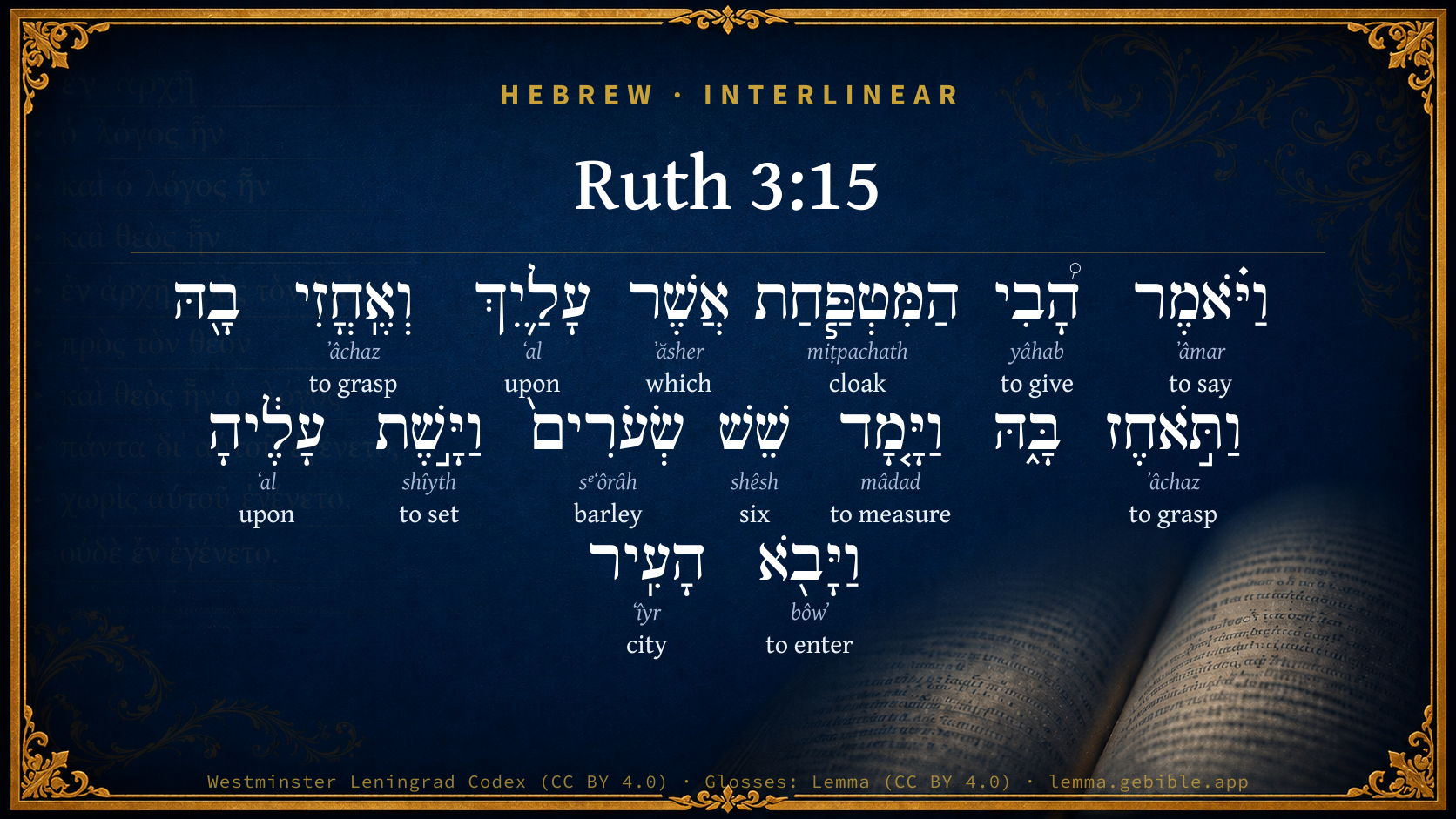
  1. וַיֹּ֗אמֶר ʼâmar H559 “and · to say” Conjunction + Verb, Qal, Sequential Imperfect, 3rd Person, Masculine, Singular
  2. הָ֠בִי yâhab H3051 “give” Verb, Qal, Imperative, 2nd Person, Feminine, Singular
  3. אֲשֶׁר ʼăsher H834 “which” Particle, Relative
  4. עָלַ֛יִךְ ʻal H5921 “upon · you” Preposition + Suffix, Personal, 2nd Person, Feminine, Singular
  5. וְאֶֽחֳזִי ʼâchaz H270 “and · grasp” Conjunction + Verb, Qal, Imperative, 2nd Person, Feminine, Singular
  6. וַתֹּ֣אחֶז ʼâchaz H270 “and · to grasp” Conjunction + Verb, Qal, Sequential Imperfect, 3rd Person, Feminine, Singular
  7. וַיָּ֤מָד mâdad H4058 “and · to measure” Conjunction + Verb, Qal, Sequential Imperfect, 3rd Person, Masculine, Singular
  8. שֵׁשׁ shêsh H8337 “six” Adjective, Cardinal number, Feminine, Singular, Absolute
  9. שְׂעֹרִים֙ sᵉʻôrâh H8184 “barley” Noun, Common, Feminine, Plural, Absolute
  10. וַיָּ֣שֶׁת shîyth H7896 “and · to set” Conjunction + Verb, Qal, Sequential Imperfect, 3rd Person, Masculine, Singular
  11. עָלֶ֔יהָ ʻal H5921 “upon · her” Preposition + Suffix, Personal, 3rd Person, Feminine, Singular
  12. וַיָּבֹ֖א bôwʼ H935 “and · to enter” Conjunction + Verb, Qal, Sequential Imperfect, 3rd Person, Masculine, Singular
  13. הָעִֽיר ʻîyr H5892 “the · city” Particle, Definite Article + Noun, Common, Feminine, Singular, Absolute

About this verse

These counts appear in no published source. They are computed here, from the morphology-tagged text and Lemma’s own curated glosses. What Lemma adds →

16
words
12
distinct lemmas
Historical
section

Notable vocabulary

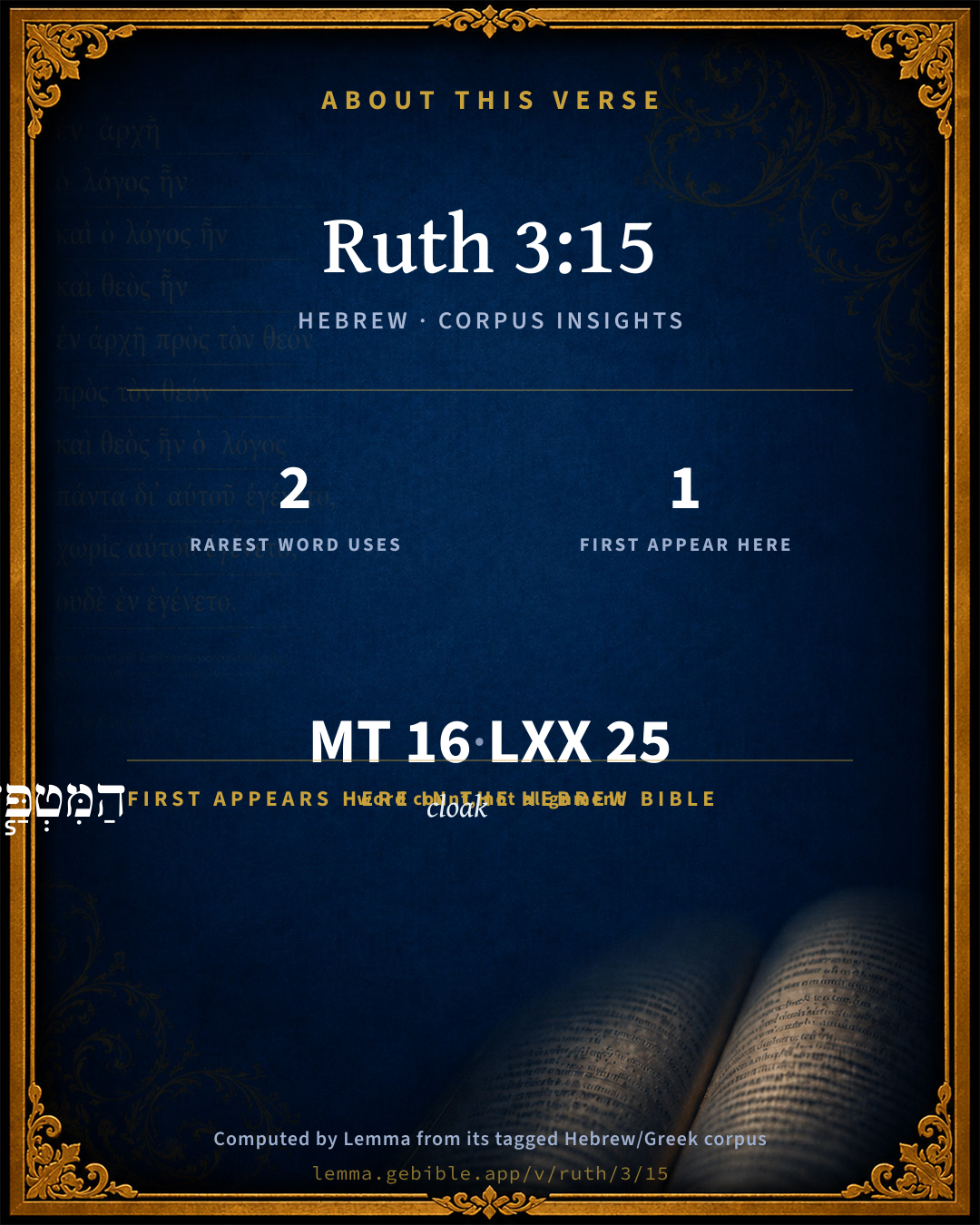
The rarest word here is הַמִּטְפַּ֧חַת cloak H4304 — appearing just 2 times in the whole Hebrew Bible.

First appearance in Scripture

This word makes its first canonical appearance in the Hebrew Bible here:

  • הַמִּטְפַּ֧חַת cloak H4304

Shared distinctive vocabulary

הַמִּטְפַּ֧חַת cloak H4304 occurs in 2 verses of the Hebrew Bible. Also found in:

Grammatical profile

  • 7 verbs
  • 3 nouns
  • 1 adjective
  • 4 prepositions
  • 1 particle

Verb forms

  • וַיֹּ֗אמֶר Qal · Sequential Imperfect
  • הָ֠בִי Qal · Imperative
  • וְאֶֽחֳזִי Qal · Imperative
  • וַתֹּ֣אחֶז Qal · Sequential Imperfect
  • וַיָּ֤מָד Qal · Sequential Imperfect
  • וַיָּ֣שֶׁת Qal · Sequential Imperfect
  • וַיָּבֹ֖א Qal · Sequential Imperfect

Repetition

Words recur within this verse — often emphatic in Hebrew:

  • עָלַ֛יִךְ upon H5921 ×2
  • וְאֶֽחֳזִי to grasp H270 ×2

Hebrew & Septuagint length

In English translation the verse runs 34 words from the Hebrew and 34 from the Septuagint (LXX English) — the same length.

A rough comparison of the two English renderings, which tokenize alike — not a word-level alignment.

Word counts can differ between the Hebrew and the Greek without any difference in meaning — e.g. the Hebrew direct-object marker אֵת has no separate Greek word, and Greek often adds the article ὁ.

In the original languages it is 16 Hebrew tokens and 25 Greek tokens — but the two are counted differently (Hebrew bundles its prefixes and suffixes into one token; the Greek is in lemma form), so that isn’t a like-for-like length.

Cross-references

2

Topical passages linked to Ruth 3:15 in the Treasury of Scripture Knowledge — connected by theme and wording, ordered by reader-vote popularity; previews shown in the World English Bible.

  • Isaiah 32:8 But the noble devises noble things; and in noble things shall he continue.
  • Galatians 6:10 So then, as we have opportunity, let's do what is good toward all men, and especially toward those who are of the household of the faith.

Cross-references courtesy of OpenBible.info (CC BY 4.0).

Hebrew and Greek witnesses Masoretic Hebrew ↔ Greek Septuagint

The same verse in the two great witnesses to the Old Testament, shown verse-for-verse.

These are two independent witnesses, not word-aligned to each other, and the Septuagint is shown in lemma (dictionary) form.

Hebrew Ruth 3:15 Masoretic · Westminster Leningrad Codex

וַיֹּ֗אמֶר הָ֠בִי הַמִּטְפַּ֧חַת אֲשֶׁר עָלַ֛יִךְ וְאֶֽחֳזִי בָ֖הּ וַתֹּ֣אחֶז בָּ֑הּ וַיָּ֤מָד שֵׁשׁ שְׂעֹרִים֙ וַיָּ֣שֶׁת עָלֶ֔יהָ וַיָּבֹ֖א הָעִֽיר

He said, Bring the mantle that is on you, and hold it; and she held it; and he measured six [measures] of barley, and laid it on her: and he went into the city.

World English Bible · Public Domain

Greek LXX Ruth 3:15 Septuagint · lemma form

καί εἶπον αὐτός φέρω ὁ περίζωμα ὁ ἐπάνω σύ καί κρατέω αὐτός καί μετρέω ἕξ κριθή καί ἐπιτίθημι ἐπί αὐτός καί εἰςἔρχομαι εἰς ὁ πόλις

And he said to her, Bring the apron that is upon you: and she held it, and he measured six measures of barley, and put them upon her, and she went into the city.

LXX2012 (modern English Septuagint) · Public Domain

On this verse, Ellicott's Commentary for English Readers discusses the Septuagint’s reading. Read the note in Commentary ↓

Hebrew: Westminster Leningrad Codex (CC BY 4.0). Greek: Septuagint (public domain); English from LXX2012 (modern English Septuagint) (Public Domain). How the Septuagint differs from the Hebrew →

Commentary

Notes on Ruth 3:15 from classic Christian and Jewish commentators (each source and its license shown beneath its notes). The classic Christian expositions comment on the surrounding passage and are grouped to its opening verse, so a note may address several verses; the Jewish commentaries on the Tanakh (Rashi and others) are per-verse, so they appear only where the commentator wrote on this verse.

Lemma curates 59 commentaries, every one of them public domain or Creative Commons licensed, each selected and text-cleaned for this edition rather than reprinted as found. About our sources →

Trapp's Complete Commentary

John Trapp

Rth 3:15 Also he said, Bring the vail that [thou hast] upon thee, and hold it. And when she held it, he measured six [measures] of barley, and laid [it] on her: and she went into the city.

Ver. 15. Also he said, Bring the vail that thou hast.] Pallium, peplum: some render it the mantle, others the apron, others the sheet. Our west country women wear mantles when they go abroad: the women of the Isle of Man sheets, as was before observed out of Speed.

He measured six measures of barley.] Six ephahs, saith Bibliander: six gallons, saith Bunting. The Hebrew is, Six barleys; as much as she could well carry. God also sendeth not away his suitors without their bosoms full of blessings, even as many as they can bring faith to bear away. And in that Boaz gave not Ruth this at random, but measured it out, one well observeth, that liberality is not lavish of God’s blessings, but giveth in judgment, and not without consideration: for every virtue either is or should be guided with prudence.

John Trapp, A Commentary or Exposition upon All the Books of the Old and New Testament (1647–1656) — public domain. Text from a community e-Sword module.

The Biblical Illustrator

Joseph S. Exell

Rth_3:15-17

Six measures of barley.

Exact reckonings of mercies

1. True virtue or grace makes persons universally good. Boaz was a gracious or virtuous man. He is good in his charity as well as in his chastity: he adds one grace to another (2Pe_1:5).

2. Gods blessings bestowed on us should be received by us in an exact reckoning: we should receive them by number, weight and measure; and to behold the quantity of them is an excellent way to get a thankful heart (Psa_116:12).

3. As charity is no churl, so neither must it be blind or extravagant. His liberality is not lavish in laying out Gods blessings, but he giveth in judgment with discretion, not without consideration. Prudence is the general guide and universal mistress in all acts and exercises of virtue (Psa_112:5).

4. As Boaz, so much more our God never sends home true suitors empty. He giveth, and He giveth liberally--He giveth grace, He giveth more grace (Jam_4:6). Every Sabbath, and sermon or sacrament, Christ cries to us, as Boaz to Ruth, Bring hither thy vail, that I may fill it. Faith is the receiving grace. God proportions His performing to our believing: as thou believest so be it unto thee (Mat_8:13). (C. Ness.)

The Biblical Illustrator, edited by Joseph S. Exell (c. 1880s–1900s) — public domain. Text from a community e-Sword module.

Tyndale Open Study Notes

Tyndale Open Resources

3:15 six scoops: There were two scoop sizes. The smaller measure (the omer) was 1/10 of an ephah (about 2 quarts); the larger measure (the seah) was 1/3 of an ephah (about 6 2/3 quarts). The latter quantity is more likely and indicates a very generous gift, twice the amount that Ruth gleaned on her first day (2:17); it was a significant token of good faith.

Tyndale Open Study Notes — © Tyndale Open Resources, licensed CC BY-SA 4.0. Text via the HelloAO Bible API.

Geneva Bible (1599)

Geneva Bible translators

Or, mantle.

Geneva Bible (1599) marginal notes — public domain. Text via Bolls.life.

Jamieson, Fausset & Brown

Robert Jamieson, A. R. Fausset & David Brown

Bring the veil that thou hast upon thee, and hold it--Eastern veils are large sheets--those of ladies being of red silk; but the poorer or common class of women wear them of blue, or blue and white striped linen or cotton. They are wrapped round the head, so as to conceal the whole face except one eye.

Jamieson, Fausset & Brown — Commentary Critical and Explanatory on the Whole Bible (1871) — public domain (CC PDM 1.0). Text via the HelloAO Bible API.

Adam Clarke's Commentary

Verse 15. Bring the veil] המט פחת hammit pachath; this seems to have been a cloak, plaid, or what the Arabs call hayk, which has been largely explained elsewhere. See Jdg 14:12.

Six measures of barley] We supply the word measures, for the Hebrew mentions no quantity. The Targum renders six seahs, שית סאין shith sein, which, as a seah was about two gallons and a half, must have been a very heavy load for a woman; and so the Targumist thought, for he adds, And she received strength from the Lord to carry it. If the omer be meant, which is about six pints, the load would not be so great, as this would amount to but about four gallons and a half; a very goodly present. The Targum says, that on receiving these six measures "it was said in the spirit of prophecy, that from her should proceed the six righteous persons of the world, viz., David, Daniel, Shadrach, Meshach, Abednego, and the King Messiah; each of whom should be blessed with six benedictions." It is, however, remarkable, that the Targum makes the Messiah to spring from her through the line of David, and goes down to Daniel and his companions; which Daniel prophesied so clearly, not only of the advent of Messiah the prince, but also of the very time in which he was to come, and the sacrificial death he was to die.

Adam Clarke's Commentary on the Bible (1810–1826) — public domain. Text from a community e-Sword/MySword module.

Ellicott's Commentary for English Readers

(15) Vail—Rather a mantle, so in Isa_3:22.

She went.—This should be, if we follow the current Hebrew text, he went. The verb is masculine (yabho), and the distinction is shewn in the Targum, which inserts the name Boaz as the nominative. It must be allowed that a fair number of Hebrew MSS., as well as the Peshito and Vulgate, take the verb in the feminine. The LXX. is from the nature of the Greek language unable to mark the distinction. The clause. if we accept the current reading, will mean that Boaz went to the city to find the kinsman whose claim lay before his own, while Ruth, laden with six measures of barley, goes to her mother-in-law.

A Bible Commentary for English Readers, edited by Charles John Ellicott (1878–1897) — public domain. Text from a community e-Sword module.

The Cambridge Bible for Schools and Colleges

gen. ed. J. J. S. Perowne

15. the mantle] Only again in Isa_3:22; apparently a large wrap worn over the ordinary clothes.

six measures of barley] The measure to be supplied is uncertain: six seahs=two ephahs (i.e. bushels), which the Targ. gives, or six ephahs, would be too heavy to carry; hence it is suggested that six omers are meant = 3/6 of an ephah, Exo_16:36. The gift is intended for Naomi, who would have to consent to the marriage, as standing in the relation of parent to Ruth. Mr S. A. Cook points out a parallel in a Babylonian tablet (KB. iv. P. 187, xi. lines 1–6), where the widowed mother is approached by the intending bridegroom; The Laws of Moses and the Code of H̬ammurabi, p. 75 n.

The Cambridge Bible for Schools and Colleges (gen. ed. J. J. S. Perowne; Cambridge University Press, 1878–1918) — public domain. Text from a community e-Sword module.

John Gill's Exposition

Also he said,.... Which seems to confirm the first sense, that what he had said before was to Ruth, beside which he also said to her what follows:

bring the vail which thou hast upon thee, and hold it; by which it appears that he rose also thus early, since he ordered her to bring her vail to him, and hold it with both her hands, while he filled it from the heap of corn: this vail was either what she wore on her head, as women used to do, or a coverlet she brought with her to cover herself with, when she lay down; the Septuagint renders it a "girdle", that is, an apron she tied or girt about her; which is as likely as anything: and when she held it, he measured six measures of barley; what these measures were is not expressed; the Targum is six seahs or bushels, as the Vulgate Latin version, but that is too much, and more than a woman could carry; unless we suppose, with the Targum, that she had strength from the Lord to carry it, and was extraordinarily assisted by him in it, which is not very probable; rather six omers, an omer being the tenth part of an ephah, and so was a quantity she might be able to carry:

and laid it upon her; upon her shoulder, or put it on her head, it being, no doubt, as much as she could well bear, and which required some assistance to help her up with it:

and she went into the city; of Bethlehem, with her burden; or rather he went (b); for the word is masculine, and to be understood of Boaz, who accompanied her to the city, lest she should meet with any that should abuse her; and so the Targum expresses it,"Boaz went into the city.''

(b) "et ingressus est", Tigurine version. Drusius, Junius & Tremellius, Piscator.

John Gill's Exposition of the Whole Bible (1746–1763) — public domain (CC PDM 1.0). Text via the HelloAO Bible API.

Albert Barnes' Notes on the Bible

The vail - Quite a different word from that rendered “vail,” in Gen 38:14. It seems rather to mean a kind of loose cloak, worn over the ordinary dress (see the margin).

Six measures - i. e. six seahs, in all two ephahs, twice as much as she gleaned Rth 3:17, and a heavy load to carry; for which reason he laid it on her, probably placed it on her head. It is well known that women can carry great weights when duly positioned on their heads.

And she went into the city - The Hebrew has “he went,” namely, Boaz, where, accordingly, we find him Rth 4:1.

Albert Barnes' Notes on the Bible (1834–1885) — public domain. Text from a community e-Sword/MySword module.

Haydock's Catholic Bible Commentary

Mantle. The Syrian and Arabian ladies cover themselves all over with a large white veil, or piece of cloth, which has no hole", so that Ruth might conveniently carry the barley in it. --- Measures is not in [the] Hebrew or Septuagint. Most people supply ephi. St. Jerome, who has translated six bushels, (allowing three to the ephi; chap. ii. 17,) has understood that Booz gave Ruth two ephi. If we explain it of six ephi, the burden would be great enough, consisting of 180 pints or pounds of barley. Bonfrere would supply six gomers, each of which consisted of only the tenth part of the ephi, or three pints, in all 18. But such a present seems too inconsiderable. We may therefore stick to St. Jerome, whose six measures (Calmet--- modios, bushels; Haydock.) make about 60 pints; (Calmet) or, according to others, 160 pounds, which, though heavy, a woman might carry. The Septuagint insinuate, that Ruth carried the barley in her apron. (Menochius) --- And. Hebrew, "he went." But the text is probably corrupted. (Calmet)

George Leo Haydock (1774–1849), Haydock's Catholic Family Bible and Commentary, 1859 edition — public domain. Excludes Psalms (Douay-Rheims chapter numbering differs from Protestant) and Deuterocanonical books (Catholic canon only).

Matthew Poole's English Annotations

The veil, or, the apron, such as women ordinarily wear.

Six measures; known and usual measure: it is not determined how large those measures were, but this the nature of the thing shows, that they were no larger than one woman could carry in her veil, or apron.

Matthew Poole's English Annotations on the Holy Bible (1683–1685) — public domain. Text from a community e-Sword/MySword module.

Whedon's Commentary on the Bible

Daniel D. Whedon

15. Bring the veil — The long loose wrapper in which the eastern women envelope themselves when out of doors. Among the poorer classes its material is strong and coarse enough not to be at all damaged by the use here made of it.

Six measures — How large the measures were we have no means of ascertaining, and conjecture is vain. The Chaldee paraphrase has the following: “He measured six seahs (nearly two bushels!) of barley, and placed it upon her, and she received strength from the Lord to carry it, and immediately it was said in prophecy that there should come of her the six righteous ones of the world, each one of whom should be blessed with six benedictions — David, and Daniel and his companions, and King Messiah.”

She went into the city — Rather, He went, etc., for the form of the verb is masculine, and the meaning is, that he gave her the barley and sent her away, and then he also went into the city.

Daniel D. Whedon (gen. ed.), Commentary on the Old and New Testaments (1874–1909) — public domain. Text from a community e-Sword module.

The Pulpit Commentary

And he said, Allow me the wrapper which is upon thee, and hold on by it; and she held on by it; and he measured six measures of barley; and he put it on her, and went to the city. The expression "Allow me," literally, "Give (me)," was a current phrase of courtesy. The verb employed bhy was common Semitic property, ere yet the mother-tongue was subdivided into Hebrew, Syriac, Chaldee, Arabic. The wrapper which is upon thee. The word for wrapper occurs nowhere else except in Isa_3:22, where it is translated, in King James"s version, "wimple." Here it is rendered "vail," and, in the margin, "sheet or apron, all of them unhappy translations. So is the rendering of the Targumist, ardWs, i.e. sudarium, or "napkin." N.G. Schroder discusses the word at great length in his masterly "Commentarius Philologico-Criticus de Vestitu Mulierum Hebraearum," pp. 247-277. He would render it pallium or palla In consequence of national peculiarities in articles of dress, especially in ancient times, it is best to avoid a specific, and to employ a generic translation. When Boaz said, "Give me the wrapper," he did not ask that it should be handed to him. He had already put his hand upon it, and was engaged in hollowing out a scoop or cavity. Hence he said, on the one hand, "Allow me," and, on the other, "Hold on by it." And he measured six measures of barley. The particular measure referred to is unspecified. It is not only mere dream on the part of the Targumist, but it is dream involving almost sheer impossibility, that the measures were seahs, i.e. two ephahs. The Targumist had to bolster up his dream by adding another, viz., that Ruth got miraculously strength to carry the load. Load, indeed, there undoubtedly was; and no doubt it would be as great as she could conveniently carry. And likewise, in accordance with the primitive simplicity of manners, the magnitude of the burden would be demonstration to Naomi of Boaz"s satisfaction with the measures" which, in full motherliness of spirit, she had planned. And he went to the city. The Vulgate and Syriac versions, as also Castellio, Coverdale, and various other translators, but not Luther, have assumed that we should read aObTw, "and she went," instead of aOBYw, "and he went." So too Wright. But there seems to be no good reason for making the change. If there had been no division into verses, then the departure of both Boaz and Ruth on their respective routes, or in their respective order of sequence, would have been recorded close together: "and "he" went to the city, and "she" went to her mother-in-law each, let us bear in mind, with the heart elate.

He wished that Naomi might have some tangible evidence of his satisfaction.

Vers. 15-17. Generosity.

Boaz was "a mighty man of wealth," and Naomi and Ruth were poor, widowed, friendless, and comparatively strangers. All through the narrative Boaz appears as thoughtful, liberal, unselfish, honorable, munificent. He is an example to those whom Providence has endowed with wealth.

I WEALTH IS GIVEN TO THE RICH not for their own sake only, but FOR THE SAKE OF OTHERS. Men are not the owners, but the stewards, of their possessions. How imperfectly this truth is recognized! The only way in which we can give to Christ is by giving to his people.

II GENEROSITY SHOULD BE PROPORTIONATE TO THE MEANS OF THE GIVER. Both his means absolutely and his means relatively, i.e. considering the claims upon him by virtue of his family, his position, &c. ;

III GENEROSITY SHOULD BE PROPORTIONATE TO THE NEEDS OF THE RECIPIENT. Those should have the preference who are old, crippled, and helpless; the widow and the orphan.

IV GENEROSITY SHOULD BE UNOSTENTATIOUS AND SYMPATHETIC in its spirit., Let not thy left hand know what thy right hand doeth." Hardness of manner may spoil beneficence. "Rich gifts wax poor when givers prove unkind. T.

The Pulpit Commentary (1880–1919), ed. H.D.M. Spence-Jones & Joseph S. Exell — public domain. Text from a community e-Sword module.

John Wesley's Explanatory Notes

Veil - Or, the apron.

John Wesley, Explanatory Notes Upon the Whole Bible (1754–1765) — public domain. Text via the GEBible commentary corpus.

Keil & Delitzsch

C. F. Keil & F. Delitzsch

He then said, "Bring the cloak that thou hast on, and lay hold of it" (to hold it open), and measured for her six measures of barley into it as a present, that she might not to back empty to her mother-in-law (Rut 3:17). מטפּחת, here and Isa 3:22, is a broad upper garment, pallium, possibly only a large shawl. "As the cloaks worn by the ancients were so full, that one part was thrown upon the shoulder, and another gathered up under the arm, Ruth, by holding a certain part, could receive into her bosom the corn which Boaz gave her" (Schrder, De vestit. mul. p. 264). Six (measures of) barley: the measure is not given. According to the Targum and the Rabbins, it was six seahs = two ephahs. This is certainly incorrect; for Ruth would not have been able to carry that quantity of barley home. When Boaz had given her the barley he measured out, and had sent here away, he also went into the city. This is the correct rendering, as given by the Chaldee, to the words העיר ויּבא; though Jerome referred the words to Ruth, but certainly without any reason, as יבא cannot stand for תּבא. This reading is no doubt found in some of the MSS, but it merely owes its origin to a mistaken interpretation of the words.

Keil & Delitzsch — Biblical Commentary on the Old Testament (1861–1891) — public domain (CC PDM 1.0). Text via the HelloAO Bible API. (Old Testament only.)

Rashi

Rabbi Shlomo Yitzchaki (Rashi)

six barleys It is impossible to say six seah, because it is not customary for a woman to carry such a load; it refers literally to six barleycorns, and he hinted to her that a son who would be blessed with six blessings was destined to emerge from her. [The blessings are:] (Isa. 11:2): “a spirit of wisdom and understanding, counsel and heroism, a spirit of knowledge and fear of the Lord,” [referring to the King Messiah].

Rashi on the Tanakh — English translations: “The Judaica Press complete Tanach with Rashi, translated by A. J. Rosenberg” (CC BY 4.0); “Pentateuch with Rashi's commentary by M. Rosenbaum and A.M. Silbermann, 1929-1934” (public domain); “The Metsudah Tanach series, Lakewood, N.J” (CC BY 4.0); and “The Book of Joshua, Metsudah Publications, 1997” (CC BY 4.0). Text via Sefaria.

Ibn Ezra

Rabbi Abraham ibn Ezra

"וימד שש שעורים (and he measured six measures of barley):" The text narrates what he gave her. And in the Midrash, it is interpreted that six righteous men will descend from her.

Ibn Ezra on the Tanakh — English translations: “Sefaria Community Translation” (CC0 1.0 (public-domain dedication)); “Yalkut, Sifsei Chachomim Chumash, Metsudah Publications, 2009” (CC BY 4.0); and “Commentary of Ibn Ezra on Isaiah - trans. by M. Friedlander, 1873” (public domain). Text via Sefaria.

Lesson kit

Teaching starters — assembled from the data on this page, not authored interpretation. Every prompt links to the verse data it draws on. Edit before teaching.

Ruth, in the Historical, opens this verse with 16 words (12 distinct Hebrew lemmas). Its most distinctive word is miṭpachath (“cloak”). A historical commentator’s framing appears above. Read the whole chapter for the surrounding context.

Discussion questions

  1. How does “cloak” (miṭpachath) shape what this verse is saying?
  2. The word “cloak” first appears here in Scripture. What is being introduced at this debut?
  3. Isaiah 3:22 shares the word «cloak» with this verse. How do the two illuminate each other?
  4. “upon” occurs 2× in this one verse. What is the effect of the repetition?
  5. These translations render this verse differently. What is at stake in choosing one wording over another?
  6. The verb «וַיֹּ֗אמֶר» is Qal Sequential Imperfect. How does its form color the action?
  7. Reading how Trapp's Complete Commentary and The Biblical Illustrator read this verse, where do the two commentators agree and where do they part?

Things to notice

Reading settings

Reading text

Shown beneath each verse's original-language words.

Old Testament
Old Testament edition

Read the OT as the Masoretic Hebrew (MT) or the Greek Septuagint (LXX).

English shown for the Greek Septuagint (in the Hebrew ↔ Greek comparison).

Comparing translations? Open the Compare panel on any verse page to stack up to four side by side.