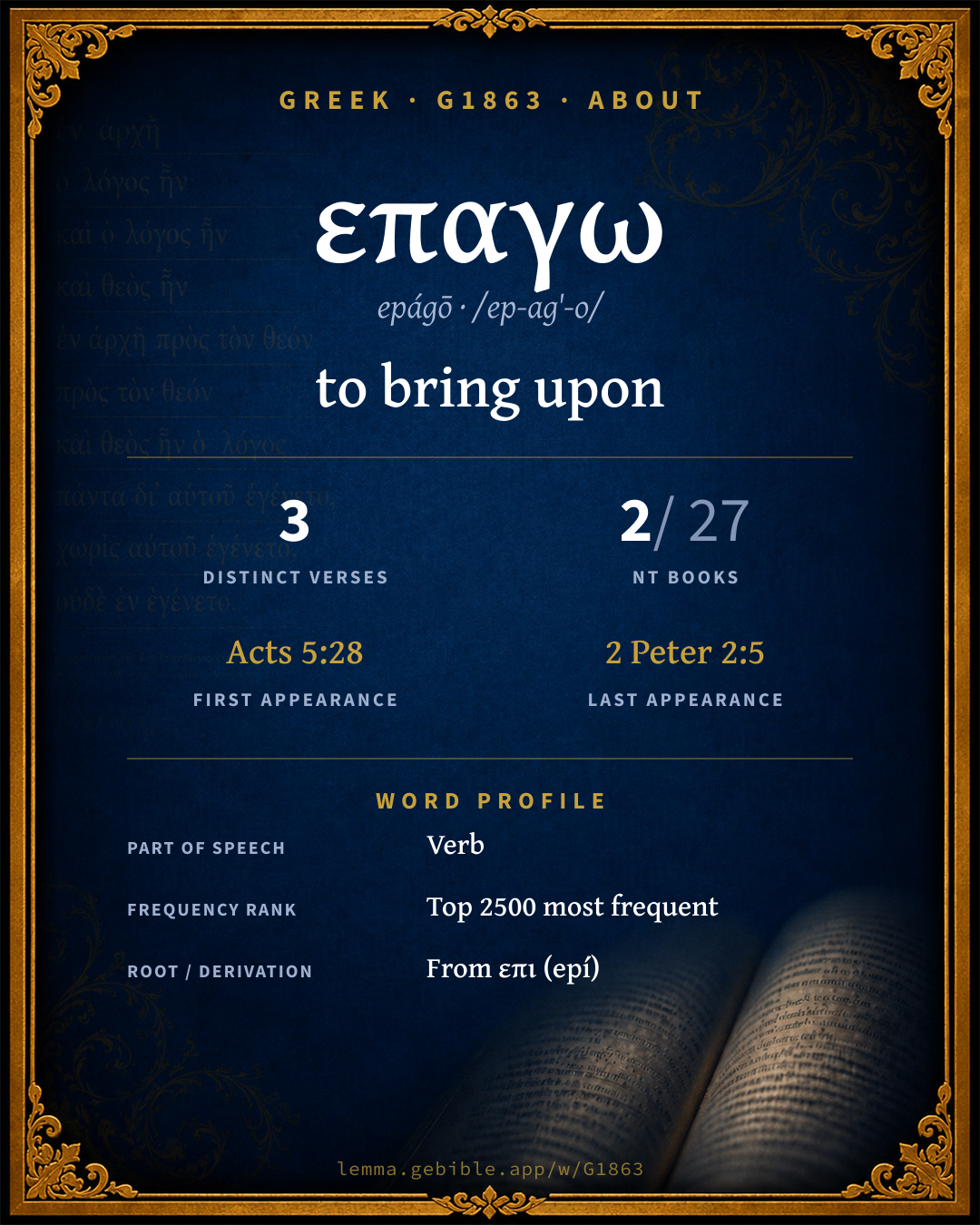
ἐπάγω
to bring upon
‘to bring upon’ is one of 2 main senses fuller range ↓
Full lexicon entry — Thayer's Greek Lexicon
From Thayer's Greek Lexicon
Where this word appears
See every Aorist-tense verb in the Greek New Testament →
Grammar key — what these labels mean
Part of speech
- Verb
- An action or state-of-being word.
Tense
- Aorist
- Action viewed as a simple whole, without regard to duration — often past (perfective aspect).
- Present
- Ongoing or general action in present time (imperfective aspect).
Voice
- Active
- The subject performs the action.
Mood
- Infinitive
- A verbal noun (“to write”), unmarked for person or number.
- Participle
- A verbal adjective (“writing,” “having written”).
Case
- Nominative
- The case of the subject (and the predicate nominative).
Gender
- Masculine
- Grammatically masculine.
Number
- Singular
- One.
- Plural
- More than one.
Grammatical forms
- Verb, Aorist, Active, Infinitive 1 time (33%)
- Verb, Aorist, Active, Participle, Nominative, Singular, Masculine 1 time (33%)
- Verb, Present, Active, Participle, Nominative, Plural, Masculine 1 time (33%)
Parsed forms decoded from the imported morphology (Robinson–Tischendorf, public domain), counted across 3 parsed occurrences — not distinct verses.
Every verse where G1863 appears — 3 distinct verses across 2 books. Click any verse to open its interlinear word-by-word view. Verse text shown in the World English Bible for context — . Each verse’s Greek form is shown with its reference; the English is not keyword-highlighted, since the data carries no word-level English alignment. Use “Compare translations” on any verse to read it across multiple English versions. This concordance covers the Greek New Testament; Septuagint (Greek Old Testament) occurrences of this word are not indexed here.
Acts 1 verse
2 Peter 2 verses
- 2 Peter 2:1 ἐπάγοντες pres act ptcp nom pl masc But there also arose false prophets among the people, as among you also there will be false teachers, who will secretly bring in destructive heresies, denying even the Master who bought them, bringing on themselves swift destruction.
- 2 Peter 2:5 ἐπάξας aor act ptcp nom sg masc and didn't spare the ancient world, but preserved Noah with seven others, a preacher of righteousness, when he brought a flood on the world of the ungodly;
About this entry
At a glance — auto-summarized from this page’s data, not written by a person. Every figure links to its source below. This summary describes the numbers; it doesn’t interpret them.
επαγω — transliterated epágō — is a Greek verb carrying the sense “to bring upon.” A scarce word — 3 verses in all of the Greek New Testament. Its uses cluster heavily in 2 Peter (67% of all occurrences). Debuting at Acts 5:28, it then recurs through the corpus. Thayer's distinguishes 2 senses for it. See the sense tree, 3-verse concordance, and the renderings breakdown below.
Gloss history
Strong's 1890 vs modern scholarship
About this word
Strong's G1863 catalogs a Greek word from the Greek New Testament.
These counts are not copied from any lexicon or concordance. They are computed here, from the morphology-tagged Greek New Testament. What Lemma adds →
- 3
- distinct verses
- The word appears in 3 distinct verses.
- 2 / 27
- NT books
- The word appears in 2 of 27 New Testament books.
- #2,203
- by frequency
- Top 2500 most frequent Greek words (rank 2,203 of 5,347 Greek words by occurrence).
View all 3 occurrences in the concordance →
By traditional corpus
Conventional, traditional groupings — biblical authorship is debated, so this is a traditional corpus grouping, not an authorship claim. Some books belong to more than one corpus (Luke is in both the Gospels and the Lukan corpus, and so on), so these shares overlap and need not total 100%. Each figure is a share of the word’s 3 distinct verses.
- General (Catholic) Epistles 2 verses · 67%
- Lukan (Luke–Acts) 1 verse · 33%
How translations render this word
Counts come from each version’s own published word-to-Strong’s tagging or interlinear alignment — an approximate guide to how each version renders this word, not a word-level alignment the data otherwise carries. Because each total is that version’s own tagged count, the per-version totals vary from one another and need not match the appearance or distinct-verse counts above. These counts may also differ from a printed concordance because Lemma counts each distinctly tagged rendering and does not collapse phrase taggings into a single head-word total. This is a fixed set of word-tagged versions (KJV, ASV, BSB, ULT) and does not change with the reading translation you choose elsewhere. Each version’s license is shown beside its name below (and on Sources).
- King James Version: Bring 2×
- American Standard Version: Bring 1×, Bringing upon 1×, He brought 1×
- Berean Standard Bible: Bringing 1×, He brought 1×, Make us responsible for 1×
- unfoldingWord Literal Text: Bring 1×, Bringing 1×, Having brought 1×
King James Version Public Domain
Renders G1863 across 3 tagged occurrences — most commonly:
Plus 1 rendering that appears only once — usually multi-word phrases or single function words the recovered tagging swept in, not distinct renderings.
American Standard Version Public Domain
Renders G1863 across 3 tagged occurrences — most commonly:
Berean Standard Bible Public Domain
Renders G1863 across 3 tagged occurrences — most commonly:
unfoldingWord Literal Text CC BY-SA 4.0
Renders G1863 across 4 tagged occurrences — most commonly:
Senses in Thayer's
The 2 senses Thayer's distinguishes for this word, in lexicon order (not ranked by frequency or importance). The full entry — with sub-senses — is in the Lexicon Entry tab.
- to lead or bring upon
- to cause something to befall one, usually something evil
Word origin
Derived from επι (epí) (G1909) — upon.
Forms in the corpus
The 3 distinct written forms G1863 takes in the Greek New Testament, most frequent first — each parse links to that tense’s occurrences in the concordance.
| Form | Parsing | Example | Uses |
|---|---|---|---|
| ἐπάγοντες epágontes | Verb, Present, Active, Participle, Nominative, Plural, Masculine | 2 Peter 2:1 | 1 |
| ἐπάξας epáxas | Verb, Aorist, Active, Participle, Nominative, Singular, Masculine | 2 Peter 2:5 | 1 |
| ἐπαγαγεῖν epagageîn | Verb, Aorist, Active, Infinitive | Acts 5:28 | 1 |
Same root — word family
Other Thayer's entries built from the same root as G1863, grouped by Strong’s listed origin. These share a root / origin per the lexicon — not necessarily a shared meaning. Each links to that word’s own entry.
Derives from
Shares the same root
- επαγγελλω epangéllō G1861 to announce
- επαγωνιζομαι epagōnízomai G1864 to contend
- επαθροιζω epathroízō G1865 to gather together
- επαινεω epainéō G1867 to approve
- επαινος épainos G1868 approval
- επαιρω epaírō G1869 to lift up
- επαισχυνομαι epaischýnomai G1870 to be ashamed
- επαιτεω epaitéō G1871 to ask repeatedly
- επακουω epakoúō G1873 to give ear to
- επακροαομαι epakroáomai G1874 to listen to
- επαν epán G1875 after
- επαναγκες epánankes G1876 necessarily
- επαναγω epanágō G1877 to lead back
- επαναμιμνησκω epanamimnḗskō G1878 to remind
- επαναπαυομαι epanapaúomai G1879 to rest upon
- επανερχομαι epanérchomai G1880 to return
- επανισταμαι epanístamai G1881 to raise up against
- επανορθωσις epanórthōsis G1882 correction
- επανω epánō G1883 above
- επαρκεω eparkéō G1884 to avail
- επαρχια eparchía G1885 office of governor
- επαυλις épaulis G1886 farm
- επαυριον epaúrion G1887 the next day
- επαυτοφωρω epautophṓrōi G1888 caught in the act
+110 more words share this root (not shown).
Proper names from this root
People and places named from this root — a name, not an additional meaning of the word.
Compare all same-root words → Showing 4 of 137 — not the complete family. 1 of the same-root words is a proper name (a person or place). They share a root, not necessarily a meaning.
Septuagint usage
The same Greek word επαγω appears 118 times in the Greek Old Testament (Septuagint), across 114 verses in 26 books.
- 118
- LXX occurrences
- Tagged occurrences of this Greek word in the Septuagint.
- 114
- verses
- Distinct Septuagint verses containing this word.
- 26 / 39
- OT books
- The word appears in 26 of the 39 Old Testament books.
Sample Septuagint occurrences
- Genesis 6:17 ἐπιἄγω
- Exodus 10:4 ἐπιἄγω
- Leviticus 22:16 ἐπιἄγω
- Deuteronomy 23:14 ἐπιἄγω
- Joshua 23:15 ἐπιἄγω
- Judges 4:7 ἐπιἄγω
- 1 Samuel 5:6 ἐπιἄγω
- 2 Samuel 17:14 ἐπιἄγω
- 1 Kings 8:46 ἐπιἄγω
- 2 Kings 22:16 ἐπιἄγω
- 1 Chronicles 4:10 ἐπιἄγω
- 2 Chronicles 7:22 ἐπιἄγω
Septuagint occurrences (same lexeme)
Every verse where the same Strong’s number (G1863) appears in the Greek Septuagint — showing the first 50 of 114. Verse text shown in the World English Bible for context; the Greek form is the matched word — the English is not keyword-highlighted.
- Genesis 6:17 ἐπιἄγω I, even, I do bring the flood of waters on this earth, to destroy all flesh having the breath of life from under the sky. Everything that is in the earth will die.
- Genesis 7:4 ἐπιἄγω In seven days, I will cause it to rain on the earth for forty days and forty nights. Every living thing that I have made, I will destroy from the surface of the ground."
- Genesis 8:1 ἐπιἄγω God remembered Noah, all the animals, and all the cattle that were with him in the ark; and God made a wind to pass over the earth. The waters subsided.
- Genesis 18:19 ἐπιἄγω For I have known him, to the end that he may command his children and his household after him, that they may keep the way of Yahweh, to do righteousness and justice; to the end that Yahweh may bring on Abraham that which he has spoken of him."
- Genesis 20:9 ἐπιἄγω Then Abimelech called Abraham, and said to him, "What have you done to us? How have I sinned against you, that you have brought on me and on my kingdom a great sin? You have done deeds to me that ought not to be done!"
- Genesis 26:10 ἐπιἄγω Abimelech said, "What is this you have done to us? One of the people might easily have lain with your wife, and you would have brought guilt on us!"
- Genesis 27:12 ἐπιἄγω What if my father touches me? I will seem to him as a deceiver, and I would bring a curse on myself, and not a blessing."
- Exodus 10:4 ἐπιἄγω Or else, if you refuse to let my people go, behold, tomorrow I will bring locusts into your country,
- Exodus 10:13 ἐπιἄγω Moses stretched forth his rod over the land of Egypt, and Yahweh brought an east wind on the land all that day, and all the night; and when it was morning, the east wind brought the locusts.
- Exodus 11:1 ἐπιἄγω Yahweh said to Moses, "Yet one plague more will I bring on Pharaoh, and on Egypt; afterwards he will let you go. When he lets you go, he will surely thrust you out altogether.
- Exodus 15:19 ἐπιἄγω For the horses of Pharaoh went in with his chariots and with his horsemen into the sea, and Yahweh brought back the waters of the sea on them; but the children of Israel walked on dry land in the midst of the sea.
- Exodus 15:26 ἐπιἄγω and he said, "If you will diligently listen to the voice of Yahweh your God, and will do that which is right in his eyes, and will pay attention to his commandments, and keep all his statutes, I will put none of the diseases on you, which I have put on the Egyptians; for I am Yahweh who heals you."
- Exodus 28:43 ἐπιἄγω They shall be on Aaron, and on his sons, when they go in to the tent of meeting, or when they come near to the altar to minister in the holy place; that they don't bear iniquity, and die: it shall be a statute forever to him and to his descendants after him.
- Exodus 32:21 ἐπιἄγω Moses said to Aaron, "What did these people do to you, that you have brought a great sin on them?"
- Exodus 32:34 ἐπιἄγω Now go, lead the people to the place of which I have spoken to you. Behold, my angel shall go before you. Nevertheless in the day when I punish, I will punish them for their sin."
- Exodus 33:5 ἐπιἄγω Yahweh said to Moses, "Tell the children of Israel, 'You are a stiff-necked people. If I were to go up into your midst for one moment, I would consume you. Therefore now take off your jewelry from you, that I may know what to do to you."
- Exodus 34:7 ἐπιἄγω keeping loving kindness for thousands, forgiving iniquity and disobedience and sin; and that will by no means clear the guilty, visiting the iniquity of the fathers on the children, and on the children's children, on the third and on the fourth generation."
- Leviticus 22:16 ἐπιἄγω and so cause them to bear the iniquity that brings guilt, when they eat their holy things: for I am Yahweh who sanctifies them.'"
- Leviticus 26:25 ἐπιἄγω I will bring a sword upon you, that will execute the vengeance of the covenant; and you will be gathered together within your cities: and I will send the pestilence among you; and you will be delivered into the hand of the enemy.
- Leviticus 26:36 ἐπιἄγω "'As for those of you who are left, I will send a faintness into their hearts in the lands of their enemies: and the sound of a driven leaf will put them to flight; and they shall flee, as one flees from the sword; and they will fall when no one pursues.
- Deuteronomy 23:14 ἐπιἄγω for Yahweh your God walks in the midst of your camp, to deliver you, and to give up your enemies before you; therefore shall your camp be holy, that he may not see an unclean thing in you, and turn away from you.
- Deuteronomy 28:49 ἐπιἄγω Yahweh will bring a nation against you from far, from the end of the earth, as the eagle flies; a nation whose language you shall not understand;
- Deuteronomy 28:61 ἐπιἄγω Also every sickness, and every plague, which is not written in the book of this law, them will Yahweh bring on you, until you are destroyed.
- Deuteronomy 29:26 ἐπιἄγω and went and served other gods, and worshiped them, gods that they didn't know, and that he had not given to them:
- Joshua 23:15 ἐπιἄγω It shall happen, that as all the good things are come on you of which Yahweh your God spoke to you, so will Yahweh bring on you all the evil things, until he have destroyed you from off this good land which Yahweh your God has given you.
- Joshua 24:7 ἐπιἄγω When they cried out to Yahweh, he put darkness between you and the Egyptians, and brought the sea on them, and covered them; and your eyes saw what I did in Egypt: and you lived in the wilderness many days.
- Judges 4:7 ἐπιἄγω I will draw to you, to the river Kishon, Sisera, the captain of Jabin's army, with his chariots and his multitude; and I will deliver him into your hand.
- Judges 9:24 ἐπιἄγω that the violence done to the seventy sons of Jerubbaal might come, and that their blood might be laid on Abimelech their brother, who killed them, and on the men of Shechem, who strengthened his hands to kill his brothers.
- 1 Samuel 5:6 ἐπιἄγω But the hand of Yahweh was heavy on them of Ashdod, and he destroyed them, and struck them with tumors, even Ashdod and the borders of it.
- 1 Samuel 15:23 ἐπιἄγω For rebellion is as the sin of witchcraft, and stubbornness is as idolatry and teraphim. Because you have rejected the word of Yahweh, he has also rejected you from being king.
- 2 Samuel 17:14 ἐπιἄγω Absalom and all the men of Israel said, The counsel of Hushai the Archite is better than the counsel of Ahithophel. For Yahweh had ordained to defeat the good counsel of Ahithophel, to the intent that Yahweh might bring evil on Absalom.
- 1 Kings 8:46 ἐπιἄγω If they sin against you (for there is no man who doesn't sin), and you are angry with them, and deliver them to the enemy, so that they carry them away captive to the land of the enemy, far off or near;
- 1 Kings 9:9 ἐπιἄγω and they shall answer, Because they forsook Yahweh their God, who brought forth their fathers out of the land of Egypt, and laid hold on other gods, and worshiped them, and served them: therefore has Yahweh brought all this evil on them.
- 1 Kings 20:21 ἐπιἄγω The king of Israel went out, and struck the horses and chariots, and killed the Syrians with a great slaughter.
- 1 Kings 20:29 ἐπιἄγω They encamped one over against the other seven days. So it was, that in the seventh day the battle was joined; and the children of Israel killed of the Syrians one hundred thousand footmen in one day.
- 2 Kings 22:16 ἐπιἄγω Thus says Yahweh, Behold, I will bring evil on this place, and on the inhabitants of it, even all the words of the book which the king of Judah has read.
- 2 Kings 22:20 ἐπιἄγω Therefore, behold, I will gather you to your fathers, and you shall be gathered to your grave in peace, neither shall your eyes see all the evil which I will bring on this place. They brought the king word again.
- 1 Chronicles 4:10 ἐπιἄγω Jabez called on the God of Israel, saying, Oh that you would bless me indeed, and enlarge my border, and that your hand might be with me, and that you would keep me from evil, that it not be to my sorrow! God granted him that which he requested.
- 2 Chronicles 7:22 ἐπιἄγω They shall answer, Because they forsook Yahweh, the God of their fathers, who brought them forth out of the land of Egypt, and laid hold on other gods, and worshiped them, and served them: therefore has he brought all this evil on them.
- 2 Chronicles 34:24 ἐπιἄγω Thus says Yahweh, Behold, I will bring evil on this place, and on the inhabitants of it, even all the curses that are written in the book which they have read before the king of Judah.
- 2 Chronicles 34:28 ἐπιἄγω Behold, I will gather you to your fathers, and you shall be gathered to your grave in peace, neither shall your eyes see all the evil that I will bring on this place, and on the inhabitants of it. They brought back word to the king.
- Esther 9:25 ἐπιἄγω but when [the matter] came before the king, he commanded by letters that his wicked device, which he had devised against the Jews, should return on his own head, and that he and his sons should be hanged on the gallows.
- Job 10:17 ἐπιἄγω You renew your witnesses against me, And increase your indignation on me. Changes and warfare are with me.
- Job 22:17 ἐπιἄγω Who said to God, 'Depart from us;' And, 'What can the Almighty do for us?'
- Job 34:28 ἐπιἄγω So that they caused the cry of the poor to come to him, He heard the cry of the afflicted.
- Job 38:5 ἐπιἄγω Who determined the measures of it, if you know? Or who stretched the line on it?
- Job 42:11 ἐπιἄγω Then came there to him all his brothers, and all his sisters, and all those who had been of his acquaintance before, and ate bread with him in his house. They comforted him, and consoled him concerning all the evil that Yahweh had brought on him. Everyone also gave him a piece of money, and everyone a ring of gold.
- Psalms 7:12 ἐπιἄγω If a man doesn't relent, he will sharpen his sword; He has bent and strung his bow.
- Psalms 77:26 ἐπιἄγω
- Psalms 87:8 ἐπιἄγω
These are occurrences of the same Greek lexeme (G1863) in the Septuagint — not a translation of any one Hebrew word. The store carries no word-level Hebrew↔Greek alignment, so no Hebrew original is asserted here. Counts come from the recovered LXX Strong's tagging — high-frequency vocabulary is well covered, while rare or late forms may be untagged — so they reflect tagged occurrences and may slightly undercount.