Exodus 29:19

Hebrew (Westminster Leningrad Codex) Exodus 29:19 appears in the Hebrew Old Testament. The text above is from the Westminster Leningrad Codex. Each word links to its Strong’s number, a concise gloss, and parsing drawn from the Open Scriptures Hebrew Bible morphology. Click any word for its full Brown-Driver-Briggs (BDB) entry.
Download image
Cite this verse

Exodus 29:19 (World English Bible). Public Domain. Lemma interlinear Bible study tool, https://lemma.gebible.app/v/exodus/29/19.

Show BibTeX & RIS
BibTeX
RIS
English Translation
"You shall take the other ram; and Aaron and his sons shall lay their hands on the head of the ram.
World English Bible · Public Domain
Download a study sheet

One document with this verse’s original text, its word-by-word gloss line, the meaning frame, cross-references with their text, attributed commentary, and full source and license credits — printable, and it pastes into notes with its structure intact.

This verse Autodidact and up

Study sheet (.html) Plain text (.txt)

A passage Seminary Student

Up to 50 verses in one chapter. A passage sheet keeps up to 6 commentary sources and 12 cross-references per verse, in the order this page ranks them, and says so on the sheet whenever that leaves anything out. Ask for a single verse and you get the Autodidact verse sheet above.

Everything on this page stays free to read, with no account — the sheet is a download of what is already on screen, not access to it.

Want to remove ads? Support Godless Engineer
Compare translations 3

The same verse in 3 English versions, stacked beneath the original-language interlinear above. Click any original word for its lexicon entry.

Each is an independent rendering of the whole verse — the interlinear is not word-aligned to these translations.

Highlighted words mark where these versions differ — a whole-verse word diff, not a word-by-word alignment.

  • World English Bible Public Domain
    "You shall take the other ram; and Aaron and his sons shall lay their hands on the head of the ram.
  • King James Version Public Domain
    And thou shalt take the other ram; and Aaron and his sons shall put their hands upon the head of the ram.
  • unfoldingWord Literal Text CC BY-SA 4.0
    And you shall take the second ram, and Aaron and his sons shall lay their hands on the head of the ram,

unfoldingWord Literal Text — © unfoldingWord, licensed CC BY-SA 4.0. Word-aligned USFM3 via Door43 (git.door43.org/unfoldingWord/en_ult).

Versions to compare (up to 4)

3 of 4 selected

Show all 18 translations

Every available English version of this verse, each an independent rendering of the whole verse.

  • World English Bible Public Domain
    "You shall take the other ram; and Aaron and his sons shall lay their hands on the head of the ram.
  • Berean Standard Bible Public Domain
    Take the second ram, and Aaron and his sons are to lay their hands on its head.
  • Majority Standard Bible Public Domain
    Take the second ram, and Aaron and his sons are to lay their hands on its head.
  • King James Version Public Domain
    And thou shalt take the other ram; and Aaron and his sons shall put their hands upon the head of the ram.
  • American Standard Version (1901) Public Domain
    And thou shalt take the other ram; and Aaron and his sons shall lay their hands upon the head of the ram.
  • Revised Version (1885) Public Domain
    And thou shalt take the other ram; and Aaron and his sons shall lay their hands upon the head of the ram.
  • Geneva Bible (1599) Public Domain
    And thou shalt take the other ramme, and Aaron and his sonnes shall put their handes vpon the head of the ramme.
  • Douay-Rheims (1899) Public Domain
    Thou shalt take also the other ram, upon whose head Aaron and his sons shall lay their hands.
  • Young's Literal Translation Public Domain
    `And thou hast taken the second ram, and Aaron hath laid -- his sons also -- their hands on the head of the ram,
  • Literal Standard Version CC BY-SA 4.0
    And you have taken the second ram, and Aaron has laid—his sons also—their hands on the head of the ram,
  • Unlocked Literal Bible CC BY-SA 4.0
    You must then take the other ram, and Aaron and his sons must lay their hands on its head.
  • unfoldingWord Literal Text CC BY-SA 4.0
    And you shall take the second ram, and Aaron and his sons shall lay their hands on the head of the ram,
  • Darby Bible Public Domain
    And thou shalt take the second ram, and Aaron and his sons shall lay their hands upon the head of the ram;
  • World Messianic Bible Public Domain
    “You shall take the other ram, and Aaron and his sons shall lay their hands on the head of the ram.
  • Webster's Bible Public Domain
    And thou shalt take the other ram; and Aaron and his sons shall put their hands upon the head of the ram.
  • Free Bible Version CC BY-SA 4.0
    Then have Aaron and his sons place their hands on the head of the other ram.
  • Bible in Basic English Public Domain
    Then take the other sheep; and after Aaron and his sons have put their hands on its head,
  • JPS Tanakh (1917) Public Domain
    And thou shalt take the other ram; and Aaron and his sons shall lay their hands upon the head of the ram.

Literal Standard Version (2020), Covenant Press — licensed CC BY-SA 4.0. Text via the HelloAO Bible API (eBible.org). Unlocked Literal Bible (unfoldingWord) — licensed CC BY-SA 4.0. Text via the HelloAO Bible API (eBible.org). unfoldingWord Literal Text — © unfoldingWord, licensed CC BY-SA 4.0. Word-aligned USFM3 via Door43 (git.door43.org/unfoldingWord/en_ult). Free Bible Version, Dr. Jonathan Gallagher — licensed CC BY-SA 4.0. Text via the HelloAO Bible API (eBible.org).

Word by word

More ways to search: Search by grammar → Find every occurrence → Compare this word →

Practice this passage: Drill this verse → Learn its vocabulary →

וְסָמַ֨ךְ
çâmak
H5564
“and · to lean”
Conjunction + Verb, Qal, Sequential Perfect, 3rd Person, Masculine, Singular
Part of Speech
Conjunction + Verb
Stem
Qal
Form
Sequential Perfect
Person
3rd Person
Gender
Masculine
Number
Singular
Full BDB Definition

Origin: a primitive root

TWOT: 1514

to lean, lay, rest, support, put, uphold, lean upon - (Qal) - to lean or lay upon, rest upon, lean against - to support, uphold, sustain - (Niphal) to support or brace oneself - (Piel) to sustain, refresh, revive
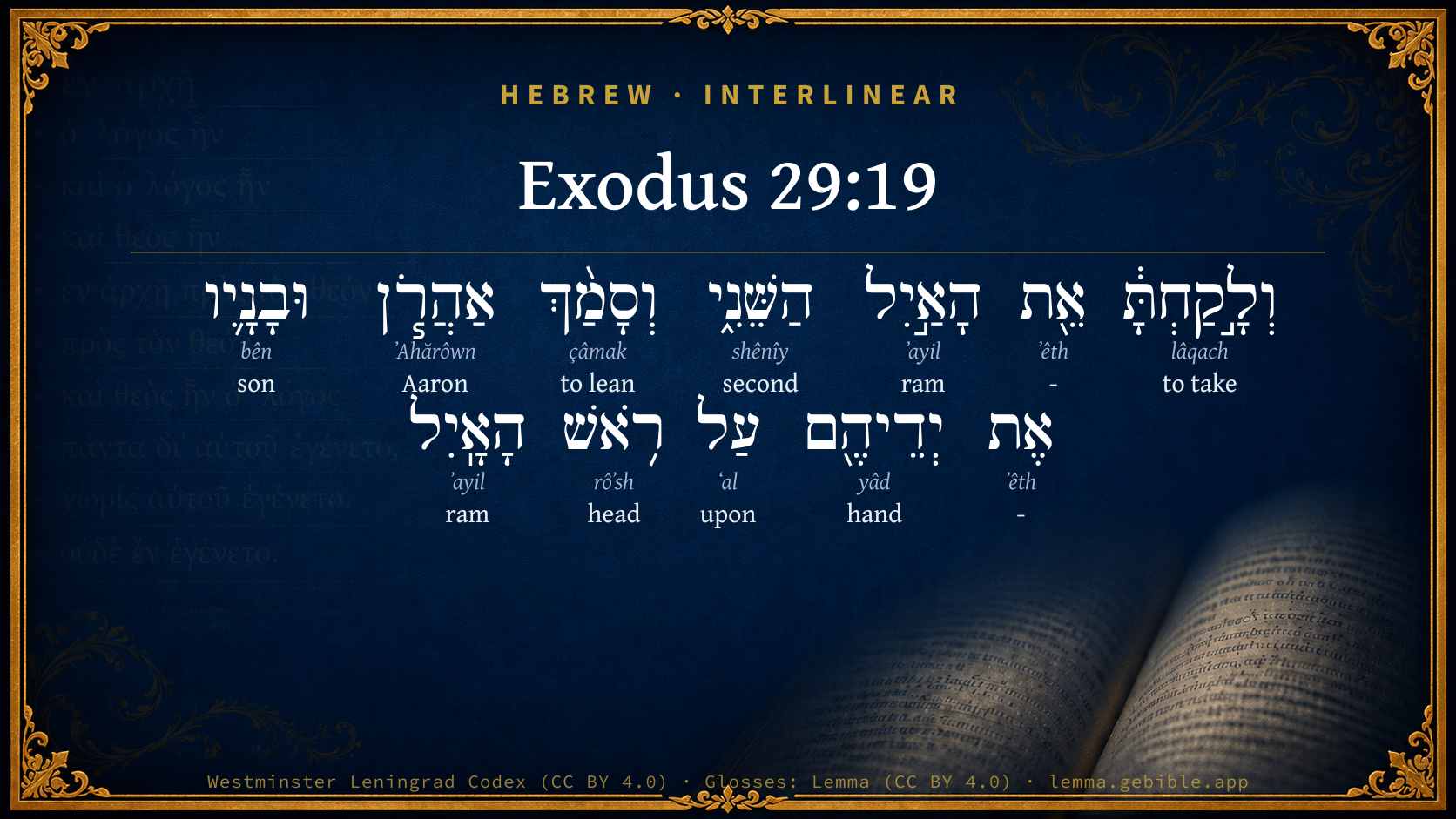
  1. וְלָ֣קַחְתָּ֔ lâqach H3947 “and · to take” Conjunction + Verb, Qal, Sequential Perfect, 2nd Person, Masculine, Singular
  2. אֵ֖ת ʼêth H853 “-” Particle, Direct Object
  3. הָאַ֣יִל ʼayil H352 “the · ram” Particle, Definite Article + Noun, Common, Masculine, Singular, Absolute
  4. הַשֵּׁנִ֑י shênîy H8145 “the · second” Particle, Definite Article + Adjective, Ordinal number, Masculine, Singular, Absolute
  5. אַהֲרֹ֧ן ʼAhărôwn H175 “Aaron” Noun, Proper
  6. וּבָנָ֛יו bên H1121 “and · sons · his” Conjunction + Noun, Common, Masculine, Plural, Construct + Suffix, Personal, 3rd Person, Masculine, Singular
  7. אֶת ʼêth H853 “-” Particle, Direct Object
  8. יְדֵיהֶ֖ם yâd H3027 “hands · their” Noun, Common, Both, Dual, Construct + Suffix, Personal, 3rd Person, Masculine, Plural
  9. עַל ʻal H5921 “upon” Preposition
  10. רֹ֥אשׁ rôʼsh H7218 “head of” Noun, Common, Masculine, Singular, Construct
  11. הָאָֽיִל ʼayil H352 “the · ram” Particle, Definite Article + Noun, Common, Masculine, Singular, Absolute

About this verse

These counts appear in no published source. They are computed here, from the morphology-tagged text and Lemma’s own curated glosses. What Lemma adds →

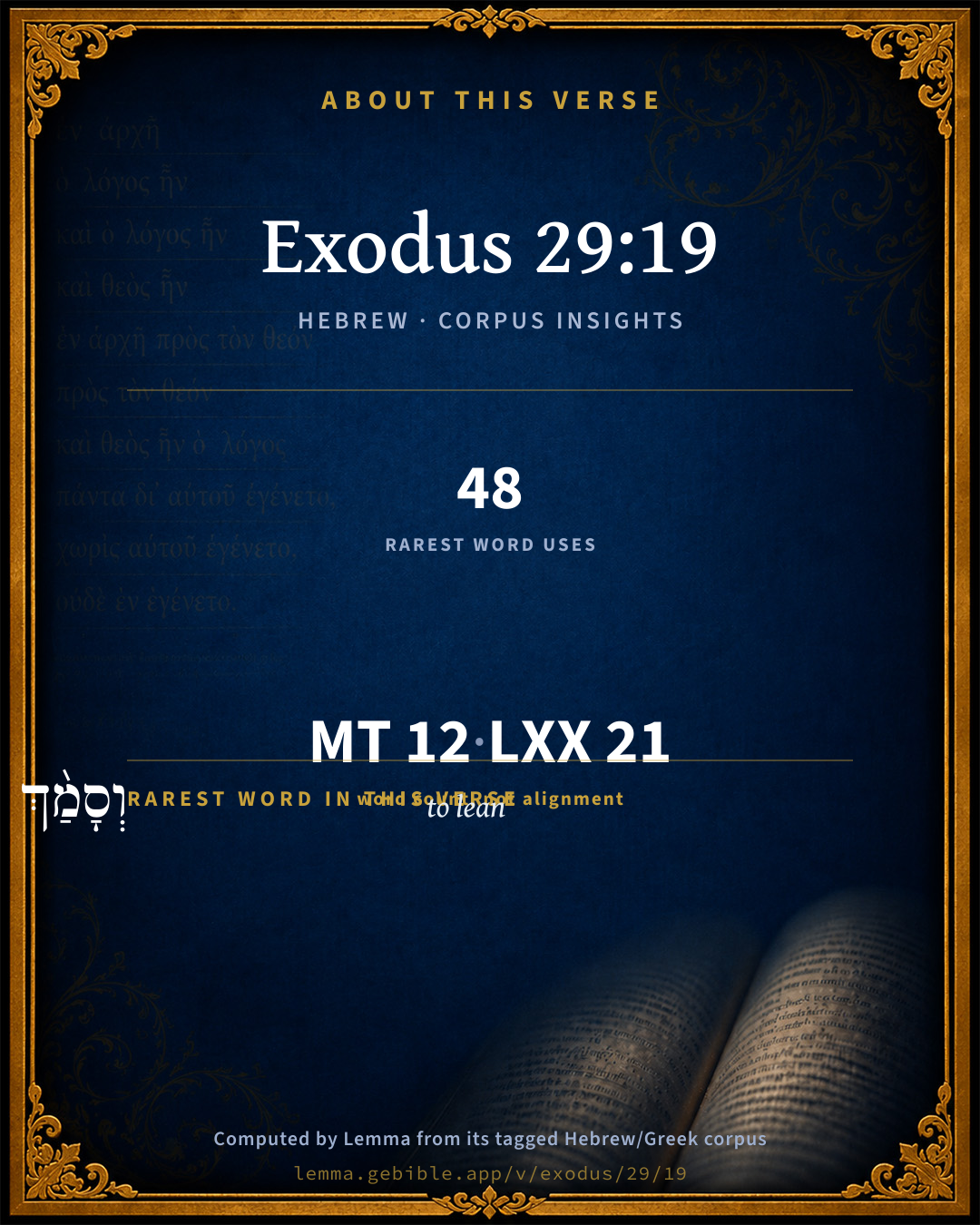
12
words
10
distinct lemmas
Pentateuch
section

Shared distinctive vocabulary

וְסָמַ֨ךְ to lean H5564 occurs in 47 verses of the Hebrew Bible. Also found in:

Grammatical profile

  • 2 verbs
  • 6 nouns
  • 1 adjective
  • 1 preposition
  • 2 particles

Verb forms

  • וְלָ֣קַחְתָּ֔ Qal · Sequential Perfect
  • וְסָמַ֨ךְ Qal · Sequential Perfect

Repetition

A word recurs within this verse — often emphatic in Hebrew:

  • הָאַ֣יִל ram H352 ×2

Hebrew & Septuagint length

In English translation the verse runs 21 words from the Hebrew and 22 from the Septuagint (LXX English) — closely comparable.

A rough comparison of the two English renderings, which tokenize alike — not a word-level alignment.

Word counts can differ between the Hebrew and the Greek without any difference in meaning — e.g. the Hebrew direct-object marker אֵת has no separate Greek word, and Greek often adds the article ὁ.

In the original languages it is 12 Hebrew tokens and 21 Greek tokens — but the two are counted differently (Hebrew bundles its prefixes and suffixes into one token; the Greek is in lemma form), so that isn’t a like-for-like length.

Cross-references

2

Topical passages linked to Exodus 29:19 in the Treasury of Scripture Knowledge — connected by theme and wording, ordered by reader-vote popularity; previews shown in the World English Bible.

  • Exodus 29:3 You shall put them into one basket, and bring them in the basket, with the bull and the two rams.
  • Leviticus 8:22–29 He presented the other ram, the ram of consecration: and Aaron and his sons laid their hands on the head of the ram.

Cross-references courtesy of OpenBible.info (CC BY 4.0).

Hebrew and Greek witnesses Masoretic Hebrew ↔ Greek Septuagint

The same verse in the two great witnesses to the Old Testament, shown verse-for-verse.

These are two independent witnesses, not word-aligned to each other, and the Septuagint is shown in lemma (dictionary) form.

Hebrew Exodus 29:19 Masoretic · Westminster Leningrad Codex

וְלָ֣קַחְתָּ֔ אֵ֖ת הָאַ֣יִל הַשֵּׁנִ֑י וְסָמַ֨ךְ אַהֲרֹ֧ן וּבָנָ֛יו אֶת יְדֵיהֶ֖ם עַל רֹ֥אשׁ הָאָֽיִל

"You shall take the other ram; and Aaron and his sons shall lay their hands on the head of the ram.

World English Bible · Public Domain

Greek LXX Exodus 29:19 Septuagint · lemma form

καί λαμβάνω ὁ κριός ὁ δεύτερος καί ἐπιτίθημι ααρων καί ὁ υἱός αὐτός ὁ χείρ αὐτός ἐπί ὁ κεφαλή ὁ κριός

And you shall take the second ram, and Aaron and his sons shall lay their hands on the head of the ram.

LXX2012 (modern English Septuagint) · Public Domain

Hebrew: Westminster Leningrad Codex (CC BY 4.0). Greek: Septuagint (public domain); English from LXX2012 (modern English Septuagint) (Public Domain). How the Septuagint differs from the Hebrew →

Targum (Aramaic paraphrase)

2

The Targum is the ancient Jewish Aramaic paraphrase of the Hebrew Scriptures — an interpretive translation, not the Hebrew text itself. Onkelos (literal) and Pseudo-Jonathan (expansive) render the Torah, and Jonathan the Prophets. Coverage is partial: where no permissively-licensed English translation exists for a verse, only the Aramaic is shown. This is verse-level text, not a word-by-word alignment to the Hebrew.

  1. Targum Onkelos Torah (Genesis–Deuteronomy)
    וְתִסַב יָת דִכְרָא תִנְיָנָא וְיִסְמוֹךְ אַהֲרֹן וּבְנוֹהִי יָת יְדֵיהוֹן עַל רֵישׁ דִכְרָא:

    (no public-domain English translation for this verse)

    Targum Onkelos — Aramaic: “Onkelos Genesis” (public domain); “Onkelos Exodus” (public domain); “Onkelos Leviticus” (public domain); “Onkelos Numbers” (public domain); “Onkelos Deuteronomy” (public domain). English: “Sefaria Community Translation” (CC0 1.0 (public-domain dedication)); “J.W. Etheridge. The Targums of Onkelos and Jonathan Ben Uzziel on the Pentateuch. London: Longmans, Green, 1862” (public domain). Text via Sefaria.

  2. Targum Pseudo-Jonathan Torah (Genesis–Deuteronomy)
    וְתִיסַב יַת דִּכְרָא תִנְיָנָא וְיִסְמוֹךְ אַהֲרן וּבְנוֹי יַת יְדֵיהוֹן עַל רֵישׁ דִּכְרָא

    And thou shalt take the second ram, and Aharon and his sons shall lay their hands upon the head of the ram.

    Targum Pseudo-Jonathan — Aramaic: “Targum Jonathan on Genesis” (public domain); “Targum Jonathan on Exodus” (public domain); “Targum Jonathan on Leviticus” (public domain); “Targum Jonathan on Numbers” (public domain); “Targum Jonathan on Deuteronomy” (public domain). English: “The Targum of Jonathan ben Uzziel, trans. J. W. Etheridge, London, 1862” (public domain). Text via Sefaria.

Commentary

Notes on Exodus 29:19 from classic Christian and Jewish commentators (each source and its license shown beneath its notes). The classic Christian expositions comment on the surrounding passage and are grouped to its opening verse, so a note may address several verses; the Jewish commentaries on the Tanakh (Rashi and others) are per-verse, so they appear only where the commentator wrote on this verse.

Lemma curates 59 commentaries, every one of them public domain or Creative Commons licensed, each selected and text-cleaned for this edition rather than reprinted as found. About our sources →

Trapp's Complete Commentary

John Trapp

Exo 29:19 And thou shalt take the other ram; and Aaron and his sons shall put their hands upon the head of the ram.

Ver. 19. Put their hands.] Both their hands between the horns of the ram.

John Trapp, A Commentary or Exposition upon All the Books of the Old and New Testament (1647–1656) — public domain. Text from a community e-Sword module.

Joseph Benson's Commentary

Exo 29:19. There must be a peace-offering; it is called the ram of consecration, because there was more in this, peculiar to the occasion, than in the other two. In the burnt-offering, God had the glory of their priesthood, in this they had the comfort of it. And in token of a mutual covenant between God and them, the blood of this sacrifice was divided between God and them, part of the blood was sprinkled upon the altar round about, and part upon them, upon their bodies, and upon their garments. Thus the benefit of the expiation made by the sacrifice was applied and assured to them, and their whole selves, from head to foot, sanctified to the service of God. The blood was put upon the extreme parts of the body, to signify that it was all, as it were, enclosed and taken in for God, the tip of the ear and the great toe not excepted. And the blood and oil signified the blood of Christ, and the graces of the Spirit, which constitute and complete the beauty of holiness, and recommend us to God. The flesh of the sacrifice, with the meat-offering annexed to it, was likewise divided between God and them, that (to speak with reverence) God and they might feast together, in token of friendship and fellowship.

Joseph Benson's Commentary on the Old and New Testaments (1811–1818) — public domain. Text from a community e-Sword module.

Tyndale Open Study Notes

Tyndale Open Resources

29:19-28 This ordination offering is very similar to the peace (or fellowship) offering later described in Lev 3. The fat was burned as a gift to the Lord, but the breast and the thigh, after having been dedicated to the Lord by lifting them up before him (29:24-26), became the portion for the priests to eat (29:26-28). In the regular peace offering, the remainder of the meat was to be eaten by the person making the offering in a fellowship meal (Lev 7:11-18), as the priests did here (Exod 29:31-34).

Tyndale Open Study Notes — © Tyndale Open Resources, licensed CC BY-SA 4.0. Text via the HelloAO Bible API.

Adam Clarke's Commentary

Verse 19. The other ram] There were two rams brought on this occasion: one was for a burnt-offering, and was to be entirely consumed; the other was the ram of consecration, Ex 29:22, איל מלאים eil milluim, the ram of filling up, because when a person was dedicated or consecrated to God, his hands were filled with some particular offering proper for the occasion, which he presented to God. Hence the word consecration signifies the filling up or filling the hands, some part of the sacrifice being put into the hands of such persons, denoting thereby that they had now a right to offer sacrifices and oblations to God. It seems in reference to this ancient mode of consecration, that in the Church of England, when a person is ordained priest, a Bible is put into his hands with these words, "Take thou authority to preach the word of God," &c. The filling the hands refers also to the presents which, in the eastern countries, every inferior was obliged to bring when brought into the presence of a superior. Thus the sacrifice was considered, not only as an atonement for sin, but also as a means of approach and as a present to Jehovah.

Adam Clarke's Commentary on the Bible (1810–1826) — public domain. Text from a community e-Sword/MySword module.

Ellicott's Commentary for English Readers

(19) The other ram.—Comp. Exo_29:1; Exo_29:15. This ram is called in Leviticus (Exo_8:22) “the ram of consecration.” It formed, as has been observed (Speaker’s Commentary, vol. i. pt. 2, p. 535), “by far the most peculiar part of the whole ceremony” Consecrated to God by the act of sacrifice, its blood was used, together with the holy oil, for the consecration of Aaron and his sons (Exo_29:20-21); while at the same time its most sacred parts were placed on their hands by Moses, that with them they might perform their first sacerdotal act, and so be inaugurated into their office (Exo_29:22-24). This last was not only the crowning act of the ceremony, but also its most essential feature—the act which imparted to Aaron and his sons the priestly character.

A Bible Commentary for English Readers, edited by Charles John Ellicott (1878–1897) — public domain. Text from a community e-Sword module.

The Cambridge Bible for Schools and Colleges

gen. ed. J. J. S. Perowne

19–20. The second of the two rams (v. 1) to be killed, and its blood applied to the persons of Aaron and his sons (cf. Lev_8:22-24).

19–26. The installation-offering (cf. Lev_8:22-29). This was essentially a peace-offering,—the special characteristic of which was that the flesh of the sacrifice was partaken of by the offerer and his friends (cf. on Exo_20:24; and see here vv. 32–34),—with modifications due to the particular occasion (such as the application of the blood to the priests and their garments, vv. 20, 21, the solemn ‘waving’ of the offerings in the priests’ hands, vv. 22–25, the special term ‘ram of installation,’ &c.). On the peace-offering in general, see Leviticus 3.

The Cambridge Bible for Schools and Colleges (gen. ed. J. J. S. Perowne; Cambridge University Press, 1878–1918) — public domain. Text from a community e-Sword module.

John Gill's Exposition

And thou shall take the other ram,.... The other of the two that was left, Exo 29:1,

and Aaron and his sons shall put their hands on the head of the ram, as they were to do, and did, upon the head of the other; See Gill on Exo 29:15.

John Gill's Exposition of the Whole Bible (1746–1763) — public domain (CC PDM 1.0). Text via the HelloAO Bible API.

Matthew Poole's English Annotations

This was for a peace-offering. So here were all the three sorts of sacrifices, which were afterwards to be offered by them for the people.

Matthew Poole's English Annotations on the Holy Bible (1683–1685) — public domain. Text from a community e-Sword/MySword module.

Whedon's Commentary on the Bible

Daniel D. Whedon

19. The other ram — This appears to have been a peace offering, not to be wholly consumed upon the altar, but portions to be given to the priests. It is called in Exo_29:22; Exo_29:26-27, and Lev_8:22, “the ram of consecration,” literally, ram of the fillings, alluding either to the filling of their hands or to the completion of their consecration. Rams were to be selected from “the herd” and were not commonly brought by individuals for peace offerings, (Lev_3:1;) but they were used for national peace offerings of the people, (Lev_9:4; Lev_9:18,) and by the Nazarites (Num_6:14) and the princes of Israel. Num_7:17. So, too, this was viewed as an exceptional peace offering, fitted to an extraordinary occasion.

Daniel D. Whedon (gen. ed.), Commentary on the Old and New Testaments (1874–1909) — public domain. Text from a community e-Sword module.

The Pulpit Commentary

The other ram. Compare ver. 15; and see also vers. 1 and 3, where two rams had been mentioned. This second ram is called, "the ram of consecration" in ver. 22, and again in Lev_8:22. It was "by far the most peculiar part of the whole ceremony" (S. Clark) It must be viewed as a "peace-offering", (Lev_3:1-17) but one of a peculiar character. The application of the blood to the persons of the priests was altogether unique, and most significant. It was the crowning act of consecration, and implied the complete dedication of their life and of all their powers to the service of the Almighty.

The Pulpit Commentary (1880–1919), ed. H.D.M. Spence-Jones & Joseph S. Exell — public domain. Text from a community e-Sword module.

John Wesley's Explanatory Notes

There must be a peace-offering; it is called the ram of consecration, because there was more in this, peculiar to the occasion, than in the other two. In the burnt-offering God had the glory of their priesthood, in this they had the comfort of it. And in token of a mutual covenant between God and them, the blood of this sacrifice was divided between God and them, part of the blood was sprinkled upon the altar round about, and part upon them, upon their bodies, and upon their garments. Thus the benefit of the expiation made by the sacrifice was applied and assured to them, and their whole selves from head to foot sanctified to the service of God. The blood was put upon the extreme parts of the body, to signify, that it was all as it were enclosed and taken in for God, the tip of the ear, and the great toe not excepted. And the blood and oil signified the blood of Christ, and the graces of the Spirit, which constitute and compleat the beauty of holiness, and recommend us to God. The flesh of the sacrifice, with the meat- offering annexed to it, was likewise divided between God and them, that (to speak with reverence) God and they might feast together, in token of friendship and fellowship.

John Wesley, Explanatory Notes Upon the Whole Bible (1754–1765) — public domain. Text via the GEBible commentary corpus.

unfoldingWord translationNotes

Door43 World Missions Community

General Information:

Yahweh continues speaking to Moses.

Then you must kill the ram

The ram was killed by cutting its throat. This can be stated clearly in the translation. AT: "Then kill the ram by slitting its throat" or "Then kill the ram by cutting its throat" (See: Assumed Knowledge and Implicit Information)

translationWords

ewe

Aaron

hand

blood

altar

unfoldingWord translationNotes — © Distant Shores Media and the Door43 World Missions Community, licensed CC BY-SA 4.0. Source: git.door43.org/Door43/en_tn.

Lesson kit

Teaching starters — assembled from the data on this page, not authored interpretation. Every prompt links to the verse data it draws on. Edit before teaching.

Exodus, in the Pentateuch, opens this verse with 12 words (10 distinct Hebrew lemmas). Its most distinctive word is çâmak (“to lean”). A historical commentator’s framing appears above. Read the whole chapter for the surrounding context.

Discussion questions

  1. What does “to lean” (çâmak) contribute to the verse as a whole?
  2. How does Genesis 27:37, which shares the word «to lean», read alongside this verse?
  3. What does the repetition of “ram” (2× in this one verse) do in this verse?
  4. The translations on this page render this verse differently — a whole-verse word diff, not a word-by-word alignment. What might account for the different wordings?
  5. «וְלָ֣קַחְתָּ֔» is a Qal Sequential Perfect verb. How does that grammatical form shape the action described?
  6. Compare how Trapp's Complete Commentary and Joseph Benson's Commentary read this verse. Where do they agree or differ?

Things to notice

Reading settings

Reading text

Shown beneath each verse's original-language words.

Old Testament
Old Testament edition

Read the OT as the Masoretic Hebrew (MT) or the Greek Septuagint (LXX).

English shown for the Greek Septuagint (in the Hebrew ↔ Greek comparison).

Comparing translations? Open the Compare panel on any verse page to stack up to four side by side.