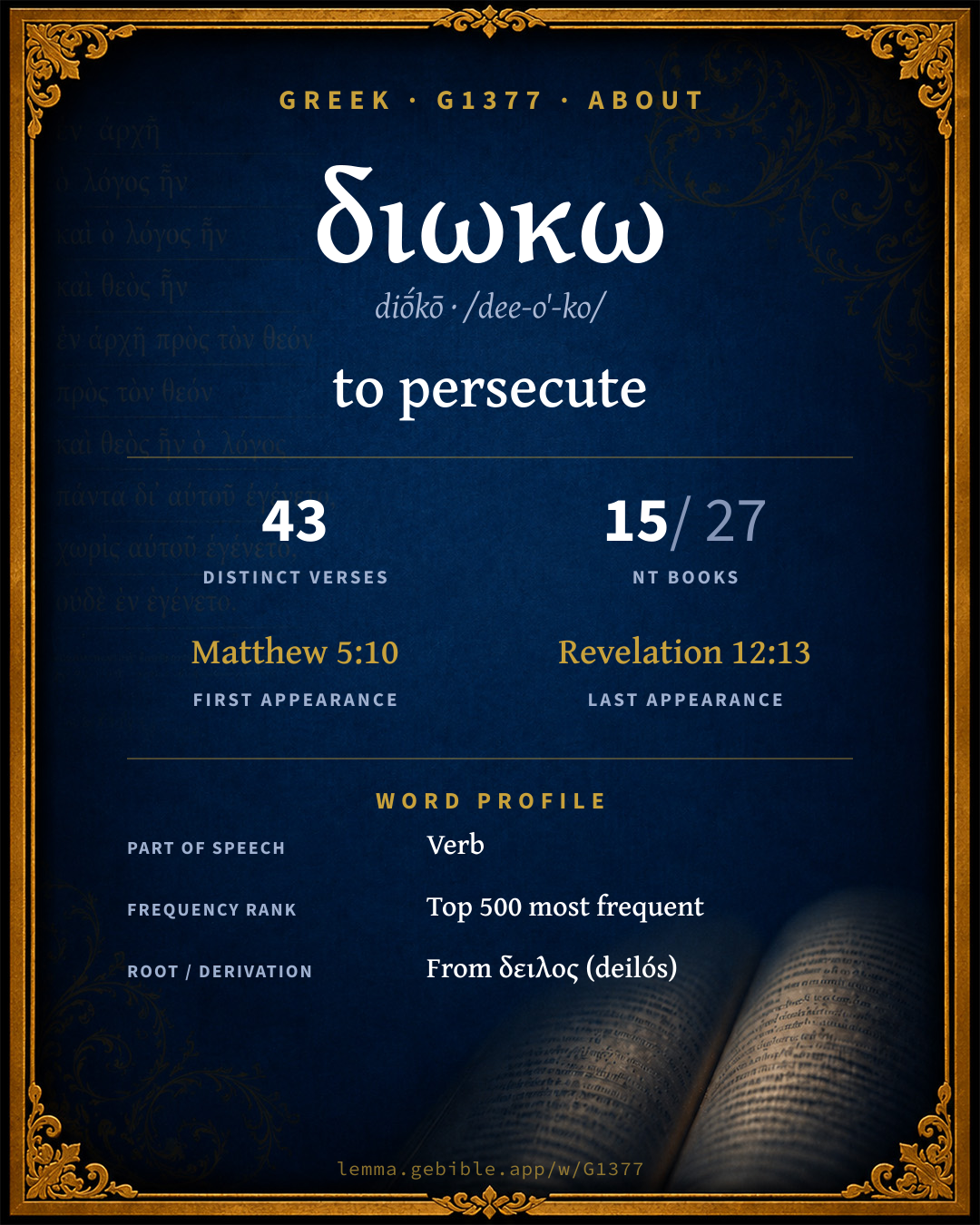
διώκω
to persecute
‘to persecute’ is one of 5 main senses fuller range ↓
Full lexicon entry — Thayer's Greek Lexicon
From Thayer's Greek Lexicon
Where this word appears
See every Present-tense verb in the Greek New Testament →
Grammar key — what these labels mean
Part of speech
- Verb
- An action or state-of-being word.
Tense
- Present
- Ongoing or general action in present time (imperfective aspect).
- Aorist
- Action viewed as a simple whole, without regard to duration — often past (perfective aspect).
- Future
- Action expected in future time.
- Imperfect
- Continuous or repeated action in past time (“was writing”).
- Perfect
- A completed past action with continuing present results.
Voice
- Active
- The subject performs the action.
- Passive
- The subject receives the action.
Mood
- Indicative
- States a fact or asks a factual question (the mood of reality).
- Imperative
- Expresses a command or request.
- Participle
- A verbal adjective (“writing,” “having written”).
- Subjunctive
- Expresses probability, purpose, or possibility (the mood of contingency).
Case
- Nominative
- The case of the subject (and the predicate nominative).
- Accusative
- The case of the direct object and of extent.
- Genitive
- The case of source, possession, or “of” — answers “whose / from what.”
Person
- 2nd person
- The one addressed (“you”).
- 3rd person
- The one spoken about (“he / she / it / they”).
- 1st person
- The speaker (“I / we”).
Gender
- Masculine
- Grammatically masculine.
- Neuter
- Grammatically neuter.
Number
- Singular
- One.
- Plural
- More than one.
Grammatical forms 27 distinct
- Verb, Present, Active, Indicative, 2nd person, Singular 6 times (14%)
- Verb, Aorist, Active, Indicative, 3rd person, Plural 3 times (7%)
- Verb, Present, Active, Imperative, 2nd person, Plural 3 times (7%)
- Verb, Present, Active, Participle, Nominative, Singular, Masculine 3 times (7%)
- Verb, Aorist, Active, Indicative, 1st person, Singular 2 times (5%)
- Verb, Future, Active, Indicative, 3rd person, Plural 2 times (5%)
- Verb, Imperfect, Active, Indicative, 1st person, Singular 2 times (5%)
- Verb, Present, Active, Indicative, 1st person, Singular 2 times (5%)
+19 more forms (21 occurrences)
Parsed forms decoded from the imported morphology (Robinson–Tischendorf, public domain), counted across 44 parsed occurrences — not distinct verses.
Every verse where G1377 appears — 43 distinct verses across 15 books. Click any verse to open its interlinear word-by-word view. Verse text shown in the World English Bible for context — . Each verse’s Greek form is shown with its reference; the English is not keyword-highlighted, since the data carries no word-level English alignment. Use “Compare translations” on any verse to read it across multiple English versions. This concordance covers the Greek New Testament; Septuagint (Greek Old Testament) occurrences of this word are not indexed here.
Matthew 6 verses
- Matthew 5:10 δεδιωγμένοι perf pass ptcp nom pl masc Blessed are those who have been persecuted for righteousness' sake, For theirs is the Kingdom of Heaven.
- Matthew 5:11 διώξωσιν aor act subj 3pl "Blessed are you when people reproach you, persecute you, and say all kinds of evil against you falsely, for my sake.
- Matthew 5:12 ἐδίωξαν aor act ind 3pl Rejoice, and be exceedingly glad, for great is your reward in heaven. For that is how they persecuted the prophets who were before you.
- Matthew 5:44 διωκόντων pres act ptcp gen pl masc But I tell you, love your enemies, bless those who curse you, do good to those who hate you, and pray for those who mistreat you and persecute you,
- Matthew 10:23 διώκωσιν pres act subj 3pl But when they persecute you in this city, flee into the next, for most assuredly I tell you, you will not have gone through the cities of Israel, until the Son of Man has come.
- Matthew 23:34 διώξετε fut act ind 2pl Therefore, behold, I send to you prophets, wise men, and scribes. Some of them you will kill and crucify; and some of them you will scourge in your synagogues, and persecute from city to city;
Luke 2 verses
- Luke 17:23 διώξητε aor act subj 2pl They will tell you, 'Look, here!' or 'Look, there!' Don't go away, nor follow after them,
- Luke 21:12 διώξουσιν fut act ind 3pl But before all these things, they will lay their hands on you and will persecute you, delivering you up to synagogues and prisons, bringing you before kings and governors for my name's sake.
John 2 verses
- John 5:16 ἐδίωκον impf act ind 3pl For this cause the Jews persecuted Jesus, and sought to kill him, because he did these things on the Sabbath.
- John 15:20 ἐδίωξαν διώξουσιν aor act ind 3pl fut act ind 3pl Remember the word that I said to you: 'A servant is not greater than his lord.' If they persecuted me, they will also persecute you. If they kept my word, they will keep yours also.
Acts 9 verses
- Acts 7:52 ἐδίωξαν aor act ind 3pl Which of the prophets didn't your fathers persecute? They killed those who foretold the coming of the Righteous One, of whom you have now become betrayers and murderers.
- Acts 9:4 διώκεις pres act ind 2sg He fell on the earth, and heard a voice saying to him, "Saul, Saul, why do you persecute me?"
- Acts 9:5 διώκεις pres act ind 2sg He said, "Who are you, Lord?" The Lord said, "I am Jesus, whom you are persecuting.
- Acts 22:4 ἐδίωξα aor act ind 1sg I persecuted this Way to the death, binding and delivering into prisons both men and women.
- Acts 22:7 διώκεις pres act ind 2sg I fell to the ground, and heard a voice saying to me, 'Saul, Saul, why are you persecuting me?'
- Acts 22:8 διώκεις pres act ind 2sg I answered, 'Who are you, Lord?' He said to me, 'I am Jesus of Nazareth, whom you persecute.'
- Acts 26:11 ἐδίωκον impf act ind 1sg Punishing them often in all the synagogues, I tried to make them blaspheme. Being exceedingly enraged against them, I persecuted them even to foreign cities.
- Acts 26:14 διώκεις pres act ind 2sg When we had all fallen to the earth, I heard a voice saying to me in the Hebrew language, 'Saul, Saul, why are you persecuting me? It is hard for you to kick against the goads.'
- Acts 26:15 διώκεις pres act ind 2sg "I said, 'Who are you, Lord?' "He said, 'I am Jesus, whom you are persecuting.
Romans 5 verses
- Romans 9:30 διώκοντα pres act ptcp nom pl neut What shall we say then? That the Gentiles, who didn't follow after righteousness, attained to righteousness, even the righteousness which is of faith;
- Romans 9:31 διώκων pres act ptcp nom sg masc but Israel, following after a law of righteousness, didn't arrive at the law of righteousness.
- Romans 12:13 διώκοντες pres act ptcp nom pl masc contributing to the needs of the saints; given to hospitality.
- Romans 12:14 διώκοντας pres act ptcp acc pl masc Bless those who persecute you; bless, and don't curse.
- Romans 14:19 διώκομεν pres act ind 1pl So then, let us follow after things which make for peace, and things by which we may build one another up.
1 Corinthians 3 verses
- 1 Corinthians 4:12 διωκόμενοι pres pass ptcp nom pl masc We toil, working with our own hands. When people curse us, we bless. Being persecuted, we endure.
- 1 Corinthians 14:1 Διώκετε pres act impv 2pl Follow after love, and earnestly desire spiritual gifts, but especially that you may prophesy.
- 1 Corinthians 15:9 ἐδίωξα aor act ind 1sg For I am the least of the apostles, who is not worthy to be called an apostle, because I persecuted the assembly of God.
2 Corinthians 1 verse
Galatians 5 verses
- Galatians 1:13 ἐδίωκον impf act ind 1sg For you have heard of my way of living in time past in the Jews' religion, how that beyond measure I persecuted the assembly of God, and ravaged it.
- Galatians 1:23 διώκων pres act ptcp nom sg masc but they only heard: "He who once persecuted us now preaches the faith that he once tried to destroy."
- Galatians 4:29 ἐδίωκεν impf act ind 3sg But as then, he who was born according to the flesh persecuted him who was born according to the Spirit, so also it is now.
- Galatians 5:11 διώκομαι pres pass ind 1sg But I, brothers, if I still preach circumcision, why am I still persecuted? Then the stumbling-block of the cross has been removed.
- Galatians 6:12 διώκονται pres pass ind 3pl As many as desire to look good in the flesh, they compel you to be circumcised; only that they may not be persecuted for the cross of Christ.
Philippians 3 verses
- Philippians 3:6 διώκων pres act ptcp nom sg masc concerning zeal, persecuting the assembly; concerning the righteousness which is in the law, found blameless.
- Philippians 3:12 διώκω pres act ind 1sg Not that I have already obtained, or am already made perfect; but I press on, if it is so that I may take hold of that for which also I was taken hold of by Christ Jesus.
- Philippians 3:14 διώκω pres act ind 1sg I press on toward the goal for the prize of the high calling of God in Christ Jesus.
1 Thessalonians 1 verse
1 Timothy 1 verse
2 Timothy 2 verses
Hebrews 1 verse
1 Peter 1 verse
Revelation 1 verse
About this entry
At a glance — auto-summarized from this page’s data, not written by a person. Every figure links to its source below. This summary describes the numbers; it doesn’t interpret them.
διωκω (diṓkō) is a Greek verb most often rendered “to persecute.” Translators differ — “persecute” in the King James Version, then “pursue” (unfoldingWord Literal Text), as the renderings breakdown shows. It turns up in 43 verses across 15 books, a moderately common footprint. It first appears in Matthew 5:10. Its lexical range runs to 5 senses. The sections below give every sense, occurrence, and version rendering.
Gloss history
Strong's 1890 vs modern scholarship

About this word
Strong's G1377 catalogs a Greek word from the Greek New Testament.
These counts are not copied from any lexicon or concordance. They are computed here, from the morphology-tagged Greek New Testament. What Lemma adds →
- 43
- distinct verses
- The word appears in 43 distinct verses.
- 15 / 27
- NT books
- The word appears in 15 of 27 New Testament books.
- #343
- by frequency
- Top 500 most frequent Greek words (rank 343 of 5,347 Greek words by occurrence).
View all 43 occurrences in the concordance →
By section of the New Testament
By traditional corpus
Conventional, traditional groupings — biblical authorship is debated, so this is a traditional corpus grouping, not an authorship claim. Some books belong to more than one corpus (Luke is in both the Gospels and the Lukan corpus, and so on), so these shares overlap and need not total 100%. Each figure is a share of the word’s 43 distinct verses.
- Pauline corpus 21 verses · 49%
- Lukan (Luke–Acts) 11 verses · 26%
- Gospels 10 verses · 23%
- Johannine 3 verses · 7%
- Hebrews 1 verse · 2%
- General (Catholic) Epistles 1 verse · 2%
- Revelation 1 verse · 2%
How translations render this word
Counts come from each version’s own published word-to-Strong’s tagging or interlinear alignment — an approximate guide to how each version renders this word, not a word-level alignment the data otherwise carries. Because each total is that version’s own tagged count, the per-version totals vary from one another and need not match the appearance or distinct-verse counts above. These counts may also differ from a printed concordance because Lemma counts each distinctly tagged rendering and does not collapse phrase taggings into a single head-word total. This is a fixed set of word-tagged versions (KJV, ASV, BSB, ULT) and does not change with the reading translation you choose elsewhere. Each version’s license is shown beside its name below (and on Sources).
- King James Version: Persecute 7×, Follow 5×, Persecuted 4×
- American Standard Version: Persecute 6×, Persecutest 6×, Follow 4×
- Berean Standard Bible: Persecute 7×, Pursue 5×, Persecuted 4×
- unfoldingWord Literal Text: Pursue 6×, Persecute 4×, Are persecuting 3×
King James Version Public Domain
Renders G1377 across 49 tagged occurrences — most commonly:
Plus 20 renderings that appear only once — usually multi-word phrases or single function words the recovered tagging swept in, not distinct renderings.
American Standard Version Public Domain
Renders G1377 across 50 tagged occurrences — most commonly:
Plus 23 renderings that appear only once — usually multi-word phrases or single function words the recovered tagging swept in, not distinct renderings.
Berean Standard Bible Public Domain
Renders G1377 across 45 tagged occurrences — most commonly:
Plus 15 renderings that appear only once — usually multi-word phrases or single function words the recovered tagging swept in, not distinct renderings.
unfoldingWord Literal Text CC BY-SA 4.0
Renders G1377 across 53 tagged occurrences — most commonly:
Plus 22 renderings that appear only once — usually multi-word phrases or single function words the recovered tagging swept in, not distinct renderings.
Senses in Thayer's
The 5 senses Thayer's distinguishes for this word, in lexicon order (not ranked by frequency or importance). The full entry — with sub-senses — is in the Lexicon Entry tab.
- to make to run or flee, put to flight, drive away
- to run swiftly in order to catch a person or thing, to run after
- in any way whatever to harass, trouble, molest one
- without the idea of hostility, to run after, follow after: someone
- metaph., to pursue
Word origin
Derived from δειλος (deilós) (G1169) — timid.
A prolonged (and causative) form of a primary verb δίω diō (to flee ; compare the base of G1169 and G1249 ); to pursue (literally or figuratively); by implication to persecute : - ensue follow (after) given to (suffer) persecute (-ion) press toward.
— Strong’s Exhaustive Concordance (1890), public domain.
Forms in the corpus
The 27 distinct written forms G1377 takes in the Greek New Testament, most frequent first — each parse links to that tense’s occurrences in the concordance.
Same root — word family
Other Thayer's entries built from the same root as G1377, grouped by Strong’s listed origin. These share a root / origin per the lexicon — not necessarily a shared meaning. Each links to that word’s own entry.
Derives from
Shares the same root
- δειλια deilía G1167 cowardice
- δεινως deinōs G1171 terribly
- δεισιδαιμονεστερος deisidaimonésteros G1174 reverent
Derived from this word
Compare all same-root words → Showing 4 of 8 — not the complete family. They share a root, not necessarily a meaning.
Septuagint usage
The same Greek word διωκω appears 75 times in the Greek Old Testament (Septuagint), across 70 verses in 24 books.
- 75
- LXX occurrences
- Tagged occurrences of this Greek word in the Septuagint.
- 70
- verses
- Distinct Septuagint verses containing this word.
- 24 / 39
- OT books
- The word appears in 24 of the 39 Old Testament books.
Sample Septuagint occurrences
- Genesis 14:15 διώκω
- Exodus 15:9 διώκω
- Leviticus 26:7 διώκω
- Deuteronomy 16:20 διώκω
- Joshua 2:7 διώκω
- Judges 4:16 διώκω
- 2 Samuel 18:16 διώκω
- 2 Kings 5:21 διώκω
- Ezra 9:4 διώκω
- Job 19:22 διώκω
- Psalms 7:2 διώκω
- Proverbs 9:12 διώκω
Septuagint occurrences (same lexeme)
Every verse where the same Strong’s number (G1377) appears in the Greek Septuagint — showing the first 50 of 70. Verse text shown in the World English Bible for context; the Greek form is the matched word — the English is not keyword-highlighted.
- Genesis 14:15 διώκω He divided himself against them by night, he and his servants, and struck them, and pursued them to Hobah, which is on the left hand of Damascus.
- Genesis 31:23 διώκω He took his relatives with him, and pursued after him seven days' journey. He overtook him in the mountain of Gilead.
- Exodus 15:9 διώκω The enemy said, 'I will pursue, I will overtake, I will divide the spoil. My desire shall be satisfied on them. I will draw my sword, my hand shall destroy them.'
- Leviticus 26:7 διώκω You shall chase your enemies, and they shall fall before you by the sword.
- Leviticus 26:8 διώκω Five of you shall chase a hundred, and a hundred of you shall chase ten thousand; and your enemies shall fall before you by the sword.
- Leviticus 26:17 διώκω I will set my face against you, and you will be struck before your enemies. Those who hate you will rule over you; and you will flee when no one pursues you.
- Leviticus 26:36 διώκω "'As for those of you who are left, I will send a faintness into their hearts in the lands of their enemies: and the sound of a driven leaf will put them to flight; and they shall flee, as one flees from the sword; and they will fall when no one pursues.
- Deuteronomy 16:20 διώκω That which is altogether just shall you follow, that you may live, and inherit the land which Yahweh your God gives you.
- Deuteronomy 19:6 διώκω lest the avenger of blood pursue the manslayer, while his heart is hot, and overtake him, because the way is long, and strike him mortally; whereas he was not worthy of death, inasmuch as he didn't hate him in time past.
- Deuteronomy 30:7 διώκω Yahweh your God will put all these curses on your enemies, and on those who hate you, who persecuted you.
- Deuteronomy 32:30 διώκω How should one chase a thousand, Two put ten thousand to flight, Except their Rock had sold them, Yahweh had delivered them up?
- Joshua 2:7 διώκω The men pursued after them the way to the Jordan to the fords: and as soon as those who pursued after them were gone out, they shut the gate.
- Joshua 23:10 διώκω One man of you shall chase a thousand; for Yahweh your God, he it is who fights for you, as he spoke to you.
- Judges 4:16 διώκω But Barak pursued after the chariots, and after the host, to Harosheth of the Gentiles: and all the host of Sisera fell by the edge of the sword; there was not a man left.
- Judges 4:22 διώκω Behold, as Barak pursued Sisera, Jael came out to meet him, and said to him, Come, and I will show you the man whom you seek. He came to her; and, behold, Sisera lay dead, and the tent-pin was in his temples.
- Judges 7:23 διώκω The men of Israel were gathered together out of Naphtali, and out of Asher, and out of all Manasseh, and pursued after Midian.
- Judges 8:4 διώκω Gideon came to the Jordan, [and] passed over, he, and the three hundred men who were with him, faint, yet pursuing.
- Judges 8:5 διώκω He said to the men of Succoth, Please give loaves of bread to the people who follow me; for they are faint, and I am pursuing after Zebah and Zalmunna, the kings of Midian.
- Judges 8:12 διώκω Zebah and Zalmunna fled; and he pursued after them; and he took the two kings of Midian, Zebah and Zalmunna, and confused all the host.
- Judges 9:40 διώκω Abimelech chased him, and he fled before him, and there fell many wounded, even to the entrance of the gate.
- Judges 20:43 διώκω They enclosed the Benjamites round about, [and] chased them, [and] trod them down at [their] resting-place, as far as over against Gibeah toward the sunrise.
- 2 Samuel 18:16 διώκω Joab blew the trumpet, and the people returned from pursuing after Israel; for Joab held back the people.
- 2 Samuel 20:7 διώκω There went out after him Joab's men, and the Cherethites and the Pelethites, and all the mighty men; and they went out of Jerusalem, to pursue after Sheba the son of Bichri.
- 2 Samuel 20:10 διώκω But Amasa took no heed to the sword that was in Joab's hand: so he struck him therewith in the body, and shed out his bowels to the ground, and didn't strike him again; and he died. Joab and Abishai his brother pursued after Sheba the son of Bichri.
- 2 Samuel 20:13 διώκω When he was removed out of the highway, all the people went on after Joab, to pursue after Sheba the son of Bichri.
- 2 Samuel 21:5 διώκω They said to the king, The man who consumed us, and who devised against us, [that] we should be destroyed from remaining in any of the borders of Israel,
- 2 Samuel 22:38 διώκω I have pursued my enemies, and destroyed them; Neither did I turn again until they were consumed.
- 2 Samuel 24:13 διώκω So Gad came to David, and told him, and said to him, Shall seven years of famine come to you in your land? or will you flee three months before your foes while they pursue you? or shall there be three days' pestilence in your land? now advise you, and consider what answer I shall return to him who sent me.
- 2 Kings 5:21 διώκω So Gehazi followed after Naaman. When Naaman saw one running after him, he alighted from the chariot to meet him, and said, Is all well?
- 2 Kings 9:27 διώκω But when Ahaziah the king of Judah saw this, he fled by the way of the garden-house. Jehu followed after him, and said, Smite him also in the chariot: [and they struck him] at the ascent of Gur, which is by Ibleam. He fled to Megiddo, and died there.
- 2 Kings 25:5 διώκω But the army of the Chaldeans pursued after the king, and overtook him in the plains of Jericho; and all his army was scattered from him.
- Ezra 9:4 διώκω Then were assembled to me everyone who trembled at the words of the God of Israel, because of the trespass of them of the captivity; and I sat confounded until the evening offering.
- Job 19:22 διώκω Why do you persecute me as God, And are not satisfied with my flesh?
- Psalms 7:2 διώκω Lest they tear apart my soul like a lion, Ripping it in pieces, while there is none to deliver.
- Psalms 33:15 διώκω He who fashions all of their hearts; And he considers all of their works.
- Proverbs 9:12 διώκω If you are wise, you are wise for yourself. If you mock, you alone will bear it.
- Proverbs 12:11 διώκω He who tills his land shall have plenty of bread, But he who chases fantasies is void of understanding.
- Proverbs 15:9 διώκω The way of the wicked is an abomination to Yahweh, But he loves him who follows after righteousness.
- Proverbs 21:6 διώκω Getting treasures by a lying tongue Is a fleeting vapor for those who seek death.
- Proverbs 28:1 διώκω The wicked flee when no one pursues; But the righteous are as bold as a lion.
- Proverbs 28:19 διώκω One who works his land will have an abundance of food; But one who chases fantasies will have his fill of poverty.
- Ecclesiastes 3:15 διώκω That which is has been long ago, and that which is to be has been long ago: and God seeks again that which is passed away.
- Isaiah 1:23 διώκω Your princes are rebellious, and companions of thieves. Everyone loves bribes, and follows after rewards. They don't judge the fatherless, Neither does the cause of the widow come to them.
- Isaiah 5:11 διώκω Woe to those who rise up early in the morning, that they may follow strong drink; Who stay late into the night, until wine inflames them!
- Isaiah 13:14 διώκω It shall happen, that as the chased roe, and as sheep that no man gathers, they shall turn every man to his own people, and shall flee every man to his own land.
- Isaiah 16:4 διώκω Let my outcasts dwell with you; as for Moab, be a covert to him from the face of the destroyer. For the extortioner is brought to nothing, destruction ceases, the oppressors are consumed out of the land.
- Isaiah 17:2 διώκω The cities of Aroer are forsaken; they shall be for flocks, which shall lie down, and none shall make them afraid.
- Isaiah 17:13 διώκω The nations shall rush like the rushing of many waters: but he shall rebuke them, and they shall flee far off, and shall be chased as the chaff of the mountains before the wind, and like the whirling dust before the storm.
- Isaiah 30:16 διώκω but you said, No, for we will flee on horses; therefore shall you flee: and, We will ride on the swift; therefore shall those who pursue you be swift.
- Isaiah 30:28 διώκω and his breath is as an overflowing stream, that reaches even to the neck, to sift the nations with the sieve of destruction: and a bridle that causes to err [shall be] in the jaws of the peoples.
These are occurrences of the same Greek lexeme (G1377) in the Septuagint — not a translation of any one Hebrew word. The store carries no word-level Hebrew↔Greek alignment, so no Hebrew original is asserted here. Counts come from the recovered LXX Strong's tagging — high-frequency vocabulary is well covered, while rare or late forms may be untagged — so they reflect tagged occurrences and may slightly undercount.