

Philippians 3:6
Greek (Tischendorf 8th ed.) Philippians 3:6 appears in the Greek New Testament. The text above is from the Tischendorf 8th edition. Each word links to its Strong’s number and a concise gloss. Click any word for its full Thayer’s Greek Lexicon entry.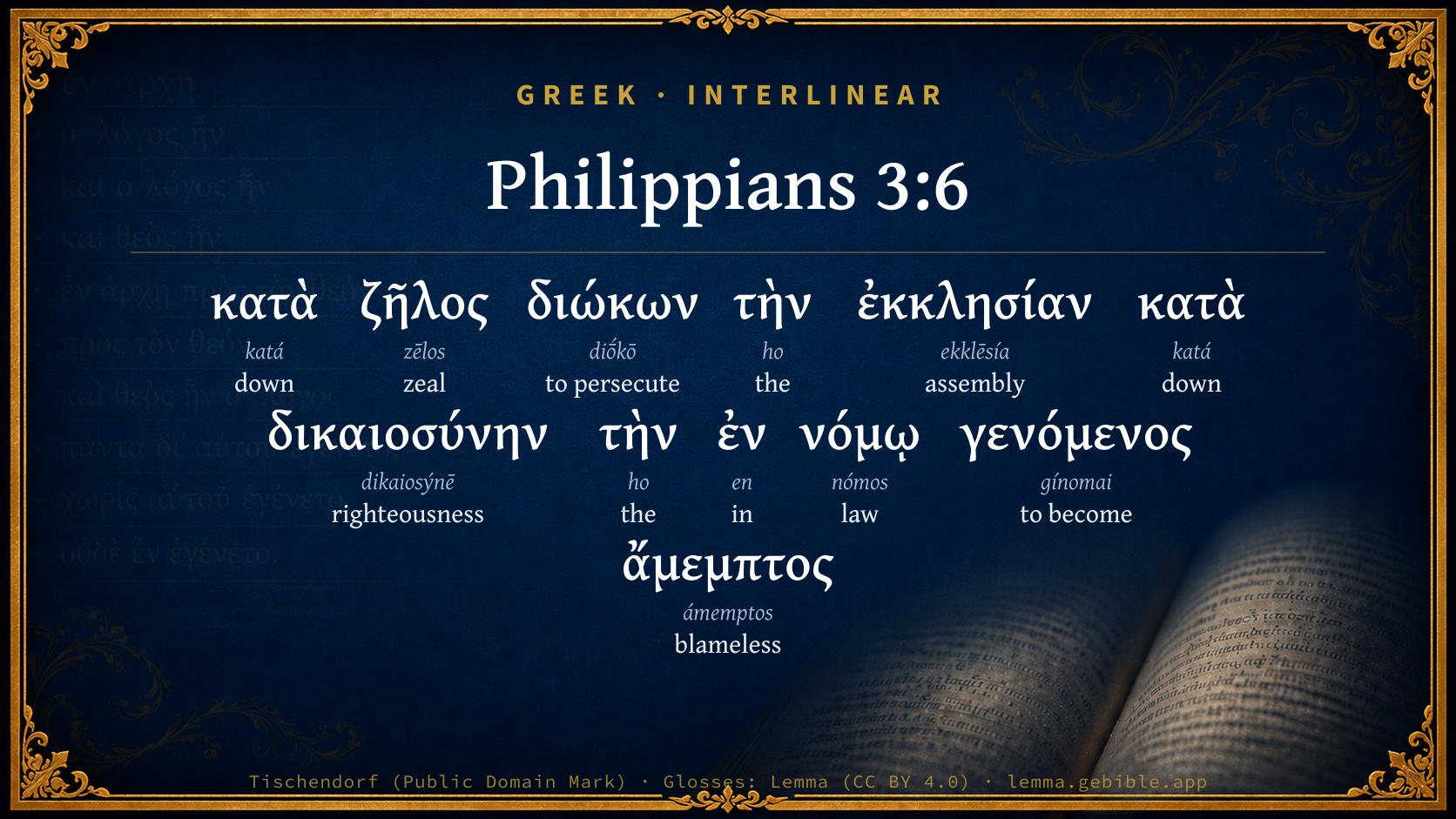
concerning zeal, persecuting the assembly; concerning the righteousness which is in the law, found blameless.
Download a study sheet
One document with this verse’s original text, its word-by-word gloss line, the meaning frame, cross-references with their text, attributed commentary, and full source and license credits — printable, and it pastes into notes with its structure intact.
This verse Autodidact and up
A passage Seminary Student
Up to 50 verses in one chapter. A passage sheet keeps up to 6 commentary sources and 12 cross-references per verse, in the order this page ranks them, and says so on the sheet whenever that leaves anything out. Ask for a single verse and you get the Autodidact verse sheet above.
Everything on this page stays free to read, with no account — the sheet is a download of what is already on screen, not access to it.
Compare translations 3
The same verse in 3 English versions, stacked beneath the original-language interlinear above. Click any original word for its lexicon entry.
Each is an independent rendering of the whole verse — the interlinear is not word-aligned to these translations.
Highlighted words mark where these versions differ — a whole-verse word diff, not a word-by-word alignment.
-
World English Bible Public Domain
concerning zeal, persecuting the assembly; concerning the righteousness which is in the law, found blameless.
-
King James Version Public Domain
Concerning zeal, persecuting the church; touching the righteousness which is in the law, blameless.
-
unfoldingWord Literal Text CC BY-SA 4.0
according to zeal, persecuting the church; according to righteousness in the law, having become blameless.
unfoldingWord Literal Text — © unfoldingWord, licensed CC BY-SA 4.0. Word-aligned USFM3 via Door43 (git.door43.org/unfoldingWord/en_ult).
Show all 19 translations
Every available English version of this verse, each an independent rendering of the whole verse.
-
World English Bible Public Domain
concerning zeal, persecuting the assembly; concerning the righteousness which is in the law, found blameless.
-
Berean Standard Bible Public Domain
as to zeal, persecuting the church; as to righteousness in the law, faultless.
-
Majority Standard Bible Public Domain
as to zeal, persecuting the church; as to righteousness in the law, faultless.
-
King James Version Public Domain
Concerning zeal, persecuting the church; touching the righteousness which is in the law, blameless.
-
American Standard Version (1901) Public Domain
as touching zeal, persecuting the church; as touching the righteousness which is in the law, found blameless.
-
Revised Version (1885) Public Domain
as touching zeal, persecuting the church; as touching the righteousness which is in the law, found blameless.
-
Geneva Bible (1599) Public Domain
Concerning zeale, I persecuted ye Church: touching the righteousnesse which is in the Law, I was vnrebukeable.
-
Douay-Rheims (1899) Public Domain
According to zeal, persecuting the church of God; according to the justice that is in the law, conversing without blame.
-
Young's Literal Translation Public Domain
according to zeal persecuting the assembly! according to righteousness that is in law becoming blameless!
-
Literal Standard Version CC BY-SA 4.0
According to zeal—persecuting the Assembly! According to righteousness that is in law—becoming blameless!
-
Unlocked Literal Bible CC BY-SA 4.0
As for zeal, I persecuted the church; as for righteousness under the law, I was blameless.
-
unfoldingWord Literal Text CC BY-SA 4.0
according to zeal, persecuting the church; according to righteousness in the law, having become blameless.
-
Darby Bible Public Domain
as to zeal, persecuting the assembly; as to righteousness which [is] in [the] law, found blameless;
-
World Messianic Bible Public Domain
concerning zeal, persecuting the assembly; concerning the righteousness which is in the law, found blameless.
-
Webster's Bible Public Domain
Concerning zeal, persecuting the church; with respect to the righteousness which is by the law, blameless.
-
Free Bible Version CC BY-SA 4.0
as for religious dedication I was a persecutor of the church; while in regard to doing right according to the law I was blameless!
-
Bible in Basic English Public Domain
In bitter hate I was cruel to the church; I kept all the righteousness of the law to the last detail.
-
Text-Critical English NT CC BY 4.0
as to zeal, a persecutor of the church; as to righteousness under the law, blameless.
-
Tyndale New Testament (1534) Public Domain
and as concernynge fervetnes I perseuted the congregacion and as touchynge the rightewesnes which is in the lawe I was vnrebukable.
Literal Standard Version (2020), Covenant Press — licensed CC BY-SA 4.0. Text via the HelloAO Bible API (eBible.org). Unlocked Literal Bible (unfoldingWord) — licensed CC BY-SA 4.0. Text via the HelloAO Bible API (eBible.org). unfoldingWord Literal Text — © unfoldingWord, licensed CC BY-SA 4.0. Word-aligned USFM3 via Door43 (git.door43.org/unfoldingWord/en_ult). Free Bible Version, Dr. Jonathan Gallagher — licensed CC BY-SA 4.0. Text via the HelloAO Bible API (eBible.org).
Word by word
More ways to search: Search by grammar → Find every occurrence → Compare this word →
Practice this passage: Drill this verse → Learn its vocabulary →
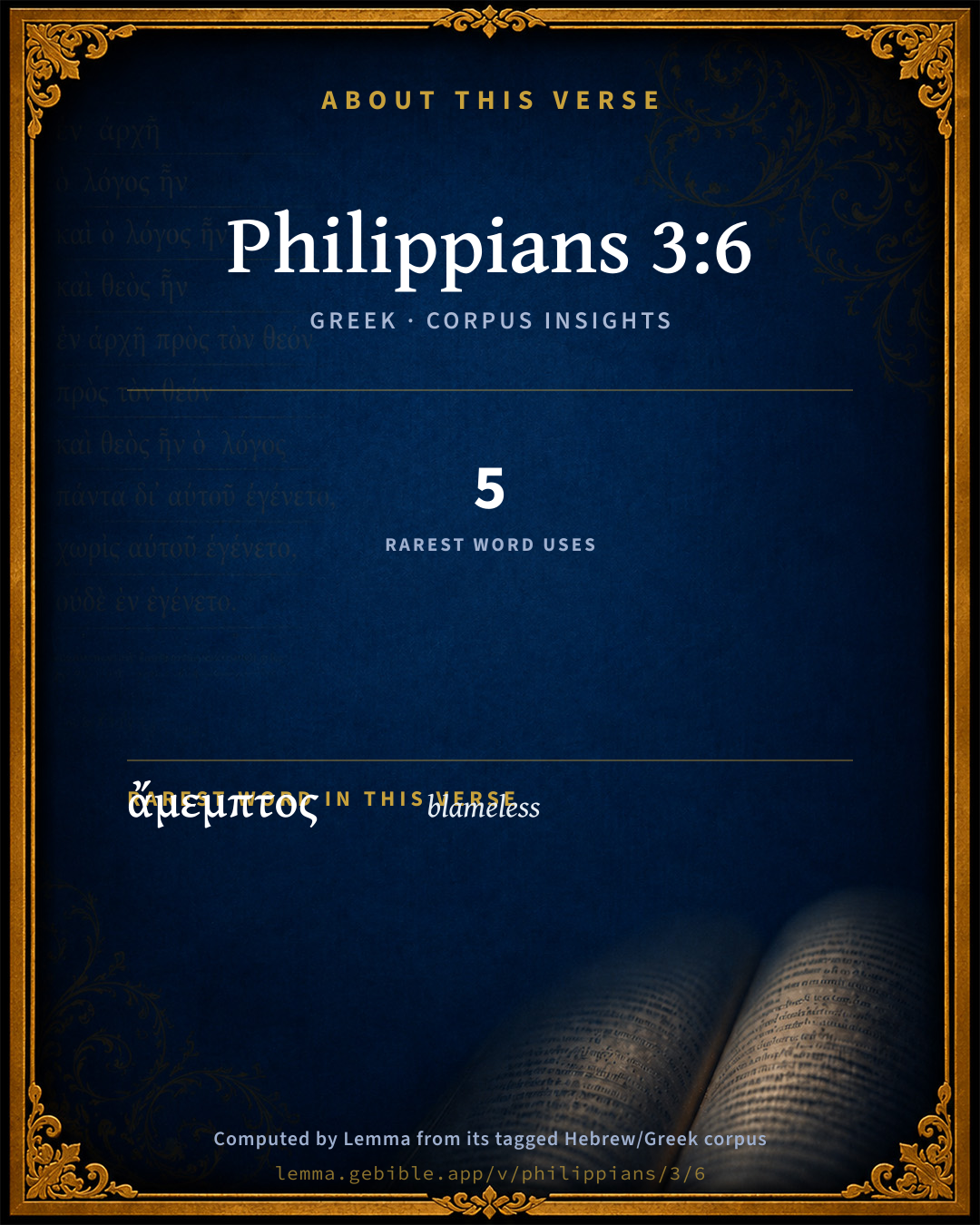
- Appears 5× in the Greek New Testament
- First appears at Luke 1:6
- Part of Speech
- Adjective
- Case
- Nominative
- Number
- Singular
- Gender
- Masculine
Full Thayer's Definition
- κατὰ katá G2596 “down” Preposition
- ζῆλος zēlos G2205 “zeal” Noun, Accusative, Singular, Neuter
- διώκων diṓkō G1377 “to persecute” Verb, Present, Active, Participle, Nominative, Singular, Masculine
- τὴν ho G3588 “the” Article, Accusative, Singular, Feminine
- ἐκκλησίαν ekklēsía G1577 “assembly” Noun, Accusative, Singular, Feminine
- κατὰ katá G2596 “down” Preposition
- δικαιοσύνην dikaiosýnē G1343 “righteousness” Noun, Accusative, Singular, Feminine
- τὴν ho G3588 “the” Article, Accusative, Singular, Feminine
- ἐν en G1722 “in” Preposition
- νόμῳ nómos G3551 “law” Noun, Dative, Singular, Masculine
- γενόμενος gínomai G1096 “to become” Verb, Aorist, Middle deponent, Participle, Nominative, Singular, Masculine
- ἄμεμπτος ámemptos G273 “blameless” Adjective, Nominative, Singular, Masculine
About this verse
These counts appear in no published source. They are computed here, from the morphology-tagged text and Lemma’s own curated glosses. What Lemma adds →
- 12
- words
- 10
- distinct lemmas
- Pauline Epistles
- section
Cross-references
19Topical passages linked to Philippians 3:6 in the Treasury of Scripture Knowledge — connected by theme and wording, ordered by reader-vote popularity; previews shown in the World English Bible.
- Galatians 1:13–14 For you have heard of my way of living in time past in the Jews' religion, how that beyond measure I persecuted the assembly of God, and ravaged it.
- Acts 8:3 But Saul ravaged the assembly, entering into every house, and dragged both men and women off to prison.
- Acts 26:9–10 "I myself most assuredly thought that I ought to do many things contrary to the name of Jesus of Nazareth.
- Acts 22:3–4 "I am indeed a Jew, born in Tarsus of Cilicia, but brought up in this city at the feet of Gamaliel, instructed according to the strict manner of the law of our fathers, being zealous for God, even as you all are this day.
- Matthew 5:20 For I tell you that unless your righteousness exceeds that of the scribes and Pharisees, there is no way you will enter into the Kingdom of Heaven.
- Acts 26:5 having known me from the first, if they are willing to testify, that after the strictest sect of our religion I lived a Pharisee.
- Romans 9:31–32 but Israel, following after a law of righteousness, didn't arrive at the law of righteousness.
- 2 Kings 10:16 He said, Come with me, and see my zeal for Yahweh. So they made him ride in his chariot.
- Matthew 23:25 "Woe to you, scribes and Pharisees, hypocrites! For you clean the outside of the cup and of the platter, but within they are full of extortion and unrighteousness.
- Mark 10:20–21 He said to him, "Teacher, I have observed all these things from my youth."
- Luke 1:6 They were both righteous before God, walking blamelessly in all the commandments and ordinances of the Lord.
- Acts 21:20 They, when they heard it, glorified God. They said to him, "You see, brother, how many thousands there are among the Jews of those who have believed, and they are all zealous for the law.
- Romans 7:9 I was alive apart from the law once, but when the commandment came, sin revived, and I died.
- 1 Corinthians 15:9 For I am the least of the apostles, who is not worthy to be called an apostle, because I persecuted the assembly of God.
- Philippians 3:9 and be found in him, not having a righteousness of my own, that which is of the law, but that which is through faith in Christ, the righteousness which is from God by faith;
- 1 Timothy 1:13 although I was before a blasphemer, a persecutor, and insolent. However, I obtained mercy, because I did it ignorantly in unbelief.
- 2 Samuel 21:2 The king called the Gibeonites, and said to them (now the Gibeonites were not of the children of Israel, but of the remnant of the Amorites; and the children of Israel had sworn to them: and Saul sought to kill them in his zeal for the children of Israel and Judah);
- Acts 9:1–19 But Saul, still breathing threats and slaughter against the disciples of the Lord, went to the high priest,
- Romans 10:2–5 For I testify about them that they have a zeal for God, but not according to knowledge.
Cross-references courtesy of OpenBible.info (CC BY 4.0).
Lesson kit
Teaching starters — assembled from the data on this page, not authored interpretation. Every prompt links to the verse data it draws on. Edit before teaching.
Philippians, in the Pauline Epistles, opens this verse with 12 words (10 distinct Greek lemmas). Its most distinctive word is ámemptos (“blameless”). A historical commentator’s framing appears above. Read the whole chapter for the surrounding context.
Discussion questions
- What does “blameless” (ámemptos) contribute to the verse as a whole?
- Luke 1:6 shares the word «blameless» with this verse. How do the two illuminate each other?
- “down” occurs 2× in this one verse. What is the effect of the repetition?
- These translations render this verse differently. What is at stake in choosing one wording over another?
- Reading how Joseph Benson's Commentary and Tyndale Open Study Notes read this verse, where do the two commentators agree and where do they part?
Things to notice
- These translations choose different wording for 9 words in this verse.
- “down” occurs 2× in this single verse.
- 10 distinct Greek lemmas span 12 words in this verse.
Commentary
Notes on Philippians 3:6 from classic Christian and Jewish commentators (each source and its license shown beneath its notes). The classic Christian expositions comment on the surrounding passage and are grouped to its opening verse, so a note may address several verses; the Jewish commentaries on the Tanakh (Rashi and others) are per-verse, so they appear only where the commentator wrote on this verse.
Lemma curates 59 commentaries, every one of them public domain or Creative Commons licensed, each selected and text-cleaned for this edition rather than reprinted as found. About our sources →
Joseph Benson's Commentary
Joseph Benson's Commentary on the Old and New Testaments (1811–1818) — public domain. Text from a community e-Sword module.
Tyndale Open Study Notes
Tyndale Open Resources
Tyndale Open Study Notes — © Tyndale Open Resources, licensed CC BY-SA 4.0. Text via the HelloAO Bible API.
Bengel's Gnomon
Johann Albrecht Bengel
Bengel's Gnomon of the New Testament — English translation (T&T Clark, Edinburgh, 1860) — public domain. Text from a community e-Sword module.
Expositor's Greek Testament
ed. W. Robertson Nicoll
The Expositor's Greek Testament, edited by W. Robertson Nicoll (1897–1910) — public domain. Text from a community e-Sword module.
Jamieson, Fausset & Brown
Robert Jamieson, A. R. Fausset & David Brown
Jamieson, Fausset & Brown — Commentary Critical and Explanatory on the Whole Bible (1871) — public domain (CC PDM 1.0). Text via the HelloAO Bible API.
Adam Clarke's Commentary
Adam Clarke's Commentary on the Bible (1810–1826) — public domain. Text from a community e-Sword/MySword module.
John Calvin's Commentaries
John Calvin's Commentaries (1540-1563) — public domain. Text from the Calvin Translation Society English edition (1840s-50s) via the Christian Classics Ethereal Library (ccel.org). Calvin's coverage is partial (roughly two-thirds of the Bible); uncommented books and verses are honest gaps, never fabricated. The 19th-century editor's footnotes and remarks are omitted so the notes are faithfully Calvin's own voice.
Ellicott's Commentary for English Readers
A Bible Commentary for English Readers, edited by Charles John Ellicott (1878–1897) — public domain. Text from a community e-Sword module.
The Cambridge Bible for Schools and Colleges
gen. ed. J. J. S. Perowne
The Cambridge Bible for Schools and Colleges (gen. ed. J. J. S. Perowne; Cambridge University Press, 1878–1918) — public domain. Text from a community e-Sword module.
John Gill's Exposition
John Gill's Exposition of the Whole Bible (1746–1763) — public domain (CC PDM 1.0). Text via the HelloAO Bible API.
Trapp's Complete Commentary
John Trapp
John Trapp, A Commentary or Exposition upon All the Books of the Old and New Testament (1647–1656) — public domain. Text from a community e-Sword module.
Albert Barnes' Notes on the Bible
Albert Barnes' Notes on the Bible (1834–1885) — public domain. Text from a community e-Sword/MySword module.
Matthew Poole's English Annotations
Matthew Poole's English Annotations on the Holy Bible (1683–1685) — public domain. Text from a community e-Sword/MySword module.
Whedon's Commentary on the Bible
Daniel D. Whedon
Daniel D. Whedon (gen. ed.), Commentary on the Old and New Testaments (1874–1909) — public domain. Text from a community e-Sword module.
The Pulpit Commentary
The Pulpit Commentary (1880–1919), ed. H.D.M. Spence-Jones & Joseph S. Exell — public domain. Text from a community e-Sword module.
John Wesley's Explanatory Notes
John Wesley, Explanatory Notes Upon the Whole Bible (1754–1765) — public domain. Text via the GEBible commentary corpus.
Scofield Reference Notes
C. I. Scofield
The Scofield Reference Bible (1917 edition), notes by C. I. Scofield — public domain. Text from a community e-Sword module.
The People's New Testament
B. W. Johnson
B. W. Johnson's The People's New Testament with Notes (1889–1891) — public domain. Electronic text from the Christian Classics Ethereal Library (CCEL) ThML edition.
unfoldingWord translationNotes
Door43 World Missions Community
unfoldingWord translationNotes — © Distant Shores Media and the Door43 World Missions Community, licensed CC BY-SA 4.0. Source: git.door43.org/Door43/en_tn.
Cambridge Greek Testament for Schools and Colleges
Cambridge Greek Testament for Schools and Colleges (Cambridge University Press, 1896; 21 vols, various authors incl. Carr, Maclear, Plummer, Farrar, Lumby, Moule, M. R. James, Simcox) — public domain. Text from a community e-Sword module.
International Critical Commentary
International Critical Commentary — older volumes (1896–1929), various authors — public domain. Text from a community e-Sword module.
Vincent's Word Studies in the New Testament
Marvin R. Vincent
Marvin R. Vincent, Word Studies in the New Testament (1887–1900) — public domain. Text from a community e-Sword/MySword module.