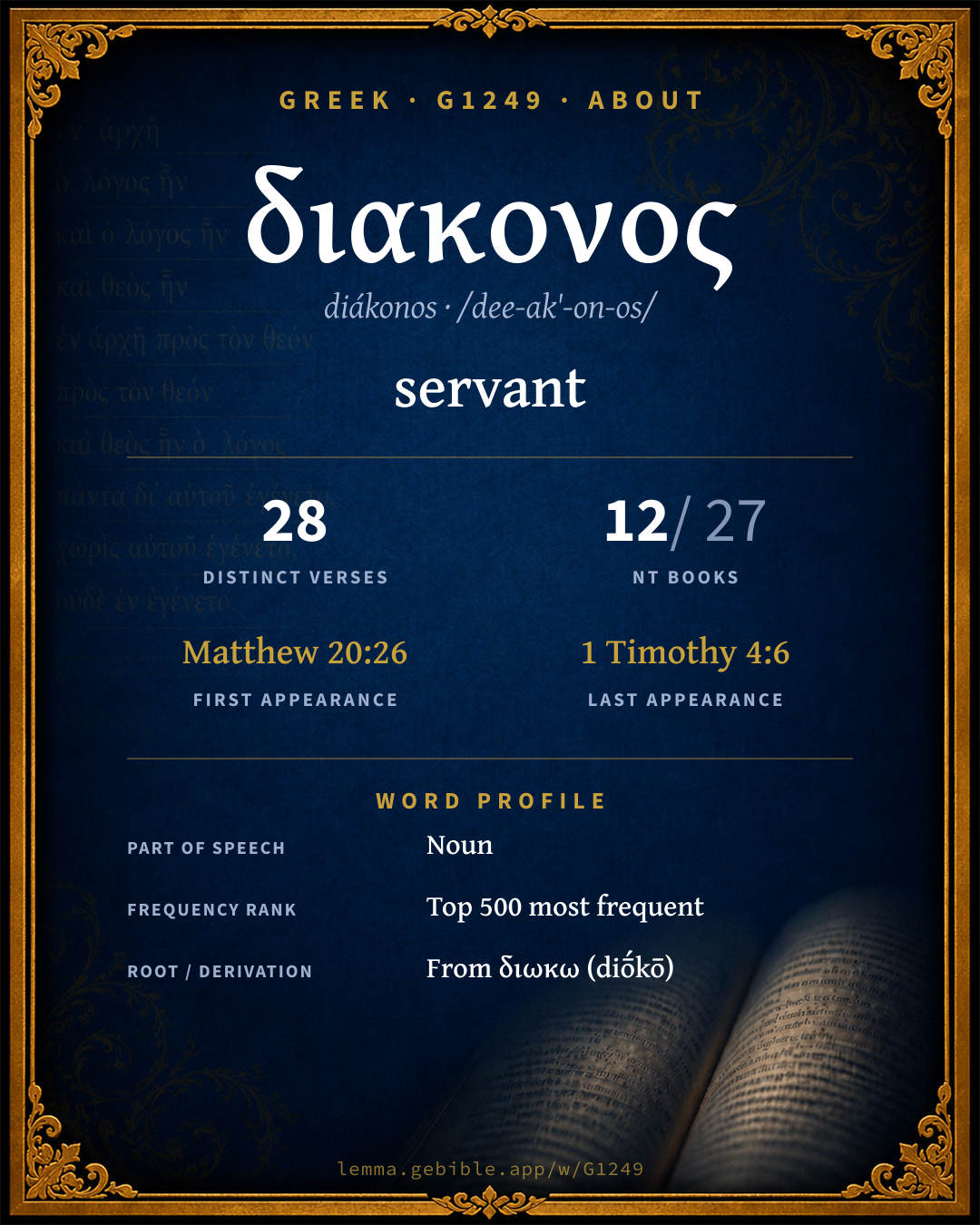
διάκονος
servant
Full lexicon entry — Thayer's Greek Lexicon
From Thayer's Greek Lexicon
Where this word appears
See every Nominative-case word in the Greek New Testament →
Grammar key — what these labels mean
Part of speech
- Noun
- A naming word — a person, place, thing, or idea.
Case
- Nominative
- The case of the subject (and the predicate nominative).
- Dative
- The case of the indirect object, means, or location — “to / for / with / in.”
- Accusative
- The case of the direct object and of extent.
Gender
- Masculine
- Grammatically masculine.
- Feminine
- Grammatically feminine.
Number
- Singular
- One.
- Plural
- More than one.
Grammatical forms
- Noun, Nominative, Singular, Masculine 15 times (50%)
- Noun, Nominative, Plural, Masculine 7 times (23%)
- Noun, Dative, Plural, Masculine 3 times (10%)
- Noun, Accusative, Plural, Masculine 2 times (7%)
- Noun, Accusative, Singular, Masculine 2 times (7%)
- Noun, Accusative, Singular, Feminine 1 time (3%)
Parsed forms decoded from the imported morphology (Robinson–Tischendorf, public domain), counted across 30 parsed occurrences — not distinct verses.
Every verse where G1249 appears — 28 distinct verses across 12 books. Click any verse to open its interlinear word-by-word view. Verse text shown in the World English Bible for context — . Each verse’s Greek form is shown with its reference; the English is not keyword-highlighted, since the data carries no word-level English alignment. Use “Compare translations” on any verse to read it across multiple English versions. This concordance covers the Greek New Testament; Septuagint (Greek Old Testament) occurrences of this word are not indexed here.
Matthew 3 verses
- Matthew 20:26 διάκονος n nom sg masc It shall not be so among you, but whoever desires to become great among you shall be your servant.
- Matthew 22:13 διακόνοις n dat pl masc Then the king said to the servants, 'Bind him hand and foot, take him away, and throw him into the outer darkness; there is where the weeping and grinding of teeth will be.'
- Matthew 23:11 διάκονος n nom sg masc But he who is greatest among you will be your servant.
Mark 2 verses
- Mark 9:35 διάκονος n nom sg masc He sat down, and called the twelve; and he said to them, "If any man wants to be first, he shall be last of all, and servant of all."
- Mark 10:43 διάκονος n nom sg masc But it shall not be so among you, but whoever wants to become great among you shall be your servant.
John 3 verses
- John 2:5 διακόνοις n dat pl masc His mother said to the servants, "Whatever he says to you, do it."
- John 2:9 διάκονοι n nom pl masc When the ruler of the feast tasted the water now become wine, and didn't know where it came from (but the servants who had drawn the water knew), the ruler of the feast called the bridegroom,
- John 12:26 διάκονος n nom sg masc If anyone serves me, let him follow me. Where I am, there will my servant also be. If anyone serves me, the Father will honor him.
Romans 3 verses
- Romans 13:4 διάκονός διάκονός n nom sg masc n nom sg masc for he is a servant of God to you for good. But if you do that which is evil, be afraid, for he doesn't bear the sword in vain; for he is a minister of God, an avenger for wrath to him who does evil.
- Romans 15:8 διάκονον n acc sg masc Now I say that Christ has been made a minister of the circumcision for the truth of God, that he might confirm the promises given to the fathers,
- Romans 16:1 διάκονον n acc sg fem I commend to you Phoebe, our sister, who is a servant of the assembly that is at Cenchreae,
1 Corinthians 1 verse
2 Corinthians 4 verses
- 2 Corinthians 3:6 διακόνους n acc pl masc who also made us sufficient as servants of a new covenant; not of the letter, but of the Spirit. For the letter kills, but the Spirit gives life.
- 2 Corinthians 6:4 διάκονοι n nom pl masc but in everything commending ourselves, as servants of God, in great endurance, in afflictions, in hardships, in distresses,
- 2 Corinthians 11:15 διάκονοι διάκονοι n nom pl masc n nom pl masc It is no great thing therefore if his ministers also masquerade as servants of righteousness, whose end will be according to their works.
- 2 Corinthians 11:23 διάκονοι n nom pl masc Are they servants of Christ? (I speak as one beside himself) I am more so; in labors more abundantly, in prisons more abundantly, in stripes above measure, in deaths often.
Galatians 1 verse
Ephesians 2 verses
- Ephesians 3:7 διάκονος n nom sg masc of which I was made a servant, according to the gift of that grace of God which was given me according to the working of his power.
- Ephesians 6:21 διάκονος n nom sg masc But that you also may know my affairs, how I am doing, Tychicus, the beloved brother and faithful servant in the Lord, will make known to you all things;
Philippians 1 verse
Colossians 4 verses
- Colossians 1:7 διάκονος n nom sg masc even as you learned of Epaphras our beloved fellow servant, who is a faithful minister of Christ on our behalf,
- Colossians 1:23 διάκονος n nom sg masc if it is so that you continue in the faith, grounded and steadfast, and not moved away from the hope of the Gospel which you heard, which is being proclaimed in all creation under heaven; of which I, Paul, was made a servant.
- Colossians 1:25 διάκονος n nom sg masc of which I was made a servant, according to the stewardship of God which was given me toward you, to fulfill the word of God,
- Colossians 4:7 διάκονος n nom sg masc All my affairs will be made known to you by Tychicus, the beloved brother, faithful servant, and fellow bondservant in the Lord.
1 Thessalonians 1 verse
1 Timothy 3 verses
- 1 Timothy 3:8 διακόνους n acc pl masc Deacons, in the same way, must be reverent, not double-tongued, not addicted to much wine, not greedy for money;
- 1 Timothy 3:12 διάκονοι n nom pl masc Let deacons be husbands of one wife, ruling their children and their own houses well.
- 1 Timothy 4:6 διάκονος n nom sg masc If you instruct the brothers of these things, you will be a good servant of Christ Jesus, nourished in the words of the faith, and of the good doctrine which you have followed.
About this entry
At a glance — auto-summarized from this page’s data, not written by a person. Every figure links to its source below. This summary describes the numbers; it doesn’t interpret them.
διακονος (diákonos) is a Greek noun most often rendered “servant.” Its English rendering has broadened — “minister” classically, “servant” (Berean Standard Bible) in modern versions; see the renderings breakdown. Spanning 28 verses in 12 books, it ranks among the moderately common words of the Greek New Testament. It first appears in Matthew 20:26. Related forms include διωκω, διωγμος and διωκτης. For the data behind this summary, explore the sense tree and the renderings breakdown below.
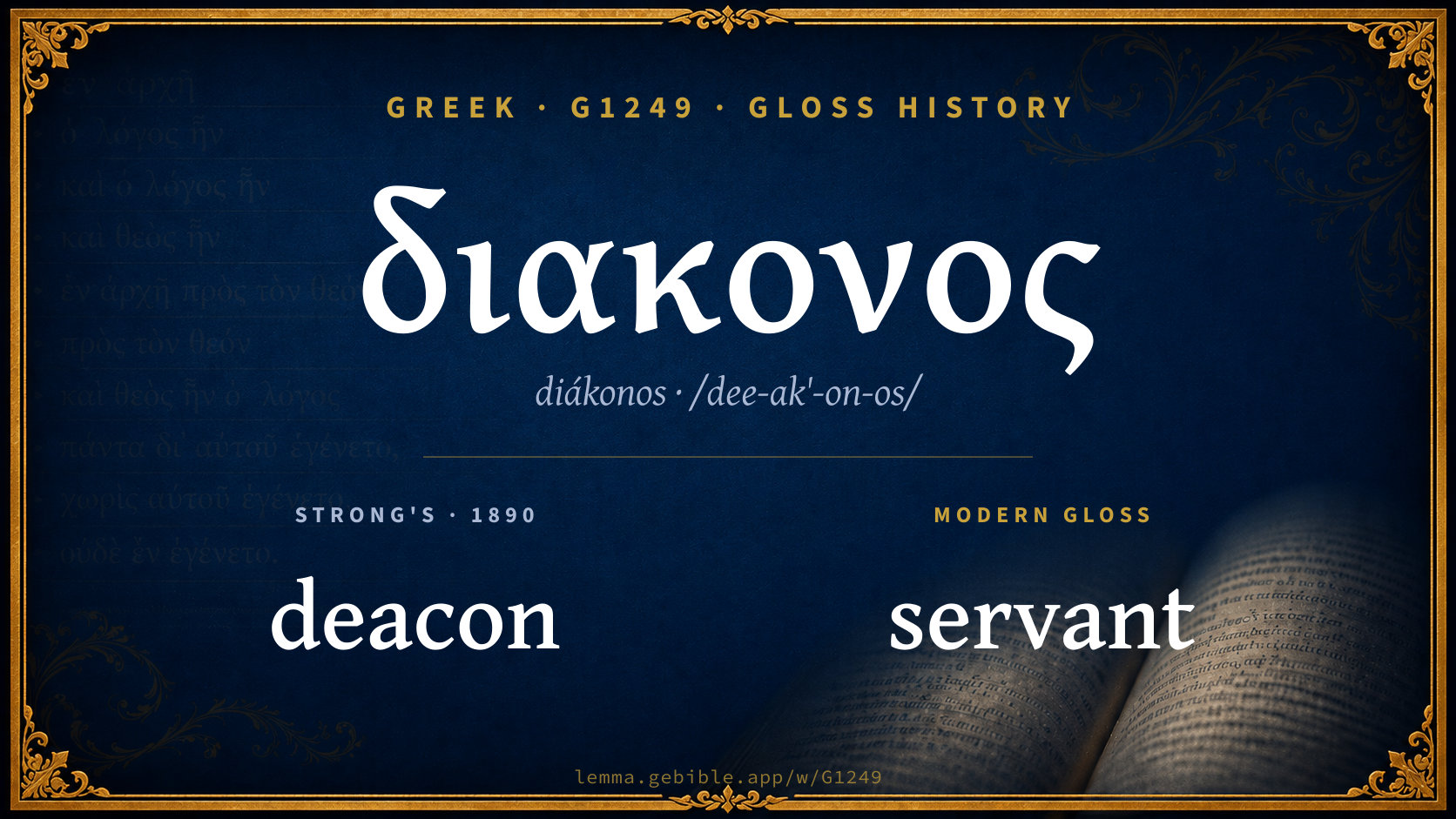
Gloss history
Strong's 1890 vs modern scholarship
About this word
Strong's G1249 catalogs a Greek word from the Greek New Testament.
These counts are not copied from any lexicon or concordance. They are computed here, from the morphology-tagged Greek New Testament. What Lemma adds →
- 28
- distinct verses
- The word appears in 28 distinct verses.
- 12 / 27
- NT books
- The word appears in 12 of 27 New Testament books.
- #463
- by frequency
- Top 500 most frequent Greek words (rank 463 of 5,347 Greek words by occurrence).
View all 28 occurrences in the concordance →
Most concentrated in
- 2 Corinthians 4 verses 14%
- Colossians 4 verses 14%
- Matthew 3 verses 11%
By section of the New Testament
By traditional corpus
Conventional, traditional groupings — biblical authorship is debated, so this is a traditional corpus grouping, not an authorship claim. Some books belong to more than one corpus (Luke is in both the Gospels and the Lukan corpus, and so on), so these shares overlap and need not total 100%. Each figure is a share of the word’s 28 distinct verses.
- Pauline corpus 20 verses · 71%
- Gospels 8 verses · 29%
- Johannine 3 verses · 11%
How translations render this word
Counts come from each version’s own published word-to-Strong’s tagging or interlinear alignment — an approximate guide to how each version renders this word, not a word-level alignment the data otherwise carries. Because each total is that version’s own tagged count, the per-version totals vary from one another and need not match the appearance or distinct-verse counts above. These counts may also differ from a printed concordance because Lemma counts each distinctly tagged rendering and does not collapse phrase taggings into a single head-word total. This is a fixed set of word-tagged versions (KJV, ASV, BSB, ULT) and does not change with the reading translation you choose elsewhere. Each version’s license is shown beside its name below (and on Sources).
- King James Version: Minister 14×, Ministers 6×, Servant 4×
- American Standard Version: Minister 12×, Ministers 5×, Servant 4×
- Berean Standard Bible: Servant 14×, Servants 8×, Minister 3×
- unfoldingWord Literal Text: Servant 17×, Servants 9×, Deacons 3×
King James Version Public Domain
Renders G1249 across 30 tagged occurrences — most commonly:
Plus 1 rendering that appears only once — usually multi-word phrases or single function words the recovered tagging swept in, not distinct renderings.
American Standard Version Public Domain
Renders G1249 across 30 tagged occurrences — most commonly:
Plus 3 renderings that appear only once — usually multi-word phrases or single function words the recovered tagging swept in, not distinct renderings.
Berean Standard Bible Public Domain
Renders G1249 across 29 tagged occurrences — most commonly:
Plus 2 renderings that appear only once — usually multi-word phrases or single function words the recovered tagging swept in, not distinct renderings.
unfoldingWord Literal Text CC BY-SA 4.0
Renders G1249 across 32 tagged occurrences — most commonly:
Plus 1 rendering that appears only once — usually multi-word phrases or single function words the recovered tagging swept in, not distinct renderings.
Senses in Thayer's
The 1 sense Thayer's distinguishes for this word, in lexicon order (not ranked by frequency or importance). The full entry — with sub-senses — is in the Lexicon Entry tab.
- one who executes the commands of another, esp. of a master, a servant, attendant, minister
Word origin
Derived from διωκω (diṓkō) (G1377) — to persecute.
Probably from διάκω diakō (obsolete to run on errands; compare G1377 ); an attendant that is (generally) a waiter (at table or in other menial duties); specifically a Christian teacher and pastor (technically a deacon or deaconess ): - deacon minister servant.
— Strong’s Exhaustive Concordance (1890), public domain.
Forms in the corpus
The 6 distinct written forms G1249 takes in the Greek New Testament, most frequent first — each parse links to that case’s occurrences in the concordance.
| Form | Parsing | Example | Uses |
|---|---|---|---|
| διάκονος diákonos | Noun, Nominative, Singular, Masculine | Matthew 20:26 | 13 |
| διάκονοι diákonoi | Noun, Nominative, Plural, Masculine | John 2:9 | 7 |
| διάκονον diákonon | Noun, Accusative, Singular, Masculine | Romans 15:8 | 3 |
| διακόνοις diakónois | Noun, Dative, Plural, Masculine | Matthew 22:13 | 3 |
| διάκονός diákonós | Noun, Nominative, Singular, Masculine | Romans 13:4 | 2 |
| διακόνους diakónous | Noun, Accusative, Plural, Masculine | 2 Corinthians 3:6 | 2 |
Same root — word family
Other Thayer's entries built from the same root as G1249, grouped by Strong’s listed origin. These share a root / origin per the lexicon — not necessarily a shared meaning. Each links to that word’s own entry.
Derives from
Shares the same root
Derived from this word
Compare all same-root words → Showing 4 of 6 — not the complete family. They share a root, not necessarily a meaning.
Septuagint usage
The same Greek word διακονος appears 5 times in the Greek Old Testament (Septuagint), across 5 verses in 2 books.
- 5
- LXX occurrences
- Tagged occurrences of this Greek word in the Septuagint.
- 5
- verses
- Distinct Septuagint verses containing this word.
- 2 / 39
- OT books
- The word appears in 2 of the 39 Old Testament books.
Sample Septuagint occurrences
- Esther 1:10 διάκονος
- Proverbs 10:4 διάκονος
Septuagint occurrences (same lexeme)
Every verse where the same Strong’s number (G1249) appears in the Greek Septuagint. Verse text shown in the World English Bible for context; the Greek form is the matched word — the English is not keyword-highlighted.
- Esther 1:10 διάκονος On the seventh day, when the heart of the king was merry with wine, he commanded Mehuman, Biztha, Harbona, Bigtha, and Abagtha, Zethar, and Carcass, the seven chamberlains who ministered in the presence of Ahasuerus the king,
- Esther 2:2 διάκονος Then said the king's servants who ministered to him, Let there be beautiful young virgins sought for the king:
- Esther 6:3 διάκονος The king said, What honor and dignity has been bestowed on Mordecai for this? Then the king's servants who ministered to him said, "Nothing has been done for him."
- Esther 6:5 διάκονος The king's servants said to him, Behold, Haman stands in the court. The king said, Let him come in.
- Proverbs 10:4 διάκονος He becomes poor who works with a lazy hand, But the hand of the diligent brings wealth.
These are occurrences of the same Greek lexeme (G1249) in the Septuagint — not a translation of any one Hebrew word. The store carries no word-level Hebrew↔Greek alignment, so no Hebrew original is asserted here. Counts come from the recovered LXX Strong's tagging — high-frequency vocabulary is well covered, while rare or late forms may be untagged — so they reflect tagged occurrences and may slightly undercount.