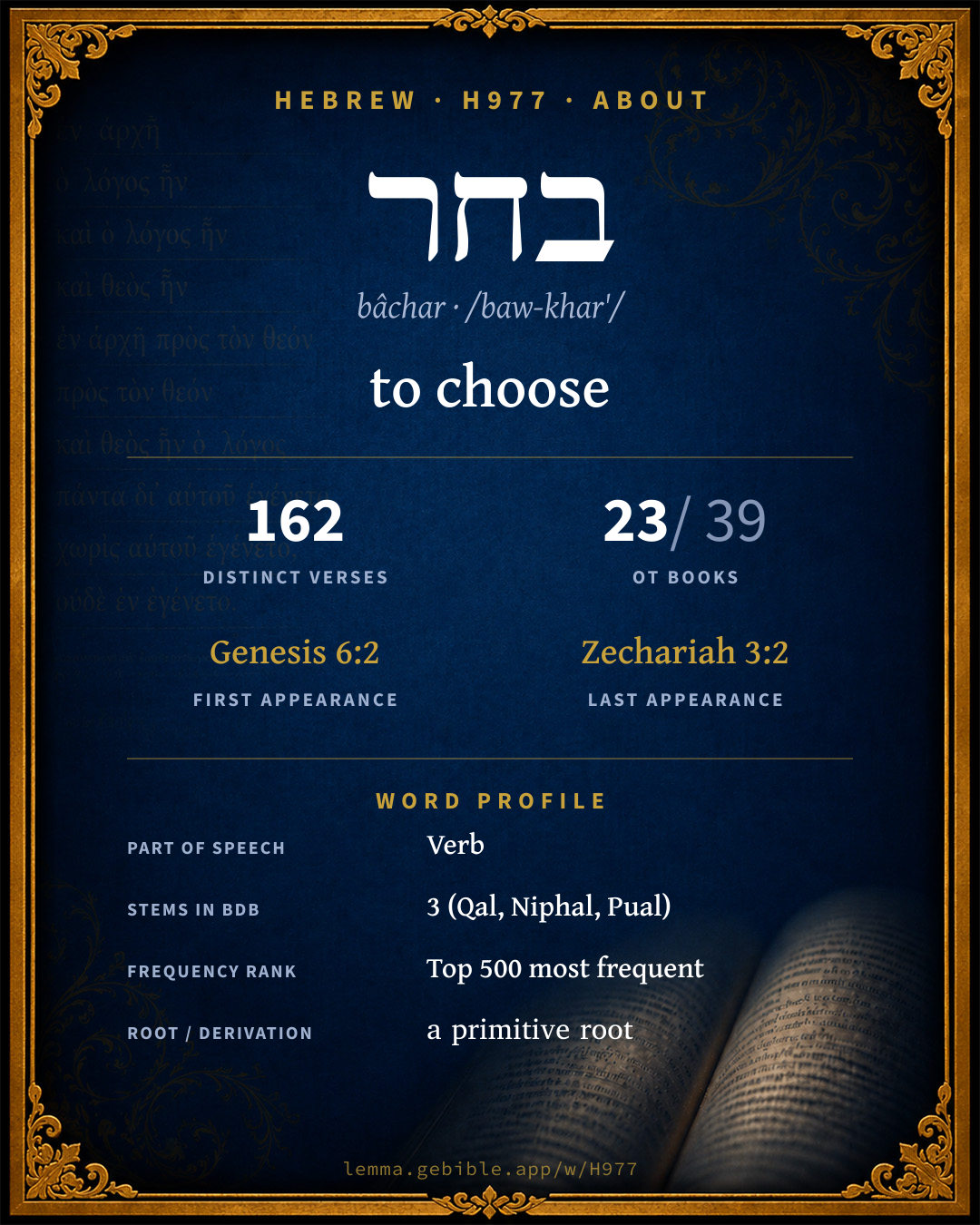
בָּחַר
to choose
also: elect, decide for fuller range ↓
Full lexicon entry — Brown-Driver-Briggs (BDB)
From Brown-Driver-Briggs (BDB)
Where this word appears
See every Niphal verb in the Hebrew Bible →
Grammar key — what these labels mean
Part of speech
- Verb
- An action or state-of-being word.
Stem
- Qal
- The basic, simple active stem — the plain form of the verb (“he wrote”). Here: ‘with’
- Niphal
- Usually the simple passive or reflexive of the Qal (“he was written”). Here: ‘cstr.’
- Pual
- The passive counterpart of the Piel.
- Qal Passive
- An archaic passive of the Qal, preserved in a few forms.
Form
- Imperfect
- An incomplete, ongoing, or future action (“he will / would write”).
- Perfect
- A completed action or state — Hebrew marks aspect (completeness) more than strict tense (“he wrote”).
- Sequential Imperfect
- An imperfect with prefixed waw — the standard past-narrative form (waw-consecutive imperfect).
- Participle Passive
- A verbal adjective expressing action received (“written”).
- Participle Active
- A verbal adjective expressing ongoing or characteristic action (“writing / one who writes”).
- Infinitive Absolute
- An unbound verbal noun, often intensifying or standing in for a finite verb.
- Sequential Perfect
- A perfect with prefixed waw continuing a preceding imperfect or command (waw-consecutive perfect).
- Imperative
- A direct command (“write!”).
- Cohortative
- A first-person volitional form expressing wish or resolve (“let me / let us write”).
- Jussive
- A third- or second-person volitional form expressing wish or command (“let him write”).
- Infinitive Construct
- A bound verbal noun, frequently with prepositions (“to write / in writing”).
State
- Absolute
- The independent form of a noun, not bound to a following word.
- Construct
- A noun bound to a following noun in a possessive / “of” relationship (the construct chain).
Person
- 3rd Person
- The one spoken about (“he / she / it / they”).
- 1st Person
- The speaker (“I / we”).
- 2nd Person
- The one addressed (“you”).
Gender
- Masculine
- Grammatically masculine.
- Common
- Either gender — not distinguished for this form.
- Feminine
- Grammatically feminine.
Number
- Singular
- One.
- Plural
- More than one (in Hebrew, generally three or more).
Every verse where H977 appears in the Book of Proverbs — 8 distinct verses. Click any verse to open its interlinear word-by-word view. Verse text shown in the World English Bible for context — . Each verse’s Hebrew form is shown with its reference; the English is not keyword-highlighted, since the data carries no word-level English alignment. Use “Compare translations” on any verse to read it across multiple English versions. This concordance covers the Hebrew Bible; Septuagint (Greek Old Testament) occurrences are not indexed here.
Proverbs
- Proverbs 1:29 בָחָֽרוּ Qal pf 3cp Because they hated knowledge, And didn't choose the fear of Yahweh.
- Proverbs 3:31 תִּ֝בְחַ֗ר Qal juss 2ms Don't envy the man of violence. Choose none of his ways.
- Proverbs 8:10 נִבְחָֽר Niphal ptcp.act ms Receive my instruction rather than silver; Knowledge rather than choice gold.
- Proverbs 8:19 נִבְחָֽר Niphal ptcp.act ms My fruit is better than gold, yes, than fine gold; My yield than choice silver.
- Proverbs 10:20 נִ֭בְחָר Niphal ptcp.act ms The tongue of the righteous is like choice silver. The heart of the wicked is of little worth.
- Proverbs 16:16 נִבְחָ֥ר Niphal ptcp.act ms How much better it is to get wisdom than gold! Yes, to get understanding is to be chosen rather than silver.
- Proverbs 21:3 נִבְחָ֖ר Niphal ptcp.act ms To do righteousness and justice Is more acceptable to Yahweh than sacrifice.
- Proverbs 22:1 נִבְחָ֣ר Niphal ptcp.act ms A good name is more desirable than great riches, And loving favor is better than silver and gold.
About this entry
At a glance — auto-summarized from this page’s data, not written by a person. Every figure links to its source below. This summary describes the numbers; it doesn’t interpret them.
“to choose” is the headline sense of the Hebrew verb בחר (bâchar). Where the King James Version says “i have chosen,” newer translations reach for “will choose” (Berean Standard Bible); the renderings breakdown has the detail. The Hebrew Bible uses it across 162 verses — common. First canonically at Genesis 6:2, it enters the text early. Different stems carry different senses — BDB groups them under 3 stems, among them Qal and Niphal. The sections below give every sense, occurrence, and version rendering.
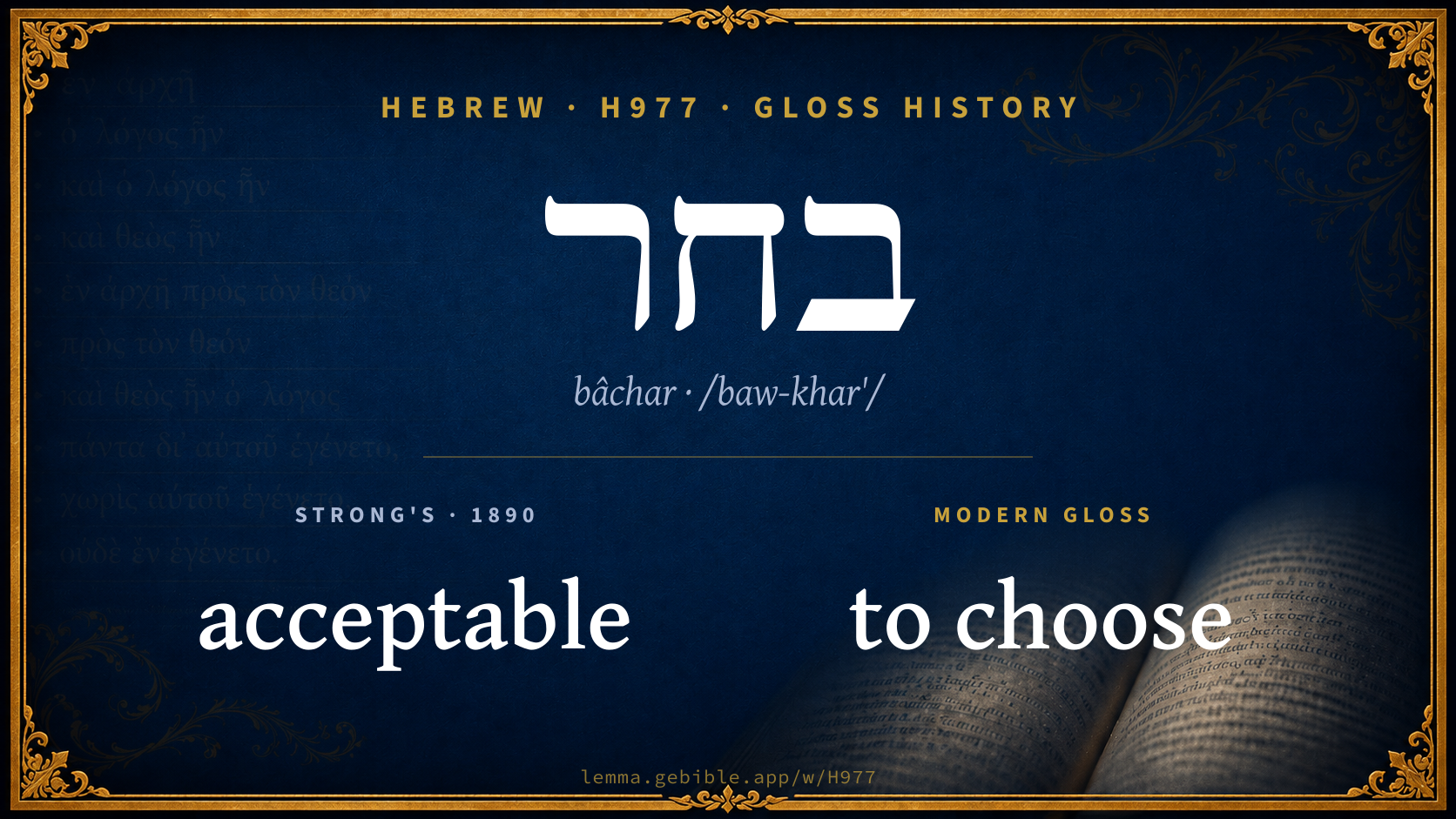
Gloss history
Strong's 1890 vs modern scholarship
About this word
Strong's H977 catalogs a Hebrew word from the Hebrew Old Testament.
These counts are not copied from any lexicon or concordance. They are computed here, from the morphology-tagged Hebrew Old Testament. What Lemma adds →
- 162
- distinct verses
- The word appears in 162 distinct verses.
- 23 / 39
- OT books
- The word appears in 23 of 39 Old Testament books.
- #271
- by frequency
- Top 500 most frequent Hebrew words (rank 271 of 8,640 Hebrew words by occurrence).
View all 162 occurrences in the concordance →
Most concentrated in
- Deuteronomy 31 verses 19%
- Isaiah 19 verses 12%
- 2 Chronicles 13 verses 8%
By section of the Old Testament
By traditional corpus
Conventional, traditional groupings — biblical authorship is debated, so this is a traditional corpus grouping, not an authorship claim. Each share is this word’s portion of its verses in that division of the Hebrew canon. Each figure is a share of the word’s 162 distinct verses.
- Prophets (Nevi'im) 70 verses · 43%
- Writings (Ketuvim) 53 verses · 33%
- Torah (Pentateuch) 39 verses · 24%
How translations render this word
Counts come from each version’s own published word-to-Strong’s tagging or interlinear alignment — an approximate guide to how each version renders this word, not a word-level alignment the data otherwise carries. Because each total is that version’s own tagged count, the per-version totals vary from one another and need not match the appearance or distinct-verse counts above. These counts may also differ from a printed concordance because Lemma counts each distinctly tagged rendering and does not collapse phrase taggings into a single head-word total. This is a fixed set of word-tagged versions (KJV, ASV, BSB, ULT) and does not change with the reading translation you choose elsewhere. Each version’s license is shown beside its name below (and on Sources).
BDB lists this Strong’s number as 2 distinct words (homographs). Each count above pools all of them and is not split by sense — see the Senses section below. A low-frequency rendering may belong to a different one of those words, not the primary meaning.
- King James Version†: I have chosen 19×, Shall choose 18×, Hath chosen 14×
- American Standard Version†: Shall choose 20×, I have chosen 14×, Chosen 12×
- Berean Standard Bible†: Will choose 19×, I have chosen 17×, Chosen 16×
- unfoldingWord Literal Text†: Will choose 19×, I have chosen 18×, Choose 17×
King James Version Public Domain
Renders H977 across 171† tagged occurrences — most commonly:
Plus other, less common renderings. Plus 54 renderings that appear only once — usually multi-word phrases or single function words the recovered tagging swept in, not distinct renderings. Not rendered by a distinct English word in 1 further occurrence.
American Standard Version Public Domain
Renders H977 across 171† tagged occurrences — most commonly:
Plus other, less common renderings. Plus 57 renderings that appear only once — usually multi-word phrases or single function words the recovered tagging swept in, not distinct renderings.
Berean Standard Bible Public Domain
Renders H977 across 171† tagged occurrences — most commonly:
Plus other, less common renderings. Plus 28 renderings that appear only once — usually multi-word phrases or single function words the recovered tagging swept in, not distinct renderings. Not rendered by a distinct English word in 1 further occurrence.
unfoldingWord Literal Text CC BY-SA 4.0
Renders H977 across 189† tagged occurrences — most commonly:
Plus other, less common renderings. Plus 26 renderings that appear only once — usually multi-word phrases or single function words the recovered tagging swept in, not distinct renderings.
21 senses and sub-senses in the full BDB
Hebrew verbs can shift meaning by stem (binyan): Qal is the basic action, Niphal is often passive or reflexive, Piel often intensifies or makes it factitive, and Hiphil is typically causative. The senses below are grouped under the stem BDB assigns to each. This entry also uses Pual (the passive of Piel).
What do BDB’s symbols mean?
BDB uses these scholarly abbreviations:
| Symbol | Meaning |
|---|---|
| 𝔊 | the Septuagint (the ancient Greek translation, LXX) |
| 𝔙 | the Vulgate (the Latin translation) |
| 𝔖 | the Syriac version (the Peshitta) |
| 𝔗 | the Targum (the Aramaic translation) |
| ψ | the Psalms |
| √ | root (the underlying root or stem) |
| ‖ | parallel passage (a synonymous or contrasted parallel) |
| † | the dagger: every passage where the word occurs is cited |
The 21 senses and sub-senses the full Brown-Driver-Briggs lexicon distinguishes for this word, in lexicon order (not ranked by frequency), with BDB’s own verbatim wording and sub-sense lettering. Shown in Hebrew script with BDB’s own scholarly abbreviations. The condensed entry is in the Lexicon Entry tab. See also the Forms in the corpus table below.
בחר I choose (cf. Aramaic בְּחַר, Syriac ܒܚܰܪ ‖ בחן, Assyrian bêru (√ באר) DlPr 76)
Qal
- Pf. בָּחַר Dt 7:6 +; Impf. יִבְחַר Is 41:24 + 60 times; אֶבֲחַר Jb 29:25 (Baer); Imv. בְּחַר Ex 17:9 + 5 times; Inf. abs. בָּחוֹר 1 S 2:28 Is 7:15, 16; Inf. cstr. sf. בָּהֳרִי Ez 20:5; Pt. בֹּחֵר 1 S 20:30 Zc 3:2; pass. בָּחוּר Ex 14:7 + 18 times;— e.g. Deuteronomy 7:6
- 1. with בְּ,
- a. divine choice, of Abraham Ne 9:7; Israel Dt 7:7 Is 44:1 Ez 20:5; to become his people Dt 7:6; 14:2; Jeshurun Is 44:2; the seed of the patriarchs Dt 4:37; 10:15; Levites Dt 18:5; 21:5 1 Ch 15:2 2 Ch 29:11; Aaron ψ 105:26; Judah 1 Ch 28:4 not Ephraim ψ 78:67; Levi and Judah Je 33:24; the king Dt 17:15, especially David 1 S 10:24; 16:8, 9, 10 2 S 6:21 1 K 8:16 (= 2 Ch 6:6) 1 Ch 28:4, 5; 29:1 2 Ch 6:5 ψ 78:70; others Nu 16:5; 17:20 (P) Hg 2:23; place of sacrifice Dt 12:11, 18; 14:25; 16:7, 15; 17:8 2 Ch 7:12; the city 1 K 8:16, 44 (= 2 Ch 6:5, 34) 11:32; Jerusalem 2 Ch 6:6 Is 14:1 Zc 1:17; 2:16; 3:2; Zion ψ 132:13; delusions Is 66:4. e.g. Nehemiah 9:7
- b. man’s choice, of ways Pr 3:31 Is 66:3; good things Is 7:15, 16 ψ 84:11 (?); life Dt 30:19; gods Ju 10:14 Is 41:24; God’s pleasure Is 56:4; 65:12; 66:4. e.g. Proverbs 3:31
- 2. with אֲשֶׁר (alone, for אשׁר בחר ב׳):
- a. divine choice, of Israel Is 41:8 יַעֲקֹב אֲשֶׁר בְּחַרְתִּיךָ, 43:10; the people 1 K 3:8 ψ 33:12; men Nu 16:7 (P) ψ 65:5; king 2 S 16:18 1 K 11:34; place of sacrifice Dt 12:14, 26; 15:20; 17:10; 31:11 (D) Jos 9:27 (P), especially לָשׂוּם שְׁמוֹ שָׁם Dt 12:5, 21; 14:24, לְשַׁכֵּן שְׁמוֹ שָׁם Dt 12:11; 14:23; 16:2, 6, 11 Ne 1:9; the city 1 K 8:48 (= 2 Ch 6:38), לשׂום שׁמי שׁם 1 K 11:36; 14:21 (= 2 Ch 12:13); Jerusalem 1 K 11:13 2 K 21:7 (= 2 Ch 33:7) 23:27; fast Is 58:5, 6; way ψ 25:12. e.g. Isaiah 41:8
- b. man’s choice, place to dwell in Dt 23:7; gardens Is 1:29; king 1 S 12:13; wives Gn 6:2 (J); what to do 2 S 15:15. e.g. Deuteronomy 23:7
- 3. with acc. & לְ, choose some one or something for:
- a. divine choice, of Levi 1 S 2:28; Jacob ψ 135:4, 5; inheritance ψ 47:5. e.g. 1 Samuel 2:28
- b. human choice, persons Ex 17:9 Jos 24:15, 22 (E) 1 S 8:18; 13:2 2 S 24:12 (= 1 Ch 21:20); things Gn 13:11 (J) 1 S 17:40 1 K 18:23, 25 Jb 34:4. e.g. Exodus 17:9
- 4. with acc. and מִן, choose, select from 2 S 10:9 (= 1 Ch 19:10). e.g. 2 Samuel 10:9
- 5. acc.
- a. divine choice, temple 2 Ch 7:16; Judah ψ 78:68; servant Is 41:9; 49:7. e.g. 2 Chronicles 7:16
- b. man’s choice, persons Ex 18:25 (E) Ju 5:8 Jos 8:3 (J) 2 S 17:1; things Jb 7:15; 9:14; 15:5; 29:25; 34:33; ψ 119:30, ψ 119:173, Pr 1:29 Is 40:20. e.g. Exodus 18:25
- 6. with עַל, כי על זה בחרת מעני for this thou hast chosen rather than affliction Jb 36:21; with acc. and על pregn. כל אשׁר תבחר עלי all that thou choosest (to lay) upon me 2 S 19:39. e.g. Job 36:21
- 7. with לְ of acc. 1 S 20:30 (many MSS. have בְּ; but 𝔊 We Dr read חָבֵר companion). The ptcp. בָּחוּר chosen, of a ruler ψ 89:20, warrior Je 49:19 (= 50:44); as cedars Ct 5:15; coll. רכב בחור chosen chariots Ex 14:7 (E); אישׁ בחור chosen men, warriors Ju 20:15, 16, 34 1 S 24:3 2 Ch 13:3, 17, for wh. בָּחוּר alone 1 K 12:21 = 2 Ch 11:1, 2 Ch 25:5; בחורי ישׂראל 1 S 26:2 ψ 78:31; 2 S 10:9 בחורי בישׂראל (‖ 1 Ch 19:10 בחור בישׂראל, doubtless the true reading, as 2 Ch 6:1). e.g. 1 Samuel 20:30
- 8. test, try (Aramaic = בחן) בְּחַרְתִּיךָ בְּכוּר עֹ֑נִי Is 48:10 I have tested thee in the furnace of affliction 𝔖 𝔗 Ges Hi Ew De Che Dr, but chosen 𝔙 Rab Calv AV. e.g. Isaiah 48:10
Niphal
- נִבְחַר Je 8:3; Pt. נִבְחָר Pr 8:10 + 5 times;—to be chosen. e.g. Jeremiah 8:3
- a. abs. chosen, choice Pr 8:10, 19; 10:20. e.g. Proverbs 8:10
- b. cstr. מִן, וְנִבְחַר מות מחיים death will be chosen rather than life Je 8:3; choicer than Pr 16:16; 22:1; נבחר ליהוה מזבח choicer (more acceptable) to Yahweh than peace-offering Pr 21:3. e.g. Jeremiah 8:3
Pual
- יְבֻחַר chosen, selected Ec 9:4 (יְחֻבַּר Qr). e.g. Ecclesiastes 9:4
בחר II young man Is 62
Senses from the full Brown-Driver-Briggs lexicon (Brown, Driver, Briggs; Oxford 1906 — public domain), digitized via Sefaria, supplemented by the OpenScriptures HebrewLexicon (CC BY 4.0). Full attribution on Sources.
Word origin
I. vb. choose (cf. Aramaic בְּחַר, Syriac ܒܚܰܪ ‖ בחן, Assyrian bêru (√ באר) DlPr 76)—
I. n.m. young man Is 62:5 + 7 times; pl. בַּחוּרִים (intensive with dag. f. implic.) Pr 20:29 + 13 times; cstr. בַּחוּרֵי Ez 23:6 + 4 times; sf. בַּחוּרַי etc. La 1:18 + 16 times;—young man (choice, in the prime of manhood) 1 S 9:2 Ec 11:9 Is 62:5; coll. young men Je 15:8; בָּחוּר וּבְתוּלָה young men and virgins Dt 32:25 2 Ch 36:17 Je 51:22 Ez 9:6; usually pl. Ju 14:10 Ru 3:10 1 S 8:16 2 K 8:12 2 Ch 36:17 Pr 20:29 Is 9:17; 31:8; 40:30 Je 6:11; 9:20; 11:22; 18:21; 48:15; 49:26; 50:30; 51:3 La 1:15; 5:13, 14 Ez 33:6, 12, 23; 30:17 Jo 3:1 Am 2:11; 4:10; ‖ בתולות ψ 78:63; 148:12 Is 23:4 Je 31:13 La 1:18; 2:21 Am 8:13 Zc 9:17.
— Brown-Driver-Briggs (Oxford 1906, public domain), digitized via Sefaria, supplemented by the OpenScriptures HebrewLexicon (CC BY 4.0). See Sources.
Origin: a primitive root
Jastrow Dictionary
A second Hebrew/Aramaic lexicon for comparison, covering Aramaic and post-biblical (Talmudic, Targumic, Midrashic) usage that the biblical-Hebrew BDB does not. Matched by lemma rather than by Strong’s number, so a lemma may carry more than one Jastrow headword (shown separately below), and the entries cover usage well beyond the Bible.
בָּחַר
- , v. preced.)
- 1. to try, examine; v. infra. v. infra.
- 2. (with ב) to choose, select, prefer. Tanḥ. Mishp. 11 בָּחַרְתָּ ביסורים יותר וכ׳ thou didst prefer sufferings to poverty. Mass. Sof’rim XIII, 9; a. e.—Part. Hof. מוּבְחָר chosen. מן המ׳ of the best, the best way. Bicc. I, 3; a. fr.—מצוה מן המ׳ the most preferable way of performing a religious act. B. Kam. 78ᵇ; a. fr.—מ׳ מן המ׳ the very best. Y. Pes. VI, 33ᵇ top מ׳ דוחה וכ׳ for doing a thing (in the Temple) in the preferable way, you may set aside (the Sabbath law); for doing it in the best way, you dare not &c.; a. fr.
- to examine. Pesik. R. s. 33 (ref. to אבחר Job XXIX, 25) הייתי שואלו וּמְבַחֲרוֹ I was in the habit of investigating and examining it; [ed. Fr. emends ומְבַהֲרוֹ, v. בָּהַר]. e.g. Job 29:25
בְּחַר
- 1. to try, test. Targ. Jer. XVII, 10 (h. text בחן); a. fr.
- 2. to choose, select. Targ. Ps. XXXIII, 12.—Part. בָּחֵר. Targ. Job XV, 5 (not בָּחִיר).—V. בְּחִיר.
- to pick out. Y. Sabb. VII, 10ᵃ bot. כד מַבְחַר בקלופייתא when one picks out (the pieces of garlick) in the husks. Ib. כד מכחד (corr. acc.).
A Dictionary of the Targumim, the Talmud Babli and Yerushalmi, and the Midrashic Literature (Marcus Jastrow; London, Luzac, 1903) — Public Domain. Digitized via Sefaria. Digitized via Sefaria. Full attribution on Sources.
Forms in the corpus
The 104 distinct written forms H977 takes in the Hebrew Bible, most frequent first — each parse links to that stem’s occurrences in the concordance. Hebrew forms include their vowel points and cantillation, so a single lemma takes many written forms.
The 60 most common forms are shown; 44 rarer forms follow in the full concordance.
Same root — word family
Other BDB entries built from the same root as H977, grouped by Strong’s listed origin. These share a root / origin per the lexicon — not necessarily a shared meaning. Each links to that word’s own entry.
Derived from this word
- בחור bâchûwr H970 young man
- בחיר bâchîyr H972 chosen
- מבחור mibchôwr H4004 choice
- מבחר mibchâr H4005 choicest
Proper names from this root
People and places named from this root — a name, not an additional meaning of the word.
Compare all same-root words → Showing 4 of 6 — not the complete family. 1 of the same-root words is a proper name (a person or place). They share a root, not necessarily a meaning.
Septuagint verse parallels
This word appears in 152 verses that also exist in the Greek Old Testament (Septuagint), out of the 162 Hebrew verses it occurs in. You can read those verses in Greek by switching the Old Testament edition to the Septuagint.
Read these verses in the Septuagint
- Genesis 6:2
- Exodus 14:7
- Numbers 16:5
- Deuteronomy 4:37
- Joshua 8:3
- Judges 5:8
- 1 Samuel 2:28
- 2 Samuel 6:1
- 1 Kings 3:8
- 2 Kings 21:7
- 1 Chronicles 15:2
- 2 Chronicles 6:5
This is a verse-level parallel only — the same verses exist in both the Hebrew and Greek Old Testaments. No word-level Hebrew↔Greek correspondence is claimed: the data carries no such alignment, so no Greek word is shown as this Hebrew word’s translation. Coverage is not total — the Septuagint omits the deuterocanon and renumbers the Psalms, so some Hebrew verses have no direct Greek parallel.