
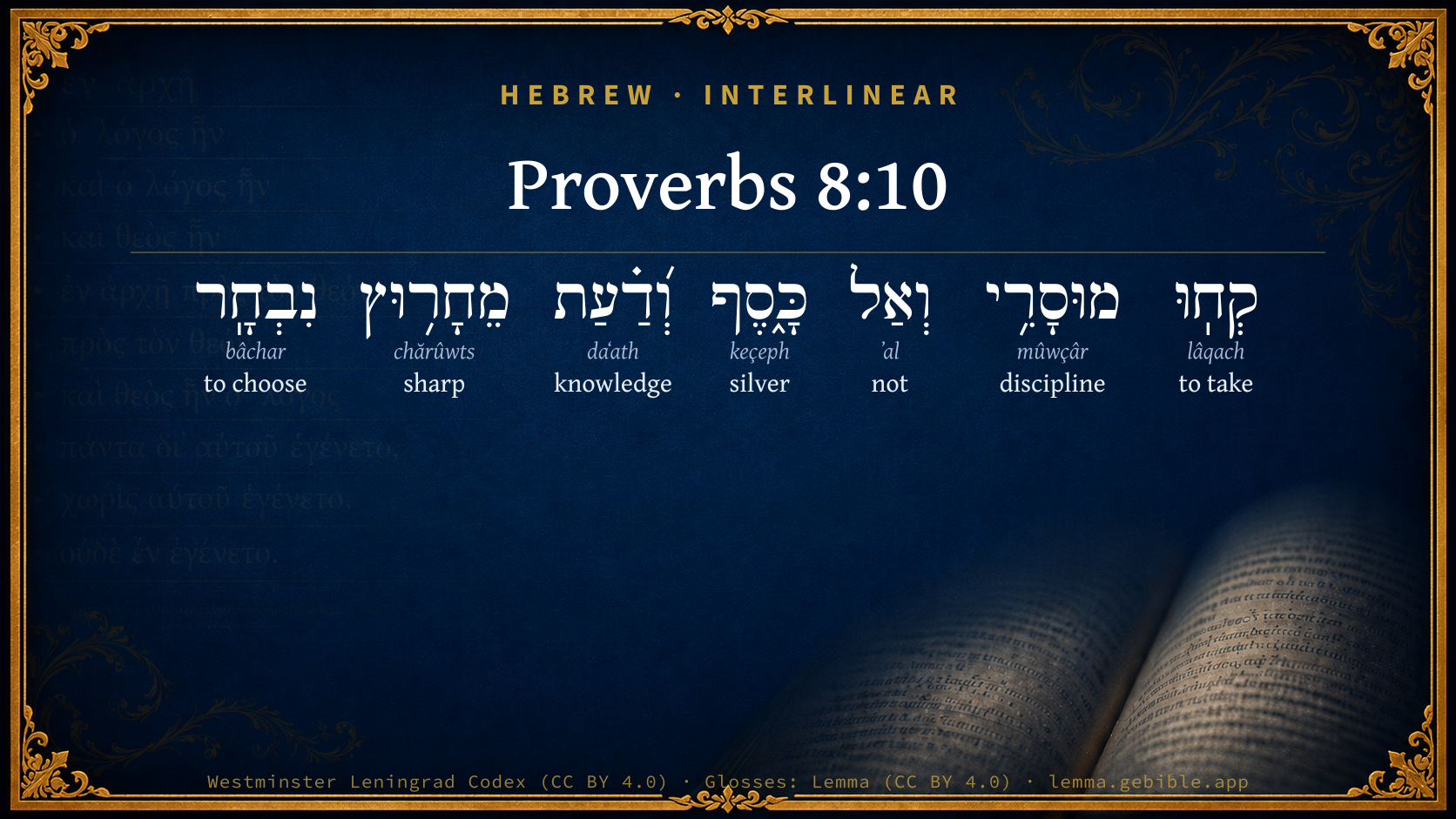
Proverbs 8:10

Hebrew (Westminster Leningrad Codex) Proverbs 8:10 appears in the Hebrew Old Testament. The text above is from the Westminster Leningrad Codex. Each word links to its Strong’s number, a concise gloss, and parsing drawn from the Open Scriptures Hebrew Bible morphology. Click any word for its full Brown-Driver-Briggs (BDB) entry.
Download image
Cite this verse

Proverbs 8:10 (World English Bible). Public Domain. Lemma interlinear Bible study tool, https://lemma.gebible.app/v/proverbs/8/10.

Show BibTeX & RIS
BibTeX
RIS
English Translation
Receive my instruction rather than silver; Knowledge rather than choice gold.
World English Bible · Public Domain
Download a study sheet

One document with this verse’s original text, its word-by-word gloss line, the meaning frame, cross-references with their text, attributed commentary, and full source and license credits — printable, and it pastes into notes with its structure intact.

This verse Autodidact and up

Study sheet (.html) Plain text (.txt)

A passage Seminary Student

Up to 50 verses in one chapter. A passage sheet keeps up to 6 commentary sources and 12 cross-references per verse, in the order this page ranks them, and says so on the sheet whenever that leaves anything out. Ask for a single verse and you get the Autodidact verse sheet above.

Everything on this page stays free to read, with no account — the sheet is a download of what is already on screen, not access to it.

Want to remove ads? Support Godless Engineer
Compare translations 3

The same verse in 3 English versions, stacked beneath the original-language interlinear above. Click any original word for its lexicon entry.

Each is an independent rendering of the whole verse — the interlinear is not word-aligned to these translations.

Highlighted words mark where these versions differ — a whole-verse word diff, not a word-by-word alignment.

  • World English Bible Public Domain
    Receive my instruction rather than silver; Knowledge rather than choice gold.
  • King James Version Public Domain
    Receive my instruction, and not silver; and knowledge rather than choice gold.
  • unfoldingWord Literal Text CC BY-SA 4.0
    Take my instruction and not silver, and knowledge rather than choice gold.

unfoldingWord Literal Text — © unfoldingWord, licensed CC BY-SA 4.0. Word-aligned USFM3 via Door43 (git.door43.org/unfoldingWord/en_ult).

Versions to compare (up to 4)

3 of 4 selected

Show all 18 translations

Every available English version of this verse, each an independent rendering of the whole verse.

  • World English Bible Public Domain
    Receive my instruction rather than silver; Knowledge rather than choice gold.
  • Berean Standard Bible Public Domain
    Receive my instruction instead of silver, and knowledge rather than pure gold.
  • Majority Standard Bible Public Domain
    Receive my instruction instead of silver, and knowledge rather than pure gold.
  • King James Version Public Domain
    Receive my instruction, and not silver; and knowledge rather than choice gold.
  • American Standard Version (1901) Public Domain
    Receive my instruction, and not silver; And knowledge rather than choice gold.
  • Revised Version (1885) Public Domain
    Receive my instruction, and not silver; and knowledge rather than choice gold.
  • Geneva Bible (1599) Public Domain
    Receiue mine instruction, and not siluer, and knowledge rather then fine golde.
  • Douay-Rheims (1899) Public Domain
    Receive my instruction, and not money: choose knowledge rather than gold.
  • Young's Literal Translation Public Domain
    Receive my instruction, and not silver, And knowledge rather than choice gold.
  • Literal Standard Version CC BY-SA 4.0
    Receive my instruction, and not silver, || And knowledge rather than choice gold.
  • Unlocked Literal Bible CC BY-SA 4.0
    Acquire my instruction rather than silver; acquire knowledge rather than pure gold.
  • unfoldingWord Literal Text CC BY-SA 4.0
    Take my instruction and not silver, and knowledge rather than choice gold.
  • Darby Bible Public Domain
    Receive my instruction, and not silver; and knowledge rather than choice gold:
  • World Messianic Bible Public Domain
    Receive my instruction rather than silver, knowledge rather than choice gold.
  • Webster's Bible Public Domain
    Receive my instruction, and not silver; and knowledge rather than choice gold.
  • Free Bible Version CC BY-SA 4.0
    Choose my instruction over silver; choose knowledge over pure gold.
  • Bible in Basic English Public Domain
    Take my teaching, and not silver; get knowledge in place of the best gold.
  • JPS Tanakh (1917) Public Domain
    Receive my instruction, and not silver, and knowledge rather than choice gold.

Literal Standard Version (2020), Covenant Press — licensed CC BY-SA 4.0. Text via the HelloAO Bible API (eBible.org). Unlocked Literal Bible (unfoldingWord) — licensed CC BY-SA 4.0. Text via the HelloAO Bible API (eBible.org). unfoldingWord Literal Text — © unfoldingWord, licensed CC BY-SA 4.0. Word-aligned USFM3 via Door43 (git.door43.org/unfoldingWord/en_ult). Free Bible Version, Dr. Jonathan Gallagher — licensed CC BY-SA 4.0. Text via the HelloAO Bible API (eBible.org).

Word by word

More ways to search: Search by grammar → Find every occurrence → Compare this word →

Practice this passage: Drill this verse → Learn its vocabulary →

About this verse

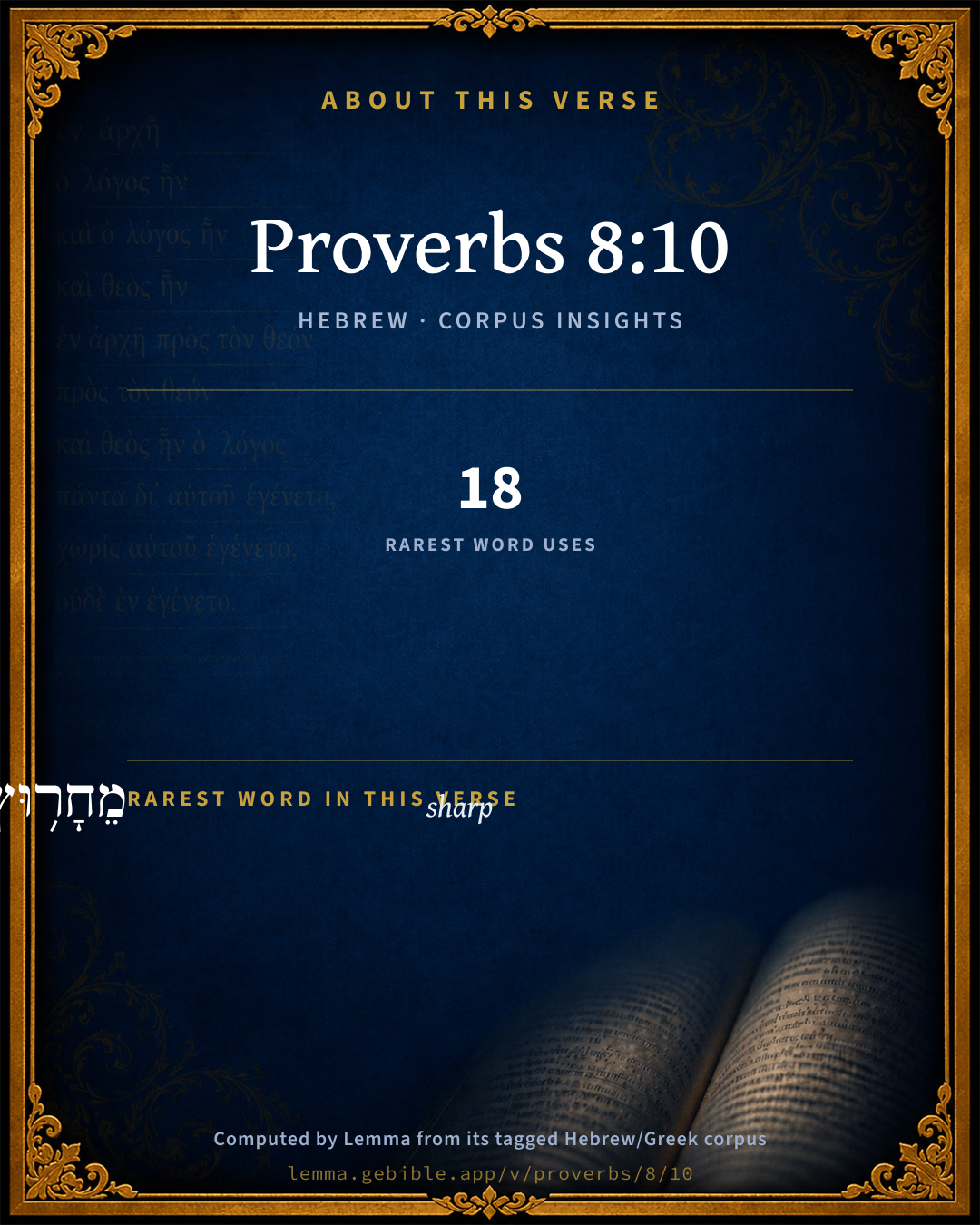
These counts appear in no published source. They are computed here, from the morphology-tagged text and Lemma’s own curated glosses. What Lemma adds →

7
words
7
distinct lemmas
Wisdom
section

Notable vocabulary

The rarest word here is מֵחָר֥וּץ sharp H2742 — appearing just 18 times in the whole Hebrew Bible.

Shared distinctive vocabulary

מֵחָר֥וּץ sharp H2742 occurs in 17 verses of the Hebrew Bible. Also found in:

Grammatical profile

  • 2 verbs
  • 4 nouns
  • 1 particle

Verb forms

  • קְחֽוּ Qal · Imperative
  • נִבְחָֽר Niphal · Participle Active

Hebrew & Septuagint length

In English translation the verse runs 11 words from the Hebrew and 11 from the Septuagint (LXX English) — the same length.

A rough comparison of the two English renderings, which tokenize alike — not a word-level alignment.

Word counts can differ between the Hebrew and the Greek without any difference in meaning — e.g. the Hebrew direct-object marker אֵת has no separate Greek word, and Greek often adds the article ὁ.

Cross-references

12

Topical passages linked to Proverbs 8:10 in the Treasury of Scripture Knowledge — connected by theme and wording, ordered by reader-vote popularity; previews shown in the World English Bible.

  • Proverbs 2:4–5 If you seek her as silver, And search for her as for hidden treasures:
  • Psalms 119:72 The law of your mouth is better to me than thousands of pieces of gold and silver.
  • Psalms 119:127 Therefore I love your commandments more than gold, Yes, more than pure gold.
  • Proverbs 3:13–15 Happy is the man who finds wisdom, The man who gets understanding.
  • Proverbs 23:23 Buy the truth, and don't sell it: Get wisdom, discipline, and understanding.
  • Proverbs 10:20 The tongue of the righteous is like choice silver. The heart of the wicked is of little worth.
  • Ecclesiastes 7:11 Wisdom is as good as an inheritance. Yes, it is more excellent for those who see the sun.
  • Acts 3:6 But Peter said, "Silver and gold have I none, but what I have, that I give you. In the name of Jesus Christ of Nazareth, get up and walk!"
  • Proverbs 16:16 How much better it is to get wisdom than gold! Yes, to get understanding is to be chosen rather than silver.
  • Psalms 119:162 I rejoice at your word, As one who finds great spoil.
  • Proverbs 8:19 My fruit is better than gold, yes, than fine gold; My yield than choice silver.
  • 2 Corinthians 6:10 as sorrowful, yet always rejoicing; as poor, yet making many rich; as having nothing, and yet possessing all things.

Cross-references courtesy of OpenBible.info (CC BY 4.0).

Hebrew and Greek witnesses Masoretic Hebrew ↔ Greek Septuagint

The same verse in the two great witnesses to the Old Testament, shown verse-for-verse.

These are two independent witnesses, not word-aligned to each other, and the Septuagint is shown in lemma (dictionary) form.

Hebrew Proverbs 8:10 Masoretic · Westminster Leningrad Codex

קְחֽוּ מוּסָרִ֥י וְאַל כָּ֑סֶף וְ֝דַ֗עַת מֵחָר֥וּץ נִבְחָֽר

Receive my instruction rather than silver; Knowledge rather than choice gold.

World English Bible · Public Domain

Greek LXX Proverbs 8:10 Septuagint · lemma form

λαμβάνω παιδεία καί μή ἀργύριον καί γνῶσις ὑπέρ χρυσίον δοκιμάζω ἀντιαἱρέω δέ αἴσθησις χρυσίον καθαρός

Receive instruction, and not silver; and knowledge rather than tried gold.

LXX2012 (modern English Septuagint) · Public Domain

Hebrew: Westminster Leningrad Codex (CC BY 4.0). Greek: Septuagint (public domain); English from LXX2012 (modern English Septuagint) (Public Domain). How the Septuagint differs from the Hebrew →

Commentary

Notes on Proverbs 8:10 from classic Christian and Jewish commentators (each source and its license shown beneath its notes). The classic Christian expositions comment on the surrounding passage and are grouped to its opening verse, so a note may address several verses; the Jewish commentaries on the Tanakh (Rashi and others) are per-verse, so they appear only where the commentator wrote on this verse.

Lemma curates 59 commentaries, every one of them public domain or Creative Commons licensed, each selected and text-cleaned for this edition rather than reprinted as found. About our sources →

Trapp's Complete Commentary

John Trapp

Pro 8:10 Receive my instruction, and not silver; and knowledge rather than choice gold.

Ver. 10. Receive mine instruction, and not money.] That is, Rather than money; as, "I will have mercy, and not sacrifice" - that is, rather than sacrifice. Knowledge of the Scriptures is the greatest riches. "Let the word of Christ dwell richly in you." {Col 3:16} The Corinthians were enriched in all knowledge. {1Co 1:5} Plato gave three hundred florins for a book that he liked. {a} Dionysius said that Aristippus was always craving money from him, but Plato desired nothing but books. What spending of money and lavishing out of the bag is there for human learning! And yet Aristotle himself could say, that a little knowledge, though but conjectural, about heavenly things, is to be preferred above much knowledge, though certain, about inferior things.

{a} Called Sophron.

John Trapp, A Commentary or Exposition upon All the Books of the Old and New Testament (1647–1656) — public domain. Text from a community e-Sword module.

The Biblical Illustrator

Joseph S. Exell

Pro_8:10

Receive my instruction, and not silver.

The commendation of wisdom

I. Knowledge must be received.

1. Do not refuse knowledge offered you in the Book of God.

2. Do not refuse instruction offered you by Gods ministers.

II. Knowledge must be received by way of instruction. Instruction is necessary, as it does not come by nature, and God does not teach it now by miracle.

III. Knowledge must be more readily received than silver or gold. It can do that which gold and silver can never do. It is the best riches. More is gotten by labouring for knowledge than for money. (Francis Taylor, B. D.)

The Biblical Illustrator, edited by Joseph S. Exell (c. 1880s–1900s) — public domain. Text from a community e-Sword module.

The Preacher's Complete Homiletical Commentary

Joseph S. Exell (gen. ed.)

CRITICAL NOTES.—

Pro_8:11. Rubies, “pearls.”

MAIN HOMILETICS OF THE PARAGRAPH—Pro_8:10-11

WISDOM BETTER THAN WEALTH

I. Wisdom is to be preferred to wealth because it belongs to a higher sphere. The wisdom by which men succeed in finding gold and silver reveals the superiority of mind over matter. The apparatus of the miner or digger reveals that his thought, by which he is enabled to find the precious metal, is more than the metal itself. The precious stones which the merchant gains by trading are inferior to the wisdom he puts in operation to gain them, even though it is a wisdom which is only devoted to gaining money. The mental power which he puts forth shows that he is possessed of intelligence, which, belonging to the region of mind, belongs to a higher sphere than material wealth. When the wisdom is that spoken of in the text, the wisdom which springs from the very Fountain of goodness, it is not only preferable because it is the offspring of mind, but because it belongs to the higher region of spiritual purity.

II. Wisdom is to be preferred to wealth, because it had an existence before wealth. The world, with all its precious stones, and rich mines of gold and silver, is but of yesterday compared with wisdom. The mental and spiritual wealth of God was before matter; upon that wisdom—as we learn in this chapter—depended the existence of the material (Pro_8:22-32; chap Pro_3:19-20). Mental wealth is eternal, material wealth belongs only to time. Gold had a beginning, because the earth had a birthday, but wisdom is as old as God.

III. Wisdom is to be preferred to wealth, because it is an absolute necessity to man’s well-being, which gold is not. The first man, in his state of sinlessness, had no need of what men now call wealth, but wisdom—spiritual wisdom—was absolutely necessary to his continuation in a state of blessedness. Men need worldly, intellectual wisdom, even to make money. Many who inherit wealth lose it because they lack wisdom to use it rightly. But they can be blest without wealth, but not without the wisdom which leads to holiness. Wealth may bring pleasure with it, but to do so it must be united to true wisdom. Many who roll in riches have no pleasure in them; sometimes their very wealth adds to their unhappiness. Mental wealth enables men to extract some enjoyment from material wealth, but the riches of goodness makes gold and silver a means of increasing men’s happiness.

IV. Wisdom is to be preferred to wealth, because the latter may be destructive to character, and the former is its constructive power. Many men have been morally destroyed by their riches. But true wisdom is that by which a holy character is formed, the sustenance of the spiritual life. Riches may ruin; the wisdom which God gives to those who seek it at His hand can but bless.

OUTLINES AND SUGGESTIVE COMMENTS

Pro_8:10. Thou canst not make as thy chief aim the acquisition of silver and that of true wisdom at one and the same time, for those aims mutually conflict, and each claims the whole man (Mat_6:24). To accept the one involves the rejection of the other as the chief portion. He who lives for money is void of wisdom (Luk_12:16; Luk_12:20), and is called in Scripture a “fool.”—Fausset.

Had it been said, Receive silver, who would not have held out his hand to receive it? Had it been said, Receive gold, who would not have been forward and glad with both his hands to have taken it? But it is instruction and not silver, wherein, lest a worldly heart be afraid that the taking of silver were forbidden him, the next words show the meaning, that it is but instruction rather than silver, as it is knowledge rather than gold.… He that seeketh gold and silver diggeth up much earth, but finds little of them, but he that receiveth instruction and knowledge, which are, indeed, of a golden nature, even in a little shall get and find much. Wherefore Clemens Alexandrinus saith, “It is in the soul that riches are, and they alone are riches whereof the soul alone is the treasure.”—Jermin.

The first warning uttered by this wisdom from above is the repetition of a former word. The repetition is not vain. Another stroke so soon on the same place indicates that he who strikes feels a peculiar hardness there. The love of money is a root of evil against which the Bible mercifully deals many a blow. There lies one of our deepest sores. Thanks be to God for touching it with “line upon line” of His healing Word.… A ship bearing a hundred emigrants has been driven from her course and wrecked on a desert island, far from the tracks of men. The passengers get safe ashore with all their stores. There is no way of escape, but there are means of subsistence. An ocean unvisited by ordinary voyagers circles round their prison, but they have seed, with a rich soil to receive, and a genial climate to ripen it. Ere any plan has been laid, or any operation begun, an exploring party returns to head quarters reporting the discovery of a gold mine. Thither instantly the whole company resort to dig. They acquire and accumulate heaps of gold. The people are quickly becoming rich. But the spring is past, and not a field has been cleared, not a grain of seed has been committed to the ground. The summer comes, and their wealth increases, but the store of food is small. In harvest they begin to discover that their stores of gold are worthless. A cart-load of it cannot satisfy a hungry child. When famine stares them in the face a suspicion shoots across their fainting hearts that their gold has cheated them. They loathe the bright betrayer. They rush to the woods, fell the trees, till the ground, and sow the seed. Alas! it is too late! Winter has come, and their seed rots in the soil. They die of want in the midst of their treasures. This earth is a little isle—eternity the ocean round it. On this shore we have been cast, like shipwrecked sailors. There is a living seed; there is an auspicious spring time; the sower may eat and live. But gold mines attract us; we spend our spring there—our summer there: winter overtakes us toiling there, with heaps of hoarded dust, but destitute of the bread of life.—Arnot.

Pro_8:11. First, because everything else without it is a curse, and with it is just what is needed; second, because it is necessary to all beings, and even to God himself, as the spring of action; third, because it is glory and wealth in its very nature.—Miller.

Surely he that thinketh himself adorned with precious stones, showeth himself to be of less price than the stones are. To whom Clemens well applieth that saying of Apelles, who, when one of his scholars had painted Helena set out with much gold, said unto him, “Alas, poor young man, when thou could’st not draw her fair thou hast made her rich,” for so, when many have neglected the jewel of the soul they seek to prank out the body with jewels.—Jermin.

The wisdom of goodness, or virtue.

1. Is absolutely and without any limitation good, absolutely and without any limitation useful and desirable. It alone can never be misapplied, can never be criminal. This we cannot pronounce of any other good. Riches may be a snare, honours a burden, even the endowments of the mind may be a snare to us.

2. It is far more unchangeable than the value of all other goods and endowments. The value of riches is regulated by our wants and the wants of the society in which we live. The value of honour changes according to the opinions, the usages, the political institutions of mankind. The value of sensual pleasure depends much on our constitution, age, and health. Even the value of mental endowments is subject to vicissitudes. The value of true wisdom alone is invariably the same.

3. It is much more independent of station than any other good. Riches would cease to be riches if all men lived in abundance. Honour would lose much of its value if it gave us no precedence over others. A great proportion of the value of sensual and mental pleasures would be reduced to nothing if every man possessed them, and each in the same degree. But no man loses anything if another be virtuous likewise, but if all were virtuous all would infinitely profit thereby.

4. It has a pre-eminent value, by the effects it produces in us. It renders us:

(1) much better,

(2) more useful,

(3) more happy.

5. It alone fits us for a better life. It passes for as much in heaven as it does upon earth, and much more. It alone assimilates us with God. What we call riches, power, and knowledge, are poverty, weakness, and darkness, with Him.—Zollikofer.

The Preacher's Complete Homiletical Commentary (gen. ed. Joseph S. Exell; Funk & Wagnalls, c. 1892) — public domain (pre-1929). A full-Bible homiletical/sermon-outline anthology covering 65 of 66 books (2 John is absent from the source module). Text from a community e-Sword module.

Tyndale Open Study Notes

Tyndale Open Resources

8:10-11 Choose: An ethical choice must be made between seeking money or valuables and seeking wisdom, which is far more valuable.

Tyndale Open Study Notes — © Tyndale Open Resources, licensed CC BY-SA 4.0. Text via the HelloAO Bible API.

Jamieson, Fausset & Brown

Robert Jamieson, A. R. Fausset & David Brown

not silver--preferable to it, so last clause implies comparison.

Jamieson, Fausset & Brown — Commentary Critical and Explanatory on the Whole Bible (1871) — public domain (CC PDM 1.0). Text via the HelloAO Bible API.

Adam Clarke's Commentary

Verse 10. Receive my instruction, and not silver] A Hebrew idiom; receive my instruction in preference to silver.

Adam Clarke's Commentary on the Bible (1810–1826) — public domain. Text from a community e-Sword/MySword module.

John Gill's Exposition

Receive my instruction, and not silver,.... Not but that silver may be desired, sought after and received, consistent with the instructions of wisdom; though an anxious, immoderate, sinful pursuit after it, hinders the reception of them; and when they are in competition, the one is to be preferred to the other: the doctrines of the Gospel are of more worth, and more to be desired, than thousands of gold and silver; and therefore the meaning is, that the instruction of wisdom should be received rather than silver; it should have the preference; so Gersom interprets it, and with which agrees the following clause:

and knowledge rather than choice gold; that is, the knowledge of Christ, and the knowledge of God in Christ; the knowledge of the Gospel, and the truths of it; a spiritual and experimental knowledge of these things is of more value than the finest gold, than the gold of Ophir; see Psa 19:10.

John Gill's Exposition of the Whole Bible (1746–1763) — public domain (CC PDM 1.0). Text via the HelloAO Bible API.

Haydock's Catholic Bible Commentary

Money. They are generally incompatible.

George Leo Haydock (1774–1849), Haydock's Catholic Family Bible and Commentary, 1859 edition — public domain. Excludes Psalms (Douay-Rheims chapter numbering differs from Protestant) and Deuterocanonical books (Catholic canon only).

Matthew Poole's English Annotations

And not silver, i.e. rather than silver, as such negative expressions are understood, Gen 45:8; Exo 16:8; Jer 7:22; 16:14,15, and in many other places. Though withal he seems to intimate the inconsistency of these two studies and designs, and the great hinderance which the love of riches gives to the study of wisdom.

Matthew Poole's English Annotations on the Holy Bible (1683–1685) — public domain. Text from a community e-Sword/MySword module.

Whedon's Commentary on the Bible

Daniel D. Whedon

10, 11. Receive, etc. — Having recommended the character and quality of her instructions, she again urgently presses the acceptance of them.

Instruction — Discipline, correction, precepts of restraint. See Pro_1:2, and note.

Rubies — Or, pearls.

Things that may be desired — All desirable things. Comp. Pro_8:19. Wisdom had begun to specify silver, gold, pearls; but cuts the matter short by including all valuable and desirable things. Her teachings are more valuable than all else. Comp. Pro_3:15.

Daniel D. Whedon (gen. ed.), Commentary on the Old and New Testaments (1874–1909) — public domain. Text from a community e-Sword module.

The Pulpit Commentary

Receive my instruction, and not silver; i.e. acquire wisdom rather than silver, if ever the choice is yours. And knowledge rather than choice gold. (comp. ver. 19; Pro_3:14. For "knowledge," daath , see on Pro_2:10) The comparison is implied rather than expressed in the first clause, while it is made clear in the second. Thus Hos_6:6, "I desired mercy, and not sacrifice," the second matter mentioned being, not necessarily of no importance, but always in such cases of inferior importance to the other. We may quote Horace"s complaint of the worldliness of his countrymen, a marked contrast to the inspired counsel of Proverbs ("Epist.," 1:1, 52)"Villus argentum est auro, virtutibus aurum. O cives, cives! quaerenda pecunia primum est, Virtus post nummos.

Vers. 10-21. Wisdom"s pleadings.

She has nothing novel to say concerning her nature, value, and blessings. Preaching must in the main be repetition; the iteration of the old, not with dry and sterile monotony, but with that freshness which comparison with everyday facts and illustrations gives. New combinations of facts are ever arising in which to frame the old precepts and set them forth. Besides, love gives novelty to old truth, as the old song is enjoyed from the lips of the latest sweet singer.

I SHE APPEALS TO COMPARISON. (Vers, 10, 11) By comparison we increase and strengthen our perceptions. In the knowledge of man, books, art, life, comparison is everything. We are to compare Wisdom with material objects of sense, such as gold and silver, that we may see her to be incomparable; and so each for ourselves repeat the choice of Solomon. (comp. on Pro_3:14, Pro_3:15)

II SHE APPEALS TO ASSOCIATION. (Ver. 12) Wisdom dwells with prudence. In modern language, the general implies the particular. Wisdom is intelligence in general; prudence, the appreciation of it in particular cases. In the poetical mode of representation we should say that Piety and Prudence are sisters, and go hand-in-hand, daughters of the voice of God, as Wordsworth said of duty. So, too, Wisdom has insight into enigmas, dark sayings, and generally deep things of God. (see on Pro_1:4)

III SHE UNFOLDS TEE CONTENTS OF HER MIND. (Vers. 13, 14) One of her many aliases is the fear of Jehovah. And this is religion, which includes all wholesome aversions, viz. wickedness in general, and in particular assumption, arrogance, evil habits, perverted speech. In other words, her sympathies are all with lowliness, purity, love, and truth. Insight or sharp and deep perception is another of her attributes, and force. (comp. on Pro_2:7)

IV SHE CLAIMS SUPREME AUTHORITY. (Vers. 15, 16) Kings, rulers, princes, potentates, judges, all received those places and fulfil those functions through her and her alone. Authority in polities rests on consent or on force, or both. And these are traceable ultimately to reason, and reason is the "inspiration of the Almighty." Exceptions form no part of this representation. In modern language, we say that government, as a principle or institute, rests on an ultimate Divine basis. The text says tic less than this, nor does it say mort.

V SHE IS IN RECIPROCAL RELATION TO HER SUBJECTS. (Ver. 17) Her love is conditioned by love; the winning of her by the wooing. The notion that we can be passive, whether in knowledge or goodness, is an entire illusion. Such an illusion once prevailed as the doctrine of "innate ideas" now exploded in philosophy. All that becomes the portion of head or heart implies, necessitates a previous spiritual activity in us. We are ignorant because we will not learn, unhappy because we will not love.

VI SHE COMMANDS WEALTH AND HONOUR AND THE AVENUES TO THEM. (Vers. 18-21) Riches, honour, self-increasing goods, and righteous". (comp. on Pro_3:16) The righteous here is elucidated by the next two verses; she shows the right way to all earthly good. She is a tree of life, and yields incomparable fruit both for value and abundance (ver. 19). She guarantees possessions to her votaries. The connection between righteous and worldly wealth is insisted on. Not that it is always obvious. Nor again are we to expect notice of exceptions in teaching that is from first to last absolute in form. The stringency of the connection is what we have to recognize; the knowledge of its complete application to all cases opens the relations of eternity and demands the omniscience of God. J.

Vers. 10, 11. Wisdom and wealth.

The immeasurable preference of heavenly wisdom to earthly wealth may be seen if we consider

I THE FAILURE OF WEALTH. Wealth is continually found to fail; for:

1. It cannot even buy happiness. It may purchase a certain amount of excitement and jollity, but it will not secure contentment, even for one brief year.

2. Much less can it buy blessedness. That happy state of which our Lord so often spoke as blessedness the deep and true gladness of heart which God plants within the soul, and which all may well wish to possess this wealth is utterly unable to impart.

3. It will equally fail to buy wisdom. Indeed, it may be truly said that:

4. It often stands positively in the way of its acquisition. (Mar_10:23-25)

II THE CAPACITY OF WISDOM.

1. It tends to provide men with competency, if not with abundance. Honesty, purity, sobriety, diligence, frugality, those virtues which go with the "fear of the Lord," tend to supply a man"s home with all that is needful and desirable.

2. It secures peace and joy of heart.

3. It, itself, is man"s chief treasure. Better the knowledge of God, the love of Christ, a holy, manly, loving spirit, than any external advantages whatsoever. (see Jer_9:23, Jer_9:24)

4. It prepares for the enjoyment of the treasures which are in heaven. C. (Mat_6:19-21)

The Pulpit Commentary (1880–1919), ed. H.D.M. Spence-Jones & Joseph S. Exell — public domain. Text from a community e-Sword module.

John Wesley's Explanatory Notes

And not silver - Rather than silver.

John Wesley, Explanatory Notes Upon the Whole Bible (1754–1765) — public domain. Text via the GEBible commentary corpus.

Keil & Delitzsch

C. F. Keil & F. Delitzsch

Her self-commendation is continued in the resumed address:

10 "Receive my instruction, and not silver,

And knowledge rather than choice gold!

11 For wisdom is better than corals,

And all precious jewels do not equal her.

12 I, Wisdom, inhabit prudence,

And the knowledge of right counsels is attainable by me."

Instead of ולא־כּסף influenced by קחוּ, is ואל־כסף with תּקחוּ to be supplied; besides, with most Codd. and older editions, we are to accentuate קחוּ מוּסרי with the erasure of the Makkeph. "Such negations and prohibitions," Fleischer remarks, "are to be understood comparatively: instead of acquiring silver, rather acquire wisdom. Similar is the old Arabic 'l-nâr w-l'-'l-'âr, the fire, and not the disgrace! Also among the modern Arabic proverbs collected by Burckhardt, many have this form, e.g., No. 34, alḥajamat balafas wala alḥajat alanas, Better to let oneself be cut with the axe then to beg for the favour of another" 10b is to be translated, with Jerome, Kimchi, and others: and knowledge is more precious than fine gold (נבחר, neut.: auro pretiosius); and in view of Pro 16:16, this construction appears to be intended. But Fleischer has quite correctly affirmed that this assertatory clause is unsuitably placed as a parallel clause over against the preceding imperative clause, and, what is yet more important, that then Pro 8:11 would repeat idem per idem in a tautological manner. We therefore, after the Aramaic and Greek translators, take כסף נבחר together here as well as at Pro 8:19, inasmuch as we carry forward the קחו: et scientiam prae auro lectissimo, which is also according to the accentuation. Equally pregnant is the מן in מחרוּץ of the passage Pro 3:14-15, which is here varied.

Pro 8:12

Ver. 12 follows Pro 8:11 = Pro 3:15 as a justification of this estimating of wisdom above all else in worth. Regarding אני with Gaja, vid., the rule which the accentuation of this word in the three so-called metrical books follows in Merx' Archiv, 1868, p. 203 (cf. Baer's Torath Emeth, p. 40). We translate: ego sapientia involo sollertiam, for the verb שׁכן is construed with the accusative of the object, Pro 2:21; Pro 10:30; 37:3 (cf. גוּר, Psa 5:5), as well as with ב, Gen 26:2, Ps. 69:37. Wisdom inhabits prudence, has settled down, as it were, and taken up her residence in it, is at home in its whole sphere, and rules it. Bertheau not unsuitably compares οἰκῶν with μόνος ἔχων, Ti1 6:16. Regarding מזמּות, vid., Pro 1:4; Pro 5:2. It denotes well-considered, carefully thought out designs, plans, conclusions, and דּעת is here the knowledge that is so potent. This intellectual power is nothing beyond wisdom, it is in her possession on every occasion; she strives after it not in vain, her knowledge is defined according to her wish. Wisdom describes herself here personally with regard to that which she bestows on men who receive her.

Keil & Delitzsch — Biblical Commentary on the Old Testament (1861–1891) — public domain (CC PDM 1.0). Text via the HelloAO Bible API. (Old Testament only.)

unfoldingWord translationNotes

Door43 World Missions Community

Acquire my instruction rather than silver

"You should try much harder to understand my instructions than to get silver"

For Wisdom is better than jewels; no treasure is equal to her

Here Wisdom, personified as a woman, is not speaking. However, it is possible to make Wisdom the speaker here as well. AT: "For I, Wisdom, am better than jewels; no treasure is equal to me" (See: Direct and Indirect Quotations)

translationWords

instruct

silver

know

pure

gold

wise

unfoldingWord translationNotes — © Distant Shores Media and the Door43 World Missions Community, licensed CC BY-SA 4.0. Source: git.door43.org/Door43/en_tn.

Rashi

Rabbi Shlomo Yitzchaki (Rashi)

gold Heb. חרוץ. A type of gold.

Rashi on the Tanakh — English translations: “The Judaica Press complete Tanach with Rashi, translated by A. J. Rosenberg” (CC BY 4.0); “Pentateuch with Rashi's commentary by M. Rosenbaum and A.M. Silbermann, 1929-1934” (public domain); “The Metsudah Tanach series, Lakewood, N.J” (CC BY 4.0); and “The Book of Joshua, Metsudah Publications, 1997” (CC BY 4.0). Text via Sefaria.

Lesson kit

Teaching starters — assembled from the data on this page, not authored interpretation. Every prompt links to the verse data it draws on. Edit before teaching.

Proverbs, in the Wisdom, opens this verse with 7 words (7 distinct Hebrew lemmas). Its most distinctive word is chărûwts (“sharp”). A historical commentator’s framing appears above. Read the whole chapter for the surrounding context.

Discussion questions

  1. What does “sharp” (chărûwts) contribute to the verse as a whole?
  2. Job 41:30 shares the word «sharp» with this verse. How do the two illuminate each other?
  3. The translations on this page render this verse differently — a whole-verse word diff, not a word-by-word alignment. What might account for the different wordings?
  4. The verb «קְחֽוּ» is Qal Imperative. How does its form color the action?
  5. Reading how Trapp's Complete Commentary and The Biblical Illustrator read this verse, where do the two commentators agree and where do they part?

Things to notice

Reading settings

Reading text

Shown beneath each verse's original-language words.

Old Testament
Old Testament edition

Read the OT as the Masoretic Hebrew (MT) or the Greek Septuagint (LXX).

English shown for the Greek Septuagint (in the Hebrew ↔ Greek comparison).

Comparing translations? Open the Compare panel on any verse page to stack up to four side by side.