
Isaiah 66:4

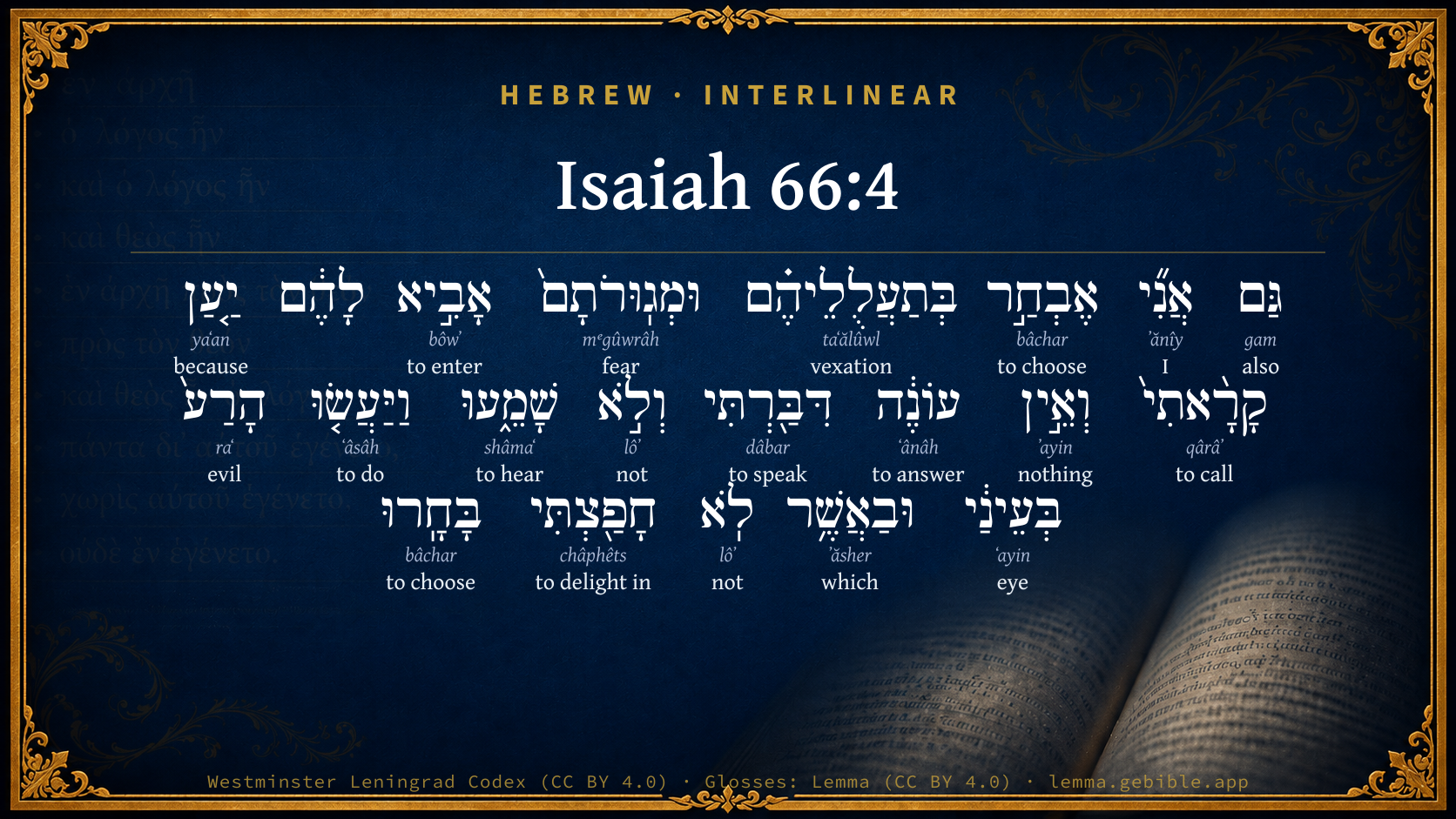
Hebrew (Westminster Leningrad Codex) Isaiah 66:4 appears in the Hebrew Old Testament. The text above is from the Westminster Leningrad Codex. Each word links to its Strong’s number, a concise gloss, and parsing drawn from the Open Scriptures Hebrew Bible morphology. Click any word for its full Brown-Driver-Briggs (BDB) entry.
Download image
Cite this verse

Isaiah 66:4 (World English Bible). Public Domain. Lemma interlinear Bible study tool, https://lemma.gebible.app/v/isaiah/66/4.

Show BibTeX & RIS
BibTeX
RIS
English Translation
I also will choose their delusions, and will bring their fears on them; because when I called, none did answer; when I spoke, they did not hear: but they did that which was evil in my eyes, and chose that in which I didn't delight.
World English Bible · Public Domain
Highlights
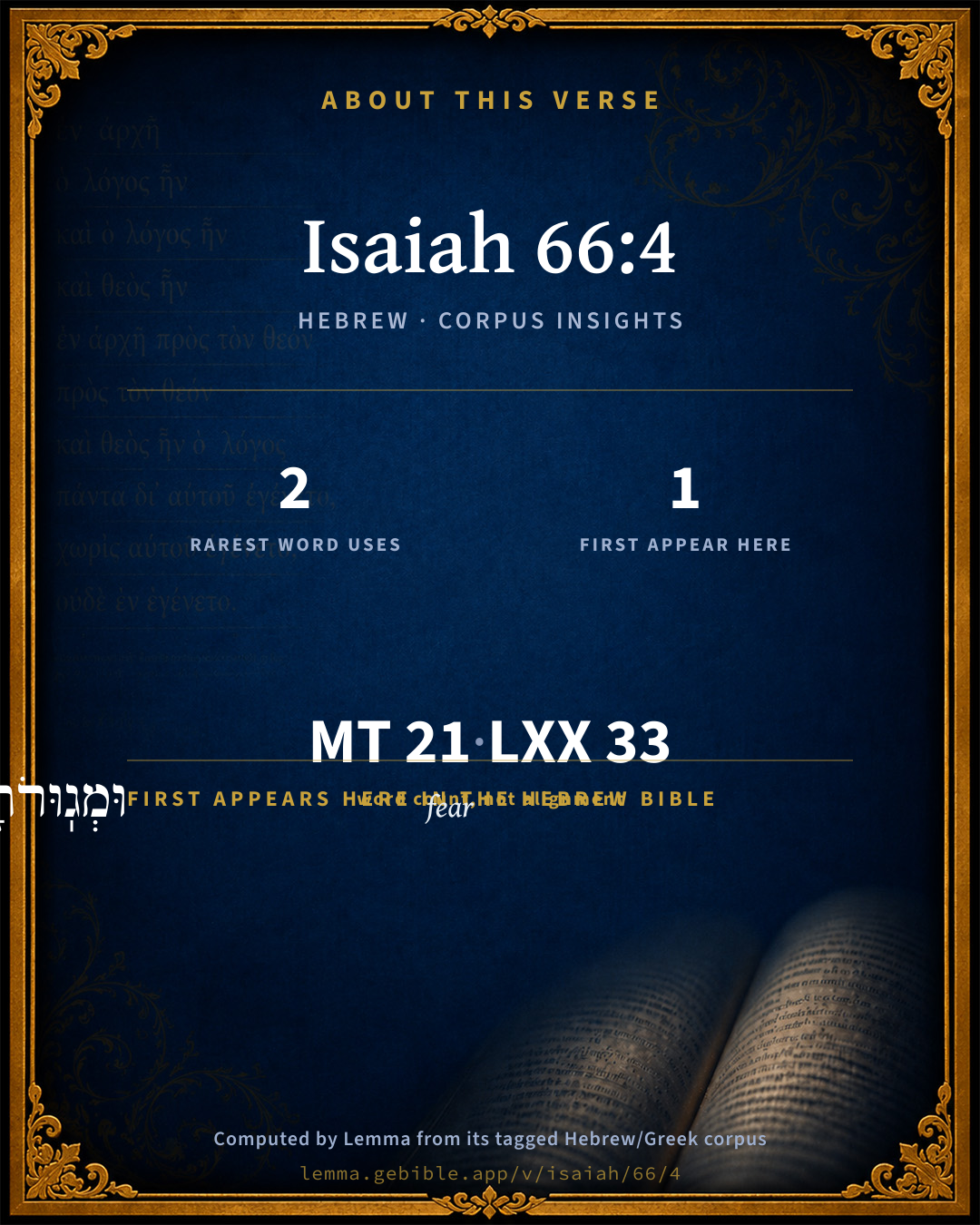
  • 1 first appearance in the Hebrew Bible
Full analysis ↓
Download a study sheet

One document with this verse’s original text, its word-by-word gloss line, the meaning frame, cross-references with their text, attributed commentary, and full source and license credits — printable, and it pastes into notes with its structure intact.

This verse Autodidact and up

Study sheet (.html) Plain text (.txt)

A passage Seminary Student

Up to 50 verses in one chapter. A passage sheet keeps up to 6 commentary sources and 12 cross-references per verse, in the order this page ranks them, and says so on the sheet whenever that leaves anything out. Ask for a single verse and you get the Autodidact verse sheet above.

Everything on this page stays free to read, with no account — the sheet is a download of what is already on screen, not access to it.

Want to remove ads? Support Godless Engineer
Compare translations 3

The same verse in 3 English versions, stacked beneath the original-language interlinear above. Click any original word for its lexicon entry.

Each is an independent rendering of the whole verse — the interlinear is not word-aligned to these translations.

Highlighted words mark where these versions differ — a whole-verse word diff, not a word-by-word alignment.

  • World English Bible Public Domain
    I also will choose their delusions, and will bring their fears on them; because when I called, none did answer; when I spoke, they did not hear: but they did that which was evil in my eyes, and chose that in which I didn't delight.
  • King James Version Public Domain
    I also will choose their delusions, and will bring their fears upon them; because when I called, none did answer; when I spake, they did not hear: but they did evil before mine eyes, and chose that in which I delighted not.
  • unfoldingWord Literal Text CC BY-SA 4.0
    so I, I will choose their harsh treatments, and I will bring their fears to them, because I called, but none was answering; I spoke, but they did not listen. And they did evil in my eyes, and they chose what I do not delight in.” q1

unfoldingWord Literal Text — © unfoldingWord, licensed CC BY-SA 4.0. Word-aligned USFM3 via Door43 (git.door43.org/unfoldingWord/en_ult).

Versions to compare (up to 4)

3 of 4 selected

Show all 18 translations

Every available English version of this verse, each an independent rendering of the whole verse.

  • World English Bible Public Domain
    I also will choose their delusions, and will bring their fears on them; because when I called, none did answer; when I spoke, they did not hear: but they did that which was evil in my eyes, and chose that in which I didn't delight.
  • Berean Standard Bible Public Domain
    So I will choose their punishment and I will bring terror upon them, because I called and no one answered, I spoke and no one listened. But they did evil in My sight and chose that in which I did not delight.”
  • Majority Standard Bible Public Domain
    So I will choose their punishment and I will bring terror upon them, because I called and no one answered, I spoke and no one listened. But they did evil in My sight and chose that in which I did not delight.”
  • King James Version Public Domain
    I also will choose their delusions, and will bring their fears upon them; because when I called, none did answer; when I spake, they did not hear: but they did evil before mine eyes, and chose that in which I delighted not.
  • American Standard Version (1901) Public Domain
    I also will choose their delusions, and will bring their fears upon them; because when I called, none did answer; when I spake, they did not hear: but they did that which was evil in mine eyes, and chose that wherein I delighted not.
  • Revised Version (1885) Public Domain
    I also will choose their delusions, and will bring their fears upon them; because when I called, none did answer; when I spake, they did not hear: but they did that which was evil in mine eyes, and chose that wherein I delighted not.
  • Geneva Bible (1599) Public Domain
    Therefore will I chuse out their delusions, and I will bring their feare vpon them, because I called, and none woulde answere: I spake and they woulde not heare: but they did euill in my sight, and chose the things which I would not.
  • Douay-Rheims (1899) Public Domain
    Wherefore I also will choose their mockeries, and will bring upon them the things they feared: y because I called, and there was none that would answer; I have spoken, and they heard not; and they have done evil in my eyes, and have chosen the things that displease me.
  • Young's Literal Translation Public Domain
    I also -- I fix on their vexations, And their fears I bring in to them, Because I have called, and there is none answering, I spake, and they have not hearkened, And they do the evil things in Mine eyes, And on that which I desired not -- fixed.
  • Literal Standard Version CC BY-SA 4.0
    I also—I fix on their distress, || And I bring in their fears to them, || Because I have called, and there is none answering, || I spoke, and they have not listened, || And they do evil in My eyes, || And on that which I did not desire—fixed.”
  • Unlocked Literal Bible CC BY-SA 4.0
    In the same way I will choose their own punishment; I will bring on them what they fear, because when I called, no one answered; when I spoke, no one listened. They did what was evil in my sight, and chose to do what displeases me.”
  • unfoldingWord Literal Text CC BY-SA 4.0
    so I, I will choose their harsh treatments, and I will bring their fears to them, because I called, but none was answering; I spoke, but they did not listen. And they did evil in my eyes, and they chose what I do not delight in.” q1
  • Darby Bible Public Domain
    I also will choose their calamities, and will bring their fears upon them; because I called, and none answered, I spoke, and they did not hear, but did that which was evil in mine eyes, and chose that wherein I delight not.
  • World Messianic Bible Public Domain
    I also will choose their delusions, and will bring their fears on them, because when I called, no one answered; when I spoke, they didn’t listen, but they did that which was evil in my eyes, and chose that in which I didn’t delight.”
  • Webster's Bible Public Domain
    I also will choose their delusions, and will bring their fears upon them; because when I called, none did answer; when I spoke, they did not hear: but they did evil before my eyes, and chose that in which I delighted not.
  • Free Bible Version CC BY-SA 4.0
    I will also choose to punish them severely and to terrify them, because I called out to them but no one answered; I spoke to them, but no one listened. Instead they did what's evil in my sight, choosing to do what I hate.
  • Bible in Basic English Public Domain
    So I will go after trouble for them, and will send on them what they are fearing: because no one made answer to my voice, or gave ear to my word; but they did what was evil in my eyes, going after that in which I took no pleasure.
  • JPS Tanakh (1917) Public Domain
    Even so I will choose their mockings, and will bring their fears upon them; because when I called, none did answer; when I spoke, they did not hear, but they did that which was evil in Mine eyes, and chose that in which I delighted not.

Literal Standard Version (2020), Covenant Press — licensed CC BY-SA 4.0. Text via the HelloAO Bible API (eBible.org). Unlocked Literal Bible (unfoldingWord) — licensed CC BY-SA 4.0. Text via the HelloAO Bible API (eBible.org). unfoldingWord Literal Text — © unfoldingWord, licensed CC BY-SA 4.0. Word-aligned USFM3 via Door43 (git.door43.org/unfoldingWord/en_ult). Free Bible Version, Dr. Jonathan Gallagher — licensed CC BY-SA 4.0. Text via the HelloAO Bible API (eBible.org).

Word by word

More ways to search: Search by grammar → Find every occurrence → Compare this word →

Practice this passage: Drill this verse → Learn its vocabulary →

בְּתַעֲלֻלֵיהֶ֗ם
taʻălûwl
H8586
“in/at · vexations · their”
Preposition + Noun, Common, Masculine, Plural, Construct + Suffix, Personal, 3rd Person, Masculine, Plural
Part of Speech
Preposition + Noun
Type
Common
Gender
Masculine
Number
Plural
State
Construct
Full BDB Definition

Origin: from H5953

TWOT: 1627f

wantonness, caprice, vexation
  1. גַּם gam H1571 “also” Particle, Accusative
  2. אֲנִ֞י ʼănîy H589 “I” Pronoun, Personal, 1st Person, Common, Singular
  3. אֶבְחַ֣ר bâchar H977 “to choose” Verb, Qal, Imperfect, 1st Person, Common, Singular
  4. וּמְגֽוּרֹתָם֙ mᵉgûwrâh H4035 “and · fears · their” Conjunction + Noun, Common, Feminine, Plural, Construct + Suffix, Personal, 3rd Person, Masculine, Plural
  5. אָבִ֣יא bôwʼ H935 “to enter” Verb, Hiphil, Imperfect, 1st Person, Common, Singular
  6. יַ֤עַן yaʻan H3282 “because” Conjunction
  7. קָרָ֨אתִי֙ qârâʼ H7121 “to call” Verb, Qal, Perfect, 1st Person, Common, Singular
  8. וְאֵ֣ין ʼayin H369 “and · nothing” Conjunction + Particle, Negative
  9. עוֹנֶ֔ה ʻânâh H6030 “answering” Verb, Qal, Participle Active, Masculine, Singular, Absolute
  10. דִּבַּ֖רְתִּי dâbar H1696 “to speak” Verb, Piel, Perfect, 1st Person, Common, Singular
  11. וְלֹ֣א lôʼ H3808 “and · not” Conjunction + Particle, Negative
  12. שָׁמֵ֑עוּ shâmaʻ H8085 “to hear” Verb, Qal, Perfect, 3rd Person, Common, Plural
  13. וַיַּעֲשׂ֤וּ ʻâsâh H6213 “and · to do” Conjunction + Verb, Qal, Sequential Imperfect, 3rd Person, Masculine, Plural
  14. הָרַע֙ raʻ H7451 “the · evil” Particle, Definite Article + Adjective, Adjective, Masculine, Singular, Absolute
  15. בְּעֵינַ֔י ʻayin H5869 “in/at · eyes · my” Preposition + Noun, Common, Both, Dual, Construct + Suffix, Personal, 1st Person, Common, Singular
  16. וּבַאֲשֶׁ֥ר ʼăsher H834 “and · in/at · which” Conjunction + Preposition + Particle, Relative
  17. לֹֽא lôʼ H3808 “not” Particle, Negative
  18. חָפַ֖צְתִּי châphêts H2654 “to delight in” Verb, Qal, Perfect, 1st Person, Common, Singular
  19. בָּחָֽרוּ bâchar H977 “to choose” Verb, Qal, Perfect, 3rd Person, Common, Plural

About this verse

These counts appear in no published source. They are computed here, from the morphology-tagged text and Lemma’s own curated glosses. What Lemma adds →

21
words
18
distinct lemmas
Prophets
section

Notable vocabulary

The rarest word here is בְּתַעֲלֻלֵיהֶ֗ם vexation H8586 — appearing just 2 times in the whole Hebrew Bible.

First appearance in Scripture

This word makes its first canonical appearance in the Hebrew Bible here:

  • וּמְגֽוּרֹתָם֙ fear H4035

Shared distinctive vocabulary

בְּתַעֲלֻלֵיהֶ֗ם vexation H8586 occurs in 2 verses of the Hebrew Bible. Also found in:

Grammatical profile

  • 9 verbs
  • 3 nouns
  • 1 adjective
  • 1 pronoun
  • 1 preposition
  • 1 conjunction
  • 5 particles

Verb forms

  • אֶבְחַ֣ר Qal · Imperfect
  • אָבִ֣יא Hiphil · Imperfect
  • קָרָ֨אתִי֙ Qal · Perfect
  • עוֹנֶ֔ה Qal · Participle Active
  • דִּבַּ֖רְתִּי Piel · Perfect
  • שָׁמֵ֑עוּ Qal · Perfect
  • וַיַּעֲשׂ֤וּ Qal · Sequential Imperfect
  • חָפַ֖צְתִּי Qal · Perfect
  • בָּחָֽרוּ Qal · Perfect

Repetition

Words recur within this verse — often emphatic in Hebrew:

  • אֶבְחַ֣ר to choose H977 ×2
  • וְלֹ֣א not H3808 ×2

Hebrew & Septuagint length

In English translation the verse runs 45 words from the Hebrew and 44 from the Septuagint (LXX English) — closely comparable.

A rough comparison of the two English renderings, which tokenize alike — not a word-level alignment.

Word counts can differ between the Hebrew and the Greek without any difference in meaning — e.g. the Hebrew direct-object marker אֵת has no separate Greek word, and Greek often adds the article ὁ.

In the original languages it is 21 Hebrew tokens and 33 Greek tokens — but the two are counted differently (Hebrew bundles its prefixes and suffixes into one token; the Greek is in lemma form), so that isn’t a like-for-like length.

Cross-references

14

Topical passages linked to Isaiah 66:4 in the Treasury of Scripture Knowledge — connected by theme and wording, ordered by reader-vote popularity; previews shown in the World English Bible.

  • Isaiah 65:12 I will destine you to the sword, and you shall all bow down to the slaughter; because when I called, you did not answer; when I spoke, you did not hear; but you did that which was evil in my eyes, and chose that in which I didn't delight.
  • 2 Kings 21:2 He did that which was evil in the sight of Yahweh, after the abominations of the nations whom Yahweh cast out before the children of Israel.
  • 2 Kings 21:6 He made his son to pass through the fire, and practiced sorcery, and used enchantments, and dealt with those who had familiar spirits, and with wizards: he worked much evil in the sight of Yahweh, to provoke him to anger.
  • Proverbs 1:24 Because I have called, and you have refused; I have stretched out my hand, and no one has paid attention;
  • Proverbs 10:24 What the wicked fear, will overtake them, But the desire of the righteous will be granted.
  • Jeremiah 7:13 Now, because you have done all these works, says Yahweh, and I spoke to you, rising up early and speaking, but you didn't hear; and I called you, but you didn't answer:
  • Psalms 81:12 So I let them go after the stubbornness of their hearts, That they might walk in their own counsels.
  • Proverbs 1:31–32 Therefore they will eat of the fruit of their own way, And be filled with their own schemes.
  • 1 Kings 22:19–23 [Micaiah] said, Therefore hear you the word of Yahweh: I saw Yahweh sitting on his throne, and all the host of heaven standing by him on his right hand and on his left.
  • Isaiah 50:2 Why, when I came, was there no man? when I called, was there none to answer? Is my hand shortened at all, that it can't redeem? or have I no power to deliver? Behold, at my rebuke I dry up the sea, I make the rivers a wilderness: their fish stink, because there is no water, and die for thirst.
  • Isaiah 65:3 a people who provoke me to my face continually, sacrificing in gardens, and burning incense on bricks;
  • Matthew 22:2–7 "The Kingdom of Heaven is like a certain king, who made a marriage feast for his son,
  • Matthew 24:24 For there will arise false christs, and false prophets, and they will show great signs and wonders, so as to lead astray, if possible, even the chosen ones.
  • 2 Thessalonians 2:10–12 and with all deception of wickedness for those who are being lost, because they didn't receive the love of the truth, that they might be saved.

Cross-references courtesy of OpenBible.info (CC BY 4.0).

Hebrew and Greek witnesses Masoretic Hebrew ↔ Greek Septuagint

The same verse in the two great witnesses to the Old Testament, shown verse-for-verse.

These are two independent witnesses, not word-aligned to each other, and the Septuagint is shown in lemma (dictionary) form.

Hebrew Isaiah 66:4 Masoretic · Westminster Leningrad Codex

גַּם אֲנִ֞י אֶבְחַ֣ר בְּתַעֲלֻלֵיהֶ֗ם וּמְגֽוּרֹתָם֙ אָבִ֣יא לָהֶ֔ם יַ֤עַן קָרָ֨אתִי֙ וְאֵ֣ין עוֹנֶ֔ה דִּבַּ֖רְתִּי וְלֹ֣א שָׁמֵ֑עוּ וַיַּעֲשׂ֤וּ הָרַע֙ בְּעֵינַ֔י וּבַאֲשֶׁ֥ר לֹֽא חָפַ֖צְתִּי בָּחָֽרוּ

I also will choose their delusions, and will bring their fears on them; because when I called, none did answer; when I spoke, they did not hear: but they did that which was evil in my eyes, and chose that in which I didn't delight.

World English Bible · Public Domain

Greek LXX Isaiah 66:4 Septuagint · lemma form

καΐἐγώ ἐκλέγω ὁ ἐμπαίγμα αὐτός καί ὁ ἁμαρτία ἀντι ἀποδίδωμι αὐτός ὅτι καλέω αὐτός καί οὐ ὑποἀκούω ἐγώ λαλέω καί οὐ ἀκούω καί ποιέω ὁ πονηρός ἐναντίον ἐγώ καί ὅς οὐ βούλομαι ἐκλέγω

I also will choose their mockeries, and will recompense their sins upon them; because I called them, and they did not listen to me; I spoke, and they heard not: and they did evil before me, and chose the things wherein I delighted not.

LXX2012 (modern English Septuagint) · Public Domain

On this verse, Albert Barnes' Notes on the Bible discusses the Septuagint’s reading. Read the note in Commentary ↓

Hebrew: Westminster Leningrad Codex (CC BY 4.0). Greek: Septuagint (public domain); English from LXX2012 (modern English Septuagint) (Public Domain). How the Septuagint differs from the Hebrew →

Targum (Aramaic paraphrase)

1

The Targum is the ancient Jewish Aramaic paraphrase of the Hebrew Scriptures — an interpretive translation, not the Hebrew text itself. Onkelos (literal) and Pseudo-Jonathan (expansive) render the Torah, and Jonathan the Prophets. Coverage is partial: where no permissively-licensed English translation exists for a verse, only the Aramaic is shown. This is verse-level text, not a word-by-word alignment to the Hebrew.

  1. Targum Jonathan Prophets (Joshua–Malachi)
    אַף אֲנָא אֶצְבֵּי בְתַבְרֵהוֹן וּמִמַה דְיָצְפָן לָא יִשְׁתֵּיזְבוּן חֲלַף דִשְׁלָחֵית נְבִיֵי וְלָא תָבוּ אִתְנַבִיאוּ וְלָא קַבִּילוּ וַעֲבָדוּ דְבִישׁ קֳדָמַי וּבִדְלָא צְבִינָא אִתְרְעִיאוּ:

    I also will desire their destruction, and they shall not be delivered from that which they dread; because, when I sent my prophets, yea, they did not repent; they prophesied, but they obeyed not: but they did evil before me, and they delighted in that I desired not.

    Targum Jonathan — Aramaic: “Mikraot Gedolot” (public domain). English: “Sefaria Community Translation” (CC0 1.0 (public-domain dedication)); “London "Chaldee Paraphrase," 1871” (public domain). Text via Sefaria.

Commentary

Notes on Isaiah 66:4 from classic Christian and Jewish commentators (each source and its license shown beneath its notes). The classic Christian expositions comment on the surrounding passage and are grouped to its opening verse, so a note may address several verses; the Jewish commentaries on the Tanakh (Rashi and others) are per-verse, so they appear only where the commentator wrote on this verse.

Lemma curates 59 commentaries, every one of them public domain or Creative Commons licensed, each selected and text-cleaned for this edition rather than reprinted as found. About our sources →

Trapp's Complete Commentary

John Trapp

Isa 66:4 I also will choose their delusions, and will bring their fears upon them; because when I called, none did answer; when I spake, they did not hear: but they did evil before mine eyes, and chose [that] in which I delighted not.

Ver. 4. I also will choose their delusions.] As they have had their will, so will I have mine another while. I will make them to perish by their mockeries, idque ex lege talionis. See Isa 65:11-12. They thought to dupe me by an outside service; but it shall appear that they have duped themselves when I bring upon them mercedem multiplicis petulantiae eorum, as Piscator rendereth it, the reward of their manifold petulancies and illusions.

And will bring their fear upon them.] Inducam nivem super eos qui timuerunt a pruina. They have feared the coming of the Chaldees, and come they shall. So their posterity feared the Romans, {Joh 11:48} and they felt their fury. See Pro 10:24. {See Trapp on "Pro 10:24"}

Because when I called, &c.] See Isa 65:12.

John Trapp, A Commentary or Exposition upon All the Books of the Old and New Testament (1647–1656) — public domain. Text from a community e-Sword module.

The Biblical Illustrator

Joseph S. Exell

Isa_66:4

I also will choose their delusions

Sin and penalty

I.

THE OFFENCE. Impenitence, aggravated transgression, wilful contempt.

II. THE PUNISHMENT. Delusion, fear, ruin. (J. Lyth, D. D.)

The Biblical Illustrator, edited by Joseph S. Exell (c. 1880s–1900s) — public domain. Text from a community e-Sword module.

Joseph Benson's Commentary

Isa 66:4. I also will choose their delusions — I will punish them in their own way, and set those over them as teachers who shall govern them by their traditions instead of my word. Or, I will suffer false Christs and false prophets to deceive them, Mat 24:24; Joh 5:43. And I will bring their fears upon them — This was exactly fulfilled when, as they crucified Christ for fear of the Romans, (Joh 11:48,) that very sin was punished with their utter destruction by the Romans. Because when I called — Because when, by my servants, I called you to repentance, to bring forth fruit worthy of repentance, and to believe in my Son, your true Messiah; none did answer — Very few yielded obedience. He evidently speaks of the calls to repentance, and the invitations to believe in Christ, given them by John the Baptist, Jesus himself, and his apostles and evangelists. When I spake they did not hear — God accounts that those do not hear who do not obey his will.

Joseph Benson's Commentary on the Old and New Testaments (1811–1818) — public domain. Text from a community e-Sword module.

Geneva Bible (1599)

Geneva Bible translators

I will discover their wickedness and hypocrisy, wherewith they think to blind mine eyes, to all the world.

Geneva Bible (1599) marginal notes — public domain. Text via Bolls.life.

Jamieson, Fausset & Brown

Robert Jamieson, A. R. Fausset & David Brown

delusions-- (Th2 2:11), answering to "their own ways" (Isa 66:3; so Pro 1:31). However, the Hebrew means rather "vexations," "calamities," which also the parallelism to "fears" requires; "choose their calamities" means, "choose the calamities which they thought to escape by their own ways."

their fears--the things they feared, to avert which their idolatrous "abominations" (Isa 66:3) were practised.

I called . . . none . . . answer--(See on Isa 65:12; Isa 65:24; Jer 7:13).

did . . . chose--not only did the evil deed, but did it deliberately as a matter of choice (Rom 1:32). "They chose that in which I delighted not"; therefore, "I will choose" that in which they delight not, the "calamities" and "fears" which they were most anxious to avert.

before mine eyes--(See on Isa 65:3).

Jamieson, Fausset & Brown — Commentary Critical and Explanatory on the Whole Bible (1871) — public domain (CC PDM 1.0). Text via the HelloAO Bible API.

Ellicott's Commentary for English Readers

(4) I also will choose their delusions . . .—The Hebrew noun conveys the thought of the turnings and windings of fortune—what has been called the irony of history. These are the instruments with which God, as it were, mocks and has in derision those who mock Him by their hypocrisy. Their choice did not delight Him; what He chooses will be far other than delightful for them. (Comp. Psa_2:4; Pro_1:24-26.)

A Bible Commentary for English Readers, edited by Charles John Ellicott (1878–1897) — public domain. Text from a community e-Sword module.

The Cambridge Bible for Schools and Colleges

gen. ed. J. J. S. Perowne

4. delusions] Perhaps insults; see on ch. Isa_3:4. Cheyne renders expressively “freaks of fortune,” remarking, “the word is very peculiar: it represents calamity under the figure of a petulant child.”

their fears] i.e. “that which they fear,” and strive to avert by their magical rites.

because when I called &c.] Repeated from ch. Isa_65:12.

The Cambridge Bible for Schools and Colleges (gen. ed. J. J. S. Perowne; Cambridge University Press, 1878–1918) — public domain. Text from a community e-Sword module.

John Gill's Exposition

I also will choose their delusions,.... Suffer them to approve and make choice of such persons that should delude and deceive them; as the Scribes and Pharisees, who were wolves in sheep's clothing, and through their appearance of sanctity deceived many, and by their long prayers devoured widows' houses; and as these false prophets, so likewise false Christs, many of which arose after the true Messiah was come, and was rejected by them, whom they embraced, and, by whom they were deluded and ruined, Mat 7:15.

and will bring their fears upon them; the things they feared; such as the sword, famine, and pestilence; and especially the Romans, who, they feared, would come and take away their place and nation, Joh 11:48,

because, when I called, none did answer; when I spake, they did not hear; that is, when Christ called unto the Jews, in the external ministry of the word, to come and hear him, they refused to come, nor would they suffer others to answer to this call, and hear him, and attend on his ministry; which rejection of him and his Gospel was the cause of their ruin:

but they did evil before mine eyes; openly and publicly to his face; blasphemed and contradicted his word, and despised his ordinances: and chose that in which I delighted not; their oral law, their legal sacrifices, and their own self-righteousness, as well as their immoralities.

John Gill's Exposition of the Whole Bible (1746–1763) — public domain (CC PDM 1.0). Text via the HelloAO Bible API.

Albert Barnes' Notes on the Bible

I also will choose their delusions - Margin, ‘Devices.’ The Hebrew word rendered here ‘delusions’ and ‘devices’ (תעלוּלים ta‛ălûlı̂ym) properly denotes petulance, sauciness; and then vexation, adverse destiny, from עלל ‛âlal, to do, to accomplish, to do evil, to maltreat. It is not used in the sense of delusions, or devices; and evidently here means the same as calamity or punishment. Compare the Hebrew in Lam 1:22. Lowth and Noyes render it, Calamities; though Jerome and the Septuagint understand it in the sense of illusions or delusions; the former rendering it, ‘Illusiones, and the latter ἐμπαίγματα empaigmata - ‘delusions.’ The parallelism requires us to understand it of calamity, or something answering to ‘fear,’ or that which was dreaded; and the sense undoubtedly is, that God would choose out for them the kind of punishment which would be expressive of his sense of the evil of their conduct.

And will bring their fears upon them - That is, the punishment which they have so much dreaded, or which they had so much reason to apprehend.

Because when I called - (See the notes at Isa 65:12).

But they did evil before mine eyes - (See the notes at Isa 65:3).

Albert Barnes' Notes on the Bible (1834–1885) — public domain. Text from a community e-Sword/MySword module.

Haydock's Catholic Bible Commentary

Mockeries. I will turn their mockeries upon themselves; and will cause them to be mocked by their enemies. (Challoner)

George Leo Haydock (1774–1849), Haydock's Catholic Family Bible and Commentary, 1859 edition — public domain. Excludes Psalms (Douay-Rheims chapter numbering differs from Protestant) and Deuterocanonical books (Catholic canon only).

Matthew Poole's English Annotations

They had made their choice, they chose not the ways of God, but their own ways, that which God delighted not in, as in the latter part of this verse; therefore (saith God) I will also choose their delusions, or illusions, or devices. Montanus translates it, ad inventionibus; it is a noun derived from a word which signifies to speak childishly or corruptly; the word in this form is only used in this text, and in 1Sa 25:3; it signifies studies, or works, Psa 12:4; Isa 3:4; Hos 4:9. It is an ordinary thing for God thus generally to declare his justice against men, that he will deal with sinners as they deal with him; so Psa 18:25,26; Le 26:27,28; Jer 34:17; Pro 1:24,28. The meaning is, I will be no kinder to them than they have been to me; they have chosen to mock and delude me, I will choose to suffer them to delude themselves; or they have chosen to work wickedness, I will choose the effect. Their fears; that is, (say some,) the things which they feared, and did these things to avoid, as Jer 42:16; Eze 11:8. Others by their fears choose rather to understand such terrors and affrightments as are natural to men upon the prospect of great evils, as. Lev 20:4; as God in mercy delivereth his people from their fears, Psa 34:4; so in judgment he causeth fears as a great judgment to possess sinners, Lev 26:16; Deu 28:66.

Because when I called, none did answer; because when by my prophets I exhorted you to your duty, very few yielded obedience: see Pro 1:24; Isa 65:12; Jer 7:13.

When I spake, they did not hear: hearing here signifieth hearkening or obeying; not hearing is expounded by doing evil, and choosing that wherein God delighted not. God accounts that those do not hear who do not obey his will.

Matthew Poole's English Annotations on the Holy Bible (1683–1685) — public domain. Text from a community e-Sword/MySword module.

Whedon's Commentary on the Bible

Daniel D. Whedon

4. Choose their delusions — “Delusions” — rather, devices — consists of still offering ritual worship now that its original intent is all removed from it. The born, crucified, and risen Messiah, to whom it had pointed in its symbols and types, has taken its place.

Because — From this point the language is the same as that of Isa_65:12.

Daniel D. Whedon (gen. ed.), Commentary on the Old and New Testaments (1874–1909) — public domain. Text from a community e-Sword module.

The Pulpit Commentary

Their delusions; or, their childish follies (LXX, empaigmata ). As God sends on some men "strong delusion that they should believe a lie", (2Th_2:11) so on others he sends a spirit of childish folly, which makes their conduct silly and headstrong. Persons whose characters are of this stamp are especially liable to vain and groundless "fears." When I called, none did answer. (comp. Isa_65:12, and see the comment on that passage)

The Pulpit Commentary (1880–1919), ed. H.D.M. Spence-Jones & Joseph S. Exell — public domain. Text from a community e-Sword module.

John Wesley's Explanatory Notes

Chuse - They have chosen to mock and delude me, I will chuse to suffer them to delude themselves; they have chosen to work wickedness, I will chuse the effect. Their fears - That is, the things which they feared. Did not hear - God accounts that those do not hear, who do not obey his will.

John Wesley, Explanatory Notes Upon the Whole Bible (1754–1765) — public domain. Text via the GEBible commentary corpus.

J. A. Alexander on Isaiah

Joseph Addison Alexander

“I also will choose their vexations, and their fear I will bring upon them; because I called and there was no one answering, I spake and they did not hear, and they did evil in my eyes, and that which I delight not in they chose.” The larger part of this verse, from because to the end, is repeated from Isa 65:12, and serves not only to connect the passages as parts of an unbroken composition, but also to identify the subjects of discourse in the two places. The common version of the first Hebrew noun (delusions) seems to be founded on a misconception of the Vulgate (illusiones), which was probably intended to suggest the idea of derision like the empaigmata of the Septuagint. It is in the cognate sense of petulance, caprice, that it is used to denote children in Isa 3:4. Their fear is the evil which they fear, as in Pro 10:24, where the same idea is expressed almost in the same words.

Joseph Addison Alexander, The Prophecies of Isaiah (1846–1847; New York: Scribner, 1870–1878) — public domain. Text from a community e-Sword module.

unfoldingWord translationNotes

Door43 World Missions Community

General Information:

Yahweh continues speaking about the wicked people.

what was evil in my sight

Here sight represents judgment or evaluation. AT: "what I consider to be evil" or "what is evil in my judgement" (See: Metaphor)

translationWords

fear

call

evil

unfoldingWord translationNotes — © Distant Shores Media and the Door43 World Missions Community, licensed CC BY-SA 4.0. Source: git.door43.org/Door43/en_tn.

Rashi

Rabbi Shlomo Yitzchaki (Rashi)

their mockeries Heb. בְּתַעֲלוּלֵיהֶם, to mock them, an expression like (ibid. 22:29) “For you mocked (הִתְעַלַּלְתְּ) me.”

and their fears What they fear.

since I called Hearken and return to Me.

and no one answered saying, “I heard.”

Rashi on the Tanakh — English translations: “The Judaica Press complete Tanach with Rashi, translated by A. J. Rosenberg” (CC BY 4.0); “Pentateuch with Rashi's commentary by M. Rosenbaum and A.M. Silbermann, 1929-1934” (public domain); “The Metsudah Tanach series, Lakewood, N.J” (CC BY 4.0); and “The Book of Joshua, Metsudah Publications, 1997” (CC BY 4.0). Text via Sefaria.

Ibn Ezra

Rabbi Abraham ibn Ezra

I also will choose, etc. בתעלוליהם Their charges. Comp. עלילות charges (Deut. 22:17), their charges are the charges brought against them. It may also be rendered their delusions; comp. ויתעללו and they abused (Judg. 19:25); התעולל he mocked (1 Sam. 6:6).

מגורתם Their fears. Comp. ויגר and was afraid (Num. 22:3)

Ibn Ezra on the Tanakh — English translations: “Sefaria Community Translation” (CC0 1.0 (public-domain dedication)); “Yalkut, Sifsei Chachomim Chumash, Metsudah Publications, 2009” (CC BY 4.0); and “Commentary of Ibn Ezra on Isaiah - trans. by M. Friedlander, 1873” (public domain). Text via Sefaria.

Lesson kit

Teaching starters — assembled from the data on this page, not authored interpretation. Every prompt links to the verse data it draws on. Edit before teaching.

Isaiah, in the Prophets, opens this verse with 21 words (18 distinct Hebrew lemmas). Its most distinctive word is taʻălûwl (“vexation”). A historical commentator’s framing appears above. Read the whole chapter for the surrounding context.

Discussion questions

  1. What does “vexation” (taʻălûwl) contribute to the verse as a whole?
  2. This is the first place “fear” appears in Scripture (first appears here). What does its debut here establish?
  3. How does Isaiah 3:4, which shares the word «vexation», read alongside this verse?
  4. What does the repetition of “to choose” (2× in this one verse) do in this verse?
  5. These translations render this verse differently. What is at stake in choosing one wording over another?
  6. «אֶבְחַ֣ר» is a Qal Imperfect verb. How does that grammatical form shape the action described?
  7. Compare how Trapp's Complete Commentary and The Biblical Illustrator read this verse. Where do they agree or differ?

Things to notice

Reading settings

Reading text

Shown beneath each verse's original-language words.

Old Testament
Old Testament edition

Read the OT as the Masoretic Hebrew (MT) or the Greek Septuagint (LXX).

English shown for the Greek Septuagint (in the Hebrew ↔ Greek comparison).

Comparing translations? Open the Compare panel on any verse page to stack up to four side by side.