
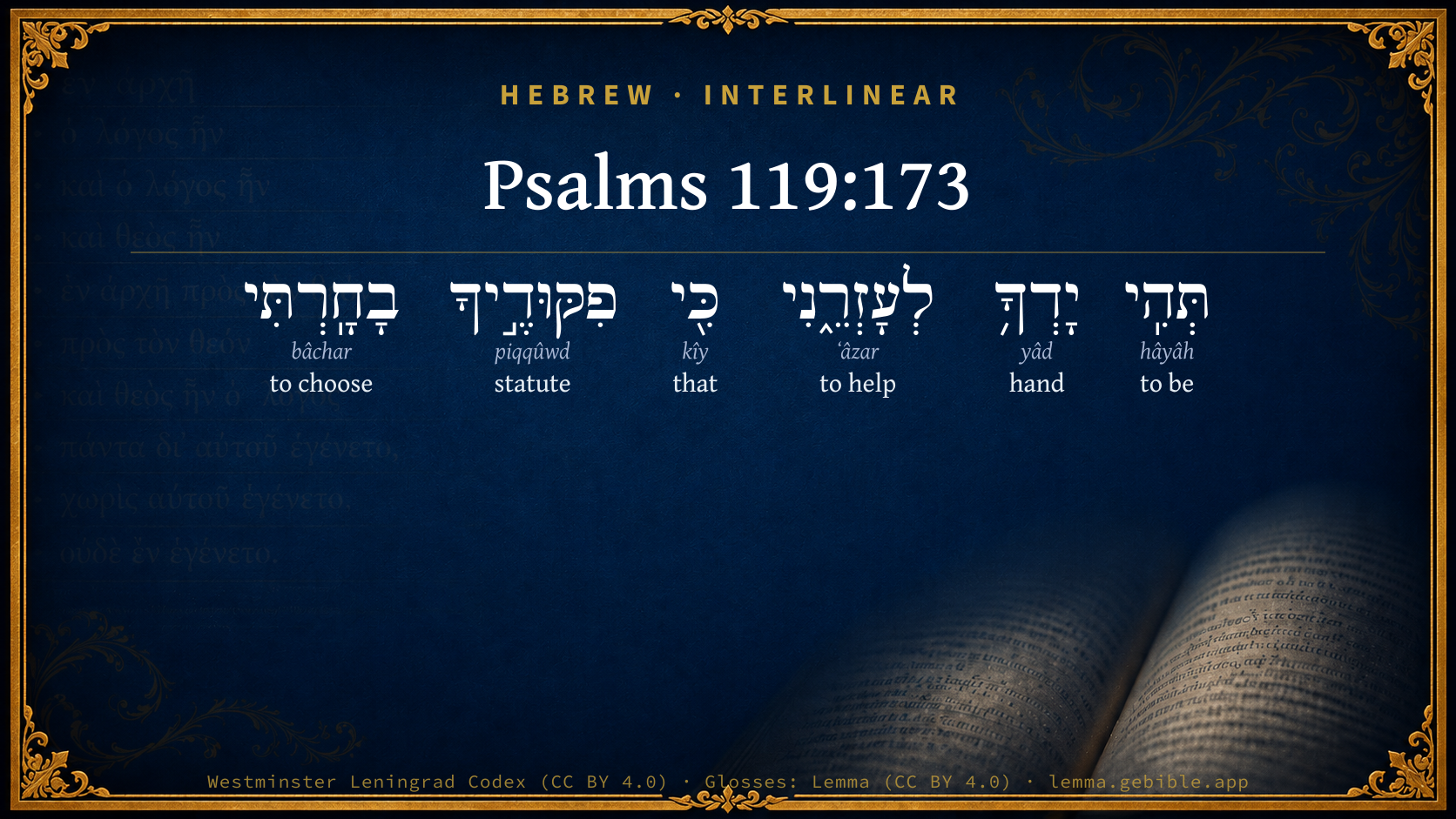
Psalms 119:173

Hebrew (Westminster Leningrad Codex) Psalms 119:173 appears in the Hebrew Old Testament. The text above is from the Westminster Leningrad Codex. Each word links to its Strong’s number, a concise gloss, and parsing drawn from the Open Scriptures Hebrew Bible morphology. Click any word for its full Brown-Driver-Briggs (BDB) entry.
Download image
Cite this verse

Psalms 119:173 (World English Bible). Public Domain. Lemma interlinear Bible study tool, https://lemma.gebible.app/v/psalms/119/173.

Show BibTeX & RIS
BibTeX
RIS
English Translation
Let your hand be ready to help me, For I have chosen your precepts.
World English Bible · Public Domain
Download a study sheet

One document with this verse’s original text, its word-by-word gloss line, the meaning frame, cross-references with their text, attributed commentary, and full source and license credits — printable, and it pastes into notes with its structure intact.

This verse Autodidact and up

Study sheet (.html) Plain text (.txt)

A passage Seminary Student

Up to 50 verses in one chapter. A passage sheet keeps up to 6 commentary sources and 12 cross-references per verse, in the order this page ranks them, and says so on the sheet whenever that leaves anything out. Ask for a single verse and you get the Autodidact verse sheet above.

Everything on this page stays free to read, with no account — the sheet is a download of what is already on screen, not access to it.

Want to remove ads? Support Godless Engineer
Compare translations 3

The same verse in 3 English versions, stacked beneath the original-language interlinear above. Click any original word for its lexicon entry.

Each is an independent rendering of the whole verse — the interlinear is not word-aligned to these translations.

Highlighted words mark where these versions differ — a whole-verse word diff, not a word-by-word alignment.

  • World English Bible Public Domain
    Let your hand be ready to help me, For I have chosen your precepts.
  • King James Version Public Domain
    Let thine hand help me; for I have chosen thy precepts.
  • unfoldingWord Literal Text CC BY-SA 4.0
    May your hand be to help me, for I have chosen your precepts.

unfoldingWord Literal Text — © unfoldingWord, licensed CC BY-SA 4.0. Word-aligned USFM3 via Door43 (git.door43.org/unfoldingWord/en_ult).

Versions to compare (up to 4)

3 of 4 selected

Show all 17 translations

Every available English version of this verse, each an independent rendering of the whole verse.

  • World English Bible Public Domain
    Let your hand be ready to help me, For I have chosen your precepts.
  • Berean Standard Bible Public Domain
    May Your hand be ready to help me, for I have chosen Your precepts.
  • Majority Standard Bible Public Domain
    May Your hand be ready to help me, for I have chosen Your precepts.
  • King James Version Public Domain
    Let thine hand help me; for I have chosen thy precepts.
  • American Standard Version (1901) Public Domain
    Let thy hand be ready to help me; For I have chosen thy precepts.
  • Revised Version (1885) Public Domain
    Let thine hand be ready to help me; for I have chosen thy precepts.
  • Geneva Bible (1599) Public Domain
    Let thine hand helpe me: for I haue chosen thy precepts.
  • Young's Literal Translation Public Domain
    Thy hand is for a help to me, For Thy commands I have chosen.
  • Literal Standard Version CC BY-SA 4.0
    Your hand is for a help to me, || For I have chosen Your commands.
  • Unlocked Literal Bible CC BY-SA 4.0
    May your hand help me, for I have chosen your instructions.
  • unfoldingWord Literal Text CC BY-SA 4.0
    May your hand be to help me, for I have chosen your precepts.
  • Darby Bible Public Domain
    Let thy hand be for my help; for I have chosen thy precepts.
  • World Messianic Bible Public Domain
    Let your hand be ready to help me, for I have chosen your precepts.
  • Webster's Bible Public Domain
    Let thy hand help me; for I have chosen thy precepts.
  • Free Bible Version CC BY-SA 4.0
    Please be ready to help me, for I have chosen to follow your instructions.
  • Bible in Basic English Public Domain
    Let your hand be near for my help; for I have given my heart to your orders.
  • JPS Tanakh (1917) Public Domain
    Let Thy hand be ready to help me; for I have chosen Thy precepts.

Literal Standard Version (2020), Covenant Press — licensed CC BY-SA 4.0. Text via the HelloAO Bible API (eBible.org). Unlocked Literal Bible (unfoldingWord) — licensed CC BY-SA 4.0. Text via the HelloAO Bible API (eBible.org). unfoldingWord Literal Text — © unfoldingWord, licensed CC BY-SA 4.0. Word-aligned USFM3 via Door43 (git.door43.org/unfoldingWord/en_ult). Free Bible Version, Dr. Jonathan Gallagher — licensed CC BY-SA 4.0. Text via the HelloAO Bible API (eBible.org).

Word by word

More ways to search: Search by grammar → Find every occurrence → Compare this word →

Practice this passage: Drill this verse → Learn its vocabulary →

About this verse

These counts appear in no published source. They are computed here, from the morphology-tagged text and Lemma’s own curated glosses. What Lemma adds →

6
words
6
distinct lemmas
Wisdom
section

Notable vocabulary

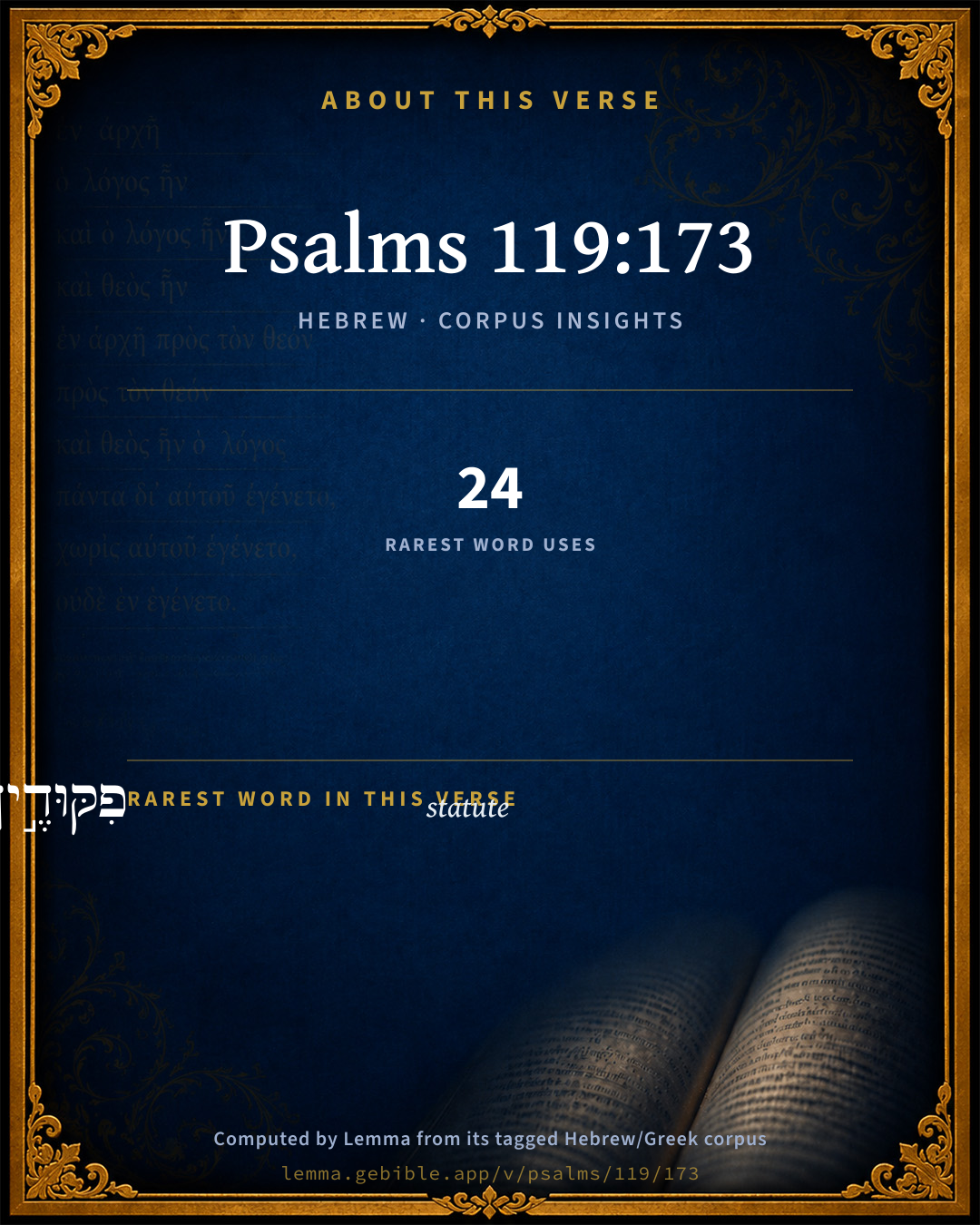
The rarest word here is פִקּוּדֶ֣יךָ statute H6490 — appearing just 24 times in the whole Hebrew Bible.

Shared distinctive vocabulary

פִקּוּדֶ֣יךָ statute H6490 occurs in 24 verses of the Hebrew Bible. Also found in:

Grammatical profile

  • 3 verbs
  • 2 nouns
  • 1 conjunction

Verb forms

  • תְּהִֽי Qal · Imperfect
  • לְעָזְרֵ֑נִי Qal · Infinitive Construct
  • בָחָֽרְתִּי Qal · Perfect

Hebrew & Septuagint length

In English translation the verse runs 14 words from the Hebrew and 14 from the Septuagint (LXX English) — the same length.

A rough comparison of the two English renderings, which tokenize alike — not a word-level alignment.

Word counts can differ between the Hebrew and the Greek without any difference in meaning — e.g. the Hebrew direct-object marker אֵת has no separate Greek word, and Greek often adds the article ὁ.

Cross-references

17

Topical passages linked to Psalms 119:173 in the Treasury of Scripture Knowledge — connected by theme and wording, ordered by reader-vote popularity; previews shown in the World English Bible.

  • Isaiah 41:10–14 Don't you be afraid, for I am with you; don't be dismayed, for I am your God; I will strengthen you; yes, I will help you; yes, I will uphold you with the right hand of my righteousness.
  • Joshua 24:22 Joshua said to the people, You are witnesses against yourselves that you have chosen you Yahweh, to serve him. They said, We are witnesses.
  • Deuteronomy 30:19 I call heaven and earth to witness against you this day, that I have set before you life and death, the blessing and the curse: therefore choose life, that you may live, you and your seed;
  • Joshua 24:15 If it seem evil to you to serve Yahweh, choose you this day whom you will serve; whether the gods which your fathers served that were beyond the River, or the gods of the Amorites, in whose land you dwell: but as for me and my house, we will serve Yahweh.
  • 1 Kings 3:11–12 God said to him, Because you have asked this thing, and have not asked for yourself long life, neither have asked riches for yourself, nor have asked the life of your enemies, but have asked for yourself understanding to discern justice;
  • Psalms 37:24 Though he stumble, he shall not fall, For Yahweh holds him up with his hand.
  • Psalms 119:30 I have chosen the way of truth. I have set my heart on your law.
  • Psalms 119:35 Direct me in the path of your commandments, For I delight in them.
  • Psalms 119:40 Behold, I long for your precepts! Revive me in your righteousness.
  • Psalms 119:94 I am yours. Save me, for I have sought your precepts.
  • Psalms 119:111 I have taken your testimonies as a heritage forever, For they are the joy of my heart.
  • Psalms 119:117 Hold me up, and I will be safe, And will have respect for your statutes continually.
  • Proverbs 1:29 Because they hated knowledge, And didn't choose the fear of Yahweh.
  • Mark 9:24 Immediately the father of the child cried out with tears, "I believe. Help my unbelief!"
  • Luke 10:42 but one thing is needed. Mary has chosen the good part, which will not be taken away from her."
  • 2 Corinthians 12:9 He has said to me, "My grace is sufficient for you, for my power is made perfect in weakness." Most gladly therefore I will rather glory in my weaknesses, that the power of Christ may rest on me.

Cross-references courtesy of OpenBible.info (CC BY 4.0).

Hebrew and Greek witnesses Masoretic Hebrew ↔ Greek Septuagint

The same verse in the two great witnesses to the Old Testament, shown verse-for-verse.

You’re reading Greek Psalm 118 (Hebrew Psalm 119). The Septuagint counts the superscription, so verse numbers can differ from the Hebrew — chapter-level alignment, not verse-by-verse. Numbering follows Rahlfs.

These are two independent witnesses, not word-aligned to each other, and the Septuagint is shown in lemma (dictionary) form.

Hebrew Psalms 119:173 Masoretic · Westminster Leningrad Codex

תְּהִֽי יָדְךָ֥ לְעָזְרֵ֑נִי כִּ֖י פִקּוּדֶ֣יךָ בָחָֽרְתִּי

Let your hand be ready to help me, For I have chosen your precepts.

World English Bible · Public Domain

Greek LXX Greek Psalm 118:173 Septuagint · lemma form

γίγνομαι ὁ χείρ σύ ὁ σώζω ἐγώ ὅτι ὁ ἐντολή σύ αἱρετίζω

Let your hand be prompt to save me; for I have chosen your commandments.

LXX2012 (modern English Septuagint) · Public Domain

Hebrew: Westminster Leningrad Codex (CC BY 4.0). Greek: Septuagint (public domain); English from LXX2012 (modern English Septuagint) (Public Domain). How the Septuagint differs from the Hebrew →

Commentary

Notes on Psalms 119:173 from classic Christian and Jewish commentators (each source and its license shown beneath its notes). The classic Christian expositions comment on the surrounding passage and are grouped to its opening verse, so a note may address several verses; the Jewish commentaries on the Tanakh (Rashi and others) are per-verse, so they appear only where the commentator wrote on this verse.

Lemma curates 59 commentaries, every one of them public domain or Creative Commons licensed, each selected and text-cleaned for this edition rather than reprinted as found. About our sources →

The Cambridge Bible for Schools and Colleges

gen. ed. J. J. S. Perowne

173. Let thine hand be ready to help me (R.V.).

for &c.] Psa_119:174 is best taken in close connexion with Psa_119:173 b. He pleads three reasons for an answer to his prayers:—he has deliberately resolved to obey God’s precepts (cp. Psa_119:30; Deu_30:19); he has long been waiting eagerly for deliverance from the hindrances to obedience which surround him (cp. Psa_119:40; Psa_119:166); his devotion has been no grudging service, but his constant delight (Psa_119:24 &c.).

The Cambridge Bible for Schools and Colleges (gen. ed. J. J. S. Perowne; Cambridge University Press, 1878–1918) — public domain. Text from a community e-Sword module.

Trapp's Complete Commentary

John Trapp

Psa 119:173 Let thine hand help me; for I have chosen thy precepts.

Ver. 173. Let thy hand help me] To do what I have promised.

For I have chosen thy precepts] Refusing Satan’s cut-throat kindness.

John Trapp, A Commentary or Exposition upon All the Books of the Old and New Testament (1647–1656) — public domain. Text from a community e-Sword module.

The Biblical Illustrator

Joseph S. Exell

Psa_119:173-175

Let Thine hand help me; for I have chosen Thy precepts.

The character and requests of a truly godly man

I. His character.

1. His choice is the precepts of God.

2. His object of desire is Gods salvation. With respect to earthly things, nature is contented with a little, and grace with less. Not so in spiritual things. Here grace is insatiable; the more it has received, the more it desires.

3. His source of joy is Gods law. Here he chooses the term law for denoting the whole revelation of Gods will, to remind us of the inseparable connection between privilege and duty, faith and obedience, holiness and comfort; and to teach us that we ought to be thankful to God for the direction tie hath given us in the road to heaven, no less than for the promises by which we are assured of the possession of it.

II. His leading requests. He prays--

1. For strengthening and upholding grace. Let Thine hand help me.

2. For quickening grace. Let my soul live. This was the life for which David prayed; a confirmed sense of pardoning mercy, larger measures of sanctifying grace, communion with his God in a present world, and the full and everlasting enjoyment of Him in heaven. The life for which he prays is no other than the salvation for which he longed. He had tasted of its sweetness, and he thirsted for more. Let my soul live, saith he; to which he subjoins, and it shall praise Thee.

III. The ultimate end for which David was so earnest in his requests for help and life, and the improvement he proposed to make of both. He prayed for upholding and quickening grace, that he might be better qualified for the service of his God, to whom he had devoted himself and his all. Thus he prays (Psa_51:12; Psa_51:18; Psa_51:15). And the principal reason for which he was desirous to obtain Divine consolation appears from the use he intended to make of it (verse 32). (R. Walker.)

The Biblical Illustrator, edited by Joseph S. Exell (c. 1880s–1900s) — public domain. Text from a community e-Sword module.

J. A. Alexander on Psalms

Joseph Addison Alexander

173. (Psa 119:173) Let thy hand be (near) to help me; for thy precepts do I choose. The word supplied in this translation is not necessary to the sense, but is introduced for the purpose of retaining the original construction, be to help me, i.e. be my help, or simply help me. The reason given in the last clause is, that as he voluntarily makes choice of God's will as his rule of conduct, he thereby renounces all other protection. The Hebrew verb is a preterite; I choose, and have already chosen.

Joseph Addison Alexander, The Psalms Translated and Explained (1850) — public domain. Text from a community e-Sword module.

Matthew Henry's Commentary

Here, 1. David prays that divine grace would work for him: Let thy hand help me. He finds his own hands are not sufficient for him, nor can any creature lend him a helping hand to any purpose; therefore he looks up to God in hopes that the hand that had made him would help him; for, if the Lord do not help us, whence can any creature help us? All our help must be expected from God's hand, from his power and his bounty. 2. He pleads what divine grace had already wrought in him as a pledge of further mercy, being a qualification for it. Three things he pleads: - (1.) That he had made religion his serious and deliberate choice: "I have chosen thy precepts. I took them for my rule, not because I knew no other, but because, upon trial, I knew no better." Those are good, and do good indeed, who are good and do good, not by chance, but from choice; and those who have thus chosen God's precepts may depend upon God's helping hand in all their services and under all their sufferings. (2.) That his heart was upon heaven: I have longed for thy salvation. David, when he had got to the throne, met with enough in the world to court his stay, and to make him say, "It is good to be here;" but still he was looking further, and longing for something better in another world. There is an eternal salvation which all the saints are longing for, and therefore pray that God's hand would help them forward in their way to it. (3.) That he took pleasure in doing his duty: "Thy law is my delight. Not only I delight in it, but it is my delight, the greatest delight I have in this world." Those that are cheerful in their obedience may in faith beg help of God to carry them on in their obedience; and those that expect God's salvation must take delight in his law and their hopes must increase their delight.

Matthew Henry's Commentary on the Whole Bible (1708–1710) — public domain (CC PDM 1.0). Text via the HelloAO Bible API.

Adam Clarke's Commentary

Verse 173. Let thine hand help me] Exert thy power in my defence.

Adam Clarke's Commentary on the Bible (1810–1826) — public domain. Text from a community e-Sword/MySword module.

John Calvin's Commentaries

173. Let thy hand be to succor me. As he had devoted himself to the doctrine of the law, David requests that the hand of God may be stretched forth for his aid. Farther, by these words he declares, that those who yield themselves to God to be governed by His word have continually need of His help. The more sincerely any individual studies to be a good man, so much the more numerous are the ways in which Satan troubles him, and so much the more are the enemies multiplied who molest him on all sides. But when God sees those who once embraced the truth of his word remaining steadfast in their resolution, he is so much the more inclined to aid them. By the word choose in the second clause, the Psalmist has expressed that nothing had hindered him from devoting himself to the law of God. No man will apply this mind to the love of the law without a great struggle, since the thoughts of every man are drawn away to a variety of objects, by the depraved affections of the flesh. This choosing then spoken of shows that it is not through ignorance or an inconsiderate zeal that the children of God desire above all things heavenly doctrine; but as they partake of the flexibility or pliancy of mind common to men, and feel the various impulses of the flesh, they purposely subdue their minds to the obedience of God.

John Calvin's Commentaries (1540-1563) — public domain. Text from the Calvin Translation Society English edition (1840s-50s) via the Christian Classics Ethereal Library (ccel.org). Calvin's coverage is partial (roughly two-thirds of the Bible); uncommented books and verses are honest gaps, never fabricated. The 19th-century editor's footnotes and remarks are omitted so the notes are faithfully Calvin's own voice.

Albert Barnes' Notes on the Bible

Let thine hand help me - Do thou help me - the hand being that by which we accomplish anything.

For I have chosen that precepts - I have chosen them as my comforters and my guide. I have resolved to obey them, and I pray that thou wilt help me to accomplish the purpose of my heart.

Albert Barnes' Notes on the Bible (1834–1885) — public domain. Text from a community e-Sword/MySword module.

Matthew Poole's English Annotations

For my guide and companion, and chief joy and treasure.

Matthew Poole's English Annotations on the Holy Bible (1683–1685) — public domain. Text from a community e-Sword/MySword module.

The Treasury of David

Charles H. Spurgeon

Ver. 173. Let thine hand help me. Give me practical succour. Do not entrust me to my friends or thy friends, but put thine own hand to the work. Thy hand has both skill and power, readiness and force: display all these qualities on my behalf. I am willing to do the utmost that I am able to do; but what I need is thine help, and this is so urgently required that if I have it not I shall sink. Do not refuse thy succour. Great as thy hand is, let it light on me, even me. The prayer reminds me of Peter walking on the sea and beginning to sink; he, too, cried, "Lord, help me, "and the hand of his Master was stretched out for his rescue.

For I have chosen, thy precepts. A good argument. A man may fitly ask help from God's hand when he has dedicated his own hand entirely to the obedience of the faith. "I have chosen thy precepts." His election was made, his mind was made up. In preference to all earthly rules and ways, in preference even to his own will, he had chosen to be obedient to the divine commands. Will not God help such a man in holy work and sacred service? Assuredly he will. If grace has given us the heart with which to will, it will also give us the hand with which to perform. Wherever, under the constraints of a divine call, we are engaged in any high and lofty enterprise, and feel it to be too much for our strength, we may always invoke the right hand of God in words like these.

Ver. 173. Let thine hand help me. David having before made promises of thankfulness, seeks now help from God, that he may perform them. Our sufficiency is not of ourselves, but of God; to will and to do are both from him. In temporal things men ofttimes take great pains with small profit; first, because they seek not to make their conscience good; next, because they seek not help front God: therefore they speed no better than Peter, who fished all night and got nothing till he cast his net in the name of the Lord. But in spiritual things we may far less look to prosper, if we call not for God's assistance: the means will not profit us unless God's blessing accompany them. There is preaching, but for the most part without profit; there is prayer, but it prevails not; there is hearing of the word, but without edifying; and all because in spiritual exercises instant prayer is not made unto God, that his hand may bc with us to help us. Abraham Wright.

Ver. 173. I have chosen thy precepts. Hath God given you a heart to make choice of his ways? O bless God! There was a time when you went on in giving pleasing to the flesh, and you saw then no better thing than such a kind of life, and the Lord hath been pleased to discover better things to you, so as to make you renounce your former ways, and to make choice of another way, in which your souls have found other manner of comforts, and satisfactions, and contentments than ever you did before. Bless God as David did: "Blessed be the Lord who hath given me counsel"...Seeing God hath thus inclined your heart to himself, be for ever established in your choice: seeing God hath shown to you his ways, as Pilate said in another case, "That I have written I have written": so say you, "That I have chosen I have chosen." Jeremiah Burroughs, in "Moses his Choice."

Ver. 173, 174. I have chosen. My delight. Cheerfulness accompanies election of a thing. Lumpishness is a sign we never chose it, but were forced to it. Such cheerfulness in service procures cheerfulness in mercies: Isa 64:5, "Thou meetest him that rejoiceth and worketh righteousness." He puts to his hand to help such an one. Christ loves not melancholy and phlegmatic service; such a temper in acts of obedience is a disgrace to God and to religion: to God, it betrays us to have jealous thoughts of God, as though he were a hard master; to religion, it makes others think duties are drudgeries, and not privileges.

Stephen Charnock.

Ver. 173.

1. "To will is present with me."

2. "How to perform that which I would, I find not."

3. "Help. Lord."

Ver. 173.

1. Help needed to keep the divine precepts.

2. Help sought: "Let thy hand, "etc. We should choose nothing and do nothing in which we cannot ask help from God.

G.R.

Ver. 173.

1. God's Hand.

(a) Its warm hold (Joh 5:29).

(b) Its wealth of contents (Ps 104:28).

(c) Its heavy blow (Ps 39:10).

(d) Its weight (1Sa 5:11).

(e) Its saving reach (Isa 54:1).

(f) Its sweet shadow (Isa 49:2), etc.

2. The saint plucks him by the sleeve: "Let thy hand help me."

(a) His humble representation.

(b) His down drawing of the hand of God.

W.B.H.

Ver. 173. Let Thy hand help me.

1. Thy reconciling hand: "stretched out."

2. Thy comforting hand; like that which touched Daniel and John.

3. Thy supplying hand. "Thou openest thy hand, "etc.

4. Thy protecting hand: "all his saints are in thy hand": De 33:3. "Great Shepherd of the sheep."

5. Thy supporting hand: "I will uphold thee."

6. Thy governing hand: "all my times are in thy hand."

7. Thy chastening hand: "Thy hand was heavy upon me."

8. Thy prospering hand: "the hand of the Lord was with, "etc.

W.J.

Psalms 119:174*

Charles H. Spurgeon's The Treasury of David (1869–1885) — public domain. Psalms only. Text from a community e-Sword/MySword module.

The Pulpit Commentary

Let thine hand help me; literally, be to help me; i.e. be ever ready to help me. For I have chosen thy precepts. I have cast aside all other helpers, and have pinned my faith on thee and thy Word.

The Pulpit Commentary (1880–1919), ed. H.D.M. Spence-Jones & Joseph S. Exell — public domain. Text from a community e-Sword module.

unfoldingWord translationNotes

Door43 World Missions Community

May your hand help me

The hand is a synecdoche for the whole person. AT: "Please help me" (See: Synecdoche)

have chosen

"have chosen to obey"

for your rescue

"you to rescue me"

your law is my delight

The abstract noun "delight" can be stated as a verb. "I very much enjoy obeying your law" (See: Abstract Nouns)

translationWords

hand

law

delight

unfoldingWord translationNotes — © Distant Shores Media and the Door43 World Missions Community, licensed CC BY-SA 4.0. Source: git.door43.org/Door43/en_tn.

Lesson kit

Teaching starters — assembled from the data on this page, not authored interpretation. Every prompt links to the verse data it draws on. Edit before teaching.

Psalms, in the Wisdom, opens this verse with 6 words (6 distinct Hebrew lemmas). Its most distinctive word is piqqûwd (“statute”). A historical commentator’s framing appears above. Read the whole chapter for the surrounding context.

Discussion questions

  1. The word piqqûwd carries the sense “statute.” How does it shape the verse?
  2. Psalms 19:8 shares the word «statute» with this verse. How do the two illuminate each other?
  3. These translations render this verse differently. What is at stake in choosing one wording over another?
  4. The verb «תְּהִֽי» is Qal Imperfect. How does its form color the action?
  5. Reading how The Cambridge Bible for Schools and Colleges and Trapp's Complete Commentary read this verse, where do the two commentators agree and where do they part?

Things to notice

Reading settings

Reading text

Shown beneath each verse's original-language words.

Old Testament
Old Testament edition

Read the OT as the Masoretic Hebrew (MT) or the Greek Septuagint (LXX).

English shown for the Greek Septuagint (in the Hebrew ↔ Greek comparison).

Comparing translations? Open the Compare panel on any verse page to stack up to four side by side.