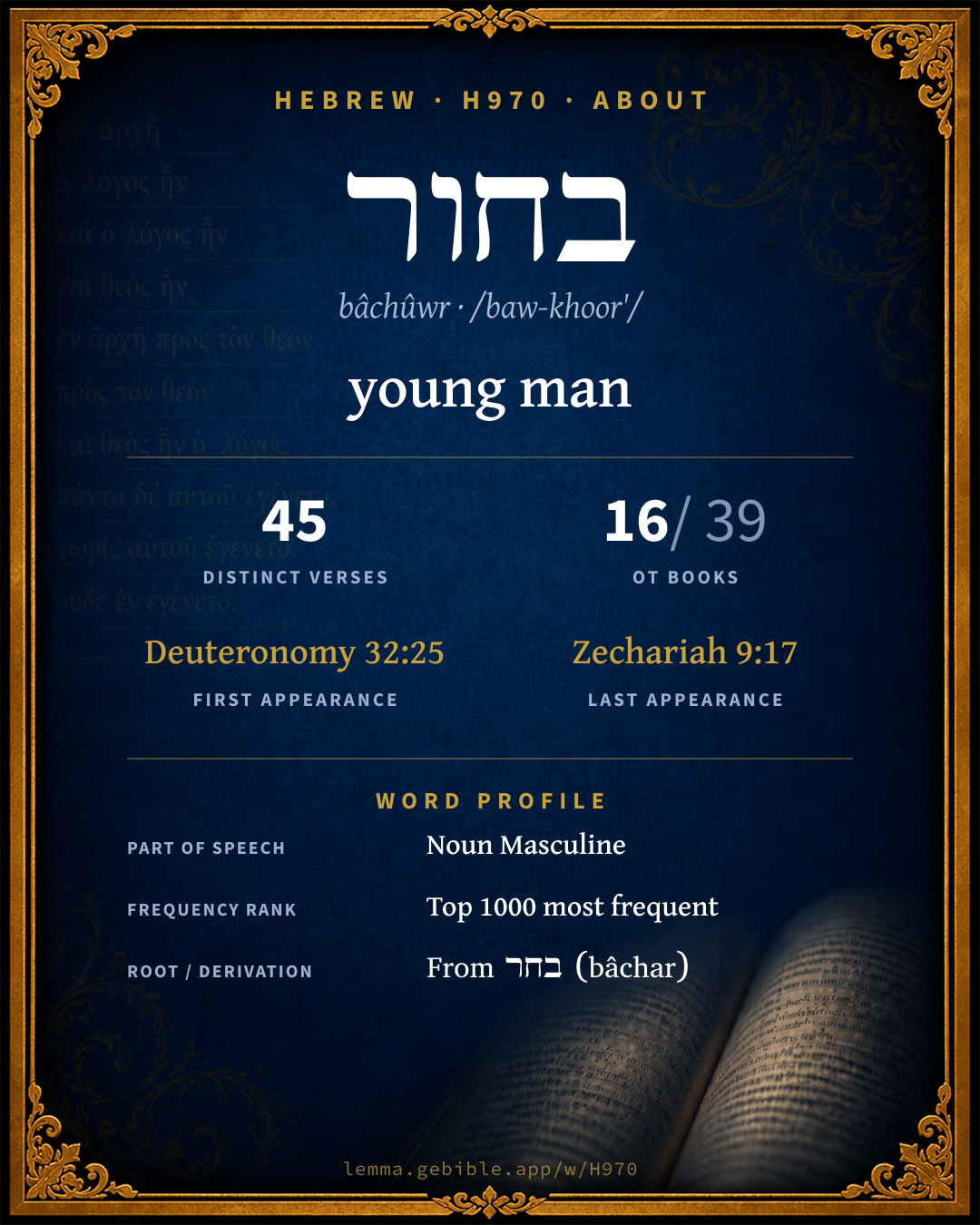
בָּחוּר
young man
Full lexicon entry — Brown-Driver-Briggs (BDB)
From Brown-Driver-Briggs (BDB)
Where this word appears
See every Absolute-state word in the Hebrew Bible →
Grammar key — what these labels mean
Part of speech
- Noun
- A naming word — a person, place, thing, or idea.
- Verb
- An action or state-of-being word.
Noun type
- Common
- A common noun — a general class of person, place, or thing (“king,” “city,” “water”), not a specific name.
Stem
- Qal
- The basic, simple active stem — the plain form of the verb (“he wrote”).
Form
- Participle Passive
- A verbal adjective expressing action received (“written”).
State
- Absolute
- The independent form of a noun, not bound to a following word.
- Construct
- A noun bound to a following noun in a possessive / “of” relationship (the construct chain).
Gender
- Masculine
- Grammatically masculine.
Number
- Plural
- More than one (in Hebrew, generally three or more).
- Singular
- One.
Grammatical forms
- Noun, Common, Masculine, Plural, Construct 22 times (48%)
- Noun, Common, Masculine, Plural, Absolute 14 times (30%)
- Noun, Common, Masculine, Singular, Absolute 8 times (17%)
- Verb, Qal, Participle Passive, Masculine, Singular, Absolute 2 times (4%)
Parsed forms decoded from the imported morphology (morphhb / Westminster Leningrad Codex — WLC text public domain, morphhb tagging CC BY 4.0), counted across 46 parsed occurrences — not distinct verses.
Every verse where H970 appears — 45 distinct verses across 16 books. Click any verse to open its interlinear word-by-word view. Verse text shown in the World English Bible for context — . Each verse’s Hebrew form is shown with its reference; the English is not keyword-highlighted, since the data carries no word-level English alignment. Use “Compare translations” on any verse to read it across multiple English versions. This concordance covers the Hebrew Bible; Septuagint (Greek Old Testament) occurrences are not indexed here.
Deuteronomy 1 verse
Judges 1 verse
Ruth 1 verse
1 Samuel 2 verses
- 1 Samuel 8:16 בַּחוּרֵי/כֶ֧ם n c mp cs + sfx pers 2mp He will take your men-servants, and your maid-servants, and your best young men, and your donkeys, and put them to his work.
- 1 Samuel 9:2 בָּח֣וּר n c ms He had a son, whose name was Saul, an impressive young man; and there was not among the children of Israel a better person than he. From his shoulders and upward he was higher than any of the people.
2 Kings 1 verse
2 Chronicles 1 verse
Psalms 4 verses
- Psalms 78:31 וּ/בַחוּרֵ֖י conj + n c mp cs When the anger of God went up against them, Killed some of the fattest of them, And struck down the young men of Israel.
- Psalms 78:63 בַּחוּרָ֥י/ו n c mp cs + sfx pers 3ms Fire devoured their young men; Their virgins had no wedding song.
- Psalms 89:19 בָח֣וּר Qal ptcp.pass ms Then you spoke in vision to your saints, And said, "I have bestowed strength on the warrior. I have exalted a young man from the people.
- Psalms 148:12 בַּחוּרִ֥ים n c mp Both young men and maidens; Old men and children:
Proverbs 1 verse
Ecclesiastes 1 verse
Isaiah 5 verses
- Isaiah 9:17 בַּחוּרָ֜י/ו n c mp cs + sfx pers 3ms Therefore the Lord will not rejoice over their young men, neither will he have compassion on their fatherless and widows; for everyone is profane and an evil-doer, and every mouth speaks folly. For all this his anger is not turned away, but his hand is stretched out still.
- Isaiah 23:4 בַּחוּרִ֖ים n c mp Be ashamed, Sidon; for the sea has spoken, the stronghold of the sea, saying, I have not travailed, nor brought forth, neither have I nourished young men, nor brought up virgins.
- Isaiah 31:8 וּ/בַחוּרָ֖י/ו conj + n c mp cs + sfx pers 3ms The Assyrian shall fall by the sword, not of man; and the sword, not of men, shall devour him; and he shall flee from the sword, and his young men shall become subject to forced labor.
- Isaiah 40:30 וּ/בַחוּרִ֖ים conj + n c mp Even the youths shall faint and be weary, and the young men shall utterly fall:
- Isaiah 62:5 בָּחוּר֙ n c ms For as a young man marries a virgin, so shall your sons marry you; and as the bridegroom rejoices over the bride, so shall your God rejoice over you.
Jeremiah 12 verses
- Jeremiah 6:11 בַּחוּרִ֖ים n c mp Therefore I am full of the wrath of Yahweh; I am weary with holding in: pour it out on the children in the street, and on the assembly of young men together; for even the husband with the wife shall be taken, the aged with him who is full of days.
- Jeremiah 9:21 בַּחוּרִ֖ים n c mp For death is come up into our windows, it is entered into our palaces; to cut off the children from outside, [and] the young men from the streets.
- Jeremiah 11:22 הַ/בַּֽחוּרִים֙ ptcl def.art + n c mp therefore thus says Yahweh of hosts, Behold, I will punish them: the young men shall die by the sword; their sons and their daughters shall die by famine;
- Jeremiah 15:8 בָּח֖וּר n c ms Their widows are increased to me above the sand of the seas; I have brought on them against the mother of the young men a destroyer at noonday: I have caused anguish and terrors to fall on her suddenly.
- Jeremiah 18:21 בַּח֣וּרֵי/הֶ֔ם n c mp cs + sfx pers 3mp Therefore deliver up their children to the famine, and give them over to the power of the sword; and let their wives become childless, and widows; and let their men be slain of death, [and] their young men struck of the sword in battle.
- Jeremiah 31:13 וּ/בַחֻרִ֥ים conj + n c mp Then shall the virgin rejoice in the dance, and the young men and the old together; for I will turn their mourning into joy, and will comfort them, and make them rejoice from their sorrow.
- Jeremiah 48:15 בַּֽחוּרָ֖י/ו n c mp cs + sfx pers 3ms Moab is laid waste, and they are gone up into his cities, and his chosen young men are gone down to the slaughter, says the King, whose name is Yahweh of Hosts.
- Jeremiah 49:26 בַחוּרֶ֖י/הָ n c mp cs + sfx pers 3fs Therefore her young men shall fall in her streets, and all the men of war shall be brought to silence in that day, says Yahweh of Hosts.
- Jeremiah 50:30 בַחוּרֶ֖י/הָ n c mp cs + sfx pers 3fs Therefore shall her young men fall in her streets, and all her men of war shall be brought to silence in that day, says Yahweh.
- Jeremiah 50:44 בָח֖וּר Qal ptcp.pass ms Behold, [the enemy] shall come up like a lion from the pride of the Jordan against the strong habitation: for I will suddenly make them run away from it; and whoever is chosen, him will I appoint over it: for who is like me? and who will appoint me a time? and who is the shepherd who can stand before me?
- Jeremiah 51:3 בַּ֣חֻרֶ֔י/הָ n c mp cs + sfx pers 3fs Against [him who] bends let the archer bend his bow, and against [him who] lifts himself up in his coat of mail: and don't you spare her young men; destroy you utterly all her host.
- Jeremiah 51:22 בָּח֖וּר n c ms and with you will I break in pieces the chariot and him who rides therein; and with you will I break in pieces man and woman; and with you will I break in pieces the old man and the youth; and with you will I break in pieces the young man and the virgin;
Lamentations 5 verses
- Lamentations 1:15 בַּחוּרָ֑/י n c mp cs + sfx pers 1cs The Lord has set at nothing all my mighty men in the midst of me; He has called a solemn assembly against me to crush my young men: The Lord has trodden as in a winepress the virgin daughter of Judah.
- Lamentations 1:18 וּ/בַחוּרַ֖/י conj + n c mp cs + sfx pers 1cs Yahweh is righteous; for I have rebelled against his commandment: Please hear all you peoples, and see my sorrow: My virgins and my young men are gone into captivity.
- Lamentations 2:21 וּ/בַחוּרַ֖/י conj + n c mp cs + sfx pers 1cs The youth and the old man lie on the ground in the streets; My virgins and my young men are fallen by the sword: You have killed them in the day of your anger; you have slaughtered, [and] not pitied.
- Lamentations 5:13 בַּחוּרִים֙ n c mp The young men bare the mill; The children stumbled under the wood.
- Lamentations 5:14 בַּחוּרִ֖ים n c mp The elders have ceased from the gate, The young men from their music.
Ezekiel 5 verses
- Ezekiel 9:6 בָּח֣וּר n c ms kill utterly the old man, the young man and the virgin, and little children and women; but don't come near any man on whom is the mark: and begin at my sanctuary. Then they began at the old men that were before the house.
- Ezekiel 23:6 בַּח֥וּרֵי n c mp cs who were clothed with blue, governors and rulers, all of them desirable young men, horsemen riding on horses.
- Ezekiel 23:12 בַּח֥וּרֵי n c mp cs She doted on the Assyrians, governors and rulers, [her] neighbors, clothed most gorgeously, horsemen riding on horses, all of them desirable young men.
- Ezekiel 23:23 בַּח֨וּרֵי n c mp cs the Babylonians and all the Chaldeans, Pekod and Shoa and Koa, [and] all the Assyrians with them; desirable young men, governors and rulers all of them, princes and men of renown, all of them riding on horses.
- Ezekiel 30:17 בַּח֥וּרֵי n c mp cs The young men of Aven and of Pibeseth shall fall by the sword; and these [cities] shall go into captivity.
Joel 1 verse
Amos 3 verses
- Amos 2:11 וּ/מִ/בַּחוּרֵי/כֶ֖ם conj + prep + n c mp cs + sfx pers 2mp I raised up some of your sons for prophets, And some of your young men for Nazirites. Isn't this true, You children of Israel?" says Yahweh.
- Amos 4:10 בַּח֣וּרֵי/כֶ֔ם n c mp cs + sfx pers 2mp I sent plagues among you like I did Egypt. I have slain your young men with the sword, And have carried away your horses; And I filled your nostrils with the stench of your camp Yet you haven't returned to me," says Yahweh.
- Amos 8:13 וְ/הַ/בַּחוּרִ֖ים conj + ptcl def.art + n c mp In that day the beautiful virgins And the young men will faint for thirst.
Zechariah 1 verse
About this entry
At a glance — auto-summarized from this page’s data, not written by a person. Every figure links to its source below. This summary describes the numbers; it doesn’t interpret them.
בחור — transliterated bâchûwr — is a Hebrew noun carrying the sense “young man.” Its earliest occurrence is Deuteronomy 32:25. It appears 45 verses across 16 books of the Hebrew Bible, among its moderately common vocabulary. More than a quarter of its appearances fall in Jeremiah. It shares a root with בחר, בחיר and מבחור. See the sense tree, 45-verse concordance, and the renderings breakdown below.
Gloss history
Strong's 1890 vs modern scholarship
About this word
Strong's H970 catalogs a Hebrew word from the Hebrew Old Testament.
These counts are not copied from any lexicon or concordance. They are computed here, from the morphology-tagged Hebrew Old Testament. What Lemma adds →
- 45
- distinct verses
- The word appears in 45 distinct verses.
- 16 / 39
- OT books
- The word appears in 16 of 39 Old Testament books.
- #796
- by frequency
- Top 1000 most frequent Hebrew words (rank 796 of 8,640 Hebrew words by occurrence).
View all 45 occurrences in the concordance →
Most concentrated in
- Jeremiah 12 verses 27%
- Isaiah 5 verses 11%
- Lamentations 5 verses 11%
By section of the Old Testament
By traditional corpus
Conventional, traditional groupings — biblical authorship is debated, so this is a traditional corpus grouping, not an authorship claim. Each share is this word’s portion of its verses in that division of the Hebrew canon. Each figure is a share of the word’s 45 distinct verses.
- Prophets (Nevi'im) 31 verses · 69%
- Writings (Ketuvim) 13 verses · 29%
- Torah (Pentateuch) 1 verse · 2%
How translations render this word
Counts come from each version’s own published word-to-Strong’s tagging or interlinear alignment — an approximate guide to how each version renders this word, not a word-level alignment the data otherwise carries. Because each total is that version’s own tagged count, the per-version totals vary from one another and need not match the appearance or distinct-verse counts above. These counts may also differ from a printed concordance because Lemma counts each distinctly tagged rendering and does not collapse phrase taggings into a single head-word total. This is a fixed set of word-tagged versions (KJV, ASV, BSB, ULT) and does not change with the reading translation you choose elsewhere. Each version’s license is shown beside its name below (and on Sources).
- King James Version: Young men 28×, Young man 4×, Both young men 2×
- American Standard Version: Young men 27×, Young man 5×
- Berean Standard Bible: Young men 33×, Young man 4×
- unfoldingWord Literal Text: Young men 28×, Young man 5×, Were strong 2×
King James Version Public Domain
Renders H970 across 44 tagged occurrences — most commonly:
Plus 10 renderings that appear only once — usually multi-word phrases or single function words the recovered tagging swept in, not distinct renderings. Not rendered by a distinct English word in 1 further occurrence.
American Standard Version Public Domain
Renders H970 across 45 tagged occurrences — most commonly:
Plus 13 renderings that appear only once — usually multi-word phrases or single function words the recovered tagging swept in, not distinct renderings.
Berean Standard Bible Public Domain
Renders H970 across 44 tagged occurrences — most commonly:
Plus 7 renderings that appear only once — usually multi-word phrases or single function words the recovered tagging swept in, not distinct renderings.
unfoldingWord Literal Text CC BY-SA 4.0
Renders H970 across 40 tagged occurrences — most commonly:
Plus 5 renderings that appear only once — usually multi-word phrases or single function words the recovered tagging swept in, not distinct renderings.
Senses in BDB
The 1 sense BDB distinguishes for this word, in lexicon order (not ranked by frequency or importance). The full entry — with sub-senses — is in the Lexicon Entry tab.
- youth, young man
Word origin
n.m. young man Is 62:5 + 7 times; pl. בַּחוּרִים (intensive with dag. f. implic.) Pr 20:29 + 13 times; cstr. בַּחוּרֵי Ez 23:6 + 4 times; sf. בַּחוּרַי etc. La 1:18 + 16 times;—young man (choice, in the prime of manhood) 1 S 9:2 Ec 11:9 Is 62:5; coll. young men Je 15:8; בָּחוּר וּבְתוּלָה young men and virgins Dt 32:25 2 Ch 36:17 Je 51:22 Ez 9:6; usually pl. Ju 14:10 Ru 3:10 1 S 8:16 2 K 8:12 2 Ch 36:17 Pr 20:29 Is 9:17; 31:8; 40:30 Je 6:11; 9:20; 11:22; 18:21; 48:15; 49:26; 50:30; 51:3 La 1:15; 5:13, 14 Ez 33:6, 12, 23; 30:17 Jo 3:1 Am 2:11; 4:10; ‖ בתולות ψ 78:63; 148:12 Is 23:4 Je 31:13 La 1:18; 2:21 Am 8:13 Zc 9:17.
— Brown-Driver-Briggs (Oxford 1906, public domain), digitized via Sefaria, supplemented by the OpenScriptures HebrewLexicon (CC BY 4.0). See Sources.
Derived from בחר (bâchar) (H977) — to choose.
Jastrow Dictionary
A second Hebrew/Aramaic lexicon for comparison, covering Aramaic and post-biblical (Talmudic, Targumic, Midrashic) usage that the biblical-Hebrew BDB does not. Matched by lemma rather than by Strong’s number, so a lemma may carry more than one Jastrow headword (shown separately below), and the entries cover usage well beyond the Bible.
בָּחוּר
- 1. chosen. Sabb. 105ᵃ (ref. to א̇ב̇, Gen. XVII, 5) I have made thee א̇ב a father of the nations, ב̇' נתתיך וכ׳ I have made thee a chosen one among the nations. Gen. R. s. 76, beg.; a. fr. e.g. Genesis 17:5
- 2. young man, youth, unmarried. Keth. 7ᵇ, opp. אַלְמוֹן.—Gen. R. s. 39 ב׳ ובתולה מיכן a young man and a virgin on the one side (of the coin). Ḥag. 14ᵃ; a. fr.—Fem. בַּחוּרָה. Gen. R. s. 71; a. e.—Pl. בַּחוּרִים, f. בַּחוּרוֹת. Num. R. s. 10, beg. לב׳ קול וכ׳ to the young (the strong) ‘the voice of the Lord (at revelation) sounded with might’, opp. תשים; a. e.
חָוַר
- to perforate; to be transparent, white, clear.
- to make clear, evident. Mekh. Mishp., N’zikin, s. 13 (ref. to Deut. XXII, 17) מְחַוְּורִין … כשמלה they must make the fact as clear as a (white) sheet. Gen. R. s. 98 (ref. to כבס, ib. XLIX, 11) שהוא מְחַוֵּור וכ׳ he will make clear to them the words of the Law; שהוא מח׳ להם טעיותיהם he will prove to them their errors; a. e.—Part. pass. מְחוּוָּר clear, proved, evident. Y. Shek. III, end, 47ᶜ מ׳ שבכולן the clearest of all the quoted Biblical evidences. Gen. R. s. 47, end; Y. Ab. Zar. I, 39ᵈ top מ׳ שבכולן the least doubtful of all. Y. Succ. V, beg. 55ᵃ משם שאינו מח׳ because the use of the flute is not clearly stated in the Law. Y. Ter. II, 41ᶜ bot. זה אחד … שהן מְחוּוָּרִין וכ׳ this is one of the three interpretations (of the Rabbis) which are clearly indicated in the Bible text. Y. Erub. III, 21ᵃ bot. הגיעוך סוף … שאינן מח׳ thou must finally admit that the law of Sabbath limits finds no proof in the Biblical words. Y. Ber. II, 5ᵃ bot. הגיעוך סוף מלאכות תפלה שאינן מח׳ מד"ת ed. Lehm. (oth. ed. corr. acc.) thou must admit that for labors permitted or forbidden during prayer no support is to be found in &c.; a. fr. e.g. Deuteronomy 22:17
- to be made clear. Y. Keth. IV, 28ᶜ top (ref. to Deut. XXII, 17) עד שיִתְחַוְּורוּ וכ׳ the facts must be as clear &c., v. supra. e.g. Deuteronomy 22:17
חֲוַר
- 1. to be white, to shine. Targ. Joel I, 7. Targ. O. Gen. XLIX, 12 יְחִוְּרַן ed. Berl. (ed. Lsb. יַחְוְרָן, oth. ed. יְחַוְּ׳). Targ. Is. I, 18 (some ed. Pa.); a. e.—Keth. 61ᵇ top דחֲוַור אפיה that he looked pale. B. Kam. 69ᵃ כי היכי דנִיחֲוַור טפי that it may appear still more white (glistening from a distance). Naz. 39ᵃ, sq. חַוְורִין עיקבי נימהון the lower ends of dyed hair are white (which proves that the growth comes from beneath); a. fr.
- 2. (of eyes) to be bright, to look with gratification. Targ. Prov. XXIII, 33. Ib. XVII, 24 חָיְירָן Ms. (ed. חדיין, v. חדי). [Ib. IV, 25, emend. by Luzzatto Oheb Ger p. 108, v., however, אוֹר I ch.]—Kidd. 39ᵃ לא חַוְורִיתוּ you do not see clearly (the law is not clear to you).
- 1. to whiten, wash, cleanse. Targ. II Sam. XIX, 25; a. fr.—B. Mets. 60ᵇ חַוְּורֵיה וכ׳, v. דְּקַן. Ḥull. 95ᵇ top מְחַוֵּור, v. חֲלַל II. [Y. Taan. IV, 69ᵇ bot. מרוח, read מְחַוֵּר or מִחְוַר to wash.]—Part. pass. מְחַוַּור, f. מְחַוְּוָרא blanched. Targ. Y. Ex. IV, 6.
- 2. to make evident, to prove. Gen. R. s. 27 דמְחַוֵּור וכ׳ which will prove it better; Yalk. Koh. 968.—מְחַוַּורְתָּא it is proven, obvious. Ḥull. 117ᵃ. Pes. 55ᵇ; a. fr.
- to make white. B. Kam. 85ᵇ ואַחְוְורֵיה לבשריה and it (the corrodent) made his skin look white (like a leper’s; Var. v. Rabb. D. S. a. l.). B. Mets. 58ᵇ באַחְוְורֵי אפי (they guard against) whitening faces (putting persons to shame); Yalk. Ex. 349.
חָוַּר
- , v. חִיוַּר
חוּר I
- (cmp. preced. wds.) to bore. Sabb. 103ᵃ חָר חורתא he bored a hole.
חוֹר I
- preced. wds.)
- 1. hole, cavity. Pes. 8ᵃ ח׳ שבין אדם לחבירו a cave between two residences of neighbors.—Sabb. 52ᵇ מחט שניטל חוּרָהּ (Ms. M. חוּדְדָהּ, Ms. O. חֲרָרָהּ, some ed. חוּדָּהּ) a needle whose eye is broken off; ib. 123ᵃ חֲרָרָהּ (Ms. M. חוּדָּהּ); Kel. XIII, 5 חֲרִירָהּ; Tosef. Kel. B. Mets. III, 9 חודה.—Pl. חוֹרִין. Pes. l. c. Ib. חוֹרֵי בית וכ׳ the upper and the lower holes in the wall; a. fr.
- 2. ant’s store, v. חוֹרָר. [Pesik. Shor p. 74ᵇ חורין דדהב, v. חַזּוּר.] [Y. Maasr. V, end, 52ᵃ חור אחד, v. זוּר II.]
חוֹר II
- (b. h.), pl. חוֹרִין [white garments,] freedom; בֶּן ח׳, בַּת ח׳ free, freed, opp. to slave. Gitt. IV, 4 ועושה … בן ח׳ and he must declare him free. Ib. 5 חציו עבד וחציו בן ח׳ half a slave and half a freedman; a. fr.—Pl. בְּנֵי ח׳. B. Kam. I, 3 עדים ב׳ ח׳ וכ׳ witnesses who are freemen and of the Jewish faith. Esth. R. to I, 6 (expl. חוּר ib.) בגדים שב׳ ח׳ וכ׳ garments which freemen wear; a. fr.—(נכסים) בני ח׳ free (not mortgaged) property, opp. משועבדים. B. Kam. 8ᵇ; a. fr. [Bibl. Hebr. חוֹרִים, חֹרִים noblemen
חוּר III
- (b. h.) pr. n. m. Hur, the husband of Miriam. Mekh. B’shall., Amalek 1. Pesik. R. s. 12. Ex. R. s. 48 (grandfather of Bezaleel); a. fr.
A Dictionary of the Targumim, the Talmud Babli and Yerushalmi, and the Midrashic Literature (Marcus Jastrow; London, Luzac, 1903) — Public Domain. Digitized via Sefaria. Digitized via Sefaria. Full attribution on Sources.
Forms in the corpus
The 34 distinct written forms H970 takes in the Hebrew Bible, most frequent first — each parse links to that state’s occurrences in the concordance. Hebrew forms include their vowel points and cantillation, so a single lemma takes many written forms.
Same root — word family
Other BDB entries built from the same root as H970, grouped by Strong’s listed origin. These share a root / origin per the lexicon — not necessarily a shared meaning. Each links to that word’s own entry.
Derives from
Shares the same root
Derived from this word
Proper names from this root
People and places named from this root — a name, not an additional meaning of the word.
Compare all same-root words → Showing 4 of 8 — not the complete family. 2 of the same-root words are proper names (people or places). They share a root, not necessarily a meaning.
Septuagint verse parallels
This word appears in 37 verses that also exist in the Greek Old Testament (Septuagint), out of the 45 Hebrew verses it occurs in. You can read those verses in Greek by switching the Old Testament edition to the Septuagint.
Read these verses in the Septuagint
- Deuteronomy 32:25
- Judges 14:10
- Ruth 3:10
- 1 Samuel 8:16
- 2 Kings 8:12
- 2 Chronicles 36:17
- Psalms 148:12
- Ecclesiastes 11:9
- Isaiah 9:17
- Jeremiah 6:11
- Lamentations 1:15
- Ezekiel 9:6
This is a verse-level parallel only — the same verses exist in both the Hebrew and Greek Old Testaments. No word-level Hebrew↔Greek correspondence is claimed: the data carries no such alignment, so no Greek word is shown as this Hebrew word’s translation. Coverage is not total — the Septuagint omits the deuterocanon and renumbers the Psalms, so some Hebrew verses have no direct Greek parallel.