
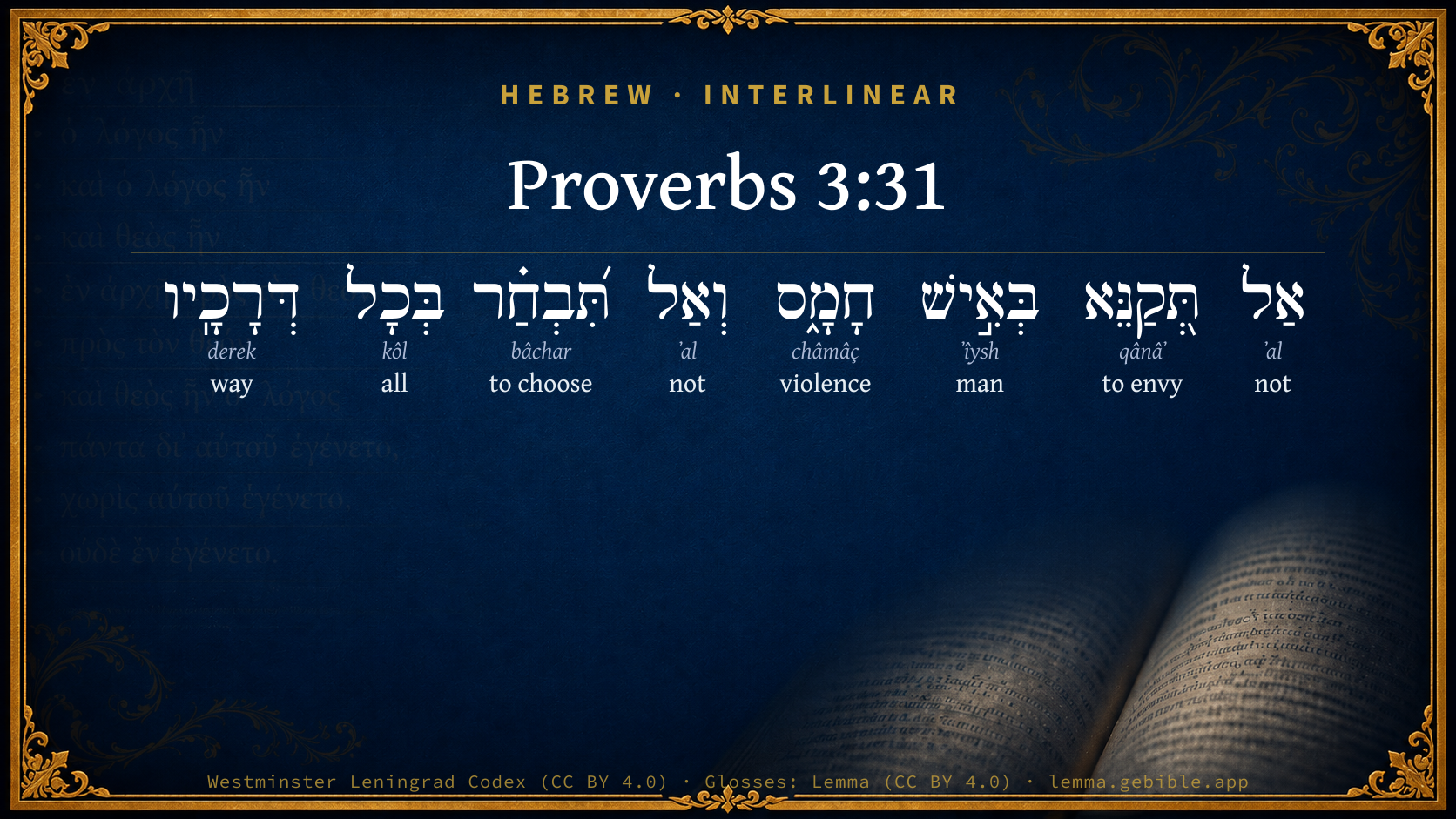
Proverbs 3:31

Hebrew (Westminster Leningrad Codex) Proverbs 3:31 appears in the Hebrew Old Testament. The text above is from the Westminster Leningrad Codex. Each word links to its Strong’s number, a concise gloss, and parsing drawn from the Open Scriptures Hebrew Bible morphology. Click any word for its full Brown-Driver-Briggs (BDB) entry.
Download image
Cite this verse

Proverbs 3:31 (World English Bible). Public Domain. Lemma interlinear Bible study tool, https://lemma.gebible.app/v/proverbs/3/31.

Show BibTeX & RIS
BibTeX
RIS
English Translation
Don't envy the man of violence. Choose none of his ways.
World English Bible · Public Domain
Download a study sheet

One document with this verse’s original text, its word-by-word gloss line, the meaning frame, cross-references with their text, attributed commentary, and full source and license credits — printable, and it pastes into notes with its structure intact.

This verse Autodidact and up

Study sheet (.html) Plain text (.txt)

A passage Seminary Student

Up to 50 verses in one chapter. A passage sheet keeps up to 6 commentary sources and 12 cross-references per verse, in the order this page ranks them, and says so on the sheet whenever that leaves anything out. Ask for a single verse and you get the Autodidact verse sheet above.

Everything on this page stays free to read, with no account — the sheet is a download of what is already on screen, not access to it.

Want to remove ads? Support Godless Engineer
Compare translations 3

The same verse in 3 English versions, stacked beneath the original-language interlinear above. Click any original word for its lexicon entry.

Each is an independent rendering of the whole verse — the interlinear is not word-aligned to these translations.

Highlighted words mark where these versions differ — a whole-verse word diff, not a word-by-word alignment.

  • World English Bible Public Domain
    Don't envy the man of violence. Choose none of his ways.
  • King James Version Public Domain
    Envy thou not the oppressor, and choose none of his ways.
  • unfoldingWord Literal Text CC BY-SA 4.0
    Do not be envious of a man of violence, and do not choose any of his ways.

unfoldingWord Literal Text — © unfoldingWord, licensed CC BY-SA 4.0. Word-aligned USFM3 via Door43 (git.door43.org/unfoldingWord/en_ult).

Versions to compare (up to 4)

3 of 4 selected

Show all 18 translations

Every available English version of this verse, each an independent rendering of the whole verse.

  • World English Bible Public Domain
    Don't envy the man of violence. Choose none of his ways.
  • Berean Standard Bible Public Domain
    Do not envy a violent man or choose any of his ways;
  • Majority Standard Bible Public Domain
    Do not envy a violent man or choose any of his ways;
  • King James Version Public Domain
    Envy thou not the oppressor, and choose none of his ways.
  • American Standard Version (1901) Public Domain
    Envy thou not the man of violence, And choose none of his ways.
  • Revised Version (1885) Public Domain
    Envy thou not the man of violence, and choose none of his ways.
  • Geneva Bible (1599) Public Domain
    Bee not enuious for the wicked man, neither chuse any of his wayes.
  • Douay-Rheims (1899) Public Domain
    Envy not the unjust man, and do not follow his ways:
  • Young's Literal Translation Public Domain
    Be not envious of a man of violence, Nor fix thou on any of his ways.
  • Literal Standard Version CC BY-SA 4.0
    Do not be envious of a man of violence, || Nor fix on any of his ways.
  • Unlocked Literal Bible CC BY-SA 4.0
    Do not envy a violent person or choose any of his ways.
  • unfoldingWord Literal Text CC BY-SA 4.0
    Do not be envious of a man of violence, and do not choose any of his ways.
  • Darby Bible Public Domain
    Envy not the man of violence, and choose none of his ways.
  • World Messianic Bible Public Domain
    Don’t envy the man of violence. Choose none of his ways.
  • Webster's Bible Public Domain
    Envy thou not the oppressor, and choose none of his ways.
  • Free Bible Version CC BY-SA 4.0
    Don't be jealous of violent people—don't choose to follow their example!
  • Bible in Basic English Public Domain
    Have no envy of the violent man, or take any of his ways as an example.
  • JPS Tanakh (1917) Public Domain
    Envy thou not the man of violence, and choose none of his ways.

Literal Standard Version (2020), Covenant Press — licensed CC BY-SA 4.0. Text via the HelloAO Bible API (eBible.org). Unlocked Literal Bible (unfoldingWord) — licensed CC BY-SA 4.0. Text via the HelloAO Bible API (eBible.org). unfoldingWord Literal Text — © unfoldingWord, licensed CC BY-SA 4.0. Word-aligned USFM3 via Door43 (git.door43.org/unfoldingWord/en_ult). Free Bible Version, Dr. Jonathan Gallagher — licensed CC BY-SA 4.0. Text via the HelloAO Bible API (eBible.org).

Word by word

More ways to search: Search by grammar → Find every occurrence → Compare this word →

Practice this passage: Drill this verse → Learn its vocabulary →

About this verse

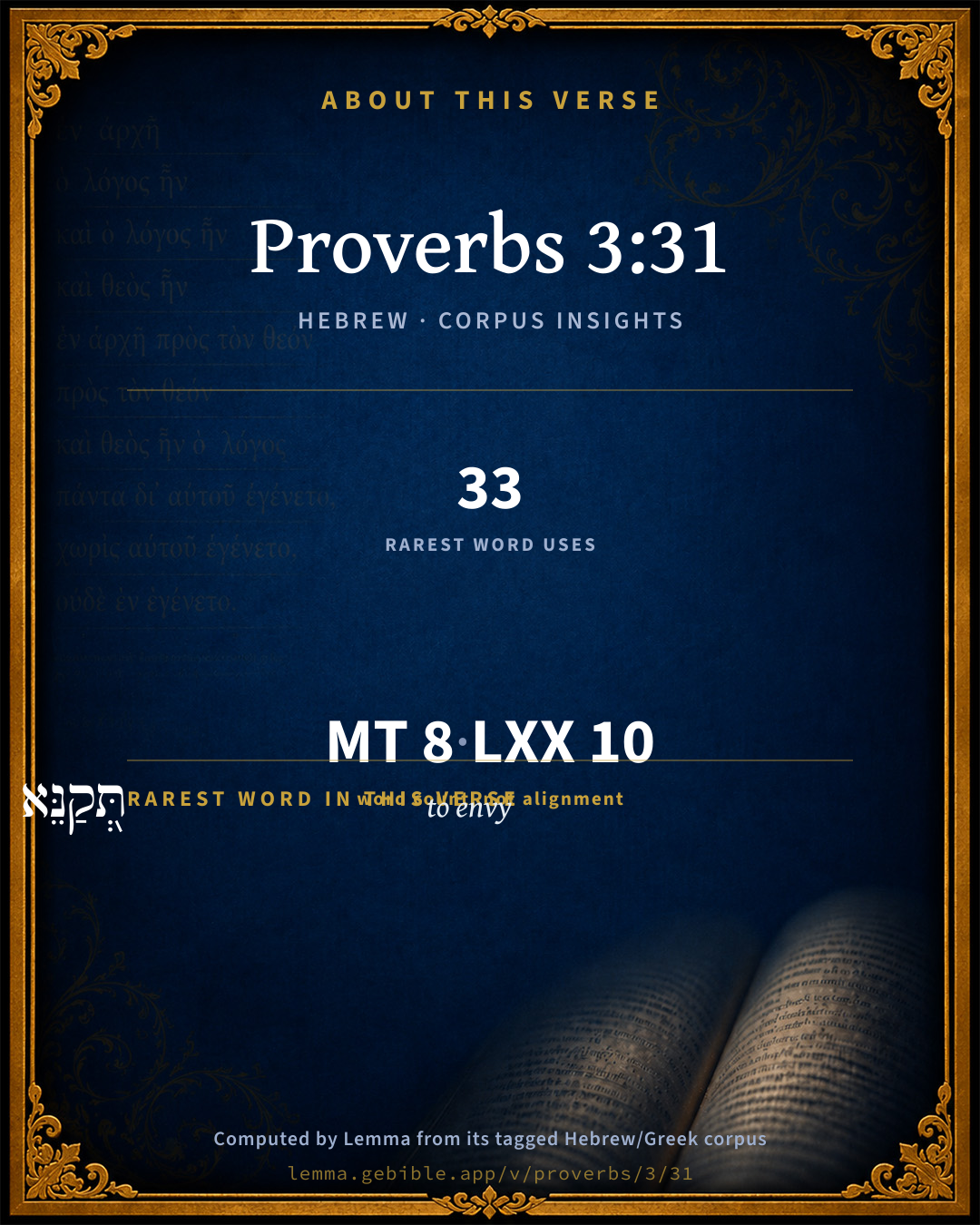
These counts appear in no published source. They are computed here, from the morphology-tagged text and Lemma’s own curated glosses. What Lemma adds →

8
words
7
distinct lemmas
Wisdom
section

Shared distinctive vocabulary

תְּ֭קַנֵּא to envy H7065 occurs in 28 verses of the Hebrew Bible. Also found in:

Grammatical profile

  • 2 verbs
  • 4 nouns
  • 2 particles

Verb forms

  • תְּ֭קַנֵּא Piel · Jussive
  • תִּ֝בְחַ֗ר Qal · Jussive

Repetition

A word recurs within this verse — often emphatic in Hebrew:

  • אַל not H408 ×2

Hebrew & Septuagint length

In English translation the verse runs 11 words from the Hebrew and 13 from the Septuagint (LXX English) — closely comparable.

A rough comparison of the two English renderings, which tokenize alike — not a word-level alignment.

Word counts can differ between the Hebrew and the Greek without any difference in meaning — e.g. the Hebrew direct-object marker אֵת has no separate Greek word, and Greek often adds the article ὁ.

In the original languages it is 8 Hebrew tokens and 10 Greek tokens — but the two are counted differently (Hebrew bundles its prefixes and suffixes into one token; the Greek is in lemma form), so that isn’t a like-for-like length.

Cross-references

12

Topical passages linked to Proverbs 3:31 in the Treasury of Scripture Knowledge — connected by theme and wording, ordered by reader-vote popularity; previews shown in the World English Bible.

  • Proverbs 24:1 Don't be envious of evil men; Neither desire to be with them:
  • Psalms 37:1 Don't fret because of evil-doers, Neither be envious against those who work unrighteousness.
  • Ecclesiastes 5:8 If you see the oppression of the poor, and the violent taking away of justice and righteousness in a district, don't marvel at the matter: for one official is eyed by a higher one; and there are officials over them.
  • Galatians 5:21 envyings, murders, drunkenness, orgies, and things like these; of which I forewarn you, even as I also forewarned you, that those who practice such things will not inherit the Kingdom of God.
  • Proverbs 23:17 Don't let your heart envy sinners; But rather fear Yahweh all the day long.
  • Proverbs 12:12 The wicked desires the plunder of evil men, But the root of the righteous flourishes.
  • Proverbs 24:19–20 Don't fret yourself because of evildoers; Neither be envious of the wicked:
  • Psalms 37:7–9 Rest in Yahweh, and wait patiently for him. Don't fret because of him who prospers in his way, Because of the man who makes wicked plots happen.
  • Proverbs 1:15–18 My son, don't walk in the way with them. Keep your foot from their path,
  • Proverbs 2:12–15 To deliver you from the way of evil, From the men who speak perverse things;
  • Psalms 73:3 For I was envious of the arrogant, When I saw the prosperity of the wicked.
  • Proverbs 22:22–25 Don't exploit the poor, because he is poor; And don't crush the needy in court;

Cross-references courtesy of OpenBible.info (CC BY 4.0).

Hebrew and Greek witnesses Masoretic Hebrew ↔ Greek Septuagint

The same verse in the two great witnesses to the Old Testament, shown verse-for-verse.

These are two independent witnesses, not word-aligned to each other, and the Septuagint is shown in lemma (dictionary) form.

Hebrew Proverbs 3:31 Masoretic · Westminster Leningrad Codex

אַל תְּ֭קַנֵּא בְּאִ֣ישׁ חָמָ֑ס וְאַל תִּ֝בְחַ֗ר בְּכָל דְּרָכָֽיו

Don't envy the man of violence. Choose none of his ways.

World English Bible · Public Domain

Greek LXX Proverbs 3:31 Septuagint · lemma form

μή κτάομαι κακός ἀνήρ ὄνειδος μηδέ ζηλόω ὁ ὁδός αὐτός

Procure not the reproaches of bad men, neither do you covet their ways.

LXX2012 (modern English Septuagint) · Public Domain

On this verse, The Pulpit Commentary discusses the Septuagint’s reading. Read the note in Commentary ↓

Hebrew: Westminster Leningrad Codex (CC BY 4.0). Greek: Septuagint (public domain); English from LXX2012 (modern English Septuagint) (Public Domain). How the Septuagint differs from the Hebrew →

Commentary

Notes on Proverbs 3:31 from classic Christian and Jewish commentators (each source and its license shown beneath its notes). The classic Christian expositions comment on the surrounding passage and are grouped to its opening verse, so a note may address several verses; the Jewish commentaries on the Tanakh (Rashi and others) are per-verse, so they appear only where the commentator wrote on this verse.

Lemma curates 59 commentaries, every one of them public domain or Creative Commons licensed, each selected and text-cleaned for this edition rather than reprinted as found. About our sources →

Trapp's Complete Commentary

John Trapp

Pro 3:31 Envy thou not the oppressor, and choose none of his ways.

Ver. 31. Envy not the oppressor.] That grows rich by unjust quarrels and vexatious lawsuits. It is not for nothing surely that our Saviour, {Luk 12:15} after "who made me a judge?" adds, "Take heed and beware of covetousness." Implying that most men go to law with a covetous or a vindictive mind; whereas if they will needs wage law, they should do it as Charles the French King made war with our Henry VII, "more desiring peace, than profit or victory." It should be with men in this case as it was with Augustine and Jerome in their disputations: it was no matter who gained the day, they would both win by understanding their errors.

John Trapp, A Commentary or Exposition upon All the Books of the Old and New Testament (1647–1656) — public domain. Text from a community e-Sword module.

The Biblical Illustrator

Joseph S. Exell

Pro_3:31

Envy thou not the oppressor.

The oppressor

He is a common character. There is the political oppressor, the social oppressor, the ecclesiastical oppressor.

I. His character is not to be envied.

1. Because envy is in itself an evil.

2. Because there is nothing in the oppressor to be desired.

II. His conduct is not to be followed. Stand aloof (Psa_37:1). (D. Thomas, D. D.)

The oppressor not to be envied

Whether public or private, the man who grinds the faces of the poor by severity and extortion, may succeed, may prosper; may, by this means, amass a fortune, and rise to still higher honour. He is not to be envied; not only because envy is in itself wrong, but also because there is really nothing in his character and career to produce it. His prosperity is not to be envied even by the poorest and most suffering victim of his oppression. And while he is not to be envied, far less are his ways to be imitated for the sake of obtaining the envied results--the same wealth, the same greatness, the same power. (R. Wardlaw, D.D.)

The Biblical Illustrator, edited by Joseph S. Exell (c. 1880s–1900s) — public domain. Text from a community e-Sword module.

The Preacher's Complete Homiletical Commentary

Joseph S. Exell (gen. ed.)

CRITICAL NOTES.—

Pro_3:31. Envy thou not, &c., or “emulate not” (Vulg.) “Do not anxiously covet” (Stuart).

Pro_3:32. Secret. His “secret compact,” “familiar intimacy.”

Pro_3:34. “If,” or “Seeing that He scorneth the scorners,” &c.

Pro_3:35. The promotion, &c., literally “shame lifts up,” i.e., in order to sweep away and destroy them; so Lange translates. Miller reads, “fools are each piling shame.” Stuart says on this verse, “Glory means here honour or an exalted station. Ziegler and Ewald render the next clause, ‘Shame shall elevate fools,’ spoken sarcastically. I prefer the meaning sanctioned by Eze_21:23; Isa_57:14, viz., to take off, to sweep away, as the dust which is elevated by the wind and is swept off, as may be seen in Isa_17:13. Compare Isa_29:5; Psa_35:5. At least, the image understood in this way is very vivid. It stands thus: ‘Fools are elevated like the light dust, and then are swept away in the same manner.’ ”

MAIN HOMILETICS OF THE PARAGRAPH—Pro_3:31-35

THE OPPRESSOR NOT TO BE ENVIED

The children of Wisdom are strongly tempted sometimes to do this. Like Asaph (Psalms 73.), they see the prosperity of the wicked encompassed with pride, and clothed, as it were, with violence (Pro_3:6), and they are tempted to say: “Verily I have cleansed my heart in vain, and washed my hands in innocency.”

Such a state of mind is—

I. Dangerous. It is the first step to becoming like him. Envy of the oppressor may result in “choosing his ways.” A conviction that there is anything belonging to the oppressor that can be envied may lead to becoming oppressors ourselves.

II. Unwise.

1. Because the oppressor is held in universal abhorrence by men. True it is that he possesses power, or he could not oppress, but sooner or later the power will be transferred to the hands of those whose rights he has trampled on, and the outburst of rejoicing at his overthrow is the revelation of the hidden hatred of which he has all along been the subject.

2. Because he is an abomination to the Most High (Pro_3:32). As there is in the noblest of human kind an intense loathing of those who use their power to the injury of others, so this feeling exists more strongly in the mind of God in proportion as His goodness and benevolence exceeds that of the most perfect man. This is not only declared in revelation, but is manifested in the retributions of Providence. Since Pharaoh and his hosts were overthrown in the Red Sea, God has been slaying “mighty kings” who have followed in Pharaoh’s footsteps, because “He is good, and His mercy endureth for ever” (Psalms 136).

3. Because of the contrast in the character, and in the present and future reward of the oppressor and the child of Wisdom. The oppressor is “froward.” He will not submit to the voice of instruction or correction, but will be his own absolute lord and master. His actions, if not his words, say: “Who is the Lord, that I should obey His voice?” The righteous are submissive to the Divine will—they are the “lowly,” who are willing to learn of Him who was meek and lowly in heart (Mat_11:29). Such opposite characters must necessarily meet with opposite dealing from a righteous Ruler. It is a righteous law that “Whatsoever a man soweth, that shall he also reap” (Gal_6:7). With the froward Thou wilt show Thyself froward—with the merciful Thou wilt show Thyself merciful—are the curse and the blessing which rest respectively upon, not only the froward and lowly man, but upon those to whom they belong—their house—those who are bound to them in family relation. The scorn of the froward man reaps a harvest of scorn, but “grace” is the reward of lowliness and humility (Pro_3:34). The contrast in the future inheritance is still greater. The present curse and blessing may not be always evident to onlookers, but the future glory and shame will be manifest to the universe (Mat_25:31-36).

OUTLINES AND SUGGESTIVE COMMENTS

Pro_3:32. The Lord will freely reveal to the righteous what He keeps from others—the truths and promises, the blessings and joys of His covenant of peace, secret to the soul that possesses them, intransferable, “passing all understanding,” “unspeakable and full of glory.”—Wardlaw.

There is no less a secret of godliness than there is of any other trade or profession. Many profess an art or a trade, but thrive not by it because they possess not the secret or mystery of it, and many profess godliness but are little the better for it, because they have not the true secret of it. He hath that with whom God is in secret in his heart, and he that is righteous in secret where no man sees him, he is the righteous man with whom the secret of the Lord is.—Jernim.

They shall be of His cabinet council who choose rather to lie in the dust than to rise by evil arts, by wicked principles.—Trapp.

Pro_3:33. Whatever cost be there, there can be no true cheer, for God’s curse mars all; this will either rot the timber, and pull it down, or undermine the foundation, and blow it up. Possibly there may be in thy house a loving wife, loving children, many servants, stately rooms, costly furniture, dainty fare, great earthly delights; but, man, the curse of God is there. A spoonful of this, like copperas, will turn all thy wine into ink; thy sea of honey into gall and wormwood. How can thy sweetest dish be savoury, when the curse of God is thy sauce? Or thy finest raiment delight thee when in every suit there is the curse of God like a plague-sore? or how can thy most beautiful building content thee, when this curse of God on thee for thy wickedness turns it into a prison to keep thee, who art in the bond of iniquity, till the hour of death, the time of thine execution?—Swinnock.

The houses of the wicked are of two kinds, some dwell in their merits, others in their vices. The Pharisees of the world dwell in the lofty houses of their own meritorious holiness. But as St. Bernard saith, What more foolish than to dwell in a house yet hardly begun? The debauched people of the world dwell in the dirty houses of their wicked lives, and cannot be gotten out of them. But the curse of God is upon both. The righteous dwell in God’s mercy which covereth them from the anger of His justice.… The rich glutton may keep out Lazarus, but he keeps in God’s curse.—Jermin.

Here are the gods—could the philosopher say of his poor habitation, meaning his heathenish household gods—whatever else is wanting to me. How much more may the saint say so of his God.—Trapp.

Pro_3:35. They shall be promoted, indeed, but their exaltation shall be like that of Haman, who was exalted when he was hung upon a gallows fifty cubits high.—Lawson.

This last contrast carries us forward to the coming day when all shall “discern” in the full delight of eternity (Mal_3:18). The wise—the heirs of glory—are identified with the lowly (Pro_3:34)—the heirs of grace. Self-knowledge—the principle of lowliness—is the very substance of wisdom. Their inheritance also is one—grace and glory (Psa_84:11). For what higher glory can there be than the grace which hath redeemed a worm of the earth and made him a king and priest unto God?—Bridges.

Humility is both a grace and a vessel to receive grace.—Trapp.

The Preacher's Complete Homiletical Commentary (gen. ed. Joseph S. Exell; Funk & Wagnalls, c. 1892) — public domain (pre-1929). A full-Bible homiletical/sermon-outline anthology covering 65 of 66 books (2 John is absent from the source module). Text from a community e-Sword module.

Tyndale Open Study Notes

Tyndale Open Resources

3:31-32 The violent will ultimately be punished for their ways (1:18-32), even if they seem to have an enviable position in the world (11:16). The wise will not envy them, because they are detestable to the Lord. God’s friendship is of far greater benefit than anything the violent achieve.

Tyndale Open Study Notes — © Tyndale Open Resources, licensed CC BY-SA 4.0. Text via the HelloAO Bible API.

Geneva Bible (1599)

Geneva Bible translators

Desire not to be like unto him.

Geneva Bible (1599) marginal notes — public domain. Text via Bolls.life.

Jamieson, Fausset & Brown

Robert Jamieson, A. R. Fausset & David Brown

oppressor--or man of mischief. The destiny of successful evildoers warns against desiring their lot (Psa 37:1-2, Psa 37:35-36).

Jamieson, Fausset & Brown — Commentary Critical and Explanatory on the Whole Bible (1871) — public domain (CC PDM 1.0). Text via the HelloAO Bible API.

Adam Clarke's Commentary

Verse 31. Envy thou not the oppressor] O how bewitching is power! Every man desires it; and yet all hate tyrants. But query, if all had power, would not the major part be tyrants?

Adam Clarke's Commentary on the Bible (1810–1826) — public domain. Text from a community e-Sword/MySword module.

The Cambridge Bible for Schools and Colleges

gen. ed. J. J. S. Perowne

31. Envy thou not] The temporal rewards of wisdom, health (Pro_3:8), long life (Pro_3:16), riches and honour (ib.), as they may be withheld from thee (Pro_3:11-12), so may they be surpassed by the prosperity of the wicked; but let not the comparison of thy lot with his move thee to envy, for the true reward of wisdom is higher and surer (Pro_3:32-35). Psalms 73. illustrates these verses.

oppressor] Lit. man of violence, R.V.

The Cambridge Bible for Schools and Colleges (gen. ed. J. J. S. Perowne; Cambridge University Press, 1878–1918) — public domain. Text from a community e-Sword module.

John Gill's Exposition

Envy thou not the oppressor,.... The man that gets wealth and riches by acts of injustice, by oppressing the poor, by rapine and violence; do not envy his prosperity, and the substance he is possessed of; do not wish to be in his place and circumstances, to enjoy his affluence and ease; do not look upon his happiness with an envious eye and a fretting heart; he is far from being a happy man; his end will be bad; see Psa 37:1;

and choose none of his ways; which he has used to get his riches in; do not follow him in them; for should you do as he has done, and get ever so much, since this would be with the loss of your souls, of what advantage would it be? He makes the best choice that chooses the "good part" that shall not be taken away, Luk 10:42; Christ, and the ways of Christ.

John Gill's Exposition of the Whole Bible (1746–1763) — public domain (CC PDM 1.0). Text via the HelloAO Bible API.

Haydock's Catholic Bible Commentary

Ways. Of injustice. Seek not to attain his prosperity by the same means. (Calmet)

George Leo Haydock (1774–1849), Haydock's Catholic Family Bible and Commentary, 1859 edition — public domain. Excludes Psalms (Douay-Rheims chapter numbering differs from Protestant) and Deuterocanonical books (Catholic canon only).

Matthew Poole's English Annotations

Envy thou not the oppressor, for his impunity and success in his wicked designs, and the wealth which he gains by his unrighteous practices.

Choose none of his ways; for what men envy in others they seek to obtain for themselves.

Matthew Poole's English Annotations on the Holy Bible (1683–1685) — public domain. Text from a community e-Sword/MySword module.

Whedon's Commentary on the Bible

Daniel D. Whedon

31. Envy thou not the oppressor — Literally, the man of violence or wrong; who uses violent or wrong means to enrich himself: do not desire his unjust gains.

Choose none of his ways — Modes of making money. Zockler, “Imitate not.” Miller, “Do not become excited about.”

Daniel D. Whedon (gen. ed.), Commentary on the Old and New Testaments (1874–1909) — public domain. Text from a community e-Sword module.

The Pulpit Commentary

Envy thou not the oppressor, and choose none of his ways. The thought of strife in the preceding verse leads to that of oppression, and the precept is directed against fellowship with those who outrage the general law of benevolence and justice, Envy not; i.e. as Stuart, "Do not anxiously covet the booty which men of violence acquire." Success and wealth may follow from severity and extortion, but the man who acquires prosperity by these means is not to be envied even by the victim of his oppression. (for the verb, see Pro_23:17 Pro_24:1, Pro_24:19) The oppressor (ish khamas); literally, a man of violence (see margin). The expression occurs in Pro_14:29 Psa_18:41, and in its plural form, ish khamamim, "man of violences," in 2Sa_22:49 Psa_140:1, Psa_140:4. The man of violence is one who "grinds the faces of the poor," and whose conduct is rapacious, violent, and unjust. And choose none of his ways; literally, and choose not all his ways, i.e. with a view to acquire the same wealth, greatness, and power. The LXX renders this verse, "Do not acquire the hatred of evil men, neither be jealous of their ways," evidently from having taken tiv"khar, "choose," in the second hemistich, for tith"khan, "be jealous."

The Pulpit Commentary (1880–1919), ed. H.D.M. Spence-Jones & Joseph S. Exell — public domain. Text from a community e-Sword module.

John Wesley's Explanatory Notes

Envy not - For his impunity and success.

John Wesley, Explanatory Notes Upon the Whole Bible (1754–1765) — public domain. Text via the GEBible commentary corpus.

Keil & Delitzsch

C. F. Keil & F. Delitzsch

These exhortations to neighbourly love in the form of warning against whatever is opposed to it, are followed by the warning against fellowship with the loveless:

31 Be not envious toward the man of violence,

And have no pleasure in all his ways.

32 For an abhorrence to Jahve is the perverse,

But with the upight is His secret.

The conceptions of jealousy and envy lie in קנּא (derived by Schultens from קנא, Arab. ḳanâ, intensius rubere) inseparable from each other. The lxx, which for תקנא reads תקנה (κτήσῃ), brings the envy into 31b, as if the words here were ואל־תּתחר, as in Psa 37:1, Psa 37:7 (there the lxx has μὴ παραζήλου, here μηδὲ ζηλώσῃς). There is no reason for correcting our text in accordance with this (substituting תּתחר for תּבחר as Hitzig does), because בּכל־דּרכיו would be too vague an expression for the object of the envy, while אל־תבחר altogether agrees with it; and the contrary remark, that בּחר בּכּל is fundamentally no בחר, fails since (1) בחר frequently expresses pleasure in anything without the idea of choice, and (2) "have not pleasure in all his ways" is in the Hebrew style equivalent to "in any one of his ways;" Ewald, 323b. He who does "violence to the law" (Zep 3:4) becomes thereby, according to the common course of the world, a person who is feared, whose authority, power, and resources are increased, but one must not therefore envy him, nor on any side take pleasure in his conduct, which in all respects is to be reprobated; for the נלוז, inflexus, tortuosus (vid., Pro 2:15), who swerves from the right way and goes in a crooked false way, is an object of Jahve's abhorrence, while, on the contrary, the just, who with a right mind walks in the right way, is Jahve's סוד - an echo of Psa 25:14. סוד (R. סד, to be firm, compressed) means properly the being pressed together, or sitting together (cf. the Arab. wisâd, wisâdt, a cushion, divan, corresponding in form to the Hebr. יסוד) for the purpose of private communication and conversation (הוּסד), and then partly the confidential intercourse, as here (cf. Job 29:4), partly the private communication, the secret (Amo 3:7). lxx, ἐν δὲ δικαίοις [οὐ] συνεδριάζει. Those who are out of the way, who prefer to the simplicity of right-doing all manner of crooked ways, are contrary to God, and He may have nothing to do with them; but the right-minded He makes partakers of His most intimate intercourse, He deals with them as His friends.

Keil & Delitzsch — Biblical Commentary on the Old Testament (1861–1891) — public domain (CC PDM 1.0). Text via the HelloAO Bible API. (Old Testament only.)

Bridges on Proverbs

Charles Bridges

What is there — we might ask — to envy in the oppressor? The love of power is a ruling passion; and the slave of his own will enjoys a brutish pleasure in tyranny. Yet little reason have we to envy him, much less to choose his ways. (Pro 24:1 . Ecc 4:1 .) Can he be happy, going froward in his way, in perverse contradiction to the will of the Lord? with the frown of Heaven? ’For he who hateth nothing that he hath made, abhors those who have thus marred themselves. They are not only abominable, but ’an abomination in his sight.’’†1 Really to be envied, or rather ardently to be desired, is the lot of the righteous, enriched with the secret of the Lord — "his covenant and fatherly affection, which is hid and secret from the world."†2 Sinners are an abomination. Saints are his delight. ’They are God’s friends, to whom he familiarly imparts, as men used to do to their friends, his mind and counsels, or his secret favor and comforts, to which other men are strangers.’†3 Communion with himself (Joh 14:21-23 ); peace (Php 4:6-7 ); joy (Pro 14:10 ); assurance (Rev 2:17 ); teaching (Mat 11:25 ; Mat 13:11-17 ; Mat 16:17 . Joh 7:17 . 1Co 2:12, 1Co 2:15 ); confidence (Joh 15:15 ); an enlightened apprehension of providence (Gen 18:17-18 . Psa 107:43 ); yea, all the blessings of his covenant (Psa 25:14 ) — this is the secret between God and the soul, an enclosed portion, hidden from the world, sealed to his beloved people. Here then — child of God — "dwell in the secret place of the Most High." (Psa 91:1 .) If he hath given to thee the knowledge of himself, and of thine interest in him; and to the froward oppressor only worldly advantage; is it not the seal of his love to thee, and rejection of him? Is it not infinitely more to dwell on high with thy God, than in the vain pomp of an ungodly world? (Psa 84:10 .)

Footnotes

†1 Henry in loco. Pro 6:14-18 ; Pro 11:20 ; Pro 15:9 . Mic 2:1-2 . See the Lord’s open judgment, Exo 9:16 ; Exo 14:28 . Isa 37:21-38 . Act 12:1-2, Act 12:23 .

†2 Reformers’ Notes.

†3 Pool’s Annotations. ’He loves them dearly as his intimate friends, to whom he communicates the very secrets of his heart.’ — Diodati.

Charles Bridges, An Exposition of the Book of Proverbs (1846) — public domain. Text from a community e-Sword module.

unfoldingWord translationNotes

Door43 World Missions Community

Do not ... choose any of his ways

It is implied that he is not to choose to imitate the actions of the violent person. AT: "Do not ... choose to imitate any of his ways" (See: Assumed Knowledge and Implicit Information)

the devious person is detestable to Yahweh

"Yahweh detests the devious person"

the devious person

the person who is dishonest or deceitful

he brings the upright person into his confidence

Yahweh shares his thoughts with the those who do right as with a close, trusted friend. AT: "Yahweh is a close friend to the upright" (See: Assumed Knowledge and Implicit Information)

translationWords

envy

Yahweh

righteous

confidence

unfoldingWord translationNotes — © Distant Shores Media and the Door43 World Missions Community, licensed CC BY-SA 4.0. Source: git.door43.org/Door43/en_tn.

Rashi

Rabbi Shlomo Yitzchaki (Rashi)

Do not envy a man of violence to do as his deeds if you see him prospering.

Rashi on the Tanakh — English translations: “The Judaica Press complete Tanach with Rashi, translated by A. J. Rosenberg” (CC BY 4.0); “Pentateuch with Rashi's commentary by M. Rosenbaum and A.M. Silbermann, 1929-1934” (public domain); “The Metsudah Tanach series, Lakewood, N.J” (CC BY 4.0); and “The Book of Joshua, Metsudah Publications, 1997” (CC BY 4.0). Text via Sefaria.

Lesson kit

Teaching starters — assembled from the data on this page, not authored interpretation. Every prompt links to the verse data it draws on. Edit before teaching.

Proverbs, in the Wisdom, opens this verse with 8 words (7 distinct Hebrew lemmas). Its most distinctive word is qânâʼ (“to envy”). A historical commentator’s framing appears above. Read the whole chapter for the surrounding context.

Discussion questions

  1. How does “to envy” (qânâʼ) shape what this verse is saying?
  2. Genesis 26:14 shares the word «to envy» with this verse. How do the two illuminate each other?
  3. “not” occurs 2× in this one verse. What is the effect of the repetition?
  4. These translations render this verse differently; the difference is in the English rendering, not the original. What questions does that raise?
  5. The verb «תְּ֭קַנֵּא» is Piel Jussive. How does its form color the action?
  6. Reading how Trapp's Complete Commentary and The Biblical Illustrator read this verse, where do the two commentators agree and where do they part?

Things to notice

Reading settings

Reading text

Shown beneath each verse's original-language words.

Old Testament
Old Testament edition

Read the OT as the Masoretic Hebrew (MT) or the Greek Septuagint (LXX).

English shown for the Greek Septuagint (in the Hebrew ↔ Greek comparison).

Comparing translations? Open the Compare panel on any verse page to stack up to four side by side.