
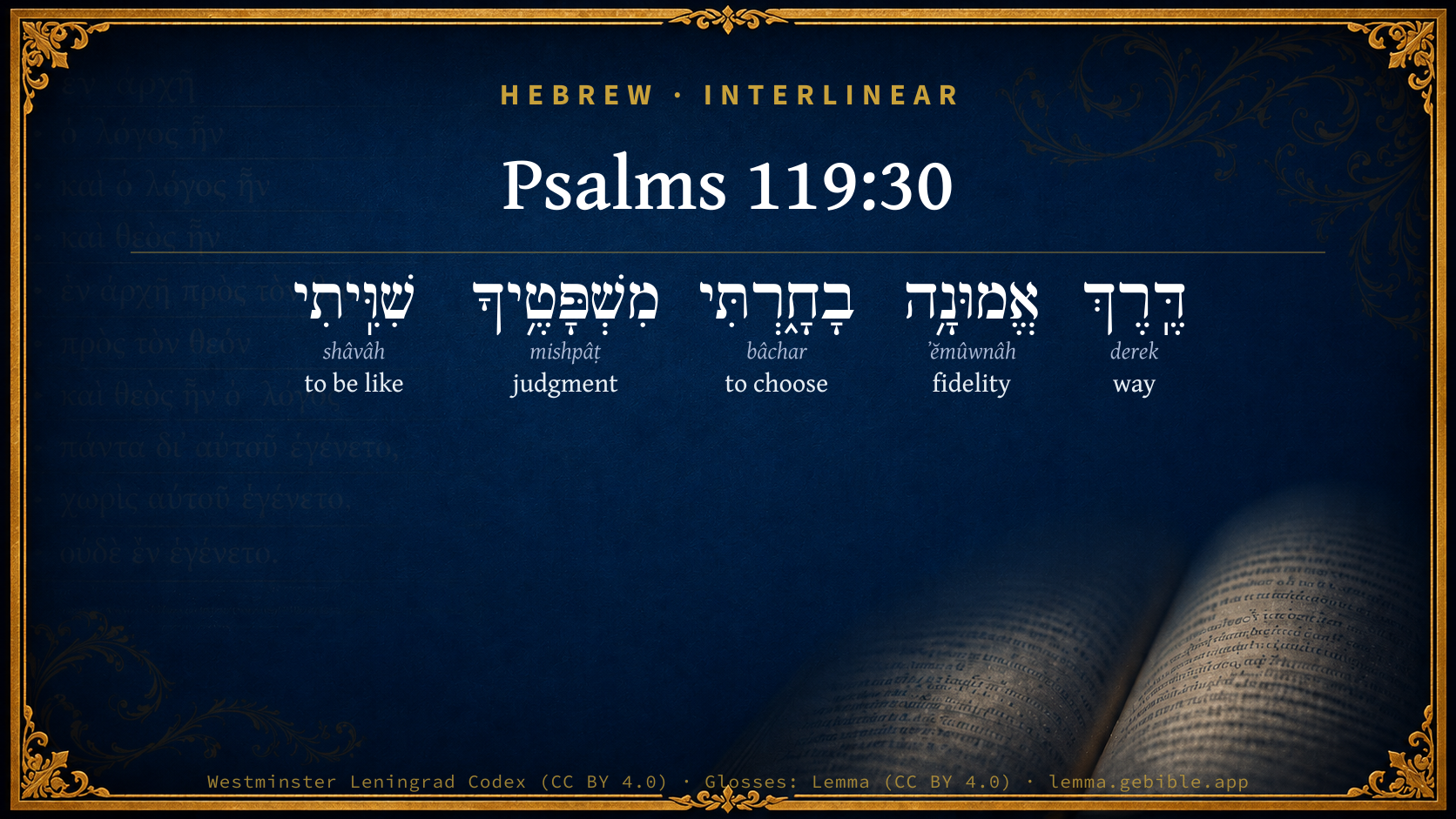
Psalms 119:30

Hebrew (Westminster Leningrad Codex) Psalms 119:30 appears in the Hebrew Old Testament. The text above is from the Westminster Leningrad Codex. Each word links to its Strong’s number, a concise gloss, and parsing drawn from the Open Scriptures Hebrew Bible morphology. Click any word for its full Brown-Driver-Briggs (BDB) entry.
Download image
Cite this verse

Psalms 119:30 (World English Bible). Public Domain. Lemma interlinear Bible study tool, https://lemma.gebible.app/v/psalms/119/30.

Show BibTeX & RIS
BibTeX
RIS
English Translation
I have chosen the way of truth. I have set my heart on your law.
World English Bible · Public Domain
Download a study sheet

One document with this verse’s original text, its word-by-word gloss line, the meaning frame, cross-references with their text, attributed commentary, and full source and license credits — printable, and it pastes into notes with its structure intact.

This verse Autodidact and up

Study sheet (.html) Plain text (.txt)

A passage Seminary Student

Up to 50 verses in one chapter. A passage sheet keeps up to 6 commentary sources and 12 cross-references per verse, in the order this page ranks them, and says so on the sheet whenever that leaves anything out. Ask for a single verse and you get the Autodidact verse sheet above.

Everything on this page stays free to read, with no account — the sheet is a download of what is already on screen, not access to it.

Want to remove ads? Support Godless Engineer
Compare translations 3

The same verse in 3 English versions, stacked beneath the original-language interlinear above. Click any original word for its lexicon entry.

Each is an independent rendering of the whole verse — the interlinear is not word-aligned to these translations.

Highlighted words mark where these versions differ — a whole-verse word diff, not a word-by-word alignment.

  • World English Bible Public Domain
    I have chosen the way of truth. I have set my heart on your law.
  • King James Version Public Domain
    I have chosen the way of truth: thy judgments have I laid before me.
  • unfoldingWord Literal Text CC BY-SA 4.0
    I have chosen the way of faithfulness; I agree with your judgments.

unfoldingWord Literal Text — © unfoldingWord, licensed CC BY-SA 4.0. Word-aligned USFM3 via Door43 (git.door43.org/unfoldingWord/en_ult).

Versions to compare (up to 4)

3 of 4 selected

Show all 17 translations

Every available English version of this verse, each an independent rendering of the whole verse.

  • World English Bible Public Domain
    I have chosen the way of truth. I have set my heart on your law.
  • Berean Standard Bible Public Domain
    I have chosen the way of truth; I have set Your ordinances before me.
  • Majority Standard Bible Public Domain
    I have chosen the way of truth; I have set Your ordinances before me.
  • King James Version Public Domain
    I have chosen the way of truth: thy judgments have I laid before me.
  • American Standard Version (1901) Public Domain
    I have chosen the way of faithfulness: Thine ordinances have I set `before me'.
  • Revised Version (1885) Public Domain
    I have chosen the way of faithfulness: thy judgments have I set before me.
  • Geneva Bible (1599) Public Domain
    I haue chosen the way of trueth, and thy iudgements haue I laied before me.
  • Young's Literal Translation Public Domain
    The way of faithfulness I have chosen, Thy judgments I have compared,
  • Literal Standard Version CC BY-SA 4.0
    I have chosen the way of faithfulness, || I have compared Your judgments,
  • Unlocked Literal Bible CC BY-SA 4.0
    I have chosen the way of faithfulness; I have always kept your righteous decrees before me.
  • unfoldingWord Literal Text CC BY-SA 4.0
    I have chosen the way of faithfulness; I agree with your judgments.
  • Darby Bible Public Domain
    I have chosen the way of faithfulness; thy judgments have I set [before me].
  • World Messianic Bible Public Domain
    I have chosen the way of truth. I have set your ordinances before me.
  • Webster's Bible Public Domain
    I have chosen the way of truth: thy judgments have I laid before me.
  • Free Bible Version CC BY-SA 4.0
    I have chosen to trust in you. I always pay attention to what you say.
  • Bible in Basic English Public Domain
    I have taken the way of faith: I have kept your decisions before me.
  • JPS Tanakh (1917) Public Domain
    I have chosen the way of faithfulness; Thine ordinances have I set before me.

Literal Standard Version (2020), Covenant Press — licensed CC BY-SA 4.0. Text via the HelloAO Bible API (eBible.org). Unlocked Literal Bible (unfoldingWord) — licensed CC BY-SA 4.0. Text via the HelloAO Bible API (eBible.org). unfoldingWord Literal Text — © unfoldingWord, licensed CC BY-SA 4.0. Word-aligned USFM3 via Door43 (git.door43.org/unfoldingWord/en_ult). Free Bible Version, Dr. Jonathan Gallagher — licensed CC BY-SA 4.0. Text via the HelloAO Bible API (eBible.org).

Word by word

More ways to search: Search by grammar → Find every occurrence → Compare this word →

Practice this passage: Drill this verse → Learn its vocabulary →

About this verse

These counts appear in no published source. They are computed here, from the morphology-tagged text and Lemma’s own curated glosses. What Lemma adds →

5
words
5
distinct lemmas
Wisdom
section

Notable vocabulary

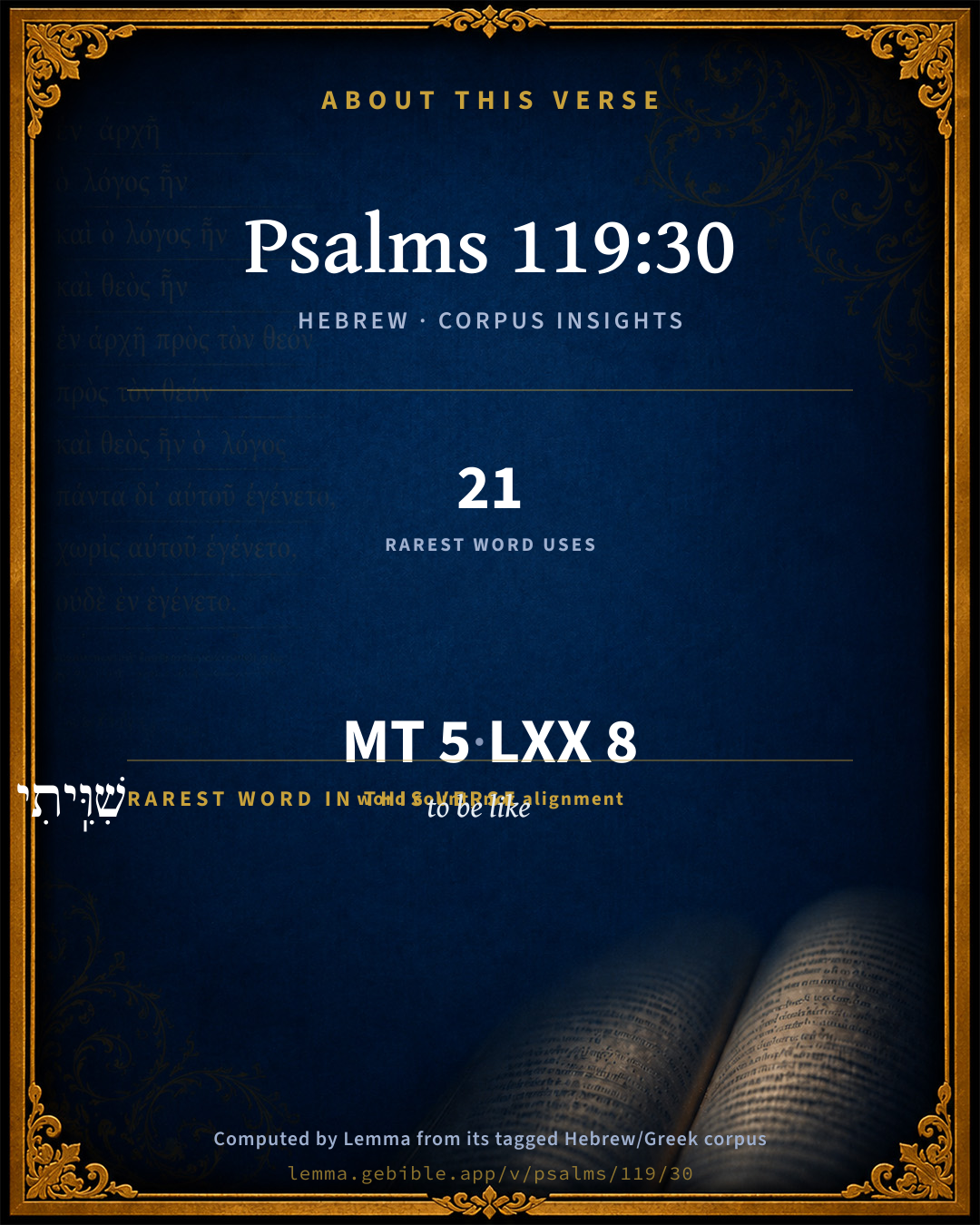
The rarest word here is שִׁוִּֽיתִי to be like H7737 — appearing just 21 times in the whole Hebrew Bible.

Shared distinctive vocabulary

שִׁוִּֽיתִי to be like H7737 occurs in 21 verses of the Hebrew Bible. Also found in:

Grammatical profile

  • 2 verbs
  • 3 nouns

Verb forms

  • בָחָ֑רְתִּי Qal · Perfect
  • שִׁוִּֽיתִי Piel · Perfect

Hebrew & Septuagint length

In English translation the verse runs 15 words from the Hebrew and 13 from the Septuagint (LXX English) — closely comparable.

A rough comparison of the two English renderings, which tokenize alike — not a word-level alignment.

Word counts can differ between the Hebrew and the Greek without any difference in meaning — e.g. the Hebrew direct-object marker אֵת has no separate Greek word, and Greek often adds the article ὁ.

In the original languages it is 5 Hebrew tokens and 8 Greek tokens — but the two are counted differently (Hebrew bundles its prefixes and suffixes into one token; the Greek is in lemma form), so that isn’t a like-for-like length.

Cross-references

13

Topical passages linked to Psalms 119:30 in the Treasury of Scripture Knowledge — connected by theme and wording, ordered by reader-vote popularity; previews shown in the World English Bible.

  • John 3:19–21 This is the judgment, that the light has come into the world, and men loved the darkness rather than the light; for their works were evil.
  • Psalms 119:29 Keep me from the way of deceit. Grant me your law graciously!
  • Proverbs 1:29 Because they hated knowledge, And didn't choose the fear of Yahweh.
  • Luke 10:42 but one thing is needed. Mary has chosen the good part, which will not be taken away from her."
  • Joshua 24:15 If it seem evil to you to serve Yahweh, choose you this day whom you will serve; whether the gods which your fathers served that were beyond the River, or the gods of the Amorites, in whose land you dwell: but as for me and my house, we will serve Yahweh.
  • 1 Peter 2:2 as newborn babes, long for the pure milk of the Word, that you may grow thereby,
  • Deuteronomy 11:18–20 Therefore shall you lay up these my words in your heart and in your soul; and you shall bind them for a sign on your hand, and they shall be for symbols between your eyes.
  • Psalms 119:24 Indeed your statutes are my delight, And my counselors.
  • Psalms 119:111 I have taken your testimonies as a heritage forever, For they are the joy of my heart.
  • 2 John 1:4 I rejoice greatly that I have found some of your children walking in truth, even as we have been commanded by the Father.
  • John 8:45 But because I tell the truth, you don't believe me.
  • Psalms 119:173 Let your hand be ready to help me, For I have chosen your precepts.
  • Psalms 119:52 I remember your ordinances of old, Yahweh, And have comforted myself.

Cross-references courtesy of OpenBible.info (CC BY 4.0).

Hebrew and Greek witnesses Masoretic Hebrew ↔ Greek Septuagint

The same verse in the two great witnesses to the Old Testament, shown verse-for-verse.

You’re reading Greek Psalm 118 (Hebrew Psalm 119). The Septuagint counts the superscription, so verse numbers can differ from the Hebrew — chapter-level alignment, not verse-by-verse. Numbering follows Rahlfs.

These are two independent witnesses, not word-aligned to each other, and the Septuagint is shown in lemma (dictionary) form.

Hebrew Psalms 119:30 Masoretic · Westminster Leningrad Codex

דֶּֽרֶךְ אֱמוּנָ֥ה בָחָ֑רְתִּי מִשְׁפָּטֶ֥יךָ שִׁוִּֽיתִי

I have chosen the way of truth. I have set my heart on your law.

World English Bible · Public Domain

Greek LXX Greek Psalm 118:30 Septuagint · lemma form

ὁδός ἀλήθεια αἱρετίζω ὁ κρίμα σύ οὐ ἐπιλανθάνω

I have chosen the way of truth; and have not forgotten your judgments.

LXX2012 (modern English Septuagint) · Public Domain

On this verse, J. A. Alexander on Psalms discusses the Septuagint’s reading. Read the note in Commentary ↓

Hebrew: Westminster Leningrad Codex (CC BY 4.0). Greek: Septuagint (public domain); English from LXX2012 (modern English Septuagint) (Public Domain). How the Septuagint differs from the Hebrew →

Commentary

Notes on Psalms 119:30 from classic Christian and Jewish commentators (each source and its license shown beneath its notes). The classic Christian expositions comment on the surrounding passage and are grouped to its opening verse, so a note may address several verses; the Jewish commentaries on the Tanakh (Rashi and others) are per-verse, so they appear only where the commentator wrote on this verse.

Lemma curates 59 commentaries, every one of them public domain or Creative Commons licensed, each selected and text-cleaned for this edition rather than reprinted as found. About our sources →

Trapp's Complete Commentary

John Trapp

Psa 119:30 I have chosen the way of truth: thy judgments have I laid [before me].

Ver. 30. I have chosen the way of truth] I am fully bent against lying, and am resolved to speak truth; though I have done otherwise sometimes, through frailty.

Thy judgments have I laid before me] Thereby to fright my conscience, that I might not so much as equivocate. Some render it iudicia tua aequiperavi, I have kept pace with thy judgments, sc. in the bent and bias of my heart at least.

John Trapp, A Commentary or Exposition upon All the Books of the Old and New Testament (1647–1656) — public domain. Text from a community e-Sword module.

The Biblical Illustrator

Joseph S. Exell

Psa_119:30-32

I have chosen the way of truth: Thy judgments have I laid before me.

The commendable past and the desirable future in life

I. The commendable in the past.

1. The best choice has been made. The way of truth is the way of reality, in contradistinction to the way of sham and fiction.

2. The best guide has been followed. Gods Word is the only true guide.

3. The best cause has been adhered to. Whatever else he had given up and forsaken, he had stuck to Gods testimonies. If ye continue in My Word, then are ye My disciples.

II. The desirable in the future. I will run, etc. If ye love Me, keep My commandments.

1. The pursuance of the Divine law is essential to human happiness. Man can find no happiness in any way but in the way of Gods commandments.

2. The enlargement of the human heart is essential to the pursuance of the Divine law. The moral heart of man is sadly contracted by selfishness and materialism. Love alone can expand it, and make it wide enough to embrace God and His universe. (Homilist.)

The way of truth

I. The way of truth. It is the way of God; for the Lord is the God of truth: it is the way of Christ; for, said He, I am the way, etc. it is the way of the Spirit; for the Spirit beareth witness, because the Spirit is truth. And as all that we know of God--of God who made us by His power, of Christ who redeemed us by His blood, of the Spirit who renews us by His grace--is contained in Scripture, the way of truth is the way of Gods Word. Sanctify them through Thy truth: Thy Word is truth.

II. To choose the way of truth.

1. To determine, with entire honesty of intention, and with full purpose of heart, that you will walk, as far as you know it, in the way of Gods precepts--entertaining, not only a confident hope, but cherishing a firm assurance, that so doing you shall attain, sooner or later, when the days of your appointed time are past, to the end of Gods promises.

2. To be careful that, so far as lies in our power, we act out what we have determined; that we do not, like too many, ask one thing in our prayers, and seek another in our practice; that we do not through the after stages engage in any occupation, or devote ourselves to any amusement, or join ourselves to any society, by which our early approach to God may be made to seem hypocrisy, and our very petitions be turned into sin.

3. A continual dependence upon the help of God, as promised for the sake of Christ, and conveyed by the influence of the Holy Spirit; and not only a continual dependence upon it, but a constant expectation of it; and not only a constant expectation of it, but an earnest and frequent entreaty for it. (T. Dale, M. A.)

The Biblical Illustrator, edited by Joseph S. Exell (c. 1880s–1900s) — public domain. Text from a community e-Sword module.

J. A. Alexander on Psalms

Joseph Addison Alexander

30. (Psa 119:30) The way of truth have I chosen; thy judgments have I set (before me). Truth, in the sense of faithfulness, fidelity to obligations, the opposite of the falsehood mentioned in Psa 119:29. His own choice coincides with the divine requisitions. Judgments, as in Psa 119:7; Psa 119:13, above. I have set, i.e. before me, as an end to be aimed at, and a rule to be followed. The Hebrew verb occurs above, Psa 18:33; Psa 21:5; Psa 89:19, and the full phrase, Psa 16:8. The Septuagint renders it here, I have not forgotten.

Joseph Addison Alexander, The Psalms Translated and Explained (1850) — public domain. Text from a community e-Sword module.

Matthew Henry's Commentary

Observe, I. That those who will make anything to purpose of their religion must first make it their serious and deliberate choice; so David did: I have chosen the way of truth. Note, 1. The way of serious godliness is the way of truth; the principles it is founded on are principles of eternal truth, and it is the only true way to happiness. 2. We must choose to walk in this way, not because we know no other way, but because we know no better; nay we know no other safe and good way. Let us choose that way for our way, which we will walk in, though it be narrow.

II. That those who have chosen the way of truth must have a constant regard to the word of God as the rule of their walking: Thy judgments have I laid before me, as he who learns to write lays his copy before him, that he may write according to it, as the workman lays his model and platform before him, that he may do his work exactly. As we must have the word in our heart by an habitual conformity to it, so we must have it in our eye by an actual regard to it upon all occasions, that we may walk accurately and by rule.

III. That those who make religion their choice and rule are likely to adhere to it faithfully: "I have stuck to thy testimonies with unchanged affection and an unshaken resolution, stuck to them at all times, through all trials. I have chosen them, and therefore I have stuck to them." Note, The choosing Christian is likely to be the steady Christian; while those that are Christians by chance tack about if the wind turn.

IV. That those who stick to the word of God may in faith expect and pray for acceptance with God; for David means this when he begs, "Lord, put me not to shame; that is, never leave me to do that by which I shall shame myself, and do thou not reject my services, which will put me to the greatest confusion."

V. That the more comfort God gives us the more duty he expects from us, Psa 119:32. Here we have, 1. His resolution to go on vigorously in religion: I will run the way of thy commandments. Those that are going to heaven should make haste thither and be still pressing forward. It concerns us to redeem time and take pains, and to go on in our business with cheerfulness. We then run the way of our duty, when we are ready to it, and pleasant in it, and lay aside every weight, Heb 12:1. 2. His dependence upon God for grace to do so: "I shall then abound in thy work, when thou shalt enlarge my heart." God, by his Spirit, enlarges the hearts of his people when he gives them wisdom (for that is called largeness of heart, Kg1 4:29), when he sheds abroad the love of God in the heart, and puts gladness there. The joy of our Lord should be wheels to our obedience.

Matthew Henry's Commentary on the Whole Bible (1708–1710) — public domain (CC PDM 1.0). Text via the HelloAO Bible API.

Adam Clarke's Commentary

Verse 30. I have chosen the way of truth] And that I may continue in its "remove from me the way of lying." See above.

Adam Clarke's Commentary on the Bible (1810–1826) — public domain. Text from a community e-Sword/MySword module.

John Calvin's Commentaries

30. I have chosen the way of truth. In this and the following verse he affirms that he was so disposed as to desire nothing more than to follow righteousness and truth. It is, therefore, with great propriety he employs the term to choose. The old adage, that man’s life is as it were at the point where two ways meet, refers not simply to the general tenor of human life, but to every particular action of it. For no sooner do we undertake any thing, no matter how small, than we are grievously perplexed, and as if hurried off by a tempest, are confounded by conflicting counsels. Hence the prophet declares, that in order constantly to pursue the right path, he had resolved and fully determined not to relinquish the truth. And thus he intimates that he was not entirely exempted from temptations, yet that he had surmounted them by giving himself up to the conscientious observance of the law.

The last clause of the verse, I have set thy judgments before me, relates to the same subject. There would be no fixed choice on the part of the faithful, unless they steadily contemplate the law, and did not suffer their eyes to wander to and fro. In the subsequent verse he not only asserts his entertaining this holy affection for the law, but also combines it with prayer, that he might not become ashamed and enfeebled under the derision of the ungodly, while he gave himself wholly to the law of God. Here he employs the same term as formerly, when he said his soul cleaved to the dust, and, in doing so, affirms he had so firmly taken hold of God’s law, that he cannot be separated from it. From his expressing a fear lest he might be put to shame or overwhelmed with reproach, we learn that the more sincerely a man surrenders himself to God, the more will he be assailed by the tongues of the vile and the venomous.

John Calvin's Commentaries (1540-1563) — public domain. Text from the Calvin Translation Society English edition (1840s-50s) via the Christian Classics Ethereal Library (ccel.org). Calvin's coverage is partial (roughly two-thirds of the Bible); uncommented books and verses are honest gaps, never fabricated. The 19th-century editor's footnotes and remarks are omitted so the notes are faithfully Calvin's own voice.

John Gill's Exposition

I will run the way of thy commandments,.... Not only walk but run in it; which is expressive of great affection to the commands of God, of great readiness and cheerfulness, of great haste and swiftness in the way of them, and of great delight and pleasure therein;

when thou shall enlarge my heart; with the knowledge of God, his word, ways, worship, and ordinances; with his love more fully made known, and with an increase of love to him; with the fear of him, and a flow of spiritual joy and peace; and when delivered from straits and difficulties, from weights and pressures, and everything that may hinder walking or running; and being in circumstances which may lead and encourage to the one as to the other; see Kg1 4:29, Isa 60:5.

John Gill's Exposition of the Whole Bible (1746–1763) — public domain (CC PDM 1.0). Text via the HelloAO Bible API.

Albert Barnes' Notes on the Bible

I have chosen the way of truth - Among all the paths of life I have selected this. I prefer this. I desire to walk in this. Religion is, wherever it exists, a matter of preference or choice; and the friend of God prefers his service to the service of the world.

Thy judgments - Thy statutes; thy laws.

Have I laid before me - I have set them before my mind as the guide of my conduct; I have made their observance the end and aim of my life.

Albert Barnes' Notes on the Bible (1834–1885) — public domain. Text from a community e-Sword/MySword module.

Matthew Poole's English Annotations

I have chosen the way of truth, to wit, thy word or law, for my portion, and the rule of my worship and whole life.

Laid before me; or, set before me, as the phrase is fully expressed, Psa 16:8, as a delightful object, or as a mark to aim at, or as a rule to direct me.

Matthew Poole's English Annotations on the Holy Bible (1683–1685) — public domain. Text from a community e-Sword/MySword module.

The Treasury of David

Charles H. Spurgeon

Ver. 30. I have chosen the way of truth. As he abhorred the way of lying, so he chose the way of truth: a man must choose one or the other, for there cannot be any neutrality in the case. Men do not drop into the right way by chance; they must choose it, and continue to choose it, or they will soon wander from it. Those whom God has chosen in due time choose his way. There is a doctrinal way of truth which we ought to choose, rejecting every dogma of man's devising; there is a ceremonial way of truth which we should follow, detesting all the forms which apostate churches have invented; and then there is a practical way of truth, the way of holiness, to which we must adhere whatever may be our temptation to forsake it. Let our election be made, and made irrevocably. Let us answer to all seducers, "I have chosen, and what I have chosen I have chosen." O Lord, by thy grace lead us with a hearty free will to choose to do thy will; thus shall thine eternal choice of us bring forth the end which it designs.

Thy judgments have I laid before me What he had chosen he kept in mind, laying it out before his mind's eye. Men do not become holy by a careless wish: there must be study, consideration, deliberation, and earnest enquiry, or the way of truth will be missed. The commands of God must be set before us as the mark to aim at, the model to work by, the road to walk in. If we put God's judgments into the background we shall soon find ourselves departing from them.

Here again the sixth stanzas of the third and fourth octaves ring out a similar note. "I have kept thy testimonies" (Ps 119:22), and "Thy judgments have I laid before me." This is a happy confession, and there is no wonder that it is repeated.

Ver. 30. I have chosen the way of truth. Here you have the working of a gracious soul. This is more than sitting and hearing the word having no objection to what you hear. Such hearing is all that can be affirmed of the generality of gospel hearers, except we add, that none are more ready to be caught by false and easy ways of salvation, for they assent to all they hear. The man of God strikes a higher and more spiritual note he goes into the choice of the thing; he chooses the way of truth; and he cannot but choose it; it is the bent of his renewed nature, the effect indeed of all he has been pleading. How act we? The way of truth is all that God has revealed concerning his Son Jesus. The willing heart chooses this way, and all of it; the bitterness of it, the self denial of it, as well as the comfort of it; a Saviour from sin as well as a Saviour from hell; a Saviour whose Spirit can lead from prayerlessness to godliness, from idleness upon the Sabbath day to a holy keeping of that day, from self seeking to the seeking of Christ, from slack, inconsistent conduct to a careful observance of all the Lord's will. Where God's people meet, there such will delight to be. O for such to abound among us! John Stephen.

Ver. 30. I have chosen the way of truth. Religion is not a matter of chance, but of choice. Have we weighed things in the balance, and, upon mature deliberation, made an election, "We will have God upon any terms" Have we sat down and reckoned the cost, or what religion must cost us, the parting with our lusts; and what it may cost us, the parting with our lives? Have we resolved, through the assistance of grace, to own Christ when the swords and staves are up? and to sail with him, not only in a pleasure boat, but in a man of war? This choosing God speaks him to be ours: hypocrites profess God out of worldly design, not religious choice. Thomas Watson, in "The Morning Exercises."

Ver. 30. I have chosen the way of truth. The choice which David makes here of God's truth proceeds from that choice and election whereby the Lord before all time made choice of David, in Christ, to be one of his elect. For as it is true of love, "Herein is love, not that we loved God, but that he loved us" we could never have loved him, if first he had not loved us; so it is true of election; if he before time had not chosen us to be his people, we could never in time have chosen him to be our God. And this I mark in them who love the word of God, and delight in it, who can say out of a good heart, that the Lord is their portion and the joy of their soul: this is a sure seal of their election, imprinted by the finger of God in their heart. William Cowper.

Ver. 30. In all our religious exercises, let deliberation precede our resolution, and consideration usher in determination. David did so; and therefore he says here, I have chosen the way of truth: thy judgments have I laid before me. Indeed, he cannot but resolve upon, and make choice of, the way of piety, who layeth before him the goodness, the rectitude and pleasantness of the way. When the prodigal considereth with himself how well his father's servants fared, he thinketh of, yea, determines to go home: "I will arise and go to my father." Abraham Wright, 1661.

Ver. 30. I have chosen. No man ever served the Lord but he first made choice of him to be his Master. Every man when he comes to years of discretion, so as to be master of himself, advises with himself what course he shall take, whether he will serve God or the world. Now all the saints of God have made this distinct choice; we will serve the Lord, and no other. Moses when both stood before him, the pleasures of Egypt on the one hand, and God and his people with their afflictions on the other, he chose the latter before the former, Heb 11:25. So David saith he did, I have chosen the way of truth: thy judgments have I laid before me; for to choose, is, when a thing lies before a man, and he considers and takes it. So Joshua, "I and my house will serve the Lord." John Preston, (1587-1628) in "The Golden Sceptre held forth to the Humble." 1638.

Ver. 30. Truth. There are three kinds of truth; truth in heart, truth in word, truth in deed (2Ki 20:3 Zec 8:16 Heb 10:22). Ayguan. From "The Preacher's Storehouse, "by J. E. Vaux.

Ver. 30. Thy judgments. God's word is called his judgment, because it discerns good from evil; and is not a naked sentence; but, as it points out evil, so it pronounces plagues against it, which shall be executed according to the sentence thereof. William Cowper.

Ver. 30-31. I have chosen; I have stuck. The choosing Christian is likely to be the sticking Christian; when those that are Christians by chance tack about if the wind turn. Matthew Henry.

Ver. 30. Thy judgments have I laid before me. The solid consideration that God's word is God's decree or judgment may guard a believer against men's terrors and allurements, and fix him in his right choice, as here. David Dickson.

Ver. 30. Thy judgments have I laid before me. Men that mean to travel the right way will lay before them a map: so David, as his will had resolved upon the ways of truth, so he setteth before his eyes the map of the law, which did manifest this unto him, as the ship man hath his card with the compass. Paul Bayne.

Psalms 119:31*

Charles H. Spurgeon's The Treasury of David (1869–1885) — public domain. Psalms only. Text from a community e-Sword/MySword module.

The Pulpit Commentary

I have chosen the way of truth. The converse of "the way of lying" (ver. 29), the path of true religion, of faithfulness and steadfastness to God. Thy judgments have I laid before me. Thy commandments have I set before my eyes as rules to be observed constantly.

The Pulpit Commentary (1880–1919), ed. H.D.M. Spence-Jones & Joseph S. Exell — public domain. Text from a community e-Sword module.

John Wesley's Explanatory Notes

Laid - Or, set before me as a mark to aim at; as a rule to direct me.

John Wesley, Explanatory Notes Upon the Whole Bible (1754–1765) — public domain. Text via the GEBible commentary corpus.

Rashi

Rabbi Shlomo Yitzchaki (Rashi)

Your judgments I have set I applied myself to your judgments and I clung to your testimony, to choose the way of faith. Therefore, I ask, “Remove from me the way of falsehood.”

Rashi on the Tanakh — English translations: “The Judaica Press complete Tanach with Rashi, translated by A. J. Rosenberg” (CC BY 4.0); “Pentateuch with Rashi's commentary by M. Rosenbaum and A.M. Silbermann, 1929-1934” (public domain); “The Metsudah Tanach series, Lakewood, N.J” (CC BY 4.0); and “The Book of Joshua, Metsudah Publications, 1997” (CC BY 4.0). Text via Sefaria.

Lesson kit

Teaching starters — assembled from the data on this page, not authored interpretation. Every prompt links to the verse data it draws on. Edit before teaching.

Psalms, in the Wisdom, opens this verse with 5 words (5 distinct Hebrew lemmas). Its most distinctive word is shâvâh (“to be like”). A historical commentator’s framing appears above. Read the whole chapter for the surrounding context.

Discussion questions

  1. The word shâvâh carries the sense “to be like.” How does it shape the verse?
  2. 2 Samuel 22:34 shares the word «to be like» with this verse. How do the two illuminate each other?
  3. These translations render this verse differently. What is at stake in choosing one wording over another?
  4. The verb «בָחָ֑רְתִּי» is Qal Perfect. How does its form color the action?
  5. Reading how Trapp's Complete Commentary and The Biblical Illustrator read this verse, where do the two commentators agree and where do they part?

Things to notice

Reading settings

Reading text

Shown beneath each verse's original-language words.

Old Testament
Old Testament edition

Read the OT as the Masoretic Hebrew (MT) or the Greek Septuagint (LXX).

English shown for the Greek Septuagint (in the Hebrew ↔ Greek comparison).

Comparing translations? Open the Compare panel on any verse page to stack up to four side by side.