Joshua 24:22

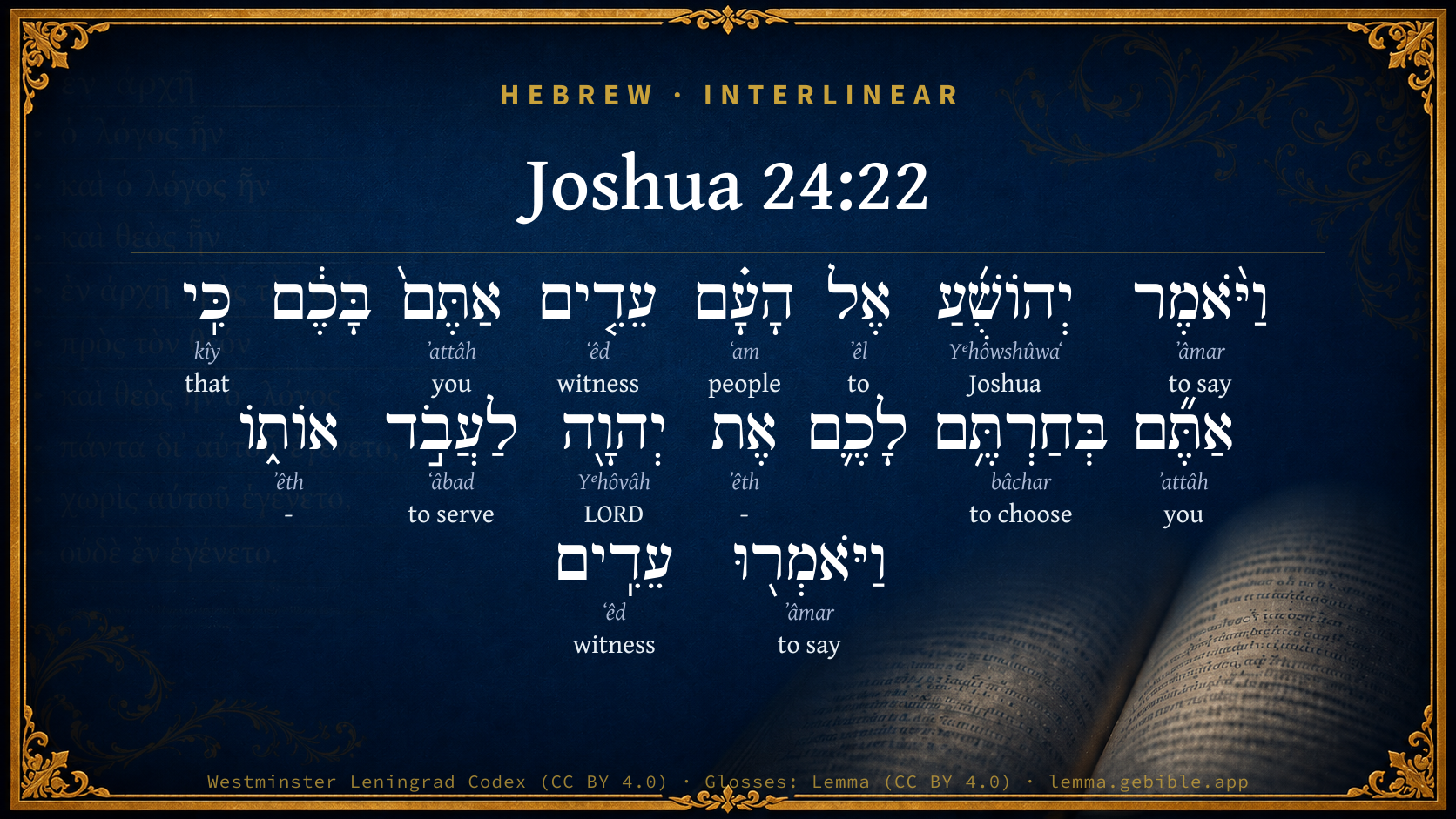
Hebrew (Westminster Leningrad Codex) Joshua 24:22 appears in the Hebrew Old Testament. The text above is from the Westminster Leningrad Codex. Each word links to its Strong’s number, a concise gloss, and parsing drawn from the Open Scriptures Hebrew Bible morphology. Click any word for its full Brown-Driver-Briggs (BDB) entry.
Download image
Cite this verse

Joshua 24:22 (World English Bible). Public Domain. Lemma interlinear Bible study tool, https://lemma.gebible.app/v/joshua/24/22.

Show BibTeX & RIS
BibTeX
RIS
English Translation
Joshua said to the people, You are witnesses against yourselves that you have chosen you Yahweh, to serve him. They said, We are witnesses.
World English Bible · Public Domain
Download a study sheet

One document with this verse’s original text, its word-by-word gloss line, the meaning frame, cross-references with their text, attributed commentary, and full source and license credits — printable, and it pastes into notes with its structure intact.

This verse Autodidact and up

Study sheet (.html) Plain text (.txt)

A passage Seminary Student

Up to 50 verses in one chapter. A passage sheet keeps up to 6 commentary sources and 12 cross-references per verse, in the order this page ranks them, and says so on the sheet whenever that leaves anything out. Ask for a single verse and you get the Autodidact verse sheet above.

Everything on this page stays free to read, with no account — the sheet is a download of what is already on screen, not access to it.

Want to remove ads? Support Godless Engineer
Compare translations 3

The same verse in 3 English versions, stacked beneath the original-language interlinear above. Click any original word for its lexicon entry.

Each is an independent rendering of the whole verse — the interlinear is not word-aligned to these translations.

Highlighted words mark where these versions differ — a whole-verse word diff, not a word-by-word alignment.

  • World English Bible Public Domain
    Joshua said to the people, You are witnesses against yourselves that you have chosen you Yahweh, to serve him. They said, We are witnesses.
  • King James Version Public Domain
    And Joshua said unto the people, Ye are witnesses against yourselves that ye have chosen you the LORD, to serve him. And they said, We are witnesses.
  • unfoldingWord Literal Text CC BY-SA 4.0
    And Joshua said to the people, “You witnesses against yourselves that you yourselves have chosen Yahweh for yourselves, to serve him.” And they said, “Witnesses.”

unfoldingWord Literal Text — © unfoldingWord, licensed CC BY-SA 4.0. Word-aligned USFM3 via Door43 (git.door43.org/unfoldingWord/en_ult).

Versions to compare (up to 4)

3 of 4 selected

Show all 18 translations

Every available English version of this verse, each an independent rendering of the whole verse.

  • World English Bible Public Domain
    Joshua said to the people, You are witnesses against yourselves that you have chosen you Yahweh, to serve him. They said, We are witnesses.
  • Berean Standard Bible Public Domain
    Then Joshua told them, “You are witnesses against yourselves that you have chosen to serve the LORD.” “We are witnesses!” they said.
  • Majority Standard Bible Public Domain
    Then Joshua told them, “You are witnesses against yourselves that you have chosen to serve the LORD.” “We are witnesses!” they said.
  • King James Version Public Domain
    And Joshua said unto the people, Ye are witnesses against yourselves that ye have chosen you the LORD, to serve him. And they said, We are witnesses.
  • American Standard Version (1901) Public Domain
    And Joshua said unto the people, Ye are witnesses against yourselves that ye have chosen you Jehovah, to serve him. And they said, We are witnesses.
  • Revised Version (1885) Public Domain
    And Joshua said unto the people, Ye are witnesses against yourselves that ye have chosen you the LORD, to serve him. And they said, We are witnesses.
  • Geneva Bible (1599) Public Domain
    And Ioshua saide vnto the people, Yee are witnesses against your selues, that yee haue chosen you the Lord, to serue him: and they sayd, We are witnesses.
  • Douay-Rheims (1899) Public Domain
    And Josue said to the people: You are witnesses, that you yourselves have chosen you the Lord to serve him. And they answered: We are witnesses.
  • Young's Literal Translation Public Domain
    And Joshua saith unto the people, `Witnesses ye are against yourselves, that ye have chosen for you Jehovah to serve Him (and they say, `Witnesses!')
  • Literal Standard Version CC BY-SA 4.0
    And Joshua says to the people, “You are witnesses against yourselves, that you have chosen YHWH for yourselves, to serve Him,” and they say, “Witnesses!”
  • Unlocked Literal Bible CC BY-SA 4.0
    Then Joshua said to the people, “You are witnesses against yourselves that you have chosen for yourselves Yahweh, to worship him.” They said, “We are witnesses.”
  • unfoldingWord Literal Text CC BY-SA 4.0
    And Joshua said to the people, “You witnesses against yourselves that you yourselves have chosen Yahweh for yourselves, to serve him.” And they said, “Witnesses.”
  • Darby Bible Public Domain
    And Joshua said unto the people, Ye are witnesses against yourselves that ye have chosen you Jehovah, to serve him. And they said, [We are] witnesses.
  • World Messianic Bible Public Domain
    Joshua said to the people, “You are witnesses against yourselves that you have chosen the LORD yourselves, to serve him.” They said, “We are witnesses.”
  • Webster's Bible Public Domain
    And Joshua said to the people, Ye are witnesses against yourselves that ye have chosen you the LORD, to serve him. And they said, We are witnesses.
  • Free Bible Version CC BY-SA 4.0
    Then Joshua cautioned the people, “You have made yourselves witnesses against yourselves by saying that you have chosen to worship the Lord.” “Yes, we are witnesses,” the people replied.
  • Bible in Basic English Public Domain
    And Joshua said to the people, You are witnesses against yourselves that you have made the decision to be the servants of the Lord. And they said, We are witnesses.
  • JPS Tanakh (1917) Public Domain
    And Joshua said unto the people: 'Ye are witnesses against yourselves that ye have chosen you the LORD, to serve Him. — And they said: 'We are witnesses.' —

Literal Standard Version (2020), Covenant Press — licensed CC BY-SA 4.0. Text via the HelloAO Bible API (eBible.org). Unlocked Literal Bible (unfoldingWord) — licensed CC BY-SA 4.0. Text via the HelloAO Bible API (eBible.org). unfoldingWord Literal Text — © unfoldingWord, licensed CC BY-SA 4.0. Word-aligned USFM3 via Door43 (git.door43.org/unfoldingWord/en_ult). Free Bible Version, Dr. Jonathan Gallagher — licensed CC BY-SA 4.0. Text via the HelloAO Bible API (eBible.org).

Word by word

More ways to search: Search by grammar → Find every occurrence → Compare this word →

Practice this passage: Drill this verse → Learn its vocabulary →

עֵדִ֤ים
ʻêd
H5707
“witnesses”
Noun, Common, Masculine, Plural, Absolute
Part of Speech
Noun
Type
Common
Gender
Masculine
Number
Plural
State
Absolute
Full BDB Definition

Origin: contracted from H5749

TWOT: 1576b

witness - witness, testimony, evidence (of things) - witness (of people)
  1. וַיֹּ֨אמֶר ʼâmar H559 “and · to say” Conjunction + Verb, Qal, Sequential Imperfect, 3rd Person, Masculine, Singular
  2. יְהוֹשֻׁ֜עַ Yᵉhôwshûwaʻ H3091 “Joshua” Noun, Proper
  3. אֶל ʼêl H413 “to” Preposition
  4. הָעָ֗ם ʻam H5971 “the · people” Particle, Definite Article + Noun, Common, Masculine, Singular, Absolute
  5. אַתֶּם֙ ʼattâh H859 “you” Pronoun, Personal, 2nd Person, Masculine, Plural
  6. כִּֽי kîy H3588 “that” Conjunction
  7. אַתֶּ֞ם ʼattâh H859 “you” Pronoun, Personal, 2nd Person, Masculine, Plural
  8. בְּחַרְתֶּ֥ם bâchar H977 “to choose” Verb, Qal, Perfect, 2nd Person, Masculine, Plural
  9. אֶת ʼêth H853 “-” Particle, Direct Object
  10. יְהוָ֖ה Yᵉhôvâh H3068 “LORD” Noun, Proper
  11. לַעֲבֹ֣ד ʻâbad H5647 “to serve” Preposition + Verb, Qal, Infinitive Construct
  12. אוֹת֑וֹ ʼêth H853 “- · him” Particle, Direct Object + Suffix, Personal, 3rd Person, Masculine, Singular
  13. וַיֹּאמְר֖וּ ʼâmar H559 “and · to say” Conjunction + Verb, Qal, Sequential Imperfect, 3rd Person, Masculine, Plural
  14. עֵדִֽים ʻêd H5707 “witnesses” Noun, Common, Masculine, Plural, Absolute

About this verse

These counts appear in no published source. They are computed here, from the morphology-tagged text and Lemma’s own curated glosses. What Lemma adds →

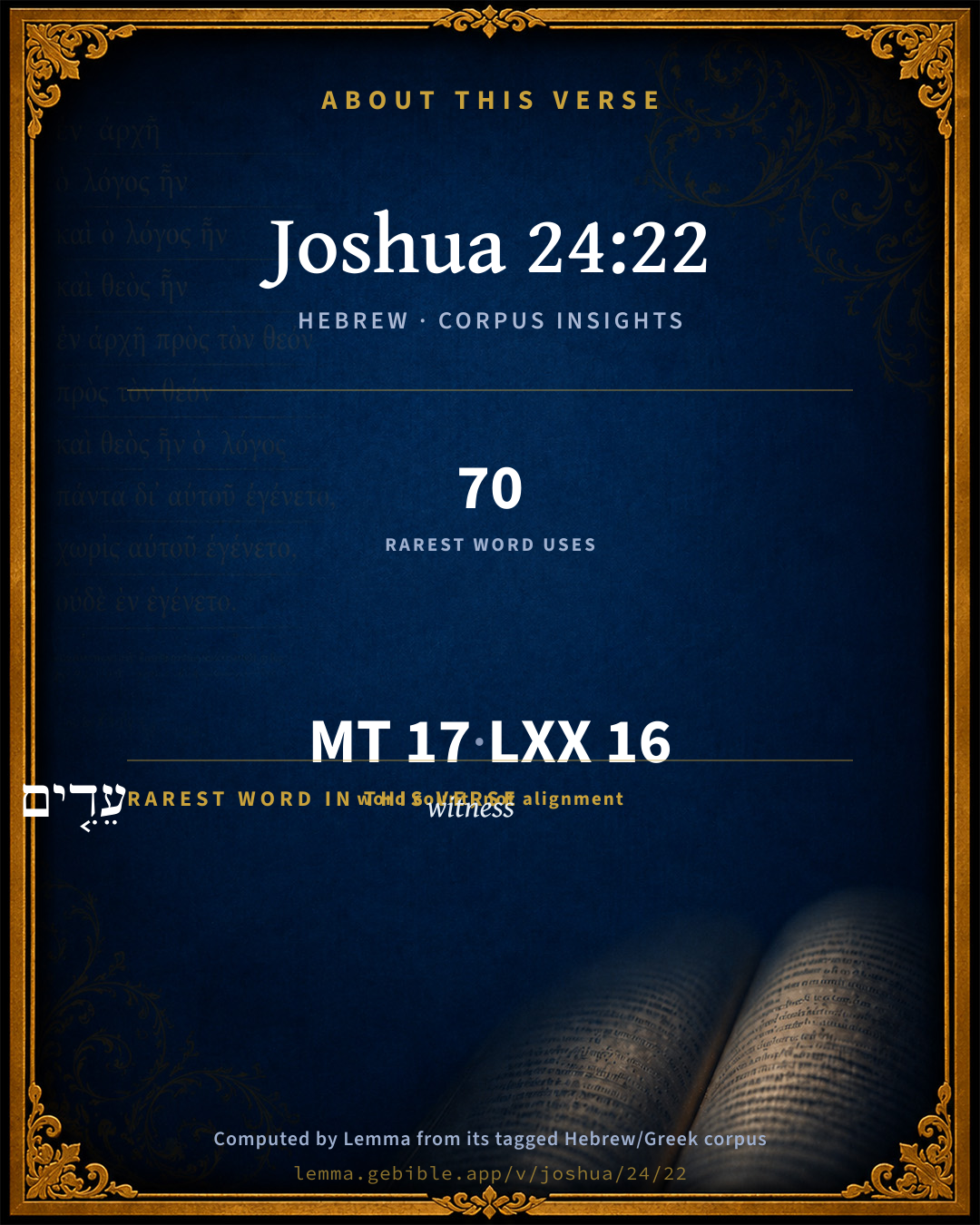
17
words
11
distinct lemmas
Historical
section

Grammatical profile

  • 4 verbs
  • 5 nouns
  • 2 pronouns
  • 3 prepositions
  • 1 conjunction
  • 2 particles

Verb forms

  • וַיֹּ֨אמֶר Qal · Sequential Imperfect
  • בְּחַרְתֶּ֥ם Qal · Perfect
  • לַעֲבֹ֣ד Qal · Infinitive Construct
  • וַיֹּאמְר֖וּ Qal · Sequential Imperfect

Repetition

Words recur within this verse — often emphatic in Hebrew:

  • וַיֹּ֨אמֶר to say H559 ×2
  • עֵדִ֤ים witness H5707 ×2
  • אַתֶּם֙ you H859 ×2

Hebrew & Septuagint length

In English translation the verse runs 24 words from the Hebrew and 20 from the Septuagint (LXX English) — closely comparable.

A rough comparison of the two English renderings, which tokenize alike — not a word-level alignment.

Word counts can differ between the Hebrew and the Greek without any difference in meaning — e.g. the Hebrew direct-object marker אֵת has no separate Greek word, and Greek often adds the article ὁ.

In the original languages it is 17 Hebrew tokens and 16 Greek tokens — but the two are counted differently (Hebrew bundles its prefixes and suffixes into one token; the Greek is in lemma form), so that isn’t a like-for-like length.

Cross-references

6

Topical passages linked to Joshua 24:22 in the Treasury of Scripture Knowledge — connected by theme and wording, ordered by reader-vote popularity; previews shown in the World English Bible.

  • Psalms 119:173 Let your hand be ready to help me, For I have chosen your precepts.
  • Psalms 119:11 I have hidden your word in my heart, That I might not sin against you.
  • Job 15:6 Your own mouth condemns you, and not I; Yes, your own lips testify against you.
  • Luke 10:42 but one thing is needed. Mary has chosen the good part, which will not be taken away from her."
  • Deuteronomy 26:17 You have declared Yahweh this day to be your God, and that you would walk in his ways, and keep his statutes, and his commandments, and his ordinances, and listen to his voice:
  • Luke 19:22 "He said to him, 'Out of your own mouth will I judge you, you wicked servant! You knew that I am an exacting man, taking up that which I didn't lay down, and reaping that which I didn't sow.

Cross-references courtesy of OpenBible.info (CC BY 4.0).

Hebrew and Greek witnesses Masoretic Hebrew ↔ Greek Septuagint

The same verse in the two great witnesses to the Old Testament, shown verse-for-verse.

These are two independent witnesses, not word-aligned to each other, and the Septuagint is shown in lemma (dictionary) form.

Hebrew Joshua 24:22 Masoretic · Westminster Leningrad Codex

וַיֹּ֨אמֶר יְהוֹשֻׁ֜עַ אֶל הָעָ֗ם עֵדִ֤ים אַתֶּם֙ בָּכֶ֔ם כִּֽי אַתֶּ֞ם בְּחַרְתֶּ֥ם לָכֶ֛ם אֶת יְהוָ֖ה לַעֲבֹ֣ד אוֹת֑וֹ וַיֹּאמְר֖וּ עֵדִֽים

Joshua said to the people, You are witnesses against yourselves that you have chosen you Yahweh, to serve him. They said, We are witnesses.

World English Bible · Public Domain

Greek LXX Joshua 24:22 Septuagint · lemma form

καί εἶπον ἰησοῦς πρός ὁ λαός μάρτυς σύ κατά σύ ὅτι σύ ἐκλέγω κύριος λατρεύω αὐτός

And Joshua said to the people, You⌃ are witnesses against yourselves, that you⌃ have chosen the Lord to serve him.

LXX2012 (modern English Septuagint) · Public Domain

Hebrew: Westminster Leningrad Codex (CC BY 4.0). Greek: Septuagint (public domain); English from LXX2012 (modern English Septuagint) (Public Domain). How the Septuagint differs from the Hebrew →

Targum (Aramaic paraphrase)

1

The Targum is the ancient Jewish Aramaic paraphrase of the Hebrew Scriptures — an interpretive translation, not the Hebrew text itself. Onkelos (literal) and Pseudo-Jonathan (expansive) render the Torah, and Jonathan the Prophets. Coverage is partial: where no permissively-licensed English translation exists for a verse, only the Aramaic is shown. This is verse-level text, not a word-by-word alignment to the Hebrew.

  1. Targum Jonathan Prophets (Joshua–Malachi)
    וַאֲמַר יְהוֹשֻׁעַ לְעַמָא סַהֲדִין אַתּוּן בְּנַפְשַׁתְכוֹן אֲרֵי אַתּוּן בְּחַרְתּוּן לְכוֹן יַת פּוּלְחָנָא דַייָ לְמִפְלַח קֳדָמוֹהִי וַאֲמַרוּ סַהֲדִין:

    (no public-domain English translation for this verse)

    Targum Jonathan — Aramaic: “Mikraot Gedolot” (public domain). English: “Sefaria Community Translation” (CC0 1.0 (public-domain dedication)); “London "Chaldee Paraphrase," 1871” (public domain). Text via Sefaria.

Commentary

Notes on Joshua 24:22 from classic Christian and Jewish commentators (each source and its license shown beneath its notes). The classic Christian expositions comment on the surrounding passage and are grouped to its opening verse, so a note may address several verses; the Jewish commentaries on the Tanakh (Rashi and others) are per-verse, so they appear only where the commentator wrote on this verse.

Lemma curates 59 commentaries, every one of them public domain or Creative Commons licensed, each selected and text-cleaned for this edition rather than reprinted as found. About our sources →

Trapp's Complete Commentary

John Trapp

Jos 24:22 And Joshua said unto the people, Ye [are] witnesses against yourselves that ye have chosen you the LORD, to serve him. And they said, [We are] witnesses.

Ver. 22. Ye are witnesses against yourselves.] In case ye falsify ye shall be self-condemned, and cut of your own mouths God shall judge you: meanwhile conscience shall do its office upon you, as an index, iudex, vindex, accuser, judge, and executioner.

John Trapp, A Commentary or Exposition upon All the Books of the Old and New Testament (1647–1656) — public domain. Text from a community e-Sword module.

Tyndale Open Study Notes

Tyndale Open Resources

24:22 a witness to your own decision: Joshua pressed the people to repeat their declaration as a legal affirmation and commitment.

Tyndale Open Study Notes — © Tyndale Open Resources, licensed CC BY-SA 4.0. Text via the HelloAO Bible API.

Geneva Bible (1599)

Geneva Bible translators

If you do the contrary, your own mouths shall condemn you.

Geneva Bible (1599) marginal notes — public domain. Text via Bolls.life.

Adam Clarke's Commentary

Verse 22. Ye are witnesses against yourselves] Ye have been sufficiently apprised of the difficulties in your way - of GOD'S holiness - your own weakness and inconstancy - the need you have of Divine help, and the awful consequences of apostasy; and now ye deliberately make your choice. Remember then, that ye are witnesses against yourselves, and your own conscience will be witness, judge, and executioner; or, as one terms it, index, judex, vindex.

Adam Clarke's Commentary on the Bible (1810–1826) — public domain. Text from a community e-Sword/MySword module.

John Calvin's Commentaries

22. And Joshua said unto the people, etc We now understand what the object was at which Joshua had hitherto aimed. It was not to terrify the people and make them fall away from their religion, but to make the obligation more sacred by their having of their own accord chosen his government, and betaken themselves to his guidance, that they might live under his protection. They acknowledge, therefore, that their own conscience will accuse them, and hold them guilty of perfidy, if they prove unfaithful. But although they were not insincere in declaring that they would be witnesses to their own condemnation, still how easily the remembrance of this promise faded away, is obvious from the Book of Judges. For when the more aged among them had died, they quickly turned aside to various superstitions. By this example we are taught how multifarious are the fallacies which occupy the senses of men, and how tortuous the recesses in which they hide their hypocrisy and folly, while they deceive themselves by vain confidence.

John Calvin's Commentaries (1540-1563) — public domain. Text from the Calvin Translation Society English edition (1840s-50s) via the Christian Classics Ethereal Library (ccel.org). Calvin's coverage is partial (roughly two-thirds of the Bible); uncommented books and verses are honest gaps, never fabricated. The 19th-century editor's footnotes and remarks are omitted so the notes are faithfully Calvin's own voice.

The Cambridge Bible for Schools and Colleges

gen. ed. J. J. S. Perowne

22. Ye are witnesses against yourselves] Clearly and unmistakeably the people had declared that they had chosen the service of Jehovah. By so doing, in the event of their falling away, they would condemn themselves by their own evidence, and would be obliged to admit that Jehovah had a right to punish them for their unfaithfulness.

We are witnesses] Literally, Witnesses are we against ourselves.

The Cambridge Bible for Schools and Colleges (gen. ed. J. J. S. Perowne; Cambridge University Press, 1878–1918) — public domain. Text from a community e-Sword module.

John Gill's Exposition

And Joshua said unto the people,.... In reply to their answer and resolution:

ye are witnesses against yourselves, that ye have chosen you the Lord God to serve him; that is, should they, after this choice of him, which they had so publicly declared, desert his service, and go into idolatry, their testimony would rise up against them, and they would, be self-condemned:

and they said, we are witnesses; should we ever apostatize from the Lord and his worship, we are content to have this our witness produced against us.

John Gill's Exposition of the Whole Bible (1746–1763) — public domain (CC PDM 1.0). Text via the HelloAO Bible API.

Matthew Poole's English Annotations

Ye are witnesses against yourselves; this solemn profession will be a swift witness against you, if hereafter you apostatize from God.

Matthew Poole's English Annotations on the Holy Bible (1683–1685) — public domain. Text from a community e-Sword/MySword module.

The Pulpit Commentary

Ye are witnesses against yourselves. Joshua has not disguised from them the difficulty of the task they have undertaken. Like a true guide and father, he has placed the case fully and fairly before them, and they have made their choice. He reminds them that their own words so deliberately uttered will be forever witnesses against them, should they afterwards refuse to keep an engagement into which they entered with their eyes open. They do not in any way shrink from the responsibility, and by accepting the situation as it is placed before them, render it impossible henceforth to plead ignorance or surprise as an excuse for their disobedience. And it is well to observe, as has been remarked above, that such an excuse never was pleaded afterwards, that the obligation, though evaded, was never disavowed.

The Pulpit Commentary (1880–1919), ed. H.D.M. Spence-Jones & Joseph S. Exell — public domain. Text from a community e-Sword module.

John Wesley's Explanatory Notes

Against yourselves - This solemn profession will be a swift witness against you, if hereafter you apostatize from God.

John Wesley, Explanatory Notes Upon the Whole Bible (1754–1765) — public domain. Text via the GEBible commentary corpus.

Keil & Delitzsch

C. F. Keil & F. Delitzsch

Upon this repeated declaration Joshua says to them, "ye are witnesses against yourselves," i.e., ye will condemn yourselves by this your own testimony if ye should now forsake the Lord, "for ye yourselves have chosen you Jehovah to serve Him;" whereupon they answer עדים, "witnesses are we against ourselves," signifying thereby, "we profess and ratify once more all that we have said" (Rosenmller). Joshua then repeated his demand that they should put away the strange gods from within them, and incline their hearts (entirely) to Jehovah the God of Israel. בּקבּכם אשׁר הנּכר אלהי might mean the foreign gods which are in the midst of you, i.e., among you, and imply the existence of idols, and the grosser forms of idolatrous worship in the nation; but בּקרב also signifies "within," or "in the heart," in which case the words refer to idols of the heart. That the latter is the sense in which the words are to be understood is evident from the fact, that although the people expressed their willingness to renounce all idolatry, they did not bring any idols to Joshua to be destroyed, as was done in other similar cases, viz., Gen 35:4, and Sa1 7:4. Even if the people had carried idols about with them in the desert, as the prophet Amos stated to his contemporaries (Amo 5:26; cf. Act 7:43), the grosser forms of idolatry had disappeared from Israel with the dying out of the generation that was condemned at Kadesh. The new generation, which had been received afresh into covenant with the Lord by the circumcision at Gilgal, and had set up this covenant at Ebal, and was now assembled around Joshua, the dying servant of God, to renew the covenant once more, had no idols of wood, stone, or metal, but only the "figments of false gods," as Calvin calls them, the idols of the heart, which it was to put away, that it might give its heart entirely to the Lord, who is not content with divided affections, but requires the whole heart (Deu 6:5-6).

Keil & Delitzsch — Biblical Commentary on the Old Testament (1861–1891) — public domain (CC PDM 1.0). Text via the HelloAO Bible API. (Old Testament only.)

Rashi

Rabbi Shlomo Yitzchaki (Rashi)

You are witnesses against yourselves. Yehoshua foresaw that in the future, they would undermine [the covenant] in the days of Yechezkeil and say, “We want to be like the [other] nations,” and therefore he was so hard on them now. Therefore it was said to them in the days of Yechezkeil, “The thought you entertain will never come to pass etc., As I live says Adonoy, God, I will rule over you with a strong hand etc.” You have already accepted upon yourselves [the covenant] in the days of Yehoshua. And you can not say “We only accepted it upon ourselves in the days of Moshe because we wanted [God’s help] to enter the land,” since in the days of Yehoshua you had already entered the land, and [yet] you accepted the covenant.

Rashi on the Tanakh — English translations: “The Judaica Press complete Tanach with Rashi, translated by A. J. Rosenberg” (CC BY 4.0); “Pentateuch with Rashi's commentary by M. Rosenbaum and A.M. Silbermann, 1929-1934” (public domain); “The Metsudah Tanach series, Lakewood, N.J” (CC BY 4.0); and “The Book of Joshua, Metsudah Publications, 1997” (CC BY 4.0). Text via Sefaria.

Lesson kit

Teaching starters — assembled from the data on this page, not authored interpretation. Every prompt links to the verse data it draws on. Edit before teaching.

Joshua, in the Historical, opens this verse with 17 words (11 distinct Hebrew lemmas). Its most distinctive word is ʻêd (“witness”). A historical commentator’s framing appears above. Read the whole chapter for the surrounding context.

Discussion questions

  1. How does “witness” (ʻêd) shape what this verse is saying?
  2. Psalms 119:173 shares this passage’s theme. How do the two illuminate each other?
  3. “to say” occurs 2× in this one verse. What is the effect of the repetition?
  4. The translations on this page render this verse differently — a whole-verse word diff, not a word-by-word alignment. What might account for the different wordings?
  5. The verb «וַיֹּ֨אמֶר» is Qal Sequential Imperfect. How does its form color the action?
  6. Reading how Trapp's Complete Commentary and Tyndale Open Study Notes read this verse, where do the two commentators agree and where do they part?

Things to notice

Reading settings

Reading text

Shown beneath each verse's original-language words.

Old Testament
Old Testament edition

Read the OT as the Masoretic Hebrew (MT) or the Greek Septuagint (LXX).

English shown for the Greek Septuagint (in the Hebrew ↔ Greek comparison).

Comparing translations? Open the Compare panel on any verse page to stack up to four side by side.