
Isaiah 41:9

Hebrew (Westminster Leningrad Codex) Isaiah 41:9 appears in the Hebrew Old Testament. The text above is from the Westminster Leningrad Codex. Each word links to its Strong’s number, a concise gloss, and parsing drawn from the Open Scriptures Hebrew Bible morphology. Click any word for its full Brown-Driver-Briggs (BDB) entry.
Download image
Cite this verse

Isaiah 41:9 (World English Bible). Public Domain. Lemma interlinear Bible study tool, https://lemma.gebible.app/v/isaiah/41/9.

Show BibTeX & RIS
BibTeX
RIS
English Translation
you whom I have taken hold of from the ends of the earth, and called from the corners of it, and said to you, You are my servant, I have chosen you and not cast you away;
World English Bible · Public Domain
Download a study sheet

One document with this verse’s original text, its word-by-word gloss line, the meaning frame, cross-references with their text, attributed commentary, and full source and license credits — printable, and it pastes into notes with its structure intact.

This verse Autodidact and up

Study sheet (.html) Plain text (.txt)

A passage Seminary Student

Up to 50 verses in one chapter. A passage sheet keeps up to 6 commentary sources and 12 cross-references per verse, in the order this page ranks them, and says so on the sheet whenever that leaves anything out. Ask for a single verse and you get the Autodidact verse sheet above.

Everything on this page stays free to read, with no account — the sheet is a download of what is already on screen, not access to it.

Want to remove ads? Support Godless Engineer
Compare translations 3

The same verse in 3 English versions, stacked beneath the original-language interlinear above. Click any original word for its lexicon entry.

Each is an independent rendering of the whole verse — the interlinear is not word-aligned to these translations.

Highlighted words mark where these versions differ — a whole-verse word diff, not a word-by-word alignment.

  • World English Bible Public Domain
    you whom I have taken hold of from the ends of the earth, and called from the corners of it, and said to you, You are my servant, I have chosen you and not cast you away;
  • King James Version Public Domain
    Thou whom I have taken from the ends of the earth, and called thee from the chief men thereof, and said unto thee, Thou art my servant; I have chosen thee, and not cast thee away.
  • unfoldingWord Literal Text CC BY-SA 4.0
    whom I am seizing you from the ends of the earth, and I have called you from its extremities and said to you, ‘You my servant,’ I have chosen you and not rejected you.

unfoldingWord Literal Text — © unfoldingWord, licensed CC BY-SA 4.0. Word-aligned USFM3 via Door43 (git.door43.org/unfoldingWord/en_ult).

Versions to compare (up to 4)

3 of 4 selected

Show all 18 translations

Every available English version of this verse, each an independent rendering of the whole verse.

  • World English Bible Public Domain
    you whom I have taken hold of from the ends of the earth, and called from the corners of it, and said to you, You are my servant, I have chosen you and not cast you away;
  • Berean Standard Bible Public Domain
    I brought you from the ends of the earth and called you from its farthest corners. I said, ‘You are My servant.’ I have chosen and not rejected you.
  • Majority Standard Bible Public Domain
    I brought you from the ends of the earth and called you from its farthest corners. I said, ‘You are My servant.’ I have chosen and not rejected you.
  • King James Version Public Domain
    Thou whom I have taken from the ends of the earth, and called thee from the chief men thereof, and said unto thee, Thou art my servant; I have chosen thee, and not cast thee away.
  • American Standard Version (1901) Public Domain
    thou whom I have taken hold of from the ends of the earth, and called from the corners thereof, and said unto thee, Thou art my servant, I have chosen thee and not cast thee away;
  • Revised Version (1885) Public Domain
    thou whom I have taken hold of from the ends of the earth, and called thee from the corners thereof, and said unto thee, Thou art my servant, I have chosen thee and not cast thee away;
  • Geneva Bible (1599) Public Domain
    For I haue taken thee from the endes of the earth, and called thee before the chiefe thereof, and saide vnto thee, Thou art my seruant: I haue chosen thee, and not cast thee away.
  • Douay-Rheims (1899) Public Domain
    In whom I have taken thee from the ends of the earth, and from the remote parts thereof have called thee, and said to thee: Thou art my servant, I have chosen thee, and have not cast thee away.
  • Young's Literal Translation Public Domain
    Whom I have taken hold of, from the ends of the earth, And from its near places I have called thee, And I say to thee, My servant Thou `art', I have chosen thee, and not rejected thee.
  • Literal Standard Version CC BY-SA 4.0
    Whom I have taken hold of, from the ends of the earth, || And from its near places I have called you, || And I say to you, You [are] My servant, || I have chosen you, and not rejected you.
  • Unlocked Literal Bible CC BY-SA 4.0
    you whom I am bringing back from the ends of the earth, and whom I called from the far away places, and to whom I said, 'You are my servant;' I have chosen you and not rejected you.
  • unfoldingWord Literal Text CC BY-SA 4.0
    whom I am seizing you from the ends of the earth, and I have called you from its extremities and said to you, ‘You my servant,’ I have chosen you and not rejected you.
  • Darby Bible Public Domain
    -- thou whom I have taken from the ends of the earth, and called from the extremities thereof, and to whom I said, Thou art my servant, I have chosen thee and not rejected thee,
  • World Messianic Bible Public Domain
    you whom I have taken hold of from the ends of the earth, and called from its corners, and said to you, ‘You are my servant. I have chosen you and have not cast you away.’
  • Webster's Bible Public Domain
    Thou whom I have taken from the ends of the earth, and called thee from the chief men thereof, and said to thee, Thou art my servant; I have chosen thee, and not cast thee away.
  • Free Bible Version CC BY-SA 4.0
    I brought you back from distant lands, I called you back from faraway places, telling you, “You are my servants.” I have chosen you, and I have not abandoned you.
  • Bible in Basic English Public Domain
    You whom I have taken from the ends of the earth, and sent for from its farthest parts, saying to you, You are my servant, whom I have taken for myself, and whom I have not given up:
  • JPS Tanakh (1917) Public Domain
    Thou whom I have taken hold of from the ends of the earth, and called thee from the uttermost parts thereof, and said unto thee: 'Thou art My servant, I have chosen thee and not cast thee away';

Literal Standard Version (2020), Covenant Press — licensed CC BY-SA 4.0. Text via the HelloAO Bible API (eBible.org). Unlocked Literal Bible (unfoldingWord) — licensed CC BY-SA 4.0. Text via the HelloAO Bible API (eBible.org). unfoldingWord Literal Text — © unfoldingWord, licensed CC BY-SA 4.0. Word-aligned USFM3 via Door43 (git.door43.org/unfoldingWord/en_ult). Free Bible Version, Dr. Jonathan Gallagher — licensed CC BY-SA 4.0. Text via the HelloAO Bible API (eBible.org).

Word by word

More ways to search: Search by grammar → Find every occurrence → Compare this word →

Practice this passage: Drill this verse → Learn its vocabulary →

וּמֵאֲצִילֶ֖יהָ
ʼâtsîyl
H678
“and · from · sides · her”
Conjunction + Preposition + Noun, Common, Masculine, Plural, Construct + Suffix, Personal, 3rd Person, Feminine, Singular
Part of Speech
Conjunction + Preposition + Noun
Type
Common
Gender
Masculine
Number
Plural
State
Construct
Full BDB Definition

Origin: from H680 (in its secondary sense of separation)

TWOT: 153b

side, corner, chief - (CLBL) nobles (figuratively)
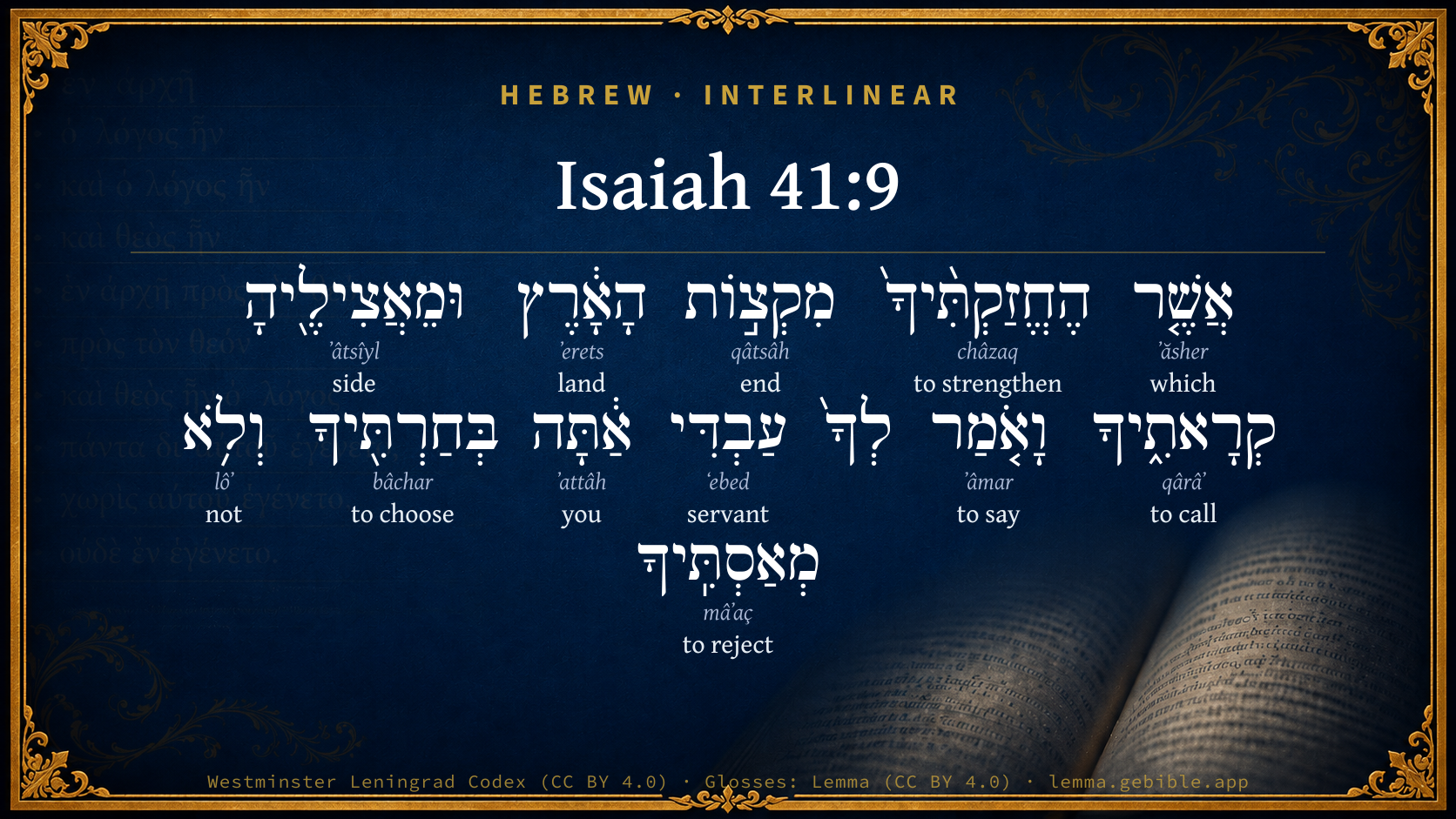
  1. אֲשֶׁ֤ר ʼăsher H834 “which” Particle, Relative
  2. הֶחֱזַקְתִּ֨יךָ֙ châzaq H2388 “to strengthen · you” Verb, Hiphil, Perfect, 1st Person, Common, Singular + Suffix, Personal, 2nd Person, Masculine, Singular
  3. מִקְצ֣וֹת qâtsâh H7098 “from · ends of” Preposition + Noun, Common, Both, Plural, Construct
  4. הָאָ֔רֶץ ʼerets H776 “the · land” Particle, Definite Article + Noun, Common, Both, Singular, Absolute
  5. קְרָאתִ֑יךָ qârâʼ H7121 “to call · you” Verb, Qal, Perfect, 1st Person, Common, Singular + Suffix, Personal, 2nd Person, Masculine, Singular
  6. וָאֹ֤מַר ʼâmar H559 “and · to say” Conjunction + Verb, Qal, Sequential Imperfect, 1st Person, Common, Singular
  7. עַבְדִּי ʻebed H5650 “servant · my” Noun, Common, Masculine, Singular, Construct + Suffix, Personal, 1st Person, Common, Singular
  8. אַ֔תָּה ʼattâh H859 “you” Pronoun, Personal, 2nd Person, Masculine, Singular
  9. בְּחַרְתִּ֖יךָ bâchar H977 “to choose · you” Verb, Qal, Perfect, 1st Person, Common, Singular + Suffix, Personal, 2nd Person, Masculine, Singular
  10. וְלֹ֥א lôʼ H3808 “and · not” Conjunction + Particle, Negative
  11. מְאַסְתִּֽיךָ mâʼaç H3988 “to reject · you” Verb, Qal, Perfect, 1st Person, Common, Singular + Suffix, Personal, 2nd Person, Masculine, Singular

About this verse

These counts appear in no published source. They are computed here, from the morphology-tagged text and Lemma’s own curated glosses. What Lemma adds →

13
words
12
distinct lemmas
Prophets
section

Notable vocabulary

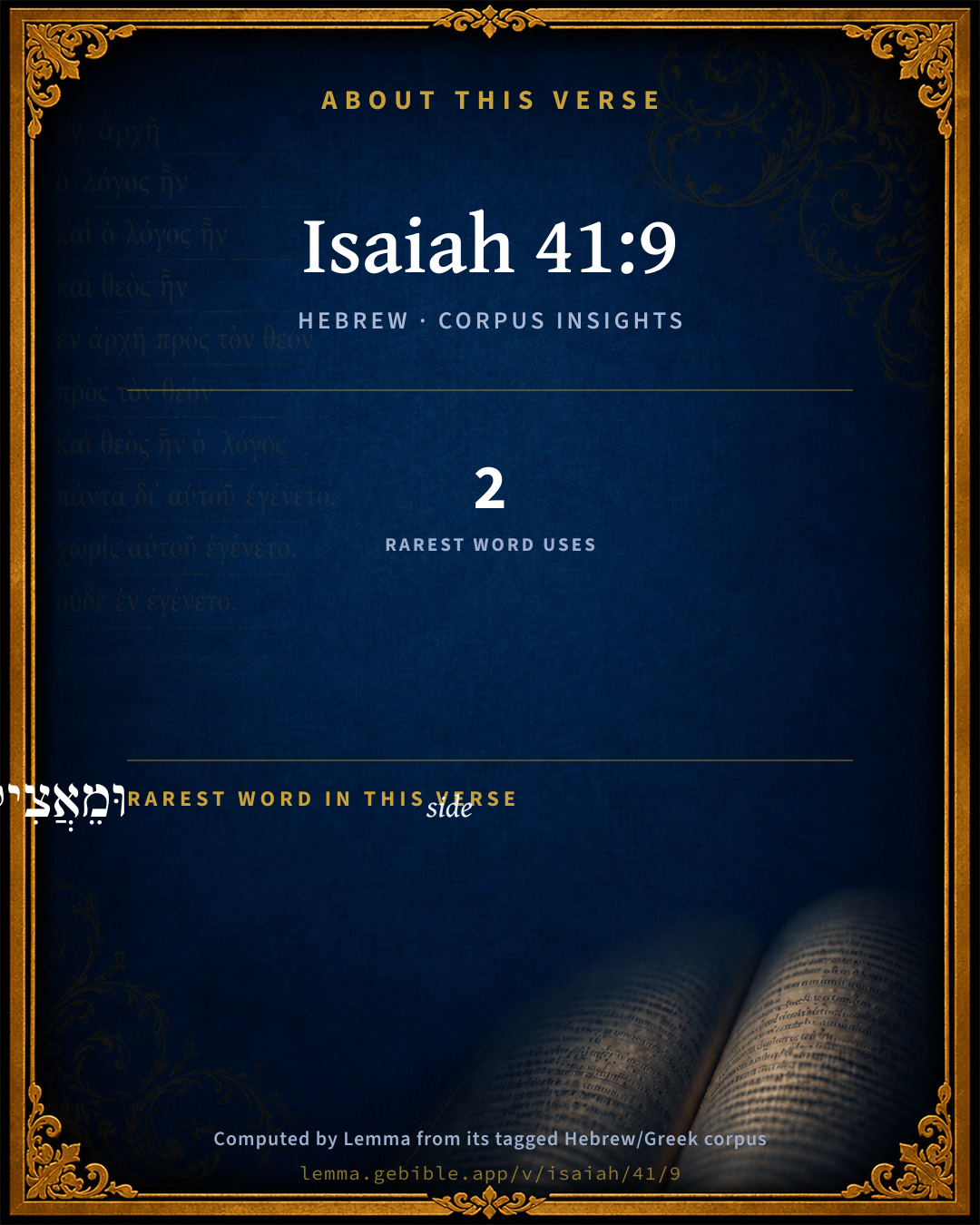
The rarest word here is וּמֵאֲצִילֶ֖יהָ side H678 — appearing just 2 times in the whole Hebrew Bible.

Shared distinctive vocabulary

וּמֵאֲצִילֶ֖יהָ side H678 occurs in 2 verses of the Hebrew Bible. Also found in:

Grammatical profile

  • 5 verbs
  • 4 nouns
  • 1 pronoun
  • 1 preposition
  • 2 particles

Verb forms

  • הֶחֱזַקְתִּ֨יךָ֙ Hiphil · Perfect
  • קְרָאתִ֑יךָ Qal · Perfect
  • וָאֹ֤מַר Qal · Sequential Imperfect
  • בְּחַרְתִּ֖יךָ Qal · Perfect
  • מְאַסְתִּֽיךָ Qal · Perfect

Hebrew & Septuagint length

In English translation the verse runs 37 words from the Hebrew and 41 from the Septuagint (LXX English) — closely comparable.

A rough comparison of the two English renderings, which tokenize alike — not a word-level alignment.

Word counts can differ between the Hebrew and the Greek without any difference in meaning — e.g. the Hebrew direct-object marker אֵת has no separate Greek word, and Greek often adds the article ὁ.

Cross-references

15

Topical passages linked to Isaiah 41:9 in the Treasury of Scripture Knowledge — connected by theme and wording, ordered by reader-vote popularity; previews shown in the World English Bible.

  • 1 Samuel 12:22 For Yahweh will not forsake his people for his great name's sake, because it has pleased Yahweh to make you a people to himself.
  • Psalms 94:14 For Yahweh won't reject his people, Neither will he forsake his inheritance.
  • Deuteronomy 7:6–7 For you are a holy people to Yahweh your God: Yahweh your God has chosen you to be a people for his own possession, above all peoples who are on the face of the earth.
  • Joshua 24:2–4 Joshua said to all the people, Thus says Yahweh, the God of Israel, Your fathers lived of old time beyond the River, even Terah, the father of Abraham, and the father of Nahor: and they served other gods.
  • James 2:5 Listen, my beloved brothers. Didn't God choose those who are poor in this world to be rich in faith, and heirs of the Kingdom which he promised to those who love him?
  • Romans 11:1–2 I ask then, Did God reject his people? May it never be! For I also am an Israelite, a descendant of Abraham, of the tribe of Benjamin.
  • 1 Corinthians 1:26–29 For you see your calling, brothers, that not many are wise according to the flesh, not many mighty, and not many noble;
  • Isaiah 41:2 Who has raised up one from the east, whom he calls in righteousness to his foot? he gives nations before him, and makes him rule over kings; he gives them as the dust to his sword, as the driven stubble to his bow.
  • Isaiah 41:8 But you, Israel, my servant, Jacob whom I have chosen, the seed of Abraham my friend,
  • Isaiah 43:5–6 Don't be afraid; for I am with you: I will bring your seed from the east, and gather you from the west;
  • Revelation 5:9 They sang a new song, saying, "You are worthy to take the book, And to open its seals: For you were killed, And bought us for God with your blood, Out of every tribe, language, people, and nation,
  • Nehemiah 9:7–38 You are Yahweh the God, who did choose Abram, and brought him forth out of Ur of the Chaldees, and gave him the name of Abraham,
  • Psalms 107:2–3 Let the redeemed by Yahweh say so, Whom he has redeemed from the hand of the adversary,
  • Jeremiah 33:25–26 Thus says Yahweh: If my covenant of day and night fails, if I have not appointed the ordinances of heaven and earth;
  • Luke 13:29 They will come from the east, west, north, and south, and will sit down in the Kingdom of God.

Cross-references courtesy of OpenBible.info (CC BY 4.0).

Hebrew and Greek witnesses Masoretic Hebrew ↔ Greek Septuagint

The same verse in the two great witnesses to the Old Testament, shown verse-for-verse.

These are two independent witnesses, not word-aligned to each other, and the Septuagint is shown in lemma (dictionary) form.

Hebrew Isaiah 41:9 Masoretic · Westminster Leningrad Codex

אֲשֶׁ֤ר הֶחֱזַקְתִּ֨יךָ֙ מִקְצ֣וֹת הָאָ֔רֶץ וּמֵאֲצִילֶ֖יהָ קְרָאתִ֑יךָ וָאֹ֤מַר לְךָ֙ עַבְדִּי אַ֔תָּה בְּחַרְתִּ֖יךָ וְלֹ֥א מְאַסְתִּֽיךָ

you whom I have taken hold of from the ends of the earth, and called from the corners of it, and said to you, You are my servant, I have chosen you and not cast you away;

World English Bible · Public Domain

Greek LXX Isaiah 41:9 Septuagint · lemma form

ὅς ἀντιλαμβάνω ἀπό ἄκρος ὁ γῆ καί ἐκ ὁ σκοπιά αὐτός καλέω σύ καί εἶπον σύ παῖς ἐγώ εἰμί ἐκλέγω σύ καί οὐ ἐν καταλείπω σύ

whom I have taken hold of from the ends of the earth, and from the high places of it I have called you, and said to you, You are my servant; I have chosen you, and I have not forsaken you.

LXX2012 (modern English Septuagint) · Public Domain

On this verse, Albert Barnes' Notes on the Bible discusses the Septuagint’s reading. Read the note in Commentary ↓

Hebrew: Westminster Leningrad Codex (CC BY 4.0). Greek: Septuagint (public domain); English from LXX2012 (modern English Septuagint) (Public Domain). How the Septuagint differs from the Hebrew →

Targum (Aramaic paraphrase)

1

The Targum is the ancient Jewish Aramaic paraphrase of the Hebrew Scriptures — an interpretive translation, not the Hebrew text itself. Onkelos (literal) and Pseudo-Jonathan (expansive) render the Torah, and Jonathan the Prophets. Coverage is partial: where no permissively-licensed English translation exists for a verse, only the Aramaic is shown. This is verse-level text, not a word-by-word alignment to the Hebrew.

  1. Targum Jonathan Prophets (Joshua–Malachi)
    דְקָרֵיבְתָּךְ מִזַרְעִית אַרְעָא וּמִמַלְכְּוָתָא בְּחַרְתָּךְ וַאֲמָרֵית לָךְ עַבְדִי אַתְּ אִתְרְעֵיתִי בָּךְ וְלָא אַרְחֵקִינָךְ:

    I have brought thee out of the families of the earth, I have chosen thee out of a kingdom: and I have said unto thee, Thou art my servant; I delight in thee, and I will not thrust thee away.

    Targum Jonathan — Aramaic: “Mikraot Gedolot” (public domain). English: “Sefaria Community Translation” (CC0 1.0 (public-domain dedication)); “London "Chaldee Paraphrase," 1871” (public domain). Text via Sefaria.

Commentary

Notes on Isaiah 41:9 from classic Christian and Jewish commentators (each source and its license shown beneath its notes). The classic Christian expositions comment on the surrounding passage and are grouped to its opening verse, so a note may address several verses; the Jewish commentaries on the Tanakh (Rashi and others) are per-verse, so they appear only where the commentator wrote on this verse.

Lemma curates 59 commentaries, every one of them public domain or Creative Commons licensed, each selected and text-cleaned for this edition rather than reprinted as found. About our sources →

Trapp's Complete Commentary

John Trapp

Isa 41:9 [Thou] whom I have taken from the ends of the earth, and called thee from the chief men thereof, and said unto thee, Thou [art] my servant; I have chosen thee, and not cast thee away.

Ver. 9. Thou whom I have taken from the ends of the earth,] sc., In the loins of Abraham thy progenitor.

And called thee from the chief men thereof.] Called thee and culled thee out of the grandees of the Chaldees, the rich, the potent, and the honourable, separate from the common sort, setting thee above the kings of the earth. {Psa 89:27}

John Trapp, A Commentary or Exposition upon All the Books of the Old and New Testament (1647–1656) — public domain. Text from a community e-Sword module.

Tyndale Open Study Notes

Tyndale Open Resources

41:9 I have chosen you restates 41:8 to emphasize God’s commitment and faithfulness to his people Israel, who had not been faithful to him. • not throw you away: Because of the Exile, the people felt that God had rejected them (see 49:21; 54:6). However, God had good purposes for them.

Tyndale Open Study Notes — © Tyndale Open Resources, licensed CC BY-SA 4.0. Text via the HelloAO Bible API.

Jamieson, Fausset & Brown

Robert Jamieson, A. R. Fausset & David Brown

Abraham, the father of the Jews, taken from the remote Ur of the Chaldees. Others take it of Israel, called out of Egypt (Deu 4:37; Hos 11:1).

from the chief men--literally, "the elbows"; so the joints; hence the root which joins the tree to the earth; figuratively, those of ancient and noble stock. But the parallel clause "ends of the earth" favors GESENIUS, who translates, "the extremities of the earth"; so JEROME.

Jamieson, Fausset & Brown — Commentary Critical and Explanatory on the Whole Bible (1871) — public domain (CC PDM 1.0). Text via the HelloAO Bible API.

Adam Clarke's Commentary

Verse 9. And called thee from the chief men thereof - "And called from the extremities thereof"] אציל מאציליה atsil meatsileyha, signifies the arm, ascilla, ala; and is used like כנף canaph, "the wing," for any thing extended from the extremity of another, or joined on to it. It is here parallel with and synonymous to מקצות mikkatsoth, "from the ends," in the preceding member.

Adam Clarke's Commentary on the Bible (1810–1826) — public domain. Text from a community e-Sword/MySword module.

Ellicott's Commentary for English Readers

(9) From the ends of the earth.—Ur of the Chaldees, as belonging to the Euphrates region, is on the extreme verge of the prophet’s horizon.

From the chief men thereof.—Better, from the far-off regions thereof.

I have chosen . . .—Isaiah becomes the preacher of the Divine election, and finds in it, as St. Paul found, the ground of an inextinguishable hope for the nation of which he was a member. As in St. Peter’s teaching, it remained for them to “make their calling and election sure” (2Pe_1:10), though God, in the unchangeableness of His nature, had chosen them before the foundation of the world.

A Bible Commentary for English Readers, edited by Charles John Ellicott (1878–1897) — public domain. Text from a community e-Sword module.

The Cambridge Bible for Schools and Colleges

gen. ed. J. J. S. Perowne

9. taken (better, as R.V., taken hold of) from the ends of the earth] It is disputed whether the reference is to the call of Abraham, or to the Exodus. It is a little difficult to suppose that Egypt could be described as the “ends of the earth” by a Jew; for although the writer may have lived in Babylonia, he could hardly divest himself of the historic consciousness of his nation, that Egypt was the neighbour of Israel. It is more probable, therefore, that he is thinking of Mesopotamia, and of the choice of Israel as effected in the call of Abraham. For chief men render corners (R.V.).

cast thee away] rejected thee—because of thy smallness.

The Cambridge Bible for Schools and Colleges (gen. ed. J. J. S. Perowne; Cambridge University Press, 1878–1918) — public domain. Text from a community e-Sword module.

John Gill's Exposition

Thou whom I have taken from the ends of the earth,.... Meaning not Abraham, nor his natural seed; but such who believed in Christ, who dwelt in the furthest parts of the earth, to whom the Gospel came, and by which they were laid hold upon, and apprehended by Christ as his own:

and called thee from the chief men thereof; from among the great men of the earth, out of their families, courts, and palaces: or rather called them by grace, when such personages were passed by and left; not many noble, not many mighty, being called in those times, Co1 1:26,

and said unto thee, thou art my servant; and not only called them by the name, but made them such in reality: adding,

I have chosen thee, and not cast thee away; nor does the Lord cast away any whom he has chosen and foreknown; and therefore being thus dear to God, as all the above titles and acts of grace show, and being secured by him from perishing or being eternally lost, this should encourage them to suffer persecution patiently for his name's sake, and not be afraid of any of their enemies, as follows.

John Gill's Exposition of the Whole Bible (1746–1763) — public domain (CC PDM 1.0). Text via the HelloAO Bible API.

Albert Barnes' Notes on the Bible

Thou whom I have taken from the ends of the earth - From Chaldea - regarded by the Jews as the remote part of the earth. Thus in Isa 13:5, it is said of the Medes that they came ‘from a far country, from the end of heaven’ (see the note on that place). Abraham was called from Ur of the Chaldees - a city still remaining on the east of the river Euphrates. It is probably the same place as the Persian fortress Ur, between Nesibis and the Tigris. It was visited by Mr. Wolfe, Mr. Buckingham, and by others.

And called thee from the chief men thereof - Or rather, from the extremities of the earth. The word אציל 'âtsiyl means properly “a side”; and when applied to the earth, means the sides ends, or extremities of it. In Exo 24:11, it is rendered ‘nobles,’ from an Arabic word signifying to he deep-rooted, and hence, those who are sprung from an ancient stock (Gesenius). In this place it is evidently used in the same sense as the word (אצל 'ētsel) meaning “side,” in the sense of extremity, or end. The parallelism requires us to give this interpretation to the word. So Jerome renders it, longinquis ejus (sc. terroe). The Septuagint renders it, Ἐκ τῶν σκωπιῶν Ek tōn skōpiōn - ‘From the speculations of the earth’ (Thompson), or rather perhaps meaning from the extremity of vision; from the countries lying in the distant horizon; or from the elevated places which offered an extensive range of vision. The Chaldee renders it, ‘From the kingdoms I have selected thee.’ Symmachus renders it, Ἀπὸ τῶν ἀγκῶνων Apo tōn angkōnōn autēs - from its angles, its corners, its extremities. Some have supposed that this refers to the deliverance from Egypt, but the more probable interpretation is that which refers it to the call of Abraham from Chaldea; and the idea is, that as God had called him from that distant land, and had made him his friend, he would preserve and guard his posterity. Perhaps it may be implied that he would be favorable to them in that same country from where he had called their illustrious progenitor, and would in like manner conduct them to the land of promise, that is, to their own land.

Albert Barnes' Notes on the Bible (1834–1885) — public domain. Text from a community e-Sword/MySword module.

Matthew Poole's English Annotations

Thou whom I have taken from the ends of the earth; thou, Israel, whom I took to myself, and brought hither in the loins of thy father Abraham from a remote country, to wit, Chaldea; or, whom I brought back out of Babylon into thine own land, which though yet to come, he may speak of as of a thing past, as the prophets use to do, as was noted before. Jut the former interpretation seems to agree better with the foregoing verse. From the chief men thereof; from the midst of many great and noble persons, among whom he lived in Chaldea. So this notes God’s singular mercy to Abraham, and consequently to the Israelites descended from him, that he passed by many of Abraham’s betters, and called him into fellowship with himself.

I have chosen thee, and not cast thee away; I have chosen thee not for a small moment, but for ever, by making an everlasting covenant with thee and thy seed through all generations. Or the sense is this; As I have chosen thee at first, so I have not since that time cast thee off, as thou hadst frequently given me sufficient occasion to do. Or, and did not refuse thee, as this word is elsewhere used. So the same thing is repeated in other words, not without some emphasis; for he intimates that he chose them when he had just cause of refusing them.

Matthew Poole's English Annotations on the Holy Bible (1683–1685) — public domain. Text from a community e-Sword/MySword module.

The Pulpit Commentary

Thou whom I have taken from the ends of the earth; i.e. from Ur of the Chaldees (Mugheir in Lower Babylonia), and again from Egypt, another "end of the earth" compared with Palestine. The prophet views Palestine as Israel"s true habitat, whatever may be its temporary abiding-place. From the chief men thereof. Most moderns translate "from the corners thereof;" but atsilim has the meaning of "chief men" in the only other place where it occurs. (Exo_24:11) And not cast thee away. Not even when in exile was Israel "cast away." God"s care was still extended over them.

The Pulpit Commentary (1880–1919), ed. H.D.M. Spence-Jones & Joseph S. Exell — public domain. Text from a community e-Sword module.

John Wesley's Explanatory Notes

Thou - Thou Israel, whom I took to myself, and brought hither in the loins of thy father Abraham, from a remote country. Called thee - From the midst of many great persons among whom he lived in Chaldea. Chosen - I have chosen thee and thy seed through all generations.

John Wesley, Explanatory Notes Upon the Whole Bible (1754–1765) — public domain. Text via the GEBible commentary corpus.

J. A. Alexander on Isaiah

Joseph Addison Alexander

“Thou whom I have grasped from the ends of the earth, and from its joints (or sides) have called thee, and said to thee, My servant (art) thou, I have chosen thee and not rejected thee.” The description of the object of address is still continued. The essential idea here expressed is that of election and separation from the rest of men, a bringing near of those who were afar off. Interpreters have needlessly disputed whether the vocation of Israel in Abraham, or at the Exodus, is here particularly meant; since both are really included in a general description of the calling and election of the people. The phrase ends of the earth is a common idiomatic expression for remoteness, often used without reference to particular localities (see Isa 5:26; Isa 13:5 ). The idea meant to be conveyed is identical with that expressed by Paul (Eph 2:13). The translation ‘I have taken’ is inadequate, the Hebrew verb meaning ‘to hold fast’, and the idea of removal being rather implied than expressed.

Joseph Addison Alexander, The Prophecies of Isaiah (1846–1847; New York: Scribner, 1870–1878) — public domain. Text from a community e-Sword module.

Rashi

Rabbi Shlomo Yitzchaki (Rashi)

whom I grasped Heb. הֶחֱזַקְתִּיךָ. I took you for My share. Comp. (Ex. 4:4) “And he stretched out his hand and grasped (וַיְּחֲזֵק) it.”

from the ends of the earth from the other nations.

and from its nobles from the greatest of them.

I called you by name for My share, “My firstborn son, Israel” (ibid. v. 22).

and I did not despise you like Esau, as it is said (Malachi 1:3), “And Esau I hated.”

Rashi on the Tanakh — English translations: “The Judaica Press complete Tanach with Rashi, translated by A. J. Rosenberg” (CC BY 4.0); “Pentateuch with Rashi's commentary by M. Rosenbaum and A.M. Silbermann, 1929-1934” (public domain); “The Metsudah Tanach series, Lakewood, N.J” (CC BY 4.0); and “The Book of Joshua, Metsudah Publications, 1997” (CC BY 4.0). Text via Sefaria.

Ibn Ezra

Rabbi Abraham ibn Ezra

From the ends of the earth. The Israelites were in Babylon, far away from their own land.

ומאציליה And from the chief men thereof, who are distinguished from the rest; comp. ואצלתי and I will take (Num. xi. אצילי.(17. the nobles of (Ex. 24:11). ומאציליה can also be explained from between her arms.

Ibn Ezra on the Tanakh — English translations: “Sefaria Community Translation” (CC0 1.0 (public-domain dedication)); “Yalkut, Sifsei Chachomim Chumash, Metsudah Publications, 2009” (CC BY 4.0); and “Commentary of Ibn Ezra on Isaiah - trans. by M. Friedlander, 1873” (public domain). Text via Sefaria.

Lesson kit

Teaching starters — assembled from the data on this page, not authored interpretation. Every prompt links to the verse data it draws on. Edit before teaching.

Isaiah, in the Prophets, opens this verse with 13 words (12 distinct Hebrew lemmas). Its most distinctive word is ʼâtsîyl (“side”). A historical commentator’s framing appears above. Read the whole chapter for the surrounding context.

Discussion questions

  1. What does “side” (ʼâtsîyl) contribute to the verse as a whole?
  2. How does Exodus 24:11, which shares the word «side», read alongside this verse?
  3. These translations render this verse differently. What is at stake in choosing one wording over another?
  4. «הֶחֱזַקְתִּ֨יךָ֙» is a Hiphil Perfect verb. How does that grammatical form shape the action described?
  5. Compare how Trapp's Complete Commentary and Tyndale Open Study Notes read this verse. Where do they agree or differ?

Things to notice

Reading settings

Reading text

Shown beneath each verse's original-language words.

Old Testament
Old Testament edition

Read the OT as the Masoretic Hebrew (MT) or the Greek Septuagint (LXX).

English shown for the Greek Septuagint (in the Hebrew ↔ Greek comparison).

Comparing translations? Open the Compare panel on any verse page to stack up to four side by side.