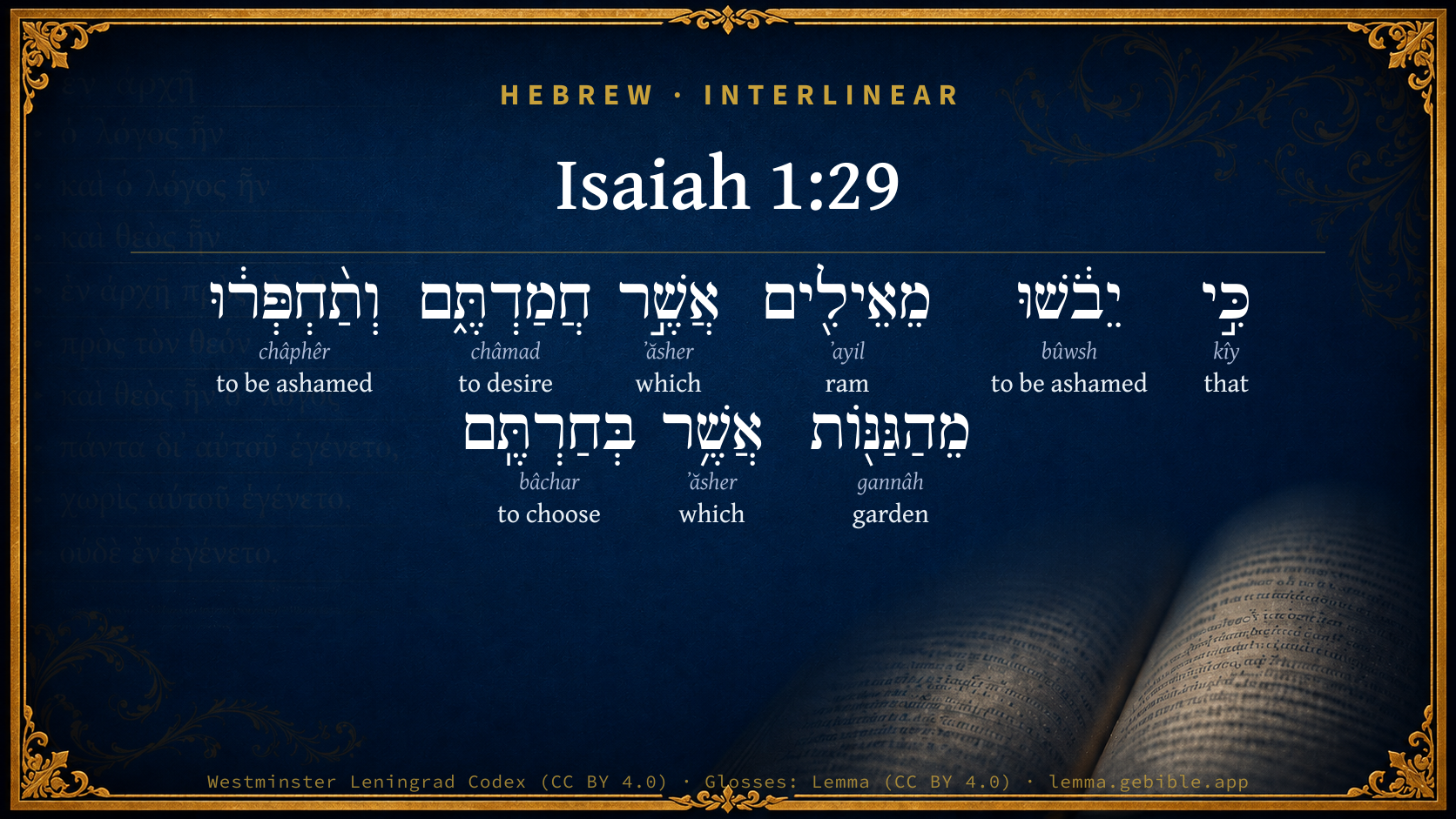
Isaiah 1:29

Hebrew (Westminster Leningrad Codex) Isaiah 1:29 appears in the Hebrew Old Testament. The text above is from the Westminster Leningrad Codex. Each word links to its Strong’s number, a concise gloss, and parsing drawn from the Open Scriptures Hebrew Bible morphology. Click any word for its full Brown-Driver-Briggs (BDB) entry.
Download image
Cite this verse

Isaiah 1:29 (World English Bible). Public Domain. Lemma interlinear Bible study tool, https://lemma.gebible.app/v/isaiah/1/29.

Show BibTeX & RIS
BibTeX
RIS
English Translation
For they shall be ashamed of the oaks which you have desired, And you shall be confounded for the gardens that you have chosen.
World English Bible · Public Domain
Download a study sheet

One document with this verse’s original text, its word-by-word gloss line, the meaning frame, cross-references with their text, attributed commentary, and full source and license credits — printable, and it pastes into notes with its structure intact.

This verse Autodidact and up

Study sheet (.html) Plain text (.txt)

A passage Seminary Student

Up to 50 verses in one chapter. A passage sheet keeps up to 6 commentary sources and 12 cross-references per verse, in the order this page ranks them, and says so on the sheet whenever that leaves anything out. Ask for a single verse and you get the Autodidact verse sheet above.

Everything on this page stays free to read, with no account — the sheet is a download of what is already on screen, not access to it.

Want to remove ads? Support Godless Engineer
Compare translations 3

The same verse in 3 English versions, stacked beneath the original-language interlinear above. Click any original word for its lexicon entry.

Each is an independent rendering of the whole verse — the interlinear is not word-aligned to these translations.

Highlighted words mark where these versions differ — a whole-verse word diff, not a word-by-word alignment.

  • World English Bible Public Domain
    For they shall be ashamed of the oaks which you have desired, And you shall be confounded for the gardens that you have chosen.
  • King James Version Public Domain
    For they shall be ashamed of the oaks which ye have desired, and ye shall be confounded for the gardens that ye have chosen.
  • unfoldingWord Literal Text CC BY-SA 4.0
    For they will have shame from the oaks that you desired, and you will blush from the gardens that you chose.

unfoldingWord Literal Text — © unfoldingWord, licensed CC BY-SA 4.0. Word-aligned USFM3 via Door43 (git.door43.org/unfoldingWord/en_ult).

Versions to compare (up to 4)

3 of 4 selected

Show all 18 translations

Every available English version of this verse, each an independent rendering of the whole verse.

  • World English Bible Public Domain
    For they shall be ashamed of the oaks which you have desired, And you shall be confounded for the gardens that you have chosen.
  • Berean Standard Bible Public Domain
    Surely you will be ashamed of the sacred oaks in which you have delighted; you will be embarrassed by the gardens that you have chosen.
  • Majority Standard Bible Public Domain
    Surely you will be ashamed of the sacred oaks in which you have delighted; you will be embarrassed by the gardens that you have chosen.
  • King James Version Public Domain
    For they shall be ashamed of the oaks which ye have desired, and ye shall be confounded for the gardens that ye have chosen.
  • American Standard Version (1901) Public Domain
    For they shall be ashamed of the oaks which ye have desired, and ye shall be confounded for the gardens that ye have chosen.
  • Revised Version (1885) Public Domain
    For they shall be ashamed of the oaks which ye have desired, and ye shall be confounded for the gardens that ye have chosen.
  • Geneva Bible (1599) Public Domain
    For they shalbe confounded for the okes, which ye haue desired, and ye shall be ashamed of the gardens, that ye haue chosen.
  • Douay-Rheims (1899) Public Domain
    For they shall be confounded for the idols, to which they have sacrificed: and you shall be ashamed of the gardens which you have chosen.
  • Young's Literal Translation Public Domain
    For `men' are ashamed because of the oaks That ye have desired, And ye are confounded because of the gardens That ye have chosen.
  • Literal Standard Version CC BY-SA 4.0
    For [men] are ashamed because of the oaks || That you have desired, || And you are confounded because of the gardens || That you have chosen.
  • Unlocked Literal Bible CC BY-SA 4.0
    “For you will be ashamed of the sacred oak trees that you desired, and you will be embarrassed by the gardens that you have chosen.
  • unfoldingWord Literal Text CC BY-SA 4.0
    For they will have shame from the oaks that you desired, and you will blush from the gardens that you chose.
  • Darby Bible Public Domain
    For they shall be ashamed of the terebinths that ye have desired, and ye shall blush for the gardens that ye have chosen.
  • World Messianic Bible Public Domain
    For they shall be ashamed of the oaks which you have desired, and you shall be confounded for the gardens that you have chosen.
  • Webster's Bible Public Domain
    For they shall be ashamed of the oaks which ye have desired, and ye shall be confounded for the gardens that ye have chosen.
  • Free Bible Version CC BY-SA 4.0
    You will be ashamed about how you enjoyed your pagan worship among the oak trees; you will be embarrassed because you chose the pleasure gardens of idols.
  • Bible in Basic English Public Domain
    For you will be put to shame because of the trees of your desire, and because of the gardens of your pleasure.
  • JPS Tanakh (1917) Public Domain
    For they shall be ashamed of the terebinths which ye have desired, and ye shall be confounded for the gardens that ye have chosen.

Literal Standard Version (2020), Covenant Press — licensed CC BY-SA 4.0. Text via the HelloAO Bible API (eBible.org). Unlocked Literal Bible (unfoldingWord) — licensed CC BY-SA 4.0. Text via the HelloAO Bible API (eBible.org). unfoldingWord Literal Text — © unfoldingWord, licensed CC BY-SA 4.0. Word-aligned USFM3 via Door43 (git.door43.org/unfoldingWord/en_ult). Free Bible Version, Dr. Jonathan Gallagher — licensed CC BY-SA 4.0. Text via the HelloAO Bible API (eBible.org).

Word by word

More ways to search: Search by grammar → Find every occurrence → Compare this word →

Practice this passage: Drill this verse → Learn its vocabulary →

About this verse

These counts appear in no published source. They are computed here, from the morphology-tagged text and Lemma’s own curated glosses. What Lemma adds →

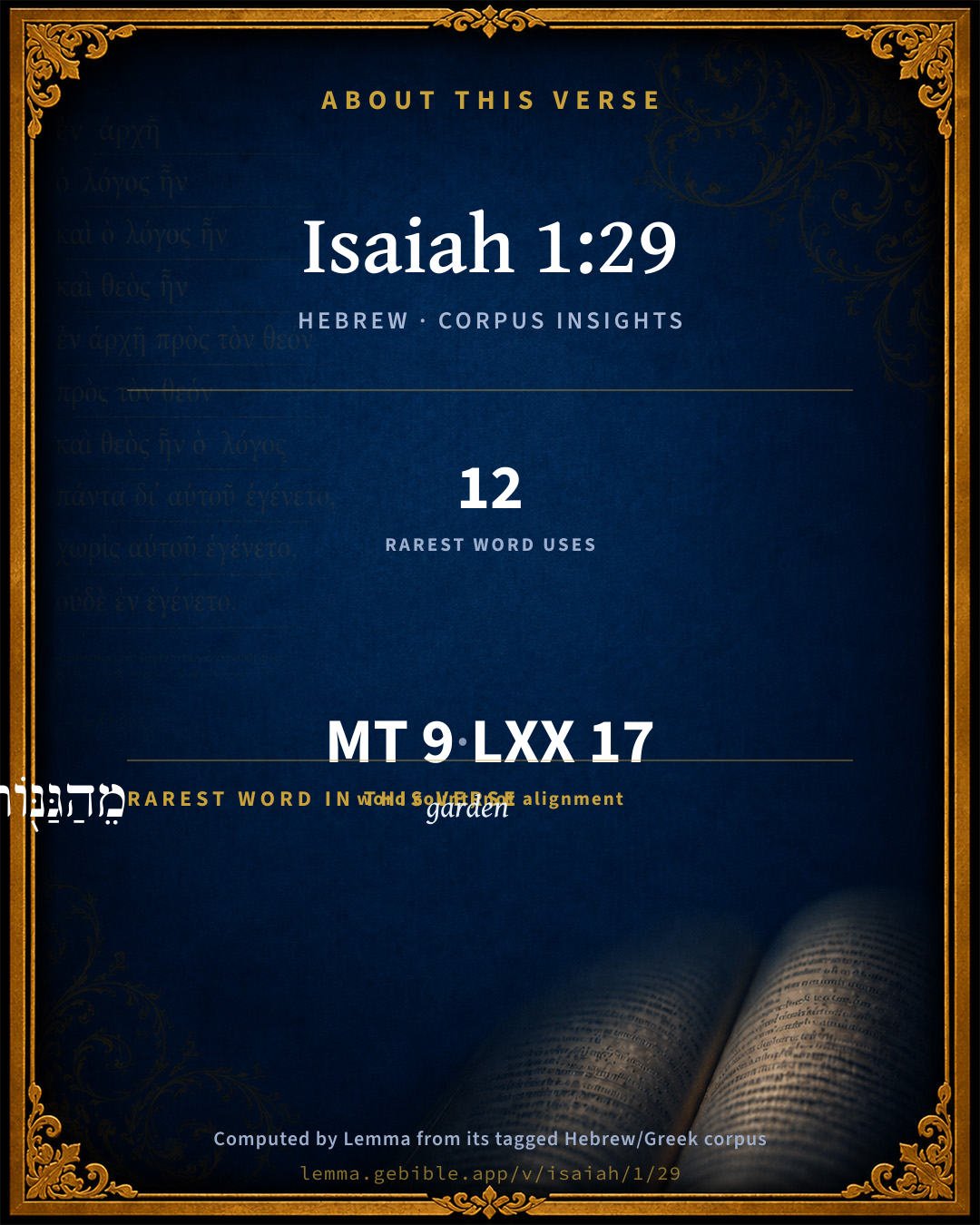
9
words
8
distinct lemmas
Prophets
section

Notable vocabulary

The rarest word here is מֵהַגַּנּ֖וֹת garden H1593 — appearing just 12 times in the whole Hebrew Bible.

Shared distinctive vocabulary

מֵהַגַּנּ֖וֹת garden H1593 occurs in 12 verses of the Hebrew Bible. Also found in:

Grammatical profile

  • 4 verbs
  • 2 nouns
  • 1 conjunction
  • 2 particles

Verb forms

  • יֵבֹ֔שׁוּ Qal · Imperfect
  • חֲמַדְתֶּ֑ם Qal · Perfect
  • וְתַ֨חְפְּר֔וּ Qal · Imperfect
  • בְּחַרְתֶּֽם Qal · Perfect

Repetition

A word recurs within this verse — often emphatic in Hebrew:

  • אֲשֶׁ֣ר which H834 ×2

Hebrew & Septuagint length

In English translation the verse runs 24 words from the Hebrew and 23 from the Septuagint (LXX English) — closely comparable.

A rough comparison of the two English renderings, which tokenize alike — not a word-level alignment.

Word counts can differ between the Hebrew and the Greek without any difference in meaning — e.g. the Hebrew direct-object marker אֵת has no separate Greek word, and Greek often adds the article ὁ.

In the original languages it is 9 Hebrew tokens and 17 Greek tokens — but the two are counted differently (Hebrew bundles its prefixes and suffixes into one token; the Greek is in lemma form), so that isn’t a like-for-like length.

Cross-references

15

Topical passages linked to Isaiah 1:29 in the Treasury of Scripture Knowledge — connected by theme and wording, ordered by reader-vote popularity; previews shown in the World English Bible.

  • Isaiah 57:5 you who inflame yourselves among the oaks, under every green tree; who kill the children in the valleys, under the clefts of the rocks?
  • Isaiah 65:3 a people who provoke me to my face continually, sacrificing in gardens, and burning incense on bricks;
  • Isaiah 66:17 Those who sanctify themselves and purify themselves [to go] to the gardens, behind one in the midst, eating pig's flesh, and the abomination, and the mouse, they shall come to an end together, says Yahweh.
  • Ezekiel 16:63 that you may remember, and be confounded, and never open your mouth any more, because of your shame, when I have forgiven you all that you have done, says the Lord Yahweh.
  • Hosea 4:13 They sacrifice on the tops of the mountains, And burn incense on the hills, under oaks and poplars and terebinths, Because its shade is good. Therefore your daughters play the prostitute, And your brides commit adultery.
  • Isaiah 30:22 You shall defile the overlaying of your engraved images of silver, and the plating of your molten images of gold: you shall cast them away as an unclean thing; you shall tell it, Get you hence.
  • Isaiah 31:7 For in that day they shall cast away every man his idols of silver, and his idols of gold, which your own hands have made to you for a sin.
  • Isaiah 45:16 They shall be disappointed, yes, confounded, all of them; they shall go into confusion together who are makers of idols.
  • Jeremiah 2:20 For of old time I have broken your yoke, and burst your bonds; and you said, I will not serve; for on every high hill and under every green tree you did bow yourself, playing the prostitute.
  • Jeremiah 3:6 Moreover Yahweh said to me in the days of Josiah the king, Have you seen that which backsliding Israel has done? she is gone up on every high mountain and under every green tree, and there has played the prostitute.
  • Ezekiel 6:13 You shall know that I am Yahweh, when their slain men shall be among their idols round about their altars, on every high hill, on all the tops of the mountains, and under every green tree, and under every thick oak, the places where they offered sweet savor to all their idols.
  • Ezekiel 36:31 Then shall you remember your evil ways, and your doings that were not good; and you shall loathe yourselves in your own sight for your iniquities and for your abominations.
  • Hosea 14:3 Assyria can't save us. We won't ride on horses; Neither will we say any more to the work of our hands, 'Our gods!' For in you the fatherless finds mercy."
  • Hosea 14:8 Ephraim, what have I to do any more with idols? I answer, and will take care of him. I am like a green fir tree; From me your fruit is found."
  • Romans 6:21 What fruit then did you have at that time in the things of which you are now ashamed? For the end of those things is death.

Cross-references courtesy of OpenBible.info (CC BY 4.0).

Hebrew and Greek witnesses Masoretic Hebrew ↔ Greek Septuagint

The same verse in the two great witnesses to the Old Testament, shown verse-for-verse.

These are two independent witnesses, not word-aligned to each other, and the Septuagint is shown in lemma (dictionary) form.

Hebrew Isaiah 1:29 Masoretic · Westminster Leningrad Codex

כִּ֣י יֵבֹ֔שׁוּ מֵאֵילִ֖ים אֲשֶׁ֣ר חֲמַדְתֶּ֑ם וְתַ֨חְפְּר֔וּ מֵהַגַּנּ֖וֹת אֲשֶׁ֥ר בְּחַרְתֶּֽם

For they shall be ashamed of the oaks which you have desired, And you shall be confounded for the gardens that you have chosen.

World English Bible · Public Domain

Greek LXX Isaiah 1:29 Septuagint · lemma form

διότι αἰσχύνω ἐπί ὁ εἴδωλον αὐτός ὅς αὐτός βούλομαι καί ἐπιαἰσχύνω ἐπί ὁ κῆπος αὐτός ὅς ἐπιθυμέω

For they shall be ashamed of their idols, which they delighted in, and they are made ashamed of the gardens which they coveted.

LXX2012 (modern English Septuagint) · Public Domain

On this verse, Keil & Delitzsch discusses the Septuagint’s reading. Read the note in Commentary ↓

Hebrew: Westminster Leningrad Codex (CC BY 4.0). Greek: Septuagint (public domain); English from LXX2012 (modern English Septuagint) (Public Domain). How the Septuagint differs from the Hebrew →

Targum (Aramaic paraphrase)

1

The Targum is the ancient Jewish Aramaic paraphrase of the Hebrew Scriptures — an interpretive translation, not the Hebrew text itself. Onkelos (literal) and Pseudo-Jonathan (expansive) render the Torah, and Jonathan the Prophets. Coverage is partial: where no permissively-licensed English translation exists for a verse, only the Aramaic is shown. This is verse-level text, not a word-by-word alignment to the Hebrew.

  1. Targum Jonathan Prophets (Joshua–Malachi)
    אֲרֵי תִּתְבַּהֲתוּן מֵאִילָנֵי טַעֲוָתָא דַחֲמַדְתּוּן וְתִתְכַּנְעוּן מִגִנֵי טַעֲוָתָא דְאַתּוּן מִסְתַּיְעִין בְּהוֹן:

    For ye shall be confounded of the oaks of idolatry which ye have desired; and ye shall be ashamed of the gardens of idolatry in which ye were seeking help.

    Targum Jonathan — Aramaic: “Mikraot Gedolot” (public domain). English: “Sefaria Community Translation” (CC0 1.0 (public-domain dedication)); “London "Chaldee Paraphrase," 1871” (public domain). Text via Sefaria.

Commentary

Notes on Isaiah 1:29 from classic Christian and Jewish commentators (each source and its license shown beneath its notes). The classic Christian expositions comment on the surrounding passage and are grouped to its opening verse, so a note may address several verses; the Jewish commentaries on the Tanakh (Rashi and others) are per-verse, so they appear only where the commentator wrote on this verse.

Lemma curates 59 commentaries, every one of them public domain or Creative Commons licensed, each selected and text-cleaned for this edition rather than reprinted as found. About our sources →

Trapp's Complete Commentary

John Trapp

Isa 1:29 For they shall be ashamed of the oaks which ye have desired, and ye shall be confounded for the gardens that ye have chosen.

Ver. 29. For they shall be ashamed of the oaks.] Pudefient et Peribunt; they shall be ashamed of their false ways of worship, but not with a godly shame, such as was Ephraim’s, {Jer 31:19} that made him say, "What have I to do any more with idols." {Hos 14:8 Eze 16:61; Eze 36:31 Dan 9:5 2Th 3:14} Of this holy shame Chrysostom saith that it is the beginning of salvation, {a} as that which drives a man into himself makes him fall low in his own eyes, shame and shent himself in the presence of God, seek for covering by Christ, that the shame of his nakedness may not appear. {Rev 3:18-19} But the shame here mentioned is of another nature, unseasonable, unprofitable, not conducing at all to true repentance, such as was that of Cain, and of those Jews in Jer 2:26, and of reprobates at the resurrection. {Dan 12:2}

Which ye have desired.] Or, Have delighted in, as adulterers do sin their sweet sin, as they call it.

And the gardens.] Where you have wickedly worshipped Priapus or Baalpeor. {b}

That ye have chosen.] Where ye have had your sacra electitia, which now, you see, cannot help you.

{a} τουτο αρχη της σωτηπιας, το ολως αισχυνεθαι.

{b} Alludit verecunde ad scortationem, quae est in idolorum cultu. - Oeclamp.

John Trapp, A Commentary or Exposition upon All the Books of the Old and New Testament (1647–1656) — public domain. Text from a community e-Sword module.

The Biblical Illustrator

Joseph S. Exell

Isa_1:29-30

They shall be ashamed of the oaks which ye have desired.

Gods judgment of destruction

For they shall be ashamed of the terebinths in which ye delighted, and ye must blush because of the gardens in which ye had pleasure (Isa_1:29). The terebinths and gardens are not referred to as objects of luxury (as Hitzig and Drechsler suppose), but as unlawful places of worship (Deu_16:21), and objects of worship; both of them are frequently mentioned by the prophets with this meaning (57:5, 65:3, 66:17). (F. Delitzsch.)

Terebinth

For ye shall be like a terebinth with withered leaves, and like a garden in which there is no water (Isa_1:30). Their prosperity is being destroyed, and they are thus like a terebinth which is withered in its foliage; their sources of help are dried up, and thus they resemble a garden that has no water and is therefore waste. The terebinth (turpentine pistacia), a native of southern and eastern Palestine, casts its leaves (which are small, and resemble those of the walnut) in the autumn. In this dry and parched condition terebinth and garden, to which the idolaters are compared, are readily inflammable. There is but needed a spark to kindle, and then they are consumed in the flame. (F Delitzsch.)

The Biblical Illustrator, edited by Joseph S. Exell (c. 1880s–1900s) — public domain. Text from a community e-Sword module.

Joseph Benson's Commentary

Isa 1:29. For they shall be ashamed — He does not speak of an ingenuous and penitential shame for sin, but of an involuntary and penal shame for the disappointment of the hopes which they had placed in their idols; of the oaks which ye have desired — Which, after the manner of the heathen, you have consecrated to idolatrous uses. Of what particular kind the trees here mentioned were, cannot be determined with certainty. The Hebrew word אלה, here used, is rendered ilex by Bishop Lowth, which properly means the scarlet oak. Others think the terebinth-tree was intended. And ye shall be confounded for the gardens, &c. — In which, as well as in the groves, they practised idolatry: see Isa 65:3; and Isa 66:17. “Sacred groves,” the reader will observe, “were a very ancient and favourite appendage of idolatry. They were furnished with the temple of the god to whom they were dedicated; with altars, images, and every thing necessary for performing the various rites of worship offered there; and were the scenes of many impure ceremonies, and of much abominable superstition. They made a principal part of the religion of the old inhabitants of Canaan; and the Israelites were commanded to destroy their groves, among other monuments of their false worship. The Israelites themselves, however, became afterward very much addicted to this species of idolatry:” see Eze 20:28; Hos 4:13. Bishop Lowth.

Joseph Benson's Commentary on the Old and New Testaments (1811–1818) — public domain. Text from a community e-Sword module.

Keil & Delitzsch

C. F. Keil & F. Delitzsch

Isa 1:29 declares how God's judgment of destruction would fall upon all of these. The v. is introduced with an explanatory "for" (Chi): "For they become ashamed of the terebinths, in which ye had your delight; and ye must blush for the gardens, in which ye took pleasure." The terebinths and gardens (the second word with the article, as in Hab 3:8, first binharim, then banneharim) are not referred to as objects of luxury, as Hitzig and Drechsler assume, but as unlawful places of worship and objects of worship (see Deu 16:21). They are both of them frequently mentioned by the prophets in this sense (Isa 57:5; Isa 65:3; Isa 66:17): Châmor and bâchar are also the words commonly applied to an arbitrary choice of false gods (Isa 44:9; Isa 41:24; Isa 66:3), and bosh min is the general phrase used to denote the shame which falls upon idolaters, when the worthlessness of their idols becomes conspicuous through their impotence. On the difference between bosh and Châpher, see the comm. on Psa 35:4.

(Note: It is perfectly certain that Châpher (Arab. Chaphira, as distinguished from Châphar, hafara, to dig) signifies to blush, erubescere; but the combination of bosh and yâbash (bâda), which would give albescere or expallescere (to turn white or pale) as the primary idea of bosh, has not only the Arabic use of bayyada and ibyadda (to rejoice, be made glad) against it, but above all the dialectic bechath, bahita (bahuta), which, when taken in connection with bethath (batta), points rather to the primary idea of being cut off (abscindi: cf., spes abscissa). See Lane's Arabic-English Lexicon, i. 263.)

The word elim is erroneously translated "idols" in the Septuagint and other ancient versions. The feeling which led to this, however, was a correct one, since the places of worship really stand for the idols worshipped in those places.

(Note: With regard to the derivation, êlim, whether used in the sense of strong men, or gods, or rams, or terebinths, is still but one word, derived from ı̄l or ūl, so that in all three senses it may be written either with or without Yod. Nevertheless elim in the sense of "rams" only occurs without Yod in Job 42:8. In the sense of "gods" it is always written without Yod; in that of "strong men" with Yod. In the singular the name of the terebinth is always written elah without Yod; in the plural, however, it is written either with or without. But this no more presupposes a singular êl (ayil) in common use, than bêtzim presupposes a singular bêts (bayits); still the word êl with Yod does occur once, viz., in Gen 14:6. Allâh and allōn, an oak, also spring from the same root, namely âlal = il; just as in Arabic both ı̄l and ill are used for ēl (God); and âl and ill, in the sense of relationship, point to a similar change in the form of the root.)

The excited state of the prophet at the close of his prophecy is evinced by his abrupt leap from an exclamation to a direct address (Ges. 137, Anm. 3).

Keil & Delitzsch — Biblical Commentary on the Old Testament (1861–1891) — public domain (CC PDM 1.0). Text via the HelloAO Bible API. (Old Testament only.)

Tyndale Open Study Notes

Tyndale Open Resources

1:29-30 The rebels (1:28), who practiced idolatry in groves of sacred oaks and in gardens dedicated to idols, would become like drought-stricken oaks and gardens. They would lack the nourishing vitality of the true God’s presence. Those who followed the Canaanite fertility religion of Baal treated gardens and trees as sacred, believing that they brought blessings. Instead, they brought spiritual death.

Tyndale Open Study Notes — © Tyndale Open Resources, licensed CC BY-SA 4.0. Text via the HelloAO Bible API.

Geneva Bible (1599)

Geneva Bible translators

That is, the trees and pleasant places, where ye commit idolatry, which was forbidden, Deut. 16:22.

Geneva Bible (1599) marginal notes — public domain. Text via Bolls.life.

Jamieson, Fausset & Brown

Robert Jamieson, A. R. Fausset & David Brown

ashamed-- (Rom 6:21).

oaks--Others translate the "terebinth" or "turpentine tree." Groves were dedicated to idols. Our Druids took their name from the Greek for "oaks." A sacred tree is often found in Assyrian sculpture; symbol of the starry hosts, Saba.

gardens--planted enclosures for idolatry; the counterpart of the garden of Eden.

Jamieson, Fausset & Brown — Commentary Critical and Explanatory on the Whole Bible (1871) — public domain (CC PDM 1.0). Text via the HelloAO Bible API.

Adam Clarke's Commentary

Verse 29. For they shall be ashamed of the oaks - "For ye shall be ashamed of the ilexes"] Sacred groves were a very ancient and favourite appendage of idolatry. They were furnished with the temple of the god to whom they were dedicated, with altars, images, and every thing necessary for performing the various rites of worship offered there; and were the scenes of many impure ceremonies, and of much abominable superstition. They made a principal part of the religion of the old inhabitants of Canaan; and the Israelites were commanded to destroy their groves, among other monuments of their false worship. The Israelites themselves became afterwards very much addicted to this species of idolatry.

"When I had brought them into the land,

Which I swore that I would give unto them;

Then they saw every high hill and every thick tree;

And there they slew their victims;

And there they presented the provocation of their offerings;

And there they placed their sweet savour;

And there they poured out their libations."

Eze 20:28.

"On the tops of the mountains they sacrifice;

And on the hills they burn incense;

Under the oak and the poplar;

And the ilex, because her shade is pleasant."

Ho 4:13.

Of what particular kinds the trees here mentioned are, cannot be determined with certainty. In regard to אלה ellah, in this place of Isaiah, as well as in Hosea, Celsius (Hierobot.) understands it of the terebinth, because the most ancient interpreters render it so; in the first place the Septuagint. He quotes eight places; but in three of these eight places the copies vary, some having δρυς, the oak, instead of τερεβινθος, the terebinth or turpentine tree. And he should have told us, that these same seventy render it in sixteen other places by δρυς, the oak; so that their authority is really against him; and the Septuagint, "stant pro quercu," contrary to what he says at first setting out. Add to this that Symmachus, Theodotion, and Aquila, generally render it by δρυς, the oak; the latter only once rendering it by τερεβινθος the terebinth. His other arguments seem to me not very conclusive; he says, that all the qualities of אלה ellah agree to the terebinth, that it grows in mountainous countries, that it is a strong tree, long-lived, large and high, and deciduous. All these qualities agree just as well to the oak, against which he contends; and he actually attributes them to the oak in the very next section. But I think neither the oak nor the terebinth will do in this place of Isaiah, from the last circumstance which he mentions, their being deciduous, where the prophet's design seems to me to require an evergreen, otherwise the casting of its leaves would be nothing out of the common established course of nature, and no proper image of extreme distress and total desolation, parallel to that of a garden without water, that is, wholly burnt up and destroyed. An ancient, who was an inhabitant and a native of this country, understands it in like manner of a tree blasted with uncommon and immoderate heat; velut arbores, cum frondes aestu torrente decusserunt. Ephrem Syr. in loc., edit. Assemani. Compare Ps 1:4; Jer 17:8. Upon the whole I have chosen to make it the ilex, which word Vossius, Etymolog., derives from the Hebrew אלה ellah, that whether the word itself be rightly rendered or not, I might at least preserve the propriety of the poetic image. - L.

By the ilex the learned prelate means the holly, which, though it generally appears as a sort of shrub, grows, in a good soil, where it is unmolested, to a considerable height. I have one in my own garden, rising three stems from the root, and between twenty and thirty feet in height. It is an evergreen.

Ver. 29. For they shall be ashamed - "For ye shall be ashamed"] תבושו teboshu, in the second person, Vulgate, Chaldee, three MSS., one of my own, ancient, and one edition; and in agreement with the rest of the sentence.

Adam Clarke's Commentary on the Bible (1810–1826) — public domain. Text from a community e-Sword/MySword module.

Ellicott's Commentary for English Readers

(29) They shall be ashamed of the oaks . . .—Better, terebinths. The words point to the groves that were so closely connected with the idolatry of Canaan, especially with the worship of the asherah, and which the people had chosen in preference to the sanctuary of Jehovah (Isa_17:8; Isa_57:5; Isa_66:17; Deu_16:21; 2Ki_16:4; Jer_3:6). Greek worship presents the parallels of the groves of Daphne at Antioch, and those of Dodona and of the Eumenides at Colônos. The “gardens” were the precinct planted round the central tree or grove.

A Bible Commentary for English Readers, edited by Charles John Ellicott (1878–1897) — public domain. Text from a community e-Sword module.

The Cambridge Bible for Schools and Colleges

gen. ed. J. J. S. Perowne

29. they shall be ashamed] Some MSS. and Ancient Versions have the second person, possibly a mere correction.

oaks] terebinths. These and the gardens are emblems not of luxury, but of nature-worship. On “gardens” as seats of heathenish cults, see Isa_65:3, Isa_66:17. The worship of sacred trees and sacred wells (which were probably the numina of the gardens [Duhm], see Isa_1:30) are two of the most widely diffused and persistent forms of nature-worship, and are not extinct in Syria at the present day.

29–31. The judgment will also bring about a purification of religion, by revealing the folly of trusting in other deities than Jehovah.

The Cambridge Bible for Schools and Colleges (gen. ed. J. J. S. Perowne; Cambridge University Press, 1878–1918) — public domain. Text from a community e-Sword module.

John Gill's Exposition

For they shall be ashamed of the oaks which ye have desired,.... Though there is a change of persons in the words, the same are intended; and design such, who being convinced of the idolatries of the church of Rome they have been fond of, and delighted in, will be ashamed of them, and relinquish them, and come out of Babylon a little before the destruction of it; for under oaks, and such like green trees, idolatry used to be committed, to which the allusion is; see Jer 2:20 and so the Targum interprets it of "trees of idols"; that is, under which idolatry was practised:

and ye shall be confounded for the gardens ye have chosen; where also idolatrous practices were used, see Isa 65:3 and so the Targum paraphrases it,

"and ye shall be ashamed of the gardens of idols, from whom ye have sought help.''

The sense is the same as before; unless both clauses should rather be understood of the destruction of sinners, before spoken of, who at that time will be filled with shame and confusion, they in vain praying to their idols for help; which sense the following words incline to.

John Gill's Exposition of the Whole Bible (1746–1763) — public domain (CC PDM 1.0). Text via the HelloAO Bible API.

Albert Barnes' Notes on the Bible

For they shall be ashamed - That is, when they see the punishment that their idolatry has brought upon them, they shall be ashamed of the folly and degradation of their worship. Moreover, the gods in which they trusted shall yield them no protection, and shall leave them to the disgrace and confusion of being forsaken and abandoned.

Of the oaks - Groves, in ancient times, were the favorite places of idolatrous worship. In the city of Rome, there were thirty-two groves consecrated to the gods. Those were commonly selected which were on hills, or high places; and they were usually furnished with temples, altars, and all the implements of idolatrous worship. Different kinds of groves were selected for this purpose, by different people. The Druids of the ancient Celtic nations in Gaul, Britain, and Germany, offered their worship in groves of oak - hence the name Druid, derived from δρῦς drus, an oak. Frequent mention is made in the Scriptures of groves and high places; and the Jews were forbidden to erect them; Deu 16:21; 1Ki 16:23; 2Ki 16:4; Eze 6:13; Eze 16:16, Eze 16:39; Exo 34:13; Jdg 3:7; 1Ki 18:19; Isa 17:8; Mic 5:14. When, therefore, it is said here, that they should be ashamed of the oaks, it means that they should be ashamed of their idolatrous worship, to which they were much addicted, and into which, under their wicked kings, they easily fell.

Their calamities were coming upon them mainly for this idolatry. It is not certainly known what species of tree is intended by the word translated oaks. The Septuagint has rendered it by the word “idols” - ἀπὸ τῶν εἰδώλων αὐτῶν apo tōn eidōlōn autōn. The Chaldee, ‘ye shall be confounded by the groves of idols.’ The Syriac version also has idols. Most critics concur in supposing that it means, not the oak, but the terebinth or turpentine tree - a species of fir. This tree is the Pistacia Terebinthus of Linnaeus, or the common turpentine tree, whose resin or juice is the China or Cyprus turpentine, used in medicine. The tree grows to a great age, and is common in Palestine. The terebinth - now called in Palestine the but’m-tree - ‘is not an evergreen, as is often represented; but its small, leathered, lancet-shaped leaves fall in the autumn, and are renewed in the spring.

The flowers are small, and are followed by small oval berries, hanging in clusters from two to five inches long, resembling much the clusters of the vine when the grapes are just set. From incisions in the trunk there is said to flow a sort of transparent balsam, constituting a very pure and fine species of turpentine, with an agreeable odor like citron or jessamine, and a mild taste, and hardening gradually into a transparent gum. The tree is found also in Asia Minor, Greece, Italy, the south of France, and in the north of Africa, and is described as not usually rising to the height of more than twenty feet.’ Robinson’s Bib. Researches, iii. 15, 16. It produces the nuts called the pistachio nuts. They have a pleasant, unctuous taste, resembling that of almonds, and they yield in abundance a sweet and pleasant oil. The best Venice turpentine, which, when it can be obtained pure, is superior to all the rest of its kind, is the produce of this tree. The picture in the book will give you an idea of the appearance of the terebinth. The Hebrew word אילים 'ēylı̂ym, from איל 'eyl, or more commonly אלה 'ēlâh, seems to be used sometimes as the Greek δρῦς drus is, to denote any large tree, whether evergreen or not; and especially any large tree, or cluster of trees, where the worship of idols was celebrated.

Which ye have desired - The Jews, until the captivity at Babylon, as all their history shows, easily relapsed into idolatry. The meaning of the prophet is, that the punishment at Babylon would be so long and so severe as to make them ashamed of this, and turn them from it.

Shall be confounded - Another word meaning to be ashamed.

For the gardens - The places planted with trees, etc., in which idolatrous worship was practiced. ‘In the language of the Hebrews, every place where plants and trees were cultivated with greater care than in the open field, was called a garden. The idea of such an enclosure was certainly borrowed from the garden of Eden, which the bountiful Creator planted for the reception of his favorite creature. The garden of Hesperides, in Eastern fables, was protected by an enormous serpent; and the gardens of Adonis, among the Greeks, may be traced to the same origin, for the terms horti Adenides, the gardens of Adonis, were used by the ancients to signify gardens of pleasure, which corresponds with the name of Paradise, or the garden of Eden, as horti Adonis answers to the garden of the Lord. Besides, the gardens of primitive nations were commonly, if not in every instance, devoted to religious purposes. In these shady retreats were celebrated, for a long succession of ages, the rites of pagan superstition.’ - Paxton. These groves or gardens were furnished with the temple of the god that was worshipped, and with altars, and with everything necessary for this species of worship. They were usually, also, made as shady and dark as possible, to inspire the worshippers with religious awe and reverence on their entrance; compare the note at Isa 66:17.

Albert Barnes' Notes on the Bible (1834–1885) — public domain. Text from a community e-Sword/MySword module.

Haydock's Catholic Bible Commentary

Idols. Protestants, "oaks, which ye have desired, and ye shall be confounded for the gardens," &c. (Haydock) --- the groves were sacred to Venus, and the gardens to Adonis, and were scenes of the greatest immorality and profanation, chap. lxv. 3.

George Leo Haydock (1774–1849), Haydock's Catholic Family Bible and Commentary, 1859 edition — public domain. Excludes Psalms (Douay-Rheims chapter numbering differs from Protestant) and Deuterocanonical books (Catholic canon only).

Matthew Poole's English Annotations

They shall be ashamed; not with an ingenuous and penitential shame for the sin, but with an involuntary and penal shame for the disappointment of their hopes which they had in their idols.

Which ye have desired; which, after the manner of the heathen, you have consecrated to idolatrous uses, that under them you might worship your idols, as they did, Eze 6:13; Hos 4:13; see also Isa 57:5; Jer 2:20; 3:6.

The gardens; in which, as well as in the groves, they committed idolatry; of which we read Isa 65:3; 66:17.

That ye have chosen, to wit, for the place of your worship, which is opposed to the place which God had chosen and appointed for his worship.

Matthew Poole's English Annotations on the Holy Bible (1683–1685) — public domain. Text from a community e-Sword/MySword module.

Whedon's Commentary on the Bible

Daniel D. Whedon

29. They… ye — These pronouns are thought by some interpreters to belong to the same parties. A Hebrew image, in some instances, allows this. But a consistent sense is yielded by supposing different classes to be referred to; in which case the meaning would be, they, of the coming period, will shrink with shame from the oaks, or terebinth groves, and the gardens, both of which ye, of this generation, have used (under the one, and within the other) for idolatrous practices. The idolatrous element was ever present in pre-eminently wicked times.

Which ye have desired — The prophet, while speaking, turns suddenly around to the men of that time, and says, “Ye are the men I mean, who are storing up shame and confusion for the generations to come.”

Daniel D. Whedon (gen. ed.), Commentary on the Old and New Testaments (1874–1909) — public domain. Text from a community e-Sword module.

The Pulpit Commentary

The oaks which ye have desired are, primarily, the "green trees" under which images were set up, (2Ki_17:10) but perhaps represent also any worldly attractions which draw the soul away from God as wealth, or power, or honors. In the day of suffering, sinners are ashamed of having been led away by such poor temptations as those to which they have yielded. (comp. Rom_6:21, "What fruit had ye then in those things whereof ye are now ashamed? The gardens. Kay suggests "idolatrous pleasure-gardens as those at Daphne, near Antioch, "which is a reasonable exegesis. Such were probably to be found wherever Astarte, or the "Dea Syra," was worshipped.

The Pulpit Commentary (1880–1919), ed. H.D.M. Spence-Jones & Joseph S. Exell — public domain. Text from a community e-Sword module.

John Wesley's Explanatory Notes

The oaks - Which, after the manner of the Heathen, you have consecrated to idolatrous uses. Gardens - In which, as well is in the groves, they committed idolatry.

John Wesley, Explanatory Notes Upon the Whole Bible (1754–1765) — public domain. Text via the GEBible commentary corpus.

J. A. Alexander on Isaiah

Joseph Addison Alexander

From the final destruction of idolaters the Prophet now reverts to their present security and confidence in idols, which he tells them shall be put to shame and disappointment. “For they shall be ashamed of the oaks” or terebinths “which ye have desired, and ye shall be confounded for the gardens which ye have chosen” as places of idolatrous worship. As these are terms constantly employed to express the frustration of religious trust, and as groves and gardens are continually spoken of as chosen scenes of idol-worship (see, for example, Isa 65:3; Isa 66:17; Eze 6:13; Hos 4:13), there can be little doubt that both this verse and the one preceding have particular allusion to idolatry.

Joseph Addison Alexander, The Prophecies of Isaiah (1846–1847; New York: Scribner, 1870–1878) — public domain. Text from a community e-Sword module.

unfoldingWord translationNotes

Door43 World Missions Community

General Information:

Isaiah speaks Yahweh's words to the people of Judah in the form of a poem. (See: Parallelism)

the sacred oak trees ... gardens

These phrases refer to places where the people of Judah worshiped idols.

you will be embarrassed by

Some versions read, "you will blush because of." A person blushes when his face turns hot and red, often because he feels that he has done something wrong.

For you will be like an oak whose leaf fades, and like a garden that has no water

Water gives life to trees and gardens. The people have cut themselves off from Yahweh, who gives them life. (See: Simile)

translationWords

shame

holy

oak

unfoldingWord translationNotes — © Distant Shores Media and the Door43 World Missions Community, licensed CC BY-SA 4.0. Source: git.door43.org/Door43/en_tn.

Rashi

Rabbi Shlomo Yitzchaki (Rashi)

of the elms Heb. מֵאֵלִים, an expression derived from אֵלָה, a species of tree called olme in O.F. [orme in modern French, an elm].

that you desired to worship idols under them, similar to what is stated (Hosea 4:13): “Under the oak and the aspen, and the elm, for its shade is good.”

because of the gardens There they would worship idols, as it is stated (infra 66:17): “Those who prepare themselves and purify themselves for the gardens.”

Rashi on the Tanakh — English translations: “The Judaica Press complete Tanach with Rashi, translated by A. J. Rosenberg” (CC BY 4.0); “Pentateuch with Rashi's commentary by M. Rosenbaum and A.M. Silbermann, 1929-1934” (public domain); “The Metsudah Tanach series, Lakewood, N.J” (CC BY 4.0); and “The Book of Joshua, Metsudah Publications, 1997” (CC BY 4.0). Text via Sefaria.

Ibn Ezra

Rabbi Abraham ibn Ezra

אילים Terebinths. The singular is אלה; it has a masculine termination in the plural like נָשִׁים of אִשָּׁח woman, and סאים of סאה measure (Gen. 18:6); comp. The gardens, which, in the corresponding phrase, balances terebinths.

יבשו They shall be ashamed. Some say that the י is here used instead of ת, the third instead of the second person, and explain many other instances in the same way; but I think that the third person of יכלו they shall be consumed of the preceding verse, is continued in יבשל, and in חמדתם ye have desired, passes over to the second person; there are many instances like it.

ותחפרו And ye shall be confounded

Ibn Ezra on the Tanakh — English translations: “Sefaria Community Translation” (CC0 1.0 (public-domain dedication)); “Yalkut, Sifsei Chachomim Chumash, Metsudah Publications, 2009” (CC BY 4.0); and “Commentary of Ibn Ezra on Isaiah - trans. by M. Friedlander, 1873” (public domain). Text via Sefaria.

Lesson kit

Teaching starters — assembled from the data on this page, not authored interpretation. Every prompt links to the verse data it draws on. Edit before teaching.

Isaiah, in the Prophets, opens this verse with 9 words (8 distinct Hebrew lemmas). Its most distinctive word is gannâh (“garden”). A historical commentator’s framing appears above. Read the whole chapter for the surrounding context.

Discussion questions

  1. What does “garden” (gannâh) contribute to the verse as a whole?
  2. How does Numbers 24:6, which shares the word «garden», read alongside this verse?
  3. What does the repetition of “which” (2× in this one verse) do in this verse?
  4. These translations render this verse differently; the difference is in the English rendering, not the original. What questions does that raise?
  5. «יֵבֹ֔שׁוּ» is a Qal Imperfect verb. How does that grammatical form shape the action described?
  6. Compare how Trapp's Complete Commentary and The Biblical Illustrator read this verse. Where do they agree or differ?

Things to notice

Reading settings

Reading text

Shown beneath each verse's original-language words.

Old Testament
Old Testament edition

Read the OT as the Masoretic Hebrew (MT) or the Greek Septuagint (LXX).

English shown for the Greek Septuagint (in the Hebrew ↔ Greek comparison).

Comparing translations? Open the Compare panel on any verse page to stack up to four side by side.