1 Samuel 8:18

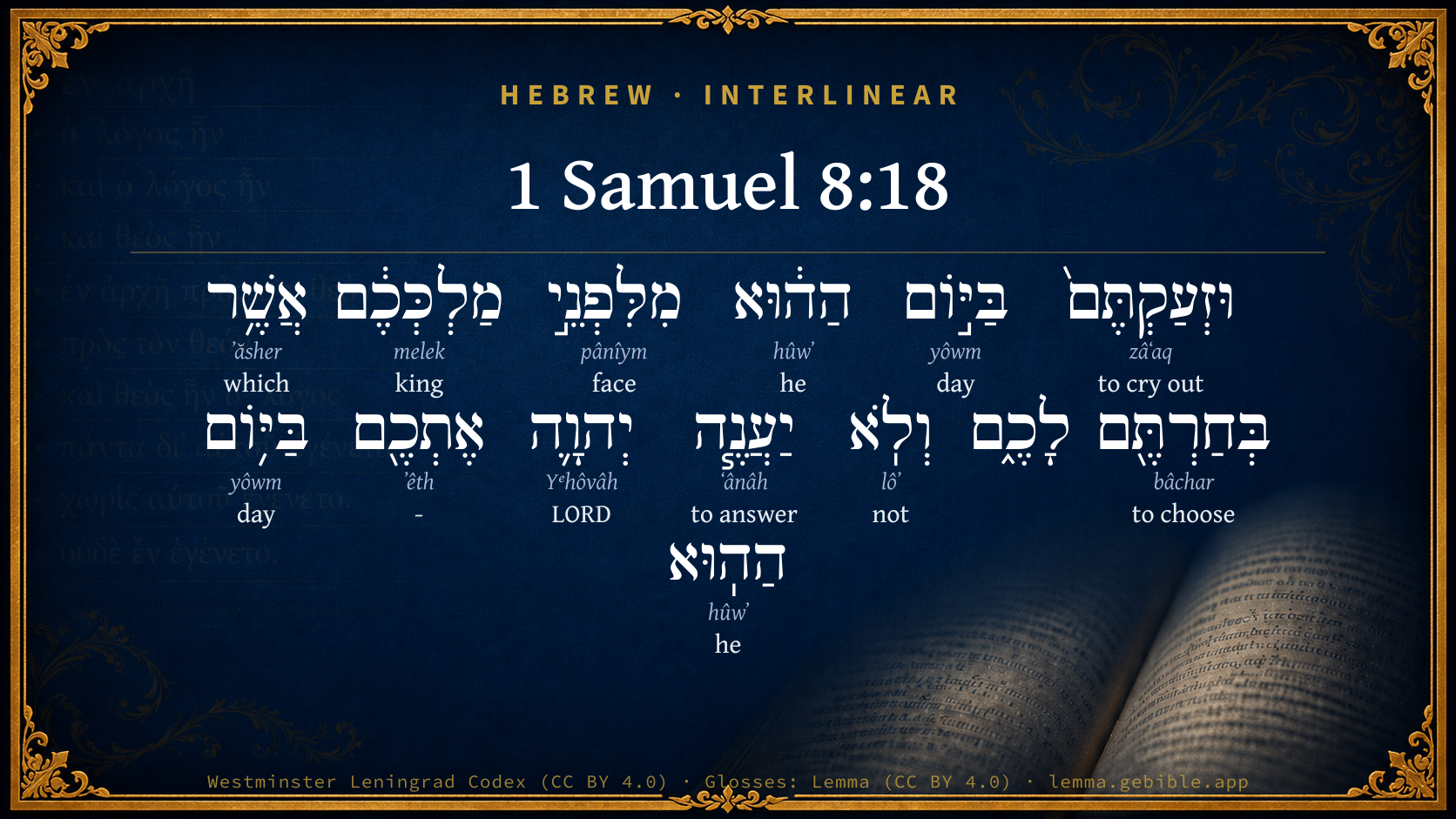
Hebrew (Westminster Leningrad Codex) 1 Samuel 8:18 appears in the Hebrew Old Testament. The text above is from the Westminster Leningrad Codex. Each word links to its Strong’s number, a concise gloss, and parsing drawn from the Open Scriptures Hebrew Bible morphology. Click any word for its full Brown-Driver-Briggs (BDB) entry.
Download image
Cite this verse

1 Samuel 8:18 (World English Bible). Public Domain. Lemma interlinear Bible study tool, https://lemma.gebible.app/v/1-samuel/8/18.

Show BibTeX & RIS
BibTeX
RIS
English Translation
You shall cry out in that day because of your king whom you shall have chosen you; and Yahweh will not answer you in that day.
World English Bible · Public Domain
Download a study sheet

One document with this verse’s original text, its word-by-word gloss line, the meaning frame, cross-references with their text, attributed commentary, and full source and license credits — printable, and it pastes into notes with its structure intact.

This verse Autodidact and up

Study sheet (.html) Plain text (.txt)

A passage Seminary Student

Up to 50 verses in one chapter. A passage sheet keeps up to 6 commentary sources and 12 cross-references per verse, in the order this page ranks them, and says so on the sheet whenever that leaves anything out. Ask for a single verse and you get the Autodidact verse sheet above.

Everything on this page stays free to read, with no account — the sheet is a download of what is already on screen, not access to it.

Want to remove ads? Support Godless Engineer
Compare translations 3

The same verse in 3 English versions, stacked beneath the original-language interlinear above. Click any original word for its lexicon entry.

Each is an independent rendering of the whole verse — the interlinear is not word-aligned to these translations.

Highlighted words mark where these versions differ — a whole-verse word diff, not a word-by-word alignment.

  • World English Bible Public Domain
    You shall cry out in that day because of your king whom you shall have chosen you; and Yahweh will not answer you in that day.
  • King James Version Public Domain
    And ye shall cry out in that day because of your king which ye shall have chosen you; and the LORD will not hear you in that day.
  • unfoldingWord Literal Text CC BY-SA 4.0
    And you will cry out on that day from to the face of your king whom you have chosen for yourselves, but Yahweh will not answer you on that day.”

unfoldingWord Literal Text — © unfoldingWord, licensed CC BY-SA 4.0. Word-aligned USFM3 via Door43 (git.door43.org/unfoldingWord/en_ult).

Versions to compare (up to 4)

3 of 4 selected

Show all 18 translations

Every available English version of this verse, each an independent rendering of the whole verse.

  • World English Bible Public Domain
    You shall cry out in that day because of your king whom you shall have chosen you; and Yahweh will not answer you in that day.
  • Berean Standard Bible Public Domain
    When that day comes, you will beg for relief from the king you have chosen, but the LORD will not answer you on that day.”
  • Majority Standard Bible Public Domain
    When that day comes, you will beg for relief from the king you have chosen, but the LORD will not answer you on that day.”
  • King James Version Public Domain
    And ye shall cry out in that day because of your king which ye shall have chosen you; and the LORD will not hear you in that day.
  • American Standard Version (1901) Public Domain
    And ye shall cry out in that day because of your king whom ye shall have chosen you; and Jehovah will not answer you in that day.
  • Revised Version (1885) Public Domain
    And ye shall cry out in that day because of your king which ye shall have chosen you; and the LORD will not answer you in that day.
  • Geneva Bible (1599) Public Domain
    And ye shall crie out at that day, because of your King, whom ye haue chosen you, and the Lord will not heare you at that day.
  • Douay-Rheims (1899) Public Domain
    And you shall cry out in that day from the face of the king, whom you have chosen to yourselves. and the Lord will not hear you in that day, because you desired unto yourselves a king.
  • Young's Literal Translation Public Domain
    And ye have cried out in that day because of the king whom ye have chosen for yourselves, and Jehovah doth not answer you in that day.'
  • Literal Standard Version CC BY-SA 4.0
    And you have cried out in that day because of the king whom you have chosen for yourselves, and YHWH does not answer you in that day.”
  • Unlocked Literal Bible CC BY-SA 4.0
    Then on that day you will cry out because of your king whom you have chosen for yourselves; but Yahweh will not answer you on that day.”
  • unfoldingWord Literal Text CC BY-SA 4.0
    And you will cry out on that day from to the face of your king whom you have chosen for yourselves, but Yahweh will not answer you on that day.”
  • Darby Bible Public Domain
    And ye shall cry out in that day because of your king whom ye have chosen; and Jehovah will not answer you in that day.
  • World Messianic Bible Public Domain
    You will cry out in that day because of your king whom you will have chosen for yourselves; and the LORD will not answer you in that day.”
  • Webster's Bible Public Domain
    And ye shall cry out in that day because of your king which ye shall have chosen for yourselves; and the LORD will not hear you in that day.
  • Free Bible Version CC BY-SA 4.0
    On that day you will plead to be rescued from the king you have chosen, but the Lord won't answer you then.”
  • Bible in Basic English Public Domain
    Then you will be crying out because of your king whom you have taken for yourselves; but the Lord will not give you an answer in that day.
  • JPS Tanakh (1917) Public Domain
    And ye shall cry out in that day because of your king whom ye shall have chosen you; and the LORD will not answer you in that day.'

Literal Standard Version (2020), Covenant Press — licensed CC BY-SA 4.0. Text via the HelloAO Bible API (eBible.org). Unlocked Literal Bible (unfoldingWord) — licensed CC BY-SA 4.0. Text via the HelloAO Bible API (eBible.org). unfoldingWord Literal Text — © unfoldingWord, licensed CC BY-SA 4.0. Word-aligned USFM3 via Door43 (git.door43.org/unfoldingWord/en_ult). Free Bible Version, Dr. Jonathan Gallagher — licensed CC BY-SA 4.0. Text via the HelloAO Bible API (eBible.org).

Word by word

More ways to search: Search by grammar → Find every occurrence → Compare this word →

Practice this passage: Drill this verse → Learn its vocabulary →

וּזְעַקְתֶּם֙
zâʻaq
H2199
“and · to cry out”
Conjunction + Verb, Qal, Sequential Perfect, 2nd Person, Masculine, Plural
Part of Speech
Conjunction + Verb
Stem
Qal
Form
Sequential Perfect
Person
2nd Person
Gender
Masculine
Number
Plural
Full BDB Definition

Origin: a primitive root

TWOT: 570

to cry, cry out, call, call for help - (Qal) - to call (to one's aid) - to cry, cry out (in need) - (Niphal) to be assembled, be called together, be joined together - (Hiphil) - to call, call out, call together, summon - to make a crying, proclaim - to have a proclamation made - to call out to, call out at
  1. בַּיּ֣וֹם yôwm H3117 “in/at the · day” Preposition, Determined + Noun, Common, Masculine, Singular, Absolute
  2. הַה֔וּא hûwʼ H1931 “the · he” Particle, Definite Article + Pronoun, Personal, 3rd Person, Masculine, Singular
  3. מִלִּפְנֵ֣י pânîym H6440 “from · to/for · face(s) of” Preposition + Preposition + Noun, Common, Both, Plural, Construct
  4. מַלְכְּכֶ֔ם melek H4428 “king · your” Noun, Common, Masculine, Singular, Construct + Suffix, Personal, 2nd Person, Masculine, Plural
  5. אֲשֶׁ֥ר ʼăsher H834 “which” Particle, Relative
  6. בְּחַרְתֶּ֖ם bâchar H977 “to choose” Verb, Qal, Perfect, 2nd Person, Masculine, Plural
  7. וְלֹֽא lôʼ H3808 “and · not” Conjunction + Particle, Negative
  8. יַעֲנֶ֧ה ʻânâh H6030 “to answer” Verb, Qal, Imperfect, 3rd Person, Masculine, Singular
  9. יְהוָ֛ה Yᵉhôvâh H3068 “LORD” Noun, Proper
  10. אֶתְכֶ֖ם ʼêth H853 “- · you” Particle, Direct Object + Suffix, Personal, 2nd Person, Masculine, Plural
  11. בַּיּ֥וֹם yôwm H3117 “in/at the · day” Preposition, Determined + Noun, Common, Masculine, Singular, Absolute
  12. הַהֽוּא hûwʼ H1931 “the · he” Particle, Definite Article + Pronoun, Personal, 3rd Person, Masculine, Singular

About this verse

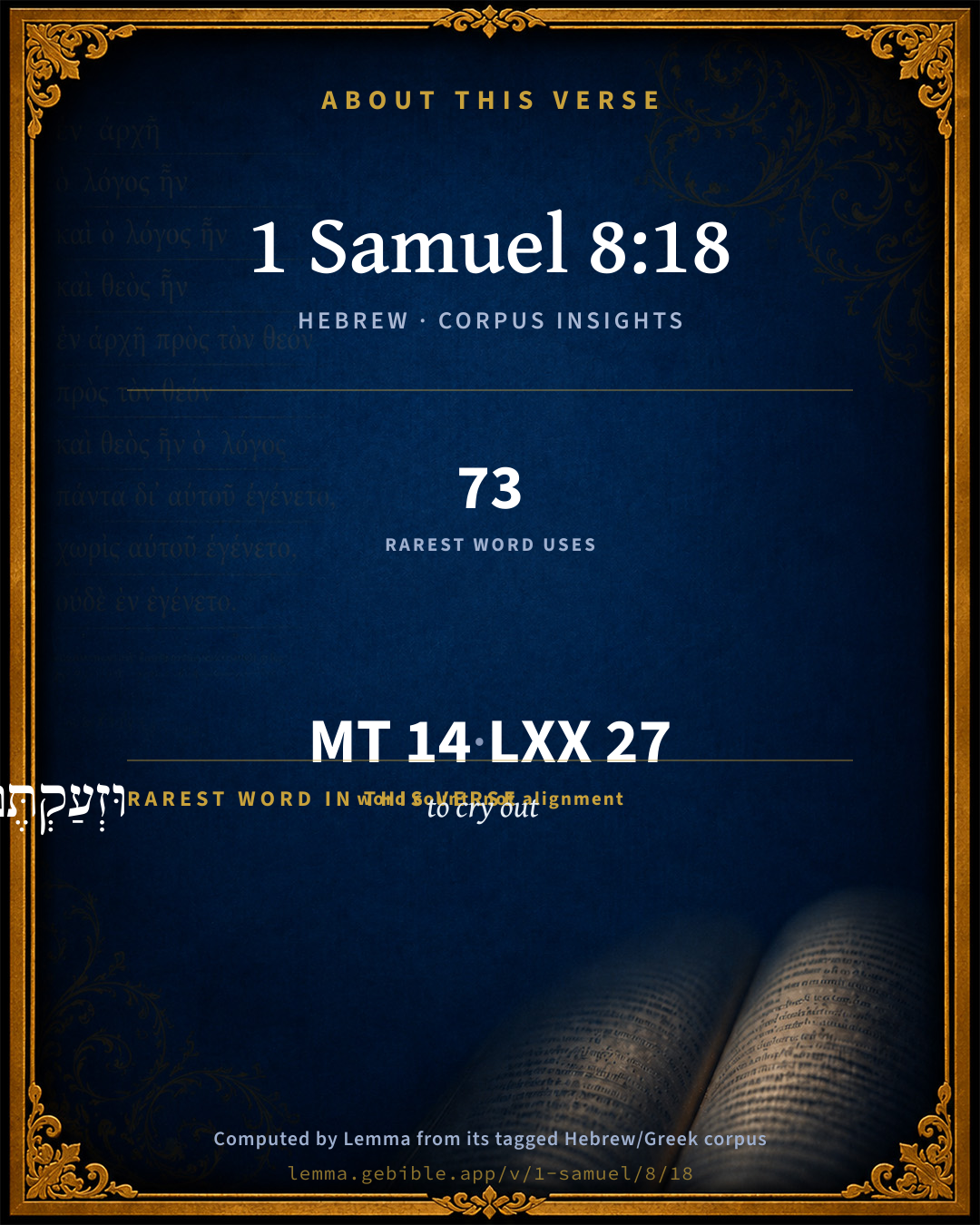
These counts appear in no published source. They are computed here, from the morphology-tagged text and Lemma’s own curated glosses. What Lemma adds →

14
words
11
distinct lemmas
Historical
section

Grammatical profile

  • 3 verbs
  • 5 nouns
  • 2 pronouns
  • 1 preposition
  • 3 particles

Verb forms

  • וּזְעַקְתֶּם֙ Qal · Sequential Perfect
  • בְּחַרְתֶּ֖ם Qal · Perfect
  • יַעֲנֶ֧ה Qal · Imperfect

Repetition

Words recur within this verse — often emphatic in Hebrew:

  • בַּיּ֣וֹם day H3117 ×2
  • הַה֔וּא he H1931 ×2

Hebrew & Septuagint length

In English translation the verse runs 26 words from the Hebrew and 36 from the Septuagint (LXX English) — closely comparable.

A rough comparison of the two English renderings, which tokenize alike — not a word-level alignment.

Word counts can differ between the Hebrew and the Greek without any difference in meaning — e.g. the Hebrew direct-object marker אֵת has no separate Greek word, and Greek often adds the article ὁ.

In the original languages it is 14 Hebrew tokens and 27 Greek tokens — but the two are counted differently (Hebrew bundles its prefixes and suffixes into one token; the Greek is in lemma form), so that isn’t a like-for-like length.

Cross-references

8

Topical passages linked to 1 Samuel 8:18 in the Treasury of Scripture Knowledge — connected by theme and wording, ordered by reader-vote popularity; previews shown in the World English Bible.

  • Micah 3:4 Then they will cry to Yahweh, But he will not answer them. Yes, he will hide his face from them at that time, Because they made their deeds evil."
  • Proverbs 1:25–28 But you have ignored all my counsel, And wanted none of my reproof;
  • Isaiah 1:15 When you spread forth your hands, I will hide my eyes from you; Yes, when you make many prayers, I will not hear. Your hands are full of blood.
  • Isaiah 8:21 They shall pass through it, sore distressed and hungry; and it shall happen that when they shall be hungry, they shall fret themselves, and curse by their king and by their God, and turn their faces upward:
  • Job 27:9 Will God hear his cry, When trouble comes on him?
  • Psalms 18:41 They cried, but there was none to save; Even to Yahweh, but he didn't answer them.
  • Proverbs 21:13 Whoever stops his ears at the cry of the poor, He will also cry out, but shall not be heard.
  • Luke 13:25 When once the master of the house has risen up, and has shut the door, and you begin to stand outside, and to knock at the door, saying, 'Lord, Lord, open to us!' then he will answer and tell you, 'I don't know you or where you come from.'

Cross-references courtesy of OpenBible.info (CC BY 4.0).

Hebrew and Greek witnesses Masoretic Hebrew ↔ Greek Septuagint

The same verse in the two great witnesses to the Old Testament, shown verse-for-verse.

These are two independent witnesses, not word-aligned to each other, and the Septuagint is shown in lemma (dictionary) form.

Hebrew 1 Samuel 8:18 Masoretic · Westminster Leningrad Codex

וּזְעַקְתֶּם֙ בַּיּ֣וֹם הַה֔וּא מִלִּפְנֵ֣י מַלְכְּכֶ֔ם אֲשֶׁ֥ר בְּחַרְתֶּ֖ם לָכֶ֑ם וְלֹֽא יַעֲנֶ֧ה יְהוָ֛ה אֶתְכֶ֖ם בַּיּ֥וֹם הַהֽוּא

You shall cry out in that day because of your king whom you shall have chosen you; and Yahweh will not answer you in that day.

World English Bible · Public Domain

Greek LXX 1 Samuel 8:18 Septuagint · lemma form

καί βοάω ἐν ὁ ἡμέρα ἐκεῖνος ἐκ πρόσωπον βασιλεύς σύ ὅς ἐκλέγω ἑαυτοῦ καί οὐ ἐπιἀκούω κύριος σύ ἐν ὁ ἡμέρα ἐκεῖνος ὅτι σύ ἐκλέγω ἑαυτοῦ βασιλεύς

And you⌃ shall cry out in that day because of your king whom you⌃ have chosen to yourselves, and the Lord shall not hear you in those days, because you⌃ have chosen to yourselves a king.

LXX2012 (modern English Septuagint) · Public Domain

Hebrew: Westminster Leningrad Codex (CC BY 4.0). Greek: Septuagint (public domain); English from LXX2012 (modern English Septuagint) (Public Domain). How the Septuagint differs from the Hebrew →

Targum (Aramaic paraphrase)

1

The Targum is the ancient Jewish Aramaic paraphrase of the Hebrew Scriptures — an interpretive translation, not the Hebrew text itself. Onkelos (literal) and Pseudo-Jonathan (expansive) render the Torah, and Jonathan the Prophets. Coverage is partial: where no permissively-licensed English translation exists for a verse, only the Aramaic is shown. This is verse-level text, not a word-by-word alignment to the Hebrew.

  1. Targum Jonathan Prophets (Joshua–Malachi)
    וּתְצַוְחוּן בְּיוֹמָא הַהוּא מִן קֳדָם מַלְכְּכוֹן דְאִתְרְעִיתוּן לְכוֹן וְלָא יְקַבֵּיל יְיָ צְלוֹתְכוֹן בְּיוֹמָא הַהוּא:

    (no public-domain English translation for this verse)

    Targum Jonathan — Aramaic: “Mikraot Gedolot” (public domain). English: “Sefaria Community Translation” (CC0 1.0 (public-domain dedication)); “London "Chaldee Paraphrase," 1871” (public domain). Text via Sefaria.

Commentary

Notes on 1 Samuel 8:18 from classic Christian and Jewish commentators (each source and its license shown beneath its notes). The classic Christian expositions comment on the surrounding passage and are grouped to its opening verse, so a note may address several verses; the Jewish commentaries on the Tanakh (Rashi and others) are per-verse, so they appear only where the commentator wrote on this verse.

Lemma curates 59 commentaries, every one of them public domain or Creative Commons licensed, each selected and text-cleaned for this edition rather than reprinted as found. About our sources →

Trapp's Complete Commentary

John Trapp

1Sa 8:18 And ye shall cry out in that day because of your king which ye shall have chosen you; and the LORD will not hear you in that day.

Ver. 18. And ye shall cry out.] As the Romans once did of Marius and Sulla, that the remedy was worse than the disease.

And the Lord will not hear you,] viz., To change your monarchy again into an aristocracy, your kings into judges.

John Trapp, A Commentary or Exposition upon All the Books of the Old and New Testament (1647–1656) — public domain. Text from a community e-Sword module.

Tyndale Open Study Notes

Tyndale Open Resources

8:18 The people would beg for relief as their ancestors had done in Egypt under another punishing and exacting ruler (see Exod 3:7).

Tyndale Open Study Notes — © Tyndale Open Resources, licensed CC BY-SA 4.0. Text via the HelloAO Bible API.

Geneva Bible (1599)

Geneva Bible translators

Because ye repent not for your sins, but because ye smart for your afflictions, whereinto ye cast yourselves willingly.

Geneva Bible (1599) marginal notes — public domain. Text via Bolls.life.

Ellicott's Commentary for English Readers

(18) The Lord will not hear you in that day.—After the separation of the north and the south, when King Solomon was dead, a large proportion of the northern sovereigns—or kings, as they were called, of “Israel,” in distinction to the southern monarchs, the kings of “Judah”—fulfilled in their lives and government of the realm the dark forebodings of the seer. The northern tribes broke with all the hallowed associations connected with the Ark and temple, and set up a rival and semi-idolatrous religion in some of their own popular centres. There no holy influences swayed the councils of their despotic kings. The lives of the Israelites who still loved the law of the Lord, and cherished the glorious memories of their fathers, must have been very bitter and hard when men like Omri and Ahab reigned with all their cruel power in Tirzah and Samaria.

But no prayers then availed; one wicked dynasty succeeded another, until the cup of iniquity was filled, and Israel carried away captive for ever out of their fair land.

A Bible Commentary for English Readers, edited by Charles John Ellicott (1878–1897) — public domain. Text from a community e-Sword module.

The Cambridge Bible for Schools and Colleges

gen. ed. J. J. S. Perowne

18. because of your king] Or, “from your king,” appealing to God to escape from his tyranny.

will not hear you] Rather, will not answer you. The Sept adds “because ye have chosen yourselves a king.”

The Cambridge Bible for Schools and Colleges (gen. ed. J. J. S. Perowne; Cambridge University Press, 1878–1918) — public domain. Text from a community e-Sword module.

John Gill's Exposition

And ye shall cry out in that day, because of your king,.... His power and pride, his oppression and tyranny, his heavy exactions, and intolerable yoke, and yet not be able to free themselves from them; all that they could do would be only to cry out under them as grievously distressed, and not knowing how to help themselves; and which would be the more aggravated, because they brought all this upon themselves, as it follows:

which ye shall have chosen you; for though the choice of a king for them, at a proper time, God had reserved to himself, yet in later times, as is here suggested, they would choose for themselves, and did, see Hos 8:4 besides, to have a king in general was at first their own choice, though the particular person was by the designation of the Lord:

and the Lord will not hear you in that day; will not regard them, have no compassion on them, suffer them to remain under their oppressions, and not deliver them out of them; because they rejected him from being their King, and put themselves out of his protection, into the hands of another, and therefore it was just to leave them to their own choice.

John Gill's Exposition of the Whole Bible (1746–1763) — public domain (CC PDM 1.0). Text via the HelloAO Bible API.

Haydock's Catholic Bible Commentary

The face, privately; for even groans will not be free. (Menochius) --- The event justified this prediction, as most of the kings of the Hebrews ruled like tyrants, and what was worse, engaged their subjects in idolatry, and drew down the heaviest judgments upon them. (Calmet) --- Hear you, so as to deliver you from oppression, though he is always willing to hear those who truly repent. (Worthington)

George Leo Haydock (1774–1849), Haydock's Catholic Family Bible and Commentary, 1859 edition — public domain. Excludes Psalms (Douay-Rheims chapter numbering differs from Protestant) and Deuterocanonical books (Catholic canon only).

Matthew Poole's English Annotations

Ye shall cry out in that day; ye shall bitterly mourn for the sad effects of this inordinate desire of a king.

The Lord will not hear you in that day, because you will not hear him, nor obey his counsel, in this day. Compare Pro 1:24, &c. Zec 7:13.

Matthew Poole's English Annotations on the Holy Bible (1683–1685) — public domain. Text from a community e-Sword/MySword module.

Whedon's Commentary on the Bible

Daniel D. Whedon

18. Ye shall cry out in that day — By this dark picture of regal prerogative Samuel hopes that the people will withdraw their request for a king like those of the nations.

Daniel D. Whedon (gen. ed.), Commentary on the Old and New Testaments (1874–1909) — public domain. Text from a community e-Sword module.

The Pulpit Commentary

Ye shall cry. In despair at this cruel oppression ye shall appeal to Jehovah, but in vain. The king was given them at their own request, persisted in even after warning, and they must abide by their choice. It is worth noting that in the northern kingdom a majority of the kings more or less fulfilled Samuel"s evil forebodings, and there they were much more completely the product of the temper condemned by the prophet than they were in Judah. The ten tribes roughly snapped the tie which bound them to Jehovah; they discarded the ark and all the services of the sanctuary, and were content with so poor an imitation of them that all piously disposed men were compelled to abandon their lands and migrate into Judaea; (2Ch_11:16) and so the majority of their kings, not being held in check by religious influences, were tyrants. At Jerusalem, on the contrary, most of them were content to remain within the limits of the Mosaic law, and were upon the whole a series of men far superior, not merely to the judges and the monarchs in old time, but to any European dynasty.

The Pulpit Commentary (1880–1919), ed. H.D.M. Spence-Jones & Joseph S. Exell — public domain. Text from a community e-Sword module.

John Wesley's Explanatory Notes

Cry out - Ye shall bitterly mourn for the sad effects of this inordinate desire of a king. Will not hear - Because you will not hear, nor obey his counsel in this day.

John Wesley, Explanatory Notes Upon the Whole Bible (1754–1765) — public domain. Text via the GEBible commentary corpus.

Lesson kit

Teaching starters — assembled from the data on this page, not authored interpretation. Every prompt links to the verse data it draws on. Edit before teaching.

1 Samuel, in the Historical, opens this verse with 14 words (11 distinct Hebrew lemmas). Its most distinctive word is zâʻaq (“to cry out”). A historical commentator’s framing appears above. Read the whole chapter for the surrounding context.

Discussion questions

  1. What does “to cry out” (zâʻaq) contribute to the verse as a whole?
  2. How does Micah 3:4, which shares this passage’s theme, read alongside this verse?
  3. What does the repetition of “day” (2× in this one verse) do in this verse?
  4. These translations render this verse differently; the difference is in the English rendering, not the original. What questions does that raise?
  5. «וּזְעַקְתֶּם֙» is a Qal Sequential Perfect verb. How does that grammatical form shape the action described?
  6. Compare how Trapp's Complete Commentary and Tyndale Open Study Notes read this verse. Where do they agree or differ?

Things to notice

Reading settings

Reading text

Shown beneath each verse's original-language words.

Old Testament
Old Testament edition

Read the OT as the Masoretic Hebrew (MT) or the Greek Septuagint (LXX).

English shown for the Greek Septuagint (in the Hebrew ↔ Greek comparison).

Comparing translations? Open the Compare panel on any verse page to stack up to four side by side.