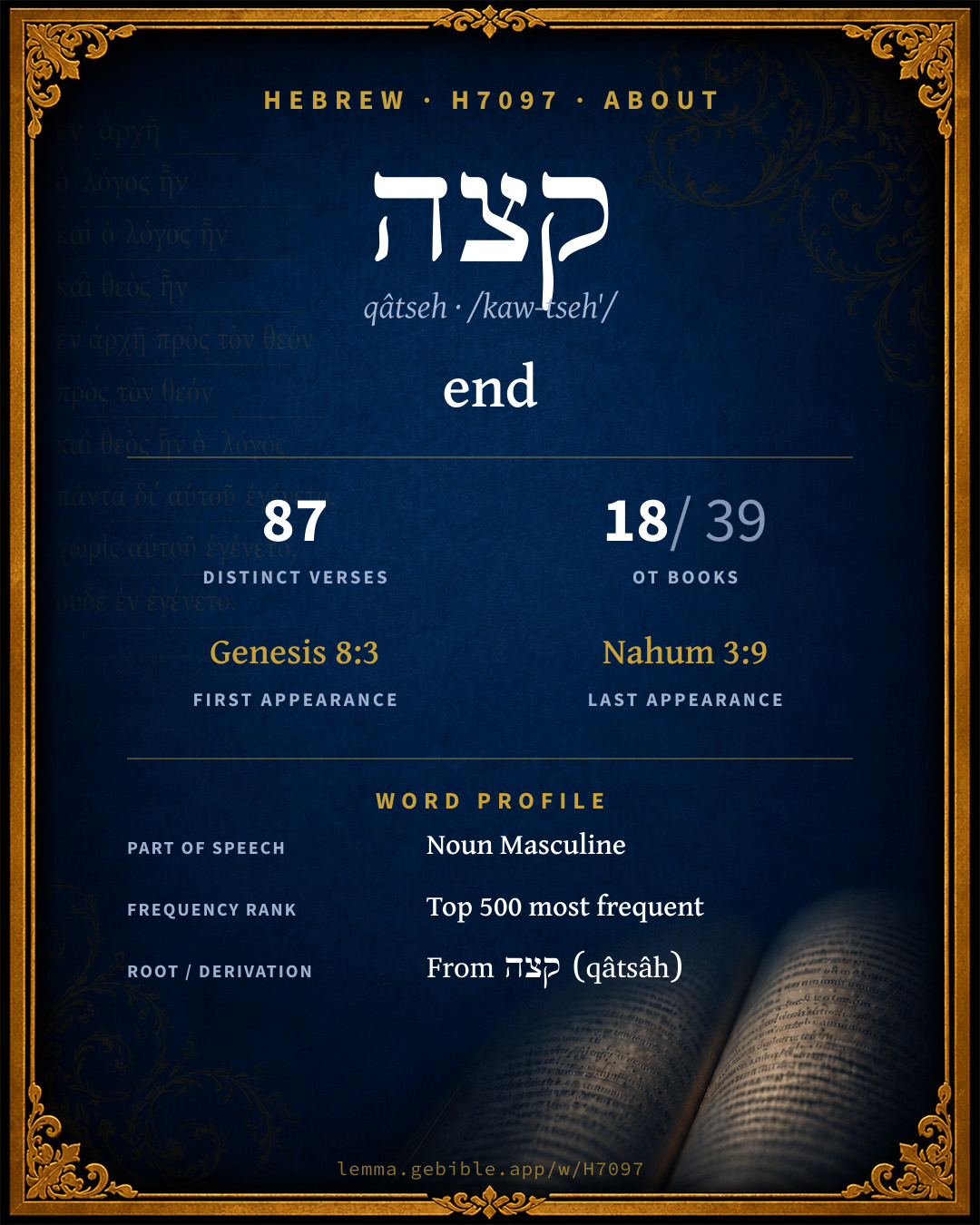
קצה
end
‘end’ is one of 5 main senses fuller range ↓
Full lexicon entry — Brown-Driver-Briggs (BDB)
From Brown-Driver-Briggs (BDB)
Where this word appears
See every Construct-state word in the Hebrew Bible →
Grammar key — what these labels mean
Part of speech
- Noun
- A naming word — a person, place, thing, or idea.
Noun type
- Common
- A common noun — a general class of person, place, or thing (“king,” “city,” “water”), not a specific name.
State
- Construct
- A noun bound to a following noun in a possessive / “of” relationship (the construct chain).
- Absolute
- The independent form of a noun, not bound to a following word.
Gender
- Both
- Attested as both masculine and feminine.
Number
- Singular
- One.
- Plural
- More than one (in Hebrew, generally three or more).
Grammatical forms
- Noun, Common, Both, Singular, Construct 85 times (88%)
- Noun, Common, Both, Singular, Absolute 11 times (11%)
- Noun, Common, Both, Plural, Construct 1 time (1%)
Parsed forms decoded from the imported morphology (morphhb / Westminster Leningrad Codex — WLC text public domain, morphhb tagging CC BY 4.0), counted across 97 parsed occurrences — not distinct verses.
Every verse where H7097 appears — 87 distinct verses across 18 books. Click any verse to open its interlinear word-by-word view. Verse text shown in the World English Bible for context — . Each verse’s Hebrew form is shown with its reference; the English is not keyword-highlighted, since the data carries no word-level English alignment. Use “Compare translations” on any verse to read it across multiple English versions. This concordance covers the Hebrew Bible; Septuagint (Greek Old Testament) occurrences are not indexed here.
Genesis 5 verses
- Genesis 8:3 מִ/קְצֵ֕ה prep + n c bs cs The waters receded from off the earth continually. After the end of one hundred fifty days the waters decreased.
- Genesis 19:4 מִ/קָּצֶֽה prep + n c bs But before they lay down, the men of the city, the men of Sodom, surrounded the house, both young and old, all the people from every quarter.
- Genesis 23:9 בִּ/קְצֵ֣ה prep + n c bs cs that he may give me the cave of Machpelah, which he has, which is in the end of his field. For the full price let him give it to me in the midst of you for a possession of a burying-place."
- Genesis 47:2 וּ/מִ/קְצֵ֣ה conj + prep + n c bs cs From among his brothers he took five men, and presented them to Pharaoh.
- Genesis 47:21 מִ/קְצֵ֥ה קָצֵֽ/הוּ prep + n c bs cs n c bs cs + sfx pers 3ms As for the people, he moved them to the cities from one end of the border of Egypt even to the other end of it.
Exodus 7 verses
- Exodus 13:20 בִּ/קְצֵ֖ה prep + n c bs cs They took their journey from Succoth, and encamped in Etham, in the edge of the wilderness.
- Exodus 16:35 קְצֵ֖ה n c bs cs The children of Israel ate the manna forty years, until they came to an inhabited land. They ate the manna until they came to the borders of the land of Canaan.
- Exodus 19:12 בְּ/קָצֵ֑/הוּ prep + n c bs cs + sfx pers 3ms You shall set bounds to the people round about, saying, 'Be careful that you don't go up onto the mountain, or touch its border. Whoever touches the mountain shall be surely put to death.
- Exodus 26:5 בִּ/קְצֵ֣ה prep + n c bs cs You shall make fifty loops in the one curtain, and you shall make fifty loops in the edge of the curtain that is in the second coupling. The loops shall be opposite one to another.
- Exodus 26:28 הַ/קָּצֶ֖ה הַ/קָּצֶֽה ptcl def.art + n c bs ptcl def.art + n c bs The middle bar in the midst of the boards shall pass through from end to end.
- Exodus 36:12 בִּ/קְצֵ֣ה prep + n c bs cs He made fifty loops in the one curtain, and he made fifty loops in the edge of the curtain that was in the second coupling. The loops were opposite one to another.
- Exodus 36:33 הַ/קָּצֶ֖ה הַ/קָּצֶֽה ptcl def.art + n c bs ptcl def.art + n c bs He made the middle bar to pass through in the midst of the boards from the one end to the other.
Numbers 8 verses
- Numbers 11:1 בִּ/קְצֵ֥ה prep + n c bs cs The people were as murmurers, [speaking] evil in the ears of Yahweh: and when Yahweh heard it, his anger was kindled; and the fire of Yahweh burnt among them, and devoured in the uttermost part of the camp.
- Numbers 20:16 קְצֵ֥ה n c bs cs and when we cried to Yahweh, he heard our voice, and sent an angel, and brought us forth out of Egypt: and, behold, we are in Kadesh, a city in the uttermost of your border.
- Numbers 22:36 בִּ/קְצֵ֥ה prep + n c bs cs When Balak heard that Balaam was come, he went out to meet him to the City of Moab, which is on the border of the Arnon, which is in the utmost part of the border.
- Numbers 22:41 קְצֵ֥ה n c bs cs It happened in the morning, that Balak took Balaam, and brought him up into the high places of Baal; and he saw from there the utmost part of the people.
- Numbers 23:13 קָצֵ֣/הוּ n c bs cs + sfx pers 3ms Balak said to him, Please come with me to another place, from whence you may see them; you shall see but the utmost part of them, and shall not see them all: and curse me them from there.
- Numbers 33:6 בִּ/קְצֵ֥ה prep + n c bs cs They traveled from Succoth, and encamped in Etham, which is in the edge of the wilderness.
- Numbers 33:37 בִּ/קְצֵ֖ה prep + n c bs cs They traveled from Kadesh, and encamped in Mount Hor, in the edge of the land of Edom.
- Numbers 34:3 מִ/קְצֵ֥ה prep + n c bs cs then your south quarter shall be from the wilderness of Zin along by the side of Edom, and your south border shall be from the end of the Salt Sea eastward;
Deuteronomy 6 verses
- Deuteronomy 4:32 וּ/לְ/מִ/קְצֵ֥ה קְצֵ֣ה conj + prep + Preposition + n c bs cs n c bs cs For ask now of the days that are past, which were before you, since the day that God created man on the earth, and from the one end of the sky to the other, whether there has been [any such thing] as this great thing is, or has been heard like it?
- Deuteronomy 13:7 מִ/קְצֵ֥ה קְצֵ֥ה prep + n c bs cs n c bs cs of the gods of the peoples who are round about you, near to you, or far off from you, from the one end of the earth even to the other end of the earth;
- Deuteronomy 14:28 מִ/קְצֵ֣ה prep + n c bs cs At the end of every three years you shall bring forth all the tithe of your increase in the same year, and shall lay it up within your gates:
- Deuteronomy 28:49 מִ/קְצֵ֣ה prep + n c bs cs Yahweh will bring a nation against you from far, from the end of the earth, as the eagle flies; a nation whose language you shall not understand;
- Deuteronomy 28:64 מִ/קְצֵ֥ה קְצֵ֣ה prep + n c bs cs n c bs cs Yahweh will scatter you among all peoples, from the one end of the earth even to the other end of the earth; and there you shall serve other gods, which you have not known, you nor your fathers, even wood and stone.
- Deuteronomy 30:4 בִּ/קְצֵ֣ה prep + n c bs cs If [any of] your outcasts are in the uttermost parts of the heavens, from there will Yahweh your God gather you, and from there will he bring you back:
Joshua 14 verses
- Joshua 3:2 מִ/קְצֵ֖ה prep + n c bs cs It happened after three days, that the officers went through the midst of the camp;
- Joshua 3:8 קְצֵה֙ n c bs cs You shall command the priests who bear the ark of the covenant, saying, When you are come to the brink of the waters of the Jordan, you shall stand still in the Jordan.
- Joshua 3:15 בִּ/קְצֵ֣ה prep + n c bs cs and when those who bore the ark were come to the Jordan, and the feet of the priests who bore the ark were dipped in the brink of the water (for the Jordan overflows all its banks all the time of harvest),
- Joshua 4:19 בִּ/קְצֵ֖ה prep + n c bs cs The people came up out of the Jordan on the tenth day of the first month, and encamped in Gilgal, on the east border of Jericho.
- Joshua 9:16 מִ/קְצֵה֙ prep + n c bs cs It happened at the end of three days after they had made a covenant with them, that they heard that they were their neighbors, and that they lived among them.
- Joshua 13:27 קְצֵה֙ n c bs cs and in the valley, Beth Haram, and Beth Nimrah, and Succoth, and Zaphon, the rest of the kingdom of Sihon king of Heshbon, the Jordan and the border [of it], to the uttermost part of the sea of Chinnereth beyond the Jordan eastward.
- Joshua 15:1 מִ/קְצֵ֥ה prep + n c bs cs The lot for the tribe of the children of Judah according to their families was to the border of Edom, even to the wilderness of Zin southward, at the uttermost part of the south.
- Joshua 15:2 מִ/קְצֵ֖ה prep + n c bs cs Their south border was from the uttermost part of the Salt Sea, from the bay that looks southward;
- Joshua 15:5 קְצֵ֖ה מִ/קְצֵ֖ה n c bs cs prep + n c bs cs The east border was the Salt Sea, even to the end of the Jordan. The border of the north quarter was from the bay of the sea at the end of the Jordan;
- Joshua 15:8 בִּ/קְצֵ֥ה prep + n c bs cs and the border went up by the valley of the son of Hinnom to the side of the Jebusite southward (the same is Jerusalem); and the border went up to the top of the mountain that lies before the valley of Hinnom westward, which is at the uttermost part of the valley of Rephaim northward;
- Joshua 15:21 מִ/קְצֵה֙ prep + n c bs cs The uttermost cities of the tribe of the children of Judah toward the border of Edom in the South were Kabzeel, and Eder, and Jagur,
- Joshua 18:15 מִ/קְצֵ֖ה prep + n c bs cs The south quarter was from the uttermost part of Kiriath Jearim; and the border went out westward, and went out to the spring of the waters of Nephtoah;
- Joshua 18:16 קְצֵ֣ה n c bs cs and the border went down to the uttermost part of the mountain that lies before the valley of the son of Hinnom, which is in the valley of Rephaim northward; and it went down to the valley of Hinnom, to the side of the Jebusite southward, and went down to En Rogel;
- Joshua 18:19 קְצֵ֥ה n c bs cs and the border passed along to the side of Beth Hoglah northward; and the goings out of the border were at the north bay of the Salt Sea, at the south end of the Jordan: this was the south border.
Judges 4 verses
- Judges 6:21 קְצֵ֤ה n c bs cs Then the angel of Yahweh put forth the end of the staff that was in his hand, and touched the flesh and the unleavened cakes; and there went up fire out of the rock, and consumed the flesh and the unleavened cakes; and the angel of Yahweh departed out of his sight.
- Judges 7:11 קְצֵ֥ה n c bs cs and you shall hear what they say; and afterward shall your hands be strengthened to go down into the camp. Then went he down with Purah his servant to the outermost part of the armed men who were in the camp.
- Judges 7:17 בִּ/קְצֵ֣ה prep + n c bs cs He said to them, Look on me, and do likewise: and, behold, when I come to the outermost part of the camp, it shall be that, as I do, so shall you do.
- Judges 7:19 בִּ/קְצֵ֣ה prep + n c bs cs So Gideon, and the hundred men who were with him, came to the outermost part of the camp in the beginning of the middle watch, when they had but newly set the watch: and they blew the trumpets, and broke in pieces the pitchers that were in their hands.
Ruth 1 verse
1 Samuel 4 verses
- 1 Samuel 9:27 בִּ/קְצֵ֣ה prep + n c bs cs As they were going down at the end of the city, Samuel said to Saul, Bid the servant pass on before us (and he passed on), but stand you still first, that I may cause you to hear the word of God.
- 1 Samuel 14:2 בִּ/קְצֵ֣ה prep + n c bs cs Saul abode in the uttermost part of Gibeah under the pomegranate tree which is in Migron: and the people who were with him were about six hundred men;
- 1 Samuel 14:27 קְצֵ֤ה n c bs cs But Jonathan didn't hear when his father charged the people with the oath: therefore he put forth the end of the rod who was in his hand, and dipped it in the honeycomb, and put his hand to his mouth; and his eyes were enlightened.
- 1 Samuel 14:43 בִּ/קְצֵ֨ה prep + n c bs cs Then Saul said to Jonathan, Tell me what you have done. Jonathan told him, and said, I did certainly taste a little honey with the end of the rod that was in my hand; and, behold, I must die.
2 Samuel 1 verse
1 Kings 1 verse
2 Kings 4 verses
- 2 Kings 7:5 קְצֵה֙ n c bs cs They rose up in the twilight, to go to the camp of the Syrians; and when they were come to the outermost part of the camp of the Syrians, behold, there was no man there.
- 2 Kings 7:8 קְצֵ֣ה n c bs cs When these lepers came to the outermost part of the camp, they went into one tent, and ate and drink, and carried there silver, and gold, and clothing, and went and hid it; and they came back, and entered into another tent, and carried there also, and went and hid it.
- 2 Kings 8:3 מִ/קְצֵה֙ prep + n c bs cs It happened at the seven years' end, that the woman returned out of the land of the Philistines: and she went forth to cry to the king for her house and for her land.
- 2 Kings 18:10 מִ/קְצֵה֙ prep + n c bs cs At the end of three years they took it: in the sixth year of Hezekiah, which was the ninth year of Hoshea king of Israel, Samaria was taken.
Nehemiah 1 verse
Psalms 5 verses
- Psalms 19:4 וּ/בִ/קְצֵ֣ה conj + prep + n c bs cs Their voice has gone out through all the earth, Their words to the end of the world. In them he has set a tent for the sun,
- Psalms 19:6 מִ/קְצֵ֤ה prep + n c bs cs His going forth is from the end of the heavens, His circuit to its ends; There is nothing hidden from its heat.
- Psalms 46:9 קְצֵ֪ה n c bs cs He makes wars cease to the end of the earth. He breaks the bow, and shatters the spear. He burns the chariots in the fire.
- Psalms 61:2 מִ/קְצֵ֤ה prep + n c bs cs From the end of the earth, I will call to you, when my heart is overwhelmed. Lead me to the rock that is higher than I.
- Psalms 135:7 מִ/קְצֵ֪ה prep + n c bs cs Who causes the clouds to rise from the ends of the earth; Who makes lightnings with the rain; Who brings forth the wind out of his treasuries;
Proverbs 1 verse
Isaiah 11 verses
- Isaiah 2:7 קֵ֖צֶה קֵ֖צֶה n c bs n c bs Their land is full of silver and gold, Neither is there any end of their treasures. Their land also is full of horses, Neither is there any end of their chariots.
- Isaiah 5:26 מִ/קְצֵ֣ה prep + n c bs cs He will lift up a banner to the nations from far, And he will whistle for them from the end of the earth. Behold, they will come speedily and swiftly.
- Isaiah 7:3 קְצֵ֗ה n c bs cs Then Yahweh said to Isaiah, "Go out now to meet Ahaz, you, and Shearjashub your son, at the end of the conduit of the upper pool, on the highway of the fuller's field.
- Isaiah 7:18 בִּ/קְצֵ֖ה prep + n c bs cs It will happen in that day that Yahweh will whistle for the fly that is in the uttermost part of the rivers of Egypt, and for the bee that is in the land of Assyria.
- Isaiah 13:5 מִ/קְצֵ֣ה prep + n c bs cs They come from a far country, from the uttermost part of heaven, even Yahweh, and the weapons of his indignation, to destroy the whole land.
- Isaiah 42:10 מִ/קְצֵ֣ה prep + n c bs cs Sing to Yahweh a new song, and his praise from the end of the earth; you who go down to the sea, and all that is therein, the isles, and the inhabitants of it.
- Isaiah 43:6 מִ/קְצֵ֥ה prep + n c bs cs I will tell the north, Give up; and to the south, Don't keep back; bring my sons from far, and my daughters from the end of the earth;
- Isaiah 48:20 קְצֵ֣ה n c bs cs Go you forth from Babylon, flee you from the Chaldeans; with a voice of singing declare you, tell this, utter it even to the end of the earth: say you, Yahweh has redeemed his servant Jacob.
- Isaiah 49:6 קְצֵ֥ה n c bs cs yes, he says, It is too light a thing that you should be my servant to raise up the tribes of Jacob, and to restore the preserved of Israel: I will also give you for a light to the Gentiles, that you may be my salvation to the end of the earth.
- Isaiah 56:11 מִ/קָּצֵֽ/הוּ prep + n c bs cs + sfx pers 3ms Yes, the dogs are greedy, they can never have enough; and these are shepherds who can't understand: they have all turned to their own way, each one to his gain, from every quarter.
- Isaiah 62:11 קְצֵ֣ה n c bs cs Behold, Yahweh has proclaimed to the end of the earth, Say you to the daughter of Zion, Behold, your salvation comes; behold, his reward is with him, and his recompense before him.
Jeremiah 6 verses
- Jeremiah 10:13 מִ/קְצֵ֣ה prep + n c bs cs when he utters his voice, there is a tumult of waters in the heavens, and he causes the vapors to ascend from the ends of the earth; he makes lightnings for the rain, and brings forth the wind out of his treasuries.
- Jeremiah 12:12 מִ/קְצֵה קְצֵ֣ה prep + n c bs cs n c bs cs Destroyers are come on all the bare heights in the wilderness; for the sword of Yahweh devours from the one end of the land even to the other end of the land: no flesh has peace.
- Jeremiah 25:31 קְצֵ֣ה n c bs cs A noise shall come even to the end of the earth; for Yahweh has a controversy with the nations; he will enter into judgment with all flesh: as for the wicked, he will give them to the sword, says Yahweh.
- Jeremiah 25:33 מִ/קְצֵ֥ה קְצֵ֣ה prep + n c bs cs n c bs cs The slain of Yahweh shall be at that day from one end of the earth even to the other end of the earth: they shall not be lamented, neither gathered, nor buried; they shall be dung on the surface of the ground.
- Jeremiah 51:16 מִ/קְצֵה prep + n c bs cs when he utters his voice, there is a tumult of waters in the heavens, and he causes the vapors to ascend from the ends of the earth; he makes lightnings for the rain, and brings forth the wind out of his treasuries.
- Jeremiah 51:31 מִ/קָּצֶֽה prep + n c bs One post shall run to meet another, and one messenger to met another, to show the king of Babylon that his city is taken on every quarter:
Ezekiel 5 verses
- Ezekiel 3:16 מִ/קְצֵ֖ה prep + n c bs cs It happened at the end of seven days, that the word of Yahweh came to me, saying,
- Ezekiel 25:9 מִ/קָּצֵ֑/הוּ prep + n c bs cs + sfx pers 3ms therefore, behold, I will open the side of Moab from the cities, from his cities which are on his frontiers, the glory of the country, Beth-jeshimoth, Baal Meon, and Kiriathaim,
- Ezekiel 33:2 מִ/קְצֵי/הֶ֔ם prep + n c bp cs + sfx pers 3mp Son of man, speak to the children of your people, and tell them, When I bring the sword on a land, and the people of the land take a man from among them, and set him for their watchman;
- Ezekiel 39:14 מִ/קְצֵ֥ה prep + n c bs cs They shall set apart men of continual employment, who shall pass through the land, and, with those who pass through, those who bury those who remain on the surface of the land, to cleanse it: after the end of seven months shall they search.
- Ezekiel 48:1 מִ/קְצֵ֣ה prep + n c bs cs Now these are the names of the tribes: From the north end, beside the way of Hethlon to the entrance of Hamath, Hazar Enan at the border of Damascus, northward beside Hamath, (and they shall have their sides east [and] west), Dan, one [portion].
Nahum 3 verses
- Nahum 2:9 קֵ֨צֶה֙ n c bs Take the spoil of silver. Take the spoil of gold, for there is no end of the store, the glory of all goodly furniture.
- Nahum 3:3 קֵ֨צֶה֙ n c bs the horseman mounting, and the flashing sword, the glittering spear, and a multitude of slain, and a great heap of corpses, and there is no end of the bodies. They stumble on their bodies,
- Nahum 3:9 קֵ֑צֶה n c bs Cush and Egypt were her boundless strength. Put and Libya were her helpers.
About this entry
At a glance — auto-summarized from this page’s data, not written by a person. Every figure links to its source below. This summary describes the numbers; it doesn’t interpret them.
קצה (qâtseh) is a Hebrew noun most often rendered “end.” Older and newer Bibles part ways — “end” in the King James Version, “end of” (unfoldingWord Literal Text) in modern versions. See the renderings breakdown. It turns up in 87 verses across 18 books, a moderately common footprint. Scripture first uses it in Genesis 8:3. Not a single-sense word: explore its full sense range. For the data behind this summary, explore the sense tree and the renderings breakdown below.
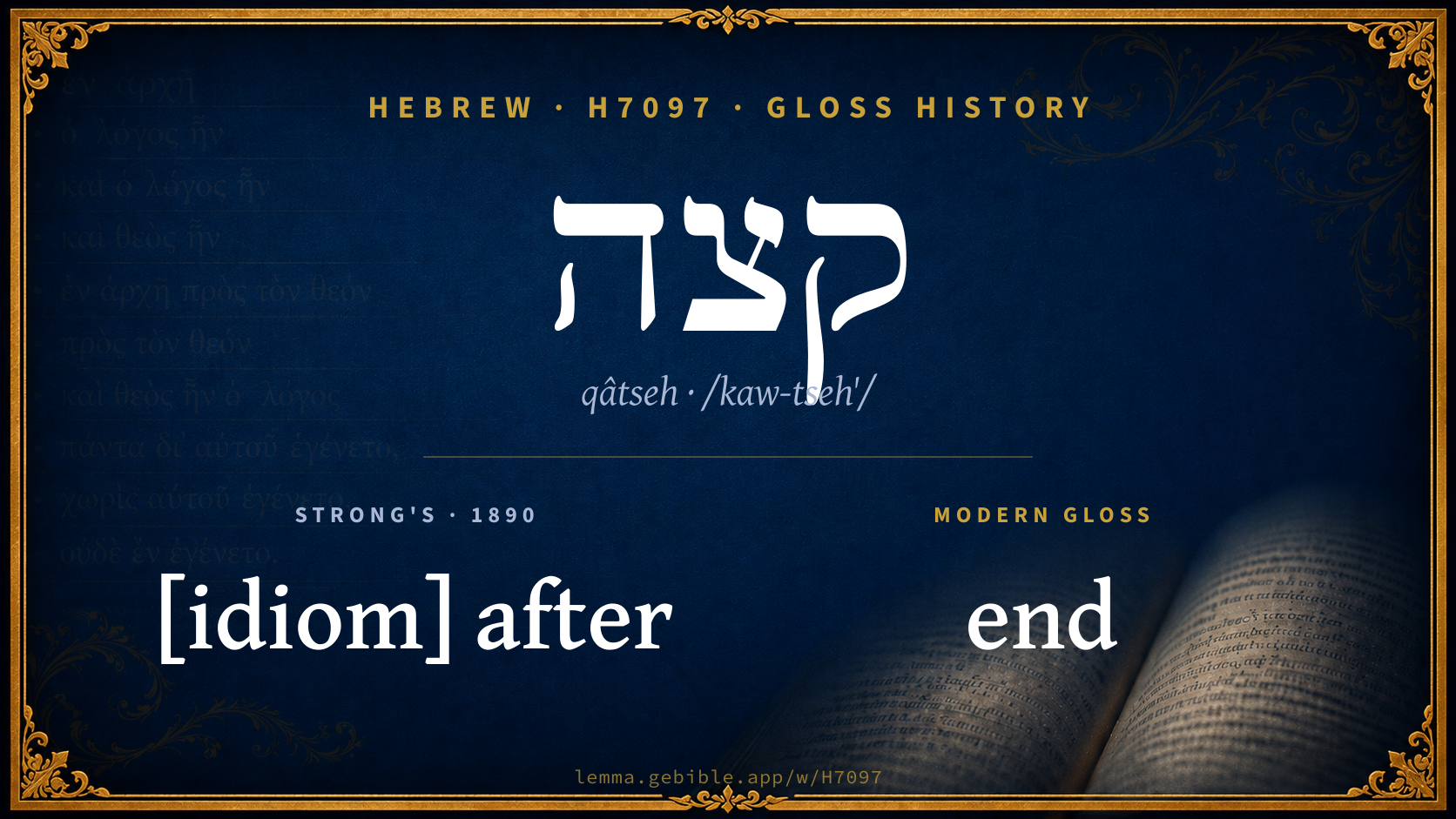
Gloss history
Strong's 1890 vs modern scholarship
About this word
Strong's H7097 catalogs a Hebrew word from the Hebrew Old Testament.
These counts are not copied from any lexicon or concordance. They are computed here, from the morphology-tagged Hebrew Old Testament. What Lemma adds →
- 87
- distinct verses
- The word appears in 87 distinct verses.
- 18 / 39
- OT books
- The word appears in 18 of 39 Old Testament books.
- #432
- by frequency
- Top 500 most frequent Hebrew words (rank 432 of 8,640 Hebrew words by occurrence).
View all 87 occurrences in the concordance →
By section of the Old Testament
By traditional corpus
Conventional, traditional groupings — biblical authorship is debated, so this is a traditional corpus grouping, not an authorship claim. Each share is this word’s portion of its verses in that division of the Hebrew canon. Each figure is a share of the word’s 87 distinct verses.
- Prophets (Nevi'im) 53 verses · 61%
- Torah (Pentateuch) 26 verses · 30%
- Writings (Ketuvim) 8 verses · 9%
How translations render this word
Counts come from each version’s own published word-to-Strong’s tagging or interlinear alignment — an approximate guide to how each version renders this word, not a word-level alignment the data otherwise carries. Because each total is that version’s own tagged count, the per-version totals vary from one another and need not match the appearance or distinct-verse counts above. These counts may also differ from a printed concordance because Lemma counts each distinctly tagged rendering and does not collapse phrase taggings into a single head-word total. This is a fixed set of word-tagged versions (KJV, ASV, BSB, ULT) and does not change with the reading translation you choose elsewhere. Each version’s license is shown beside its name below (and on Sources).
BDB lists this Strong’s number as 2 distinct words (homographs). Each count above pools all of them and is not split by sense — see the Senses section below. A low-frequency rendering may belong to a different one of those words, not the primary meaning.
- King James Version†: End 26×, One end 6×, Ends 5×
- American Standard Version†: End 24×, One end 6×, Uttermost 5×
- Berean Standard Bible†: End 19×, Ends 13×, Edge 9×
- unfoldingWord Literal Text†: End of 42×, Edge of 12×, End 11×
King James Version Public Domain
Renders H7097 across 95† tagged occurrences — most commonly:
Plus other, less common renderings. Plus 25 renderings that appear only once — usually multi-word phrases or single function words the recovered tagging swept in, not distinct renderings. Not rendered by a distinct English word in 1 further occurrence.
American Standard Version Public Domain
Renders H7097 across 95† tagged occurrences — most commonly:
Plus other, less common renderings. Plus 33 renderings that appear only once — usually multi-word phrases or single function words the recovered tagging swept in, not distinct renderings.
Berean Standard Bible Public Domain
Renders H7097 across 88† tagged occurrences — most commonly:
Plus 17 renderings that appear only once — usually multi-word phrases or single function words the recovered tagging swept in, not distinct renderings. Not rendered by a distinct English word in 9 further occurrences.
unfoldingWord Literal Text CC BY-SA 4.0
Renders H7097 across 108† tagged occurrences — most commonly:
Plus 12 renderings that appear only once — usually multi-word phrases or single function words the recovered tagging swept in, not distinct renderings.
Senses in the full BDB
What do BDB’s symbols mean?
BDB uses these scholarly abbreviations:
| Symbol | Meaning |
|---|---|
| 𝔊 | the Septuagint (the ancient Greek translation, LXX) |
| 𝔙 | the Vulgate (the Latin translation) |
| 𝔖 | the Syriac version (the Peshitta) |
| 𝔗 | the Targum (the Aramaic translation) |
| ψ | the Psalms |
| √ | root (the underlying root or stem) |
| ‖ | parallel passage (a synonymous or contrasted parallel) |
| † | the dagger: every passage where the word occurs is cited |
The 4 senses and sub-senses the full Brown-Driver-Briggs lexicon distinguishes for this word, in lexicon order (not ranked by frequency), with BDB’s own verbatim wording and sub-sense lettering. Shown in Hebrew script with BDB’s own scholarly abbreviations. The condensed entry is in the Lexicon Entry tab. See also the Forms in the corpus table below.
קצה I [m.] end, extremity, only sg.
- 1. end, of staff Ju 6:21, rod 1 S 14:27, 43, curtains Ex 26:5 = 36:12 (P; cf. קָצָה); of conduit Is 7:3, river, = mouth v 18 (prob.), Jos 15:5(×2); 18:19; of field Gn 23:9, valley Jos 15:8, tribe v 21, sea v 2 Nu 34:3 (all P); of territory (גְּבוּל) Nu 20:16 (JE; just without), 22:36 (E; just within), cf. Ez 25:9 (al. sub 3); מִק׳ גְּבוּל־מִצְרַיִם וְעַד־קָצֵהוּ Gn 47:21 (J); cf. מִן־הַקּ׳ אֶל־הַקּ׳ Ex 26:28 = 36:33 (of side of tabern.); מִקְצֵה צָפ֫וֹנָה Ez 48:1 at the northern extremity, cf. מִק׳ תֵימָן Jos 15:1 (P); of earth, מִק׳ (הָ)אָרֶץ Is 5:26; 43:6; Dt 28:49 (all ‖ מֵרָחוֹק), Is 42:10 + 4 times; + phr. מִק׳ (הָ)אָרֶץ וְעַד־ק׳ הָאָרֶץ Dt 13:8; 28:64; Je 25:33, of land 12:12 (cf. Is 26:15); of earth, abbrev. עַד־ק׳ הָא׳ 25:31; Is 48:20; 49:6 ψ 46:10, אֶל־ק׳ הָא׳ Is 62:11; of earth, בִּק׳־אָ֑רֶץ Pr 17:24, בִּק׳ תֵּבֵל ψ 19:5; מִק׳ הַשָּׁמַיִם Is 13:5 (‖ מֵאֶרֶץ מֶרְחָק), ψ 19:7 (‖ עַל־קְצוֹתָם), בִּק׳ הַשּׂ׳ Dt 30:4 = Ne 1:9; לְמִק׳ הַשּׁ׳ וְעַד־ק׳ הַשּׁ׳ Dt 4:32. e.g. Judges 6:21
- 2. border, outskirts, of city 1 S 9:27; 14:2 Jos 4:19; 18:15, camp Nu 11:1 (JE); especially to one approaching Ju 7:17, 19; 2 K 7:5, 8, so of armed force Ju 7:11, people Nu 22:41 (E), 23:13 (JE; emphat. אֶפֶם ק׳, opp. כֻּלּוֹ), mt. Ex 19:12 (E), Jos 18:16 (JE); see also 3:8 (D), v 15 (JE), Ex 13:20 = Nu 33:6; Ex 16:35; Nu 33:37; Jos 13:27 (all P), Ru 3:7. e.g. 1 Samuel 9:27
- 3. condensed term for what is included within extremities, = the whole: מִק׳ אֶחָיו Gn 47:2 (J), cf. Ez 33:2; abs. מִקָּצֶה Gn 19:4 (J) = in (its) entirety; = on all sides, Je 51:31 + 50:26 (מִקָּצֶה for מִקֵּץ, Gie); so מִקָּצֵהוּ Is 56:11 Di, but om. מִקּ׳ 𝔊 Du Che Marti. e.g. Genesis 47:2
- 4. מִקְצֵה at the end of a certain time Jos 9:16 (JE), 2 S 24:8 + 8 times. e.g. Joshua 9:16
קצה II (Baer קֶצֶה) n.[m.] end (on
Senses from the full Brown-Driver-Briggs lexicon (Brown, Driver, Briggs; Oxford 1906 — public domain), digitized via Sefaria, supplemented by the OpenScriptures HebrewLexicon (CC BY 4.0). Full attribution on Sources.
Word origin
I. n.[m.] end, extremity, only sg.: abs. ק׳ Gn 19:4 + 3 times; cstr. קְצֵה Ju 6:21 +; sf. קָצֵ֫הוּ Gn 47:21 + 4 times; (םִ)קְצֵיהֶם Ez 33:2 (sg.; Ges§ 93 ss); pl. (cstr.) supplied by קְצוֹת, v. foll.;—
I. (Baer קֶצֶה) n.[m.] end (on—ֵBaNB § 12 a, and [on ה] Köii. 1, 65);—only אֵין ק׳, usually + ל, no end to (of), Is 2:7(×2) Na 2:10; 3:3; abs. אֵין קֵ֑צֶה v 9.
— Brown-Driver-Briggs (Oxford 1906, public domain), digitized via Sefaria, supplemented by the OpenScriptures HebrewLexicon (CC BY 4.0). See Sources.
Derived from קצה (qâtsâh) (H7096) — to cut off.
Jastrow Dictionary
A second Hebrew/Aramaic lexicon for comparison, covering Aramaic and post-biblical (Talmudic, Targumic, Midrashic) usage that the biblical-Hebrew BDB does not. Matched by lemma rather than by Strong’s number, so a lemma may carry more than one Jastrow headword (shown separately below), and the entries cover usage well beyond the Bible.
קָצָה
- , v. קצי
קצה
- , Pesik. Vayhi, p. 9ᵃ בר ק׳, v. קצְרָה I
קצי
- (b. h.)
- 1. to scrape. Sifra M’tsorʿa, Neg., ch. IV, Par. 7 חולץ וקוֹצֶה וטח he must tear out (the leprous stone) and scrape (the wall) and plaster, v. קָצַע.
- 2. (of figs) to cut, dry, and store; to harvest. Maasr. II, 7 השוכר … לִקְצוֹת עמו וכ׳ if a man hires a laborer to help him in the fig harvest. Ib. III, 1 המעביר … לקצות if a person brings figs over to his court to prepare them for storage. Y. ib. II, 50ᵃ bot. להיות … וקוֹצִין אחת that they eat nine portions and store one; a. fr.—V. מוּקְצֶה.
- 3. to separate, set aside. Nidd. X, 7 (71ᵇ) קוֹצָה לה חלה she may separate the priest’s share of the dough; Y. Ber. VIII, 12ᵃ; a. e.
- 4. to carry off, reduce, level a hill. Cant. R. to V, 11 the fool says, מי יכול לקצות את זה who can level this (mound)?; הריני קוֹצֶה וכ׳ I will carry off two loads to-day …, until I have levelled the entire mound; Lev. R. s. 19 לקצות … קוצץ; (Yalk. Cant. 989 לפנות … קודח).
- to be cut off, separated. Tosef. B. Bath. III, 5 החורשין המוּקְצִין בפני עצמן the forests (near a township) which are isolated (a plantation detached from the town); B. Bath. 68ᵇ המוקצין לה which are separate but opening into it; corrected המוקצין ממנה separated from it; Y. ib. IV, 14ᶜ bot. החורשים המוקצין ממנה (not הטרשים; corr. quot. s. v. טֶרֶשׁ).—Esp. to be set aside, be designated for a special purpose and forbidden for any other use (v. מוּקְצֶה). Sabb. 45ᵃ הואיל וה׳ למצותו ה׳ לאיסורו as the oil was set aside for its religious purpose (for the Sabbath light), it was at the same time set aside as an object prohibited to be used otherwise (during the Sabbath day). Ib. ולית ליה ה׳ למצותו and does he (R. Simon) not adopt the opinion that an object set aside for a religious act is forbidden for any other use (for the time being)?; a. e.—Part. מוּקְצֶה q. v.
A Dictionary of the Targumim, the Talmud Babli and Yerushalmi, and the Midrashic Literature (Marcus Jastrow; London, Luzac, 1903) — Public Domain. Digitized via Sefaria. Digitized via Sefaria. Full attribution on Sources.
Forms in the corpus
The 37 distinct written forms H7097 takes in the Hebrew Bible, most frequent first — each parse links to that state’s occurrences in the concordance. Hebrew forms include their vowel points and cantillation, so a single lemma takes many written forms.
Same root — word family
Other BDB entries built from the same root as H7097, grouped by Strong’s listed origin. These share a root / origin per the lexicon — not necessarily a shared meaning. Each links to that word’s own entry.
Derives from
Shares the same root
Derived from this word
Compare all same-root words → Showing 4 of 6 — not the complete family. They share a root, not necessarily a meaning.
Septuagint verse parallels
This word appears in 84 verses that also exist in the Greek Old Testament (Septuagint), out of the 87 Hebrew verses it occurs in. You can read those verses in Greek by switching the Old Testament edition to the Septuagint.
Read these verses in the Septuagint
- Genesis 8:3
- Exodus 13:20
- Numbers 11:1
- Deuteronomy 4:32
- Joshua 3:2
- Judges 6:21
- Ruth 3:7
- 1 Samuel 9:27
- 2 Samuel 24:8
- 1 Kings 9:10
- 2 Kings 7:5
- Psalms 19:4
This is a verse-level parallel only — the same verses exist in both the Hebrew and Greek Old Testaments. No word-level Hebrew↔Greek correspondence is claimed: the data carries no such alignment, so no Greek word is shown as this Hebrew word’s translation. Coverage is not total — the Septuagint omits the deuterocanon and renumbers the Psalms, so some Hebrew verses have no direct Greek parallel.