
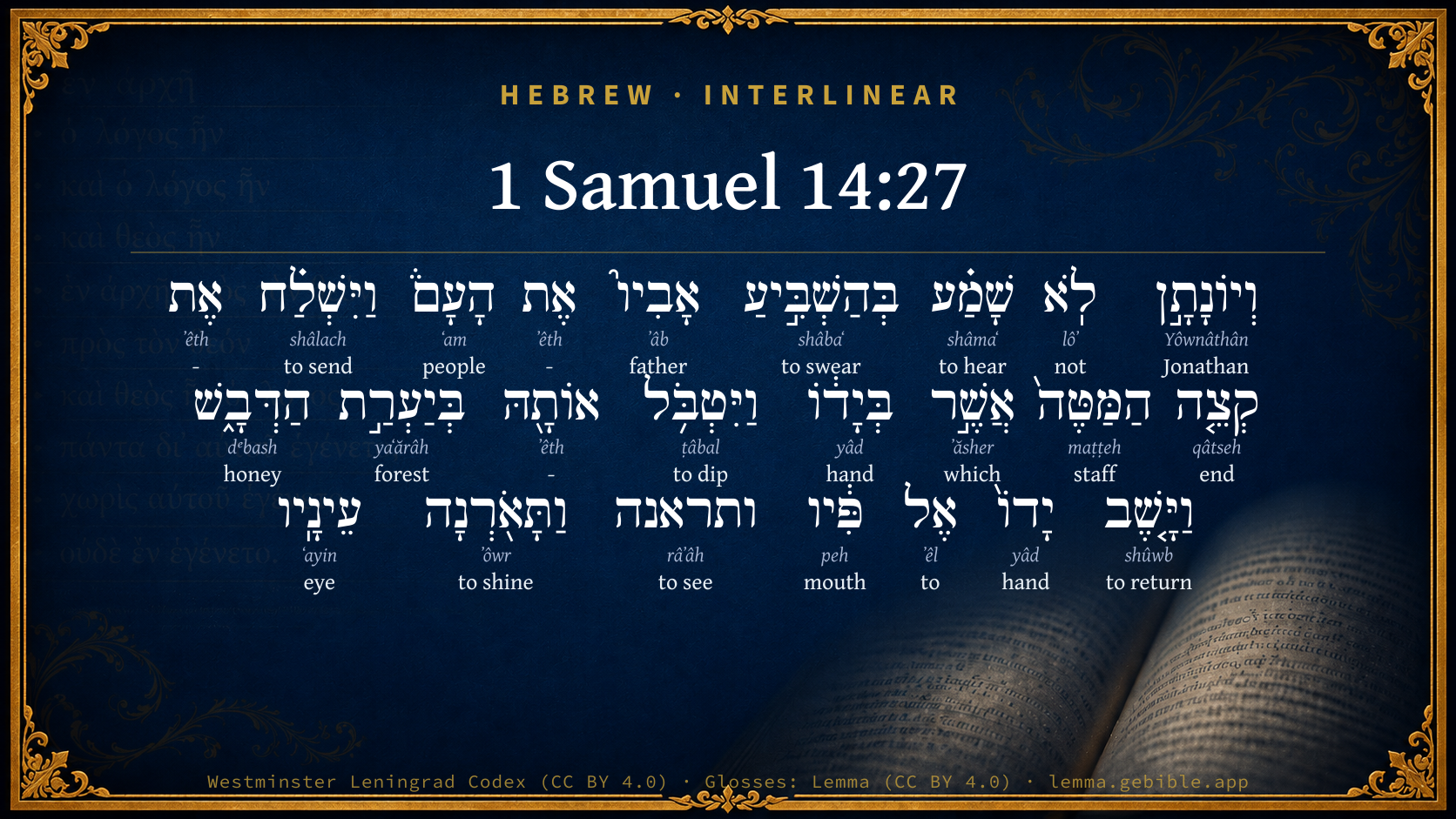
1 Samuel 14:27

Hebrew (Westminster Leningrad Codex) 1 Samuel 14:27 appears in the Hebrew Old Testament. The text above is from the Westminster Leningrad Codex. Each word links to its Strong’s number, a concise gloss, and parsing drawn from the Open Scriptures Hebrew Bible morphology. Click any word for its full Brown-Driver-Briggs (BDB) entry.
Download image
Cite this verse

1 Samuel 14:27 (World English Bible). Public Domain. Lemma interlinear Bible study tool, https://lemma.gebible.app/v/1-samuel/14/27.

Show BibTeX & RIS
BibTeX
RIS
English Translation
But Jonathan didn't hear when his father charged the people with the oath: therefore he put forth the end of the rod who was in his hand, and dipped it in the honeycomb, and put his hand to his mouth; and his eyes were enlightened.
World English Bible · Public Domain
Highlights
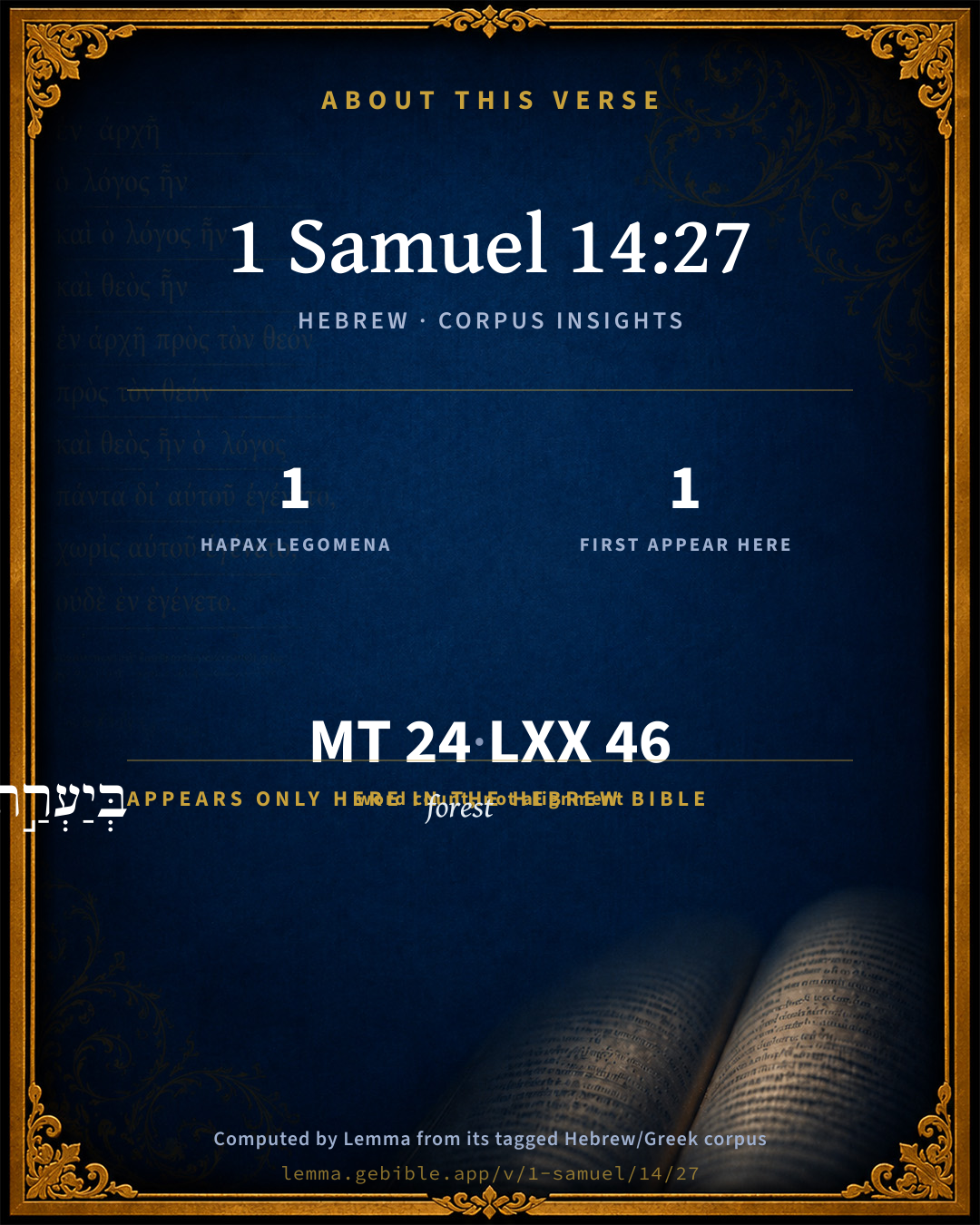
  • 1 hapax legomenon — only here in the Hebrew Bible
  • 1 first appearance in the Hebrew Bible
Full analysis ↓
Download a study sheet

One document with this verse’s original text, its word-by-word gloss line, the meaning frame, cross-references with their text, attributed commentary, and full source and license credits — printable, and it pastes into notes with its structure intact.

This verse Autodidact and up

Study sheet (.html) Plain text (.txt)

A passage Seminary Student

Up to 50 verses in one chapter. A passage sheet keeps up to 6 commentary sources and 12 cross-references per verse, in the order this page ranks them, and says so on the sheet whenever that leaves anything out. Ask for a single verse and you get the Autodidact verse sheet above.

Everything on this page stays free to read, with no account — the sheet is a download of what is already on screen, not access to it.

Want to remove ads? Support Godless Engineer
Compare translations 3

The same verse in 3 English versions, stacked beneath the original-language interlinear above. Click any original word for its lexicon entry.

Each is an independent rendering of the whole verse — the interlinear is not word-aligned to these translations.

Highlighted words mark where these versions differ — a whole-verse word diff, not a word-by-word alignment.

  • World English Bible Public Domain
    But Jonathan didn't hear when his father charged the people with the oath: therefore he put forth the end of the rod who was in his hand, and dipped it in the honeycomb, and put his hand to his mouth; and his eyes were enlightened.
  • King James Version Public Domain
    But Jonathan heard not when his father charged the people with the oath: wherefore he put forth the end of the rod that was in his hand, and dipped it in an honeycomb, and put his hand to his mouth; and his eyes were enlightened.
  • unfoldingWord Literal Text CC BY-SA 4.0
    But Jonathan had not heard when his father adjured the people. So he extended the end of the staff that in his hand, and he dipped it into a comb of honey. And he returned his hand to his mouth, and his eyes brightened.

unfoldingWord Literal Text — © unfoldingWord, licensed CC BY-SA 4.0. Word-aligned USFM3 via Door43 (git.door43.org/unfoldingWord/en_ult).

Versions to compare (up to 4)

3 of 4 selected

Show all 18 translations

Every available English version of this verse, each an independent rendering of the whole verse.

  • World English Bible Public Domain
    But Jonathan didn't hear when his father charged the people with the oath: therefore he put forth the end of the rod who was in his hand, and dipped it in the honeycomb, and put his hand to his mouth; and his eyes were enlightened.
  • Berean Standard Bible Public Domain
    Jonathan, however, had not heard that his father had charged the people with the oath. So he reached out the end of the staff in his hand, dipped it into the honeycomb, and put his hand to his mouth; and his eyes brightened.
  • Majority Standard Bible Public Domain
    Jonathan, however, had not heard that his father had bound the people with the oath. So he reached out the end of the staff in his hand, dipped it into the honeycomb, and put his hand to his mouth, and his eyes brightened.
  • King James Version Public Domain
    But Jonathan heard not when his father charged the people with the oath: wherefore he put forth the end of the rod that was in his hand, and dipped it in an honeycomb, and put his hand to his mouth; and his eyes were enlightened.
  • American Standard Version (1901) Public Domain
    But Jonathan heard not when his father charged the people with the oath: wherefore he put forth the end of the rod that was in his hand, and dipped it in the honeycomb, and put his hand to his mouth; and his eyes were enlightened.
  • Revised Version (1885) Public Domain
    But Jonathan heard not when his father charged the people with the oath: wherefore he put forth the end of the rod that was in his hand, and dipped it in the honeycomb, and put his hand to his mouth; and his eyes were enlightened.
  • Geneva Bible (1599) Public Domain
    But Ionathan heard not when his father charged the people with the othe: wherefore he put foorth the ende of the rod that was in his hand, and dipt it in an hony combe, and put his hand to his mouth, and his eyes receiued sight.
  • Douay-Rheims (1899) Public Domain
    But Jonathan had not heard when his father adjured the people: and he put forth the end of the rod, which he had in his hand, and dipt it in a honeycomb: and he carried his hand to his mouth, and his eyes were enlightened.
  • Young's Literal Translation Public Domain
    And Jonathan hath not heard of his father's adjuring the people, and putteth forth the end of the rod, which `is' in his hand, and dippeth it in the honeycomb, and bringeth back his hand unto his mouth -- and his eyes see!
  • Literal Standard Version CC BY-SA 4.0
    And Jonathan has not heard of his father’s adjuring the people, and puts forth the end of the rod, which [is] in his hand, and dips it in the honeycomb, and brings back his hand to his mouth—and his eyes see!
  • Unlocked Literal Bible CC BY-SA 4.0
    But Jonathan had not heard that his father had bound the people with an oath. He reached out the tip of the staff that was in his hand and dipped it in the honeycomb. He raised his hand to his mouth, and his eyes brightened.
  • unfoldingWord Literal Text CC BY-SA 4.0
    But Jonathan had not heard when his father adjured the people. So he extended the end of the staff that in his hand, and he dipped it into a comb of honey. And he returned his hand to his mouth, and his eyes brightened.
  • Darby Bible Public Domain
    But Jonathan had not heard when his father adjured the people; and he put forth the end of his staff which was in his hand, and dipped it in the honeycomb, and put his hand to his mouth, and his eyes became bright.
  • World Messianic Bible Public Domain
    But Jonathan didn’t hear when his father commanded the people with the oath. Therefore he put out the end of the rod that was in his hand and dipped it in the honeycomb, and put his hand to his mouth; and his eyes brightened.
  • Webster's Bible Public Domain
    But Jonathan heard not when his father charged the people with the oath: wherefore he put forth the end of the rod that was in his hand, and dipped it in a honey-comb, and put his hand to his mouth; and his eyes were enlightened.
  • Free Bible Version CC BY-SA 4.0
    But Jonathan hadn't heard that his father had ordered the army to take this oath. So he stuck the end of his stick into the honeycomb, picked up a piece to eat, and he felt much better.
  • Bible in Basic English Public Domain
    But Jonathan, having no knowledge of the oath his father had put on the people, stretching out the rod which was in his hand, put the end of it in the honey, and put it to his mouth; then his eyes were made bright.
  • JPS Tanakh (1917) Public Domain
    But Jonathan heard not when his father charged the people with the oath; and he put forth the end of the rod that was in his hand, and dipped it in the honeycomb, and put his hand to his mouth; and his eyes brightened.

Literal Standard Version (2020), Covenant Press — licensed CC BY-SA 4.0. Text via the HelloAO Bible API (eBible.org). Unlocked Literal Bible (unfoldingWord) — licensed CC BY-SA 4.0. Text via the HelloAO Bible API (eBible.org). unfoldingWord Literal Text — © unfoldingWord, licensed CC BY-SA 4.0. Word-aligned USFM3 via Door43 (git.door43.org/unfoldingWord/en_ult). Free Bible Version, Dr. Jonathan Gallagher — licensed CC BY-SA 4.0. Text via the HelloAO Bible API (eBible.org).

Word by word

More ways to search: Search by grammar → Find every occurrence → Compare this word →

Practice this passage: Drill this verse → Learn its vocabulary →

בְּיַעְרַ֣ת
yaʻărâh
H3295
“in/at · forest of”
Preposition + Noun, Common, Feminine, Singular, Construct
Part of Speech
Preposition + Noun
Type
Common
Gender
Feminine
Number
Singular
State
Construct
Full BDB Definition

Origin: from H3293

TWOT: 889b

forest - honeycomb (metonymy)
  1. וְיוֹנָתָ֣ן Yôwnâthân H3129 “and · Jonathan” Conjunction + Noun, Proper
  2. לֹֽא lôʼ H3808 “not” Particle, Negative
  3. שָׁמַ֗ע shâmaʻ H8085 “to hear” Verb, Qal, Perfect, 3rd Person, Masculine, Singular
  4. בְּהַשְׁבִּ֣יעַ shâbaʻ H7650 “in/at · to swear” Preposition + Verb, Hiphil, Infinitive Construct
  5. אָבִיו֮ ʼâb H1 “father · his” Noun, Common, Masculine, Singular, Construct + Suffix, Personal, 3rd Person, Masculine, Singular
  6. אֶת ʼêth H853 “-” Particle, Direct Object
  7. הָעָם֒ ʻam H5971 “the · people” Particle, Definite Article + Noun, Common, Masculine, Singular, Absolute
  8. וַיִּשְׁלַ֗ח shâlach H7971 “and · to send” Conjunction + Verb, Qal, Sequential Imperfect, 3rd Person, Masculine, Singular
  9. אֶת ʼêth H853 “-” Particle, Direct Object
  10. קְצֵ֤ה qâtseh H7097 “end of” Noun, Common, Both, Singular, Construct
  11. הַמַּטֶּה֙ maṭṭeh H4294 “the · staff” Particle, Definite Article + Noun, Common, Masculine, Singular, Absolute
  12. אֲשֶׁ֣ר ʼăsher H834 “which” Particle, Relative
  13. בְּיָד֔וֹ yâd H3027 “in/at · hand · his” Preposition + Noun, Common, Both, Singular, Construct + Suffix, Personal, 3rd Person, Masculine, Singular
  14. וַיִּטְבֹּ֥ל ṭâbal H2881 “and · to dip” Conjunction + Verb, Qal, Sequential Imperfect, 3rd Person, Masculine, Singular
  15. אוֹתָ֖הּ ʼêth H853 “- · her” Particle, Direct Object + Suffix, Personal, 3rd Person, Feminine, Singular
  16. הַדְּבָ֑שׁ dᵉbash H1706 “the · honey” Particle, Definite Article + Noun, Common, Masculine, Singular, Absolute
  17. וַיָּ֤שֶׁב shûwb H7725 “and · to return” Conjunction + Verb, Hiphil, Sequential Imperfect, 3rd Person, Masculine, Singular
  18. יָדוֹ֙ yâd H3027 “hand · his” Noun, Common, Both, Singular, Construct + Suffix, Personal, 3rd Person, Masculine, Singular
  19. אֶל ʼêl H413 “to” Preposition
  20. פִּ֔יו peh H6310 “mouth · his” Noun, Common, Masculine, Singular, Construct + Suffix, Personal, 3rd Person, Masculine, Singular
  21. ותראנה râʼâh H7200 “and · to see” Conjunction + Verb, Qal, Sequential Imperfect, 3rd Person, Feminine, Plural
  22. וַתָּאֹ֖רְנָה ʼôwr H215 “and · to shine” Conjunction + Verb, Qal, Sequential Imperfect, 3rd Person, Feminine, Plural
  23. עֵינָֽיו ʻayin H5869 “eyes · his” Noun, Common, Both, Dual, Construct + Suffix, Personal, 3rd Person, Masculine, Singular

About this verse

These counts appear in no published source. They are computed here, from the morphology-tagged text and Lemma’s own curated glosses. What Lemma adds →

24
words
21
distinct lemmas
Historical
section

Notable vocabulary

1 hapax legomenon — a word that appears only here in the entire Hebrew Bible:

  • בְּיַעְרַ֣ת forest H3295

First appearance in Scripture

This word makes its first canonical appearance in the Hebrew Bible here:

  • בְּיַעְרַ֣ת forest H3295

Shared distinctive vocabulary

וַיִּטְבֹּ֥ל to dip H2881 occurs in 16 verses of the Hebrew Bible. Also found in:

Grammatical profile

  • 7 verbs
  • 11 nouns
  • 1 preposition
  • 5 particles

Verb forms

  • שָׁמַ֗ע Qal · Perfect
  • בְּהַשְׁבִּ֣יעַ Hiphil · Infinitive Construct
  • וַיִּשְׁלַ֗ח Qal · Sequential Imperfect
  • וַיִּטְבֹּ֥ל Qal · Sequential Imperfect
  • וַיָּ֤שֶׁב Hiphil · Sequential Imperfect
  • ותראנה Qal · Sequential Imperfect
  • וַתָּאֹ֖רְנָה Qal · Sequential Imperfect

Repetition

A word recurs within this verse — often emphatic in Hebrew:

  • בְּיָד֔וֹ hand H3027 ×2

Hebrew & Septuagint length

In English translation the verse runs 45 words from the Hebrew and 44 from the Septuagint (LXX English) — closely comparable.

A rough comparison of the two English renderings, which tokenize alike — not a word-level alignment.

Word counts can differ between the Hebrew and the Greek without any difference in meaning — e.g. the Hebrew direct-object marker אֵת has no separate Greek word, and Greek often adds the article ὁ.

In the original languages it is 24 Hebrew tokens and 46 Greek tokens — but the two are counted differently (Hebrew bundles its prefixes and suffixes into one token; the Greek is in lemma form), so that isn’t a like-for-like length.

Cross-references

4

Topical passages linked to 1 Samuel 14:27 in the Treasury of Scripture Knowledge — connected by theme and wording, ordered by reader-vote popularity; previews shown in the World English Bible.

  • 1 Samuel 14:29 Then said Jonathan, My father has troubled the land. Please look how my eyes have been enlightened, because I tasted a little of this honey.
  • 1 Samuel 14:43 Then Saul said to Jonathan, Tell me what you have done. Jonathan told him, and said, I did certainly taste a little honey with the end of the rod that was in my hand; and, behold, I must die.
  • 1 Samuel 30:12 They gave him a piece of a cake of figs, and two clusters of raisins: and when he had eaten, his spirit came again to him; for he had eaten no bread, nor drunk any water, three days and three nights.
  • Proverbs 25:26 Like a muddied spring, and a polluted well, So is a righteous man who gives way before the wicked.

Cross-references courtesy of OpenBible.info (CC BY 4.0).

Hebrew and Greek witnesses Masoretic Hebrew ↔ Greek Septuagint

The same verse in the two great witnesses to the Old Testament, shown verse-for-verse.

These are two independent witnesses, not word-aligned to each other, and the Septuagint is shown in lemma (dictionary) form.

Hebrew 1 Samuel 14:27 Masoretic · Westminster Leningrad Codex

וְיוֹנָתָ֣ן לֹֽא שָׁמַ֗ע בְּהַשְׁבִּ֣יעַ אָבִיו֮ אֶת הָעָם֒ וַיִּשְׁלַ֗ח אֶת קְצֵ֤ה הַמַּטֶּה֙ אֲשֶׁ֣ר בְּיָד֔וֹ וַיִּטְבֹּ֥ל אוֹתָ֖הּ בְּיַעְרַ֣ת הַדְּבָ֑שׁ וַיָּ֤שֶׁב יָדוֹ֙ אֶל פִּ֔יו ותראנה וַתָּאֹ֖רְנָה עֵינָֽיו

But Jonathan didn't hear when his father charged the people with the oath: therefore he put forth the end of the rod who was in his hand, and dipped it in the honeycomb, and put his hand to his mouth; and his eyes were enlightened.

World English Bible · Public Domain

Greek LXX 1 Samuel 14:27 Septuagint · lemma form

καί ιωναθαν οὐ ἀκούω ἐν ὁ ὁρκίζω ὁ πατήρ αὐτός ὁ λαός καί ἐκτείνω ὁ ἄκρος ὁ σκῆπτρον αὐτός ὁ ἐν ὁ χείρ αὐτός καί βάπτω αὐτός εἰς ὁ κηρίον ὁ μέλι καί ἐπιστρέφω ὁ χείρ αὐτός εἰς ὁ στόμα αὐτός καί ἀναβλέπω ὁ ὀφθαλμός αὐτός

And Jonathan had not heard when his father adjured the people; and he reached forth the end of the staff that was in his hand, an dipped it into the honeycomb, and returned his hand to his mouth, and his eyes recovered their sight.

LXX2012 (modern English Septuagint) · Public Domain

Hebrew: Westminster Leningrad Codex (CC BY 4.0). Greek: Septuagint (public domain); English from LXX2012 (modern English Septuagint) (Public Domain). How the Septuagint differs from the Hebrew →

Targum (Aramaic paraphrase)

1

The Targum is the ancient Jewish Aramaic paraphrase of the Hebrew Scriptures — an interpretive translation, not the Hebrew text itself. Onkelos (literal) and Pseudo-Jonathan (expansive) render the Torah, and Jonathan the Prophets. Coverage is partial: where no permissively-licensed English translation exists for a verse, only the Aramaic is shown. This is verse-level text, not a word-by-word alignment to the Hebrew.

  1. Targum Jonathan Prophets (Joshua–Malachi)
    וְיוֹנָתָן לָא שְׁמַע כַּד אוֹמֵי אֲבוּהִי יַת עַמָא וְאוֹשִׁיט יַת רֵישׁ שׁוֹטִיתָא דְבִידֵיהּ וּטְבָל יָתָהּ בְּקִינָא דְדוּבְשָׁא וַאֲתֵיב יְדֵיהּ לְפוּמֵיהּ וְנַהֲרָא עֵינוֹהִי:

    (no public-domain English translation for this verse)

    Targum Jonathan — Aramaic: “Mikraot Gedolot” (public domain). English: “Sefaria Community Translation” (CC0 1.0 (public-domain dedication)); “London "Chaldee Paraphrase," 1871” (public domain). Text via Sefaria.

Commentary

Notes on 1 Samuel 14:27 from classic Christian and Jewish commentators (each source and its license shown beneath its notes). The classic Christian expositions comment on the surrounding passage and are grouped to its opening verse, so a note may address several verses; the Jewish commentaries on the Tanakh (Rashi and others) are per-verse, so they appear only where the commentator wrote on this verse.

Lemma curates 59 commentaries, every one of them public domain or Creative Commons licensed, each selected and text-cleaned for this edition rather than reprinted as found. About our sources →

Ellicott's Commentary for English Readers

(27) He put forth the end of the rod.—Most likely, with the point of his staff took up a piece of the honeycomb. Jonathan in that hurried battle and pursuit had heard nothing of his father’s rash oath, and was, no doubt, owing to his exertions in the earlier part of that eventful day, worn out with fatigue and hunger.

And his eyes were enlightened.—This simply means that the natural dimness caused by extreme exhaustion passed away when his long fast was broken; literally, his eyes became bright. Hence the Talmud comments: “Whoever suffers from the effects of intense hunger, let him eat honey and other sweet things, for such eatables are efficacious in restoring the light of one’s eyes . . . Thus we read of Jonathan, “See, I pray you, how my eyes have been enlightened because I tasted a little of this honey” (1Sa_14:27).—Treatise Yoma, fol. 83, Colossians 2.

A Bible Commentary for English Readers, edited by Charles John Ellicott (1878–1897) — public domain. Text from a community e-Sword module.

Trapp's Complete Commentary

John Trapp

1Sa 14:27 But Jonathan heard not when his father charged the people with the oath: wherefore he put forth the end of the rod that [was] in his hand, and dipped it in an honeycomb, and put his hand to his mouth; and his eyes were enlightened.

Ver. 27. But Jonathan heard not.] He was absent, and therefore innocent. "Where is no law, is no transgression."

Wherefore he put forth the end of the rod, &c.] He followed the chase, till he found the honey. A dog followeth his master till he meeteth with carrion; and goeth along with the company till it comes to a parting: so do hypocrites follow Christ till it come to a critical point, or till drawn away by ungodliness and worldly lusts. Lucian maketh mention of a fellow that would show King Ptolomy a strange sight. He had taught apes to act comedies, and show other tricks. Another being willing to put a trick upon this sport maker, cast nuts before those apes as they were acting. The apes left all, and picked up the nuts. So do hypocrites show themselves in a temptation; making good the proverb, an ape remaineth an ape, though clothed in purple.

And his eyes were enlightened.] Which through fasting and faintness were grown dim, the optic spirits failing.

John Trapp, A Commentary or Exposition upon All the Books of the Old and New Testament (1647–1656) — public domain. Text from a community e-Sword module.

Joseph Benson's Commentary

1Sa 14:27-28. His eyes were enlightened — He was refreshed, and recovered his lost spirits. This cleared his sight, which was grown dim by hunger and faintness. Then answered one of the people — One of them that came with Saul, whose forces were now united with Jonathan’s.

Joseph Benson's Commentary on the Old and New Testaments (1811–1818) — public domain. Text from a community e-Sword module.

Geneva Bible (1599)

Geneva Bible translators

Which were dim before for weariness and hunger.

Geneva Bible (1599) marginal notes — public domain. Text via Bolls.life.

Adam Clarke's Commentary

Verse 27. His eyes were enlightened.] Hunger and fatigue affect and dim the sight; on taking food, this affection is immediately removed. This most people know to be a fact.

Adam Clarke's Commentary on the Bible (1810–1826) — public domain. Text from a community e-Sword/MySword module.

The Cambridge Bible for Schools and Colleges

gen. ed. J. J. S. Perowne

27. his eyes were enlightened] Cp. Psa_13:3. His bodily powers were refreshed. The opposite idea is conveyed by the Heb. words for fainting, which are derived from roots meaning ‘to be shrouded in darkness.’

The Cambridge Bible for Schools and Colleges (gen. ed. J. J. S. Perowne; Cambridge University Press, 1878–1918) — public domain. Text from a community e-Sword module.

John Gill's Exposition

But Jonathan heard not when his father charged the people with the oath,.... Which charge was given, either before he came from Gibeah, before he came to Jonathan, or while pursuing, when Jonathan was with another party either fighting or pursuing:

wherefore he put forth the end of the rod that was in his hand: the staff with which he walked, or rather the spear which he carried in his hand, and fought his enemies with:

and dipped it in an honeycomb; or sugar cane, as Jarchi; or in wood honey, as the margin of our Bibles; but best, in the honeycomb, as the word is rendered, Sol 5:1 and so the Targum, into the nest of honey (x):

and he put his hand to his mouth; first he took the honey off of the top of his rod, and then put it to his mouth and ate it:

and his eyes were enlightened: which before were dim and dull through want of food, which is a common case; but became brisk and lively on eating the honey, nourishment being presently communicated, and he refreshed with it, and his spirits revived; and which quickly appeared in the briskness and sparkling of his eyes: honey being of a subtle nature, gives immediate refreshment and rigour; hence this phrase is frequently used by Jewish writers (y) for refreshment, after hunger, fatigue, and weariness; and which virtue is ascribed by them to fine bread, wine, oil, and particularly to honey.

(x) "Progeniem nidosque fovent----", Virgil. Georgic. l. 4. ver. 56. (y) T. Bab. Pesachim, fol. 42. 1, 2. Yoma, fol. 18, 2. & 83. 1. Maimon. Hilch. Maacolot Asurot, c. 14. sect. 16.

John Gill's Exposition of the Whole Bible (1746–1763) — public domain (CC PDM 1.0). Text via the HelloAO Bible API.

Albert Barnes' Notes on the Bible

Were enlightened - i. e., he was refreshed, when he was faint.

Albert Barnes' Notes on the Bible (1834–1885) — public domain. Text from a community e-Sword/MySword module.

Haydock's Catholic Bible Commentary

Enlightened. Extreme hunger and fatigue hurt the eyes, Jeremias xiv. 6. Sanctius saw a man who through fasting lost his sight, and recovered it again as soon as he had eaten. This is conformable to the observations of Hippocrates, and to nature. (Calmet) --- Tenebræ oboriuntur, genua inedia succedunt. Perii, prospicio parum. "Through hunger....I see but little." (Plautus.) (Haydock)

George Leo Haydock (1774–1849), Haydock's Catholic Family Bible and Commentary, 1859 edition — public domain. Excludes Psalms (Douay-Rheims chapter numbering differs from Protestant) and Deuterocanonical books (Catholic canon only).

Matthew Poole's English Annotations

Jonathan heard not, being then absent, and in pursuit of the Philistines, divers of the Israelites having joined themselves with him, 1Sa 14:21.

His eyes were enlightened; he was refreshed, and recovered his lost spirits, whereof part went into his optic nerves, and so cleared his sight, which was much darkened by famine, as is usual.

Matthew Poole's English Annotations on the Holy Bible (1683–1685) — public domain. Text from a community e-Sword/MySword module.

Whedon's Commentary on the Bible

Daniel D. Whedon

27. His eyes were enlightened — Languor and faintness of the body show themselves in the eye, and this was the case with Jonathan and the people. But this refreshing taste of wild honey reinvigorated Jonathan, and caused his eyes to sparkle with returning strength. There is some confusion here in the pointed Hebrew text. The Keri, after the analogy of ארוin 1Sa_14:29, and with many codices, and the Syriac, Arabic, Chaldee, and Vulgate, read תארנה, from אור, to become bright. But if we adhere to the Kethib we should change the pointing thus — תראנה. In either case the meaning is substantially the same.

Daniel D. Whedon (gen. ed.), Commentary on the Old and New Testaments (1874–1909) — public domain. Text from a community e-Sword module.

The Pulpit Commentary

Jonathan, who had not been present when his father charged the people with the oath, literally, "made the people swear, dipped the end of his staff hastily, so as not to hinder the pursuit, in an honeycomb Hebrew, "into the honey wood," i.e. into the hollow branch or trunk out of which the honey was flowing. (but see Son_5:1) His eyes were enlightened. I.e. made bright and clear, the dimness caused by excessive weariness having passed away. But this is a correction made by the Jews (kri), and the written text (c"tib) has "his eyes saw," which is more forcible and poetic. When the A.V was made the kri was supposed to be authoritative, but most modern commentators have come to the opposite conclusion.

The Pulpit Commentary (1880–1919), ed. H.D.M. Spence-Jones & Joseph S. Exell — public domain. Text from a community e-Sword module.

John Wesley's Explanatory Notes

Enlightened - He was refreshed, and recovered his lost spirits. This cleared his sight, which was grown dim by hunger and faintness.

John Wesley, Explanatory Notes Upon the Whole Bible (1754–1765) — public domain. Text via the GEBible commentary corpus.

unfoldingWord translationNotes

Door43 World Missions Community

General Information:

Jonathan learns of his father's oath.

bound the people with an oath

Here the obligation to obey an oath is spoken of as if the people were bound with ropes. AT: "commanded that the people obey his oath" (See: Metaphor)

He raised his hand to his mouth

Here "hand to his mouth" is a metonym that means to eat. AT: "He ate some honey" (See: Metonymy)

his eyes brightened

This idiom means that he was strengthened. AT: "he regained his strength" (See: Idiom)

translationWords

Jonathan

staff

people group

unfoldingWord translationNotes — © Distant Shores Media and the Door43 World Missions Community, licensed CC BY-SA 4.0. Source: git.door43.org/Door43/en_tn.

Rashi

Rabbi Shlomo Yitzchaki (Rashi)

Into the honeycomb. Into the sugar cane, as in, "and she placed it in the reeds," which Onkelos renders, "and she placed it in the יַעֲרָא," and סוּף are reeds which grow in the swamp. And similarly, "I ate my sugar cane [יַעְרִי] with my sugar, and in Arabic, that honey is called 'sukra' in their language; from R. Nosson Ha'yishme'eili.

Rashi on the Tanakh — English translations: “The Judaica Press complete Tanach with Rashi, translated by A. J. Rosenberg” (CC BY 4.0); “Pentateuch with Rashi's commentary by M. Rosenbaum and A.M. Silbermann, 1929-1934” (public domain); “The Metsudah Tanach series, Lakewood, N.J” (CC BY 4.0); and “The Book of Joshua, Metsudah Publications, 1997” (CC BY 4.0). Text via Sefaria.

Lesson kit

Teaching starters — assembled from the data on this page, not authored interpretation. Every prompt links to the verse data it draws on. Edit before teaching.

1 Samuel, in the Historical, opens this verse with 24 words (21 distinct Hebrew lemmas). Its most distinctive word is yaʻărâh (“forest”). A historical commentator’s framing appears above. Read the whole chapter for the surrounding context.

Discussion questions

  1. How does “forest” (yaʻărâh) shape what this verse is saying?
  2. This verse holds 1 word here found nowhere else in the Hebrew Bible. What might the rare word draw attention to?
  3. The word “forest” first appears here in Scripture. What is being introduced at this debut?
  4. Genesis 37:31 shares the word «to dip» with this verse. How do the two illuminate each other?
  5. “hand” occurs 2× in this one verse. What is the effect of the repetition?
  6. These translations render this verse differently; the difference is in the English rendering, not the original. What questions does that raise?
  7. The verb «שָׁמַ֗ע» is Qal Perfect. How does its form color the action?
  8. Reading how Ellicott's Commentary for English Readers and Trapp's Complete Commentary read this verse, where do the two commentators agree and where do they part?

Things to notice

  • 1 word in this verse appears nowhere else in the Hebrew Bible.
  • 1 word makes its first canonical appearance in Scripture here.
  • This verse counts 24 Hebrew ↔ 46 Greek words.
  • These translations choose different wording for 22 words in this verse.
  • “hand” occurs 2× in this single verse.

Reading settings

Reading text

Shown beneath each verse's original-language words.

Old Testament
Old Testament edition

Read the OT as the Masoretic Hebrew (MT) or the Greek Septuagint (LXX).

English shown for the Greek Septuagint (in the Hebrew ↔ Greek comparison).

Comparing translations? Open the Compare panel on any verse page to stack up to four side by side.